Author Archives: arianezurcher

A Conversation with Paula Durbin-Westby

You’ve described yourself as a “nonspeaking (at times) Autistic.

“Yes, I think the phrase “nonspeaking at times” captures my experience, and also that of others who do have speech capabilities but can’t always access them. Because one can speak at times does not mean that speech is a reliable form of communication for that person. Also, when someone can speak some of the time, others may not notice that they are having trouble speaking. I have sometimes not been able to speak and other people just thought I was “being quiet” or did not have anything to say; that dates back to childhood.”

Why did you make a video of you not speaking?

“I made the video because we need to change some of the ideas about “high functioning” and “low functioning” Autistics.  Not being able to speak is equated with “low functioning”.  A constellation of characteristics are said to be true of only “LF” people, such as self-injurious behavior, toileting difficulties, and not being able to speak or having limited speech, while “HF” people are said to have another set of characteristics, also fairly stereotypical, such as being “geniuses” who are good at computer programming and lack empathy.  These binary divisions don’t address the wide variety and range of characteristics of Autistic people, and paint a limited picture of individual Autistics, many of whom defy (not necessarily on purpose!) the expectations surrounding their “end” of the autism spectrum.  I have always known I can’t speak on a regular basis, but the conversations about “nonverbal” people assume that I have a different experience when in fact it’s not so different at all.”

Can you talk about how and why you sometimes are unable to speak?

 “I can’t say I speak “most of the time,” since most of my waking hours are not spent talking.  I showed on my video, even when I am alone, I frequently can’t talk. I don’t need to talk at those times, but I am very aware that if I were suddenly presented with a situation in which I needed to talk, I would not be able to. I am, however, usually able to make what some Autistics have called “speech sounds,” which means that I can say something, even if it is not exactly what wanted to say. I have a number of reasons for not being able to speak at any given time. I distinguish between not being able to talk at all and having trouble with word finding, which does not make me lose speech, but can have some interesting results when I find a word that is not the right one!  I can go “in and out of speech” several times during the course of a day.

The following list has some of my reasons for not being able to talk. These are not in any particular order: Sensory overload, being tired, reading or seeing something disturbing, thinking more in visual images than in words, trying to talk when other people are talking too fast and not taking turns‒which is not limited to the autism spectrum, although a lot of literature exists about teaching us to take turns. Some of that teaching is necessary, but I think it should be introduced to non-autistics as well!”

Are there other things that stop you from being able to talk?

Another thing that will stop me from being able to talk is to have big chunks of time where I am not talking because I am mostly alone, like when my son spends the weekend with his dad. After a weekend spent primarily not talking, I am not used to it and have trouble getting started again. It does not take more than half a day of not talking before I need to urge myself to take it up again. It’s the inertia of not doing it, plus I have to remind myself, consciously, of how to move my muscles (mouth, lips, larynx) and intentionally will myself to speak, which does not always work. Sometimes my son will ask me “Mommy, are you having a hard time talking?” and if I manage to say “Yes,”  I  am able to start talking again, although I can have a hard time formulating sentences and finding words for a bit.”

Of all the items on the list, which ones affect you the most?

“The thing that will stop me cold, suddenly switching from being able to speak to not being able to utter a word is seeing, reading, or hearing something that is disturbing. I write indexes for nonfiction books. Some of them have very graphic descriptions of things like genocide or war. I did my “make myself talk experiment” on a day when I was using voice recognition software to do data entry for a book that had ten chapters of very disturbing material. I used VRS a lot at that time to save my wrists and fingers for playing the organ. Since I am a visual thinker, not only was I reading it, but also seeing it in my mind, like an awful movie that I did not want to watch,. I found myself typing instead of dictating, and realized I had been doing so for maybe half an hour. I said to myself, “Why did I switch to typing?! I don’t want to be typing!” and my experiment was underway. I spent the next two hours trying to make myself talk, with no success. I was online at the time, so was typing to people telling them about the experiment. Some of them were a bit concerned that I was trying to force myself to talk when I couldn’t, but I needed to find out if I would be able to talk if I tried really hard.  My answer was provided after two hours, in the form of a small squeak. That’s the only sound I could make after all that trying. I had two realizations as I finally ended my experiment, still not able to talk except for that squeak. The first was that it reminded me of when I had an epidural for a procedure and tried (yet another!) experiment to see if I could wiggle my toe. The doctor got “mad” at me and told me I was actually wasting physical energy I would need to recover from the procedure. I had the same feeling of exhaustion from trying to make myself speak. The other thing I realized is that maybe I should be carrying an autism card with me in case I was at the scene of something upsetting, like an accident or crime, and could not talk to first responders. Some things that I find disturbing and thus making me not able to talk are not that dramatic. It can be someone saying something that I did not expect them to say (not limited to “bad” things) or anything unexpected or surprising.”

What are your earliest experiences of not being able to speak?

“When I was a child, there were many times when I could not speak. I think very early on, I was not very aware that I could not talk at times; I simply did not talk when I couldn’t. I definitely spent a lot of time looking at things like dust motes in the air and the thread on my blanket and other tiny little interesting things; I have no idea if anyone tried to talk to me and got a response, how fast a response they got, and whether or not I was conscious that I wanted to say something but couldn’t. In later childhood I was more aware that I was both not speaking and wishing I was. I attributed loss of speech to being “shy,” and was angry at myself for being that way. I spent quite a few decades having times of not being able to speak, including the entire day once, and being angry at myself for not being more “brave.” Reasons include some social ones, such as being afraid of another person for whatever reason, feeling “on the spot,” having a particularly anxious day, people interrupting me. I think people were not aware they were interrupting me, as my speech was so tentative. Other reasons include being tired, having more visual thinking and not the accompanying language-based thinking, since my thinking is visual with an audio soundtrack and the soundtrack sometimes drops out for whatever reason. Sometimes the lighting or the color green will render me speechless. I love green! It is very mesmerizing! It often makes me unable or disinterested in speaking, especially the green of a large field of grass. Eeeeeeee!!!!!”

When did your views regarding your inability to speak at times change?

“After I learned about autism, I started thinking more about the reasons I lost speech.  I met people who either could not talk at all, could not always reliably access speech (like me!), stuttered (like me, again), had trouble finding words, or had to say other words, circling around until the right one was selected, such as one of the “big words” I used to get teased about in school.

One of my ongoing word-choice problems is “French toast.” Early in the morning, I can’t think of “French toast,” for some reason. I ask my son if he wants “Um, um, um, um, …. uh… (then I draw a square shape in the air, since I can see the French toast clearly in my mind) … um, square things!…. French toast!” Since my son now knows that “square things” means French toast, sometimes we just stop at “square things” and he says yes or he will say, “Mommy, I want square things!” and we laugh and I make the French toast.”

Does it trouble your son that you can’t talk at times, or have trouble saying what you mean?

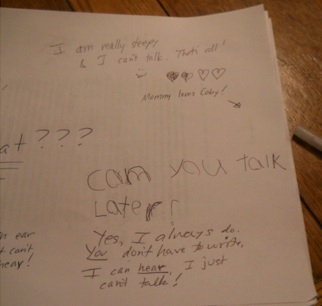
“My son is very good at talking about things he doesn’t like, but I don’t assume that he would feel entirely comfortable directly telling me things he doesn’t like about me. The things he does say indicate support rather than discomfort. A few times I have been annoyed at myself for stuttering and he says “Mommy! Don’t ever be mad at yourself for stuttering!” or, a few times, “Mommy. Stuttering. It’s a way of life.” I don’t not-communicate with him, so he does not feel ignored. I use alternative ways of communicating with him, just not talking. I write, point, use some of my extremely limited repertoire of ASL signs. I once was writing to him about what to wear to church and he wrote back “Yes, mother dearest!” He (as is true of most people I write to) matches my communication mode and writes back. I have written to him (and to others) “You don’t have to write to me; I can hear you!” He has noticed, and told me, that when he comes back from visiting his dad I “seem different.” We have talked about his coming back as a transition point- the house is suddenly noisier, and definitely “talkier.” I have often said that my child talks to think, so we are quite different in that way. I am working on what would make the transition from “kid gone” to “kid in the house” an easier one for both of us.”

 For people who do not have difficulty speaking, they may have trouble understanding how someone might be able to speak in one situation and then not able to in another.  Can you talk more about this?

“Some abilities are not there every single time a person wants to access them. This is true for all people, but for an Autistic person, these fluctuations in abilities and access to abilities might be more pronounced. If I don’t play the organ almost every day, it’s almost like I forget how to play it. That’s why I always practice on Saturday night and Sunday morning before church. There is no way I can go in there cold and play like I want to. Think of something like delivering a presentation. For most typical people, there will be good days and bad days, presentations you wish you could do over, and days when you were really “on your game.” Or, think of your favorite sports team and player. Some games are not so good; other games the team really does well. But playing the organ or hitting a home run is not an essential life skill (ballplayers  and organists feel free to disagree!). But when it comes to anything considered really basic, like being able to talk, a sense of mystery surrounds the topic, when a person can do it one time and not another. I maintain that it’s not that different anything else, but is more noticeable and pronounced when it’s something that is expected of everyone, and when one can do that “expected thing” most of the time. Maybe for some of us talking is an extreme sport, in the sense of having to really work, practice, try hard, take risks, and think consciously about what we are doing, whereas for some people the ability to talk is very natural and not even a conscious effort.”

 Talk about the idea of language and thinking.

“I have read more than one author who opines that without language there is no thought. Nothing could be farther from the truth. Language includes both written and spoken words, as well as picture-based communication systems like PECS. Not talking (and also not writing) does not equate with “not being able to think,” “being lost in an unknown world” or anything other than specifically not being able to talk.  For some people it could mean a lack of focus on “the present moment” (how many people are fully present in each moment anyway?!) or not being able to think in words, which is another one of my reasons for not talking.  But it is not, generally speaking, accurate to assume that because someone can’t talk, they can’t think.  You wouldn’t look at someone who has a tracheostomy tube and go “Oh wow.  That person can’t think!”

What is it like when you’re unable to speak while in public and are expected to? 

“It’s a bit nerve-wracking, but only in situations where people do not know me well and are expecting that I can speak like a non-autistic person. I try to anticipate what I will need to be able to communicate at those times but I can’t always build in my own supports. When I am with friends, it’s no big deal if I can’t talk or can’t talk much. In work situations it’s more difficult for me to feel calm about it. Unfortunately this expectation is not limited to people who don’t know much about disabilities, so that I have had to really struggle at autism-related events where there really aren’t accommodations for Autistic ways of communicating. It’s an ongoing process for nondisabled people to learn about communication differences and to anticipate them so that Autistics and other people with communication disabilities aren’t doing most or all of the work to create our own accommodations.”

How do people react to you?

Really, I mostly don’t get reactions, because often the times that I can’t speak coincide with the other person continuing to talk, maybe because they think I don’t have anything to say, or that they are like “Well, if she’s not going to talk, I will!” I do get all kinds of reactions, from total acceptance to “you could if you wanted to- try harder” kind of thing that made me feel sad when I was making the video. Sometimes people don’t believe me when I say (in speech or writing!) that I have trouble talking. I have to be very clear that I mean not being able to talk at all. I have learned that “trouble talking” might mean not saying the right thing, or stage fright, and “I can’t talk right now” can mean “I am too busy to deal with you” rather than that I literally an unable to speak with words coming out of my mouth! I have had a few mixups when people did not know I meant “I can’t talk right now” very literally. Sometimes people just don’t quite believe me and think I am making it up. I am not sure why they would think I would go to that much trouble! There are also people who have never heard me stutter, who think that I don’t, even though I tell them I do. They are going to get treated to another video in a few weeks! I was finally able to capture myself stuttering at a time when I also had the webcam with me.”

Are there things that help you speak after a period of not speaking?

“I mostly just have to wait. I don’t particularly want to talk a lot, but I need to. It’s just one of those things that is expected, and it is expected that if I can do it some of the time, I can do it all of the time.  It might seem that someone who can speak but loses speech at times would want to find ways to prevent speech loss, but I often welcome not being able to talk.  It gives me a break from the exhausting task of speech production.  My idea of the perfect conversation and this is ideal for a number of my Autistic friends, too, is two laptops or mobile devices or text-based equipment, but we can be in the same room together writing to one another. I don’t get a lot of this because I live in a rural area and most of the people I write to are long-distance. Some friends locally are very accepting but we don’t have any alternative setup other than me scribbling on paper. I also get way overloaded by hearing other people talk, as it challenges my auditory processing abilities and I can only take so much talking. If other people, whether or not they can speak, would type to me, I think I could get a lot more accomplished with the interaction with that person. Or, at least I think I could. If writing is not that person’s strongest form of communication, it will be a limit for that person. We should not be expected to always accommodate “talkers” and not the other way around. But it does take extra effort on my part because people can’t tell just from looking at me that I am a person who sometimes can’t access speech.

Ideally, we could take turns using each person’s communication strengths and weaknesses, assuming we are able to do that much. Of course, sometimes it just won’t work.”

Paula and her son’s writing


To read Paula’s blog, go to Paula Durbin-Westby Autistic Blog

Related articles

The Latest From Autism Speaks

This is the email I received this morning.  It’s from Autism Speaks.   Please read and let’s discuss…

“CONTACT THE CAMPAIGNS TO LET THEM KNOW WE WANT OUR 1 IN 88 IN THE DEBATES!

Dear Ariane ,

We had a significant presence at the first Presidential Debate at Denver University last week. We are going to have an even bigger presence at the next two debates to show the candidates how big the autism community is!

We need your help to make the autism community, and all of our issues, a squeaky wheel in this election season. For the next debate, we don’t want just a mention of autism.

We want the candidates to discuss a plan for leadership on increased funding for dedicated autism research and appropriate health insurance coverage for all Americans with autism.”

In the first statement Autism Speaks writes, “… we want our 1 in 88 in the debates.”  When they say “we” am I one of the “we”?  “We are going to have an even bigger presence at the next two debates…”  We are?

“Our” is a curious word to use when speaking of a group of people, many of whom can speak for themselves and those who cannot “speak” are capable of communicating, through typing or other means of communication, their thoughts and ideas.  “Our” is a pronoun implying ownership or at the very least lends a sense of unity and inclusiveness as in “our politicians,” “our neighbors,” “our friends”.   What Autism Speaks is really saying  is “our Autistics.”  I don’t think the people I know, whether Autistic or not, would take kindly to that wording, but “our 1 in 88” somehow gets a pass?

“We want our 1 in 88 in the debates!”  Really?  Is Autism Speaks suggesting Autistic people should be up on a stage or at a town hall debating the presidential candidates?  It’s an interesting and compelling idea and one I whole-heartedly embrace, except I don’t believe this is what they mean.  “Behind every person with Autism is an army of support.”  I don’t think most of the people I know who are Autistic feel they have an “army of support.”  In fact most of the people I know who are Autistic feel they have very little, if any support.  But I’d really like those who are Autistic to weigh in here and say for themselves whether they feel they have an “army of support.”  Armies are usually employed to fight or fend off an enemy.  Who is the enemy and who makes up this army?  Am I part of the ‘army’ that is supposedly supporting my daughter?   Maybe me and Richard?  An army of two?  Where is the army of support that’s standing behind each and every “person with autism”?

Autism Speaks is much, much more than an organization attempting to raise awareness or one that insists they speak for Autistic people while doing nothing of the kind.  They are running a campaign, not a campaign that raises money to help those with Autism, but a campaign that promotes fear and generates terror.  Anyone who  has spent any time in the advertising business knows, fear causes people to open their check books faster than any other single emotion.  Autism Speaks does a brilliant job using language to convey other, more subtle meanings.

Autism Speaks is interested in having autism addressed by politicians, a worthy and important suggestion that ALL of us can agree on.  Except Autism Speaks is NOT a leader in showing the world how to INCLUDE Autistic people in the building and formation of their various programs.  Autism Speaks uses the words, “Autism Speaks it’s time to listen.”  But who is it they are suggesting we listen to?  Not Autistics.  They have positioned themselves as an organization which represents Autism.  They have self-appointed themselves as the “voice” of autistic people despite the vehement protests by so many who are Autistic.

Can you imagine an organization that suggested they spoke for the American people and yet were made up of people of some other nationality.  An organization which only had one or perhaps two Americans on their board, advisory committee or occupying more than one or two seats of the upper echelons of their organization?  Imagine for a moment how you would feel if an organization called themselves: “Americans Speak it’s time to listen”, yet those who were talking weren’t American and when you tried to say something you were routinely ignored.  Imagine how you would feel if this organization continued to insist they spoke for you and yet when you heard them speak you didn’t recognize yourself or any of those you knew.  Just imagine.

To Mitt Romney and Barack Obama:  please inform yourselves about autism by listening to those who are AUTISTIC.  That’s the discussion I’m interested in listening to, the one that includes autistic people and not those organizations that say they do and yet do not.

Tackling That Troublesome Issue of ABA and Ethics

One of the best arguments against ABA is Michelle Dawson’s article, The Misbehaviour of Behaviourists: Ethical Challenges to the Autism-ABA industry.  If you google Applied Behavioral Analysis you will see glowing reports of its efficacy for more than 30 pages.  I actually stopped at the 30th page only because I didn’t have time to continue.  The first book I read on the subject of Autism was Catherine Maurice’s Let Me Hear Your Voice which details how ABA saved two of her children’s lives from Autism.  (I use this language as it is the language employed by the author.)  Catherine Maurice also likens Autism to cancer and ABA as the necessary chemotherapy.  The whole acceptance model obviously is not employed when thinking in these terms, how could it be?  And perhaps this is the single greatest problem when discussing ABA.   Ethics is not a word one associates with chemotherapy.  Why would it be?  The person considering chemotherapy is doing so because to not do so is to face the very real possibility of death.  When the language around autism becomes synonymous with cancer, one is saying to be Autistic is to have a death sentence.  And while that may seem like hyperbole to many parents and Autistics, it is not so far from the truth when we were informed of our daughter’s autism.

When Emma, then two years old, was given her diagnosis we were told, if we employed 40 hours of ABA a week she would undoubtedly be mainstreamed by Kindergarten.  This was what we were told.  This is what we hoped for.  This is what we chose to believe.  We were also told that a bio-medical approach when coupled with ABA was ideal and so we did that too.  We fought and received 40 hours of ABA a week, took Emma to a homeopath, who through more than a dozen tinctures, did a homeopathic version of chelation (i.e. removed heavy metals from her system).  I also took Emma to a cranial sacral doctor as well as had her on a gluten-free casein free diet.  Despite all of this, when she did not show the sort of monumental leaps promised, the ABA therapists said it was because we were at fault.  Never once did any of the therapists, supervisor or agency waver in their firm belief that ABA was a solid, “scientifically” backed methodology.  It was spoken of as fact.  We were the only variable.  We then did what they advised, we put Emma in an ABA based preschool, continued our own ABA training so we could continue doing it at home, hired an ABA trained therapist to help us implement ABA in the evenings and weekends and again were reassured that she would be mainstreamed by the time she was in Kindergarten.   We didn’t have any alternatives as far as preschools went, so I ignored my gut, my maternal instincts, warning me that this was NOT a method I would ever allow used on my neurotypical son and yet, was allowing to have implemented for my autistic daughter.

After a year, not only had Emma not progressed as the school had hoped, but she was actually regressing and was, what the principal informed us, a “red flag”.  The teacher, obviously aggravated with Emma’s lack of progress even suggested that this was Emma’s fault, that she was “refusing” to comply and expressed her irritation with us.  Emma, at the time was just FOUR years old.  Looking back on those first few years is surreal.  A four year old was being blamed and words like “manipulative” and “misbehaving” were used.  I’m going to interrupt this story to acknowledge, this is one story.  One family’s experience and is an anecdotal tale.  In no way do I believe for a moment that because ABA did not produce the results so many believed it would that our story is somehow scientific fact.  What I will say though is that ABA is, in my opinion, a flawed, at best, methodology and one that we do not, would not ever consider using with our NT son.  Therefore an important question must be asked – Why is that?

Why do we not use ABA for the neurotypical population?  This is where the ethical question must be considered.  This is where the “science” behind the use of ABA begins to fray.  If we really believe Autistic people (and children) deserve the same respect, are truly considered equal as those in the neurotypical population, ABA presents some real problems.   ABA can only really work if we view autism as a deficit and something that must be removed.  Autism is a complex neurological difference that cannot be removed.  I do not believe for a moment that there will ever be a “cure” for Autism.  It was explained to me by a neurologist that Autism is a web of neural pathways branching off and fusing producing new neural pathways, so random, so complex making it impossible to single out any one pathway allowing for a simple removal to produce a non autistic person.

I don’t believe anyone would argue against helping an Autistic person cope with the challenges they face, but the larger question is how do we do that?  Restraining someone who needs to concentrate by flapping is not the answer.  Insisting children sit quietly so they can “attend” and be “table ready” when flapping or twirling a piece of string actually helps them listen and concentrate does not make any logical sense.  Insisting that the non autistic way of communicating is the ONLY way to communicate is limiting and unhelpful to those who cannot express themselves by speaking.  Viewing Autism as a list of deficits that can be corrected through a series of discrete trials will not make an autistic person any less autistic.  Teaching Autistic people how to ‘pass’ so they can blend in better with non autistics is similar to the belief that a closeted gay person will live a happier and more fulfilled life by being closeted than someone who is “out”.

I don’t agree with the basic tenets of ABA because it is a methodology based in looking at those it treats as deficient and inferior.  This is not a model I believe will help Autistics or any of us in the long run.  We, who are not autistic are in a position of power, we are the majority, we are the ones making the rules.  That does not mean the rules we make are correct or even right.  We must be willing to examine what our objective is in using ABA.  Is the objective to make someone blend in better and if so we must ask ourselves why?  Before ABA is considered, ask yourself, is this a treatment you would employ for your neurotypical child?  What message are we sending our Autistic children?  What will this message do to their self-image?  What message will be internalized, a message they will carry with them well into adulthood?  Will this message serve them, make them feel good about themselves, help them lead happy, fulfilled lives.  After all isn’t that what ALL parents want for our children?

*I urge any who are reading this to read what autistic people are saying about ABA.  Ido Kedar, a non speaking Autistic teenager has written a book, Ido in Autismland where he criticizes ABA and describes why.  Any of you who are ABA therapists, it is incumbent upon you to read his book.  He is one of a number of Autistic people who are speaking out about ABA.

Other posts dealing with ABA:

Non-Speaking With A Lot to Say
Trauma & Autism
ABA

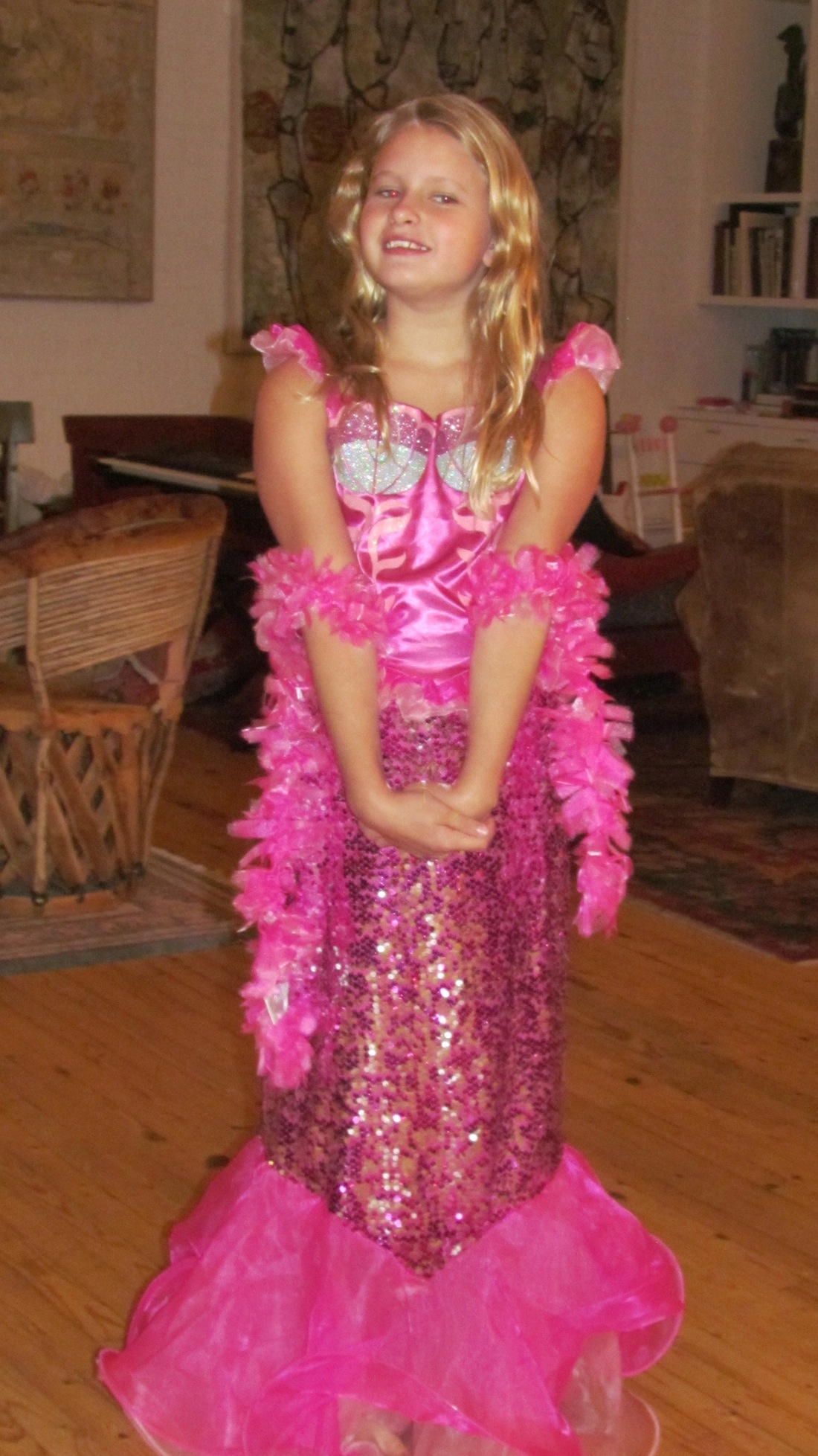
Emma as mermaid!

Sleepovers and The Importance of Inclusion

Emma has asked to have a sleepover for months now.  She doesn’t want to have ‘a’ sleepover, as in a single sleepover, she wants to have sleepovers, the way her brother Nic does, almost every weekend.  She wants to have time away from us, where she is with another family and their children.  She wants to have the experience most parents and children take as a matter of course.  I’ve had parents say to me, “Oh sleepovers and play dates are highly over rated, she’s not missing much.”  But the truth is she IS missing a lot and the fact that she so desperately wants to have a sleepover is something I would assume ALL children desire.  I doubt any child doesn’t hope for this, whatever their neurology.  My guess is those who don’t ask for a sleepover are doing so not because they don’t want one, but because they do not have the ability to ask or communicate their wish.

The question has been how to orchestrate sleepovers for Emma when she’s never been invited to have a play date, forget a sleepover.   We have tried to have kids over to our house, but they all end up playing with Nic and while we’ve been able to get everyone to play a few games of duck, duck, goose, it still ends up being mostly a play date for Nic.  Last spring, Emma’s therapist, Joe invited Em over to his house for a sleepover with his wife’s god-daughter, and Emma had a great time.  But Emma wants more than a one time event and increasingly Richard and I have discussed how to get Emma over to people’s houses who have children Emma considers her friends on a more regular basis.

So while I was away at the AutCom Conference this weekend, Richard decided to do what he does best – take matters into his own hands.  He picked up the phone and called our friends asking them if Emma could have a sleepover at their house.  This is not something I feel comfortable doing.  It feels like an enormous imposition, I wouldn’t want to put people in an uncomfortable situation.  I wouldn’t want them to feel uncomfortable saying no, I wouldn’t want to feel the sadness I would feel if they did choose to say no.  Just as I cannot use restrooms in restaurants or stores unless I’ve actually bought something, I cannot call friends and ask if my child can come to their home for a sleepover…  but Richard can and did.  And they said they would be thrilled, in fact they said they were really honored that Em had asked to come to their house.

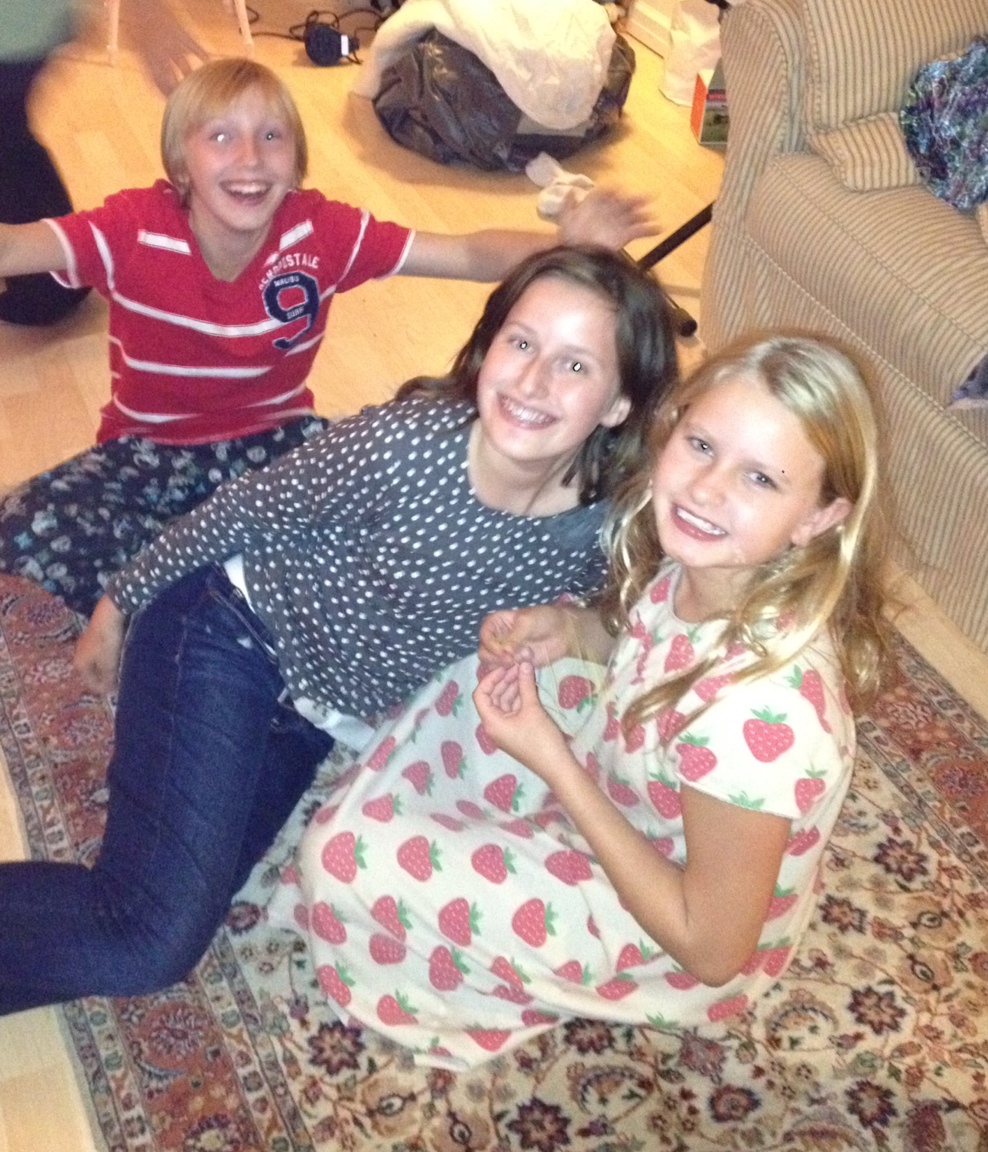
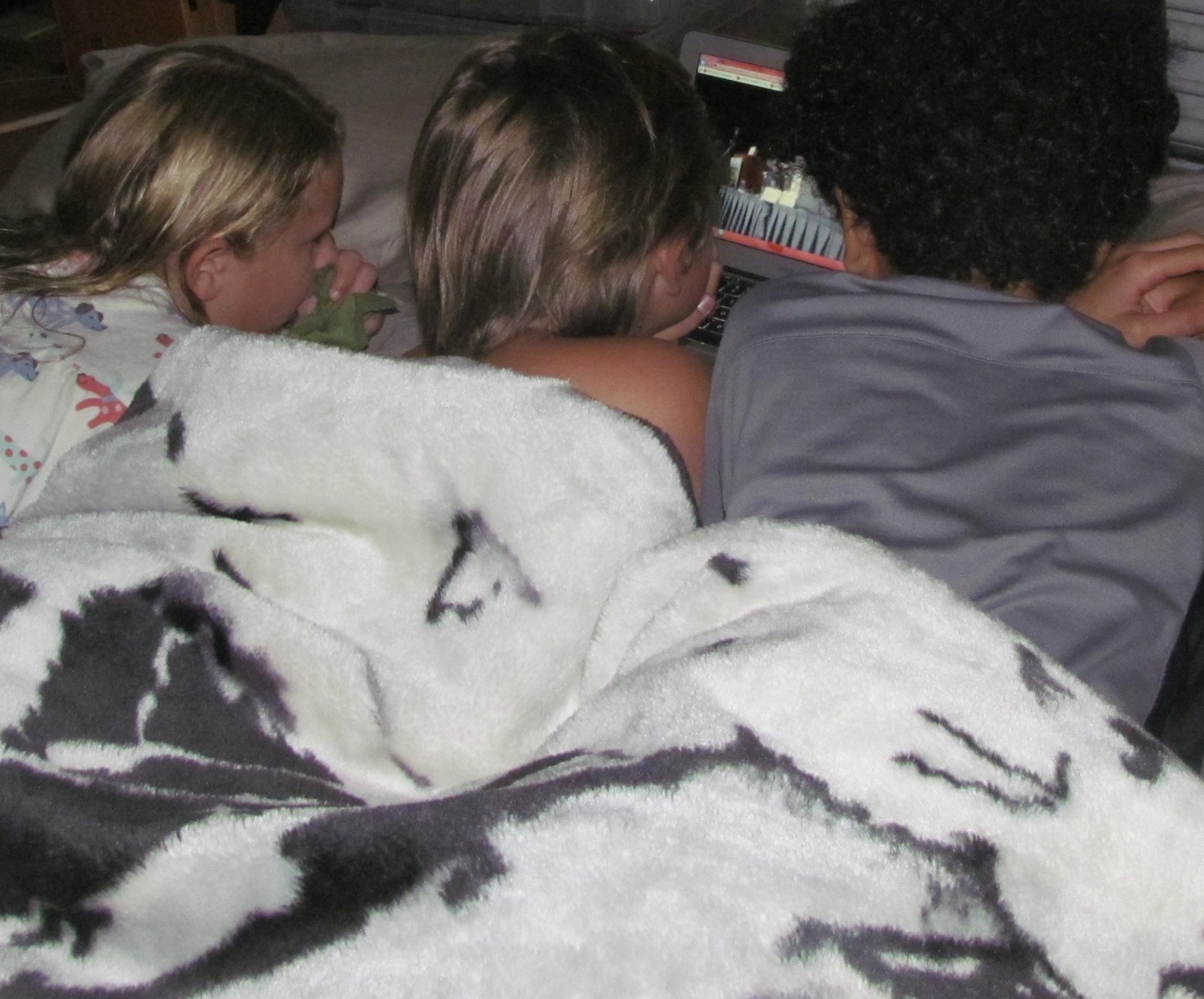
These are good friends, friends with twins, Nic’s age.  The twins, J & G have known Emma her entire life.  We adore all of them and have spent many a Sunday hanging out together.  When Emma heard that they’d invited her, she jumped up and down, threw her arms up in the air and twirled around while saying, “You get to have a sleepover at J & G’s house!   So excited to see J & G!”  Then she ran into her bedroom and came back out with her backpack filled with her nightie and a blanket.  Sunday night Richard and I received a text with these photographs.  (We have been given permission to post these photos.)

Emma used her skills of persuasion to get everyone to play a rousing game of Duck, duck, goose.


J & G & Em

The sleepover was a wild success!

When Emma came home the next day she ran over to me, threw her arms around my neck and said, “Do you want to know Emma’s sleepover was so much fun?”

“Yes!  I do want to know that!” I said.

“Emma had fun at Emma’s sleepover!”  She said and then ran into the other room to find her dad.  A few minutes later she came back and said, “Go to Gabby’s house?  Have a sleepover with Gabby?”  (Gabby is one of Emma’s cousins.)

I will have to take a page from Richard’s book, gulp down my nervousness and do something I would normally never do.  I will have to call my cousins and ask.  Maybe they’ll say no.  Maybe they’ll say yes.  Either way I have to ask because my daughter needs to do this.  She needs to have these experiences, they are important and my shyness and concerns have to take a back seat to the more important issue here, which is to do what I can to have Emma included.  The Autcom Conference gave me a glimpse into how important inclusion is, not just to those who are routinely excluded, but to all people; we all benefit from inclusion.

AutCom 2012 Conference – The Best Kept Secret

The Autcom conference was a fleeting glimpse into paradise.  A tiny taste of how the world could be were we accepting of each other, treated all people as equals and with respect, without prejudice, without assumptions, without bias.  Autcom was a window into how the world could be, but isn’t.  Not yet.  Words do not do this conference justice.  How could they?  How do you describe a room full of people who are connected not through race, nationality, religion, political views or neurology, but instead are connected by an idea.  A vision.  How do you describe that?

Accommodation – it’s a word we hear, but what does it really mean?  At the Autcom conference it meant waving hands at the end of a presentation instead of clapping, lowered lights, snacks that included gluten-free and casein free items and non dairy alternatives.  Accommodation meant no one stared disapprovingly at anyone who stimmed or made noise or got up to leave in the middle of a talk.  Accommodation meant people were polite and moved chairs that might be blocking someone’s ability to come or go.  It meant using a microphone or repeating a question for those who weren’t able to hear the first time.  It meant being respectful and considerate when someone came up to peer at your name tag and it meant understanding that when that person gently touched your hand after a presentation it was their way of thanking you and I defy anyone to not see the beauty and love in that.  Accommodation meant slowing down while someone typed their answer or question or thought.  It turns out accommodation means being a thoughtful, considerate human being who is respectful of others.  How is it this isn’t done automatically, as a matter of course.  How is it that we as a society have drifted so far from this very basic and easy way of being in the world?

The single biggest issue I had with this wonderful conference was that there were too many terrific things going on at once and it was impossible to see and hear everyone and everything.  To give you an example of this – on the first day of the conference after Ari Ne’eman’s welcome and an opening keynote address by Jennifer Paige Seybert, was Savannah Nicole Logsdon-Breakstone’s presentation – Loud Hands Project’s Neurodiversity 101.  At the same time, Larry Bissonnette, Pascal Cheng, Harvey Lavoy and Tracy Thresher were doing a presentation on Supported Typing, which I really needed to go to in order to assess whether this might be something we could use to help Em communicate more effectively, but next door to them was Nick Pentzell, Hope Block, Jacob Pratt and Autumn Dae Miller presenting “Rated “R”: That Oh-So-Difficult Topic”.  I cannot tell you how much I wanted to hear them too and later heard from others that it was a not to be missed presentation, sadly though, I missed it.  Human Development Journey was presented by Cecilia Breinbauer about using DIR, which was the method Richard and I were trained in by the late Stanley Greenspan, after abandoning ABA.

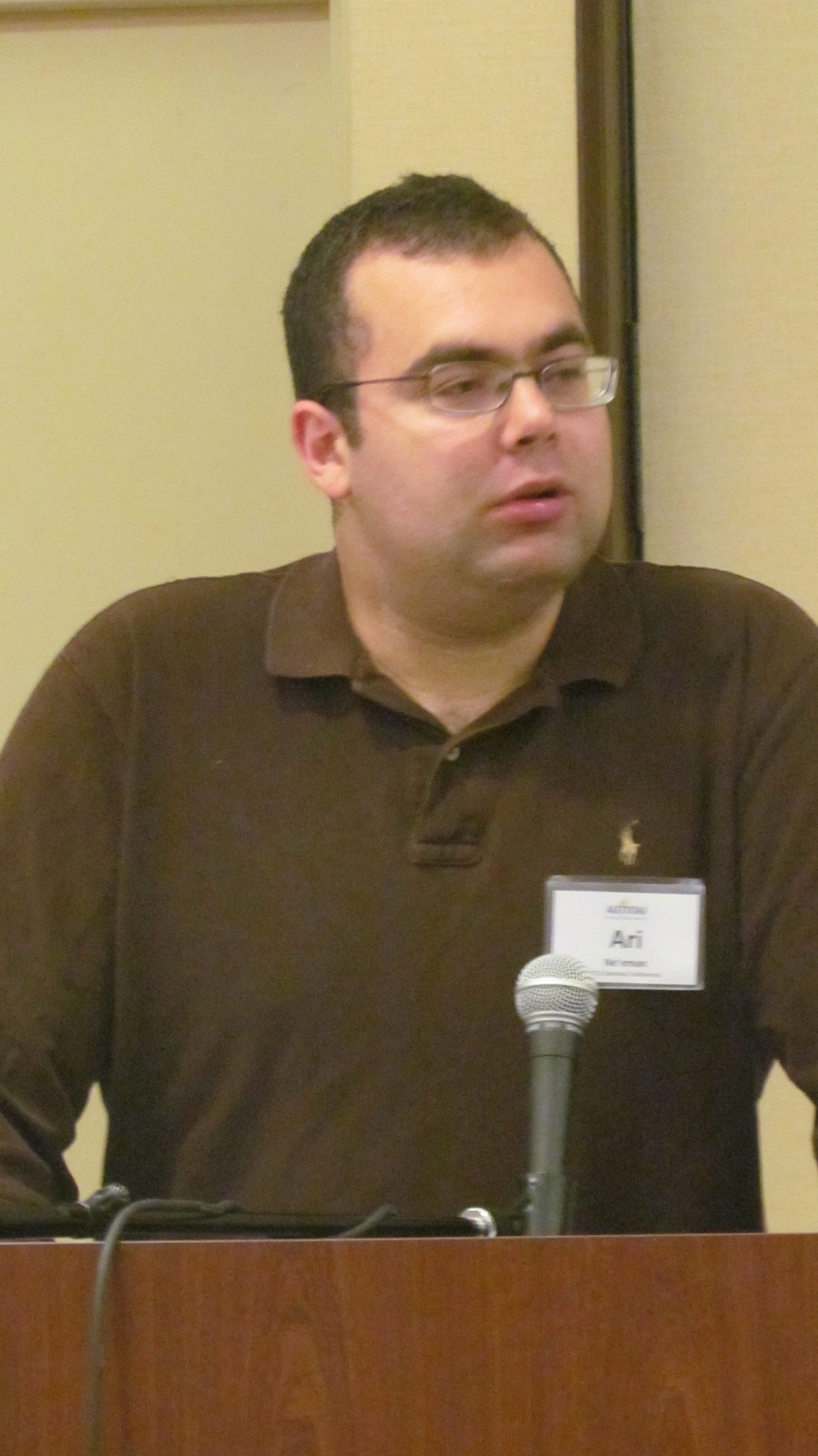
Ari Ne’eman

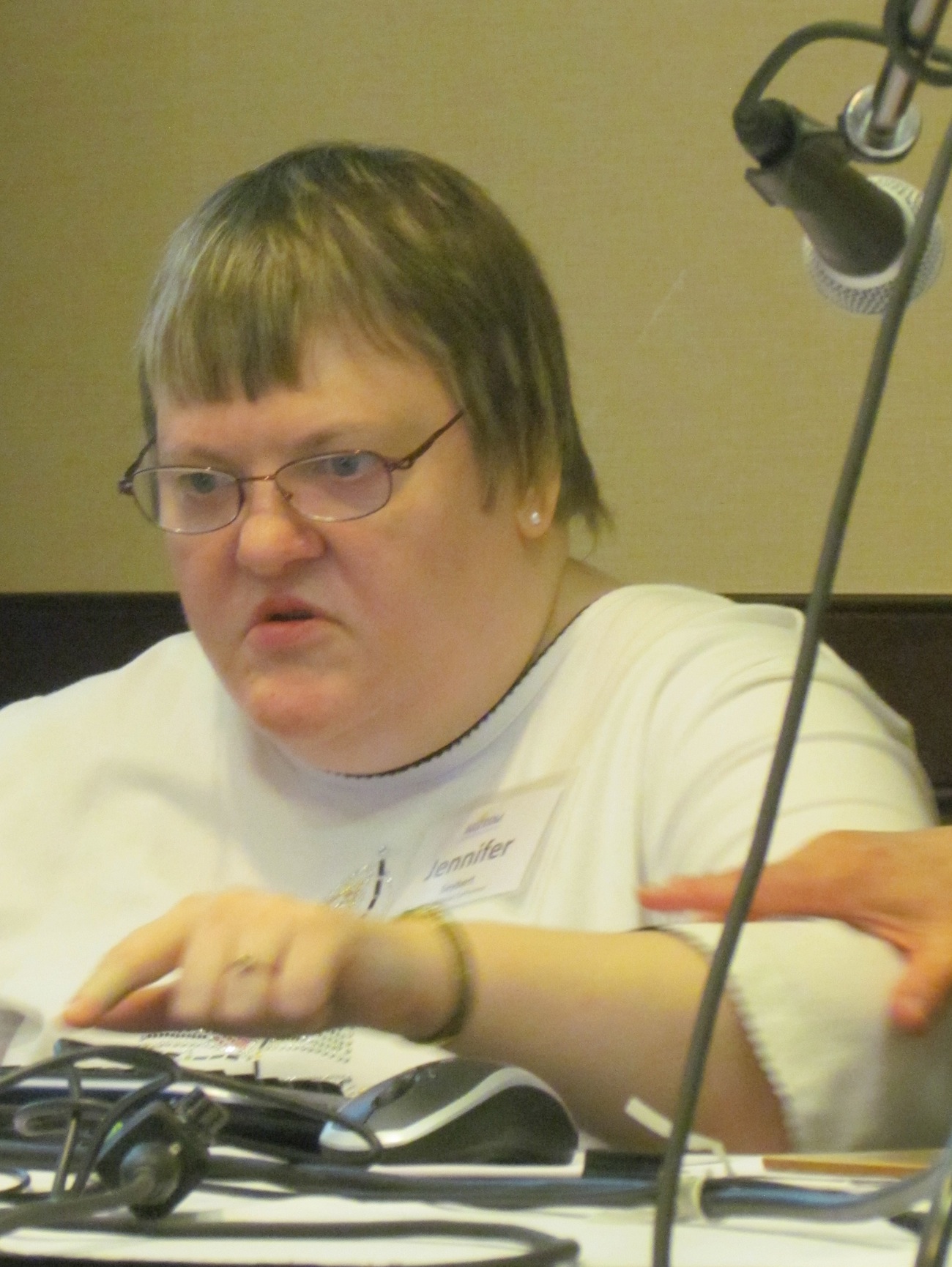
Jennifer Paige Seybert

That evening after dinner and a wonderful performance by Jordon Ackerson who reminded me of Emma because of his beautiful voice, we watched Wretches and Jabberers, with a Q&A with Larry and Tracy.  This was my third time watching this documentary, which I posted about last month ‘here‘.   I asked them about self-injurious behaviors, something both engage in during the film.  I asked for  their opinion about the commonly held belief by many that SIBs should be thwarted and how parents and caregivers are often unsure how to deal with this.  Tracy typed, “That was years of frustration with no way to reliably express myself working its way out through my behavior the problem was lack of communication which pissed me off.”  Larry typed, “I lived in an institution so I was locked in arms of restraint its legal but immoral and only represses anger nothing looks more kind than softly spoken words and lit up smiles.”

Jordan Ackerson

Tracy Thresher

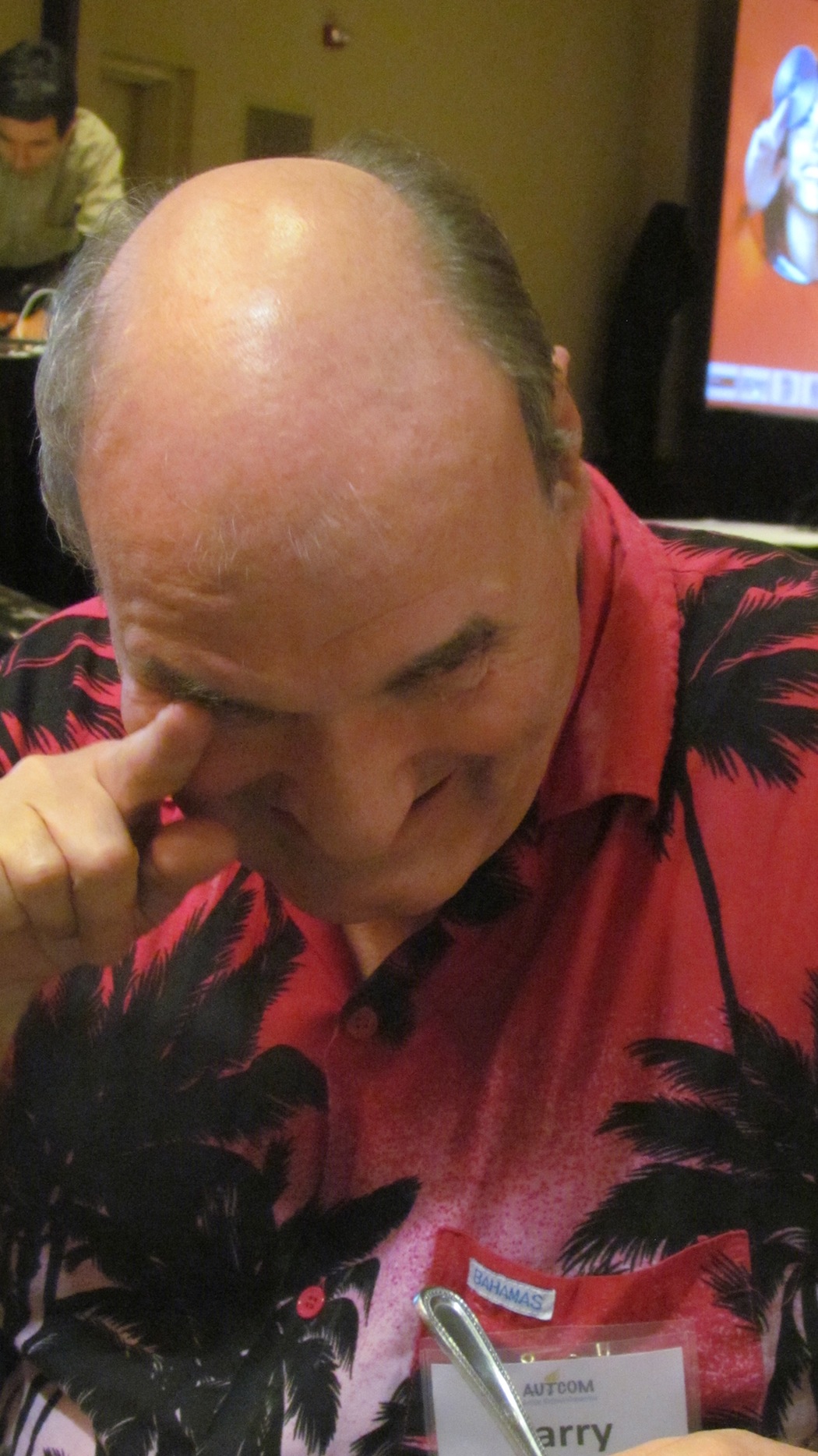
Larry Bissonnette

Read that again.  “… nothing looks more kind than softly spoken words and lit up smiles.”  The presentations were terrific, but it was what is possible that this conference represented, which affected me most profoundly. The AutCom conference was an example all organizations, who say they are interested in Autism and helping those who are Autistic, should follow.  Autistic people make up a large portion of their board, Autistic people led more than 50% of the presentations, the audience was at least half Autistic, if not more.  At my presentation there were more Autistic people than not, for which I was truly honored by.  The conference showed what the world could be like if we work together, reach out to each other, include everyone despite our perceived differences with love, compassion and kindness.  Accommodation is less about accommodating and more about getting in touch with our humanity and what it means to be alive and sharing this planet together.  Accommodation and inclusion means we ALL benefit.

The AutCom Conference – Baltimore

I am in Baltimore at the AutCom Conference.  Since the conference begins first thing in the morning, I arrived yesterday afternoon by train.  As I waited for the shuttle service to arrive I witnessed a group of men yelling at each other.  Suddenly one enormous man lunged at another, grabbed him by the throat and began to strangle him.  Several other men jumped in, amidst lots of yelling and swearing and finally were able to pry the two apart, only to have the one who had been strangled race after the strangler, shouting descriptive words which I cannot repeat, mostly because other than a few F bombs, I couldn’t figure out what he was saying, though by the look on the attackers face, they weren’t friendly.  After witnessing two men practically killing each other, I was greatly relieved to see the shuttle pull up to whisk me away.

The van driver stopped only once to pick up a party of six elderly men who were off to a business retreat.  The one gentleman seated next to me after having an animated conversation with his wife, though I’m not sure about her identity, but was clearly someone he knew well and felt comfortable hanging up on – twice –  and then called back.  Exhausted from all that, he promptly fell asleep listing so precariously in his seat that I feared he might just keel over completely.   I scooted as far away from him as was physically possible lest he fall into my lap like a felled Redwood.

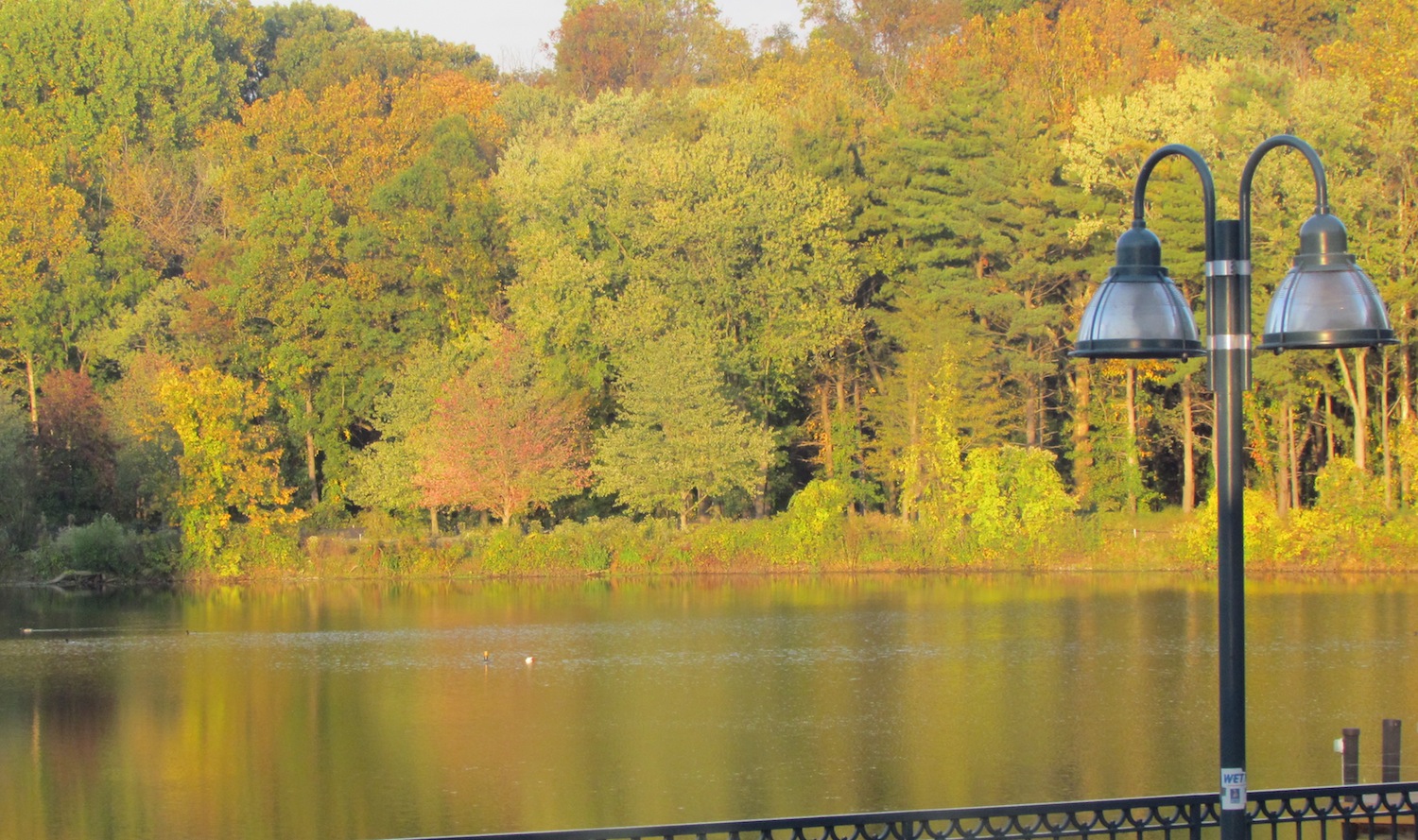
The drive was otherwise uneventful. Much to my delight the hotel looks out on a beautiful lake where I saw this… I believe this is a White Egret.  I could be wrong, but in Northern California, where I grew up, I remember seeing one once and it looked a great deal like this.

A panoramic view of the lake.

Sculpture with the lake in the background…

The conference begins at 9:00AM this morning with a welcoming ceremony by Ari Ne’eman, followed by a keynote address by Jennifer Paige Seybert.  I intend to then go to Julia Bascom and Savannah Nicole Logsdon-Breakstone’s presentation – The Loud Hands Project.  However Larry Bissonette, Pascal Cheng, Harvey Lavoy and Tracy Thresher (of Wretches and Jabberers) are also presenting at the same time, and I’d love to hear them too.  The entire conference is a who’s who of wonderful presenters.  I don’t know how anyone is able to choose!

It’s all very exciting and I’m so happy to be here!

How My Fears Drove Me To Pursue a Cure

A year ago if you’d asked me what my single greatest fear was, I would have told you it was what would happen to my daughter when my husband and I both died.  This fear was so worrisome, so looming that I often stayed up at night worrying.  Well meaning people would reassure me that “things will work out, they always do” or “group homes aren’t so bad, many are run by loving, caring people”, but none of this gave me solace.  My fear was the driving force behind my desperate pursuit of various medical interventions and treatments for my daughter.  This fear, more than any other was what drove me to search for a “cure”.  When I thought of my daughter’s future I saw one of those dark, formidable, gothic institutions, now used as set locations for horror movies.  Once my mind had latched on to that visual image my fear became so overwhelming, my throat so constricted, my body so awash in terror I would literally shut down, like an overloaded circuit.  Fade to black.

So what changed?  I began to read things like this –

Amy Sequenzia, a non-speaking, writer, poet, Autistic self-advocate from her poem Feeling Good:

“Feel the warmth of another soul                                                                                                   Ban the thoughts that block the light                                                                                           Refuse to hear what hurts, listen to the                                                                                    cry for help behind it

Well-being, feelings of unity                                                                                                             We are all the same”

Julia Bascom from her blog Just Stimming, her post Quiet Hands:

“1. When I was a little girl, they held my hands down in tacky glue while I cried.

5. When I was a little girl, I was autistic.  And when you’re autistic, it’s not abuse.  It’s therapy.”

Again from Julia, her post, The Obsessive Joy of Autism:

“If I could change three things about how the world sees autism, they would be these. That the world would see that we feel joy—sometimes a joy so intense and private and all-encompassing that it eclipses anything the world might feel. That the world would stop punishing us for our joy, stop grabbing flapping hands and eliminating interests that are not “age-appropriate”, stop shaming and gas-lighting us into believing that we are never, and can never be, happy. And that our joy would be valued in and of itself, seen as a necessary and beautiful part of our disability, pursued, and shared.”

The Third Glance, Words and Growing up Autistic: On Nature, Nurture and Abuse where she ends with this:

“But I’m not invisible anymore. I’m here, and I’m me, quirks, obsessions, passions, stims and everything else that makes me unique. Look out world, here I come.”

There were so many others, so many voices out there, somehow reading these blogs calmed my fears enough that I was able to begin dissecting them.  I was able to pause, even for a moment, allowing me to ask, what is this?  What is this fear really?  And although my immediate answer was that these were fears based in very real, logical assumptions, I was able to see that they were just that – assumptions.  They were still not reality.  Not yet.  I was also able to realize those fears were causing me to act in irrational ways.  My thought that the fear was a healthy, natural response to what I believed to be the reality of the situation, prompting me to pursue all kinds of risky, unproven and untested “treatments” for my daughter’s autism was taking all of us down a dark, dark path.  That fear caused me to behave differently toward her, but I couldn’t see that until I’d stopped and saw how my behavior toward her changed.  When I was able to stop, just for a moment and examine the fear, the fear began to fall apart.

My fears were based in things I assumed were the inevitable consequence of what I believed my daughter was or wasn’t capable of.  But this was not based in fact, I don’t have the ability to see inside my child’s mind.  In addition my fears were clouding all the things she was doing that I ignored or couldn’t see or hear.  Every single day, my daughter displays her vast intelligence.  When I read the writings of Autistic people occupying every point on the so-called spectrum, I began to see that my assumptions, what I had assumed I knew and believed were not based in anything other than that.  It was at that point that I realized I had a choice.  I could choose to believe in her incompetence and the inevitable outcome this perceived incompetence would take us or I could choose to believe her competent, making that looming horror no longer a given.

As I wrote recently in a comment to someone,  I chose the latter because to do otherwise and be wrong would be far, far worse.  This is something I cannot risk or would be able to forgive myself for.  But there’s another piece to this that is also important, and that is when we assume great things are possible, great things tend to happen.  It’s human nature to strive for independence, to communicate, to connect, ALL humans want this. Given a little encouragement we can do things we never imagined possible, but given nothing or criticism we wilt, become sad and angry.  My belief in my daughter will not change the very real challenges she faces, but it does and will help her far more than if I do not.

I’m off to the AutCom conference!

When Confronted With Parenting Questions, What Do You Do?

Someone asked me recently a question about teaching personal hygiene to their nonverbal child.  This was a question about shaving, in this case legs, but it could have been about underarms and certainly could apply to young men’s facial hair as well.  It got me thinking about  how I doubt my gut instincts or at least question them or perhaps even ignore them when it comes to my Autistic daughter and why that is.  This post is not well thought out, I’m just going to say that right from the beginning.  I’m mulling this over and would love other’s feedback.  Think of this post as a doodle pad and feel free to add your own doodles.

I’ve noticed that when confronted with a question about how to move forward with either of my children I use a couple of different methods to figure out what to do.  First I speak with Richard, then in Nic’s case, I’ll speak with him and ask a lot of questions, then I usually will speak with Richard again, sometimes he will have gone to Nic and the two of them will have talked about whatever it is too.  We will then discuss, often getting sidetracked with our own histories, there will be lots of comparing notes and then if both of us are still unsure as to how best to proceed we will ask friends, look for literature on the subject, go to the internet, seek professional help, call my mother.   (This last is said in jest, sort of, except that sometimes it’s been true.)  The point is there are a number of steps we typically take and so far this approach has worked out pretty well.

But what about when your kid’s language is limited or nonexistent, what then?  This is where the part of my brain that is firmly rooted in neurotypical thinking gets into a rut, like a record that keeps skipping until you pick the needle up and physically place it elsewhere.  I want to change my thinking when it comes to parenting my daughter.  I don’t like that I don’t automatically go to her and try to find other ways to communicate with her.  I want to make a concerted effort to do things differently, because here’s the thing, Emma has shown me countless times that she can and does have an opinion on any number of topics.  I may not have the kind of conversation I can expect to have with my son, it may take more planning, it may not be as “easy” but it is possible.  I have to train myself.   I have to teach myself and here’s the big revelation – often it takes me a while to learn, but I can and DO learn if I’m patient with myself and give myself the time and encouragement I need.

A couple of months ago I asked Ib (totally and unabashedly giving her new blog, Tiny Grace Notes AKA Ask An Autistic,  a plug here because it’s a much-needed and awesome resource, she’s brilliant and I love her, I love you too, Richard, but in a more, you know, marriage-y kind of way :D) anyway, I wanted Ib’s help in trying to interpret some of Em’s scripts.  Ib and I brainstormed, but what became clear was that I was looking for a key to unlock her language as I understood it and what Ib kept (patiently) trying to explain to me was that I would never be able to achieve a word for word translation.  At one point Ib said, “Do  you speak another language?”  And I said, “No.  I barely speak English, but if you think learning Russian will help me, I’ll learn it.”  Ib (I imagined her taking a long, deep, breath) said, and I’m paraphrasing now, No you don’t need to learn Russian, but you need to try to feel what the emotion is in what she’s saying.

At the time, I was completely freaked out, couldn’t understand what she was talking about, but then after a few more conversations, and thankfully Ib didn’t give up on me, I began to understand, I think, what she meant.  My literal mind wants a word for word translation, but that doesn’t work.  So I’m learning to train myself to ‘hear’ her words differently, which brings me back to the first paragraph regarding questions about parenting and teaching and puberty and everything else.  I admit, I’m fumbling my way along here.  I don’t have any concrete answers, but I do know that listening is a huge piece in all these questions.  Listening to my children, listening to their sensory needs, but also listening to my own instincts.

Questions about puberty, hygiene, shaving and other such matters, I will continue to seek advice, particularly from my Autistic friends, while also taking into account my specific child first and foremost.  If it’s a question that is ‘optional’ such as leg shaving, how does my child feel, is it important to them, do they care, are they interested?  On issues like teeth brushing, where negligence will result in cavities and larger problems, I don’t think twice.  I started teaching both my children how to floss and brush their teeth when they were toddlers.  Both kids need to be reminded, but I don’t grapple with whether I’m doing the right thing, I know I am, I know how important it is.  But some of this other stuff, I begin to second guess myself.

Em and I have a routine at night.  When it’s bedtime she’ll say to me, “Mommy come.”  So I will go into her room with her where she lies down and then pats the bed so that I will lie down next to her.  In the past she’s said, “Mommy read story.”  And I have.  But for the last few weeks she hasn’t said that, but instead has talked.  At first it sounded like scripting, but when I listened to her I realized she was talking about people and school, the bus, sleepovers, listing people she misses or things she wants to do, just the way my son used to do when he still wanted me to lie next to him at night.  So I started asking her, “Hey Em, would you like me to read to you or do you want to talk first?”  Every single night Emma responds, “Talk first, then read.”

And honestly.  How awesome and amazing is that?

“Talk first, then read.”

Em, Nic and Friend

Costumes, Halloween and Genetics

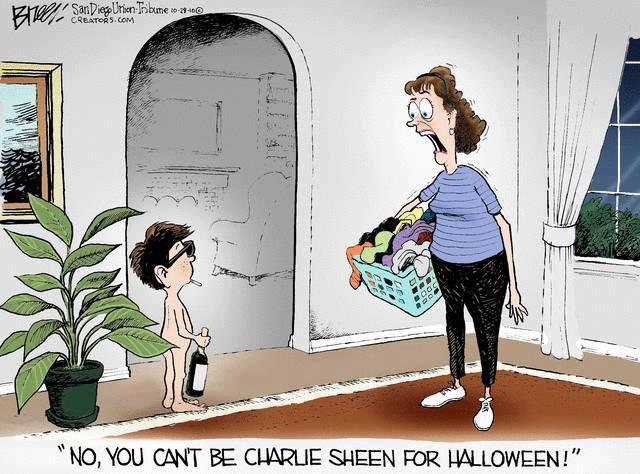
Posted on Facebook this morning…

Thankfully this “costume” would not interest either of my children, though Charlie Sheen does hold a certain appeal for my son, just not in the buff.  The costume(s) Emma picked out, ostensibly for Halloween, but will be worn, undoubtedly, on an almost daily basis for the next few years, are due to arrive any day now.  She chose a pink mermaid outfit, complete with magenta feather boa and yes, the tail is covered in sequins.  As a backup she opted for a “Renaissance Princess” costume with faux fur and a veil.  It’s all very King Arthur meets Lady Macbeth-ish.  She whipped right past the costumes for ghouls, ghosts, goblins, zombies and various farm animals.  She hovered over a “Rainbow Witch” costume, but ultimately passed it by, pointing instead to the hot pink butterfly, the “ice Princess” and a costume I couldn’t figure out what exactly it was supposed to be, but looked like a giant multi-colored lollipop with wings or maybe it was a G-rated version of Lady Gaga, it’s hard to say.  I’m grateful Madonna has yet to come onto Emma’s radar, though it could be argued Lady Gaga, one of Emma’s favorite singers, is not so different.  Both appear to favor the cones used as warnings on construction sites for breasts, still trying to work that one out…

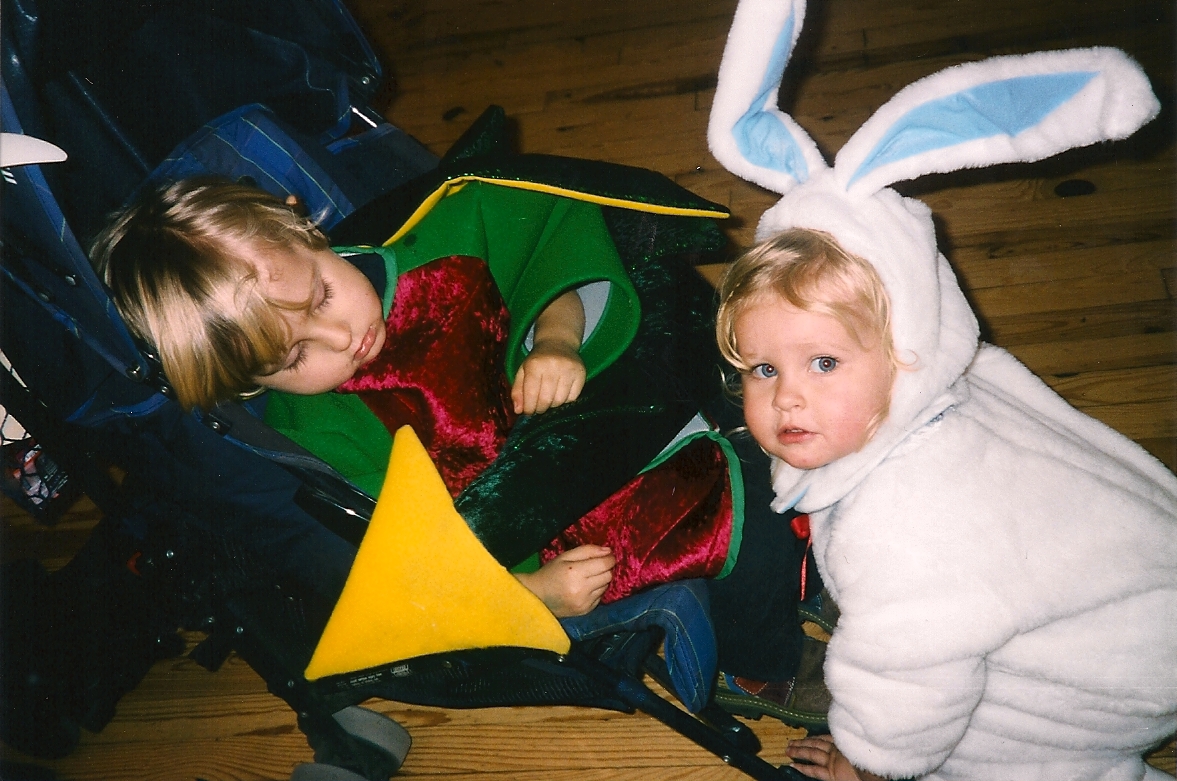
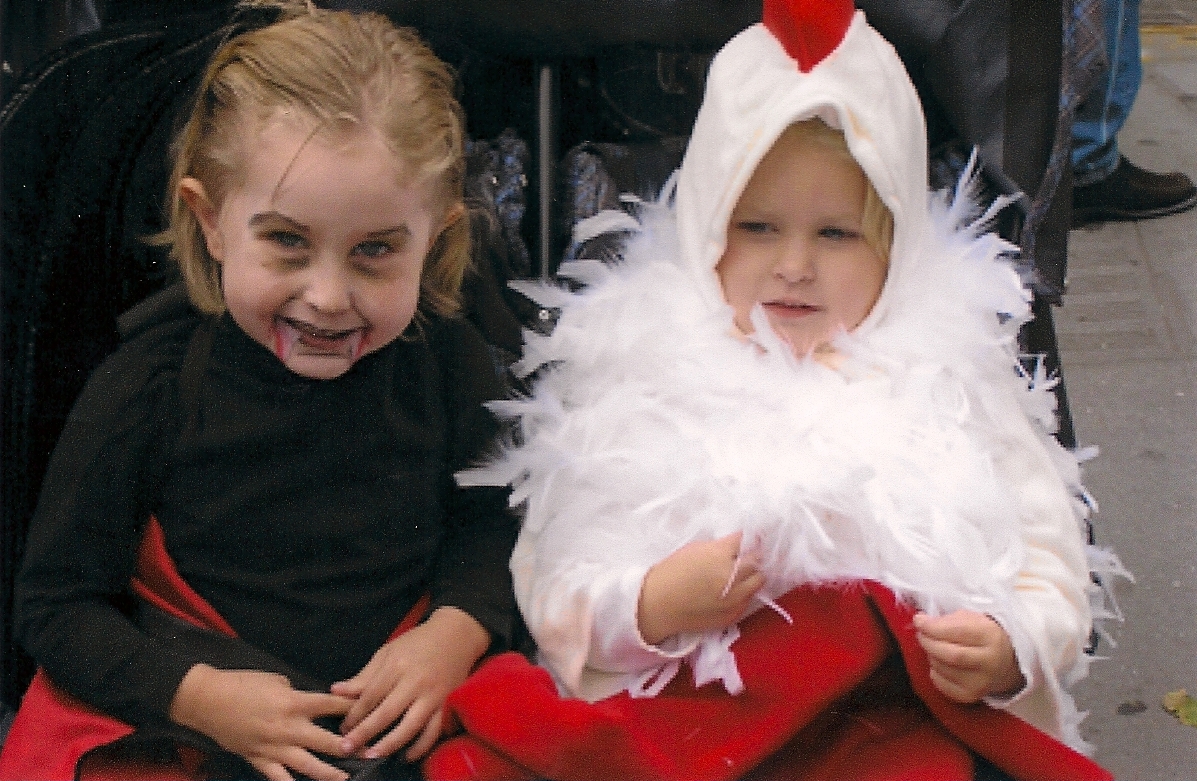
Looking back to other generations, it does seem Emma’s love of costumes was shared by several of her ancestors.  Both my grandparents, her great grandparents held “costume” parties.  There are boxes filled with photographs of my grandparents, particularly my grandmother, wearing some pretty outlandish outfits.  My mother has two racks of “costumes” occupying a corner of her project room in her house.  I have in my possession a hilarious photo of my mother dressed as Tweety Bird, but haven’t asked her permission to post it or I would. Evidently a love of drama and dress up runs deep in my family, one might even say it’s genetic.

Emma doesn’t care about the candy, she has no interest in going up to people and saying “trick or treat”;  for Emma it’s all about the costume.  Unlike her brother who sees the costume as a necessary annoyance to getting sugary morsels, sort of like the jacket and tie required at certain restaurants.  I have to say, I’m with Emma on this one, other than an inexplicable craving for that truly dreadful candy corn, (what do they put in that stuff?)  the idea of wandering around strong arming people into giving me treats doesn’t hold much interest.  However it’s right up Nic’s alley.  Each Halloween we debate which weapon in his arsenal he will brandish.  Usually he chooses several and with the inevitable face paint he demands, resembles something out of a spread in National Geographic featuring child soldiers in some war-torn country.  (Yeah, I did just write that.  Moving right along)  Nic finds Emma’s lack of candy enthusiasm absolutely baffling.  And while Emma doesn’t voice her astonishment at her brother’s disinterest in all things costume, I have to wonder that she doesn’t think it… odd.

It began young…

Related articles

Parental Bullying and Autism

I have kept the specific blog, post and commenter who I refer to in this piece anonymous because my point is not about any particular person, but about a larger issue.  But first, a little background…   I was alerted to some negative comments left on a friend’s blog.  She had written a post about learning to accept her Autistic child.  It was a beautifully written, honest and loving post detailing what things had helped her find her way to acceptance and how that journey had changed her and her relationship to her child.  The path she describes was similar to my own, except mine took much longer and was more circuitous, but I could completely relate to her process.  It was my journey, only on speed.

I went to the blog to read the comments and read this:  “”You accepted autism, I fought it.”  I stopped breathing.  I felt as though someone had taken a 2 X 4 and rammed me in the solar plexus.  I became aware of the fluttering in my stomach with the simultaneous sensation of dizziness in my head, starting just behind my eyes and then a prickly feeling at the back of my skull.  I could feel my heart pounding.  I swallowed.  I read on.  The words are no longer important.  She  related how she had “recovered” her child as though it were scientific fact and then said that her thinking would one day be common knowledge and any other view would be considered “archaic.”

I had to stop reading.  I stood up.  I left the room, walked around, drank some water and came back.  I could feel tears welling up.  I swallowed again.  I was aware that my hands trembled as I read “Seems to me a thinking person would keep an open mind and once you accept autism…there is no more thinking that occurs…just the acceptance.”  I couldn’t work out what that meant as there was no logic that I could get a firm handle on, but the feeling those words evoked was one of failure and shame.  I had to make a conscious effort to take a deep breath.  I felt the sting of her words, like a knife cutting me open.  I sat there and read the other comments and another from her, reiterating her stance, her position.  Her story, no longer a personal tale, but one given forth as though evidence in a court of law.  And her love shining through it all, triumphant, jeering, condemning.  Her actions and the outcome of her actions worn like a medal of honor, the purple heart of parenting, pinned to her chest, evidence of her supremacy.

I could no longer hold back my tears.  My tears, physical expressions of my inadequacies.  As I cried, as the tears ran down my cheeks, dripping off my chin on to my shirt, I closed my eyes and felt all those feelings of pain, of sadness, of shame that had nothing to do with autism, but are feelings I carry around, despite how hard I try to get beyond them, feelings I have had my entire adult life, long before I became a mother.  Those feelings of not being good enough, not being worthy, not being pulled together, not having all the answers.  Those feelings of being “less than” all of them came bubbling to the surface.  Those biting words from that commenter cut through the fragile dam I so carefully constructed for myself.

“You accepted… I fought…”

I am better than you.  My love is stronger, better… I love my child more than you do.

This is bullying.  Words used to personally attack or intimidate another person.  It makes us think we are not as good as someone else.  For me, her words took me back to all those years when I believed all those parents who spoke with assurance, with superiority, without doubt about something that could not be proven or even replicated, stories that are not based in any science, but are “one offs”.  All those false hopes I had and mistook for the real thing.  False promises that lead me down a path of tremendous pain, ultimately harming my daughter far more than helping her.  The biggest strides I’ve made that have positively impacted my daughter are when I was able to completely accept every aspect of Emma and put down the whip beating me to change her neurology.   This is not to say we do not do everything in our power to help her learn, teach her to care for herself and try to give her tools she can use to flourish.

Richard said to me the other day, “Parents are spending all this time and energy trying to teach their kids to be normal, when they should be teaching their kids how to be themselves.”

My husband is brilliant.

Emma – September, 2012

Expectations, Acceptance And The AutCom Conference

I am in the midst of preparing the presentation I plan to give at the AutCom conference Saturday, October 6th.  There will be lots of visuals and (hopefully) some humor. I intend to talk about our  journey from diagnosis to terror, despair, anger, determination, discovery, acceptance and HOPE!  I will keep it personal and hope that our story might resonate for other parents, while also explaining why and how the words and voices of Autistic people have so completely changed our lives.  (I use the word ‘our’, because it is not just my life that has changed, but Richard’s and by extension both our children’s too.)  I hope to illustrate the ripple effect of our actions, all of our actions and how important it is (to me) to do everything I can to change the way Autism is perceived.

I have found that in talks such as the one I am about to give, one walks a fine line between trying to share one’s personal experience and ‘lecturing’ or being seen as dictating to others how they should or shouldn’t behave.  I don’t know that I’ve always gotten that balance right, in fact, as I write this, I know I haven’t.  But there are a couple of points I know are universally important.  Things I can do and try to do – be honest and hold myself responsible for my actions.   While also being hyper aware of what Emma would say were she in the audience.  Am I saying anything that would wound?  Am I saying anything that might make her feel badly about herself?  If she were there, would she object?

On this blog I have shared all kinds of things about my past, my personal struggles, things that happened long before I ever had children because it’s important to me that people reading this blog understand, my “issues” are not caused by my husband or either of my children.  My issues are what cause me to react the way I do.  It is this baggage, some of which I’ve unpacked, some of which I continue to struggle with, that cause me to trip up and behave the way I do.  Neither my husband nor my children CAUSE me to lose my temper, feel sad, fearful, depressed or impatient.   I felt all those things long before I was fortunate enough to have a family of my own.

When I am feeling disgruntled about my life it is not because of my husband or children or anyone’s specific neurology, it is because I have expectations that have gone unmet.  Until I am able to fully embrace and accept myself, my life and everyone in it fully, I will grapple with feelings of discontentment and despair.  My level of annoyance and dissatisfaction are in direct proportion to my unmet expectations.  This is my life’s work.  This is what I need to be vigilant about.

Given all of this, it is particularly fitting that tonight Richard and I are going to a meditation workshop with our two favorite Buddhist teachers, Ezra Bayda and Elizabeth Hamilton at the Open Center.  Their lecture is appropriately entitled –  Freedom From Fear: A Zen Perspective.

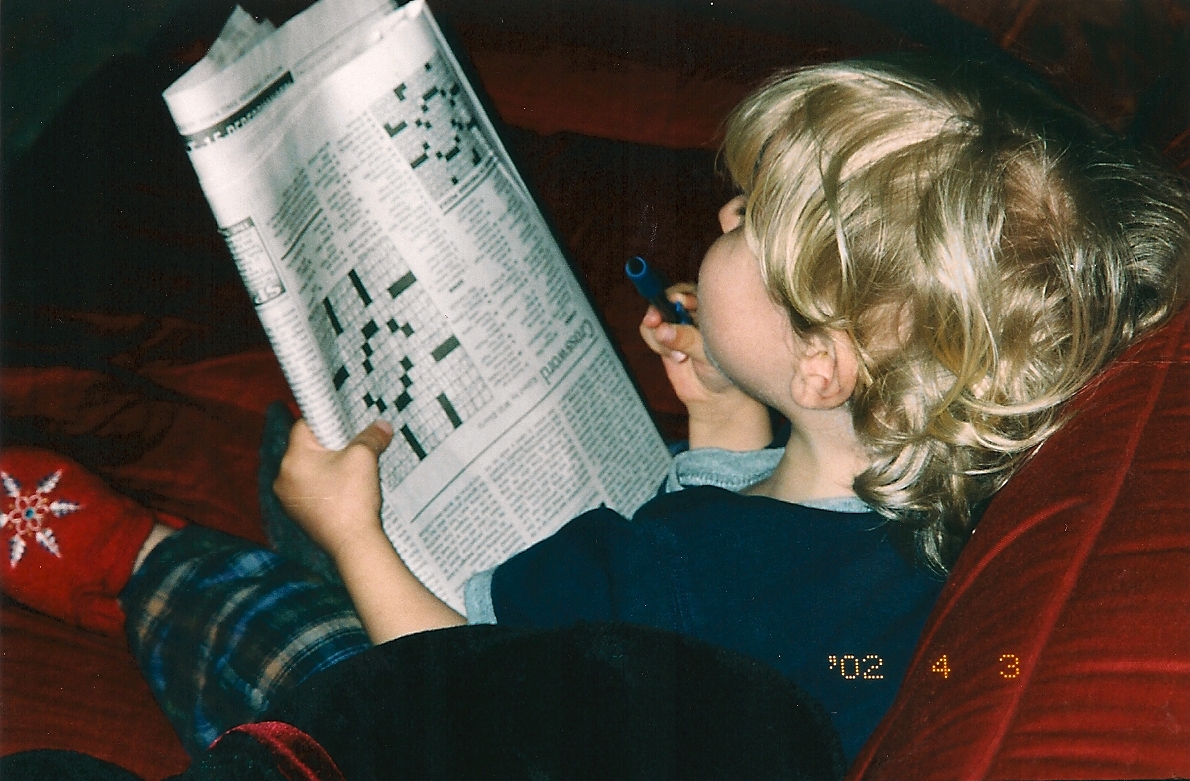
Nic does the NYTimes crossword – April, 2002

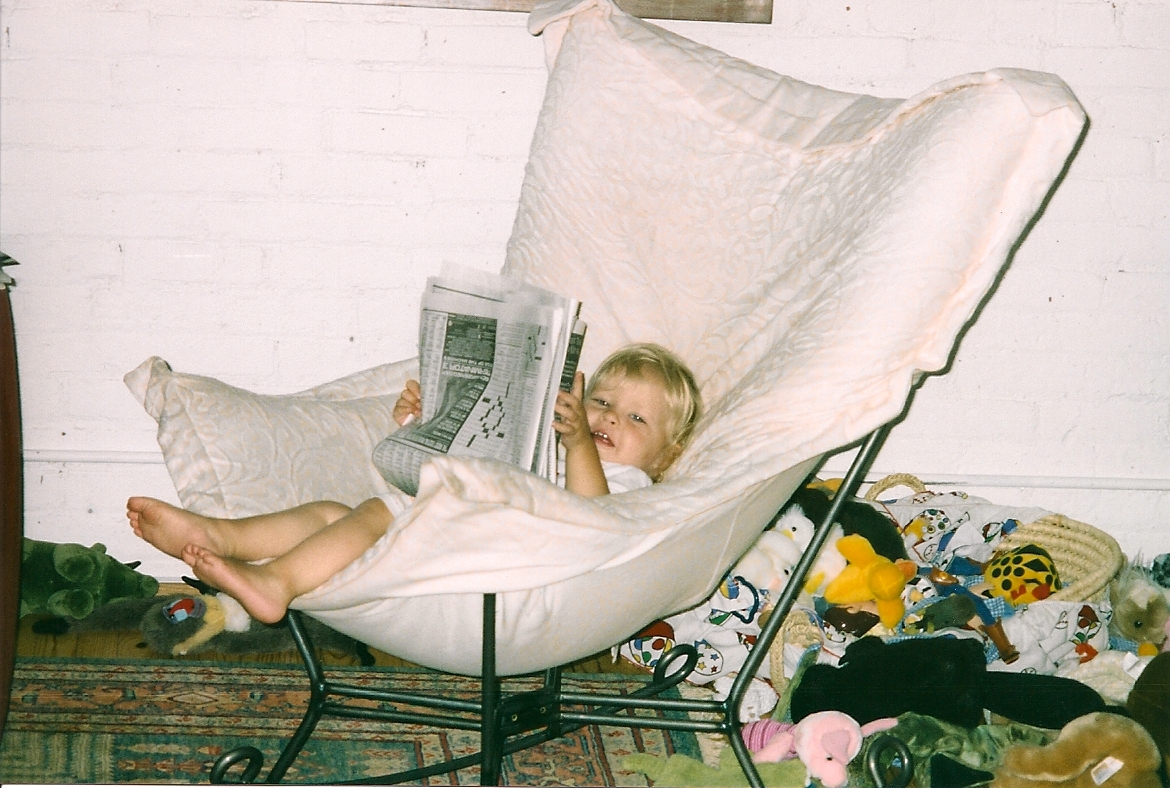
Emma ‘reads’ the NYTimes – 2003

An Ode To Ibby And Her Tiny Grace Notes

My friend Ibby has started her own shiny, new, fabulous blog, called Tiny Grace Notes (AKA Ask An Autistic!  *Doing a little snoopy dance*

This is how Ibby describes her blog:  “The purpose of this blog is specifically so people can ask me things that may not come up on other blogs, which I completely recommend reading.  But let’s say you have a burning desire for the answer to a question that nobody blogs about that week?  Come here and ask it in the comments.  You can do that right now.  I might answer myself, and I might also remember that my friend told me about it a couple months ago, so I could answer from multiple viewpoints in conversation.  Also, I may be able to give you a study about it that isn’t insulting and eugenic and horrible.”

This is how Ibby describes herself:  “I’m an Autistic member of the Community and an education professor…”

Ib is an educator.  She teaches educators.  Not only that, but Ibby is patient, incredibly kind, nonjudgmental and one of the funniest people I’ve ever met.  Seriously.  (I love saying that after saying someone’s funny…)  I know Ibby’s blog will soon have more questions than she’ll have time to give, so I’ve already elbowed my way in there and asked her a question in the comments section!  If you want to ask her something go over there NOW and get in line, because I have a feeling that line is going to get pretty long, pretty quickly!

Just to backtrack a little…  Most of you have heard me talk about Ibby.  We met at a Disability Conference here in New York City where she was presenting last spring.  I wrote about meeting her ‘here‘.  It was one of those magical moments when you meet someone and you just know instantly, you just know there’s an immediate bond, an indescribable feeling of closeness that defies explanation.  That’s what it was like for me when I met Ib.  She flapped, I allowed myself to do a tiny little, tentative bounce on my toes, nothing that would call attention, (I was new to the sensation, had not allowed myself to engage in such behavior since I was a kid, but it felt GREAT!) and we hugged.

After that first meeting we kept in touch.  In fact, we began “talking” aka IMing each other once or twice a week and then we began talking several times a week.  We talked about autism, I asked her if I could ask for advice about Emma and she graciously not only agreed, but patiently explained and re-explained things I found difficult to understand.  Over time we began talking about ourselves more.  I began to talk candidly with Ibby about my guilt over the things  I’d done, the various therapies, the remedies and Ib told me more about her life.  This was a post I wrote after one of our epic conversations.  (I hadn’t asked Ib if it was okay to use her name at that point, so I didn’t.)  We found we had similar senses of humor, we went off on whole riffs together, and I laughed.  I laughed with Ib as I hadn’t laughed in a very long time.  As our friendship grew, so did my hope.  Now, if too many days go by and I haven’t been in touch with Ib I feel a little off, a little melancholy.

All of this is to say, Ibby is rare.  She’s brilliant and really, really smart, which aren’t the same thing.  You can be brilliant, but not very wise.  Ib is both.  So go over to her blog and ask her some questions, because honestly, I can’t think of a better person to go to.

Totally unrelated photo taken by Richard of Em at MOMA

The Joys and Terror of Motorcycle Bubbles

When I went to get my Master’s degree in Creative Writing my favorite class was one in which we spent the entire semester dissecting two paragraphs from Virginia Woolf’s A Room Of One’s Own.   We spent two weeks on ONE sentence!  This was bliss as I’d never completely understood the word before.  Pure bliss.  Needless to say, I was the only student in a class of about 25, who felt this way.  Everyone else grumbled and complained, spoke of their excruciating boredom, many even transferred out of the class.  I couldn’t understand their feelings.  What was NOT to like?

I’m a big fan of the highlighter, so it was with some amusement that I read a note from Emma’s teacher last night, “She enjoys highlighting words at school and this will also help to increase her ability to read sight word vocabulary…”  Her teacher had thoughtfully included an enormous neon yellow highlighter in her binder!  Love that.    If I had a photo of a random page in Douglas Biklen’s book – Autism and the Myth of the Person Alone I would insert it here as almost every page has notations and sentences highlighted.  Such as this one from the chapter, Reflections on Language – Lucy Blackman:  “Birthdays were happy, exciting, chaotic, and connectional with food – the ultimate source of pleasure – so excitement was a birthday party.   But excitement, terror and fury are very similar emotions, so I still scream “birthday party” when expectations are more than I can cope with.”

In Aspen, Colorado where we go several times a year, they have fireworks at the foot of Aspen Mountain on the Fourth of July and again on New Year’s Eve.  Emma both looks forward to the beautiful display and is terrified by the sound they make.  She calls the fireworks “motorcycle bubbles” which is such a wonderfully descriptive phrasing of what she is seeing and hearing.  This idea that “excitement, terror and fury are similar emotions” is not something I’d considered before.  While walking the dogs on the ranch road with Emma, who has then (seemingly) randomly said “motorcycle bubbles”, I’m left wondering why she would say this.  Now I question whether her fear of dogs is similar to the terror/excitement she experiences from the fire works display.   She loves sitting in our neighbor’s house protected from the loud booming sounds, while still being able to see the beautiful colors of light raining down on to the mountain and town below.

Could this also be why she links rain to “motorcycle bubbles”?  Is rain equated with an electrical storm or the “raining” of lights during a firework display?  I can, literally, become lost in this kind of thinking.  I find it fascinating and exciting.  Like Virginia Woolf, whose writing I happen to be a fan of, Emma uses such disparate and surprising words to describe things.  I am reminded of the German word for “skyscraper”, the literal translation, I believe, is “cloud scratcher”.  How fantastic is that?  It’s beautifully descriptive, even poetic.

One of my favorite Cloud Scratchers – The Chrysler Building 

Related articles
Performer, Singer, Mother, Wife, Friend & Autistic – An Interview With Chou Chou

I met Chou Chou last spring when she left a comment on this blog.  She wrote, “I love your writing, and find your darling Emma startlingly like me as a child.  I am a happy, successful, 58 year old autistic woman.  I just wanted to say you and your husband are wonderful parents, and Emma will be fine. She will be wonderful. She is wonderful.” 

 I read her comment a dozen times. I felt indescribable joy and I wept.  I was just beginning to read the writings of Autistic adults and had started, very tentatively, to reach out to a few of them.  Then out of nowhere there was Chou Chou reaching out to me!  I was so excited!  I doubt she could know how much her kind words of encouragement meant to me.  We’ve been in touch ever since.

Chou Chou performing with Doc Scantlin and His Imperial Orchestra

 Tell me about you as a child? 

Boy! Where does one start? I was a very passive baby, and did not react to people, or reach for toys. My mother said I appeared content and able enough, but it was as if she would lose me if she wasn’t careful, as if I would slip away into my own world, forever. Baths seemed to perk me up, so I was given five baths a day, and then played with after baths. My toys were put on strings, so I could look at them, since I wouldn’t play. I would cry for hours, but could also be in total bliss. I was very late talking, almost five, except a few words, and had trouble throughout my youth speaking. I was a toe walker, head banger, and would bite myself. I had a faulty immune system, and was sick constantly. Ear aches, flu, tonsillitis, all the respiratory stuff. My gut was a mess. All one has to do is read your posts on Emma, and that describes what I went through. I did not play with other children, although I would play beside them. I was hypersensitive, and needed much time alone to recharge. I loved nature, art, swimming, especially underwater, and performing. Performing was just like plugging me into an electric socket! I would come alive! My mother realized she could make me connect better by giving me a character to play, and a small script. It has served me well.

When were you diagnosed?

Age three. My mother was the business administrator of a small, prestigious rehabilitative home, named Idylease, in northern New Jersey and the doctor in charge became our family doctor. This was the mid fifties, and he very cutting edge, because of his position at the home. He diagnosed me, much to my mother’s horror and shame. At the time, autism was considered caused by cold mothering, and children were often institutionalized, to protect them from their bad mothers. My mother hid the diagnosis, and began a masterful strategy, that not only got me through school, but made me grow into a competent, happy (if a bit odd) woman. She was a brilliant, wonderful mother.

The word autism was never used. I was called slow, or special, or a late bloomer. It was not until the late 90’s that I was told of this early diagnosis, which was confirmed by my doctor.

Can you talk a bit more about your mothers horror and shame?  Did she believe her parenting caused your Autism?

She did until the day she died. We would have long talks about it, and I would explain, over and over, what a wonderful mother she was, and all the ways she helped me, and I sometimes thought she would “get it”, but she never did. She was a career woman, in an age when that was controversial enough, and had many symptoms of what I now recognize as Aspergers, although she was never diagnosed. She was a mathematical, logical, brilliant, woman, who was loving, but not often in an emotional way, nor was she social. Unfortunately, she interpreted that as her being the “cold mother” that was considered the cause of a child being autistic. This made sense to her, and I was never able to sway her completely, and have her forgive herself for this false accusation. I know she hid my diagnosis for her own sake, as much as mine. She feared the world would see how terrible she was. So, so sad. I adored her, and she did so much right!

How did the diagnosis affect you?

 It did not effect me as much as those around me, once I opened up about it. Yes, it was nice to pinpoint what I was dealing with and to put a stop to years of misdiagnosis, but I already knew who I was, and, like most autist adults, had created a multitude of strategy for getting by in life. The biggest thing was that I could be honest: about why I wouldn’t come to a party, why I had trouble following a conversation, why I would stop mid sentence sometimes, or covered my ears, or twisted my fingers, or had a peculiar way of speaking. It was obvious I was under much stress, and that made people uncomfortable, and made them think I didn’t like them much, I think. Now, I simple speak up when I need to, and politely explain my challenges. Everyone relaxes, and tend to be helpful and kind. Sometimes, it makes people talk to me as if I am a child, but I can quickly nip that in the bud! I often say that what I am dealing with is neurological, not psychological. Don’t get me wrong, I’m as neurotic as anyone else, but my neurological makeup is far different from the vast majority of people. I am no better or worst than any one of the unique people roaming this planet. However, I am, it appears, of a certain somewhat predictable, if varied, ilk. I am an autist, and a happy one, and am coming to realize that there may be others rather like me, younger ones, who could benefit a bit from my becoming part of the conversation. After a lifetime of hiding my differentness, this does not come easy, but I believe there is a responsibility that is mine to accept.

I am an autistic woman. Other than that, I am perfectly normal. Aren’t we all a little strange?

What do you remember of school?  Did you go to a nursery school? 

No. Since nursery and kindergarten were mostly playing, which was hard for me, my mother kept me home until first grade. This was the peak years of the baby boom, and the schools were very, very crowded. I went to parochial school, along with my older sister, brother, and, eventually, my younger sister. I think it is hard for anyone to imagine how overwhelmed the schools were by the boom. There were 72 children in my first grade classroom alone, and there were three first grade classes. It was easy to get lost in the shuffle. School was a horrible, overwhelming blur, and I mostly sat quietly and obey the rules. I am very big on rules! I was always the “slowest” child, never finishing tests, had difficulty speaking, and was pinching and biting myself. During recess, I did not play with others. I would find some detail to focus on, like an ant, or the links in the fence. I had great anxiety and fear at school. Sometimes I wasn’t able to contain it, and I would cry inconsolably. I would be sent to the nurses office, and cry it out, or be sent home. Throughout school, my mother would watch for signs that I was getting overwhelmed, and keep me home, so I could be quiet and recharge. It was easy for her to make excuses, since I was sickly anyway. Usually she would write a note saying I had a gastrointestinal virus. I missed a lot of days at school, either really ill, or with these fictitious viruses.

Were you treated differently?   

Yes. There were no special education classes, but there were groups within the class. I was in the slow group, and given special reading skill projects and tasks. This confused me, because I was a voracious reader at home, beyond my age level. I just couldn’t communicate it, so they thought I couldn’t read. I was protected. My big sister or brother knew they needed to have me tag along, so I didn’t get lost or hurt. It was not considered safe for me to be alone, unless I was in our home or yard. We all just accepted that. I was in my own world, and wouldn’t watch for signs of danger. I was never punished, like the other children, as it would totally destroy me, and I would harm myself. Sometimes my brother and sisters resented that. They would be punished, but my errors would be quietly explained to me. That was all that was necessary. I loved to know the rules.

Did people talk about you in front of you? 

Constantly. I didn’t mind, because, it was easier to listen to the conversation than converse myself. Sometimes, of course, it was frustrating to not be able to express myself. I remember hating cooked carrots. When they were on my dinner plate, I would force myself to eat them first, so they wouldn’t “contaminate” the rest of my meal. My father thought it meant I loved them, and would pile on more. I would burst into tears, wondering why he was torturing me with carrots. Poor guy.

There were, and still are, many times I have difficulty following a conversation. Particularly “small talk”. When I listened to other children, it made no sense to me, but I never felt it was because I was less intelligent. Their bickering and constant competition sounded unintelligent to me. My interests were quiet, and beautiful, to me. Their playing was constant battle.

Do you remember any particular instances when you felt people or other children didnt understand you?

It was a great conspiracy of mine, along with my mother, that I was intelligent, and even talented, but was considered so deficient. I felt that my world, the one I played in alone, was beautiful, and that the other children struggled in meanness and chaos. I did not feel less than them. Because I was quiet and never mean, and most of the neighborhood kids went to our Catholic school, it was decided I was somehow blessed, that I would grow up and be a saint. Perhaps my mother started that rumor. She was awfully clever at protecting me. It kept them from picking on me, as it would be unheard of to harm this holy creature. I was left alone, but guided and protected, and even included. They always tried to involve me in games, but I didn’t do well with them. They were illogical. Sometimes they would invent special roles, so I would be included. If they were playing “war”, they would put me on top of the swing set, like a princess needing rescue, and I would cry, ” Help, save me” over and over, while they wrestled and battled. I would also have some terrible hours of crying, but these I don’t remember well at all, and always forgot they even happened once I recovered. They were not discussed.

Did you have other sensory issues that you were aware of? 

My sensory challenges, without a doubt, were and are, the major issue for me to contend with. I now speak, write, and socialize well, but I experience the world in a much different way, sensorily, than is in the average range. I understand this now, and have devised many way of protecting myself, but I did not understand this when I was younger. I thought everyone experienced life the way I did, but that I was some kind of weak character because I “couldn’t take it”. Sights, sound, smells, emotions, all were overwhelming. My clothes scratched, and I thought digestion, and sometimes even breathing, was a painful process for everyone. I had a headache all my life that I didn’t even know I had, until I had some pain medication as an adult that made it go away. I would bang my head, and had to bounce and rock to fall asleep. I would cry on trips home from anywhere, because being out was overwhelming. I hurt, and the stimulation of the world hurt me. Why was everyone acting just fine? I would pray, and ask for forgiveness, since I somewhat bought the story that I was holy. Wasn’t I supposed to suffer as a saint? Surely, I would die young, after much torture!

Were you able to read and write at the same age as your peers? 

I loved reading, and don’t remember ever not reading, but had great trouble writing, and could not read aloud. There were a lot of monthly magazines in our house, and encyclopedias. I poured through them, and my mother got a subscription for me to a book of the month club. I liked learning a lot, and self education. In school, though, no one knew I could do this, and I lived my role of being a remedial student. The only difference was if I was given something to memorize and perform or recite. It was like a magical trick. I would come alive, so much so, that often I would be taken from class to class, to do my performance over and over, to much applause.

I come from a very intelligent family. My mother was a mathematical genius, and member of Mensa. My brother had a photographic memory, but had a head injury, and was kept back a year in school. From then on, we were in the same grade, but he was considered the smartest kid in class, and I was the slowest. In eight grade, we were given IQ tests, for placement in the high school’s track system. Test was easy, because it involved little writing, and was logical, and solving puzzles, which I was really good at. The  answers were not written, if I remember right. They were just filling in the dots, or one word. I scored the highest in the whole eight grade, even higher than my brother. It was decided I was a bored, shy genius, and I was put in track one, with the brightest students, taking advanced courses in math, Latin, and biology. That was a big mistake. I couldn’t keep up at all! I was “demoted” to track three, out of seven, where the bright, average, most popular student mostly were, and was a terrible student. My brother was made class president, and all the girls wanted to date him, so they were VERY nice to me. I got pretty, so the boys started being VERY nice to me, too, although my big brother kept vigilant guard on the advances of those New Jersey boys.

Was there anything or anyone in particular that helped you when you were young?

Without a doubt, my mother. She always believed in me, and told me I could do anything I set my mind to. When I was sick or struggled, she never for a moment treated me like I was damaged goods in any way. She would treat me with astounding respect for how I tried, and told me I was “tough as a turtle”, and a “late bloomer”. When other family members got frustrated with me, she would say, “You just wait and see. One day she’s going to show everyone what she’s made of”. She taught me to learn on my own, and gave me access to anything that I had interest in, and could do in a quiet, solitary way. She made sure I was included, but allowed me to be separate, and somehow spun it to everyone that it was a positive thing. I never had to be like anyone else. She made me feel I was wonderful as I was, and only had to be the best me, and she convinced everyone else of the same. She had a talk with the toughest bullies in the neighborhood, and made them my, and my brother, when he was injured and small, special bodyguards, to make sure no one bullied us. I don’t know if she paid them, but I wouldn’t be surprised. I remember them swaggering, “Don’t worry, Mrs. Downs, nothin’ gonna happen to them. We’ll make sure of that!”

My mother found that if she dressed me pretty, and gave me small scripts, I could become a character, and connect much better. She told me, in order to get by, to just be quiet, smile, and use my little scripts. I learned to ask questions back, by repeating questions asked to me, and, even though I couldn’t always follow the answer, just respond by saying, “that’s nice”. Usually it worked, but, sometimes they said something sad, and I wouldn’t catch it, and my response would be inappropriate. That still happens sometimes, much to my embarrassment.

My older sister changed my life, in the most astounding way. I didn’t appreciate it at all at the time, but now I do. In high school, she signed me up for drama club, because I performed so well, and was always putting on shows. I was horrified! It was a group activity. I was really scare, but more scared of my big sister, so I did it. I soared, and had the lead in many shows, and I won awards. Through playing characters, I learned to speak, and how to present myself. I went on to become a professional actress and singer, and continue to perform as my livelihood to this day.

Did you ever internalize some of the messages you received from school or others and feel shame?

The internalized negativity I feel has more to do with feeling bad that I am not able to do some things most people find easy. Feeling bad that I let others down, and can’t socialize in a more normal way. I get very frustrated that society keeps adding more sensory challenges that make things LESS accessible all the time! More noise, more flashing lights, more dependence on the value of being socially savvy, and living in a constantly socially connected way. I can no longer watch the news, because there is just so much constantly being added to help keep people’s attention, in the way of sound, visuals and speed. Many places and things are now inaccessible to me, because of the heightened stimuli.

Weve spoken of this privately, but can you talk about feelings of shame or feeling ashamed?

I go through unbearable bouts of illogical shame, although I no longer injure myself. It has nothing to do with self-esteem. I know I am capable, and that I have a great capacity for making people happy. I am a well received entertainer, with many supportive friends and fans. I’m a rather mediocre singer, I’m afraid, but a good entertainer, and can put over a song. I am loved deeply by my husband. The shame shows up most if I’m tired. I will walk onstage, and look at the audience and think, ” who are these wonderful, beautiful, people, and why am I bothering them? It makes me want to apologize for being there. I have to remind myself that they are paying good money to see me, and I need to give them my best. It is not stage fright, which I don’t have in the least. It is shame. I wake up the next morning, drained from giving my all, and am totally ashamed. It is not a feeling like I did a bad job. I can tell that the crowd was happy, and the cheering loud. It is just a horrible, illogical feeling of fright and shame, and this tough turtle pulls into her shell! I then need to hide, for surely I will die of shame, if not allowed to recover quietly. I’m fine in a few hours, and Doc is great at understanding, and can make a joke out of anything. He will squeeze me and say, ” Oh! Are you sooo ashamed? Oh no! Oh, shame on you! Oh, it is so terrible! Oh, SHAME!” We will laugh at how silly it is that I experience this, but we both know it happens, and the best choice is to roll with the punches and laugh at this crazy crossed signal I get. I think we all have our little illogical demons. This is mine. I am not sure if this is an exclusively autistic trait. I do think it should be considered when dealing with problematic self-injury. It is no small thing. There are times in my life I would do just about anything to stop the shame, or punish myself for it, without it having anything at all to do with how things are going. I have learned to make a priority of taking care of myself, and getting enough down time.

The overwhelming shame I feel has nothing to do with internalizing what others did to me. It is just one of those odd signals that come with my particular neurological makeup, like feeling punched by flashing lights, or seeing patterns and colors when I hear music.  We all tend to react to being overextended. I get bowled over by shame that has nothing to do with anything but being in a weakened state. No one causes this. I also can get in euphoric states. That can be a problem because I want to kiss and hug everyone in sight! It’s not sexual, but I just ooze with love, but you can’t go around kissing and hugging everyone who says hello to you at the grocery store!

I am pretty good at recognizing and conquering my internal baggage, and separating it from what is a more neurological manifestation, and I feel this crazy intense shame is more neurological than psychological. If there is any psychological tie-in at all, it would be that at times I am humbled, and may not feel worthy, of all the applause and special treatment I get! As I have said, I am no better or worst than anyone else, and that, above all, must be the message in conquering ableism. We are equal, and not all of us view ourselves as victims. Some of us have had wonderful people helping us, throughout our lives.

From those early days of acting in school plays, did you have a sense of what you wanted to be when you grew up?

There were certainly times when I was growing up when I wanted a life on stage, particularly because I was good at it, and people liked when I did it. I knew I would probably always perform, in some way, but never desired to be a star. It would have destroyed me! When I was a young woman, my faraway, vulnerable, nature was compared quite often to Judy Garland and Marilyn Monroe. As flattering as that was I thought they obviously did not fare too well. What I really wanted was to be an artist, a wife, and a mother, and to someday live in a little cottage by the sea. Life has certainly taken some strange twists and turns, but I have achieved all those things.

I understand I need protection in certain areas of my life, but I also have skills and desirable traits, that can enhance, and even offer a different kind of protection, in trade. I am a good, protective wife, to a good, protective husband. That said, performing is my stock and trade, and a way of making a living that is highly enjoyable, if exhausting! I’ve walked away from it many times, but always find it in my path once again. The more spiritual part of me, for what it’s worth, had to at some point say, “Okay, I’ll do it, as long as you want me to do it.”

Because social connection can be difficult, performing is a way I can connect to a group of people in a structured, rehearsed, really fun way. I adore the spotlight! It blocks so much of the sensory challenges in a room, and allows me to feel, more than see, the audience. It is a way I can party and play with everyone, without small talk, and without that nebulous ” unwritten script”, whatever-the-heck THAT is! I always wind up falling in love with those in attendance, and I adore that! It is not about showing how wonderful I am. It is a way I can remind everyone how wonderful they are and the best part is that Doc and I get to do it together. I am grateful, beyond anyone’s imagination. My mother said I would bloom, and, since I believed it, I did somehow. I am still autistic, but one in full, frenzied, exuberant, ridiculous bloom!

Chou Chou can be seen and heard performing with her husband, Doc Scantlin and his Imperial Palms Orchestra

Air Pressure, Autism and How To Make A Perfect Arnold Palmer

Em has a cold.  When Em has a cold it’s stressful to her.  She repeatedly holds her nose and blows, despite being told this will not reduce the pressure she feels in her head, she does it anyway.  Maybe it momentarily does release the pressure and that’s why she keeps doing it.  I don’t know.  What I do know is that having a cold along with a change in air pressure causes her tremendous discomfort and pain.  A friend of mine, who is also Autistic told me her head feels as though it’s going to explode when the air pressure changes.  She told me it’s so excruciatingly painful she loses the ability to speak.

While I do not share in Em’s pain due to the barometric pressure, I did manage to throw my back out Friday afternoon.  No this is not going to be a “woe is me” post, I promise.  I could barely walk on Saturday and so Richard, being the all around amazing, wonderful, practically perfect guy that he is, took Em to the Metropolitan Museum of Art, ending with the Natural History Museum where they played an extended elevator game. (Emma rides the glass elevator in the biolife section where an enormous whale is suspended from the ceiling and a video plays on a massive screen showing the beauty of the ocean and the slow, march towards its inevitable death because of mankind’s negligence and refusal to take responsibility, while Richard pops into view and pretends to scream, and Emma, safely cocooned inside the moving glass elevator hysterically laughs.)  This game can go on for a very long time.  Thankfully Emma was NOT slowed down by her cold or the pain caused by the air pressure.

By the time they returned home I was able to hobble up to the roof with Em where she insisted on wearing this outfit.  It’s a new take on the standard knight costume, a kind of King Arthur’s knight meets one of the witches from Macbeth.  Personally I think it totally works and can we all take a moment and admire Emma’s pose.  (No.  I did not set this up.  She saw the camera and struck a pose unprompted..)

Last night, having spent yet another jam-packed day going to MOMA and (yes again) to the Natural History Museum with her awesome dad, Emma’s cold had worsened only slightly and my back had not improved.  “You two are quite the pair,” Richard observed as I hobbled over to Em’s bedroom, carrying my iPad, while making (almost inaudible) groaning noises.

“I’m going to read to her and then it’s zombie time,” I warned him.  Lest any of you conclude this is referring to some form of kinky foreplay specific to Richard and me, let me dispense with this notion.  It’s not.  We are catching up on season two of the series ‘The Walking Dead’, which Richard has tried to get me to watch for about six months.  Given my weakened state I finally gave in and found I rather enjoyed it.  Lots of zombies, end of the world as we know it, great non-zombie characters and it’s only while watching a zombie show that one can truly appreciate the following conversation: “That was totally unrealistic!  Zombies can’t move that quickly.”  Or “Gross.  How can a zombie have that much blood in their skull?”  Or  “So, wait… they eat humans?  But how are there so many of them?  I mean are the zombies basically left-overs?  Why would they just bite one human and devour another, seriously I don’t get it…”

And then, as though this might explain everything, Richard asked, “Want to go back and start from the first episode?  You’ve missed a lot.”

“No.  That’s okay.  Just keep filling me in.”

So when I was jolted awake at 3:45AM by a body (Emma’s) lying practically on top of me, I just rolled over in a zombie induced state of undead exhaustion.  I heard Richard get up and take her back to her bedroom and ten minutes after he returned to our bed, having immediately fallen back asleep, I heard Emma crying.

I grimaced in pain as I made my way to her bedroom where she had the lights on and was whimpering “Mommy come.  Ears popping.  Go see Mommy nurse.”

“Oh Emmy.  I’m sorry.  Want me to lie down with you for a little while?”

“Mommy stay.”

I promptly fell asleep only to be abruptly awoken, a few hours later when my face hit the floor, having fallen out of bed, either that or Emma pushed me in an attempt to gain a few more inches of room on her twin bed.  In a dazed state I slowly stood up and found, much to my surprise, my back felt fine!

“I think falling out of Em’s bed this morning made my back better,” I announced to Richard as we got breakfast for the children.

“Really?” he said.   Then he added, “Cheaper than a chiropractor.”

“And not as painful as a zombie bite.”

As an added plus, Emma seemed to feel much better this morning too!

Lest anyone accuse me of ‘making lemonade from lemons’, I need to add that I was voted, “Most Negative” in high school, a high school, by the way, of over 3,000 students.  Just sayin’… Plus, I don’t much care for lemonade, unless it’s in an Arnold Palmer and even then limeade is preferable.

The Perfect Arnold Palmer

Fill two-thirds of a glass with brewed, cooled English Breakfast Tea, add Limeade and a splash of Cran-Raspberry juice, garnish with a sprig of fresh mint. Voila! 

Related articles