Tag Archives: language

A Conversation with Paula Durbin-Westby

You’ve described yourself as a “nonspeaking (at times) Autistic.

“Yes, I think the phrase “nonspeaking at times” captures my experience, and also that of others who do have speech capabilities but can’t always access them. Because one can speak at times does not mean that speech is a reliable form of communication for that person. Also, when someone can speak some of the time, others may not notice that they are having trouble speaking. I have sometimes not been able to speak and other people just thought I was “being quiet” or did not have anything to say; that dates back to childhood.”

Why did you make a video of you not speaking?

“I made the video because we need to change some of the ideas about “high functioning” and “low functioning” Autistics.  Not being able to speak is equated with “low functioning”.  A constellation of characteristics are said to be true of only “LF” people, such as self-injurious behavior, toileting difficulties, and not being able to speak or having limited speech, while “HF” people are said to have another set of characteristics, also fairly stereotypical, such as being “geniuses” who are good at computer programming and lack empathy.  These binary divisions don’t address the wide variety and range of characteristics of Autistic people, and paint a limited picture of individual Autistics, many of whom defy (not necessarily on purpose!) the expectations surrounding their “end” of the autism spectrum.  I have always known I can’t speak on a regular basis, but the conversations about “nonverbal” people assume that I have a different experience when in fact it’s not so different at all.”

Can you talk about how and why you sometimes are unable to speak?

 “I can’t say I speak “most of the time,” since most of my waking hours are not spent talking.  I showed on my video, even when I am alone, I frequently can’t talk. I don’t need to talk at those times, but I am very aware that if I were suddenly presented with a situation in which I needed to talk, I would not be able to. I am, however, usually able to make what some Autistics have called “speech sounds,” which means that I can say something, even if it is not exactly what wanted to say. I have a number of reasons for not being able to speak at any given time. I distinguish between not being able to talk at all and having trouble with word finding, which does not make me lose speech, but can have some interesting results when I find a word that is not the right one!  I can go “in and out of speech” several times during the course of a day.

The following list has some of my reasons for not being able to talk. These are not in any particular order: Sensory overload, being tired, reading or seeing something disturbing, thinking more in visual images than in words, trying to talk when other people are talking too fast and not taking turns‒which is not limited to the autism spectrum, although a lot of literature exists about teaching us to take turns. Some of that teaching is necessary, but I think it should be introduced to non-autistics as well!”

Are there other things that stop you from being able to talk?

Another thing that will stop me from being able to talk is to have big chunks of time where I am not talking because I am mostly alone, like when my son spends the weekend with his dad. After a weekend spent primarily not talking, I am not used to it and have trouble getting started again. It does not take more than half a day of not talking before I need to urge myself to take it up again. It’s the inertia of not doing it, plus I have to remind myself, consciously, of how to move my muscles (mouth, lips, larynx) and intentionally will myself to speak, which does not always work. Sometimes my son will ask me “Mommy, are you having a hard time talking?” and if I manage to say “Yes,”  I  am able to start talking again, although I can have a hard time formulating sentences and finding words for a bit.”

Of all the items on the list, which ones affect you the most?

“The thing that will stop me cold, suddenly switching from being able to speak to not being able to utter a word is seeing, reading, or hearing something that is disturbing. I write indexes for nonfiction books. Some of them have very graphic descriptions of things like genocide or war. I did my “make myself talk experiment” on a day when I was using voice recognition software to do data entry for a book that had ten chapters of very disturbing material. I used VRS a lot at that time to save my wrists and fingers for playing the organ. Since I am a visual thinker, not only was I reading it, but also seeing it in my mind, like an awful movie that I did not want to watch,. I found myself typing instead of dictating, and realized I had been doing so for maybe half an hour. I said to myself, “Why did I switch to typing?! I don’t want to be typing!” and my experiment was underway. I spent the next two hours trying to make myself talk, with no success. I was online at the time, so was typing to people telling them about the experiment. Some of them were a bit concerned that I was trying to force myself to talk when I couldn’t, but I needed to find out if I would be able to talk if I tried really hard.  My answer was provided after two hours, in the form of a small squeak. That’s the only sound I could make after all that trying. I had two realizations as I finally ended my experiment, still not able to talk except for that squeak. The first was that it reminded me of when I had an epidural for a procedure and tried (yet another!) experiment to see if I could wiggle my toe. The doctor got “mad” at me and told me I was actually wasting physical energy I would need to recover from the procedure. I had the same feeling of exhaustion from trying to make myself speak. The other thing I realized is that maybe I should be carrying an autism card with me in case I was at the scene of something upsetting, like an accident or crime, and could not talk to first responders. Some things that I find disturbing and thus making me not able to talk are not that dramatic. It can be someone saying something that I did not expect them to say (not limited to “bad” things) or anything unexpected or surprising.”

What are your earliest experiences of not being able to speak?

“When I was a child, there were many times when I could not speak. I think very early on, I was not very aware that I could not talk at times; I simply did not talk when I couldn’t. I definitely spent a lot of time looking at things like dust motes in the air and the thread on my blanket and other tiny little interesting things; I have no idea if anyone tried to talk to me and got a response, how fast a response they got, and whether or not I was conscious that I wanted to say something but couldn’t. In later childhood I was more aware that I was both not speaking and wishing I was. I attributed loss of speech to being “shy,” and was angry at myself for being that way. I spent quite a few decades having times of not being able to speak, including the entire day once, and being angry at myself for not being more “brave.” Reasons include some social ones, such as being afraid of another person for whatever reason, feeling “on the spot,” having a particularly anxious day, people interrupting me. I think people were not aware they were interrupting me, as my speech was so tentative. Other reasons include being tired, having more visual thinking and not the accompanying language-based thinking, since my thinking is visual with an audio soundtrack and the soundtrack sometimes drops out for whatever reason. Sometimes the lighting or the color green will render me speechless. I love green! It is very mesmerizing! It often makes me unable or disinterested in speaking, especially the green of a large field of grass. Eeeeeeee!!!!!”

When did your views regarding your inability to speak at times change?

“After I learned about autism, I started thinking more about the reasons I lost speech.  I met people who either could not talk at all, could not always reliably access speech (like me!), stuttered (like me, again), had trouble finding words, or had to say other words, circling around until the right one was selected, such as one of the “big words” I used to get teased about in school.

One of my ongoing word-choice problems is “French toast.” Early in the morning, I can’t think of “French toast,” for some reason. I ask my son if he wants “Um, um, um, um, …. uh… (then I draw a square shape in the air, since I can see the French toast clearly in my mind) … um, square things!…. French toast!” Since my son now knows that “square things” means French toast, sometimes we just stop at “square things” and he says yes or he will say, “Mommy, I want square things!” and we laugh and I make the French toast.”

Does it trouble your son that you can’t talk at times, or have trouble saying what you mean?

“My son is very good at talking about things he doesn’t like, but I don’t assume that he would feel entirely comfortable directly telling me things he doesn’t like about me. The things he does say indicate support rather than discomfort. A few times I have been annoyed at myself for stuttering and he says “Mommy! Don’t ever be mad at yourself for stuttering!” or, a few times, “Mommy. Stuttering. It’s a way of life.” I don’t not-communicate with him, so he does not feel ignored. I use alternative ways of communicating with him, just not talking. I write, point, use some of my extremely limited repertoire of ASL signs. I once was writing to him about what to wear to church and he wrote back “Yes, mother dearest!” He (as is true of most people I write to) matches my communication mode and writes back. I have written to him (and to others) “You don’t have to write to me; I can hear you!” He has noticed, and told me, that when he comes back from visiting his dad I “seem different.” We have talked about his coming back as a transition point- the house is suddenly noisier, and definitely “talkier.” I have often said that my child talks to think, so we are quite different in that way. I am working on what would make the transition from “kid gone” to “kid in the house” an easier one for both of us.”

 For people who do not have difficulty speaking, they may have trouble understanding how someone might be able to speak in one situation and then not able to in another.  Can you talk more about this?

“Some abilities are not there every single time a person wants to access them. This is true for all people, but for an Autistic person, these fluctuations in abilities and access to abilities might be more pronounced. If I don’t play the organ almost every day, it’s almost like I forget how to play it. That’s why I always practice on Saturday night and Sunday morning before church. There is no way I can go in there cold and play like I want to. Think of something like delivering a presentation. For most typical people, there will be good days and bad days, presentations you wish you could do over, and days when you were really “on your game.” Or, think of your favorite sports team and player. Some games are not so good; other games the team really does well. But playing the organ or hitting a home run is not an essential life skill (ballplayers  and organists feel free to disagree!). But when it comes to anything considered really basic, like being able to talk, a sense of mystery surrounds the topic, when a person can do it one time and not another. I maintain that it’s not that different anything else, but is more noticeable and pronounced when it’s something that is expected of everyone, and when one can do that “expected thing” most of the time. Maybe for some of us talking is an extreme sport, in the sense of having to really work, practice, try hard, take risks, and think consciously about what we are doing, whereas for some people the ability to talk is very natural and not even a conscious effort.”

 Talk about the idea of language and thinking.

“I have read more than one author who opines that without language there is no thought. Nothing could be farther from the truth. Language includes both written and spoken words, as well as picture-based communication systems like PECS. Not talking (and also not writing) does not equate with “not being able to think,” “being lost in an unknown world” or anything other than specifically not being able to talk.  For some people it could mean a lack of focus on “the present moment” (how many people are fully present in each moment anyway?!) or not being able to think in words, which is another one of my reasons for not talking.  But it is not, generally speaking, accurate to assume that because someone can’t talk, they can’t think.  You wouldn’t look at someone who has a tracheostomy tube and go “Oh wow.  That person can’t think!”

What is it like when you’re unable to speak while in public and are expected to? 

“It’s a bit nerve-wracking, but only in situations where people do not know me well and are expecting that I can speak like a non-autistic person. I try to anticipate what I will need to be able to communicate at those times but I can’t always build in my own supports. When I am with friends, it’s no big deal if I can’t talk or can’t talk much. In work situations it’s more difficult for me to feel calm about it. Unfortunately this expectation is not limited to people who don’t know much about disabilities, so that I have had to really struggle at autism-related events where there really aren’t accommodations for Autistic ways of communicating. It’s an ongoing process for nondisabled people to learn about communication differences and to anticipate them so that Autistics and other people with communication disabilities aren’t doing most or all of the work to create our own accommodations.”

How do people react to you?

Really, I mostly don’t get reactions, because often the times that I can’t speak coincide with the other person continuing to talk, maybe because they think I don’t have anything to say, or that they are like “Well, if she’s not going to talk, I will!” I do get all kinds of reactions, from total acceptance to “you could if you wanted to- try harder” kind of thing that made me feel sad when I was making the video. Sometimes people don’t believe me when I say (in speech or writing!) that I have trouble talking. I have to be very clear that I mean not being able to talk at all. I have learned that “trouble talking” might mean not saying the right thing, or stage fright, and “I can’t talk right now” can mean “I am too busy to deal with you” rather than that I literally an unable to speak with words coming out of my mouth! I have had a few mixups when people did not know I meant “I can’t talk right now” very literally. Sometimes people just don’t quite believe me and think I am making it up. I am not sure why they would think I would go to that much trouble! There are also people who have never heard me stutter, who think that I don’t, even though I tell them I do. They are going to get treated to another video in a few weeks! I was finally able to capture myself stuttering at a time when I also had the webcam with me.”

Are there things that help you speak after a period of not speaking?

“I mostly just have to wait. I don’t particularly want to talk a lot, but I need to. It’s just one of those things that is expected, and it is expected that if I can do it some of the time, I can do it all of the time.  It might seem that someone who can speak but loses speech at times would want to find ways to prevent speech loss, but I often welcome not being able to talk.  It gives me a break from the exhausting task of speech production.  My idea of the perfect conversation and this is ideal for a number of my Autistic friends, too, is two laptops or mobile devices or text-based equipment, but we can be in the same room together writing to one another. I don’t get a lot of this because I live in a rural area and most of the people I write to are long-distance. Some friends locally are very accepting but we don’t have any alternative setup other than me scribbling on paper. I also get way overloaded by hearing other people talk, as it challenges my auditory processing abilities and I can only take so much talking. If other people, whether or not they can speak, would type to me, I think I could get a lot more accomplished with the interaction with that person. Or, at least I think I could. If writing is not that person’s strongest form of communication, it will be a limit for that person. We should not be expected to always accommodate “talkers” and not the other way around. But it does take extra effort on my part because people can’t tell just from looking at me that I am a person who sometimes can’t access speech.

Ideally, we could take turns using each person’s communication strengths and weaknesses, assuming we are able to do that much. Of course, sometimes it just won’t work.”

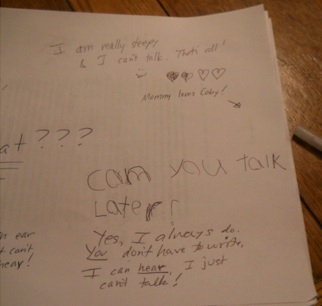
Paula and her son’s writing


To read Paula’s blog, go to Paula Durbin-Westby Autistic Blog

Related articles

The Joys and Terror of Motorcycle Bubbles

When I went to get my Master’s degree in Creative Writing my favorite class was one in which we spent the entire semester dissecting two paragraphs from Virginia Woolf’s A Room Of One’s Own.   We spent two weeks on ONE sentence!  This was bliss as I’d never completely understood the word before.  Pure bliss.  Needless to say, I was the only student in a class of about 25, who felt this way.  Everyone else grumbled and complained, spoke of their excruciating boredom, many even transferred out of the class.  I couldn’t understand their feelings.  What was NOT to like?

I’m a big fan of the highlighter, so it was with some amusement that I read a note from Emma’s teacher last night, “She enjoys highlighting words at school and this will also help to increase her ability to read sight word vocabulary…”  Her teacher had thoughtfully included an enormous neon yellow highlighter in her binder!  Love that.    If I had a photo of a random page in Douglas Biklen’s book – Autism and the Myth of the Person Alone I would insert it here as almost every page has notations and sentences highlighted.  Such as this one from the chapter, Reflections on Language – Lucy Blackman:  “Birthdays were happy, exciting, chaotic, and connectional with food – the ultimate source of pleasure – so excitement was a birthday party.   But excitement, terror and fury are very similar emotions, so I still scream “birthday party” when expectations are more than I can cope with.”

In Aspen, Colorado where we go several times a year, they have fireworks at the foot of Aspen Mountain on the Fourth of July and again on New Year’s Eve.  Emma both looks forward to the beautiful display and is terrified by the sound they make.  She calls the fireworks “motorcycle bubbles” which is such a wonderfully descriptive phrasing of what she is seeing and hearing.  This idea that “excitement, terror and fury are similar emotions” is not something I’d considered before.  While walking the dogs on the ranch road with Emma, who has then (seemingly) randomly said “motorcycle bubbles”, I’m left wondering why she would say this.  Now I question whether her fear of dogs is similar to the terror/excitement she experiences from the fire works display.   She loves sitting in our neighbor’s house protected from the loud booming sounds, while still being able to see the beautiful colors of light raining down on to the mountain and town below.

Could this also be why she links rain to “motorcycle bubbles”?  Is rain equated with an electrical storm or the “raining” of lights during a firework display?  I can, literally, become lost in this kind of thinking.  I find it fascinating and exciting.  Like Virginia Woolf, whose writing I happen to be a fan of, Emma uses such disparate and surprising words to describe things.  I am reminded of the German word for “skyscraper”, the literal translation, I believe, is “cloud scratcher”.  How fantastic is that?  It’s beautifully descriptive, even poetic.

One of my favorite Cloud Scratchers – The Chrysler Building 

Related articles

The Art of Negotiating – Get Them to Beg

“Go to Natural History Museum with just Daddy,” Emma announced this morning.

Because of the Jewish New Year it’s a four-day weekend.  Richard took Em to the museum yesterday.  Today is my turn to hang out with Em, while Richard spends the day with Nic and his friend Masiah.

“I know you do love going to the Natural History Museum with Daddy,” Em said as I came over to her.

“But Em, I’m going to spend the day with you.  What do you want to do with me?”

“Emma loves Natural History Museum with Daddy.  But they wants Museum of Natural History with Mommy.  I love playing elevator game with Daddy.  Emma loves BioLife.  Emma loves…”

“Em, what do you want to do with me?  Daddy’s staying home today.  I can take you to the Natural History museum.  Is that what you want to do?”

“Go to Toys R Us with Mommy, then Natural History Museum with Daddy!”

“No Em.  It’s just you,” I pointed at her, “and me today,” I pointed to me.  “What should we do today?”

Emma whispered, “Go with Daddy!  Oh I know you want to go with Daddy.  Say bye-bye Mommy!”  Then Em made fish lips at me.  Meaning she puckered her lips together and pretended to be a fish.  This is what she does when she really, really wants us to acquiesce.

I began laughing.  “Em.  I will take you anywhere.  Anywhere you want to go.  I’ll ask Daddy to explain the elevator game so we can play it together.  Or you can show me how.”

“Go with Daddy,” Emma said very quickly and in a mischievous voice.  Then she whispered again, “Daddy, Daddy, Daddy, just Daddy!”

So I sidled up to her and whispered back, “Emmy.  Can I take you to the Natural History Museum?  Just you and me?  Please?”

Emma grinned and nodded her head.  “Okay, okay!”

When both the children were toddlers I took them to the Natural History Museum every single day, one memorable day we even went twice.  After a few years of this, I announced to Richard, “I hope never to set foot in that museum again.”

“Uh-huh,” Richard said.

“Ever.  Seriously.”

“Yeah.  Got it,” Richard answered.

“Never.  For the rest of my life.”

“OKAY!  I hear you,” Richard said with a touch of annoyance.

So for the last few years Richard has taken Em whenever she has asked to go.  I think I’ve gone once, maybe twice in the last several years.  That I now find myself  literally begging, BEGGING Emma to take her, is just another example of Emma’s brilliant negotiating skills.

If Emma ever loses interest in being a singer, I feel confident she will find any number of career options available to her… diplomat, anyone?

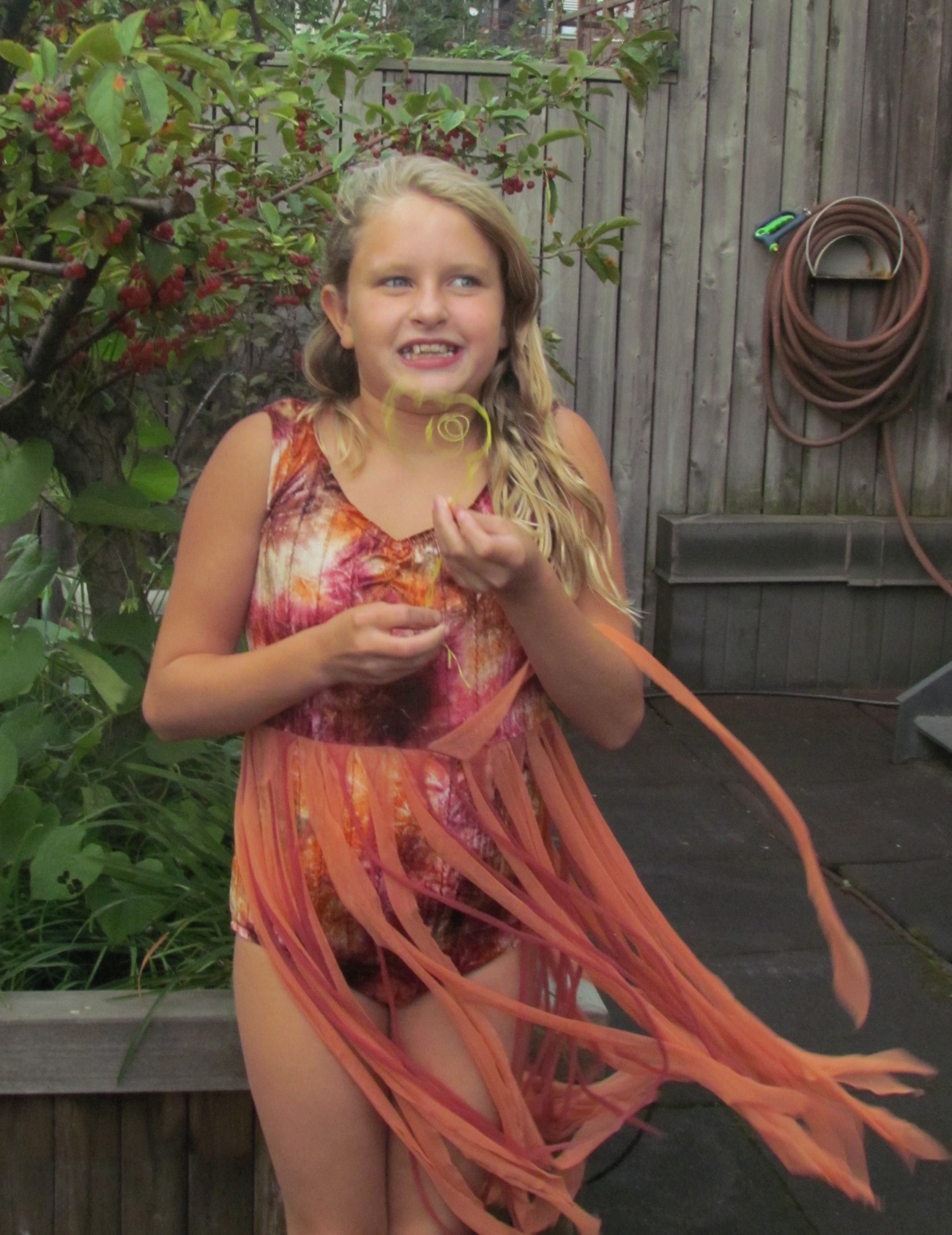
Emma – Autumnal Fairy

Related articles

Belly Go Bang-Bang

We are flying back to New York today.  Last night as I was packing Emma called out for me.  “Mommy!  Mommy!”  Em has only just begun to do this – call our name if she wants us or is wondering where we are.  It’s such a small thing, but every time she does it, my heart skips a beat.  I’ve even caught myself holding my breath, waiting to see if she’ll do it again.  It brings me such joy.  “Mommy!”  she called, then waited to hear my answer.  “Hey Em!  I’m downstairs!” I called to her.  “Mommy’s downstairs,” I could hear her saying as she came down to find me.  (Another interruption. I know, but I can’t help it.)  The fact that Emma came downstairs to find me is another thing that is fairly new.  I could hear her footsteps coming down the stairs.  “Have to go see Mommy nurse,” Emma said as she plopped into a chair near me.

“Oh no Em.  What’s wrong?”

“Belly go bang-bang,” Emma said, bending over and holding her stomach.  (This is what Em typically says when she’s about to throw up.)  “You cannot punch.  Have to go to the hospital.  Go see hospital nurse.”

I looked at her and went through the following thought process – Oh shit.  Could it be her appendix?  What side is she holding?  No, she’s holding the middle of her stomach, this can’t be her appendix, but what if it’s something serious?  An ulcer, a tumor?  Em doesn’t usually complain about aches and pains unless it’s serious.  I then calculated how long it would take to drive her to the hospital, how long we would have to wait, how long it would take to get an x-ray, and then see an actual doctor to tell us the results…  Finally having run through the entire scenario I decided I needed more information.  

“Em.  Where does it hurt exactly?”

She pointed to the middle of her stomach.  “Hurts here.  Emma’s sick.  Take temperature?”  I felt her forehead, which felt fine.  “I’m cold.  Emma has to stay home.” She wrapped her arms around herself and then said, “Emma can’t go to new school.”  She frowned and pouted, while nodding her head.  “I know, I know.  Emma’s sick.  Emma has to stay home with Mommy.”

“Oh Emmy.”  I reached my arms out to her.  She came over to me and rested her head on my shoulder.  “I know.  Emma doesn’t feel well,” she said.

Just as she said this Richard’s voice could be heard calling out, “Hey Em!  Want to go for a ride on the 4-Wheeler?”

Em jumped up from the chair and called back, “Yes!”  Then raced out the door and bounded up the stairs.

Anxiety.  Stress.  Fear.  And that’s just what I’m feeling…  For Em it’s got to be even more complicated.

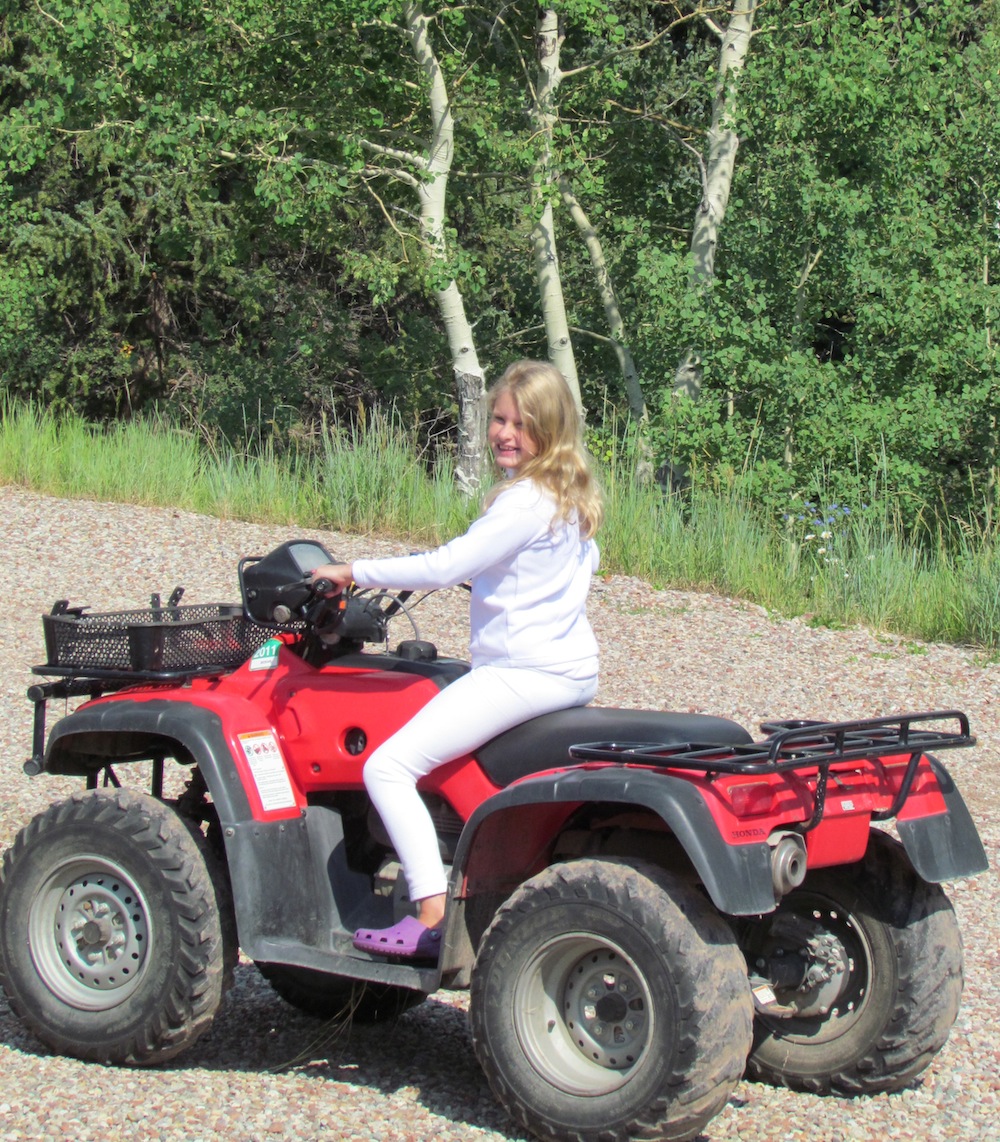
Em on the 4-wheeler

A Conversation in the Car

Because Em has just brought in the timer and set it for ten minutes, this will be quick!  Kind of like speed posting.  (Post on Markram interview will have to wait yet another day!)

I posted the following conversation on Emma’s Hope Book page on Facebook last night.

Driving home from the swimming pool. Nic and Em in the back seat. 

Nic: Em stop it.

Em: Cha, cha, cha

Nic: Mom! Make her stop. She’s doing that just because she knows how much it annoys me!

Em: Cha, Cha, Cha

Me: Turning around to monitor the situation  Okay, Em. What are you doing?

Nic: She’s trying to bug me!

Em: Grinning  Cha, cha, chocolate milk!

Me: Oh my god, that’s hilarious. Richard! Putting my hand on Richard’s shoulder.  Did you hear that?

Richard: What? What happened?  Looks in rearview mirror.

Em: Laughing  Cha, cha, cha, chocolate milk

Nic: She just changed it so you guys wouldn’t make her stop!

Em: Leaning toward Nic, gets right in his face  Cha, cha, cha, chocolate milk!

Nic & Em begin laughing hysterically.

Not only was the above conversation noteworthy because this type of interaction between Nic and Emma is not typical, but it was also worth mentioning because of Em’s increased interest in word play.  I see this in her desire to play Duck, Duck, Goose where she comes up with different word associations.  Sometimes, as in the case of “China boat, china boat, ocean!”  I’m not clear what the word association is, but I no longer doubt that there is one.

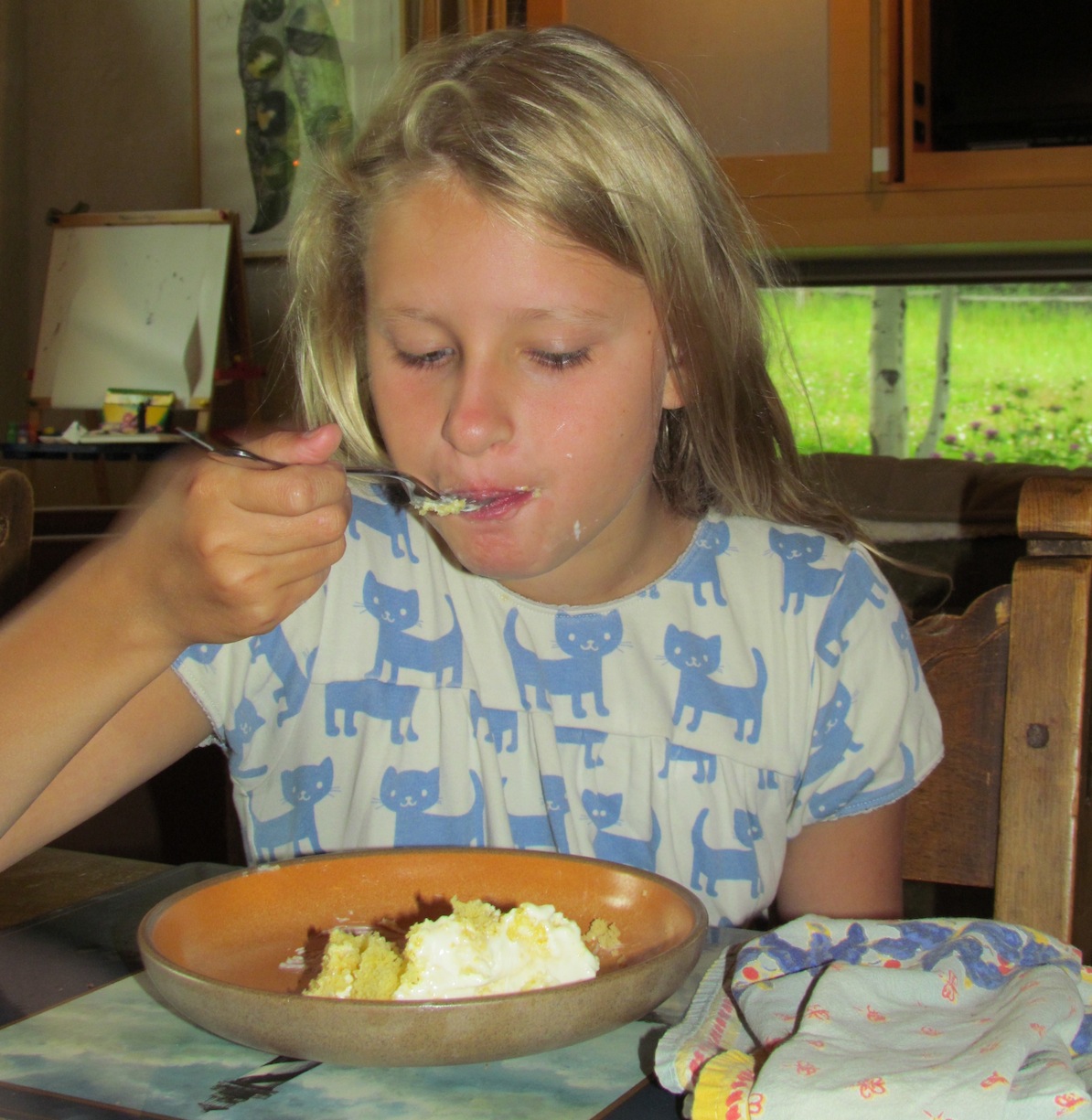
Emma eating her cake

Cloud cover over the Rockies

Walter and friends

Paul

Emma Takes Mom on An Awesome Adventure

Yesterday Em asked to go to Victoria Gardens, the amusement park, that each summer transforms the ice skating rink  in Central Park into a kid’s idea of heaven.  “Sure, that’s a good idea,” I told her.
“Take the F train,” Emma announced and began to walk purposefully toward Sixth Avenue.  “But the F doesn’t take us to Columbus Circle.  Why don’t we take the 1?”  “Take the F train,” Emma said matter-of-factly and continued walking toward Sixth.   Once on the train Emma found a single vacant seat in the crowded car and said, “Oh no!  There’s no seat for Mommy!  Mommy has to stand.”  The man sitting next to her immediately got up with a guilty expression and offered me his seat.  “Oh no, that’s alright.  It’s no problem,” I tried to assure him.  But he refused to sit back down, further humiliated, no doubt, by Emma’s interjection of “Oh Mommy cannot sit down next to Emma!”  (Clever girl, I thought to myself, and I’ll admit, with a tiny bit of pride.)  Even though that poor man who gave up his seat had no way of knowing that Emma actually prefers I stand and not sit next to her.  It’s become something of a game, with Em saying in a pretend sad voice, “Oh no!” but then when I sit next to her she pushes me or tries to get me to sit across from her.   (Making me all the more determined to get Emma some theatre training.)

When the train pulled up to Rockefeller Center Emma stood up and said, “Have to take the D train.”  I know enough not to argue with Emma because there are a number of things Emma knows better than anyone and one of them is how to navigate the labyrinthine maze that is the New York City subway system.  Except that when we arrived at Columbus Circle Emma stayed put.  “Hey don’t you want to go to Victoria Gardens?” I asked.  Emma grinned at me and said, “Go fast!”  Then she shook her head and said, “Train goes fast, fast, fast?”

“You want to stay on the train?”

“Yes!”  Emma said.  So we did.  As we sped past each stop Emma shouted out, like the seasoned guide that she is, a specific playground or significant landmark.  “Oh, there’s the American Museum of Natural History!  Oh there’s the tar playground! Oh there’s the …”  We raced along until 125th Street where Emma then led me off the train and walked over to the tracks heading back downtown.  “Where to now Em?”  I asked, having decided after we left the house that Em was going to direct the day, I was very much the passenger along for the ride.  And what a ride it turned out to be.

We eventually made it to Victoria Gardens, but not before we stopped at another large playground and ran through various sprinklers, went through a tunnel, listened to a musician playing his Saxophone, past the artist who’d set up shop  face painting small children to look like fairies, goblins and ghouls.

After several hours at Victoria Gardens we took more trains downtown, transferring so many times I can no longer keep our route in my head, but ending at Seal Park where I ran into one of my close girlfriends and her son.  Another hour and then Em said, “Now go to Chelsea Market!”   Off we went, with Emma lacing her arm through mine and occasionally she’d press her soft cheek against my upper arm.  Emma talked about the new school she will be attending in the fall, she listed all her friends, teachers and therapists, “Justus is gone, Sol is gone, Charlie is gone, Lauren is gone, Miriam is gone.  Emma goes to new school!”  (I’ll write a separate post about that another day.)

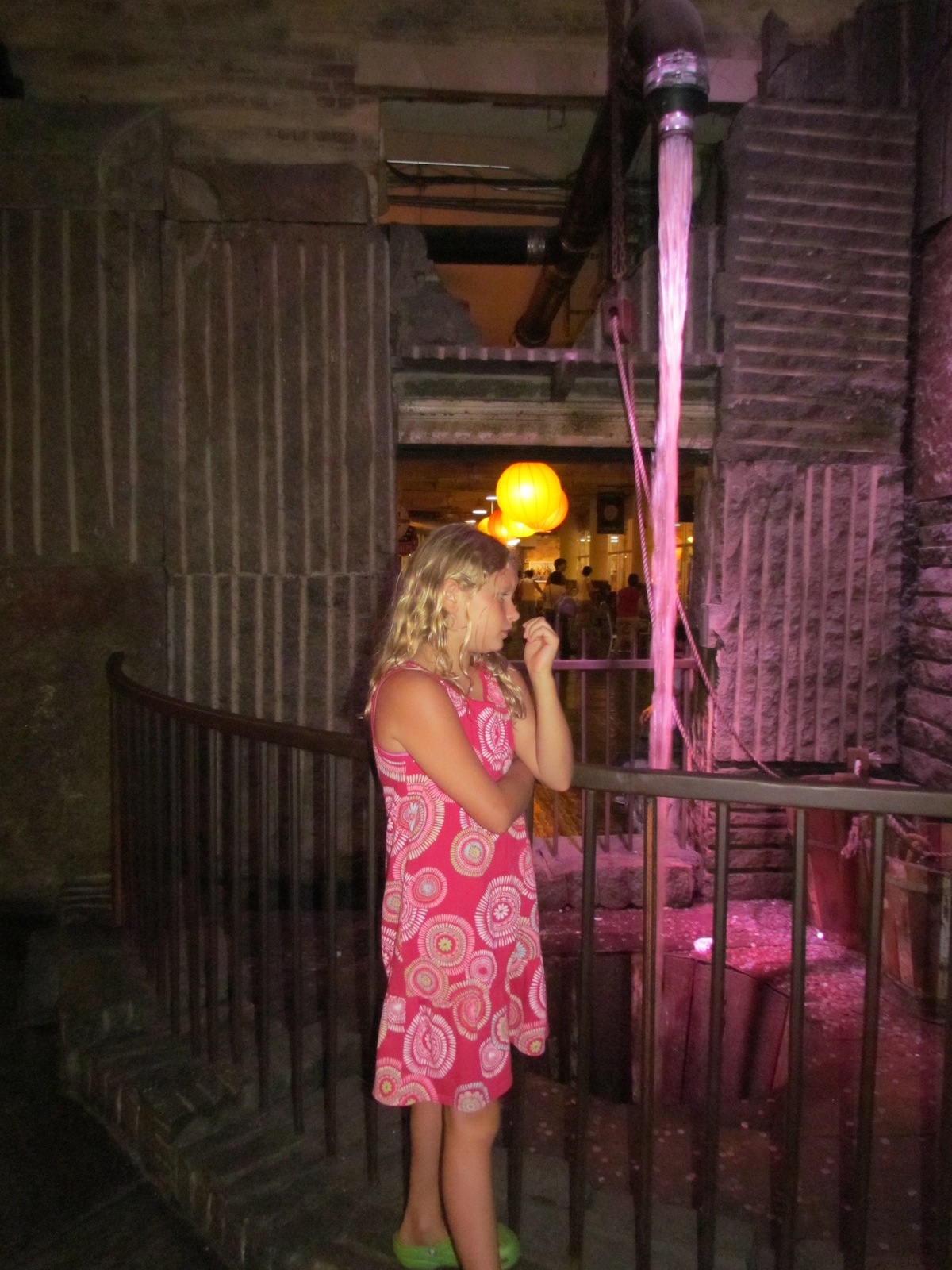
Upon our arrival to Chelsea Market Emma raced to the water feature and began to point at various things that she wanted to know the name of.  We discussed how there were wooden planks on the floor and what was under those planks – maybe a hole, darkness, who knows?  She tested the plank by sliding her foot through the guard railing and pressing down on it.  She pointed to the water gushing from a large pipe overhead.  We discussed where the water might come from, “Ocean” was Emma’s guess, and it did have a briny smell, either that or the Lobster Place and Seafood Market just opposite was giving off the distinct scent of salt water and fish.  Emma pointed to the large pipe and we walked around to the other side, following the pipe.  A huge wheel hung from the pipe and Emma said, “I can’t reach!  Have to get a ladder to turn the water off.”

This conversation with Emma was revelatory for many reasons, but most importantly it was the first time I have had such a lengthy conversation with her about something that did not have to do with a want, desire or need.  She was curious and though she spoke cryptically throughout our conversation leaving me confused as to what she was saying or asking, it was fantastic.  “Plank fall in,” she said at one point pointing to the water.”  And then again pointing up at the pipe, which I didn’t understand, making me wish I could put the pieces together.  I have been unable to find out any more about the water feature at Chelsea Market, having spent some time on google when we returned home.  I tried to find out the source of the water, does it ever get turned off, is it recycled, etc. so that I could tell Em more about it.   She was curious, engaged even mesmerized.

Eventually we headed back home, but not before we stopped at one last playground to run through the sprinklers!

When we arrived home, Em said, “We have to call Daddy!”  It was just one more first in a whole day filled with them!

Related articles

Acting Out Emotions and Pink Fingernails

Emma came home yesterday afternoon and showed me this.

“Pink,” she said proudly.  Jackie had taken Emma for a manicure.  And not only had Emma sat still for it, she liked it!  I’ve been giving Emma manicures and pedicures since she was a baby.  She likes having her toenails painted, but never her fingernails.   This was a first!

That afternoon we took the children swimming.  While Nic and Richard threw a football back and forth, Emma and I sat in the shallow end and Emma said, “No Sarah cannot throw the bottle.  Sarah!  You have to leave the room!  Sarah is sad.”  Emma then looked very sad and nodded her head.

Suddenly I had an idea from my conversation with my friend Ib, who has told me about her theatre training and how much that’s helped her.  I couldn’t figure out how to get Emma to act out the emotions she was saying, so instead I said, “Hey, Em, I’m going to pretend to be Sarah, okay?”

Emma nodded her head and grinned.  “Yeah, Sarah is sad,” she repeated.

I began to pretend-cry.

Emma watched me for a second with a little frown on her face and then she said, “Soufien is so angry!  Grrrr!”

I shook my fist and pretended to stomp my foot under the water while grimacing, “Oh!  That makes me so angry!”

Emma smiled, “Justus is happy!”

We went on like this for almost twenty minutes with Emma attributing an emotion to a child in her class and me acting out the emotion, though I did stumble a little on “shy.”   These are all emotions Emma has read about in the book – The Way I Feel – by Janan Cain.  Emma adores that book.  We’ve gone through at least three copies of it over the years.  But what is interesting is that Emma was taking all the emotions described in the book and applying a child she knew to each of them.  I don’t know that I’ve had a back and forth interaction with Emma that has ever lasted this long.  It was incredible.

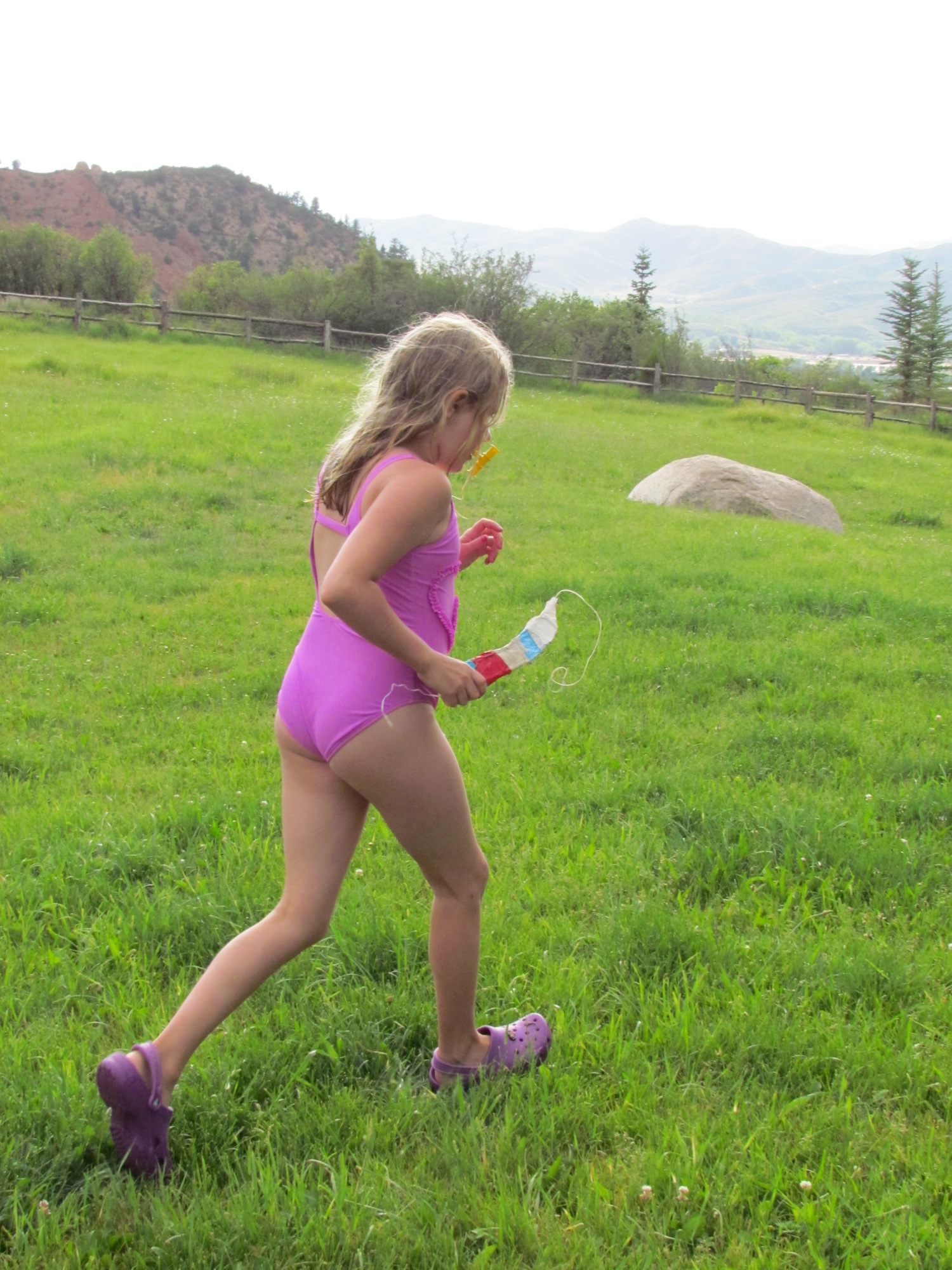
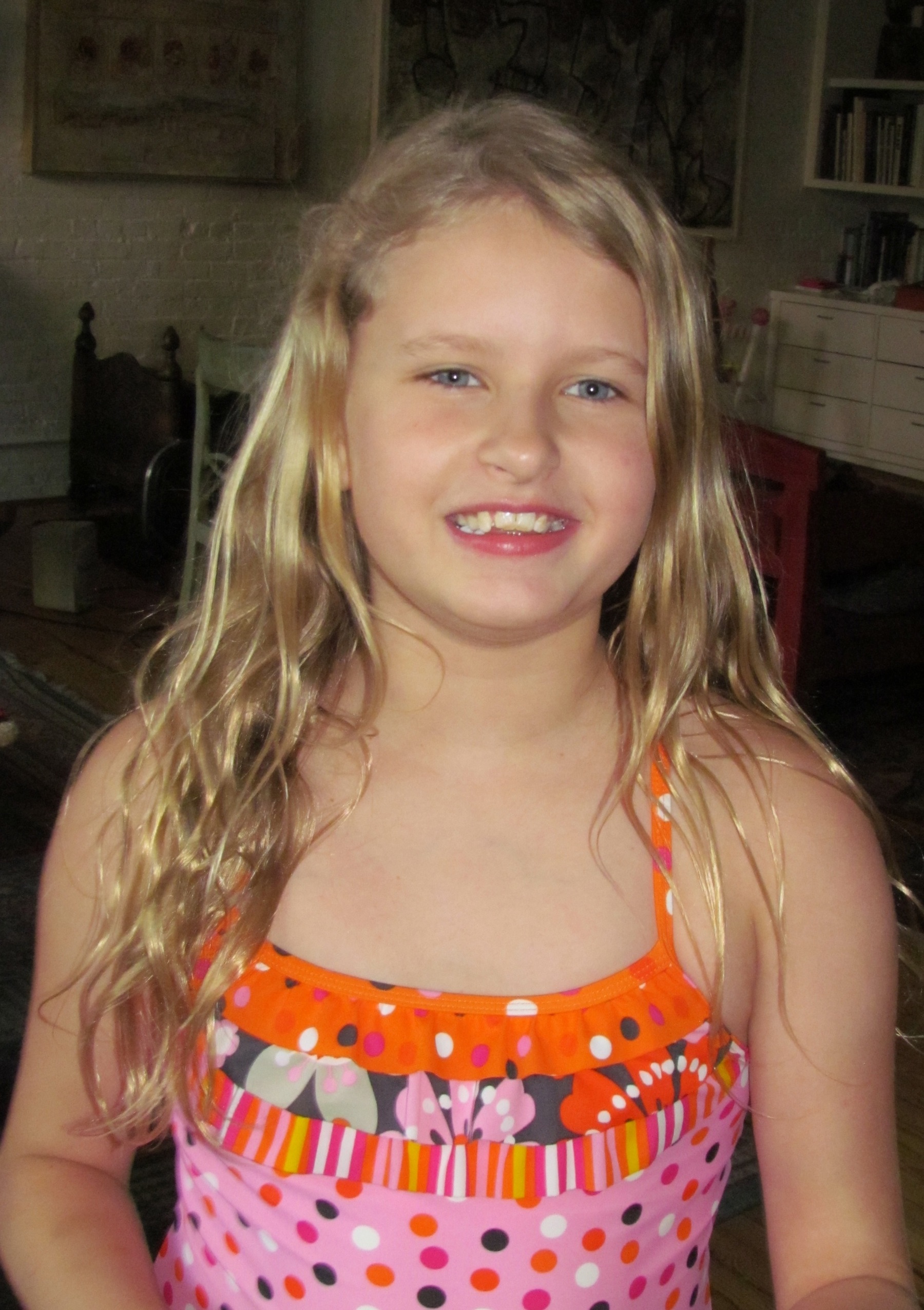
When we got home, Emma donned her pink bathing suit, which also happened to match her pink fingernails, and ran through the sprinklers until it was time for dinner.  (Notice Emma’s string, which has resurfaced and she has added to in the past month.)

Today the Aspen Ideas Festival begins, so things will be a bit hectic for the next six days.  But I will continue to post here.

Finding Ways to Connect With Other Human Beings

I have a relatively new friend.  We’ve been talking a few times a week.  She makes me really happy because she’s funny, smart and kind.  You know that magical feeling when you connect with another human being?  Someone who is special?  It’s a deeper bonding than with most people, you can’t explain why that is, you just feel it and it’s mutual.  I feel safe enough to confide in her.  I’m pretty sure she feels the same.   When we aren’t talking I think about her.  I wonder how she’s doing, is she okay.  And then one of us reaches out to the other and we start talking.  Only with my friend we don’t talk in the conventional sense, we type back and forth in real-time.  My friend reads very quickly, she’s hyperlexic; if I mention something that she hasn’t read, she’ll zip off and do a little research while I’m still typing out a sentence.  Then she’ll reply with the knowledge of someone who knows, but didn’t in the previous sentence.  It makes for an interesting conversation.

As a teen she had alexithymia.  Meaning it was difficult for her to use words to describe the emotions she was having, as well as understand other people’s emotions, which combined with her literalism, caused a great many problems.  So yesterday she was telling me about how she used echolalia and physical actions as a way to connect, but it didn’t always work out so well.  People misunderstood her.  And I thought of Emma.  Because Emma doesn’t have the language to describe her more complicated feelings.  So when she wants to connect, she’ll hit or she’ll say, “No, you cannot pull Mommy’s hair.”  Which means that she’d like to, but she knows she shouldn’t.  At her school she pulled her friend’s hair and was punished.  Emma knows this is something that while she enjoys doing it, the recipients often do not.  That must be very confusing to her.  Emma will say things like, “No you cannot pinch Mommy.”  Then she’ll look at me with a mischievous look and will wiggle her fingers at me as though she were about to pinch me.

“No Emmy!  Don’t pinch Mommy!”  I tell her.

Emma thinks this is the height of hilarity and will say again, “No.  You cannot pinch Mommy!  Pinch Mommy!” and then as though the feeling is too powerful for her to control, she will.

“Ouch!”  I will say.  And Emma will double over in laughter.

Last night we went out to dinner in town.  It’s very warm here, so we sat outside.  One of Emma’s favorite games is to pretend to give me a shot.  She “washes” my upper arm by rubbing it with her hand and then pinches me.   “Swish, swish,” Emma said, while pretending to put a band-aid on my arm.   “Now you do it,” she said, covering her eyes with one hand, while offering me her arm.  We play this game often.  It is also her way, I think, of working through her fear of having a shot or the finger prick they sometimes do at the doctor’s office.

Yesterday as my friend and I were talking I realized something else.  Emma is doing these things, punching, pulling hair, pinching, because she wants to connect, she wants to get a response, she wants to interact.  It’s not just a one-sided gesture.  She is trying, in the only way she knows, to make contact.  Sadly her gestures are often ignored or she is told no, she cannot do that, so she is then further limited.  She doesn’t have the words, she cannot always make sense of what she’s feeling, but she really wants to interact, to develop a method of “talking” with another person.  She’s doing the best she can with the limited tools she has at the moment.

I realized I needed to help her find physical ways to connect that will not be perceived as “harmful” by the other person, but that are also meaningful to her.  I will have to speak with my friend about this, because she will undoubtedly have some good ideas, besides I haven’t spoken to her in at least 16 hours and I already miss her.

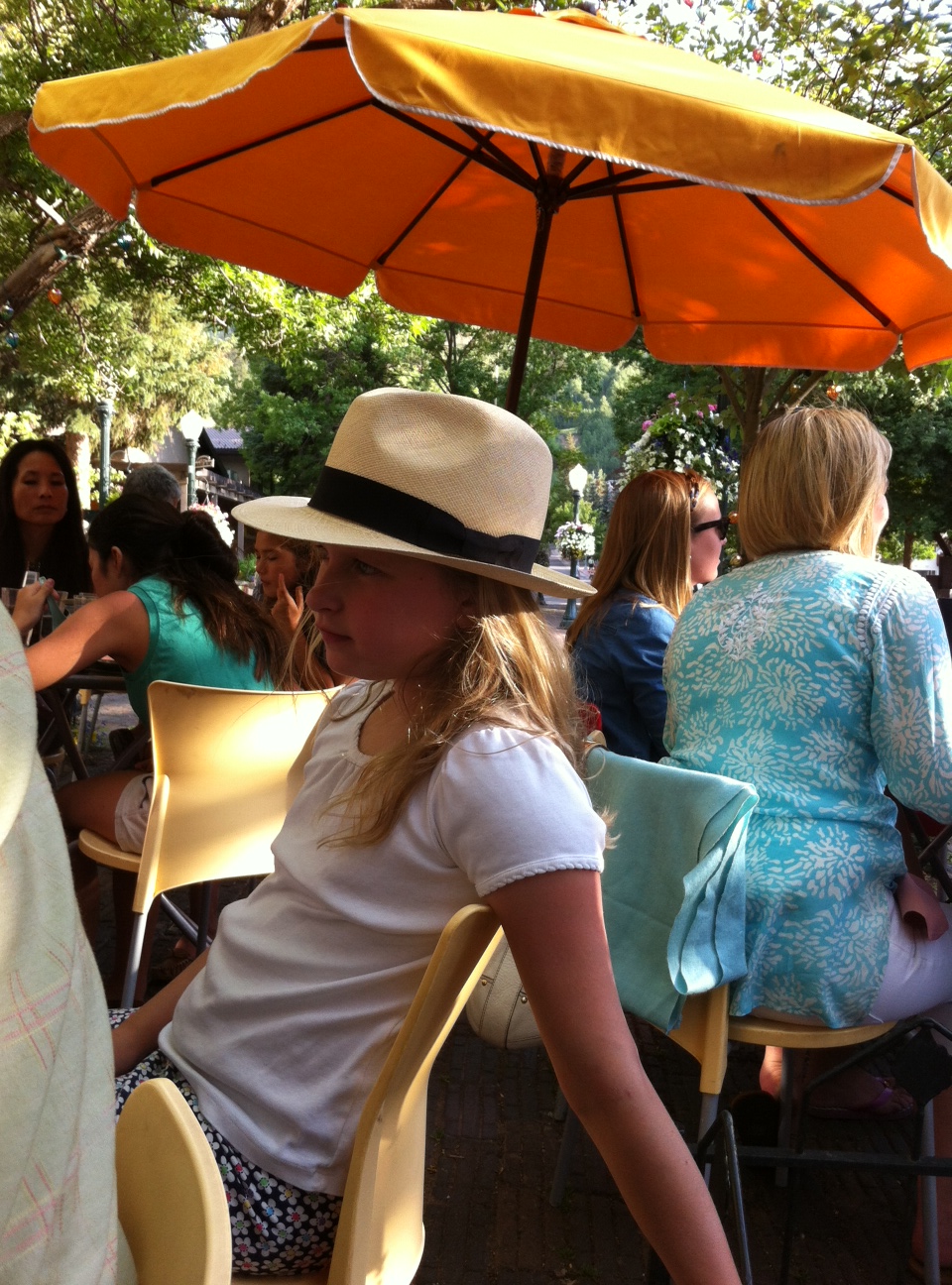
Last night at the restaurant, Emma wearing Richard’s hat

This morning – sunrise on the ranch

Merlin & Emma – Or How To Not Do Something You Don’t Want To Do

6:03AM – Our bedroom

Em:  Hi Mommy!

Me:  Hi Emma!

Em:  It’s six zero three.

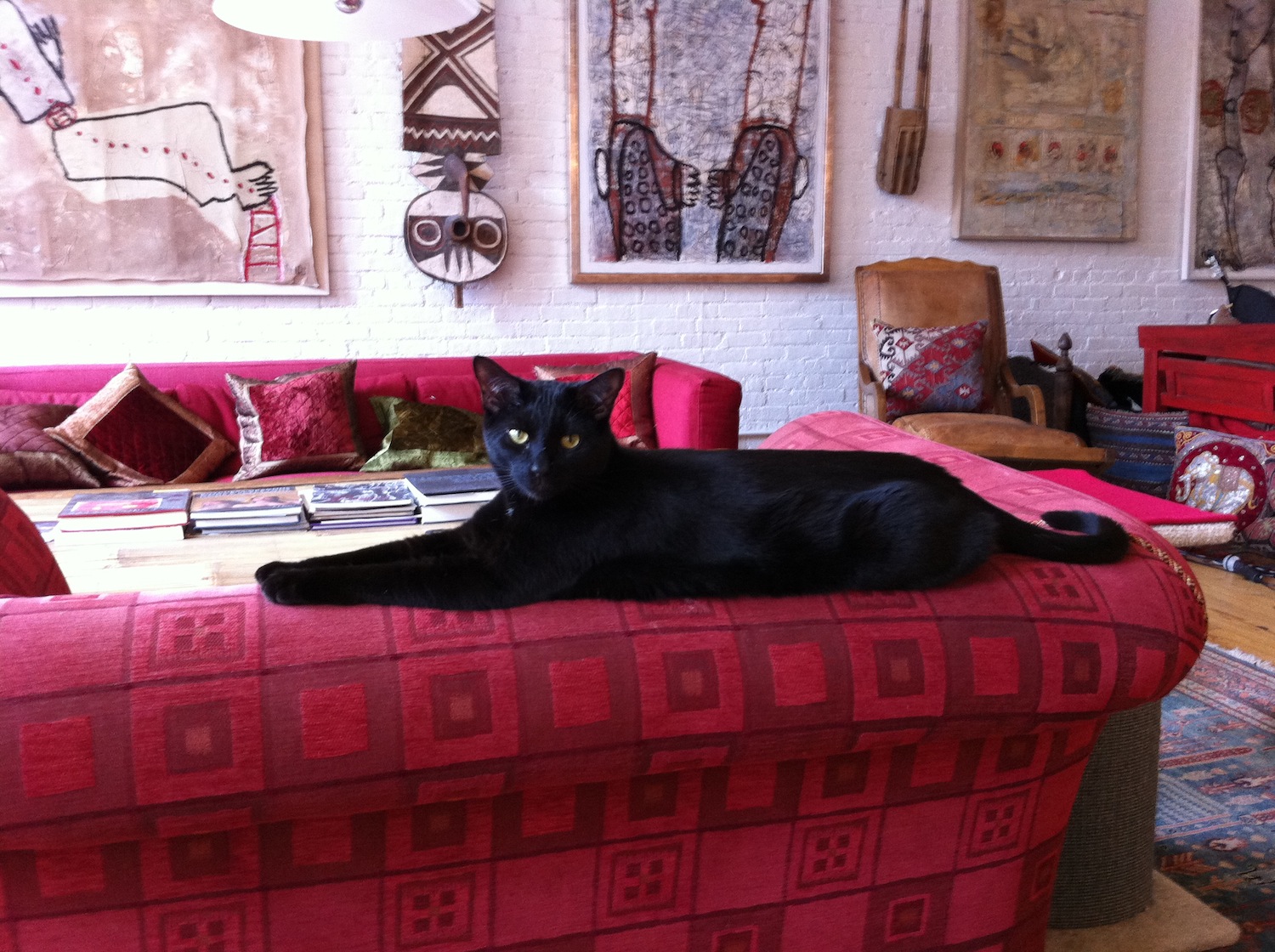
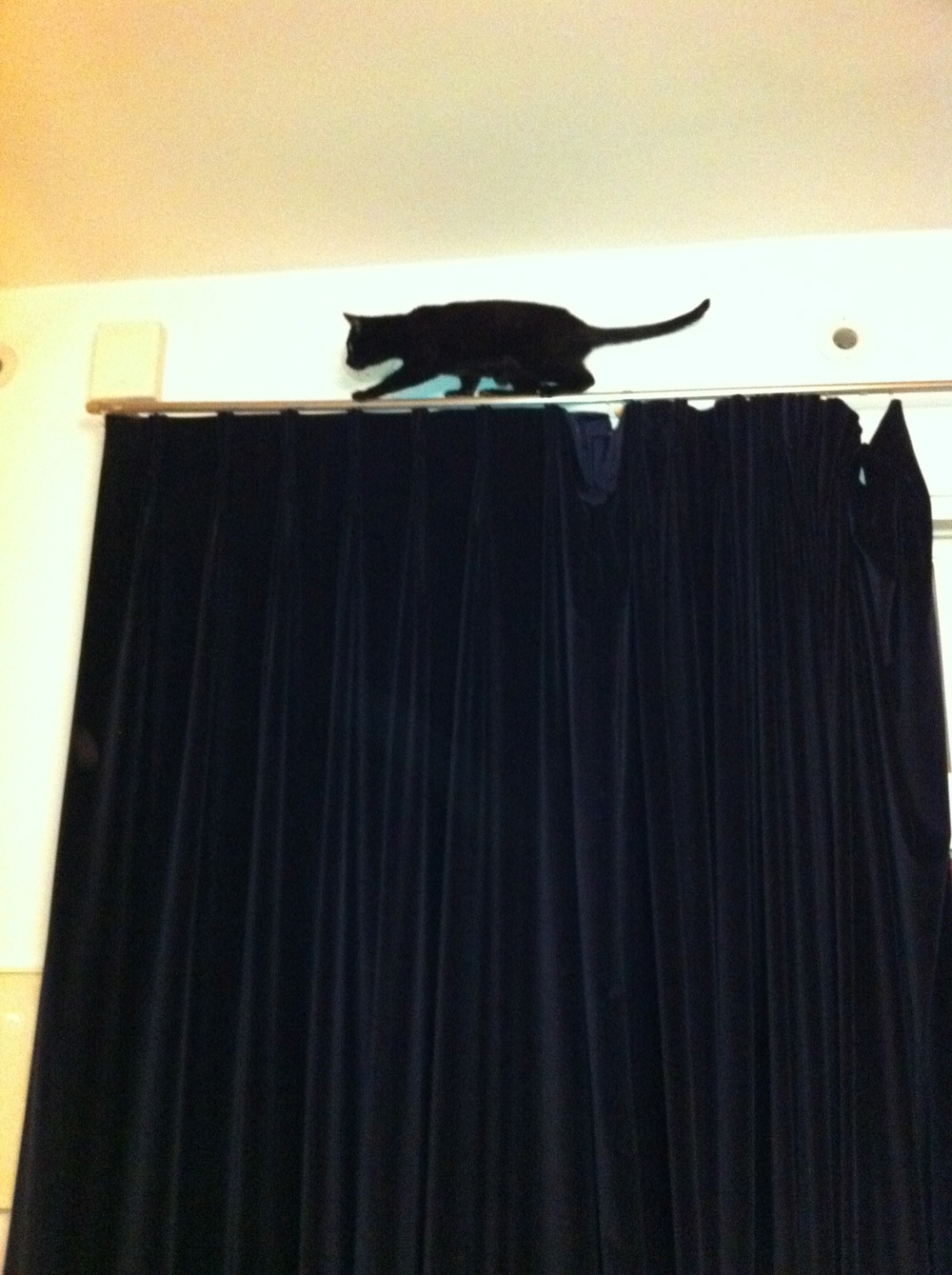
Me:  You’re awesome.  Merlin comes over in all his silky, soft adorableness.  Aww…  Look Em.  It’s the kitty.  He is so soft!

Emma smiles at me.  But makes no attempt to pet him and he’s rubbing his body against her.

Me:  Emmy, look at the kitty.  He’s so soft!  I stroke Merlin, who begins purring loudly.  Emma begins to hum a little song.

Me:  Em!  Come on!  Pet Merly.  He’s such a good kitty.  I say this as I stroke Merlin who walks lazily passed Emma towards the end of the bed.

Em:  Oh!  Oh!  I can’t reach!  I can’t reach the kitty!  She says this while in an exaggerated display, extends her arm as though she were trying to pet Merlin.  He is, in fact, within reach.

Richard begins to laugh.

Me:  Emmy!  You can too reach him!  Now Richard and I are both laughing.

Em:  Huge grin and with feigned sadness says – Oh no.  I cannot reach the kitty.  I can’t pet him.  Awwww.  I can’t pet Merly.

I love that kid.

7:30AM – In our study

Em:  Mommy, I want you to help me brush my teeth please!

Me:  Okay Em.  

Me:  (To Richard)  I’m almost finished with this post. I’m keeping it short and sweet.

Richard:  You mean like me.

I love that man.

Walking the walk

“Come Dance With Me!”

Those were Emma’s exact words.  She beckoned to me, then to her brother, Nic and then to her dad.  “Come on.  Come dance with me!”

This sort of utterance is something we have waited for, helped Emma with, hoping that one day, some day she would say something like – “Come dance with me.”   For those of you who know all about the issues of pronoun reversal, the difficulties in initiating and maintaining interactions, the challenges of expressive language and the importance of Emma’s words, skip down to the last paragraph, but for the rest of you, stay with me as I try to explain.

A defining characteristic of autism is pronoun “confusion/reversal.”  I have problems with the “confusion” assertion, as it seems pretty clear to me that when Emma says “Do you want pancakes?” she knows I don’t want pancakes, but is expressing her desire to have pancakes.  Either these are the words she would like me to say to her or these are the words she can locate to express her desire to have pancakes.  I don’t think Emma is “confused” about who loves pancakes.  I don’t for a second believe that when she asks such a question it is her intention to invite me to eat pancakes, while she foregoes eating them herself.  So no, I think that part of the whole “confusion” piece is actually incorrect.  However, I do think the idea that when speaking English, she is “me” when referring to herself and I am “you” when she is speaking, but that that is reversed when the other person speaks, is confusing.  And if you aren’t confused yet, try explaining all of that to someone whose first language isn’t a spoken language.  And after you’ve tackled that, move on to possessive pronouns.   Good luck to you, good luck.

One of my favorite quotes from someone I know who is Autistic is:  “My first language is written, my second is music, my third is math and a distant fourth is spoken.”  It perfectly describes that person’s loves, challenges and neurology.

Emma voiced her desire to have us dance with her, not simply asked that we watch her perform (something she also loves to do) but wanted to dance together, is also worth mentioning.   All of us love to dance.  When I was single and in my twenties, I used to go to Studio 54 with my girlfriends.  Our preferred night was Sunday as it was designated “gay night” with the best music and we knew we could dance all night without worrying about guys hitting on us.   Let’s just say –  the apple doesn’t fall far from the tree.  Still, dancing by yourself is one thing, it’s quite another to invite a group to join you.  For Emma, it was even more significant as parallel play is the norm for her, though recently we’ve seen an increase in her desire for interaction and playing games.  Interacting requires much more expressive language and an ability to tolerate a lessening of control over any given situation.

So last night we danced.  First to Gwen Stefani, then Michael Jackson, back to Gwen Stefani and Emma, ever the dancing DJ, even threw in some Lady Gaga.  It was a great night.

*I have been trying to figure out a way to work into this post the photograph below.  No opportunity presented itself, so I’m just going to post it, completely off topic, but it was too good to pass up.  Emma is terrified of dogs.  Even this dog.  He was adorable.  “Emma don’t you want to pet him?  Look how cute he is.  Don’t you think he’s cute?”

“No.”

But he really was cute, don’t you think?

Read My Fear Toolkit published in the Huffington Post

“Umbrella, Umbrella, Raincoat!”

Yesterday Emma, wearing one of her eight bathing suits, (Emma goes through bathing suits the way runners go through running shoes) requested that we play a game of “Duck, Duck, Goose.”
“Mommy!  I want to play duck, duck, goose, please!”  Without waiting for an answer she ran to find her brother.  “Nicky, I want to play duck, duck, goose with Nicky please!”  Again she shot out of the room to find her dad.  I could hear her muttering under her breath, “Haveta, gotta find Daddy.  Gotta ask Daddy!”  There was a moment of silence as I imagined she located her father and stood in front of him.  I heard her  say, “Daddy!  I want to play duck, duck, goose please!”

For most parents this sort of request from their child is commonplace, however, with Emma it is far from the norm.   In the past year she has increasingly asked us to engage with her, usually in the form of a chase game, hide and go seek or other activity involving lots of running and ending with tickling and loud utterances of “You better run!  I’m going to get you!”  followed by maniacal laughter – Woooohahahahahaha – done in a creepy, deep sounding voice.  These sorts of activities necessitate a lot of lung power and is how I justify not having a gym membership in an area of the city that is purported to have more gyms than any other.  I know it’s a stretch, but allow me to cling to my lame reasoning.

Within minutes Emma had managed to pry her brother away from his favorite TV show, Chopped, me from my emails, Richard from his book and gathered us together on the floor where we sat in a circle as Emma stood over us and began.  “Umbrella.  Umbrella.  Umbrella,” she said as she pushed down on each of our heads.  She even pretended there were more of us than there actually were and mimed patting at least three more heads of imaginary people seated in our circle with us.  “Raincoat!” she shouted after a third orbit around us and pushing on my head.

The whole, shouting out “Goose!” while patting the chosen person on the head then running as they manage to upright themselves from a cross-legged position and chase her, is the one part of the game Emma hasn’t quite gotten down.  However, it must be said, she is at an advantage as both Richard and I are in our golden years aka members of  AARP and careening rapidly into senior citizen status and so bounding from sitting position to standing takes us a tad bit longer than it once did.  Still, Emma is easily caught, but other than this small adjustment to the game, she gets it and loves it.

I’d like to point out her creative amendment to the game in using variations on the duck, duck, goose theme.  I loved “Umbrella, umbrella, raincoat,” which is a variation on her other favorite, “Carousel, carousel, horsey!”

What an awesome kid!

To read my latest piece, Emma’s New Shoes, in the Huffington Post, click ‘here

And if you haven’t already done so, do vote for Emma’s Hope Book by clicking this ‘link‘ and clicking on the “like” button opposite Emma’s Hope Book.

A Story About The Lady at the Zoo

Emma was confounded yesterday when she was told by one of the Central Park Zoo employees that she could not sit on the railing to watch the sea lions being fed.  She was very upset and wanted to go home.  However, instead of biting herself or doing herself injury, she came up with the following story, which is yet another example of her delightful temperament, personality and a wonderful display of the progress she is making in being able to turn something upsetting into a story that was both poignant and very funny.

Before we got on the subway, Emma verbally preseverated in her attempt to work through what had happened.  “Mommy says no.  Mommy go home, Emma stay at the zoo with just Daddy.”   Emma reasoned immediately after leaving the zoo.

“But Em.  This isn’t about Mommy or Daddy, this is about the zoo employees.  This is their rule now.  They won’t let anyone sit on the railing any more.  It’s a new rule,” We told her.

“I want to sit on the railing!”  Emma wailed over and over again as we made our way to the subway.  “You have to ask Daddy!  Daddy! I want to sit on the railing please!”

“Emmy, this isn’t up to me.  This is a rule that the zoo has.  You can’t sit on the railing.”

“But I want to sit on the railing!”  Emma cried.  Then Emma flung both arms around me and buried her head into my side.  “I know, I know.  You’re so upset,” Emma said, mimicking words I often say to her.

“Oh, Em.  I know you’re sad.  I know how hard this is for you.  But I’m also really proud of you for the way you’re handling this and talking about it.”

When her beloved R train arrived Emma secured seats for us by the window and then told the following story.

“The lady said, You have to get off the railing!  You have to get down!  Yeah,” Emma nodded her head and frowned.  Then she said,  while stomping her foot on the floor of the subway, “The lady stomped her food and said, You.  Stomp.  Have.  Stomp.  To.  Stomp. Get.  Stomp.  Down!  Stomp.  You get down right now!  Then the lady said, I’m going to get you!  I’m going to tickle you!”  Emma demonstrated being tickled.  She stomped her foot and continued.  “Yeah.  The lady is going to tickle you.  Then the lady had to go home.  She hurt her back.  Bye!  Bye, bye lady.  Lady gotta go home!  Bye!”  Emma waved her hand, like a Queen waving to her adoring subjects.  “The lady had to go.”  Emma nodded her head and feigned looking sad.  “The lady went home and Emma got up on the railing to watch the seal show!  She had to go home because she hurt her back and she has to put on a bandaid.  Now it’ll feel better.”  Emma finished and looking triumphant said, “Emma got to sit on the railing!”

“Wow, Em.  I love that story!”  I said.  “How did the lady hurt her back?”

“She tickled you!”  Emma said and then collapsed into giggles.

Earlier in the day, playing on the High Line

To read my latest piece, Emma’s New Shoes, in the Huffington Post, click ‘here

And if you haven’t already done so, do vote for Emma’s Hope Book by clicking this ‘link‘ and clicking on the “like” button opposite Emma’s Hope Book.

Cobra aka Daddy

Emma began calling her dad, Cobra a few weeks ago.  When she first said it, as in, “That’s Cobra!” while laughing and pointing to Richard, I had no idea why she was calling her father a venomous snake.  It wasn’t until later when someone said, “Isn’t that the social worker in Lilo and Stitch?”  that the mystery was solved, or at least one part of the mystery.  Why she thinks Richard, in any way, resembles Cobra is something we are still pondering, though I have a couple of thoughts. (As usual..)

Cobra, or Cobra Bubbles, as he is known in the movie Lilo and Stitch is a social worker, though he looks more like he’s in the CIA, with his dark suits and dark glasses, which he wears regardless of whether he’s inside or out and is bald.  He is also African American, is huge and speaks in a baritone booming voice and is in a state of perpetual displeasure, which he expresses with lines like, “And in case you were wondering,” said while looking over his dark glasses, “this meeting. Did. Not. Go. Well.”

Emma loves Lilo and Stitch.  She mimics Lilo’s bratty, high pitched voice and recites whole sections of the movie sometimes to comical effect.  Such as when the upstairs neighbor’s kid was running back and forth early one morning, Emma looked up at our ceiling and said in a perfect imitation of Lilo’s voice, “Aliens are attacking my house!”  It was a hilarious moment.  Emma, being the ham that she is, loved that I was laughing so hard I could barely breathe.  So when Emma pointed to Richard last Sunday on the way to the number 2 train, and said, “That’s Cobra,” then pointed to me and said, “That’s Mommy!” we asked her why Daddy reminded her of Cobra.  She grinned and said, simply, “Cobra,” before weaving her arm through her dad’s and then mine.  The three of us walked that way as Emma spoke in Lilo’s whiny voice, “We’re going to go home now.  Take the number 2 train and then eat dinner.”

By the end of the movie Cobra has become very much the family friend and is no longer threatening to put Lilo in foster care.  On the contrary he is intent on keeping the family together and has become their protector.  Which, my guess is, where the association with her dad lies.  Daddy, the larger than life protector of the family, kind and loving.

Daddy aka Cobra (Bubbles.)

To read my latest piece, Emma’s New Shoes, in the Huffington Post, click ‘here

And if you haven’t already done so, do vote for Emma’s Hope Book by clicking this ‘link‘ and clicking on the “like” button opposite Emma’s Hope Book.

“Six and Three and Zero”

We are working with Emma on time.  For the last few weeks she has been waking at 5:30AM.  I’m just grateful she isn’t also waking us at 2:00AM.  It’s all relative.  She has an analog clock in her room and we’ve discussed how she isn’t to wake us until 6:30AM.  Two nights ago she appeared at exactly 6:30AM.  “It says six and three and zero,” Emma announced before claiming her place next to me in our bed.

This morning however she appeared at 5:30AM and when I said, “Hey Em.  It’s too early. Look at the clock. Do you see what it says?” she didn’t answer.  “Look Em.  It says five thirty.”  I sat up and pointed.  “You have to go back to your room.  You can come back when it says six thirty.”

“Six and three and zero,” Emma confirmed.

“That’s right Em.”

Moving very slowly, she wandered back to her room, or more accurately, out of ours.  When Emma reappeared later she said, “Make cereal and toast?”  Then she corrected herself, “Dadddy?  I’d like to make cereal and toast, please.  May I have some cereal and toast?”

After breakfast she ran back to find me.  “Mommy!” she said bouncing up and down.

“Hi Emma.  I’m coming out.  I just had to take a shower.”

“Mommy!  I miss you,” she said, leaning her head into me.

“Oh Emmy!  I miss you too.  Whenever I’m not with you, I miss you!”  I told her.

She beamed at me.  “I miss Mommy.”  Then she pointed at me and said, “Mommy and me,” she pointed to herself, “go into the living room together.”

“Yes.  I’m coming.  Do you want to wait for me?  I’m just getting my shoes on.”

“I’m waiting,” Emma said.

I live for conversations like this.  I take for granted so many things, little quick conversations I have hundreds of times throughout a day, and yet, this one with Emma will carry me through the day like nothing else could or would.

Waiting for her school bus.

For my latest piece in the Huffington Post, click ‘here‘
Anyone can contribute! To be a part of the change, contribute to the Autism Positivity Blog click ‘here‘

The Language of Music

Sunday morning Emma wanted to listen to music and dance.  There was nothing extraordinary about this, except that her ipod wasn’t charged and Richard’s iphone was with him in the back where he was still asleep.  Both of these devices hold Emma’s favorite songs.  However, Emma picked up my iphone, a poor and unfamiliar substitute, but she was in desperate straits and realized this was not the time to be picky.  “Mommy?  Can I listen to Mommy’s iphone please?”  Emma asked.

Fortunately I have a number of Gwen Stefani albums programmed in.  It took no time for Emma to find one she liked, which I’d never heard before, Hella Good.  “You hold me like I should so I’m going to keep on dancing.”  It’s got an electronic sound infused with a great beat, blending rock and funk and makes you want to dance.  Which was exactly what Emma proceeded to do.  When the song began Emma got an intense look in her eyes, a look of concentration and focus.  I knew she knew I was watching because she looked over at me in the middle of a particularly complicated set of twirls with her arms raised high, her new string (I call it her starter string as it has no tape on it at all) she held in her right hand and twirled as the tempo picked up.  Emma went from twirling slowly to adding her head to the swirling movement, as her hand twirled the string, her upper body moved from side to side as she spun around.  The bass line reverberated and Emma suddenly thrust both arms up toward the sky and threw her head down while she spun.


This is how all of us would dance if we could.  Emma’s body, the expression on her face, the way she moves, the string extended out from her hands as though it were part of her.  She raised one arm and twirled, faster, her hair fanned out, her nightgown billowed around her ankles. Emma incorporated the music into her being, it was a part of her, it was her language.  She had taken it and made it her own.
For my latest piece in the Huffington Post, click ‘here
To contribute to the Autism Positivity Blog click ‘here

*A quick aside about Emma’s “string.”  After she covered it in red duct tape, she then covered just one end in purple duct tape and then left it in her brother, Nic’s room.  When she reappeared from her own bedroom, she was carrying two pieces of this new string.  I asked her what happened to her old string and she said, “No more.”