Tag Archives: Emma

A Sleepover, a Storm and Our “Adventure”

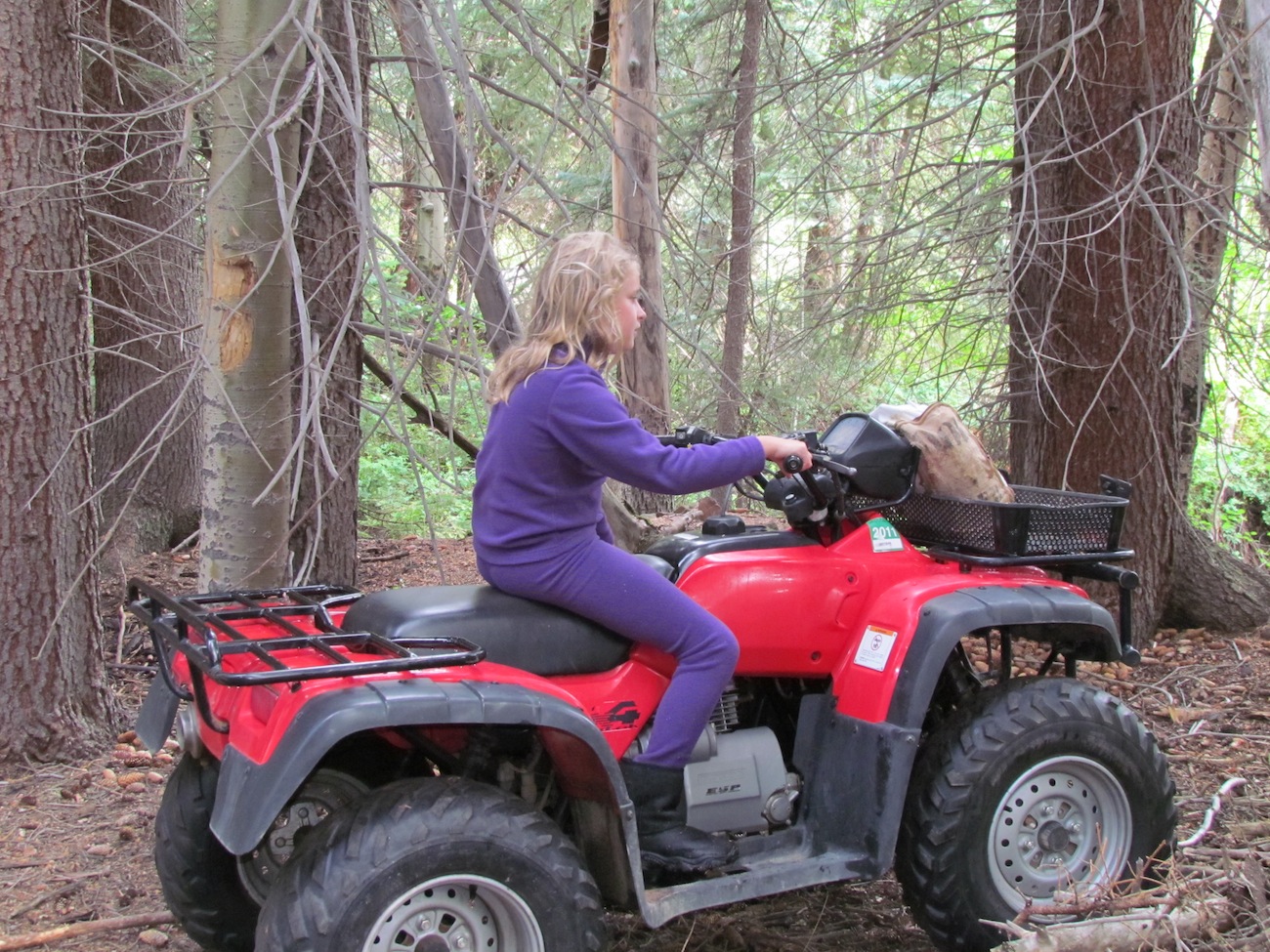
Emma loves going to our cabin.  It has become a tradition to spend the night there at least once during any given trip to Aspen.  Yesterday was our designated “sleepover” night and Emma was beside herself with excitement.  We packed backpacks and some bags up, put them into the front of the 4-wheeler and set off.  This is our equivalent of taking a fully equipped camper out to a campsite and calling it a “trek.”  I made a number of derisive comments about our lack of adventure (aka laziness) while Richard and Emma ignored me.  At one point Richard stopped the 4-wheeler and said, “No one’s stopping you from walking, you know.”  Which pretty much shut me up.  Until we ran into this –

Richard, not one to be easily deterred, proceeded to put the 4-wheeler in reverse in an attempt to go around the tree branch, and in doing so went up a steep incline and over a large boulder, while almost flipping it.  After much excitement (aka me yelling in a hysterical voice, “you’re going to flip it!” causing Richard to say, as one wheel hovered a full foot off the ground, “you know, you’re not exactly helping.”  Eventually he brought the 4-wheeler to a stop with all four wheels planted firmly on the ground (much to my relief) and we abandoned it.  “Well you get the best of both worlds,” Richard remarked, as we hoisted our backpacks and bags (some filled with Emma’s books) on our backs.  “Now you get to walk.”
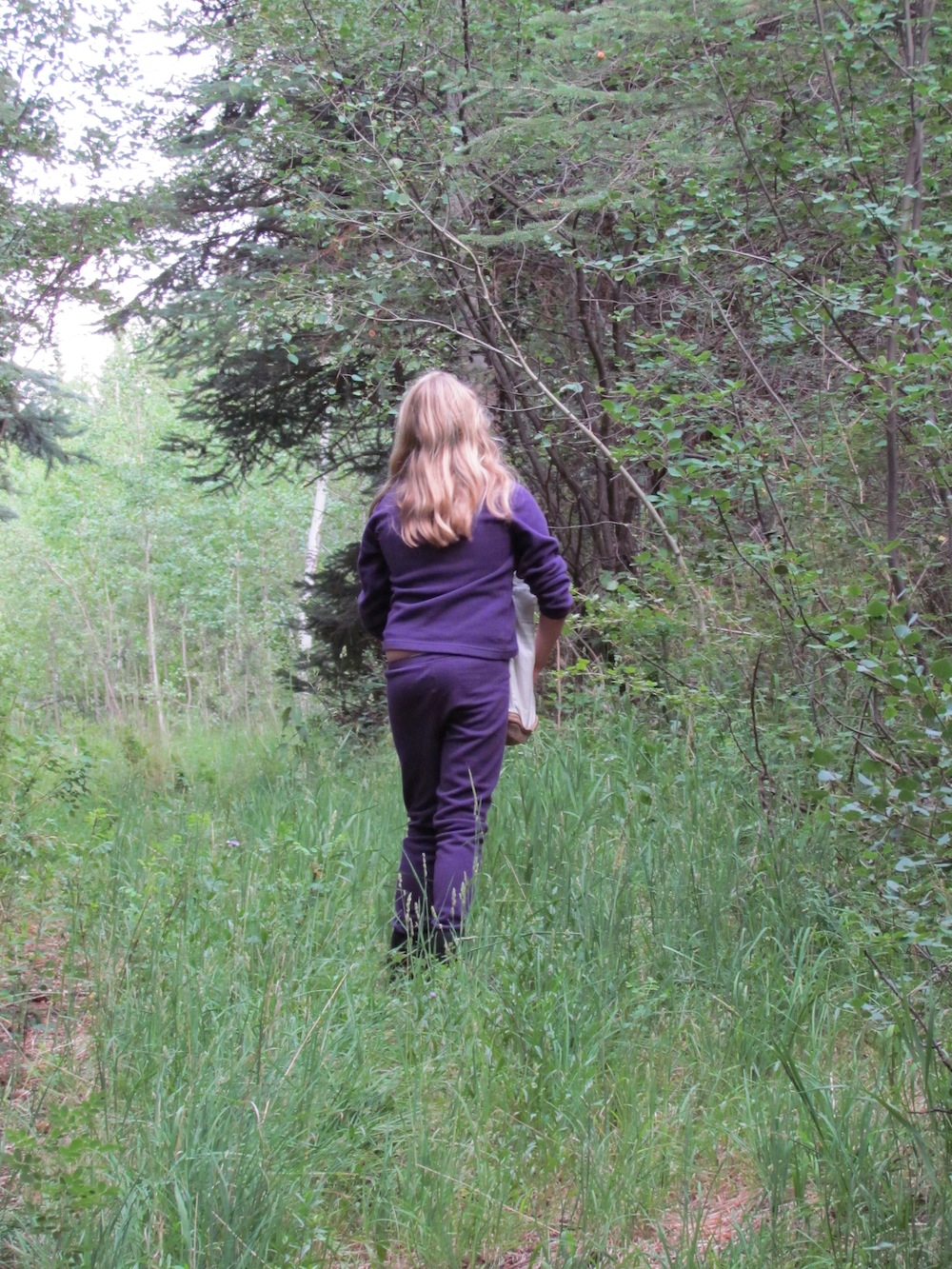
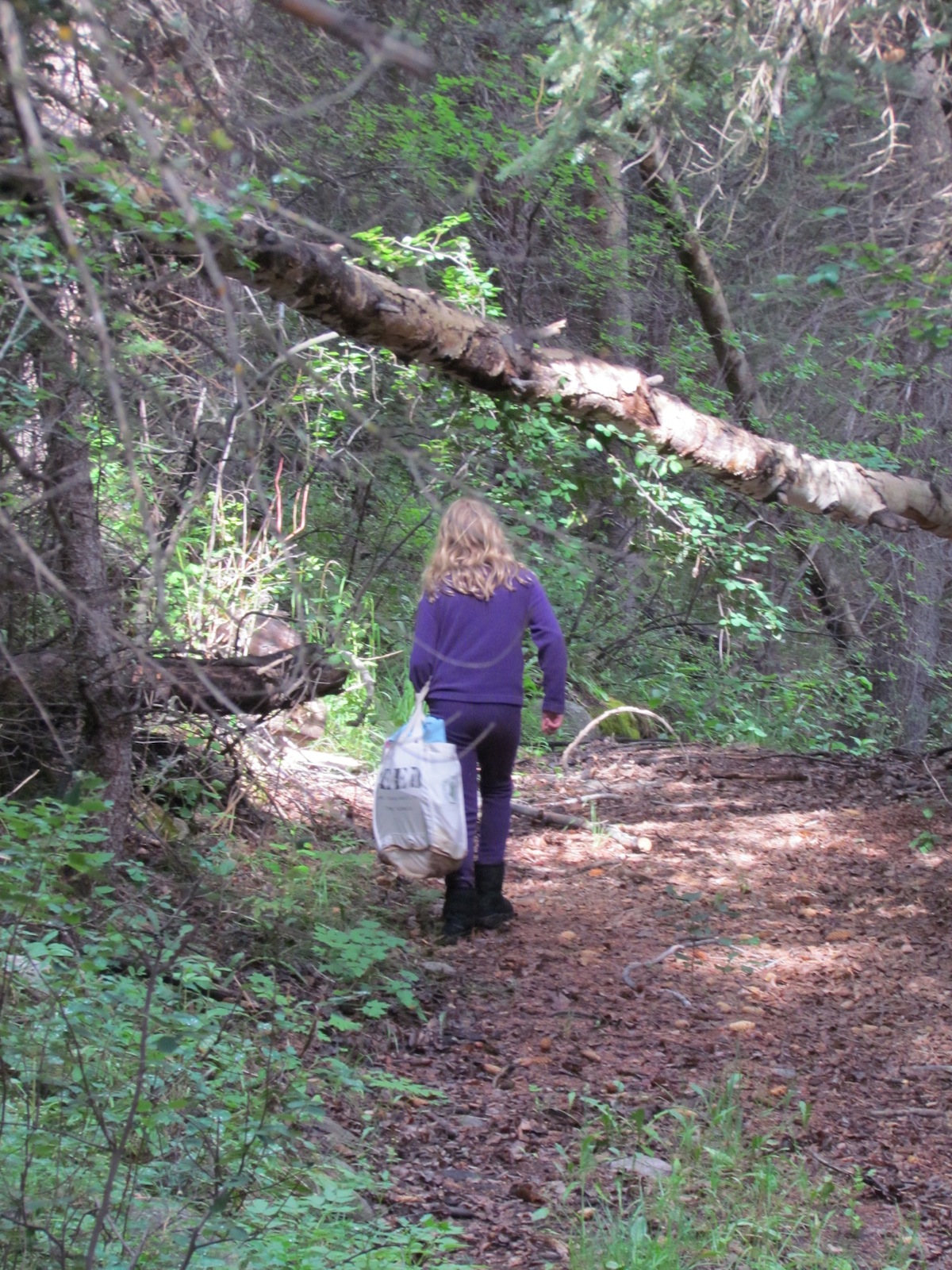
When the cabin came into sight Emma, carrying the bag with her books in them, began to run.
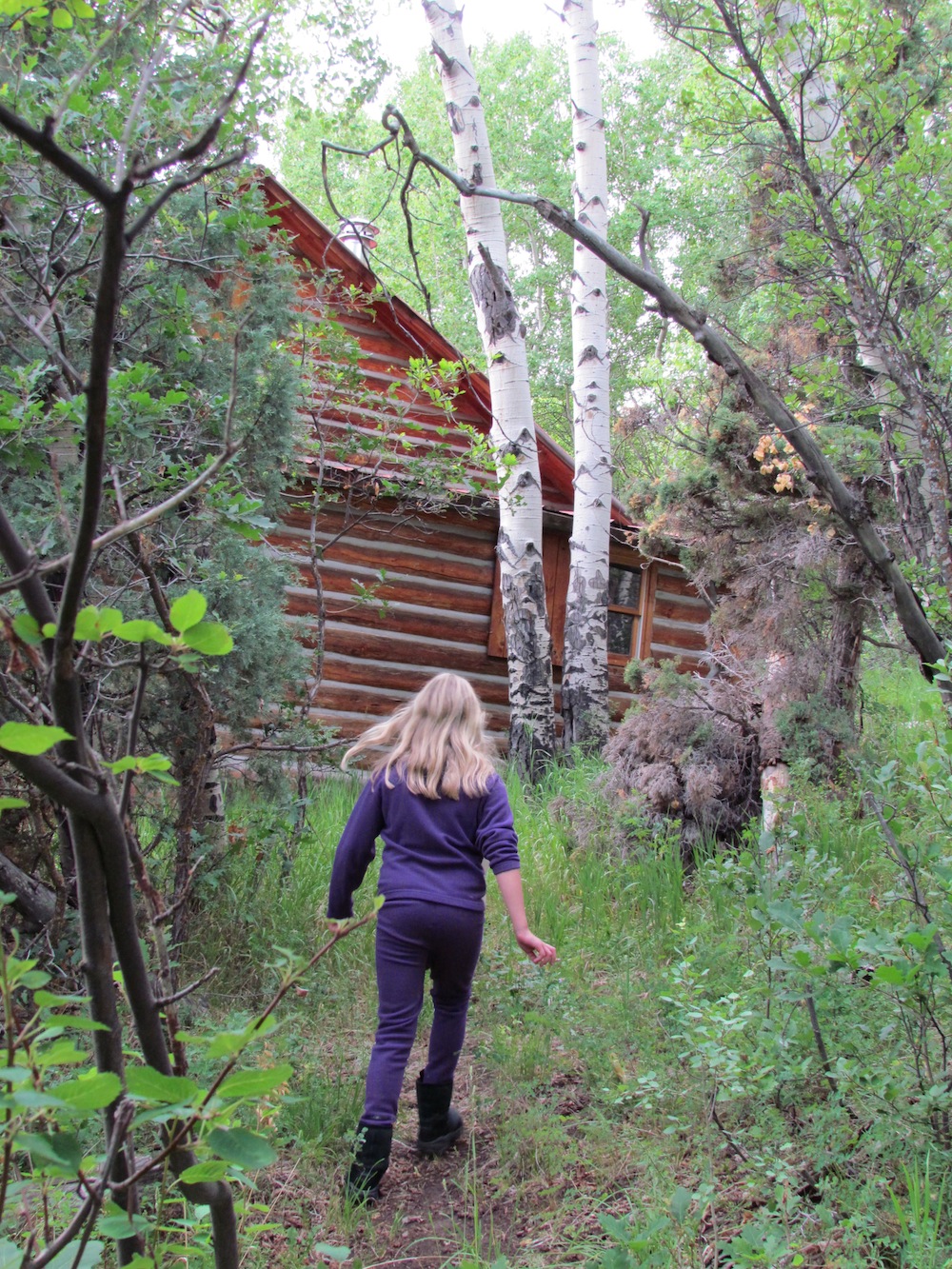
“It’s the cabin!”  Emma yelled as she bounded up the steps.  We settled in, put the screens into all the windows, swept up the cobwebs and made up the beds, while clouds began to roll in over the mountains.  A number of red-tailed hawks flew overhead calling to each other, or at least that’s what I assumed they were doing.


The rain came first preceded by a smell I cannot describe, but one that I recognize as being the forerunner to a storm.
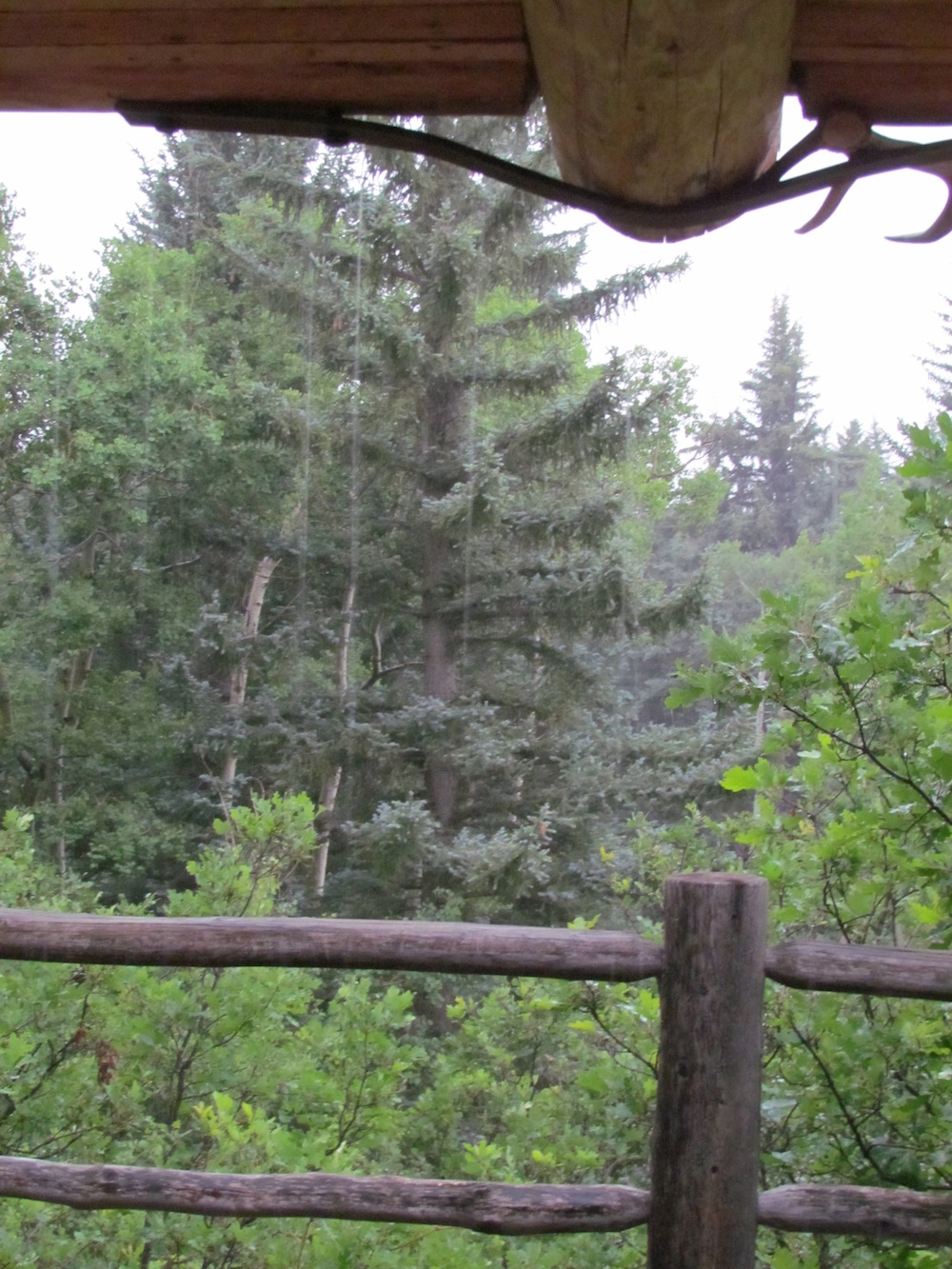
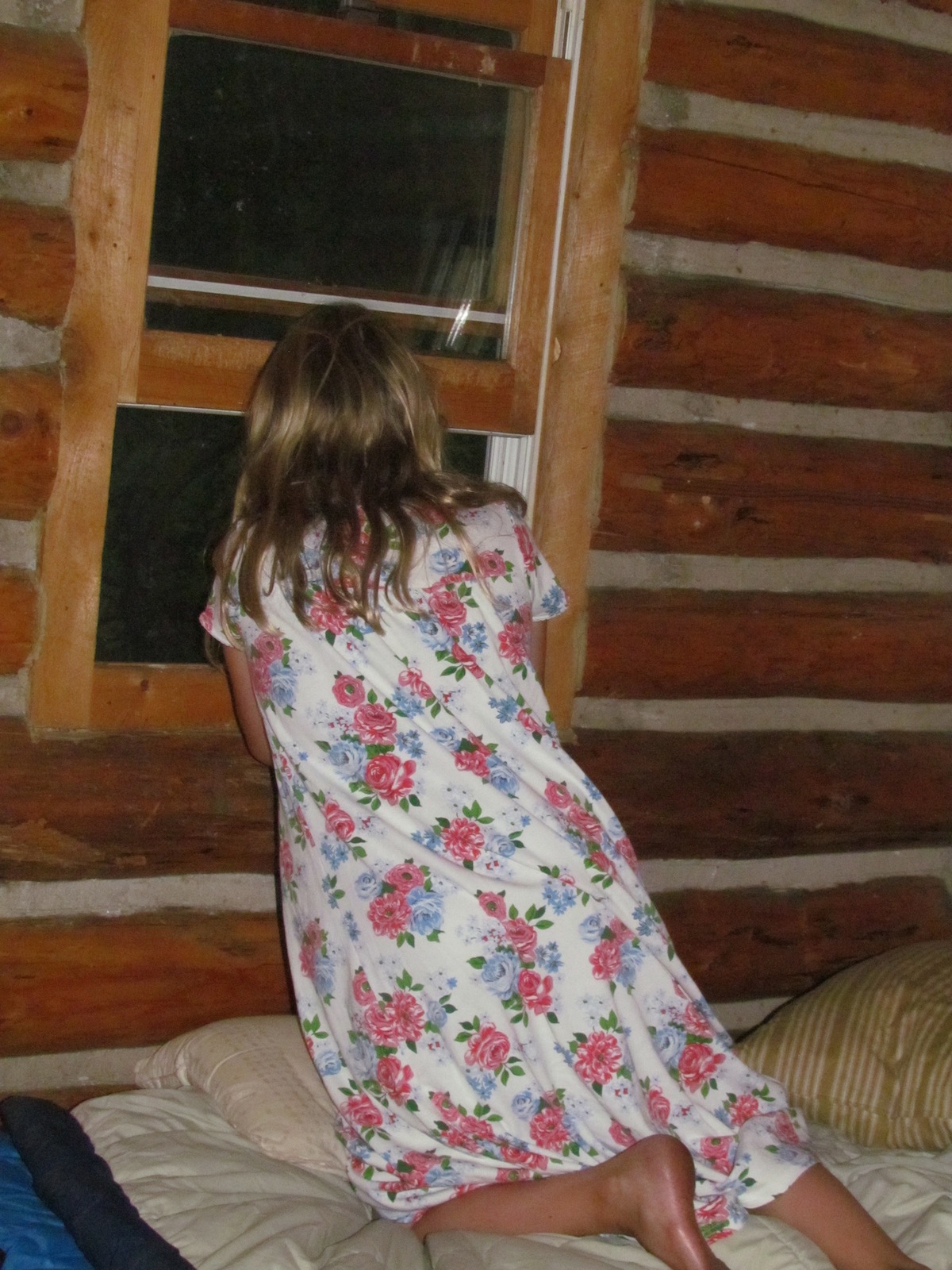
Lightening and thunder followed.  The rain came down in sheets.  Emma stayed inside.  She peered out the window and made loud crashing noises.  “It’s scary,” she said.  “I don’t like it.  Mommy come.  Sit together.”  So we did.
But eventually she felt safe enough to go sit next to her dad on the porch.  Together they watched the storm.
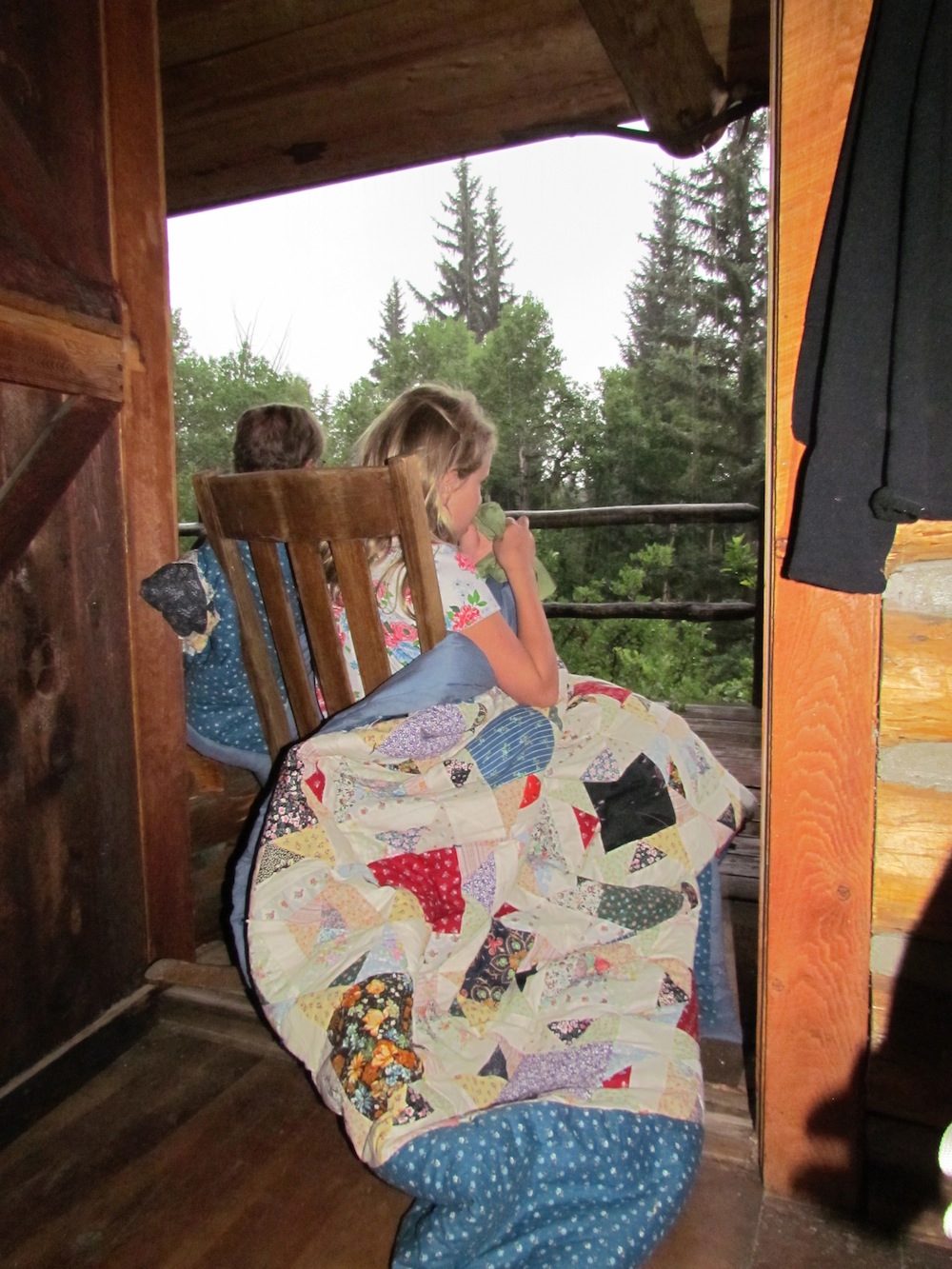
Within an hour the storm had blown past and Emma was happy.

By 10:00PM all of us were asleep.  Emma slept until after 8:00AM.  This was noteworthy as her usual waking is 6:00AM.  Reluctantly we packed up and made our way back to where we’d abandoned the 4-wheeler.
When we got back home, where Nic and my mother were I said, “I bet you guys were worried about us during that terrific electrical storm!”

My mother smiled and said, “No.  Actually when it began to rain we said to each other – Boy am I glad we stayed home!”

They have no idea what they missed.
Do We Really Believe the Things We Tell Ourselves?

There was an exercise I was told about in high school.  I was told to hold my arm out, while repeating to myself, “I am strong, I can do it, I am strong,” while the other person tried to push my arm down.  Then I was told to rest for 30 seconds, and hold my arm out again, but this time repeating, “I can’t do it, I’m a failure, I can’t do anything,” while the other person tried to push my arm down.

Have you ever tried this?  If you haven’t, do.  It’s an amazing example of how powerful self talk is.  (Richard just came in and I tried it with him.  “Wait do it again,” he said.  We did with the same results.)   I was able to push Richard’s arm down both times, but it was much harder when he was repeating to himself that he was strong and could do it.

It made me wonder how that same exercise would work if the other person said, “you’re strong, you can do this,” even if I didn’t say it to myself.  So I tried that and it helped a little, but not as much as when I said it.  As I was thinking about all of this, I thought about how Emma will often walk away if asked a question I know she knows the answer to.  Such as, “Emma what color is the 4-wheeler?”  She will walk away, as if to say, “Why are you asking me such an idiotic question?  Why should I even bother answering this question?”  I don’t know that this is what goes through her mind, but recently AspieKid wrote in a comment (he gave me permission to reprint his reaction to Simon Baron-Cohen‘s flawed Sally-Anne test) the following:

“Here is what would have gone through my mind if I were part of that study.

The researcher would set up the test, and then ask me where the other kid would look for the ball. My mind would have raced through its usual sets of combinations and permutations and a logical consideration of the question. But I would not be thinking about what researchers would have expected me to think about. I would have been thinking things like, “Why are they asking me this? Sally and Anne don’t even exist. I have no way to know where people would look for a ball, and even fewer ways to know where non-existent people would look for it. Even if the person were real, I have no information about their intelligence or their sanity, and no reason to assume they would look in any particular place. Nor do I care. Furthermore, there is no consequence for guessing the wrong answer and no reward for guessing the right answer, so it doesn’t matter what answer I give at all.

When I was a kid, those thoughts would have gone through my mind in a couple of seconds. But I would not have expressed any of those thoughts. I would have said as little as possible and probably made no eye contact whatsoever. I probably would have felt uncomfortable being there.

I probably would have thought the researcher was both stupid and insane, and he was assuming that I was both stupid and insane as well. I might have felt a little nervous about being around someone who asks such senseless questions. I might have tried to make like an ostrich and bury my head in the proverbial sand so they would just leave me alone, but that would probably not work. In that case, I would have given them any arbitrary answer that would get them to leave me alone as fast as possible so I could return to my own thoughts.

That’s mostly how I treated schoolwork too. I knew I was smarter than most people (even my teachers), but I had no interest in proving it to anyone. I was a genius (by IQ) but I did not do well in school most of the time. I did what I needed to do to get them to leave me alone, that’s all. The Sally-Anne test was based on the false assumption that autistic kids are eager to share their ways of thinking with researchers, but in reality I think most of them would rather just be left alone. I’m going to go out on a limb and say that most of the autistic kids who participated in the Sally-Anne test probably put almost no thought into that researcher’s question, nor did they have a reason to.

Like the old saying goes, “if you ask a stupid question, you’ll get a stupid answer”.

This comment from AspieKid was beautiful in it’s explanation of how we NTs “dumb down” our language, assume incompetence in the face of silence.  Assume someone does not understand the question when in fact, as AspieKid so eloquently states, this is not the case at all and is quite the opposite.  How do years of these kinds of interactions effect someone?  How do you believe in yourself when everyone around you assumes you’re incompetent.  How do you fight against those perceptions?  Do you even try?

How do we instill positive self talk in another?  Is it enough to tell another person they can do it?  Is our belief in them enough?  When we model that kind of belief in ourselves, are our children able to see that and incorporate those behaviors?

Huffington Post, Life and What’s Really Important

My piece on the Aspen Ideas Festival has just been published on Huffington Post.  Click ‘here‘ to read.  I wrote a great many drafts before finally submitting the post that has been published.  It was a long night of writing and rewriting until finally I knew I couldn’t write about the Ideas Festival without writing about my grandfather, but that too, made me uneasy.

The truth is I have a great many feelings about my grandparents and the various institutions they created and left behind here in Aspen.  Mostly I am awed by Grandfather’s vision and determination to see his vision through, while also aware that my feelings have little to do with anything.  I never knew my grandfather, he died the year I was born.  However I did know my grandmother, Elizabeth Paepcke.  As a child I thought all grandparents were like mine.  I assumed my experience was everyone’s.  I don’t remember when it dawned on me that this assumption was incorrect, but it was around that time that I also learned having famous grandparents came with other assumptions about me and my family that had nothing to do with our actual lives.

“Friends” became tricky.  People wanted to be “friends” because of an idea they had and not because they actually wanted and liked who I was.  “I” was often inconsequential in such interactions, it was the idea of being close to someone else they were after.  That makes for some odd interactions and can be disconcerting, a kind of objectification of another human being, but something we, in a culture of celebrity adoration, often do.

When I began social “networking” I felt horrified by the things others suggested I do to help my business.  It felt false to me.  I found myself going home at night incredibly depressed.  I would lie awake and wonder where was I in all of this?  My desire to get my business off the ground could be seen as self promoting in a way that other people were not accused of.  So began my process of trying to untangle myself from two people who created organizations and institutions that have had a longstanding impact on a great many people and following my own passions and interests.  I don’t always get it right, I still get caught up in trying to sort out what it is I need and want to do and what I believe others want from me.  It’s a balance, but like everything, its progress and not perfection.

Last night Emma came to me with the keys to the 4-wheeler in her hand.  When we got outside and turned on the ignition, it began to rain.  Not a light sprinkling, but a downpour.  “Em, are you sure you want to go for a ride?  We’re going to get soaked,” I told her.

“Yes!  Drive on the 4-wheeler with Mommy!”  Emma said, without hesitation.

I remembered a time when I was very young, standing at our front door and looking out at the rain.  I told my mother I wanted to go swimming.  I remember she laughed and said I couldn’t go swimming because it was raining, which made no sense to me.  As I remembered this, I zipped up my hoodie, took my glasses off and said, “Okay Em, hang on!” and put the 4-wheeler in reverse, before roaring off down the ranch road.   Emma clasped her arms around my waist and lay her head on my back as the rain pounded down on us.  It was bliss.  As we headed back to the house, completely soaked, I thought Em is going to be okay.  And then I amended that thought and said to myself, Emma IS okay.  I felt such a surge of relief, I began to cry.

I’m bombing down the road, with Emma clinging to my back and humming, in a torrential downpour, crying, soaking wet, and feeling euphoric.

These moments of pure joy shared with another human being, that’s what is important, everything else pales.

Happy Fourth of July!

View of the Rockies taken from the ranch while on the 4-wheeler

Career, Parenting, Autism and Cultivating a Moral Imagination

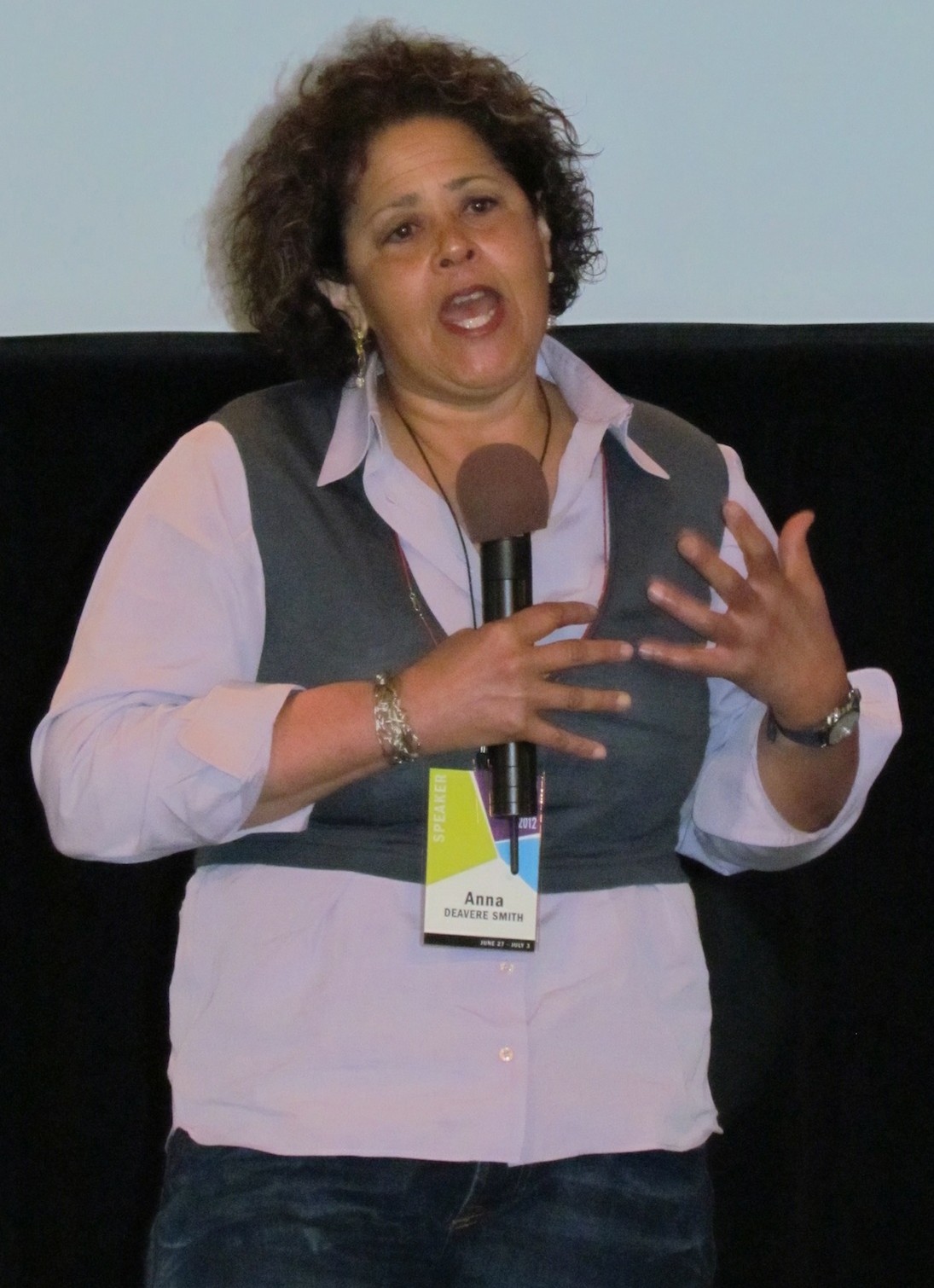
I’m attending the Aspen Ideas Festival from early in the morning until late at night.  Richard and I have joked that the Aspen Ideas Festival is summer camp for adults, minus the swimming, boating or water skiing activities.  As I am there almost constantly, Emma really misses me.  “Go with Mommy?” Emma asked yesterday morning as I got ready to attend a 7:45AM session on “Our Moral Imagination” with Jane Shaw, introduced by Anna Deavere Smith (I’m giving myself a shameless plug now) who was wearing Ariane Zurcher Designs 18 Kt gold earrings with Australian pearls.

For the Aspen Ideas Festival I am wearing my journalist’s hat.  “Come with me and Granma, Em.  She’s going to drop me off.  Do you want to come?”

“Yes, Granma and Mommy and me, go together,” Emma said, pointing to each of us.

“Right, but I have to go to work, so I’m going to get dropped off and then you and Granma will come back up to the ranch, okay?”

“Yes,” Emma said, but she looked sad.  “Mommy has to work,” Emma added.

I love working.  I’m lucky to have writing and design both of which I love.  My ambition is something I have only recently allowed myself to really appreciate or even recognize.  For years I felt the pull of guilt when I went off to work, and while I still do at times feel that familiar tug, I no longer condemn myself for loving what I do.  Loving work does not take away from the love I feel for my children.  It isn’t either/or.  It’s not as though enjoying a career means I do not enjoy and want to also be with my children.

I spent yesterday going to a number of sessions, the first beginning with the inspirational Jane Shaw who is a British Anglican priest and scholar as well as Dean of Grace Cathedral in San Francisco.  She spoke about empathy and asked, “Can we really command someone to love?”  Jane suggested art and poetry are doorways into another’s soul.  I immediately thought of nonverbal Autistic, Amy Sequenzia’s poem, Happy To Be Myself.  Jane spoke about empathy which she described as “a deep responsiveness to that which is different from us.”  I thought of my Autistic friend Ib, whose compassion and empathy is a lesson all humans would do well to learn.  And I thought of Emma.  I thought of my journey from trying desperately to find something that would change Emma’s brain to responding to the little girl who is right in front of me.   A journey that has taken me from striving, to being.

Throughout the day, Jackie texted me photos of Emma.

Emma goes bungee jumping

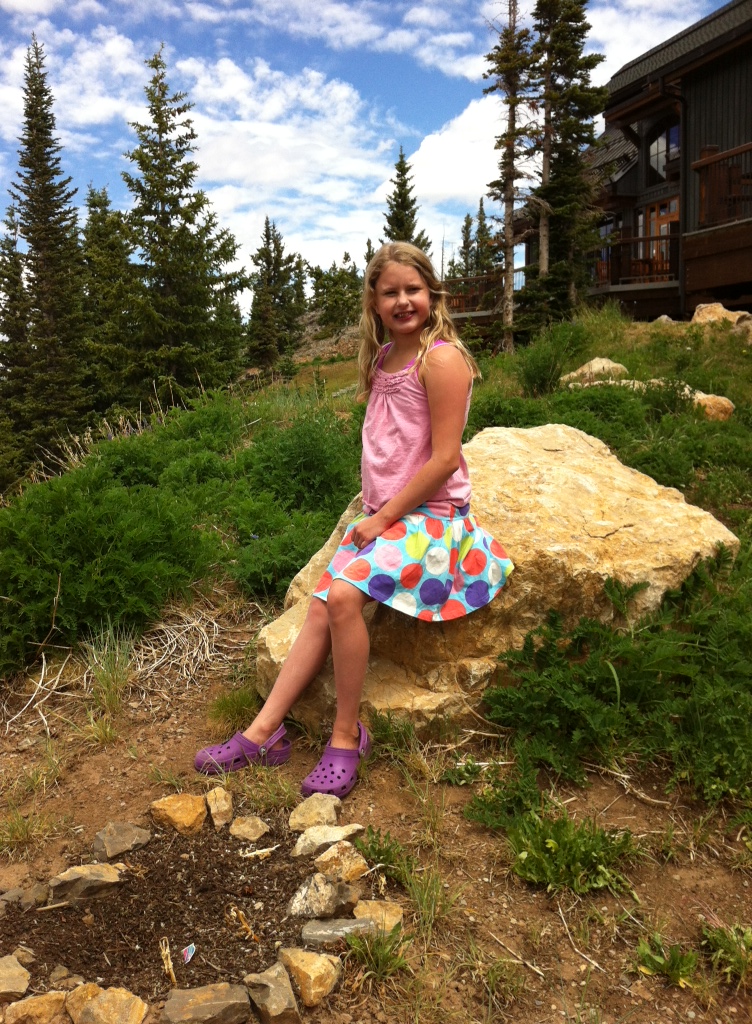
Emma on top of Aspen Mountain (notice the pose!)

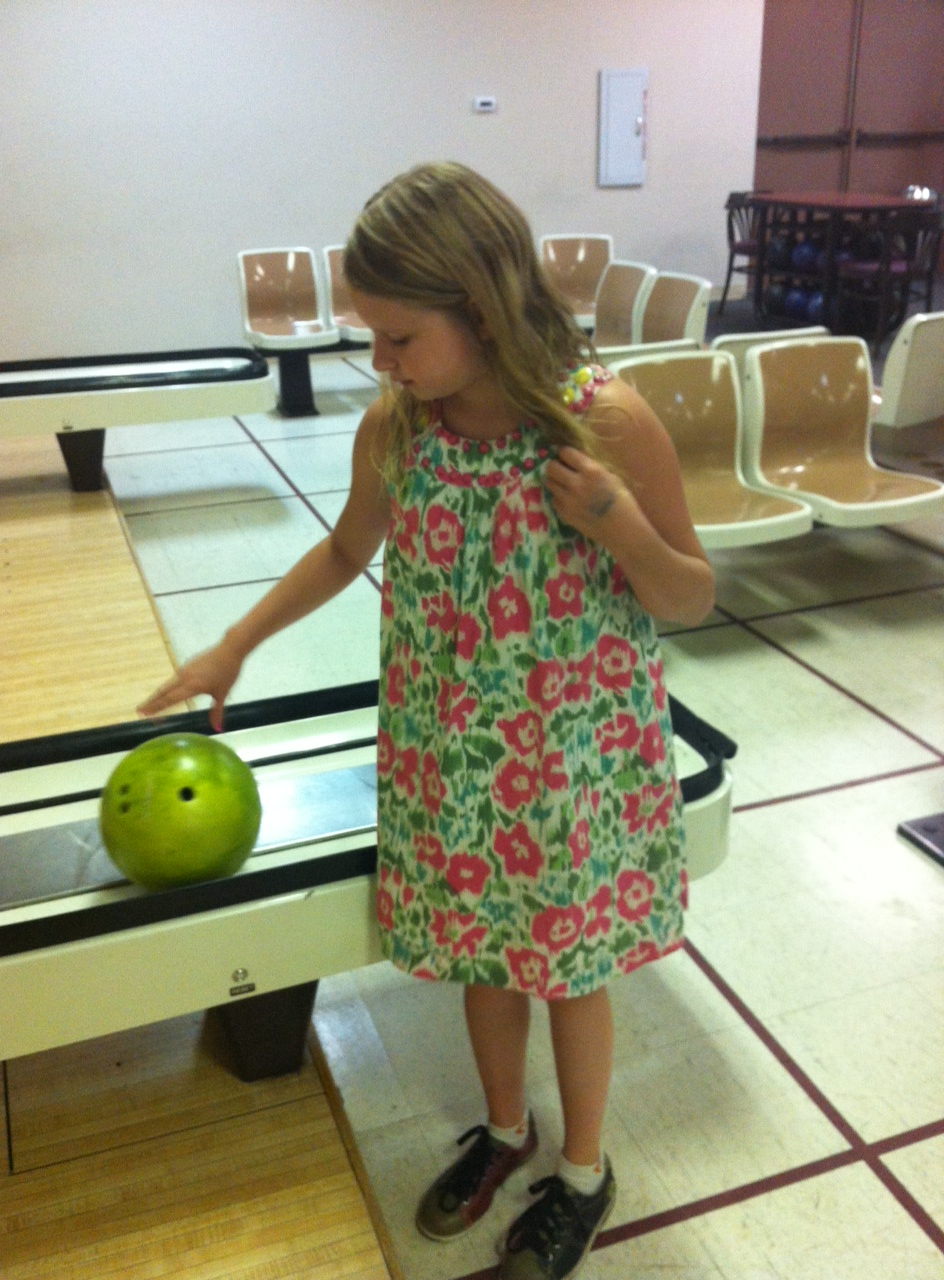
Emma goes bowling

Even when I’m working, I carry both my children in my mind.  I think about them, I wonder what they’re doing.  I hope they’re okay.

“How are we motivated to think about what it’s like to be another person?” Jane asked early in her presentation.  I thought about how for me, it began with tremendous pain, which led me to search, find and finally listen to Autistic adults.

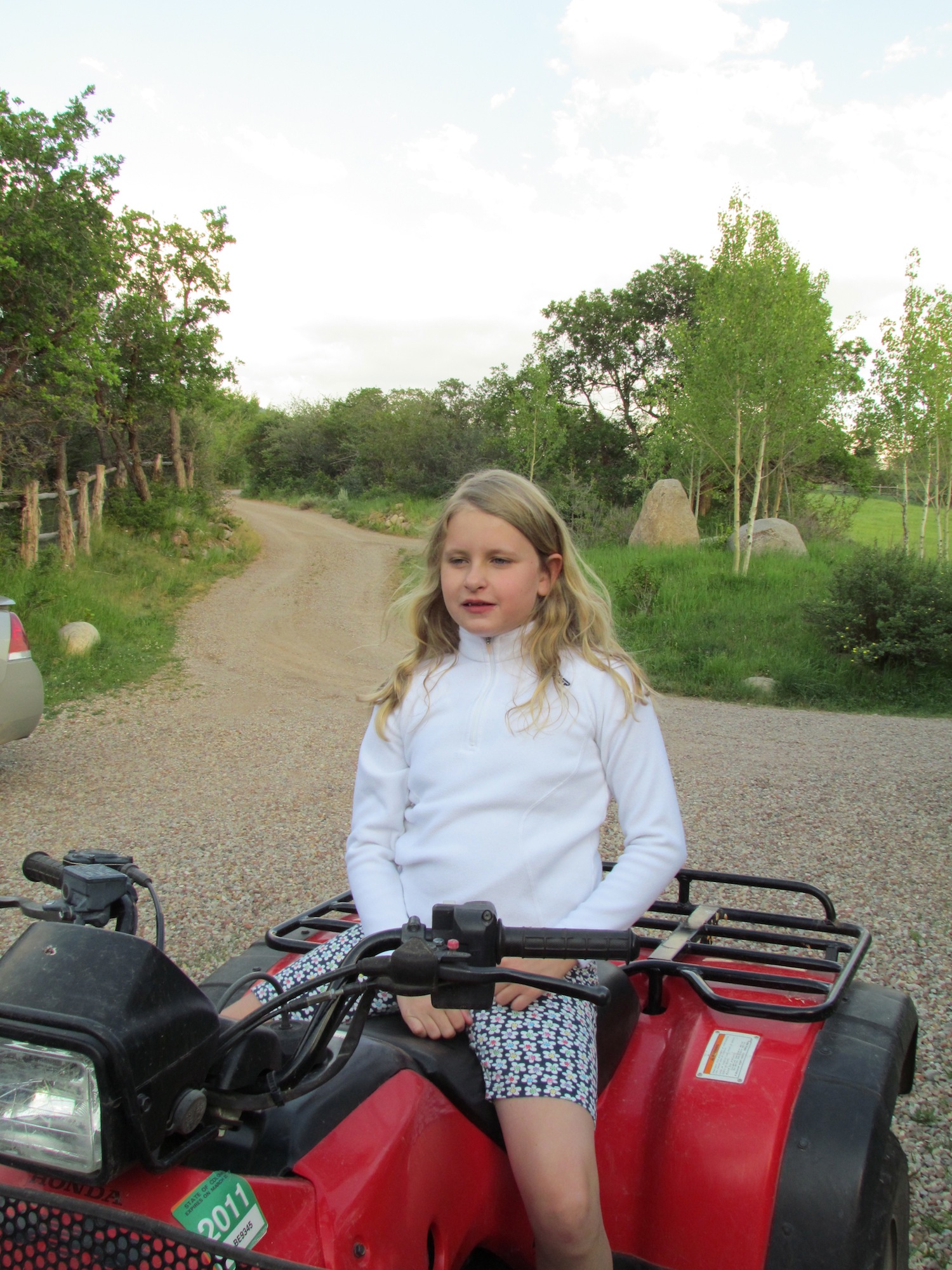
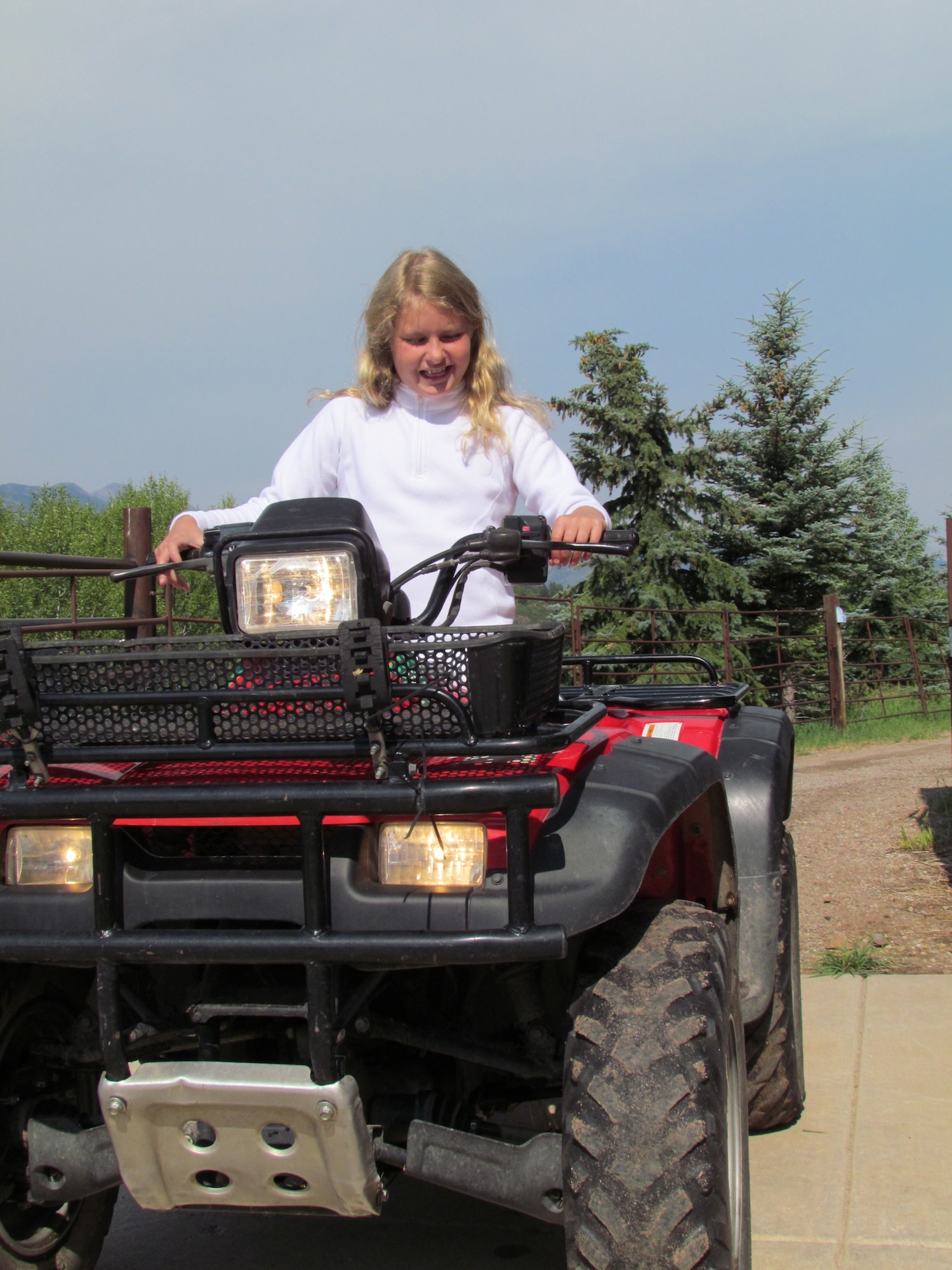
This photograph looking west to the ski area known as Buttermilk, with Highlands to the left was taken from our ranch road when I took Emma out on the 4-wheeler last night.  Or as Emma calls it, “Emma’s red 4-wheeler.”  And she’s right.  It is hers.

Ideas About Autism At The Aspen Ideas Festival

I’m attending the Aspen Ideas Festival for the next six days.  As a result I am meeting a great many interesting people.  But many people who see my Press badge are curious, what do I write about?  How is it that I’m at the Aspen Ideas Festival?  Inevitably the conversation comes around to autism, because let’s face it, that is what I write about more than anything else.  Autism is something that everyone has an opinion on, or if not an opinion, then a great many ideas.

Most of the comments I hear are in the – It’s an epidemic, vaccines must be the reason, or questions about where on the spectrum my daughter Emma falls.  If I say something positive about my daughter, they usually respond with the mistaken assumption, “Oh she must be Aspergers,” or “You’re so lucky she’s so “high functioning.”    As though that could be the only explanation for words that aren’t negative.  Amy Sequenzia eloquently describes her journey from ableist to advocate, on the blog, Autism Women’s Network.  It is the single best description I’ve read, which explains beautifully how our perceptions and ideas about autism affect those who are autistic.

Often people want to tell me stories about someone they know whose cousin, brother/niece/son/grandchild/best friend’s step brother/best friend’s neighbor, is autistic.  Sometimes people are genuinely interested and will ask me questions, but most of the time, they prefer telling me about that person they know twice removed who knows an autistic person.  There is a tremendous amount of fear out there.  I hear it all the time.  People talk about autism with the same grave tones they speak of the environment.

So I wasn’t surprised this evening when I met a couple who’s close friend’s grandchild was autistic.  “It’s so sad, just awful,” the woman said.  And then shaking her head she added, “It’s such a dreadful disease.”

“Actually it’s not a disease.   It’s not contagious.  It’s neurological,” I interjected.

The woman paused and stared at me and then said, “It’s horrible.  Very, very sad.”

“I don’t see it as a tragedy,” I began.

“Oh,”  The woman interrupted me, “well, of course you don’t.”  She took a step back and smiled.  And just like that, the conversation was over.

When I have these sorts of conversations, I see just how far we have to go in educating the public.  I know we will have to undo centuries of ingrained thinking about disability.  I understand that some people will never be convinced.  I hear others who have an opposite and yet equally unrealistic view of autism.  They are the ones who usually bring god into the mix, or talk about angels, or how these children are all geniuses or shamans, but whichever extreme they choose it is still an extreme and both do damage to those who are living their lives on the spectrum.  Whether they are being condemned as a tragedy or placed on an altar, they are being put in an impossible position that does nothing to actually help them.

It’s tricky.  How do you think about someone who needs tremendous support?  For many it is impossible not to project pain, suffering and the idea of tragedy onto them.  But very few people I know who are autistic or disabled want pity.  They want help, support and acceptance so they can flourish.  Pity or the converse of that, adulation, holding them up as divine creatures put on earth to teach the rest of us some hard-earned lessons, is not something I’ve ever heard an Autistic say.

One of the presenters at the Aspen Ideas Festival, Louie Psihoyos, who directed the amazing Academy Award winning documentary, The Cove, said during the Festival’s opening, “A few thoughtful people can change the world.”

I believe that absolutely, I believe.

Emma on the 4-Wheeler

Acting Out Emotions and Pink Fingernails

Emma came home yesterday afternoon and showed me this.

“Pink,” she said proudly.  Jackie had taken Emma for a manicure.  And not only had Emma sat still for it, she liked it!  I’ve been giving Emma manicures and pedicures since she was a baby.  She likes having her toenails painted, but never her fingernails.   This was a first!

That afternoon we took the children swimming.  While Nic and Richard threw a football back and forth, Emma and I sat in the shallow end and Emma said, “No Sarah cannot throw the bottle.  Sarah!  You have to leave the room!  Sarah is sad.”  Emma then looked very sad and nodded her head.

Suddenly I had an idea from my conversation with my friend Ib, who has told me about her theatre training and how much that’s helped her.  I couldn’t figure out how to get Emma to act out the emotions she was saying, so instead I said, “Hey, Em, I’m going to pretend to be Sarah, okay?”

Emma nodded her head and grinned.  “Yeah, Sarah is sad,” she repeated.

I began to pretend-cry.

Emma watched me for a second with a little frown on her face and then she said, “Soufien is so angry!  Grrrr!”

I shook my fist and pretended to stomp my foot under the water while grimacing, “Oh!  That makes me so angry!”

Emma smiled, “Justus is happy!”

We went on like this for almost twenty minutes with Emma attributing an emotion to a child in her class and me acting out the emotion, though I did stumble a little on “shy.”   These are all emotions Emma has read about in the book – The Way I Feel – by Janan Cain.  Emma adores that book.  We’ve gone through at least three copies of it over the years.  But what is interesting is that Emma was taking all the emotions described in the book and applying a child she knew to each of them.  I don’t know that I’ve had a back and forth interaction with Emma that has ever lasted this long.  It was incredible.

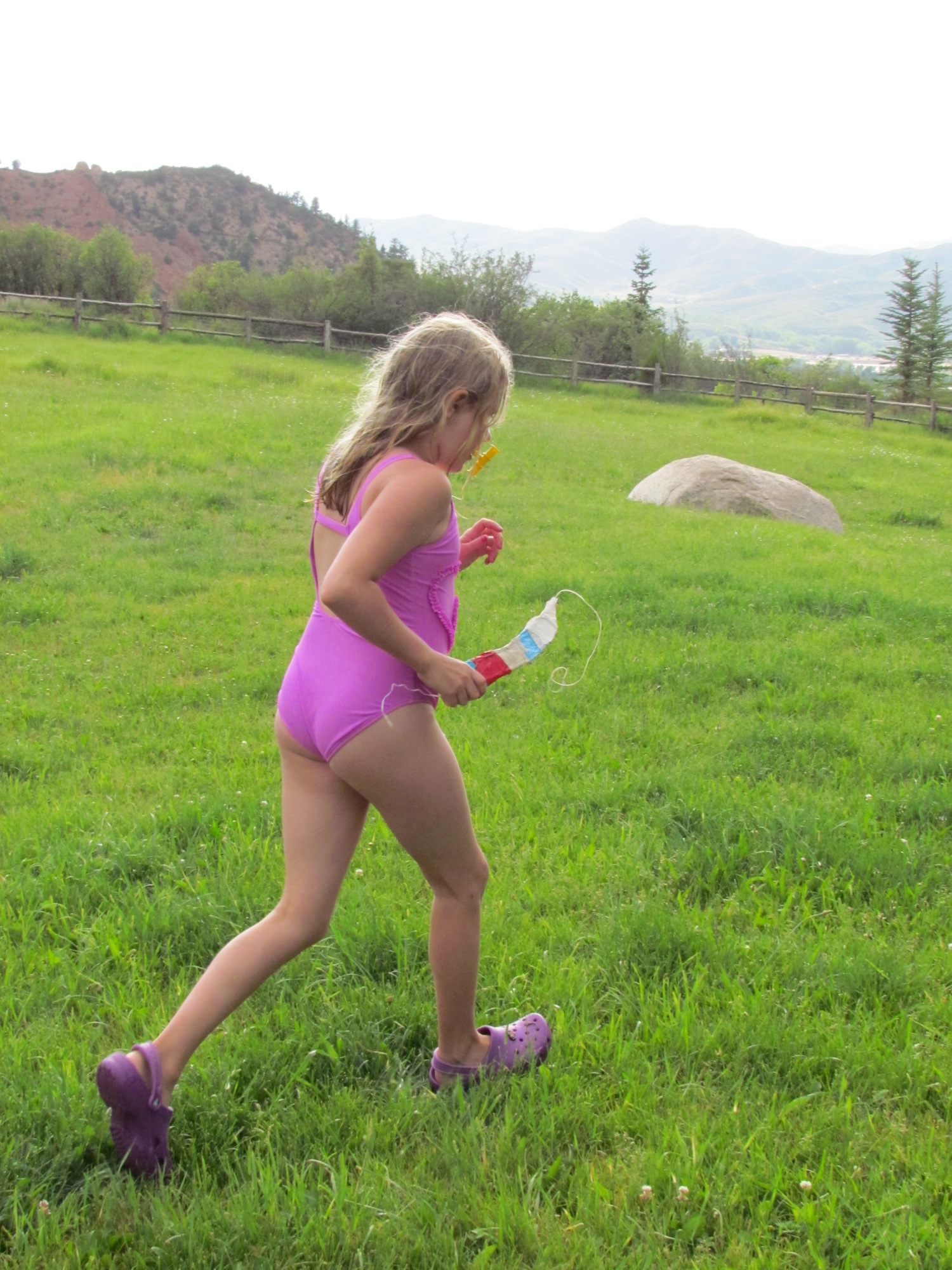
When we got home, Emma donned her pink bathing suit, which also happened to match her pink fingernails, and ran through the sprinklers until it was time for dinner.  (Notice Emma’s string, which has resurfaced and she has added to in the past month.)

Today the Aspen Ideas Festival begins, so things will be a bit hectic for the next six days.  But I will continue to post here.

Finding Ways to Connect With Other Human Beings

I have a relatively new friend.  We’ve been talking a few times a week.  She makes me really happy because she’s funny, smart and kind.  You know that magical feeling when you connect with another human being?  Someone who is special?  It’s a deeper bonding than with most people, you can’t explain why that is, you just feel it and it’s mutual.  I feel safe enough to confide in her.  I’m pretty sure she feels the same.   When we aren’t talking I think about her.  I wonder how she’s doing, is she okay.  And then one of us reaches out to the other and we start talking.  Only with my friend we don’t talk in the conventional sense, we type back and forth in real-time.  My friend reads very quickly, she’s hyperlexic; if I mention something that she hasn’t read, she’ll zip off and do a little research while I’m still typing out a sentence.  Then she’ll reply with the knowledge of someone who knows, but didn’t in the previous sentence.  It makes for an interesting conversation.

As a teen she had alexithymia.  Meaning it was difficult for her to use words to describe the emotions she was having, as well as understand other people’s emotions, which combined with her literalism, caused a great many problems.  So yesterday she was telling me about how she used echolalia and physical actions as a way to connect, but it didn’t always work out so well.  People misunderstood her.  And I thought of Emma.  Because Emma doesn’t have the language to describe her more complicated feelings.  So when she wants to connect, she’ll hit or she’ll say, “No, you cannot pull Mommy’s hair.”  Which means that she’d like to, but she knows she shouldn’t.  At her school she pulled her friend’s hair and was punished.  Emma knows this is something that while she enjoys doing it, the recipients often do not.  That must be very confusing to her.  Emma will say things like, “No you cannot pinch Mommy.”  Then she’ll look at me with a mischievous look and will wiggle her fingers at me as though she were about to pinch me.

“No Emmy!  Don’t pinch Mommy!”  I tell her.

Emma thinks this is the height of hilarity and will say again, “No.  You cannot pinch Mommy!  Pinch Mommy!” and then as though the feeling is too powerful for her to control, she will.

“Ouch!”  I will say.  And Emma will double over in laughter.

Last night we went out to dinner in town.  It’s very warm here, so we sat outside.  One of Emma’s favorite games is to pretend to give me a shot.  She “washes” my upper arm by rubbing it with her hand and then pinches me.   “Swish, swish,” Emma said, while pretending to put a band-aid on my arm.   “Now you do it,” she said, covering her eyes with one hand, while offering me her arm.  We play this game often.  It is also her way, I think, of working through her fear of having a shot or the finger prick they sometimes do at the doctor’s office.

Yesterday as my friend and I were talking I realized something else.  Emma is doing these things, punching, pulling hair, pinching, because she wants to connect, she wants to get a response, she wants to interact.  It’s not just a one-sided gesture.  She is trying, in the only way she knows, to make contact.  Sadly her gestures are often ignored or she is told no, she cannot do that, so she is then further limited.  She doesn’t have the words, she cannot always make sense of what she’s feeling, but she really wants to interact, to develop a method of “talking” with another person.  She’s doing the best she can with the limited tools she has at the moment.

I realized I needed to help her find physical ways to connect that will not be perceived as “harmful” by the other person, but that are also meaningful to her.  I will have to speak with my friend about this, because she will undoubtedly have some good ideas, besides I haven’t spoken to her in at least 16 hours and I already miss her.

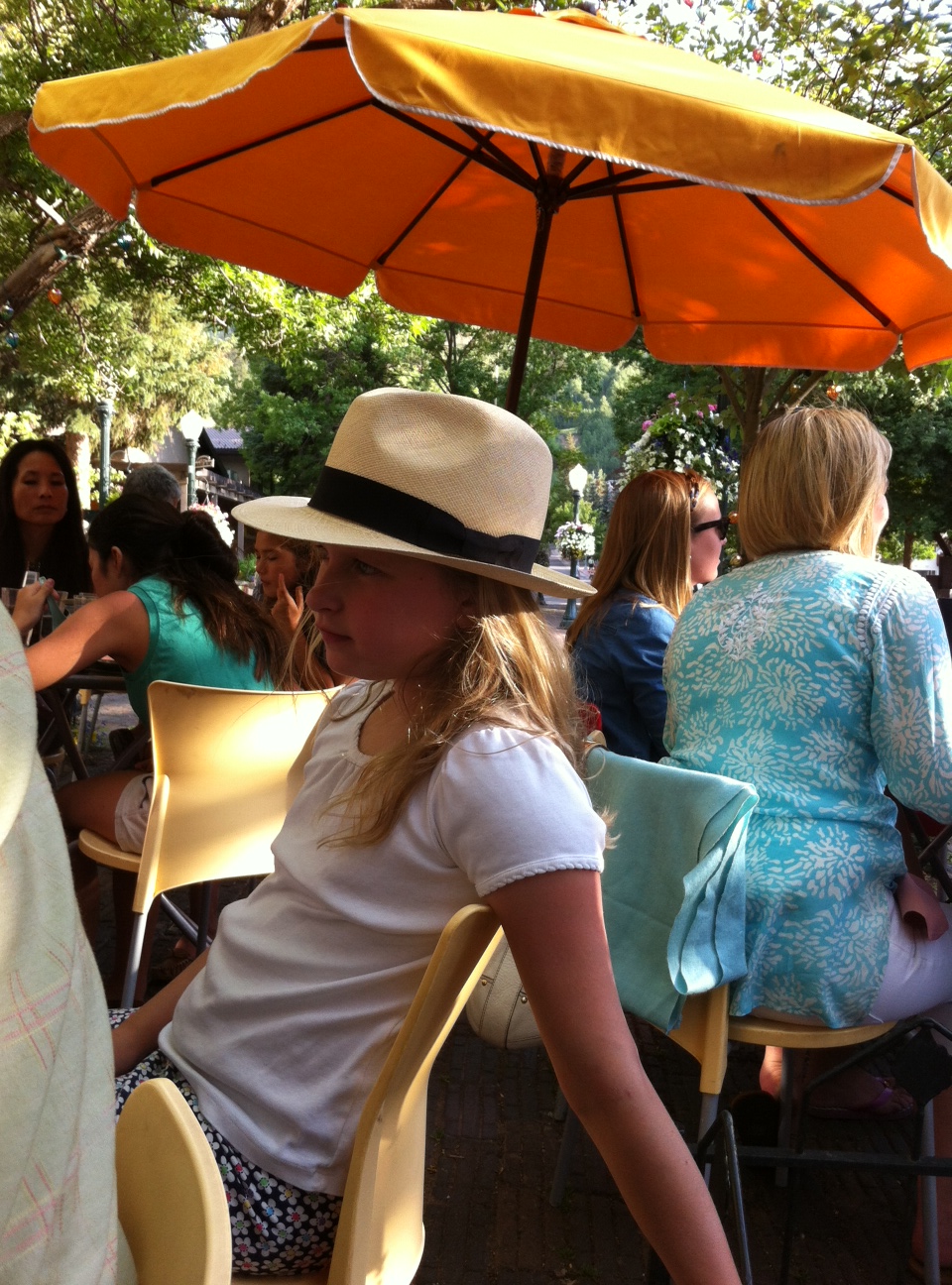
Last night at the restaurant, Emma wearing Richard’s hat

This morning – sunrise on the ranch

Two Strangers, Two Responses to Autism

Stranger number one:  A man seated next to me on the flight from New York City to Denver.   He was distressed and upset because of the extensive delays we experienced and assumed he would miss his connection home to Vancouver where his two sons and wife awaited him.  As he spoke to me, he looked over at Emma, seated in the window seat and who appeared to be sleeping, thumb in her mouth, head resting on her horse pillow, a small scrap of her green blanket clasped in her fist.  Her hair fell over her face, covering part of it.  He nodded toward her, “She’s tired, huh?”

“Yes,” I said, looking over at her and smiling.  Emma opened one eye and made a little grunting noise, before closing her eye again.

He asked me if I was traveling alone.  I explained to him that in fact we were all spread out over many rows.  Because of all the delays the airlines changed our seats, giving most of us middle seats, making it impossible to convince anyone to switch with us so that we might sit together.  At a certain point, I took a lapse in the conversation as an opportunity to pull out my book, Representing Autism.

“Are you a teacher?” the man asked.

I told him I was not, that my daughter was autistic and it was a subject I was particularly interested in.

“Ah,” he said, knowingly.  “My eldest son is too.”

He went on to relate how his son had been poisoned by high levels of lead because his wife had drunk tea throughout her pregnancy from a samovar.  This was confusing as, strictly speaking, his description would make his son’s issues lead poisoning and not autism, but before I had time to think of an appropriate response, he told me that because they had him chelated he was now high functioning and that God had blessed him with a child who could speak.   And while I think it’s wonderful many people find solace in “God” I really hate comments like this, where it has to then be concluded that God is not blessing others with things like poverty, starvation, murder.  I know, I know, don’t get me started.  

He then told me his wife contributed to his son’s autism because it was genetic and “the mother carries the genes that cause autism.  That’s why more than 80% of them are boys.”  This last remark was so staggering in it’s complete lack of logic I was thrown into a state of stunned silence.  Then he capped the conversation off with a nod to Emma and asked, “Is she functioning?”

Do NOT say another word,  I pleaded silently, while also thinking,   You have the chance to say something that might change this man’s point of view.  But I couldn’t.  I was too angry and tired, the delays had taken their toll.  I had hit a wall, silently cursed this man and just wanted to escape into my book.  I no longer felt magnanimous or in the mood to offer an opposing view.  I felt hateful, furious and resentful.  I was disturbed by the man’s, seemingly unintentional, but never-the-less confused ideas of cause and blame, not to mention the casual comment about chelation coupled with how his son’s heart stopped twice while doing so and that didn’t even cover the comment about God, which would have taken me down a whole other path.

“Does she speak?” he continued.

“She’s autistic.   Her hearing is actually excellent,” I snapped.  “And I do not speak about her as though she cannot understand.  Her intellect is as sharp as her hearing.”

“Oh!” the man said, taken aback.

All thoughts of offering patient opposing views in a kind tone went out the window.  I pulled out my book, a pen and my notepad and began reading.  End of conversation.  It must be said, this was not one of my prouder moments, but I didn’t have it in me, I just didn’t and it depressed me that so many are so misinformed.

The second stranger was a woman with two small children who asked me, as Emma and I were waiting for the bathroom, if I would keep an eye on her two kids so that she might use the bathroom.  Emma peered with curiosity at her daughter who was four-years old and son, who was not quite two.  “Boy,” Emma said, pointing at the little boy.

“Yes,”  I said, kneeling down.  “What’s your name?”

We learned that the children, Alice and James were also headed for Aspen on the same connecting flight as us.  Their Dad couldn’t go with them, but their Granma was meeting them in Denver.  When Emma and I returned to our seats, Emma said repeatedly, “Go see  Alice and James.  All go together to Aspen.  Go to Granma’s house and play with Alice and James.”

When we found the gate for our connecting flight, there was Alice and James with their mother who proceeded to ask Emma questions.  “What was her name, how old was she, did she have a brother, his name, age, where we were going, etc.  All the questions she directed to Emma and she waited for Emma to answer, even when it seemed she might not.    A couple of Emma’s answers were somewhat cryptic, as when asked what she liked doing when in Aspen and Emma answered, “Make cake.”  But all in all it was really nice to see someone behave in a sensitive manner while respecting Emma’s need to process, giving her the time to do so. It was in stark contrast to the first stranger.

This morning when I told Richard I was posting this piece, I said, “I’m too tired to find the humor.”

“My brain is operating on a case by case, need to know, basis,” Richard replied.

And that remark made me laugh.

English: Looking south from Top of the Rock, N...

(Photo credit: Wikipedia)

Merlin & Emma – Or How To Not Do Something You Don’t Want To Do

6:03AM – Our bedroom

Em:  Hi Mommy!

Me:  Hi Emma!

Em:  It’s six zero three.

Me:  You’re awesome.  Merlin comes over in all his silky, soft adorableness.  Aww…  Look Em.  It’s the kitty.  He is so soft!

Emma smiles at me.  But makes no attempt to pet him and he’s rubbing his body against her.

Me:  Emmy, look at the kitty.  He’s so soft!  I stroke Merlin, who begins purring loudly.  Emma begins to hum a little song.

Me:  Em!  Come on!  Pet Merly.  He’s such a good kitty.  I say this as I stroke Merlin who walks lazily passed Emma towards the end of the bed.

Em:  Oh!  Oh!  I can’t reach!  I can’t reach the kitty!  She says this while in an exaggerated display, extends her arm as though she were trying to pet Merlin.  He is, in fact, within reach.

Richard begins to laugh.

Me:  Emmy!  You can too reach him!  Now Richard and I are both laughing.

Em:  Huge grin and with feigned sadness says – Oh no.  I cannot reach the kitty.  I can’t pet him.  Awwww.  I can’t pet Merly.

I love that kid.

7:30AM – In our study

Em:  Mommy, I want you to help me brush my teeth please!

Me:  Okay Em.  

Me:  (To Richard)  I’m almost finished with this post. I’m keeping it short and sweet.

Richard:  You mean like me.

I love that man.

Walking the walk

Losing Sleep, Autism and Strange Noises in New York City

I’m operating on about three hours of sleep.  The piece I rewrote about Simon Baron-Cohen and The Theory Of Mind for the Huffington Post was published yesterday evening.  I knew I’d get some opposing views.  I’m used to that.  I understand that by putting my thoughts out there,  people will and do disagree.  So irritating when people disagree with me.  Eye roll, sharp intake of breath.

When I began writing at the Huffington Post I submitted a piece about Emma and her interesting use of language.  It was not a scholarly piece, (none of my pieces are, it’s not what I write)  just some observations and thoughts I had.  Once the piece was published I received a couple of scathing comments, many of which were marked as “abusive” and were removed, but one that remains, was from a retired speech pathologist who wrote,  “A jewelry designer (author of the article) who has bizarre ideas about language development should be countered by an expert opinion.”   I imagined as she wrote that comment she was looking grim and making tsking sounds.  I felt as though I were back in first grade being scolded for not paying attention.

Another piece I submitted about Emma’s painting, a number of people made derogatory comments, which were removed.  One of those comments was,  (I’m paraphrasing here) Oh great!  Stupid references to Dr. Seuss, Autism and painting all in one sentence.  How is this news?  

News?  I was supposed to write a journalistic, investigative piece?  Shit!  Where was I when that memo got sent?   I thought I was writing a piece about the joy I felt watching my daughter paint.

It’s anxiety causing to get such contemptuous responses, but over the years I’ve developed a “thicker skin” though I’m so literal-minded that phrase strikes me as really creepy.  Still, in this last piece it is I who am attacking someone else.  And while I’m sure Simon Baron-Cohen wouldn’t lose any sleep were he made aware of my rant about his questionable test and the even more questionable conclusions he’s drawn, it’s not in my nature to attack others.  I don’t feel comfortable doing it.  Against my better judgement I submitted the piece anyway because I believe strongly in its message.

As I reiterated in a comment I made to another person’s response –  SBC  is presenting himself as an “expert” on autism. It isn’t as though he was the parent of an Autistic child, had a blog and wrote the occasional piece for the Huffington Post, while making inflammatory statements, which everyone could read, laugh, argue with and forget. He has made a career for himself, based on his academic achievements. His theories should and must be held to a higher standard. His words and ideas have tremendous power. It is irresponsible to be in such a position of power while basing ideas and theories on faulty tests with no consideration of the implications. I, too, could cite many examples of my daughter’s actions, which could then be used to (erroneously) support SBC’s various theories. That doesn’t make his theory correct, it brings into question my thinking.  I urge you to read Dr. Henry Markram’s alternate theory – http://www.wrongplanet.net/article419.html – I can find many more examples of Emma’s behaviors, which support his theory. The TOM theory is a dangerous one because of the way it can be used to justify the negative perceptions of Autistics. If someone has little or no empathy, we are much more likely to behave in a less caring manner toward them. We may insist this isn’t so, but there have been studies suggesting otherwise.”

As a result of all this I’ve paid the price by getting very little sleep.  Ask me about the traffic patterns on 7th Avenue between the hours of 2 and 4.  And exactly what was going on with that woman who kept shouting WooWoo at around 3:30AM?  Was she celebrating?  In the beginning stages of labor?  These are the questions plaguing me at the moment.

Emma making her silly face, which pretty much sums up how I’m feeling at the moment.

((((((Emma)))))), Facebook, Twitter, Blogs and Other Joys

When you look at the title to this post do you read it to mean – Hugging Emma, Facebook, Twitter, Blogs and Other Joys?

(If you answered yes, you are correct.  ((((Insert name)))) = Hugging.  The more parentheses, the bigger the hug.)

Within the autism community where Facebook reigns as the ultimate gathering place, the use of emoticons, ways of expressing emotions and physical actions, are commonplace.  I would argue that within the autism community the use of emoticons is more prevalent than within the neuromajority population.  But I need verification from my Autistic friends before I make such a statement.  It’s a thought based on my observations and interactions.  Which, by the way, speaks as much against Simon Baron-Cohen‘s various theories about Autists lacking empathy and a desire for interactions as it does to the level of support, gestures of kindness and friendships that are developed and maintained over the internet.  (I just submitted an amended version of my recent post – An Empathic Debunking of the Theory of Mind – to Huffington Post so he’s very much on my mind these days.  I’ll give an update when I see if and when it’s been published over there.)

Facebook, a crowded virtual space where conversations overlap, people you’ve never met interject themselves into a conversation before moving on, friendships are formed, rekindled and developed, strangers “poke” you to say hi, even if the only connection you have is that you both occupy space in that crazy mosh pit that Facebook single-handedly created.  If you think about it in these terms, Linkedin has a more conservative, suit and tie required at the door feel to it, I haven’t figured out where twitter falls in all of this, maybe it’s akin to speed dating, while blogs are the mothership, making the insanity over at Facebook all the more raucous and surprising.

It must be said, I hated Facebook when it began.  I refused to join, I felt indignant when people would discuss their “friends” or about something that had gone “viral.”  Who cares?  Who has the time?   I scoffed.  This is just a bunch of people with way too much time on their hands.   And then I would settle back to my tenth game of Spider, while reminding myself that I really should get some sleep.  But eventually I joined.  For business reasons, I told myself.  This is a pattern for me.  I observe, remain on the side lines, dip a toe in the murky waters, sit back, observe some more and then dive head first into the deep end, blissfully unaware of any rocks that may lurk under the surface.  I’m not encouraging this approach, it’s just an honest assessment of what I have a tendency to do.

Yesterday I was a mess.  For those of you who reached out, thank you.  I was teetering on the edge, trying to keep it together, not doing a great job, but doing my best to work, taking on one small task at a time.  And then my friend stepped in and held out her virtual hand.  (((((( Insert Name ))))))  Like a life line, she held her hand out and gently pulled me off the ledge.   Lots of emoticons were used.  I’m not fluent in emoticon, but she’s been a kind and patient teacher.  Did I mention she’s Autistic, not that it matters, except that it does, if only for this reason:  Autistics aren’t suppose to be like that.  That’s what we neurotypicals are taught.  Right?  It’s what all those autism specialists tell us, right?

She sat with me, literally, while I wept.  ((((((((((Insert my friend’s name)))))))))   She said all the right things and by the time we both went back to work, I was laughing.  But wait, that can’t be right.  She must not be autistic, because she doesn’t fit the mold.  Right?  Isn’t that what we do when someone defies a stereotype, instead of re-examining the stereotype, we relabel the person?  Can we all agree to toss this insane theory about Autists lacking empathy, lacking a desire for interaction and friendship?  Can we please just stop it?  Imagine if you tried to reach out to someone, only to have them reject you because of some mistaken idea they had about who you are and how you are supposed to behave?

Which brings me back to Emma.  My beautiful daughter.  I don’t know if she’s already aware of these stereotypes and how they apply to her.  My guess is, she is.  It’s one of the many things I wish I could control and change.  But I cannot.  What I can do is make sure she knows that I am here, supporting her, encouraging her, with my arms open for those times when she needs to feel them wrapped around her securely in loving embrace, just as my friend did to me yesterday.

(((((((Emma)))))))

Listening to Emma

“Bad ear infection.”  This was the pronouncement made by the doctor who Emma saw yesterday.  Emma knew.  (Click ‘here‘ for a post about another time Emma knew and the only other time Emma had an ear infection.)  Emma told us to take her to the doctor.

We are relieved we made an appointment and sought help.  We are grateful to have her on antibiotics, which will ease her pain.  We are happy she is feeling better.  Those are the important points.  All the other words racing around in my head are less factual and more words that poorly convey my feelings of despair that I didn’t realize her pain was different than usual, that it meant something else was going on than a change in air pressure and anger with myself that I didn’t rush her to the doctor the minute the school called me two days ago.  My defensiveness, like the stereotypical white angel perched on one shoulder whispering, but you didn’t know, you couldn’t have known, is countered by the angel with devil’s horns yelling, “Yeah, but you should have!”  That dialogue or actually any dialogue that begins with – But you should have known – is better left elsewhere.

The art of the beat up job, something I could certainly write a handbook on at this point is not a message I am interested in perpetuating or sending.   What I am interested in is how I  might avoid a similar scenario in the future and take the necessary actions so that next time I can take care of my daughter in a more timely manner.   That’s interesting.  The beat up job is not.

Conclusion:  When Emma says, “Go see doctor.”  Immediately get her to the doctor.  Do not wait to see if things will get better.  Emma knows.  The cliché “better safe than sorry” leaps to mind.

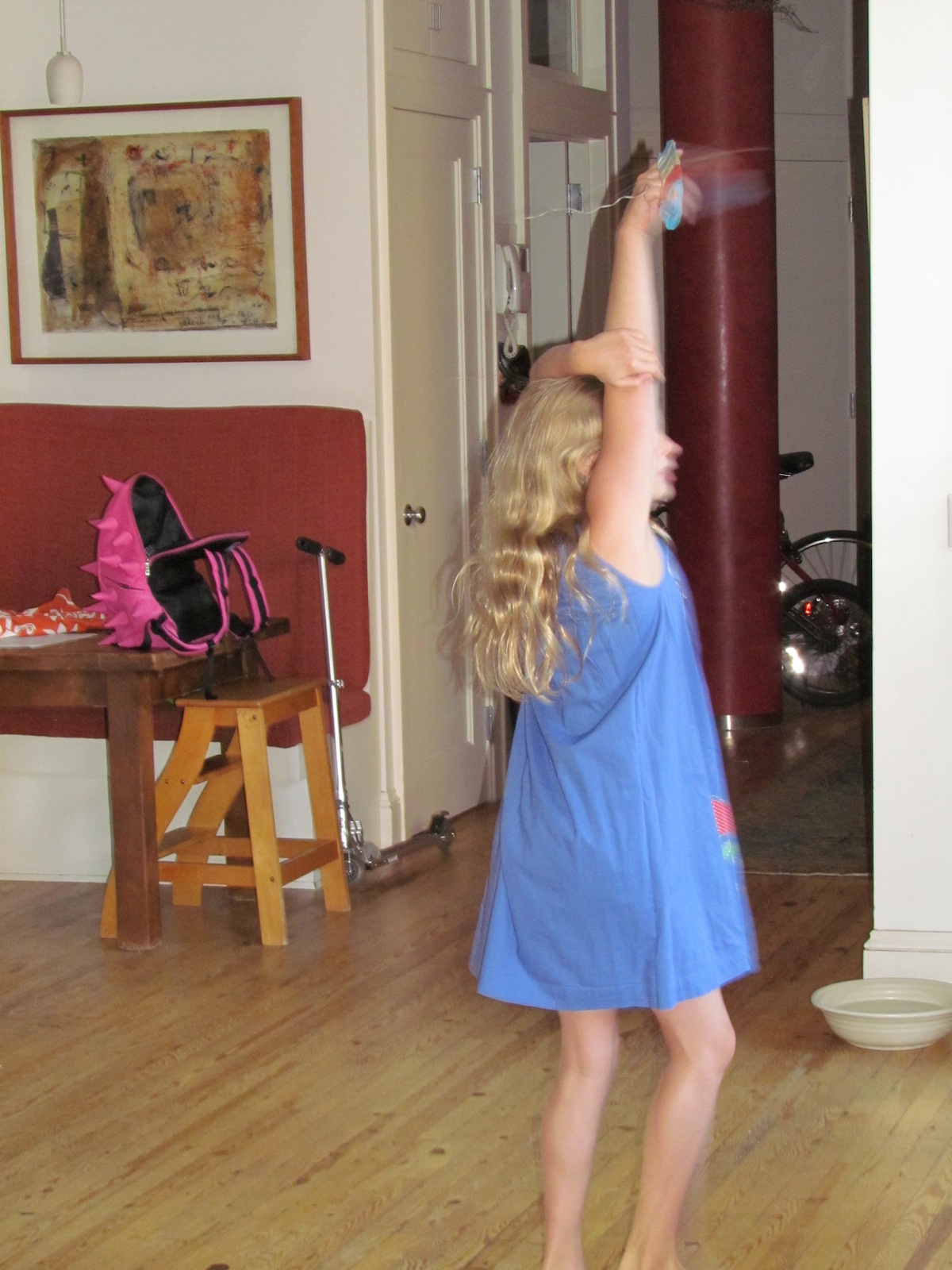
This morning – Emma dancing to MJ’s Beat it 

Emma’s new-and-improved old string is back!

An Empathic Debunking of the Theory Of Mind

Simon Baron-Cohen, the man who has single-handedly done more damage to the perception of Autistics than any other human being (though there are arguably a number of people vying for that title), depresses me.

I need to say that before continuing.

Simon Baron-Cohen developed the “Theory of Mind” based on the results from the now famous “Sally-Anne” test.  The Sally-Anne test, where the child is shown two dolls, is an example of dubious “science.”  Sally has a basket in front of her, while Anne has a box.  Sally, presumably made to move by an adult, which further complicates the test, puts a marble into her basket and leaves the room.  While she is gone, Anne takes the marble from Sally’s basket and places it in the box.  When Sally returns, the child is asked, “Where will Sally look for the marble?”  Only 20% of the Autistic children were able to correctly answer the question – Sally will look in her basket.

Emma, typically, when asked what one of her doll’s name is, will reply, “Doll” or “girl.”  This is just one example of Emma’s literal mind at work.  She is not wrong, her doll is a doll and yes, she is a girl.  To take away any other conclusion from her answer would be ridiculous.

Yet, from this “test” Simon Baron-Cohen concluded, “that the core problem in autism is the inability to think about other peoples, or one’s own thoughts.”

Except that his test did not take into consideration the level of anxiety, stress or mood of the Autistic participants at the time of testing.  Nor did it take into account the language issues, pronoun challenges or literal thinking many Autists have, which the test inevitably presented.  In addition Simon Baron-Cohen based his theory, which is taken by many as proven fact, on assumptions that the Autistic participants understood the question.  He then set about publicizing his theory, which inadvertently or not, is used by many in the neuromajority to abuse and mistreat the very people whom he categorizes as lacking empathy.  Does anyone else see a problem here?

When Emma was diagnosed I came upon the Theory of Mind paper early on in my research.  I remember thinking that this explained why, when any of us were upset, Emma seemed oblivious.  But as I continued along the road of educating myself, coupled with observing my daughter, I began to question his theory.  I read about Autistics who avoided looking in people’s eyes because it was too intense.  One Autist described it as akin to seeing into a person’s soul.  Other’s talked about how they could sense immediately upon entering a room, the various occupants emotional state and became so overwhelmed they would seek refuge in a corner, try to leave or would stim as a way to counter the intensity of what they were experiencing.

There are times when Emma will, with outstretched arm, put her hand out in front of her face like a shield.  Often it is done, I believe, as a response to the intensity of feelings, either hers or others or both, or as Jessy Park, Clara Claiborne Park’s daughter was quoted as saying, “It’s too good.”   Landon Bryce over on his terrific blog, thAutcast has a wonderful video of an Autistic artist, Tina, who talks about how she trained herself to look into people’s eyes because she paints portraits.  It is a beautiful video, as is she.

What struck me, after reading half a dozen articles and interviews by and with Simon Baron-Cohen, is the damage he is doing.  His most recent book, Zero Degrees of Empathy, (which I am not providing a link for on purpose) where he includes Autistics along with psychopaths and borderline personality disorder as examples of groups who lack empathy will further the suffering of Autistics.  For a man who claims Autists lack empathy, he is bizarrely unaware of his own lack of empathy.

For those who would like to read an opposing theory and one that seems much more in keeping with what I see demonstrated by not only my daughter, but the many Autistics I have had the honor of getting to know, read this interview with Henry Markram.

Is There A Future for Emma in the Theatre?

Yesterday, as we were leaving Nic and Emma’s gymnastics class, Emma found a stray balloon.  No doubt left by one of the children who attended a birthday party there earlier, Emma looked at me with a sly grin, then grabbed the balloon and said, “Look!  It’s a birthday party balloon.  Take it home?”

Emma loves nothing more than birthday parties, balloons and singing Happy Birthday.  “Sure Em.  But remember to hold on to it, because if you let go, it’ll fly away,” I said.

Emma nodded her head gravely and said, “You have to hold it.  If you let go, the balloon goes up in the air.  Oh no!  Don’t go away balloon.  You have to hold it.  But listen, if you let go, there will be no more balloon!”

Emma’s way of coping with anxiety is to repeat a script of sorts.  These are things she’s heard from a variety of sources.  She pulls together threads and combines them to make a dialogue that she then repeats.  Many Autistics script.  Some people feel scripting is to be ignored and even discouraged, but I find Emma’s scripts are informative and useful.  It is the way she is attempting to communicate.  I don’t believe they are nonsense or meaningless.  I believe she uses them in situations when she cannot come up with words of her own.

Emma managed to get through the next four hours without losing the balloon.  This was no small accomplishment as those four hours were packed with activities, ranging from shopping for shorts and an awesome camouflage swim cap for Nic, bathing suits for Em, swim goggles for me, ear plugs for all of us, slices of pizza for everyone, before meeting Richard at the local Y to swim.  Emma attempted to jam the balloon inside our locker, (we ended up letting it float outside the locker, with the string inside the locker ensuring it wouldn’t float away.)  After swimming we went to a room where they’d set up an obstacle course and bouncy castle.  Meanwhile Emma’s balloon, which she’d secured inside my swim bag, stayed put.

Once outside as we headed home Emma suddenly gasped.  All of us watched with dread as her beloved balloon sailed out of reach.  In the past, losing her balloon would have induced a meltdown of epic proportions.  “Oh no, my balloon!” Emma said, her tone and inflection sounded vaguely familiar.  Emma stomped her foot and said again, “Oh no, my balloon!  Can you tell how Katy feels about losing her balloon?  Yes, Katy is mad she lost her balloon.  We can tell she’s mad because she’s raising her fist and stomping her foot.”

I looked at Emma in shock. Emma was repeating the dialogue from an app Marc Zimmerman, CEO of the app The Social Express Lite sent me more than six months ago.  At the time I showed it to Emma who liked it and watched the five different lessons a couple dozen times and so a few months later, I bought the long version of the Social Express, but other things took precedence, so it was soon forgotten.

“Emma lost her balloon,” Emma said looking at me as I awaited the meltdown I was sure would come.  Instead, Emma stood still, gazed up at the balloon floating farther and farther away and said, “Emma’s mad she lost her balloon.”  Emma stared at me for a moment and began to laugh.

I was amazed.  This was NOT the reaction I expected.  “Katy’s mad.  Emma’s mad,” Emma laughed.  She gave me her pretend “mad” face –  frowning, mouth set in a silent scream – and dissolved into peals of laughter.

I was reminded of a conversation I had with a friend of mine (who’s autistic), just two days ago.  She told me how going into a theatre program changed her life.  She told me how theatre taught her a range of things, including an increased desire to read because there was a reason to,  she learned how others thought and what motivated them.  She said, “In theater, everyone is honest, they have to be.  If they are not, the director says, No, be honest.”

“I am determined to find a theatre program for Emma,” I said to Richard.  “I think it is the thing that could change everything for her.”

“I’m with you,” Richard said.

When we got home Emma and I watched the Social Express together.  When the story with Katy losing her balloon came on, Emma pointed to the screen.  “Oh no! Katy lost her balloon too!”

And she began laughing.

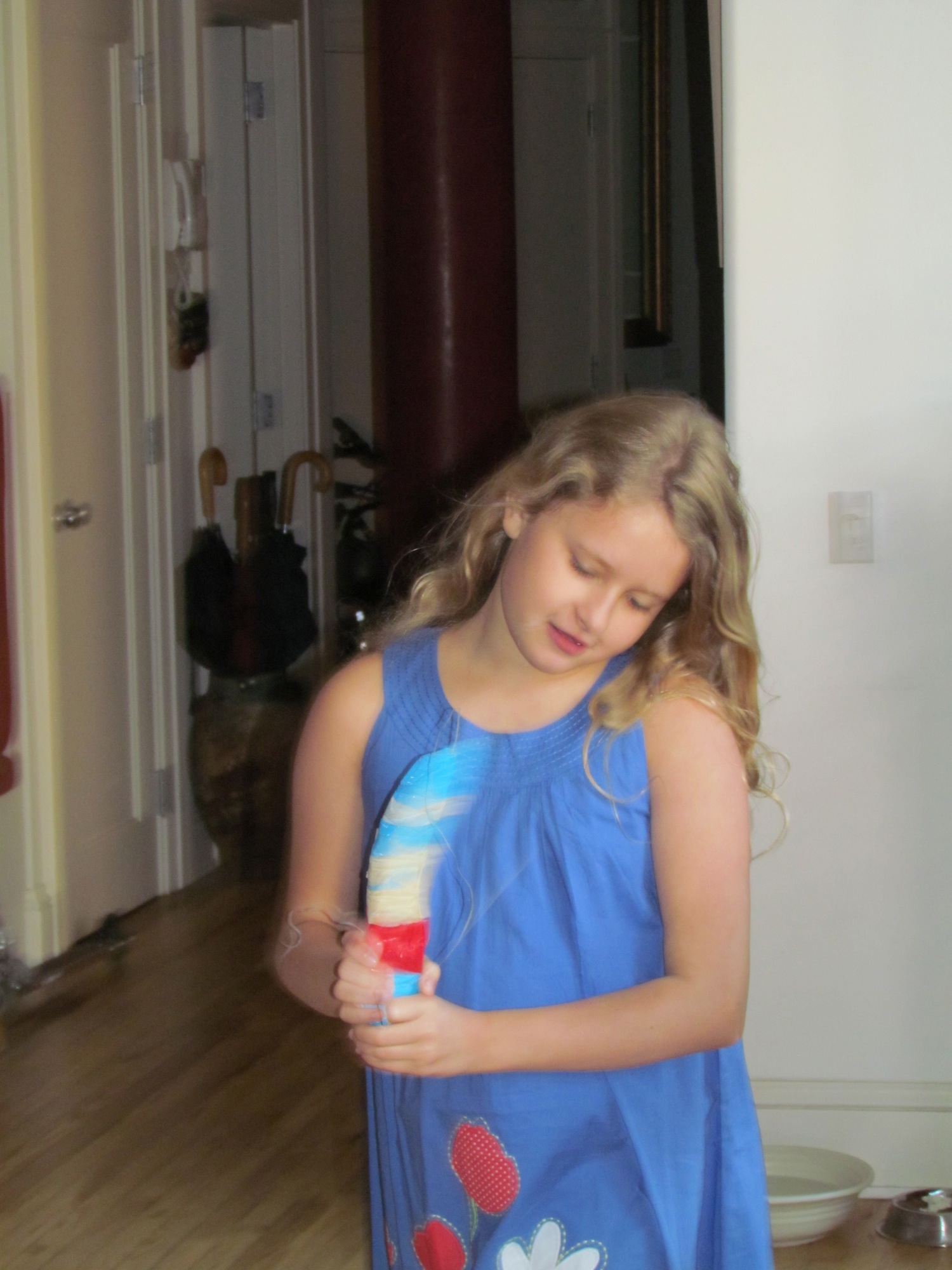
Emma demonstrating her angry face