Tag Archives: communication

Education

Yesterday I wrote a post, Your Child’s Been Diagnosed.  Now What?  There are so many things to add.  But something I wondered often during those early years was  – what good is a diagnosis if the “interventions” the professionals suggest and say will help, do not?  Now this is not everyone’s story, but it is ours.  All the recommended “interventions” did little, if anything, to actually help her.  In fact, I would argue that some of the interventions we agreed to, actually harmed her self-esteem.  And the general rhetoric, disguised as factual information, surrounding autism, encouraged her to feel damaged and at fault for the suffering of others.  No child should feel they are the cause of other’s pain and suffering.  And yet, so many do.

Once we began looking for schools that might be a good fit, we were even more horrified.  The choices were not – which one is best? – but became – which one will not harm her?  This shouldn’t be a parent’s guiding question when looking at schools, but for us, it was.  Will the staff be kind to her?  Will they be patient?  Questions like – will she learn?  Will she be taught science, math, english, social studies?  Those questions quickly gave way to – will she be harmed?  Are cameras monitoring what goes on in the classrooms and hallways?   Do they use isolation rooms?  Do they allow teachers to use restraints?  The best case scenario became less about education and more about physical safety and finding a place that did not harm or try to force compliance.

Academics were stripped down as it was “shown” that she could not understand basic concepts.  Because she could not read aloud, she was given picture books.  Because she could not answer the questions asked, the questions were simplified and simplified more and more and more until it was concluded she didn’t understand.  Because it was determined she could not understand a simple story about a boy and his dog going on a trip to visit his Grandmother, she was given less “complex” stories.  She was given “sight” words that were repeated for months and months, even years.  Billy Goat’s Gruff became the center piece for a curriculum that continued for three years, despite our disbelief and protests.  “Oh but we examine all the various characters in the story,” we were assured.  “THREE YEARS??” we responded.  “For three years?”  “Yes,” we were told with pitying looks and the hubris and bravado I’ve come to recognize from those who are convinced they “know” and understand “autism” and therefore my daughter.

Some of the worst offenders are those who have dedicated their lives to autism.  Those who are so sure they know, and as a result are no longer curious or interested in learning more.  Those are the people who are asked to give presentations at Autism Conferences, they are the ones who write books, that parents, not knowing any better, buy.  They are the ones we listen to and slowly as their voices are the loudest and most plentiful, we begin to doubt our instincts, we begin to soften our protests, we begin, slowly, slowly over time, to believe them.  Our ideas about our child are whittled away.  Our instincts are pushed aside to allow for those who know better, who have been doing this for “twenty years,” who have worked with “this population” and who, from having spent decades among children just like mine, know things I cannot possibly grasp or understand.  (This, by no means, describes everyone, but it does accurately describe a great many, and sadly, often those who were in a position with the most power.)

We parents are told to see our children for what they are: Intellectually impaired, socially inept, incapable, lacking and unable to understand the most basic concepts.  My child, as a result was shuttled off to learn how to tie her shoe laces and wash her face and hands.  While life skills are certainly important they should not take the place of academics.  So many of us are consoled with the idea that at least our child will be able to dress themselves, or not…  in which case we envy those parents who have children who can.  Our focus turns from philosophy, an exchange of ideas, history, english, poetry, literature, science, social studies, math and geography, to making sure our child can brush their teeth.  Until one is accomplished, it is thought, the other cannot be introduced.  A child who cannot dress themselves, surely cannot be introduced to Kant or Socrates or a poem by Yeats.

“Hey Emma, I’m curious, how is it that you know about WWII and Nazi Germany?”

“I hear you, Nic, and Daddy discussing,” Emma wrote over the weekend.

“Do you think it was right for Harry Truman to drop the bomb on Hiroshima?” my son asked.

“I have to learn more to say one way or the other,” Emma responded.

“Do you want to hear some arguments for and against the bombing of Nagasaki and Hiroshima?” N. asked.

“Yes, I can better understand using the bomb if you tell me more,” Emma wrote.

There is so much more to say…

Emma struck this pose while waiting for the school bus - May, 2014

Emma struck this pose while waiting for the school bus – May, 2014
Your Child’s Been Diagnosed. Now What?

I always think I’ve written something already about any given topic only to realize there is more to add.  So it was the other day when asked about advice for a parent whose child was just diagnosed with autism.  This is a question that comes up often and always when asked I hesitate and here’s why.  For every child that might respond to various “interventions” the way my daughter did, there will be countless others who will not.  The therapy may be worse or better.  The child may have different sensory issues, they may be voracious readers, hyperlexic or they may not be able to see the printed word because of visual issues, the letters may swim on the page until a different background is found or some other tweak is done, which allows everything to stay still.

There may be auditory issues that my daughter does not share, tactile, physical issues and the list goes on.  So what to do?  How does a parent wade through all the opinions?  How do you find a way to quell your fear, respect your child, ignore that list of all that’s wrong and find the things that will help your child flourish?

For me it boils down to two essentials.  The first is to presume my child competent.  I’ve written about this concept a great deal, but here are a few posts which talk about what that means – ‘here‘, ‘here‘, ‘here‘ and ‘here‘.  Presuming competence is very much a work in progress.  What I once presumed as “competent” my daughter has shown me didn’t go nearly far enough.  We do the best we can with the information we have.  But anything intended to “help” my daughter, anyone who is going to be spending time with her, must understand the concept and be committed to putting it into action.  This includes, speaking to her and not about her in her presence.  It means, even if the child shows no sign of understanding, even if the child has no spoken language and has never written a single word, we assume they can understand more than their bodies and gestures and utterances indicate.

Presuming competence has evolved for me and is helped by keeping my fear, judgment and assumptions checked at the door.  I cannot presume my daughter capable if I am simultaneously engaged in a running list of all she’s doing wrong.  I cannot practice a presumption of competence if every interaction I have with her is really an ongoing test where I’m insisting she prove herself to me.  Presuming competence is a life long practice and it is has far-reaching implications for not just my daughter, but all human beings I come into contact with.

Presuming competence is key, without doing this, everything else I do, no matter how great my intentions, will fall flat.  I have to believe in my kid.  It means that I speak to my child the same way I would speak to any child their age.  It means I approach my child believing in their ability to learn.  It means I believe they can and will learn.  It means they will communicate, I just have to find the best way to support them so that they can and it may not be with spoken language.  It means any therapy, no matter how popular, must be based in presuming my child competent, respecting my child’s process and treating them with the same respect I would insist on for anyone coming into contact with my non autistic child.  It means I have to do the inner work regarding what I believe, notions of should and shouldn’t, entitlement, prejudices, and whatever ideas I may have about my child and who they should be.  It means I approach my child with love, consideration, respect and curiosity.

I have come to believe that services, those services that everyone talks about and that are centered on our children, should include services for parents.  Early intervention for parents is crucial and much needed.  We parents are often in greater need of help and support than our children.  Good quality respite care, therapy for us, the parents, designed to help us cope and sort through our messy emotions so that we are in a better position to be there for our children.  I needed support from parents who’ve traveled the path I now found myself on.  No parent should ever feel the kind of fear I once felt.  Which means we have to change the current conversation surrounding autism if we are going to help our children.  No one is helped by having their every flaw (which is completely subjective, by the way,) scrutinized, both publicly and privately.  There are ways to get support and the help we and our kids need without demonizing our children and talking about them in ways we would never allow people to speak about our non autistic children.

Which brings me to the second essential thing – Autistic people.  It is imperative that all parents be given a list of blogs written by Autistic people who are describing their experience of the world.  This has to be essential reading while we figure out a way to put into place advisory programs made up of Autistic adults who are able to help parents understand their children.  These must be paid positions just as all other people involved with early intervention are paid.

We need mentorship programs of Autistic people mentoring our kids AND mentorship programs where our Autistic kids are mentoring younger Autistic and non Autistic kids.  One of the most valuable relationships my daughter currently has is with a little boy who shows no signs of being Autistic himself.  But they enjoy being together and the boy’s parents encourage their relationship. An inclusive society is key as we move forward.

On the Resources page of this blog I’ve put together a fairly extensive list, beginning with non-speaking Autistic people’s blogs.  I am always adding to this list.  I encourage all parents to start clicking on those blogs, find the ones that resonate and speak to you and follow them.  Start commenting on them, reach out to others who share your child’s neurology, develop relationships.  Listen and learn.  You will learn more from doing this than anything I learned in the half-dozen years I spent listening and reading non autistic people’s opinions.

And finally this is a short list of what I consider essential reading/viewing for anyone who has an Autistic child.

Wretches and Jabberers
Ido in Autismland
Intense World Theory of Autism

Emma and Teddy

Emma and Teddy

Emma, Barb Rentenbach and Lois Prislovsky

Emma, Barb Rentenbach and Lois Prislovsky

Emma, Mark Utter and Ibby at the ICI Conference - July, 2013

Emma, Mark Utter and Ibby at the ICI Conference – July, 2013

Emma and Laura

Emma and Laura

Emma and Ibby

Emma and Ibby

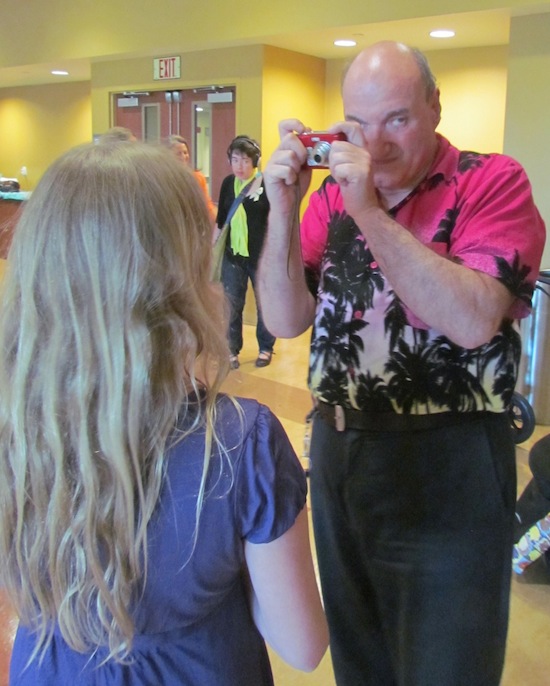
Larry Bissonette takes Emma's photograph

Larry Bissonette takes Emma’s photograph

Emma and Henry

Emma and Henry

Differences

“I want to write about being an Autistic girl.  Sometimes difference isn’t easy.  Easiest is to be like everyone else.  Trying to fit in when you act and talk like me only makes everyone more aware of how I am not the same.  Blending in isn’t an option for me.  I stand out anyway. ~  Emma Zurcher-Long

Emma’s words, written last night, reminded me of the TED talk Sir Ken Robinson gave eight years ago, in 2006.  A talk that more than 26 MILLION people have watched on the TED channel, more than 6 million on Youtube

“…If you’re not prepared to be wrong, you’ll never come up with anything original.” ~  Sir Ken Robinson

He also said later in this same talk,  “…the consequence is that many highly talented, brilliant, creative people think they’re not, because the thing they were good at at school wasn’t valued, or was actually stigmatized. And I think we can’t afford to go on that way.”

He wasn’t referring to children with a different neurology.  He was referring to the NON autistic population!  Now think about his words in relation to those with a different neurology…  “wasn’t valued, or was actually stigmatized.”  THIS, this is something I think about all the time.  What if… what if we lived in a society that actually valued Autistic neurology?

We need to radically rethink our view of intelligence,” Sir Ken Robinson said.  He also said, “…creativity — which I define as the process of having original ideas that have value — more often than not comes about through the interaction of different disciplinary ways of seeing things.”  An Autistic brain is all about seeing things differently from the majority of the population.  Why are we trying to temper this?  Why do we spend so much time, energy, effort and money on trying to make Autistic people like their NON autistic peers?  Doesn’t this seem like a massive waste of time?  It does to me.  And this isn’t even taking into account the trauma we are inflicting on a group of people who canNOT be like their non autistic peers even if they were motivated to be.  

Sir Ken Robinson goes on to tell a story about a girl who is failing in school.  Her teachers are complaining, she can’t stop fidgeting, she’s doing poorly in all subjects and the mother takes her to a specialist who after listening to all the things the girl is doing wrong, tells the girl he has to speak with her mother privately and together they leave the room, but not before he turns on the radio.  “And when they got out the room, he said to her mother, “Just stand and watch her.” And the minute they left the room, she was on her feet, moving to the music. And they watched for a few minutes and he turned to her mother and said, “Mrs. Lynne, Gillian isn’t sick; she’s a dancer. Take her to a dance school.”

That girl, Gillian went on to graduate from the Royal Ballet School “and founded her own company — the Gillian Lynne Dance Company — met Andrew Lloyd Weber. She’s been responsible for some of the most successful musical theater productions in history.”

I’m not saying all of our kids will become famous dancers, heading up their own companies, but what I AM saying is that it’s time to rethink how we think about autism and our Autistic children who will one day grow up to be Autistic adults.  We can crush them with the insistence they conform, despite all evidence suggesting they cannot or we can encourage them to flourish.  We can insist they communicate like their non autistic peers and subject them to endless hours of therapies created to train them in how to be indistinguishable from their peers.  OR we can find other ways, creative ways to help them be all they can be.

Sir Ken Robinson ends his talk, which I hope you’ll watch if you haven’t already, by talking about the gift of human imagination and using it wisely.  He says, “the only way we’ll do it is by seeing our creative capacities for the richness they are and seeing our children for the hope that they are.”

“Seeing our children for the hope that they are.”

This, it seems to me, is at the crux of everything.  Every single child born, no matter how different they may be from the majority of people, must be approached with this in mind.

“Blending in isn’t an option for me.  I stand out anyway.” ~  Emma Zurcher-Long

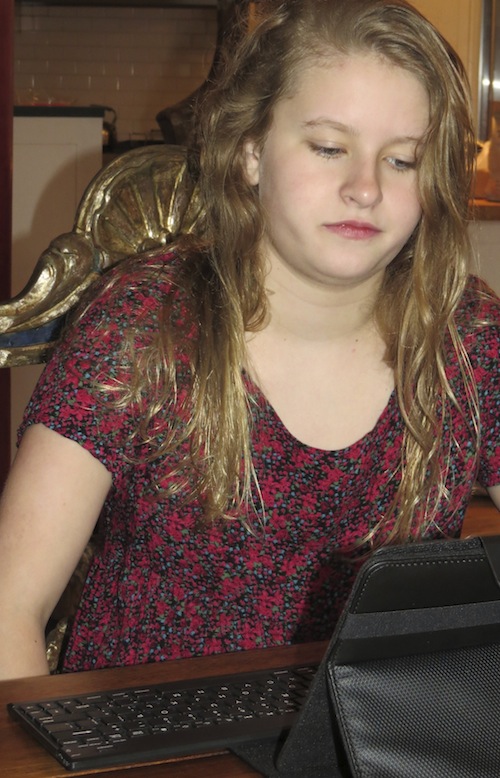
Contemplation

Contemplation

“It’s Important That Other Parents Understand.”

Written by Emma Zurcher-Long

“I will talk about the upheaval from last night”

“I toyed with downward feelings of rage then

as bountiful memories seeped into my raging mind

I surrendered to purposeful sleep

my screaming mind is momentarily spared from stormy thoughts

piercing my being

threatening no kindness

patience is ground down til pounding terror is all that remains.

Only the dedicated few

talk about love during episodes of furious pain

their love is rejuvenative and restores faith in this awkward world.”


From Ariane:

Emma wrote this after having a very rough night over the weekend.  I asked her if it was okay to post her beautiful words here and she agreed.  I asked because there was a time before we had found a way to support Emma’s outpouring of words, before she was able to write, before we were able to understand, before we understood…  those were the times when nights such as the one she is referring to were even more devastating for all of us and our assumptions about what might be going on were so often wrong.  Emma agreed to post this because, “It’s important that other parents understand.”  The problem with the assumptions we made was that they often led us to then behave accordingly, even without meaning to, they affected how we responded to her.

We might have thought – this is a manipulation, she is doing this to us.  We are being held hostage to her screams.  We would mistake her terror for manipulation.  We might withhold our love in anger.  We might assume that to not do so was giving in or condoning the “behavior”.  We might do any number of things to “show” her that this way of being was unacceptable.  Except that this “way of being” was so beyond the scope of our experiences, so beyond what we could make sense of.

“Pounding terror is all that remains.”

And so I remembered afterward the comments from this post, “What Others Had to Say: Love, Overwhelm, Violence” and all the people who so generously opened up their lives and wrote about their experiences with being overwhelmed and no longer able to cope.  That point when feelings completely take over and all we can do is weather the storm.  Emily K. wrote: “Remove yourself from “their” space but do not leave. Defend yourself but do not leave. Let your child Leave/ escape and do not block his/her path. Follow but do not intrude. Allow space and time do not react but respond in the opposite, we need peaceful and loving parents.”

And Autisticook who wrote:  “It will get better.”

And she also wrote this:  “Teach me how to be upset. Show me there are other ways of being upset, instead of only telling me the way I have chosen is wrong and leaving it at that.”

And this:  “You’re the adult, so I’m depending on you to explain to me what I’m doing and why. I won’t be able to correct you on your assumptions until I’m an adult myself. So please be careful in learning my behaviour and don’t label it until you’re absolutely sure. It’s also OK to ask my input on this when I’m calm and happy.”

And this:  “Allow me a way out. If my self-regulating isn’t allowed, I can guarantee you I will get a meltdown. And once I am in that space, all I can think of is making the thing stop that made me go into meltdown. I only have short term memory and very limited reasoning power when I go into meltdown, so I will latch onto whatever trigger I see in front of me.”

And this:  “I will keep triggering until the world is empty of triggers or until I am utterly exhausted. So if you hold me down, you’re actually keeping me in the world of triggers. I need a different world that is practically triggerless. But I’m too young to know this, which is why I will sometimes keep following you and hitting you even though you try to remove yourself. Because I want the upset feeling to stop and the only way I know how to stop something is to hit it until it stops moving.”

And THIS.  This is SO important:  “Don’t ask me questions.  If you want to know how I’m feeling, please ask me afterwards, when I have calmed down and can find my words again.

And this: “Don’t try to distract me.”

And this:  “Once I’m in my safe space and I know people will no longer ask me questions and I can block out the noises and lights and stim to my heart’s content without someone telling me it’s wrong, I usually calm down within an hour or two.”

And finally, this:  “Please give me time to process.”

I would like to report here that I remembered each and every one of these things and that I put them all into action, but I didn’t.  What I did do was try to remain calm and loving.  And when my calm began to fray, I tried to remove myself, while reminding her of my love.  I did a number of things right, and I made a number of mistakes.   We are all learning here.  When calm was restored Emma said she wanted to write about “the upheaval from last night.”  This was in response to my question, “Is there something in particular you want to talk about this morning or would you prefer we discuss an article from the New York Times?

I was surprised she wanted to talk about it.  And then she wrote those beautiful words, which I can only describe as less prose and more poetry, a song, really.  A song borne of experience, despair, and transformed into a thing of beauty.

The beauty of Emma.

Emma ~ 2012

Emma ~ 2012


The Dreaded IEP Meeting

Those annual IEP (Individualized Education Plans) meetings all parents of children with “special needs” attend are something I used to dread.  Meant to ensure our children are given the supports and accommodations they need, I went to our first meeting with eager anticipation.  This was where, I thought, we would be able to work with a team of people all of whom had the same goal for our child – getting and giving her the best supports and accommodations available so that she could flourish.

What quickly became apparent however was that this was when her team would write a series of bullet points describing all that was wrong with her.  All the ways in which she fell short, all the ways she demonstrated how incapable she was, were described in detail, documented and added to her growing file.  This was the time, once a year, when I would sit and listen to that itemization, fighting back my tears.  The few things said during that first IEP meeting that were supposedly positive regarding spoken language, were written as a criticism, “…uses gestures to whine or protest.  She is described as shouting or vocalizing to gain attention.”   I would leave these meetings feeling hopeless and filled with the sort of despair I described in yesterday’s post, Dare to Hope.

Today, almost ten years after that first IEP was written, Emma writes by pointing to letters on a letter board and more recently with both her RPM teacher and me, she is typing on a bluetooth keyboard attached to an iPad.  No one touches her as she writes.  Emma has written before about the words that come out of her mouth.  I will quote her, since the way she describes what happens to her when she speaks is far more descriptive and eloquent than anything I might write.  Emma wrote yesterday in her IEP meeting, “I try to talk, but the words just come out wrong.”  A few months ago she wrote how she wished people would, “listen to my writing voice, but they listen to my talking voice instead.”

As always, I asked Emma if I could write this post about her first IEP, as an example of the assumptions made and how far off we were in our thinking as well as a document for those of you who are at the beginning of all of this.  Emma generously agreed that this was a good idea and wrote, “know that just because a kid doesn’t talk or talks like me, doesn’t mean the words that come out are the same words that are in their mind.”  Regarding her so-called “behaviors” which Emma describes as a body/mind disconnection, she wrote,”I hope to better control my misbehaving body, but sometimes it won’t obey.”

A few weeks ago I asked Emma if she could remember when she was very young.  She wrote, “Yes, my body could not behave because I was not able to cope… too many competing sensations.  I couldn’t make sense of everything that did not connect me with my irritable body.”  Now keeping her words in mind, read these words taken from her IEP, dated 2005 (Emma was three years old):

Emma avoids “looking others in the eye, does not answer when people talk to her, does not get along with other children, seems unresponsive to affection and shows little affection towards people, withdrawn…”

“The skills that she does not show evidence of include:  does not yet engage in make believe play, does not yet match objects, complete interlocking puzzles, repeat digit sequences, identify body parts or show understanding of number concepts.  She does not yet point to body parts, clothing items, prepositional commands, or know size.  She does not participate in story telling or give her full name or use pronouns… and shows limited interest in other children.”

The report goes on to say:

  “She does not vocalize when another person calls her name.  She produces a variety of consonant sounds.”

When I read Emma’s words and the way she describes some of what was going on for her and compare her words to the words written on her IEP, it is impossible not to see the massive disconnect between what was actually going on and what all of us assumed was going on.  It is from those assumptions that her goals were then created.  Goals such as:  “Emma will increase communicative intent via word and/or gesture to consistently request object article/toy/food (8/10) trials.”  “Emma will maintain eye contact and prompt (8/10) trials.” “Emma will use at least 10 objects functionally, 4/5x”  “Emma will imitate 1-2 word utterances during play, 4/5x” the list goes on, but the goals are all either regarding compliance and/or acting according to non autistic standards of behavior using spoken language.

In contrast, yesterday we went to Emma’s IEP meeting with Emma, who contributed her own thoughts and opinions about the goals that were set by writing on the keyboard I held for her.   At one point she wrote, “it’s very good having time to go over goals.”  And when asked about the efficacy of being asked to use a mood chart, she wrote, “Sometimes I feel many things at once.  Would the mood chart work for you?”

Can I just say how proud I am that my daughter asked this question?  And by the way – No, Emma, being asked to chart my moods or anticipate what my mood might be would not work for me.  I think it would actually really piss me off if I was asked, while feeling both upset, sad, frustrated, maybe a little frightened and annoyed  to use one word to describe what I was feeling and then was asked, “What’s wrong?” when I could not rely on spoken language to adequately express myself and no one could support me in the way I needed, so that I could write either.

What was wonderful about yesterday’s IEP meeting was that her staff is dedicated and completely committed to listening to Emma and learning from her what it is that she needs and wants.  Everyone was kind, thoughtful and patient and in the end we have an IEP that reflects our goals for Emma, but more importantly it is a reflection of her goals for herself.

Emma the year before that first IEP

Emma ~ 2004, the year before that first IEP


Dare to Hope

Trigger Warning:  Parental despair

Five years ago I was in a bad, bad place.  Life felt unbearable.  The future loomed ahead shrouded in fear.  I could not imagine a life that was not bleak and filled with pain.  There were times when I could not bear the thought of another day.  There were times when I felt it was all too much.  People would make kind suggestions, but none of their words made sense to me.  I was sinking and saw no light.  I thought it was because of my specific circumstances.  I thought it was because I was the parent of a child who, I was told, couldn’t and didn’t understand most of what was said to her.  I was told she couldn’t comprehend this world.  I was told concepts like less and more, time, currency were beyond her ability to grasp.  I was told she was in her own world.  Despite all the years of therapy, there was no hope of her being mainstreamed, she did not make the sorts of leaps forward that other people’s children  had.

I blamed myself, I blamed my husband, I blamed the environment, I blamed my father, I blamed…  There were so many things to blame, but all it did was leave me bereft, empty, and in the middle of the night I would lie awake and cry.  I cried for myself, but I also cried for my child.  I loved my child.  I ached for my child and what seemed to be her inevitable future.  Along with the ache for what might have been, but was not, was the sad, dark, bleak despair that seeped into every aspect of my being.  I had fantasies of “heading north”.  I would smile weakly at my husband and joke, as I gathered my wallet and keys for a quick trip to buy milk at the grocery store, “I may not be back.”  Richard would grin and maybe we would even chuckle, but there was a part of me that wasn’t laughing.  There was a part of me that meant it.  I wanted to leave all that pain behind me.

There are those reading this who will cringe at this description.  There are those who will judge me and what I once felt.  There are those who will point out how self involved all of this sounds.  They will say, but how could you not see that what you were feeling was affecting your child?  There are parents who have children just like mine who never felt what I’ve described, who will not be able to understand or relate, who will read my words and shake their heads in horror.  I understand those responses too, because now, I catch myself feeling those feelings too.

My daughter has defied everyone’s expectations, including ours.  She is writing now.

She is writing such incredible words.  Sometimes a sentence may take her five minutes to construct.  I would cheerfully sit for thirty minutes or however long it takes for her to express herself.  Parents hear about my daughter and they say, “Ah, but my child isn’t like that.”  And so I ask, “How do you know?”  Parents say, “I know my kid.  He/she isn’t able to understand.”  I once believed that too.  And so again I ask, “How do you know?”  Parents say, “I know my child better than anyone.”  I once said this as well.  I thought I knew.  I believed what others told me.  She would laugh and then run full force into a cement wall, using her head as a batting ram.  We would get the dreaded phone calls from her school.  All those doctors, therapists and teachers, all those IEPs where she was described as unable, incapable – “Emma is unable to decipher simple text.”  “She does not know the value of a penny.”   “We will continue to work on sight words.”

Today my daughter is enlightening me.  If you want to know more, read “How We Got Here“.  Just the other day Emma wrote, in response to an incident at school, “You must remember how stressful it is not being able to tell anyone my silent screams of disconnection.”  Her school is now trying to learn RPM so that she can write with them too.

I cried when she wrote that.  I cried because I didn’t know until recently.  I cried for all the years when she had no way of telling us.  I cried for all the times I didn’t believe.  I cried for all the children who are just like her, right now, who cannot tell anyone about their silent screams.  I cried for every single parent who has ever felt the way I once did.  I cried for every single child of those parents and for all the times I heard about a child who was writing to communicate, just as my daughter is now, and how I didn’t believe she would be one of them.  I cried for all the times I heard about an Autistic child or adult and consoled myself by saying, “they are an anomaly.”  I didn’t dare hope that one day my daughter might be writing the things she now writes.  I didn’t dare hope, it hurt too much.

To the parents who feel overwhelmed with fear and despair  – I was once just like you.  Had I found a secret online group of parents feeling and talking the way I once did, I would have joined in an instant.  I’m grateful now that I didn’t find such a group because there’s another way.  I found another way, but not before making many, many more mistakes.  This blog documents a number of the mistakes I’ve made over the years, but not all of them.

If there’s one thing I want to say, it’s please, dare to hope.  Without that we are all lost.

*As always, I asked Emma for her permission to publish this post.

Watch:
Wretches and Jabberers
Mark Utter’s I am in here

Read:
Ido Kedar’s book:  Ido in Autismland
Non-speaking Autistic blogs, many of which can be found on The Resources Page on this blog.

Emma getting ready to write

Emma getting ready to write

Outpouring of Words ~ By Emma Zurcher-Long

Three Haikus By Emma Zurcher-Long for #AutismPositivity2014

*Emma writes by typing on a bluetooth qwerty keyboard attached to her iPad.  For more about the way Emma communicates, read – How we Got Here

Springtime
My writing blossoms
greeting welcoming smiles of
 encouragement gladly.
Springtime

Springtime

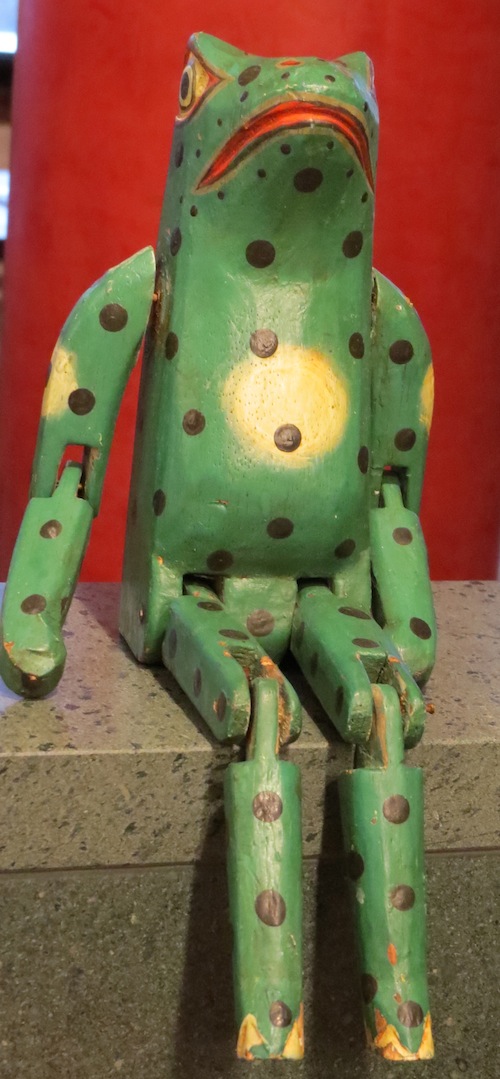
Frog
Green with envy you
strain to jump as far and high
daring to come close.
Frog

Frog

Rain
Lashing down, I run
to find shelter but there’s none,
laughter, roaming, I stay.
Rain

Rain

As the parent to a child who has been described as “verbal” but who was thought to be unable to understand much of what was said to her because she could not answer with spoken language questions such as, “How old are you?”  I will never be able to adequately describe what it is like to read my daughter’s words.

This blog began as a document of hope for our daughter, but it has evolved to become a message of hope to parents who feel the kind of despair and terror I once did.   As Emma wrote, “I am smarter than most people think.  So many kids are just like me.”

This post is dedicated to the Autism Positivity Flashblog going on all day today.

If you would like to submit to the flashblog, here is the submission form.

Having THE Conversation & Parenting

Emma not only gave me permission to write about this, but asked that I “put it on the blog.”  I posted a small portion of this conversation on Emma’s Hope Book Facebook Page yesterday.

Trigger warning:  eugenics, abortion

Yesterday morning I saw an article in National Geographic about the Seine and Paris that I thought Emma might enjoy reading, particularly since her grandfather, my father, was born and raised in Paris.  But as with any topic I choose I asked Emma if it was something she was interested in.

Ever the diplomat, Emma wrote, “I do want to talk about the Seine, just not now.”

“Okay,” I said, “what would you like to talk about instead?”

“I want to have the conversation about eugenics,” Emma wrote.

I was astonished.  After I’d recovered from my astonishment I thought of how I continually talk about presuming competence and yet am so often surprised by my daughter’s words.  I’ve come to the conclusion that one does not preclude the other.  I can presume competence and still be surprised by the things she knows and says.  In fact, if I asked a group of twelve-year olds to talk to me about eugenics, I’m guessing there would be several who would not be familiar with the word, let alone able to spell it correctly.

“What specifically are you wanting to say or know?” I asked.

Emma wrote, “What do you believe is right?”

I said, “I don’t believe eugenics is ever a good idea, because it is a desire to extinguish those believed to be lesser beings.  I think all human beings are valuable and should be treated with respect and equally.”  As I spoke I held the keyboard for her to respond if she wanted to.

Emma wrote, “I believe human life is sacred and people treat those who they think are different far worse than people who are like them.”

“Yes, I think you’re right,” I said.  “Do you worry about eugenics?”

“Yes,” Emma wrote, “because parents seem so upset when they find out their kid is autistic.  I worry that people like me will end up being aborted.”

Eugenics and abortion…  Now two topics I was completely unprepared to talk about.  So we discussed both.  I talked to Emma about prenatal testing and how such a test has not been made yet.  I explained that autism has not been found in one particular gene, but that researchers are finding whole clusters of genes suggesting that it will be very difficult to isolate one or even a group of genes that may or may not be related to autism.  We discussed abortion and how and why it is a complicated topic.  And we talked about the difference between abortion and eugenics and how the two can overlap, but that they are also not necessarily related.

As with any complex issue, this is where parenting can get tricky.  I asked myself, how much information is too much?  I do not want to be overly protective and try to shield either of my children from difficult topics, nor do I want to “feed” my children my opinions.  Instead I want them to have enough information so they can form their own opinions, even if they develop opinions I do not agree with.  I’d rather disagree and talk about that than have them believe something without thinking about it.

I told Emma that her concerns were one of the reasons I feel so compelled to continue writing and why I hope she will also continue to write so that “more people get to know someone like me.”  We discussed how people’s perceptions about autism and how the things we see and are told, all that inaccurate information, can cause people to do things they would not do if they were given a more balanced and informed view.

Emma then wrote, “…I will write about this more so other parents open their hearts and learn…”

Now I realize I am bringing up difficult and complex topics.  Topics many people have strong opinions about.  I’m actually not interested in getting into an ideological argument about abortion and a woman’s right to choose, however I am interested in discussing the ramifications of the current and ongoing conversation regarding autism.

Eugenics was not a topic I would have ever thought to bring up with my daughter.  Not only was it not something I’d thought to discuss, it is a word I did not assume she knew.  But, just as when she wrote to Soma a few months back that she had seen the Grammy’s, unbeknownst to me, my daughter hears everything that is said around her.   Emma wrote that she saw the Grammy’s while waiting in the airport.  I hadn’t even noticed they were being shown because I don’t pay attention to the television screens when we are in an airport, so busy am I with getting through security and finding our gate.

I am so grateful Emma is able to write about these things so that we can discuss her concerns.  How many people who are Autistic worry about being harmed or even killed because of their neurology?  How many are able to voice their concerns?  How many are worrying in silence?

Emma - April 2014

Emma – April 2014

FC and RPM

Both facilitated communication (FC) and Rapid Prompting Method (RPM) while different in practice, are based in a presumption of competence and both are often a bridge to the ideal goal of independent communication.  There are those who may not be able to achieve full independence because of physical challenges. It bears repeating, however that the eventual goal for all who are physically able to, is independence.  And yet both methods are criticized.  In fact, no matter what the initial method used to learn to type by non-speaking, Autistic people who have gone on to type independently, people like Carly Fleischmann, Tito Mukhopadhyay, Sue Rubin, Jamie Burke, Ido Kedar and so many others, there are those who continue to question the authorship of their words.  Even though no one touches them as they type.  Even though there is no physical contact of any kind as they write.  Even though they all talk about the issues they must contend with on a daily basis, things that are specific to them and the challenges they face with a mind and body that are often not in sync.

In the case of FC there are a number of people, now independent, who began typing to communicate, but for physical reasons need the help of another person to provide resistance or to help with physical challenges.  As with Applied Behavior Analysis (ABA) where a child is given hand over hand prompts that are hoped to be eventually faded, so it is with FC.  However FC is continually attacked for using, often less, physical prompts than ABA practitioners use.  Some people like Barb Rentenbach, Peyton Goddard, Jennifer Seybert and Tracy Thresher are now typing with a finger placed on their shoulder or the middle of their back.  If one goes back to how they began to type, this shows enormous progress.  All of them are intent on becoming fully independent and work extremely hard in trying to reach this goal.  Yet, it is interesting to note that few people object or question ABA’s use of hand over hand prompts.   What is good for one, seems to not be good for all. Why is that?

Carly Fleischmann who types independently wrote, “I don’t have a hand up my butt like a puppet…”  Despite her words, if you google “Carly Fleischmann” the second search term that comes up after “Carly Fleischmann blog” is “Carly Fleischmann fake”.  Oddly, when entering “Stephen Hawking” into google, the search terms are “Stephen Hawking quotes” and “Stephen Hawking black holes”.  Why is it that Carly Fleischmann, who types independently, is viewed with suspicion, while Stephen Hawking is not?

RPM, the method created by Soma Mukhopadhyay, does not use physical prompts at all.  No one touches the person writing, but instead a stencil board is held in front of the person writing.  The stencil letter board, it is hoped, will be eventually faded and replaced with a laminated letter board with the goal, in my daughter’s case, being able to move to a qwerty keyboard, which is how Emma now communicates with me as well as with the person she has weekly RPM sessions with.  Still, there are those who insist that no matter how steady the letter board is held, the person holding it is manipulating it ever so slightly and enough to influence the person writing.  Or, as is the case with Carly and others who type independently, it doesn’t matter, the fact that they are not able to speak seems to be all people need to discount their words, no matter how they communicate.  All of this would be laughable if it were not for the tragic fact that people’s voices are being discredited and silenced.

My friend Kerima Cevik, of the blog The Autism Wars, recently wrote “My Standing Position of Facilitated Communication” and posted it on Facebook.  It immediately went viral and brings up a number of excellent points consistently ignored by those who seek to discredit FC.  Please read it.  I find it incredible that people, almost all of them psychologists, just as Bruno Bettelheim claimed to be (and not neuroscientists) continue to come up with all kinds of theories regarding any number of things involving autism and Autistic people, things like Theory of Mind and Cognitive Empathy.  All of these are “theories” and not scientifically proven as fact, yet they are treated as fact, while things like RPM and FC are ridiculed for not being scientifically proven and dismissed, while other methods like ABA are applauded, funded and given a golden seal of approval.   One more question to consider, why is it that people who are aphasic are not immediately given ABA?  No one recommends ABA as a therapy for someone who has had a stroke and as a result cannot speak.

I urge all of you to consider, regardless of what other people decide they believe, if a child cannot communicate through spoken language what are their options?  Whatever the approach is, whether it uses pictures, hand gestures, eye movement, pointing, or some other form of communication I have a series of questions I ask.

Does this approach presume competence?

Would I use this system for a non-autistic person who cannot speak?

Does it infantilize?

Is this way of communicating limiting or is it a bridge to more complex communication?

Emma types on a qwerty keyboard

Emma types on a qwerty keyboard


A Living Amends & the Ripple Effect

Last night I was on Marc Rosen, Nick Hale and James P. Wagner’s blog talk radio show Human Potential.  You can listen to the show by clicking on the link provided.  The show focused on “The Importance of Allies.”  I was really honored to have been asked on the show, particularly given my past and the things I once believed about autism and my daughter.  I certainly did not begin this journey as an ally and so I am filled with a great deal of gratitude when told there are those who think of me as one now.

One of the things I forgot to mention last night as we talked, was this idea I’ve had ever since that day when I found Julia Bascom’s blog, Just Stimming, and specifically her post “The Obsessive Joy of Autism.”  It’s an idea I’ve tried hard to put into practice these past few years. The idea is that because I made so many really awful decisions about my daughter, I needed to make a “living amends” to her.

The idea of a living amends is that as long as I am alive the only true amends I can make that will have any lasting impact, that has any chance at countering at least some of the bad choices I made, is to do everything in my power now to live my life differently.  A living amends is different from an apology no matter how heartfelt that apology may be.  It is an ongoing commitment to change, to be open, to be willing, to have humility, to learn, and to behave differently as a result of this new-found awareness and commitment.  This is what I promised myself and my daughter just over two years ago when Julia’s blog opened my eyes to a different way of viewing my daughter’s neurology.

Since then I’ve had time to contemplate all of this and believe my role as Emma’s parent is to support her, encourage her, cheer her on and do everything in my power to make sure she feels empowered and supported to be all that she can be.  I do not ever want either of my children to be who they think I want them to be, or who anyone wants them to be, for that matter.  My job is to help them figure out who they want to be and then give them the support to help them be that person.

It is also this thinking that continues to drive me to do all I can to change how the world views autism.  I don’t mean that to sound as egotistical as some might take it. I do not expect, nor do I believe I have the power to change the world’s view, but I do believe each one of us can and does make change happen one person at a time.  There is a ripple effect that then occurs and that ripple effect repeated many times over does have the power to change what no single one of us can.  There is a saying – together we can do what neither one of us can do alone.  Or as Helen Keller is quoted as saying, “Alone we can do so little, together we can do so much.”

Julia Bascom’s blog is a perfect example of this.  How many, like me, were radically changed as a result of her words?  How many people then took her words and began to live their life differently?  How many then altered the lives of their children because they now presumed them competent?  How many?  I’m guessing the answer is more than just a few…  that’s the ripple effect in action!

Em & Ariane on New Year's Eve ~ 2013

Em & Ariane on New Year’s Eve ~ 2013

The Power Of Understanding

I’m honored to be a guest on Human Potential‘s blog talk radio show, The Importance of Allies With Ariane Zurcher, airing tonight at 9pm EDT.

If you have not viewed the two youtube videos of Ari Ne’eman’s speech and Emma’s, where she writes a message to parents about autism, I hope you’ll take the time to do so now.  Please feel free to share widely.

As both kids are on spring break this week, I asked them whether they wanted to have a “sibling chat”.  Both agreed.  What has occurred as a result is nothing short of incredible.  Understandings have been forged, exchanges of ideas and beliefs have been made.  They have listened to each other, asked questions, shown patience and tremendous compassion for one another and in the end grown closer…  Many people take these types of conversations for granted.  But we do not.

Listening and learning…

Nic & Em

The YouTube Video of Ari Ne’eman and Emma Zurcher-Long

My fabulous husband, Richard Long, has edited the videos of Ari’ Ne’eman’s and Emma Zurcher-Long’s presentation April 2nd at CoNGO (The Conference of Non-Governmental Organizations in Consultative Relationship with the United Nations).   

As Richard edited Ari’s terrific speech, Emma was in the room looking at the iPhoto library I keep on my computer, which is near the computer Richard was editing on.  At one point Ari describes the Autism Speaks video when a mother describes (in front of her non-speaking autistic daughter, who attempts to hug her mother several times as she talks) how she thought about driving off the George Washington Bridge with her autistic daughter strapped into the back seat, but doesn’t, for the sake of her other child who is not autistic.  As Richard had taken a still shot of Ari just at that moment, he needed to edit out the pause that was caused by the still shot and so had to repeat this portion of the video over and over and over.

Emma and I have discussed this video before and though I’ve not shown it to her I wondered whether she was ever in the room when either Richard or I watched it. By  the fourth edit of that particular section, I looked over at my daughter who showed no outward sign of upset and whispered, “Emmy, is this upsetting you?”  (I know, talk about asking the obvious…)

I am painfully aware that  by writing about this I open myself up to all kinds of judgement and criticism, but I believe my insensitivity and slow response is an excellent example of the general malaise society has regarding messages like this one that Ari discusses and that are so cavalierly displayed with regularity not only by Autism Speaks, but a great many organizations and autism experts, which are then repeated in the media.  If none of us are able to admit ignorance and our less than ideal reactions, but only point fingers at others, there will be no conversation and little will change.  So I’m willing to reluctantly admit that it took having that section on repeat before it occurred to me to get my intensely sensitive daughter out of the room to discuss the Autism Speaks video in more detail.

This idea that our children and people (of all neurologies) hear these things, but because those who cannot communicate through spoken language are therefore thought to not be able to understand what is being said, is one of the more destructive assumptions made.  And what about those who do speak, are their feelings not important?  These kinds of messages, stated both publicly and privately without thought of the impact this has, encourages prejudice and intolerance, focuses on the suffering, not of the child, but of the parent because of the child, only fuels anger and fear.  Meanwhile Autistic people’s feelings are ignored, their response and reactions to such messages are considered, if at all, of little importance.

“Come Emma, let’s go in the other room.”  I suggested.  Once outside I asked Emma if she wanted to discuss the video Ari was referring to.  Emma wrote, “The video has a mom who is lost and cannot rationalize hope.”  Then a little later Emma wrote, “Autistic people are not viewed as able beings, this view makes us suffer.”  Read that again –

“Autistic people are not viewed as able beings, this view makes us suffer.”

After Ari’s terrific talk, Emma and I were introduced.  Watch Emma writing her final sentence regarding autism and acceptance, which says it all…

And the Winners Are…

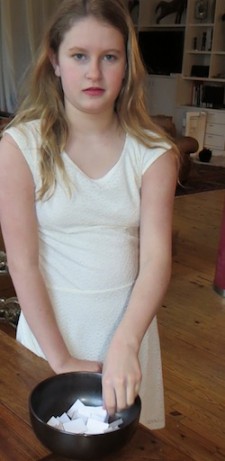
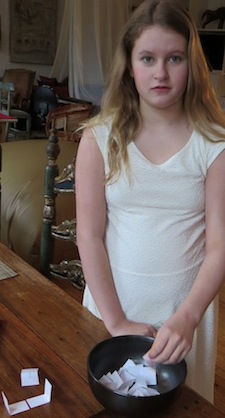
Emma randomly chooses the winners...

Emma randomly chooses the winners…

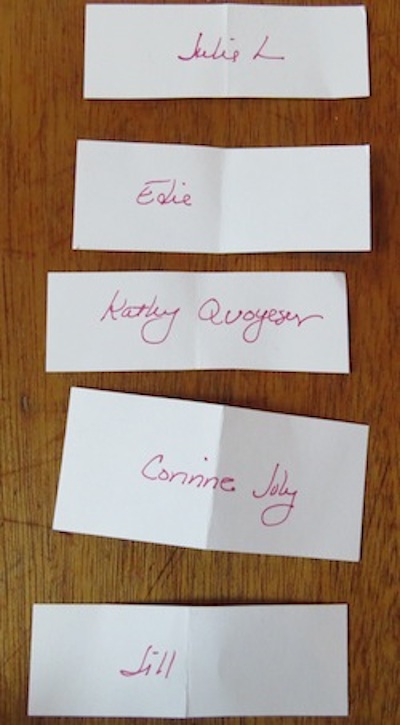
This morning  I placed all the names of those who commented on yesterday’s post into a bowl and Emma randomly chose five names to win Barb Rentenbach and Lois Prislovsky’s hard cover book, I Might Be You

Be prepared to be blown away.  This book is absolutely wonderful.

To all the winners – Julie L., Edie, Kathy Quoyerser, Corinne Joly and Jill – I will be contacting you by email. Your book will be sent via United States Postal Service after I’ve received your address.

And for those who want to read it, but didn’t win, please consider purchasing this terrific book either as a hard cover or as an ebook available for all eReaders, or the audiobook, which I had the honor of recording with Barb and Lois in New York City last year.  I am the “voice of Barb” and documented that amazing experience ‘here‘, ‘here‘, ‘here‘ and ‘here‘.

2

without looking…

And the winners are...

And the winners are…

“Barb Doesn’t Talk” ~ Emma

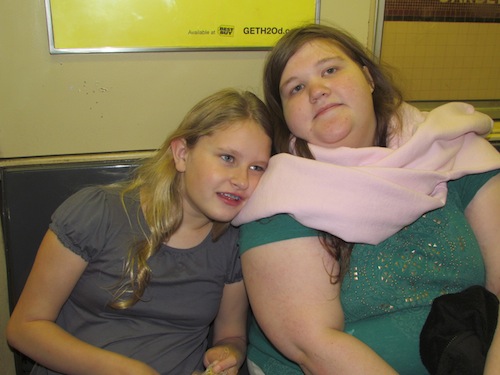
I have a friend who, when they met over a year ago, Emma observed, “Barb doesn’t talk“.  “Doesn’t talk” means she doesn’t talk with her mouth to communicate the way she can and does when writing.  Her name is Barb Rentenbach and she and her therapist, Lois Prislovsky wrote a book, I Might Be You.  I’ve written about Barb and Lois before, ‘here‘, ‘here‘, ‘here‘ and ‘here‘.  If you haven’t read their book, you must.  (Continue reading for a surprise later in this post about that book.)

I met Barb at the Autcom Conference in 2012 and though I didn’t know it at the time, Barb and Lois  would have an enormous impact on me that was far-reaching.  You see, it was because of Larry Bissonnette, Tracy Thresher, a boy I saw writing to communicate, and finally Barb, all of whom I met at the Autcom Conference, that I began looking into other ways for my daughter to communicate.  (You can read more about the process by clicking “How We Got Here“.)  Even though Emma can and does use her voice to speak, she has described her attempts to communicate with spoken language as, “I can’t talk the way I think.”  Later Emma wrote, “Please remember that my mind tells my body and my mouth to do all sorts of wonderful things constantly, but they don’t obey.”

In Barb’s most recent blog post (I urge everyone to read it) – Open Hearted Letter Quilt to Andrew Solomon –  she writes about autism, empathy, and how autistic people are often misunderstood:

“It’s like Saxe’s (1873) poem, “The Blindmen and the Elephant” where each blind man is partly in the right as he describes an elephant piece he studies, but all are in the wrong in knowing an elephant.

This autistic pachyderm will expand perceptions by presenting more pieces.”

Barb goes on to describe herself, “I don’t look normal.  I appear quite messed up and a prime candidate for nothing but pity and patronization, with a sprinkling of repulsion and fear.  I am disguised as a poor thinker.”

Still further along she quotes Emma:

“To quote my mentor Emma who is 12 (This old dog is all about learning new tricks) who wrote this by saying each letter aloud she pointed to it on a stencil board, “Autism is not what parents want to hear, but I hope that will change as more people get to know someone like me.”

This short video shows Barb typing just a few days ago.

Now there are some people who have suggested Barb is not typing on her own.  They believe that the person whose two fingers are tentatively touching her back are actually guiding her and that it is their voice and not hers that we are reading. This is a video of Barb writing four months ago…

And here is a video of Barb typing in 2011…

I am showing you these clips so you can see Barb’s obvious progress and please note, Barb is not a child.  I know that’s obvious, but it seems many people forget this or have trouble believing that people of all ages can and do progress.  Just as Barb works hard to become more independent while typing, so does my daughter.  Emma’s way of writing is slightly different in that no one is physically touching her and she points to letters on a letter board,  but she is working hard to move from pointing to the stencil letter board to the laminated letter board to a qwerty keyboard, with the eventual goal – being able to type on a computer regardless of who might be seated nearby.

As all these videos show, none of this is easy.  Barb is working hard and so is Emma.  Some days go more smoothly than others.  As Barb writes –

“I often politely ask my brain to please move my hand to do this or that only to be told, “We’re sorry due to high autism volume we are not able to answer your call at this time.  Please try harder later.”

For any of you who would like to have a hard cover copy of Barb and Lois’ terrific book, I Might Be You, I am giving away five hard cover copies.  Please comment below, saying something about yourself and why this book is of interest.  I will place all comments into a hat and will choose five at random.  If your comment is chosen I will contact you, via the email you use to comment, for your street address, where I will send you your copy of Barb and Lois’ MUST READ book at no cost to you and in appreciation to Barb, Lois and Emma for their hard work in bringing much-needed awareness to all who are like Barb and my daughter!

Emma, Barb Rentenbach and Lois Prislovsky

Emma, Barb Rentenbach and Lois Prislovsky


What Are State Assessments Assessing?

Yesterday, while at Emma’s school, her teacher showed me a sample of the state assessments that Emma is required to take, though there were record numbers of parents this year who protested them by opting out.  These assessments are done twice a year and take an enormous amount of time and energy from all involved.  The page the teacher showed me was about Ronald Reagan.  It was a series of facts that are read and then the student is supposed to choose the correct answer from two choices related to the facts just read.  I decided to use the page as an example of why I so vehemently object to these state required assessments as they are currently laid out.

I read the facts to Emma and then asked her to give me the answers by saying the correct answer out loud.  This is how the test is typically done.  Emma chose the last choice to each question every single time.  I then said, “Okay.  Now let’s do this using your letter board.  I asked the same questions, only this time, offered her the letter board and without any hesitation she got 100% correct.  I then asked her to circle the correct choice and she was able to do that too, which was interesting to see.

We did not go over more of the assessment, but for all those students who are like Emma, these assessments are useless.  They are not telling anyone anything helpful.  In fact they are giving inaccurate data.  If Emma had not been given the opportunity to learn to communicate using a letter board, she would have no way of proving she knows the correct answer.  How many children are just like Emma?  I do not believe for a second she is the only one who cannot say what she knows, but if given appropriate accommodations would be able to.

It is incredibly frustrating to have the state require her to take such assessments, which, as they are currently written, do not accurately assess what she is capable of.  This is my biggest objection with so much that is done when it comes to autism.  Far too often the current conversation is by people who are looking at things, similar to these assessments, and basing their beliefs on the information they are getting from them.  Incorrect information that tells us nothing of what a child is actually capable of.  Assessments, that in fact are assessing nothing.  What is being learned?  What a massive waste of time and money.  We should be doing better.  Our children deserve better than this!

*We are hoping to have the video of Emma’s presentation at CoNGO up on the blog tomorrow!

April 9, 2014

April 9, 2014