Tag Archives: Parenting

“A Mind Like a Magician’s Hat”

This morning I asked Emma what she wanted to work on.  She wrote, “We could write a blog post.”

“Okay, what do you want to write about?”  I asked.

“I could make up a story about an Autistic girl who means well, but is not believed smart,” Emma wrote.

“Okay.  Good idea,” I said.

Emma wrote, “She has a mind like a magician’s hat.  Mysterious things are inside.   When revealed, people gasp in astonishment.  Tied to the words regular people can hear are lots of other things they miss.”

“Like what?” I asked.

“All sorts of pleasing sounds, colors and tastes that are healing, but only a special few can experience this.  As loud minds drown out hers, she must work harder than most to be heard.  The End.”

This is the image Emma chose to accompany her story

This is the image Emma chose to accompany her story

Pathologizing Autism? Let’s Discuss.

People argue that we have to pathologize autism because if we do not, families and Autistic people cannot obtain much needed services.  People say that it is one of those unfortunate things, but given the confines of our system, it’s the way it works.  People say that those who argue against the medical model for autism are not considering those who are more profoundly affected by their autism, those who require 24 hour care and assistance, people whose bodies cannot and do not do what their brains tell them, so much so that they cannot live without daily support.

I would love feedback and links from those who are Autistic favoring a shift away from pathologizing language and your reasons why.  I am particularly interested in hearing from those who are themselves, or who discuss people who are, in need of round the clock care.  If you have written about this, or have read anything about this, please send links.

Things people say, that I’d like thoughts on –

The medical model has its place and is needed to get services.

If we do not pathologize how will the people who require assistance receive it?

Any and all arguments and specific reasons why pathologizing autism is harmful.  Are there any studies showing the direct links to pathology language and harm and abuse of the people who are being pathologized?

What are the psychological repercussions of pathologizing autism?  Personal experience would be great!  (If you prefer to keep this confidential, email me at emmashopeblog@gmail.com.)  I will only share content from those who comment here or who tell me in private that I may do so.

A fantastic blog I refer to often and have reread countless times, is Nick Walker’s blog – Neurocosmopolitan, so no one need send me links to Nick’s work.  But for those of you who are unfamiliar with him, please, please read.  His blog is fairly new and has half a dozen posts, so it’s possible to read everything he’s posted in an hour or so, depending on how quickly you read.  I highly recommend doing so. (It took me a bit longer than an hour because I made notes along the way, as well as went to all the links he provided.)

DSM5

A Traffic Jam and an Analogy

Yesterday we had to rent a car (we New Yorkers often do not own cars, one of the many wonderful benefits of living in such a vibrant city!) to go see Soma, who was about an hour outside of the city.  (For more about Soma, you can click on her name above, which will take you to her website for the Halo Center.  You can also read more that I’ve written by typing either Soma and/or RPM into the search box on this blog.)  We thought we’d given ourselves plenty of time by renting the car almost two hours prior to our appointment, but as luck would have it a lane was closed due to an earlier collision and coupled with the ongoing and seemingly never ending road work on all and any highways in and out of Manhattan, we realized we would be lucky if we made our appointment at all.

When we pulled up, Soma was waiting, we were exactly two minutes late(!) so we jumped out of the car and raced in to begin Emma’s session.  Emma wrote, “What happens if traffic never gets moving?”

Pause.

“You are stuck in a rut.  It’s like autism.  When you have the diagnosis you are stuck in stims and cannot proceed where your actions want to be.  It is always clogged like a caged mind driving through traffic.”

This morning I asked Emma if we could talk more about this as I’ve not heard her talk about autism and stims in this way before.  In fact, Emma has referred to stimming as self-care ‘here‘ and ‘here‘ and I wondered if she’d be willing to talk a bit more about this with me.  She wrote that she would.  She wrote, “Circular stimming begins in self-care and can aid focussed mind, but samples hasty stress when consumed by the stim.”

“So what I hear you saying is that the stim begins as a way to self-care, but can also become the cause of stress.  Is that accurate?”  I asked.

“Understand that I cannot always filter all that is going on easily.  My string grounds me.  Not having it can cause horrible stress, but it can also distract me.”

I asked Emma if there was anything that another person can do that would feel supportive and encouraging, but that might also make that struggle easier.

Emma wrote, “Don’t force me to put it away, but instead gently remind me to stay in the task asked.”

“Is it okay to suggest you hold the string in your left hand or wrap it around one hand so that you’re still free to type?”  I asked.

“It is nice to be helped with kind suggestions, not nice to be stripped of any say in what is being done.”

“Okay, I totally get that,” I said.  “With Soma you wrote, “What is wrong with the world?”  Then you answered your own question by writing, “In fact nothing is wrong with the world.  We are the problems.  We are not right.  We see things and create a problem.  I don’t have autism label on my forehead like Soma’s dot.”

(Emma was referring to Soma’s “bindi” the red dot Hindi Indian women often wear.  Soma, being Soma, made a joke and did not take offense.)  Emma then wrote, “But I have to walk around all my life with this label.”

I asked Emma if she’d talk a bit more about this and asked, “Do you feel if you didn’t have a diagnosis, people would treat you differently?”

“People see me, think she is different, forgetting that I have feelings like they do. If people understood what autism really is, it would not matter, but people don’t, and so it makes life much harder.”

“So it isn’t the label or the word “autism” that bothers you as much as what that seems to mean to so many people?”

Emma wrote, “This is the biggest problem and causes mistreatment and misunderstandings.”

“Thank you so much for clarifying all of this Emma.  Do you have anything to say to parents and educators who are trying to understand?”

“Keep your open mind and listen to the people who are Autistic for information about autism,” Emma wrote.

Soma and Emma ~ June 12, 2014

Soma and Emma ~ June 12, 2014

Ido Kedar’s Blog and Emma’s Response

I’ve written about Ido and his book and blog, both entitled Ido in Autismland, before, ‘here‘, ‘here‘, and ‘here,’ but want to devote today’s post to Ido’s latest blog post because Emma and I read his post this morning and Emma added some of her own thoughts to what Ido wrote.

Ido begins by talking about having just finished up his junior year at a non special education high school.  (I originally wrote “regular,” but then amended that because I no longer know what any of these words even mean, much less how derogatory they sound.)  Ido then addresses parents and then professionals and finally ends the post with a few encouraging words to other Autistic non-speakers.

After Emma and I read his post, I asked Emma what she thought.  She wrote, “I thought it was decidedly helpful to read Ido’s writing.  He tells strong truths lived.  Teaching wasted talkers about life not run on word fuel.”

“Word fuel.”  Can we just take a moment to fully appreciate that?  “Teaching wasted talkers about life not run on word fuel.”  There’s more, so I will disregard my urge to just end this post with that.

I asked Emma if she had anything she wanted to add to the paragraph he addresses to parents.  Emma wrote, “Parents – you must address your fears and doubts first, and then have caring words of encouragement for all word thinkers.”

I then asked for her thoughts on the paragraph addressed to “professionals”.  Emma wrote, “Teaching tedium does nothing, but water down ideas.  Lethargy is the lesson learned.”

Lethargy is the lesson learned.

Ido ends his post with a few words directed to Autistics like him.  Emma then wrote, “Work today, knowing each day pleases the necessary work of tomorrow.  Having hope, and loving, believing parents will make work easier.”

"Talkers"

“Talkers”

Homeschooling

We have sent in our “Letter of Intent” to home school.  Yup.  We have made the leap.  We are going to do this.  We will need to send in quarterly reports.  We will need to send in detailed descriptions of our curriculum.  We have begun a file.  Correction.  We have begun several files.  One of the files has the copy of our “letter of intent”.  The others will soon be filled with “history,” “social studies,” “science,” “math,” “english,” “creative writing,” “philosophy,” “geography,” to name just a few, and “German”.   You read that right.  German.  This is the language Emma asked to learn. “Language,” Emma wrote.    “You mean you want to learn a different language?” I asked.

“Yes,” she wrote back.  “How about German?”

“Seriously?” I asked.

“Yes,” she replied.

We will also be doing theatre and acting.  Emma suggested writing a musical, as well as studying art, art history, artists and doing art projects incorporating painting, collage, photography, origami, fabric, found objects and anything else Emma might show interest in doing and learning about.  Taking a page from one of my favorite artists, Robert Rauschenberg, who once wrote that he wanted to work, “in the gap between art and life” so will we!

All of this has happened quite suddenly.  I have gone from gut churning terror and overwhelm to something calmer and more peaceful.  Somehow writing and sending that letter of intent made it seem concrete…  and now, now I feel tremendous relief.  Just tremendous relief.  I know we will figure this out as we go.  I know it will be tough at times, but in the end, I no longer need to worry that she will be challenged academically.

During a recent typing session I asked Emma if she had anything more to add regarding homeschooling.  She wrote that she was excited to be home schooled and then wrote, “… what cabaret kind of life awaits me I can only guess.”

When I showed this to her just now and asked if there was anything else she wanted to add, she wrote, “I paint words on to the canvas that I think of as my life.”

This is the photograph she chose to accompany this post.

July, 2010

July, 2010


Silencing

“Having a voice after years of being ignored saves me from treacherous loss.  Years of nothing, makes the smart ideas percolate.  It is a strong force within, waiting for encouragement.”  ~  Emma

There are people who would like to silence my daughter and those like her.   One person recently accused me of “exploiting” my daughter to “satisfy your own vanity and craving for attention” by publishing things Emma’s said she wants others to read.  This particular person went on to write (as though to Emma), “Autistic people are irrelevant in your mother’s world.  And parenting is more of a competitive sport to her than a domestic responsibility.  That is truly disgusting.”   And yet if I do not publish the things my daughter writes and says she wants others to read and understand, then I become the silencer.  I cannot presume her competent, but then selectively do so, by not publishing what she has asked to have published.

As with my older child, we have discussed, and continue to discuss at length the internet, the importance of realizing what one says on the internet, stays on the internet.  We have discussed issues around human rights and advocacy.  We are currently engaged in an ongoing discussion related specifically to blog writing because of the book we are reading, I am Malala in which Malala writes about being increasingly threatened and silenced by the Taliban and how her right to an education was taken from her simply because she was born female.

There are those who say that the words someone like my daughter writes are not really hers.  This is a different way of silencing, but it is as equally brutal and effective.  They say that because science has not shown RPM to be an easily replicated method it is therefore suspect.  They say, parents like me are so determined to believe in their child’s intelligence and competence, we will go to any lengths to “believe” even when it’s clear (to them) our children cannot possibly be the competent beings we know they are.  This is the opposite of presuming competence.  They go on to suggest that though (in the case of RPM, where there is no physical contact of any kind) no one touches my daughter, those nearby are able to influence, so much so that they can actually force the person to point to letters, which spell out things they do not mean to write.

People like my daughter are in a perpetual state of limbo, a kind of no man’s land, neither here nor there.  For those of us speaking out, writing about all of this, giving our children a platform from which to write, we are easy targets.  There will always be people who disagree. There will always be people who are threatened by ideas that confront what they believe and have been told.  There will always be people who viciously attack for reasons that may or may not be apparent to those they strike out at.  I’ve been fortunate and have not had many who have attacked.  In fact this recent commenter is the only one who has come after me, repeatedly, with such viciousness and undisguised hatred.

But I will not be silenced, nor will I allow my daughter to be; as long as she wants to be heard, I will do all I can to make sure she is.

*Emma chose this photograph to go along with her and my words.  Yes, I read this to her, before publishing.  And sadly, it seems, I must also state the obvious,  I do not and will not publish anything ever, that she does not want me to publish.  This blog will disappear the instant Emma tells me she wants it taken down.

Emma Riding Beau

Emma Riding Beau


Finding Hope ~ By Emma

“Finding Hope

It cannot be found in fear, anger or when overwhelmed.

Hope must be cared for. It has to be nurtured and fed yummy treats.  Hope needs love and trust to grow.

Many people give up on hope because they are told it is not realistic and they need to face reality.

But what is reality?

Do you prefer living with hope or without it?

I prefer to be hopeful.”

*This post was written by Emma, including the title and she chose the accompanying photograph.*

This photograph is what Emma chose to represent hope.  It is a pine cone resting atop her great grandfather's tombstone.

This photograph is what Emma chose to represent hope. It is a pine cone with a metal heart, resting atop her great grandfather’s tombstone.

Emma’s Ten Research Questions

* A note from Ariane:  What follows was the result of a discussion about people who say one thing, but actually do something else.  Emma then wrote a list of questions she would like to ask such people to make sure they were genuine.

Emma wrote that she’d like to do some research on “who is faking their love of autistic people.”  She proposed that there be a list of questions.  This is the list she wrote.

1.  Where did you get information about autism?

2. What was your initial reaction after reading (the information)?

3.  How many people did you see?
a) Less than ten
b) Less than fifteen
c) Fifteen to thirty
d) More than thirty

4. What will you do if you see a five-year old Autistic person?
a) ask curious questions
b) Advise parents
c) Ignore them as if they are invisible
d) Talk to the child by saying, “Hello”

5. If an Autistic teenager holds (touches) your clothes, what will you do? (No choices)

6. What do you expect to see in an autism classroom?

7. Will you let an Autistic teenager spend the weekend with your family?

8. What present will you buy for an Autistic person?

9. Will you accept if autism is not cured?

10. Did you enjoy the questions?

From Ariane:  What struck me as Emma created this list was how so many organizations, therapy centers, schools, treatment facilities and people who have chosen the field of autism as a career and yet do not treat Autistic people with the respect and care one would show others one supposedly “loves.”  Any who suggest the conversation that continues to take place regarding autism and our autistic kids is not affecting them, is sadly mistaken.

Emma writes her list of questions

Emma writes her list of questions

A Stim or “Self-Care”

I asked Emma if I could write a post about her string and she has agreed.  Yesterday she told Soma about her string.  Emma wrote by pointing to letters on a letter board.

“It is sometimes like a pet, but I don’t have to walk it every day. It does not bother me with noise. It helps me think and I can have secret names for it…”

When Emma was around two she had a mermaid finger puppet that she would hold in one hand and run up and down the hallway leading to our front door.  The mermaid had long black hair and she’d watch its hair sway as she ran.  Later, Emma began twirling a strand of her own hair.  She would twirl it around, but then began putting it in her mouth.  The strand would get tangled and knotted and no matter what we did, that strand of hair would escape our attempts to keep it contained.  We were advised to always put her hair in a pony tail, or braid it, which we diligently did, but despite our best efforts, the strand would come loose, wrapped around a sticky finger, wound and unwound; no brush or comb could tame it.

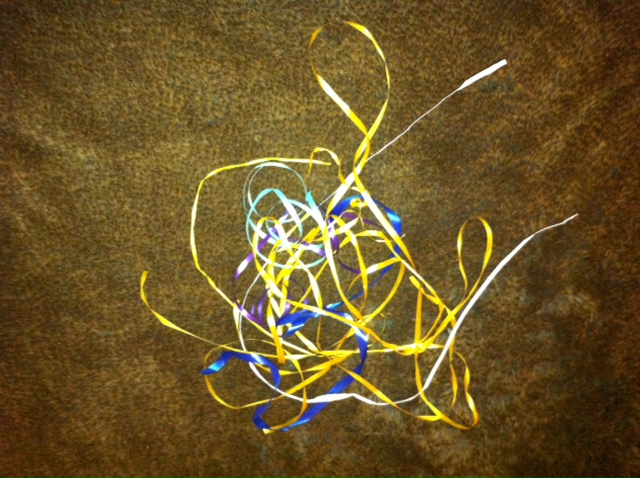
Then, one day at a birthday party Emma caught hold of a balloon string, the kind that one uses for wrapping presents with.  It was yellow and the balloon had long since popped and been cut away.  I kept thinking she wanted the balloon and asked the parent hosting the party if I could take another balloon as Emma’s had popped.  But Emma wasn’t interested in the balloon.  It was the string she wanted.  I was so fixated on the balloon it took several balloons before it dawned on me that the balloon was merely an annoyance and removing it from the beloved string was necessary.

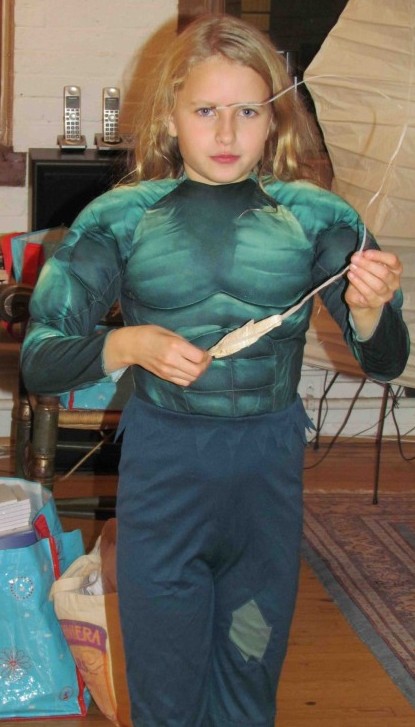
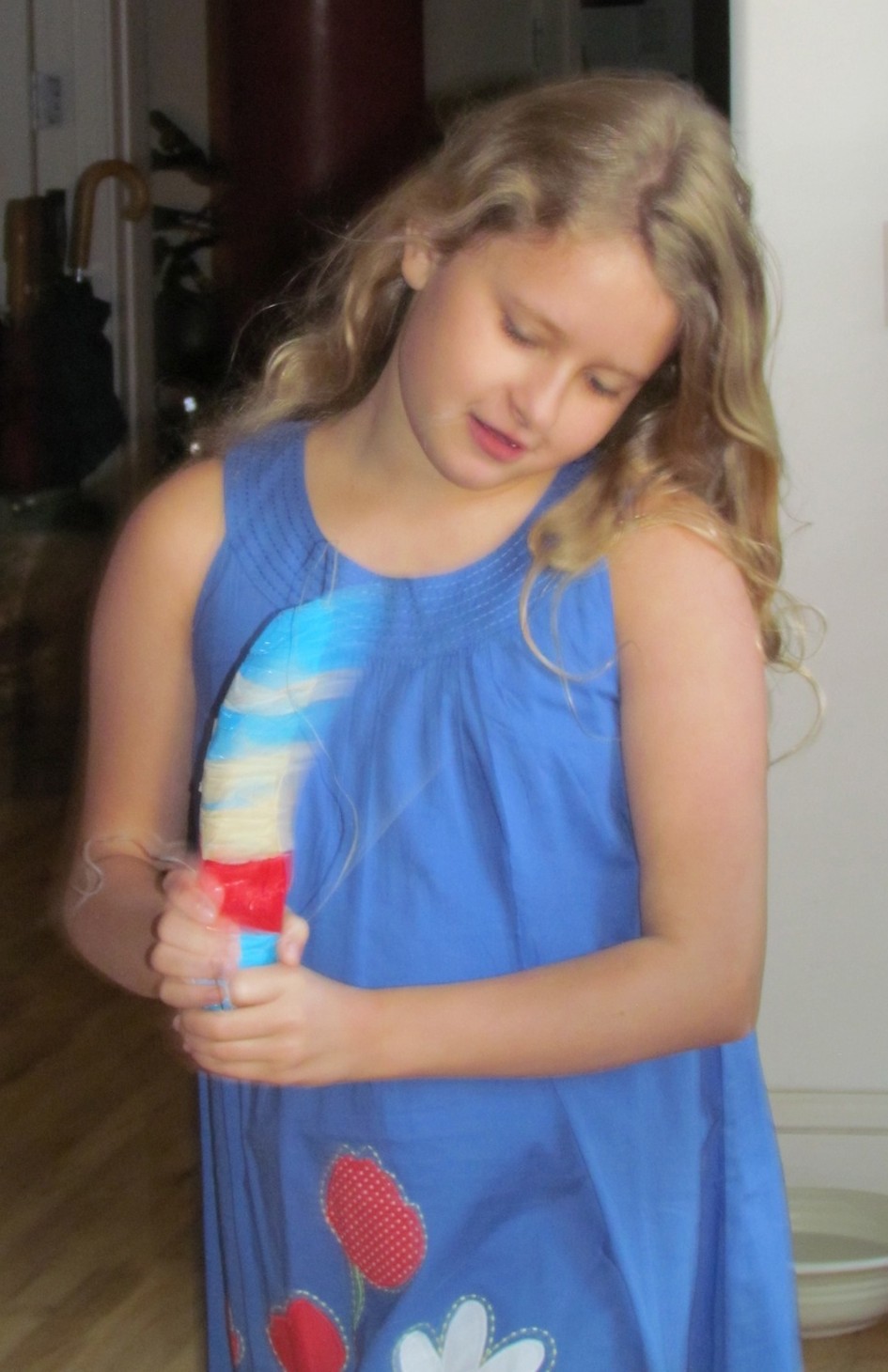
That yellow balloon string was joined by another balloon string, this time blue.  Emma would intertwine the two, twist them together and twirl them.  This then evolved to packing tape, which Emma would strip down to narrower pieces and then gather a dozen or so up and twirl them about.  A few years ago, she began adding brightly colored duct tape to a few of the pieces, thereby binding them together and it became a kind of work of art, constantly changing, growing, evolving.

Now, the packing strips count to over a dozen, some are several feet long, others are shorter, some even less than six inches, but each string is part of a larger whole and when one goes missing, the upset it causes can be terrible.  Still, we have come to understand how important the string is.  When Emma is writing she wraps it around the other hand, or will place it in her lap, or sometimes will even set it down on the table next to her left hand.  But it is always close by.  We have come to see that this is Emma’s version of a stim, or as Emma has described it, “self-care”.

Yesterday Emma wrote about her string with Soma and I once again marveled at her creative and inventive mind.  I have come to see it as a thing of beauty, ever-changing, a metamorphic reminder of life, attachment, movement, and the never-ending dance we are engaged in with ourselves and each other.

A collection of balloon strings

A collection of balloon strings

The string with masking tape.  A precursor to the colorful duck tape that would follow.

The string with masking tape. A precursor to the colorful duct tape that would follow.

The "string" with duck tape

The “string” with duct tape

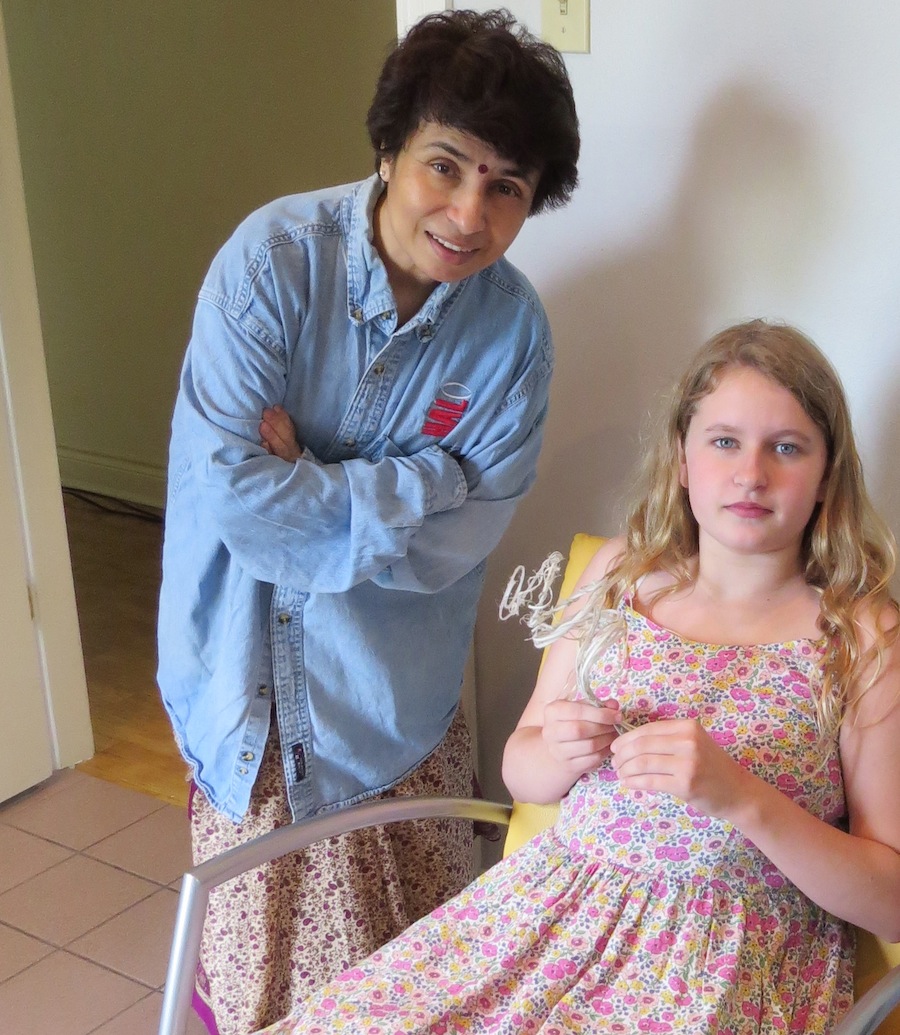
Soma and Emma

Soma and Emma

Transformations

I began this blog in April, 2010 as a document of what I thought would surely be our finding a cure for my daughter’s autistic neurology.  At the time I did not question that this was a worthy goal and one I should be pursuing.  At the time, all I could see were the things challenging her, making her life more difficult with no upside.  She was, I thought, the victim of a neurology that caused her nothing but pain and suffering.  It was not until I was confronted with the joys, things that I had witnessed right from the beginning of her life, but, after receiving her diagnosis then ignored and dismissed, that I began to appreciate the more complex truth about autism and what that might mean to her.  I could not have imagined that four years later my daughter would be posting her profound insights about life, her neurology and the impact society has on her, not because we found a cure, but because we didn’t.

For those of you who have read this blog from the beginning, or poked around and read a post or two from those early days or those who’ve looked through the archives of the pieces published on Huffington Post, you will see a transformation.  It is not a transformation of my daughter’s neurology as was once my goal, but a transformation of our thinking, and as a result the impact our thinking has had, not just on her self-esteem, but on our ideas about ourselves, individually and as a family.  We had to examine and question our own neurology and the challenges we face as a result, before we were able to fully appreciate hers.

We do not take credit for who she is becoming.  We cannot.  My daughter is strong, stronger and wiser than I have any right to claim influence on.  While it has certainly helped that we no longer fight against her neurology, but instead encourage, support and provide her with the help she needs to flourish, it would be wrong to suggest who she is and is becoming is all due to us.  Had we not found people who believed completely in her, people who saw beneath the words she spoke, the way her body moved, had they not shown us and encouraged us to question our beliefs and set them aside, to look beyond what we thought we were seeing and what that meant, we would still be lost in the horror of what we once thought and were told “autism” meant.

This concept, that of helping an Autistic child flourish to be all they autistically can be, is counter to all that we non autistics are told and urged to believe.  So much of the focus is on making our Autistic children behave and appear less autistic-like.  Appearing non autistic is the emphasis and the fact that this comes at a price, is not often spoken of or even considered among the non autistic population.  Many people see Autistic people, witness their inability to say what they feel and think, and believe there is nothing more to see.  They come to conclusions, having witnessed the person’s movement, their facial expressions or lack of, and believe what they see and what they then conclude is the “truth”.  Assumptions can create all kinds of misunderstandings that hurt a population who do not follow the unspoken rules of a majority.

(Trigger for abuse contained in links)  Misunderstandings that then lead to abuse.  Beliefs, like this and this are expressed and taken by many as fact, regardless of how misinformed, regardless of how shoddy the reporting, which further harm people and children, like my daughter.  The cure I seek now is for our society.  A cure for intolerance, sameness at any cost, and for those who seek to silence those who cannot speak with spoken language, but who have a great deal to say through the words they write, is what I dream of.

One of the many down sides of non autistic neurology is how we struggle mightily to blend in, to fit in at all and any cost.   We strive to be better than, to keep up appearances, to cover our awful feelings of insecurity and discomfort with pretense and by controlling those around us.  Some become obsessed with money and power and yet once they have both, they use it to further separate themselves.  Where and what is the cure for that?

This is the journey I now find myself on.  There are others farther ahead, I am doing my best to follow.  There are many who learned all of this sooner than I did.  There are some who will read this and because they have been on this road longer, will see how far I still have to go, but this is a trek, the best sort of trek, filled with discovery and beauty.  Emma is leading the way now.  I really am just trying my best to keep up, while remaining open to all that I still do not know, but am eager to learn.


Emma’s Take on “The Tyger”

The other day Emma chose to read and discuss William Blake’s poem “The Tyger” for one of our two sessions.  A brief aside:  When I was in graduate school, one of my favorite classes  was on Virginia Woolf’s A Room of One’s Own.  As I remember it, we spent a week discussing a single paragraph.  To me, this was bliss.  Are you familiar with Virginia Woolf?  A goddess of women writers.  A writer of imperfect perfection, truth, honesty, despair, joy and suffering, that tumultuous roiling, spilling of words on the page evoking sadness, confusion and ecstasy all at the same time, this was what I felt as I read Virginia Woolf for the first time.

But the other day, instead of pulling out my old copy of Virginia Woolf’s A Room of One’s Own, I thought of poetry and grappled with which poet and which poem?  Should we read Yeats, Wordsworth, Baudelaire or Keats?  But then, for some reason I decided on William Blake’s The Tyger:

“Tyger Tyger, burning bright,
In the forest of the night;
What immortal hand or eye,
Could frame thy fearful symmetry?”

After we’d read the entire poem to its end I asked Emma what she thought.  Emma wrote, “Beautiful illustration of torn ideas.  Rabid wondering regarding innocence and the result of omnipotence.”

Wow.

Seriously.

Wow.

This was her response after reading it through one time.  No discussion.  Nothing from me about meaning or interpretation.  Nothing.  This was Emma’s take away, having been given nothing else.

I then asked her what role if any evil played in the poem.  Emma wrote, “I am thinking evil is understood as being the tiger.”

“I agree,” I said, “What do you think about using the tiger to describe evil?”

Emma wrote, “The worst evil is the kind that is camouflaged as something else…  like an innocent lamb.”

The second to last stanza is:

“When the stars threw down their spears
And water’d heaven with their tears:
Did he smile his work to see?
Did he who made the Lamb make thee?”

Emma then wrote, “… maybe god understands what it’s like to be misunderstood.”

Emma ~ May 2014

Emma ~ May 2014

“Rethinking Your Beliefs About Autism”

Emma and I are speaking at the upcoming icare4autism conference  here in New York City, July 2nd.  Over the weekend I asked Emma what she thought the topic of our talk should be.  She wrote, “Let’s talk about mind/body disconnect and how that makes people misunderstand someone like me…”

I told her I thought this was an excellent topic particularly as this conference will most likely not have an audience familiar with the idea of there being a mind/body disconnect or if they are, what that actually means.  In fact this is one of those topics I wish I’d known about from the beginning.  It would have been so helpful had someone explained to me, when Emma was diagnosed, what it meant.  Perhaps more than anything it is the body/mind disconnect that caused me to make all kinds of assumptions about my daughter, which I now know were incorrect.  Because she did not look at me or turn her head toward me when I spoke to her, I assumed she wasn’t listening.  Because she said things that I couldn’t understand or were disconnected from my questions, I assumed she didn’t understand the question.  I believed the words she spoke were the words she intended and meant.  It didn’t occur to me that I was wrong.  It didn’t occur to me that she was thinking a great many things, but had no way of communicating all that she knew and thought.

Both Ido Kedar and Naoki Higashida talk about how their bodies do not do as their brain requests.  Tracy Kedar, Ido’s mom, writes in the introduction to Ido’s book, Ido in Autismland, “Imagine being unable to communicate because you have a body that doesn’t listen to your thoughts.  You want to speak and you know what you want to say, but either you  can’t get words out, or what comes out are nonsensical sounds or the same embedded phrases you have said thousands of times.  Imagine your face staying flat and blank when inside you are furious, sad, or wanting to smile in greeting.”  Later Tracy writes, “Since you cannot express your thoughts, only you know that you are intellectually intact.”  And still later Tracy writes, “Imagine being stuck in an educational program, year after year, that is designed for a preschooler who learns slowly.  You are bored, frustrated, angry, misunderstood and more than a little hopeless.”

Emma has written about some of this before, but in the next month will be writing about her experience with the “mind/body disconnect” more.  I will be reading her thoughts and insights at the conference and adding my experience of what I once believed.  Emma will then answer questions from the audience time permitting, by writing on her keyboard.

I asked Emma what she wanted to call our presentation.  She wrote, “Let’s call it – Rethinking Your Beliefs About Autism”

And so we are…

Em strikes a pose

And Then Suddenly Life Changes

Life has, quite suddenly, taken a dramatic turn.  Over the weekend I finally came to the decision that I cannot keep my business AND finish this book I’m writing AND work with Emma AND have the time to study this method of helping her, so that I can help others help her.  This feels like a good decision, the right decision, one I’ve been struggling with since last fall, but finally feel ready to take the actions to make this happen. So this morning as I looked around my studio, wondering how I was going to sort through everything and begin the process of dismantling a business and a working studio, I received a call from Emma’s school.  They are putting on a show next week and there have been some issues that required my presence.  As I’ve been going to her school every Tuesday afternoon in an attempt to teach some of the staff how to support her so she can write with them too, I left a little earlier than usual.

After school we met with the principal who asked Emma what she did for mother’s day, Emma wrote, “Mom helped me talk to my brother.”

“Oh!  What did you talk about,” the principal asked.

“We talked about whether Truman should have dropped the bomb on Hiroshima and Nagasaki,” Emma wrote.  Then she stood up and ran across the room, whipping her arms around like windmills before settling back in her chair.

It was decided that Emma needs to be in a classroom where she is being taught the same curriculum as her same age non autistic peers.  Except that she is not yet able to write with anyone at her school the way she can with me, so I volunteered to come in until someone can be trained.  It makes perfect sense.  But as Emma and I left her school yesterday, I thought to myself – what did I just agree to? It was one of those moments when the full weight of what you’ve committed to hits you and you think – am I going to be able to do this?  Really?  Can I do this?

Well, I guess we’ll see.  And for the next ten days I will get an interesting view into how her school does things.  And here’s the other thing…   There is nothing I could do that comes even close to being as important as finding a way for my daughter to communicate in a way that gives her greater access to this “awkward world” as she wrote the other day.  No book I might write, no piece of jewelry I might design, nothing comes close.

My life is suddenly no longer what it was.  I am nervous about going to her school with her and essentially being her one on one aide, but I am also really curious to see how it goes and I’m excited to see her in a class where, I’m hoping, she will be challenged.

Before we left school yesterday, the principal asked Emma whether she preferred being referred to as a young lady with autism or an Autistic young lady, Emma wrote, “I am an Autistic girl and proud of it.”

The principal smiled and asked, “Why do you prefer being called Autistic?”

“Because autism is part of me and can’t be removed,” Emma wrote.

“That makes sense,” her principal said.

I told the principal and assistant principal how fortunate we are that I have a number of friends who are Autistic, one of whom is like a sister to me.  And then Emma wrote, “They are my Autistic family.”

How lucky are we?

The journey continues…

Emma and Me

Emma and Me

Your Child’s Been Diagnosed. Now What?

I always think I’ve written something already about any given topic only to realize there is more to add.  So it was the other day when asked about advice for a parent whose child was just diagnosed with autism.  This is a question that comes up often and always when asked I hesitate and here’s why.  For every child that might respond to various “interventions” the way my daughter did, there will be countless others who will not.  The therapy may be worse or better.  The child may have different sensory issues, they may be voracious readers, hyperlexic or they may not be able to see the printed word because of visual issues, the letters may swim on the page until a different background is found or some other tweak is done, which allows everything to stay still.

There may be auditory issues that my daughter does not share, tactile, physical issues and the list goes on.  So what to do?  How does a parent wade through all the opinions?  How do you find a way to quell your fear, respect your child, ignore that list of all that’s wrong and find the things that will help your child flourish?

For me it boils down to two essentials.  The first is to presume my child competent.  I’ve written about this concept a great deal, but here are a few posts which talk about what that means – ‘here‘, ‘here‘, ‘here‘ and ‘here‘.  Presuming competence is very much a work in progress.  What I once presumed as “competent” my daughter has shown me didn’t go nearly far enough.  We do the best we can with the information we have.  But anything intended to “help” my daughter, anyone who is going to be spending time with her, must understand the concept and be committed to putting it into action.  This includes, speaking to her and not about her in her presence.  It means, even if the child shows no sign of understanding, even if the child has no spoken language and has never written a single word, we assume they can understand more than their bodies and gestures and utterances indicate.

Presuming competence has evolved for me and is helped by keeping my fear, judgment and assumptions checked at the door.  I cannot presume my daughter capable if I am simultaneously engaged in a running list of all she’s doing wrong.  I cannot practice a presumption of competence if every interaction I have with her is really an ongoing test where I’m insisting she prove herself to me.  Presuming competence is a life long practice and it is has far-reaching implications for not just my daughter, but all human beings I come into contact with.

Presuming competence is key, without doing this, everything else I do, no matter how great my intentions, will fall flat.  I have to believe in my kid.  It means that I speak to my child the same way I would speak to any child their age.  It means I approach my child believing in their ability to learn.  It means I believe they can and will learn.  It means they will communicate, I just have to find the best way to support them so that they can and it may not be with spoken language.  It means any therapy, no matter how popular, must be based in presuming my child competent, respecting my child’s process and treating them with the same respect I would insist on for anyone coming into contact with my non autistic child.  It means I have to do the inner work regarding what I believe, notions of should and shouldn’t, entitlement, prejudices, and whatever ideas I may have about my child and who they should be.  It means I approach my child with love, consideration, respect and curiosity.

I have come to believe that services, those services that everyone talks about and that are centered on our children, should include services for parents.  Early intervention for parents is crucial and much needed.  We parents are often in greater need of help and support than our children.  Good quality respite care, therapy for us, the parents, designed to help us cope and sort through our messy emotions so that we are in a better position to be there for our children.  I needed support from parents who’ve traveled the path I now found myself on.  No parent should ever feel the kind of fear I once felt.  Which means we have to change the current conversation surrounding autism if we are going to help our children.  No one is helped by having their every flaw (which is completely subjective, by the way,) scrutinized, both publicly and privately.  There are ways to get support and the help we and our kids need without demonizing our children and talking about them in ways we would never allow people to speak about our non autistic children.

Which brings me to the second essential thing – Autistic people.  It is imperative that all parents be given a list of blogs written by Autistic people who are describing their experience of the world.  This has to be essential reading while we figure out a way to put into place advisory programs made up of Autistic adults who are able to help parents understand their children.  These must be paid positions just as all other people involved with early intervention are paid.

We need mentorship programs of Autistic people mentoring our kids AND mentorship programs where our Autistic kids are mentoring younger Autistic and non Autistic kids.  One of the most valuable relationships my daughter currently has is with a little boy who shows no signs of being Autistic himself.  But they enjoy being together and the boy’s parents encourage their relationship. An inclusive society is key as we move forward.

On the Resources page of this blog I’ve put together a fairly extensive list, beginning with non-speaking Autistic people’s blogs.  I am always adding to this list.  I encourage all parents to start clicking on those blogs, find the ones that resonate and speak to you and follow them.  Start commenting on them, reach out to others who share your child’s neurology, develop relationships.  Listen and learn.  You will learn more from doing this than anything I learned in the half-dozen years I spent listening and reading non autistic people’s opinions.

And finally this is a short list of what I consider essential reading/viewing for anyone who has an Autistic child.

Wretches and Jabberers
Ido in Autismland
Intense World Theory of Autism

Emma and Teddy

Emma and Teddy

Emma, Barb Rentenbach and Lois Prislovsky
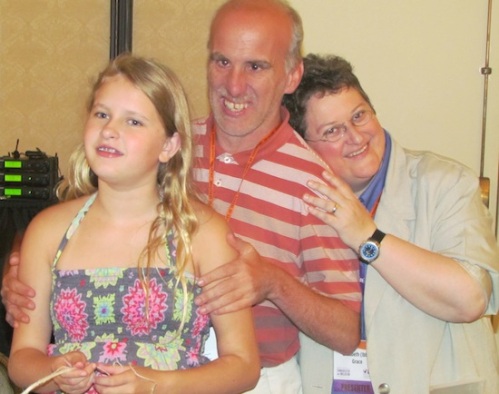
Emma, Barb Rentenbach and Lois Prislovsky

Emma, Mark Utter and Ibby at the ICI Conference - July, 2013

Emma, Mark Utter and Ibby at the ICI Conference – July, 2013
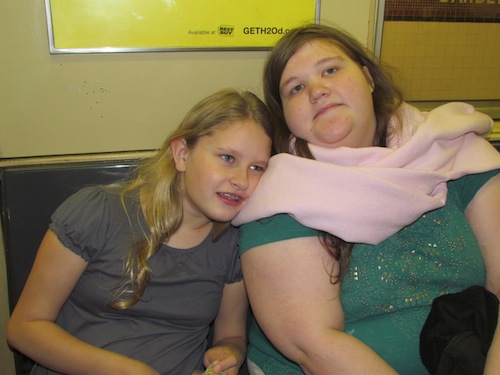
Emma and Laura

Emma and Laura

Emma and Ibby

Emma and Ibby

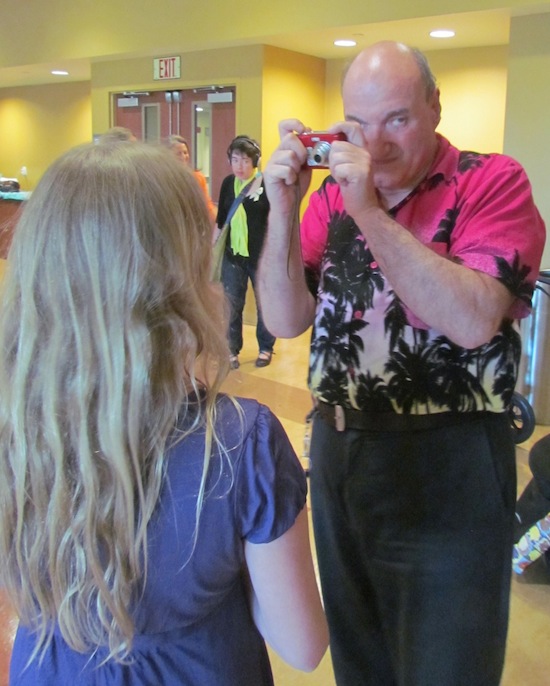
Larry Bissonette takes Emma's photograph

Larry Bissonette takes Emma’s photograph

Emma and Henry

Emma and Henry

Theories or What Does the Least Damage?

“Of all the therapies and various interventions we tried before you were able to write to us, did any help you?” I asked Emma the other day.

“No,” she wrote and then looked me in the eye and said out loud, as if I might not have understood her, “No.”

I have written about what we would have done differently had we known all that we now know ‘here‘ but still, I have to admit, I was surprised.

“But what about OT?” I asked.

“It is helpful to move,” Emma wrote.

“But did it help?” I asked.

“It’s helpful to move,” she wrote again.

And then I realized.  I was doing that thing that people so often do.  I was asking her a question, she was answering and then, because I couldn’t fully take in her answer or because I was hoping for a different answer, I was asking again.  If this were an interrogation it would be called, “leading the witness.”  Asking questions to elicit a particular response.

“Really?” I said, without thinking.  This time, Emma didn’t even bother to answer, she just looked at the timer and observed out loud, “Six more minutes and study room is allll   doooooone!”

I know for parents new to autism, these words may strike terror.  I remember early on being told about a parent who chose not to do any of the recommended therapies and being horrified.  Wasn’t doing something, even if it wasn’t helpful, better than nothing?  And then I met Henry and Kamila Markram.  They are the two neuroscientists who came up with the Intense World Theory of Autism.  It was Henry who suggested that if you could create a stress free environment for your young child, if you could shield them from surprise, create a calm, safe environment, you would do more for them than any therapy currently available.

Now for those reading this who are thinking I am saying this amounts to doing nothing, I’m not.  But there are those, like Uta Firth and Anna Remington, who insist the Markram’s recommendation, to lessen or adjust the stimuli in autistic children’s environment, is comparable to Romanian orphanages’ and go on to say, “insufficient stimulation and impoverished neuronal input in early development are damaging to children’s social, cognitive and emotional functioning3.” Except this shows a serious  misunderstanding of what the Markram’s are suggesting.  Neglect, mistreatment and being chained to a bed are not what I would call providing a safe, loving, environment free of surprises and lessening of outside stimuli.  

All children crave stimulus, but with the hyper/hypo-sensory issues that confront most if not all autistic children, Dr. Henry Markram suggests sheltering children in a comforting environment that minimizes surprises, sudden unexpected changes of plans, entering new, unfamiliar environments without any preparation, sensory assaults from loud sounds, bright lights, etc. He especially suggests avoiding confrontational behavioral therapies that demand eye contact, verbal responses, compliance and restricting movement.  What makes sense to me?  Following the child’s lead in seeking out craved stimuli. This is an aspect of Floortime that I think is a good approach.

As for other suggestions on “the right way to do it” I’d love to hear more ideas from our autistic readers. What do you think would be truly helpful?

Ideally we would have more scientific studies that show which of these various ideas are correct and that parents should do x, y and z while knowing that they were doing the right thing, the best thing, for their child, but we aren’t there yet.  So until we do know, without a doubt, one way or the other I am going to continue to look to Autistic people and my daughter to guide me.

Riding on the carousel - 2010

Riding on the carousel – 2010