Category Archives: Parenting

Entries about what it means to be the parents of an autistic child.

An Unexpected Response and The Importance of Trust

During my supported typing session with Emma Saturday evening we discussed Little Red Riding Hood.  I asked Em what she thought Little Red was bringing Grandma in her basket.  Emma typed “blueberries”, which seemed like a terrific guess, particularly as Little Red could certainly have picked them herself, placing each blueberry in her basket as she made her way toward her Grandma’s house.  We discussed the wolf and I asked questions I thought it likely Em knew the answer to, but that I wouldn’t expect her to answer verbally, just as Pascal, who is helping me, advised.  Eventually I asked, “Em, what would you do if you were asleep in your bed and woke to see the big bad wolf?”  To which Emma typed,  “I would go to the three little pigs house”.  Though she paused after she’d typed, “I would go to the”.  I urged her, “Take your time Em.  Write what’s in your head.”  She looked at me and whispered, “three little pig’s house.”  She then typed the rest of the sentence with me.  “I would go to the three little pigs house.”

I looked at that sentence.  It took me a second and then I laughed and said, “Wow Em.  That is such a great idea!”  After all the three little pigs have had run-ins with the wolf.   They know, better than anyone, how to deal with him AND they figured out how to build a wolf-proof structure after much trial and error that the wolf cannot break into and where they are safe.  Emma grinned at me and then, very sweetly, patted my cheek.  I took her loving gesture as a sign of her encouragement and patience with me.

Supporting Emma’s typing is not easy.  It is actually much harder than I imagined it would be.  I am pretty sure Emma spoke the last four words of that sentence because she was not able to trust that I was able to support her well enough to type that.  I think she sensed my hesitation.  I had no idea what she was trying to type and because I am not well trained and am very new to this, my support varies and is not consistent yet.  I am hoping I will learn and be able to give her the support she needs to flourish and eventually type independently.  What is fascinating about FC (facilitated communication, more on that ‘here‘ and ‘here‘) is that had I asked this same question of Emma and expected a verbal response, I do not believe she would have given me this answer.  If she had, I would have been absolutely blown away.  These are not the types of things we have been able to “talk” about.  Typing is giving her the tool she needs to be able to express herself in a way that has not been possible to date.

As an aside, two years ago we hired a woman who developed a literacy program for Autistic children.  While I have some serious misgivings about certain aspects of her program, the literacy piece is extremely well mapped out and it was what finally gave Emma the tools and practice she needed to learn to form the letters of the alphabet and began to read, write and type.  Now two years later as a result, Emma is reading and writing at a second grade level, though it is probably much higher.  Emma was not taught through phonetics, in fact we never even taught her the names of the letters in the alphabet.  For two years Joe and I worked with Emma every day on her literacy program.  For more about that program you can read ‘here‘ and ‘here‘ or put the word “literacy” into the search box and everything I’ve written on the topic will come up (just be aware my ideas and views have changed pretty dramatically since many of these posts were written.)

I mention all of this, because I want people to understand that Emma did not sit down one day and begin typing in full sentences.  She did not suddenly pick up an encyclopedia and begin quoting from it.  I know there are those who have.  I wanted to pursue supported typing with Emma after going to the Autcom Conference this past October and meeting Pascal.  He was kind enough to speak with me about Emma and gave me some advice.  I didn’t know if she would be a good candidate for FC.  After all she has some language and typed independently with her two index fingers.  But I want her able to converse on a more sophisticated level.  It seemed to me, FC might be the method by which she would be able to do that.

I am always in awe of Emma’s patience with this world, with all of us, with me.  Her inner strength and resilience are incredible.  She has been ignored, doubted, talked down to, spoken of while she stood right there listening as though she were deaf, she has been misunderstood and treated as though she were incapable of understanding.  Were I treated this way I would be in a state of near constant rage, alternating with debilitating depression.  If any one of us were treated the way so many view and treat Autistic (whether non-speaking, marginally speaking or fully speaking) people, most of us would want to retreat from this world and lose all faith in people, even people we love.

I do not know how or where Emma gets the strength to greet each day with such cheer or how it is that she is so good-natured, kind and loving after all she has been through in her short life.  But she has and is.  I began this blog thinking it would be a document of Emma’s progress.  But in fact, this blog is a document of my progression.  I look back on entries made just a year ago and see how completely my ideas about Autism and my daughter have changed.  So much of what I thought and believed I no longer agree with or feel.  I have resisted the urge to delete all those past posts, because as horrified as I am by so many of them, I also know they are what I believed at the time.  My own journey is a reminder that we neuro-typical (not otherwise specified) adults can and do change, sometimes it just takes some of us a bit longer.

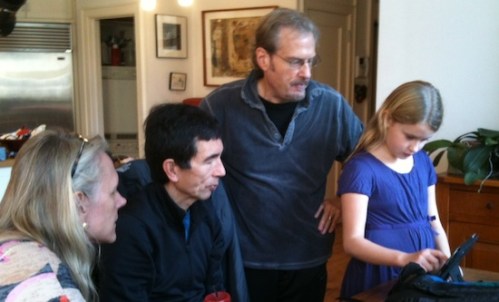
Me, Pascal, Richard and Em during our first “training” session
“Burden”? I Don’t Think So.

The roller coaster I call “autism” is less actual and more a description of my emotions, expectations and judgments surrounding specific things such as communication differences, internal issues, pain perception, sensory issues and the different ways in which Emma takes in information as opposed to the way my (more often than not) non-autistic brain works.  (My friend, AspieKid calls brains like mine NT-NOS, which I think is a hilarious and fitting acronym.) It is a “roller coaster” of my own design and construct.  A roller coaster being an accurate description of my emotional state, something I’ve grappled with my entire life and certainly well before I ever met my husband and had children.  Suggesting “autism” is the root cause for those pre-existing twists and turns my emotions tend to take or pinning the psychological upheavals I’m experiencing onto “autism” is not only wrong, it’s dishonest.

The truth is, I’ve always been a bit high-strung.  I live in New York City, a city whose inhabitants wear their neuroses proudly.  Neuroses in New York city are treated the way a runny nose is looked upon in the mid-west.  No big deal.  New Yorkers have melt downs at the drop of a hat.  I’ve seen fist fights break out between grown men in the middle of an intersection because of a perceived insult, people routinely scream at each other and cut each other off while driving.  Moms pushing babies and toddlers in Hummer-sized strollers wield them like tanks plowing a path for themselves along clogged sidewalks like Moses parting the Red Sea.  People think nothing of getting into loud arguments with lovers, neighbors, friends and strangers in the middle of the sidewalk, forcing pedestrians to walk around them.  It’s a city of ids and super egos.  It’s a city that is (perhaps) an exaggerated version of what one sees anywhere in the world.  People are capable of some pretty dreadful behavior.  Add a child with a different neurology to that already fragile, high-strung mix and you’re going to get some interesting results.  To then conclude that autism is to blame, defies all logic.  No one would do that.  Yet people blame their bad behavior, their inability to cope, their sadness, depression and general irritability on their autistic child all the time.

Suddenly it’s autism and Autistic people who are a “burden” to society.  Autism isn’t a “burden”.  It’s the negative views of autism, it’s the autism = untold horror, it’s the perception of autism and the lack of understanding and services, the lack of training and programs in our schools so they can help our Autistic children learn in a way that will ensure they flourish.  The “burden” is not our Autistic child on society.  The “burden” is the lack of support and adequate help families need so they can better support their child, giving them the sort of assistance  they need to thrive and flourish, a child who will one day become an Autistic adult and, in an ideal world, an active member of society.  We have to move away from this idea of Autism = burden.  Autism = tragedy.  Autism = _______ fill in the blank with a negative word.  We need to abandon our preconceived notions of what a non-speaking Autistic child cannot do.  We need to open our minds to the idea that our children are capable of far more than we may believe or can fathom.  We need to begin looking at what is good about Autism and the countless ways in which Autistic people can and do contribute to this world.  We need to remove the stigma and negativity and replace it with a more balanced and yes, positive view.

Imagine a world that includes Autistic people, accommodates Autistic people and stops shunning, restraining and abusing them.  A world in which it is not okay to have seclusion rooms and restraints, where a non-speaking person is treated with respect and without prejudice and where it is not assumed that because they do not speak they have nothing to say.  A world where people finally understand the burden isn’t the Autistic person, whether child or adult, it’s the lack of services, the judgments and the scare tactics being used.   Autism is big business and there is no better way to ensure dollars continue to pour in than when we are terrified. Let’s change that.

Having a child is joyful, exhausting, frustrating and the single most extraordinary experience a human being can have.  Having an Autistic child is joyful, exhausting, frustrating and the single most extraordinary experience a human being can have.   One can say that about a great many things in this life.  Let’s stop blaming Autism and our Autistic children for the ills of the world and the bad behavior displayed by people.

Emma and her infectious laugh

Em

EEEEEEEEEEEEE!

EEEEEEEEEE!!!!   (This is, but one, of many fabulous expressions I have come to love and use.  I first saw it used by my friend Paula and it made me happy.  I love that woman.)  What better way to express emotions that go far beyond “excitement”?  What words can possibly express joy and excitement and exuberance and that feeling when your throat constricts and tears flood your eyes and there’s that fluttering feeling in your chest that travels up and down as your vision blurs because of the tears?  Tears of joy.  Tears of overwhelming emotion that are impossible to express, that makes it difficult to breathe.  I don’t know of anything I could write here that would sum up what I am feeling.  EEEEEEEEEEEEEEEEEEE!   ⇐ comes the closest.

Yesterday was our second session with Pascal who is a trained facilitator of more than two decades.  Our first session I described ‘here‘.  Yesterday’s session took place over Skype.  It took us a while to get connected and once we did our connection kept going out on us.  At one point during a particularly exciting moment with Emma I squealed in delight, looked over to see Pascal’s expression and was met with a blank screen.  We’d lost him again.  “NOOOOOOO!  I cannot believe you just missed this!”  I shouted at the darkened screen while Joe, Emma’s therapist, and Richard laughed.  Our excitement was palpable.  But I’m getting ahead of myself.  Let me back up.

Two weeks ago we had our first session.  It was beyond exciting, but in the interim, between that session and our Skype call yesterday I’ve been filled with anxiety and so have only tried to practice with Emma a couple of times.  (For those of you unfamiliar with facilitated communication, it has a complicated history.  That history I’ve touched upon ‘here‘ and ‘here‘.)  I worried that I would inadvertently push Emma to type something she didn’t intend, I worried that I might betray her, by literally putting words in her mouth.  I have never forgotten one of the things Amy Sequenzia said to me regarding FC – that the most important piece was trust.  I didn’t want to do anything that would betray that, so I did nothing at all.

The first thing Pascal did was cover some of the basics.  We went over different things I could try.  We discussed the correct way of providing support firmly enough to ensure that trust, but not so much that it becomes a vise grip or so loosely that it is little more than an irritant.  Getting the support right is key and not as easy as it might sound.  There is also the resistance piece to all of this and there’s a rhythm that must be achieved as well.  The process is unlike anything I’ve ever done before.  I want to liken it to dancing, not the sort of dancing one does in a mosh pit, but ballroom dancing or learning the mambo, where you have to be in sync with your partner, both with your physical movements, but with your mind as well.  I’ve had some wonderful FC advisors (other moms who have generously talked to me and given me tips from their experiences doing FC) and so I remembered some of their suggestions.  One, from a new friend, Sheree, told me I need to empty my mind.  For anyone familiar with Buddhism this sounds much easier than it actually is.  But when I felt myself wanting to push Emma to hit a certain letter on the iPad, I “told on myself” immediately and Pascal would gently advise me.

As our session continued and I became more comfortable, feeling the rhythm and getting the right sense of her, we went beyond Emma typing answers to questions such as, “Where are they ice skating?” after being shown a photograph of ice skaters at the ice rink in Rockefeller Center and her dutifully typing Rockefeller Center (which I don’t mean to sound blasé about because you have no idea how  HUGE this was, but it was nothing compared to what happened next!)  We moved on to increasingly challenging questions, like “What is the name of the airport we have to fly into before we fly to Granma’s house?”  She typed “Denver” and I gasped.  *I keep wanting to tell you, to describe to you how massive this is.  I want to explain to you that while it may seem small or even utterly unexciting to you, it was beyond exciting for me to see her respond in this way.*  I don’t think I’ve ever heard Emma say the word “Denver” before and while this is something she has heard many, many times in her life; it is a place we must fly to several times a year when we go visit Granma, it is not something I expect Emma to utter.

Pascal continued to ask Emma more questions about visiting Granma and then I asked, without really thinking, “What kind of dogs does Granma have?”  Emma pointed her index finger and then reached for the “g”.  I think I may have held my breath.  Waiting.  Empty my mind.  Wait.  And then her finger found the “e” and I let myself take a tiny breath.  Keep breathing I told myself.  Keep breathing.  Quiet mind.  Be with her.  Let go.  Be with her.  Open mind.  Breathe.  And then her finger found the “r” and on we went until she’d written “german shepherds” complete with the “s” at the end because there are two and of course she’s correct and I sat there and stared at those words; the two most beautiful words my daughter has ever typed and I looked at her and pressed my forehead to her cheek.  I cannot convey the feelings.  Gratitude.  Joy, unbelievable joy and something else…  something I don’t know that I have the words for.  A knowing.  That’s all I can say.  I deep knowing that this is the right road we’ve taken.  We are on the right road.  And I exhaled and asked, “Em.  What kind of dog is Dozer?”  Emma looked at me and said, “Last time.”  And I laughed and hugged her and said, “Oh Em.  Really?  I want to talk to you like this all day!”  Emma beamed at me and then she patted my knee.  “Okay Em.  Last time,” I said. Then she typed, “nufandland.”

EEEEEEEEEEEEEEEEEEE!

*Cannot type through the tears.

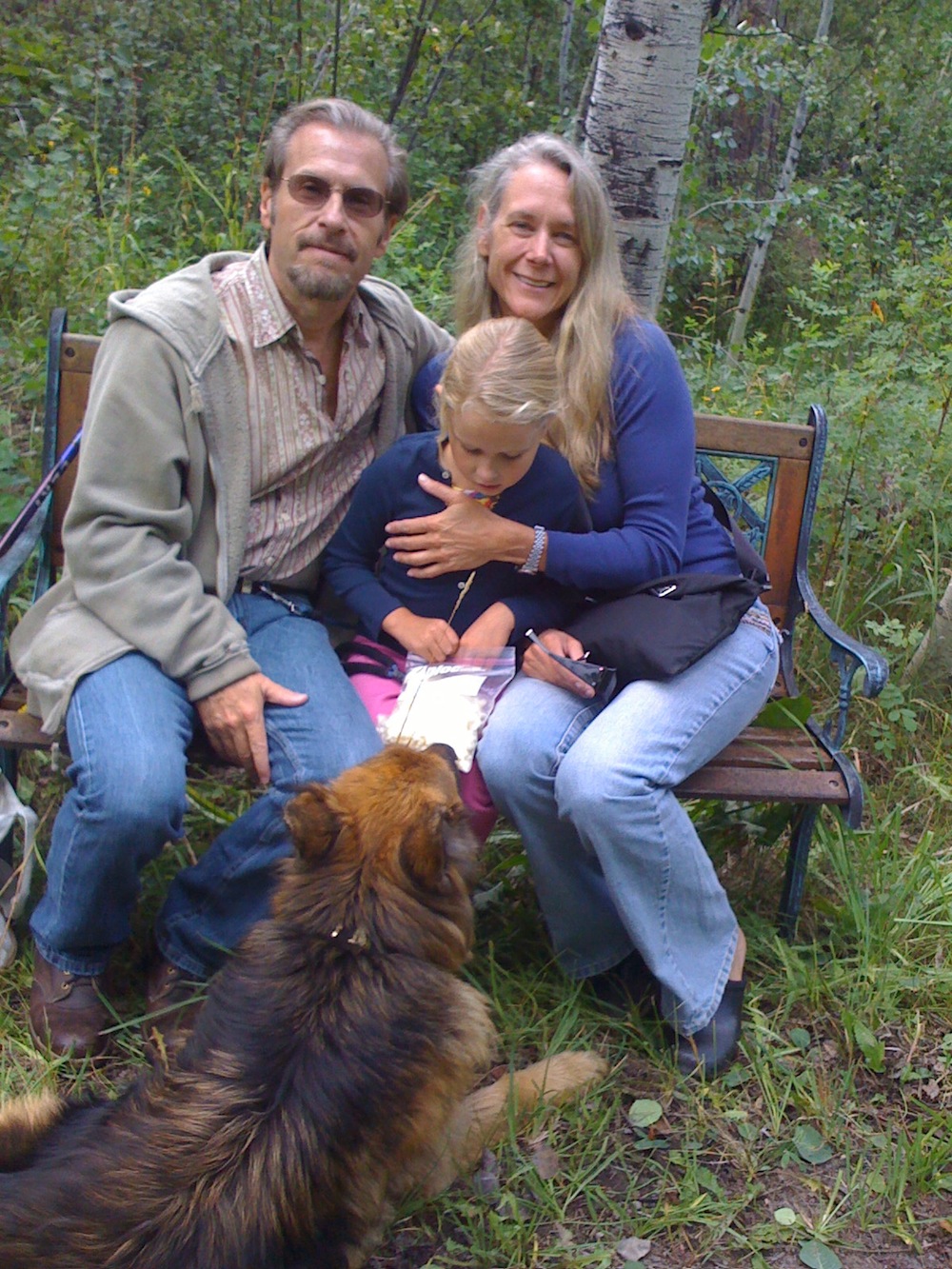
Dozer with Emma, who is terrified of dogs and yet…

Dozer&Em

To the Person Who Googled “I don’t know if I can handle Autism”

I have three things I need to say to you.

First.  Come.  Talk.  Find a safe place where you can talk without being judged, somewhere private, somewhere and with someone(s) who will understand and listen.

Second.  Fear.  Feel the fear.  It’s impossible for me to talk about autism without talking about the abject fear I used to feel, every single day, every moment.  They say fear can be informative.  This was not my experience of it in the beginning, I was running too fast and doing so much to avoid it.  Fear drove me to do a great many things I regret.  I wish I could tell you I have no regrets, but I do.  So, so many regrets.  Avoiding the fear is just one of them.  I wish I’d sat with it.  Leaned into it and listened to it, without believing what it whispered to me as though it were fact.  Listen to it, but don’t believe it.  Who knows what I might have learned all those years ago.  Who knows had I done that, what mistakes I might have avoided.  Who knows?

You see, fear was the driving force behind my relentless search for a “cure”.  Fear is what made me think anything I did was better than doing nothing.  Fear drove me to rationalize some dangerous and very risky “interventions” because I thought to do otherwise was wrong.  It was my fear that kept me up at night, on the computer, typing one more search word into Google’s vast engine, hoping I would find the thing, the remedy, the treatment, the pill, the tincture, the doctor, the nutritionist, the biomed doctor, the QiGong Master, the homeopath, the naturopath, the GI specialist, the thyroid specialist, the speech therapist, the occupational therapist, the cranial sacral doctor, the shaman, the Zuni chieftain, the psychic, yeah you read that right, the psychic, each and every one of these people I put my faith in.  I convinced myself that this person, finally would be the ONE.  They would reach out their hand and show me the path I needed to take.

All those words used to describe autism and Autistic people, our children or parents or siblings, all those words like, “burden”, “epidemic”, “crisis”, the war terminology evoked telling us how we must “fight” and “combat”, all those words like crumbs left in a dark forest were words I believed and used and never, never once during those early years did it occur to me to question them.  For those who did, well, they obviously didn’t have a child like mine.  You had a child who was less profoundly affected by autism than mine.  This was my thinking, this is what I believed in my heart.  (This is my story, it may not be yours, but it is the only story I can tell.)

Third.  There is a documentary I love.  I have watched it many times now.  It’s called Wretches and Jabberers.  I’m not going to tell you more, you just have to see it for yourself.  It’s available on iTunes, Netflix and Hula.   You can purchase a copy from Amazon.  Even if you ignore every other thing I’ve written here, just watch it.  It is a documentary that every human being on this planet should see, because it is about more than just autism.  It is about our beliefs and how our beliefs make us behave in ways we might not otherwise condone.  It is about prejudice and fear and ingrained thinking and the inherent limitations all of that encourages for those who are different.

And finally remember this – just because someone does not speak, does not mean they have nothing to say.  Just because someone cannot make their needs known, does not mean they have none.  Just because someone does not tell us they love us does not mean they do not.  Just because someone does not look at us, does not mean they do not see us.  Just because they do not seem to understand in a way that we recognize, does not mean they do not and cannot.  Just because we think they are ignoring or cannot hear us, does not mean they are or do not.  Just because we think someone cannot write or read does not mean they can’t or never will.

Just because we feel, in this moment, we cannot handle something does not mean we can’t.  With support, we can and we will.  And so will our children.  They can, they do, and with help, they will.  Believe this and you will not only help your child and yourself, you will help the world and all human beings who inhabit it.

Choose to believe.

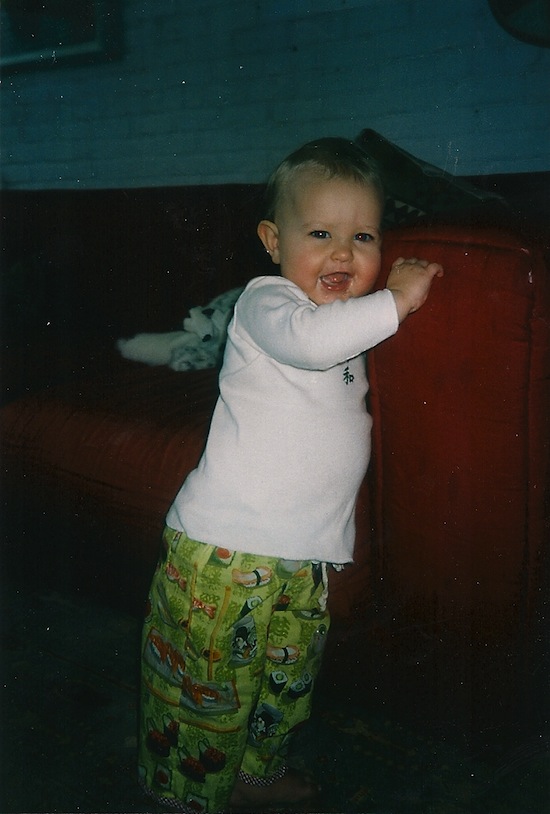
Emma on her 4th Birthday – 2006

Em - 2006

Two Autistics Spoke. How Many Listened?

Yesterday C-Span covered “Lawmakers Look into Federal Response to Rising Rates of Autism.” For those of you interested in seeing all 3 hours and 48 minutes of it click ‘here‘. You can also read all eight transcripts of testimony by clicking on each link ‘here‘.

There were two Autistic people of the eight who spoke.  This, in and of itself was significant.  The last two speakers were Michael John Carley, executive dircetor of Global & Regional Asperger Syndrome Partnership (GRASP) and Ari Ne’eman, President of Autistic Self Advocacy Network.

Michael, at one point said, “…research is geared towards the future, and not where the greatest need lies, which is in the present. Today, the amount of services we collectively provide is like one page out of War and Peace when compared with what’s needed.”

He went on to talk about language, “Tone, and language may seem like pc-nonsense semantics to many, but not to someone on the spectrum who grows up having to hear words like “cure,” “disease,” “defeat,” and “combat” …

Such negative self-imagery makes self-esteem so much harder to achieve for an individual who is at a psychological disadvantage enough as it is. We have to remember that the vast majority of this population can read what is being written about them, and hear what is being said about them.

Ari Ne’eman spoke last.  His was a riveting and powerful speech in which he spoke to the “epidemic” of Autism, “If we want to put the idea of an “epidemic” to the test, one of the most compelling lines of research we could pursue is an epidemiological study of the rate of autism among the adult population. A recent study of this nature conducted by the United Kingdom’s National Health Service found a comparable rate of autism in adults as in children in England.” 

Ari spoke of those who are non-speaking Autistics,  “If we invested a mere one-tenth of the amount of money that we currently pour into causation into empowering Autistic people to communicate, that young man and hundreds of thousands more like him would be able to communicate their needs to us today.” 

He went on to point out, “Autism Speaks and the Simons Foundation – devote even less to these areas, with Autism Speaks investing approximately 1% of its research budget to studies on the quality of services to Autistic people (and less than one quarter of a percent to Autistic adults) and the Simons Foundation making no investments in either area. It cannot be doubted that when it comes to the needs of Autistic people today both the public and private research agendas are quite simply not responsive to the priorities of the Autistic community, itself. 

And he talked about the importance of Medicaid, the importance of providing assistance to those just entering the work force and those who would like to, but do not have the supports in place to do so.

Ari ended with – “I want to thank the Committee members for allowing my community – the Autistic community – the opportunity to have a voice in these discussions. The challenges society currently faces in integrating and supporting Autistic people and our families are not new. We have faced these challenges and made tremendous progress with other disability groups in the past. I believe that at the end the day this is a civil rights issue. I believe in the ability of the United States of America to guarantee the civil rights of all of its citizens. Autistic people want and deserve the same things that anyone else wants – inclusion in our communities, the opportunity to go to school and get a good job, the chance to make our voices heard about the things that matter to us. With your help, we can make that a reality.”

His final words were, “I look forward to hearing your questions.”

I was eager to hear the questions that would undoubtedly be asked of both him and Michael after such terrific speeches, particularly as they are both Autistic, the very people this entire hearing were meant to care about and want to help.   So I waited.  And then I waited some more.

Finally there were a few, but the majority of people who spoke continued to repeat those words that Ari and Michael had cited, as though they’d never been said.  It seems we care about Autism and our Autistic children specifically, but when it comes to “Autistic people” in general, we don’t care so much.

And so I’d like to know, Why is that?

How is it that we can say we “care” about Autism and those who are Autistic yet not fund programs that will make their lives better?  How is it we can use words usually reserved for war and ignore that these words make those who are on the spectrum feel badly about their very existence?  Is this how we want our children to feel?  Do we really want our own children to feel their existence is called into question?  Let’s just say, for the sake of argument, that our Autistic children, whether they speak or not, whether they are in a special education classroom or are mainstreamed, let’s just say, ALL of them can and do understand what is being said about them, but they cannot tell us or do not have the ability to communicate how that feels.   Can we at least imagine what that would be like if this were done to us?  Can we try, just for a moment to have the “empathy” needed to imagine?   Are we compassionate enough to pause, even if for a moment and consider the implications of what we are saying and doing?  Even if we cannot or do not want to think about all the Autistic adults whom we do not know, can we just think about our own child?  Our children will be adults one day, do we really want them to feel as so many Autistic adults do?  Our children have feelings.

Ari is Autistic.

Michael is Autistic.

Both spoke.

How many listened?

My Autistic daughter, Emma – 2002

Emma - 2002

Related articles

Yes, These Are Things I Think About – What About You?

We, non-Autistics say all kinds of things without thinking.  We use a sort of socially accepted shorthand during a great many encounters.  It’s a way of being in the world that requires no thought, rote gestures and words that are mindless and often meaningless.  Expected utterances we don’t think about, we do and say them because we are taught to do otherwise is impolite.  Upon meeting someone we automatically put out our right hand in greeting.   We are taught to smile and ask, “How are you?”  The response is unimportant, after all we aren’t really asking the person we’ve only just met to seriously contemplate their mental state and then divulge this information to us, neither are we honestly curious except in specific instances when we know something about the person and have wanted to meet them.  But typically, “How are you?” is an opener.  It’s merely a polite question we’ve been taught to ask, showing the accepted degree of interest in the other person, even if we actually have none.

Someone I know sent me a wonderful piece she’d written about meeting her baby nephew for the first time and being expected to say immediately that she loved him and how disappointed her family member was when she couldn’t bring herself to say those words right away, even though she felt a number of things that we non-autistics would probably identify as feelings of “love”.  Reading her wonderful piece (click ‘here‘ to read it in its entirety) made me think about all those years when I would encourage Emma to say “I love you.”  I even said to her, on  a number of occasions, “I love you Emmy.”   To which she would reply, “So much.”  I then laughed and said, “No Em, you’re suppose to say, I love you, back.” And Em dutifully said, “You’re suppose to say I love you back.”  I don’t, for a second, doubt that Emma loves me.  I know she does.  I also know my desire to have her say so, is my wish and not a desire she puts much weight into.  For all I know Emma doesn’t say those words because she doesn’t  feel the need to, perhaps she doesn’t see the point in reminding me of this fact.  Perhaps, and this is the one I hope is most true, she doesn’t feel the need to utter those three words because she is secure in the knowledge of her love and assumes I am too.

Many of the “niceties” we non-autistics say are said with a degree of dishonesty because really, how “nice” is it to meet someone you may or may not ever see again, may or may not have anything in common with and do not have time to actually get to know?  And while we’re at it, let’s consider “how are you?”  How many people really care?  We are taught to respond with the equally (often) dishonest single word, “Fine” but how many of us really are “fine” when we’ve been asked how we are?  Seriously.  How many times have you been asked, “How are you?” and you either didn’t actually know, hadn’t had time to think about it or weren’t fine, but were instead feeling something else, yet replied with “fine” because it was simpler, easier, safer or because the conversation had already moved on, before you’d had the chance to give your more thoughtful reply?

So I’m curious – what if we didn’t ask or say things unless we were honestly interested and meant what we were saying as a way of communicating something new or that required discussion?  What would happen if, upon meeting someone we weren’t sure we really were pleased to meet, said nothing?  Would this be so bad?  What if, when asked “how are you?” we answered truthfully?  What if when we voiced our love for our children and they said nothing in return, we didn’t assume that meant anything other than our child did not find it necessary to state the obvious?

Em & Nic – Summer 2004

Excitement, Impatience and Waiting

The day before Thanksgiving a facilitator, P. came over to work with Emma.  I met P. at the AutCom Conference in October and asked him for some guidance in helping Emma communicate more effectively through typing.  And while Emma is verbal, she can voice basic desires, has even begun to comment on things going on around her, she has not communicated more complex thoughts.  I know Emma is intelligent with a great many ideas and interests.  I want to help her express herself in whatever way proves most advantageous, whether that is verbally, through typing or some other, still unknown, way.   I want to help her be a full participant in this world so that she can have choices and options available to her.

P. has facilitated people for several decades, so I felt confident he would be able to help me learn how I can help Emma better and was excited to have him work directly with her while I watched.  We started with a number of apps, Emma had no trouble pointing, using her index finger to match words with images that she knows.  But in the past when it comes to typing an idea, Em will usually type, “yes” or “no” and then repeat the question, which is what she was taught to do with her most recent literacy program.  I am hoping Emma can be encouraged to move beyond that.

As P. worked with her, slowing her down so she couldn’t simply repeat what had been asked, holding her arm at the elbow, putting up some resistance to her desire to type quickly, reminding her to write what she was thinking, asking if that’s what she meant, I felt tremendous hope.  P. asked Em to bring a book she liked.  She brought him a collection of fairy tales and plopped the large book on the table in front of him.  Em chose to discuss Goldilocks and the three bears.  Most of what was typed were fairly simple ideas about the bears and Goldilocks and the havoc Goldilocks causes (much to Em’s delight.)  But then P. asked Em what she would do if she went into her own bedroom and found baby bear in her bed, Em typed, “I would be scared and I would watch his mother.”

I read that sentence several times.  How can I describe the feelings that came with reading it?  How can I express the surge of hope I felt?  How can I possibly describe the feeling of euphoria?  This sentence, this idea was beyond what I have come to expect.  It suggested a whole other level of thinking, a thought process far beyond anything she has been able to express before.  It was a terrific idea, one I have discussed with both children during the summer months when we visit my mother in Colorado where we often see bears.  I have warned the children that if they encounter a bear, especially a mother with her cubs, to not get between them, to keep their distance, to keep their eye on the mother and to make loud noises.

But Emma wasn’t finished.  She then typed, “By the way, this is a very sad story.”  I was astonished.  I had a million questions.  Emma has never spoken this way.  Ever.  “By the way” is something both Richard and I say, both in jest as well as seriously.   Em has never uttered these words, let alone typed them.  And why does she think it’s a “sad story”?  What strikes her as sad?  Which part or does she think the whole thing is sad?  It is sad, I thought and then I Immediately went to,  I have to become trained in facilitated communication.  I have to find a way to communicate like this with Emma.  As I am not able to become trained in facilitated communication in the next 24 hours, I made an appointment to Skype with P. in another week, which feels like an eternity, and will try to do whatever I can to continue to learn so that I am better able to help my daughter become an independent communicator.

Between now and that Skype call, I am doing my best to manage my impatience, my excitement, my hopes and dreams and the reality that my daughter has a great deal to say and boy do I want to hear it all!

Em & P.

Related articles

A Story About Our Black Cat

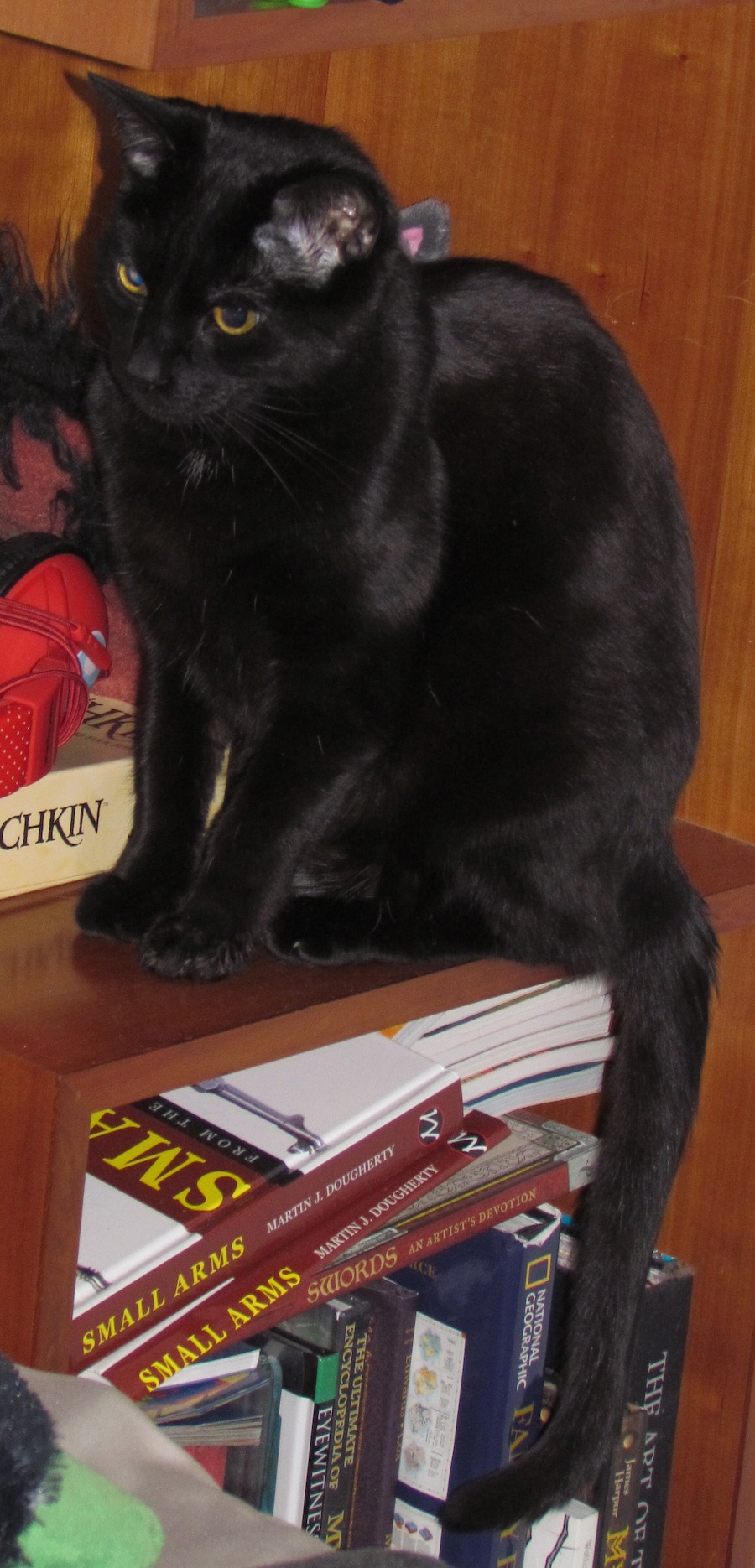
About nine months ago I read this post from E.  click ‘here‘.  It’s about her cat M. (I just loved she chose to keep him anonymous!)  When I found E.’s blog The Third Glance I went to the beginning and read every single post she’d written.  She was fairly new to the blogging world and so it was relatively easy to read all her posts in a few days.  I sent Richard the link to My Cat is My Hero because we have a black cat also with a name starting with the letter M.  Also from a rescue shelter and also a pet that we absolutely adore.  Unlike E.’s cat however, Merlin announces his presence to anyone who is capable of bending down to pet him.  He demands attention and shamelessly pursues anyone who seems remotely willing to give him his due.

Prior to Merlin, Richard was a self-proclaimed “dog man”.  He explained to me patiently that he did not particularly like cats, that given his preference he would surround himself with dogs.  In fact, Richard, when I brought up the idea of getting a cat after the children kept asking for one, said to me, “If you care about me and our marriage, you will not bring this up again.”  To which I replied, “I do care about you and our marriage.”  And the subject was dropped.  (By me.)  However that did not hold for Nic and Emma.  They brought the subject up repeatedly (and I did nothing to discourage them, though I will deny this to Richard, even after he reads this here, I’m still going to deny it.)  And finally when Emma said, in a particularly adorable and sad voice, “Bring kitty home?” while at our weekly trip to the pet store, Richard said, “What do you think about getting a cat?”  To which I casually replied, “Oh, good idea.” Eye roll and the slightest of smirks.

When we arrived at the pet store we explained that the cat we were looking for would need to be comfortable with children and loud music.  One of the employees brought over a rust colored cat whom he assured us loved being held and was a “lap cat”.  He was adorable, but Richard looking slightly ill, leaned over as I held the kitty in my lap and whispered, “We are not getting that cat, he looks like liverwurst.”  “He does not Dad!” Nic cried.  But Richard stood firm.  We continued to view the dozens of cats and then Nic said, “Mom.  Look at this one!” And there he was, black as chimney soot, green eyes calmly staring at us, he even swaggered as he made his way over to us.   I had been reading Temple Grandin’s book, Animals Make Us Human  and had made a mental note about her suggestion that black, male cats were often calmer and she advised gently putting the cat on his back with a light hand on his belly to see what he would do.  If he bit or clawed or panicked, he was probably not the right cat for a family with children, but if he was calm, he was, most likely ideal.  I did as suggested and Merlin purred, relishing in the attention, then righted himself when he’d had enough and wandered over to Emma, who began to pet him.

Both Nic and Emma expressed their approval and after the lengthy intake process where we had to present referrals and swear to uphold a lengthy list of requirements such as promising not to declaw him, take him regularly to the vet, etc we were allowed to bring Merlin home.  Though there was an anguished moment when Nic asked Richard, “Dad, aren’t you so excited?” And Richard said loudly, “Yeah, right Nic.  I am NOT excited to have this animal come home with us.” Meanwhile the manager of the shelter was standing behind Richard looking none too pleased.  It was one of those moments when I thought our plans to adopt were dashed and Merlin would not be released to us after all.  But even with Richard’s ill-timed, less than enthusiastic response, within hours Merlin was home and strutting about as if he owned the place and by the second day was scaling the curtains, climbing to the highest places he could find, walking like a tightrope walker along the curtain rods and then leaping down on top of us, much to our terror.

Despite all of this, or perhaps because of it, Richard began to soften.  Merlin being the brilliant cat that he is, immediately began following Richard around as though he were a faithful hound and NOT a cat at all.  Within a week Richard was speaking to him and by the end of that first month it was clear Richard had succumbed to Merlin’s charms.  In addition to all of this there were sightings by Nic of him using the toilet to pee and it was also around this time that Merlin taught us to play fetch with him, which sealed the deal for Richard who now cannot be away from Merlin for more than a few hours before mentioning him.

Please enjoy this video, shot by the ever adoring, Richard just last week while I go brine our turkey.

Merlin

Mistakes Have Been Made and Random Acts of Kindness

A few months ago someone typed into a search engine – “how can a 56 year old make a mistake” – and they were led to my blog.  Which is either a great relief or pretty horrifying, I haven’t decided.  I read those words and my first thought was, Why are they being led to my blog?  I am NOT 56 years old!  But when I am, I will undoubtedly still be making mistakes.  Do any of us stop making mistakes?  Isn’t that part of being in the world, being human and being alive?  To err is human and all of that?  None of us get out of here doing this perfectly.  So yeah, I’m okay with the fact that someone was led to my blog who may have been incredulous that a 56-year-old or even a 52-year-old (my actual age) could make a mistake or, as is my case, many, many mistakes.  I have, I do, no doubt I will continue to make mistakes.  But the wisdom of years is that I don’t need to pretend I’m doing everything perfectly, I don’t need to hide from my mistakes.  I can look at them, see them for what they are and hopefully, move on.

Which brings me to Emma.  I would really like to not repeat a great number of the mistakes I’ve made when it comes to my daughter.  Some I can’t even call “mistakes” because I kept repeating them and at a certain point repeated actions get pushed out of the “mistakes” category and into the “bad decision” category.  (It’s kind of like when someone says they’re going to go take a nap and then disappear for four hours.  That’s not a “nap”, that’s going back to sleep!  It doesn’t matter that it’s in the middle of the day.)   So yeah, I’ve made plenty of decisions I really wish I hadn’t, decisions that affected my daughter.  Decisions I don’t feel happy about or proud of.  There are others I am even ashamed of and feel tremendous guilt over.  It would be dishonest of me to say otherwise.

But here’s the thing, beating myself up over those things doesn’t make me behave better, it doesn’t make me a better parent.  I used to think that if I just punished myself enough I’d stop doing whatever it was, but that never happened.  Punishment just led to more feelings of guilt and shame.  Punishment meant I felt worse about myself not better.  Punishment and self-criticism make me exhausted and keep me firmly rooted in my ‘self’.  There are two things I know to do when I’m feeling this way (but still forget to do them, so this post is equivalent to putting a string around my finger.)  I need to do both these things at the same time, or within close proximity to each other.  I need to be specific about what I’ve done that I feel is unforgivable.  I need to list these things and then I need to tell on myself. I have to be careful with this part.  I have to find people who I’m pretty sure will not condemn me, but instead will be kind and loving.  I need to admit what I’ve done and then I need to reach out to others and “be of service”.

The concept of being of service has saved my life.  I don’t mean to suggest that I think of myself as a martyr or Mother Teresa or Gandhi.  I mean that it is crucial for me to reach out to others and not just when I’m in self punishing mode, but every day.   Random acts of kindness.  I had to learn how to do this years ago.  It was something I had to practice, because it didn’t come naturally to me, particularly when I was in self punishment mode.

I will never forget when both the children were young.  I had Nic in a backpack and Em was a baby in a sling.  I was waiting for the light to turn green on our way home from a day spent in the park.  Both kids were tired, I was tired and feeling grumpy.  I was obsessing over how I’d spoken crossly to Nic and was exasperated with Emma because she wouldn’t nap.  I began beating myself up.  I wasn’t a good mother, I should be more patient, I shouldn’t be so easily annoyed.  And as I was ruminating about all of this I noticed there was a blind man waiting on the corner with us.  I had been practicing random acts of kindness for several years by then so without thinking I said, “Would you like help crossing the street?” and the elderly man said he would.  I offered him my arm, he held it right where my elbow was bent and the four of us crossed the street.  As we were crossing Nic began to coo and Emma was making gurgling noises, the man turned his head and said, “sounds like you’ve got your hands full!”  So I told him about how I was carrying my baby daughter in a sling and my son loved being in a Kelty backpack and the man just thought this was hilarious.  We ended up walking with him for several blocks beyond our home and when he was close to where he lived we parted.  I no longer felt grumpy or tired, I felt exuberant, in love with the world and all its inhabitants.  I bet that man doesn’t remember us, but I’ve never forgotten him.  He gave me a gift that day, something I hadn’t been able to give myself and it was beautiful.

He gave me kindness and forgiveness.

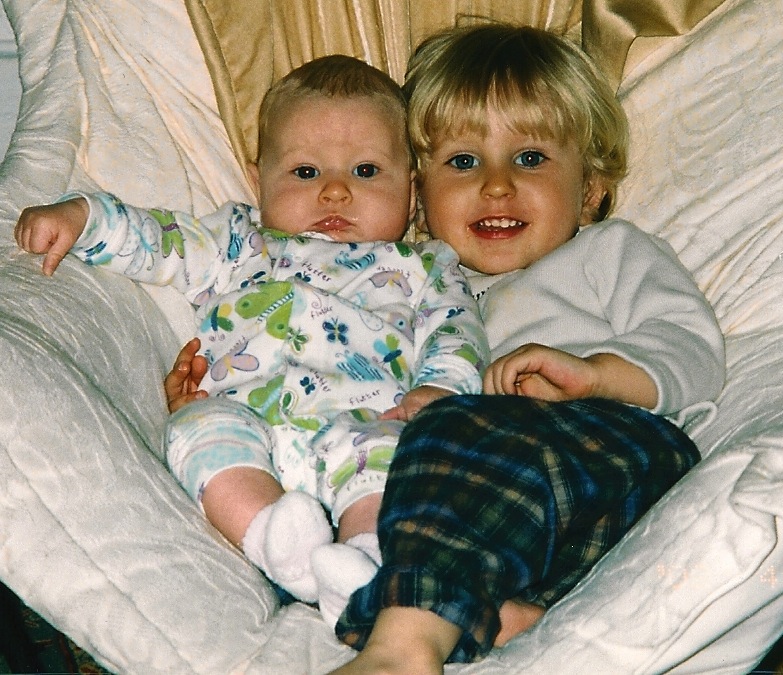
Emma & Nic – April 2002

Related articles

Bloggers, Writers, Autism and a Huge Amount of Hope

When Emma was diagnosed with PDD-NOS (pervasive developmental disorder – not otherwise specified) in 2004, I was lulled into believing it was a temporary condition, nothing that a few years of therapy wouldn’t resolve.  I saw it as a kind of throw away diagnosis, not exactly full-blown autism, more like a mild version of something that resembled Autism, but wasn’t.  Kind of like a bad cold, not exactly a bacterial infection requiring antibiotics, but troublesome never-the-less and we’d have to ride it out.  Besides, I reasoned, just because many of Em’s behavior looked autistic-like, seemed autistic-ish, she probably wasn’t autistic because, well, no one really understood what autism was and so how could she be labeled something that no one understood or really knew what it even meant?  Or so my thinking went.  During this initial period I kept my eye out for any Autistic adults I could find, just in case, you know, she really was autistic, I wanted to know what we might expect.  I found none and concluded that since I couldn’t find any, there must not actually BE any to find.

Still, just on the off-chance I was somehow wrong, I kept looking.  Every now and again I’d find someone, read everything they wrote or said and conclude that my daughter wasn’t really like them or wasn’t like them enough to give me much hope that they were good examples of what she might be like later in life.   (In retrospect, since Em wants to be a singer, I should have been looking for performers who are autistic, but even so, would, most likely, have come to the same conclusion.) By the way, I have never met a neurotypical adult who seemed like an adult version of my neurotypical son, but this thought didn’t occur to me for a great many years.  Despite all of this, my search continued.

In 2005 Em’s PDD-NOS diagnosis officially became “autism”.  As time went on and my thinking continued to change, Emma remained Emma with all her “Autistic-like behaviors” very much in place and I continued to grapple with what this meant.  I wasn’t one of those parents who understood that regardless of her neurology, she was who she was and it was all good.  I bought into the autism is like cancer idea, and therapy was chemo.  (This idea was very popular back in 2004, though I hope it has waned.)  It took me awhile to question this thinking and it took me even longer to see how these beliefs made any “therapeutic” program somewhat reasonable, because, after all, nobody signs up to have chemo and talks about what an enjoyable experience it is.  The idea that Autism is NOT cancer, that this thinking in and of itself leads us down a very dark and dangerous path was something I didn’t come to until much later.

Now fast forward to this morning.  This morning I read a terrific post, The Princess, Her Socks and Her Late Pass on a wonderful blog I’ve begun reading regularly by Aspie Writer called, Twirling Naked in the Street and No-one Noticed, (love that title) which she describes as “A blogged book: Growing up with undiagnosed autism”.  Reading her post about how she hated wearing socks, (so does Emma) how the fabric bunched and the seam on her toes hurt and how the socks had tiny rocks in them that no one else could see or find, kept reminding me of Em.  Aspie Writer recounts how she was always late to class and keeps saying over and over, “I have to see Mr. Hiler for my late pass.”  It is a wonderfully written description about a baffling behavior.  She does such a terrific job describing her actions and words that they made total sense to me.  Not only was I able to identify with her thinking, it gave me a little glimpse into some of Em’s seemingly baffling actions or repeated sentences.

And I was reminded (again) of why reading blogs by Autistic people is of such vital importance to me.  It’s not because I think to myself, oh Emma is going to become this person when she’s an adult.  I don’t assume that because Aspie Writer is married, a mom of 3 and a wonderful writer this will be Emma’s future.  I haven’t met a single adult, autistic or otherwise who seems to be just like either of my children.  How could I?  There wasn’t an adult version of me when I was a child and I’m certainly not an adult version of anyone else’s child.  It’s kind of a ridiculous idea when you stop to think about it.  And yet, that’s what I wanted for all those years when I was searching.  I wanted to find someone who seemed just like Emma was.  I wanted this desperately because I was so fearful of her future.  Yet, all those autistic adults who are not exactly like my daughter  are the very reason I am no longer fearful and why I have so much hope.

Blogs, both the writing of this one and finding those written by Autistics have changed my life.  Blogs are a slice of life, immediate and interactive.  I can read a post and “like” it, comment on it, even though I may or may not get a response from the writer.  I can then tweet the post out, share it on Facebook and engage in a dialogue with the writer if they care to respond.  The immediacy of blogs is compelling, engaging and makes the reader feel more apart of than when reading a book.  Books are wonderful too, but they’re different.  They do not have the interactive element to them that makes blogging so wonderful.  Blogging is very much about “us”.  We, whether as a reader or writer, have the opportunity to become part of the process, a part of “them”.  Another aspect of blogging is – anyone can blog.  You don’t need an agent, you don’t need to even write “well” (though there are many wonderful writers who also blog), you just need to want to write.  So you have a great many people who may never have bothered to look for an agent or publisher, who are writing and because it’s a casual writing form, you also find some amazingly beautiful blogs written with honesty, unedited, raw and complex.

To all the Autistic people who are sharing your stories, your words, your lives, whether by commenting or by having a blog of your own or both, here’s a very loud and heartfelt thank you!  You are making a difference.  You have changed my life.  How does “thank you” even cover the enormity of that?  It doesn’t.

Emma – 2003

Fog

When I climbed the stairs out of the subway this morning and began heading west to my studio, fog completely obscured the Manhattan skyline.  I’m no stranger to fog, whether metaphorical or actual.  In northern California where I grew up, fog was a constant.  Each morning the fog would cover the mountains near our house, but by 11:00AM it would have lifted.  I feel a certain nostalgia for fog.  As I walked the four blocks to my studio this morning I thought about how, when we can’t see something we often assume it isn’t there or what we assume is there, actually isn’t.   Had I not known fog was covering an entire thriving metropolis called Manhattan, I would not have been able to imagine it.  That’s the beauty of fog, it usually lifts and when it does, it often reveals surprising things.

This has been my experience with my daughter and autism.  Autism was, for a great many years, like the fog, obscuring the child within.  I kept trying to lift the fog, thinking that if I could do so, I would “find” my daughter.  Then I began to realize the “fog” was my thinking.  The way I thought about autism was obscuring my daughter.   My daughter has always been there, just like Manhattan is and when the fog lifts I can see her in all her magnificent glory.

Emma – 2004

The Best Marital Advice I Was Ever Given and How It Applies to My Daughter

One of the single best pieces of marital/relationship advice I was ever given was:  Every day record all the things your partner did that was kind, helpful, thoughtful, ‘right’.  What are the things you love about this person?  What do you admire about this person?  What do you respect about them?  What are the things they do that make you happy?  What do they do that fills you with joy?  To many, these questions may seem obvious, but try doing this when you’re angry or fearful or even just annoyed.  I remember sitting with my journal that first evening and wondering what the hell was I going to write?  He breathes?  Could that really be seen as a good thing?  (It’s okay to laugh.)  I’m a master at this exercise now.   In fact, I’m so good at it, I now think of the positives FIRST!  And guess what?  My marriage is pretty fabulous, of course it helps that I’m married to such an amazing guy.

The first time anyone asked me about Emma’s assets we were a year or two into the diagnosis.  I thought it was a trick question.  Seriously.  It was my brother Chris, who asked, “What does Emma like to do?  What is she interested in?  What is she good at?”

My mind went completely blank.  No one had asked me these three important questions about my Autistic daughter.  Listing assets does not fit neatly into all those questionnaires I was constantly having to fill out.  Those little booklets with questions broken into categories of age.   Example:  From 3-5 years old:  Your child plays appropriately with toys  The choices were:  Never, Rarely, Sometimes, Usually, Always.   My pencil would hover over the choices as my mind raced.  What does “appropriate” even mean?  Why is pretending a doll is an actual baby, when it clearly is not, considered “appropriate”?   Eventually I resigned myself to the task and considered “Rarely” and “Sometimes”.   Depending on my mood, I would mark one of the two and feel the all too familiar sensation of constriction in my stomach and throat.  Fear flooded my body and mind as I tried to concentrate on the next question:  Your child eats using all utensils.  Again I would resist the urge to fudge the truth.  I had to force myself to choose the answer that came closest to reality.  I came to dread those questionnaires almost as much as reading the evaluation reports sent in once a year from the Board Of Education.  They were both exercises in, so-called, critical thinking – Look at this picture and tell me what’s wrong with it.  Look at this child.  Now let’s compare her to her neurotypical peers.  Let’s make a list of all that’s “wrong” so we can make things “right”.

But wait!  How is this helpful to anyone?  Comparing anyone to anyone else is a lesson in how to live one’s life in hell.  But compare a neuroatypical person to a neurotypical one is absurd.  Why do we even do this?  To what end?  How is this helpful?  Certainly it isn’t helpful to the neuroatypical person.  We do not say to a person who uses a wheelchair, well, you’re not walking and your same age ambulatory peer is, so let’s get you up and out of that chair and try to build those muscles. Then, when you resist or protest, we restrain you, tell you to stop complaining or tell you that you can’t fully comprehend the situation.  When you still do not manage to stand, let alone walk, we shake our heads sadly and tell you, you really need to have a better attitude and try harder, but don’t worry, it’s okay, we’ll keep working on it.

What does this thinking do to a person over the long-term?  If we are judged, compared, relentlessly criticized, taught that we fall short, told we don’t measure up, dissected publicly, privately and shunned, what does that do to us?  What would that do to any of us?  We are, after all, regardless of our neurology, human beings.  We do all share that.  Has the human piece gotten lost in all of this?

What does she like?  What’s she good at?  What is she interested in?

I’ll have to get a bigger pad of paper.

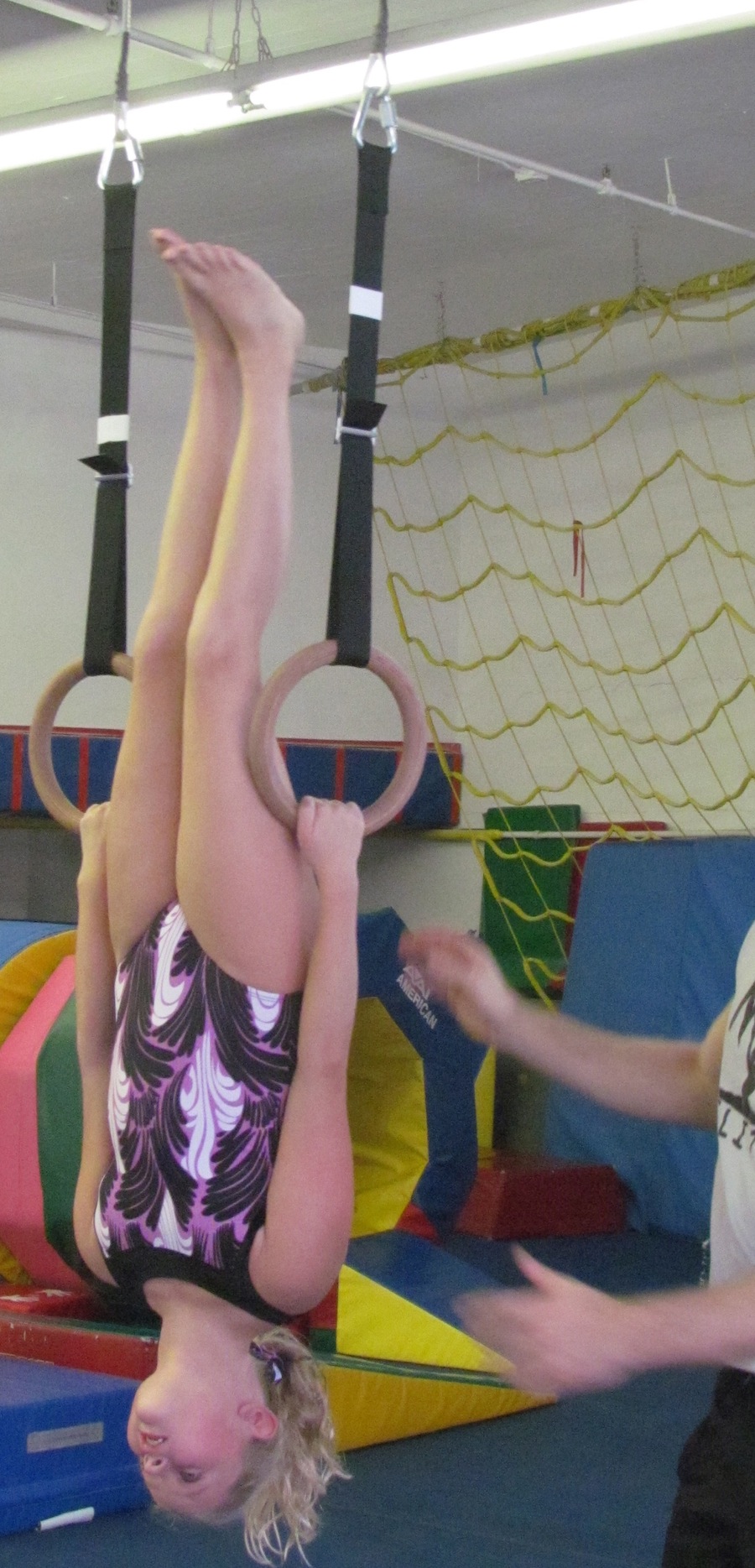
Em at Gymnastics – October, 2012

Related articles

Why? I Want to Understand…

I’m one of those people who, when told to do something that doesn’t make sense or that I can’t figure out the reasoning behind the request, questions it.  I don’t mean I think about it, while silently complying.  I mean I question the thinking out loud as in, “Why are we taking 8th Avenue, when we could take 10th?” or “Why are they asking for the last four digits of my social security number when I just gave them my passport number and anyway it’s a domestic flight?” or “Why take the ice out first when we could just put everything on top and then scoop ice around it?” or any number of other questions that so easily slide from my brain to my mouth before I can stop myself.

I can’t help myself from asking, “Why?”  By the way, I am also married to someone who does the EXACT same thing.  Some people would call this controlling or being defiant, but I see it as a need to understand the reasoning.  Sometimes when someone explains to me their reasoning, I get it, it makes sense and we can carry on, even if I don’t agree with it.  But many times the person explains their reasoning, it still makes no sense and that’s when things get problematic.  It is at this point I have a couple of choices, I can comply, do something that makes no sense to me, which is physically painful, it literally hurts to do whatever it is or I can refuse to do it while explaining why I cannot or I can ask for further clarification.  I tend toward the last two options.  I’m all about clarity.  I’m really not trying to cause problems or be difficult, I really am interested in understanding another point of view.

There are other questions I have that have nothing to do with any requests being made of me, but the answers affect me or someone I love.  Which brings me to a question that’s been very much on my mind recently.  It’s a question that has nagged me since I read Lydia Brown’s piece – Protesting Autism Speaks  on her blog Autistic Hoya – why don’t people who say they care about Autism want to hear from Autistic people directly?  I’m actually being very serious with this question.  I want to understand the thinking behind this.  Because, you see, when I finally found Autistic people who were writing blogs, I felt like I’d hit the jack pot.  When I read Julia Bascom’s blog Just Stimming it was like a beautiful universe unfolded before my eyes.  When E. of The Third Glance reached out to me that first time I read her comment and literally wept with gratitude.  I think I read her comment a dozen times.  When I met Ibby of Tiny Grace Notes at the Disability Conference in New York City, she may as well have been the President of the United States, I was so thrilled.  When she flapped because she was excited to meet me, I felt so completely flattered, it was all I could do not to jump up and down with unadulterated excitement.  I felt profound relief because:

1)  they are Autistic adults and until I found them, I personally knew none
2)  they were describing their thought processes, their experiences, their lives and it gave me insight into how my daughter may be processing the world too
3)  they introduced me to concepts I’d never considered, such as: Presuming competence and not speaking about my daughter as though she couldn’t understand, including my daughter in decisions that affect her and not speaking for her.
4) The whole idea of being talked about as inferior, as a deficit, as a tragedy and how that directly affected their self-esteem.  This last seems so obvious in retrospect, but it was something I hadn’t considered.
5) Having relied on other parents and so-called “autism professionals” up until my daughter was 10 years old, I was incredibly grateful to meet Autistic adults who were able to explain the experience of being autistic first hand. Their experience has helped me help my daughter more than anything else I’ve read or been told.
6) Many of the autistic adults I now know aren’t that much older than my daughter and I found it comforting to know there is a whole community that she may one day choose to join.

I do not read or speak with my Autistic friends and assume they are speaking for Emma.  I don’t assume Emma will grow up to be just like Julia or E. or Ibby or Chou Chou or Paula or Amy.  Each of these women has helped me help Emma far more than any “autism professional” has.  The Autistic men and women I know give me hope.  Hope, not just for Emma, but for ALL our children.  Hope for our world and our future.  I feel grateful to them.  I’m profoundly grateful that they’re blogging, speaking out, protesting, reaching out and asking to be heard.  Maybe one day my daughter will be among them.  I would hate to think that Emma, having worked so hard to communicate, in whatever way that may be when she’s an adult, having worked up the courage to ask a complete stranger, “Want to hear from me?  Want to hear what I have to say?” would be answered with silence or an abrupt “No.” I cannot imagine how painful that must be.  I cannot imagine what that does to one’s sense of self to be met with such outright hostility.  And I don’t understand why.

I am seeing that my experience is not the experience of others.  I do understand that, but why?  Why don’t people see those who are Autistic and can communicate, whether by typing or speaking , as a good thing, as a hopeful thing?  Why is it that some parents don’t want to hear from Autistics who can communicate?  What am I missing here?  Really, I want to understand this.  Help me understand.

How could you NOT want to hear what she has to say?

An Ode To My Daughter

Dearest One,

When you were first born I had an idea about you, it was an idea I have come back to, all these years later, it was an idea that was more right than wrong.  You were very much your own person right from that first moment you drew breath.  I remember marveling at your strength and independence.  I knew almost nothing about autism.  I hadn’t taken the idea of independence and remolded it as “autism” yet, only to rework that idea back to its original concept later.  I saw you and appreciated you for who I saw you to be.  Defiant, independent, strong, determined and silly.  Even as a baby you loved to laugh and appreciated silliness in all its various forms.  You loved playing peek-a-boo and being thrown in the air.  Those first eighteen months, before I knew words like “vestibular”, “proprioceptive”, “stimming”, “perseverative”, “echolalia” and all the other words that threatened to push you from center stage, making you less you and more an example of a diagnosis weighted with other’s learned opinions, I was in awe of you.

Words have power, but words can confuse, they blinded me for many years, I became caught up in what they meant or what others thought they meant and as a result was less able to appreciate you.  I used to wield those words as though they were weapons banishing what was, into something else, something undefinable, something “other”, something I wanted to find a way to control or remove.

As a baby before I knew those other words, you were in a state of either bliss or agitation.  I use to watch you with wonder and admiration.  You were distressed by the lights and the air seemed to hurt you, as though it scraped against your skin.  You liked being swaddled tightly in one of the soft baby blankets I had bought for your arrival.  You slept almost constantly those first two weeks.  Then your deep slumber was interrupted by internal discomforts I could not guess or see.  You greeted these intrusions with indignation, howls of distress and I felt a helplessness I had not known could exist.  A helplessness borne from not knowing; watching, but not able to intervene, hearing, but unable to understand.  I tried to comfort you, but my understanding of what comfort meant was not the same as yours and so your teaching began.  You have been so very patient with me, dearest one.  You have never given up on me.

You have painstakingly tried to communicate in a language that does not come naturally to you.  You have met me more than half way.  You have tried over and over to help me understand and you’ve never stopped.  It has taken me a long time to learn some very basic things about you, things you’ve been telling me ever since you were born, but that I couldn’t understand.  Things I still forget, but  I’m getting better at listening to you and understanding that words are not the only way a human being communicates.  I am getting better at hearing you.  I have learned to listen to your behavior as though it were a conversation, because it is how you reach out, it is the way you connect.  I am learning to lean into you, to not try to do a word-for-word interpretation of your verbal utterances, but to try to feel the meaning of what you are doing or saying.

You are Autistic.  Do not let other’s interpretation of that word define you, rather help others understand that you define it.  Make your mark in this world by continuing to believe in yourself.  Continue to stand up for yourself.  Advocate. Let your voice be heard.  “Actions speak louder than words,” people say, but they don’t seem to apply that to you and others who cannot and do not rely solely on language.  Those people need to be taught, because actions DO speak louder than words if we can learn to listen to them.

You, my beautiful daughter, are kind and good and honest and talented and funny and caring and sensitive and yes, Autistic.  Be proud of your neurology, but do not allow others to limit you because of it.  Do not allow someone’s idea of what that means to encroach on who you are or how you perceive yourself.  You are Autistic and you are my daughter.  It could be argued that both come with a great deal of baggage, but both also come with many wonders and advantages.  Concentrate on the positives, lean into them, and make your way.  Reach out to me, grab my hand, together we are stronger than we are alone.

I am so proud of you.

Richard, Em & Me – 2010


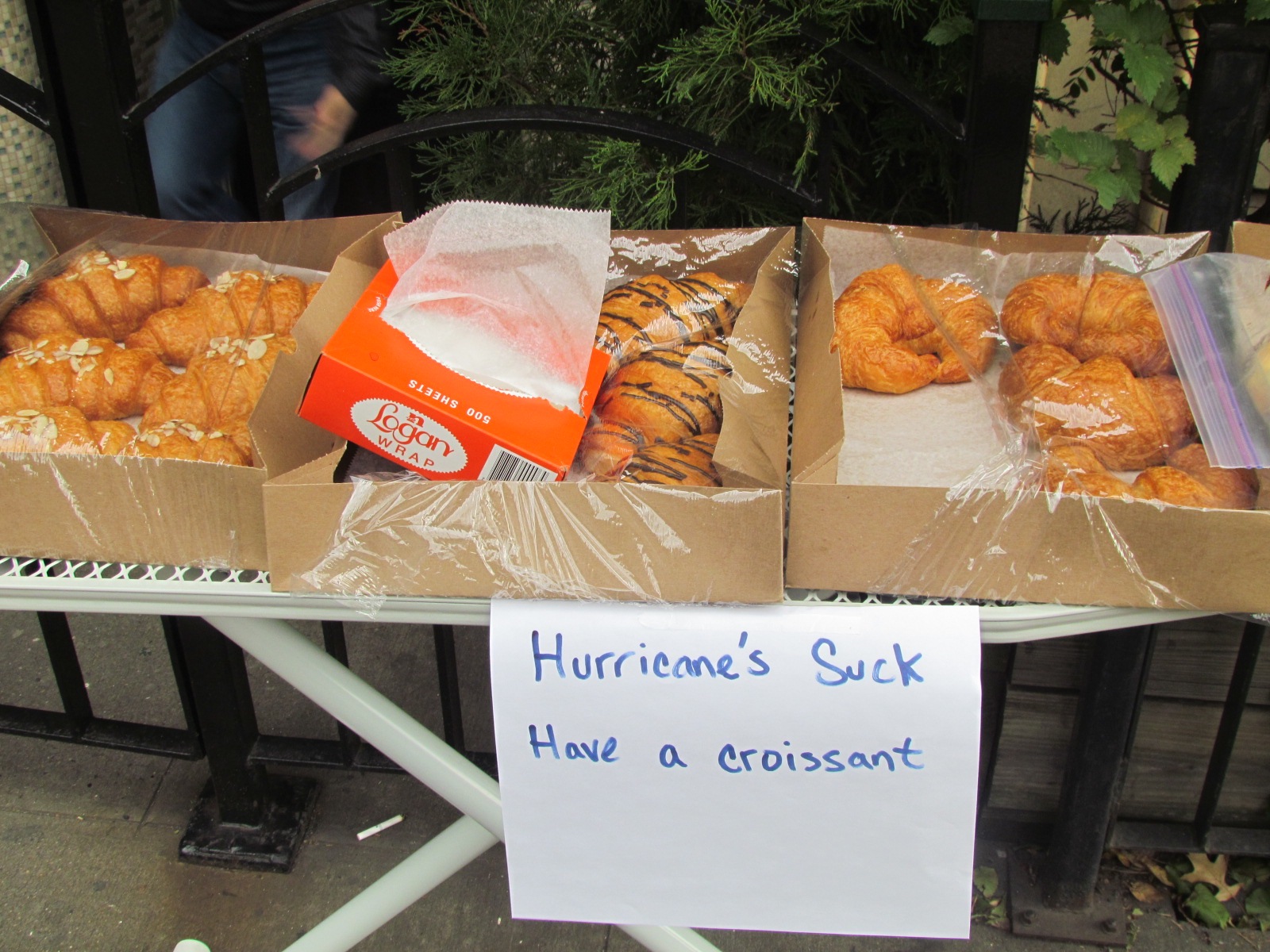
“Hurricane’s Suck, Have A Croissant”

Processing…  I haven’t.  There are still too many people who are without power, whose homes have been destroyed, too many people who continue to have no heat, no hot water or any water at all, too many displaced people, too many who have lost so much….  How does one process this?

Nic had nightmares last night about a zombie apocalypse where he was the lone survivor.  Emma is perseverating more than usual; her stims have gotten noticeably worse; her scripting more pronounced.  I watched her yesterday as she did her Sunday morning DJ routine, listening to all her favorite songs, singing and dancing, losing herself in the music and felt both grateful for all we have and utterly exhausted.  I slept seven and half hours last night and yet feel as though it were 5.  I am feeling fragile particularly sensitive and emotional, and we were the lucky ones.  We have power, heat, hot water, a home that is undamaged, everything’s back to “normal” and yet it isn’t.  I don’t know what normal means anymore.  Where do we go from here?  How do we process this?

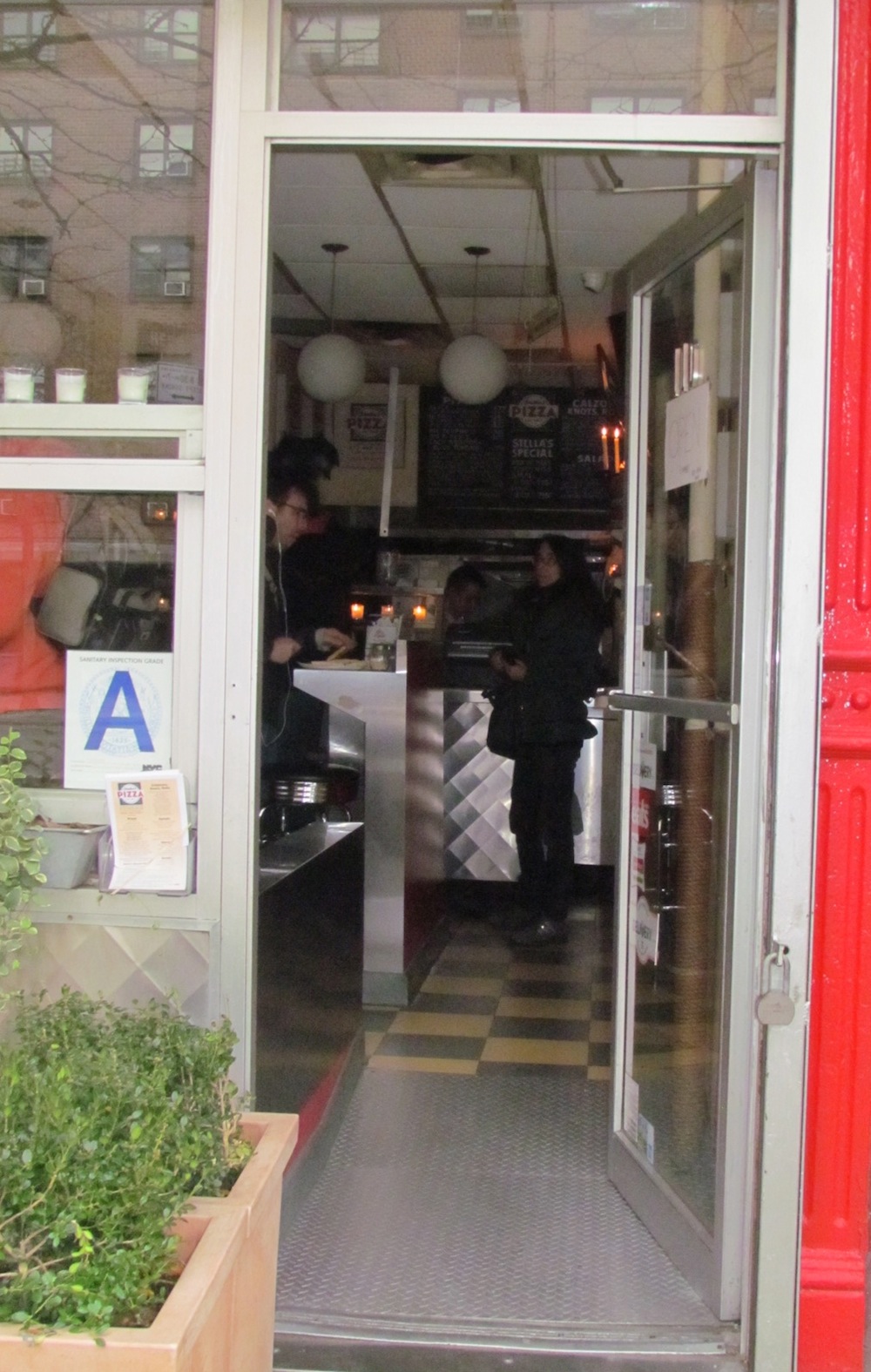
On Friday I went downtown and took photographs.  The lighting wasn’t great, it was impossible to capture the mood or what it felt like to walk along empty streets where the only lights came from headlights on busses, taxis and those who still had enough gas in their cars to get around.  I couldn’t photograph the group of young women weeping in the street or the man looking for his father whom he had not heard from in four days or the old woman painstakingly climbing the stairs of her unlit building, her pug tugging on its leash, urging her upwards into the darkness or the faces of all those people I passed obsessively checking their dead cell phones, trudging north with the hope they might find an available electrical socket that would breathe life into it.  I’m not a skilled enough photographer to be able to capture any of that.  (I’ve provided a couple of links to some professional photographers who were though.)  But I did get a few images that at least document the storm and our resilience…

One of the many Chelsea art galleries whose flooded basement held art work. 

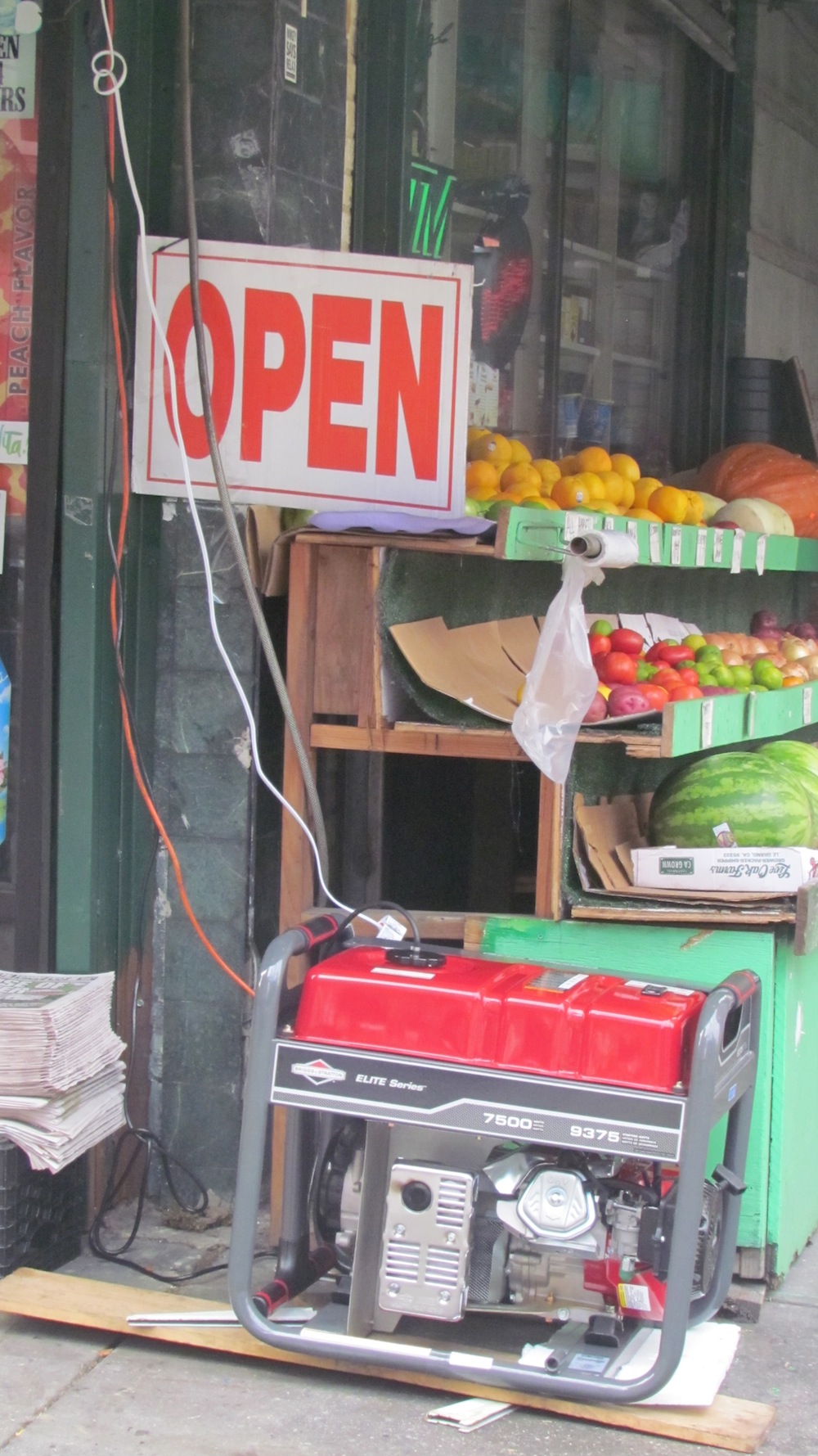
An intrepid New Yorker who found a way to stay open despite the power outage downtown

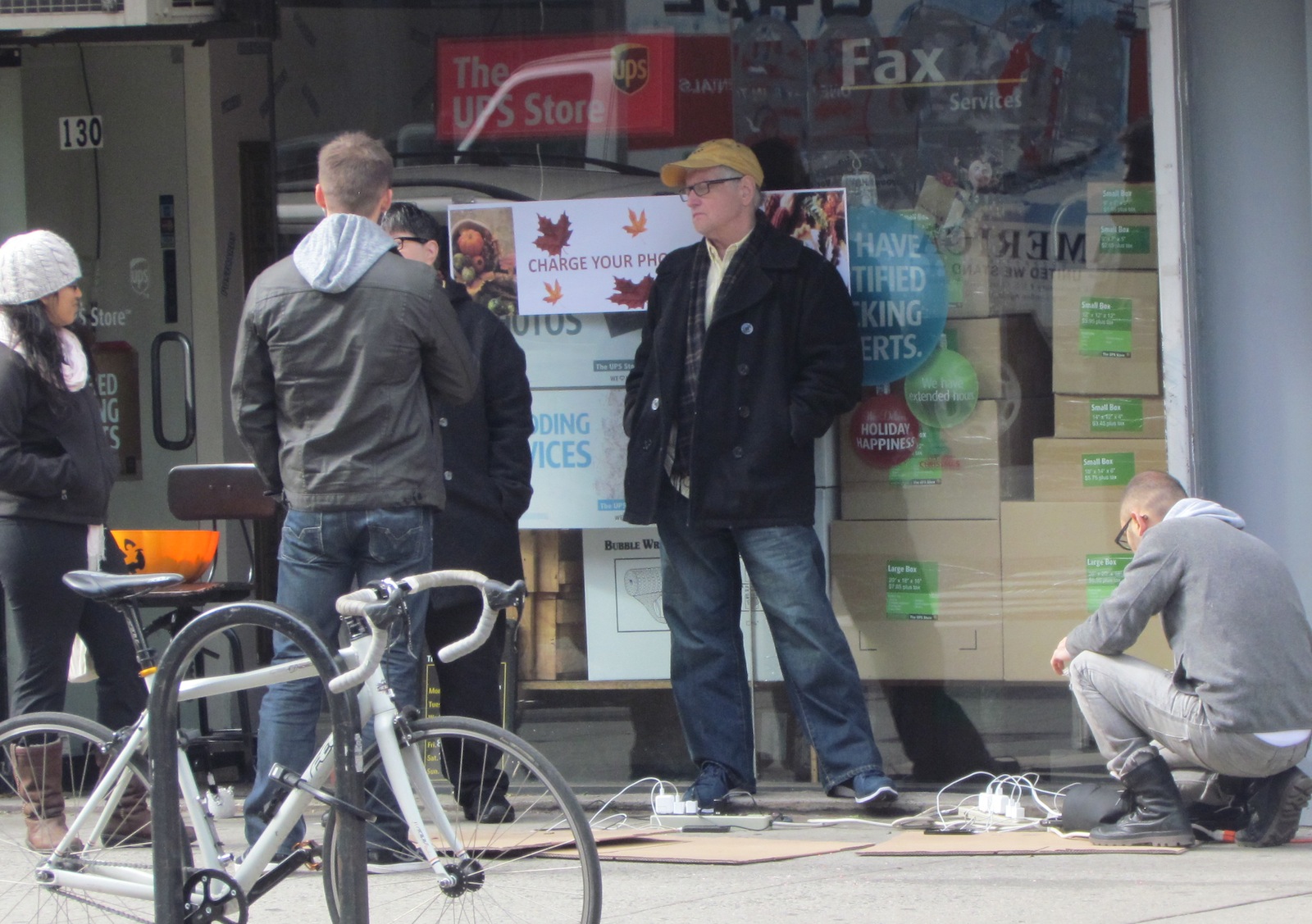
Powering up on 7th Avenue

The “Doll House” on 8th Avenue

Kindness on 14th Street

Pizza by candle light

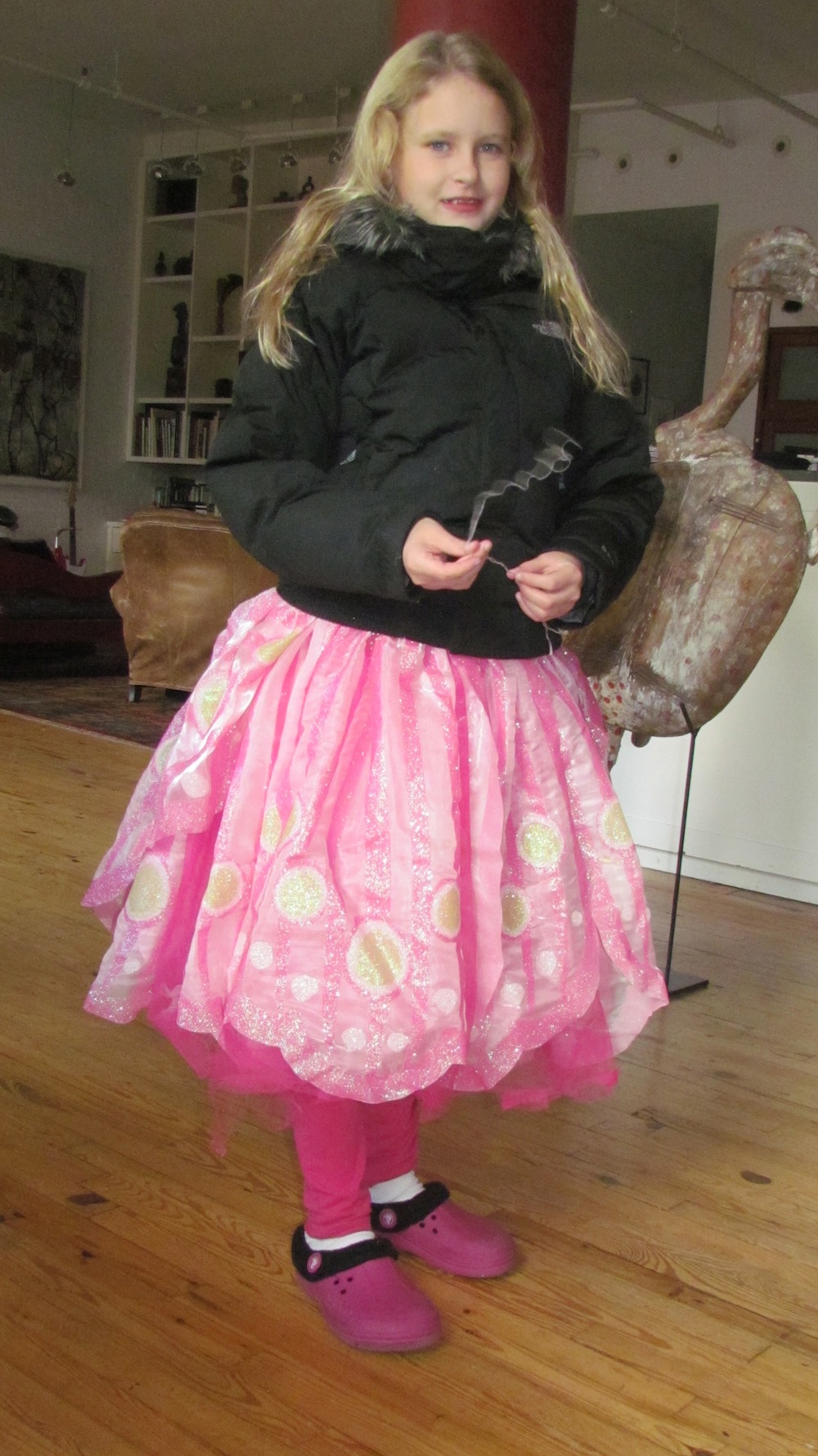
Emma wasn’t able to go trick or treating, but she still dressed as a butterfly on October 31st

The Statue of Liberty during the storm

We are capable of so much.

Be grateful.

I am.