Tag Archives: communication

My Star: Emma

Rhyming words, poetry, fables, history, science, multiplication, math word problems…  these are the things Soma has covered with Emma over the last three days.  Emma went from pointing to one letter at a time, to writing out several words and even whole sentences describing profound thoughts, insights, doubts and concerns, and I sat there witnessing this outpouring of words, this torrent of letters that, when added up, evoked emotion and identification and concern and understanding.  The power of language.  The power of communication.  There is tremendous power in both.

This has been a profound few days; transformative, exhilarating and exhausting.  I have watched my daughter work and she has worked very, very hard.  I have watched her and I have marveled at her and been dismayed by her and astonished with her.  I have laughed and wept and listened and listened and listened some more.  She has said things that have provoked more questions than answers, but she is here, very much rooted in this world and not, as many suggest or seem to think, somewhere else, off in her own “little world”.

I cannot write about anything specific this morning, I’m too tired and Emma has said she is too.  We have two more sessions today with Soma and then we head home.  We are lucky.  We are incredibly fortunate that we’ve had the means to do this, to come here, to stay for the week so that Emma could work with Soma.  All the young children Soma has worked with over the years, so many of them are now writing books, and are at an age where they are publishing their hard-won  words; there are too many to ignore.  They are communicating on letter boards and iPads and keyboards, an unbelievable output of thoughts, ideas and opinions.  “I want to be able to talk,” Emma wrote yesterday.  And maybe, just maybe one day she will be able to talk the way she writes, but until then we will keep providing her with every available resource we can find so that she has a better chance of achieving that goal.

Em standing beneath the “Star of Texas”

Em & Star of Texas copy

Our Amazing Adventure

Emma gave me permission to blog about some of our day yesterday.  I asked her, “Is there anything you typed that you do not want me to write about?”  She typed, “No.”  So… here goes…

We are in Texas to work with Soma Mukhopadhyay.  I’ve written about Soma many times before, ‘here‘, ‘here‘, ‘here‘ and ‘here‘.  By the way, Tito, Soma’s son (who is non-speaking and autistic) is the author of several books.  I highly recommend all of them.

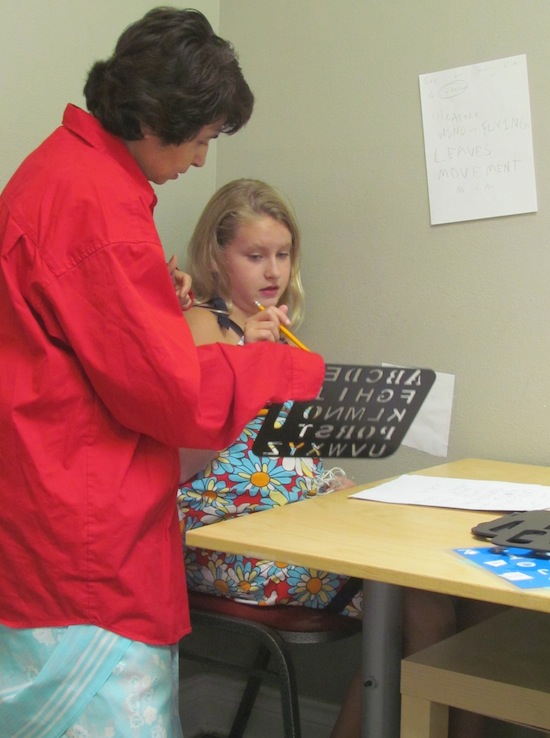
Soma began the session using a stencil board and having Em point to the letter she wanted with a pencil, then took the pencil, wrote the letter down, handed the pencil back, and on they went.  By the afternoon session Em was pointing to the first letter and then the next and the next, spelling out whole words and even several words before Soma wrote all the letters down.  As the sessions are all being videotaped, the stencil board is by far the best thing to use, as it is clear when you are watching the tape, which letters Em is pointing to, where as a laminated letter board, or a keyboard would be more difficult to see as clearly.  Soma does not touch the person she is working with.  There is no physical contact of any kind, unless initiated by the other person.

Some people have accused Soma of manipulating the stencil board.  I have watched Soma work with my daughter many times, as well as with other students and beyond the natural slight movement that occurs when holding an object with one hand, I have witnessed no manipulation of any kind.  With Emma she used a full alphabet stencil board, so even if one wanted to somehow make her point to a particular letter this would be impossible without physically touching her.

They began discussing the weather and Em wrote that she likes it when it is windy.  Soma asked her to tell her anything at all about windy weather and Em wrote, “flying leaves”.  They then discussed temperature, how heat rises, the sun, and finally Soma asked her for the name of any state.  Emma wrote, “Colorado”.  Soma asked her why she chose Colorado and I smiled knowingly, believing that I knew the answer and expecting her to write something about how this is where her Granma lives and where we go to visit several times a year.  But Emma had something else in mind.  She went for the letter “b” and then wrote “Boulder”.

Okay, I thought.  Boulder, that’s kind of weird.  Richard’s best friend lives in Boulder, maybe she’s thinking about Steve.  Meanwhile Soma asked, “What happened there?”  And Emma wrote, “flood”.  And I sat there stunned.  You see, we are not a family that ever turns on the television unless it’s for a pre-recorded show or to watch a dvd.  We do not listen to the radio.  We no longer have the NYTimes delivered to our house as both Richard and I receive it online and read the news from our iPads.  Neither Richard nor I spoke (that we can remember) about the devastation that occurred because of the flooding in Boulder recently.  And yet, there is absolutely no doubt that others have and did discuss the floods in Emma’s presence, though it’s doubtful anyone spoke to her about them and yet here she was, writing about the floods.

The afternoon session began with Emma choosing “story” from a choice between “story” and “number”.  Soma proceeded to tell a fable about a crane and a fox who were friends.  The fox invited the crane over for dinner and prepared meat for the crane which was almost impossible for the crane to pick up with his beak and the fox watched with great delight as the meat fell from his beak over and over.  Soma talked about how the fox was having fun, but mean fun and throughout all of this asked Emma clarifying questions about various words, all of which Emma knew without hesitation.  But the fox underestimated his friend the crane, Soma continued.  She then asked Emma what she thought about the word underestimated and Emma wrote, “less expectation”.  The story continued with the crane being polite and asking the fox to come over the next day for dinner at the crane’s house where upon the crane served the fox soup in a jar that the fox could not drink, except to lick the sides.  Soma then asked Emma for the moral of the story and Emma wrote, “do unto others”.

Soma used Emma’s interest (anxiety?) about the time and how long the session was going to last, to discuss time and the calendar year and then asked Em “how would you like to be treated by others?” Emma wrote, “I want to disappear when people talk about me.”  Soma asked a clarifying question about situations that she was specifically referring to and asked if Emma felt that way when people said nice things.  Emma said, “no”.

Later, using a laminated “yes” or “no” card that Rosemary Crossley uses and gave us, I asked Em more about this.  It came out that people are “mean” to her on the school bus.  I asked her if people were mean to her at school and she wrote, “No.”

Today we go back for Emma’s next two sessions with Soma.   As they say in the 12-step rooms – more will be revealed.  I cannot write about how I feel, other than to say, Soma is doing amazing work.  She has been doing this work for close to two decades, everyday for hours at a time.  I am learning a great deal, but will I be able to replicate what she is doing?  No.  I won’t.  Not yet, anyway and I don’t expect to, but I can get better with practice and I can apply what I see Soma doing with other things I’ve learned that Emma has responded to.  But more than anything else, I can continue to stretch my limited mind and limited thinking, (my neurological deficits) and practice, continue to practice expanding my knee jerk “truths” until one day perhaps I will no longer feel incredulous at what I continue to witness, not only with Soma, but with a great many people, all of whom have devoted their lives to finding ways for people like my daughter to communicate.

I want to disappear when people talk about me.

*I have read this to Emma to make sure what I’ve written is okay to publish.  She has given me her permission.

Soma and Emma

Soma & Em

The Pitfalls of Reading Out Loud

When Rosemary Crossley was here she spent several hours working with my daughter.  One of the many discoveries we made was that Emma can and does read very quickly, but if asked to read out loud, she will stumble and get so caught up in pronunciation I question whether she is able to comprehend what she’s reading at all.  I know I have trouble following the story.  Yet most schools ask children to read out loud, both as a way to assess what they are capable of, and also to make sure they are at the correct reading level.  If a child reads a first grade reader out loud with great difficulty, the impulse is to make the reading material simpler.  Except that if this is done with my daughter she will be stuck reading kindergarten and beginning level reading books for the foreseeable future.

I know Emma is able to read much more complicated texts than beginning readers.  I know this because I have seen her read with Rosemary and me very quickly.  I have witnessed her ability to read, not only faster than I can, but her ability to accurately answer multiple choice questions related to the text with ease when  given some resistance.  In other words, if she is asked to wait a beat, instead of being allowed to immediately point to an answer, her accuracy goes way up.  Without the pause she is just as likely to randomly pick any answer.  From Rosemary Crossley’s book, Speechless, “The resistance I provided slowed her down very substantially, and the quality of her output increased as her speed fell.  I gave Jan a picture of a cow and asked her to write me a sentence about it.  Instead she typed, THIS TYPING IS HARD.  I HAVE TO THINK.  That was, of course, the aim of the exercise.

This idea of providing resistance is a tricky one to explain to people.  I have had some people say they just cannot understand why this would be necessary.  The only way I know of to better explain, is by comparing it to the way many, who are like my daughter, will perseverate on a word, or will rely on favorite scripts.  It is not that these scripts have no meaning, it is more that they are often difficult for others to understand.  If I hand Emma her iPad and ask her to type me a story, she will most likely write something like, “rollercoaster, kiteflyer, greenride, hurricane harbor, waterslide” which is also in keeping with what she might say out loud.

These words are powerful to her, they hold a great deal of meaning, but to most people, they are seen as gibberish.  If this then is used to assess her capabilities she will not be well served.  However if I ask her to type me a story and then hold one end of a rod while she holds the other end with her typing hand and types with one finger while I pull her hand back after each letter is typed, she might type, ““One day there was a boy called george. He had been in afight can’t tell you how he got into the fight but he was bruised all over.  He fought a lot and his teacher was very angry.  The next day he was all purple and his mother said you can’t go to school looking like that.  The very clever boy covered himself in flower and his teacher thought he was sick and sent him home.  The end.”  

Incidentally, that story is one Emma wrote when Rosemary was here working with her and is typical of the sorts of things she can and does type when given the kind of resistance I’ve described.  (You can read the entire post I wrote about her session with Rosie, ‘here‘.)  However, ask Emma to read out loud a story similar to the one she typed and she will have a great deal of trouble.  What she is capable of is far greater than what one might assume from what she verbalizes, whether that means reading out loud or with spontaneous speech.  Ask Emma to sing the lyrics of a song, in Greek no less, and she will get much of it right, but that’s a whole other post.

But how does one convince others that this is so?  Particularly when many are trained and told that reading out loud is a good indicator of ability.  There is surprisingly little written on the topic of the problems with reading out loud for those who have spoken language and word retrieval issues.  Again, in Rosemary Crossley’s book, Speechless, she writes, “her reading aloud was bedeviled by the same word-finding problems which affected her spontaneous speech, preventing her reading with any fluency.”

Obviously there needs to be more written about all of this.  The closest I have found, other than Rosemary’s book, Speechless, is a blog, The Right Side of Normal,  that concentrates on “right brained children”.  And on that blog, this post specifically, Silent Reading versus Reading Aloud, which deals with, at least some of what I’m discussing here. If others know of other resources discussing any of this, please do leave me links in the comments section.

Rosemarie Crossley

Rosie

When We Say Things We Do Not Mean

Erratic speech.  Unreliable language.  These are all words to describe what many, like my daughter, experience.   Speech that does not represent what is meant,  but that people hear and make assumptions about the person based on what has been said.  Rosemary Crossley in her book, Speechless talks about nominal aphasia – “One of the familiar aftereffects of stroke, for example, is not being able to say what you mean.

Many years ago I became friends with a man who’d had a stroke, leaving him aphasic (meaning he was mostly unable to speak, though he understood what was being said to him.)  Every few months my then boyfriend and I would pick him up at his apartment and take him somewhere.  I don’t remember if he could type his thoughts, this was long before the advent of the iPad, and as he could not hold a writing implement, this was not something he did when we were together.  I do not remember him ever uttering a single word.  Prior to his stroke he had made a name for himself as an avant-garde theater director.  In the theater world he was thought of as a god.  After his stroke he went on to direct a number of works with many famous actors.  People were willing to believe he could not only understand what was being said, but that he had a great deal to say, even though he could not verbalize his thoughts.   His name was Joseph Chaikin.

For those who are Autistic and also have unreliable speech, people tend to take what they say at face value and believe their speech is indicative of their thinking and thought process.  Yet this could not be farther from the truth.  Many are willing to dispense with their disbelief when someone is famous and once spoke, but most are not as willing to believe when someone has word retrieval issues, that they are capable of more than what we hear them say.  “…children who have never been able to speak fluently have not had a chance to establish themselves.  They have not had the typical infant’s experience of controlling the world with their speech.” ~ Speechless by Rosemary Crossley

And as a result they also do not have the same types of interactions with others as those who have more fluent speech.

Because our judgments of intellectual capacity, both formal and informal, are strongly tied to speech, a child who says the wrong words, who gives “silly” answers when asked questions, is likely to be seen as stupid.  A child who can never find the word he wants, or a child who cannot make his tongue do what it should, can come to associate speech with tension, embarrassment, and failure.” ~ Speechless by Rosemary Crossley.

Children with severe speech impairments often develop behavioral problems. These may simply be a result of the frustration inherent in not being able to say what you mean, but this frustration may also be exacerbated by the reactions of the people around them.” ~ Speechless by Rosemary Crossley

One young man who had unreliable language and who Rosemary worked with typed, “I dont make sense and people think Im senseless.” Speechless by Rosemary Crossley

Typically, when someone speaks to us, we believe that what they say is what they mean to say.  We respond  accordingly.  When people tell me something Emma has said and how they don’t understand why she then became so upset because they were doing what she told them she wanted, I understand.  I understand how frustrating that must be, for her, for the other person, for everyone involved.  Emma does not have phrases like, “Oh I know the answer to that, but I can’t think of it just now” or “give me a minute, it will come to me” or “it’s on the tip of my tongue” or “I just had it, the word was right there” or “what’s the word, you know it sounds like ________?”  or “wait, I know this, I know this…” or any of the other things most of us say when we know something, but the words have momentarily escaped us.

Communication is not just speech and for some, spoken language is an unreliable method of communicating.  Finding a more reliable method then becomes essential.  For my daughter, typing is proving to be a far more reliable way to communicate.  And as it turns out, there are a great many others who are just like her.

Waiting

On the Topic of Violence…

On the topic of violence or actions, that by those witnessing, appear violent, actions that harm another or oneself, there is one thing that stands out, one thing every single person who has physically harmed themselves or another person have all agreed upon, and that is the need for a self-appointed safe place.  Not a place chosen by another, which can too often be seen as punishment, but a place that the person who is overwhelmed can go to, a place that feels safe.  A place that is sacred, that will not be violated; a place that is a safe haven.

From reading the numerous comments, emails and DMs people have sent over the last few days, it is the one thing every single person has agreed upon.  (If you’d like to read the other posts on this topic click ‘here‘, ‘here‘ and ‘here‘.)  And interestingly, not only a safe place for the person who is feeling overwhelmed and whose actions are harming others and/or themselves is needed, but a safe place for all present, those who either by chance or because they are trying to defuse the situation, is necessary.  A number of people have asked, but what if my child follows me or is breaking things and is a danger to themselves?  Again a number of people answered this question with the same answer.  They all said that in such cases it will take some time, repeatedly moving to a safe space, being followed, and leading them back to their safe space.  Every single person said that talking, reasoning, arguing, placing demands, insisting that the person “use your words”, telling them to take deep breaths, demanding they count to ten are uniformly unhelpful, and in most cases, cause the person more distress and further upset.

Another aspect to all of this is escalation.  Lots of people have described how they escalate or their child does.  One wrote about a child who had 8 escalation levels and that “if he gets to 4, they’ve lost him.”  They wrote that “most kids have at least 2 before they get to the attacking stage.”  They described one child whose first level was so subtle, many did not even notice or pick up on it – a heavy sigh.  Another parent wrote about a certain look the child gets, a stare off into space that they now know means they must get them to safety.  All agree that catching it before things escalate is key.  This is something Judy Endow talks about in her book, Outsmarting Explosive Behavior.  She describes “the four stages of explosive behavior: Starting Out, Picking up Steam, Point of No Return, and Explosion.”

Ari, who is non speaking and has a blog, Perceptions, described in detail what things help and what does not.  He wrote, “Am autistic and nonverbal. Never speak. Use devices with pictures mostly, but can type (sometimes). Have been violent. Usually only when people around me have problems below.

Problem #1. No one thinks to get one of my communication devices, switch to meltdown page, and put it in my hands to see if I could use it. Communication is hard. Some times I need be helped to use picture buttons. I have a page specifically for pre-meltdowns. It never gets used.

Problem #2. Blocking me, restraining me, pushing me into a corner, or otherwise making me feel trapped is not okay without my advance consent. Can follow me, stay close enough to see what I do or where I go, but let me go. Walking is calming. Non-autistics get to walk when stressed, why not me too? Trusted friends get my permission to touch my arm to guide me in safe walking direction. So much easier when there is trust and respect.

Problem #3. I hit myself, pull my hair, scratch/cut my skin, do other harmful things. Very rarely is done hard enough to cause serious damage. I understand it is uncomfortable to watch, but interfering will make me hurt myself far more. If you cannot bear to see this, leave and call someone else who can instead of interfering with my efforts to calm myself.

Problem #4. This one applies to everyone, I think. #1-3 may not be true for anyone other than me. Problem #4 is BELIEVE ME. Believe what I say about me because I am only one who knows what it is like to be me. If I tell you that you are wrong about me, accept that you are wrong and pay attention to what I say is right.

Problem #5. I admit there are times when I cannot calm myself, they are rare now but still can happen. There are acceptable ways to protect me (and others) from harm.  It usually involves medication, thick soft blanket, silence, darkness, patience, and ice. If person can resolve #4 with me, I am happy to discuss #5. Otherwise… Energy is not infinite, left alone I will eventually stop screaming and fall asleep. There may be blood. I will not die. Ice for my head when I am done is much appreciated. This is when I am most likely to get violent towards others. I know it is scary. I know. For me too. If unsure of what to do, just stay away from me, be quiet, wait for calmness. I will look for help when I am ready.

#5 usually happens because of problems #1-4. It is best avoided.

Last time was about 1 months ago in a hospital waiting room. I am 31 years old legally independent adult (whether I should be is another matter entirely). I just needed to walk. Instead I was pushed into corner and trapped until doctor called us into private room. If had been restrained longer probably would have hit person hard. Probably would have been charged with assault. Probably sent to psych hospital again. This is not my fault. I can not fix this. But at least it has taught me self control. I can endure incredible amounts of pain/fear/chaos without reacting, now. I did not hit her.

I asked Ari what he meant by “medication”.  He responded, “Only medication now is ativan. Had haldol many years ago and it worked better for #5 situations. But not good for anything less intense, unlike ativan. Need better. But no doctor good with this. So get no help finding better. Need body sedation, sensory pain away, fuzziness from situation, to for logical thought processes work again so can calm self.”  

He then added:  “Broken logical reasoning ability. In those moments, no logic. Only chaos.

A parent wrote:  “People have seen it and have threatened to call the police (when he was five!) or worse.  I really didn’t know what to do because he would get so upset and frustrated.  People said to put him in therapy, but the thing I did that saved us was I put our whole family in therapy.  We learned to communicate with him in ways he understood.  We learned that we weren’t always right in how we handled it, and we often made things worse.  We learned to find effective problem solving solutions (mostly following The Explosive Child by Ross Greene) It really made a huge difference and he rarely has violent meltdowns now.  When he does, I have to step back and ask myself what was going on, was I not listening to him?  Was I placing too many demands on him?  Was I not allowing him to effectively self advocate?  He always says to me that he doesn’t want to do it, he just is so frustrated and has a hard time communicating and identifying his feelings. We are still a work in progress, learning together how to understand each other.   I KNOW he doesn’t like it when he is violent, but he is doing the best that he can with the tools we give him.  I know this because he tells me, and because I was also a violent child.  My target was my younger sister sometimes, but mostly myself.   I was beyond frustrated and felt completely powerless due to the environment in which we were brought up.  I know I am doing better with my son than what I grew up with, but there are times I screw up.  I had to relearn everything I was taught about children, about communication and about respect.  I had to learn that “noncompliance” is really just self advocacy and that it’s actually a positive character trait!   That has made all the difference.  I really believe that kids do the best that they can with what they have to work with.  Kids who are violent are frustrated and need our help to find their voice.

If any of you know of other blogs, articles that have been helpful or are writing something on this topic, please send the links in the comments section so I can include in future posts.  I may need to make a separate page for all of this…

An Analogy – Communication via Violin

*This is a guest post by a friend of mine who is brilliant and thoughtful and compassionate and patient and, well, all-around fabulous.

*Guest Post by DYMPHNA

This blog post is a brainstorm I had after reading several posts (‘here‘ and ‘here‘) on this blog regarding the idea of communication, particular why spoken language, which seems so natural for some, is more difficult for others.  First, I must own the fact that I have a pretty strong relative privilege in this vein.  Spoken language comes naturally to me, so I am writing all of this with the caveat that I might be totally wrong.  If Autistics who are less inclined to spoken language correct me on anything I write in this blog post, listen to them, not me.  Secondly, this is an analogy and all analogies are imperfect; my hope is that this might provide an accurate framework through which people who grasp spoken language easily might be able to understand the difficulties of those for whom it does not come so easily.  (This process for learning music is way out of order from how people actually learn music.  Please don’t kill me, music educators.)

Okay, so, in this analogy, you are going to take this page of information and realize it into meaningful sound:
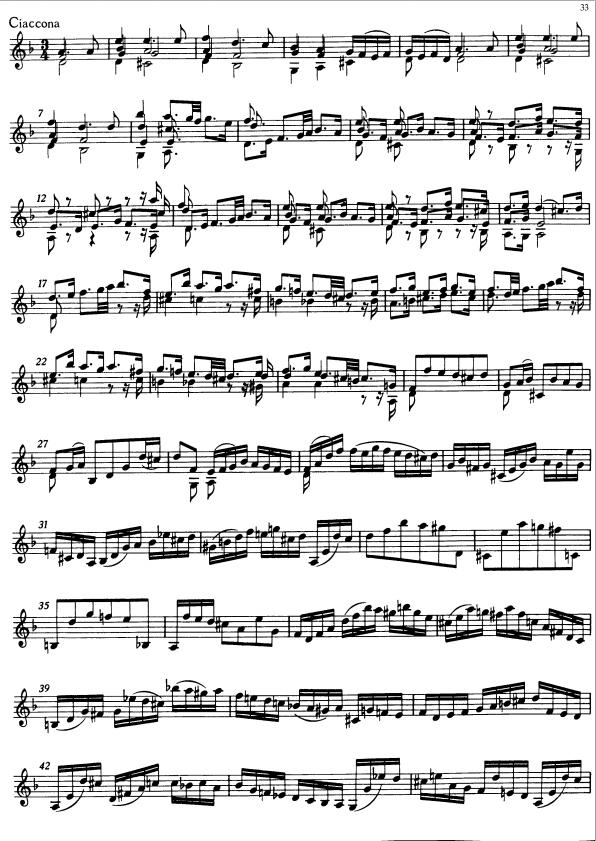

[Image description: Picture is the first page of the Chaconne
from Bach’s Violin Partita No. 2 in D Minor, BWV 1004.]

Now, for many of you who haven’t learned anything about musical notation, you are already at a loss.  The picture above is literally meaningless to you.  There are some horizontal lines and there are dot’s connected to vertical lines and there are these weird symbols that look like a lowercase b and a #.  If you haven’t learned to read musical notation, the only things on this page that you even recognize are some arabic numerals that you have no idea how to interpret and this Italian word at the top “Ciaconna”, which the dictionary defines as, “a slow, stately dance of the 18th century or the music for it,” a definition which is not particularly helpful.  With the resources available to you, you have established that this is an Italian dance from the 1700s.  So in order to realize the page I put above you, you need to become fluent in musical notation and have the ear training necessary to understand what the pitches are and how to keep time properly, a process which many people find quite difficult.

So, having learned all you need to know about musical notation, you’re ready to perform the Chaconne, right?  Well, probably not, as you have no idea how to play the violin.  (Violinists, you are playing the piece on the piano.  If you are also a pianist, you’re playing it on the flute.  If you’re also a flautist, you are playing it on the musical saw.  If you also play the musical saw, you need to just accept the premise of this analogy and move on.)  If you are not a violinist, and I imagine that most of you are not, you don’t even know how to set up, hold, or tune the instrument, let alone produce a decent sound and then connect those sounds into a meaningful piece of music.  So now that you understand what the notation means, you need to tackle the actual physical reality of learning how to play the instrument, a skill that takes years to do competently, decades to do proficiently, and half a lifetime to do masterfully.  You need to learn how to hold the instrument and the bow and all sorts of skills about how to make the correct sounds come out of the instrument.  Likewise, before you can do any of that, you have to learn to set up and tune the instrument, skills which are quite challenging to the beginning player.  (As someone who has attempted to play the violin on several occasions, I can attest to this.)  The process usually involves tedious work on many minute elements of technique that are by themselves very difficult, such as using different bow strokes, crossing strings, and pressing the fingerboard in the correct location.  Moreover, you have to keep track of all of these elements of technique while attempting to accurately realize a score of music, so in addition to the difficulty of playing the music, you are simultaneously applying the skills you’ve learned in step one.

Congratulations!  Having done that, you have the skills needed to accurately realize the first page of Bach’s Chaconne, a skill that will land you zero audiences and communicate very little.  What most people don’t realize is that very little information is actually given to the musician by the composer.  Many elements, such as the subtle ebb and flow of time, the varying loudness of any given instant of music, vibrato, etc., the elements that make music expressive and, if you’ll pardon the expression, musical, are not given to the performer by the composer.  If the performer performs the work exactly as written on the page, it will sound mechanical and banal.  This is why proficient musicians spend a great deal of their time focusing on interpretation.  They are trying not only to reproduce the pitches and rhythms indicated on the page, but also subtlety that music needs to be truly compelling and persuasive.

All right, having done all of that, you can now convincingly convey great musical ideas.  Musical ideas written by Johann Sebastian Bach.  While you certainly bring something of yourself to the table, none of these are ideas that you originally had.  The basis for all of these ideas was written almost three centuries ago.  In speaking, this is analogous to someone being able to convincing recite a work by Shakespeare.  A great skill in its own right, but all the while we’ve still fallen short of our actual goal, which is to communicate our own ideas effectively to others.  Right now we are only equipped to communicate other people’s ideas, albeit with our own twist.

I would like to pause here and draw some of the analogies between playing the violin and speaking.  First of all, there is the process of developing a rudimentary understanding of what music is, which corresponds to having a crude and basic understanding of the English language.  I will discuss the full understanding in just a moment.  Next, we have to negotiate the physical reality of playing the instrument.  We might have a fantastic conception of what the Bach Chaconne should sound like, but that means nothing if we lack the ability to realize it on the instrument, which is an inherently physical process.  This, not surprisingly, corresponds to the actual motor process of forming words.  For many of us, those processes seem pretty simple, but imagine what it would be like if they didn’t come naturally to you.  Imagine if everyone seemed to have this innate aptitude for holding the violin and producing pleasant sounds on it while you are struggling to get notes out.  Most people, having able or neurotypical privilege, take this ability for granted, so I want you to imagine a world where, instead of speaking, we communicated by playing the violin, a skill for which many people do not have the natural aptitude.  This is where the Social Model of Disability comes into play.  For those who find speech easy but playing the violin difficult, this world is fine for them while they would be disabled in the violin world.  Likewise, those who find playing the violin easy and speech difficult are disabled in this world but fine in the violin world.

Resuming our violin analogy, there is a lot more to speech than playing the Chaconne by J.S. Bach.  As I stated before, most people seek not to reproduce the ideas of others, but rather to convey their own ideas, which they do in real-time.  In music, this equates to improvising, a skill that isn’t necessarily that difficult provided you don’t seek to convey anything that complex.  However, there are still things to consider.  First, you want to have the semantics of what you are improvising accurately reflect what you are trying to convey.  I cannot think of an accurate analogy for this, so please leave an idea in comments if you have one.  On top of that, you have the elements of music theory, which is essentially the grammar of music.  Certain notes in certain contexts convey specific meanings that might not be conveyed in another context.  Without using this correct syntax, what you are trying to convey will start to sound random and disorganized or possibly just “wrong”.  This process comes very easily to most people, but understanding grammar is no simple task, a fact which anyone who has tried to learn a foreign language can testify.  In our native language, we can just say what “sounds right” without having to put too much thought into it.  In the same way, a native tonal musician might be able to tell you that a C-Sharp and a G need to resolve to D and F intuitively without explaining the theoretical reason behind this in the same way that you know whether to use “me” or “I” in a sentence.  However, just because this process comes to us intuitively doesn’t mean it isn’t going on and it’s something we oughtn’t take for granted when thinking about communication.

So what is the point in all of this?  I’ve drawn all of these parallels about how spoken language is like playing the violin.  The point in all of this is the following:

First, the process that we think of as intuitive and easy is not necessarily that easy or intuitive for others.  I don’t find playing the piano very difficult, but most people would struggle to play something rudimentary on the piano because they are dealing with all of the things I mentioned above.  Moreover, at the piano, you at least have the reassurance that if you press a key, a musically sounding sound will come out, something that isn’t guaranteed on a violin or when speaking (which is why I chose the violin for this analogy).

Second, I want people who find things to be easy and intuitive to think about what it might be like for those who don’t find the process so intuitive.  As many people are not instrumental musicians, I challenge you to think about what challenges you would face in the world if, instead of communicating via mouth sounds in natural language, we communicated by instrumental music.  Hopefully this exercise will expand your empathic process so that you can understand what it means to be disabled without medicalizing us or assuming we have a deficit.

Third, I want everyone to think about some of the strategies you might employ in this alternative violin world where you are struggling with many of the rudimentary elements of communication.  Maybe, since you don’t want to have to deal with the challenge of writing a syntactically correct and semantically accurate statement while dealing with the difficulty of playing the instrument, you might instead use an existing melody that approximates what you want to say instead of attempting to improvise something of your own.  Maybe in this violin world, you’ll get special education for doing this, seeing that you have musical echolalia and your ability to use spoken natural language, a skill that frustrates you as you want to use it to express yourself while no one uses that skill, is seen as a “splinter skill”, not inherently useful, but rather a means to develop your violin skills, which are the “correct” way to communicate.

I think this exercise in empathy is much more effective than the wholly appropriative and mocking “Be Disabled for an Hour” idea that many people try out.  Of course, you need to recognize that this will not give you a perfect view into our world.  Being that you don’t live in this culture in which you are disabled, there are things that might not occur to you that are realities that disabled folks have to deal with every day.  Thus is the nature of privilege.  But I hope this has expanded your notion about how disabilities impact your life and how society defines what is and is not a disability.


Sensing Another

Last week I wrote a post, Speaking vs Typing, which sparked a terrific discussion about language, communication and how we interpret what others say and do.  My friend Barb, who wrote (with Lois Prislovsky) the not-to-be-missed book, I might be you commented:

“my dear neurotypical friends, first, let me say i love that you all are putting your heads together to break down this truth into practical ideas to help me and my autistic peers who struggle mightily with spoken language communications. em is right, “language is an awkward way to communicate” and i argue that is true for everyone but highly challenging for those of us who are autistically wired in the “vanilla cake” or “mail truck” way that em and i are. it took me years to think in language. but prior to that my thinking was not faulty it was just not language based. thinking in language is not efficient for me. i wish i could give you a pretty little fact package about what works so folk like me could get such treatment and soar socially and academically. of course, the problem is…it is hard to say in language. typing makes it way easier, because i can control the speed of each thought and break it down to smaller parts to be better described by letters one peck at a time. speaking requires a rather unnatural process for me perhaps like you singing a song you heard in another language. u may be able to imitate the sounds but the meaning in each mimic is not precise. since most folk are not yet well practiced in telepathy the best way for me now is to communicate through typing. but still my thinking is not easily translated in to words. feelings, sensations, visions and perceptions that are cleanly processed in my mind dont fit well into letter symbols. there i said it – or something close. thanks for caring. trying b”

Barb’s comment made me wonder whether my daughter is able to “hear” my thoughts, even if just a little.  And that if she were able to, it would make sense that either typing or speaking would feel like an inferior, less efficient form of communication, perhaps it would be viewed as somewhat barbaric, and certainly a less sophisticated way of communicating.  So I asked her, “Can you hear my thoughts?”  To which she answered, “No.”  Not undone, I asked, “Do you feel them?”  To which she did not reply.  This post is not about mental telepathy, but is more about how we sense each other.  Some of our senses we are taught to fine-tune and others society either doesn’t recognize or doesn’t place as much importance on.

But what if we lived in a culture that did encourage sensing another’s presence and feelings?  What if, from the time we were born, our sense of other people’s state of mind, their feelings, was nurtured.  Would that change how we communicated with each other?  What if spoken language took a back seat to our intuition?  What if we lived in a society that placed more importance on our presence, than on our words?

All of this reminded me of a conversation I had with a couple of friends, both of whom are Autistic, about disability and society’s role.  I wrote a post about that, ‘here‘.  One friend said that if we lived in a world where everyone used a variety of alternate forms of communication, where a longer time period was allowed and expected between words, and supports were anticipated and provided, then people who do not speak would not be considered disabled, just as I am not considered disabled because I cannot juggle or jump as high as an Olympic high jumper.

If children were taught at an early age to sense each other without relying on language, would we evolve into a species where language was viewed as unreliable and untrustworthy?  Does my daughter view language as a lesser form of communication?  Is she not as motivated to communicate, either through typing or verbally because her other senses are more finely tuned?  Does motivation even enter into all of this?  My brain is constantly looking for intent, motivation, but what if this isn’t what’s going on at all?  What if this has nothing to do with any of that?  What if she is trying so hard to communicate by typing and speaking because she understands I want her to, but not because she has the same need that I have?  Does music call to her because it is less about the lyrics and more about the beauty of the music, the feelings the music evokes?

Is all of this way too esoteric and ethereal?  EmTypes ICI


Routines Disrupted

We have been traveling.  Our cell phone and internet coverage has been spotty and in some places we’ve had none at all.  As a result my routine, which usually means I wake up when Emma comes into our room, (anywhere from 5:15AM – 6:00AM) get dressed and go to my studio where I begin the day by writing, has been disrupted.  The beautiful thing about traveling is that there is no room for routines.  We’ve spent a few days with my sister, gone on a rafting trip down the Colorado River, gone horseback riding, gotten lost, spent time with one of my brothers, hung out with one of my cousins, (I have a large and sprawling family that live all over the United States and even world, and my mother’s house is often the only place we get to see one another.)  So it’s been really wonderful and lots of fun.

When I have gotten up early enough to write AND the internet is cooperating, I have begun a post only to have Em say she doesn’t want me to write about the topic I began writing about.  In fact, I have started three different posts, and Em has shot down every single one of them.  This could be seen as a bad thing, but I don’t view it that way.  I see this as an incredibly good, no, a great thing.  The first time I told her what I was starting to write about and asked her permission, she said no, I was surprised.  The second time I began writing about something else and asked her permission, I was surprised and amused when she typed “no, I do not want you to write that.”  The third time I thought – this is great!  Great because this blog began with no thought of her opinion and has evolved to represent only what she agrees to and may well end because of her thoughts and opinions.

What all of this means is that I haven’t been writing every morning.

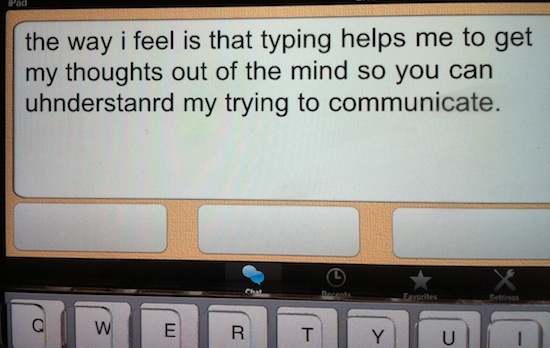
So I will end with something Em typed to me the other day and told me I could post.  She typed, “Language is an awkward way to communicate.”  She would not elaborate further and why would she, as that sentence says it all.

The Rocky Mountains

View From Cabin

Being the Adult I Want my Children to Become

“Are you the adult you want your child to grow up to be?” ~ Brené Brown from her book Daring Greatly.

Are we being honest here?

Because if we’re being honest, then – no, no I’m not.

I could hit the publish button right now and call this a post, but I’ve got a couple of things to add here.

From Daring Greatly – “…we should strive to raise children who:

  • Engage with the world from a place of worthiness
  • Embrace their vulnerabilities and imperfections
  • Feel a deep sense of love and compassion for themselves and others
  • Value hard work, perseverance, and respect
  • Carry a sense of authenticity and belonging with them, rather than searching for it in external places
  • Have the courage to be imperfect, vulnerable, and creative
  • Don’t fear feeling ashamed or unlovable if they are different or if they are struggling
  • Move through our rapidly changing world with courage and a resilient spirit

Now read every one of these things as a directive for yourself, like this:  Embrace your vulnerabilities and imperfections.  Feel a deep sense of love and compassion for yourself and others.  Carry a sense of authenticity and belonging with you, rather than searching for it in external places.  Don’t fear feeling ashamed or unlovable if you are different or if you are struggling.

I am becoming increasingly aware of how often my critical responses to my children are often reflections of my deepest insecurities. I don’t want them to make the same mistakes I’ve made.  I think I can control their future by making sure they understand just how serious all of this is.  I admonish my son for forgetting to feed the cat, while remembering the time my parents left me in charge when I was fifteen, two years older than my son is now, and how I forgot to feed the horses and had nightmares for years afterward.  I try to remember to phrase my sentences as – You forgot to feed the cat, what might help you remember?  Instead of my knee jerk response of “Did you forget to feed the cat again?  Why can’t you ever remember to do that?”  Because, wow, there’s a world of difference between the two…  and yes, I’ve said both.  The first is when I’m being the adult I want my children to grow up to be and the second is the adult I hope beyond measure they never become.

I worry about what a neighbor is thinking when he asks how we are and my daughter responds with, “Yeah, baby Teddy can’t go on the pogo stick.  Baby Teddy might fall and hurt his head.  Baby Teddy will cry and have to go to hospital…” and then describes how the doctors are going to have to put a breathing mask on baby Teddy.  I stand there feeling increasingly uncomfortable, because I care what our friendly neighbor thinks or because I’m afraid of what this might say about me and the things we put her through years ago?  And even as I am writing this, I marvel at how she really was answering his question, far more honestly than I ever would dare.

The truth is my children are closer to the adult I’d like to be, but am not yet.  I figure since my husband is hard at work figuring out the whole anti-aging thing, I’ve got at least as many decades ahead of me as I’ve got behind me to work on this goal.  I’m grateful for that, really.  I’m going to need every year I’ve got left.

“Have the courage to be imperfect, vulnerable, and creative”

Yup, check.

“Move through our rapidly changing world with courage and a resilient spirit”

Yup, check.   I got this.

Reflections in a puddle

Reflections in a puddle


Non-Speaking People Who Type

This is a topic I would prefer not to discuss, but a few things happened recently that make it difficult not to write about this.  So… here goes…

Facilitated communication has had a bumpy history.  It began in the ’70’s and has been lurching along ever since.  There have been studies done, both proving it’s validity and others proving it as an invalid method of aiding those who do not speak to communicate.  This post is not about whether FC is valid.  Those who do not believe in FC’s ability to help those who cannot speak will not be swayed by anything I write here.  For those who are interested in reading more about FC and its history you can do so by reading this and this and the many links embedded in these posts.

What I will write about however, is all those FC users who have gone on to type independently.  And here is where things get really interesting.  Those same people who are convinced FC is all a mirage, a kind of non-speaking, Autistic version of an elaborate magic show, remain convinced the non-speaking person who now types independently is not really doing so.  Those people continue to insist it is a “hoax” despite witnessing, some even after seeing in real life, a non-speaking person type on their own.

Just to be clear, I am not writing about hand over hand or a hand on a forearm assistance.  I am writing about the many people who began typing with a facilitator, but who now type independently.  By independently I am referring to those who may still need a trusted person standing nearby.   Some type with another person’s hand placed on the middle of their back, others may need a hand gently placed on their shoulder.  Yet these same people who speak out forcefully, often aggressively to any who dare write about someone who is non-speaking and writing of their experiences, say even a hand on the back proves these non-speakers cannot and do not type their own words.  They insist that they are merely puppets doing the bidding of the person who is physically nearby.

What fascinates me about this is that these same people who insist it’s all a “hoax” (this is the word they usually use) would rather believe a person can move a seated, non-speaking person’s hand to hit specific keys on a keyboard by virtue of their physical presence, rather than entertain the notion that this non-speaking person, may in fact, be typing their own words.  One such person commenting on a blog post about something unrelated to FC, but that had a link to Barb Rentenbach’s book, I Might Be You, wrote, ” I don’t consider typing with an arm on the shoulder independent typing. You can clearly see the facilitator nudging her towards the letters.”  Not to quibble, but seriously?  So this is like some sort of typed ventriloquism?  Touch someone’s back and direct them to write thoughts that are not their own?

I urge any of you who believe this is possible to try doing it… place your hand on another’s shoulder or the middle of their back and see if you are able to control what that person then types.  And while you’re at it, try standing next to the person and psychically urge them to write something.  It seems incredible, but there are those who not only believe this to be the case, but they then demand “proof” that this person is typing independently, despite the fact that they’ve just been given the very “proof” they asked for.  Evidently “proof” is subjective.

What bothers me about all of this is that those who are typing to communicate are doing so because they have no other means.  This is not a “choice” that’s being made.  The people who continue to insist they are a “hoax”, that it’s all a “mirage”, that they are being “controlled” are taking away the only way they can communicate.  They are silencing them.  They counter this assertion by saying that on the contrary, they are actually “advocating” for those who do not speak and are protecting those who are at the mercy of a facilitator who is putting words into another’s mouth.  Yet, even when confronted with a non-speaking person’s typed words, typed without anyone’s hand on their arm, they continue to insist the very presence of this other person is all it takes.  The transference of perceived power to cover up their dehumanization of another is convoluted.

If you google “Carly Fleischmann” the third entry that comes up is “Carly Fleischmann fake”.  Sadly Carly is not alone when it comes to such beliefs.  There is a long and horrible history of non-speaking people being discounted and effectively silenced by those who believe they cannot possibly be intelligent, insightful beings.  There are those who will dismiss people like Carly as an anomaly, a “prodigy” and thereby ignore the years of effort it has taken her to get to where she now is, or they conclude she is a “fake”.  There is nothing new about the silencing of human beings deemed inferior.  (Read Inventing the Feeble Mind by James W. Trent, Jr.)  The ingrained prejudices and dehumanization of Autistic people continues.

I want to end with one last thought, which is this – if you found yourself unable to speak, but could type to communicate, yet when you did so, people doubted the validity of your words, accused you of not actually writing what you’d so painstakingly typed, what would you do?  How would you respond?  How would you fight back?  Could you fight back?  Restraints come in many forms, but all are effective.

As Barb Rentenbach writes, “I might be you.”  For those who doubt that sentence is her own, you better hope those words are wrong.

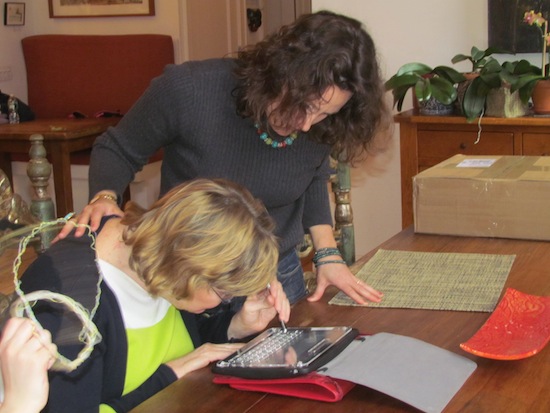
Barb types with Lois’s hand on her back as Emma twirls her string – April 2013

Barb types

Autism And Stress

Lest you think this post is about stress felt by parents, let me quickly say, it’s not.  This post is about the stress I have observed my daughter experiences.  The stress she feels and that I (often unwittingly and unknowingly) exacerbate.  This is not about  beating myself up, but is an honest look at how my reactions can make matters worse.  As I’ve said before, it is my hope that as Emma’s mother I continue to make progress in my parenting, but also as a human being.  Just as I hope and expect my daughter to learn and progress, I hope the same for myself.

“We have to minimize her stress.”  This was something Soma Mukhopadhyay said during Emma’s most recent session with her.  It was in answer to my question about when to graduate from using a letter board to a computer keyboard during her RPM (rapid prompting method) sessions.  During the session Emma pointed to a letter, then Soma wrote the letter down, Emma pointed to another letter, and on it went until Emma had written an entire sentence.  This technique, of one letter pointed to, one letter written down, helps with Emma’s impulsivity, which is amplified when she’s feeling stress.  It was during this same session that Emma answered Soma’s question about whether she could feel colors, with, “Of course.  That answer, those two words spelled out so easily by my daughter, made me laugh and cry at the same time.

My daughter types and does things that astound me.  It doesn’t matter how much I believe in her competence, I am continually astonished, ecstatic and heartbroken all at the same time.  Astonished because of the ease and confidence with which she will say something like, “Of course” in answer to a highly complex question, heartbroken because for so long these were words I never imagined I’d hear, let alone learn what I am now learning about her.  I no longer believe these feelings are mutually exclusive to each other.  Now, instead of wondering whether it was all a dream, I celebrate the exquisite beauty of my child and all she does that constantly reminds me of just how vast and incredible the human mind is.  I am humbled, on a daily basis, in the best possible way.  I would not trade the awe I get to feel when in the presence of my child for anything.  Seeing my daughter defy every limited idea about her that has ever been uttered, including my own thinking, gives me tremendous hope for this world, for my own growth and for humanity.

I witness greatness when I watch her work and it is a beautiful thing.  So when she expresses upset, which I now am able to identify as stress, it breaks my heart in a way that it didn’t, before I understood.  What I used to think of as stubbornness or a temper tantrum or a form of manipulation, I now see as a product of the enormous stress she feels.  And I have to wonder, exactly how much stress must she cope with?  I have talked about what I perceived to be her “resistance” in typing, but am now beginning to think of it as less “resistance” and more stress.  Stress from how very difficult it is.  Stress from expectations, stress from making a mistake, stress from doing something different, and those are just the stresses I can easily come up with and relate to.  I’m guessing there are many more I am completely unaware of.

Stress is something that, when she is gripped by it, all systems seem to simultaneously crash.  To make matters worse, my stress level rises in direct proportion to hers and I am confronted with how unhelpful I am when I allow my stress to overwhelm me as was the case the other day.  My response to Emma’s panic was to panic too.  So much so that I could barely breathe.  “You have to calm down!” I instructed her, while my own sense of calm, shattered so completely, was a perfect example of what NOT to do.  It was the antithesis of modeling behavior sought and it reminded me of something my father used to say to my siblings and me – “Do as I say and not as I do!”  I think he thought it amusing, however I remember it as anything but.

There are times I cannot predict, when something happens, things I don’t know or understand, and suddenly my seemingly placid, happy child is in a turmoil of upset.  There is often a sensory component I’m unaware of.  During these times sentences are repeated that are obviously meaningful to her, but that I find confusing.  As her stress escalates, her ability to verbalize what’s going on plummets and my frenzied request that she “type it out” does nothing to alleviate the situation.  The longer all of this goes on, the more I feel completely ill-equipped to keep my stress level from going into the red, let alone help her with hers.  That Emma seems convinced I am, not only capable of pulling it together, but will be able to help her, is an example of my daughter presuming in my competence, which makes me all the more determined to work through my own issues and do better.  I owe it to her.

September, 2009

September '09

The Complexity of Life and Change

*Emma gave me her permission to write about this.

Yesterday Em was having a tough time.  She has been talking about an indoor playground that closed some six years ago, expressing her upset that it’s now a store and asking that we build a new indoor playground exactly like it.  We have discussed the idea that places go out of business and that we can’t bring them back, we’ve talked about what is required to build an indoor playground, but that it will not be exactly like the one that closed.  We’ve discussed the concept of same and different.  We’ve gone over the preliminary steps needed to be taken in creating any sort of space.  Joe even thought she might like to build a model playground, complete with running water and electricity, but none of this has helped.  She remains very upset.  So much so that I began to feel certain her upset was not actually about this specific playground, but that this playground has come to symbolize loss.

“I want playground.  I want to build it.   Will take out the store and build a different playground has slides and a bouncy castle.”

I explained again that we couldn’t do that.  Em then repeated how she wanted to build a playground and then said, “Bertie kitty can’t eat pancakes.  Bertie kitty, the animal vet doctor, says no.  Might get sick.  Bertie kitty died.”

I nodded my head and said, “Bertie was old, Em.  He didn’t die from eating pancakes.  He died because he was very old.”

“I want to take it out!” Em pulled at the palate expander in her mouth and began to cry.

“I know you do, Em.  But we can’t take it out yet.  The orthodontist will take it out eventually.”

“Soon.  I want to take it out now.  I want to build it.  I want to build new playground.”

It’s easy for me to get caught up in the literalness of Emma’s words.  To get swept up in each upset individually, as it shows itself, veering from the closing of a playground, to the death of my cat, to the desire to have her palate expander removed.  If I take each of these concerns separately and at face value, I can quickly become lost in each one.  This is something I continually struggle with, not just with my daughter, but in life.  I take things pretty literally and often try to compartmentalize each thing so as not to get overwhelmed.  So in instances when Emma seems to be racing from one upsetting thought to the next, it isn’t my first thought to look for the common thread.  But I am fairly certain I’m correct about my interpretation of what’s going on here.  I think Emma is working through a number of difficult concepts that in her mind are all related.  The playground closing and being replaced by a store that holds no interest for her, the death of my elderly cat Bertie, whom she loved, and the palate expander that she dislikes and wishes would be removed.  I could be wrong, of course, but it seems to me they are all connected.  They all fall under the heading of permanence and impermanence, or death.

As Emma learns to communicate better through both typing and verbally, we become better at listening and understanding her, her anxieties are becoming more obvious to us.  As her communication skills increase, so does her obsessive compulsiveness, or so it seems to us.  It’s entirely possible that Em has always had this degree of anxiety, obsessiveness, coupled with compulsivity, but we are only now becoming aware of just how difficult it is and how often it overwhelms her.  Leaping from one upsetting scenario to the next is something I do too, particularly when I am tired.  With Emma it’s all about things that are impossible to have, things that are gone and won’t come back or, as is the case with the palate expander, about change, literally physical change as she looses the last of her baby teeth and her permanent teeth appear.

As we continue to support Emma with her typing, we have noticed she is becoming more verbal.  As she becomes more verbal she is expressing her anxieties, her concerns, as well as her desire to be heard.  The more we listen, the more she has to say.  Yesterday as we worked on her typing, I asked, “Em tell me two things you like doing and one thing that’s hard.”

Em typed, with my hand barely touching her forearm, “I like to bounce on the trampoline.  I like to bounce on the bouncy castle.  It is hard for me to work with mommy.  You could help them work with mommy.”

“Thank you for telling me that, Em.  Who should help me so it’s easier for you to work with me?”

“Pascal.”

Emma and Pascal take each other’s photographs  – April, 2013

*Pascal

When Insights are Speculation

One of the things I’ve felt particularly confused by is why my daughter sometimes resists communicating.  My thinking has been – why would she resist doing the one thing that will help her get along in this world more than perhaps anything else?  The other day, I had a moment of clarity.  I came a step closer to “getting it”.  And now, I think I understand.  Not only do I think I understand, but I am able to identify and relate to that resistance, because, I realized, I do it too!  There are a number of things I resist doing, even while knowing that if I just did them I’d feel better and would be able to weather the vicissitudes of daily life a bit better.  I’d be happier, calmer, less anxious, and yet knowing this, intellectually understanding that this is true, does not make my resistance any less.

know being mindful and in the present gives me clarity and a sense of calm, I do not otherwise have.  I know this, and yet find it extremely difficult to be completely present for more than moments at a time.  My daughter has little problem with this.  In fact, Emma is far more comfortable in the moment than anywhere else.  I remember when we were inundated with therapists coming and going during those early years of fear and panic.  Richard and I used to comment on the irony that Emma was completely present and in the here and now far more easily than we were and yet we were constantly encouraging her to talk about tomorrow or yesterday or any number of other topics that had little to do with NOW.    We were pushing her to move away from the bliss of this moment to join us in the fear and anxiety of the non-present moment, all for the sake of the larger picture, which in our minds was to have her join us in our world.  Even though our world was fraught with expectations, hopes, dreams, wishes and the inevitable disappointment those things often bring.

We used to joke that if we could bottle what Emma came to naturally we would have no cause for worry.  And that really is the crux of most conversations.  They are usually not about the here and now.  They are almost always about some other time, some other idea, some other person, some other concern that is not now.  And yet…  

I resist being in the present and Emma resists being pulled out of it.   And yet, we non-Autistics continue to insist our world is better, or superior even as many spend thousands of dollars going on spiritual retreats, reading books about meditation and going to workshops to teach us how to “sit”.  So the question I am now asking myself is this:  Can I find the grey area of encouraging Emma to communicate with me, something that is difficult for her and pulls her from the bliss of now, while giving her plenty of time to be present and just be?  And what about my own resistance?  Can I learn to meet Emma in her blissful place of now and resist the urge to go off in my mind to somewhere else?

Of course there’s always a danger in interpreting my daughter’s behavior as any one thing.  Her resistance, like mine, is probably made up of many things, and this could be just one reason.  Or I may have this entirely wrong and her resistance is about something that hasn’t even occurred to me.  Or perhaps it isn’t resistance at all and is something else or I may find, next time we type together and when I ask her why, she will tell me something I hadn’t considered.  And that’s the beauty of all of this, I can’t and don’t know until she tells me.  Until then it’s just speculation and me projecting my stuff onto her.   So that’s more for me to be aware of – seeing when and if I do that and understanding that I am.

Henry and I sharing a moment of laughter at Emma’s antics

H & A

The Magic of This Moment

Early this morning:

Nic: I’m late!  Gotta go Mom.

Me:  Okay,  babe.  Have a great day!

Nic:  I love you.

Me:  Love you!  Bye babe.

Emma:  Love you, Nicky..

Nic:  I love you Em.

Emma:  Bye bye

Just another typical conversation, right?

Um no.  No.  Not at all.  Nothing typical about it.  This.  This is why I don’t envy any other family, this is what I treasure about MY family.  This is exactly why, this conversation, this seemingly common, innocent, no-big-deal conversation…. yeah.  Because this conversation has never been uttered before until this morning.  And weirdly Nic and I were talking just five minutes before, while the three of us had breakfast about the importance and magic of being present.  We were discussing how this moment, right now, this second will never be repeated.  We may have moments like it, but this one?  Nope.  Never again.

And as we were talking about all of this, Nic interrupted me and we had the above conversation, the one I’ve just transcribed.  It may seem un-noteworthy to many of you, you may be thinking, so what?  Or who cares?  But to me, this conversation that other families have, perhaps on a daily basis and don’t think twice about, they are little nuggets of pure gold because these moments with my children are gifts, each one of them, pure gifts that I am so lucky to have.

In Buddhism there is emphasis on being present and practice and it isn’t easy.  It’s  a simple concept, but definitely not easy for most of us to actually do.  And yet, when I am able to really show up for this moment the joy is beyond description.

I will leave you with one more snippet.

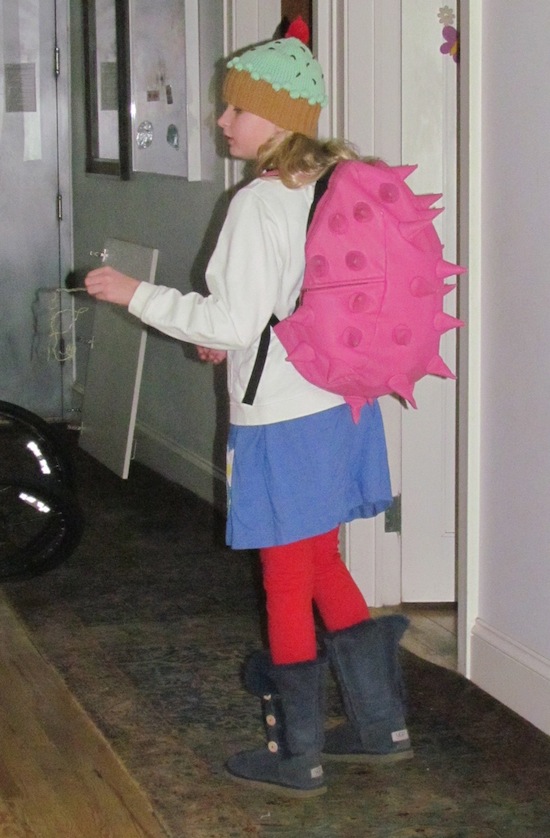
Later this morning as Em and I walked toward her school, we stopped at a red light.  As we waited she linked her arm through mine.  Not a single word was exchanged.  We waited, a mother and daughter, side by side for the light to turn green and once it did we made our way to the entrance to her school.  As Emma entered the gymnasium where the children and teachers were waiting, one of Em’s classmates called out, “It’s Emma.  Yay!  It’s Emma.  LOOK!  Look!  It’s a cupcake, I love cupcakes!”

And Em looked back at me and grinned before running to greet her friend.

The Cupcake Hat

Islands of Words

In Judy Endow’s book, Paper Wordsshe describes the process she went through to communicate.  She writes about the “bridge pieces” or information storage system she experienced, “Then world-people might see the little bridge pieces stuck onto the sides of all these stone islands.  

“Bridge pieces just hanging there serving no purpose (other than to underline the fact that a bridge was meant to be there, but isn’t) little bridge pieces going nowhere with gray -matter   g   a   p   s    where the bridges should be.

“Perhaps then the world-people might come to understand that even though she may know all the info that’s needed to answer their question or to produce a reciprocal response to keep up with her part of their conversation, sometimes it takes a lot of her time to jump in a boat and float around in that gray-matter space of her mind floating in the    g   a   p   s     trying to find all the right islands of stone that might hold any relevant data pertinent to the subject at hand.

“Sometimes it’s a cumbersome task to access information in this manner and at other times it is downright impossible.”

Judy’s book is incredible on so many levels and I hope she will forgive me for butchering the placement of her words, because my blog would not allow me to replicate what she does in her book.  However, I will try to explain.  She literally breaks the sentences apart in meaningful ways.  There are the words she’s writing, but there is another layer of meaning to be gleaned from her words, and that is how and where she places the words on the page.  As an example of the above quote, these words are placed in such a way as to create islands of words, separate from each other and yet the meaning overlaps, but the placement of the words (the islands) do not.  This requires the reader to visually leap from one island of words to the next, just as she describes her thought process must do.  It is a wild experience to read in this way and further illustrates her struggles with “bridge pieces” (information storage), “gaps” (information processing),  and canoe transportation (information retrieval).

In her chapter entitled,”People Are Not Interchangeable” Judy Endow writes, “…meaning that if PERSON ONE has a conversation with her today   …then tomorrow she can’t speak her response to PERSON TWO even if both persons belong to the very same group  sometimes when she knows what she’s talking about and the person to whom she is speaking acts like he doesn’t understand her the first thing she does is to repeat herself saying her exact words over but if the person still acts confused she begins to wonder… this may be one of those times when she needs to be talking to PERSON ONE but because both of them are in the same group it somehow makes perfect sense to her to be talking to PERSON TWO but this kind of mistake rarely works out so she must always remember the rule that she made for herself:  “People are NOT interchangeable.”

Again I couldn’t duplicate the arrangement of these words on this blog, an arrangement that serves to visually recreate the issues she describes having.

As I read Judy’s powerful book it was impossible not to reflect on my daughter.  How often has she said something that I did not/ could not understand?  How many times has she spoken to me about something or someone who I didn’t understand the context of, but that she seemed to know and understood me to know as well.  Only I did not.  How many times did I think – what am I missing?  And now I wonder, was she speaking to me, assuming I was PERSON TWO, while PERSON ONE might well have known exactly what she was referring to?  How many times have I been PERSON ONE and then explained to PERSON TWO what I thought was meant?

It happens often.

Emma doing one of her favorite “finger mazes” – 2013

Emma mazes