Category Archives: Autism

Henry & Emma’s Story

Yesterday Emma and I spent time with our friends Lauri and her son Henry.   Lauri has a wonderful blog, Ollibean, which is a model of  inclusion and what that really means.  Recent posts include Judy Endow’s How to Figure Out if an Autistic Needs Fixing, Amy Sequenzia’s Walk in my Shoes, and Henry Frost’s All the People Saw my Intelligence.

About a year and a half ago I interviewed Henry regarding his wish to be allowed to go to his local school.  Because Henry cannot speak and is Autistic, he was denied that right.  That interview was published on The Huffington Post ‘here‘.  And a follow-up post ‘here‘ because the piece went viral.  I also wrote about staying with Lauri and her family last spring ‘here‘, which was also when Emma and Henry became friends.

Henry and Emma wrote this story together, taking turns writing a sentence by pointing to letters on an alphabet board.  Henry is “H” and Emma is “E”.  (I know … that’s probably pretty obvious…)  Afterwards Henry and Emma gave me permission to publish their story here.

H:  Once a man went to the king.

E:  He had a complaint against his horse.

H:  His horse would not carry him any more.

E:  His horse wanted five dollars each ride.

H:  The king asked him to sell the horse.

E:  The horse said it is not a slave.

H:  The king asked the horse its price.

E:  The horse said it needs a million dollars.

H:  Finally the king gave two options to the horse.

E:  First was – fight a lion.

H:  Second is –  serve this man.

E:  Choose between the two.

H:  Question is – what will he choose?

E:  The End

Henry & Emma ~ January 30, 2014

Henry & Emma ~ January 30, 2014

Social Expectations

Yesterday there was some discussion about accepting and rejecting social rules.  Asked to talk about the rules she would reject, Emma wrote four that she would prefer were not required and expected of her.  When we returned to our hotel we discussed this further and Emma slightly amended what she’d written and added one to the list she’d made during her morning session.  I’m guessing there are additions to this list, but these sessions are exhausting and I didn’t want to push for more.

1.  “Giving eye contact when I don’t want to.”

2. “Being expected to answer verbally.”

3. “Being happy when I don’t feel up to it.”

4. “Keeping my body still”

5. “Trying to be Temple Grandin”

When Emma wrote “being happy when I don’t feel up to it” Soma asked, “do you feel social pressure to be happy?”  Emma wrote, “Don’t you?”

So here’s my question to all of you…  if you could change a societal expectation, what would it be?

Oh, and this is the eagle Emma drew after her last session…

Emma's Eagle ~ January 29th, 2014

Emma’s Eagle ~ January 29th, 2014

Questions & Learning

“Did you see the Grammy’s?”  Emma asked Soma yesterday.

And as I sat nearby watching, I marveled at how surprised I was by this question.    In part because she was asking a question, something Emma does a great deal of when she is working with Soma, but not so much with me yet.  I can’t tell you how much I look forward to that…

My surprise was not just limited to the fact that she was asking a question though, it was also because I often wonder how she knows all the things she knows.  “The Grammy’s?” I found myself thinking.  “How does she even know about the Grammy’s?  Where did she see anything about the Grammy’s?”  “Richard and I didn’t watch the Grammy’s.  I can’t even tell you when the Grammy’s were.

After Soma told Emma that she had watched the Grammy’s, Soma asked Emma where she’d seen them.

Emma wrote, “At the airport TV.”

The airport TV?  Seriously?  I didn’t even see a television, let alone notice what was on.  When we arrived at the airport we checked our bag, went through security and went looking for our gate, and when we finally found it, I don’t remember seeing a television anywhere near the seats we finally found to wait for our flight.   What else has she seen in passing?  What else would she like to know about?  What things would she be interested in learning about?  

I write all of this, because Richard and I often ask each other, “But where did she learn that?”  or “How does she know about that?”  And, well…  this is, but one answer.  There is information everywhere and my daughter is picking up information all the time.

I used to assume there was an input issue with learning, but my daughter continues to defy this idea.  An output issue?  Yes.  Input?  Evidently that’s my issue, not hers.

*Emma has given me permission to publish this on the blog.

Emma ~ January 29th, 2014

Emma ~ January 29th, 2014

A Short Interview With Emma

This is a short interview I did with Emma this morning about speaking, writing, and words.  

Ariane:  Do you have an inner dialogue?  You know, where you have a running conversation in your head?

Emma:  I do not think in words.

Ariane:  So that must make it hard to articulate what you are thinking and feeling.

Emma:  Yes, it is frustrating.  I am often unable to express myself even in writing.

Ariane:  Any suggestions for those of us who think in words?

Emma:  Do not think so much.  Empathy and love are not conveyed with words.

Texas ~ September, 2013

Texas ~ September, 2013

Discrimination

In Emma’s RPM session yesterday with B. on the topic of discrimination, Emma wrote, “Autism voices have been silent.” (Emma initially typed “silenct and then she edited that to “silent”.)   B. encouraged her to write more, asking her what she suggested.  Emma wrote, “take time to try and learn from us instead of staring at us like we are garbage.”

When she wrote the word “garbage” I felt sick to my stomach. This, from my twelve-year-old daughter.

I remember when my father would call me into his home office to scold me for my latest infraction.  I remember the shame I felt.  I still remember the tingling feeling of rebellion mixed with self-doubt when I noticed the disapproving stare of a stranger upon seeing my outfit – a crop top and pair of cut-offs that I’d smuggled into my backpack to wear to go shopping with a friend after school.   There was shame then too.  But stares like I’m garbage?  No.  I don’t know what that’s like and yet, my twelve-year-old daughter does.  Twelve years old.  Evidently she knows this feeling all too well, as there was no hesitation when she wrote that sentence yesterday.  It wasn’t like she had to stop and think about her answer.  She didn’t pause before pointing to the letter “g”.

take time to try and learn from us instead of staring at us like we are garbage.”

B. had been talking about Martin Luther King.  She had spoken of the civil rights movement and quoted a few things Martin Luther King said.  Emma immediately wrote about autism.  No hesitation there.  I can’t really console myself with the idea that racism and discrimination are no longer an issue in the United States and therefore the prejudice Autistic people encounter will change any time soon as well.  The language has been cleaned up, people know not to use certain words, but the feelings, the feelings of bias, the violence that prejudice and oppression encourage continues.

“take time to try and learn from us instead of staring at us like we are garbage.”

Emma ~ 2010

Emma ~ 2010

Stem Cell Treatments

“You thought my autism was hurting me and that you needed to remove it, but you did not understand that it is a neurological difference and fear caused you to behave with desperation.”  ~  Emma on the topic of the three stem cell treatments we did in 2010

Every now and then people find this blog through a site that promotes stem cell treatments in Central America.  In our long and twisted journey since Emma was diagnosed with autism, stem cell treatments were something we once hoped would help our daughter.  It is a decision I deeply regret.  People ask me whether I think it may have helped her.  I do not.  People have wondered whether the tremendous strides Emma has made are not directly related to those stem cell treatments.  They are not.  I can say this with assurance.   If you want to learn more about how Emma is communicating, click on this link.  The stem cell treatments put Emma’s life in danger.   We have no way of knowing what we may have exposed her to because of those treatments.  For the rest of our lives we will not know if the stem cell treatments harmed her.  We will never know and that is a fact we must live with.

In April of 2010, we believed anything was worth trying if it would help our daughter.   Just four years ago, I believed being Autistic meant a life of untold misery.  Autism was a list of deficits.  At the time, I doubted whether my daughter would be able to learn to read and write, let alone speak in a conversational manner.   I had no idea what my daughter was capable of.  I had no idea that she already knew how to read.  I know this now because she has told me through her writing.

We took Emma to Costa Rica and later to Panama for three rounds of stem cell treatments despite being strenuously urged not to go by a team of stem cell researchers out of Harvard.  We were cautioned about the experimental nature of this procedure.  We were told it was risky, dangerous, highly invasive, and yet we made the decision to take her anyway.  We did this because we loved our child and, at the time, believed anything we tried was worth it, if it might “save” her.  (I use that word purposely because this was what we once believed.)  We believed we were giving her a chance at life, we believed, if we did not try this, we would regret it.  We held out hope that maybe, just maybe this would help her communicate and thereby give her the opportunity to form friendships.    

I’m not going to go on a rant about all the misinformation we were given by well meaning professionals, educators, medical experts and pretty much every single person we came into contact with on the subject of autism and our daughter, all of that is pretty well documented throughout this blog over the last year and half, but I will say this, our response to autism and what we believed that meant for our daughter was not unique.  We knew of a great many parents who believed just as we did, that any treatment was better than doing nothing at all.

This blog began as a result of those stem cell treatments.  I never thought more than a handful of people would read what I was writing.  This blog was a way to document the changes we hoped we would see because of the stem cell treatments, a treatment that is not allowed in the United States, a treatment that has since been outlawed in Costa Rica as well.  We believed we were doing a good thing.   For those of you who never contemplated such drastic measures, I understand how incredible this must sound.  For those of you who are Autistic, I can only tell you how sorry I am that this was what we once believed.

We all make mistakes.  Some of us have made terrible ones; things we cannot undo, take back or cancel out with an apology, no matter how heartfelt.  What I can do is continue to learn, hope to do better, and do all I can to counter that list of deficits so commonly attached to an autism diagnosis, while signal boosting Autistic people’s words, including my daughter’s.

Last night Emma and I discussed those stem cell treatments from four years ago and she wrote the words I opened this post with.  When I told her that if I could take those treatments back, if I could cancel them out, I would, in an instant and without hesitation.   She then wrote, “Many parents have not loved their children as much as you.

This isn’t about forgiveness, I know she forgives me, this isn’t about publicly beating myself up, this isn’t about me learning to forgive myself, this isn’t about me at all.  This is about misinformation, where that misinformation leads us and the inherent problem with speaking about autism as a “medical disorder” as opposed to a neurological difference; a difference that carries assets and deficits just as non autistic neurology does.  This is about oppression, segregation, prejudice and how that plays out in every aspect of autism, autism research, autism treatments, biomed interventions and almost all of the various autism therapies that currently exist.

“Put it on the blog!” Emma said, after we talked about all of this.  

“Really?  You want me to put this on the blog?”

“Yes,” she said and then she leaned over, gave me little kisses and added, “Aw… sweetheart…”

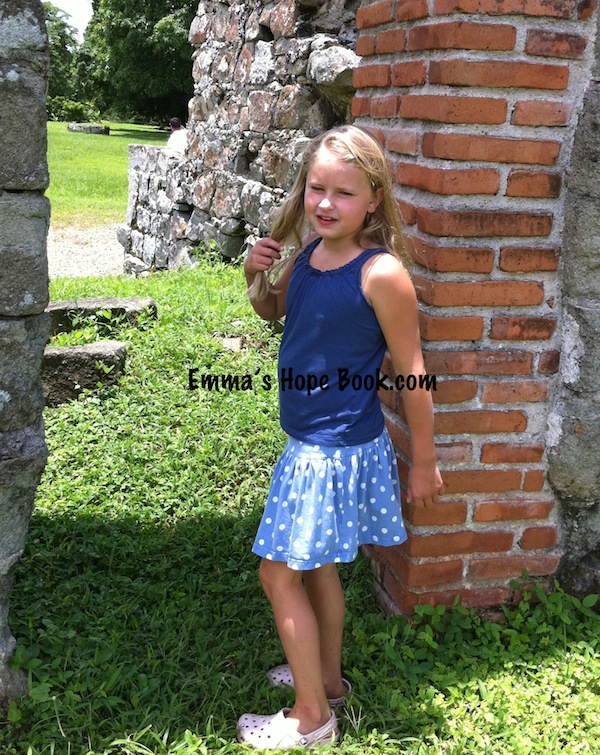
Emma walking among ruins in Panama ~ 2010

Emma walking among ruins in Panama ~ 2010

“Voices”

The Halo Center has published a little pamphlet of Autistic people’s writing. It’s called “Voices” and this year’s issue – “Voices” 2013 edition –  is available for purchase ‘here‘.  One of Emma’s fabulous folk tales is in it, along with dozens of others.  For anyone who is even remotely interested in Soma Mukhopadhyay’s Rapid Prompting Method or RPM, it is a great sample of the writings of a wide range of people of all ages who do not rely on spoken language to communicate, but who write to communicate.

“Butterflies used to be sticky as butter.  But they had curiosity.” ~ Emma

I am not going to reprint Emma’s entire story here as I hope some of you will go over and purchase a copy.

Soma and RPM have completely transformed our lives.  It is my dream that every school, every educator, every therapist, and all people who are in the field of autism have the opportunity to witness someone like my daughter writing her thoughts on the letter board.  Eventually Emma will write on her iPad and computer, but for now she is using a laminated letter board with me, her iPad with the person she sees here and the laminated board, which she even holds herself at times, with Soma.

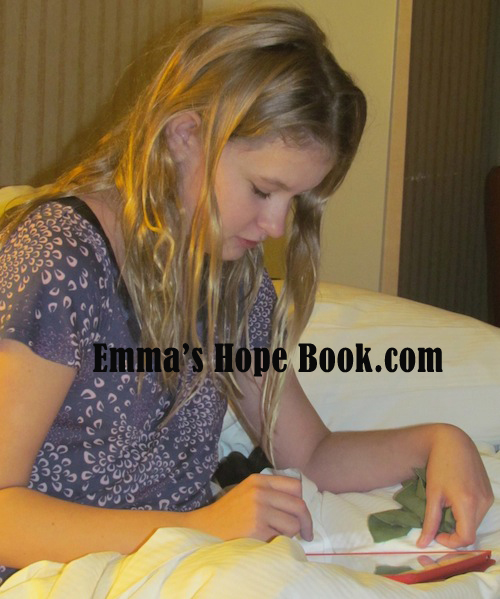
A Session With Soma

A Session With Soma

“There is Wisdom in the Echo Silence Makes”

“I want to talk about autism, but I am dear-like because badly needed information is angering.

Assuring many people understand about neurology they do not have is difficult.

I want the world to have another opinion to work with.

I am happy but people find that impossible to believe.  That causes me anxiety.

Acceptance and kindness are crucial for all people.  As one who is constantly thought less than, forgiveness is like a soothing bath and the talking people might learn more if they did not talk so much.

There is wisdom in the echo silence makes.”

Emma just wrote this.  She asked that I put it on the blog.

“There is wisdom in the echo silence makes.”

It turns out we are living with the buddha.

Emma ~ 2004

Emma ~ 2004

Emma’s “Folk Tale”

*Emma worked on this story for a week and it took many 45 minute sessions to complete.

“Once upon a time there was a duck and she bought a gorgeous pair of shoes.  She could not force her webbed feet into the lovely shoes, so she fell into a terrible depression.

“Oh what is the matter with me?” she cried.

“Her once beautiful feet now disgusted her.  The new shoes languished in her closet.  Golden hopes for her acting debut were dashed.  Without her new shoes she believed she would not be as highly regarded as she would be while wearing them.  Delightful she once was, but now no longer.

“Dawn arose like a spring crocus and she decided matters could only improve if only her feet were dainty.  Seeking the advice of an aged, old, spotted owl, she wondered if her feet could be changed.

“The ancient bird asked, “Have you always hated your feet this way?”

“No,” she said, “I have always enjoyed my wonderfully webbed feet.”

“Then, ” asked the sage, “why do you dislike them so, now?”

“Because,” she replied, “my new shoes do not fit and they are so pretty.  Could they be changed so I may wear them?”

“Yes.” Owl smiled.

Relieved to be in the company of one so wise, Duck had seen the failure of her ways.  It was not her feet needing amendment, it was her perception.

Duck's Lovely Webbed Feet

Duck’s Lovely Webbed Feet

Today is Emma’s birthday.  She turns 12.  Happy Birthday to my beautiful girl!!

Prejudice & Autism

Emma and I have been discussing the civil rights movement and the events throughout American history that led up to it.  We’ve discussed the word segregation and what it means to a society when we isolate a group of people and how people come to form opinions about other people they’ve never met.

We have discussed the word prejudice  and how it is preconceived opinions based on an idea rather than factual.  We’ve talked about how those preconceived ideas almost always do harm.  We’ve discussed oppression and how many who’ve been oppressed internalize that message and how it changes how they then view themselves.

Emma has asked to read a biography of Harriet Tubman and we have been discussing the importance of Rosa Parks and her decision to not give up her seat on a crowded bus in Montgomery, Alabama.  We have not yet talked about Martin Luther King, Malcolm X or Thurgood Marshall, though Emma wrote that she has heard of the first two, and for all I know, may know of all three.

When I asked Emma to write something about Harriet Tubman, she wrote, “defender of freedom.”  This was a couple of months ago and I was shocked because the only time I’d mentioned Harriet Tubman to Emma was about three years ago.  I had read one of those beginning readers to Emma about Harriet Tubman before bedtime. And while I always hoped she might be listening, even if only a little, I wasn’t convinced she understood what I was reading.  This was during those years before I realized Emma understood everything.  It was during those years when I believed what I was being told, that my daughter was only able to understand the most basic concepts, and even those, it was often questioned just how much she understood.

Prejudice is when we form opinions about people, that are not based in fact. Prejudice makes us blind, it twists our minds into thinking we understand or know, even when we do not.  It can make us deny facts, or decide that what is true, is not real.

As Emma never indicated that she was listening, much less taking everything in, I often wondered.  But a couple of people had encouraged me to “act as if” and so I did my best.  I remember when I read the biography of Helen Keller and later she asked me to read it to her again.  Still, despite the now obvious evidence, I doubted and even when I wasn’t actively doubting, I wondered.  Often.  It was as though I could not make the mental leap to believe what increasingly seems obvious in retrospect.  Prejudice is like that, it fools us into believing we understand things about a group of people that we do not.

As James H. Cone writes in his book Black Theology & Black Power – “How should I respond to a world which defines me as a nonperson?”  And later in the same book, he writes, “A man is free when he can determine the style of his existence in an absurd world; a man is free when he sees himself for what he is and not as others define him.”

Emma in Colorado - 2010

Emma in Colorado – 2010

Unable to Speak Does Not Mean Unable to Think

*Emma gave me her permission to write about this.

“How old is she?” a stranger asked the other day as Richard, Emma and I searched the grocery store shelves for Emma’s favorite jam.  Emma was bounding back and forth between where Richard and I were standing peering at the shelf where her jam is usually located, to the dairy case, twirling her string and saying things like, “but where is it?  I don’t know!  It’s gone!  Somebody took it.  You threw it! Aw sweetheart…”

The strange man then observed, “She’s acting like a young child.”

My first reaction was to move Emma away from this person so she wouldn’t hear any more of his words.  My second reaction was to go over to the man and say, “You know, my daughter understands everything you’re saying.”

“I wasn’t trying to be rude,” came the stranger’s reply.

“Yes, but in fact you were,” was my knee-jerk response before walking away.  *I’m not proud of this and I know this was an opportunity for a “teaching moment” but I didn’t have it in me.*

Later, Emma and I talked about what happened.  Emma told me it hurts her feelings when people do this – talk about her and say things about her as though she couldn’t hear them, or doesn’t understand everything they’re saying.

I want to disappear when people talk about me.“  Emma wrote to Soma last September.  I wrote about that session in more detail ‘here.’

People, usually, do not mean to be rude, they do not mean to say hurtful things about my daughter in front of her, in fact people do not think about what they’re saying a great deal of the time.  As my daughter does not protest or respond when they talk about her in front of her, people assume she doesn’t want to or cannot understand.  It doesn’t occur to them that she doesn’t respond because the words she’d like to say do not come out of her mouth in the way she intends.  Until Emma was able to write her thoughts, people (including us) believed what they thought they were seeing, even though what they thought they were seeing was completely incorrect.  In cases like my daughter – seeing is NOT believing.

When people do not speak, they are often viewed as not being able to comprehend things said.  People come to the conclusion that if you cannot say what you mean, you must not want to, or you are unable to understand what others are saying.  There’s a false logic at work here.  Particularly when it comes to Autistic people.  When someone is unable to speak, cannot say what is in their mind, is unable to voice their ideas, thoughts and opinions, it does not then follow that they do not have ideas, thoughts and opinions that they would like to express.

Emma ~ 2003

Emma ~ 2003

Autism and Human Rights

Peyton Goddard gave the keynote address at the 2013 TASH Conference in Chicago on December 11th, 2013.

You can watch, hear and read a transcript of her speech ‘here‘.  Peyton does not speak, but instead types to communicate.  I was fortunate enough to be in attendance at the TASH Conference and hear her speech.

“Understated and devalued, I was segregated and secluded, walled-in for controlling decades, and repeatedly traumatized by bullying abusers.”

Peyton describes her existence prior to learning how to communicate through typing.

“I’m less. I’m freak. I’m throwaway trash. Daily, for decades, I try but cannot be the person you want me to be.”

“Your answer was to fix me, to change me to be what you feared not. To cure me of being ME. I reply that YOU were less than I needed.”

Read that again – “I reply that YOU were less than I needed.”

“Segregation is the beast whose bite cheats us all. The isolation of people different renders you and me strangers. Reality is that you are me and I am you.”

At the crux of any prejudice is the idea that “I” am different, separate and, ultimately “superior”.  To live with this delusion, we must keep ourselves apart from those we believe “inferior”.  If we live together, in a world that embraces all humans, we lose our superior/inferior status.  This is the world I strive and hope for.  This is the world I want my children to inhabit.

*For more of Peyton’s wisdom, read her book, I am intelligent.  I interviewed Peyton and Dianne for the Huffington Post.  You can read that interview ‘here‘.

Peyton and Dianne Goddard ~ TASH 2013

Peyton and Dianne Goddard ~ TASH 2013

“Be Patient With Me…”

“Be patient with me, Mommy.”

This is what Emma wrote on the airplane coming home when we were delayed yet again.  This was what she wrote after spending four hours waiting to board the aircraft, an aircraft that never took off, a plane that sat at the gate for another two hours waiting for the pilot to show up, an airplane that we then had to de-plane when that same pilot never arrived, forcing us to stand for two and a half hours in the airline’s customer care line, only to be told we would not be able to get home for three more days, oh and by the way, our luggage was nowhere to be found.  Oops.  Sorry.  Shrug.

“Be patient with me…”

There were tears and a struggle to contain the overwhelming feelings of panic and exhaustion.  Cries and fists that pummeled, teeth that bit, flailing limbs, and I was right there, wanting to do the same.  Wanting to lash out.  Wanting to scream and do something that would make it all go away.  Change reality.  Change these feelings.  Change these circumstances.  Scream.  Disappear into the screams.  Clench my jaw, grind my teeth, breathe, clench, grind, breathe, clench, grind, breathe…

“Be patient with me…”

“You’re impatient,” people have repeatedly observed and thought to tell me.  Yeah.  I know.  That feeling that begins as mild anxiety, builds into an almost impossible feeling of discomfort…  the feeling that if I don’t DO something, anything right now, I will die… that’s my impatience.  I get that now, though I didn’t always.  It used to be I didn’t know what those feelings were called, I just knew I would do just about anything to avoid them.

“Be patient…”

There’s an ongoing irony to parenting.  How many times have I admonished my children to do the very thing I lack or am incapable of?  I remember going to a parent/teacher conference at my son’s school.  He was in grade school at the time and the teacher made a comment about how he needed to work on building his tolerance for frustration.  I replied, “Yup, that’s something his mom’s still working on too.”  The teacher looked at me with surprise.

“Be patient…”  

I try.  I am trying.  But don’t use me as a model.  I’m not very patient.  I tend to be controlling too.  I don’t like when things change suddenly, I feel calmer when I know what will happen next.  I don’t love spontaneity, it messes with my sense of order.  And once I’m in overwhelm, once the feelings are coming at me so quickly, I cannot access my thoughts, it doesn’t occur to me to say to the person I’m with, “Be patient with me…”

But my daughter did.  My daughter was able to get in touch with what she needed from me during a time of heightened distress.  So who was helping whom in that moment?  Was I helping her or was she helping me?

“Be patient with me…”

Em & N. ~ 2010

Em & N. ~ 2010

Michael Scott Monje Jr.

I want to introduce all of you to Michael Scott Monje Jr.  “Michael Scott Monje, Jr. is a graduate of Western Michigan University with an MFA in Creative Writing and a BA in English and Philosophy. He’s also autistic, a fact which everyone overlooked until he was in his late 20s.

Michael has a blog, Shaping Clay where he writes about a great many things including – Autism, Human Rights, Gender, and where his serial novel, Defiant can be read.

Mike’s novel The Mirror Project, a Sci-Fi psychological drama about artificial intelligence forces us to consider what happens when we create a being that cannot be “controlled” or forced to do as we bid.  There are moral and ethical implications, but more to the point, The Mirror Project is about oppression, our responsibility to not only each other, but to ourselves, and how we must relinquish the desire to control, in favor of encouraging and supporting one another’s independence, which in turn benefits the entire human race.

The artificial intelligence created is called Lynn, the name of the creator’s dead wife.

“Lynn’s existence is continuously dictated from without while she struggles to articulate the damage that her creators are doing to her.”

It was impossible for me to read this novel and not highlight the similarities between what Lynn ponders and what, I can only imagine, many who cannot easily access language or who have difficulty synching their mind with their body, must wonder.  Lynn asks early on “…what is the soul if it is not the constant awareness of the desolation of your own existence?”

Later Lynn protests the way she has been treated, “That attitude will open the door to all kinds of rationalized brutality on your part.  You might even break me and change my behavior permanently, but you will never be able to know that you did the right thing.  You’ll have to live with the idea that literally every experience I have for the rest of my life might be re-traumatizing me.  There’s no rationalizing that. You either refuse to create the situation in the first place, or you admit what you’re doing and accept the cost.  Could you accept the cost and live with yourself?”

Nothing’s Right is about a year in the life of an Autistic boy who must navigate the messy and painful maze of growing up in a family whose neurology differs from his own, a school that does not even attempt to understand him and a world where he is seen as the sum total of problematic behaviors.  Nothing’s Right has some of the most brilliant and haunting passages depicting “self-injurious behaviors” that I’ve ever read.

If you are not familiar with Michael Scott Monje Jr.’s writing, it is time you were.

You’re welcome.   🙂

The Mirror Project By Michael Scott Monje Jr.

The Mirror Project By Michael Scott Monje Jr.

Emma’s Letter to Her Teachers

This is a letter Emma wrote yesterday to her teachers.

Dear ____________________,

I would like to teach you how to use a stencil board so that I can show you how much I know and so we can discuss what you are teaching me in class.

I want to learn both syntax and style of diverse writers.  Poetry and prose both interest me.  I love to write stories and welcome the opportunity to do so.

You try to teach me, but not in a way that I can learn.  Try to learn what my mother has learned from Soma and change how you think about autism.

Addition and subtraction are fun, but I have been doing that for many years and numbers are easy for me to understand.  It is boring to do the same thing over and over all the time.

I do not like school and I wish I could go to a regular school where I was treated like other kids.

Sincerely,

Emma

After Emma wrote this letter I sat with my husband Richard, clutching the three pages it took to contain these words that Emma wrote, pointing to one letter at a time on her laminated letter board.  I asked Emma if I had her permission to read her words aloud to her dad, she nodded yes and then said out loud, “on the blog.”

Education for our kids, whatever their neurology, is something every parent worries about.  Our schools are buckling under the weight of mismanagement, bureaucracy, out dated and irrelevant standardized test requirements, politics, and the diverse needs of our children, make any one-size-fits-all method of teaching impossible.

I don’t have any answers, but I intend to get some.

To anyone who has successfully gotten their non-speaking child (or a child like Emma who is able to speak, but says things they do not intend) into a “regular” school, please contact me and let me know how you did it.  Does your child have a one-on-one aide?  Did you train the aide yourself?  Do you do RPM?  Did the school work with you?  If they didn’t, what did you do instead?  Any and all experiences are welcome.  You can also contact me by email:  emmashopeblog@gmail.com.

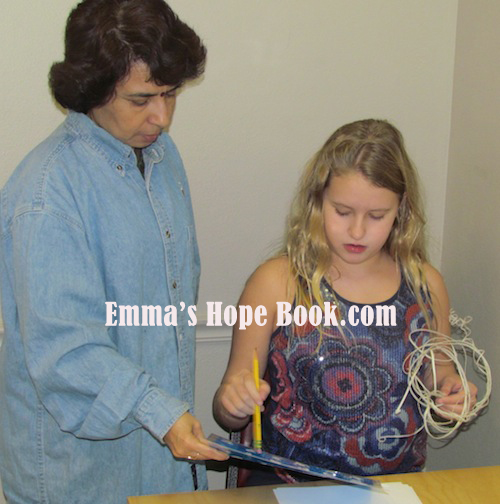
A Session With Soma

A Session With Soma