“I am smarter than most people think. So many kids are just like me.”
Emma wrote this yesterday in response to my question, “What would you like teachers, who want to teach Autistic kids, to know?”
There are a number of young people who write to communicate things that they cannot with spoken words, just as Emma does. Many of them are starting blogs of their own, some have parents who have blogs and like Emma they are beginning to take ownership of those blogs. On the “Resources” page here on Emma’s Hope Book I’ve listed a great many blogs beginning with those written by non-speakers, or people who write to communicate.
When Emma wrote “so many kids are just like me” I thought about how when Emma was diagnosed I knew of none (of any age) who wrote to communicate. The entire concept was completely foreign to me. In fact, and I hate admitting this, I hadn’t spent any time considering neurology, literacy, language, or which parts of the brain process language. I remember being confused by the idea that someone who didn’t speak, could still read. I’ve come a long way!
I would like to take the opportunity to list here just a few blogs that I personally know of where people around or near Emma’s age are writing to communicate. This is by no means a comprehensive list and I welcome any additions, which I will add here and on the resources page as they come in.
“People do not believe me” was what Emma wrote on our last day in Texas last week. Prior to that sentence she wrote a message to Richard and me that left me in tears because it expressed her gratitude for believing in her and for fighting for her right to be thought competent and intelligent.
One day my daughter will be able to write what she feels and believes independently, of this I have absolutely no doubt. When that day occurs, she can choose what and when she wants to write such things, but for now, I will keep this post to my own views and opinions.
As many of you know, it was not so very long ago that I was one of those people Emma was referring to. I have a great many feelings as I write that sentence, but as I trace back what was going on and why I didn’t or couldn’t or wouldn’t believe in all, that it turns out, she is capable of, it wasn’t that I didn’t want to, it wasn’t that I didn’t hope, it was that everything I saw, heard and thought was muddied by what I read and was told and was confirmed by what I thought I was seeing.
When I met people face to face (as opposed to reading their words or hearing of them) like Barb Rentenbach, Tracy Thresher, Larry Bissonnette, Amy Sequenzia, young Nick, Joey, Jamie, Jenn, Mark, Tito, Sarah and countless others who do not speak, or whose spoken utterances are not in keeping with what they write, I began to question what I once believed. It was during a presentation Barb Rentenbach and Lois Prislovsky gave at the Autcom Conference in the fall of 2012 that I thought, okay, maybe, just maybe, my daughter is not saying what she intends to say. At that same conference I went to another presentation with Larry Bissonnette, Tracy Thresher, Pascal Cheng, Harvey Lavoy where a young boy, younger than Emma, typed on his iPad extremely insightful comments pertaining to the topic and again I thought, maybe, just maybe my daughter is like that boy and I just have to find a way to help her communicate.
It was the first time I’d really considered the disconnect between speech and intent. It was the first time I began to wonder whether all this energy being placed on output of spoken language was the best way to help her communicate. You see, up until then I bought into the idea that if we could just get her to talk, we would be giving her the tools she needed to say what she thought, that the words that came out of her mouth were indicative of what was going on in her mind. We even would give her spoken prompts, say a sentence and have her repeat it, as though if she could just repeat the words, even though they were dictated and not her words, they would make sense and the connections would be made. And when they didn’t seem to build to a critical mass, instead of questioning the push for spoken output, I questioned what was going on in her brain.
This was a huge mistake, it turns out. Huge. But I didn’t understand. I didn’t see the error in this thinking. I could not believe. Not yet.
And then I met these wonderfully resilient, creative, intelligent people who did not communicate through spoken words, but instead wrote beautifully, poetic words that put together made equally gorgeous sentences that spoke of insights and wisdom and hope and strength and courage and compassion and I was blown away. At first I thought each person was an anomaly. I told myself they couldn’t possibly be representative of many, they had to be one in a million… and then I met more and more and eventually, even I could no longer doubt what I was seeing and witnessing, this critical mass… this unleashing of hundreds of voices, each unique and yet all…. all were communicating what was in their minds and many spoke of that disconnect that occurred between a thought and what then came out of their mouths.
“my mouth constantly talks different from what I think…” Emma wrote.
“People do not believe me.”
“Yes,” I told her, “but that is changing… that will change.”
It is my promise to my daughter. I will not stop writing until it is no longer necessary to say these things.
The Purple Tree and Other Poems is a collection of poems by Sydney Edmond who is non-speaking and autistic. She learned how to write using a letter board when she was ten-years old, two years later she gave her first public presentation and has presented at a number of other conferences since then. Now ten years later, Sydney continues to write, present and is the subject of a documentary called, “My name is Sydney”
“Lazy, achy lady
lived by the sea.
Lazy, achy lady,
move away, please.
You are always blabbing,
talking long and loud.
You are closing in on
my lovely little cloud.” ~ From the poem, Some Early Poems
One of the most exciting things happening now is the emergence of a growing number of non-speaking Autistic people who are writing. Thankfully self-publishing and blogs are making their work accessible to the public. As more non-speaking Autistic people write and publish their work, it will become increasingly difficult for the public to deny that the assumptions we have long-held about Autistic people are incorrect. Eventually we will have to re-evaluate how we are viewing those who are Autistic and what that actually means. Our notions of “intellectual disability”, our ideas about what someone is or is not capable of are being challenged and will continue to be until what we think we know now, what is considered common knowledge will be seen as antiquated and our limited assumptions an example of just how ignorant we once were.
“I lack the lovely peace of mind,
lack my always smile.
Who listens to a lonely girl,
Listens to a child?” ~ From Dear Friend
The first presentation Sydney gave was in 2005, just two years after she began communicating on a letter board. This poem, Love, Love, Love! was part of her presentation at the West Coast Symposium on Facilitated Communication.
“But Soma came along
and changed my life.
She actually lifted poor little me
out of darkness
and into light,
love,
and lovable, lovable, lovely happiness.
Soma taught Mom
how to communicate with me,
and Mom and I have been talking
ever since.
Now I can choose my own clothes,
make my own decisions,
and make lovely friends out of people.”
For those of us with children who do not speak or whose language is unreliable, or does not necessarily reflect what is meant or intended, we are entering a time of tremendous hope. There is a great deal of work still to be done, but in publicizing the work of those who are like our children, who are communicating by typing and pointing to letters on letter boards, we will shift how people view not only our children, but all our children and people. By questioning commonly held beliefs about any one group of people we affect change for all mankind.
Erratic speech. Unreliable language. These are all words to describe what many, like my daughter, experience. Speech that does not represent what is meant, but that people hear and make assumptions about the person based on what has been said. Rosemary Crossley in her book, Speechless talks about nominal aphasia – “One of the familiar aftereffects of stroke, for example, is not being able to say what you mean.”
Many years ago I became friends with a man who’d had a stroke, leaving him aphasic (meaning he was mostly unable to speak, though he understood what was being said to him.) Every few months my then boyfriend and I would pick him up at his apartment and take him somewhere. I don’t remember if he could type his thoughts, this was long before the advent of the iPad, and as he could not hold a writing implement, this was not something he did when we were together. I do not remember him ever uttering a single word. Prior to his stroke he had made a name for himself as an avant-garde theater director. In the theater world he was thought of as a god. After his stroke he went on to direct a number of works with many famous actors. People were willing to believe he could not only understand what was being said, but that he had a great deal to say, even though he could not verbalize his thoughts. His name was Joseph Chaikin.
For those who are Autistic and also have unreliable speech, people tend to take what they say at face value and believe their speech is indicative of their thinking and thought process. Yet this could not be farther from the truth. Many are willing to dispense with their disbelief when someone is famous and once spoke, but most are not as willing to believe when someone has word retrieval issues, that they are capable of more than what we hear them say. “…children who have never been able to speak fluently have not had a chance to establish themselves. They have not had the typical infant’s experience of controlling the world with their speech.” ~ Speechless by Rosemary Crossley
And as a result they also do not have the same types of interactions with others as those who have more fluent speech.
“Because our judgments of intellectual capacity, both formal and informal, are strongly tied to speech, a child who says the wrong words, who gives “silly” answers when asked questions, is likely to be seen as stupid. A child who can never find the word he wants, or a child who cannot make his tongue do what it should, can come to associate speech with tension, embarrassment, and failure.” ~ Speechless by Rosemary Crossley.
“Children with severe speech impairments often develop behavioral problems. These may simply be a result of the frustration inherent in not being able to say what you mean, but this frustration may also be exacerbated by the reactions of the people around them.” ~ Speechless by Rosemary Crossley
One young man who had unreliable language and who Rosemary worked with typed, “I dont make sense and people think Im senseless.” Speechless by Rosemary Crossley
Typically, when someone speaks to us, we believe that what they say is what they mean to say. We respond accordingly. When people tell me something Emma has said and how they don’t understand why she then became so upset because they were doing what she told them she wanted, I understand. I understand how frustrating that must be, for her, for the other person, for everyone involved. Emma does not have phrases like, “Oh I know the answer to that, but I can’t think of it just now” or “give me a minute, it will come to me” or “it’s on the tip of my tongue” or “I just had it, the word was right there” or “what’s the word, you know it sounds like ________?” or “wait, I know this, I know this…” or any of the other things most of us say when we know something, but the words have momentarily escaped us.
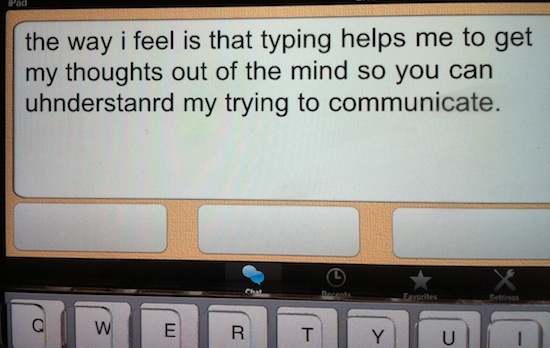
Communication is not just speech and for some, spoken language is an unreliable method of communicating. Finding a more reliable method then becomes essential. For my daughter, typing is proving to be a far more reliable way to communicate. And as it turns out, there are a great many others who are just like her.
Last week I wrote a post, Speaking vs Typing, which sparked a terrific discussion about language, communication and how we interpret what others say and do. My friend Barb, who wrote (with Lois Prislovsky) the not-to-be-missed book, I might be you commented:
“my dear neurotypical friends, first, let me say i love that you all are putting your heads together to break down this truth into practical ideas to help me and my autistic peers who struggle mightily with spoken language communications. em is right, “language is an awkward way to communicate” and i argue that is true for everyone but highly challenging for those of us who are autistically wired in the “vanilla cake” or “mail truck” way that em and i are. it took me years to think in language. but prior to that my thinking was not faulty it was just not language based. thinking in language is not efficient for me. i wish i could give you a pretty little fact package about what works so folk like me could get such treatment and soar socially and academically. of course, the problem is…it is hard to say in language. typing makes it way easier, because i can control the speed of each thought and break it down to smaller parts to be better described by letters one peck at a time. speaking requires a rather unnatural process for me perhaps like you singing a song you heard in another language. u may be able to imitate the sounds but the meaning in each mimic is not precise. since most folk are not yet well practiced in telepathy the best way for me now is to communicate through typing. but still my thinking is not easily translated in to words. feelings, sensations, visions and perceptions that are cleanly processed in my mind dont fit well into letter symbols. there i said it – or something close. thanks for caring. trying b”
Barb’s comment made me wonder whether my daughter is able to “hear” my thoughts, even if just a little. And that if she were able to, it would make sense that either typing or speaking would feel like an inferior, less efficient form of communication, perhaps it would be viewed as somewhat barbaric, and certainly a less sophisticated way of communicating. So I asked her, “Can you hear my thoughts?” To which she answered, “No.” Not undone, I asked, “Do you feel them?” To which she did not reply. This post is not about mental telepathy, but is more about how we sense each other. Some of our senses we are taught to fine-tune and others society either doesn’t recognize or doesn’t place as much importance on.
But what if we lived in a culture that did encourage sensing another’s presence and feelings? What if, from the time we were born, our sense of other people’s state of mind, their feelings, was nurtured. Would that change how we communicated with each other? What if spoken language took a back seat to our intuition? What if we lived in a society that placed more importance on our presence, than on our words?
All of this reminded me of a conversation I had with a couple of friends, both of whom are Autistic, about disability and society’s role. I wrote a post about that, ‘here‘. One friend said that if we lived in a world where everyone used a variety of alternate forms of communication, where a longer time period was allowed and expected between words, and supports were anticipated and provided, then people who do not speak would not be considered disabled, just as I am not considered disabled because I cannot juggle or jump as high as an Olympic high jumper.
If children were taught at an early age to sense each other without relying on language, would we evolve into a species where language was viewed as unreliable and untrustworthy? Does my daughter view language as a lesser form of communication? Is she not as motivated to communicate, either through typing or verbally because her other senses are more finely tuned? Does motivation even enter into all of this? My brain is constantly looking for intent, motivation, but what if this isn’t what’s going on at all? What if this has nothing to do with any of that? What if she is trying so hard to communicate by typing and speaking because she understands I want her to, but not because she has the same need that I have? Does music call to her because it is less about the lyrics and more about the beauty of the music, the feelings the music evokes?
At an Autism Conference last month someone asked my daughter “Have you ever been to Australia?” Em immediately answered “Yes!” Yet when this person held up a laminated card with two boxes, one red with the word NO and the other box green with the word YES and asked the same question, Em promptly pointed to the red box with the word “NO”. When asked what she had for breakfast that morning, she answered, “Vanilla cake!” but when asked the same question and asked to respond by typing she wrote, “I ate cereal, toast and yogurt.”
Many people ask me why we are spending so much time and energy learning to support Emma’s typing. The most common two questions I’m asked regarding this are – why do you need to support her at all when she can use her two index fingers to type independently (I will write a separate post on that question) and why do you encourage her to type when she does and can speak?
Ironically I have yet to find accurate words to describe my daughter’s speech. I’ve said things like, “Her speech is unreliable” or “She can use language, but it often does not reflect what she really means to say” or “When she types we get a more accurate idea of what she intends to say, wants, or is thinking.” But I’m never sure people understand what I mean or if they do understand, whether it helps them when they try to talk to someone like Emma. (I have since met a great many people who have some language, but it is “unreliable” in that they will say things that are not necessarily the answer they mean or the words they meant to say.) Inaccurate speech is not because the person means to evade or is willfully not telling the truth, but is indicative of specific brain function. Lots of speech therapy, concentrating on spoken language, did not help Emma.
By the way verbal scripts serve as a default and come into play often in context to what is going on, but sometimes they are triggered by a detail. The script can appear to have nothing to do with the topic being discussed. For example we had an electrical storm the other night which reminds Emma of the fireworks on both New Year’s Eve and the Fourth of July. Emma calls both firework displays and electrical storms, “thunder fireworks.” She also calls rain storms and electrical storms, “firework bubbles” or “motorcycle bubbles”. But if you didn’t know any of this and were with her when it began to rain, you probably would not understand the association when she said, “Ohhh, look! It’s motorcycle bubbles!” and then pointed cheerfully out the window.
If I ask, “Em do you want to make vanilla cake?” Em will ecstatically respond, “Yes!” She happens to love nothing more than vanilla cake with vanilla frosting. I know this, no further questions are needed. However, if I ask her, “Em what did you eat for dinner last night?” She might respond with, “Vanilla cake!” or she might respond with what she actually ate. If I ask her why she was crying on the school bus, she might say, “You cannot scream! You cannot scream and bite on the bus. If you bite, no hitting!” or some other equally cryptic answer that does not answer the question of why, though it does give me a good idea of what was said to her and that she became so upset she began to bite herself.
However if I ask her to type her answer, she might type, “A boy was scratching my seat. I asked him to stop, but he kept scratching. He made me mad. The matron said, no kicking. Emma’s sad, Emma bit her arm. I don’t like that boy.” If pressed further, she will type his name and I will be able to tell the bus matron that Emma should not be seated near the boy whose name is X. Problem solved. The point is, when typing, Emma will write things she does not say. But to people who are unfamiliar with someone like this, they find it confusing.
When I showed Emma this photograph just now and asked, “what do you see?” She answered, “Good!” We went horseback riding while visiting my sister last week. And it was. It was “good!”
This is a topic I would prefer not to discuss, but a few things happened recently that make it difficult not to write about this. So… here goes…
Facilitated communication has had a bumpy history. It began in the ’70’s and has been lurching along ever since. There have been studies done, both proving it’s validity and others proving it as an invalid method of aiding those who do not speak to communicate. This post is not about whether FC is valid. Those who do not believe in FC’s ability to help those who cannot speak will not be swayed by anything I write here. For those who are interested in reading more about FC and its history you can do so by reading this and this and the many links embedded in these posts.
What I will write about however, is all those FC users who have gone on to type independently. And here is where things get really interesting. Those same people who are convinced FC is all a mirage, a kind of non-speaking, Autistic version of an elaborate magic show, remain convinced the non-speaking person who now types independently is not really doing so. Those people continue to insist it is a “hoax” despite witnessing, some even after seeing in real life, a non-speaking person type on their own.
Just to be clear, I am not writing about hand over hand or a hand on a forearm assistance. I am writing about the many people who began typing with a facilitator, but who now type independently. By independently I am referring to those who may still need a trusted person standing nearby. Some type with another person’s hand placed on the middle of their back, others may need a hand gently placed on their shoulder. Yet these same people who speak out forcefully, often aggressively to any who dare write about someone who is non-speaking and writing of their experiences, say even a hand on the back proves these non-speakers cannot and do not type their own words. They insist that they are merely puppets doing the bidding of the person who is physically nearby.
What fascinates me about this is that these same people who insist it’s all a “hoax” (this is the word they usually use) would rather believe a person can move a seated, non-speaking person’s hand to hit specific keys on a keyboard by virtue of their physical presence, rather than entertain the notion that this non-speaking person, may in fact, be typing their own words. One such person commenting on a blog post about something unrelated to FC, but that had a link to Barb Rentenbach’s book, I Might Be You, wrote, ” I don’t consider typing with an arm on the shoulder independent typing. You can clearly see the facilitator nudging her towards the letters.” Not to quibble, but seriously? So this is like some sort of typed ventriloquism? Touch someone’s back and direct them to write thoughts that are not their own?
I urge any of you who believe this is possible to try doing it… place your hand on another’s shoulder or the middle of their back and see if you are able to control what that person then types. And while you’re at it, try standing next to the person and psychically urge them to write something. It seems incredible, but there are those who not only believe this to be the case, but they then demand “proof” that this person is typing independently, despite the fact that they’ve just been given the very “proof” they asked for. Evidently “proof” is subjective.
What bothers me about all of this is that those who are typing to communicate are doing so because they have no other means. This is not a “choice” that’s being made. The people who continue to insist they are a “hoax”, that it’s all a “mirage”, that they are being “controlled” are taking away the only way they can communicate. They are silencing them. They counter this assertion by saying that on the contrary, they are actually “advocating” for those who do not speak and are protecting those who are at the mercy of a facilitator who is putting words into another’s mouth. Yet, even when confronted with a non-speaking person’s typed words, typed without anyone’s hand on their arm, they continue to insist the very presence of this other person is all it takes. The transference of perceived power to cover up their dehumanization of another is convoluted.
If you google “Carly Fleischmann” the third entry that comes up is “Carly Fleischmann fake”. Sadly Carly is not alone when it comes to such beliefs. There is a long and horrible history of non-speaking people being discounted and effectively silenced by those who believe they cannot possibly be intelligent, insightful beings. There are those who will dismiss people like Carly as an anomaly, a “prodigy” and thereby ignore the years of effort it has taken her to get to where she now is, or they conclude she is a “fake”. There is nothing new about the silencing of human beings deemed inferior. (Read Inventing the Feeble Mind by James W. Trent, Jr.) The ingrained prejudices and dehumanization of Autistic people continues.
I want to end with one last thought, which is this – if you found yourself unable to speak, but could type to communicate, yet when you did so, people doubted the validity of your words, accused you of not actually writing what you’d so painstakingly typed, what would you do? How would you respond? How would you fight back? Could you fight back? Restraints come in many forms, but all are effective.
As Barb Rentenbach writes, “I might be you.” For those who doubt that sentence is her own, you better hope those words are wrong.
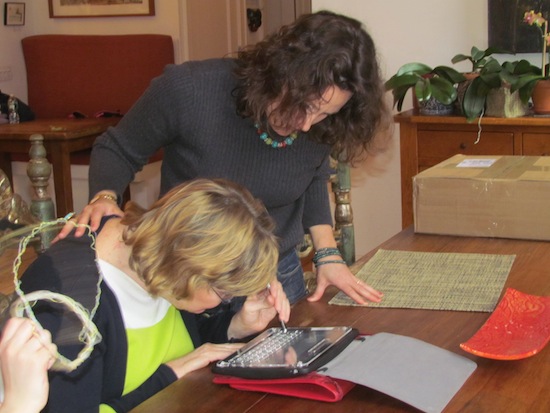
Barb types with Lois’s hand on her back as Emma twirls her string – April 2013
You’ve described yourself as a “nonspeaking (at times) Autistic.
“Yes, I think the phrase “nonspeaking at times” captures my experience, and also that of others who do have speech capabilities but can’t always access them. Because one can speak at times does not mean that speech is a reliable form of communication for that person. Also, when someone can speak some of the time, others may not notice that they are having trouble speaking. I have sometimes not been able to speak and other people just thought I was “being quiet” or did not have anything to say; that dates back to childhood.”
Why did you make a video of you not speaking?
“I made the video because we need to change some of the ideas about “high functioning” and “low functioning” Autistics. Not being able to speak is equated with “low functioning”. A constellation of characteristics are said to be true of only “LF” people, such as self-injurious behavior, toileting difficulties, and not being able to speak or having limited speech, while “HF” people are said to have another set of characteristics, also fairly stereotypical, such as being “geniuses” who are good at computer programming and lack empathy. These binary divisions don’t address the wide variety and range of characteristics of Autistic people, and paint a limited picture of individual Autistics, many of whom defy (not necessarily on purpose!) the expectations surrounding their “end” of the autism spectrum. I have always known I can’t speak on a regular basis, but the conversations about “nonverbal” people assume that I have a different experience when in fact it’s not so different at all.”
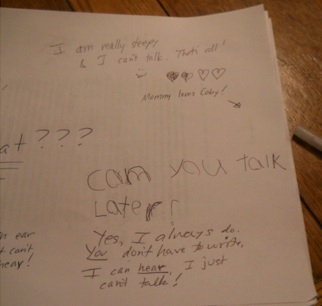
Can you talk about how and why you sometimes are unable to speak?
“I can’t say I speak “most of the time,” since most of my waking hours are not spent talking. I showed on my video, even when I am alone, I frequently can’t talk. I don’t need to talk at those times, but I am very aware that if I were suddenly presented with a situation in which I needed to talk, I would not be able to. I am, however, usually able to make what some Autistics have called “speech sounds,” which means that I can say something, even if it is not exactly what wanted to say. I have a number of reasons for not being able to speak at any given time. I distinguish between not being able to talk at all and having trouble with word finding, which does not make me lose speech, but can have some interesting results when I find a word that is not the right one! I can go “in and out of speech” several times during the course of a day.
The following list has some of my reasons for not being able to talk. These are not in any particular order: Sensory overload, being tired, reading or seeing something disturbing, thinking more in visual images than in words, trying to talk when other people are talking too fast and not taking turns‒which is not limited to the autism spectrum, although a lot of literature exists about teaching us to take turns. Some of that teaching is necessary, but I think it should be introduced to non-autistics as well!”
Are there other things that stop you from being able to talk?
Another thing that will stop me from being able to talk is to have big chunks of time where I am not talking because I am mostly alone, like when my son spends the weekend with his dad. After a weekend spent primarily not talking, I am not used to it and have trouble getting started again. It does not take more than half a day of not talking before I need to urge myself to take it up again. It’s the inertia of not doing it, plus I have to remind myself, consciously, of how to move my muscles (mouth, lips, larynx) and intentionally will myself to speak, which does not always work. Sometimes my son will ask me “Mommy, are you having a hard time talking?” and if I manage to say “Yes,” I am able to start talking again, although I can have a hard time formulating sentences and finding words for a bit.”
Of all the items on the list, which ones affect you the most?
“The thing that will stop me cold, suddenly switching from being able to speak to not being able to utter a word is seeing, reading, or hearing something that is disturbing. I write indexes for nonfiction books. Some of them have very graphic descriptions of things like genocide or war. I did my “make myself talk experiment” on a day when I was using voice recognition software to do data entry for a book that had ten chapters of very disturbing material. I used VRS a lot at that time to save my wrists and fingers for playing the organ. Since I am a visual thinker, not only was I reading it, but also seeing it in my mind, like an awful movie that I did not want to watch,. I found myself typing instead of dictating, and realized I had been doing so for maybe half an hour. I said to myself, “Why did I switch to typing?! I don’t want to be typing!” and my experiment was underway. I spent the next two hours trying to make myself talk, with no success. I was online at the time, so was typing to people telling them about the experiment. Some of them were a bit concerned that I was trying to force myself to talk when I couldn’t, but I needed to find out if I would be able to talk if I tried really hard. My answer was provided after two hours, in the form of a small squeak. That’s the only sound I could make after all that trying. I had two realizations as I finally ended my experiment, still not able to talk except for that squeak. The first was that it reminded me of when I had an epidural for a procedure and tried (yet another!) experiment to see if I could wiggle my toe. The doctor got “mad” at me and told me I was actually wasting physical energy I would need to recover from the procedure. I had the same feeling of exhaustion from trying to make myself speak. The other thing I realized is that maybe I should be carrying an autism card with me in case I was at the scene of something upsetting, like an accident or crime, and could not talk to first responders. Some things that I find disturbing and thus making me not able to talk are not that dramatic. It can be someone saying something that I did not expect them to say (not limited to “bad” things) or anything unexpected or surprising.”
What are your earliest experiences of not being able to speak?
“When I was a child, there were many times when I could not speak. I think very early on, I was not very aware that I could not talk at times; I simply did not talk when I couldn’t. I definitely spent a lot of time looking at things like dust motes in the air and the thread on my blanket and other tiny little interesting things; I have no idea if anyone tried to talk to me and got a response, how fast a response they got, and whether or not I was conscious that I wanted to say something but couldn’t. In later childhood I was more aware that I was both not speaking and wishing I was. I attributed loss of speech to being “shy,” and was angry at myself for being that way. I spent quite a few decades having times of not being able to speak, including the entire day once, and being angry at myself for not being more “brave.” Reasons include some social ones, such as being afraid of another person for whatever reason, feeling “on the spot,” having a particularly anxious day, people interrupting me. I think people were not aware they were interrupting me, as my speech was so tentative. Other reasons include being tired, having more visual thinking and not the accompanying language-based thinking, since my thinking is visual with an audio soundtrack and the soundtrack sometimes drops out for whatever reason. Sometimes the lighting or the color green will render me speechless. I love green! It is very mesmerizing! It often makes me unable or disinterested in speaking, especially the green of a large field of grass. Eeeeeeee!!!!!”
When did your views regarding your inability to speak at times change?
“After I learned about autism, I started thinking more about the reasons I lost speech. I met people who either could not talk at all, could not always reliably access speech (like me!), stuttered (like me, again), had trouble finding words, or had to say other words, circling around until the right one was selected, such as one of the “big words” I used to get teased about in school.
One of my ongoing word-choice problems is “French toast.” Early in the morning, I can’t think of “French toast,” for some reason. I ask my son if he wants “Um, um, um, um, …. uh… (then I draw a square shape in the air, since I can see the French toast clearly in my mind) … um, square things!…. French toast!” Since my son now knows that “square things” means French toast, sometimes we just stop at “square things” and he says yes or he will say, “Mommy, I want square things!” and we laugh and I make the French toast.”
Does it trouble your son that you can’t talk at times, or have trouble saying what you mean?
“My son is very good at talking about things he doesn’t like, but I don’t assume that he would feel entirely comfortable directly telling me things he doesn’t like about me. The things he does say indicate support rather than discomfort. A few times I have been annoyed at myself for stuttering and he says “Mommy! Don’t ever be mad at yourself for stuttering!” or, a few times, “Mommy. Stuttering. It’s a way of life.” I don’t not-communicate with him, so he does not feel ignored. I use alternative ways of communicating with him, just not talking. I write, point, use some of my extremely limited repertoire of ASL signs. I once was writing to him about what to wear to church and he wrote back “Yes, mother dearest!” He (as is true of most people I write to) matches my communication mode and writes back. I have written to him (and to others) “You don’t have to write to me; I can hear you!” He has noticed, and told me, that when he comes back from visiting his dad I “seem different.” We have talked about his coming back as a transition point- the house is suddenly noisier, and definitely “talkier.” I have often said that my child talks to think, so we are quite different in that way. I am working on what would make the transition from “kid gone” to “kid in the house” an easier one for both of us.”
For people who do not have difficulty speaking, they may have trouble understanding how someone might be able to speak in one situation and then not able to in another. Can you talk more about this?
“Some abilities are not there every single time a person wants to access them. This is true for all people, but for an Autistic person, these fluctuations in abilities and access to abilities might be more pronounced. If I don’t play the organ almost every day, it’s almost like I forget how to play it. That’s why I always practice on Saturday night and Sunday morning before church. There is no way I can go in there cold and play like I want to. Think of something like delivering a presentation. For most typical people, there will be good days and bad days, presentations you wish you could do over, and days when you were really “on your game.” Or, think of your favorite sports team and player. Some games are not so good; other games the team really does well. But playing the organ or hitting a home run is not an essential life skill (ballplayers and organists feel free to disagree!). But when it comes to anything considered really basic, like being able to talk, a sense of mystery surrounds the topic, when a person can do it one time and not another. I maintain that it’s not that different anything else, but is more noticeable and pronounced when it’s something that is expected of everyone, and when one can do that “expected thing” most of the time. Maybe for some of us talking is an extreme sport, in the sense of having to really work, practice, try hard, take risks, and think consciously about what we are doing, whereas for some people the ability to talk is very natural and not even a conscious effort.”
Talk about the idea of language and thinking.
“I have read more than one author who opines that without language there is no thought. Nothing could be farther from the truth. Language includes both written and spoken words, as well as picture-based communication systems like PECS. Not talking (and also not writing) does not equate with “not being able to think,” “being lost in an unknown world” or anything other than specifically not being able to talk. For some people it could mean a lack of focus on “the present moment” (how many people are fully present in each moment anyway?!) or not being able to think in words, which is another one of my reasons for not talking. But it is not, generally speaking, accurate to assume that because someone can’t talk, they can’t think. You wouldn’t look at someone who has a tracheostomy tube and go “Oh wow. That person can’t think!”
What is it like when you’re unable to speak while in public and are expected to?
“It’s a bit nerve-wracking, but only in situations where people do not know me well and are expecting that I can speak like a non-autistic person. I try to anticipate what I will need to be able to communicate at those times but I can’t always build in my own supports. When I am with friends, it’s no big deal if I can’t talk or can’t talk much. In work situations it’s more difficult for me to feel calm about it. Unfortunately this expectation is not limited to people who don’t know much about disabilities, so that I have had to really struggle at autism-related events where there really aren’t accommodations for Autistic ways of communicating. It’s an ongoing process for nondisabled people to learn about communication differences and to anticipate them so that Autistics and other people with communication disabilities aren’t doing most or all of the work to create our own accommodations.”
How do people react to you?
Really, I mostly don’t get reactions, because often the times that I can’t speak coincide with the other person continuing to talk, maybe because they think I don’t have anything to say, or that they are like “Well, if she’s not going to talk, I will!” I do get all kinds of reactions, from total acceptance to “you could if you wanted to- try harder” kind of thing that made me feel sad when I was making the video. Sometimes people don’t believe me when I say (in speech or writing!) that I have trouble talking. I have to be very clear that I mean not being able to talk at all. I have learned that “trouble talking” might mean not saying the right thing, or stage fright, and “I can’t talk right now” can mean “I am too busy to deal with you” rather than that I literally an unable to speak with words coming out of my mouth! I have had a few mixups when people did not know I meant “I can’t talk right now” very literally. Sometimes people just don’t quite believe me and think I am making it up. I am not sure why they would think I would go to that much trouble! There are also people who have never heard me stutter, who think that I don’t, even though I tell them I do. They are going to get treated to another video in a few weeks! I was finally able to capture myself stuttering at a time when I also had the webcam with me.”
Are there things that help you speak after a period of not speaking?
“I mostly just have to wait. I don’t particularly want to talk a lot, but I need to. It’s just one of those things that is expected, and it is expected that if I can do it some of the time, I can do it all of the time. It might seem that someone who can speak but loses speech at times would want to find ways to prevent speech loss, but I often welcome not being able to talk. It gives me a break from the exhausting task of speech production. My idea of the perfect conversation and this is ideal for a number of my Autistic friends, too, is two laptops or mobile devices or text-based equipment, but we can be in the same room together writing to one another. I don’t get a lot of this because I live in a rural area and most of the people I write to are long-distance. Some friends locally are very accepting but we don’t have any alternative setup other than me scribbling on paper. I also get way overloaded by hearing other people talk, as it challenges my auditory processing abilities and I can only take so much talking. If other people, whether or not they can speak, would type to me, I think I could get a lot more accomplished with the interaction with that person. Or, at least I think I could. If writing is not that person’s strongest form of communication, it will be a limit for that person. We should not be expected to always accommodate “talkers” and not the other way around. But it does take extra effort on my part because people can’t tell just from looking at me that I am a person who sometimes can’t access speech.
Ideally, we could take turns using each person’s communication strengths and weaknesses, assuming we are able to do that much. Of course, sometimes it just won’t work.”
Friday we arrived safely in Aspen, or as Emma described it, “We have to take two planes, then get to see Granma!” Despite my reservations about not having any seats together, people were kind and accommodating, several happily moved for us and we ended up all together. I didn’t have to plead with anyone, or explain; I think this was a first!
Upon our arrival Nic and Emma ran ahead, first Nic flinging his entire body against my aging mother with all his might, so happy was he to see her and then Emma, more timidly perhaps, but with no less excitement wrapped her arms around her granma and hugged her. We have been through this routine dozens and dozens of times, taking two airplanes, arriving in Aspen, my mother always there at the airport to greet us and never has Emma greeted her granma like this without at least some prompting. My mother looked up at me with her beautiful smile and said nothing. She didn’t need to. Emma was now holding one of her arthritic hands and exclaiming, “Oh, Granma hurt her fingers!” But instead of then racing off or letting go, she continued to hold her granma’s hand, tenderly examining her arthritic fingers, the same misshapen fingers my grandmother had, that as a child, I too had found so fascinating.
Later as Richard was unpacking and I was setting my computer up in the adjoining bedroom, Emma came in and said, “Going to go outside. We can go outside and talk. Talk with Mommy.” She then opened the door to the porch directly outside our bedroom and sat in one of the chairs. “Mommy sit here,” she said, pointing to the other chair.
Obediently I did as she directed and we talked. Emma talked about how high it was from where we were sitting to the ground downstairs where she could see the dogs playing. She talked about how I was sitting with her in the chair next to her. She walked the length of the porch and talked about how she couldn’t reach the dogs, nor could she reach the ground downstairs. We discussed distance and the difference between being inside and outside and then she stood in front of me and said, “Now I’m going to sit on Mommy’s lap.”
Which she then did. And I wrapped my arms around her, while we looked out at the Rocky Mountains, jagged and covered in snow and breathed in the crisp mountain air together.
The next morning, outside with the dogs, who were behind me looking at Emma.
For more on Emma’s journey through a childhood of autism, go to: Emma’s Hope Book
Sadly, I have no new photographs of Emma petting Merlin. After that one brief encounter she has returned to ignoring him. He seems to take it all in stride, poor kitty. But it leads me to another topic I keep meaning to write about – building blocks. Not the literal kind, but the developmental kind. Children typically go through a series of advancements in their speech, physical abilities, etc. There are specific physical milestones – lifting their head, turning over, crawling, standing walking, and on it goes. A foundation is being laid down which further progress is built upon.
What I have seen with Emma is less a foundation and more a series of seemingly unrelated events. We see her do or say things never to be repeated or if they are, not for many months or even years. I’m not sure I would have noticed this, except that I’ve made a habit of noting everything she does and then writing about it. She pets Merlin and then instead of tentatively reaching out to him again the following day, it’s as though she never spent those few minutes petting him.
It reminds me of when she was just over a year old. She would learn to say something – “play catch” and we assumed that these two words would now be added to the other words she had, such as ba-bye, dada, ah da (all done), hi, okay and no. We expected to hear them uttered again. At the time, knowing absolutely nothing about autism, we weren’t looking for signs of anything being wrong. When she didn’t repeat – play catch – we assumed it was because she didn’t want to play, not that it was a one time event, never to be spoken again.
When I look at her baby journals, (which I discontinued after she was diagnosed – more about that some other time) the first two and a half years of her life, I am struck by the words she knew by the time she was thirteen months old. Including the ones I’ve listed above she said, Bertie (the name of our elderly cat), Ma-ma, Nic, and Ra-ra (our caregiver). I was concerned with her lack of language, but it wasn’t as though she wasn’t speaking at all and then she’d come out with something like “play catch” and I would sigh a huge sigh of relief and push my concerns aside. Except that she never said play catch again. The full list of words she spoke as a thirteen month old were either salutations or proper nouns of the main people in her life. Other than the one time she said, “play catch” she did not use any verbs or nouns. It was at around this time, between thirteen and fifteen months of age that she would seem to learn a new word or phrase – “play catch”, but also, “chase me” and “go out”. Some of them, like “chase me!” she would say many times but at around eighteen months she suddenly stopped. We never heard her say those two words again. It was as though there were some sort of black hole sucking all those words and phrases away.
Still we fully expected to hear her say those words again, that she did not was something we didn’t realize until much later. At the time we were sure it was because she chose not to, as opposed to something neurologically wrong. Why would one assume something was terribly wrong when she would come out with a new phrase or word the next week? It wasn’t until we were told she was autistic, and only after much research did I begin to look back on all those hopeful notes from her baby journals and see a pattern. There was not the steady building of a foundation of words, ever added upon to become an extensive and diverse vocabulary. Instead there were a few scattered words and phrases some repeated, some never heard again. Arbitrary words, perhaps she heard us say and repeated, but the milestones were not being reached in the time frame one normally would expect.
What I see now is that Emma is slowly, slowly building a vocabulary, but it is at a snail’s pace and it does not follow a neuro-typical trajectory. Still she is advancing in her own haphazard way. Who knows, she may even pet Merlin again.
For more on Emma’s criss-crossing journey through a childhood of autism and my ongoing attempts to make sense of it all, go to: www.EmmasHopeBook.com
Last night Emma arrived home in tears. It turns out she had swallowed a piece of peach flavored gum and her therapist, Joe, who had warned her that if she swallowed the gum he would not give her another piece, wouldn’t allow her to have another. He offered her two other flavors to no avail.
“No! Peach gum!” Emma cried when I went into her bedroom to sit with her.
“But Em, you swallowed it and Joe told you, you couldn’t have another piece if you swallowed it,” I said, stroking her hair.
“No!” Emma shouted, tears streaming down her face. “NO! Peach gum!”
“How about a different flavor? But you can’t swallow it or you won’t be able to have another piece of any kind,” I offered.
“No, no, no, no. Peach,” Emma insisted.
I often wonder, when Emma is derailed by something, seemingly rather insignificant, if there isn’t a whole series of events – perhaps unrelated – that have lead up to this kind of monumental upset. It reminds me of days I’ve had, when everything that could go wrong does. I get to work and my printer won’t scan, the cartridge is out of ink and I don’t have a back up, I can’t remember my password to upload images that have been requested to my FTP site, my merchant account isn’t showing my latest sales transaction, my gem setter calls to tell me he’s chipped a stone, I forgot to bring some documents I need from home, etc. and then after all that I go home, having put in nine or ten hours of work, tired and grumpy and find a light bulb has blown in the living room. It just seems too much. Meanwhile my husband wanders in, sees me and says innocently, “Hey, what’s going on?”
Those words are what flip the switch and suddenly I feel nothing but rage.
Is that what it’s like for Emma sometimes? Only she can’t take a deep breath and explain that her day has been a nightmare of frustrations and mishaps, while the other person nods their head and says things like, “God that sounds awful. Here why don’t you put your things down and let’s talk about it.” Or “I know just what you mean. It’s been a hell of a day.” Poor Emma can’t say any of those things. She doesn’t have the words to tell me how she’s feeling she can’t keep it together for one more second, so she just screams and cries and if things are really bad, bites or hits herself.
This morning one of her therapists emailed me, telling me about some of her frustrations at school yesterday. I thought about how upset she was when she came home and it all began to make sense. She had a bad day. I can relate to that. I have bad days from time to time too. But I can pick up the phone and rant about it to one of my girlfriends or I can call my husband and tell him or I can sit and try to be quiet for a few minutes, “sit with the discomfort of it all”, as a meditation teacher I knew referred to those moments when it all feels unbearable. The point is I don’t have to be alone with those feelings of frustration. I can reach out and by reaching out I mitigate the feelings.
“You were frustrated, you scream, you bite,” Emma told her therapist yesterday. Emma was doing what we all do when we’re upset, trying to communicate her feelings with another human being.
Emma on a good day when she was seven.
For more on Emma’s journey through a childhood of autism and how that effects her older brother, go to: www.EmmasHopeBook.com
Emma is fussy about what she will eat and drink. The type of food is sometimes less important than the packaging. If the packaging changes or varies, even a little the item is rejected. As with so much in autism it is all about regularity and routine. Emma is completely thrown by the unexpected when applied to things she is accustomed to.
For the past two years Vanilla Milk from Horizon has been on Emma’s top five list of favorites. It’s the little milk in a white and purple box with plastic wrapped straw glued to the side. Except Horizon changed the packaging about three months ago – the colors remain the same, as do the graphics, size, shape and even the little straw. What has changed is they no longer use a coating to make the little boxes appear ever so slightly glossy. The boxes are now a bit flatter looking. Honestly, it wasn’t until Emma stopped drinking them, that I realized they had changed.
When we arrived in Aspen, we had a case from Christmas in the mudroom with the original packaging and Emma immediately grabbed one.
“Vanilla Milk!” she said with pleasure.
We are nearing the end of that case and so she will boycott them once again. Not that I care much as they are one of the least healthy things she consumes, but I do mind that she won’t eat the Cheerios we buy here, haven’t figured out why. We bring her special bread with us, which we cannot get out here and her jam, so it was with some dismay when she refused to eat any of those things this time out, as well. Last night I asked her what she wanted for dinner. I told her what I was having and asked if she wanted some. She always answers no, so it wasn’t a big surprise when she again said, “No?” as though it were more of a question, than a statement.
“Okay, so what would you like?” I asked.
“Bread,” she announced and handed me two pieces of her bread, which she had buttered and placed together, like a butter sandwich.
“Oh!” I said with surprise. “You don’t want it toasted?”
“Yes. Toast.” Emma said. Then she handed the bread to me and said, “Put it in the bakery.”
“In the bakery?” I repeated, looking around, wondering what she meant.
“In the bakery?” she said again gesturing at the oven.
“Oh! You mean the oven. You want me to put it in the oven to warm.” I am often amazed by Emma’s creativity in her choice of words. She has seen me bake bread in the oven. She knows bread comes out of the oven and more often comes from a bakery.
“Yes. Make it nice and warm!” Emma said.
“In the oven,” I said.
“In the oven,” Emma repeated.
“We have to heat the oven first and then we can toast it. But we have to get a cookie tray to put it on, otherwise the butter might drip out,” I told her.
When her bread was done, I opened the oven.
“You have to stand back,” Emma said sternly.
“It’s okay Em. Here, I’ll take it out and you can take it to the table.”
After Emma ate her bread she said, “Another bread from the bakery?”
“Yes. We can do that. You make it and I’ll put it in the oven.”
I keep waiting for the kind of miraculous progress you only find in movies or works of fiction. Every now and then I’ll hear a story about a child who has recovered (or as they say in the field – lost their diagnosis) but these are so rare they fall into the category of fantasy in my mind. Every now and then, when I find myself longing to wake up one morning and have Emma jump into bed with me speaking in full sentences, a look of cognition unmistakable on her face, I must remind myself of all the steps, the tiny steps of progress she makes everyday. It isn’t just about making myself feel better, it’s about charting her progress.
Last night she went over to the phone in the kitchen.
“Hey Em. Do you want to call Daddy?” Joe asked.
“Call Daddy?” Emma responded in her typically enigmatic way.
“I’ll say the numbers,” Joe prompted.
Emma dutifully found the right buttons to push and held the receiver up to her ear. “Hi Daddy!” Pause. “Hi Daddy!”
I stood next to her, wondering if she’d gotten the answering machine.
“Hi Daddy!” Emma said again.
I tried to listen to see if I could detect Richard’s voice. I didn’t hear anything. “Did he answer?” I asked Joe.
“Yeah. He picked up.”
“I’m fine,” Emma said.
Silence.
“Yes. Glenwood rec center. Swimming, ice skating,” Emma said into the phone. A clear response to the question – What did you do today? “Sledding, skiing…”
“No, you didn’t ski today,” I interjected.
“No skiing,” Emma said. “Sledding.”
By this point I had my ear next to her cheek and could hear Richard’s voice. “I miss you, Emmy,” I heard him say.
“I miss you, Daddy,” she said.
The conversation went on a bit longer, but I was so overcome by the fact she’d said – I miss you Daddy – in response to him saying, I miss you. Usually when Emma repeats us she repeats us in total. In other words she would say – I miss you Emmy. An exact replica of his sentence to her. But she didn’t do that. She responded appropriately with the appropriate pronoun. I was impressed.
I know this is small, but to us, it’s HUGE. A huge step for Emma to express emotions regarding another person.
Later I said to Richard, “That was completely unprompted!”
“Really?” he asked.
“Yes! I wasn’t prompting her to say anything,” I told him. “She said it all on her own. It’s the Aspen air out here,” I said, referring to our theory that there’s something in the air out here, which seems to inspire an uptick in her language and cognition. We have seen it every time we come here. Blame it on Aspen, blame it on all the exercise she gets out here, blame it on anything, we’ll take it.
“It’s Mommy! Mommy come to visit!” Emma said this morning when she saw me. It’s an odd feeling to have one’s own child, a child one lives with and sees on a daily basis, exclaim with apparent happiness that I’ve come to visit, especially when I am in my own home. My first thought was that as Richard and I went out the night before and I only saw Emma for a brief period before we left, she was indirectly expressing her feelings that I haven’t been around enough. Then I began to feel guilty and consoled myself with the fact that I will not be going out again in the foreseeable future. “You came to visit!” Emma said, cutting through my thoughts.
“Well it’s not really a visit, when I’m here all the time,” I said in an effort to clarify and unburden myself of just a little guilt.
“It’s Mommy!” Emma repeated, as though she were surprised.
It reminded me of a time not long ago, when Emma on one of her perseverative loops of anguish, kept running through the house crying out something none of us could decipher.
“What is she saying?” we asked each other more than a few times.
Emma’s upset became more extreme and ended with her biting herself.
Someone (it may have been me) then asked, “Why is she doing this?”
I remember thinking, “Umm, because she’s autistic? Do we really need to look much further?” But I didn’t say it out loud, okay so maybe I muttered it under my breath. The point is, applying my own reasoning to Emma’s behavior usually doesn’t get me very far. And often it is counter-productive.
“You came to visit!” Emma repeated again.
“No Em. I live here. You visit someone when you go to their house, a different house to see them for a little while or when they come here, to our house, but then leave, then they visit you.” Okay, so it wasn’t the best explanation I’ve ever come up with, but it was the best I could do in the moment.
Emma stared at me for a moment and then said matter-of-factly, “Have breakfast now.”
“Right,” I said. Too much information. Got it.
When Emma and I were in her bathroom, getting ready to brush her teeth, she stood on her little stool and while looking at herself in the mirror, put her arm around my neck, pressing her cheek against mine. “It’s Mommy!” she said, pointing to my reflection. Then she gave me a kiss on the cheek.
It was one of the moments you wish you had a remote control to hit the pause button on. I thought of how it was such a typical little kid thing to do, how wonderful it was to see her do something like that.
“Let’s go visit Nic,” I said after she’d finished brushing her teeth – meaning we should go find him, see what he was doing. And I caught myself. I understood how and why she said, earlier – I was “visiting.” Emma was hearing the word used and applying it as best she could in a similar situation.
Last night as Emma was getting ready for bed, she said, “Remember, he took it.” She looked over at me and then said, “He take – no, he took it?”
“Took. He took it. That’s right Em. You had it right the first time.” I was dismayed to hear her correcting herself. I’ve never heard her do that before. There have been countless times, Emma has used the past tense, but this was different. She was using the past tense, then playing with the present tense as though she were trying it on for size and coming to the conclusion the past tense was what was needed. And she was correct, which made it all the more incredible.
She smiled at me and repeated, “Remember when he took it.”
“Who, Em. Who took it?” I asked.
She ignored me and continued, “Remember then you running – you ran.”
“You’re remembering our day at Bounce U, aren’t you?” I said.
“Mmhm,” she answered. “Mmhm” is new. It’s something Emma says now instead of “Yes,” which she often said in the past, even when she meant “No.” Now she says, “Mmhm,” or however you write out the sound of agreement people make which is less than “Uh-huh” and more than “Mmmm.”
“That was a fun day, wasn’t it?”
“Mmhm,” Emma nodded her head and added, “He took the picture! You have to give it back. You ran. That’s funny.” She sat up and began giggling.
I realize a little explanation is needed here.
On Emma’s birthday – which she shares with Martin Luther King – Richard, Joe, Nic and I took Emma to an indoor playground filled with inflatable structures. It’s way out in Brooklyn and appropriately named, BounceU. Emma loves the place and since we’d celebrated her birthday with a party and friends the day before, it seemed the perfect setting to spend her actual birthday.
Once we arrived, we ran into a friend of Emma’s from her school who was there with both her parents, Ryan and Susan. Ryan had a camera with him, which Emma immediately wanted to take pictures with. It quickly became a game with Becca’s good natured dad chasing Emma as she ran around taking shots of – the carpeting, people’s feet, her own face, etc. before he caught up with her and took the camera, often hiding it in places she could see. Emma would then try to sneak the camera away while Ryan pretended not to notice, the whole thing was hilarious and Emma has referred to that day many times since.
Emma continued to giggle. “He took it. He want to take a picture. You ran!” She was laughing so hard she had to catch her breath. “No! You have to give it back!” This last was said in a stern voice. “Emma!” Then she doubled over with laughter and said, “Remember?”
At this point I was laughing too. “Em, that was such a fun day, wasn’t it. And you got to spend time with Becca.”
“Yeah,” Emma said, before starting to giggle again.










 Emma's Hope Book