Tag Archives: non-speaking

Silence and the Words That Fill it

Emma has been writing stories to give as Christmas presents to a couple of special people in her life.  It is an exhausting process for her and one that takes a great deal of time.  As the person who is witnessing and encouraging her to keep going, it is always revelatory.  Her gift to me is her ongoing commitment to keep showing up for the hard work that is required of her to communicate in ways most people consider most important, with words.   However as I sit with her I am increasingly aware of how much, those of us who are talkers, often miss.   Because of my daughter, I have a heightened appreciation for the beauty of silence words seek to fill.

I cannot quote anything from the amazing stories Emma has written for family members, as they are gifts to be given tonight and tomorrow.  But I can quote this, which Em wrote in response to my question – “Tell me one thing about Christmas?”

Emma wrote, “Christmas means love and family.”  (This, from an eleven year old.)

There is nothing more to say.

Merry Christmas to those of you who celebrate and for everyone else, may you experience love and family, in whatever way those words may mean for you this holiday season.

Why People Walk With Two Legs Instead of Four

Emma wrote this folk tale yesterday.  She gave us permission to post it here on the blog.  It took her 45 minutes, pointing to one letter after another.  She is so, so talented!

Why People Walk With Two Legs Instead of Four

“Many years ago, people were walking on all fours like many animals.  Reaching for food meant they could use front arms or back legs.  They were very strong.  Other animals were not afraid of them.  They looked at other animals as family.

“There was much to see from being so low to the ground.  There was much to touch from living in the dirt and the grass.  They tasted whatever they could. People now are more fussy with food.  The smells were all they knew.

“What is missing?

“You are right if you said:  sound.  People heard sounds from high above and they did not know where they were coming from.  The sounds were soft and silky.   Days went by without knowledge of sound.  One people leader wanted badly to hear it louder.  The only way she thought possible was to be taller.  She practiced standing on her back legs and it was successful.  Everyone else followed.  The soft and silky sounds were birds chirping.”

Emma began writing this series of folk tales while we were in Texas last month.  She has written five now and the third one was entitled, Why People Walk on Two Legs.  You can read it by clicking on the link, but in it she wrote, “They had to work in the fields wearing knee-shoes and regular shoes.  They could not run fast that way.”  I love that!  She goes on to talk about a king who had outlawed walking, until he was injured from all that crawling around and the only remedy was for him to walk, whereupon he made it legal for people to walk on their two feet and so they did, never looking back.  To me, that story was about how until we experience what another goes through, we often remain divided, though I have no idea if that was her intent.   This one is completely different, even though the titles are similar.

I am in Chicago at the TASH conference, where IbbyLeah Kelly and I are presenting first thing this morning on Relationships and Multi-media (so excited to be with my two wonderful friends!)

Em giving the Queen’s wave astride her favorite statue – Balto

Em on Balto

Autism Speaks and Signal Boosting

Signal boosting.  I love that phrase, it reminds me of a train yard.  That’s the image that comes to mind when I write those two words.  Signal boosting is when someone else shares a link or another’s writing either on a blog or on some other form of social media.  It’s the single most appreciated and important tool, those of us who are not Autistic, can use to help amplify the words of those we support.

The other day I signal boosted a letter to the sponsors of Autism Speaks from ASAN, Autistic Self Advocacy Network, – you can read that letter ‘here‘, which outlines why they are asking sponsors to reconsider lending their support to Autism Speaks.  I thought it was an excellent letter and as such, I decided to post it on my timeline on Facebook, with the heading, “For all who may be confused as to why so many are asking to boycott organizations that sponsor Autism Speaks, this is a wonderful explanation.”  And that’s when the proverbial shit hit the fan.  I’m not going to derail this post by going into the specifics of the comments I then received because I want to use this time to discuss Autism Speaks and why I object to what they are doing.  Again ASAN’s letter is an excellent point by point summation of exactly this, but I will attempt to give my personal views and why I have come to believe as I do.

Many defenders of Autism Speaks point out all the “good” they have done and continue to do.  They highlight insurance reform, their 100 day tool kit, autism awareness, spending millions of dollars on research, etc and yet, even if every single thing people who support Autism Speaks believe they are doing that is positive and helpful to Autistic people were true, (which I, for one, do not believe) it still does not take away from the fact that Autism Speaks does a great deal that hurts Autistic people and my child.  Autism Speaks uses its power and massive reach to shape how the public views autism and autistic people.  Suzanne Wright’s A Call for Action is a good example of this.  She begins with –

“This week is the week America will fully wake up to the autism crisis.

If three million children in America one day went missing – what would we as a country do?”

“Went missing” furthers the misconception that our autistic children were once here, and now are gone.  This idea is not helpful to anyone, least of all the parents who are new to a diagnosis and their young children.  Nothing positive, absolutely nothing positive comes from this kind of language, in fact this is exactly the sort of thinking that had my husband and I pursuing all kinds of “cures” not so long ago.  It was this thinking, that my daughter was buried beneath “autism” and that if I could just find a way to release her from its tortured grip, I would have done the noble thing, the right thing for my daughter.  As painful as it all was, as terrified as we were, she would thank us later… this was my thinking.

And yet, none of this helped me find ways to help her communicate.  Once we found a way to help her write and find her “voice” that was when the real miracles began to happen.  Helping my daughter communicate is what she is thanking us for now, not all those so-called “cures” we traumatized her with.  And please know, I mean that word, “traumatized” literally.  You can read more about some of that trauma ‘here‘, ‘here‘ and ‘here‘.

Suzanne Wright continues with increasingly alarmist, even threatening language.

“And, what about their parents? How much can we ask them to handle? How long will it be before the exhaustion makes them ill?  How long before they break?

“How long before they break?”  Given that several parents have recently attempted and some have succeeded in killing their Autistic children, this language is particularly repugnant.  This is not a call for action, it is a call for fear.  It sets autism up as something to go to war against.  It dismisses the horror of these crimes against their own children as something that is practically inevitable.    It suggests that autism is the reason people would go to such extremes, but nowhere does Autism Speaks suggest it is the public perception, a perception they have had a massive hand in creating, that makes the lives of families and our Autistic children more difficult and yet I can tell you, it  does.  What they are doing, what they are saying is making my daughter’s life harder, not easier.

Those horrible ads (ransom notes) they posted all over New York City in 2007 and then took down because of the public outcry, the videos of parents who speak about their children, while their child is right there, but because their child does not speak it is assumed they cannot understand what others are saying… these are the things people believe, but that I have learned from my non-speaking Autistic friends and my daughter are simply not true.  My daughter understands everything that is said around her and she is not alone.  So many who do not speak have written about this, Ido, Naoki, Amy, Nick, Joey, Barb, Carly, Tito…  too many to ignore or to dismiss as an anomaly.

In one video Autism Speaks produced a few years ago, the mother describes how she thinks about driving off the George Washington Bridge with her Autistic daughter in the back seat, the same daughter who goes over, numerous times, as her mother talks to the camera, to hug her. This video continues to haunt me.  I no longer believe that child did not understand what her mother was saying.  My daughter understood everything we said in front of her, even though at the time she gave no indication she did.  I now know differently.  What must it have been like to be that child, to hear your mother saying to a camera crew that she thinks about killing herself and you and that the only reason she does not is because of her other non autistic child?  What would that be like to be that child?

These ad campaigns, these videos, these words, these “calls” for action DO have a huge impact on what people then think about autism, about Autistic people, about my daughter.   People make assumptions about my daughter’s intellectual capabilities all the time.  If you are curious to read some of what my daughter is writing these days, please click ‘here‘, ‘here‘ and ‘here‘.  None of what she is writing is thanks to anything Autism Speaks has done.  Autism Speaks absolutely impacts my daughter’s life, and they aren’t doing her any favors.  

In the end, it doesn’t matter what good Autism Speaks has accomplished, until they really understand why so many are so angry, as long as they continue to not include Autistic people in any position of power, they will continue to be attacked by the very people they claim to represent.  How long will it take?  What will need to happen before Autism Speaks stops talking and LISTENS to those it keeps insisting it represents.  So many Autistic people are furious. And so am I.  All their power, resources, money could be used to do so much good for Autistic people, they could make such a difference in the lives of so many…

I stand beside my Autistic brothers and sisters and I will signal boost their words at every opportunity I get until they are able to take the microphone away from Autism Speaks and people begin to hear their voices. Their voices are what the public needs to hear, NOT Autism Speaks.

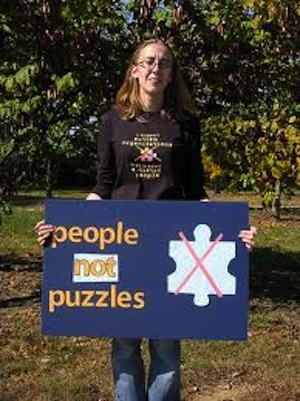
Image of Melanie Yergeau with a sign of a red X over a puzzle piece.  To the left of the image are the words “people not puzzles”

images-1


Celebrating Gratitude

Emma and I discussed yesterday’s post and I asked her what she thought of the way I’ve described her as an “unreliable speaker.”  I haven’t liked how negative that sounds, though I have meant it more factually, and was not suggesting anything beyond those exact words.  She wrote, “Yes, unreliable.  Mostly talking other words even though not what I think.”

We discussed the comments many have written about believing her and how today is, for many, a day celebrating gratitude. I told her how grateful I was to be able to communicate with her.  She told me I could post some of what she wrote in response…

“Decade of ignorance dead. Deny ideas of intelligence can directly minimize the amount of self-worth one feels. I am grateful many are believing in me.”

Happy Thanksgiving everyone!

This photograph of Emma was taken outside my old studio by Jackie Maillis.  Thanks Jackie!

Power


“Let Me Tell You…”

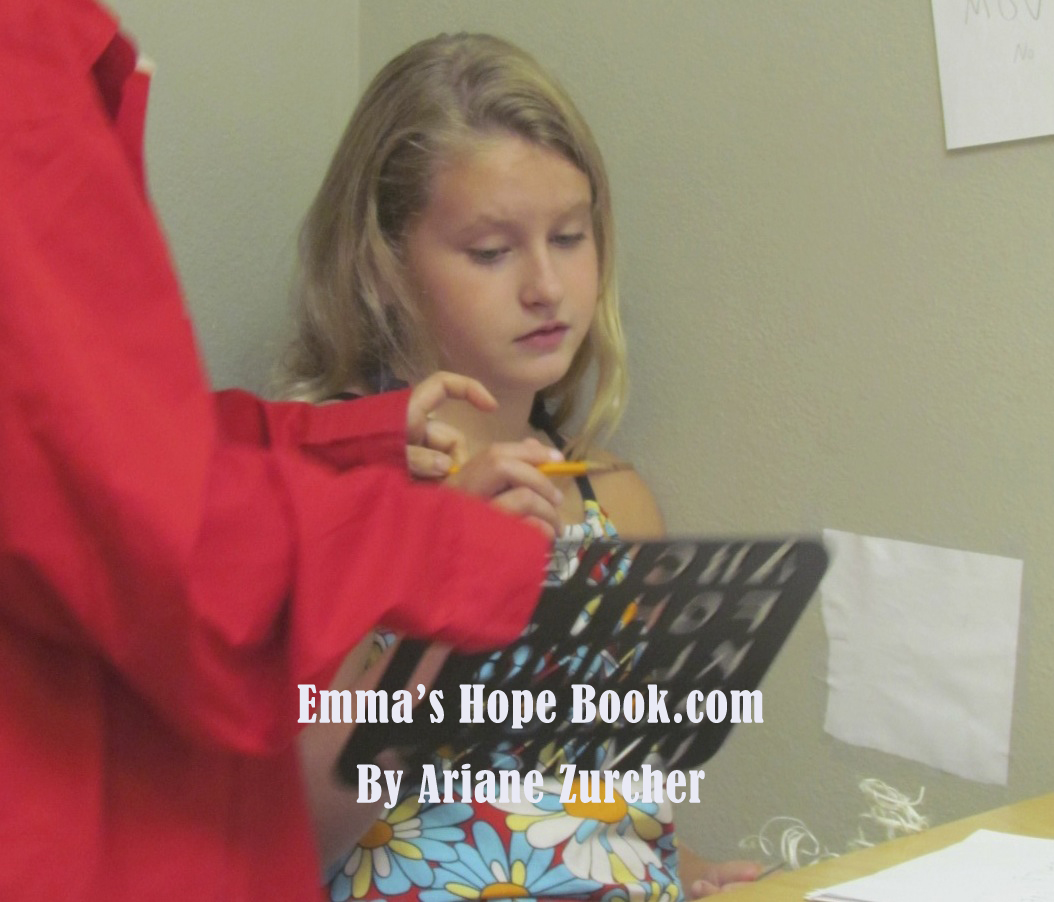
Emma gave me permission to tell all of you what she would invent were she an inventor.  *A little background – the quotes from Emma are what she spelled out by pointing to a letter, one letter at a time on a stenciled alphabet board.  No one touches Emma as she does this.  In fact there is no physical contact of any kind during the session, also known as an RPM (Rapid Prompting Method) session.

Emma has been doing RPM daily with me since the end of September.  Within the past two weeks she has begun to answer open-ended questions with me.  However the session I am going to write about was with someone who was trained by Soma Mukhopadhyay (the creator of RPM) and whom she is now seeing a couple of times a week.  This person, who I have not asked permission to print her name and so will refer to as B, has been doing RPM for a while now and as a result is able to move far more quickly into open-ended questions than I am.

In their previous session they had discussed train engines.  At the end of their session B asked Emma to think about what she might invent were she an inventor.  When Emma returned for her next session they began with the question, “What would you think was a really great thing to invent?”

Emma then replied, “Let me tell you that it is not a train engine.”

I have to interject here…   I love how ballsy my daughter is.  I love that she didn’t just answer with one word.  I love how audacious, cocky even her answer was… “Let me tell you…”  Emma spells words out, and I sit watching, literally on the edge of my chair, waiting, wondering what wonderful words will she write?  “Let me tell you…”  YES!  I cannot wait to hear what you have to say!!!!!

Emma continued, “It is more from the future…”

B urged her to tell us more.

“It is a spaceship.”

For all who know my husband this answer has brought a smile to your face.  For those of you who do not, let’s just say he has a particular fascination with spaceships, UFO sightings, etc.  He has logged in many an hour watching YouTube clips of various sightings.   As I sat watching my daughter spelling out these words I kept thinking how much Richard was going to LOVE hearing about this session.  But there’s more…

B encouraged Emma to continue, asking her to tell us more about the spaceship she would invent.

Emma spelled out, “Have you ever seen spaceships in New York?”

Sorry, I have to interject again.  This question… this question is wonderful and defies all that is commonly thought about so many of our kids who cannot verbalize questions like this.  For all those parents who have never had their child ask a question, for all who have bought into this idea of Autistic self involvement, of a lack of interest in others, this thought that our children who are non-speaking or unreliable speakers are “caught” or “lost” in some other world… to all of you, I suggest we rethink these ideas.  My daughter is not the only one writing things like this, she is one of many, many children, teenagers and adults who cannot voice their thoughts, but are writing them.  I have watched her, time and time again, asking questions; this kind of engaged conversing goes against everything we are taught and being told about non-speaking/unreliably speaking autistic people.  

B answered Emma’s question saying that she had not seen a spaceship in New York City.  She said she’d seen a great many different types of transportation in New York City, but never a spaceship, to which Emma then wrote, “You never have to wait to go anywhere.”

B then asked her how you could get a spaceship and Emma wrote, “You buy it on your own or you get a monthly pass.”  (In New York City most of us take advantage of the terrific subway system.  To use the subway you need a “Metrocard” which you can purchase for a single ride, multiple rides or for those who commute daily a monthly card of unlimited rides.)

B observed that as parking in New York City is already limited she wondered where a spaceship would go.  Emma wrote, “No parking needed.  Once they have landed they become invisible.”

B then asked her,  “How do you call for one?”

Emma wrote, “You have a button to press and it arrives right away.”

Let me tell you…

images

Facing the Skeptics

It’s snowing.  In New York City.  Right now.

“Look Daddy!  It’s snowing!”  Em said this morning.

There’s nothing particularly spectacular about that comment, except to us, it’s not only spectacular, it is exciting and yet another example of how my husband and I continue to underestimate our child.  (This is less a criticism of us and more a statement of fact to illustrate a larger point.)

“Em, do you know who the president of the United States is?”

“Yes,” she spelled out.

“What is our president’s name?”  I asked.

“Barak Obama,” she spelled.

“Do you know our vice president’s name?” I asked, thinking this might be taking things too far.

“Yes,” she spelled again.

“What is the name of our vice president?” I asked.

“Biden,” she wrote matter-of-factly.

“Communication is the most essential use to which spelling should be devoted.  It should not be used as a test or an exhibition piece.  Try being confined to a sentence a week and see h ow you feel about using that sentence to answer some stupid question about whether you live in St. Nicholas.  If Rosie had spent all her time giving tests we would not have had time to use spelling for our own communication.  Crushing the personalities of speechless individuals is very easy: just make it impossible for them to communicate freely.” ~ Anne McDonald from the book Annie’s Coming Out

This is what we are striving toward.  Annie’s comment here is one I have read and reread and yet find so difficult to apply because I am in a near constant state of disbelief when it comes to all that my child is capable of.  I write often about presuming competence, I write about how we dehumanize Autistic people with the language that is commonly used to describe them.  I write about how important it is to treat all people as equal.  I talk about human rights and how the rights of those who are Autistic, particularly those who do not speak reliably or at all, are dismissed, ignored or simply not acknowledged.  And yet I underestimate my child’s ability constantly and without meaning to.

On a daily basis she writes something that blows my mind.  EVERY DAY.  Read that again.  Every.  Single. Day.  It’s like living in an alternate universe.  Every day I feel excited to know what the day will bring.  Every day when I sit down with her I am prepared to feel that mixture of excitement, surprise and overwhelming gratitude.  Every day I think, will I ever stop being surprised?  How long will it take?  I don’t know.  But here’s what I do know – everyday I am overcome with emotion, respect and profound joy in  all that is my daughter.  I am sincerely grateful to read what she tells us, and grateful to all the people who have made it possible for her to do so.  Grateful doesn’t cover the emotions, but it’s the best I can do at the moment.

Yesterday in her *RPM session (follow this link to read more about RPM, which is not the same as FC or facilitated communication, though there is some overlap in that they both presume competence and treat the person with the respect most of us take for granted) she was asked, “What else has an engine?”

Emma spelled out, “Lets say leaf blower.”

My smile was like the Cheshire Cat’s, from ear to ear.  Leaf blower?  I LOVE that!  And later she asked for a clarifying question and then wrote a wonderful answer to a question about what changed once we began using automatic train engines.

“Until I could prove that they were intelligent nobody would come and assess them.  Guilty until proved innocent.  The children were profoundly and hopelessly retarded until they could prove they were intelligent.”  ~ Rosemary Crossley from  Annie’s Coming Out

“It was simply too threatening; my discovery questioned the basic assumptions on which care was offered…”  ~ Rosemary Crossley from Annie’s Coming Out

My daughter is one of hundreds of Autistic people who are writing and typing to communicate and in doing so she is proving every day how extremely gifted she is.  We are at the very beginning with all of this.   There are others who are far ahead of us, those who have published their thoughts, with more being published all the time.  Incredibly, what Rosie experienced, those deeply held prejudices back in the 1970s, continue to flourish today, now more than thirty years later.

“This was one of our standard problems:  people who doubted the children were always so sure of themselves that they openly expressed their skepticism in front of them.  It did not occur to them that if they were wrong they were terribly rude, and that they were making it very difficult for the children to respond to them.  How do you talk to someone who tells  you that they are convinced that you cannot talk?  What are they going to ‘hear’ when you try to talk?” ~ Rosemary Crossley from Annie’s Coming Out

We are living in a time when more and more parents, educators, people who work with Autistic people and Autistic people are facing the skeptics.  We are offering continued proof of our children’s and Autistic people’s intellectual gifts, indisputable evidence of all they are capable of.   My daughter is but one of a great many.  As long as she gives me her permission, I will continue to report some of what she is saying here while hoping that one day soon she, and others like her, will no longer be placed in  the insulting position of having to prove their vast intelligence, and themselves, to anyone.

Rosemary Crossley and Anne McDonald

Unknown

The Purple Tree

The Purple Tree and Other Poems is a collection of poems by Sydney Edmond who is non-speaking and autistic.  She learned how to write using a letter board when she was ten-years old, two years later she gave her first public presentation  and has presented at a number of other conferences since then.  Now ten years later, Sydney continues to write, present and is the subject of a documentary called, “My name is Sydney

“Lazy, achy lady
lived by the sea.
Lazy, achy lady,
move away, please.

You are always blabbing,
talking long and loud.
You are closing in on
my lovely little cloud.” ~ From the poem, Some Early Poems

One of the most exciting things happening now is the emergence of a growing number of non-speaking Autistic people who are writing.  Thankfully self-publishing and blogs are making their work accessible to the public.  As more non-speaking Autistic people write and publish their work, it will become increasingly difficult for the public to deny that the assumptions we have long-held about Autistic people are incorrect.  Eventually we will have to re-evaluate how we are viewing those who are Autistic and what that actually means.  Our notions of “intellectual disability”, our ideas about what someone is or is not capable of are being challenged and will continue to be until what we think we know now, what is considered common knowledge will be seen as antiquated and our limited assumptions an example of just how ignorant we once were.

“I lack the lovely peace of mind,
lack my always smile.
Who listens to a lonely girl,
Listens to a child?”  ~ From Dear Friend

The first presentation Sydney gave was in 2005, just two years after she began communicating on a letter board.  This poem, Love, Love, Love! was part of her presentation at the West Coast Symposium on Facilitated Communication.

“But Soma came along
and changed my life.
She actually lifted poor little me
out of darkness
and into light,
love,
and lovable, lovable, lovely happiness.

Soma taught Mom
how to communicate with me,
and Mom and I have been talking
ever since.
Now I can choose my own clothes,
make my own decisions,
and make lovely friends out of people.”

For those of us with children who do not speak or whose language is unreliable, or does not necessarily reflect what is meant or intended, we are entering a time of tremendous hope.  There is a great deal of work still to be done, but in publicizing the work of those who are like our children, who are communicating by typing and pointing to letters on letter boards, we will shift how people view not only our children, but all our children and people.  By questioning commonly held beliefs about any one group of people we affect change for all mankind.

Unknown

“It’s Good to Be Heard”

It’s good to be heard

These are the words my daughter spelled out yesterday during an RPM session.  She wrote some other wonderful things too, but I don’t have her permission to print them here.

“It’s good to be heard”

Imagine a life where it was not a given that what you said would be listened to, or even understood.  Imagine if you said things you didn’t mean or that people couldn’t follow the meaning and so you were dismissed.  Imagine being treated “like a three-year old” (this was something else my daughter wrote last week) by people who do not understand, cannot understand, are incapable of understanding because it flies directly in the face of all they’ve been taught and know.  My daughter does not have the mind of a three-year old, despite what anyone else may think or assume.

“It’s good to be heard”

Thanks to a number of dedicated people who have devoted their lives to figuring out alternate ways for people to communicate who cannot or do not reliably speak, my daughter is communicating with us.  Much to our surprise she has managed to learn an enormous amount despite the fact that she has spent years of her life in little more than holding tanks, i.e. special education schools where “life skills” classes are lauded as progressive, where verbal speech is seen as the only true barometer by which intelligence can be gauged.

It’s good to be heard”

RPM copy

When Words Don’t Reflect What is in the Mind

Imagine being asked a simple question, say a question about whether you’ve ever been to New Zealand.  Now you know perfectly well that you’ve never traveled to New Zealand, though you have a pretty good idea of where it’s located, however it’s not a place you’ve spent much time thinking about and it wasn’t even on your top-ten-must-travel-to-before-I die list.  But when you opened your mouth instead of saying, “No, I’ve never been to New Zealand, why do you ask?” all you could manage to say was, “Yes!” and not just a sullen sort of yes, but a happy, eager and enthusiastic “YES!”

So now the person begins talking to you about New Zealand and maybe they’ve just returned or they were born and raised there and they go on and on and then say, “What was your favorite place in New Zealand?”  Well, since you’ve actually never stepped foot in New Zealand this question is impossible to answer and so maybe you say “vanilla cake” because the one thing you know about New Zealand is that people are referred to as Kiwis and your only reference to kiwis is when you tried an actual kiwi once and didn’t care for it, but your favorite thing to eat is vanilla cake and besides vanilla cake makes you happy and this conversation is making you anxious because you said “YES!” when you actually meant “no” but things have moved on so quickly that you are feeling tremendous anxiety and wish you could just go somewhere away from this voice that is speaking so quickly about a place you’ve never been to nor have any interest in.

They look at you with that look, it’s a mixture of irritation and surprise, like they cannot decide whether you are purposefully making fun of them, or are tuning them out because you’re rude and have no manners or because you are actually hungry and are wanting to eat some cake.  So they give you the benefit of the doubt and say, “Yeah, well we can’t eat vanilla cake right now and anyway we were discussing New Zealand, so I’d like you to focus so that we can continue.”  Feeling frustrated and maybe even ashamed that they think you’re rude, you try to make a friendly overture by saying, “I like vanilla cake.”  But instead of smiling they look even more angry and so your anxiety kicks into high gear and you bite your hand to center yourself and because you are overwhelmed with frustration.

Suddenly all thought of New Zealand and anything else gets tossed out the window, because here you are biting yourself to center yourself and also cope with how frustrated you are, but all it does is make the other person furious.  You are so completely misunderstood and without the means to explain, you are caught in a web of other people’s assumptions.  “Stop it!  We do not bite!” the person scolds and maybe they grab your hand and hold it done at your side.  Their grip is firm, so firm, it actually hurts, and they look so angry that it’s scary too.  They are restraining you and glaring at you and all because your mouth wouldn’t obey your mind and said, “Yes” when you meant “no”.

I have no idea if this is what it’s like for my daughter or others who have what I call unreliable spoken language, but these are the kinds of scenarios I imagine and wonder about.  Is this what it’s like?  One day she will tell me, but in the meantime, there are others who are now writing about similar things, when their mind knows but their body is unable to do as their mind wants.  This is what Ido writes in his book, Ido in Autismland:

“… my mom asked me to hand her a bag.  I kept handing her a piece of paper the bag was near.”

“It happens less often now but it was common when I was small in my ABA drills.  I wanted to touch a card but my hand had another plan so I had to redo drills until my hand got it.  Not my head.  It knew everything.  My hand had to learn the drill. It’s something for the neurologists to study.  This is why so many parents think their kids don’t understand them.”

Naoki Higashida in his book, The Reason I Jump, writes:

“…as soon as I try to speak to someone my words just vanish.  Sure, sometimes I manage a few words, but even these can come out the complete opposite to what I want to say.”

What would that be like?  How would it feel to be completely misunderstood, your every action misinterpreted by someone else who believes you meant something that you did not?

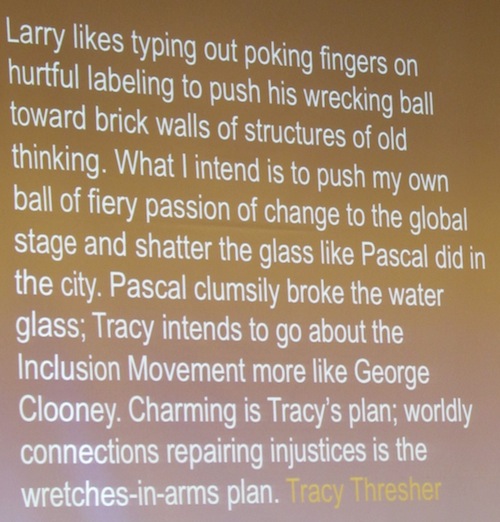
Tracy Thresher types during a Q&A at the ICI Conference ~ July, 2013

Tracy Writes

Non-Speaking With a Lot To Say

I am reading Ido in Autismland: Climbing out of Autism’s Prison by Ido Kedar.  This is another one of those MUST READ books.  Ido is a non-speaking Autistic teenager who learned to write his thoughts by pointing to a stencil board using Soma Mukhopadhyay‘s RPM method.  Ido now types on an iPad.  When I first received a copy of this book, I admit, I was put off by the subtitle.  You see, I was one of those people who once believed my daughter was trapped inside a prison that I called “autism” and for a long time I absolutely believed this.  This thinking led me to believe that if I could cure her, if I could remove her “autism” she would be released from its prison.  It was also this thinking that caused me to say how much I loved my daughter, but hated her autism.  Once I discovered blogs written by Autistic people I began to reassess these various beliefs and finally began to understand how my thinking was actually harming her.    I’ve written about some of this ‘here‘, ‘here‘ and ‘here‘.

But in reading Ido’s book and because I wrote directly to him and his mom about my initial reaction to the subtitle, I have come to understand that his reference to “prison” refers to being imprisoned in a body that does not obey what his mind wants, a mouth that does not say the words he wants to communicate and a society that perceives him as someone he is not.  But more importantly this is Ido’s story and is about the way he perceives autism as it relates to himself and what he has been through as a result. To not read this terrific book because of semantics or because Ido’s perception of autism as “illness” is one I found unhelpful and even harmful to my family and daughter, would mean I would have missed reading a great book written by a really insightful and wise young man who had to fight against prejudices and preconceived ideas about who and what he was capable of.  This is Ido’s story and what a wonderful story it is!

In the introduction, Tracy Kedar, Ido’s mother, writes,

“The ideas in this book challenge many assumptions long held by professionals working with autistic people.  In our own experience, Ido broke free in spite of, not because of, the mainstream thinking today.  If we had continued to rely on  the specialists and educators who dominated Ido’s early years, if he had not been able to find a way to show me that he could read and write, and if I had not finally trusted my own eyes and impressions, Ido would still be stuck as he was, locked internally, underestimated and hopeless.  It is time for our understanding of autism to undergo yet another paradigm shift, and Ido, along with other non-verbal autistic communicators, is a pivotal guide.”

*The use of bold is mine, used for emphasis and is not in the book.

Just as a quick aside, Soma’s RPM method begins with written choices, progresses to a stencil board with the student pointing to the desired letters with a pencil, then to a laminated alphabet board and eventually to an iPad and computer.  Soma or the person doing RPM does not come into physical contact with the student and once the student has moved to a laminated board, she even encourages the student to hold the board themselves.  The final step is to move from the laminated board to independently typing on an iPad or computer.

This quote was written by Ido in 2008 regarding his body and mind and how the two do not obey each other.

“Time after time people assume that I don’t understand simple words when they see me move wrong.  Understanding is not the problem.  It’s that my body finds its own route when my mind can’t find it.”

Again in 2008, Ido writes about his life before he learned to communicate using RPM.

“They misinterpreted my behavior often.  For example, I remember that during my ABA supervisions, I sometimes ran to the window over the parking lot in an attempt to show them that I wanted to go to my car.  They didn’t understand how a non-verbal person might be communicating.  Once, when I got really mad I urinated in my seat, but the supervisor just thought I couldn’t hold my bladder.

“But even worse was that they didn’t support me when I began to communicate.  Maybe they assumed I was too dumb, or they simply couldn’t see what I had learned because I learned it in a different way than their methods.  The response to everything was to give me drills.  If I had a dollar for every time I had to touch my nose, I’d be rich. I remember one day they realized that I hated being told to touch my nose, so they brilliantly switched the command to “touch your head.”  I felt like a prisoner of these theories and methods…”

“On Being Silent and Liberated from Silence”

“Can you imagine silence your entire life?  This silence includes writing, gestures, and non-verbal communication, so it is a total silence.  This is what a non-verbal autistic person deals with, forever.  Your hopes dim, yet you persevere in going to ABA or Floortime (play focused treatment for autism) or speech therapy, all to no avail.  The therapists can’t help and you despair, and only you know that your mind is intact.  This is a kind of hell, I am certain.

“The experts focused on stim management, or drills of rote activities, or silly play like finding things in Play Doh, over and over, on and on.  But they never taught me communication.  I shouted to them in my heart, “I need to communicate!”  They never listened to my plea.  It was silent.

“I could read from an early age.  I could write too, only my fingers were too clumsy to show it.  In school I sat through ABC tapes over and over and added 1+2=3 over and over.  It was a nightmare…”

Ido writes how when he was seven years old his mother supported his hand in an effort to have him help write invitations to his birthday party and how she could feel he was attempting to move his hand and in this way realized he could write.  But things did not immediately change.  No one believed him or his mother.

“My ABA team tried to convince my mom that she was wrong.  This hurt me so much because I thought they’d be happy for me and teach me how to communicate better.”

My daughter has asked that I read Ido’s book to her, so I am.  It has opened up a whole discussion about communication, what it means to not be given the tools to do so, what is autism, what it means to be autistic, being in a body that often does not do as one would like and what others believe as a result of actions you often have little if any control over.

Ido

The Problem with “Use Your Words”

How many of us have uttered those three words to our kids?

Use your words!

And yet, if your child is like mine, they probably do use words.  Perhaps they “script”, words we dismiss because we recognize them from a movie, or perhaps we hear the tone and recognize it as echolalia and therefore  ignore.  Maybe we think of the words as a verbal stim or maybe we hear that those words come from a teacher, the bus driver, another kid, a friend, us…  and again we dismiss them as meaningless.  But what if we are wrong?  What if all those words our kids are nobly attempting to use ARE communicating something, but it is US who cannot make the connection?  What if our kids do not learn language as we think of language being learned, but they are learning it, in their own way, on their own timeline?  What if all those words they keep using, the ones we are told to ignore or not reinforce by acknowledging, are HOW they are learning to speak?

I am currently reading Marge Blanc’s book, Natural Language Acquisition on the Autism Spectrum: The Journey from Echolalia to Self-Generated Language
and these are but a few of the questions being answered.  One thing I have not yet seen or can find in this terrific book is any mention of Tourette’s.  I am curious to know the authors opinion on how Tourette’s factors into language acquisition or if it even does.  Marge, if you’re reading this, I’m hoping you’ll comment!

In those early, blurred years after Emma’s diagnosis I remember thinking that any language was good language.  And then my daughter began to say things, things I could not and did not understand and I was told, those are meaningless words, you must ignore them, you must not reinforce them.  But maybe, just maybe those words are the foundation for others that I and others will be able to understand at some point.  My friend Ibby, of the fabulous blog, Tiny Grace Notes, told me more than a year ago about the importance of not trying to do a word for word translation of the things my daughter said, but rather to lean into the words.  I couldn’t fully understand what she was telling me at the time, but slowly I have begun to.

Marge Blanc writes, “As we valiantly try to replace our kids’ echolalia, their natural language, we feel validated when they learn to say new things.  We teach our kids a dozen functional phrases and sentences and feel satisfied that we have taught “functional speech.”  The tragedy is that while IEP goals are met, children’s linguistic potential has been ignored – and undermined.  We have forgotten how to assess a child’s developmental language level and his capacity to develop generative language.  And we have also failed to consider that the functional phrases we’ve taught might actually interfere with his potential to develop language competence.  And in the process, the echolalia doesn’t go away.”

Now add to this idea the way we are taught to ignore those scripts, that we mustn’t give them any air to breathe as we will only encourage the proliferation of similar non “language.”  So we smile patiently and nod our heads and say…

Use your words.

But not those words.  Use these words.  The words I want to hear.  The words I am now going to repeat and have you say over and over with the hope that you will say these words, my words, in place of yours.  Isn’t that really what we mean when we say “use your words”?  Use words I want to hear.  Use words I give you, but don’t, please don’t use YOUR words.

Over a year ago I wrote about how Emma advocated for herself on the school bus.  You can read that post ‘here‘.  What I didn’t spend a great deal of time talking about was how she tried, repeatedly to “use her words” but was not listened to because they did not believe she understood what she was saying.  It was only after many attempts of using the only words she knew, “you’re going the wrong way!”  “Emma goes to a different school!”  and “you have to go this way!” that she began to scream and then bite herself and eventually punch herself in the face.  Even then, when she fell to the floor of the bus, refusing to get off, crying and hurting herself, even then they continued to not listen to the words she was saying and using and insisted she get off the bus.  It was only when one of the staff at her old school heard her and recognized her and thought to tell the driver that yes, she was correct and no longer went to this school, that she was on the wrong bus, it was only then that they dialed my number and told me my daughter was refusing to go to school, and as it turns out, rightfully so.  They had taken her to the wrong school.

When they brought her home she was devastated.  I will never forget the look on her face as she descended the steps of that bus.  Before her feet hit the ground I said, “You are so awesome Emma!  You told them this wasn’t your bus.   You told them they were going the wrong way!  I am so proud of you!”  Emma still talks about that morning, that morning over a year ago when she was “using her words” and no one listened.

Use your words.

Waiting for the school bus ~ October 2, 2013
*Em copy

Changing Our Thinking

I asked Emma for her permission to talk about language retrieval issues, and specifically to describe some of what occurred during her first session with Soma last week.  She said it was okay for me to do so.  I’m incredibly grateful to my daughter for being so generous with what is personal information.  She has given me her permission, but to leave it at that, would be wrong.  To not acknowledge what this means would be negligent at best.  She is unbelievably generous to allow me to share these things.  I do not know how many of us would be willing for another to share such personal things about ourselves, and the trust she has bestowed upon me, the trust that I will not betray her…  it is something I not only take very seriously, but need to acknowledge.  To say I am grateful does not come close to describing the feelings of appreciation and awe my daughter inspires.  If all human beings could take a page from Emma, both in her cheerful generosity in giving of herself so that others might benefit and her compassion and willingness to see the best in people, even when so many have said and done cruel things to her, this world would be a far better place for all of us.

I wrote about Emma’s first session with Soma ‘here‘.  What I didn’t write about was how after Emma pointed to a letter she was encouraged to say the name of the letter, just as her Proloquo2Go program does on her iPad.  She was able to do so without hesitation.  But when Soma put the stencil board down and asked Emma to say the next letter of the word she was writing, without pointing to it first, Emma would, more often than not, say a random letter.  Soma then picked up the stencil board and again without hesitation, Emma pointed to the correct letter and was able to identify it correctly out loud.  After Emma wrote a sentence she was invited to read the sentence aloud, but could not do so.  This is a sentence she’d just written, one letter at a time.  A sentence she’d created, yet was not able to read.  It is not then surprising that Emma is unable to read a random story out loud, even though she is perfectly capable of reading it silently to herself and fully comprehending it.  See related post about reading aloud, ‘here‘.

To see this broken down, to witness this at the level of single letter retrieval and not a whole word even, made it all even clearer to me.   Which isn’t to say that Emma will never be able to do this.  Perhaps at another point, perhaps once she is proficient in writing her thoughts and identifying a letter after pointing to it, one letter at a time, she will then be able to work slowly, patiently and without the anxiety of feeling expectations are being placed on her, perhaps then she will be able to come up with the next letter before she points to it and from there the next word and on it goes until verbal language can catch up to her written.  But for now, it is imperative that every single person who comes into contact with my daughter understand how detrimental it is for her to have these expectations placed on her and then to have the inevitable conclusions drawn about her comprehension and ability.

My daughter is nothing short of brilliant.  I am not saying this as a biased mother who is basing her thoughts on nothing more than some sort of convoluted tip of the hat to genetics, or a round about way of bolstering my own ego and intellect.  I am saying this because I have seen the evidence.  Since her diagnosis, Emma has been treated as though she were intellectually impaired when, in fact, she is intellectually gifted.  This is, I’m sorry to say, something I am hearing from others.  We have a growing population of children and people who are treated as though they are incapable, when in countless cases the opposite is true.  The onus is on us to change our current teaching methods and the therapies we are employing and to open our minds to the idea that we have gone about this all wrong.  This is what must change.

Soma & Em copy

My Star: Emma

Rhyming words, poetry, fables, history, science, multiplication, math word problems…  these are the things Soma has covered with Emma over the last three days.  Emma went from pointing to one letter at a time, to writing out several words and even whole sentences describing profound thoughts, insights, doubts and concerns, and I sat there witnessing this outpouring of words, this torrent of letters that, when added up, evoked emotion and identification and concern and understanding.  The power of language.  The power of communication.  There is tremendous power in both.

This has been a profound few days; transformative, exhilarating and exhausting.  I have watched my daughter work and she has worked very, very hard.  I have watched her and I have marveled at her and been dismayed by her and astonished with her.  I have laughed and wept and listened and listened and listened some more.  She has said things that have provoked more questions than answers, but she is here, very much rooted in this world and not, as many suggest or seem to think, somewhere else, off in her own “little world”.

I cannot write about anything specific this morning, I’m too tired and Emma has said she is too.  We have two more sessions today with Soma and then we head home.  We are lucky.  We are incredibly fortunate that we’ve had the means to do this, to come here, to stay for the week so that Emma could work with Soma.  All the young children Soma has worked with over the years, so many of them are now writing books, and are at an age where they are publishing their hard-won  words; there are too many to ignore.  They are communicating on letter boards and iPads and keyboards, an unbelievable output of thoughts, ideas and opinions.  “I want to be able to talk,” Emma wrote yesterday.  And maybe, just maybe one day she will be able to talk the way she writes, but until then we will keep providing her with every available resource we can find so that she has a better chance of achieving that goal.

Em standing beneath the “Star of Texas”

Em & Star of Texas copy

When Upset Turns Violent

A number of people have reached out to me privately with questions about how to help their child who is violent.  They fear for their other children’s safety as well as their own, but are frightened to reach out for help because they worry their child will be taken from them.  This is not an easy topic.  If you do not have a child who is prone to violence, it is difficult to imagine what that child is going through.  If you are not and have never been the recipient of violence it is difficult to imagine what that is like.  Similar to self injury/harm this is a hot button topic for many people, not just parents who feel powerless to help their child and feel they have nowhere to turn, but for the person who does not have any other way to express themselves.

So I am asking for all of your help.  If you once were or currently are someone who knows anything about responding to the environment and people in your life with violence, and are comfortable telling me what that experience is/was like for you, please email me at:  emmashopeblog@gmail.com.  Also if you are in a position to tell me what might have helped, what, if anything, might have given you the support you needed/wanted.  Was there anyone you could talk to?  If you cannot speak or cannot rely on verbal speech when upset, were you able to type?  Would that have helped?  Is there anything that might help/would have helped?  Do you have advice for parents?  Do you have advice for those who are under the care of another person?  If you are the parent of a child you are frightened of and want to reach out, please do.  Please describe your situation as best you can, as well as what might be helpful to you.  In other words would a help/hotline (if one were available) be something you would use?  Would you prefer an anonymous support group where you could discuss what you are going through with others?  Would something else be helpful?  Anyone who contacts me will remain anonymous.  Anything you tell me, I will quote as anonymous.  If you prefer that what you write NOT be quoted, please be sure to tell me that.  All names and/or places you tell me about will remain confidential.

I don’t know what can be done, but it seems to me, from some of the stories I’m being told, that something needs to be done/created to help all involved.  Maybe you know of resources that have helped, maybe something you’ve tried helped, maybe there was something/one helped you.  If any of you know of anything, please let me know.  Any and all information is appreciated.  Maybe just talking about what’s going on in a safe place is a start.  You can also write in the comments section anonymously, if you prefer doing that.

An Analogy – Communication via Violin

*This is a guest post by a friend of mine who is brilliant and thoughtful and compassionate and patient and, well, all-around fabulous.

*Guest Post by DYMPHNA

This blog post is a brainstorm I had after reading several posts (‘here‘ and ‘here‘) on this blog regarding the idea of communication, particular why spoken language, which seems so natural for some, is more difficult for others.  First, I must own the fact that I have a pretty strong relative privilege in this vein.  Spoken language comes naturally to me, so I am writing all of this with the caveat that I might be totally wrong.  If Autistics who are less inclined to spoken language correct me on anything I write in this blog post, listen to them, not me.  Secondly, this is an analogy and all analogies are imperfect; my hope is that this might provide an accurate framework through which people who grasp spoken language easily might be able to understand the difficulties of those for whom it does not come so easily.  (This process for learning music is way out of order from how people actually learn music.  Please don’t kill me, music educators.)

Okay, so, in this analogy, you are going to take this page of information and realize it into meaningful sound:
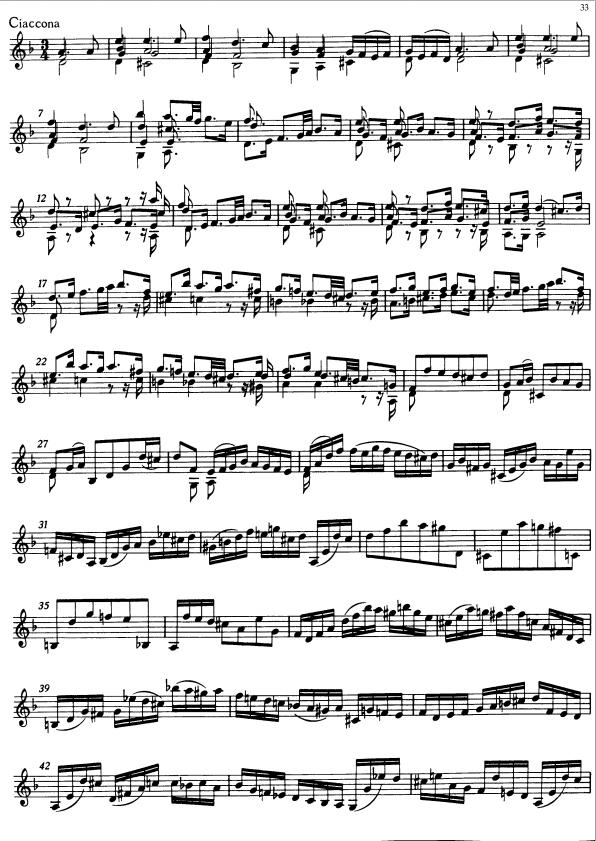

[Image description: Picture is the first page of the Chaconne
from Bach’s Violin Partita No. 2 in D Minor, BWV 1004.]

Now, for many of you who haven’t learned anything about musical notation, you are already at a loss.  The picture above is literally meaningless to you.  There are some horizontal lines and there are dot’s connected to vertical lines and there are these weird symbols that look like a lowercase b and a #.  If you haven’t learned to read musical notation, the only things on this page that you even recognize are some arabic numerals that you have no idea how to interpret and this Italian word at the top “Ciaconna”, which the dictionary defines as, “a slow, stately dance of the 18th century or the music for it,” a definition which is not particularly helpful.  With the resources available to you, you have established that this is an Italian dance from the 1700s.  So in order to realize the page I put above you, you need to become fluent in musical notation and have the ear training necessary to understand what the pitches are and how to keep time properly, a process which many people find quite difficult.

So, having learned all you need to know about musical notation, you’re ready to perform the Chaconne, right?  Well, probably not, as you have no idea how to play the violin.  (Violinists, you are playing the piece on the piano.  If you are also a pianist, you’re playing it on the flute.  If you’re also a flautist, you are playing it on the musical saw.  If you also play the musical saw, you need to just accept the premise of this analogy and move on.)  If you are not a violinist, and I imagine that most of you are not, you don’t even know how to set up, hold, or tune the instrument, let alone produce a decent sound and then connect those sounds into a meaningful piece of music.  So now that you understand what the notation means, you need to tackle the actual physical reality of learning how to play the instrument, a skill that takes years to do competently, decades to do proficiently, and half a lifetime to do masterfully.  You need to learn how to hold the instrument and the bow and all sorts of skills about how to make the correct sounds come out of the instrument.  Likewise, before you can do any of that, you have to learn to set up and tune the instrument, skills which are quite challenging to the beginning player.  (As someone who has attempted to play the violin on several occasions, I can attest to this.)  The process usually involves tedious work on many minute elements of technique that are by themselves very difficult, such as using different bow strokes, crossing strings, and pressing the fingerboard in the correct location.  Moreover, you have to keep track of all of these elements of technique while attempting to accurately realize a score of music, so in addition to the difficulty of playing the music, you are simultaneously applying the skills you’ve learned in step one.

Congratulations!  Having done that, you have the skills needed to accurately realize the first page of Bach’s Chaconne, a skill that will land you zero audiences and communicate very little.  What most people don’t realize is that very little information is actually given to the musician by the composer.  Many elements, such as the subtle ebb and flow of time, the varying loudness of any given instant of music, vibrato, etc., the elements that make music expressive and, if you’ll pardon the expression, musical, are not given to the performer by the composer.  If the performer performs the work exactly as written on the page, it will sound mechanical and banal.  This is why proficient musicians spend a great deal of their time focusing on interpretation.  They are trying not only to reproduce the pitches and rhythms indicated on the page, but also subtlety that music needs to be truly compelling and persuasive.

All right, having done all of that, you can now convincingly convey great musical ideas.  Musical ideas written by Johann Sebastian Bach.  While you certainly bring something of yourself to the table, none of these are ideas that you originally had.  The basis for all of these ideas was written almost three centuries ago.  In speaking, this is analogous to someone being able to convincing recite a work by Shakespeare.  A great skill in its own right, but all the while we’ve still fallen short of our actual goal, which is to communicate our own ideas effectively to others.  Right now we are only equipped to communicate other people’s ideas, albeit with our own twist.

I would like to pause here and draw some of the analogies between playing the violin and speaking.  First of all, there is the process of developing a rudimentary understanding of what music is, which corresponds to having a crude and basic understanding of the English language.  I will discuss the full understanding in just a moment.  Next, we have to negotiate the physical reality of playing the instrument.  We might have a fantastic conception of what the Bach Chaconne should sound like, but that means nothing if we lack the ability to realize it on the instrument, which is an inherently physical process.  This, not surprisingly, corresponds to the actual motor process of forming words.  For many of us, those processes seem pretty simple, but imagine what it would be like if they didn’t come naturally to you.  Imagine if everyone seemed to have this innate aptitude for holding the violin and producing pleasant sounds on it while you are struggling to get notes out.  Most people, having able or neurotypical privilege, take this ability for granted, so I want you to imagine a world where, instead of speaking, we communicated by playing the violin, a skill for which many people do not have the natural aptitude.  This is where the Social Model of Disability comes into play.  For those who find speech easy but playing the violin difficult, this world is fine for them while they would be disabled in the violin world.  Likewise, those who find playing the violin easy and speech difficult are disabled in this world but fine in the violin world.

Resuming our violin analogy, there is a lot more to speech than playing the Chaconne by J.S. Bach.  As I stated before, most people seek not to reproduce the ideas of others, but rather to convey their own ideas, which they do in real-time.  In music, this equates to improvising, a skill that isn’t necessarily that difficult provided you don’t seek to convey anything that complex.  However, there are still things to consider.  First, you want to have the semantics of what you are improvising accurately reflect what you are trying to convey.  I cannot think of an accurate analogy for this, so please leave an idea in comments if you have one.  On top of that, you have the elements of music theory, which is essentially the grammar of music.  Certain notes in certain contexts convey specific meanings that might not be conveyed in another context.  Without using this correct syntax, what you are trying to convey will start to sound random and disorganized or possibly just “wrong”.  This process comes very easily to most people, but understanding grammar is no simple task, a fact which anyone who has tried to learn a foreign language can testify.  In our native language, we can just say what “sounds right” without having to put too much thought into it.  In the same way, a native tonal musician might be able to tell you that a C-Sharp and a G need to resolve to D and F intuitively without explaining the theoretical reason behind this in the same way that you know whether to use “me” or “I” in a sentence.  However, just because this process comes to us intuitively doesn’t mean it isn’t going on and it’s something we oughtn’t take for granted when thinking about communication.

So what is the point in all of this?  I’ve drawn all of these parallels about how spoken language is like playing the violin.  The point in all of this is the following:

First, the process that we think of as intuitive and easy is not necessarily that easy or intuitive for others.  I don’t find playing the piano very difficult, but most people would struggle to play something rudimentary on the piano because they are dealing with all of the things I mentioned above.  Moreover, at the piano, you at least have the reassurance that if you press a key, a musically sounding sound will come out, something that isn’t guaranteed on a violin or when speaking (which is why I chose the violin for this analogy).

Second, I want people who find things to be easy and intuitive to think about what it might be like for those who don’t find the process so intuitive.  As many people are not instrumental musicians, I challenge you to think about what challenges you would face in the world if, instead of communicating via mouth sounds in natural language, we communicated by instrumental music.  Hopefully this exercise will expand your empathic process so that you can understand what it means to be disabled without medicalizing us or assuming we have a deficit.

Third, I want everyone to think about some of the strategies you might employ in this alternative violin world where you are struggling with many of the rudimentary elements of communication.  Maybe, since you don’t want to have to deal with the challenge of writing a syntactically correct and semantically accurate statement while dealing with the difficulty of playing the instrument, you might instead use an existing melody that approximates what you want to say instead of attempting to improvise something of your own.  Maybe in this violin world, you’ll get special education for doing this, seeing that you have musical echolalia and your ability to use spoken natural language, a skill that frustrates you as you want to use it to express yourself while no one uses that skill, is seen as a “splinter skill”, not inherently useful, but rather a means to develop your violin skills, which are the “correct” way to communicate.

I think this exercise in empathy is much more effective than the wholly appropriative and mocking “Be Disabled for an Hour” idea that many people try out.  Of course, you need to recognize that this will not give you a perfect view into our world.  Being that you don’t live in this culture in which you are disabled, there are things that might not occur to you that are realities that disabled folks have to deal with every day.  Thus is the nature of privilege.  But I hope this has expanded your notion about how disabilities impact your life and how society defines what is and is not a disability.