Tag Archives: language

What Wasn’t Said and Other Omissions

I just received a call from Richard who told me after I left to take Nic down to his school bus, Emma went into her room and began crying.  When Richard asked her what was wrong, she said, “I miss Mommy.   See Mommy tomorrow.”

For the past two nights I have been out, not coming home until well after Emma has already gone to sleep.  It is unusual for me to go out two nights in a row and clearly it made Emma sad.  While Nic is now at the age when he looks forward to our evenings out, so much so that he offered Richard $100.00 of his own hard earned allowance (generous and thoughtful boy that he is), “so you and Mommy can go out on a date,” Emma does not share his enthusiasm.

This morning Emma appeared in our bedroom at 5:28AM.  “Emmy, it’s too early.  You have to go back to your bed.”

Emma pointed out the window and protested, “But it’s light out!”

She was technically correct.  The first morning light was just beginning to show itself and though it wasn’t full daylight, you couldn’t argue that it was exactly dark, either.

“Em, look at the clock.  It has to say 6:30 before you come in and wake us.”  But I knew, even as I said this, that I was changing the “rules” on her.  Emma knows she isn’t to come into our bedroom until “it’s light out.”  As the seasons change, this is a dubious “rule” and one far too vulnerable to interpretation to really be meaningful.  Still Emma was doing her best to honor it.

Emma morosely trudged out of our bedroom and I, now wide awake opened up my ipad and began checking my email.  Five minutes later Emma appeared again.  “It says five and three and three.”

“Yes, but it has to say six, three, zero.”

“Okay. Okay.”  Emma said and looking forlorn she made her way out of the room.

I could hear her in the living room reciting various arbitrary “rules.”  “Lauren’s class.  No you can’t sit on the ledge, that’s dangerous.  You have to get down or you’ll bump your head.  No not going to hang on the pipe.  You might fall down and hurt your head.  Ouch!  That hurts, you have to go see nurse.  Be careful.  But listen, if you go on the ledge, you might fall down…”  this went on for quite some time and then there she was again.  “It says six, zer0, seven,” she informed me, while peering at the clock.

“Okay Em.  You can stay, but you have to be quiet.”  I scooted over so that she could crawl under the covers next to me.  She lay her head on my shoulder and picked up from where she’d left off.  “Have cereal and toast?  Then play the Wii?  School bus, Lauren’s class, study room with Joe, sleep, wake up…”

As I listened to her, it never occurred to me to note what she wasn’t saying.  In her list of what she expected would take place in the next 24 hours, I was not one of the things she included.  It never occurred to me that that omission was intentional and because she didn’t expect to see me again when she returned home, just as she hadn’t for the past two evenings.

This afternoon, I will be waiting for her when she returns home.
To read Emma’s profile in The Thinking Person’s Guide to Autism, click ‘here.’
To read my most recent Huffington Post, click ‘here.’


New York City Subways and Musings on Autism

Yesterday afternoon I received the following text from Emma’s therapist Joe – “Heading your way.  Em had a rough day after museum trip.  Wants to see you.”

First of all, I’d like to point out that the fact that Emma was able to communicate to Joe that she’d had a rough day is a massive leap forward.  Secondly that she was able to then make it known that what she now wanted to do was see me was nothing short of amazing.  It required her to identify her feelings.  It required her to map out what might make her feel better.  It required her to verbally put together the words in such a way that they would be understood.  It required her to then make her request.

Yesterday morning on the subway headed to my studio I was reading the memoir by the autist, Rachel Cohen-Rottenberg, Blazing My Trail on my ipad.  It’s a wonderful book, for those who don’t know of it, and had fully captured my attention when I felt a light tap on my arm.  I looked to my left and there sat a woman, about my age or maybe a bit younger dressed in a suit, clasping a briefcase.  “Excuse me,” she said.  “I get claustrophobic in subways, especially when they stop and it helps if I have someone to talk to.  Do you mind?”

“Oh,” I said, surprised by her directness, but also relieved that she seemed genuine (this is New York City after all) and was clearly frightened that our train had come to a halt in the middle of the tracks, something I hadn’t even noticed until she tapped my arm.  I closed my ipad and turned toward her.  “Sure,” I said. Not at all sure what to say next, but because I had just been reading Blazing My Trail in which Rachel Cohen-Rottenberg talks about wishing people would just ask how they might help, I asked, “What can I do?”

“Just talk,” she said, then to help me along she motioned to my ipad, “What were you reading?”

So I told her about the book I was reading and how wonderful it was.  We then talked briefly about autism, something she knew almost nothing about. I asked her where she was headed.  She told me about a business meeting she was on her way to at Rockefeller Center and how she was nervous about it.  And then the train began to move again.  She took a deep inward breath and exhaled, shutting her eyes momentarily before opening them again and smiling at me.  “Thank you for being so kind and talking to me.  You have no idea how much it helped.”  At the next stop she got up.  I wished her luck and she disappeared.  As I sat watching her leave I thought about how great it was that she had figured out what she needed to do to help herself through what was clearly a stressful situation.  And then I thought about Emma.  I thought about how I hoped Emma would one day be able to express herself in a similar way.  I thought about Rachel Cohen-Rottenberg’s memoir and how she has learned through a great deal of trial and error to get her needs met and I thought about how hard it is for so many of us to know what we want let alone muster up the courage to ask for help.

Not eight hours later I received Joe’s text – “Em had a rough day after museum trip.  Wants to see you.”

Wow!

For more on Emma’s journey through a childhood of autism, go to:   Emma’s Hope Book

Autism, Huffington Post and Getting Away to The Cabin

As I wrote yesterday – please be sure to read my most recent post on Huffington Post.  It is the introduction to a series of posts written by autists throughout the month of April.  Share the link, tweet, “like” and comment!

Last Friday Emma said, “Mommy, I want to go to the cabin please.” And since going to the cabin isn’t nearly as arduous as it sounds, we decided to go for a sleepover Saturday night.

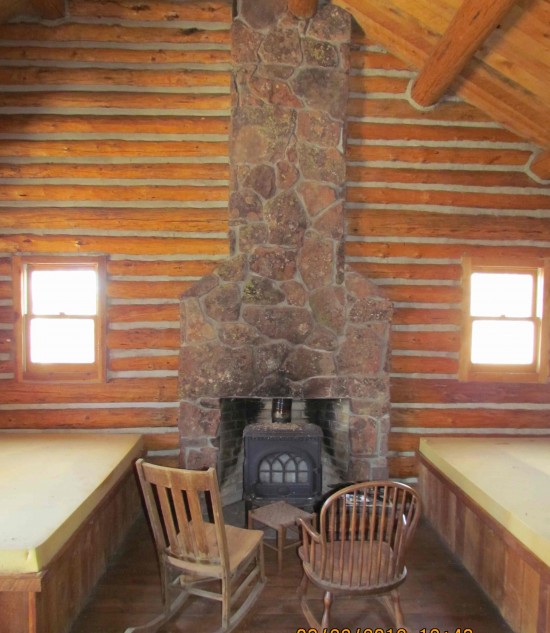
It’s “rustic” but sleeps four comfortably and the kids love going there, particularly Emma.

Emma grabbed the heaviest pack and began tromping through the snow.

Once we arrived, she wasted no time getting comfortable.

Despite the fact it was broad daylight and there were lots of weird insects flying around, many of them inside the cabin.  Nic took enormous pleasure in shooshing all the bugs and moths outside, while Emma, Richard and I sat together in the rocking chairs.  Point a camera toward Emma and she makes her “say cheese” face.

We tried to get Emma to look at the clouds. They were like nothing I’d seen before.  As though each had it’s own rainbow.

But Emma was much more interested in sitting on the porch railing with her brother.

And looking out at the mountains.

When we woke up the next morning, Emma said, “Go back to Granma’s house, eat breakfast, go swimming in the indoor pool, make cake, pack and go back to the cabin!”

“But we haven’t even left yet!”

“Go now,” Emma said.  Then as she was packing up, she said, “Come back later.”

Makes sense to me.

“Minus One Equals Zero”

Emma reached for the last bag of Pirate’s Booty yesterday and said, “Minus one equals zero.”  Then she grabbed the bag and ate it’s contents.

I am constantly impressed with Emma’s mind and creative use of words.  I often think when I listen to her that there’s a kind of poetry in the way she phrases things, the way she will use seemingly unrelated words to describe something, such as “motorcycle bubbles” for the fireworks we see over the fourth of July.  It conjures up the noise, which she finds frightening, but also the visual image of bubbles, which I think she likes.  I don’t know if this is what she thinks of when she uses those words, but to me, it’s beautifully descriptive in a nuanced and personal way.  It’s very “Emma.”

When Emma and I did some literacy work yesterday, she was having a terrible time with a story we read and that she had to summarize.  I mentioned to Joe that we had a tough session, so when he worked with her later he used no verbal language and she was able to fly through the work.  During my session with her I was reminded of a post I read recently, written by an autistic adult who described how one day conversing and finding the correct words came relatively easily, but the following day, or even that afternoon, she found it almost impossible to express herself verbally.

I have become much more aware of Emma’s sensory issues in the past few weeks from reading other blogs written by autistic adults.  I have certainly been aware that Emma had to deal with a sensory overload, but how that manifested itself, what that actually meant to her was something I had trouble understanding.  But reading what it’s like for some other autistic people has been enlightening.  This is one of my favorite posts on the subject of language and words.  It is written by E. who has a blog – The Third Glance.  The post is entitled – Words.

Another post – Squawk? by Square 8 is another wonderful description of how talking can be akin to walking through a minefield for many on the spectrum.  Sadly this blog’s last entry was in November 2010.

Minus one equals…

For more on Emma’s journey through a childhood of autism, go to:  Emma’s Hope Book

Buffalo H & Buffalo J

When we are in Aspen we stay on our ranch.  It is no longer a working ranch, but my mother and her sister built houses on it, separated by a stretch of dirt road.  You can’t actually see either house when inside one or the other, which is wonderful as each have views of the mountains, but they are close enough that you can walk from one house to the other.  Or as is the case with the children, they run.  Except in the summertime when one of us will yell after them, “Remember if you see a bear, don’t run!”   This comment usually elicits a dramatic display of bravado with the children demonstrating how they would raise their arms while yelling loudly until the bear wandered off.  We are hoping the bears are still hibernating, though it’s been so warm they may be out and about, it’s hard to say.  Yesterday afternoon, Emma and Nic went over to their cousin’s house and spent many blissful hours playing.

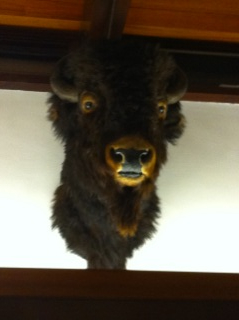
At one point Emma stopped, looked up at the enormous buffalo head situated in her cousin’s living room and said, “Buffalo head!”  Joe, who was standing nearby confirmed that it was in fact a buffalo head.  To which Emma replied, “Two buffalo heads.”

“No, Em.  Not two.  Just one.”  Joe pointed to the buffalo’s head.

“Two,” Emma said matter-of-factly.  Then she pointed to the house that was once owned by my sister, just up the road and said, “Buffalo H and,” she pointed back to the buffalo above her, “Buffalo J.”

I realize this story requires some explanation – my cousin’s name is Jennifer and the last name of the people who bought my sister’s house is Hunt.  When my sister moved out, she left the buffalo head hanging above the fireplace and when the Hunts moved in they decided to leave it there.  As we are good friends with the Hunts, who also happen to have two boys Emma and Nic’s age, we have been over to their house many, many times.  Hence Emma’s designating their buffalo as “Buffalo H.”

Excuse me while I bask in the glow of my child’s brilliant mind.

Neurotypicals =  The art of small talk, Kim Kardashian and Snooki.

Autistics = Einstein, Mozart, Nietzsche and Isaac Newton.

‘Nuf said.

Buffalo J.

For more on Emma’s journey through a childhood of autism, go to:   Emma’s Hope Book

Greeting Granma

Friday we arrived safely in Aspen, or as Emma described it, “We have to take two planes, then get to see Granma!”  Despite my reservations about not having any seats together, people were kind and accommodating, several happily moved for us and we ended up all together.  I didn’t have to plead with anyone, or explain; I think this was a first!

Upon our arrival Nic and Emma ran ahead, first Nic flinging his entire body against my aging mother with all his might, so happy was he to see her and then Emma, more timidly perhaps, but with no less excitement wrapped her arms around her granma and hugged her.  We have been through this routine dozens and dozens of times, taking two airplanes, arriving in Aspen, my mother always there at the airport to greet us and never has Emma greeted her granma like this without at least some prompting.  My mother looked up at me with her beautiful smile and said nothing.  She didn’t need to.  Emma was now holding one of her arthritic hands and exclaiming, “Oh, Granma hurt her fingers!”  But instead of then racing off or letting go, she continued to hold her granma’s hand, tenderly examining her arthritic fingers, the same misshapen fingers my grandmother had, that as a child, I too had found so fascinating.

Later as Richard was unpacking and I was setting my computer up in the adjoining bedroom, Emma came in and said, “Going to go outside.  We can go outside and talk. Talk with Mommy.”  She then opened the door to the porch directly outside our bedroom and sat in one of the chairs.  “Mommy sit here,” she said, pointing to the other chair.

Obediently I did as she directed and we talked.  Emma talked about how high it was from where we were sitting to the ground downstairs where she could see the dogs playing.  She talked about how I was sitting with her in the chair next to her.  She walked the length of the porch and talked about how she couldn’t reach the dogs, nor could she reach the ground downstairs.  We discussed distance and the difference between being inside and outside and then she stood in front of me and said, “Now I’m going to sit on Mommy’s lap.”

Which she then did.  And I wrapped my arms around her, while we looked out at the Rocky Mountains, jagged and covered in snow and breathed in the crisp mountain air together.

The next morning, outside with the dogs, who were behind me looking at Emma.

For more on Emma’s journey through a childhood of autism, go to:  Emma’s Hope Book

Pooh Bear and Emma

Often before bed Emma asks if she can watch one of two movies – Mary Poppins or Winnie the Pooh.  She has been watching these same two movies for the past five years and in the case of Winnie the Pooh, going on eight years.   Typically we tell her she can watch whichever movie she’s chosen for twenty minutes or so before bedtime when I read to her.  Last night she chose Winnie the Pooh.  I sat next to her, but wasn’t really paying attention as I was reading an email, when I realized she was talking and looking over at me.  This was unusual.  Emma will often repeat much of the dialogue, particularly her favorite parts of the movie which, having watched literally thousands of times, she has memorized.  But last night she wasn’t just repeating the dialogue.  Last night she was talking – about the movie – to me!

It took me a couple of seconds to understand what she was saying, but it went something like this.

Emma laughing.  “He’s stuck!”  More laughter.  “He can’t get out.  Ooof!  Pooh bear is stuck.  Yeah.  He cannot get out.”  Emma points to the screen while looking at me.

I look at the television, inwardly feeling nothing short of elation that she is initiating contact, that she wants to share her amusement at Pooh’s predicament with me!  “Oh no!  You’re right.  He’s stuck.  He ate too much honey.”

Emma nods her head.  “Don’t… feed… the …bear!” she shouts at the same time that Rabbit says this while pounding a sign with these words into the ground with his fist.  “Rabbit’s angry!”

“Yes, he is!  He doesn’t want Pooh stuck in his house.”

“Pooh can’t get out,” she says, laughing.

“Pooh was so hungry, he ate and ate and ate all of Rabbit’s honey.”

“Now he can’t get out.”  Emma says, watching the television.

“He ate so much, his belly got so big, now he’s too big to get out.”

Emma shrieks with laughter.  “Oh no! Oh no!  I’m stuck!”

“You aren’t stuck, Em.  Who’s stuck?”

“Pooh’s stuck!”

This continued throughout the entire scene until Pooh gets thin enough that he can be pulled out.  While Christopher Robbin and the rest of the animals pull Pooh bear, Rabbit pushes him from behind and he finally shoots out of the hole like a cannonball and lands inside of a tree, which just happens to be filled with honey.

“Pooh’s eating!  He likes honey!”  Emma says, pointing to the part when Christopher Robin says – Don’t worry Pooh.  We’ll get you out!  (of the tree) and Pooh says, through mouthfuls of honey – Don’t hurry!   Yum!  Yum!

Emma thought this hilarious.  “Oh no!  He’s stuck again!”  Then she collapsed into a fit of giggles with her hand on my arm.

For more on Emma’s journey through a childhood of autism, go to:   Emma’s Hope Book

“Thriller”

For Emma’s birthday, Joe gave her a video montage with Michael Jackson’s incomprehensible song – Wanna Be Startin Somethin – playing in the background.  Emma loves playing the DVD and calls it – “Thriller.”  Despite our corrections, she is resolute.  Saturday night she put the DVD into the player and then said, “Halloween!” and ran to the costume chest.  “Want to put on halloween costume?”

“But, Emma it’s not halloween,” Richard told her.

“I think she wants to put on a costume like she does on halloween,” I said.

After a good bit of rummaging around, Emma pulled out a costume, ran to her room and several minutes later burst forth wearing this…

“Watch Thriller,” she announced before settling down on the couch to watch the video montage Joe had put together for her.

*Just in case anyone is curious, we correct Emma when she makes these types of grammatical errors.  For example in the above comment, I said, “You want to watch your video?”  To which she responded, “Yes, I want to watch my video.”  With repetition we have seen an enormous uptick in Emma’s spontaneous language as well as an increase in her ability to say grammatically correct sentences without our intervening.  The pronoun confusion, while still present, has gotten much better as well.

Richard and I have a running joke regarding MJ’s lyrics, something neither of us can understand without printing out the actual lyrics, still, as a nod to our advancing years, we use phrases like “new fangled” and “these kids” while shaking our heads.  Thankfully Richard finds all of this as humorous as I do and we have each come up with obviously ridiculous lyrics, which we then suggest are the actual lyrics.  “Do you think he just sang, go to the post office?”  “Yeah, post a letter, I’m pretty sure he just sang that.”  So I wasn’t surprised when Richard said at one point, “He just said, “You’re a vegetable.”

“I am not!” I responded with feigned indignation.

“No.  Seriously, I think he just sang, You’re a vegetable.”

“Uh-huh.  Yup.  I think you’re right,” I said, nodding my head and grinning at him.

“I’m being serious.  Do you think that could be part of the song?”

“Oh yeah,” I said with an exaggerated tone, “You’re a vegetable.  I think that has to be right.”

“I’m going to google it,” Richard announced.

A few minutes later Richard returned, “Look!” he thrust a sheet with the lyrics printed on them and there it was in black and white – “You’re a vegetable, You’re just a buffet, You’re a vegetable,  They eat off of you, You’re a vegetable.”

Richard looked at me.

Meanwhile, Emma continued to bop her head up and down as she watched the slideshow of photographs from the past year of herself, that all of us have taken, wearing her witch costume.

For more on Emma’s journey through a childhood of autism, go to:  Emma’s Hope Book

Conversing With Emma

“Mommy, I want to make pancakes please!”  Emma said sweetly the other morning.  A simple sentence, no big deal, right?  Except to us it was an enormous deal.  Pronouns all in their proper place and used appropriately, a polite “please” added at the end to ensure a positive response to her request, how could we say no?  And since it was the weekend, we didn’t.  Though we did tell her, she would need to wait a little while, which she did.

Someone, years ago, asked me what I hoped for when it came to Emma’s progress and I responded with something about giving my right arm if she would only ask me for something.  At the time, it was a worthy objective.  Please, just let her ask me for anything and I’ll be happy.  Thankfully I did not have to relinquish a limb for her to get to that point and now those requests have become commonplace.  “Mommy!  I want to go to the Vanderbuilt Y please,”  “Daddy, I want to go to the New York Botanical Gardens with just Daddy!” or “I don’t want to eat the pear.  Please Mommy, no more pear!”

Now that we have the “I want,” “I don’t want” sentences, we are moving on to the lofty goal of commenting on surroundings.  “Oh look, Em!  Look at the bird outside the window!  Do you see it?”  And then we wait.  “Yes, I see the bird.  There’s a bird flying outside,” Emma might respond or she might then comment on something else.  “It’s raining outside.  We cannot go to the park.”  The idea of using language as a way to connect, a bonding experience or as a way to share an experience with another person remains somewhat elusive, though she is making strides in that direction.  We are not able to carry on a conversation with Emma yet.  But we hope to get there eventually.

For more on Emma’s journey through a childhood of autism, go to:   Emma’s Hope Book

“I Am In Here” – Autism

There’s a terrific new book entitled:  I am in here:  The Journey of a Child with Autism Who Cannot Speak But Finds Her Voice by Elizabeth M. Bonker and Virginia G. Breen.  The title is a line from the poem  Me written by Elizabeth when she was 9.   The story is yet another example of a nonverbal child with autism who was helped by Soma Mukhopadhyay’s Rapid Prompting Method.  Elizabeth’s mother, Virginia has tried any number of therapies with the hope that something, anything will help her daughter.  It is not a story about a cure, but rather a message of hope in the face of continual struggle and perseverance.

Virginia writes about using a three pronged approach in her battle with autism – Mind (academics), body (biomedical interventions and diets) and Spirit (the more difficult concept of something greater than ourselves, which Elizabeth seems to have a solid grasp of.)  The mind, body & spirit concept particularly resonated with me as it was this very idea which captured my grandfather, Walter Paepcke’s imagination when he envisioned a place of contemplation and learning in his creation of what came to be known as the “Aspen Idea” more than 60 years ago in Aspen, Colorado.

I can claim full allegiance to the mind and body portion of this, however I must admit the spiritual piece continues to allude me.  Though a close friend of mine said to me recently that for a person who professes not to believe, I certainly spend a great deal of time thinking, reading and discussing the subject.  She then said, “It’s kind of like the wife who’s husband everyone knows is having an affair.  She’s the last to know.”  When I answered her with a perplexed look, she said somewhat exasperated, “Come on, Ariane.  You’re the most spiritual non-spiritual person I’ve ever met.”

I’m pretty sure she meant that as a compliment.

For more on our journey with Emma through her childhood marked by autism, go to:   Emma’s Hope Book

Asking – Autism

I remember the first time Emma’s older brother, Nic asked permission to do something.  He was about 14 months old and he asked if it was okay to take a particular toy with him to the playground.  It was noteworthy for a number of reasons, but as his mom, I remember thinking how incredible it was that this tiny child understood that if you asked, rather than just did something, chances were you would be able to do whatever it was.  The whole “polite” thing wasn’t part of the equation yet, but it soon came to be, shortly thereafter.

With Emma it was different right from the beginning.  For one thing, she didn’t ask questions as much as demand that her basic needs were met.  Because her language was severely delayed, she would often drag one of us to the refrigerator and indicate what she wanted.  As she didn’t “want” our attention, toys or many of the things other neuro-typical children do, there was less motivation to ask for things.

As Nic grew older his questions became more complicated and interesting.  Suddenly we were discussing such topics as religion, questioning the existence of God and if there was a God, who made him.  Could there be a heaven without a “God”, why did people die, was there life beyond our planet earth, how did we come to be and what was our purpose, where did the earth come from, how is it possible that the universe is infinite and what does that mean, exactly.  Nic also became curious about Richard and my experiences.  He wanted to know if I’d ever felt scared (yes!), whether I was nervous when in front of new people (often), when did I know what I wanted to be when I grew up (that concept continues to evolve), when did Richard and I meet, and the questions have never stopped.

Emma does not ask questions about life and the world.  She has never asked me a personal question.  But she has learned to ask for things that she needs or wants.  Often the question is a demand with an upward lilt added, making the demand more palatable, as in  – “Go to the zoo?”  “See the snake bite boy?” “Apple juice?”  However lately her questions have changed slightly.  It’s a subtle difference, but I have noticed it a number of times in the last few days.  This morning she came into the study (this in and of itself is startlingly new as in the past she would simply ask from where ever she was and then when no one responded because no one heard her, she would begin to scream until someone appeared) but today she found me and said, “Mommy?”  Then she waited for me to respond.  When I looked up, she said, “Can I have a caramel yogurt?”  Again she waited for my response.  This too is different.  In the past she might have asked if I was standing nearby and then after uttering the words she would have raced off, not waiting for a response.  The question was rhetorical.

“Sure Em.  Go have a caramel yogurt,” I said.

To which she ran off, only to reappear a few minutes later saying, “Okay.  Last one caramel yogurt?  Eat one more and then it’s all done.”

“Yeah.  Okay, Em.  That sounds good.  Go have another one.”

“Okay!”  She yelled as she went back into the kitchen.

Last night she found me in the bathroom, where I was brushing my teeth.  “Mommy?”  She waited.

“Yes, Em?”

“Can I watch Winnie-the-Pooh?”  Again she stood looking at me expectantly, waiting for my answer.

“Sure Em.  But first put on your nightie and brush your teeth.  Okay?”

“Okay!”  she said tearing off to change.

I cannot describe my surprise at her actually waiting for me to respond.  This is new and a welcome change.

For more on Emma’s journey through a childhood of autism, go to:  www.EmmasHopeBook.com

Literacy and Autism

We have been working intensively with Emma on her reading, writing, typing and more recently math and verbal skills.  The reading, writing and typing program we began in January.  It was at this time that she painstakingly learned how to form each letter of the alphabet.

This morning Emma wrote this, in answer to the written question – Did the cat jump? – after I had made the cat jump.

In answering the question – Did the boy jump? (the boy as seen in this photo was lying in a bed) Emma wrote:

In accessing Emma’s progress, I need to compare her to herself and not other children.  I have seen over the years how easy it is to become discouraged when I compare Emma to her brother or any neuro-typical child or even other children on the spectrum – unless they are much more severe.

“This isn’t going to be a sprint,” Richard once observed, after seeing yet another neurologist.

And it isn’t.  Emma is making slow and steady progress.  We work with her for about three hours every day on her literacy, math and verbal exercises.  There has been no instantaneous miracle.  She has not begun to write on her own in complete, complex and revealing sentences.  She has not gotten to the point where she is able to tell us what it is like for her to be her.  She cannot answer questions regarding anything remotely abstract.  (Which doesn’t mean I don’t continually hold out hope that one day she will.  I do.)  But at the moment, I am happy to reflect on her slow, steady progress and it fills me with joy to work with her each morning and to see these beautiful sentences that she constructs on her own.

Someone once asked me – Is it good enough?

The idea being that I had a preconceived notion of how I wanted something to be and anything short of that meant it was an utter failure.  Sometimes being “good enough” is still pretty fabulous.  So yes – Emma’s progress is good enough.  In fact, it’s better than good enough, it’s wonderful.

For more on Emma’s journey through a childhood of autism, go to:  www.EmmasHopeBook.com

Deficits and Assets – Autism

It is easy to see what’s wrong – with the world, with other people, with ourselves.  When Emma was diagnosed with autism we were told about all that was “wrong” with her.  Her deficits were listed with great care:  Her eye contact was weak.  She showed little interest in interaction with others, she didn’t point, she didn’t ask questions about others, she showed little awareness of others, she seemed oblivious to others pain or feelings.  Her verbal skills were delayed, her fine motor skills were delayed, her ability to play, to project, to engage in any sort of fantasy or pretend play was almost non-existent.  The list went on and on.

But what of her assets?  What about all the things she did that showed tremendous creativity and intelligence?  Where was the balance in her many and varied evaluations?

When Emma went to a Special Education Pre-School I met a little boy who couldn’t have been older than three.  He was pointing to all the signs in the building and reading them.  I exclaimed to one of the therapists standing nearby how incredible this seemed to me.  She then told me he was hyperlexic and that they discouraged him from reading as it wasn’t “normal”.

I have never forgotten that.  Here was a child with an unusual ability.  A talent that could be used to further his education and perhaps interests and yet it was being discouraged.  Is that what we want from our children – to be “normal”?  What do we sacrifice in our attempts to “fit in”, to adapt, to be like everyone else?

Emma has a beautiful voice and a love of performing.  If we have guests over she asks to “sing a song” for them as she did last night.  Sometimes she needs to be reminded that the song must eventually end as she can get into a loop, singing the same refrain over and over again.  She hasn’t mastered the whole concept of “losing ones audience”.  But we encourage her singing and desire to perform just as we encourage Nic to practice his Alto Sax and the piano.  Emma has a great many assets, things she loves doing over and over again.  With Nic we use the word “practicing”, with Emma we say she is “perseverating.”  Yet in her perseveration Emma is practicing as much as Nic is.  The difference is, Emma will do the same thing over and over again for hours, whereas Nic will practice for 20 or 30 minutes and move on to something else.

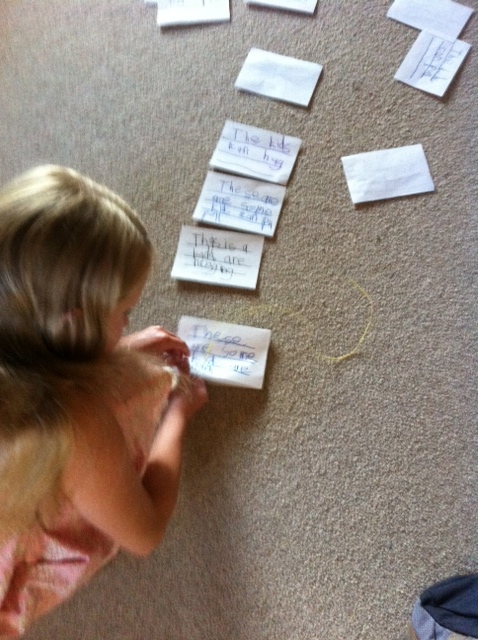
Last night as guests began to arrive, Emma was upstairs in her “study room”, sitting on the floor in her party dress writing.  When I went upstairs, this is what I saw.

She was talking to herself and picking up each piece of paper then reading it before placing it back down and moving to the next.

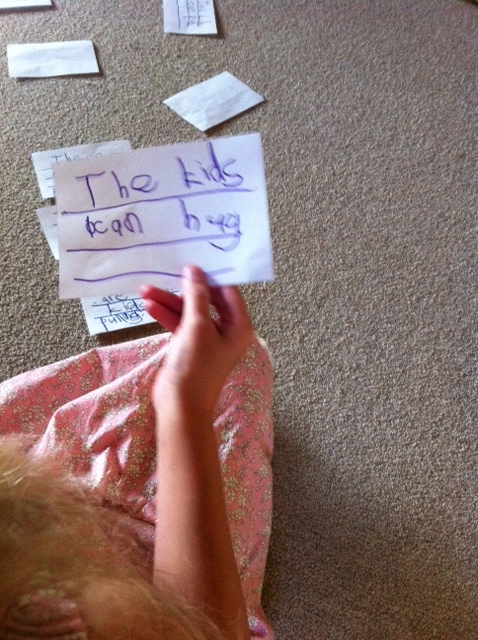
As we had run out of lined paper, she had made the lines herself, before writing the sentence – The kids can hug.

Now this scene isn’t exactly “normal”, on the other hand very little in our household is.

For more on Emma’s journey through a childhood of autism, go to:  www.EmmasHopeBook.com

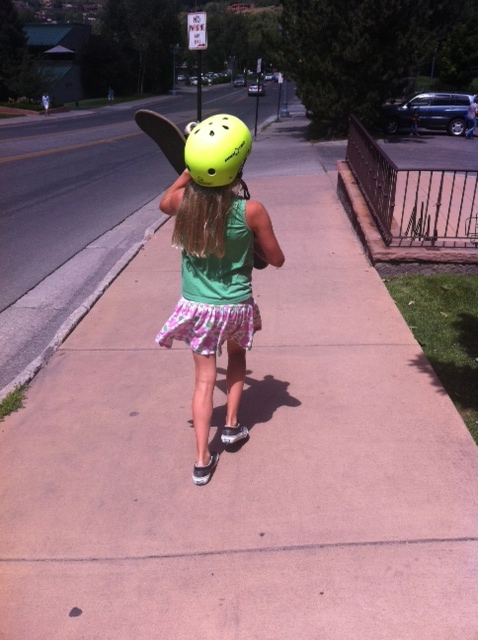
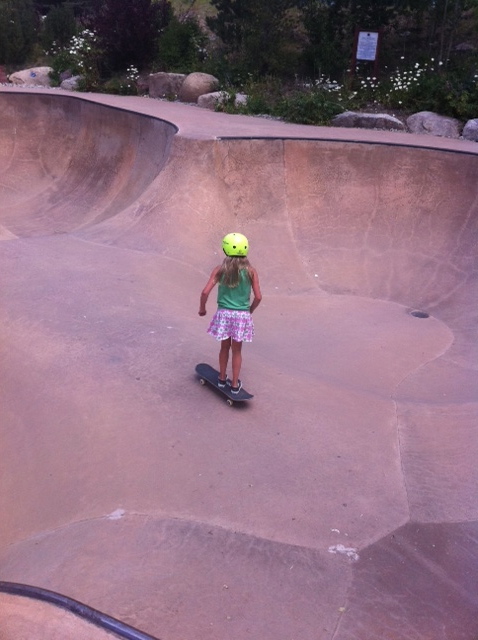
Skateboarding – Autism

When Emma was a toddler, she taught herself how to swing by herself.  She thrust her legs out in front of her and then leaned her body forward as she tucked her legs under her.  It was an amazing and beautiful thing to witness.  I remember the first time it happened, we were in the Washington Square playground in New York City.  She pushed me away as she clambered up onto the swing.  I stood just to the side and behind her ready to push, but she shook her head no.  Then she reached down with her toes to the ground pushed off.  A small group of caregivers and parents gathered around as she sailed up higher and higher, so incredible was it that a child of just eighteen months could swing so high unassisted.

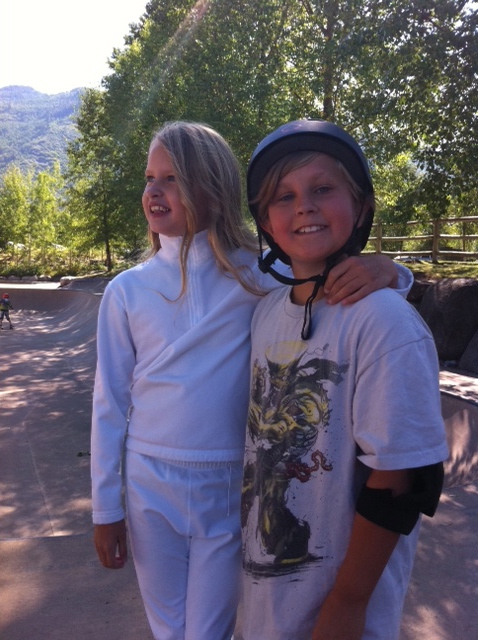
That’s how it is with Emma when it comes to physical things.  She has always insisted on doing things herself and while she can take direction, it is often very difficult for her to be taught by someone who relies on verbal explanation.  Emma feels and learns from watching and doing.  So when she put her arm around her brother, Nic the other morning at the skateboard park and said, “Nicky’s turn, then Emma’s turn,” we knew we were going to have to get creative if she was going to learn to skateboard.

We spoke to one of the instructors from Nic’s skateboard camp and arranged a lesson for Emma that afternoon.  When we finally went to meet him, we realized we hadn’t brought sneakers for her to wear and so bought a new pair at the skateboard shop.  They didn’t have any socks small enough for her, so she just wore the shoes without socks, despite my fleeting concern that she would get blisters.  With borrowed skateboard in hand, we headed to the skateboard park, Emma leading the way.

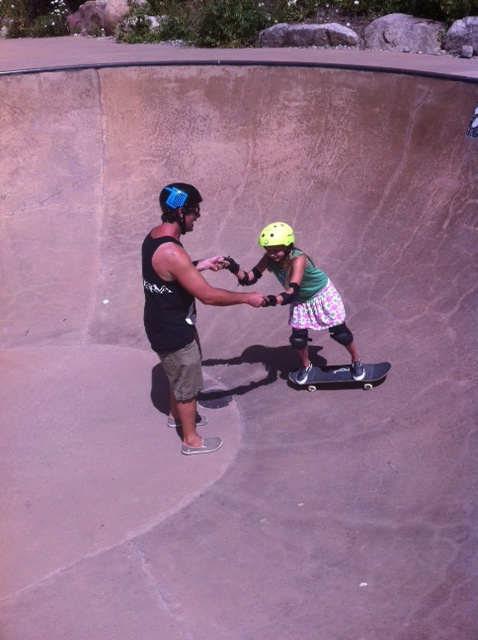
The instructor got her to put on elbow, knee and wrist pads and then together they slid into the bowl to practice foot positioning.  Emma wanted to skateboard though and didn’t want to practice standing on the board.  She wanted to go.

In this way Emma is fearless.

And then the blister on her heel became too painful and she tried to take her shoes off.  From there the lesson took a downward turn and after another ten minutes or so, Emma had had enough.  I am convinced that if we just let Emma experiment on a skateboard for awhile, she’d eventually figure it out on her own.  Just as she did so many years ago on the playground swing, and later with her scooter.  But for now, we will let her dictate how this goes.  If she shows interest in skateboarding again, we’ll try to borrow one for her to practice on.

For more on Emma’s journey through a childhood of autism, go to:  www.EmmasHopeBook.com

Emma’s Struggle with Pronouns

I have written about this before – Emma’s continuing struggle with using the correct pronouns.  It is something one sees in children on the spectrum.  Pronoun confusion, lack of pointing at an early age, a lack of engagement or initiating play, these are all warning signs in small children and almost all children diagnosed with autism share at least a couple of these.

Emma uses the word “you” when speaking about herself, but also when speaking about someone else.  It’s a word she uses for anyone, herself included.  As in “You want to go on the 4-wheeler?”  Someone who doesn’t know Emma would assume she’s inviting them to go with her and the response is often an enthusiastic, “Yes, I do want to go on the 4-wheeler!”

Emma, then happily runs outside, turns the engine on and waits for the unsuspecting person to join her.  This scenario actually happened with our cousin Max, whom neither of the kids had ever met until last summer.  But when Emma says things like, “Bye Emma!” to the person she has just been introduced to, things get a bit more confusing.

So last night when Richard and Emma picked me up from my store in town, she said, “No not going to see July fireworks.  They’re too scary.  Mommy has to pick you up.”  Then she paused and said, “No, Mommy has to pick me up!”  We were surprised and pleased.

“That’s right Em!”  And then as an aside to Richard, “Wow!  That was pretty great.  She corrected herself!”

Emma then repeated herself several times, “Fireworks too scary.  Mommy will pick me up.”  She looked from Richard to me proudly.  “Good talking!” she said, before leaping into the car.

During the ride back to the ranch she tried various variations on this theme.  Each time using “me” correctly.

It was a proud moment for all of us.

For more on Emma’s journey through a childhood of autism, go to:  www.EmmasHopeBook.com