Tag Archives: communication

“Feeling knowledge…”

“Feeling knowledge is reality understood.”

This is what Emma wrote over the weekend.   Yeah.  I’ve been unraveling that one  ever since she wrote it…  At this point there are a couple of things I have come to realize:  First – if I can just keep up with her, I’m doing really well.  Second –  presuming competence is a vast concept and is much more about me and my limitations than it is about the person I’m applying this idea to.  And third – the amount we do not know about autism far surpasses that which we do.

“Feeling knowledge is reality understood.”

EmContemplatesNature copy

Celebrating Gratitude

Emma and I discussed yesterday’s post and I asked her what she thought of the way I’ve described her as an “unreliable speaker.”  I haven’t liked how negative that sounds, though I have meant it more factually, and was not suggesting anything beyond those exact words.  She wrote, “Yes, unreliable.  Mostly talking other words even though not what I think.”

We discussed the comments many have written about believing her and how today is, for many, a day celebrating gratitude. I told her how grateful I was to be able to communicate with her.  She told me I could post some of what she wrote in response…

“Decade of ignorance dead. Deny ideas of intelligence can directly minimize the amount of self-worth one feels. I am grateful many are believing in me.”

Happy Thanksgiving everyone!

This photograph of Emma was taken outside my old studio by Jackie Maillis.  Thanks Jackie!

Power


“People Do Not Believe Me”

“People do not believe me” was what Emma wrote on our last day in Texas last week.  Prior to that sentence she wrote a message to Richard and me that left me in tears because it expressed her gratitude for believing in her and for fighting for her right to be thought competent and intelligent.

One day my daughter will be able to write what she feels and believes independently, of this I have absolutely no doubt.  When that day occurs, she can choose what and when she wants to write such things, but for now, I will keep this post to my own views and opinions.

As many of you know, it was not so very long ago that I was one of those people Emma was referring to.  I have a great many feelings as I write that sentence, but as I trace back what was going on and why I didn’t or couldn’t or wouldn’t believe in all, that it turns out, she is capable of, it wasn’t that I didn’t want to, it wasn’t that I didn’t hope, it was that everything I saw, heard and thought was muddied by what I read and was told and was confirmed by what I thought I was seeing.

When I met people face to face (as opposed to reading their words or hearing of them) like Barb Rentenbach, Tracy Thresher, Larry Bissonnette, Amy Sequenzia, young Nick, Joey, Jamie, Jenn, Mark, Tito, Sarah and countless others who do not speak, or whose spoken utterances are not in keeping with what they write, I began to question what I once believed.  It was during a presentation Barb Rentenbach and Lois Prislovsky gave at the Autcom Conference in the fall of 2012 that I thought, okay, maybe, just maybe, my daughter is not saying what she intends to say.   At that same conference I went to another presentation with Larry Bissonnette, Tracy Thresher, Pascal Cheng, Harvey Lavoy where a young boy, younger than Emma, typed on his iPad extremely insightful comments pertaining to the topic and again I thought, maybe, just maybe my daughter is like that boy and I just have to find a way to help her communicate.

It was the first time I’d really considered the disconnect between speech and intent.  It was the first time I began to wonder whether all this energy being placed on output of spoken language was the best way to help her communicate.  You see, up until then I bought into the idea that if we could just get her to talk, we would be giving her the tools she needed to say what she thought, that the words that came out of her mouth were indicative of what was going on in her mind.  We even would give her spoken prompts, say a sentence and have her repeat it, as though if she could just repeat the words, even though they were dictated and not her words, they would make sense and the connections would be made.  And when they didn’t seem to build to a critical mass, instead of questioning the push for spoken output, I questioned what was going on in her brain.

This was a huge mistake, it turns out.  Huge.  But I didn’t understand.  I didn’t see the error in this thinking.  I could not believe.  Not yet.

And then I met these wonderfully resilient, creative, intelligent people who did not communicate through spoken words, but instead wrote beautifully, poetic words that put together made equally gorgeous sentences that spoke of insights and wisdom and hope and strength and courage and compassion and I was blown away.  At first I thought each person was an anomaly.  I told myself they couldn’t possibly be representative of many, they had to be one in a million… and then I met more and more and eventually, even I could no longer doubt what I was seeing and witnessing, this critical mass… this unleashing of hundreds of voices, each unique and yet all…. all were communicating what was in their minds and many spoke of that disconnect that occurred between a thought and what then came out of their mouths.

“my mouth constantly talks different from what I think…” Emma wrote.

“People do not believe me.”

“Yes,” I told her, “but that is changing…  that will change.”

It is my promise to my daughter.  I will not stop writing until it is no longer necessary to say these things.

Lois Prislovsky, Barb Rentenbach and Emma

L,B&E copy

Returning Home

Em and I returned home Friday night.  It was an exhilarating trip, but also an exhausting one.  These trips always are.  We went from having daily sessions with Soma (you can read more about Emma’s experience working with Soma ‘here‘, ‘here‘ and ‘here‘ and more about Soma and RPM by clicking ‘here‘) that were so incredibly exciting, I could barely take in all that my daughter was writing.  Personal, gut wrenchingly, painful insights, loving notes of gratitude to my husband and me that made me weep with joy, but also bittersweet because it is she who has had to put up with us and not the other way around.  Her writing displays an almost unfathomable intellect, wisdom beyond her years as well as compassion and patience for all who do not understand her, for those who doubt, for those who do not believe her and all she is capable of, for all who talk down to her, my daughter is a beacon of kindness, forgiveness and compassion.

I do not want people to come away with ideas about saintliness, holiness or angels being dropped down from the heavens and inhabiting her body.  I cannot and do not believe in any of that and it dismisses the many challenges and struggles my daughter must endure.  Above all else my daughter is a human being, just like you, just like me, very much grounded on this earth and in this life, but she is also exemplary in her ability to see the good in others.  It is something I am trying hard to emulate.  It is as though the more she writes about what she believes and thinks, the angrier I become.  The more enraged I am that we have all believed so easily, without question, the standard assumptions about Autistic people and autism and what that means.

I understand that for many they just cannot believe someone like my child is capable of knowing so much despite having had little formal education, but instead has spent all of her school years segregated in special education schools where she reads below age level literature and is taught the value of nickels, dimes and pennies because it is assumed she does not understand concepts such as money and time.  I understand.  I do.  I was one of those people not so long ago.  But now I know otherwise.  We are fortunate that her current school is open, willing and interested in learning all she is capable of.  They have expressed interest and their intent to support her and to help in any way they can.  We will be revising her IEP soon.  It will be quite a revision!

Now we are home and I know better than to expect I will be able to pick up where Soma left off.  I know better than to think I will be able to sit down with my daughter and accomplish the same level of writing I witnessed this past week.  I have to pick up from where I left off before our trip to Texas.  This can feel incredibly frustrating and even depressing, but I am learning to not delve too deeply in despair, but rather continue moving forward with the knowledge that I will and already have progressed in my ability to support my daughter better each day so that one day she will be able to converse with me on a similar level as she does with Soma.

This disparity between what Soma is able to do and what those at home then try, has caused a few to claim that therefore Soma’s method is flawed or is cause for suspicion and doubt.  What I have come to understand is that my Autistic child is intensely sensitive to her relationships.  I cannot sit down and expect to have her write to me as she does with someone who developed this system and who has fine tuned it, perfected it along the way, while working with close to a dozen people every day for over ten years now.   It is akin to expecting that I will be able to set a diamond as well as a master jeweler who has been perfecting his craft over the last twenty years or after taking a painting class be able to create something on par with Rembrandt or after taking French 101 go to France and speak fluently.  We do not expect any of these things from each other or ourselves, and yet, people decide something like RPM will be easy and simple and anyone will be able to do it instantly and when they cannot, the flaw is in RPM.  I have met too many other people who are practicing RPM to see that it is this thinking that is flawed.

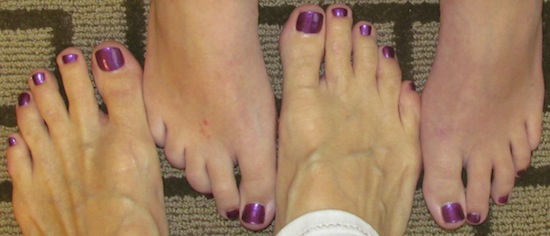
Em chose toenail polish for both of us!

Matching toenails

“Why People Walk on Two Legs” – A Folk Tale By Emma

What follows is one in a series of folk tales Emma is in the process of writing since we arrived in Texas visiting Soma Mukhopadhyay.  I’ve written about Soma quite a bit; for more posts about Soma  click ‘here‘, ‘here‘,  and ‘here‘.  Anyone who is curious about Soma’s Rapid Prompting Method (RPM) please visit her website, which is full of terrific information.

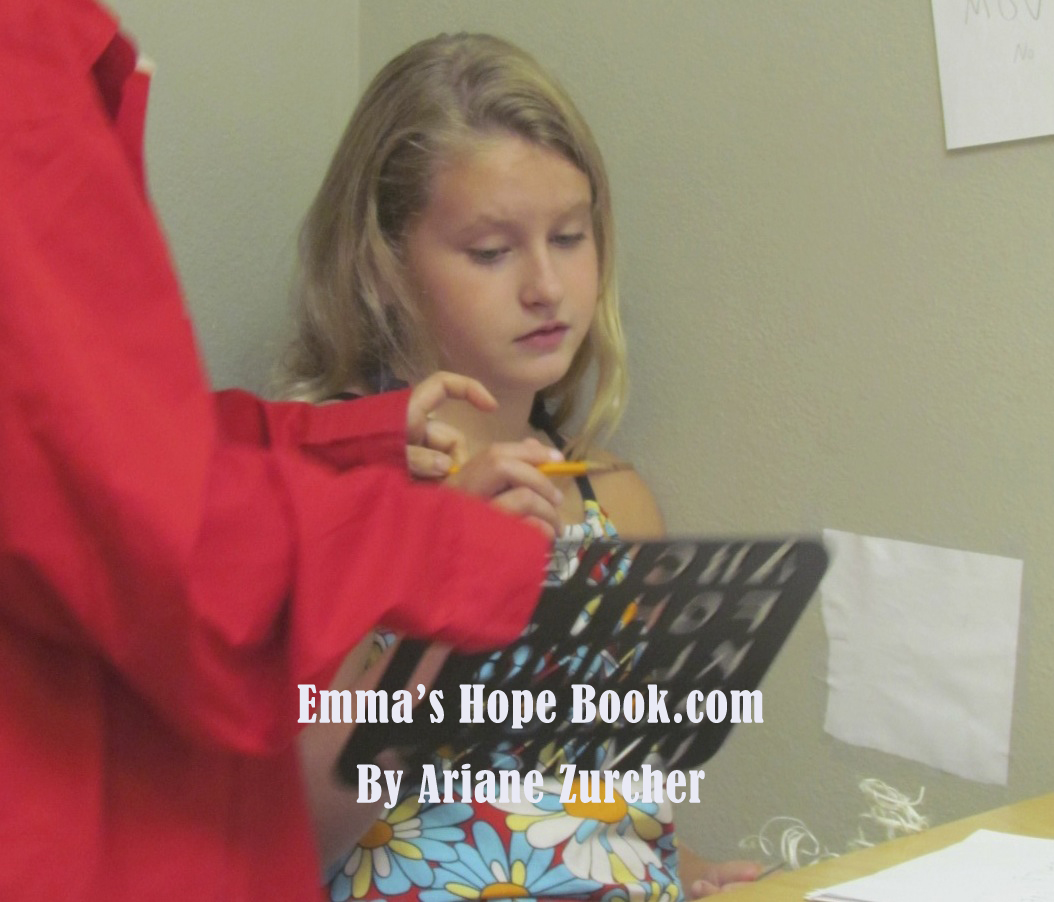
A quick note about how I transcribe Emma’s words.  Emma points with a pencil to letters on a laminated letter board that Soma holds in front of her, though she also has Emma hold the laminated board herself from time to time.  No one touches Emma as she does this.  Every few words that Emma spells, Soma takes the pencil from her and writes what she has written and repeats the words out loud.  Emma then proceeds.  As there is no way to punctuate the words as she spells them, I take my notes, transcribe them and ask her to tell me where to put commas and periods.  This story, Emma wrote yesterday and afterward told me, “You could put it on the blog!”

                  Why People Walk on Two Legs ~
A Folk Tale By Emma

Long ago people walked like animals because it was funny.  They had to work in the fields wearing knee-shoes and regular shoes.  They could not run fast that way.

In ancient Turkey there was a man who was sort of a doctor.  He had to be very careful while treating his patients.  He saw most of his patients had bone injury, so he asked them to stand.  It was against the law.  Kings punished anyone who walked that way.

But one day the king hurt his back.  The doctor treated him.  Finally the king made it legal.  Today it is natural to walk the way we walk.

The end

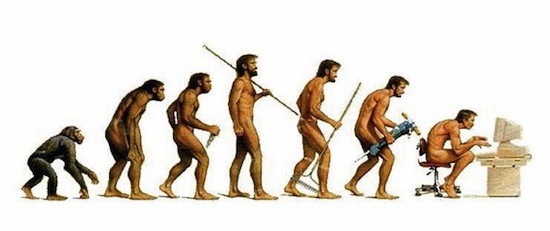
Emma chose this image from a google search for images of “evolution of man walking”

evolution

A Tale: “Horses Will Never Fly”

This tale was written by Emma and she has generously agreed to allow me to share it here with all of you.  She will finish it at a later date since she was too tired to do so now.

“Horses Will Never Fly ~ By Emma

Long ago horses were mean animals.  If anyone tried to go near, they charged at them.  They had big wings and flew higher than eagles.

One day they flew around and caused so much wind that the dust began to fly.  Dust and sand covered big areas of earth, making deserts.  People and trees were buried below the dust.

Finally when they rested they saw their wings had begun to shed…”

Originally Emma ended this with “They stopped flying.  Horses will never fly.  The end.”  But once we returned to our hotel and discussed it more, Em said it wasn’t quite finished and promised to finish it later when she wasn’t so tired.  In addition, I added the punctuation with Emma’s approval.  As there is no way to punctuate from a stencil board it must be done afterwards.

These sessions are exhausting and she works so hard.   Her story reminded me of Rudyard Kipling’s Just So Stories that I loved as a child.  I cannot wait to read what Emma writes next!

Emma chose this image to accompany her tale from a search for “winged horses.”  It was attributed to redorbit.com

images

This is Autism (Written by Emma)

*A quick note on today’s flashblog ~ This is Autism.  In response to Suzanne Wright’s upsetting and fear-inducing letter entitled A Call for Action  a Flashblog has been organized to take back the phrase “this is autism”, which Suzanne Wright used several times in her letter that was posted on Autism Speaks’ website, the organization she and her husband Bob Wright created eight years ago.   Suzanne and Bob Wright and their organization’s beliefs are exactly what I hope my daughter never sees, hears or is confronted with, but that she feels the repercussions from on a daily basis.

I asked Emma if she wanted to write something for today’s post with the title, “This is Autism”.  She wrote that, yes, she did.  The following is what my daughter wrote, pointing to one letter at a time on a stencil board with a pencil.

This is Autism

Autism is anything.  

It is not bad,  

it is a mindset.

Autism is a method of energy,

it is how I think.

Autism is derided and except in some accepting eyes,

it is seen as not a nice thing,

but

it is me.

*Em

A Guest Post From Richard Long…

What follows is a guest post from my husband, Richard Long

After Ariane’s post What’s Wrong With Autism Speaks yesterday, I thought I’d throw my three cents in here. I didn’t know ANYTHING about autism when our daughter Emma was first diagnosed–except that it was BAD, very BAD and that I should be terrified. My wife went out and read most of the books written about autism at the time, mostly written by parents of autistic children documenting their torturous journey, many about the miracle cure they found that “cured” their child.

Like most guys, I Googled my ass off to try and bottom line the situation. And the news was BAD. My child was probably incapable of feeling empathy, of understanding sarcasm, of connecting with other people. Wow. Since Emma was making very little eye contact at the time and was not interested in cuddling or hugging, I thought this all had to be true. Poor Emma. Poor Ariane. Poor me.

I was told life would be difficult. Meltdowns, speech and language processing issues, OCD symptoms, toilet training. I watched horrifying videos like the ones made my Autism Speaks, (I won’t post links here, but they are on the other posts I linked to earlier if you want to get the crap scared out of yourself as well). I was told that a cure may be possible if we ponied up enough $ to Autism Speaks or TACA, so I opened my wallet. I was told about other miracle cures from casein-free, gluten-free diets, hyperbaric chambers, even stem cell therapy! We actually tried them all. We were so very desperate to “save” our daughter.

Then a true miracle happened. Ariane discovered the blogs of adult autistics who were telling a very different story. They DIDN’T want to be “cured.” Autism was part of who they were, as integral as any other component of their personalities. We were told that there were many advantages of autism: heightened senses, high intelligence, great analytic capabilities. I discovered all the famous inventors who were probably autistic.

Most importantly, we learned that what you see isn’t necessarily what you get.

We thought our daughter couldn’t understand what we were saying. Why? Because A) she didn’t react like she was listening B)  she didn’t comment on what we were saying C) she never spoke about things like that herself and D) she didn’t seem capable of very much speech at all. But now that we have found new communication systems, it turns out Emma understands EVERYTHING we are saying and has AMAZING things to say about her world. She is HIGHLY intelligent (I suspect she is more intelligent than me). Her sense of humor is incredibly sophisticated. She thinks about some things we never considered at all and sees things in such a creative, unique way.

Live and learn. It took us SEVEN YEARS to realize these things. During that time, we really did think of our lives as tragic. And now I can see how much better all our lives would have been if we had received the right information about autism from the very start. Information that came directly from autistic people, rather than people who claimed to “Speak for Autism”. Information from the parents of autistic children who had also discovered the truth about autism from adult autistics. Parents who weren’t looking for a cure, but instead trying to help their children communicate more effectively and deal with the other issues that make life difficult.

It’s a brave new world for us. Thank god. “Better late than never” I keep repeating to myself. But better yet, my hope is that all children who are born autistic are lucky enough to have people around them who actually understand what this means, that don’t look at this as tragedy, who are ready to help in the best ways possible because they have truly useful information available to them.

And I have never seen any useful information come from Autism Speaks. Then again, if they had said something useful recently, I wouldn’t know because I stopped listening to a group that never speaks with the voice of actual autistic people.

Speaking of which, yesterday Emma had another writing session, which Ariane will post in full on her blog tomorrow. It is mind-blowing so don’t miss it. Here’s a preview: In the session before last, Emma was taught about an inventor of oil pumps for train steam engines. At the end of that session the teacher asked Emma to think about what she would want to invent. So yesterday the teacher asks her what would be a really great thing to invent. Emma’s response:

“Let me tell you that it is not a train engine.”

What is it then?

“It is more from the future. It is a spaceship.”

I can’t wait to show her my UFO videos tonight.

Summer 2008 ~ Richard, Em and Ariane

Richard, Em & A

The Purple Tree

The Purple Tree and Other Poems is a collection of poems by Sydney Edmond who is non-speaking and autistic.  She learned how to write using a letter board when she was ten-years old, two years later she gave her first public presentation  and has presented at a number of other conferences since then.  Now ten years later, Sydney continues to write, present and is the subject of a documentary called, “My name is Sydney

“Lazy, achy lady
lived by the sea.
Lazy, achy lady,
move away, please.

You are always blabbing,
talking long and loud.
You are closing in on
my lovely little cloud.” ~ From the poem, Some Early Poems

One of the most exciting things happening now is the emergence of a growing number of non-speaking Autistic people who are writing.  Thankfully self-publishing and blogs are making their work accessible to the public.  As more non-speaking Autistic people write and publish their work, it will become increasingly difficult for the public to deny that the assumptions we have long-held about Autistic people are incorrect.  Eventually we will have to re-evaluate how we are viewing those who are Autistic and what that actually means.  Our notions of “intellectual disability”, our ideas about what someone is or is not capable of are being challenged and will continue to be until what we think we know now, what is considered common knowledge will be seen as antiquated and our limited assumptions an example of just how ignorant we once were.

“I lack the lovely peace of mind,
lack my always smile.
Who listens to a lonely girl,
Listens to a child?”  ~ From Dear Friend

The first presentation Sydney gave was in 2005, just two years after she began communicating on a letter board.  This poem, Love, Love, Love! was part of her presentation at the West Coast Symposium on Facilitated Communication.

“But Soma came along
and changed my life.
She actually lifted poor little me
out of darkness
and into light,
love,
and lovable, lovable, lovely happiness.

Soma taught Mom
how to communicate with me,
and Mom and I have been talking
ever since.
Now I can choose my own clothes,
make my own decisions,
and make lovely friends out of people.”

For those of us with children who do not speak or whose language is unreliable, or does not necessarily reflect what is meant or intended, we are entering a time of tremendous hope.  There is a great deal of work still to be done, but in publicizing the work of those who are like our children, who are communicating by typing and pointing to letters on letter boards, we will shift how people view not only our children, but all our children and people.  By questioning commonly held beliefs about any one group of people we affect change for all mankind.

Unknown

“It’s Good to Be Heard”

It’s good to be heard

These are the words my daughter spelled out yesterday during an RPM session.  She wrote some other wonderful things too, but I don’t have her permission to print them here.

“It’s good to be heard”

Imagine a life where it was not a given that what you said would be listened to, or even understood.  Imagine if you said things you didn’t mean or that people couldn’t follow the meaning and so you were dismissed.  Imagine being treated “like a three-year old” (this was something else my daughter wrote last week) by people who do not understand, cannot understand, are incapable of understanding because it flies directly in the face of all they’ve been taught and know.  My daughter does not have the mind of a three-year old, despite what anyone else may think or assume.

“It’s good to be heard”

Thanks to a number of dedicated people who have devoted their lives to figuring out alternate ways for people to communicate who cannot or do not reliably speak, my daughter is communicating with us.  Much to our surprise she has managed to learn an enormous amount despite the fact that she has spent years of her life in little more than holding tanks, i.e. special education schools where “life skills” classes are lauded as progressive, where verbal speech is seen as the only true barometer by which intelligence can be gauged.

It’s good to be heard”

RPM copy

My Resistance to Practice

I’ve been struggling, feeling very emotional in a “bad” sort of way.  You know how when you’re weepy all the time for seemingly no good reason?  Those times when you keep crying every time you hear sad music, and all music strikes you as sad, even really upbeat music, or when someone looks at you with a stern face, or uses a harsh tone, or if you read something sad, and everything you read seems really sad, and you keep having to wipe tears from your face and hope you remembered to bring tissues with you, but you never do?  Yeah, sort of like that.

*Sigh*  It’s been a tough few weeks.  I have felt off-balance because I have been expecting myself to be able to do what I’ve seen a number of people do with my daughter, but that I have not been able to do.  I returned from our trip to Texas and thought, after only a couple of sessions with my daughter, I’d be able to start asking her open-ended questions, just as I’d seen Soma Mukhopadhyay do.  (Despite the fact that Soma advised me NOT to ask any open-ended questions in the beginning.)  *Define beginning, I kept thinking.  I HAVE begun.  Surely now after the second or third day home I am beyond “beginning”!  This thinking is akin to seeing a master jeweler create a beautiful ring and expecting that I should be able to create that same ring without having spent years practicing the craft as a bench jeweler, or hearing a Rachmaninoff piano concerto played at Carnegie Hall and then going home and thinking after a couple of piano lessons that I would be able to replicate that piano concerto.  The point is, Soma is a master at RPM (rapid prompting method).  She’s been doing RPM for close to two decades, first with her son Tito and later with hundreds of Autistic people.

But I so wanted to have the kind of conversations with my daughter that I saw her having with Soma.  It was like catching a little glimpse of paradise, but not being able to find the bridge to actually get there.  I kept trying to leap.  I kept trying to find a short cut.  And as I did this, each day, my distress grew.  I felt frustrated and then angry and then beaten down.  All because I was expecting myself to be able to do something without any practice.  So when my suffering reached an all time high, when the occasional weeping, became more than occasional and my son, upon seeing me asked, “why are you always crying?” I realized I had to get help.  I did what years of recovery from addiction has taught me – I reached out to another human being.  I contacted someone I only know through the internet, but who has been working with her son for a number of years now.

She gave me wonderful tips.  She sent me videos to watch.  She listened to my distress.  She told me it took months of practice and as I read everything she sent me, I kept thinking both how grateful I was to her for being so kind and generous in sharing her experience with me, but also was reminded that I need to practice and I need to start at the beginning.  Everything takes practice.  My expectations of myself were causing me tremendous pain.  They were unrealistic.  It isn’t that I can’t do this method with my child, it’s that I can, but I need to practice.  And as I realized this, as I thought more about this, I saw the parallels to presuming competence in my child.  I have written about what “presume competence” means, but in all the posts I’ve written on the topic there is one piece of this that I have neglected to mention and that is, presuming that we can and will be able to learn with appropriate accommodations and enough practice.  I forgot to include myself in presuming competence.  I need that presumption too.  I need to remember that I can and do learn if I’m given instruction and give myself the opportunity and time to practice.

I had the proper instruction, but I haven’t been practicing long enough to get the results I wanted.  So last night I wrote up a lesson plan, just as Soma had instructed during a previous four-day intensive workshop I took last spring.  I made sure I followed her format of how to create a lesson plan.  I made sure I began with choices and spelling key words.  I even tried to embody her lovely, sing-song, calm, kind voice.  I laid aside any expectations of what would or should happen.  And you know what?  It was a great session.  I made a couple of mistakes, I had to refer to my notes often.  I had to make some adjustments.  I forgot a couple of key things, but I jotted down some comments to myself so I can remember to revise accordingly for our next session this afternoon and more importantly, we were both more relaxed than we have been since we returned home.

Practice.  I hate the idea of having to practice.  I want to go from never having done something, to immediate fluency.  But once I begin practicing and let go of that desire and those expectations for immediate fluency, practicing can be incredibly enjoyable.

To Sue:  This post is for you.  Thank you.

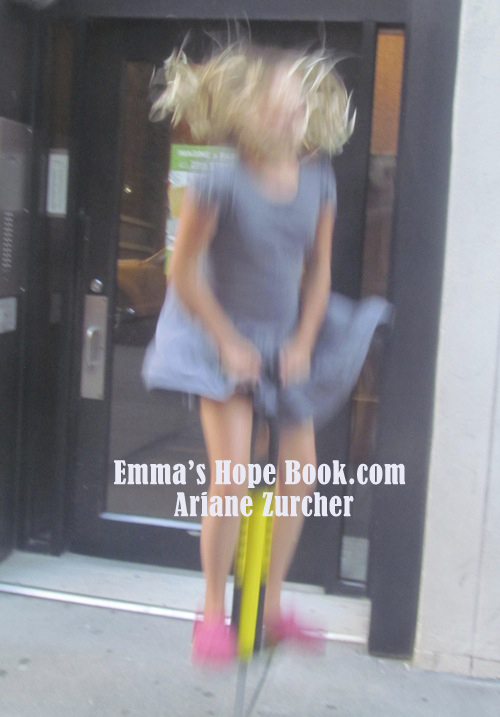
Em practices jumping on her pogo stick.  New all time record?   127.

Joy copy

When Words Don’t Reflect What is in the Mind

Imagine being asked a simple question, say a question about whether you’ve ever been to New Zealand.  Now you know perfectly well that you’ve never traveled to New Zealand, though you have a pretty good idea of where it’s located, however it’s not a place you’ve spent much time thinking about and it wasn’t even on your top-ten-must-travel-to-before-I die list.  But when you opened your mouth instead of saying, “No, I’ve never been to New Zealand, why do you ask?” all you could manage to say was, “Yes!” and not just a sullen sort of yes, but a happy, eager and enthusiastic “YES!”

So now the person begins talking to you about New Zealand and maybe they’ve just returned or they were born and raised there and they go on and on and then say, “What was your favorite place in New Zealand?”  Well, since you’ve actually never stepped foot in New Zealand this question is impossible to answer and so maybe you say “vanilla cake” because the one thing you know about New Zealand is that people are referred to as Kiwis and your only reference to kiwis is when you tried an actual kiwi once and didn’t care for it, but your favorite thing to eat is vanilla cake and besides vanilla cake makes you happy and this conversation is making you anxious because you said “YES!” when you actually meant “no” but things have moved on so quickly that you are feeling tremendous anxiety and wish you could just go somewhere away from this voice that is speaking so quickly about a place you’ve never been to nor have any interest in.

They look at you with that look, it’s a mixture of irritation and surprise, like they cannot decide whether you are purposefully making fun of them, or are tuning them out because you’re rude and have no manners or because you are actually hungry and are wanting to eat some cake.  So they give you the benefit of the doubt and say, “Yeah, well we can’t eat vanilla cake right now and anyway we were discussing New Zealand, so I’d like you to focus so that we can continue.”  Feeling frustrated and maybe even ashamed that they think you’re rude, you try to make a friendly overture by saying, “I like vanilla cake.”  But instead of smiling they look even more angry and so your anxiety kicks into high gear and you bite your hand to center yourself and because you are overwhelmed with frustration.

Suddenly all thought of New Zealand and anything else gets tossed out the window, because here you are biting yourself to center yourself and also cope with how frustrated you are, but all it does is make the other person furious.  You are so completely misunderstood and without the means to explain, you are caught in a web of other people’s assumptions.  “Stop it!  We do not bite!” the person scolds and maybe they grab your hand and hold it done at your side.  Their grip is firm, so firm, it actually hurts, and they look so angry that it’s scary too.  They are restraining you and glaring at you and all because your mouth wouldn’t obey your mind and said, “Yes” when you meant “no”.

I have no idea if this is what it’s like for my daughter or others who have what I call unreliable spoken language, but these are the kinds of scenarios I imagine and wonder about.  Is this what it’s like?  One day she will tell me, but in the meantime, there are others who are now writing about similar things, when their mind knows but their body is unable to do as their mind wants.  This is what Ido writes in his book, Ido in Autismland:

“… my mom asked me to hand her a bag.  I kept handing her a piece of paper the bag was near.”

“It happens less often now but it was common when I was small in my ABA drills.  I wanted to touch a card but my hand had another plan so I had to redo drills until my hand got it.  Not my head.  It knew everything.  My hand had to learn the drill. It’s something for the neurologists to study.  This is why so many parents think their kids don’t understand them.”

Naoki Higashida in his book, The Reason I Jump, writes:

“…as soon as I try to speak to someone my words just vanish.  Sure, sometimes I manage a few words, but even these can come out the complete opposite to what I want to say.”

What would that be like?  How would it feel to be completely misunderstood, your every action misinterpreted by someone else who believes you meant something that you did not?

Tracy Thresher types during a Q&A at the ICI Conference ~ July, 2013

Tracy Writes

Non-Speaking With a Lot To Say

I am reading Ido in Autismland: Climbing out of Autism’s Prison by Ido Kedar.  This is another one of those MUST READ books.  Ido is a non-speaking Autistic teenager who learned to write his thoughts by pointing to a stencil board using Soma Mukhopadhyay‘s RPM method.  Ido now types on an iPad.  When I first received a copy of this book, I admit, I was put off by the subtitle.  You see, I was one of those people who once believed my daughter was trapped inside a prison that I called “autism” and for a long time I absolutely believed this.  This thinking led me to believe that if I could cure her, if I could remove her “autism” she would be released from its prison.  It was also this thinking that caused me to say how much I loved my daughter, but hated her autism.  Once I discovered blogs written by Autistic people I began to reassess these various beliefs and finally began to understand how my thinking was actually harming her.    I’ve written about some of this ‘here‘, ‘here‘ and ‘here‘.

But in reading Ido’s book and because I wrote directly to him and his mom about my initial reaction to the subtitle, I have come to understand that his reference to “prison” refers to being imprisoned in a body that does not obey what his mind wants, a mouth that does not say the words he wants to communicate and a society that perceives him as someone he is not.  But more importantly this is Ido’s story and is about the way he perceives autism as it relates to himself and what he has been through as a result. To not read this terrific book because of semantics or because Ido’s perception of autism as “illness” is one I found unhelpful and even harmful to my family and daughter, would mean I would have missed reading a great book written by a really insightful and wise young man who had to fight against prejudices and preconceived ideas about who and what he was capable of.  This is Ido’s story and what a wonderful story it is!

In the introduction, Tracy Kedar, Ido’s mother, writes,

“The ideas in this book challenge many assumptions long held by professionals working with autistic people.  In our own experience, Ido broke free in spite of, not because of, the mainstream thinking today.  If we had continued to rely on  the specialists and educators who dominated Ido’s early years, if he had not been able to find a way to show me that he could read and write, and if I had not finally trusted my own eyes and impressions, Ido would still be stuck as he was, locked internally, underestimated and hopeless.  It is time for our understanding of autism to undergo yet another paradigm shift, and Ido, along with other non-verbal autistic communicators, is a pivotal guide.”

*The use of bold is mine, used for emphasis and is not in the book.

Just as a quick aside, Soma’s RPM method begins with written choices, progresses to a stencil board with the student pointing to the desired letters with a pencil, then to a laminated alphabet board and eventually to an iPad and computer.  Soma or the person doing RPM does not come into physical contact with the student and once the student has moved to a laminated board, she even encourages the student to hold the board themselves.  The final step is to move from the laminated board to independently typing on an iPad or computer.

This quote was written by Ido in 2008 regarding his body and mind and how the two do not obey each other.

“Time after time people assume that I don’t understand simple words when they see me move wrong.  Understanding is not the problem.  It’s that my body finds its own route when my mind can’t find it.”

Again in 2008, Ido writes about his life before he learned to communicate using RPM.

“They misinterpreted my behavior often.  For example, I remember that during my ABA supervisions, I sometimes ran to the window over the parking lot in an attempt to show them that I wanted to go to my car.  They didn’t understand how a non-verbal person might be communicating.  Once, when I got really mad I urinated in my seat, but the supervisor just thought I couldn’t hold my bladder.

“But even worse was that they didn’t support me when I began to communicate.  Maybe they assumed I was too dumb, or they simply couldn’t see what I had learned because I learned it in a different way than their methods.  The response to everything was to give me drills.  If I had a dollar for every time I had to touch my nose, I’d be rich. I remember one day they realized that I hated being told to touch my nose, so they brilliantly switched the command to “touch your head.”  I felt like a prisoner of these theories and methods…”

“On Being Silent and Liberated from Silence”

“Can you imagine silence your entire life?  This silence includes writing, gestures, and non-verbal communication, so it is a total silence.  This is what a non-verbal autistic person deals with, forever.  Your hopes dim, yet you persevere in going to ABA or Floortime (play focused treatment for autism) or speech therapy, all to no avail.  The therapists can’t help and you despair, and only you know that your mind is intact.  This is a kind of hell, I am certain.

“The experts focused on stim management, or drills of rote activities, or silly play like finding things in Play Doh, over and over, on and on.  But they never taught me communication.  I shouted to them in my heart, “I need to communicate!”  They never listened to my plea.  It was silent.

“I could read from an early age.  I could write too, only my fingers were too clumsy to show it.  In school I sat through ABC tapes over and over and added 1+2=3 over and over.  It was a nightmare…”

Ido writes how when he was seven years old his mother supported his hand in an effort to have him help write invitations to his birthday party and how she could feel he was attempting to move his hand and in this way realized he could write.  But things did not immediately change.  No one believed him or his mother.

“My ABA team tried to convince my mom that she was wrong.  This hurt me so much because I thought they’d be happy for me and teach me how to communicate better.”

My daughter has asked that I read Ido’s book to her, so I am.  It has opened up a whole discussion about communication, what it means to not be given the tools to do so, what is autism, what it means to be autistic, being in a body that often does not do as one would like and what others believe as a result of actions you often have little if any control over.

Ido

I Will Not Model Compliance For My Child

“Look! Motorcycle bubbles!”  This was a phrase Emma used to say often.  It was an all-encompassing phrase that was both a metaphor for rain and the Fourth of July and New Years Eve fireworks, as well as a descriptive phrase of what both are like sensorily for her. (Emma has verified this is true.)  “Motorcycle bubbles” meant rain and fireworks, but there was so much more to those two words than simply pointing out the window and saying, “Look!  It’s raining!”  or “Look at the fireworks!”

When I went back through this blog to find the post I’d written about motorcycle bubbles, I found these, “Sorry Bubbles” and Em & The 4-Wheeler  written more than two years ago, that I’d completely forgotten about.  “Motorcycle bubbles” and her related phrase, “Sorry bubbles” are nothing short of poetic.  Poetry is all about using words in unusual, unexpected ways, “Sorry bubbles”  Great art evokes an emotional response within us.  While, a few years ago, I was appreciative of the beauty of phrases such as “sorry bubbles”, I was even aware of the emotional tug I felt when I heard her say those words, that appreciation was tempered by worry and concern about what I believed the larger issues were for my child who said such fascinating, yet cryptic, words.

I no longer feel the strain of worry and concern, but rather delight in my daughter’s obvious brilliance and poetic gifts.   I am grateful to have gotten to this place of appreciation and joy.  So many autism specialists and so-called treatments did not and do not appreciate the beauty of those word combinations.  So many believed they were aberrant, meaningless words that must be righted through rote learning and repetition of more “appropriate” words.  Which was code for “use these conventional words, so that we can understand you more easily.   Make our lives easier.  Behave in ways that do not draw attention to you.  Be like everyone else.”  And all of this was done under the guise of “helping”.  Meanwhile “motorcycle bubbles” and the like would be bulldozed, covered with the dirt of more conventional language.

People argue that our children need to learn to “fit in” that it is our job to teach them these skills and to not do so is to be negligent or (at the very least) unrealistic about life and the world.  But for those like my daughter, asking her to spend so much of her energy and time to try to change the way she moves (were that even in the realm of possibilities), forcing her to give up her string (which marks her as different), trying to get her to substitute her string for a more “socially acceptable” object, teaching her to swallow her verbal utterances that to others seem nonsensical, forcing her, every time she said anything, to repeat a more conventional way of speaking, even if all of this were remotely possible, I ask WHY?

Why would we do this?  Why is all of that more important than giving her the freedom, support and encouragement to be her unique and beautiful self?  Why is quelling her natural tendencies so desirable?  Why is tamping down her poetic phrases, replacing them with more standard, “accepted” speech preferable?  Why is all of this considered desirable given the massive toll all of that takes on her?  Even if she could do any of these things, even if all of it were obtainable goals, how exhausting, how bone-numbingly frightening, how terrifyingly isolating it would be to grow up believing that everything about you was fundamentally wrong.

I’m not interested in grooming my child to be something she is not, demanding that she be someone, that even if it were possible for her to attempt, would make her feel awful about herself, just so society could feel better about its own mediocrity.  I’m not willing to do that.  The only thing I care about, the only thing I’m interested in, is changing society’s views and the only way that’s going to happen is by countering what is considered the “norm” and saying, NO!  I’m not going along with it.  NO!  I am not going to raise my child to be compliant or train her to say what you want to hear or try to force her to move in ways that society has deemed acceptable.  I will not model compliance for my child to imitate.  I do not condone censorship that would bury “motorcycle bubbles” and “sorry bubbles” forever.

(Chou Chou – This photo’s for you!)
Love copy

“Be Nice To Each Other”

Be nice to each other” – this was the final sentence Emma wrote to Soma on Friday before we flew back home.  She wrote it in answer to Soma’s question, “Any message to the world?  To mankind?”

Be nice to each other.

We returned home late Friday night.  I was riding on a cloud of excitement, newly found realizations, solid, unequivocal confirmation and proof that not only is Emma completely aware of her surroundings, but she has profoundly wise insights into the world, other people and herself.  She is one brilliant girl.  She has managed to learn despite having almost no formal education, she knows her multiplication tables as though she’d been studying them for years.  She knows how to solve mathematical word problems, she understands things I have only come to understand very recently and her compassion for others is astonishing.  She has been spoken harshly about.  She has heard what others have said about her in front of her as though she could not hear or understand.  She knows what others think of her, and yet, she understands these things are said in ignorance.

So excited was I, that I slept fitfully, and Saturday morning awoke to blinding, crushing, devastating sadness.  I felt the weight, the enormity of my daughter’s life and my role in all that has happened to her these past nine years since she was diagnosed.  My mind latched on to each and every misstep, the mistakes piled up so quickly, one on top of the other I felt I couldn’t breathe.  I spent Saturday in a state of crisis.  I completely broke down.  And the thought that continued to blast in my mind was, “How will I ever find my way out?  How can I forgive myself for what I’ve done?  How does one forgive another who has made the decisions I’ve made?  In essence, how can you forgive what is unforgivable? And yet, she has.  And therefore, so must I.

Be nice to each other.

And here is the thing about all of this.  Berating myself, hating myself, NOT forgiving myself allows me to continue the cycle.  It wears me down, threatens to break me when I need to be strong.  But I also know that when I am overwhelmed with feelings, telling myself that I must not feel the things I am feeling, does not make them go away.  Tamping the feelings down, pretending they do not exist, none of that actually helps me move through them.  Criticizing myself for hating myself does not make me hate any less.  And so I accepted that this was where I was.  And for one day I sat with all those awful, painful feelings and felt them.  Neither pushing them away or adding to them by criticizing myself for having them.  I sat with them one excruciating hour after the next and allowed them to be.  And all the while I repeated Emma’s words, Be nice to each other. And I allowed that to include myself.  By Sunday morning I felt my strength returning.  I felt that old determination returning.  I could feel energy flowing and I knew.  I knew.  As long as Emma gives me permission to, I will tell all who will listen, at least some of what she is writing.

When I asked Emma yesterday if I could write today’s post using her words as the title she nodded her head, yes, and smiled.  Last night before going to sleep she said, “Mommy?  No school tomorrow?  I don’t like new school.”  And so I promised her, I promised I would do everything in my power to help her school understand, but I know I have one hell of a battle before me.  And I need every ounce of strength I’ve got in me.  But maybe, just maybe some of the video clips I have of Emma writing these things will have the power to change even a few minds so that they will be swayed and will come to understand what I have.  Not only is my daughter capable, she has a great deal to teach us, but all of that will be lost if we are not willing to open our minds and listen.  This is the non autistic limitation of our neurology.  This is our neurological deficit and we will have to work mightily to change that.

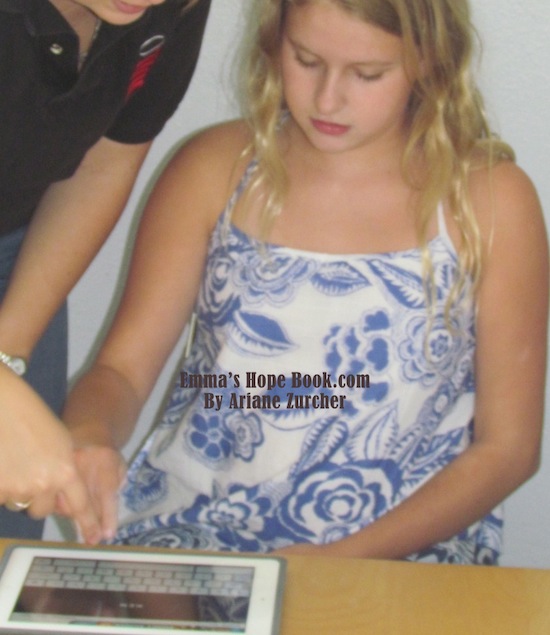
Emma at Halo – September 26th, 2013

Em iPad copy