Acceptance And A Webinar

When my daughter was diagnosed first with PDD-NOS and later with autism, I easily fell into the ~ I-completely-love-and-accept-my-daughter-but-I-do-not-accept-her-autism ~ mindset.  At the time, this seemed perfectly logical and I didn’t think a great deal more about it.  Autism was the “problem” after all, not her, and once we got rid of the autism, everything else would fall into place.  When people said the word “acceptance” and “autism” in the same sentence I nodded my head yes, while my mind carefully separated autism from my daughter, plucked the word from the sentence and placed it into a box before closing the lid.

It took a very long time for me to understand that my daughter and autism were not to be separated.  And it wasn’t until I began developing real friendships with Autistic adults that I stopped trying or wanting to separate the two.  Acceptance is much more than tolerating something or saying – okay I won’t actively fight this any longer.  Acceptance is an embrace, it’s understanding and actively celebrating difference, it’s about looking inward and asking questions.  It’s about self-reflection and digging deep into the darkness of preconceived beliefs and being willing to be wrong.  It’s about saying – I don’t know and I don’t understand, will you help me?  It’s about being vulnerable and not “right” and it’s about the excitement of discovery and being curious and open to different ways of being and seeing the world.  To me, it is the most exciting way to live life.

To say I’m grateful to all those people in my life whose neurology falls under the Autistic label, would be a vast understatement.

Today at 4PM eastern time, Brenda Rothman of Mama Be Good, Melody Latimer of AS Parenting and I will be speaking about Parenting Toward Acceptance.  The webinar can be found at the following link – http://www.icdl.com.

In other news, I was more than a little surprised to see this – Top 10 Social HealthMakers

The Audio Book is Finished!

Barb’s audio book is finished!  Ol’ Barb had me quoting Shakespeare, Stephen Hawking, Ralph Waldo Emerson and many others, as well as her own words…  It was an incredible process, with me wearing headphones, seated in front of a microphone in the sound room (or as I called it – the cave), while Barb and Lois (with Chad, the wonderfully upbeat and accommodating sound/tech guy sat in an adjoining room with a huge picture window so we could see each other) gave me direction, sometimes with hand signals, but more often with Barb typing her instructions, which Lois then read.  Chad alerted me to any technical issues that arose such as when a word sounded scratchy or slightly garbled or if I forgot a word or said a word incorrectly.  All in all it took more than 20 hours, probably more than 30 all told to record.

I am told the audio version of I might be you will be available for purchase and your listening pleasure by next week, but I will leave a link here when I have one.

In other news… I am doing a webinar on Parenting Toward Acceptance, Monday April 1st at 4:00 PM  for DIR Floortime, ICDL with Brenda Rothman, Mother and Blogger – Mama Be Good and Melody Latimer, Mother, Blogger – AS Parenting, Autistic Self-Advocate and Director of Community Engagement, Autistic Self Advocacy Network, ASAN.  I will leave a link Monday morning when I have one.  Until then have a lovely weekend everyone!

Light it up Blue? – No

I must interrupt my previously planned programming regarding the recording of Barb’s audio book, I might be you and mention the “light it up blue” campaign from Autism Speaks, as April is fast upon us.  I know a great many, really well-meaning people will be “lighting it up blue” on at least one day in April, but I urge you to reconsider.  For those of you who love reading links to other relevant posts on the topic, here you go…

Warning April is Coming! ~ Gareeth’s Blog

Autism Acceptance Day ~ This blog was started by Paula Durbin-Westby and originally began as a way to counter the “awareness” that Autism Speaks suggests it is promoting.

Tone it Down Taupe This April!! ~ From Radical Neurodivergence Speaking an alternative to the “light it up blue” campaign!  This is a MUST read and it’s also very funny.

For those of you who can’t cope with yet another link, let me try to explain.  “Lighting it up blue” seems like a perfectly benign and thoughtful thing to do, yet what is meant as a token gesture of caring and thoughtfulness, is actually anything but that.  Lighting it up blue is an ad campaign by Autism Speaks.  It is less about bringing any real awareness about autism or the lives being led by those who are Autistic and everything about branding and promoting that brand that is Autism Speaks.  It is a brilliant campaign.  Most people who “light it up blue” believe they are showing solidarity and support to Autistic people.  Most people would be shocked to know that Autism Speaks is the single most powerful organization promoting fear of autism by using language to describe autism as a “terrifying epidemic,” “a crisis” and Autistic people as “burdens” to society.

This quote is taken from Autism Speaks website:

“Acceptance
Ultimately, you may feel a sense of acceptance. It’s helpful to distinguish between accepting that your child has been diagnosed with autism and accepting autism.”

This sentence encapsulates everything I once believed and thought about autism and my autistic child.  This idea is incredibly destructive and insidious in it’s seemingly benign wording, but it is anything but that.  If we separate out the person from their neurology, what do we have?  How do we do that?  What exactly does this mean?  This sentence from Autism Speaks is exactly what is wrong with the organization.  You cannot accept your child while NOT accepting their neurology.  It is not possible.  Yet this is exactly what I believed for many years to the detriment of my child’s well-being, to the detriment of her self-esteem, to the detriment of who and what she is.  But I didn’t know that.

“Lighting it up blue” is not helping any of our children or those who are Autistic.  The only one who is benefiting from this campaign is the organization who came up with it – Autism Speaks.

So before you head to the hardware store to find some blue light bulbs or open your check book, please, reconsider.   Think how you would feel if this campaign was about your neurology.  Because as Barb Rentenbach has so beautifully written in her book that I am currently recording the audio version for,

I might be you.

Directed by Barb

Barb is a wonderful director.  Here’s an example of yesterday’s adventures and challenges for this verbal, literal-minded, non Autistic as I did my best to embody Barb in all her mischievous, non verbal, antics as described on page 56 of her book, I might be you.  This passage took me more than thirty minutes to get right:  “Freedom.  But the mission is far from complete.  No middle-class chain-link fence to hop and then pay dirt.  No, Sir, our musty mansion sits on acres of green, rocky earth dramatically sloping to the Tennessee River.  I take ever caution to avoid a tumbling fate.  Even the most mischievous princesses don’t swim in dirty water – Southern daddy saviors or not. I assume my most stable forty-five-degree stance and horizontally hike to the neighbors’ inviting castle, remove restricting PJs, and let the fun begin.

 “I think, Wow!  The water is so cold it may make my heart stop.  This sure beats picking or rocking stimulation.  I consider holding off on my 3:00 a.m. phone call-evoking mimicry because I fancy enjoying a longer prerescue soak.  Alas, my scrawny self control fails me again and I sound off with a loud medley of “”you are not going,” “You can’t get in the mail truck,” It’s a fire,” and other such bizarre phrases the sleeping wealthy find disturbing when emanating from their private estate.”

This isn’t a silly story about some southern belle with far too much time on her hands who is up to no good because she’s bored and wants to piss Mom and Dad off.  No, this is a description of Barb’s elopement in the middle of the night to skinny dip in a neighbor’s pool.  It’s funny, but it’s also not funny.  It’s poignant and powerful and yet it says as much about us “normals” as Barb describes those who are not Autistic, as it does about Barb.  Straddling that precarious razor-sharp edge of self-deprecating humor while not holding back any punches is what Barb does best, but say these lines out loud without the right balance of self-reflection, honesty, desperation and rage as well as humor and all those beautiful words Barb painstakingly wrote are lost.

So after each sentence I would glance up waiting for Lois to give me the thumbs up signal before moving on.  On that particular passage there were no thumbs up.  Instead I could see Barb’s bent head as she madly typed things like, “AZ you’re doing great.  But you have to give this more power.”  or “okay AZ you’re taking it too literally, you need to loosen up.” or “Again.   Not so monotone.” And so I would do it again.  And again.  And again.   And again.   At one point I had the thought – I’m not going to be able to get this.  But then I looked over at Barb rapid fire pointing at the letter board and I thought, Damn it.  I will get this.  I have to.  For Barb.  I have to get this right for Barb.  And then I’d take a deep breath and try again.  Because she has trusted me with her words.  She has given me the greatest privilege a person could give another, she has asked me to be her voice.  And that.  That is the single biggest compliment I have ever received from another human being.  And I’ll be damned if I don’t do her words justice.

As a quick aside, y’all (that’s for you, Barb) will be pleased to know I whipped through Chapter 7, which is entitled:  Autistic Sex:  For a Terrible Time, Call.  Because when the words are raunchy that whole upper crust, uptight, WASPY thing works beautifully and it’s funny just because the two are a perfect blend  of lewd and classy, which is… funny.

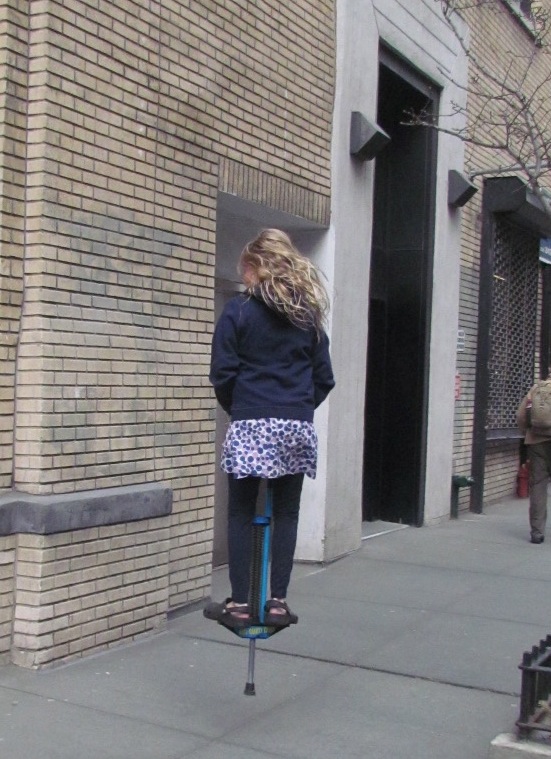
Em shows Lois how to jump on a pogo-stick

*Em on the pogo-stick

The Barb Show…

I’ve written before ‘here‘ and ‘here‘ about how I don’t always get jokes.  It’s not that I don’t have a sense of humor, it’s just that a great many jokes are hard for me to understand why other people find them funny.  Jokes or anything that starts with the words “Two” (of anything) “walk into a bar…”, or The Onion, (I can’t tell you how many times Richard will thrust some headline from the Onion at me, only for me to say, “wait, what?  I don’t get it.  Why is that funny?”) fall flat.  At this point, Richard now tells me jokes or shows me things that he knows I won’t laugh at because he finds my response as funny if not funnier than the actual thing.  Apparently humor is all the more so when someone is completely clueless. I’m good at that – playing it straight.  

For those who follow this blog, you know by now that I am in the recording studio all week recording Barb Rentenbach’s terrific book, I might be you.  Barb has a wonderfully nuanced and, at times, sarcastic wit.  I can do sarcasm, and wit for that matter, except, as it turns out, when I’m reading aloud someone else’s words.  In addition to this challenge of mine, when I’m nervous, my blue-blooded-upper-crust-WASPy heritage becomes even more pronounced.  So when I’m reading some of Barb’s naughtier bits, not only do my cheeks turn quite pink, I also pretty much stomp all over the delivery of a number of her otherwise humorous sentences.  Because if you read a sentence that is funny as though it weren’t and said it straight, carefully articulating each word as though doing an exercise in drama class, the humor is completely and utterly lost.  The only analogy I can think of that captures this is, imagine reciting the Commodore’s 1977 hit song, Brick House.  “She’s a brick —– ‘ouse, mighty, mighty, just lettin’ it all hang out…” but instead of saying the words as they were meant to be read, carefully articulate each word as though reciting a psalm in church.  I think that gives you an idea of what happened a couple of times in the recording studio.

Fortunately I do have a sense of humor and can laugh at my fumbling.  Barb and Lois were kind and patient.  Even when I had to repeat the sentence until I got the inflection right, they did not fall on the floor in hysterical laughter or poke fun.  I’m grateful to them.  Really.  Because truthfully, that had to have been pretty funny to witness.  The good news is, I was able to get it right… eventually, which is important because this book, this incredible book by Barb and Lois deserves to be heard as it was written, with elegance, eloquence, poignant power, laced with self-deprecating humor.  Every few moments I’d look up to see Barb beaming at me and Lois giving me an enthusiastic thumbs up and I would continue reading feeling exuberant and grateful to be involved in such an incredible project.

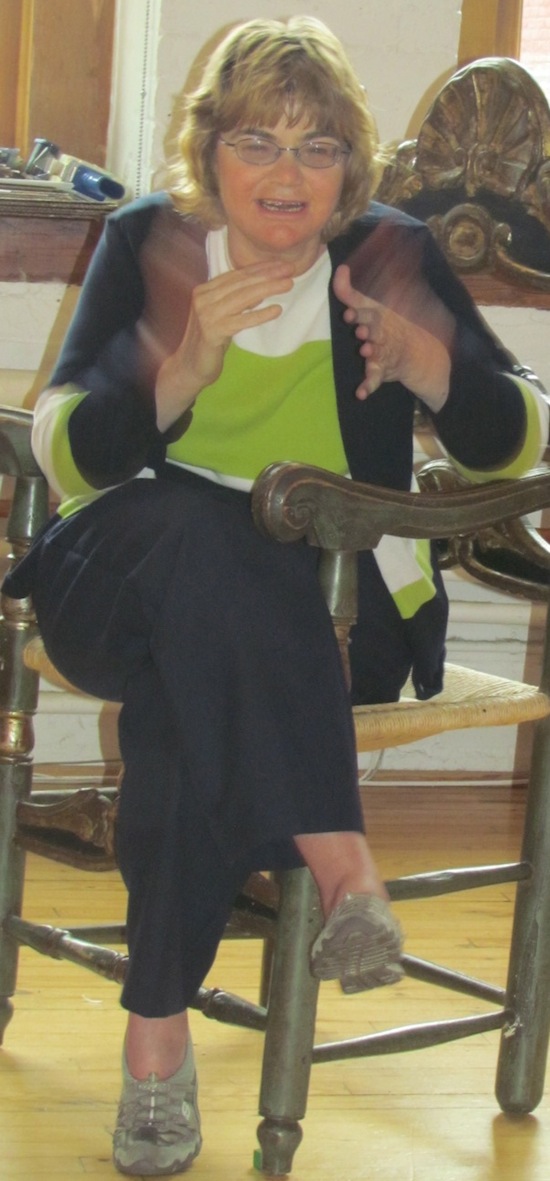
Barb showing Em encouragement later that afternoon.

Barb Rentenbach

The Adventures With Barb Rentenbach in The Recording Studio Begin!

I’m speed blogging this morning because I need to be in the recording studio in a little while where I will be at Barb’s mercy.  For those of you new to this blog, read Friday’s post ‘here‘.  For those of you who cannot cope with clicking on a link  – I’m recording the audio book version of Barb’s fabulous book  I might be you which she wrote with Lois Prislovsky.  Barb is non-speaking and writes with a sharp-witted, take no prisoners eloquence.  She is brutally honest in her description of her life as someone who is often mistaken as someone she is not.  For anyone who has ever felt they are on the fringes of society, felt they didn’t “fit in”, judged, seen as an “outsider”, as “other”, as less than, this book will resonate.  For anyone who has ever felt insecure, shunned, rejected, judged, criticized, and/or misunderstood, this book is for you.  I might be you is about how we are more alike than not.

I don’t know that I’ve ever been so excited to go into work!

More to follow…

“I Might Be You” – The Audio Version – Voice by Ariane Zurcher :)

Next week I will be in a recording studio taping the audio version of the wonderful book, I might be you by Barb Rentenbach and Lois Prislovsky.  *Doing a happy dance.  Barb asked me to be her voice a few months ago and without hesitation I agreed!  EEEEE!  Not only will I spend time with both Barb and Lois, but Barb will direct me to make sure I don’t mangle her beautiful words or trample on her often bawdy sense of humor.  It’s all in the delivery; I will do my best to make her proud.  Did I mention, Barb is funny?  She has a wonderful, edgy, R-rated sense of humor.  She avoids nothing and no topic is off-limits.  And while I’m not exactly a prude, I may get a little rosy-cheeked as I attempt to do her words justice, especially that chapter discussing masturbation, sex, or the lack of, and those hunky personal trainers who motivate her…  Taking a deep breath.  For those of you unfamiliar with the book, I wrote about it ‘here‘.  For those of you interested in purchasing a hard cover copy, and why wouldn’t you be (?) you can do so ‘here‘.  (I gain nothing from your purchase, other than the pleasure in knowing you will enjoy reading her book.)

I first met Barb and Lois at the AutCom Conference in the fall of 2012.  Their presentation was crowded, but I managed to secure myself a seat at one of the round tables.  I remember watching Barb type on a key board and being wonderfully surprised by both her self-deprecating sense of humor and how quickly she was able to type.  I admit, I couldn’t keep up as the letters whipped by while Lois read what she was typing.  Barb told of how it took her ten years to write the book because there were so many who simply did not believe she was actually writing the things that were being typed.  The assumption was that Lois or whoever was facilitating her was doing the writing.  But Barb being Barb, did not allow their doubts to stop her.  Now Barb is typing independently, her book has been published and the audio version is about to be recorded!  Woot!  Woot!

Do I need to say how excited I am?

Have I mentioned how honored I am to be Barb’s voice?

Stay tuned next week for ~ Adventures in the Recording Studio with Barb!

Practice

Everything takes practice.  Learning to sit with my fears, takes practice.  Learning to not say something that might be hurtful takes practice.  Learning how to best help my child takes practice.  Learning to disagree with my husband and not do harm takes practice.  Learning to feel compassion for those who harm me takes practice.

Everything I have learned in life, I’ve had to learn over and over.  I seldom get it the first time.  I’m a slow learner.  I know this.  I can admit this without shame.  It all takes practice.

Practice.

I am never going to do any of this perfectly.  But I will always continue to practice.

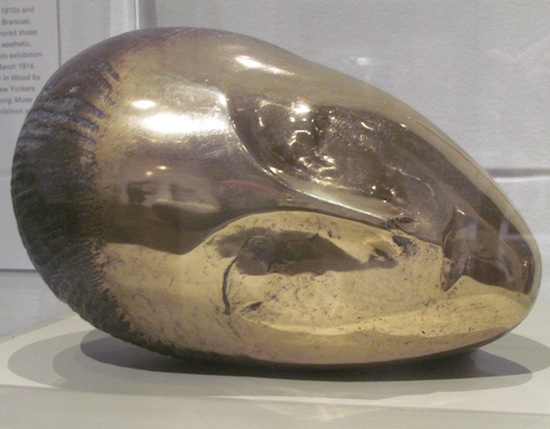
Sleeping Muse – Constantin Brancusi 1910

*Sleeping Muse

“Splinter Skills” and Other Words We Use

When Em was not yet three years old we received her diagnosis and began the long trek through, what appeared to us at the time to be, the treacherous terrain of autism.  All the things we admired, her various abilities, all those things I had identified as wonderfully “Emma” were now reduced to a single word “autism.”  I remember bragging about the fact that Emma, at the age of 18 months had taught herself how to pump her legs on a big kid’s swing, only to be told after her diagnosis that “kids with autism will often display splinter skills.” When I then commented that my daughter was extremely independent it was said that her autism caused her to shun other children and people, thus reducing her independence to nothing more than, yet another example of, her autism.

After awhile I felt I didn’t know who my daughter was, other than “autistic”.  That word seemed to so thoroughly obscure her in the minds of so many experts and people in the know.  Autism, it seemed, meant lacking and less than and not capable.   Whenever my daughter displayed things that could not be neatly placed in the deficit box, it was tossed into the “splinter skills” box.  It seemed no matter what she did it was viewed as “deficient” even when it wasn’t.  I remember feeling I finally understood what people meant when they talked about their child being imprisoned or all those awful images that abound of children silently, sadly, standing behind impenetrable walls of glass or behind bars of steel,  their small hands gripping the cold metal as they silently watch the world go by.  All of this, the words and images, showing us, telling us what we could and should expect were like seeing train tracks descending into hell.  Who knew it would take me eight years to understand that so many of those impenetrable walls of glass were constructs made by us.

If we did the same thing to those who are born without Autism, if we talked about our non-Autistic neurology as a deficit and identified all the ways in which it would cause us problems and difficulty, would we not despair when our non-autistic child was born as well?  Take your own life as an example and imagine that when you were born you were seen as a great disappointment.  Think about how each time you did something well it was dismissed as a “splinter skill” and was seen as yet another example of all that was “wrong” with you.  Think about what it would do to your self-esteem if your interests and passions were spoken of as “obsessions” or actively undermined and limited because they were seen as “unhealthy”.  It’s a double standard we have.  We non Autistics are praised, admired, given awards and accolades for our passions and obsessive interests.  People describe us as “driven”, “ambitious” or any number of other words used to describe the things that interest us.  But think if instead we were denigrated, ridiculed and scolded.  What does that do to a person?

The way we speak of and about our children, the way we think about their neurology, the way we attempt to “help” them “fit in”, these are the things I hope will change because it is not helping us parent our children, who need our help, it is not helping educators teach our children, who need to be taught, but mostly it is not helping our children be all that they can be.   My husband once said, “People spend all their time and energy trying to teach their Autistic kids to be something they’re not, when they should be spending all their time teaching their kids to be all they can be.”

Emma’s favorite work of art “Railroad Nostalgia” at the Scope Show in NYC.

Train tracks

Why Teach Age Appropriate Topics?

Someone asked me why would I teach my child age appropriate topics such as the American Indians, the arrival of Europeans to America, the Roman Empire and the difference between amphibians and reptiles, when tying her shoes, answering (whether verbally or by typing) a why question and riding a two-wheel bike has yet to be accomplished.

The short answer is – they are not mutually exclusive.  It is not that one thing gets taught and the other is left to languish.  I believe all these things are important for any child to learn; why shouldn’t my child have the opportunity to learn these things too?  But just to play devils advocate, let’s say that the questioner still asks, but why?  To them I say, because knowledge is freedom.   Knowledge gives us context, history provides us with choices, knowing how our government works gives us important information about leadership, honesty and conversely dishonesty.  Learning about geography gives us information about the physical world we inhabit.  Reading Wordsworth or Shakespeare or Susan Sontag, studying a painting by Rubens or Renoir or Basquiat, listening to music by Rachmaninov or  Ray Charles or, my daughter’s personal favorite, Gwen Stefani transports us, encourages us to think both analytically and creatively and enhances our lives.

Ralph Saverese, author of  Reasonable People: A Memoir of Autism and Adoption wrote a wonderful piece about a year ago, The Silver Trumpet of Freedom about his non-speaking, Autistic, son DJ who had just been accepted into Oberlin.  It’s a terrific piece and I encourage all of you to take a few minutes to read it.  I’ll wait.

Right here.

Seriously.

Go.

Read it.  

What many believe to be true about Autism is proving again and again to be incorrect.  What many believe to be true about those who are Autistic AND non-speaking is proving to be incorrect.  Our ideas about someone who has physical challenges AND is Autistic AND does not speak are proving to be incorrect.  Our incorrect beliefs are limiting how that segment of the population is taught and what information they are given access to.

This must change.

To My Daughter…

You are capable.  I am sorry it has taken me so long to fully understand this.  You are smart and able to learn and know so much more than I ever knew.  You understand that sea turtles lay their eggs beneath the sand and then, once hatched, the baby turtles must make the treacherous trek toward the ocean.  An ocean many will never reach.  You understand this.  You understand that turtles live in and out of water.  We did not categorize them yet as reptiles, but we will get to that, possibly tomorrow.

You know Christopher Columbus is said to have reached America in 1492 and that there were people already living here.  You pointed to an illustration of an American Indian and typed that this person was called a Native American.  You showed me where we live on a globe and then suggested we take a boat to England over the Atlantic Ocean so that you might visit an old therapist you still remember and speak of with great fondness.  You became particularly excited by the thought that we would have to stay in a hotel and inquired whether that hotel would have a swimming pool.  I know.  A hotel is not a good hotel without a pool.

You told me an insect has six legs and that a spider has eight legs and even though it kind of seems like a spider should be called an insect, it is not and in fact eats insects which is why all those insects in the Miss Spider book you love so much are scared of Miss Spider and that makes her cry.  You demonstrated your innate acting talents by pretending to cry about Miss Spider’s predicament.  It turns out Miss Spider is a vegetarian and happily eats the flowers offered to her much to the relief of all the fearful insects.  That made you laugh.  Then you remembered how “Bertie kitty” was admonished for getting on the dining room table and eating the flowers and said so, again in a very convincing and stern voice.  You are so talented.  I believed both your pretend tears and your pretend/scolding voice. Thank you for telling me you were pretending because you were very convincing.

You are so, so capable and for so many years I’ve been blind to just how capable you really are.  But maybe, just maybe now I have the tools I need to hear you.  Those tools I thought I was learning to use for you, it turns out are tools I needed for me.  I need them so that I can hear all the things you’ve tried to tell me for so long.

I promise.  I promise to keep listening.

The Final Day With Soma and A Word About Methodologies

Yesterday was the last day of Soma Mukhopadhyay‘s 4-day training.  I wrote about it ‘here‘, ‘here‘, and ‘here‘.  Soma packs an enormous amount of information into four days.  She discussed everything from neural pathways of the brain to which parts of the brain are used during specific activities, to how to devise lesson plans and ways to physically position oneself in relation to the student.  There were so many surprising moments, but one that I never could have anticipated, was how helpful it was to learn about the actual brain function during moments that are emotionally charged or OCD.  Learning some of the basics in brain function demystified a great many things in a way I hadn’t before considered.

Given what we now know, and granted it isn’t much comparatively speaking, but is so much more than we knew even twenty years ago, it is astonishing that certain older therapies continue to be popular and used for autism.  Two of the most destructive phrases used with an Autistic person are the dreaded, “Look at me!” and “Use your words!” I cannot list how many times Emma has been instructed to “use your words” only to do so and be ignored.  It seems those who say “use your words” really mean, “use the words I want to hear”.   Add to that the insistence that an Autistic student have “quiet hands” and not stim because it is believed learning cannot take place while stimming even though by removing the stim no learning can or will take place because we’ve just taken away the one thing that was allowing the student to stay focused and attend, even if it did not “look” that way to us.  We non Autistics have a tough time understanding anything or anyone who is vaguely different from ourselves.  Before we start calling ourselves “experts” in Autism, we might want to become “experts” in our own neurology first, at least we’d have a better handle on our own limitations and see how those can so easily dovetail into how we are interpreting what we’ve decided is “the truth” about someone else.

I have written about methodologies before on this blog.  There are some that I find more troubling than others, but in the end, the thing I care about more than anything else is: is it helping my child?  Is she learning?  Is she safe?  Will the short-term gains be at the cost of long-term pain and even trauma?  What is this doing to her self-esteem?  Is respectful interaction being modeled?  Is she being humiliated, shamed, made to feel badly for the way her brain processes information?  Is she being taught by people who believe in her ability to learn?  Are her teachers believing her capable and giving her the tools she needs to flourish and be all that she can be?  Is she assumed to be competent or is she being forced to prove her competence?  Is she being taught the same equation, story, concept and terms over and over?  Is she seen as a human being with the same rights as any other person?  Would YOU want to be treated the way you are treating and teaching this person?

I don’t care what the methodology is, who created it or how many people believe in its efficacy, if it isn’t taking these questions into account, I am not interested in it.  I do not care what others believe, I don’t care what the “experts” say, I don’t care how many letters a person has after their name or who created the methodology or the various papers and/or books the person has written, if the methodology is not attempting to consider these other ideas, I am not interested in it.  I, as a parent,  am not invested in any particular methodology unlike so many schools.  And for that reason I have far more leeway than most schools do, to keep trying different things until we (I’m including my wonderful husband) find the thing or a combination of things that will best help our daughter learn, grow and become all that she can be.  In the end that is what we care about more than anything.

This weekend I will create a lesson plan for my daughter with age appropriate materials for next week’s  RPM session.  I am hoping I will be able to demonstrate, at least some of what I’ve learned, to Emma’s therapist and her teacher.    But I also know I will make mistakes, I do not expect that after four days of an intensive training I will do Soma’s method well, but I think I have a fairly good understanding of the basics so that I can start, at least, trying.

Wish me luck!

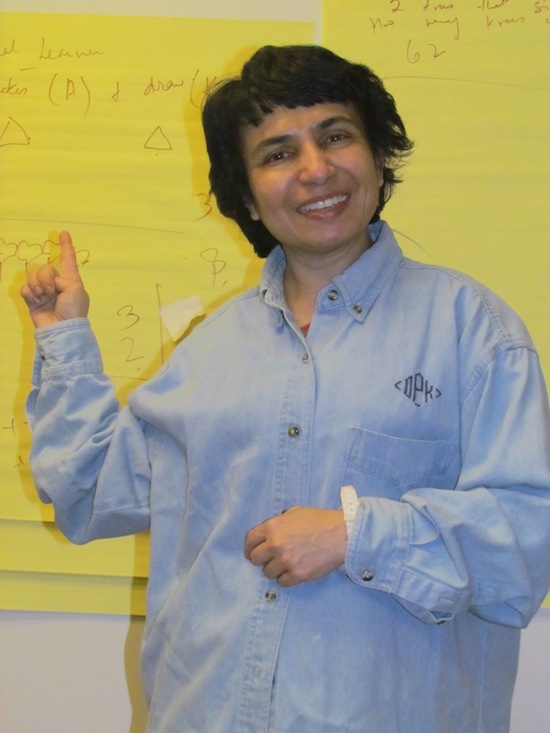
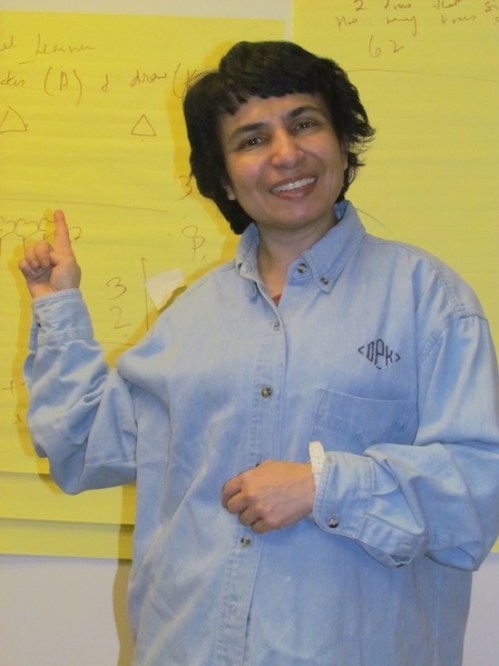
Soma Mukhopadhyay – March, 2013
3Soma

Soma Mukhopadhyay ~ Day 3

It is hard to believe how much information Soma is able to pack into the first three days of a four-day training.  She has managed to cover the different learning channels and how to teach toward each one.  We learned about the various stages of development, left brain/right brain, the difference between an excitatory stim and a calming stim.  The importance of presuming competence, working through self-injury and highly charged emotional situations have all been discussed.  We were taught that social expression and gestures begin in the hypothalamus travels down into the body, then back up to the somatosensory cortex, to the pre-motor cortex and finally to the motor cortex and how at any point along the way, things can become disconnected causing the Autistic person tremendous challenges in behaving as we non-autistics might expect.  We learned about OCD and how to interrupt it by asking the student to spell a relevant word or introduce numbers and/or a math problem as a way of working with it while at the same time diffusing it.

Soma described how to implement a lesson plan around just about any topic, mental mapping and the different stages of rapid prompting method.  We went over methodologies and how to plan a lesson by using flow charts, listing objectives, relevant spelling words and key terms and concepts that need to be introduced, explored and learned.  She taught us the importance of teaching concepts, and the words used, as well as reading comprehension, spelling, grammar and such abstract ideas as time, symbolism, relativity, belief systems and throughout all of this Soma emphasized the importance of teaching age appropriate or above age level materials while filling in the gaps of what isn’t yet learned.

I’m exhausted, exhilarated, but exhausted and there’s still one day to go!  Today, the final day of the training, we are going to cover how to teach math and math goals, how to take and administer a test, how to teach poetry, literature and creative writing and the training will end in a review aka test. Tests have always been my downfall when I was in school.  I become anxious and overly nervous.  When I was in high school I learned to over study and even then I would become easily overwhelmed if I didn’t know the answer to a question and would get so upset that even the questions I could answer would go unanswered because I couldn’t move on from the one I didn’t know.  Writing all of this makes me aware of how similar my daughter is to me in this regard.  She also becomes fixated and upset when she gets an answer wrong.  She too has trouble moving on to the next question or topic, can become dis-regulated and overly anxious.  I will try to incorporate some of the exercises Soma has taught to see if I can interrupt my obsessive thinking if and when it happens.  So much of what Soma teaches could be used for anyone, even me!  I could write a lesson plan around that…

*5

Soma Mukhopadhyay ~ Training Day 2

I’m halfway through a four-day training with Soma and I have filled more than half a legal sized notepad with notes.  Yesterday we covered Mental Mapping/ the different stages of RPM and Implementation.  I told Soma about my encounter with the child who didn’t want to work and immediately hit themselves.  I described how I’d had them spell “hitting” on the letter board and how this had immediately diffused the situation.  Soma then gave me more terrific suggestions on how to devise a lesson plan around an action such as hitting.  An example of this is (I”m making this up) “I would like to know more about hitting.  What else can you hit?  Do you hit the sky or a ball?”  Soma spoke of how when emotions are running high, switching to numbers and math, which have no emotion can be helpful during emotional outbursts.  “How many times can you hit the ball? Here let’s count.  1, 2, 3, 4, 5.  You hit 5 times and if you hit once more, that would be 87 times or 6 times?”

We spent a great deal of time discussing the ways in which one can learn about a student through their preferences, stims, what they’ve been exposed to, skill levels and abilities, tolerance levels, acquired knowledge and defenses.  Soma then covered how one goes about implementing all of this through lesson plans.  Each step of the way one presumes competence in the student’s ability to learn and be taught without presuming that they already know how to read, write, add and subtract.  Through the various activities it quickly becomes clear whether the student needs to be shown how to spell a word such as “hitting” or whether they already know the word.  On the first day one of the students, whom Soma had never met before, sat down and after working with her for fifteen minutes or so, was asked what his favorite color was.  She had him choose from one of two stencil boards for the first letter.  From that board he chose the letter “r”.  He then proceeded to type ‘r’, ‘e’, ‘d’.  The following day a number of the people  taking the training expressed skepticism that the student actually could read or write.  One suggested that red may not have been his favorite color.

When asked how they knew that he couldn’t read or write, they weren’t able to give specific reasons, it seems many just assumed he could not.  It reminded me of the years and years I spent believing a whole variety of things about my own child, which turned out to be untrue.  I had no proof that the things I thought were actually true, I had just assumed and then behaved toward her as though it were fact.  Perhaps one of the single most destructive things we can do to our children, students, the people we meet is to make assumptions about their intelligence and abilities.  Beliefs based in nothing other than unfounded assumptions and our own biases of those who look or seem to us as not being capable.  These assumptions are dangerous and can do real harm.  As I’ve said before ~ to presume competence and be wrong will do no harm, to presume incompetence and be wrong can and will do tremendous damage.

Soma – 2013

Soma

A Training with Soma Mukhopadhyay

I am taking a four-day training that Soma Mukhopadhyay is giving this week.  Yesterday was the first day and Soma covered the stages of development and different learning styles.  Throughout the entire day Soma demonstrated how one teaches while presuming competence, though she never said those two words or even mentioned this, it is, in fact, what she was doing.  She does not assume a person she’s never met will know how to read or write, but she does presume that the person can and will learn regardless of whether they speak or not.  Rapid Prompt Method teaches skills that create a strong foundation for all learning to take place.

Soma walked us through stims that are excitatory and calming and how to tell the difference.  She demonstrated how one can work with them and how they give us clues about whether the person is auditory, visual, tactile and kinesthetic.  I asked a great many questions about things such as, what do you do when the person you’re working with hits, bites, slaps or pinches themselves or you.  Later after the training had ended I had the opportunity to work with someone who almost immediately hit themselves in the chest and they shouted, “No hitting!”  Fresh from the day’s training, I grabbed a letter board and said, “Oh here.  Spell hitting.”  I held the letter board out and shoved a pencil in their hand.  Immediately they stopped hitting themselves and pointing to first the ‘h’ then the ‘i’ and so on until they’d spelled “hitting” at which point they were able and willing to move on to do some other things.

Afterwards I reflected on what had just happened and remembered something else Soma did when one of the children she was working with tried to bite her.  I am paraphrasing as I didn’t write down exactly what she said. In a very calm, matter of fact voice, she said something like ~ Oh you’re trying to bite my arm.  My arm is not lunch. What else can you bite?  No judgment, no scolding, shaming or anger, there was nothing in her voice to suggest she was speaking of anything out of the ordinary or that this was something to get upset about.

For years I have been baffled by how to respond or even if one should respond to such actions.  I have written about “self-injurious” actions ‘here‘, ‘here‘ and ‘here‘.  I’ve never completely known how to respond and have responded in a variety of different ways, but today… today was the first day I saw someone model a response in an academic setting that made sense to me.  It isn’t that this response will eradicate the need or desire to hit or bite, but it was the first time I’ve seen someone respond in a way that didn’t make it worse, either by scolding, shaming or reinforcing.  As was the case this afternoon, the child I was with, immediately stopped hitting themselves and we were able to get back to work without further comment.

Today is day 2 of the training and it’s very exciting!