Category Archives: Parenting

Taking Action ~ Presuming Competence

A full transcript of Richard’s Blog Talk Radio Show is now available for any who want it by clicking ‘Blog Talk Radio Transcript‘.  I am trying to add it to Facebook, but have run into problems as the file is too large to add to “notes” and I can’t add it even when changing it to either a txt file or an .htm file.  So unless someone knows how to attach a large file, (12,540 word count) I am not sure how to get this on Facebook.  I may need to break it into several smaller segments, which would be too bad.  Please advise!

Lots of people have been asking questions about “presuming competence” and how that applies to either their child or someone they are working with.  So I am adding links to a couple terrific articles that I’ve found helpful.

Kathie Snow, entitled: PRESUME COMPETENCE:  Challenging Conventional Wisdom About People with Disabilities.

An interview with Douglas Biklen, winner of the UNESCO/Emir Jaber al-Ahmad al-Jaber al-Sabah Prize to promote Quality Education for Persons with Intellectual Disabilities and Dean of the School of Education at Syracuse University.

Presume Competence – a PDF from the Peal Center

Presuming Competence ~ By Douglas Biklen and Jamie Burke (Jamie, who we met this past March, just graduated from college and types independently! Yay Jamie and congratulations!!)

I am just beginning on this road of “presuming competence”.  There are others who are far ahead of me, many of whom have been kind enough to email me privately with their experience, strength, wisdom and encouragement.  There are many of you who are directly affected by society’s inability to “presume competence” and all that means to you and your life.  Many of you I know, others I am just getting to know, some I don’t know, but hope to know, but all of you are living with the consequences of a society that does not believe in a basic right we should all have granted to us – a presumption of competence.

What follows is a list of things I try not to forget that have helped me presume competence, please add your own thoughts, as I am well aware many of you are further along than I am.  I am still learning!

*I hesitated publishing this post because I do not want anyone to take this as a lecture or that I think I have all the answers.  I don’t and it isn’t.  I made the decision to publish this because many people have contacted me privately asking for help in presuming competence.  These are the things I do and continue to do, tools really, that I’ve personally found helpful.

In order to presume competence I have to:

1)  Presuming Competence is a “practice”.  Much like anything I want to get really good at, I must practice this.  It is very much an action.

2)  Examine my preconceived notions about autism and what that means to my child.  For me I made a list.  Everything that comes to mind, no matter how awful I may feel about myself for thinking such things, I must “out” myself so that I can come face to face with ingrained beliefs, prejudices, things I assumed, but couldn’t know, fears… a full inventory of all that I once believed and may still believe about autism and Autistic people.  It is helpful to share this list privately with another trustworthy human being who will not judge or condemn.  By the way, this is not something I will ever share publicly.  None need see it as it would be hurtful to many and judged by others.  But for my progress it is important that I be able to admit these things so that I may change.

Once I have my list and I’ve confided in someone I trust, I must be willing to examine and dismantle any remaining destructive beliefs.

To do this I must ask myself:
How is this belief continuing to serve me?
What am I afraid of?
What do I think will happen if I let go of this thought?

I have to be willing to face my fears.  I have to be willing to honestly and without judgment acknowledge my own thinking.

3) Question everything.  Literally, question everything.  Do not take my word for any of this, try it yourself.

4)  Be curious, ask questions, seek advise from those who are ahead of you.  This has been key as there are many people who have been doing this much longer than I have.  Talk to them.  Many people are living with the results of being presumed incompetent.  Read what they are writing.  Listen to them, learn from them.

5)  When in doubt ask.  When in doubt don’t act.  Doing nothing is often far better than doing something or saying something that I’ll later regret.  If I am not sure how to proceed, it may be the least dangerous option to not continue until I can figure out how best to approach the situation.

6) We all make mistakes.  It’s okay.  It’s part of the human condition, no matter what our neurology.  I make mistakes all the time, so do my children.  It’s okay.  Keep moving forward.

7) If my daughter isn’t communicating in a way that I’m able to understand, I need to try a different method of communication.  All human beings seek connection.

8) I cannot and do not speak for either of my children, nor do I own them.  They are not extensions of me.  They are their own people, with their own unique personalities.  It is my job as their parent to encourage them and find the best ways to support them so they can flourish.  Any embarrassment, shame, fear or assumptions about who they should or shouldn’t be are mine.  They have little to do with my children as much as I may believe otherwise.  These are things I am responsible for working through privately.

9) Realize I don’t know.  There is just a great deal I don’t understand.  The only way I can hope to understand is by admitting that I don’t.  I don’t have all the answers.  I am learning.  My daughter is my best teacher.

10) Listen.  I have to be willing to listen to her.  I don’t mean just verbal language, I mean “listen” in a more holistic way.  Listen to every aspect of her.  What is she trying to tell me?  Often I will not immediately be able to understand.  Sometimes it may take years before I will, but it is more important that I continue to try even when I don’t understand than deciding she isn’t trying to tell me anything.

11) Patience.  This is one of the single most difficult things for me to practice.  I am, by my very nature, incredibly impatient.  Impatience serves me in some ways, but in approaching my children, impatience almost always hurts them and me more than it helps.  I have to “check my impatience at the door” as a friend of mine once said.  If I am unable to do that, it’s probably best if I take a break and come back when I’m able to.

This list is not complete… there are many more things to add… but they will have to wait for another day…
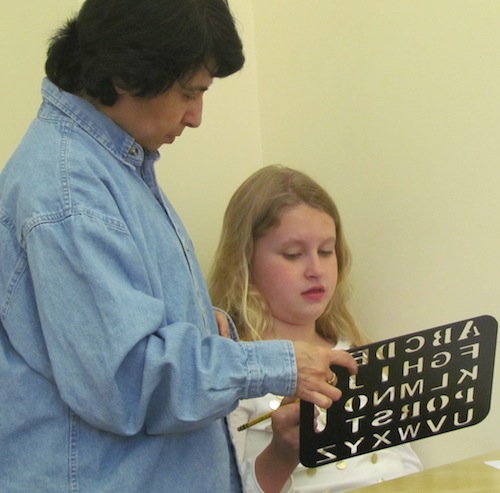
Soma Mukhopadhyay's First RPM session with Emma ~ 2013

Soma Mukhopadhyay’s First RPM session with Emma ~ 2013

“Proof” of Competence

Last night I asked Emma, “Do you want me to read Anne of Green Gables or something else?”  I was seated at the computer responding to a comment left on yesterday’s post.  Em was leaning over my shoulder looking at the computer screen.  She pointed and said, “Look!  There’s Harvey and Tracy and Pascal!”

“Yeah!  I’m just finishing up here, Em.  Did you brush your teeth?”

“Uh-huh,” she answered.  Her one hand gently rested on my shoulder, her head about an inch from mine, she twirled her string and continued to peer at the screen.

“So Em.  Should I read Anne of Green Gables?”

“Nah.”

“Oh!” I said, surprised.  Turning toward her, I looked at her, “What do you want me to read then?”

“This,” she said pointing to the screen.

“You want me to read the blog to you?”

“Yes,” she said.

I mentally scanned yesterday’s post, suddenly wondering if I’d written anything I would feel badly to have her read or hear.  And as I did so, I marveled that this was something I was having to be concerned about.  Several years ago, had someone cautioned me to be careful about what I wrote on this blog and gave the reason for their concern as one day my daughter would express an interest in reading it, I would have laughed and assumed the person did not understand my child.  The idea that my daughter would be interested in anything I wrote, let alone anything I wrote on a blog about autism was the LAST thing I was worried about.  And yet, last night, there I was, and not for the first time, rereading a post I’d written with a critical eye.  This says far more about me and my limitations in imagination, as Anne of Green Gables would say, than about my daughter who continues to surprise, astound and prove us wrong.

That my daughter continually “proves us wrong” is something I am working hard to change, because again, this says far more about me and my limited thinking than it does about her.  Why should she need to “prove” anything?  So many of the various therapies used for Autistic children spend an inordinate amount of time requiring our children to “prove themselves” to us.  Often, having done so, we then change the question or the format, suggesting that this is for their own good as they need to “generalize” the information.  We ask again, insist that the answer be given within a certain time frame, insist that it be given with specific wording or in a different format, as though their first answer wasn’t enough to convince us.  Who exactly is benefitting from these exercises?  We say we are doing this with their best interests in mind.  We tell ourselves we are “teaching” and this must be done in order for them to learn, but it seems to me, it is often the other way around.  It seems to me these exercises are done to convince the skeptics among us.

We do not treat our Autistic population as equals.  We do not presume Autistic people are competent, often we believe they are incompetent and ask that they prove to us their competence again and again.  We pity them and often their families too.  Organizations set on “helping” those who are Autistic discuss their work initiative programs, their mentoring programs, (almost always it is non Autistic people mentoring those who are Autistic) yet fail to see how their well-meaning programs are biased, do not presume the competence of those they suggest they want to help, do not include Autistic people in the planning and implementation of such programs and express shock when their various programs are met with resistance within the very population they say they are helping.

This is really at the crux of the most astonishing thing I’m learning.  It is not that my child is limited.  It is that I and others like me have been limited in our thinking about her and those like her.  It is this, that I hope I will see change in my lifetime.

“Read the blog,” Emma stated as she crawled into bed last night.

And so I did.

Nic and Em ~April, 2013

Nic & Em

Parenting & Presuming Competence

I am reading Anne of Green Gables to Emma.  Three years ago it would not have occurred to me to read her a book that I might have enjoyed at her age.  Three years ago I was “reading” picture books to her before bed.  Three years ago I did not assume she understood the stories in those picture books.  Three years ago I not only did not assume my then eight year old child understood what I read, but I also did not assume she understood 90% of what was being said to her.   Because I did not assume she understood I treated her as though she couldn’t understand.  I treated her as though what I thought was a fact.  Then I learned I was wrong.   Not only did I learn my assumptions were incorrect, I began to see how those assumptions caused me to act and treat her as less capable than she actually was.  I treated her as though she couldn’t and I didn’t see how this attitude was hurting her.  Instead of teaching her to do things for herself, I did them for her.  It was quicker, easier…

I wrote a post not long ago ~ Presume Competence, What does that mean exactly?   People have a tough time with the idea of presuming competence,  let alone putting that idea into action.  I get that.  I did too.  Here was a child, my child, a child we had been told was capable of this, but not of that, a child who was treated by society as much younger than she actually was, a child who, because of her unreliable language did not have conversations with us, did not answer most of our questions, never asked us questions, and so we assumed had little if any interest in such things.  We made the mistake of assuming language retrieval issues were indicative of lack of intent and desire.  We made the mistake of limiting our thinking and therefore limited our child.  We thought we knew, until we didn’t.  We behaved as though what we thought was true and our behavior and actions or inactions fed into that erroneous thinking.

I’ve spoken a great deal about the brilliant documentary by Gerardine Wurzburg, Wretches and Jabberers.  I continue to urge everyone I know to watch it because it is the best illustration I know of, that explains the concept of presuming competence and what can happen as a direct result of doing so.  It is a highly entertaining, moving documentary following two (mostly) non-speaking Autistic men as they travel the world meeting other non-speaking Autistic people who are all far more capable than society believes.  Many are in “life skills” programs or work initiatives doing menial tasks like paper shredding and folding towels.  They type about their mind numbing boredom and brutal frustration they feel as a result of being treated as far less intelligent than they are.

Presuming competence is an act, it isn’t just an idea.  Presuming competence is the single most powerful action we have taken that has directly helped our daughter flourish and grow.  Nothing, absolutely nothing else we’ve done has helped Emma as much as presuming competence.  When we stopped limiting her with our limited beliefs of what she is or isn’t capable of and began giving her the information and materials she needed, she has taken off.  In school she is being taught grade level science, at home she is being taught grade level geography, I am reading age level fiction and nonfiction, she clears her own dishes, cleans them and puts them away.  She sorts her own laundry, helps fold it and knows how to make pancakes without assistance.  She takes a shower on her own, has learned to shampoo her hair and brush it afterwards.  She brushes and flosses her own teeth with minimal support, she dresses herself.  When it is clear she needs help learning to do something, we help her, without admonishment, without distress, but instead with the knowledge that she will eventually learn to do it on her own.

Presuming competence does not mean we expect her to know how to do something without support and instruction, it means we assume she can and will learn with appropriate accommodation.  This is is a very different way of thinking than either assuming she can’t do something and never teaching her, or teaching her, but requiring her to prove her knowledge over and over before moving on.  With reading comprehension we realized we were asking the wrong questions.  Often we were asking her to answer questions that were not obvious to the story.  When she couldn’t answer, we’d dumb down the reading material and then wonder why she wouldn’t pay attention.

In the beginning, presuming competence felt like a leap of faith.  It scared me.  I didn’t want to get my hopes up.  I didn’t want to feel the disappointment that I knew I’d feel if I was wrong.  It felt like a massive disconnect.  But presuming competence is not about my ego, my expectations or anything else involving me.  Presuming competence is about respecting my daughter and respecting her process.  It is about honoring her.  It is about giving her what she needs to flourish.  It is about dispensing with what I think, believe and have been told.  Presuming competence has nothing to do with my fears of success or failure.  Presuming competence is not about me at all.  It is all about my daughter.

Harvey, Tracy, Pascal & Em @ USFEmma takes the stages with Pascal, Tracy Thresher and Harvey

The Magic of Connection

At a certain point during Richard’s radio show  the other night, where he was featuring Moms, he asked me about those years when we were determined to find a cure for our daughter.  I didn’t want to take up time on the show to talk about all of that because there was so much to cover, but also because it makes me really sad to talk about it and I also know it is hard for many of my Autistic friends to hear, two of whom were guests on the show and many more who I knew were listening!  I try hard not to live in regret, but I’ve done things that I really DO regret.  Things I really do wish I could go back and erase and do again differently.  More than anything, all those therapies and bio medical treatments we did, fall into that folder labeled “Things I wish I could do over.”

My reluctance to talk about all of this the other night on the radio wasn’t because I don’t think it’s important as much as it’s really painful to talk about and I know, for many of my friends, people I love dearly who happen to also be Autistic, it is very painful for them to hear me talk about those years, all those years when I was so intent on curing my daughter.  It may remind them of their own upbringing.  It may bring up all those devastating feelings of being unworthy or that they were somehow damaged or diseased, or any of the other hurtful words people use when discussing autism, that hurt them.   So to my Autistic friends, please skip down to the final paragraph.  The last thing I want to do is cause more pain and suffering to those I love.

At the time, after Emma’s diagnosis was given, I believed autism was something that could be “treated” the way one treats a disease.  Only it isn’t a disease.  But at the time I thought things like vitamin supplements , homeopathic remedies, therapies like ABA and diets could actually remove the “autism”, that these things would somehow transform her brain from an Autistic brain to a non Autistic brain.  I know it may sound over the top, even ridiculous to many, but at the time, I wanted to believe and so I bought into the idea that autism could be ‘removed’.  The concept of someone being pressured into learning to “pass” as non Autistic and the massive emotional and physical toll that inevitably takes, was not something I knew about at the time.  It never occurred to me to wonder what the fallout might be or how my own child’s self-esteem might suffer as a direct result of what I was doing and saying.

Over time, as I kept trying different things, which culminated in going to Central America for stem cell treatments, I continued to believe, being the very best mother I could be, meant doing everything I could to “remove” her autism.  I believed all those words that are used to describe autism: disease, affliction, epidemic and crisis.  Autism was BAD.  Autism meant all kinds of things and none of them were positive or beneficial.  So that’s what I pursued – a cure.  And I pursued a cure with the same dogged persistence I now apply to changing how autism is viewed by others.  Where I once was determined to change my daughter, I am now determined to change society’s views of autism and, it must be added, society’s views of Autistic people.

You cannot talk about autism without talking about Autistic people.  Yet people do all the time.  They talk about autism as though their words will have no affect on those who are Autistic.  But you can’t do that. When we talk about autism we ARE talking about our Autistic children.  We ARE talking about our Autistic friends.  We ARE talking about Autistic people.  What we say, how autism is depicted, DOES impact those who are Autistic .  It does directly affect how others then treat them.  To pretend that all the derogatory language used has no direct effect on Autistic people is ignoring that fact.  And this is where all of this no longer is just about my daughter and the risks I took and the impact my actions have had on her.  This is about something far bigger than any one person.  This is about a segment of the population who are Autistic and the fallout they must cope with from all of us talking about them as though it wasn’t about THEM, but instead was about a word – that word being – Autism.

Toward the end of the radio show, Lauri Swann spoke of how her son, Henry developed a relationship with his mentor Tracy Thresher and how transformative that was for him.  I reflected on how magical it was for Richard, Emma and me to visit Lauri and her family during the screening of Wretches and Jabberers this past April.  We reminisced about the evening before the screening, when we all went back to Lauri and Russ’s home and everyone sat around their dining room table typing to one another.  The only word I could come up with to describe that visit was “magical“.  And it was, because like the Autcom conference last fall and the Syracuse conference this past winter, being in an atmosphere of inclusion, where every single person is treated with the same respect as anyone else, where all are treated equal, is magical.  How did we move so far from those words in the Declaration of Independence ~ “We hold these truths to be self-evident, that all men are created equal”?  How did we get to this other place, where an evening like the one I’ve just described is considered out of the ordinary?

Now, sitting here writing this post, I am thinking about two more magical days and evenings when Ib came to New York City and stayed with us.  Ib is like family.  My children adore her.  My husband adores her.  I feel honored to know her, let alone call her my friend.  I don’t know how to talk about all of this when lines are drawn, when words are used that separate and divide.  I can’t do that and I don’t want to live in a society that does.  What people do not understand fully, or cannot completely appreciate, is this – when we stop dividing people into categories of us and them – we open ourselves up to the experience of being united, of really feeling that indescribable magic of connection.   The beauty of belonging.  The joy of interacting with our fellow human beings and rejoicing in our diversity.  There IS magic in that.  This is what I wish all human beings have the opportunity to experience.  This is what I hope I will live long enough to see occur on a grand scale.

Henry & Tracy during our magical visit with Lauri’s family

Henri & Tracy

Adrianna, Amy Sequenzia, Em & Me
Adrianna, Amy, Em and Me

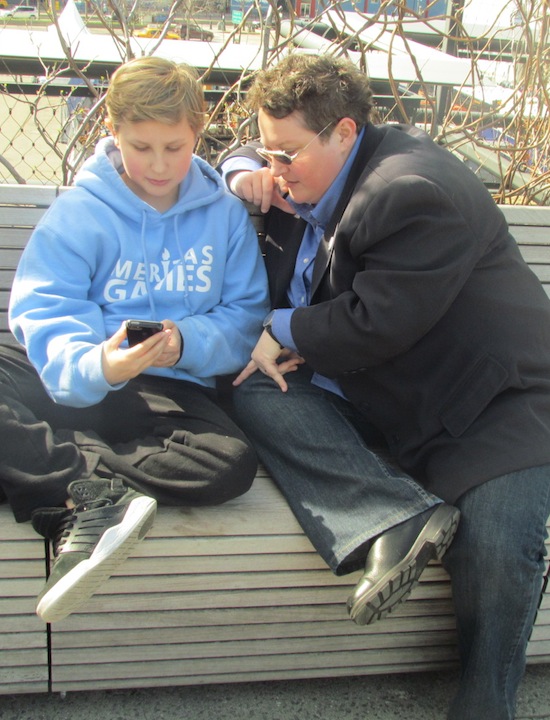
Nic & Ib on the High Line

Nic & Ib

Having it All Often Means Doing it All

*The title of this post is said in a joking, not exactly sarcastic way, but certainly not in a serious way.  Throw in an eye roll as you read and a knowing grin, and you’ll get it!

So much to tell you, but where to begin?

For Mother’s Day my wonderful husband decided he would interview me on his radio show and asked if I wanted to invite a couple other moms to come on  the show too.   “Yes, please!” I said and promptly invited my friends, Ibby Grace of the blog Tiny Grace Notes (AKA Ask an Autistic), Paula Durbin-Westby, who has two blogs, one with her name as its title and the other – Autism Acceptance Day (which is a terrific resource filled with interviews among other things) and Lauri Swann Hunt of the fabulous website and blog Ollibean, where both her son Henry and Amy Sequenzia often post among many other wonderful writers.  The show aired last night at 8:30PM – 10:00PM Eastern Daylight Savings Time and has been archived ‘here‘ for those who would like to listen.  We do not have a transcript of it yet, but my fabulous friend Alyssa of the blog, Yes, That Too, suggested we break it into ten minute chunks, which means we need eight more people to volunteer.   Anyone who is so inclined can contact me here or at emmashopeblog@gmail.com and we will get a transcript written!

I meant to write a post about all of this yesterday so anyone who wanted to listen live, could, but Richard came down with some sort of stomach bug that kept him up for the better part of the night and Em woke up in the middle of the night complaining of a sore throat.  When I went to her she was burning up, so I stayed with her for the rest of the night.   By yesterday morning, which was also the first day of my “play date with jewelry” trunk show, I realized, I was not going to be able to keep all the necessary balls in the air.  It was that moment when you realize the reality and what you had envisioned, were not meshing even remotely and so priorities needed to be set.  Nic, who was off early to go on a three-day field trip, made it out the door without mishap.  A doctor’s appointment for Em was secured. Joe, Em’s devoted, dedicated and all around amazing therapist, was called in for reinforcements. Richard was checked in on and given liquids between preparations for my trunk show.

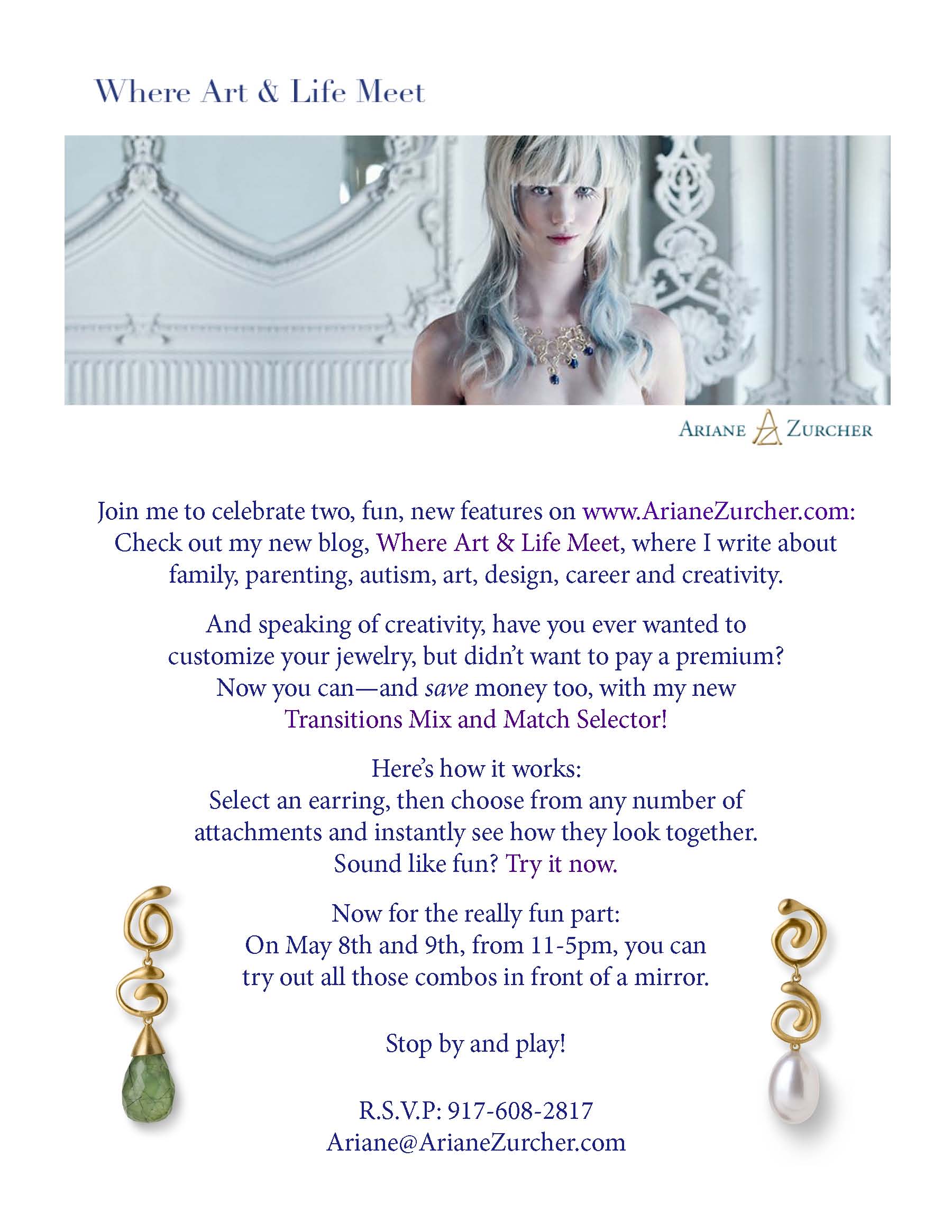
By the way, the show continues today, for those who might be interested in playing with jewelry and seeing my Transitions Collection, which I’ve finally gotten up on my Ariane Zurcher Jewelry website, and joining me to play with the real thing and so I can give a live demonstration of all the various possibilities, many of which the website does not yet have or do.

AZ jpg evite

So given that the day was not proceeding as optimally as planned, it was kind of fitting and perfect that Richard, albeit, groggily, insisted that the radio show (dedicated to motherhood and all that entails) must go on as planned!  So it did. And other than a couple of minutes when Richard and I were inexplicably tossed out of the show, it was great fun, everyone was wonderful and I think Paula Durbin-Westby may need to seriously consider hosting her own radio show in the foreseeable future!  As I said at the end of the show, it is these Moms and women like them, who have helped me be a better mother to both my children.  I am so lucky and very, very grateful.

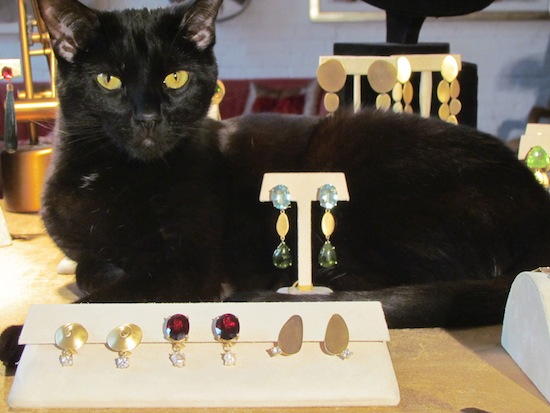
Merlin Assists in Preparing for the Trunk Show

Merlin:Jewelry 

The Mean Voice

I have struggled with a mean voice in my head my entire life.  “You messed up,” “You can’t do anything right,” “You’re a failure”, “What were you thinking?” “Why did you do/say/think that?”  “How could you not have known?”  When I was young I thought I was the only one who had it.  I believed the voice.  I thought it spoke the truth.  I felt crushed by it.  It was a condemning voice and I thought it would help me become a better person if I listened to it.  I was wrong about that.  These days I don’t allow myself to believe it, but now and then I can’t help myself and those are the days when everything is harder.  Those are the days when the people I love will suffer because that voice isn’t content to stay internal for long.  No matter how hard I try, no matter how much I tell myself I’m not going to repeat those hurtful words to someone else, I end up doing so because self-hatred is never kept completely contained.  Those of us who struggle with self loathing tend to hurt others a great deal, which then feeds our self-loathing.

“Self knowledge avails us nothing.”  ~ Big Book of Alcoholics Anonymous.

Awareness, acceptance, action.  These are the steps I know to take if I want to change my behavior.  These are the things I must do on a daily basis, sometimes hour by hour.  These are the things I stumble over, like giant boulders in my path.  Someone else yelling at me to stop listening to the voices does NOT help.  Someone else scolding me for having hurtful voices in my head only ADDS to my stress and the noise, it does not lessen it.  Awareness – I have to acknowledge I’m listening to the cruel voice.  Acceptance – I have to accept I’m in a dark place, that this is what is going on, that this is my reality in this moment, without judgement, without condemnation.  Breathe.   Action – this is the most difficult piece.  What actions can I take now that I’ve become aware and have accepted that this is where I am?  Often action has nothing to do with any of it.  For me action works best in the form of a small or big act of kindness. If I’m in self-pity or when I have tremendous ego, an anonymous act of kindness is by far the most helpful and centering thing I can do.

Feel the pain of the moment but do not be controlled by it.  Feel the anger/irritation/impatience, but do not allow it to take the lead.  Can I do this?  Can I just allow myself to be?  Can I reach out with love instead of anger?  If the answer in this moment is no, then can I just be silent, without turning my anger and frustration inward?  Can I just do nothing at all until this passes?  These things are easy to write about, but so much harder to practice.  And yet I must continue to pick myself up when I fall and practice what does not come naturally or easily because that other road is one I have been down.  I already know where it leads.

For an expanded upon and wonderful post on the mean voice please visit: hereirawr’s Balance Isn’t a Destination and Gray IS Gorgeous!

Road to hell


Rethinking Unhappiness

I was alerted to an article written by Dr. Michael Oberschneider entitled, Ask Dr. Mike: Expecting and Anxious About Autism.  In the piece he writes, “Some of the happiest parents I know (both personally and professionally) have children on the Autistic Spectrum.”  In the comments section people weighed in with their thoughts.   Many parents wrote of their outrage (and a few of their disbelief) that Dr. Mike suggest “happy” parents of Autistic children even exist.  They seemed to equate happiness with a lack of concern.  A number of parents suggested that Dr. Mike was simply wrong and refused to believe that he could actually know such parents.  One person went so far as to suggest he was trying to trump up more clients, which is an interesting idea, but the logic of that argument eludes me.

Before I go any further, I have to say this – there was a time, not so very long ago – when I was one of those parents who was incredulous that anyone could be “happy” and have an Autistic child.  I no longer feel that way and the reason is, I stopped trying to cure my child of herself.  I feel sad that this was my experience.  I wish it hadn’t been.  I know it negatively affected my daughter.  I know it negatively affected my entire family.  I know now that the depression I felt was because I believed I could cure her.  I was angry, I was depressed, I believed that no one could truly understand.  I felt alone and isolated in my sadness and rage.  I was engaged in a war only to realize I was fighting myself.  I know this now, but I didn’t then.  I wish I could hit the rewind button and do it over differently, knowing what I know now.  But I can’t.  I have to move forward.  In moving forward I am aware that I owe it to my daughter to make a living amends to her for my past mistakes.  Mistakes that I cannot know and will never know how badly they impacted her. Part of my living amends to her, beyond trying my best to be the best mother to her (presume competence) that I am capable of is to counter the negativity and fear that continues to swirl around the very mention of autism.

Today I am one of those happy parents Dr. Mike mentions.  I have two beautiful children, one who happens to be not autistic and one who happens to be Autistic.  And yes, there are times when I worry about both their futures.  There are times when one of them does something or is going through something and I find myself concerned.  Concern is one of those feelings, like worry, that actually does not help my child.  These are things I feel and it is up to me to figure out what to do about them.  Are there actions I need to take that will help my child get through whatever it is that is troubling them or causing problems?  Are those problems something I can control or are they things that require patience, compassion, love and support?  What can I do to accommodate my child so that they might better cope with whatever is going on?

The single biggest issue I confront repeatedly with having a child who is Autistic, with unreliable verbal language, is the misinformation, the fear, the misperceptions and the ignorance of those who meet her and what they then assume because of what they see.  Fear coupled with ignorance = prejudice.  We fear that which we do not know or understand.  We make judgments, we believe ourselves to be superior, we then behave accordingly.  None of this helps anyone.

It makes me sad that I was once so unhappy and that I attributed my unhappiness to my child.  I know now this was not true.  It wasn’t my child who made me so unhappy, it was my perception of her and what I believed that meant that caused my unhappiness.  I assumed things about her that I now know are not true.  They are not fact.  What is true, what is a fact is this:  My Autistic child is far more capable than most people give her credit for.  My autistic child does not use language the way most people expect.  Through a great deal of hard work and over the course of many years my daughter is learning to communicate through typing.  She has proven repeatedly that she is not only aware of what goes on around her, but she is extremely intelligent and capable.  At the moment she requires support to communicate, though we believe she will not require that level of support in the future.

My happiness or unhappiness has nothing to do with either of my children or my husband or my marriage.  My ability to feel joy is an inside job.  It takes work to excavate all those old beliefs, to throw everything you think you know and believe and start over.  I encourage anyone who is suffering and believes their suffering is directly the result of their child’s neurology to examine their beliefs.  Throw it all out.  It isn’t serving you and your suffering isn’t helping you help your child.  Isn’t that ultimately what all of this is about?  Aren’t we all trying to be the very best person we can each be?  Isn’t that what we hope and want to model for our children?  Isn’t that the point?

April 2013 – With my beautiful friend Lauri, another “happy” parent 

A & L

Watch Emma Fly!

Years ago Richard and I went to hear Temple Grandin speak (this was before the documentary about her had been made).  She had slides and gave a terrific talk about what it was like growing up as an Autistic child in a not autistic friendly world.  After the talk she went into the front entrance of the auditorium where she sat near a table displaying her latest book.  I went over to tell her how much I enjoyed reading her two previous books and to ask her if she had any suggestions for me regarding Emma’s inability to stay seated when on an airplane  prior to take off and again once we landed.  (This was something Em had a terrible time dealing with and would get a look of abject panic, before launching into a high volumed scream that had all the passengers covering their ears.  We were pretty desperate to find some way to help her cope.)

Temple said she was pretty sure there were sensory issues at work and gave some suggestions of things we might do to mitigate those.  I remember thinking that Temple in no way resembled my daughter and then made the assumption that Temple must have been far more able when she was my daughter’s age than my daughter currently was.  Whether this is actually true or not is something I cannot know, but a version of this thought process on my part is one I’ve repeated over the years on more than a few occasions.  So desperate to quell my fears and worries I have sought to find my daughter’s adult replica.  I have made the mistake of comparing an adult, possibly an adult who is now even in their 30’s, 40’s or even 50’s, and then drawn conclusions about what I imagine they were like when they were my daughter’s age.

Comparing Em to any adult has proven to be unhelpful to me, to my daughter and, I imagine to the person I am comparing her to, if they were aware I was doing it.  In addition, comparing a child to an adult is never going to give an accurate view of anything, there are too many variables involved.  And this kind of thinking completely ignores the fact that all human beings progress, evolve and change.  This is an obvious statement when applied to a non autistic child, but somehow I came to believe that my Autistic child was different.  I worried she would not progress.  I worried she would not be able to learn.  I worried because, in part anyway, we were given information about our Autistic child that has been proven to be not true.  We were given information that was in direct contrast to presuming competence.  Just as Emma no longer suffers when traveling in an airplane, she also now reads and writes and has, as of three days ago, mastered the complicated skill of a “catch” at her trapeze school.

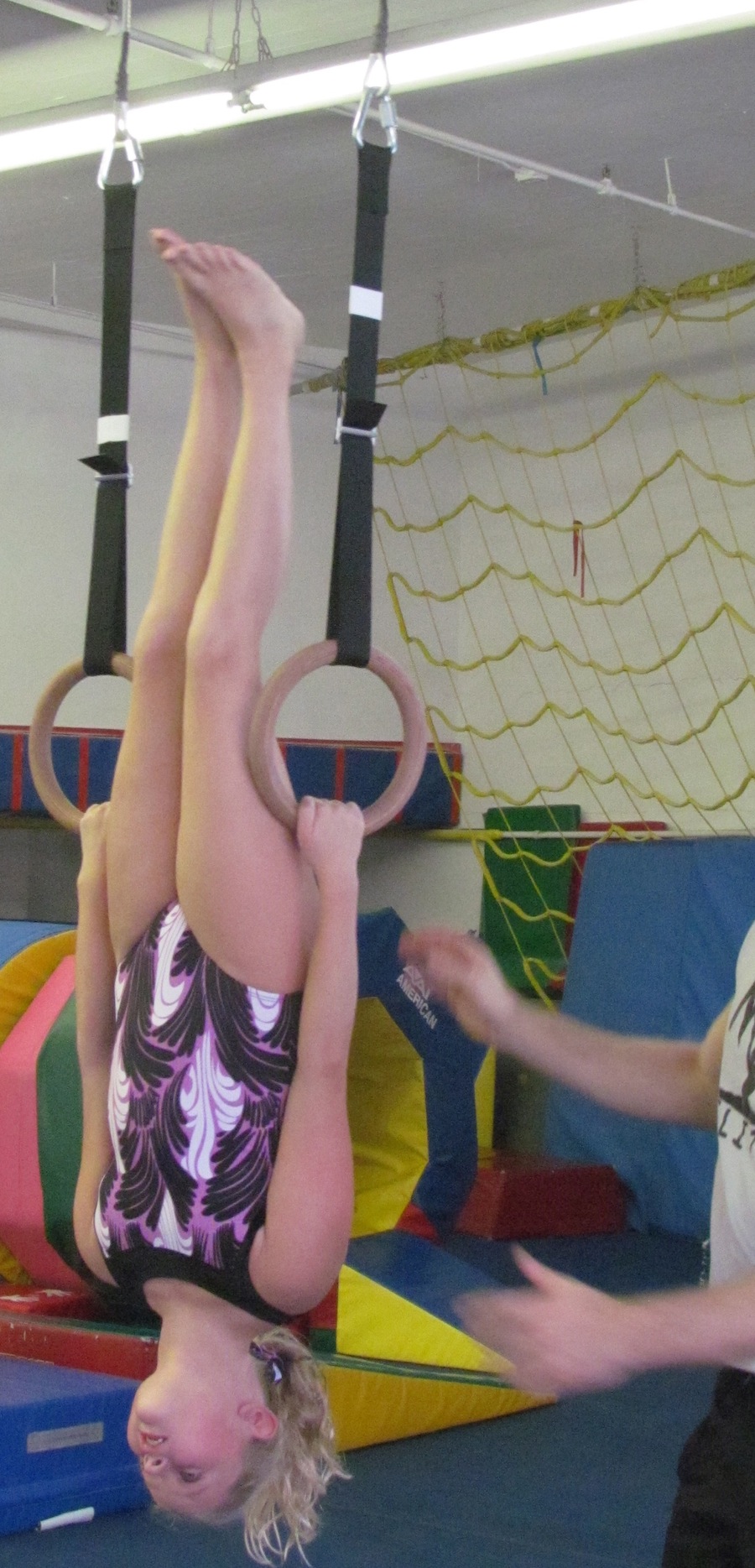
Excuse me while I jump up and down while wiping away my tears of joy.  Emma wasn’t able to do a catch upon her first try or second or even third.  Em has been going to trapeze school for more than two years.  She also goes to gymnastics once a week where she has been working hard for almost three years strengthening her core muscles.  In the last month she is now able to do a cartwheel.  Emma began learning to type two and a half years ago.  She practices every day.  She practices reading too.  She practices and works really hard.  None of this has come easily or automatically, there is no “magic” involved, unless magic means being given the opportunity to work toward her strengths, to learn and practice and the belief that she can and will succeed.  Watch that video again, because all her hard work is paying off.  Watch Emma fly!

Bungee jumping barefoot – December 2012

photo

Functioning Labels

When my daughter was two-years old she was diagnosed with PDD-NOS (Pervasive Developmental Disorder – Not Otherwise Specified).  People assured us she was “mild” and she would certainly be mainstreamed by kindergarten.  When she was not mainstreamed, people shrugged and suggested any number of things we might do to ensure she have that meteoric rise that everyone kept saying was just around the corner.  When that meteoric rise did not occur people stopped using the word mild and the word “autism” replaced the initials PDD-NOS on her IEP.

During those early years I didn’t spend much time considering or questioning functioning labels, what they really meant, how they were being used, other than to say when people inquired, that my daughter was “mild”.  And then we went to Em’s  neurologist where I happened to say something about how Emma was “mild” and the neurologist said, in a tone of poorly concealed shock, “Well no.  I wouldn’t say she was mild.”

“You wouldn’t?” I asked in surprise.  “Well what would you say?”

He looked away from me before answering, “I would say she was… moderate, but mild?  No.”

I was stunned.  The idea that my daughter was not “mildly autistic” had not occurred to me.  Those two words that I had clung to during those early years, were suddenly ripped from my grasp.  I stood there trying to remember to breathe.  And I remember that sinking feeling in my gut.  That feeling you feel when you see something massive barreling toward you and you know there’s no chance you’ll be able to get out of the way in time.  There have been a handful of defining moments during this crazy journey that began when I first heard the word autism uttered in reference to my young child and this moment at the neurologist’s was one of them.  At the time I couldn’t speak.  What was there to say?  My knowledge of functioning labels was almost non-existent and what I thought I knew about them caused me to make a whole series of assumptions I would later find were wrong, each and every one of them, completely, categorically, wrong.

It has taken me many, many years to deconstruct what people are attempting to say when they use functioning labels.  I have found the use of these labels is uniformly inaccurate, misguided and does far more harm than good.  I understand they serve as a short-hand for insurance companies, schools and various medical institutions, but I strongly believe we as a society need to re-examine the words we are applying to a great many people and the disservice these labels are doing.  Rather than labeling someone mild, moderate or severe we should be looking at the specific needs each person has, breaking those needs down into more specific language that would better serve them.

As an example (this is in an ideal world):

A eleven-year old Autistic girl who has some verbal language, but relies heavily on scripts should be encouraged and taught to type and/or write.  An iPad should be made available to her during school hours and in the home.  Pointing skills should be a priority and supportive typing techniques should be explored.

Teaching grade level material in an engaging way, using visual, auditory, tactile and kinesthetic teaching techniques is essential.

As this young girl shows a need for intense sensory input and craves an audience, as well as displays strong leadership qualities – drama, acting and theatre classes should be included in her curriculum.  It turns out she is also very musical and is a talented singer with excellent aptitudes for both melody and rhythm – therefore music should be incorporated into her day as well.

This same young girl has shown athletic abilities.  She has core weakness and sequencing issues, therefore gymnastics, swimming and track should be essential components of her day, etc.

I could go on and on here, but the point is, if this same young girl is presented simply as “moderately” autistic how does that help her receive the specific things she needs in order to flourish?  Does the label help her at all or does it suggest a level of incompetence?   Is she relegated to a special education classroom where she is taught “life skills” at the exclusion of all else?  What does this functioning label do to our expectations of her?  Do we “dumb down” her learning materials because we assume she cannot possible understand?  Just because she enjoys watching the same video over and over for years on end, do we assume this is an accurate gauge of intellectual capability or do we entertain the notion that this is a way to calm herself with something that is familiar?  How does the label help her parents understand their child? How does the label “moderate” help educational and medical establishments help her?  How does a “moderate” label directly influence the goals that are then listed on her IEP?

Functioning labels are more than just meaningless constructs; they are doing damage. I understand the arguments for why people feel strongly they are necessary, but I disagree.  Functioning labels need to be tossed aside.  None are being served by them.

Em during her gymnastics class

IMG_4248

Related Posts:

What Is Autism?

Google that term and one is faced with a lengthy list of deficits.  The definitions of autism are cloaked in subjective language.  All the words used are in relation to non Autistic neurology: “severe impairment”, “life long developmental disorder”,  “social impairment” and one site went so far as to say, “A mental condition in which fantasy dominates over reality, as a symptom of schizophrenia and other disorders.”  None of these “definitions” have been helpful to me, personally, nor have I found them to be factually correct.  The most common definitions of autism out there have increased my fear and encouraged me to pursue therapies and treatments that have done far more harm than good.

People often ask, “so what is autism exactly?”  Over the years I’ve had a variety of responses, but like the definitions above, they always seemed inadequate, unhelpful and inaccurate.  So now, when I answer that question all I can come up with is this:  Autism is a type of neurology.   Short and sweet.  No judgment, no comparison, just six words.  It is a neurology.  It’s the best way I know of to describe what is often mired in negativity and judgment.

Comparing Autism to non autistic neurology has gotten me into a great deal of trouble over the years.  I have found it is important that I avoid doing that.  (I’m keeping this personal.  I speak only for myself and do not presume this is how others feel.)  For years I worried about my daughter’s ability to have friends.  If I believe the common definitions of autism, her ability to make friends is “impaired”.  Yet the impairment is less about her desire and attempts to have friends as it is about non Autistic neurology being out of sync with hers.  When Em was in Florida with her friend Henry, they had no problem hanging out together, laughing and enjoying each other’s company.  Just because they typed to each other and didn’t engage in endless verbal conversation, didn’t mean they didn’t have a blast together.

If I listened to and believed the definitions of autism, I might think my child couldn’t learn to read or write.  I would be wrong.   Not only has my daughter learned to read and write, she also has learned to type.  Because I no longer believe the common definitions regarding autism I do not limit what she should or shouldn’t do.  I do not limit her future with set ideas about her future capabilities.  I have found it helpful to disregard those organizations and people who insist that Autism is a dreadful “affliction” and compare rates of autism diagnosis with cancer.

So what is a longer definition of autism?

It’s a terrific question.  Finding an answer that is factual as well as helpful to me, has been difficult to find.  However there are a few who have done a terrific job defining autism and in doing so have also helped me, personally.  Autistic Self Advocacy Network (ASAN) defines Autism ‘here‘ and this post by Brenda, over at Mama Be Good, gives a great, comprehensive answer to the question and at the end includes her personal observations of her child and what it’s been like to parent an Autistic child.

So I ask you, how do you answer the question – What is Autism?

Em on her way back to Henry’s house – April 2013

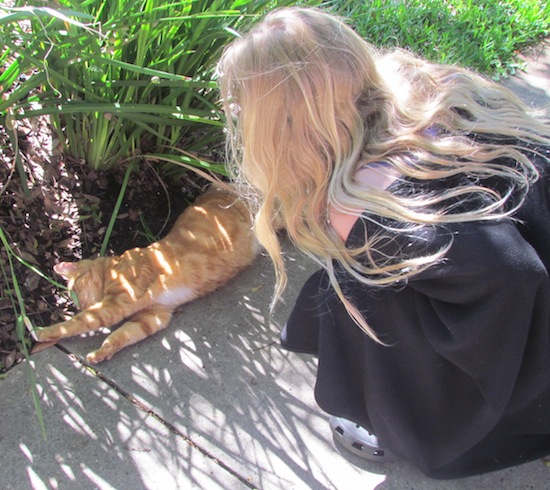
Em pets the kitty

Accepting Ourselves So We Can Accept Others

Accepting myself has been an ongoing process and it began well before I became a parent and got married.  It began more than seventeen years ago when I was flailing about, bulimic, unable to stop using my substance of choice (food) the way a drug addict uses crack.  I have written about this period of my life before ‘here‘, ‘here‘, ‘here‘ and ‘here‘ so I won’t go into great detail again now.  Suffice it to say, I was out of control, scared, suicidal and I couldn’t stop binging and purging.  And then someone who had once been an active alcoholic and obese, with more than a hundred pound maintained weight loss, said to me, “What if you accept that this is where you are?”

I remember I looked at her in shock.  Even now, thinking back to her words I find I am holding my breath.  It was such a stunning statement.  Never had anyone suggested such a thing.  To me it suggested complete defeat.  It was blasphemous.  It was the single most heinous suggestion I’d ever heard.  I think I said something like, “Are you kidding?  What do you mean?”  I can no longer remember her exact words, but she said something like, “You just told me you can’t stop binging and throwing up.  You just said you are out of control.  You just gave me a detailed description of what you do, how completely depressed you are, how you’ve tried for twenty-two years to control yourself and yet here you are, still unable to.  What if you told yourself – okay.  This is where I am.  I am out of control.  I hate it.  I hate feeling this way.  I can’t stop.  I can’t stop hurting myself.  I can’t stop binging.  I can’t stop throwing up.  I can’t stop thinking about food.  I can’t stop abusing myself.  This is where I am.  I accept that I am here.  What if you did that?

I didn’t have an answer.  I couldn’t think.  I felt like I was being given a pop quiz I hadn’t studied for.  I stared at her and then she did the next thing that I could not understand or wrap my mind around.  She opened her arms in embrace and hugged me.  I remember my confusion, the feeling that this couldn’t be right, that she was unhinged, that the only thing that could save me from self-destruction was more self-criticism, more self-loathing and more self-recrimination.  But I also knew what she’d said made some sort of bizarre sense; for twenty-two years I’d been upping the self hate talk to no avail.  All that criticism I kept dumping on myself had gotten me exactly where I was – at a dead end.  So I took a deep breath, held onto her hand and took a metaphoric leap into the unknown.  The unknown of acceptance.

Just in case you’re wondering, it didn’t happen as quickly or as easily as this may sound.  That leap took years of practice, of gently reminding myself that whatever I was feeling, whatever I was doing, I could accept that in that moment I was where I was.  It took years and years of cultivating awareness, of being able to see when I took up the whip that I could also put it down again.  Kindness, compassion, gentle reminders and acceptance, this is the road I have tried to stay on.  As I said, this is very much a work in progress.  Some call it a ‘practice’ because ‘work’ sounds difficult.  My experience with acceptance has been that it is “work”.  It is not easy for me.  It does not come naturally.  I have stumbled along the way.  I continue to wander off at times, only to be brought back, gently, kindly and with compassion by others who are on the same path.  It takes gentle reminders, many nonjudgmental nudges to move back onto the path of acceptance.  But I have seen the light and know to follow it even when it grows dim.

My experience with acceptance regarding autism has followed a similar trajectory.  You might think – why didn’t she ‘get it’ right away?  Why did it take so long for her to remember that what had worked for herself would work with this too?   And the only answer I have is this – I forgot and I couldn’t see that they were connected.  I didn’t see the value in accepting autism because I didn’t see my child as Autistic.  I saw her as having been diagnosed with a word I feared and didn’t understand, and therefore was not going to accept.  Again it felt like defeat to accept.  It has only been a little over a year that I was able to make the connection.  And the thing that helped me make the connection came in the form of yet another person who accepted me and all my fear, guilt and shame with compassion.  Once I was able to make the connection, became aware of my lack of acceptance and allowed that to be, without adding criticism and judgement to it, was I finally able to begin the process of true acceptance.

Acceptance of ourselves and where we are in this moment opens us up to the wonder of all.

Pascal, Emma, Harvey & Henry typing to each other – April, 2013

H &E type


The Complexity of Life and Change

*Emma gave me her permission to write about this.

Yesterday Em was having a tough time.  She has been talking about an indoor playground that closed some six years ago, expressing her upset that it’s now a store and asking that we build a new indoor playground exactly like it.  We have discussed the idea that places go out of business and that we can’t bring them back, we’ve talked about what is required to build an indoor playground, but that it will not be exactly like the one that closed.  We’ve discussed the concept of same and different.  We’ve gone over the preliminary steps needed to be taken in creating any sort of space.  Joe even thought she might like to build a model playground, complete with running water and electricity, but none of this has helped.  She remains very upset.  So much so that I began to feel certain her upset was not actually about this specific playground, but that this playground has come to symbolize loss.

“I want playground.  I want to build it.   Will take out the store and build a different playground has slides and a bouncy castle.”

I explained again that we couldn’t do that.  Em then repeated how she wanted to build a playground and then said, “Bertie kitty can’t eat pancakes.  Bertie kitty, the animal vet doctor, says no.  Might get sick.  Bertie kitty died.”

I nodded my head and said, “Bertie was old, Em.  He didn’t die from eating pancakes.  He died because he was very old.”

“I want to take it out!” Em pulled at the palate expander in her mouth and began to cry.

“I know you do, Em.  But we can’t take it out yet.  The orthodontist will take it out eventually.”

“Soon.  I want to take it out now.  I want to build it.  I want to build new playground.”

It’s easy for me to get caught up in the literalness of Emma’s words.  To get swept up in each upset individually, as it shows itself, veering from the closing of a playground, to the death of my cat, to the desire to have her palate expander removed.  If I take each of these concerns separately and at face value, I can quickly become lost in each one.  This is something I continually struggle with, not just with my daughter, but in life.  I take things pretty literally and often try to compartmentalize each thing so as not to get overwhelmed.  So in instances when Emma seems to be racing from one upsetting thought to the next, it isn’t my first thought to look for the common thread.  But I am fairly certain I’m correct about my interpretation of what’s going on here.  I think Emma is working through a number of difficult concepts that in her mind are all related.  The playground closing and being replaced by a store that holds no interest for her, the death of my elderly cat Bertie, whom she loved, and the palate expander that she dislikes and wishes would be removed.  I could be wrong, of course, but it seems to me they are all connected.  They all fall under the heading of permanence and impermanence, or death.

As Emma learns to communicate better through both typing and verbally, we become better at listening and understanding her, her anxieties are becoming more obvious to us.  As her communication skills increase, so does her obsessive compulsiveness, or so it seems to us.  It’s entirely possible that Em has always had this degree of anxiety, obsessiveness, coupled with compulsivity, but we are only now becoming aware of just how difficult it is and how often it overwhelms her.  Leaping from one upsetting scenario to the next is something I do too, particularly when I am tired.  With Emma it’s all about things that are impossible to have, things that are gone and won’t come back or, as is the case with the palate expander, about change, literally physical change as she looses the last of her baby teeth and her permanent teeth appear.

As we continue to support Emma with her typing, we have noticed she is becoming more verbal.  As she becomes more verbal she is expressing her anxieties, her concerns, as well as her desire to be heard.  The more we listen, the more she has to say.  Yesterday as we worked on her typing, I asked, “Em tell me two things you like doing and one thing that’s hard.”

Em typed, with my hand barely touching her forearm, “I like to bounce on the trampoline.  I like to bounce on the bouncy castle.  It is hard for me to work with mommy.  You could help them work with mommy.”

“Thank you for telling me that, Em.  Who should help me so it’s easier for you to work with me?”

“Pascal.”

Emma and Pascal take each other’s photographs  – April, 2013

*Pascal

Diversity Abounds

It's Spring!

Spring at the New York Botanical Gardens!

Epidendrum

Orange Epidendrum ~ The Orchid Show at the New York Botanical Gardens

Phalaenopsis

Pink Phaleanopsis

Dendrobium

I can’t remember what the name of these orchids are.  Dendrobium, perhaps?  Richard gave me one years ago.  

I love orchids.  When I went to Thailand almost two decades ago, I was surprised to see orchids growing like weeds on the sides of the roads.  Something that is seen as exotic here in New York City was tossed into the backs of pick-up trucks in Bangkok.  Something that is thought difficult to grow, given the right climate flourishes in other parts of the world.

As I looked for an orchid to take home with me, I thought of diversity.  I thought about how some orchids require just the right light, just the right amount of water and soaking and humidity and how others require much less, but once its needs are met, all can and do flourish; just like us!

The Practice of Life

Yesterday while working with Em (we are learning about American Indians) I had a moment of panic.  I thought, I have no idea what I’m doing here.  I don’t know how to teach this material.  I don’t know that she understands any of this.  

The more panicked I became, the more impatient I felt.  The more impatient I felt the more in touch with my anger I was.  When she randomly pointed to the wrong answer I said in a stern voice, “No!”  Emma doesn’t respond well to “No!”  I know this. But in that moment yesterday, I needed to take a break.  In that moment, neither of us were going to be well served by pushing ahead with the material.  It didn’t matter that I’d printed out more than a dozen photographs of various American Indians and the living structures different tribes used.  It didn’t matter that I’d prepared material to discuss how some planted and became farmers, while others fished and still others hunted buffalo.  None of it mattered because I was having feelings about how she should be able to learn it in the way I was teaching it, despite the fact that the way I was presenting the material was not the way I’ve been taught.

I was not, in that moment, able to practice patience and good teaching.  In addition to this, my thinking was my own worst enemy.  Whenever I begin to think in terms of fearful, projected thinking, and then ask questions such as, “what if she doesn’t understand this?”  or “why didn’t she know the answer to that question?”  I begin to feel impatient and then angry.  In that moment I was not able to see that I was asking the wrong questions.  In that moment I was not presuming competence in her ability to learn.  I know she can learn the material.  I have seen her learn all kinds of material.  This is an example of expectations, coupled with impatience and not teaching the material in the best possible way.

It is during moments like this that I need to take a break.  I know this.  It seems that this would be a fairly easy thing to recognize and then implement by saying something like.  “Oh, hey.  I need to take a break.  Let’s come back to this later.”  Or some other equally non-judgmental comment, but this isn’t easy for me nor does it come naturally.  I slide quickly into either self recrimination or fear and annoyance that she isn’t attending to the material (and me) in the way I would like.  *Breathe*  It’s okay.  You’re okay.  Just take a deep breath.  It’s all fine.  In moments such as this, it is vitally important that I take good care of myself so that I don’t do harm to those around me.  I’ve learned this.  I know this.  This is fact.

So I am writing all of this out here, not as a public flogging or because I’m seeking absolution, but as a gentle reminder to myself that the way I treat myself is the way I treat others.  It’s all practice.  My specific practice includes patience, remaining calm in the face of fear and annoyance.  Recognizing, without judgement, that I do not always behave the way I would ideally like.  Admitting and accepting that I am flawed.  And doing everything in my power to be the very best parent (and person) I can be.  I can’t rewind the tape of yesterday’s session, but I can acknowledge what happened and that I do have the tools to present the material differently this afternoon.

This lesson of patience and calm when my emotions are running in the red is one I have not yet mastered, but am working toward one day at a time.

contemplation

Some Thoughts on Accommodation

A year ago I did a crash landing into the world of bloggers, all of whom were Autistic.  I had been looking for them for years, but suddenly, or so it seemed to me, I found not one, not two, but dozens and dozens of blogs written by Autistic men and women in their 20’s, 30’s, 40’s and 50’s.  It was surreal because these people were writing about their lives, giving glimpses into what it is like to grow up and live in a world and society that does not “see” you, yet talks about you and perpetuates misinformation about you with little interest in verifying whether their interpretation is in fact correct.

Pretty quickly after my crash landing I found this ‘post‘ from the blog Radical Neurodivergence Speaking about attending an Autism conference where the keynote speaker said, “When one family member has autism, the whole family has autism”.  The blogger writes, “My autism is not about my parents or my siblings or my non autistic friends and extended family. It is my neurology. It is not theirs. No matter how much they listen to me, how much they try to understand, it is not about them. It’s a lot easier to protect the martyr mentality when you insist it’s about you, but that’s just not how it is. As long as it’s considered to be our parents’ thing, though, the system will continue to be broken. We keep having to fight for ownership of our own experiences, and that’s not right. It isn’t even wrong. It’s so backwards there is not yet an adjective for it.

Now remember, I was at the very beginning of finding actual people who were talking about their own neurology as opposed to ‘experts’ talking about their interpretation or ideas about a neurology they did not have.  I had to reread that paragraph before I could go on.  “As long as it’s considered to be our parents’ thing, though, the system will continue to be broken. We keep having to fight for ownership of our own experiences, and that’s not right. It isn’t even wrong. It’s so backwards there is not yet an adjective for it.

I had to get up and walk around because this concept, this simple, and now it was dawning on me, pretty obvious idea was not something I’d really considered before.  I had to sit down and think about this.  “As long as it’s considered to be our parents’ thing, though, the system will continue to be broken.”  And then I realized something.  I didn’t like what I realized, but I couldn’t tamp it down.  It kept springing back up into the forefront of my mind.  I realized by making autism and my daughter’s neurology about me, I would continue to feel sad and victimized by “it”.  “It” was this terrible thing that had happened to us. “It” being the operative word.  “It” wasn’t my daughter.  “It” was what we fought against.  And by then adding a judgment to my daughter’s neurology (it’s bad) I was limiting it even more and adding a layer of horror to it.  Without meaning to I was making things much, much worse for all of us.  Without knowing it, I was doing the opposite of accommodating “it” I was co-opting it and making it all about ME.

Now before people start saying things like – wait a second, autism DOES affect the whole family, or, but the siblings DO feel x,y and z – I need to state the obvious – of course an autism diagnosis affects the whole family, but affecting the family is different from saying, “When one family member has autism, the whole family has autism.”  That simply is not true.  The whole family does not “have” autism.  This is not FACT.  Insisting that it is fact when it is not, does not serve any of us, but mostly it is a massive disservice to my daughter and all who are Autistic.

When my father had his horseback riding accident I was nine years old.  It completely affected my outlook on life.  At the age of nine I considered death, hospitals, doctors, what it means to be physically disabled, in a way that my same age peers were probably not contemplating.  Yet I was not suddenly “disabled” because of his accident.  None would have suggested that.  I might have been helped had I seen a therapist to work through some of my fears and later phobias that resulted from his accident, but that is very different from co-opting his experience.  When my father was in a wheel chair, the entire family did not suddenly lose the use of their legs.  My father needed accommodation, ramps needed to be built inside our house where there were stairs, he needed assistance getting into and out of the swimming pool, but the rest of us continued to walk around, ride our bikes, play with our friends and live our lives.  Did my father’s accident affect me, well of course it did, but never would anyone have suggested that because of my father’s disability the entire family was therefore disabled.

We keep having to fight for ownership of our own experiences, and that’s not right.”

Ownership.

We all need and want to be heard.  Parents want their experiences to be heard and acknowledged.  Siblings want their experiences heard and acknowledged.  But that should not be at the cost of our Autistic children.  ALL people deserve to have the accommodations they need.  Just as my father required ramps built in our house, my daughter needs support to communicate without the added pressure or guilt that she is causing the rest of us hardship.  We need to reframe the conversation.

More terrific posts from Radical Neurodivergence Speaking:

I shouldn’t have to beg

I’m on your kid’s side too

Autism and child abuse: Both for April. Oh IRONY.

More Toxic Lessons Learned

Em