Category Archives: Parenting

Being the Adult I Want my Children to Become

“Are you the adult you want your child to grow up to be?” ~ Brené Brown from her book Daring Greatly.

Are we being honest here?

Because if we’re being honest, then – no, no I’m not.

I could hit the publish button right now and call this a post, but I’ve got a couple of things to add here.

From Daring Greatly – “…we should strive to raise children who:

  • Engage with the world from a place of worthiness
  • Embrace their vulnerabilities and imperfections
  • Feel a deep sense of love and compassion for themselves and others
  • Value hard work, perseverance, and respect
  • Carry a sense of authenticity and belonging with them, rather than searching for it in external places
  • Have the courage to be imperfect, vulnerable, and creative
  • Don’t fear feeling ashamed or unlovable if they are different or if they are struggling
  • Move through our rapidly changing world with courage and a resilient spirit

Now read every one of these things as a directive for yourself, like this:  Embrace your vulnerabilities and imperfections.  Feel a deep sense of love and compassion for yourself and others.  Carry a sense of authenticity and belonging with you, rather than searching for it in external places.  Don’t fear feeling ashamed or unlovable if you are different or if you are struggling.

I am becoming increasingly aware of how often my critical responses to my children are often reflections of my deepest insecurities. I don’t want them to make the same mistakes I’ve made.  I think I can control their future by making sure they understand just how serious all of this is.  I admonish my son for forgetting to feed the cat, while remembering the time my parents left me in charge when I was fifteen, two years older than my son is now, and how I forgot to feed the horses and had nightmares for years afterward.  I try to remember to phrase my sentences as – You forgot to feed the cat, what might help you remember?  Instead of my knee jerk response of “Did you forget to feed the cat again?  Why can’t you ever remember to do that?”  Because, wow, there’s a world of difference between the two…  and yes, I’ve said both.  The first is when I’m being the adult I want my children to grow up to be and the second is the adult I hope beyond measure they never become.

I worry about what a neighbor is thinking when he asks how we are and my daughter responds with, “Yeah, baby Teddy can’t go on the pogo stick.  Baby Teddy might fall and hurt his head.  Baby Teddy will cry and have to go to hospital…” and then describes how the doctors are going to have to put a breathing mask on baby Teddy.  I stand there feeling increasingly uncomfortable, because I care what our friendly neighbor thinks or because I’m afraid of what this might say about me and the things we put her through years ago?  And even as I am writing this, I marvel at how she really was answering his question, far more honestly than I ever would dare.

The truth is my children are closer to the adult I’d like to be, but am not yet.  I figure since my husband is hard at work figuring out the whole anti-aging thing, I’ve got at least as many decades ahead of me as I’ve got behind me to work on this goal.  I’m grateful for that, really.  I’m going to need every year I’ve got left.

“Have the courage to be imperfect, vulnerable, and creative”

Yup, check.

“Move through our rapidly changing world with courage and a resilient spirit”

Yup, check.   I got this.

Reflections in a puddle
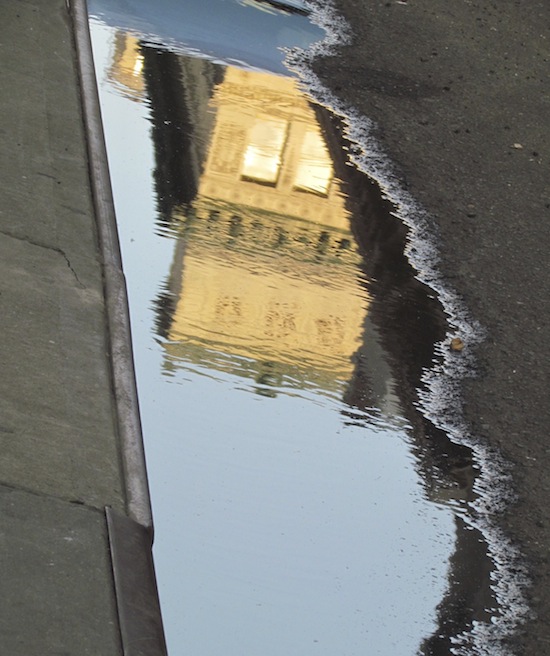
Reflections in a puddle


Beauty in Being

A couple of years after my daughter was diagnosed with autism, a well-meaning acquaintance said to me, “God must think you very strong.”  It was one of those comments you wish the person hadn’t said.  I understood they meant well, I understood it was some sort of convoluted compliment, I understood they meant to be something like supportive, but it felt awful.  Least of all because I have never gained any solace from the existence or non-existence of the G-word, but mostly because of its obvious prejudice to those who are Autistic.  The person then followed that sentence with this next one, which was like a second jab to the solar plexus.  “I could never handle an Autistic child.”  I stood there in stunned silence.

At the time I think I probably looked away and tried to untangle the multitude of feelings that surged through me.  But today, now years later, I have a couple of things I want to say.  Let me tell you about my beautiful, perfectly wonderful, very human, child.  She is like the sunlight that glimmers off the leaves of an Aspen tree.  She is that first ripple that appears on a crystal clear lake, extending outward in ever-widening arcs.  She is the sound of rain on fallen autumn leaves, she is the smell of sage brush after an electrical storm, she is the glimmer of morning sunlight when it first appears rising up over snow capped mountains, she is imperfectly perfect and a gift and yes, a blessing.  And if I’m going to be completely, utterly selfish, I must say this:  she has taught me more in her short eleven years of existence than any book, spiritual leader, graduate class, academic study or person I’ve ever read, listened to or met.

I know Emma’s life will have challenges because of her specific neurology.  I know she will often have to fight harder, prove herself more often, work more doggedly and persistently than her non Autistic peers to accomplish things that many do not even consider accomplishments, but assume are a given.  Yet there are some things she can do and will learn to do that will be easier for her than many of her non Autistic peers.  I no longer see autism as a road block, but more as a different road all together.

Every morning I wake up filled with gratitude for my family.   But it is my daughter, my beautiful, beautiful daughter who has introduced me to a world I never knew existed.  A world that is beyond anything I could have imagined, a world filled with other Autistic people who enhance my life and the world on a daily basis because of their existence.  Emma has taught me the true meaning of gratitude.  She impacts my life in ways I will never be able to fully describe or express.  Gifts are like that.  Strength has nothing to do with receiving gifts.  It does not require strength to see the good in others.  It does not require anything actually.

That is another lesson my daughter has taught me –  the beauty in being.

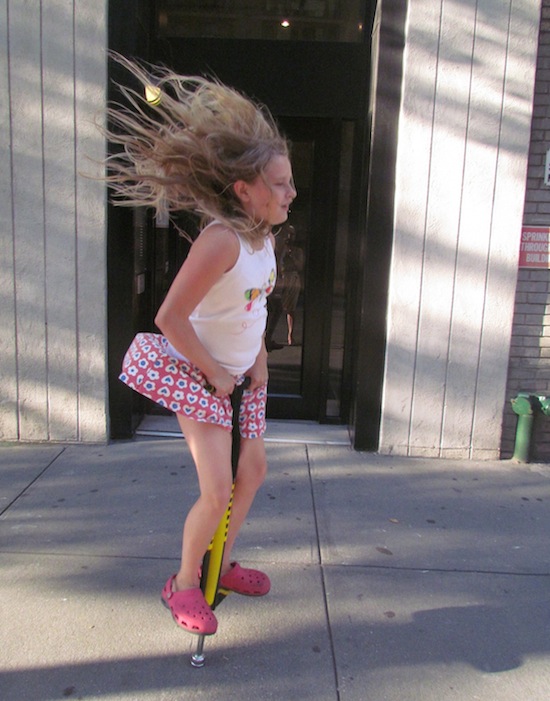
Em testing out her new pogo stick.  Her record?  62 bounces.  

*Blue Pogo Stick

  • Reflection (whereartandlifemeet.com – Ariane’s other blog)


Progress

It’s a little ironic that this blog began as a document of my daughter’s “progress” (which, at the time I defined as – becoming indistinguishable from her non autistic peers) and has evolved into a document of my progress and movement away from exactly that kind of thinking.  I don’t really have a problem admitting the mistakes I’ve made, which is probably a very good thing as I am not going to get to a point where I never make any.  But I do my best to learn from them.  I try hard not to beat myself up.  Sometimes I’m more successful at that than other times, but that too is a lesson I learn from.  I didn’t get to any of this on my own.  The progress I’ve made regarding autism, how I think about my daughter and because of that thinking, how I interact with her, is a result of the help I’ve been given.  Help given to me by those who are Autistic.

I would be dishonest if I didn’t admit to times I’ve felt confused, afraid, unsure of myself, and incredibly vulnerable more often than I’d like, but that’s progress too.  There was a time in my twenties and early thirties when I did pretty much anything not to admit I ever needed help, let alone asked for it.  Thankfully I’ve progressed.  So last night when Richard told me about running into one of Emma’s early intervention therapists and how it seemed she was surprised that Emma was not able to carry on a conversation with her, I felt a wave of something I couldn’t immediately identify.  First I cycled through thoughts of “I don’t want to hear your feelings on this,” to “I wish you hadn’t told me about this” to the overwhelming urge to stick my fingers in my ears and yell, “LALALALALALALALA I CAN’T HEAR YOU LALALALALALALALA!!!”

Yeah.  I know.  That would have been childish of me.  And by the way, I’m 52 years old.  You have no idea how much I wanted to do that.  *Shrugs, then smiles. 

Progress…

So after all that, after we got into a fight about something unrelated that I can no longer even remember what the topic was, I realized what I was feeling.  I felt the weight and force of my feelings.  Feelings I really prefer not to have or feel.  Ever.  Shame.  Feelings of shame.  Yup.  Shame.  Like a massive metal door closing in on me, I felt shame.  And then I felt shame for feeling shame.  Fade to black.

Because that’s how this works right?  We feel something and then instead of being able to sit with the feeling, work through it, we add to it by feeling shame for feeling the initial feeling of shame.  Who came up with this stuff?  If it wasn’t so damn painful it would be beautiful in its perfection!  As a friend of mine and I like to say, it’s a “pick your poison” situation.  Whichever way you go, it’s going to hurt.  So yeah, I chose to feel the initial shame and tried hard to be aware of my judgment and that really loud, obnoxious, critical voice that loves to shout at me given the slightest opportunity.  “Shame.  Feeling shame.  Lots of shame,” I said.  Meanwhile Richard had moved on to the New York Times Crossword puzzle and looked at me with confusion.

To be clear – This isn’t about my kid.  This has nothing to do with her, who she is, her neurology, what she did or didn’t say.  This has nothing to do with Richard running into one of her Early Intervention therapists or perceived expectations, either mine, his or the therapist’s.  This isn’t about autism.  This isn’t even about parenting.  This is about perfectionism.  This is about my shame for being an imperfect human being.  That’s what this is about.

Progress…

Reflection

Early Intervention

Last week I wrote a post,  Autism “Experts” about how I used to attribute any action or sentence uttered by my daughter as evidence that whatever therapy or treatment we were employing at the time was “working.”  It was my way of staving off the persistent fear that if we were not intimately involved in a constant barrage of therapies, she would make no progress or whatever progress she made would be less, than if we devoted every waking hour to constant involvement and interaction.  Suddenly every waking moment became a moment we must engage, interact, teach and push for more.

We were told about the human brain and the small window when the brain’s plasticity is at its most optimal for learning.  From the moment that diagnosis was handed to us, we felt we were in a race against time.  Any time we sat down to read the newspaper or took ten minutes in our daughter’s presence to relax and just be in each other’s company without “working” with her was reason for guilt and the feeling that time was slipping away from us.  The nagging worry, if only we did more than we already were, she would be better served, is one I remember well and can still feel the residual stress of.

I want to clarify a couple of things that perhaps were not entirely clear in last week’s post.  I do not believe an autism diagnosis means we sit and do nothing to help our children, but I believe there must be a balance.  What we did was detrimental to all involved and I do not encourage anyone to follow in our footsteps.  All our hard work, the round the clock therapy, (more than 40 hours a week) the training, the evenings and weekends spent taking over once the therapists had gone home, did not ensure our child’s brain was rewired.  She was not mainstreamed within a few years.

This idea, popularized by the book, Let me Hear Your Voice by Catherine Maurice was NOT our story.  I do NOT recommend that book, in fact I urge parents to avoid it.  It was the first one recommended to me by Emma’s ABA supervisor and it set us on a very painful road of discouragement and disappointment, but perhaps even more importantly and destructive, it put into play the belief that Emma’s neurology could and should be “fixed.” And it pushed us further away from any degree of acceptance and eventually embracing and yes, celebrating our daughter for the amazing, uniquely beautiful being that she is.

That early intervention is so often equated with ABA is worrisome to me.  I hope this is changing.  People suggest it is, but when my daughter was diagnosed it was a given.  It was ABA or nothing.  Agencies offered versions of ABA, but it was still ABA.  My child was not helped by ABA.  I would not have done it could I do it all over again.  I’ve written about ABA before ‘here‘ and ‘here‘.  I know many of you feel it has helped your child, many have written to me and described some version of ABA that bears no resemblance to the method used with my daughter.   Evidently ABA has, in some cases, changed.  The bottom line is this – Does it presume competence?  Does it respect the child as a human being?   Is this a method I would use on a child who was not Autistic?

What I would have done when my daughter was first diagnosed was OT.  I would have enrolled her in gymnastics, trapeze school, swimming and I would have introduced her to a stencil board and AAC (Augmentative and Alternative Communication) devices.  I would have begun using Proloquo2go and many of the terrific Grasshopper apps had we had iPads when Emma was diagnosed.  And I would have begun working with Soma Mukhopadhyay.  In an ideal world all of these things would be a given.  All of these things would fall under “early intervention.”  All of these things would be available to ALL families despite their level of income.  These are the things that have proven to help my daughter.  All children may not respond to the things she has responded to.  But in an ideal world “services” would include an evaluation determining what things would help and a plan would be made.

In last week’s post I questioned those who are not Autistic and have little or no contact outside of a professional setting to those who are and yet call themselves “experts.”  I was not referring to the many professionals who are intimately involved in the autism community (and by that I mean the community of people who are Autistic) who have dedicated themselves to helping our kids and us so that we can be, not only the best parents we can be, but also equipped with information that will help us help our children flourish.  There are a great many of you out there, and to you I am incredibly grateful.  To all those professionals in the field of autism who are not familiar with Autistic blogs, books or do not have have any Autistic people in your life who are friends and colleagues, please become familiar with Autistic people’s work so you can tell parents.  Many parent’s first contact with anyone involved with autism, outside of their child, will be a therapist.

Please make sure parents know there is a growing population of adults who share our child’s neurology.  Even if that means just giving us a list of blogs and books written by Autistic people.  Ideally there would be programs in place that employed Autistic people, just as social workers, therapists, parent liaisons are employed. Autistic people who are interested in interacting with new parents and their newly diagnosed children would become a part of “Early Intervention.”

Ideally we would live in a society where we did not segregate those who were more profoundly affected by physical impairments and do not speak, so that all of us came into daily contact with those whose neurology was similar to our child’s as well as those with an array of impairments.  Perhaps families with older kids who are farther along in the process would volunteer to reach out and be available to other families new to all of this.   The point is that we could help each other more than is being currently done.

No family should feel they are alone, or feel the fear we felt or the terror and worry that dogged us every waking moment of those first years after my daughter’s diagnosis.  Years we spent in a state of almost constant panic that we should be doing more, that if we didn’t we were losing time, that our daughter’s life depended on it and that anything less meant we were failing her.

No one, who is given a diagnosis of autism, should feel they are alone.  None should feel less than or believe they are damaged or broken.  No child should feel ostracized or that the way they process and view the world is “wrong” or “bad.”  None should feel that because they are Autistic, they need to hide or feel abandoned by society. No one should be made to feel ashamed for the way they were born.  No one.  This is what I want to see change.  This is why I keep writing.  All of us can work together to create a world that embraces one another and encourages, rather than condemns.  Each of us can play a small part in making this happen, by increasing our awareness, by accepting difference, by working together.

**Em

Autism “Experts”

Yesterday Emma asked Richard a question.  It was a question she’d never asked before.  It was a question that made us both inwardly gasp and later discuss at length.  It was one of those things that was noteworthy and made us both rejoice.  It was an example of progress, not just Emma’s, but as I’ll explain, our’s too.  Emma’s reaction to Richard crying out when our impish kitty, Merlin leapt onto his back, was what one might expect, except it wasn’t.  As all four paws, claws extended made contact with Richard’s flesh, Richard howled out in considerable pain.  Emma ran into our bedroom and asked, “What happened Daddy?”

Had we been in the midst of some “therapy” or “treatment” protocol, as we almost always were a few years back, we would have attributed this new, never-before-heard question to that therapy or treatment.  We would have felt a wave of euphoria, believing, even if only briefly, that this new treatment or therapy could be credited for her voicing such a question.  We would have remarked to each other that this was proof and only later, perhaps the following day or day after that, we might have questioned our conclusions.  We might have discussed any other significant thing that might have occurred or we might have waited with guarded excitement for the “next” wonderful thing that would prove to us, once and for all, without a doubt that this thing we were doing was making a difference.  As though our daughter would otherwise stagnate without our constant tinkering.  As though she would not make any “progress” without our various interventions.  As though autism meant complete stagnation and no movement of any kind.

Since we no longer adhere to this line of thinking, we simply spoke of what we’d just witnessed with joy, while shaking our heads at how fabulous it was that we are making progress along side our wonderful daughter.  And as we mutually applauded ourselves for the headway we’ve made, we attributed all of it, her question and our reaction, to what it was – life, maturity, learning, growth and the fact that we humans have a tendency to change and progress and how wonderful is that?!

No one told us this seemingly obvious fact when Em was first diagnosed.  No one told us this, probably because no one thought it necessary to.  Except that in my case anyway, it was necessary.  It was more than necessary.  It was required.  Because with all the misinformation we received upon Emma’s diagnosis, one of the implications was that massive amounts of intervention, forced interaction and jumping through a million hoops was more than necessary, it was required if we wanted to see any “progress.”  It was suggested that if we didn’t do all these things, we might as well resign ourselves to the idea that our child would never move beyond where she currently was.

“I can’t stress strongly enough the importance of diving into action immediately. Every expert in the field agrees that early intervention is essential and critical. The “wait and see” approach is detrimental to your child.” ~  Lynn Koegel and Claire LaZebnik

It should be noted, “Every expert” who is NOT Autistic, may believe this, though I’d argue with the word “every.”  It wasn’t until I began reading blogs written by Autistic people and talking with my Autistic friends, that I started to seriously question this idea.  I also began questioning the whole idea of what “progress” really meant, but that will have to be tackled in another post.  It wasn’t until I began questioning the idea, that I then began also questioning who exactly were these people calling themselves “experts” and how none of them were Autistic, nor did they seem particularly interested in hearing what Autistic people were saying.  Do any of you find it curious that so many of these so-called “experts” do not seem to personally know any Autistic people outside of a clinical setting?  The very people they say they are experts on?  Don’t you find that odd?

Can you imagine if a number of men claimed to be “experts” of women and what it is to be female, but none actually knew any women outside of their professional setting?  Can you imagine that when women spoke up or suggested these views were in direct contrast to what they, as women, lived on a daily basis, these male “experts” ignored them or suggested they couldn’t possibly know what they were talking about because women couldn’t be relied upon to make sense of such things?  Perhaps even suggesting that women tended toward hysteria and being overly emotional? Can you imagine laws being enacted that directly affected women’s lives and their bodies, with a complete disregard for how women felt about such laws?  Any of this sound vaguely familiar?

“What happened, Daddy?”

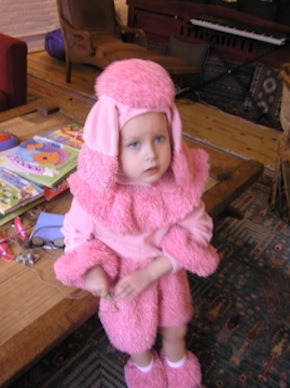
Em dressed as a pink poodle ~ 2007

Em- poodle

A Recipe For Living a Good Life

Last night Richard and I had one of our conversations.  It’s the conversation that starts with, “If only we’d known what we know now…”  The conversation that continues with, “If only we’d known our friends, particularly the ones whose neurology we don’t share, the ones who are Autistic…”  It’s the conversation that ends with both of us looking at each other and shaking our heads until one of us says, “We would have done everything differently…”   And then the other joins in with, “Literally.  We would have literally done everything differently!”

One of the biggest motivators I have for continuing to blog about autism is this idea that everything would have changed had we known what we know now.  How different our lives would have been had our introduction to autism not been abject fear, but to adults who are Autistic.  How different our approach would have been had we not reacted to the news of our daughter’s neurology with terror.  How much money, time, energy, not to mention pain would have been avoided had we not listened to all those non-autistic people who greeted our daughter’s diagnosis with, “Here’s what you need to do…”  “Here’s the name of a therapist/neurologist/homeopath/nutritionist/DAN doctor, call them now!”  “You should try…”

I’ve written about all of this before, but since I typically blog Monday through Friday, many of you may have missed those posts, so here are just a few…

What I Wish I’d Been Made Aware Of When My Daughter Was Diagnosed With Autism
How Fear Drove Me To Pursue A Cure
We Are in This Together
A Fantasy For Parents of Newly Diagnosed Autistic Children
To The Person Who Googled “I Don’t Know if I Can Handle Autism”

What we were told about autism was WRONG.  Everything we were told during those first few years after Emma was diagnosed have NOT proven to be true.  Having an Autistic child does not mean the entire family will be dragged down.  No one need “sacrifice” their life to support another, in fact, our lives are enhanced by each member of our family.  Each of us brings something unique and special to the family. Having an Autistic child is not the same as having a child diagnosed with cancer, this comparison is incredibly hurtful to my child, to your child, it is offensive to all of us.

We have been told all kinds of things about our daughter by non autistic people.  Not one of their predictions has come true.  NOT ONE!  Read that again.  Nothing we were told would happen, actually has!   Think about that.  Being given an autism diagnosis for your child is like listening to an anchorman predict the weather a year from now.  But we believed every single one of those pronouncements and then behaved as though each dire prediction was fact.  If I’d known all the people I know now, the people I’ve interviewed, whose blogs I read, all the people I am fortunate enough to call my friends, who have changed my life and helped me understand autism and what it’s like living in a world that doesn’t accept them, growing up with parents who believed they were doing what was best for them, but who were being told the same sorts of things we were told… Had I known all those people when Emma was first diagnosed, our response to the pronouncements and predictions given to us would have been to laugh and walk away. Literally.  We would have laughed and walked away.

We would not have hired the agency who provided us with round the clock therapists.  We would not have shuttled Emma from one doctor to the next.  We would not have spent all those nights lying awake, staring at the ceiling fearing what would never come to pass.  We would not have lost all those years, years we could have spent actually enjoying and loving our child, but that were spent in fear, engaged in a war on her neurology.   All those years when Richard and I felt beaten down, could have been spent embracing this amazing being who has taught us so much.  The challenges any parent faces, exhaustion, sleepless nights, worry, these would certainly have been a part of our story, but the terror… the terror did not have to be a part of it.

So here’s the truth about my Autistic child:

She is a human being with desires, wants, needs, emotions and feelings, just like any other child.  If I treat my (Autistic) child the way I would want to be treated, with unconditional love, respect, encouragement and support, I will have been a good parent.  If I can be kind, patient, vulnerable and willing to examine my preconceived beliefs about what it is to be a human being, while making amends for my mistakes;  I will have led a good life.

Emma and Nic ~ 2003

Em & Nic - 2003

Shame, Addiction & Autism

“We all have shame.  We all have good and bad, dark and light, inside of us.  But if we don’t come to terms with our shame, our struggles, we start believing that there’s something wrong with us – that we’re bad, flawed, not good enough – and even worse, we start acting on those beliefs. If we want to be fully engaged, to be connected, we have to be vulnerable.  In order to be vulnerable, we need to develop resilience to shame.” ~ Daring Greatly by Brené Brown

I’ve written about shame before.  A couple of commenters on my last post about shame told me to watch Brené Brown’s TED talks on vulnerability and shame, which I did.  B. Brown also has several books, Daring Greatly, is the one I’m currently reading, where she writes, “A sense of worthiness inspires us to be vulnerable, share openly, and persevere.  Shame keeps us small, resentful, and afraid.”

Shame is something I am intimate with.  I don’t know many addicts who aren’t.  I’ve written about addiction and specifically having an eating disorder ‘here‘, ‘here‘ and ‘here‘.  The self-betrayal implicit in addictive behavior exacerbates the pre-existing shame, creating depression and self-loathing.  Attempts to alleviate those feelings with addictive behavior only fuels them.  Shame heaped upon more shame is not a recipe for happiness or success.  Ignoring shame, trying to bury it, and trying harder to not feel it, doesn’t work either.

There have been a number of studies suggesting a link between addictive behavior and autism.  I don’t find this surprising given how feelings of alienation, isolation and fractured self-worth all contribute to wanting to seek refuge and escape. Except the thing we are trying to escape from is often ourselves.  Many of us have internalized our shame, particularly those of us who tend toward perfectionism.  Add to this obsessive tendencies, a desire to be loved, wanting to fit in, believing we are “less than” and addiction can feel like a perfect fit and the only way we can survive in a hostile, unaccepting world.

Oddly, we, as a society, tend to attribute laziness and a lack of will power as the reason people eat too much, drink too much or spend more money than they make.  Similarly, people seem to think autism is a choice or at least the behaviors associated with autism are.  These people apparently believe Autistic people can  “lose” their “autism” if they can just be trained to hide their “problem” behaviors or the things they do that make them obviously Autistic.  Many Autistic people talk about being scolded and punished when they were unable to produce the results expected of them when told they needed to “try harder.”  Trying harder will usually make the person feel more terrible about themselves.

I worry about a culture that is conditioned to believe we must ‘train’ our Autistic children to behave in ways that most cannot, or cannot without a massive cost to their self-esteem.  I worry about “autism treatments” and “therapies” whose underlying message is that our children are not okay.  I worry about what our children are internalizing.  I worry about addiction, depression, suicidal ideation, and how those things get set in motion at a very young age from feeling we are “bad,” not worthy and less than. I worry that because many do not understand autism is a neurological wiring, or do not take into account the experience so many Autistic people are describing, we are raising fearful children, filled with shame for who they are as human beings.  Instead of helping our children flourish, encouraging them to be all they can be, we are trying to make them into something they cannot be.

I love this photo of Emma because it captures her in all her Emma-ness!

Emma - 2002

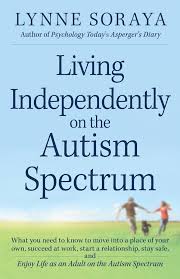
Living Independently on the Autism Spectrum: by Lynne Soraya

Unknown-1Living Independently on the Autism Spectrum by Lynne Soraya is described as “What you need to know to move into a place of your own, succeed at work, start a relationship, stay safe.”  In fact, it’s a great deal more.  Lynne, who writes for Asperger’s Diary in Psychology Today and works for a Fortune 500 company, covers everything from proper conduct and attire at a job interview, what to do when stopped by the police, setting boundaries, career goals, work related issues and self advocacy.  My copy is filled with highlighted sections and notations, such as this quote regarding boundaries:

“The unfortunate reality for many on the spectrum is that the training that we receive to help us to “blend in” to the wider world can have the difficult side effect of teaching us to ignore our own boundaries.

“We learn to tolerate pain and discomfort of situations beyond what many others experience in order to appear more “normal” or to “fit in.”

In the margin I scribbled – “encourage a sense of self, listen, honor and respect.  Attempts to teach how to “fit in” ensures the opposite within one’s own self. Feelings of being a fraud.”

And this, in her chapter on safety:

“There are times when you will not want to make eye contact.  For example, for men, making eye contact while in the bathroom or at the urinal may be completely misunderstood.”

I wrote in the margin, “Privilege = never having to think about things like this.”  And, I would add, not only never thinking about something like this, but never having the thought occur to me to think about something like this.  Many of the things Lynne writes about are not only things I’ve never had to think about, they are things that have never even occurred to me to think about.

Another sentence I highlighted regarding encounters with law enforcement:

“If you are concerned as to how your body language or speech patterns may be perceived by the officer or first responder, let her know that you have autism and/or provide an autism information card.  Before you reach for the card, however, indicate to the officer either verbally or with gestures that you will be reaching into your pocket or wherever the card is located so that the officer will not think you are reaching for a weapon.”

And this about job interviews:

“However, the way many charities represent autism, mixed with our culture’s very simplistic understanding of what disability is all about, can be devastating to many of us who are seeking deeper inclusion in the world.  The reality is that I, you, and everyone else on the spectrum need to help the world understand that having challenges – even extreme ones – does not mean a person does not have abilities and contributions to make to the world.  Ability isn’t a binary thing.  Unfortunately, many people who have limited experience with disabilities tend to act like it is, so when challenges are emphasized, lack of ability is assumed.”

Throughout this book I thought about my daughter.  I thought about how, as she grows older, she may encounter, at least, some of these issues.  I thought about how she put music to a slide show of photographs on her computer last night and was so excited because I came in to watch it with her and told her how impressed I was.  I thought about how creative she is with language and how she comes up with ideas and ways of saying things that would never occur to me, I thought of her joy in music and how when she dances, she is without inhibitions or self-conscious thought.  I thought about society and how so many would suggest we “train” her to conform, fit in, and how, many believe, it is all for her own good.  And I thought about how I hope my daughter never feels she must betray herself to appease or please others.

Lynne’s thought-provoking and insightful book is available in paperback and on kindle at Amazon.

Disability and Society’s Role

I have to preface this post by saying I’m still grappling with all of this.  I recognize that while I can intellectually understand something, it takes me much longer to completely “get it” to the degree that I can own it and incorporate it into my thinking.   Perhaps this is a specific quirk to my neurology…  Here goes – Yesterday afternoon something came up that I didn’t understand.  It was surrounding the words “disability”, “impairment” and the role society plays.  It was stated that autism is a neurological difference that can create certain impairments.  Impairments that can lead to disability when not accommodated.  I didn’t understand the concept at all.  I couldn’t wrap my mind around society’s role in creating disability by not accommodating.  I need to backtrack here for a second. Stay with me…

My father was in a wheelchair the last decade of his life due to a horseback riding accident that occurred when he was 40 years old.  Most of us, who do not require a wheelchair, probably don’t think about what can happen to the human body as a result of not being able to stand and walk around.  There are things that often occur as a direct result of being in a wheelchair for the majority of one’s waking day.  Things like sores, atrophied muscles, metabolism changes due to inactivity, which can lead to constipation, a greater risk for infection, etc.

My father’s accident was my introduction to “disability” as the word my father used to describe himself.  I didn’t spend much time thinking about society’s role beyond the easy to spot prejudices people obviously had upon seeing him, how some people were worse than others, either in the way they spoke to him with barely concealed pity or the way they raised their voice or slowed their speech as though he were intellectually impaired as well.  I was acutely aware of the many places he could not go because they were not accessible to his wheelchair.  And I was aware of the physical pain he was often in. But I didn’t think society played a role in creating his disability, but rather it exacerbated it.

I’m going to interrupt this train of thought for a second while you watch the following short video (1:26) via Ollibean, the terrific site that “unites disability-centric news & editorial led content- connecting families, self-advocates, & professionals through social conversations.”

This article (by  Lisa Egan) is a great one, sent to me by the wonderful, incredibly, kind and extremely thoughtful, Nick Walker, who is interviewed ‘here‘ on Shrink Rap Radio.  After I watched the video and read all the links, I felt I was beginning to understand.

My father’s accident left him physically impaired, but with the necessary accommodations in place he could still get around and do many of the things he enjoyed.  His quality of life was greatly reduced because many of the things he once enjoyed, playing tennis, skiing, were no longer possible, but he could do other things, swimming, gardening, spending time outside.  (Still, I feel confusion and can tell, I’m not quite there yet.  I think I have an understanding, without completely understanding, if that makes any sense.  And I’m also getting hung up on semantics.  But I have to keep going with this.)  I understand my father was impaired, but was he disabled?  Obviously he was to the degree that society didn’t do a great job accommodating him, but what about his weakened body and the pain he was in that kept him from pursuing things he enjoyed and would have done had he not been in such physical pain, such as travel?

*Those of you who understand all of this, please feel free to jump in and correct me.  As I said, I am processing!

Autism.  When my daughter was diagnosed I didn’t think of her as disabled, in fact I remember resenting the notion that anyone might think of her as such.   I understood she was different, and, sadly, I also bought into the “disease” thinking, which I’ve written about on this blog.  As my thinking evolved I thought of her as neurologically different from the majority of people and as such would face more challenges in the world, than if she were not Autistic.  Still later, and more recently I thought that because she cannot reliably use either speech or independent typing to communicate yet, she had a disability, but that her disability had little to do with society and was very much a result of the many issues she faced, physically, emotionally and neurologically.

The idea that society could and should do more to accommodate her and those like her is something I have witnessed first hand and am fighting for.  Yet, this idea that society created her disability, either some or all of it, is a new concept.  So last night I spent many hours reading.  This post from Savannah on her blog, Cracked Mirror in Shalott is terrific with great links to four other bloggers whose work I have tremendous respect for:  That Crazy Crippled Chick – A Musing on the Word Disabled, Radical Neurodivergence Speaking – In this place, in this activity, I am not disabled, Yes, That Too – Ablism is to Blame and  Autistic Hoya – Constructing Disability.   And finally this piece from Sparrow Jones, Voices of Experience on her blog Unstrange Minds where she writes, “In contrast to impairment, Reindal writes about disability as the “barrier to being,” suggesting that the social constructs that view those with impairments as lesser beings, not worthy of inclusion or accommodation, creates an existential crisis that extends deeply into the disabled person’s core being.”

And this is why all of this matters so much.  Because we as a society are adding to impairment.  My child is Autistic.  There are things that are much harder for her to do than the majority of the population.  Her hardship is exponentially increased by society’s lack of accommodations for her and those like her.  This post about my experience at the AutCom Conference last fall is an example of simple accommodations  easily put into place.  My daughter’s life will be infinitely easier if people were better informed about autism and what that means.

Society plays a role in all aspects of her life, from the education system and how we perceive inclusion, to air travel, where she could be allowed to sit by the window to accommodate her need to look out the window to better manage her stress, just as someone in a wheelchair is given an aisle seat and not expected to sit just anywhere.  I could go on and on, but I’m interested to hear from all of you and hear your thoughts on all of this.

Emma and Henry type to each other with Pascal and Harvey’s assistance

H &E type

Person First Language

I wrote yesterday about an evolving fantasy of my ideal introduction to autism and what that might look like.  Later I was asked privately about ‘person first’ language.  An example of ‘person first’ language is:  “My child has autism” or “She is a person with autism” as opposed to:  “My daughter is Autistic.” This topic comes up repeatedly so I thought I’d tackle it with a post of its own.  The current language used to describe autism and Autistic people, starting with the insistence among many parents, educational institutions and the medical establishment to use person-first language (read Jim Sinclair’s Why I Dislike ‘Person First’ Language),  is all about deficits, comparing Autistic neurology (inferior) to non Autistic neurology (superior) which is self-serving, biased and continues to further the general public’s misperceptions about autism and Autistic people.

Shame based language, the things we say because we don’t know better, because we’ve heard or been told it’s how, whatever the topic is, should be spoken of, is still shame based language.  For a long time I didn’t understand why person-first language was objectionable.  It seemed “respectful” to speak of the person first before adding their neurology.  Except that autism brings with it discrimination, prejudice, misunderstanding, assumptions about intelligence or a lack of, and so suddenly all those people who are being so careful to describe this person, whose neurology is “Autistic”, are actually implying that they think autism is something to be avoided, it’s something we pity, it’s something we’d like to be sure the person knows, we “understand” and are being careful to give them “respect” except we are doing exactly the opposite.  When we have no particular issue with some aspect of a person, we do not make sure they understand we are aware they are part of the human race.

I will always respect anyone’s personal preference, but in general, I will continue to use “Autistic” because I am not ashamed of my daughter’s neurology and I refuse to convey that underlying message of ‘less than’ inherent in ‘person first’ language.

Autistic perspective on ‘person first’ language:

ASAN – Identity First Language
Shaping Clay – Person-First Language Doesn’t Put People First, It Makes Them Invisibly
Autistic Hoya – A Second Argument Against Person-First Language
Radical Neurodivergence Speaking:  I don’t have autism.  I am autistic.
Amy Sequenzia – I am Autistic

Em

A Radical Notion

As I fantasize about a world in which autism is not consider a “bad” thing, but instead is seen as yet another type of neurology with its pluses and minuses, I continue to rewrite the “ideal introduction to autism” with the hope that one day this may actually be a parent’s experience.  I can’t imagine what that would be like, but I know for a fact, it would be a hell of a lot better than the very real, very upsetting, confusing and painful introduction to autism that I was given almost ten years ago.

First off, the literature regarding autism…  more and more there are books and blogs (!) written by Autistic people introducing the idea of autism as another kind of neurology with both innate challenges and wonders.  I’ve listed many of them on the Resources page on this blog.  As there were no blogs (written by Autistic people) that I knew of in the fall of 2004 I went to Barnes & Noble and bought pretty much every single book written on Autism.  Some would say that was my first mistake, as I was greeted with nothing but gloom and doom.  Other than Donna Williams and Temple Grandin, all the books were written by non autistic people about the dire, horrors of autism and what that meant for your child. (And none of it was good.)  Autism was most definitely not something to celebrate.

The idea that autism could be seen as anything but terrible was not even a radical notion, it was a thought that hadn’t made it into the public sphere.  When Emma was diagnosed the big names associated with autism were Andrew Wakefield, Jenny McCarthy and Bernard Rimland.  It was impossible to read anything about autism without those three names coming up.  Parents new to all of this, fumbled around trying to make sense of the various thoughts about cause, was it really an epidemic and how to best serve our children who were said to have been snatched from our protective arms.  I’ve written about the depth of my fear during those first few months that turned quickly into years in numerous posts on this blog.

My fantasy is nothing short of radical, but perhaps one day it will not be seen as such, but instead, will be commonplace.  My fantasy introduction to autism begins with the evaluation.  At least one of the therapists who came to our home in September of 2004 would have been Autistic.  Once it was thought my daughter might occupy a place on the Autism spectrum, more Autistic therapists, social workers and psychologists would have come to conduct the evaluation and talk to us.  This, then, would have been our introduction to autism…  meeting actual Autistic people, who are able to articulate what the challenges are and what the joys are!  People who could offer a balanced view of a neurology that I would be able to identify with and see there was overlap with my own.  People who would gently encourage me to review my own neurology and see that my daughter’s experience and processing of the world, while different from mine, has many similarities.  People who could help me so that I was in a better position to be the mother my daughter needed me to be.

After the evaluation and diagnosis had been made, we would then be given support in finding at least a few Autistic people who were in the profession of working with families with Autistic children.  In my fantasy, Autistic people would be among those creating schools, designing curriculums, teaching academics, conducting seminars for us, the parents of Autistic children, to attend so that we might better help our kids.  It seems to me a radical shift in all aspects of autism, what is said about what it is to be Autistic and what is being told to those who are non autistic, needs to occur.  My dream team would include Autistic and non autistic alike, but it would be a blend of those who presume my child competent, who treat my child with respect, who are interested in my child’s well being and want to work towards her strengths, encouraging her to be all she can be and cheering her on.  photo

Trauma & Autism

Studies confirm that people who are Autistic often respond to stimuli more intensely than those who are not.  Hypo and hyper sensitivities are often discussed when it comes to vision, taste, hearing, smell and touch in Autistic people.  Often there is a mixture of both hyper and hypo sensitivities in any one person.  (I use these terms because we have a lack of good words to describe these things.  Both hyper and hypo sensitivities are subjective and are used in comparison to non autistic people, which is problematic in and of itself, but for the sake of this post, it is the best language I have.)  What happens to a person who experiences the world more intensely than the majority of people, particularly when confronted with frightening situations, anger, loud noises, etc?

Recent studies have confirmed that children with autism have very active Amygdalas; the center of the brain that stores traumatic events.” Traumatizing Events and Autism

When Emma was just two, we went to visit my mother, the proud owner of an adorable German Shepherd puppy.  Emma had no fear of dogs, but during that visit, the puppy playfully chased Emma, nipping at her ankles and Emma began to scream in terror.  By the time I was able to rescue her, hoisting her up in the air and away from the puppy’s sharp little teeth, the damage had been done.  To this day, Emma is frightened of dogs and upon seeing one that gets too close, she will cry, “Mommy pick me up!”  Despite the fact that Emma is now much older, the trauma is real and intensely felt.  For years I couldn’t understand how something so (seemingly) benign could cause her such incredible, and to me anyway, over-the-top terror.  I continued to believe this was a fear she would “outgrow” and that it was only a matter of time before she did so.  But so far, her fear, while not as extreme as it once was, is very much intact.

I am on a family picnic.  My parents pull out a french baguette, an imported pâté, a coveted gift from my father’s sister who lives in Paris, and some Swiss chocolate.  I am hungry and excited as pâté and chocolate are two of my favorite things to eat.  On the way home I begin to feel sick.  By the time we return home, I am vomiting and have the flu, but associate the feeling of nausea with the pâté.   It is almost two decades before I can stand the smell of pâté, let alone taste it without gagging.

These are both relatively benign examples of sensory issues intersecting with memory and causing longer term associations, but what about intense trauma such as physical and emotional traumas?  What about the time when the ABA therapist locked Emma, who was only three years old, in her room for 30 minutes, instructing me to stay out or he would pull all our services, while she screamed and begged to be let out?  I know how traumatized I was and continue to be because of those 30 minutes, what about Emma’s experience?  Did this cause untold damage?  Did Emma experience the degree of trauma that I did?  Is her experience even more profound?  What about how she experienced her own mother not saving her from such a person?  How has she integrated these events into her life experience?  Is it felt as the ultimate betrayal?  How will it manifest in the future?

These are the things I think about.  Not because I am intent on beating myself up, but because these are things that happened and I don’t think any of us are served by NOT talking about them.  These are the kinds of dilemmas many parents have experienced.  These are the questions so many of us have. Questions that are, as yet, unanswered.  We have to ask ourselves when we are considering a methodology and those who will come into contact with our children, are they going to be respectful and kind?  Does this methodology presume competence, is it respectful of my child?  Will the person be patient? Will they treat our children as inferior because they see autism as an inferior neurology and one that needs to be “trained” away?

What does trauma do to the brain?

“Severe or repeated trauma can re-route emergency systems that are meant to be used only occasionally, and leaves them active, like a switch stuck in the “on” position. This can shrink or damage the part of the brain that thinks and plans, and potentially damages the brain’s ability to feel love and safety in the presence of others.

“To deal with this pain and stress, the individual may become more rigid and inflexible in his or her thinking and develop tunnel vision and selective listening. Over time to compensate for the damage done to the short term memory and ability to sequence by continued exposure to our fight or flight response, or allostasis, the individual may develop rituals, become rigid and controlling or “oppositional”, shut down, withdraw, rage, retreat into a special place, or become over-involved in things that help the individual to escape.” ~ Autism and Trauma:  Calming Anxious Brains 

It is tragic that the very methods a traumatized Autistic person may use to calm themselves from the trauma they’ve experienced, are often the very things those who are not Autistic pinpoint as “behaviors” or actions that must be stopped.   Not only is the person trying as best they can to deal with the initial traumatic event(s), but they are often being punished and told to stop using the only ways they know of that actually help them cope, thus creating further trauma.

Traumatic events often occur during developmentally vulnerable stages in the individual’s life, and in this process become intertwined with the child’s bio- psychosocial development. How easy it would be to dismiss this in a child with an ASD, who by definition is struggling with development of a sense of self, and is uncomfortable in an alien world, even prior to repeated exposure to trauma.” ~  Commentary: Complex Post-Traumatic Stress Disorder. Implications for Individuals with Autism Spectrum Disorders—Part II 

Trauma, in relation to autism, is something I wish I’d heard about during those first few years so that I might have made better and different choices for my daughter.  Those I know who are Autistic talk about their trauma often, yet there is very little written about trauma in relation to autism in the general conversations currently going on.  This must change.

Em with the dogs

A Teacher You Want to Clone

Having had a downright, dreadful experience at our daughter’s ABA based preschool that was publicly funded and had come highly recommended, we were determined not to make the same mistake twice.   We found a private school, the only non-ABA based school around at that time and for the next six years she went to it.  She was loved, she was well taken care of and she learned almost nothing.  It wasn’t that no one tried to teach her, it was that the way she was being taught was not a way she was able to learn.  So we hired a private literacy specialist and over the next two years, Emma learned to read and write.  But there was a “behavioral” piece to this person’s program that came at a cost.  I don’t mean a financial cost, though there was that too, I mean a different sort of cost, the kind you can’t completely assess or gauge until years later.  It was the cost that comes with being put into an emotional strait jacket.  So, at a certain point, as I learned more about autism from Autistic people I realized we could not continue, despite her terrific gains in learning to read, write and type.

A year ago we found a public school (most no longer adhere to any one methodology, thankfully) where Emma is loved and well taken care of AND is learning.  Her teacher is wonderful.  The kind of teacher all parents dream of for their child.  Loving, patient, kind, observant, respectful, presumes competence of all the children in her class, smart, has a sense of humor and open to anything that may prove helpful in teaching.  The sort of teacher who takes time out of a Sunday afternoon to sit in on a session with Soma Mukhopadhyay and Emma and takes notes and then asks to borrow books written by Soma on her method.  The sort of teacher who then comes over to our house to do a strategy session and begins to incorporate what she saw and has learned into her teaching.  Suddenly Em’s backpack is filled with material from a grade level curriculum she is now doing at school with this amazing teacher.  The sort of teacher who seems too good to be true.  The sort of teacher you wish you could clone…  The sort of teacher who is better than Xanax, Wellbutrin and Prozac without any of the side effects.  Except that the school year is almost over and this amazing teacher is leaving to teach somewhere else and Emma is entering middle school, so we must say goodbye to her wonderful school and her incredible teacher.

This morning we toured a middle school.  And guess what?  It emphasizes the performing arts AND it looks wonderful, with a fantastic sensory gym and a “theatre room” with photos lining the hallways of the children performing their own musical that they wrote and performed in.  Could we have created such a place more perfectly suited to Emma?  It could be a little closer to where we live, but that would be nit-picky of me.  So come this September, Emma will go to yet another school.  That’s three different schools in three years.  For any kid, that’s a lot of change.  For Em, who was such a trooper about her “new” school last September, I am keeping my fingers crossed the transition will be as positive.  Anyone have a cloning machine perfected?  Because if her current teacher could just be cloned and her head teacher in this newer new school, I’d have no stress at all!

In the meantime, Em will visit her “new” school a couple of times over the summer months.  From what we’ve seen so far, we are filled with hope!

**Em

Parenting = Love, Respect & Encouragement

One of Emma’s top five favorite IMAX movies is, Born to Be Wild about orphaned orangutans and elephants and the people who rescue and nurture them until they can go out on their own to live independently in the wild.  It’s a beautiful film and during the watching of it, Emma did a running narrative, which was both amazing and insightful because the things she noticed and talked about were not necessarily the things I noticed.  Her observations were all about identifying with the baby orphaned animals and not about the humans who have saved their lives.  This is as it should be, it seems to me.

She was identifying with the small animals, whose lives are dependent upon the human adults to care for them, respect them, nurture them while they are still so vulnerable and young.  I, however, identified with the adults who are feeding, caring for, giving bottles to, making comfortable sleeping areas for, while being careful to not “tame”, so they will one day be able to return to the wild.  I was so relieved to see the human caretakers encouraging the babies to build their innate skills by taking them to places where they could strengthen and build their climbing abilities and offering them materials to make nests or giving them the opportunity to interact with older orphans who would soon be venturing out on their own.

It was impossible for me, as a parent, to view this movie and not see the connections to parenting.  How we try hard to manage that balancing act of encouraging our children to do for themselves, only intervening when absolutely necessary, trying hard to not over identify, to honor and respect our children and not think of them as reflections of ourselves.  Watch for their innate talents and foster and encourage them, join them in their interests instead of trying to foist our interests upon them.  Respect them enough to allow them to make mistakes, encourage them to dare to dream big,  and give them the opportunity to flourish without criticism, but with love and guidance.  In the end, we all want that from each other.  We all want to feel loved and to love.  We all want to be seen and heard.  We all want to feel we are approved of.  We need that.  Children, adults, living beings, we all want to feel we matter.

Unknown

Walk Toward the Light

First there was the evaluation.  The therapists, the psychologist, the questions. Everyone arrived with their little bag of toys that remained untouched by session’s end.  Some tried to interact, others just observed, but all, eventually, turned to us to ask pointed questions.  Questions meant to gather information, but that felt like tiny daggers, cloaked in kindness, laced with concern.  They jotted down things we could not see, little bits of information they would, no doubt, refer to later, once back in the safety of their office.

Meanwhile we were in the midst of it, with our child who behaved in ways we couldn’t anticipate and often did not understand.  None helped us with that. Their reports finished, their conclusions made, their notes and jottings summarized into a single word – autism.  Delivered to us by phone, we were told, like a psychic delivering a premonition, the cold, hard “truth”.  Our daughter’s life, suddenly bled of joy, like so many leeches placed on a feverish body, draining her of all vibrancy.  Her bright future no longer bright, she was categorized.   Her deficits itemized and highlighted, her strengths dismissed or ignored, the solution, the remedy, the therapeutic interventions, the “behavior modification” programs could now begin.  If we were lucky she could be trained.  She could be “modified”.  She was young, we were reassured.  There was still time.  We were congratulated for having caught “it” so early.  Early intervention was key, we were told.  Intervention…

That was the beginning.  That was the beginning.  Instead of reassurances, we were given dire statistics, useless advice, asides about inner strength, courage, even “god” was evoked with alarming frequency.  People learned of our news. Carried along on the same wave of terror, they tried their best to conceal what they really thought.  Some were more successful than others.  Some, couldn’t help themselves, in an ill-conceived attempt to prop up, they said things like, “I don’t think I’m strong enough to have such a child…” or “I wouldn’t be able to handle it if…” or simply “How do you do it?”  and with each, the darkness crept closer, enveloping us in arms of sadness and pity.  The darkness became familiar, soon, without realizing it, I had embraced it and found others who felt similarly.

What I would have given to have had my Autistic friends there with me during that period when everything was so scary and the unknown loomed before us like a dark  impenetrable wall.  What I would have given, for someone to say, “You are frightened now, but they do not know, they do not understand, they may mean well, but they cannot help you.   You see, they are coming at all of this from the perspective of their own limited neurology.  They cannot see beyond what they believe to be true.  But there is another “truth” and it is one they are unable to tell.  The words they use will only lead you down a path you must reject.  It is a path that will descend into more fear, more terror.  It will not lead you and your child to anywhere you want to go.  Come with me, instead.  Walk with me.  Walk toward the light.

In my ever evolving fantasy of – What if? – I imagine all my friends… my friends who are Autistic, some of whom do not speak, some who do, some have similar interests as my daughter, others do not, but all… all share her neurology… and it is towards them that I walk.  It is with them that I surround myself.  It is with them that I choose to be among, because they know.  They know what it is to be Autistic.  They put beauty in the word “autism”.  It is their faces, their words that I think of when I think about autism and my fear is vanquished.  Fear, now replaced with pride and hope and joy that my daughter is part of such a caring, loving group of people; I am relieved.   A community who has come together to care for each other in a world that continues to ostracize, segregate and criticize, this is the community that stands with their arms open wide, in acceptance, in celebration of all that my daughter is and will become.

Walk with me… walk toward the light…

Rainbow Clouds