Tag Archives: RPM

Why People Walk With Two Legs Instead of Four

Emma wrote this folk tale yesterday.  She gave us permission to post it here on the blog.  It took her 45 minutes, pointing to one letter after another.  She is so, so talented!

Why People Walk With Two Legs Instead of Four

“Many years ago, people were walking on all fours like many animals.  Reaching for food meant they could use front arms or back legs.  They were very strong.  Other animals were not afraid of them.  They looked at other animals as family.

“There was much to see from being so low to the ground.  There was much to touch from living in the dirt and the grass.  They tasted whatever they could. People now are more fussy with food.  The smells were all they knew.

“What is missing?

“You are right if you said:  sound.  People heard sounds from high above and they did not know where they were coming from.  The sounds were soft and silky.   Days went by without knowledge of sound.  One people leader wanted badly to hear it louder.  The only way she thought possible was to be taller.  She practiced standing on her back legs and it was successful.  Everyone else followed.  The soft and silky sounds were birds chirping.”

Emma began writing this series of folk tales while we were in Texas last month.  She has written five now and the third one was entitled, Why People Walk on Two Legs.  You can read it by clicking on the link, but in it she wrote, “They had to work in the fields wearing knee-shoes and regular shoes.  They could not run fast that way.”  I love that!  She goes on to talk about a king who had outlawed walking, until he was injured from all that crawling around and the only remedy was for him to walk, whereupon he made it legal for people to walk on their two feet and so they did, never looking back.  To me, that story was about how until we experience what another goes through, we often remain divided, though I have no idea if that was her intent.   This one is completely different, even though the titles are similar.

I am in Chicago at the TASH conference, where IbbyLeah Kelly and I are presenting first thing this morning on Relationships and Multi-media (so excited to be with my two wonderful friends!)

Em giving the Queen’s wave astride her favorite statue – Balto

Em on Balto

Man and Woman – A Tale

This story was written by Emma and was inspired by a photograph she was shown of a small house built in the middle of a lake atop a large rock with steps carved into the rock leading into the water.  Against one side of the house was a kayak and paddle.  (To read more about how Emma is writing, please click, ‘here‘ and ‘here‘.)

“Man and woman landed into marriage.  Both worked hard to make thousands of pennies.  There was trouble when they decided on what to do with the thousands.  Woman wanted to buy a boat; man did not agree.  Man and woman gave fighting a try, but it was not for them.

Welcome to their new home.”

Earlier when first shown the photograph (I’ve posted it below) and asked to make a comment about it, Emma wrote, “There is many reasons to believe it is fall.”

When asked to write one question she thought people would ask the person(s) who live in this house, she wrote, “Do you know how to swim?”

house-river-serbia_57361_600x450

Returning Home

Em and I returned home Friday night.  It was an exhilarating trip, but also an exhausting one.  These trips always are.  We went from having daily sessions with Soma (you can read more about Emma’s experience working with Soma ‘here‘, ‘here‘ and ‘here‘ and more about Soma and RPM by clicking ‘here‘) that were so incredibly exciting, I could barely take in all that my daughter was writing.  Personal, gut wrenchingly, painful insights, loving notes of gratitude to my husband and me that made me weep with joy, but also bittersweet because it is she who has had to put up with us and not the other way around.  Her writing displays an almost unfathomable intellect, wisdom beyond her years as well as compassion and patience for all who do not understand her, for those who doubt, for those who do not believe her and all she is capable of, for all who talk down to her, my daughter is a beacon of kindness, forgiveness and compassion.

I do not want people to come away with ideas about saintliness, holiness or angels being dropped down from the heavens and inhabiting her body.  I cannot and do not believe in any of that and it dismisses the many challenges and struggles my daughter must endure.  Above all else my daughter is a human being, just like you, just like me, very much grounded on this earth and in this life, but she is also exemplary in her ability to see the good in others.  It is something I am trying hard to emulate.  It is as though the more she writes about what she believes and thinks, the angrier I become.  The more enraged I am that we have all believed so easily, without question, the standard assumptions about Autistic people and autism and what that means.

I understand that for many they just cannot believe someone like my child is capable of knowing so much despite having had little formal education, but instead has spent all of her school years segregated in special education schools where she reads below age level literature and is taught the value of nickels, dimes and pennies because it is assumed she does not understand concepts such as money and time.  I understand.  I do.  I was one of those people not so long ago.  But now I know otherwise.  We are fortunate that her current school is open, willing and interested in learning all she is capable of.  They have expressed interest and their intent to support her and to help in any way they can.  We will be revising her IEP soon.  It will be quite a revision!

Now we are home and I know better than to expect I will be able to pick up where Soma left off.  I know better than to think I will be able to sit down with my daughter and accomplish the same level of writing I witnessed this past week.  I have to pick up from where I left off before our trip to Texas.  This can feel incredibly frustrating and even depressing, but I am learning to not delve too deeply in despair, but rather continue moving forward with the knowledge that I will and already have progressed in my ability to support my daughter better each day so that one day she will be able to converse with me on a similar level as she does with Soma.

This disparity between what Soma is able to do and what those at home then try, has caused a few to claim that therefore Soma’s method is flawed or is cause for suspicion and doubt.  What I have come to understand is that my Autistic child is intensely sensitive to her relationships.  I cannot sit down and expect to have her write to me as she does with someone who developed this system and who has fine tuned it, perfected it along the way, while working with close to a dozen people every day for over ten years now.   It is akin to expecting that I will be able to set a diamond as well as a master jeweler who has been perfecting his craft over the last twenty years or after taking a painting class be able to create something on par with Rembrandt or after taking French 101 go to France and speak fluently.  We do not expect any of these things from each other or ourselves, and yet, people decide something like RPM will be easy and simple and anyone will be able to do it instantly and when they cannot, the flaw is in RPM.  I have met too many other people who are practicing RPM to see that it is this thinking that is flawed.

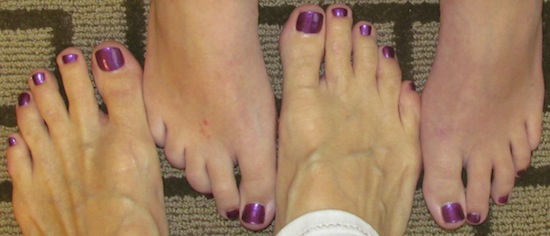
Em chose toenail polish for both of us!

Matching toenails

“Why People Walk on Two Legs” – A Folk Tale By Emma

What follows is one in a series of folk tales Emma is in the process of writing since we arrived in Texas visiting Soma Mukhopadhyay.  I’ve written about Soma quite a bit; for more posts about Soma  click ‘here‘, ‘here‘,  and ‘here‘.  Anyone who is curious about Soma’s Rapid Prompting Method (RPM) please visit her website, which is full of terrific information.

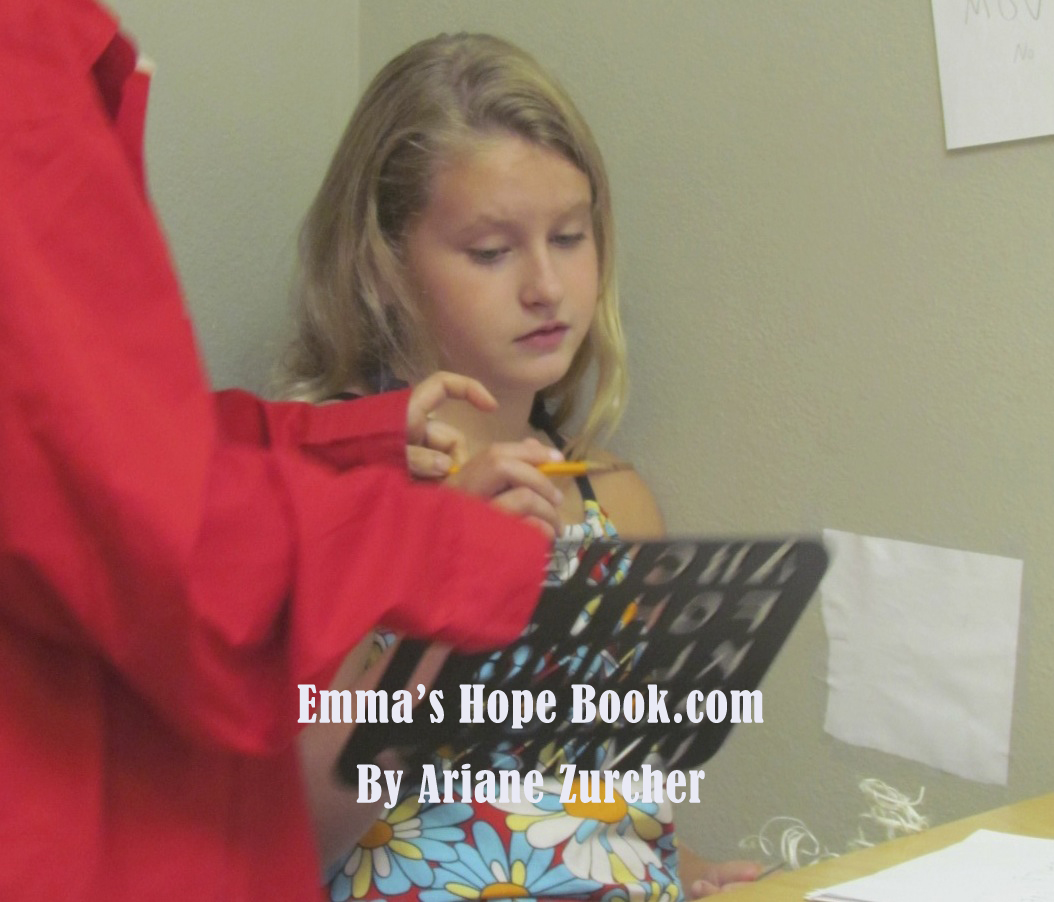
A quick note about how I transcribe Emma’s words.  Emma points with a pencil to letters on a laminated letter board that Soma holds in front of her, though she also has Emma hold the laminated board herself from time to time.  No one touches Emma as she does this.  Every few words that Emma spells, Soma takes the pencil from her and writes what she has written and repeats the words out loud.  Emma then proceeds.  As there is no way to punctuate the words as she spells them, I take my notes, transcribe them and ask her to tell me where to put commas and periods.  This story, Emma wrote yesterday and afterward told me, “You could put it on the blog!”

                  Why People Walk on Two Legs ~
A Folk Tale By Emma

Long ago people walked like animals because it was funny.  They had to work in the fields wearing knee-shoes and regular shoes.  They could not run fast that way.

In ancient Turkey there was a man who was sort of a doctor.  He had to be very careful while treating his patients.  He saw most of his patients had bone injury, so he asked them to stand.  It was against the law.  Kings punished anyone who walked that way.

But one day the king hurt his back.  The doctor treated him.  Finally the king made it legal.  Today it is natural to walk the way we walk.

The end

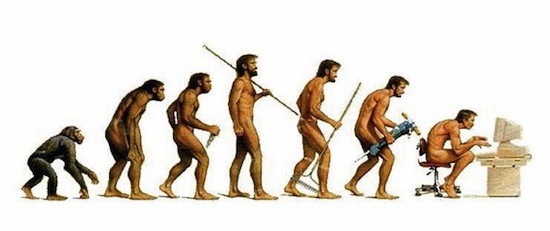
Emma chose this image from a google search for images of “evolution of man walking”

evolution

A Tale: “Horses Will Never Fly”

This tale was written by Emma and she has generously agreed to allow me to share it here with all of you.  She will finish it at a later date since she was too tired to do so now.

“Horses Will Never Fly ~ By Emma

Long ago horses were mean animals.  If anyone tried to go near, they charged at them.  They had big wings and flew higher than eagles.

One day they flew around and caused so much wind that the dust began to fly.  Dust and sand covered big areas of earth, making deserts.  People and trees were buried below the dust.

Finally when they rested they saw their wings had begun to shed…”

Originally Emma ended this with “They stopped flying.  Horses will never fly.  The end.”  But once we returned to our hotel and discussed it more, Em said it wasn’t quite finished and promised to finish it later when she wasn’t so tired.  In addition, I added the punctuation with Emma’s approval.  As there is no way to punctuate from a stencil board it must be done afterwards.

These sessions are exhausting and she works so hard.   Her story reminded me of Rudyard Kipling’s Just So Stories that I loved as a child.  I cannot wait to read what Emma writes next!

Emma chose this image to accompany her tale from a search for “winged horses.”  It was attributed to redorbit.com

images

Emma’s Letter

Yesterday Soma (for more about Soma, RPM and the Halo Center please click on this link) spoke with Emma about ethanol, fuel and bio fuel, what happens to plants and animals when their bodies decompose, green house gasses, carbon dioxide, fossil fuels, how all of this can affect the economy, and finally Soma asked, “Suppose you are giving a speech at the UN.  What kind of speech would you give?”

Emma gave me permission to quote the speech she then wrote.

“Dear World,

Heat is important, but the world also needs snow.  We must think about the future and use fossil fuel wisely.

Personally, I like car rides, but I am going to walk more.  Walking is good for the heart.”

After we returned to our hotel, I told Em about her Grandpa who had to use a wheelchair when he could no longer walk.  We talked about other ways of getting around and how public transportation, particularly some of New York City’s older subway stations are inaccessible to those who use wheelchairs.  We discussed “green cities” and what that means.  We went to a website to look at photos of “15 Green Cities” and it turns out Austin, Texas is listed as the 15th.

I am too tired and do not have enough time to write more about our first day, and, as always, I need time to process all that has happened and is continuing to happen.

Every day I am being shown that what I believe it means to “presume competence” does not go nearly far enough.  Every. Single. Day.

S&E


This is Autism (Written by Emma)

*A quick note on today’s flashblog ~ This is Autism.  In response to Suzanne Wright’s upsetting and fear-inducing letter entitled A Call for Action  a Flashblog has been organized to take back the phrase “this is autism”, which Suzanne Wright used several times in her letter that was posted on Autism Speaks’ website, the organization she and her husband Bob Wright created eight years ago.   Suzanne and Bob Wright and their organization’s beliefs are exactly what I hope my daughter never sees, hears or is confronted with, but that she feels the repercussions from on a daily basis.

I asked Emma if she wanted to write something for today’s post with the title, “This is Autism”.  She wrote that, yes, she did.  The following is what my daughter wrote, pointing to one letter at a time on a stencil board with a pencil.

This is Autism

Autism is anything.  

It is not bad,  

it is a mindset.

Autism is a method of energy,

it is how I think.

Autism is derided and except in some accepting eyes,

it is seen as not a nice thing,

but

it is me.

*Em

“Let Me Tell You…”

Emma gave me permission to tell all of you what she would invent were she an inventor.  *A little background – the quotes from Emma are what she spelled out by pointing to a letter, one letter at a time on a stenciled alphabet board.  No one touches Emma as she does this.  In fact there is no physical contact of any kind during the session, also known as an RPM (Rapid Prompting Method) session.

Emma has been doing RPM daily with me since the end of September.  Within the past two weeks she has begun to answer open-ended questions with me.  However the session I am going to write about was with someone who was trained by Soma Mukhopadhyay (the creator of RPM) and whom she is now seeing a couple of times a week.  This person, who I have not asked permission to print her name and so will refer to as B, has been doing RPM for a while now and as a result is able to move far more quickly into open-ended questions than I am.

In their previous session they had discussed train engines.  At the end of their session B asked Emma to think about what she might invent were she an inventor.  When Emma returned for her next session they began with the question, “What would you think was a really great thing to invent?”

Emma then replied, “Let me tell you that it is not a train engine.”

I have to interject here…   I love how ballsy my daughter is.  I love that she didn’t just answer with one word.  I love how audacious, cocky even her answer was… “Let me tell you…”  Emma spells words out, and I sit watching, literally on the edge of my chair, waiting, wondering what wonderful words will she write?  “Let me tell you…”  YES!  I cannot wait to hear what you have to say!!!!!

Emma continued, “It is more from the future…”

B urged her to tell us more.

“It is a spaceship.”

For all who know my husband this answer has brought a smile to your face.  For those of you who do not, let’s just say he has a particular fascination with spaceships, UFO sightings, etc.  He has logged in many an hour watching YouTube clips of various sightings.   As I sat watching my daughter spelling out these words I kept thinking how much Richard was going to LOVE hearing about this session.  But there’s more…

B encouraged Emma to continue, asking her to tell us more about the spaceship she would invent.

Emma spelled out, “Have you ever seen spaceships in New York?”

Sorry, I have to interject again.  This question… this question is wonderful and defies all that is commonly thought about so many of our kids who cannot verbalize questions like this.  For all those parents who have never had their child ask a question, for all who have bought into this idea of Autistic self involvement, of a lack of interest in others, this thought that our children who are non-speaking or unreliable speakers are “caught” or “lost” in some other world… to all of you, I suggest we rethink these ideas.  My daughter is not the only one writing things like this, she is one of many, many children, teenagers and adults who cannot voice their thoughts, but are writing them.  I have watched her, time and time again, asking questions; this kind of engaged conversing goes against everything we are taught and being told about non-speaking/unreliably speaking autistic people.  

B answered Emma’s question saying that she had not seen a spaceship in New York City.  She said she’d seen a great many different types of transportation in New York City, but never a spaceship, to which Emma then wrote, “You never have to wait to go anywhere.”

B then asked her how you could get a spaceship and Emma wrote, “You buy it on your own or you get a monthly pass.”  (In New York City most of us take advantage of the terrific subway system.  To use the subway you need a “Metrocard” which you can purchase for a single ride, multiple rides or for those who commute daily a monthly card of unlimited rides.)

B observed that as parking in New York City is already limited she wondered where a spaceship would go.  Emma wrote, “No parking needed.  Once they have landed they become invisible.”

B then asked her,  “How do you call for one?”

Emma wrote, “You have a button to press and it arrives right away.”

Let me tell you…

images

A Guest Post From Richard Long…

What follows is a guest post from my husband, Richard Long

After Ariane’s post What’s Wrong With Autism Speaks yesterday, I thought I’d throw my three cents in here. I didn’t know ANYTHING about autism when our daughter Emma was first diagnosed–except that it was BAD, very BAD and that I should be terrified. My wife went out and read most of the books written about autism at the time, mostly written by parents of autistic children documenting their torturous journey, many about the miracle cure they found that “cured” their child.

Like most guys, I Googled my ass off to try and bottom line the situation. And the news was BAD. My child was probably incapable of feeling empathy, of understanding sarcasm, of connecting with other people. Wow. Since Emma was making very little eye contact at the time and was not interested in cuddling or hugging, I thought this all had to be true. Poor Emma. Poor Ariane. Poor me.

I was told life would be difficult. Meltdowns, speech and language processing issues, OCD symptoms, toilet training. I watched horrifying videos like the ones made my Autism Speaks, (I won’t post links here, but they are on the other posts I linked to earlier if you want to get the crap scared out of yourself as well). I was told that a cure may be possible if we ponied up enough $ to Autism Speaks or TACA, so I opened my wallet. I was told about other miracle cures from casein-free, gluten-free diets, hyperbaric chambers, even stem cell therapy! We actually tried them all. We were so very desperate to “save” our daughter.

Then a true miracle happened. Ariane discovered the blogs of adult autistics who were telling a very different story. They DIDN’T want to be “cured.” Autism was part of who they were, as integral as any other component of their personalities. We were told that there were many advantages of autism: heightened senses, high intelligence, great analytic capabilities. I discovered all the famous inventors who were probably autistic.

Most importantly, we learned that what you see isn’t necessarily what you get.

We thought our daughter couldn’t understand what we were saying. Why? Because A) she didn’t react like she was listening B)  she didn’t comment on what we were saying C) she never spoke about things like that herself and D) she didn’t seem capable of very much speech at all. But now that we have found new communication systems, it turns out Emma understands EVERYTHING we are saying and has AMAZING things to say about her world. She is HIGHLY intelligent (I suspect she is more intelligent than me). Her sense of humor is incredibly sophisticated. She thinks about some things we never considered at all and sees things in such a creative, unique way.

Live and learn. It took us SEVEN YEARS to realize these things. During that time, we really did think of our lives as tragic. And now I can see how much better all our lives would have been if we had received the right information about autism from the very start. Information that came directly from autistic people, rather than people who claimed to “Speak for Autism”. Information from the parents of autistic children who had also discovered the truth about autism from adult autistics. Parents who weren’t looking for a cure, but instead trying to help their children communicate more effectively and deal with the other issues that make life difficult.

It’s a brave new world for us. Thank god. “Better late than never” I keep repeating to myself. But better yet, my hope is that all children who are born autistic are lucky enough to have people around them who actually understand what this means, that don’t look at this as tragedy, who are ready to help in the best ways possible because they have truly useful information available to them.

And I have never seen any useful information come from Autism Speaks. Then again, if they had said something useful recently, I wouldn’t know because I stopped listening to a group that never speaks with the voice of actual autistic people.

Speaking of which, yesterday Emma had another writing session, which Ariane will post in full on her blog tomorrow. It is mind-blowing so don’t miss it. Here’s a preview: In the session before last, Emma was taught about an inventor of oil pumps for train steam engines. At the end of that session the teacher asked Emma to think about what she would want to invent. So yesterday the teacher asks her what would be a really great thing to invent. Emma’s response:

“Let me tell you that it is not a train engine.”

What is it then?

“It is more from the future. It is a spaceship.”

I can’t wait to show her my UFO videos tonight.

Summer 2008 ~ Richard, Em and Ariane

Richard, Em & A

Facing the Skeptics

It’s snowing.  In New York City.  Right now.

“Look Daddy!  It’s snowing!”  Em said this morning.

There’s nothing particularly spectacular about that comment, except to us, it’s not only spectacular, it is exciting and yet another example of how my husband and I continue to underestimate our child.  (This is less a criticism of us and more a statement of fact to illustrate a larger point.)

“Em, do you know who the president of the United States is?”

“Yes,” she spelled out.

“What is our president’s name?”  I asked.

“Barak Obama,” she spelled.

“Do you know our vice president’s name?” I asked, thinking this might be taking things too far.

“Yes,” she spelled again.

“What is the name of our vice president?” I asked.

“Biden,” she wrote matter-of-factly.

“Communication is the most essential use to which spelling should be devoted.  It should not be used as a test or an exhibition piece.  Try being confined to a sentence a week and see h ow you feel about using that sentence to answer some stupid question about whether you live in St. Nicholas.  If Rosie had spent all her time giving tests we would not have had time to use spelling for our own communication.  Crushing the personalities of speechless individuals is very easy: just make it impossible for them to communicate freely.” ~ Anne McDonald from the book Annie’s Coming Out

This is what we are striving toward.  Annie’s comment here is one I have read and reread and yet find so difficult to apply because I am in a near constant state of disbelief when it comes to all that my child is capable of.  I write often about presuming competence, I write about how we dehumanize Autistic people with the language that is commonly used to describe them.  I write about how important it is to treat all people as equal.  I talk about human rights and how the rights of those who are Autistic, particularly those who do not speak reliably or at all, are dismissed, ignored or simply not acknowledged.  And yet I underestimate my child’s ability constantly and without meaning to.

On a daily basis she writes something that blows my mind.  EVERY DAY.  Read that again.  Every.  Single. Day.  It’s like living in an alternate universe.  Every day I feel excited to know what the day will bring.  Every day when I sit down with her I am prepared to feel that mixture of excitement, surprise and overwhelming gratitude.  Every day I think, will I ever stop being surprised?  How long will it take?  I don’t know.  But here’s what I do know – everyday I am overcome with emotion, respect and profound joy in  all that is my daughter.  I am sincerely grateful to read what she tells us, and grateful to all the people who have made it possible for her to do so.  Grateful doesn’t cover the emotions, but it’s the best I can do at the moment.

Yesterday in her *RPM session (follow this link to read more about RPM, which is not the same as FC or facilitated communication, though there is some overlap in that they both presume competence and treat the person with the respect most of us take for granted) she was asked, “What else has an engine?”

Emma spelled out, “Lets say leaf blower.”

My smile was like the Cheshire Cat’s, from ear to ear.  Leaf blower?  I LOVE that!  And later she asked for a clarifying question and then wrote a wonderful answer to a question about what changed once we began using automatic train engines.

“Until I could prove that they were intelligent nobody would come and assess them.  Guilty until proved innocent.  The children were profoundly and hopelessly retarded until they could prove they were intelligent.”  ~ Rosemary Crossley from  Annie’s Coming Out

“It was simply too threatening; my discovery questioned the basic assumptions on which care was offered…”  ~ Rosemary Crossley from Annie’s Coming Out

My daughter is one of hundreds of Autistic people who are writing and typing to communicate and in doing so she is proving every day how extremely gifted she is.  We are at the very beginning with all of this.   There are others who are far ahead of us, those who have published their thoughts, with more being published all the time.  Incredibly, what Rosie experienced, those deeply held prejudices back in the 1970s, continue to flourish today, now more than thirty years later.

“This was one of our standard problems:  people who doubted the children were always so sure of themselves that they openly expressed their skepticism in front of them.  It did not occur to them that if they were wrong they were terribly rude, and that they were making it very difficult for the children to respond to them.  How do you talk to someone who tells  you that they are convinced that you cannot talk?  What are they going to ‘hear’ when you try to talk?” ~ Rosemary Crossley from Annie’s Coming Out

We are living in a time when more and more parents, educators, people who work with Autistic people and Autistic people are facing the skeptics.  We are offering continued proof of our children’s and Autistic people’s intellectual gifts, indisputable evidence of all they are capable of.   My daughter is but one of a great many.  As long as she gives me her permission, I will continue to report some of what she is saying here while hoping that one day soon she, and others like her, will no longer be placed in  the insulting position of having to prove their vast intelligence, and themselves, to anyone.

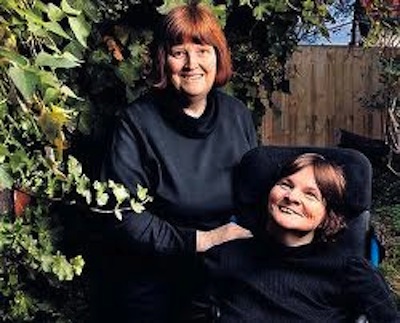
Rosemary Crossley and Anne McDonald
Unknown

“It’s Good to Be Heard”

It’s good to be heard

These are the words my daughter spelled out yesterday during an RPM session.  She wrote some other wonderful things too, but I don’t have her permission to print them here.

“It’s good to be heard”

Imagine a life where it was not a given that what you said would be listened to, or even understood.  Imagine if you said things you didn’t mean or that people couldn’t follow the meaning and so you were dismissed.  Imagine being treated “like a three-year old” (this was something else my daughter wrote last week) by people who do not understand, cannot understand, are incapable of understanding because it flies directly in the face of all they’ve been taught and know.  My daughter does not have the mind of a three-year old, despite what anyone else may think or assume.

“It’s good to be heard”

Thanks to a number of dedicated people who have devoted their lives to figuring out alternate ways for people to communicate who cannot or do not reliably speak, my daughter is communicating with us.  Much to our surprise she has managed to learn an enormous amount despite the fact that she has spent years of her life in little more than holding tanks, i.e. special education schools where “life skills” classes are lauded as progressive, where verbal speech is seen as the only true barometer by which intelligence can be gauged.

It’s good to be heard”

RPM copy

My Resistance to Practice

I’ve been struggling, feeling very emotional in a “bad” sort of way.  You know how when you’re weepy all the time for seemingly no good reason?  Those times when you keep crying every time you hear sad music, and all music strikes you as sad, even really upbeat music, or when someone looks at you with a stern face, or uses a harsh tone, or if you read something sad, and everything you read seems really sad, and you keep having to wipe tears from your face and hope you remembered to bring tissues with you, but you never do?  Yeah, sort of like that.

*Sigh*  It’s been a tough few weeks.  I have felt off-balance because I have been expecting myself to be able to do what I’ve seen a number of people do with my daughter, but that I have not been able to do.  I returned from our trip to Texas and thought, after only a couple of sessions with my daughter, I’d be able to start asking her open-ended questions, just as I’d seen Soma Mukhopadhyay do.  (Despite the fact that Soma advised me NOT to ask any open-ended questions in the beginning.)  *Define beginning, I kept thinking.  I HAVE begun.  Surely now after the second or third day home I am beyond “beginning”!  This thinking is akin to seeing a master jeweler create a beautiful ring and expecting that I should be able to create that same ring without having spent years practicing the craft as a bench jeweler, or hearing a Rachmaninoff piano concerto played at Carnegie Hall and then going home and thinking after a couple of piano lessons that I would be able to replicate that piano concerto.  The point is, Soma is a master at RPM (rapid prompting method).  She’s been doing RPM for close to two decades, first with her son Tito and later with hundreds of Autistic people.

But I so wanted to have the kind of conversations with my daughter that I saw her having with Soma.  It was like catching a little glimpse of paradise, but not being able to find the bridge to actually get there.  I kept trying to leap.  I kept trying to find a short cut.  And as I did this, each day, my distress grew.  I felt frustrated and then angry and then beaten down.  All because I was expecting myself to be able to do something without any practice.  So when my suffering reached an all time high, when the occasional weeping, became more than occasional and my son, upon seeing me asked, “why are you always crying?” I realized I had to get help.  I did what years of recovery from addiction has taught me – I reached out to another human being.  I contacted someone I only know through the internet, but who has been working with her son for a number of years now.

She gave me wonderful tips.  She sent me videos to watch.  She listened to my distress.  She told me it took months of practice and as I read everything she sent me, I kept thinking both how grateful I was to her for being so kind and generous in sharing her experience with me, but also was reminded that I need to practice and I need to start at the beginning.  Everything takes practice.  My expectations of myself were causing me tremendous pain.  They were unrealistic.  It isn’t that I can’t do this method with my child, it’s that I can, but I need to practice.  And as I realized this, as I thought more about this, I saw the parallels to presuming competence in my child.  I have written about what “presume competence” means, but in all the posts I’ve written on the topic there is one piece of this that I have neglected to mention and that is, presuming that we can and will be able to learn with appropriate accommodations and enough practice.  I forgot to include myself in presuming competence.  I need that presumption too.  I need to remember that I can and do learn if I’m given instruction and give myself the opportunity and time to practice.

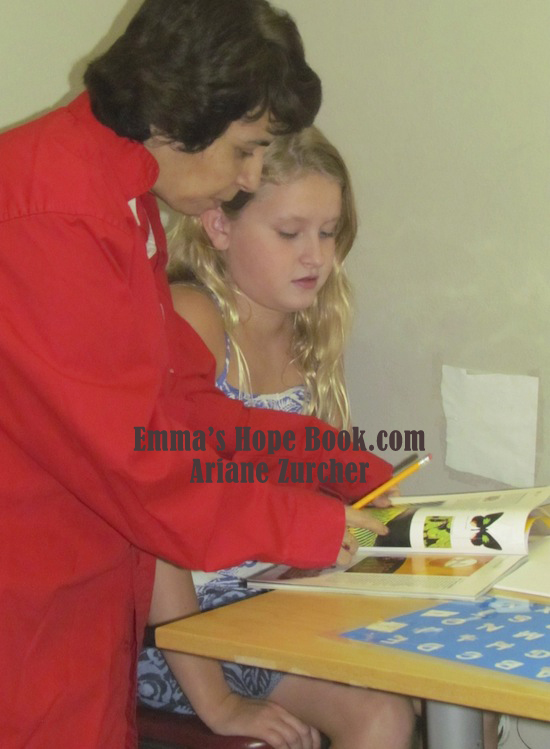
I had the proper instruction, but I haven’t been practicing long enough to get the results I wanted.  So last night I wrote up a lesson plan, just as Soma had instructed during a previous four-day intensive workshop I took last spring.  I made sure I followed her format of how to create a lesson plan.  I made sure I began with choices and spelling key words.  I even tried to embody her lovely, sing-song, calm, kind voice.  I laid aside any expectations of what would or should happen.  And you know what?  It was a great session.  I made a couple of mistakes, I had to refer to my notes often.  I had to make some adjustments.  I forgot a couple of key things, but I jotted down some comments to myself so I can remember to revise accordingly for our next session this afternoon and more importantly, we were both more relaxed than we have been since we returned home.

Practice.  I hate the idea of having to practice.  I want to go from never having done something, to immediate fluency.  But once I begin practicing and let go of that desire and those expectations for immediate fluency, practicing can be incredibly enjoyable.

To Sue:  This post is for you.  Thank you.

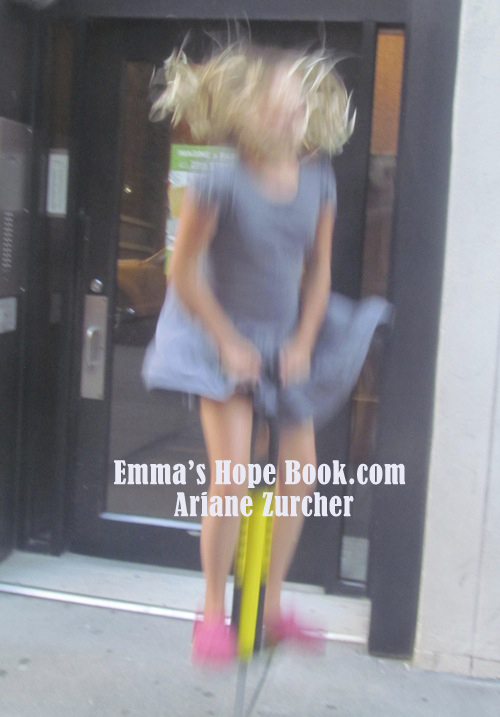
Em practices jumping on her pogo stick.  New all time record?   127.

Joy copy

Non-Speaking With a Lot To Say

I am reading Ido in Autismland: Climbing out of Autism’s Prison by Ido Kedar.  This is another one of those MUST READ books.  Ido is a non-speaking Autistic teenager who learned to write his thoughts by pointing to a stencil board using Soma Mukhopadhyay‘s RPM method.  Ido now types on an iPad.  When I first received a copy of this book, I admit, I was put off by the subtitle.  You see, I was one of those people who once believed my daughter was trapped inside a prison that I called “autism” and for a long time I absolutely believed this.  This thinking led me to believe that if I could cure her, if I could remove her “autism” she would be released from its prison.  It was also this thinking that caused me to say how much I loved my daughter, but hated her autism.  Once I discovered blogs written by Autistic people I began to reassess these various beliefs and finally began to understand how my thinking was actually harming her.    I’ve written about some of this ‘here‘, ‘here‘ and ‘here‘.

But in reading Ido’s book and because I wrote directly to him and his mom about my initial reaction to the subtitle, I have come to understand that his reference to “prison” refers to being imprisoned in a body that does not obey what his mind wants, a mouth that does not say the words he wants to communicate and a society that perceives him as someone he is not.  But more importantly this is Ido’s story and is about the way he perceives autism as it relates to himself and what he has been through as a result. To not read this terrific book because of semantics or because Ido’s perception of autism as “illness” is one I found unhelpful and even harmful to my family and daughter, would mean I would have missed reading a great book written by a really insightful and wise young man who had to fight against prejudices and preconceived ideas about who and what he was capable of.  This is Ido’s story and what a wonderful story it is!

In the introduction, Tracy Kedar, Ido’s mother, writes,

“The ideas in this book challenge many assumptions long held by professionals working with autistic people.  In our own experience, Ido broke free in spite of, not because of, the mainstream thinking today.  If we had continued to rely on  the specialists and educators who dominated Ido’s early years, if he had not been able to find a way to show me that he could read and write, and if I had not finally trusted my own eyes and impressions, Ido would still be stuck as he was, locked internally, underestimated and hopeless.  It is time for our understanding of autism to undergo yet another paradigm shift, and Ido, along with other non-verbal autistic communicators, is a pivotal guide.”

*The use of bold is mine, used for emphasis and is not in the book.

Just as a quick aside, Soma’s RPM method begins with written choices, progresses to a stencil board with the student pointing to the desired letters with a pencil, then to a laminated alphabet board and eventually to an iPad and computer.  Soma or the person doing RPM does not come into physical contact with the student and once the student has moved to a laminated board, she even encourages the student to hold the board themselves.  The final step is to move from the laminated board to independently typing on an iPad or computer.

This quote was written by Ido in 2008 regarding his body and mind and how the two do not obey each other.

“Time after time people assume that I don’t understand simple words when they see me move wrong.  Understanding is not the problem.  It’s that my body finds its own route when my mind can’t find it.”

Again in 2008, Ido writes about his life before he learned to communicate using RPM.

“They misinterpreted my behavior often.  For example, I remember that during my ABA supervisions, I sometimes ran to the window over the parking lot in an attempt to show them that I wanted to go to my car.  They didn’t understand how a non-verbal person might be communicating.  Once, when I got really mad I urinated in my seat, but the supervisor just thought I couldn’t hold my bladder.

“But even worse was that they didn’t support me when I began to communicate.  Maybe they assumed I was too dumb, or they simply couldn’t see what I had learned because I learned it in a different way than their methods.  The response to everything was to give me drills.  If I had a dollar for every time I had to touch my nose, I’d be rich. I remember one day they realized that I hated being told to touch my nose, so they brilliantly switched the command to “touch your head.”  I felt like a prisoner of these theories and methods…”

“On Being Silent and Liberated from Silence”

“Can you imagine silence your entire life?  This silence includes writing, gestures, and non-verbal communication, so it is a total silence.  This is what a non-verbal autistic person deals with, forever.  Your hopes dim, yet you persevere in going to ABA or Floortime (play focused treatment for autism) or speech therapy, all to no avail.  The therapists can’t help and you despair, and only you know that your mind is intact.  This is a kind of hell, I am certain.

“The experts focused on stim management, or drills of rote activities, or silly play like finding things in Play Doh, over and over, on and on.  But they never taught me communication.  I shouted to them in my heart, “I need to communicate!”  They never listened to my plea.  It was silent.

“I could read from an early age.  I could write too, only my fingers were too clumsy to show it.  In school I sat through ABC tapes over and over and added 1+2=3 over and over.  It was a nightmare…”

Ido writes how when he was seven years old his mother supported his hand in an effort to have him help write invitations to his birthday party and how she could feel he was attempting to move his hand and in this way realized he could write.  But things did not immediately change.  No one believed him or his mother.

“My ABA team tried to convince my mom that she was wrong.  This hurt me so much because I thought they’d be happy for me and teach me how to communicate better.”

My daughter has asked that I read Ido’s book to her, so I am.  It has opened up a whole discussion about communication, what it means to not be given the tools to do so, what is autism, what it means to be autistic, being in a body that often does not do as one would like and what others believe as a result of actions you often have little if any control over.

Ido

Patience

The strangest experience I’ve encountered with my daughter is seeing her work with someone like Soma Mukhopadhyay or Rosemary Crossley or Pascal Cheng or Harvey Lavoy.  I don’t know that one can ever really be prepared for the flurry of emotions that threaten to overwhelm as you sit and watch your non fluent speaking child write profoundly insightful things, show their vast intelligence and knowledge despite having had almost no formal education and what little they’ve had it was most definitely not anywhere near what they are capable of or even at age level.

To watch them so easily converse through writing, or what looks so easy as I sit witnessing…  it is like nothing else I’ve ever experienced.  The only thing I can liken it to was when I was eight years old and my older brother told me that the universe was infinite.  I remember saying that couldn’t be true, that it must end somewhere, and he looked at me and smiled.  Then he asked, “if it ends, then what’s on the other side of the “end”?  And I sat there mesmerized by this idea of infinity, trying over and over to imagine what that looked like, and my mind coming up against the impossibility of this concept, so conditioned, already at the age of eight to think of things as being limited.

So inevitably, after we return home from seeing these various people, or after they pack up their things and leave, I am filled with optimism.  After all what we’ve just witnessed  fills us with hope and the future, our child’s future is limitless.  Every time, without fail,  I am filled with astonishment that my daughter isn’t enthusiastically and cheerfully typing or writing her opinions and thoughts about things with me.  I’ve discussed this with my husband, I’ve spoken to close friends, I’ve talked to other parents and always it is variations on this story.  The incredulous parent with the child who does not seem overjoyed with the idea of continuing to do this all the time, or even any of the time.

At first I spoke of it as resistance, but that puts the onus on my child and I’ve learned to be very careful with words like that, they are far too close to the whole, “you just have to try harder” idea, which I know both for myself and for her is detrimental.  This isn’t about trying harder, this is about how difficult communication is for someone like my daughter.  Just because she can communicate through typing or pointing to words on a stencil board, does not mean it is easy or simple for her.  Just because I am filled with enthusiasm does not mean it isn’t hard work for her.  And so I have to acknowledge how hard this is.

I’ve thought of it as akin to the difficulty I have in learning a foreign language, but I’m not sure that’s really a great analogy.  To me, the idea that she can communicate in any form is just fantastic news and to my thinking why wouldn’t my child want to grab that and run with it?  And then I thought about meditation or exercise or eating foods I know are good for me and how I know my day will go better if I do these things and yet days will go by and I don’t.  Perhaps it is more like that.  Perhaps the importance I place is not the same or maybe importance isn’t even part of the equation for her.

What I’ve noticed is that I feel tremendous fear trying to replicate what I’ve witnessed.  I worry that I will do it wrong, that I will inadvertently hurt her or make a mistake that will cause her upset.  I worry that I will make what is already difficult even more so.  I am also aware of how I do not want to be disappointed.  I do not want to feel those feelings of hope and expectation dashed and the inevitable feelings that then follow, which are often doubt.  Was it all a dream?  Did it really happen?  Could it be it was just that one time?  A kind of burst of brilliance, never to be seen again?

I have had dozens of these moments over the last year.  Dozens of times when I have doubted what I just witnessed.  Dozens of times when I’ve thought – I won’t be able to do this.  I’m too invested, I’m putting too much pressure, I can’t do it, I won’t be able to, I’m not cut out for this kind of work, I don’t have the patience.  But what I see over and over is that I do and I can.  I have to go slowly, I cannot expect to get the results that people who’ve been working with non-speaking Autistic people for decades get.  I have to begin with simple options.  In supported typing they have a “ladder” of communication and new supporters must begin at the bottom rung, not because the person they are supporting isn’t capable, but be cause they are not, not yet.  With Soma’s method it is similar.  One begins with choices, and from there fill-ins and slowly, slowly as one becomes more confident, as trust is built, I will move to increasingly open-ended questions.

All of this requires patience.  Patience with myself, patience with the process, patience with my child.  Patience.  Showing up and being in this moment without expectation.  Patience with my limitations.  Patience with my inexperience.  Patience with my limited thinking that is slowly, slowly expanding to embrace the unknown.

Today Emma is sick and so is home from school.  I asked her what she wanted to discuss – poetry, a story, or Buddhism.  She wrote, “buddhism.”  The irony of her choice is not lost on me…

Buddha copy

Changing Our Thinking

I asked Emma for her permission to talk about language retrieval issues, and specifically to describe some of what occurred during her first session with Soma last week.  She said it was okay for me to do so.  I’m incredibly grateful to my daughter for being so generous with what is personal information.  She has given me her permission, but to leave it at that, would be wrong.  To not acknowledge what this means would be negligent at best.  She is unbelievably generous to allow me to share these things.  I do not know how many of us would be willing for another to share such personal things about ourselves, and the trust she has bestowed upon me, the trust that I will not betray her…  it is something I not only take very seriously, but need to acknowledge.  To say I am grateful does not come close to describing the feelings of appreciation and awe my daughter inspires.  If all human beings could take a page from Emma, both in her cheerful generosity in giving of herself so that others might benefit and her compassion and willingness to see the best in people, even when so many have said and done cruel things to her, this world would be a far better place for all of us.

I wrote about Emma’s first session with Soma ‘here‘.  What I didn’t write about was how after Emma pointed to a letter she was encouraged to say the name of the letter, just as her Proloquo2Go program does on her iPad.  She was able to do so without hesitation.  But when Soma put the stencil board down and asked Emma to say the next letter of the word she was writing, without pointing to it first, Emma would, more often than not, say a random letter.  Soma then picked up the stencil board and again without hesitation, Emma pointed to the correct letter and was able to identify it correctly out loud.  After Emma wrote a sentence she was invited to read the sentence aloud, but could not do so.  This is a sentence she’d just written, one letter at a time.  A sentence she’d created, yet was not able to read.  It is not then surprising that Emma is unable to read a random story out loud, even though she is perfectly capable of reading it silently to herself and fully comprehending it.  See related post about reading aloud, ‘here‘.

To see this broken down, to witness this at the level of single letter retrieval and not a whole word even, made it all even clearer to me.   Which isn’t to say that Emma will never be able to do this.  Perhaps at another point, perhaps once she is proficient in writing her thoughts and identifying a letter after pointing to it, one letter at a time, she will then be able to work slowly, patiently and without the anxiety of feeling expectations are being placed on her, perhaps then she will be able to come up with the next letter before she points to it and from there the next word and on it goes until verbal language can catch up to her written.  But for now, it is imperative that every single person who comes into contact with my daughter understand how detrimental it is for her to have these expectations placed on her and then to have the inevitable conclusions drawn about her comprehension and ability.

My daughter is nothing short of brilliant.  I am not saying this as a biased mother who is basing her thoughts on nothing more than some sort of convoluted tip of the hat to genetics, or a round about way of bolstering my own ego and intellect.  I am saying this because I have seen the evidence.  Since her diagnosis, Emma has been treated as though she were intellectually impaired when, in fact, she is intellectually gifted.  This is, I’m sorry to say, something I am hearing from others.  We have a growing population of children and people who are treated as though they are incapable, when in countless cases the opposite is true.  The onus is on us to change our current teaching methods and the therapies we are employing and to open our minds to the idea that we have gone about this all wrong.  This is what must change.

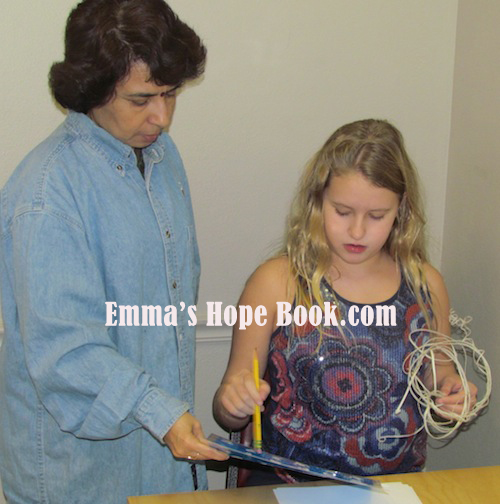
Soma & Em copy