Tag Archives: presume competence

Watch Emma Fly!

Years ago Richard and I went to hear Temple Grandin speak (this was before the documentary about her had been made).  She had slides and gave a terrific talk about what it was like growing up as an Autistic child in a not autistic friendly world.  After the talk she went into the front entrance of the auditorium where she sat near a table displaying her latest book.  I went over to tell her how much I enjoyed reading her two previous books and to ask her if she had any suggestions for me regarding Emma’s inability to stay seated when on an airplane  prior to take off and again once we landed.  (This was something Em had a terrible time dealing with and would get a look of abject panic, before launching into a high volumed scream that had all the passengers covering their ears.  We were pretty desperate to find some way to help her cope.)

Temple said she was pretty sure there were sensory issues at work and gave some suggestions of things we might do to mitigate those.  I remember thinking that Temple in no way resembled my daughter and then made the assumption that Temple must have been far more able when she was my daughter’s age than my daughter currently was.  Whether this is actually true or not is something I cannot know, but a version of this thought process on my part is one I’ve repeated over the years on more than a few occasions.  So desperate to quell my fears and worries I have sought to find my daughter’s adult replica.  I have made the mistake of comparing an adult, possibly an adult who is now even in their 30’s, 40’s or even 50’s, and then drawn conclusions about what I imagine they were like when they were my daughter’s age.

Comparing Em to any adult has proven to be unhelpful to me, to my daughter and, I imagine to the person I am comparing her to, if they were aware I was doing it.  In addition, comparing a child to an adult is never going to give an accurate view of anything, there are too many variables involved.  And this kind of thinking completely ignores the fact that all human beings progress, evolve and change.  This is an obvious statement when applied to a non autistic child, but somehow I came to believe that my Autistic child was different.  I worried she would not progress.  I worried she would not be able to learn.  I worried because, in part anyway, we were given information about our Autistic child that has been proven to be not true.  We were given information that was in direct contrast to presuming competence.  Just as Emma no longer suffers when traveling in an airplane, she also now reads and writes and has, as of three days ago, mastered the complicated skill of a “catch” at her trapeze school.

http://youtu.be/fF46D0NMGnI

Excuse me while I jump up and down while wiping away my tears of joy.  Emma wasn’t able to do a catch upon her first try or second or even third.  Em has been going to trapeze school for more than two years.  She also goes to gymnastics once a week where she has been working hard for almost three years strengthening her core muscles.  In the last month she is now able to do a cartwheel.  Emma began learning to type two and a half years ago.  She practices every day.  She practices reading too.  She practices and works really hard.  None of this has come easily or automatically, there is no “magic” involved, unless magic means being given the opportunity to work toward her strengths, to learn and practice and the belief that she can and will succeed.  Watch that video again, because all her hard work is paying off.  Watch Emma fly!

Bungee jumping barefoot – December 2012

photo

What Is Autism?

Google that term and one is faced with a lengthy list of deficits.  The definitions of autism are cloaked in subjective language.  All the words used are in relation to non Autistic neurology: “severe impairment”, “life long developmental disorder”,  “social impairment” and one site went so far as to say, “A mental condition in which fantasy dominates over reality, as a symptom of schizophrenia and other disorders.”  None of these “definitions” have been helpful to me, personally, nor have I found them to be factually correct.  The most common definitions of autism out there have increased my fear and encouraged me to pursue therapies and treatments that have done far more harm than good.

People often ask, “so what is autism exactly?”  Over the years I’ve had a variety of responses, but like the definitions above, they always seemed inadequate, unhelpful and inaccurate.  So now, when I answer that question all I can come up with is this:  Autism is a type of neurology.   Short and sweet.  No judgment, no comparison, just six words.  It is a neurology.  It’s the best way I know of to describe what is often mired in negativity and judgment.

Comparing Autism to non autistic neurology has gotten me into a great deal of trouble over the years.  I have found it is important that I avoid doing that.  (I’m keeping this personal.  I speak only for myself and do not presume this is how others feel.)  For years I worried about my daughter’s ability to have friends.  If I believe the common definitions of autism, her ability to make friends is “impaired”.  Yet the impairment is less about her desire and attempts to have friends as it is about non Autistic neurology being out of sync with hers.  When Em was in Florida with her friend Henry, they had no problem hanging out together, laughing and enjoying each other’s company.  Just because they typed to each other and didn’t engage in endless verbal conversation, didn’t mean they didn’t have a blast together.

If I listened to and believed the definitions of autism, I might think my child couldn’t learn to read or write.  I would be wrong.   Not only has my daughter learned to read and write, she also has learned to type.  Because I no longer believe the common definitions regarding autism I do not limit what she should or shouldn’t do.  I do not limit her future with set ideas about her future capabilities.  I have found it helpful to disregard those organizations and people who insist that Autism is a dreadful “affliction” and compare rates of autism diagnosis with cancer.

So what is a longer definition of autism?

It’s a terrific question.  Finding an answer that is factual as well as helpful to me, has been difficult to find.  However there are a few who have done a terrific job defining autism and in doing so have also helped me, personally.  Autistic Self Advocacy Network (ASAN) defines Autism ‘here‘ and this post by Brenda, over at Mama Be Good, gives a great, comprehensive answer to the question and at the end includes her personal observations of her child and what it’s been like to parent an Autistic child.

So I ask you, how do you answer the question – What is Autism?

Em on her way back to Henry’s house – April 2013

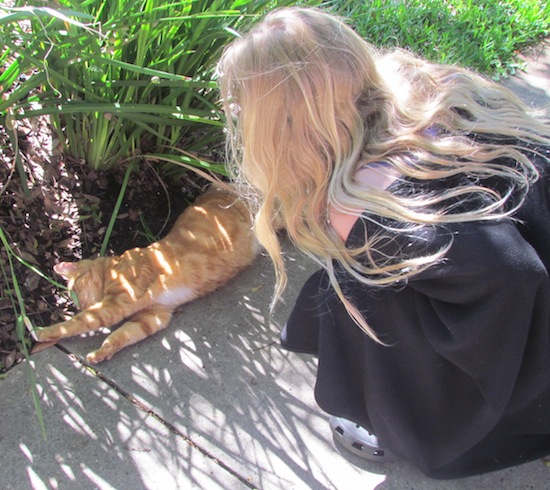
Em pets the kitty

Acceptance And A Webinar

When my daughter was diagnosed first with PDD-NOS and later with autism, I easily fell into the ~ I-completely-love-and-accept-my-daughter-but-I-do-not-accept-her-autism ~ mindset.  At the time, this seemed perfectly logical and I didn’t think a great deal more about it.  Autism was the “problem” after all, not her, and once we got rid of the autism, everything else would fall into place.  When people said the word “acceptance” and “autism” in the same sentence I nodded my head yes, while my mind carefully separated autism from my daughter, plucked the word from the sentence and placed it into a box before closing the lid.

It took a very long time for me to understand that my daughter and autism were not to be separated.  And it wasn’t until I began developing real friendships with Autistic adults that I stopped trying or wanting to separate the two.  Acceptance is much more than tolerating something or saying – okay I won’t actively fight this any longer.  Acceptance is an embrace, it’s understanding and actively celebrating difference, it’s about looking inward and asking questions.  It’s about self-reflection and digging deep into the darkness of preconceived beliefs and being willing to be wrong.  It’s about saying – I don’t know and I don’t understand, will you help me?  It’s about being vulnerable and not “right” and it’s about the excitement of discovery and being curious and open to different ways of being and seeing the world.  To me, it is the most exciting way to live life.

To say I’m grateful to all those people in my life whose neurology falls under the Autistic label, would be a vast understatement.

Today at 4PM eastern time, Brenda Rothman of Mama Be Good, Melody Latimer of AS Parenting and I will be speaking about Parenting Toward Acceptance.  The webinar can be found at the following link – http://www.icdl.com.

In other news, I was more than a little surprised to see this – Top 10 Social HealthMakers

Soma Mukhopadhyay ~ Day 3

It is hard to believe how much information Soma is able to pack into the first three days of a four-day training.  She has managed to cover the different learning channels and how to teach toward each one.  We learned about the various stages of development, left brain/right brain, the difference between an excitatory stim and a calming stim.  The importance of presuming competence, working through self-injury and highly charged emotional situations have all been discussed.  We were taught that social expression and gestures begin in the hypothalamus travels down into the body, then back up to the somatosensory cortex, to the pre-motor cortex and finally to the motor cortex and how at any point along the way, things can become disconnected causing the Autistic person tremendous challenges in behaving as we non-autistics might expect.  We learned about OCD and how to interrupt it by asking the student to spell a relevant word or introduce numbers and/or a math problem as a way of working with it while at the same time diffusing it.

Soma described how to implement a lesson plan around just about any topic, mental mapping and the different stages of rapid prompting method.  We went over methodologies and how to plan a lesson by using flow charts, listing objectives, relevant spelling words and key terms and concepts that need to be introduced, explored and learned.  She taught us the importance of teaching concepts, and the words used, as well as reading comprehension, spelling, grammar and such abstract ideas as time, symbolism, relativity, belief systems and throughout all of this Soma emphasized the importance of teaching age appropriate or above age level materials while filling in the gaps of what isn’t yet learned.

I’m exhausted, exhilarated, but exhausted and there’s still one day to go!  Today, the final day of the training, we are going to cover how to teach math and math goals, how to take and administer a test, how to teach poetry, literature and creative writing and the training will end in a review aka test. Tests have always been my downfall when I was in school.  I become anxious and overly nervous.  When I was in high school I learned to over study and even then I would become easily overwhelmed if I didn’t know the answer to a question and would get so upset that even the questions I could answer would go unanswered because I couldn’t move on from the one I didn’t know.  Writing all of this makes me aware of how similar my daughter is to me in this regard.  She also becomes fixated and upset when she gets an answer wrong.  She too has trouble moving on to the next question or topic, can become dis-regulated and overly anxious.  I will try to incorporate some of the exercises Soma has taught to see if I can interrupt my obsessive thinking if and when it happens.  So much of what Soma teaches could be used for anyone, even me!  I could write a lesson plan around that…

*5

Soma Mukhopadhyay ~ Training Day 2

I’m halfway through a four-day training with Soma and I have filled more than half a legal sized notepad with notes.  Yesterday we covered Mental Mapping/ the different stages of RPM and Implementation.  I told Soma about my encounter with the child who didn’t want to work and immediately hit themselves.  I described how I’d had them spell “hitting” on the letter board and how this had immediately diffused the situation.  Soma then gave me more terrific suggestions on how to devise a lesson plan around an action such as hitting.  An example of this is (I”m making this up) “I would like to know more about hitting.  What else can you hit?  Do you hit the sky or a ball?”  Soma spoke of how when emotions are running high, switching to numbers and math, which have no emotion can be helpful during emotional outbursts.  “How many times can you hit the ball? Here let’s count.  1, 2, 3, 4, 5.  You hit 5 times and if you hit once more, that would be 87 times or 6 times?”

We spent a great deal of time discussing the ways in which one can learn about a student through their preferences, stims, what they’ve been exposed to, skill levels and abilities, tolerance levels, acquired knowledge and defenses.  Soma then covered how one goes about implementing all of this through lesson plans.  Each step of the way one presumes competence in the student’s ability to learn and be taught without presuming that they already know how to read, write, add and subtract.  Through the various activities it quickly becomes clear whether the student needs to be shown how to spell a word such as “hitting” or whether they already know the word.  On the first day one of the students, whom Soma had never met before, sat down and after working with her for fifteen minutes or so, was asked what his favorite color was.  She had him choose from one of two stencil boards for the first letter.  From that board he chose the letter “r”.  He then proceeded to type ‘r’, ‘e’, ‘d’.  The following day a number of the people  taking the training expressed skepticism that the student actually could read or write.  One suggested that red may not have been his favorite color.

When asked how they knew that he couldn’t read or write, they weren’t able to give specific reasons, it seems many just assumed he could not.  It reminded me of the years and years I spent believing a whole variety of things about my own child, which turned out to be untrue.  I had no proof that the things I thought were actually true, I had just assumed and then behaved toward her as though it were fact.  Perhaps one of the single most destructive things we can do to our children, students, the people we meet is to make assumptions about their intelligence and abilities.  Beliefs based in nothing other than unfounded assumptions and our own biases of those who look or seem to us as not being capable.  These assumptions are dangerous and can do real harm.  As I’ve said before ~ to presume competence and be wrong will do no harm, to presume incompetence and be wrong can and will do tremendous damage.

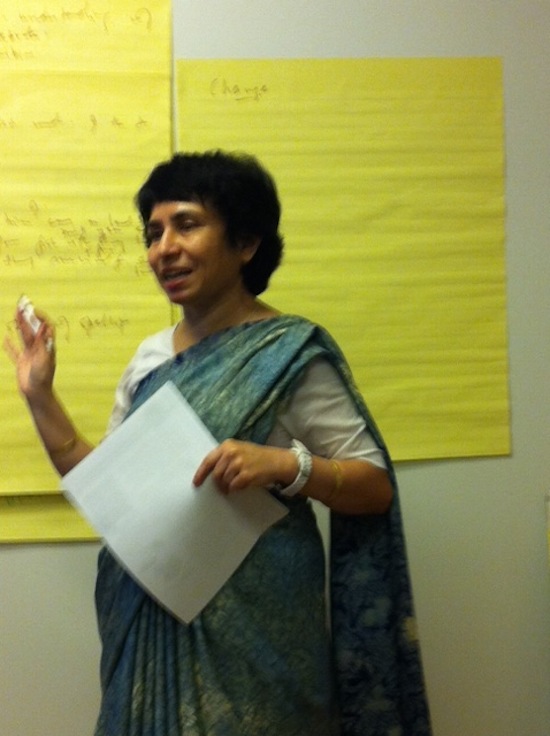
Soma – 2013

Soma

“Presume Competence” – What Does That Mean Exactly?

When my daughter was first diagnosed at the age of two and a half, presuming competence was not a concept I was ever told about or had heard of.  And even if someone had suggested we do so, I’m not sure I would have fully understood what that meant exactly.  So what does “presume competence” really mean?  And how and why should we carry out a presumption of competence?

In an interview, Douglas Biklen explained:  “Assume that a child has intellectual ability, provide opportunities to be exposed to learning, assume the child wants to learn and assert him or herself in the world.”

A key component to presuming competence is to become aware of the prejudice that currently exists regarding autism and how these ingrained beliefs harm not just our children, but ALL Autistic people.   Like any prejudice, based on layers and layers of misinformation, misperceptions, and misunderstandings, we must be willing to acknowledge our own “beliefs” before we can begin to deconstruct them.

When my daughter was little with almost no language I could not understand how it was possible for her to learn to read and write if she did not speak first.  I was surprised and confused when I learned how completely wrong I was.  When I read about all the non-speaking Autistic people who had learned to read and write despite being given no formal instruction, it seemed magical to me.  This mind that seemed, from my limited perspective, to not understand so much, actually was taking in far more than I could imagine, let alone believe.  It wasn’t until I was able to see my own limitations caused by the things I had been told about autism and hence, my daughter, that I was able to move beyond that thinking and embrace another way of thinking.  I had to acknowledge my misperceptions and the misinformation I was given, then I had to question everything I thought I knew and was being told.  I had to seek out Autistic people who were kind enough to share their own experiences before I was finally able to dispense with my erroneous ideas and move beyond them.  In case anyone’s missing it, there is a certain irony in my early assumptions regarding Autistic competence.

At the Institute on Communication and Inclusion conference, which we’ve just returned from, and I began writing about in yesterday’s post, Tracy Thresher typed, “… couldn’t let anyone know I could read and I understood what was said to me the training gave me the way to communicate with others.”  On the Wretches and Jabberers website, Tracy wrote, “My communication is paramount to my well-being and is key to my being an active citizen.”  He goes on to say, “I may appear to be a man shrouded by a cloak of incompetence but if you will take the time to listen to my typing you will understand I am intelligent.”

What I have come to understand, is that a presumption of competence is much more than a set of beliefs, it is a way of interacting with another human being who is seen as a true equal and as having the same basic human rights as I have.

A presumption of competence may seem like a leap for many non Autistic people,  it may even feel like a disconnect.  Some may argue that their non-speaking child cannot possibly understand, that they know this beyond any doubt and I must ask, but how can you know this for sure?  We may tell ourselves that our child is too “severe” and we are setting them up for certain failure by presuming competence.  To these people I would suggest the opposite is true.  The only true failure is when we walk away and assume incompetence.

Presume competence means – assume your child is aware and able to understand even though they may not show this to you in a way that you are able to recognize or understand.

To presume competence means to assume your child or the other person does and can understand when they are being spoken of and to.

Presume competence means talk to your child or the other person as you would a same age non-Autistic child or person.

Read and have available age appropriate stories and give access and instruction to age appropriate learning material.

Presumptions of competence means treating the other person with respect and as an equal without pity or infantilization.

It does not mean that we will carry expectations that if not met will cause us to admonish, scold or assume the person is being manipulative or just needs to “try harder”.

To presume competence does not mean we assume there is a “neurotypical” person “trapped” or “imprisoned” under an Autistic “shell”.

Presuming competence is not an act of kindness.

Presuming competence is not something we do because we are a “good” person.

We do not get to pat ourselves on the back because we have presumed competence.  If we believe we deserve a pat on the back and/or acknowledgement, then we are not presuming competence, we are more likely being condescending.

One last thought regarding presuming competence…   to presume incompetence is to actively do damage.  Let’s all agree not to do harm to our fellow human beings.

An Unexpected Response and The Importance of Trust

During my supported typing session with Emma Saturday evening we discussed Little Red Riding Hood.  I asked Em what she thought Little Red was bringing Grandma in her basket.  Emma typed “blueberries”, which seemed like a terrific guess, particularly as Little Red could certainly have picked them herself, placing each blueberry in her basket as she made her way toward her Grandma’s house.  We discussed the wolf and I asked questions I thought it likely Em knew the answer to, but that I wouldn’t expect her to answer verbally, just as Pascal, who is helping me, advised.  Eventually I asked, “Em, what would you do if you were asleep in your bed and woke to see the big bad wolf?”  To which Emma typed,  “I would go to the three little pigs house”.  Though she paused after she’d typed, “I would go to the”.  I urged her, “Take your time Em.  Write what’s in your head.”  She looked at me and whispered, “three little pig’s house.”  She then typed the rest of the sentence with me.  “I would go to the three little pigs house.”

I looked at that sentence.  It took me a second and then I laughed and said, “Wow Em.  That is such a great idea!”  After all the three little pigs have had run-ins with the wolf.   They know, better than anyone, how to deal with him AND they figured out how to build a wolf-proof structure after much trial and error that the wolf cannot break into and where they are safe.  Emma grinned at me and then, very sweetly, patted my cheek.  I took her loving gesture as a sign of her encouragement and patience with me.

Supporting Emma’s typing is not easy.  It is actually much harder than I imagined it would be.  I am pretty sure Emma spoke the last four words of that sentence because she was not able to trust that I was able to support her well enough to type that.  I think she sensed my hesitation.  I had no idea what she was trying to type and because I am not well trained and am very new to this, my support varies and is not consistent yet.  I am hoping I will learn and be able to give her the support she needs to flourish and eventually type independently.  What is fascinating about FC (facilitated communication, more on that ‘here‘ and ‘here‘) is that had I asked this same question of Emma and expected a verbal response, I do not believe she would have given me this answer.  If she had, I would have been absolutely blown away.  These are not the types of things we have been able to “talk” about.  Typing is giving her the tool she needs to be able to express herself in a way that has not been possible to date.

As an aside, two years ago we hired a woman who developed a literacy program for Autistic children.  While I have some serious misgivings about certain aspects of her program, the literacy piece is extremely well mapped out and it was what finally gave Emma the tools and practice she needed to learn to form the letters of the alphabet and began to read, write and type.  Now two years later as a result, Emma is reading and writing at a second grade level, though it is probably much higher.  Emma was not taught through phonetics, in fact we never even taught her the names of the letters in the alphabet.  For two years Joe and I worked with Emma every day on her literacy program.  For more about that program you can read ‘here‘ and ‘here‘ or put the word “literacy” into the search box and everything I’ve written on the topic will come up (just be aware my ideas and views have changed pretty dramatically since many of these posts were written.)

I mention all of this, because I want people to understand that Emma did not sit down one day and begin typing in full sentences.  She did not suddenly pick up an encyclopedia and begin quoting from it.  I know there are those who have.  I wanted to pursue supported typing with Emma after going to the Autcom Conference this past October and meeting Pascal.  He was kind enough to speak with me about Emma and gave me some advice.  I didn’t know if she would be a good candidate for FC.  After all she has some language and typed independently with her two index fingers.  But I want her able to converse on a more sophisticated level.  It seemed to me, FC might be the method by which she would be able to do that.

I am always in awe of Emma’s patience with this world, with all of us, with me.  Her inner strength and resilience are incredible.  She has been ignored, doubted, talked down to, spoken of while she stood right there listening as though she were deaf, she has been misunderstood and treated as though she were incapable of understanding.  Were I treated this way I would be in a state of near constant rage, alternating with debilitating depression.  If any one of us were treated the way so many view and treat Autistic (whether non-speaking, marginally speaking or fully speaking) people, most of us would want to retreat from this world and lose all faith in people, even people we love.

I do not know how or where Emma gets the strength to greet each day with such cheer or how it is that she is so good-natured, kind and loving after all she has been through in her short life.  But she has and is.  I began this blog thinking it would be a document of Emma’s progress.  But in fact, this blog is a document of my progression.  I look back on entries made just a year ago and see how completely my ideas about Autism and my daughter have changed.  So much of what I thought and believed I no longer agree with or feel.  I have resisted the urge to delete all those past posts, because as horrified as I am by so many of them, I also know they are what I believed at the time.  My own journey is a reminder that we neuro-typical (not otherwise specified) adults can and do change, sometimes it just takes some of us a bit longer.

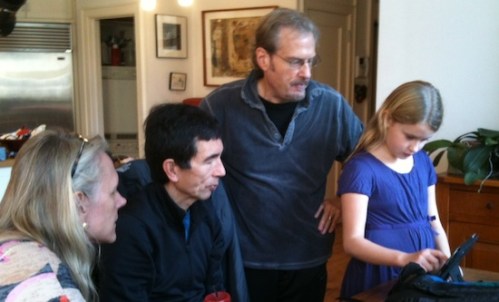
Me, Pascal, Richard and Em during our first “training” session

To the Person Who Googled “I don’t know if I can handle Autism”

I have three things I need to say to you.

First.  Come.  Talk.  Find a safe place where you can talk without being judged, somewhere private, somewhere and with someone(s) who will understand and listen.

Second.  Fear.  Feel the fear.  It’s impossible for me to talk about autism without talking about the abject fear I used to feel, every single day, every moment.  They say fear can be informative.  This was not my experience of it in the beginning, I was running too fast and doing so much to avoid it.  Fear drove me to do a great many things I regret.  I wish I could tell you I have no regrets, but I do.  So, so many regrets.  Avoiding the fear is just one of them.  I wish I’d sat with it.  Leaned into it and listened to it, without believing what it whispered to me as though it were fact.  Listen to it, but don’t believe it.  Who knows what I might have learned all those years ago.  Who knows had I done that, what mistakes I might have avoided.  Who knows?

You see, fear was the driving force behind my relentless search for a “cure”.  Fear is what made me think anything I did was better than doing nothing.  Fear drove me to rationalize some dangerous and very risky “interventions” because I thought to do otherwise was wrong.  It was my fear that kept me up at night, on the computer, typing one more search word into Google’s vast engine, hoping I would find the thing, the remedy, the treatment, the pill, the tincture, the doctor, the nutritionist, the biomed doctor, the QiGong Master, the homeopath, the naturopath, the GI specialist, the thyroid specialist, the speech therapist, the occupational therapist, the cranial sacral doctor, the shaman, the Zuni chieftain, the psychic, yeah you read that right, the psychic, each and every one of these people I put my faith in.  I convinced myself that this person, finally would be the ONE.  They would reach out their hand and show me the path I needed to take.

All those words used to describe autism and Autistic people, our children or parents or siblings, all those words like, “burden”, “epidemic”, “crisis”, the war terminology evoked telling us how we must “fight” and “combat”, all those words like crumbs left in a dark forest were words I believed and used and never, never once during those early years did it occur to me to question them.  For those who did, well, they obviously didn’t have a child like mine.  You had a child who was less profoundly affected by autism than mine.  This was my thinking, this is what I believed in my heart.  (This is my story, it may not be yours, but it is the only story I can tell.)

Third.  There is a documentary I love.  I have watched it many times now.  It’s called Wretches and Jabberers.  I’m not going to tell you more, you just have to see it for yourself.  It’s available on iTunes, Netflix and Hula.   You can purchase a copy from Amazon.  Even if you ignore every other thing I’ve written here, just watch it.  It is a documentary that every human being on this planet should see, because it is about more than just autism.  It is about our beliefs and how our beliefs make us behave in ways we might not otherwise condone.  It is about prejudice and fear and ingrained thinking and the inherent limitations all of that encourages for those who are different.

And finally remember this – just because someone does not speak, does not mean they have nothing to say.  Just because someone cannot make their needs known, does not mean they have none.  Just because someone does not tell us they love us does not mean they do not.  Just because someone does not look at us, does not mean they do not see us.  Just because they do not seem to understand in a way that we recognize, does not mean they do not and cannot.  Just because we think they are ignoring or cannot hear us, does not mean they are or do not.  Just because we think someone cannot write or read does not mean they can’t or never will.

Just because we feel, in this moment, we cannot handle something does not mean we can’t.  With support, we can and we will.  And so will our children.  They can, they do, and with help, they will.  Believe this and you will not only help your child and yourself, you will help the world and all human beings who inhabit it.

Choose to believe.

Emma on her 4th Birthday – 2006

Em - 2006