Tag Archives: presume competence

“Talking is Hard”

*Emma gave me permission to post some of what she wrote yesterday during a meeting with a few of the people who are part of her team at her school.

Emma wrote, “Talking is hard because I like to say silly things that people take seriously and that is why I am misunderstood.”

In reply to a question about Emma’s thoughts on another class joining hers for a project they are working on together, Emma wrote, “Worrying that I will not be thought intelligent.  I am considered stupid by people who don’t know better.”

One of the staff commented that the more she writes with them, the more people will understand and know how smart she is.  Emma then wrote, “I know, but it’s hard work for me to write.”

This is something I think people may not fully appreciate – that communicating is tough and hard work for Emma.  It isn’t that she doesn’t want to participate in discussions or want to express herself and have conversations with people, it’s that what most of us take completely for granted is, for Emma, not easy and requires tremendous concentration and effort.

Someone else mentioned how Emma understands everything that people are saying and Emma wrote, “People think I can’t understand what they say, but my hearing is excellent.”

And a little later Emma wrote, “I know people don’t mean to be cruel, yet they are when they see someone like me.”

One of the team wanted to know if she was referring to specific people and how she deals with them.

Emma wrote, “They are everywhere.  I try to like them anyway.”

Before people comment on this post, protesting Emma’s words and insisting that people are basically loving and kind and that Emma must be unduly influenced by me, to write such things, I will tell you that from what I’ve witnessed when with Emma – people typically talk about her right in front of her, talk about her instead of to her, do NOT presume her competent, treat her as though she were at least eight years younger than she actually is, and though they may not mean, intend or feel they are being “cruel” this is the word Emma chose to write.  I cannot, even for a moment, really know what it is to be as intelligent as my daughter is and regularly treated as though I were not.  I will just add here that Emma is far more compassionate than I am.  So if anyone is being influenced, I hope it is me being influenced by her.

And for what it’s worth, this is what I think about all of this…  I think human beings tend to be neither saints nor evil, but that the vast majority of the human population has ingrained knee-jerk responses toward those who are different from them.  It is rare to find someone who does not hold some degree of prejudice, often without realizing it.  I believe most people, often unconsciously and without meaning to, respond to people who are different, whether that means their skin color, their accent, the way they dress or look or behave, with either fear, irritation, curiosity, jealousy, impatience or pity.  It is actually quite rare for a person to treat ALL humans they encounter with respect and as complete equals, without any trace of “othering”.  I believe segregation breeds “othering” and that an inclusive society of diverse people is the ideal, but that’s another series of posts.

Emma

Emma

Asking Questions

The other day during our session about the Middle East (this post is not about the Middle East) I mentioned to Emma that I’d recently read a memoir, I am Malala written by Malala Yousafzai.  Malala is Pakistani and was shot by the Taliban when she was just 15 years old because she wanted to be able to go to school and have an education.   Emma then wrote, “Was she alive after they shot her?”

It was all I could do not to jump up and down with exuberant glee that Emma wrote me this question.  It wasn’t the specifics of the question that made me so excited, it was that it was a question at all.  You see, Emma has never asked me a question like this before.  This is the sort of question she regularly asks Soma, but not me.  In fact, I just wrote about exactly this, a few weeks ago while Emma and I were visiting Soma.  You can read that post ‘here‘.  The question Emma asked is the sort of question I’ve barely dared hope for.  It is the kind of question most people take completely for granted.  Asking a question like this is the beginning of a conversation.  It requires a different kind of thought process than answering does.  It requires initiating a line of thinking.  It is the beginning of a back and forth that we talkers do not often contemplate, but do without thinking.

I know Emma has many questions just like this one, but she is not able to easily communicate them.  This is different from in the past when I was caught in that great abyss of believing that because she didn’t ask questions, she wasn’t interested.  That old way of thinking was so detrimental to her and to our relationship.  The belief that things were not being expressed because they did not exist was so destructive, not just to Emma, her self esteem and growth, but to all of our interactions.  Instead, this was a moment of celebration.  A moment when I just sat in utter admiration of my daughter.

Presuming competence.   Those two words hold so much meaning within them.  Every day I make tiny inroads, little steps forward in presuming competence, going just a little further in my ability to stretch my thinking so that I am embracing this concept just a bit more.  And as I do my daughter is showing me over and over that I have still farther to go.  This process is one of such joy, wonder and unbridled excitement.  My husband, Richard and I discuss this all the time.  How fortunate are we that we have the opportunity to expand our awareness on a daily basis?  How exciting is it that we are in a process of constantly re-evaluating what we think we know?

“Was she alive after they shot her?” Emma asked.

“Yes!  She lived and now has written this book,” I answered, showing her the cover.  “Should we read it together?”

“Yes,” Emma replied.

Em with her string!

Em with her string!

“No ABA”

A few days ago I wrote about a conversation Emma had where she said she’d like to open a center she would call, “Emma’s Hope Care.”  You can read that piece ‘here‘.  In addition to writing that the center’s philosophy would be “no Autistic child left behind”, she wrote, “no behavior management.”  In response, a commenter asked Emma “What would you do to help children cope with their feelings in our society?”

I showed Emma the comment and asked her to elaborate a bit more on her words – “no behavior management” before asking if she would answer the commenter’s question.

This conversation took several sessions to complete.

A:  Hey Em.  I was wondering if we could talk about Emma’s Hope Care.  Would that be okay?

E:  Yes.

A:  What did you mean when you wrote “no behavior management”?

E:  No ABA.

A:  That was a long time ago, when you were just two years old.  We stopped when you were four.  Do you remember the ABA you had?

E:  Yes.

A:  Will you tell me your experience of it?

E:  I was treated with mostly kindness, but the therapists could not see beyond their training.  I learn quickly, but am not able to reply with words that sound right to another.

Worry becomes everyone’s focus.

Real learning happens when no one notices.

The goals waste away.

Tender feelings do not hurt, but are not helpful because they cannot soothe wounds of being constantly underestimated.

During a separate session Emma answered the question, “What would you do to help children cope with their feelings in our society?” from the Conversing With Emma post.

First cope with your own feelings.  Second listen to the child.  Provide them with patience, accepting their feelings as valid and respecting that this will change as they grow older.

Emma during the ABA years...

Emma during the ABA years…

Questions & Learning

“Did you see the Grammy’s?”  Emma asked Soma yesterday.

And as I sat nearby watching, I marveled at how surprised I was by this question.    In part because she was asking a question, something Emma does a great deal of when she is working with Soma, but not so much with me yet.  I can’t tell you how much I look forward to that…

My surprise was not just limited to the fact that she was asking a question though, it was also because I often wonder how she knows all the things she knows.  “The Grammy’s?” I found myself thinking.  “How does she even know about the Grammy’s?  Where did she see anything about the Grammy’s?”  “Richard and I didn’t watch the Grammy’s.  I can’t even tell you when the Grammy’s were.

After Soma told Emma that she had watched the Grammy’s, Soma asked Emma where she’d seen them.

Emma wrote, “At the airport TV.”

The airport TV?  Seriously?  I didn’t even see a television, let alone notice what was on.  When we arrived at the airport we checked our bag, went through security and went looking for our gate, and when we finally found it, I don’t remember seeing a television anywhere near the seats we finally found to wait for our flight.   What else has she seen in passing?  What else would she like to know about?  What things would she be interested in learning about?  

I write all of this, because Richard and I often ask each other, “But where did she learn that?”  or “How does she know about that?”  And, well…  this is, but one answer.  There is information everywhere and my daughter is picking up information all the time.

I used to assume there was an input issue with learning, but my daughter continues to defy this idea.  An output issue?  Yes.  Input?  Evidently that’s my issue, not hers.

*Emma has given me permission to publish this on the blog.

Emma ~ January 29th, 2014

Emma ~ January 29th, 2014

“Feeling knowledge…”

“Feeling knowledge is reality understood.”

This is what Emma wrote over the weekend.   Yeah.  I’ve been unraveling that one  ever since she wrote it…  At this point there are a couple of things I have come to realize:  First – if I can just keep up with her, I’m doing really well.  Second –  presuming competence is a vast concept and is much more about me and my limitations than it is about the person I’m applying this idea to.  And third – the amount we do not know about autism far surpasses that which we do.

“Feeling knowledge is reality understood.”

EmContemplatesNature copy

Emma’s Letter

Yesterday Soma (for more about Soma, RPM and the Halo Center please click on this link) spoke with Emma about ethanol, fuel and bio fuel, what happens to plants and animals when their bodies decompose, green house gasses, carbon dioxide, fossil fuels, how all of this can affect the economy, and finally Soma asked, “Suppose you are giving a speech at the UN.  What kind of speech would you give?”

Emma gave me permission to quote the speech she then wrote.

“Dear World,

Heat is important, but the world also needs snow.  We must think about the future and use fossil fuel wisely.

Personally, I like car rides, but I am going to walk more.  Walking is good for the heart.”

After we returned to our hotel, I told Em about her Grandpa who had to use a wheelchair when he could no longer walk.  We talked about other ways of getting around and how public transportation, particularly some of New York City’s older subway stations are inaccessible to those who use wheelchairs.  We discussed “green cities” and what that means.  We went to a website to look at photos of “15 Green Cities” and it turns out Austin, Texas is listed as the 15th.

I am too tired and do not have enough time to write more about our first day, and, as always, I need time to process all that has happened and is continuing to happen.

Every day I am being shown that what I believe it means to “presume competence” does not go nearly far enough.  Every. Single. Day.

S&E


My Resistance to Practice

I’ve been struggling, feeling very emotional in a “bad” sort of way.  You know how when you’re weepy all the time for seemingly no good reason?  Those times when you keep crying every time you hear sad music, and all music strikes you as sad, even really upbeat music, or when someone looks at you with a stern face, or uses a harsh tone, or if you read something sad, and everything you read seems really sad, and you keep having to wipe tears from your face and hope you remembered to bring tissues with you, but you never do?  Yeah, sort of like that.

*Sigh*  It’s been a tough few weeks.  I have felt off-balance because I have been expecting myself to be able to do what I’ve seen a number of people do with my daughter, but that I have not been able to do.  I returned from our trip to Texas and thought, after only a couple of sessions with my daughter, I’d be able to start asking her open-ended questions, just as I’d seen Soma Mukhopadhyay do.  (Despite the fact that Soma advised me NOT to ask any open-ended questions in the beginning.)  *Define beginning, I kept thinking.  I HAVE begun.  Surely now after the second or third day home I am beyond “beginning”!  This thinking is akin to seeing a master jeweler create a beautiful ring and expecting that I should be able to create that same ring without having spent years practicing the craft as a bench jeweler, or hearing a Rachmaninoff piano concerto played at Carnegie Hall and then going home and thinking after a couple of piano lessons that I would be able to replicate that piano concerto.  The point is, Soma is a master at RPM (rapid prompting method).  She’s been doing RPM for close to two decades, first with her son Tito and later with hundreds of Autistic people.

But I so wanted to have the kind of conversations with my daughter that I saw her having with Soma.  It was like catching a little glimpse of paradise, but not being able to find the bridge to actually get there.  I kept trying to leap.  I kept trying to find a short cut.  And as I did this, each day, my distress grew.  I felt frustrated and then angry and then beaten down.  All because I was expecting myself to be able to do something without any practice.  So when my suffering reached an all time high, when the occasional weeping, became more than occasional and my son, upon seeing me asked, “why are you always crying?” I realized I had to get help.  I did what years of recovery from addiction has taught me – I reached out to another human being.  I contacted someone I only know through the internet, but who has been working with her son for a number of years now.

She gave me wonderful tips.  She sent me videos to watch.  She listened to my distress.  She told me it took months of practice and as I read everything she sent me, I kept thinking both how grateful I was to her for being so kind and generous in sharing her experience with me, but also was reminded that I need to practice and I need to start at the beginning.  Everything takes practice.  My expectations of myself were causing me tremendous pain.  They were unrealistic.  It isn’t that I can’t do this method with my child, it’s that I can, but I need to practice.  And as I realized this, as I thought more about this, I saw the parallels to presuming competence in my child.  I have written about what “presume competence” means, but in all the posts I’ve written on the topic there is one piece of this that I have neglected to mention and that is, presuming that we can and will be able to learn with appropriate accommodations and enough practice.  I forgot to include myself in presuming competence.  I need that presumption too.  I need to remember that I can and do learn if I’m given instruction and give myself the opportunity and time to practice.

I had the proper instruction, but I haven’t been practicing long enough to get the results I wanted.  So last night I wrote up a lesson plan, just as Soma had instructed during a previous four-day intensive workshop I took last spring.  I made sure I followed her format of how to create a lesson plan.  I made sure I began with choices and spelling key words.  I even tried to embody her lovely, sing-song, calm, kind voice.  I laid aside any expectations of what would or should happen.  And you know what?  It was a great session.  I made a couple of mistakes, I had to refer to my notes often.  I had to make some adjustments.  I forgot a couple of key things, but I jotted down some comments to myself so I can remember to revise accordingly for our next session this afternoon and more importantly, we were both more relaxed than we have been since we returned home.

Practice.  I hate the idea of having to practice.  I want to go from never having done something, to immediate fluency.  But once I begin practicing and let go of that desire and those expectations for immediate fluency, practicing can be incredibly enjoyable.

To Sue:  This post is for you.  Thank you.

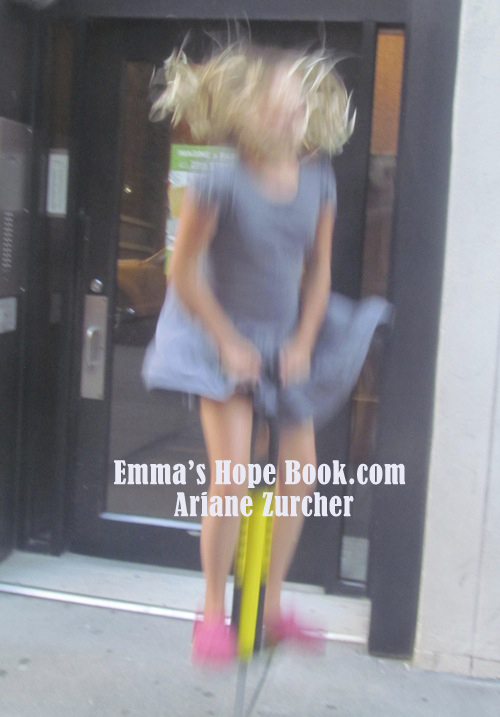
Em practices jumping on her pogo stick.  New all time record?   127.

Joy copy

Seeing But Unable to Believe

When some people hear that my daughter is Autistic they see a beautiful blonde haired girl with no noticeable physical impairments.  They see a pre-teen who has terrific eye contact.  They see someone who is happy and playful and who laughs often and with abandon.  They see someone who loves loud music, a good party and will grab hold of a microphone if given the opportunity.  They see someone who obviously loves to perform in front of an audience.  She doesn’t fit their concept of autism so they assume the diagnosis must be wrong.  They say things like,  “But I never would have known if you hadn’t said something.”

When it becomes clear that she cannot carry on a conversation with them, but demonstrates her intelligence by typing something with lots of insights and wisdom, they see a doting mother who is supporting her daughter’s arm or holding on to the other end of a pole and they assume it is all a manipulation.  They decide it is me who is writing these things, “putting words into her mouth”.  After all my daughter cannot carry on a conversation, how could she possibly be writing such beautiful words?  Later, when I am no longer present they might say, “Poor thing, she’s deluding herself about her daughter, of course she would, how could she not?  It would be giving up all hope to do otherwise.”

In our field, assumptions about labeled people are so deeply rooted that we tend to think they are facts.  They are not – they are only shared beliefs.” ~ Autism: Sensory-Movement Differences and Diversity by Martha R. Leary and Anne M. Donnellan

I explain that my daughter is typing these things, but needs support to do so, without that support, which is in the form of resistance, she will impulsively revert to her favorite scripts, and they think to themselves – that doesn’t make sense.  How is that possible?  She can type independently now, why don’t they just leave her alone and let her type what she wants?  If she can’t type these things independently, it must not be coming from her.  Her mom must be writing those things for her daughter.

I then talk about how my daughter is doing math, multiplication and division (in her head) without any formal training and they think – well, that simply isn’t  possible.  That can’t be.  They look to see if my daughter is somehow being manipulated, prompted, even though she is not being touched.  When I state that my daughter is reading faster than I can, they wonder – but how can she really know that for sure?  When Emma then obviously passes reading comprehension multiple choice tests, they think – well, but it’s just a coincidence, after all it IS multiple choice, that’s much easier than if she had to write an essay.  Those who do believe, assume she must be the exception.  They say things like, “But my child/the child I work with can’t possibly do that. You’re so lucky.  Your daughter is very, very special.”  They place my child into a little file in their mind.  A file entitled –  anomaly.

When you have enough exceptions you have to start questioning the legitimacy of the rule, the assumptions, and the paradigm.” ~ Speechless by Rosemary Crossley.

I have interviewed  a great many non-speaking Autistic people and published our conversations here and on the Huffington Post.  I have an entire page on this blog devoted to Resources, the first list is of all the blogs and writings of non-speaking Autistics that I know of, but there are a great many more that I do not know about.  Even so, people will write about how those non-speakers didn’t really write their own words or, conversely, they say –  isn’t it wonderful that these individuals are so amazing and an inspiration, but they are exceptional, they are not like my non-speaking child, or the children I teach, or the children I work with or…  Perhaps they are right, but what if they are wrong?

I would rather have my daughter surrounded by people who believe her capable than around those who do not.

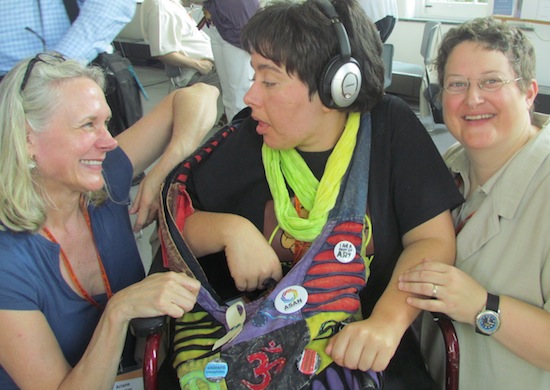
Ariane Zurcher, Amy Sequenzia and Ibby Grace at the ICI Conference ~ A conference dedicated to accommodating those who do not speak

Me, Amy & Ib

Emma’s Story

Emma told me I could post her story on here this morning.  This is a story she wrote yesterday with Rosie (Rosemary Crossley).  Rosie developed a technique more than thirty years ago to help people with a variety of issues, specifically those that make speaking difficult or impossible .  Em held onto a tube with one hand while Rosie held the other end as Emma typed.  Rosie began yesterday’s session by asking Emma to write a story that began with either, “once upon a time” or “one day.”  I was standing near Emma, with Richard, Joe and Em’s teacher, Katie, all watching as she typed the following.

“One day there was a boy called george. He had been in afight can’t tell you how he got into the fight but he was bruised all over.  He fought a lot and his teacher was very angry.  The next day he was all purple and his mother said you can’t go to school looking like that.  The very clever boy covered himself in flower and his teacher thought he was sick and sent him home.  The end.” 

Not sure I can actually continue writing here…  but I’m going to try… *Breathe*

I have read this story more than a dozen times already.  I know I’m totally biased, but I’m just going to say it – what an incredible story!  There are so many layers to it.  This story that Emma wrote with great concentration, with little pause is the first story she’s ever written.  She was focused and when asked about the word “flower” she verbally said “powder” in explanation.  Rosie explained that flower/flour are words that sound alike but are different in meaning.  Rosie explained that the powder kind is spelled “flour.”

But there’s more…  A little later Rosie brought out a math app called Math Magic where Emma proceeded to zip through addition, subtraction, multiplication and division.  None of this is particularly noteworthy, except that Emma has never been formerly taught division.  She was choosing the correct answers from a field of four.  A sample equation is:  “56 ÷ 8” and the multiple choices available were: 2, 9, 7, 6.  Emma chose the correct answers independently.    Allow me to say that again.  Division.  Emma chose the answers independently.

It was at this point that I felt so many things all at once it was almost impossible to speak.  But more than anything I kept thinking about how we continue to underestimate our daughter.  I had no idea she could do division.  Not only can she do division, she can do it quickly.  There’s another app Rosie recommended – Brain Pop and Brain Pop Jr. which Emma also did as we watched.  Not only did she listen to the short lesson, but then read all the questions silently, read the multiple choice answers and chose the correct answers.  It seems verbal speech is tricky, particularly when she is expected to answer questions verbally.  When asked to read silently and then identify the correct written statement by pointing to it, Emma did beautifully… about Ellis Island, no less!  The only interaction Rosie provided with both the math and Brain Bop was to use a laminated card that she silently moved across the words as Emma read and she did not allow Emma to point to any answer until she’d finished reading all the choices.

I cannot imagine how awful it must be to be so capable and yet treated as though you were not.  I imagine it must feel like being “bruised all over.” I imagine it must feel like you “fought a lot”.  My wish for my daughter is that she may continue to do all that she is doing, while we provide her with every opportunity to flourish and continue to show the world how very “clever” she is.  The only limitations are the ones we provide.

I am incredibly grateful to all who believe in her, all who have helped and who continue to help us so that we can be better parents to our daughter.  The list continues to grow…

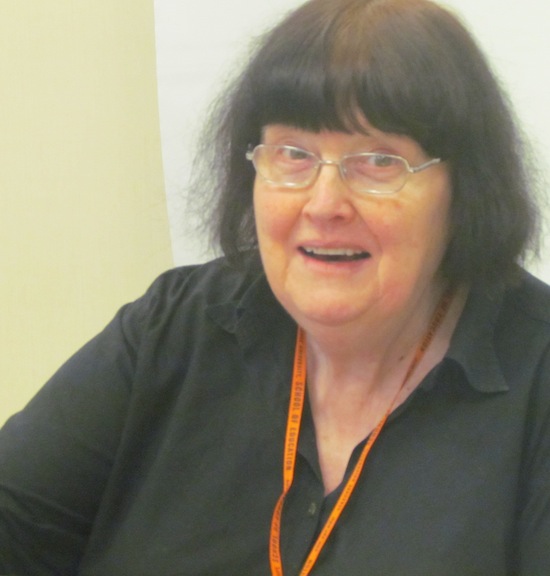
Rosemary Crossley

Rosemary Crossley

A Radical Notion

As I fantasize about a world in which autism is not consider a “bad” thing, but instead is seen as yet another type of neurology with its pluses and minuses, I continue to rewrite the “ideal introduction to autism” with the hope that one day this may actually be a parent’s experience.  I can’t imagine what that would be like, but I know for a fact, it would be a hell of a lot better than the very real, very upsetting, confusing and painful introduction to autism that I was given almost ten years ago.

First off, the literature regarding autism…  more and more there are books and blogs (!) written by Autistic people introducing the idea of autism as another kind of neurology with both innate challenges and wonders.  I’ve listed many of them on the Resources page on this blog.  As there were no blogs (written by Autistic people) that I knew of in the fall of 2004 I went to Barnes & Noble and bought pretty much every single book written on Autism.  Some would say that was my first mistake, as I was greeted with nothing but gloom and doom.  Other than Donna Williams and Temple Grandin, all the books were written by non autistic people about the dire, horrors of autism and what that meant for your child. (And none of it was good.)  Autism was most definitely not something to celebrate.

The idea that autism could be seen as anything but terrible was not even a radical notion, it was a thought that hadn’t made it into the public sphere.  When Emma was diagnosed the big names associated with autism were Andrew Wakefield, Jenny McCarthy and Bernard Rimland.  It was impossible to read anything about autism without those three names coming up.  Parents new to all of this, fumbled around trying to make sense of the various thoughts about cause, was it really an epidemic and how to best serve our children who were said to have been snatched from our protective arms.  I’ve written about the depth of my fear during those first few months that turned quickly into years in numerous posts on this blog.

My fantasy is nothing short of radical, but perhaps one day it will not be seen as such, but instead, will be commonplace.  My fantasy introduction to autism begins with the evaluation.  At least one of the therapists who came to our home in September of 2004 would have been Autistic.  Once it was thought my daughter might occupy a place on the Autism spectrum, more Autistic therapists, social workers and psychologists would have come to conduct the evaluation and talk to us.  This, then, would have been our introduction to autism…  meeting actual Autistic people, who are able to articulate what the challenges are and what the joys are!  People who could offer a balanced view of a neurology that I would be able to identify with and see there was overlap with my own.  People who would gently encourage me to review my own neurology and see that my daughter’s experience and processing of the world, while different from mine, has many similarities.  People who could help me so that I was in a better position to be the mother my daughter needed me to be.

After the evaluation and diagnosis had been made, we would then be given support in finding at least a few Autistic people who were in the profession of working with families with Autistic children.  In my fantasy, Autistic people would be among those creating schools, designing curriculums, teaching academics, conducting seminars for us, the parents of Autistic children, to attend so that we might better help our kids.  It seems to me a radical shift in all aspects of autism, what is said about what it is to be Autistic and what is being told to those who are non autistic, needs to occur.  My dream team would include Autistic and non autistic alike, but it would be a blend of those who presume my child competent, who treat my child with respect, who are interested in my child’s well being and want to work towards her strengths, encouraging her to be all she can be and cheering her on.  photo

Acknowledging Other’s Achievements

When I asked Emma if I could post this video of her doing her latest “catch”, she said, “Yes!  Post on blog!”

http://youtu.be/oed1EkujRNg

I’ve written about Emma perfecting her “catch” ‘here‘ and ‘here‘ and I’ve mentioned too, the hours of practice it took, for her to get to this point.  It’s important you understand how hard she’s worked.   She didn’t suddenly climb up a ladder, grab onto the trapeze, swing a few times and then catch someone else’s arms one day.  She has been practicing this for years.  Just as she didn’t suddenly begin typing sentences or one day open up a book and start reading it, Emma has worked hard, incredibly hard and for anyone to suggest otherwise is doing her and others who are accomplishing wonderful things a tremendous disservice.

Far too often we hear stories of children and people who, seemingly miraculously, began reading grade level material or began typing their thoughts or began playing an instrument and to us, the reader, the person who has just now discovered this story, this video, this whatever it is, it seems it all happened “suddenly”, “miraculously”,  “overnight”, yet this is rarely the case.   Years and years of practice, of hard, hard work have taken place before that moment when we become aware of the person.  How many times have we heard about someone being an “overnight sensation” with lots of exclamation marks following those two words.  How often do we hear of someone who has accomplished incredible things, we marvel at them, but we also dismiss their tremendous accomplishments with our belief that it all happened “miraculously”.

The years leading up to those success stories are not so interesting to most of us.  We don’t really want to know about the daily grind, day after day of showing up to perfect or master a skill.  When we apply these same beliefs to people with disabilities we are doing them a tremendous disservice.  Not only are we ignoring the difficult work, the hours and hours they put, in practicing and honing their skills, we are dismissing all that hard work with words like “magical” and “miraculous” and we are ignoring just how hard that work is.   There is nothing miraculous about someone accomplishing something after putting in hundreds and thousands of hours of practice and hard work for years.  Their accomplishment is not an indication of our failure.  We do not need to dismiss someone else’s achievements to make ourselves feel better.

All those people who have gone on to prove themselves as more capable than most people gave them credit for are NOT examples of miracles.  They got to where they are through HARD WORK.  To all of you,  Emma Z-L, Carly Fleischmann, Tito Mukhopadhyay, Jennifer Seybert, Jamie Burke, DJ Savarese, Barb Rentenbach, Amy Sequenzia,  Emma Studer, Paige Goddard, Amanda Baggs, Henry Frost, Larry Bissonnette, Tracy Thresher, Sue Rubin, Alberto Frugone, Richard Attfield, Nick Pentzell, Rob Cutler (there are too many people to list) to all of you who have worked so hard, who continue to work every single day to communicate and do all that you do, your hard work is acknowledged and appreciated.  I need you to know how much I appreciate the days, months, years, and for some of you, decades that each of you has spent showing up, day after day to do what does not come easily.

You are leading the way for my daughter.  You are showing me how it’s done; I cannot thank you enough.

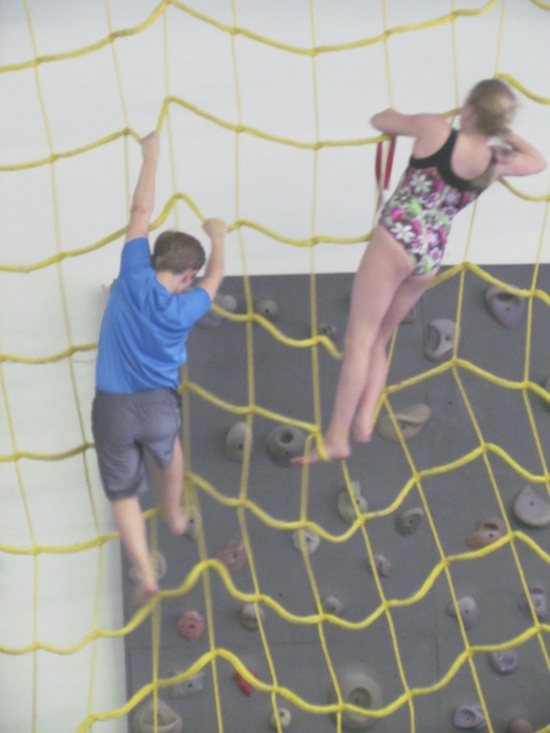
Emma practices climbing the rope wall

Nic & Em

Giving Hope…

During those first few years of Emma’s life, when we were so exhausted and everything was confusing, well-meaning people made pronouncements about Emma’s future.  If I had to choose one emotion to describe my feelings during those early years, it would be terror…  I was terrified.  The kind of terror that keeps you up at night and then, once you’ve managed to lose yourself in the welcome relief of sleep, you dream about elevators swinging in midair, doors that open up to emptiness, running to places only to find you keep ending up where you began…  and then… and then you wake up with a jolt of optimism, for a brief, few seconds you have forgotten your terror, only to have it come surging back, dispersing any wisps of residual optimism from days now gone…  You’re left bereft, empty, alone and yes, grieving… Grieving for that time when terror wasn’t something you were intimate with…

What I wanted during those early years, what I wanted later when Emma grew beyond toddlerhood, when she entered adolescence, all I wanted was for someone, anyone to say –  Don’t believe any of these people.  They have no idea what they’re talking about.  Don’t spend your time on the internet researching autism.  Don’t listen to organizations with Autism in their title, but that have few or no Autistic people occupying prominent positions in their organization.  Don’t believe any of those people who talk about “recovery” and liken your daughter’s neurology to disease or buy into therapies whose main goal is to make your daughter indistinguishable from her non Autistic peers.  Reject ALL of that.  Being able to speak isn’t the only way to communicate.  An Autism diagnosis isn’t a metaphoric nail in a coffin.  

I imagine those years of terror and how different our lives would have been had I met some of the people I now know.  People I have met on the internet, through their blogs, at conferences such as AutCom and the ICI Conference in Syracuse.  Conferences where I left feeling elated and euphoric because I witnessed all that was possible and not all that wasn’t.  How can we move beyond the current conveyor belt of fear that only serves to pad the pockets of Autism businesses run and created by non Autistic people, who do not seek out the active involvement of those very people they insist they are dedicated to help?  How do we dispense hope and what is possible amidst the maelström of deficit thinking?  How do we care for families new to all of this, those families whose children will be greatly affected by their parent’s terror?

We have to give eye-witness accounts of what is possible.  We must have resources available to families that will counter the predominantly negative views of autism.  Resources that do not condemn the parent or the child.  Resources that do not encourage terror, but offer hope and possibility.  Ideally I would have been given the list of books  I have on my “Resources” page and actual copies of these four books:  Autism and Representation Edited by Mark Osteen, Autism and The Myth of the Person Alone Edited by Douglas Biklen, Inventing the Feeble Mind: A History of Mental Retardation in the United States by James W. Trent Jr.  and Representing Autism by Stuart Murray.

Parents need support so they have the energy, patience and optimism to give their child the support and encouragement they need.  Therapists, professionals, educators, experts who are making a living working in the field of Autism must understand the importance of offering hope.  Hope based in possibility and reality.  No one is served by being terrified.  The only people who will be adversely affected if we stop the terror surrounding autism are those whose businesses thrive on such beliefs.  And to all those businesses – I say – Good riddance.

LifeThe possibilities are endless… 

Taking Action ~ Presuming Competence

A full transcript of Richard’s Blog Talk Radio Show is now available for any who want it by clicking ‘Blog Talk Radio Transcript‘.  I am trying to add it to Facebook, but have run into problems as the file is too large to add to “notes” and I can’t add it even when changing it to either a txt file or an .htm file.  So unless someone knows how to attach a large file, (12,540 word count) I am not sure how to get this on Facebook.  I may need to break it into several smaller segments, which would be too bad.  Please advise!

Lots of people have been asking questions about “presuming competence” and how that applies to either their child or someone they are working with.  So I am adding links to a couple terrific articles that I’ve found helpful.

Kathie Snow, entitled: PRESUME COMPETENCE:  Challenging Conventional Wisdom About People with Disabilities.

An interview with Douglas Biklen, winner of the UNESCO/Emir Jaber al-Ahmad al-Jaber al-Sabah Prize to promote Quality Education for Persons with Intellectual Disabilities and Dean of the School of Education at Syracuse University.

Presume Competence – a PDF from the Peal Center

Presuming Competence ~ By Douglas Biklen and Jamie Burke (Jamie, who we met this past March, just graduated from college and types independently! Yay Jamie and congratulations!!)

I am just beginning on this road of “presuming competence”.  There are others who are far ahead of me, many of whom have been kind enough to email me privately with their experience, strength, wisdom and encouragement.  There are many of you who are directly affected by society’s inability to “presume competence” and all that means to you and your life.  Many of you I know, others I am just getting to know, some I don’t know, but hope to know, but all of you are living with the consequences of a society that does not believe in a basic right we should all have granted to us – a presumption of competence.

What follows is a list of things I try not to forget that have helped me presume competence, please add your own thoughts, as I am well aware many of you are further along than I am.  I am still learning!

*I hesitated publishing this post because I do not want anyone to take this as a lecture or that I think I have all the answers.  I don’t and it isn’t.  I made the decision to publish this because many people have contacted me privately asking for help in presuming competence.  These are the things I do and continue to do, tools really, that I’ve personally found helpful.

In order to presume competence I have to:

1)  Presuming Competence is a “practice”.  Much like anything I want to get really good at, I must practice this.  It is very much an action.

2)  Examine my preconceived notions about autism and what that means to my child.  For me I made a list.  Everything that comes to mind, no matter how awful I may feel about myself for thinking such things, I must “out” myself so that I can come face to face with ingrained beliefs, prejudices, things I assumed, but couldn’t know, fears… a full inventory of all that I once believed and may still believe about autism and Autistic people.  It is helpful to share this list privately with another trustworthy human being who will not judge or condemn.  By the way, this is not something I will ever share publicly.  None need see it as it would be hurtful to many and judged by others.  But for my progress it is important that I be able to admit these things so that I may change.

Once I have my list and I’ve confided in someone I trust, I must be willing to examine and dismantle any remaining destructive beliefs.

To do this I must ask myself:
How is this belief continuing to serve me?
What am I afraid of?
What do I think will happen if I let go of this thought?

I have to be willing to face my fears.  I have to be willing to honestly and without judgment acknowledge my own thinking.

3) Question everything.  Literally, question everything.  Do not take my word for any of this, try it yourself.

4)  Be curious, ask questions, seek advise from those who are ahead of you.  This has been key as there are many people who have been doing this much longer than I have.  Talk to them.  Many people are living with the results of being presumed incompetent.  Read what they are writing.  Listen to them, learn from them.

5)  When in doubt ask.  When in doubt don’t act.  Doing nothing is often far better than doing something or saying something that I’ll later regret.  If I am not sure how to proceed, it may be the least dangerous option to not continue until I can figure out how best to approach the situation.

6) We all make mistakes.  It’s okay.  It’s part of the human condition, no matter what our neurology.  I make mistakes all the time, so do my children.  It’s okay.  Keep moving forward.

7) If my daughter isn’t communicating in a way that I’m able to understand, I need to try a different method of communication.  All human beings seek connection.

8) I cannot and do not speak for either of my children, nor do I own them.  They are not extensions of me.  They are their own people, with their own unique personalities.  It is my job as their parent to encourage them and find the best ways to support them so they can flourish.  Any embarrassment, shame, fear or assumptions about who they should or shouldn’t be are mine.  They have little to do with my children as much as I may believe otherwise.  These are things I am responsible for working through privately.

9) Realize I don’t know.  There is just a great deal I don’t understand.  The only way I can hope to understand is by admitting that I don’t.  I don’t have all the answers.  I am learning.  My daughter is my best teacher.

10) Listen.  I have to be willing to listen to her.  I don’t mean just verbal language, I mean “listen” in a more holistic way.  Listen to every aspect of her.  What is she trying to tell me?  Often I will not immediately be able to understand.  Sometimes it may take years before I will, but it is more important that I continue to try even when I don’t understand than deciding she isn’t trying to tell me anything.

11) Patience.  This is one of the single most difficult things for me to practice.  I am, by my very nature, incredibly impatient.  Impatience serves me in some ways, but in approaching my children, impatience almost always hurts them and me more than it helps.  I have to “check my impatience at the door” as a friend of mine once said.  If I am unable to do that, it’s probably best if I take a break and come back when I’m able to.

This list is not complete… there are many more things to add… but they will have to wait for another day…
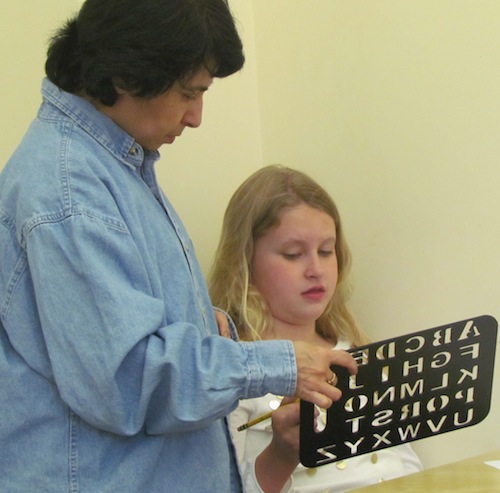
Soma Mukhopadhyay's First RPM session with Emma ~ 2013

Soma Mukhopadhyay’s First RPM session with Emma ~ 2013

A “Miracle” or the Norm?

Years ago I saw Autism is a World, about Sue Rubin who is non-speaking and Autistic.  I was amazed by her and thought how incredible she was.  I had similar thoughts when I read about Tito Mukhopadhyay, saw the news program about Carly Fleischmann, watched and listened to Amanda Baggs‘ You Tube video… there were others, all non-speaking for the most part, all Autistic and each time I was struck by how “miraculous” they were.  They gave me hope, but each one, individually, seemed incredible, too good to be true.  The word “miracle” implies a rare occurrence.  I didn’t dare believe any of these Autistic people were indicative of a larger truth.  When it came to my daughter, I could not make the connection.

I have to interrupt this post for a second because last week I went through the blog and deleted all the posts I thought might hurt my daughter’s feelings if she were to ever read them or ask me to read them to her.  (That I realized I needed to do this, is yet another example of how far I’ve come!)  I am not trying to erase the truth or the past, I just do not want those posts in the public domain for all to view, at my daughter’s expense.  I do not want people coming to this blog to read an old post and leave thinking I am supporting or encouraging people to try any of the various treatments we once did.  There is plenty of negative, stereotyped thinking going on when it comes to autism and Autistic people, I don’t want this blog to be one more place people come to read that.

As I was going through old posts I was confronted with the level of panic and desperation I felt not so long ago.  I was confronted with how completely I had bought into the way autism is represented in the world, encouraged by the media’s representation and the public’s ignorance of it.  None of which is in accordance with these stories of Autistic individuals, unless they are “miracles”.  So when I heard about people like Carly and Tito and Sue, I could not make the leap required to apply what they were accomplishing, to my daughter who was then in a private, special education, school being taught the same fairy tale going on two years.  A place where, as well-meaning as they certainly were, they were not taught or trained to presume competence of their students.  The curriculum, if you could call it that, was not remotely age appropriate, yet she was loved and safe, though not challenged intellectually; it seemed it was the best option available to us.

I was fortunate.  I had some terrific people who recommended books and documentaries that I’ve included on the Resources page of this blog.  I was asked to speak at the Autcom Conference and met a great many more Autistic people who do not speak or speak intermittently or un-reliably, but who are communicating a great deal.  So many, that it finally began to occur to me that maybe, just maybe, my daughter might be one of them.  Perhaps they were not the exceptions, perhaps she too could learn to communicate as so many of the Autistic people I was meeting were.  And once I made that connection, once I stopped viewing each person as a miracle, but began to wonder whether given appropriate accommodations this was more the norm, than not, that was when I was able to understand what practicing presuming competence really meant.  And the more I was able to do this, the more my daughter rose to the occasion.  The more she proved she could and did understand, the more I presumed her competence and on it goes…

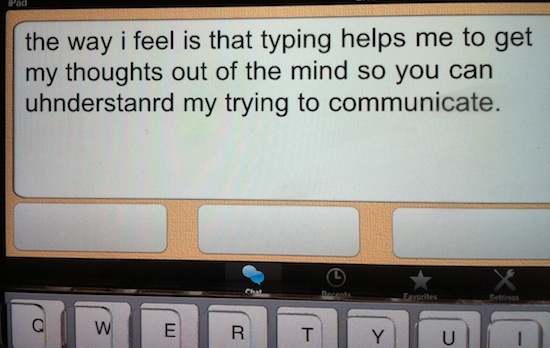
Em types us a message that astonishes us ~ April, 2013

EmTypes ICI

“Proof” of Competence

Last night I asked Emma, “Do you want me to read Anne of Green Gables or something else?”  I was seated at the computer responding to a comment left on yesterday’s post.  Em was leaning over my shoulder looking at the computer screen.  She pointed and said, “Look!  There’s Harvey and Tracy and Pascal!”

“Yeah!  I’m just finishing up here, Em.  Did you brush your teeth?”

“Uh-huh,” she answered.  Her one hand gently rested on my shoulder, her head about an inch from mine, she twirled her string and continued to peer at the screen.

“So Em.  Should I read Anne of Green Gables?”

“Nah.”

“Oh!” I said, surprised.  Turning toward her, I looked at her, “What do you want me to read then?”

“This,” she said pointing to the screen.

“You want me to read the blog to you?”

“Yes,” she said.

I mentally scanned yesterday’s post, suddenly wondering if I’d written anything I would feel badly to have her read or hear.  And as I did so, I marveled that this was something I was having to be concerned about.  Several years ago, had someone cautioned me to be careful about what I wrote on this blog and gave the reason for their concern as one day my daughter would express an interest in reading it, I would have laughed and assumed the person did not understand my child.  The idea that my daughter would be interested in anything I wrote, let alone anything I wrote on a blog about autism was the LAST thing I was worried about.  And yet, last night, there I was, and not for the first time, rereading a post I’d written with a critical eye.  This says far more about me and my limitations in imagination, as Anne of Green Gables would say, than about my daughter who continues to surprise, astound and prove us wrong.

That my daughter continually “proves us wrong” is something I am working hard to change, because again, this says far more about me and my limited thinking than it does about her.  Why should she need to “prove” anything?  So many of the various therapies used for Autistic children spend an inordinate amount of time requiring our children to “prove themselves” to us.  Often, having done so, we then change the question or the format, suggesting that this is for their own good as they need to “generalize” the information.  We ask again, insist that the answer be given within a certain time frame, insist that it be given with specific wording or in a different format, as though their first answer wasn’t enough to convince us.  Who exactly is benefitting from these exercises?  We say we are doing this with their best interests in mind.  We tell ourselves we are “teaching” and this must be done in order for them to learn, but it seems to me, it is often the other way around.  It seems to me these exercises are done to convince the skeptics among us.

We do not treat our Autistic population as equals.  We do not presume Autistic people are competent, often we believe they are incompetent and ask that they prove to us their competence again and again.  We pity them and often their families too.  Organizations set on “helping” those who are Autistic discuss their work initiative programs, their mentoring programs, (almost always it is non Autistic people mentoring those who are Autistic) yet fail to see how their well-meaning programs are biased, do not presume the competence of those they suggest they want to help, do not include Autistic people in the planning and implementation of such programs and express shock when their various programs are met with resistance within the very population they say they are helping.

This is really at the crux of the most astonishing thing I’m learning.  It is not that my child is limited.  It is that I and others like me have been limited in our thinking about her and those like her.  It is this, that I hope I will see change in my lifetime.

“Read the blog,” Emma stated as she crawled into bed last night.

And so I did.

Nic and Em ~April, 2013

Nic & Em