Tag Archives: non-speaking

Sensing Another

Last week I wrote a post, Speaking vs Typing, which sparked a terrific discussion about language, communication and how we interpret what others say and do.  My friend Barb, who wrote (with Lois Prislovsky) the not-to-be-missed book, I might be you commented:

“my dear neurotypical friends, first, let me say i love that you all are putting your heads together to break down this truth into practical ideas to help me and my autistic peers who struggle mightily with spoken language communications. em is right, “language is an awkward way to communicate” and i argue that is true for everyone but highly challenging for those of us who are autistically wired in the “vanilla cake” or “mail truck” way that em and i are. it took me years to think in language. but prior to that my thinking was not faulty it was just not language based. thinking in language is not efficient for me. i wish i could give you a pretty little fact package about what works so folk like me could get such treatment and soar socially and academically. of course, the problem is…it is hard to say in language. typing makes it way easier, because i can control the speed of each thought and break it down to smaller parts to be better described by letters one peck at a time. speaking requires a rather unnatural process for me perhaps like you singing a song you heard in another language. u may be able to imitate the sounds but the meaning in each mimic is not precise. since most folk are not yet well practiced in telepathy the best way for me now is to communicate through typing. but still my thinking is not easily translated in to words. feelings, sensations, visions and perceptions that are cleanly processed in my mind dont fit well into letter symbols. there i said it – or something close. thanks for caring. trying b”

Barb’s comment made me wonder whether my daughter is able to “hear” my thoughts, even if just a little.  And that if she were able to, it would make sense that either typing or speaking would feel like an inferior, less efficient form of communication, perhaps it would be viewed as somewhat barbaric, and certainly a less sophisticated way of communicating.  So I asked her, “Can you hear my thoughts?”  To which she answered, “No.”  Not undone, I asked, “Do you feel them?”  To which she did not reply.  This post is not about mental telepathy, but is more about how we sense each other.  Some of our senses we are taught to fine-tune and others society either doesn’t recognize or doesn’t place as much importance on.

But what if we lived in a culture that did encourage sensing another’s presence and feelings?  What if, from the time we were born, our sense of other people’s state of mind, their feelings, was nurtured.  Would that change how we communicated with each other?  What if spoken language took a back seat to our intuition?  What if we lived in a society that placed more importance on our presence, than on our words?

All of this reminded me of a conversation I had with a couple of friends, both of whom are Autistic, about disability and society’s role.  I wrote a post about that, ‘here‘.  One friend said that if we lived in a world where everyone used a variety of alternate forms of communication, where a longer time period was allowed and expected between words, and supports were anticipated and provided, then people who do not speak would not be considered disabled, just as I am not considered disabled because I cannot juggle or jump as high as an Olympic high jumper.

If children were taught at an early age to sense each other without relying on language, would we evolve into a species where language was viewed as unreliable and untrustworthy?  Does my daughter view language as a lesser form of communication?  Is she not as motivated to communicate, either through typing or verbally because her other senses are more finely tuned?  Does motivation even enter into all of this?  My brain is constantly looking for intent, motivation, but what if this isn’t what’s going on at all?  What if this has nothing to do with any of that?  What if she is trying so hard to communicate by typing and speaking because she understands I want her to, but not because she has the same need that I have?  Does music call to her because it is less about the lyrics and more about the beauty of the music, the feelings the music evokes?

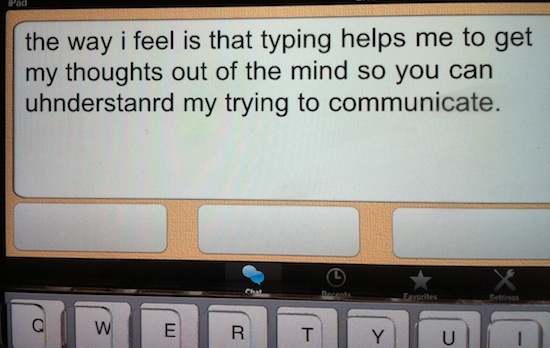
Is all of this way too esoteric and ethereal?  EmTypes ICI
 

The Snowball Effect

The snowball effect began with, what I now think of as, a leap of faith.  Richard and I leapt into that great abyss better known as the unknown.  It turns out this was actually not true, it would be more accurate to say we chose to neither believe nor disbelieve, but instead began to examine all we were being told.  Perhaps it’s better to say that instead of leaping into we jumped out of.  From there it was more of a hop to begin presuming competence.  However, as a commenter on this blog said, “presuming competence isn’t enough.” And knowing what we now know, I have to agree.  It’s the starting point.  It’s like that initial leaping off point, it’s just the beginning.

At the moment we are experiencing something akin to being in free fall.  It’s the feeling of discovery, limitlessness, surprise, and pure ecstasy that comes with being present without expectation or preconceived ideas about what should or will happen.  Our perspective continues to change as we move along.  Like any great adventure, the path is at times rocky, but the triumphs are exquisite.  As we move deeper into this process it becomes easier and more familiar to be solidly in the discomfort of the unknown.  There is bliss in that.  True bliss.

Last fall I wrote a post about how I was worried Emma was not comprehending a story that had been sent home in her back pack from school.  It was a simple story, perhaps 1st grade level reading with some questions that she seemed unable to answer.  In the post I write how I am trying to find ways to help her reading comprehension.  I talk about presuming competence.  What I am struck by now is not Emma’s level of supposed incomprehension, but by my own.  I reread all the comments just now and am amazed, amazed that though I thought I was presuming competence, I was only able to go so far with my presumptions and, as it turns out, wasn’t going far enough.  I could only presume as much as my limited thinking would allow me.  The idea that she was not only comprehending this story, but was so far beyond it, was not something I was capable of fully understanding, let alone considering.  I was much more stuck, as it turns out, than my daughter was.

Now jump forward to yesterday afternoon, almost nine months after I wrote the post I refer to in the above paragraph.  Emma chose to talk about adjectives.  We watched the BrainPop movie about adjectives and then she took the quiz.  I copied what Rosie had done, asked her to read the questions silently to herself while using a laminated card to direct her visually and then quickly guided her to read each of the four multiple choice answers.  She only hesitated once, on a question about a possessive adjective, but otherwise breezed through the quiz with 90% accuracy.  Not only was Emma reading faster than I was able to, but she was accurately answering the questions faster than I could read them, let alone answer them.

The snowball effect:  “The basic workings of a literal snowball effect can be illustrated by taking one’s average baseball-sized snowball and dropping it down the side of a snowy hill. As it descends it gathers more snow and whatever leaves, sticks, etc. are in its way. The snowball accumulates not only size, but speed.” ~ From the Urban Dictionary

Self Portrait

photo

Emma’s Story

Emma told me I could post her story on here this morning.  This is a story she wrote yesterday with Rosie (Rosemary Crossley).  Rosie developed a technique more than thirty years ago to help people with a variety of issues, specifically those that make speaking difficult or impossible .  Em held onto a tube with one hand while Rosie held the other end as Emma typed.  Rosie began yesterday’s session by asking Emma to write a story that began with either, “once upon a time” or “one day.”  I was standing near Emma, with Richard, Joe and Em’s teacher, Katie, all watching as she typed the following.

“One day there was a boy called george. He had been in afight can’t tell you how he got into the fight but he was bruised all over.  He fought a lot and his teacher was very angry.  The next day he was all purple and his mother said you can’t go to school looking like that.  The very clever boy covered himself in flower and his teacher thought he was sick and sent him home.  The end.” 

Not sure I can actually continue writing here…  but I’m going to try… *Breathe*

I have read this story more than a dozen times already.  I know I’m totally biased, but I’m just going to say it – what an incredible story!  There are so many layers to it.  This story that Emma wrote with great concentration, with little pause is the first story she’s ever written.  She was focused and when asked about the word “flower” she verbally said “powder” in explanation.  Rosie explained that flower/flour are words that sound alike but are different in meaning.  Rosie explained that the powder kind is spelled “flour.”

But there’s more…  A little later Rosie brought out a math app called Math Magic where Emma proceeded to zip through addition, subtraction, multiplication and division.  None of this is particularly noteworthy, except that Emma has never been formerly taught division.  She was choosing the correct answers from a field of four.  A sample equation is:  “56 ÷ 8” and the multiple choices available were: 2, 9, 7, 6.  Emma chose the correct answers independently.    Allow me to say that again.  Division.  Emma chose the answers independently.

It was at this point that I felt so many things all at once it was almost impossible to speak.  But more than anything I kept thinking about how we continue to underestimate our daughter.  I had no idea she could do division.  Not only can she do division, she can do it quickly.  There’s another app Rosie recommended – Brain Pop and Brain Pop Jr. which Emma also did as we watched.  Not only did she listen to the short lesson, but then read all the questions silently, read the multiple choice answers and chose the correct answers.  It seems verbal speech is tricky, particularly when she is expected to answer questions verbally.  When asked to read silently and then identify the correct written statement by pointing to it, Emma did beautifully… about Ellis Island, no less!  The only interaction Rosie provided with both the math and Brain Bop was to use a laminated card that she silently moved across the words as Emma read and she did not allow Emma to point to any answer until she’d finished reading all the choices.

I cannot imagine how awful it must be to be so capable and yet treated as though you were not.  I imagine it must feel like being “bruised all over.” I imagine it must feel like you “fought a lot”.  My wish for my daughter is that she may continue to do all that she is doing, while we provide her with every opportunity to flourish and continue to show the world how very “clever” she is.  The only limitations are the ones we provide.

I am incredibly grateful to all who believe in her, all who have helped and who continue to help us so that we can be better parents to our daughter.  The list continues to grow…

Rosemary Crossley

Rosemary Crossley

The Teen Behind the Blog

There’s a blog called, TeenTyper, written by someone who describes himself as, “an autistic teenage awesome boy.”  He started his blog two years ago when he was 14 years old.  On a recent post he wrote, “the feeling is bold saturated thimbles of strength.”  Em and I had the honor to meet the young man behind the blog while in Syracuse.  As he also lives in the same city as we do, we got together with him and his mom yesterday.   He is non-speaking, but types and so he and Em typed to each other for a little while and then I asked if it would be okay to talk to him about his blog.  He said it would.  I asked him, “Why did you start writing your blog?”

He typed, “i startd because my aggravation abt my spaz speaking.”

This is from his Subway Poem

“Subway subculture asserting the stroll
I watch and try to look like another old soul…”

Later I asked him, “Is the blog a place where you want to tell people something specific or is it more a general way to communicate your thoughts, or something else?”

He typed, “neurotypical need to be more conscious abt mean stares and hearing my voice will help them understand who I am.”

From Let me say:

“Before you judge let me say
You need to try being me
Before you judge let me say
I feel awful when you overly stare at me
Before you judge let me say…”

We need to be aware of the harm we do to each other with our judgments and implied criticism.  We need to pause and take our time.  We need to give each other the benefit of our kindness, we need to slow down…  we need to talk less and feel more, we need to give one another the gift of acceptance, we need to stop with our projected fears, our desire for sameness, our impatience, our disregard for another’s humanity…  we need to embrace one another.

From Wasted Words:

“Words wasted on nonsense
Still
Define…”

I urge everyone to go over to TeenTyper and give it, and the “badass awesome” teen who writes it, some love and support!

The ICI Conference – Day 2

Anne DonnallanDr. Anne Donnellan, Professor in the School of Leadership and Education Sciences at the University of San Diego gave the keynote address yesterday morning.  She said,  “I’m very happy to say, when it’s true – I don’t know.”  This sentence should be framed and placed inside of every doctor’s, educator’s and professional’s office.  In fact, this should be in every human being’s home, office, place of work, car… well, you get the idea.  Anne went on to say, “If you don’t know the answer, if you’re not sure, what are you going to say?”  She waited for those in the audience who speak to shout, “I don’t know!”  I have pages of notes from Anne’s speech which centered on how autism is mischaracterized as a communication, behavioral and social deficit, yet the massive sensory-movement issues that most Autistics experience is completely ignored.  Early in her presentation she said, “We didn’t notice people with autism have bodies.”  And a little later she said, “We tend to invent knowledge.”  I will be reading Anne’s book, Autism: Sensory-Movement Differences and Diversity by Martha R. Leary and Anne M. Donnellan.

The bulk of the day was spent supporting Em in her typing.   (I dreamt last night Em had taken over Emma’s Hope Book Face Book page!) Our session with Rosemary Crossley was terrific, with a young woman who is aiding Rosie, and all of twenty years old, came over and expertly supported Em in her typing.  Em proceeded to inform us that “math is not my favorite subject in school” and “The subject I like is english.”  Which… yeah…  because excuse, me young lady, but there’s this blog with YOUR name on it, all set to go!  Trying hard to contain my excitement.  Em then typed, “I am very creative.”  And in answer to my question about whether she’d like to maybe write something for the blog at some point, she typed, “I would like that.”  Yet as I write this, I paused just now and asked her if she’d like to write  something now, to which she gave me a resounding “NO!”  But she did say that she didn’t mind if I quoted her in the sentences above.  This is a work in progress for both of us!

Emily and Mark UtterAfter lunch Em and I watched a wonderful documentary by Mark Utter called, “I am in here.”  Before the movie began Mark typed, “i am totally happy you all are moving with me down this fine river.”  Mark is wonderful, and I have to say, he is one of my new favorite friends, even though we have exchanged few words.  I intend to devote a post to his creative and moving movie about what daily life is like for him and how he would respond to people were he able to talk.  Mark is one of a number of people we have met that I hope to stay in touch with.

PascalLater Em and I met with another family who also live in New York City hoping to have a conversation between Em and a non-speaking teen.  Pascal agreed to help facilitate, but as it turned out, I was able to work with Em pretty well with only a few pointers from Pascal.  It was a great day, though it’s really hard work for Em.  Later she typed with Pascal, “Much of my work with people is patterns and things like spelling is like that…”  And then she added, “And I love to work with Pascal.”
This photograph of Pascal was taken by Emma.

I must end this post now, but not before saying, these conferences are profound.  They are profound because of how they are completely unlike the world we live in.  They include, embrace and celebrate difference.  Every person is treated with respect.  People are allowed to be, without judgment.  It is bittersweet to be here, because this afternoon we will have to leave and return to the world that is not even remotely like this tiny piece, of what can only be described as, paradise.

From Cure to Celebration

Yesterday Richard wrote a wonderful post on his blog entitled ~ Happy Father’s Day.  In it he talks about being a father and how having children has changed him and his life.  He ends the post with, “To all our children, thanks for making our lives matter!”  I love that.  That’s it, right there.  That’s the feeling I’ve had, but couldn’t find the words to so beautifully or succinctly express.

Richard also wrote, “…We got a beautiful boy, Nic. Eighteen months later, we got a beautiful girl, Emma. One of each, as they say. We got “one of each” in another way, too. One autistic, one not.”  I read that and smiled, because it’s so true.  We have been fortunate enough to have a child of each sex AND of two different neurologies!  Three years ago I would not have been able to write any of this, I was still in the – Autism is tragic – mindset.  But happily all of that has changed. Some people object to those of us who have chosen to celebrate our child’s neurology.  They say we are sugar-coating what is real and difficult and makes it seem less serious than it is.  I disagree with that thinking.  I think we can still acknowledge the massive challenges our Autistic children face in this world, while still celebrating who they are and the beauty of their specific way of thinking and being.

I do not, for a second, believe that my daughter has an easy time or that she will not face all kinds of things a non Autistic peer would not have to deal with, but I do not need to increase her challenges by not accepting her, believing in her and celebrating her, exactly as she is, now, in this moment.  Adding my expectations, despair and ongoing critique and comparison of her, to the very real issues she must cope with on a daily basis does not make her life easier.  And I really want to make her life easier, not harder.  I’d like to be the person who champions her, makes the bumps she will inevitably face a bit less bumpy and help her navigate some of the twists and turns of life, by giving her acceptance and unconditional love for every aspect of her being.

I keep thinking about all our children who have trouble speaking, how when they are able to communicate in some way, either through typing or speaking, we non autistics are far more likely to listen and assume intelligence than not.  I keep wondering what would happen if all our time, money and energy were spent on finding ways to help our children communicate through typing and other AAC devises, instead of on cures; would we see a shift in society’s perception regarding autism?  Or would all those people dismiss their words because they are written and not spoken?  Amy Sequenzia writes about this ‘here‘.

You see, we were one of those families who pursued the bio-med route.  For years I tried all kinds of things, thinking we could cure.  As long as I believed in a cure, everything else took a backseat.  What I didn’t realize was that accepting and celebrating my child, fully and without amendment was the answer I had been looking for in all those doctors and specialists who claimed cure remedies.  The remedy wasn’t a cure, the remedy was celebrating the child I have, exactly as she is – that’s the remedy.

Nic & Em


But What About Alex?

Another Autistic child has died… stabbed… multiple times, in the chest, by his mother. Alex Spourdalakis was 14 years old.

The mother of a 14-year-old with severe autism who was found stabbed to death…” ~ Daily Herald.com

But what about Alex?

The mother of a 14-year-old with severe autism…” ~ Pantagraph.com

But what about Alex?

First degree murder charges have been filed against Dorothy Spourdalakis, the mother of a teen with severe autism…” ~ abclocal.go.com

But what about Alex?

A young man. Stabbed. Not once. Multiple times.

We hold these truths to be self-evident, that all men are created equal, that they are endowed by their Creator with certain unalienable Rights, that among these are Life, Liberty and the Pursuit of happiness.” The United States Declaration of Independence – 1776

But what about Alex?

In the 237 years since those words were first written we have failed miserably at putting this idea into practice. All human life is not treated as equal; apparently it is not “self-evident”. We continue to live in a world where equality is still desperately sought by a great many.

For those who are born unable to speak and Autistic, those among us, who are given the label “severe”, their lives matter even less. We not only think of ourselves, (those of us who are able to speak and whose neurology is not Autistic) as superior, our lives deemed more worthwhile, but we are reminded of our superiority every single day of our existence, just as those who are born unlike us are told in myriad ways how they are not.

Autistic people, particularly those with multiple physical challenges, are spoken of as “burdens” to society, they are talked about as though none who are Autistic are capable of understanding the words being used to describe them. They are not consulted. They are not listened to. For the most part they are being ignored. And those who are raising their voices in protest, who dare to speak out against the crimes committed against them, they are met with resistance, anger, indignation. They are often ridiculed, dismissed, silenced or simply ignored.

When a parent murders their child, we cringe in horror. When that child is disabled we sympathize. The media brings in psychologists to help us understand. We dissect the child’s history, we look for clues, what could have provoked a parent to do such a thing? Sometimes we conclude the parent was crazy and unfit, but not before we make sure there was nothing unusual about the child. As we rally around, trying to distance or identify with the parent, Alex and those like him are all but forgotten. His life is seen as an example of what some must endure. His life becomes an illustration of that burden on society that everyone wishes would just go away.

But what about Alex?

What about what Alex had to endure? What about what it must have been like to live his life for those 14 years? Where are the news articles discussing who this young man was? What did he love? What were his passions? What made him happy? What must it be like to not be able to speak? Did he communicate through typing?  Did he read and write and if so what did he like to read?   What was his favorite subject?  Did he love music?   Did he like animals?  Was there something special he enjoyed doing?

What about Alex?

Alex


The Audio Book for “I Might Be You” is Here!!

Barb Rentenbach’s fantastic, funny, poignant and beautiful, must read book, I might be you. An Exploration of Autism and Connection is now available as an audio book!  Full disclosure:  Barb, who is non-speaking or “mute” as she describes herself, and Autistic, asked me to be her voice for the audio book, an honor I cannot begin to fully express.   I do not receive any proceeds from the sale of the audio book.  The payment I receive is the joy I feel knowing that Barb was pleased with the end result.  It is a joy that is literally priceless… That all of you, who purchase the audio book, may benefit from Barb’s hard work is the metaphoric icing on an already sumptuous and exquisitely rich cake.

Barb is non-speaking and writes with a sharp-witted, R-rated, take no prisoners eloquence.  She is brutally honest in her description of her life as someone who is often mistaken as someone she is not.  For anyone who has ever felt they are on the fringes of society, felt they didn’t “fit in”, judged, seen as an “outsider”, as “other”, as less than, this book will resonate.  For anyone who has ever felt insecure, shunned, rejected, judged, criticized or misunderstood, this book is for you.  I Might Be You is about how we are more alike than not.

In preparation for this post, (and a version of this that I will be submitting to the Huffington Post) I asked both Barb and Lois Prislovsky, Barb’s therapist and co-author of I Might Be You to give me their thoughts on the making of the book and subsequent audiobook.  Lois wrote: “Barb typed, “being heard may be as close to helping to cure all that ails ya as one prescription gets.”  I agree.  As a psychologist, I get a daily front row seat to this truth.  What I find most remarkable about Barb is not her spectacular growing wisdom, wit, or even her gifted powers of perception.   It’s her patience that I think is unparalleled.   This book literally took her over 10 years to write one disappointment, milestone, and letter at a time.  My chapters were faster because as Barb says, I am, “less interesting”.  No one book or person has taught me more.  Barb is my favorite author and teacher.”

It took Barb ten years to write I Might Be You because she knew there would be those who would doubt the words in the book were her own and some who would even accuse her of not typing this book herself as she first learned to type with a facilitator.  Determined, she spent ten years learning to type independently, each word spelled out, one index finger jabbing at a letter at a time as she pushed beyond her physical and neurological challenges that made typing completely on her own so very difficult.  Ten years.

I asked Barb to weigh in on what it was like for her to hear her words being spoken out loud by someone who not only was not autistic, but who needed a great deal of direction during the recording!  By the way, Barb was a terrific director: kind, patient, encouraging, yet exacting and uncompromising in her insistence that her words be given the voice she needed them to be.  I wrote about my experience of recording her words ‘here‘, ‘here‘ and ‘here‘ on this blog.  But this post today… this post has to be Barb’s words, Barb’s experience written in Barb’s voice and not mine.  This is what Barb wrote to me:

“health: the state of being free from illness or injury.

“in preparation for this piece, az asked me to “let me not speak for you but rather hand the huffpo mic over to you”.

“i think she just cured my autism.  and what a great slogan ‘mics to mutes’ makes.

“before some poor clerk from the dmv (department of miracle validation) at the vatican calls my number, please know I am still an autistic mute so it will just go to voice mail.  but, i have finally been freed from 4 decades of ills.  it turns out being heard may be as close curing all that ails ya as one prescription gets.

“for 40 years, autism has been seen by all to hold me back.  today, autism propelled me forward as my whole self towards my life’s goal of being a successful writer.

“am i dreaming? yes. and this dream i hand pecked.

“az asked specifically what is my experience of hearing my words being read by another.

“well, it is healing.  for several years now, people have read the words i typed and that has allowed me to accomplish a more independent and quality life.   but those words were read.  meaning people ran them through their personality filters and voice boxes and simply got my gist.  the gift az is referring to is completely different.

“my lourdes miracle cure happened at the hangar studios in nyc.  there, my great difficulties in communicating and forming relationships were lifted – permanently.  this spectacular healing happened when a beautifully open woman with a strong, feminine, and southern twang free voice gifted me what i lacked with no cords attached.   my not so virgin az appeared and did not read my gist.  she got out and selflessly let me drive her luxury voice for a full week to transport my 10 years of pecked letters to let my 40 years of not talking be heard.

“i still don’t look normal.  i appear quite messed up and a prime candidate for nothing but pity and patronization with a sprinkling of repulsion and fear. i am disguised as a poor thinker with a filthy squeegee whom most veer to avoid.  so why did az give me the key? because I asked.

“like me, like you, like “THEM”, poetry is best heard.  two of my favorite lines from derrick brown’s poetry are, “dumb as a bomb on a boomerang” and  “kiss like u couldn’t beat cancer”.   being heard is key.

“we are all each other’s cure.  god cares about us all through us all.

“please say this out loud as i am borrowing your voice to be heard again (only a lunatic would give up voice jacking at this point.  plus think of the icky karma involved if one denies an autistic mute such a simple request.) : “i will not be as dumb as a bomb on a boomerang.  i will be here and hear like i couldn’t beat cancer so today i free myself and others from illness and injury.”

hear and ask to be heard.

“thanks for listening.  healthy b”

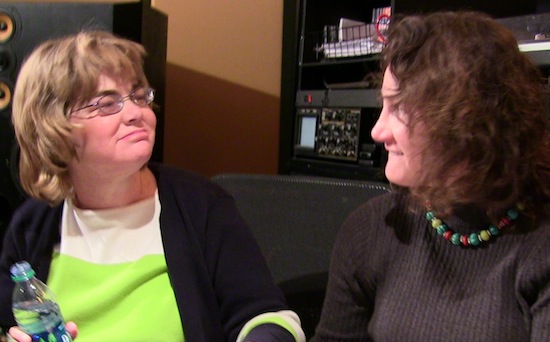
Barb and Lois at Hangar Studios in New York City ~ April, 2013

Barb & Lois


The Wisdom of Peyton Goddard

Peyton Goddard, wrote a memoir with her mother Dianne Goddard and Carol Cujec entitled, i am intelligent.  It is an unforgettable book.  Recently, Peyton gave a presentation in San Diego, where she typed, “After decades of torture, still each dawn I struggle to feel my worth.”  You can read her entire presentation ‘here‘.

“After decades of torture, still each dawn I struggle to feel my worth.”

Peyton was not tortured by her autism.  Peyton was tortured by non autistic people who cruelly and viciously hurt her over and over.  People who used the fact that she could not use her voice to speak to protect themselves.  I would like to believe we are moving away from a world and society where abusing people we have deemed “inferior” is done.  I would like to believe that, but I cannot.  The abuse of Autistic people at the hands of those who care for them, whose job it is to help them, continues.  The abuse of Autistic people by society, continues.  The abuse of Autistic people by those who are either ignorant or misinformed continues.  The abuse of Autistic people by those who pretend it isn’t abuse because they choose to believe Autistic people are incapable of feeling or really understanding what’s happening to them and therefore it’s okay, continues.

“Estimate I that anger in this pesty world is because pierced persons think hurting others will strip their own hurts away.” ~ Peyton Goddard

In her book Peyton writes about forgiveness.  Forgiveness of those who have hurt her the most.  Peyton Goddard is leading the way, with wisdom, kindness, forgiveness and compassion.

Peyton Goddard – a non-speaking Autistic woman, assumed incapable, presumed incompetent – has a great deal to teach us.

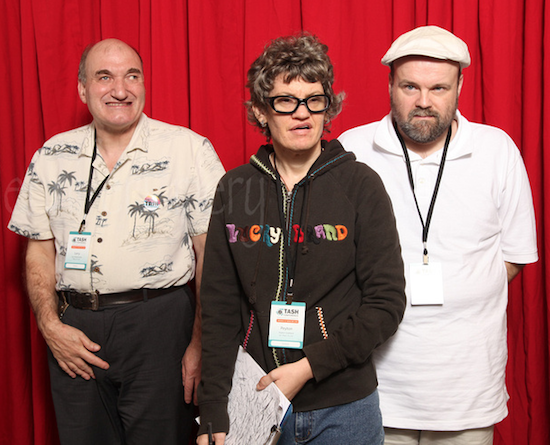
Three Non-Speaking “Teachers”:  Larry Bissonnette, Peyton Goddard & Tracy Thresher

TASH 6

The Audio Book is Finished!

Barb’s audio book is finished!  Ol’ Barb had me quoting Shakespeare, Stephen Hawking, Ralph Waldo Emerson and many others, as well as her own words…  It was an incredible process, with me wearing headphones, seated in front of a microphone in the sound room (or as I called it – the cave), while Barb and Lois (with Chad, the wonderfully upbeat and accommodating sound/tech guy sat in an adjoining room with a huge picture window so we could see each other) gave me direction, sometimes with hand signals, but more often with Barb typing her instructions, which Lois then read.  Chad alerted me to any technical issues that arose such as when a word sounded scratchy or slightly garbled or if I forgot a word or said a word incorrectly.  All in all it took more than 20 hours, probably more than 30 all told to record.

I am told the audio version of I might be you will be available for purchase and your listening pleasure by next week, but I will leave a link here when I have one.

In other news… I am doing a webinar on Parenting Toward Acceptance, Monday April 1st at 4:00 PM  for DIR Floortime, ICDL with Brenda Rothman, Mother and Blogger – Mama Be Good and Melody Latimer, Mother, Blogger – AS Parenting, Autistic Self-Advocate and Director of Community Engagement, Autistic Self Advocacy Network, ASAN.  I will leave a link Monday morning when I have one.  Until then have a lovely weekend everyone!

Directed by Barb

Barb is a wonderful director.  Here’s an example of yesterday’s adventures and challenges for this verbal, literal-minded, non Autistic as I did my best to embody Barb in all her mischievous, non verbal, antics as described on page 56 of her book, I might be you.  This passage took me more than thirty minutes to get right:  “Freedom.  But the mission is far from complete.  No middle-class chain-link fence to hop and then pay dirt.  No, Sir, our musty mansion sits on acres of green, rocky earth dramatically sloping to the Tennessee River.  I take ever caution to avoid a tumbling fate.  Even the most mischievous princesses don’t swim in dirty water – Southern daddy saviors or not. I assume my most stable forty-five-degree stance and horizontally hike to the neighbors’ inviting castle, remove restricting PJs, and let the fun begin.

 “I think, Wow!  The water is so cold it may make my heart stop.  This sure beats picking or rocking stimulation.  I consider holding off on my 3:00 a.m. phone call-evoking mimicry because I fancy enjoying a longer prerescue soak.  Alas, my scrawny self control fails me again and I sound off with a loud medley of “”you are not going,” “You can’t get in the mail truck,” It’s a fire,” and other such bizarre phrases the sleeping wealthy find disturbing when emanating from their private estate.”

This isn’t a silly story about some southern belle with far too much time on her hands who is up to no good because she’s bored and wants to piss Mom and Dad off.  No, this is a description of Barb’s elopement in the middle of the night to skinny dip in a neighbor’s pool.  It’s funny, but it’s also not funny.  It’s poignant and powerful and yet it says as much about us “normals” as Barb describes those who are not Autistic, as it does about Barb.  Straddling that precarious razor-sharp edge of self-deprecating humor while not holding back any punches is what Barb does best, but say these lines out loud without the right balance of self-reflection, honesty, desperation and rage as well as humor and all those beautiful words Barb painstakingly wrote are lost.

So after each sentence I would glance up waiting for Lois to give me the thumbs up signal before moving on.  On that particular passage there were no thumbs up.  Instead I could see Barb’s bent head as she madly typed things like, “AZ you’re doing great.  But you have to give this more power.”  or “okay AZ you’re taking it too literally, you need to loosen up.” or “Again.   Not so monotone.” And so I would do it again.  And again.  And again.   And again.   At one point I had the thought – I’m not going to be able to get this.  But then I looked over at Barb rapid fire pointing at the letter board and I thought, Damn it.  I will get this.  I have to.  For Barb.  I have to get this right for Barb.  And then I’d take a deep breath and try again.  Because she has trusted me with her words.  She has given me the greatest privilege a person could give another, she has asked me to be her voice.  And that.  That is the single biggest compliment I have ever received from another human being.  And I’ll be damned if I don’t do her words justice.

As a quick aside, y’all (that’s for you, Barb) will be pleased to know I whipped through Chapter 7, which is entitled:  Autistic Sex:  For a Terrible Time, Call.  Because when the words are raunchy that whole upper crust, uptight, WASPY thing works beautifully and it’s funny just because the two are a perfect blend  of lewd and classy, which is… funny.

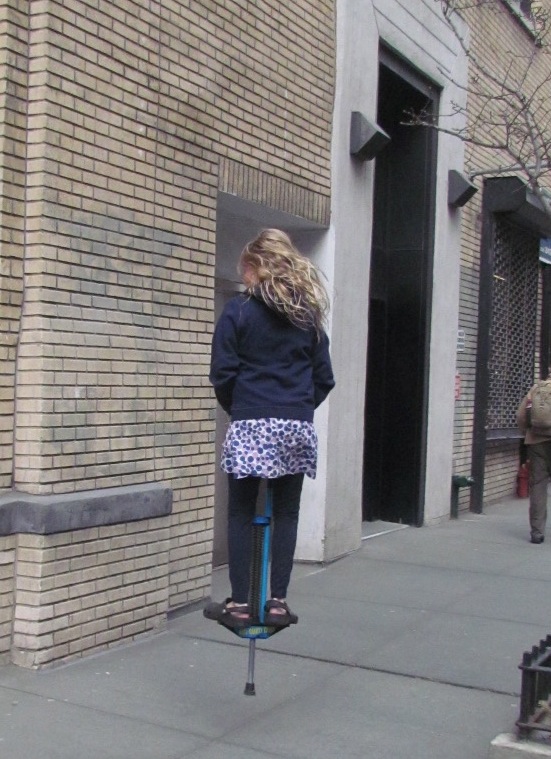
Em shows Lois how to jump on a pogo-stick

*Em on the pogo-stick

The Barb Show…

I’ve written before ‘here‘ and ‘here‘ about how I don’t always get jokes.  It’s not that I don’t have a sense of humor, it’s just that a great many jokes are hard for me to understand why other people find them funny.  Jokes or anything that starts with the words “Two” (of anything) “walk into a bar…”, or The Onion, (I can’t tell you how many times Richard will thrust some headline from the Onion at me, only for me to say, “wait, what?  I don’t get it.  Why is that funny?”) fall flat.  At this point, Richard now tells me jokes or shows me things that he knows I won’t laugh at because he finds my response as funny if not funnier than the actual thing.  Apparently humor is all the more so when someone is completely clueless. I’m good at that – playing it straight.  

For those who follow this blog, you know by now that I am in the recording studio all week recording Barb Rentenbach’s terrific book, I might be you.  Barb has a wonderfully nuanced and, at times, sarcastic wit.  I can do sarcasm, and wit for that matter, except, as it turns out, when I’m reading aloud someone else’s words.  In addition to this challenge of mine, when I’m nervous, my blue-blooded-upper-crust-WASPy heritage becomes even more pronounced.  So when I’m reading some of Barb’s naughtier bits, not only do my cheeks turn quite pink, I also pretty much stomp all over the delivery of a number of her otherwise humorous sentences.  Because if you read a sentence that is funny as though it weren’t and said it straight, carefully articulating each word as though doing an exercise in drama class, the humor is completely and utterly lost.  The only analogy I can think of that captures this is, imagine reciting the Commodore’s 1977 hit song, Brick House.  “She’s a brick —– ‘ouse, mighty, mighty, just lettin’ it all hang out…” but instead of saying the words as they were meant to be read, carefully articulate each word as though reciting a psalm in church.  I think that gives you an idea of what happened a couple of times in the recording studio.

Fortunately I do have a sense of humor and can laugh at my fumbling.  Barb and Lois were kind and patient.  Even when I had to repeat the sentence until I got the inflection right, they did not fall on the floor in hysterical laughter or poke fun.  I’m grateful to them.  Really.  Because truthfully, that had to have been pretty funny to witness.  The good news is, I was able to get it right… eventually, which is important because this book, this incredible book by Barb and Lois deserves to be heard as it was written, with elegance, eloquence, poignant power, laced with self-deprecating humor.  Every few moments I’d look up to see Barb beaming at me and Lois giving me an enthusiastic thumbs up and I would continue reading feeling exuberant and grateful to be involved in such an incredible project.

Barb showing Em encouragement later that afternoon.

Barb Rentenbach

“I Might Be You” – The Audio Version – Voice by Ariane Zurcher :)

Next week I will be in a recording studio taping the audio version of the wonderful book, I might be you by Barb Rentenbach and Lois Prislovsky.  *Doing a happy dance.  Barb asked me to be her voice a few months ago and without hesitation I agreed!  EEEEE!  Not only will I spend time with both Barb and Lois, but Barb will direct me to make sure I don’t mangle her beautiful words or trample on her often bawdy sense of humor.  It’s all in the delivery; I will do my best to make her proud.  Did I mention, Barb is funny?  She has a wonderful, edgy, R-rated sense of humor.  She avoids nothing and no topic is off-limits.  And while I’m not exactly a prude, I may get a little rosy-cheeked as I attempt to do her words justice, especially that chapter discussing masturbation, sex, or the lack of, and those hunky personal trainers who motivate her…  Taking a deep breath.  For those of you unfamiliar with the book, I wrote about it ‘here‘.  For those of you interested in purchasing a hard cover copy, and why wouldn’t you be (?) you can do so ‘here‘.  (I gain nothing from your purchase, other than the pleasure in knowing you will enjoy reading her book.)

I first met Barb and Lois at the AutCom Conference in the fall of 2012.  Their presentation was crowded, but I managed to secure myself a seat at one of the round tables.  I remember watching Barb type on a key board and being wonderfully surprised by both her self-deprecating sense of humor and how quickly she was able to type.  I admit, I couldn’t keep up as the letters whipped by while Lois read what she was typing.  Barb told of how it took her ten years to write the book because there were so many who simply did not believe she was actually writing the things that were being typed.  The assumption was that Lois or whoever was facilitating her was doing the writing.  But Barb being Barb, did not allow their doubts to stop her.  Now Barb is typing independently, her book has been published and the audio version is about to be recorded!  Woot!  Woot!

Do I need to say how excited I am?

Have I mentioned how honored I am to be Barb’s voice?

Stay tuned next week for ~ Adventures in the Recording Studio with Barb!

Less Than A Year Ago…

If I don’t immediately take notes during and after my typing sessions with Emma, I would wonder whether the words she typed were a figment of my imagination. There is something almost magical seeing and reading the words typed from someone who does not, or does not easily, communicate with spoken language.  It reminds me of the time I went to a lecture given by Soma Mukhopadhyay with her autistic son, Tito who began answering questions from the audience.  Tito is non-speaking and has a great many stims, yet translates his beautifully eloquent, poetic  thoughts into words and has no problem answering any question posed.  It’s often a disconnect for the neurotypical person watching someone who isn’t able to verbally say what they are thinking, yet has no trouble writing their thoughts, which in no way match the presumptions we, NTs tend to make.  If you’ve never witnessed something like this, it can be pretty mind-blowing, which says more about the limitations of neurotypical thinking and the constraints we unintentionally place on others who seem different from us than anything else.

Last night I began Emma’s session with a question.  It’s the same question I always ask her.  “Hey Em, how about after you sing this song we do a typing session together?”  And Emma answered, as she does every time I ask her this question, “Yeah!  Typing session with Mommy!”  Emma’s excitement, in and of itself, makes me incredibly happy.  That she’s interested and (I think) looks forward to our sessions as much as I do, makes me believe we are on the right track.  When we went into the room, now dubbed, “Emma’s office” I tried to think of a question it seemed likely Emma would know the answer to, but that if she typed it out, I would be surprised.  As we are leaving soon to visit her Granma for the holidays, I said, “When we fly to Granma’s we have to first take a taxi to an airport.  What’s the name of the airport we usually go to?”  Without hesitation, Emma typed, “La guardia”.  Wow!  Just wow!  I then asked, “There’s another airport near La Guardia, we don’t usually fly out of, but what’s the name of it?”  Emma, again, without hesitation, typed, “kennedy”.  Whoa!   Then I threw her, what I thought would be, a curve ball and asked, “When we fly out of La Guardia we always take the same airline to visit Granma.  What’s the name of the airline we always take?”  Emma wrote “United”.   EEEEEE!!!!!  Snoopy dance.  Give me a moment while I hyperventilate.  Whooooo, whooooo.

Emma went on to tell me what state and city we live in, the name of the state we were flying to and when I asked, “What’s another name for the city we live in?  It starts with an M?”  Em immediately typed “Manhattan” though she forgot the h and one of the ts.  I followed up with, “And what’s the neighborhood we live in?”  Emma, again without hesitation, typed, “Chelsea.”  Taking another deep breath.  For those of you who are doubting what I’m writing, I understand.  Really.  I do.  As I wrote above, I actually had to take notes during our session, because I knew I would come away as if in a dream.  (Ibby suggested I record our sessions together and I keep forgetting to do that, but I have to remember to from now on.)  That’s what it feels like, a dream.  I absolutely believe in my daughter’s competence.  I believe she is far more competent than most people who come into contact with her do.  I do not for a second doubt that she has a busy, complicated and fascinating mind, filled with thoughts, ideas and knowledge I can only guess at.  But to know this, to believe this, is different from being shown this.  I don’t mean to offend any of you reading this who are non-speaking and communicate by typing.  I don’t mean to offend, really I don’t.  I hope that were Emma to ever read this she will understand what I’m trying to say.  This is not about Emma’s limitations, either intellectual or otherwise, this is about my own.

For all you neurotypicals who can speak, humor me for a moment.  Think about how you would feel if you could not speak.  Think about all the things you know, but couldn’t say.  Now imagine if you were told something simple, like the city and state where you lived over and over, repeatedly, day after day.  Just think about this for a second.  Close your eyes and try to imagine what it would be like to not be able to speak.  Imagine that well-meaning people tried to help you speak through repetition and you were not allowed to move on until you were able to say these things being “taught” aloud.  Imagine how you would feel were you never able to say these things, so you weren’t allowed to move on.  It was assumed that because you couldn’t say them, you must not KNOW them. And yet, all this time…   all this time you really did know these things.  Not only did you know these things, but you knew so much more.  But no one believed that you did.  No one treated you as though you did.  Less than a year ago I assumed Emma did not know.  Less than a year ago I assumed Emma did not understand.

Less than a year ago…

Emma waiting for the school bus with her string

*Em

An Unexpected Response and The Importance of Trust

During my supported typing session with Emma Saturday evening we discussed Little Red Riding Hood.  I asked Em what she thought Little Red was bringing Grandma in her basket.  Emma typed “blueberries”, which seemed like a terrific guess, particularly as Little Red could certainly have picked them herself, placing each blueberry in her basket as she made her way toward her Grandma’s house.  We discussed the wolf and I asked questions I thought it likely Em knew the answer to, but that I wouldn’t expect her to answer verbally, just as Pascal, who is helping me, advised.  Eventually I asked, “Em, what would you do if you were asleep in your bed and woke to see the big bad wolf?”  To which Emma typed,  “I would go to the three little pigs house”.  Though she paused after she’d typed, “I would go to the”.  I urged her, “Take your time Em.  Write what’s in your head.”  She looked at me and whispered, “three little pig’s house.”  She then typed the rest of the sentence with me.  “I would go to the three little pigs house.”

I looked at that sentence.  It took me a second and then I laughed and said, “Wow Em.  That is such a great idea!”  After all the three little pigs have had run-ins with the wolf.   They know, better than anyone, how to deal with him AND they figured out how to build a wolf-proof structure after much trial and error that the wolf cannot break into and where they are safe.  Emma grinned at me and then, very sweetly, patted my cheek.  I took her loving gesture as a sign of her encouragement and patience with me.

Supporting Emma’s typing is not easy.  It is actually much harder than I imagined it would be.  I am pretty sure Emma spoke the last four words of that sentence because she was not able to trust that I was able to support her well enough to type that.  I think she sensed my hesitation.  I had no idea what she was trying to type and because I am not well trained and am very new to this, my support varies and is not consistent yet.  I am hoping I will learn and be able to give her the support she needs to flourish and eventually type independently.  What is fascinating about FC (facilitated communication, more on that ‘here‘ and ‘here‘) is that had I asked this same question of Emma and expected a verbal response, I do not believe she would have given me this answer.  If she had, I would have been absolutely blown away.  These are not the types of things we have been able to “talk” about.  Typing is giving her the tool she needs to be able to express herself in a way that has not been possible to date.

As an aside, two years ago we hired a woman who developed a literacy program for Autistic children.  While I have some serious misgivings about certain aspects of her program, the literacy piece is extremely well mapped out and it was what finally gave Emma the tools and practice she needed to learn to form the letters of the alphabet and began to read, write and type.  Now two years later as a result, Emma is reading and writing at a second grade level, though it is probably much higher.  Emma was not taught through phonetics, in fact we never even taught her the names of the letters in the alphabet.  For two years Joe and I worked with Emma every day on her literacy program.  For more about that program you can read ‘here‘ and ‘here‘ or put the word “literacy” into the search box and everything I’ve written on the topic will come up (just be aware my ideas and views have changed pretty dramatically since many of these posts were written.)

I mention all of this, because I want people to understand that Emma did not sit down one day and begin typing in full sentences.  She did not suddenly pick up an encyclopedia and begin quoting from it.  I know there are those who have.  I wanted to pursue supported typing with Emma after going to the Autcom Conference this past October and meeting Pascal.  He was kind enough to speak with me about Emma and gave me some advice.  I didn’t know if she would be a good candidate for FC.  After all she has some language and typed independently with her two index fingers.  But I want her able to converse on a more sophisticated level.  It seemed to me, FC might be the method by which she would be able to do that.

I am always in awe of Emma’s patience with this world, with all of us, with me.  Her inner strength and resilience are incredible.  She has been ignored, doubted, talked down to, spoken of while she stood right there listening as though she were deaf, she has been misunderstood and treated as though she were incapable of understanding.  Were I treated this way I would be in a state of near constant rage, alternating with debilitating depression.  If any one of us were treated the way so many view and treat Autistic (whether non-speaking, marginally speaking or fully speaking) people, most of us would want to retreat from this world and lose all faith in people, even people we love.

I do not know how or where Emma gets the strength to greet each day with such cheer or how it is that she is so good-natured, kind and loving after all she has been through in her short life.  But she has and is.  I began this blog thinking it would be a document of Emma’s progress.  But in fact, this blog is a document of my progression.  I look back on entries made just a year ago and see how completely my ideas about Autism and my daughter have changed.  So much of what I thought and believed I no longer agree with or feel.  I have resisted the urge to delete all those past posts, because as horrified as I am by so many of them, I also know they are what I believed at the time.  My own journey is a reminder that we neuro-typical (not otherwise specified) adults can and do change, sometimes it just takes some of us a bit longer.

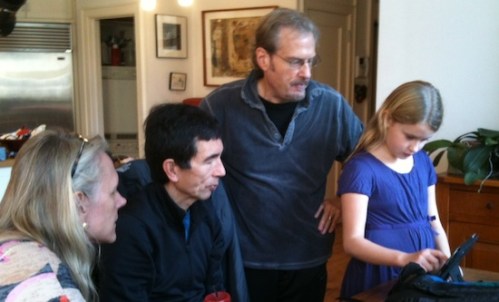
Me, Pascal, Richard and Em during our first “training” session