Tag Archives: non-speaking

Talking By Writing

*Emma gave me permission to write about the following…*

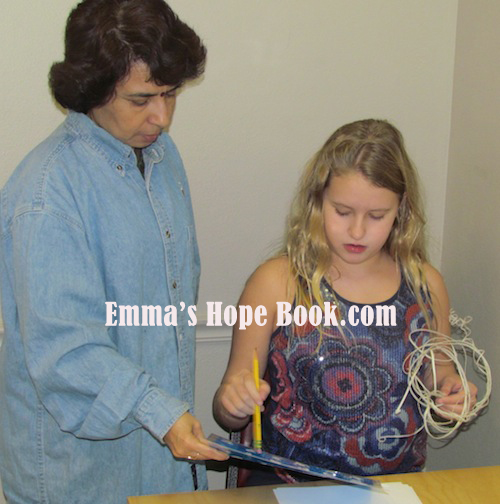
Every Tuesday afternoon I go to Emma’s school where Emma and I do a sample lesson, or Emma answers questions from staff or sometimes someone wants to share what they worked on with her and what her answer was.  As Emma “talks” by pointing with a pencil to the letters on a laminated letter board she twirls her string, and often, while she is “talking” by writing, she is also talking, as she describes it, “with my mouth” at the same time.  When I mentioned this to her at our last training session she smiled and wrote, “It is hard for non autistic people to multitask as well as I can.”  Which was one of those frequent – oh-my-gosh-Emma-you-are-so-fabulous – moments, because, really, not only does she have a wickedly wonderful sense of humor, but whoa(!) how right she is!

Later Emma wrote in answer to the question, “Is it problematic for you to switch from the letter board to a qwerty board, she wrote, “No.  It’s not a problem.  Is it hard for you?”  I was so taken aback by her response, because, honestly I had not ever considered that it isn’t a problem for me, so why did I assume it would be for her?  And yet, I have.   This was yet another reminder to me of how I presume competence as best I can with all that I know and yet, am humbled by constant little nudges urging me to go farther.  How beautiful is that?  Seriously?!

When I began witnessing people who use spoken language like my daughter does or who do not speak at all, but write, often poetically, often beautifully, I was astonished.  It was unlike anything I had ever seen before.  It’s been close to two years now since that first time I witnessed in real life someone communicating this way.  At first I was so incredulous, all I could do was watch and try to take in what I was witnessing.  After many encounters, repeated by so many people, men, women, teenagers, boys and girls as young as seven or eight I went from shocked amazement to a more calm feeling of  excitement, but even now, having spent nearly every day watching my daughter write this way, I often still feel like I’m in a dream.   It is as though I have been allowed into another dimension, and it is more beautiful than anything I ever believed possible.

"Talking" with the letter board

“Talking” to Soma using the letter board


Demanding Speech

Over the weekend I witnessed a young man who did not easily speak and when he did say a word, it was clear how hard he was having to work for that one syllable.  Yet the people around him bombarded him with questions.   Questions he could not answer with spoken language, but that did not stop them from asking.  When he managed to make a sound resembling the answer they wanted, they would pause for a moment before asking him another question.  After about ten minutes of this he retreated into what looked like a sensory friendly room, where he rocked gently back and forth, holding his hands over his ears.  Even so, the questions continued.  

Another boy who was having his lunch was told during a ten minute time period to “look at me” more than a dozen times.  He too could not easily speak and was asked a great many questions.  Things like, “Is that good?” When he said, what sounded like, “Yes,” the other person said, “Look at me.  Stop.  Put down your fork.  Look at me.  Is it very good?”  When he again said, “Yes,” he was allowed to eat his lunch for a few seconds in peace before the next question came.

People often ask me why I object to ABA therapy.  It is not only ABA therapy that I object to.  It is ANY therapy that treats another human being as these very well-intentioned people were treating these young people, all of whom were teenagers.  I object to the way so many, who are in the field of autism are trained and how that training  affects how they speak to and interact with people who are autistic.   I do not, for a moment, doubt that they believed that what they were doing was good and ultimately helpful to the kids they were working with.  Yet each one of them was unconsciously or not, treating those kids as though they could not and did not understand what was being said to and about them.  The kids were not being treated as one would treat their same age non autistic peers.

On the Presume Competence – What Does That Mean Exactly – post I wrote, “What I have come to understand, is that a presumption of competence is much more than a set of beliefs, it is a way of interacting with another human being who is seen as a true equal and as having the same basic human rights as I have.”

What I saw was fairly typical of what I see often – well-meaning people who are working with autistic people, but who do NOT presume them competent, not really.  Had I said something to any of these people, I’m sure they would have expressed surprise with my observations of what they were doing and how they were interacting.  I would even guess that they would have told me that they were presuming them competent.  These were not mean people, they were not sadistic people, these were people who believed in the training they’ve been given and believed this was the best way to interact with these teenagers.

At one point the young man who was trying to eat his lunch, looked over at me and my son.  My son, smiled at him and I did a little wave and said, “hi.” He nodded his head ever so slightly at us and then the person who was paid to sit with him, asked him another question.  I do not doubt for a second that all the kids there were competent.  In fact I am convinced of it.  I know it to the core of my being as I have been around so many people who cannot speak, or who can speak, but not easily or naturally and who are all competent.  But this was not how they were being treated.  This idea, which is popular with a number of therapies, not just ABA, that we withhold desirable things until the person speaks as demanded, is not something I agree with because it is based in a presumption that wanting something is equated with ability and this is incorrect, even if it obtains the desired result – a verbal utterance.

Until Emma began to write, using her letter board, I had a great many thoughts about her that have proven incorrect.  Until she began to express herself through those words she painstakingly spells out, I was not treating her as the exceedingly  competent human being that she is, even though I often thought I was.  Even now, on any given day, I do not do this as well as I’d like to.  All those years of ingrained thinking are extremely difficult to change.  But change I must…

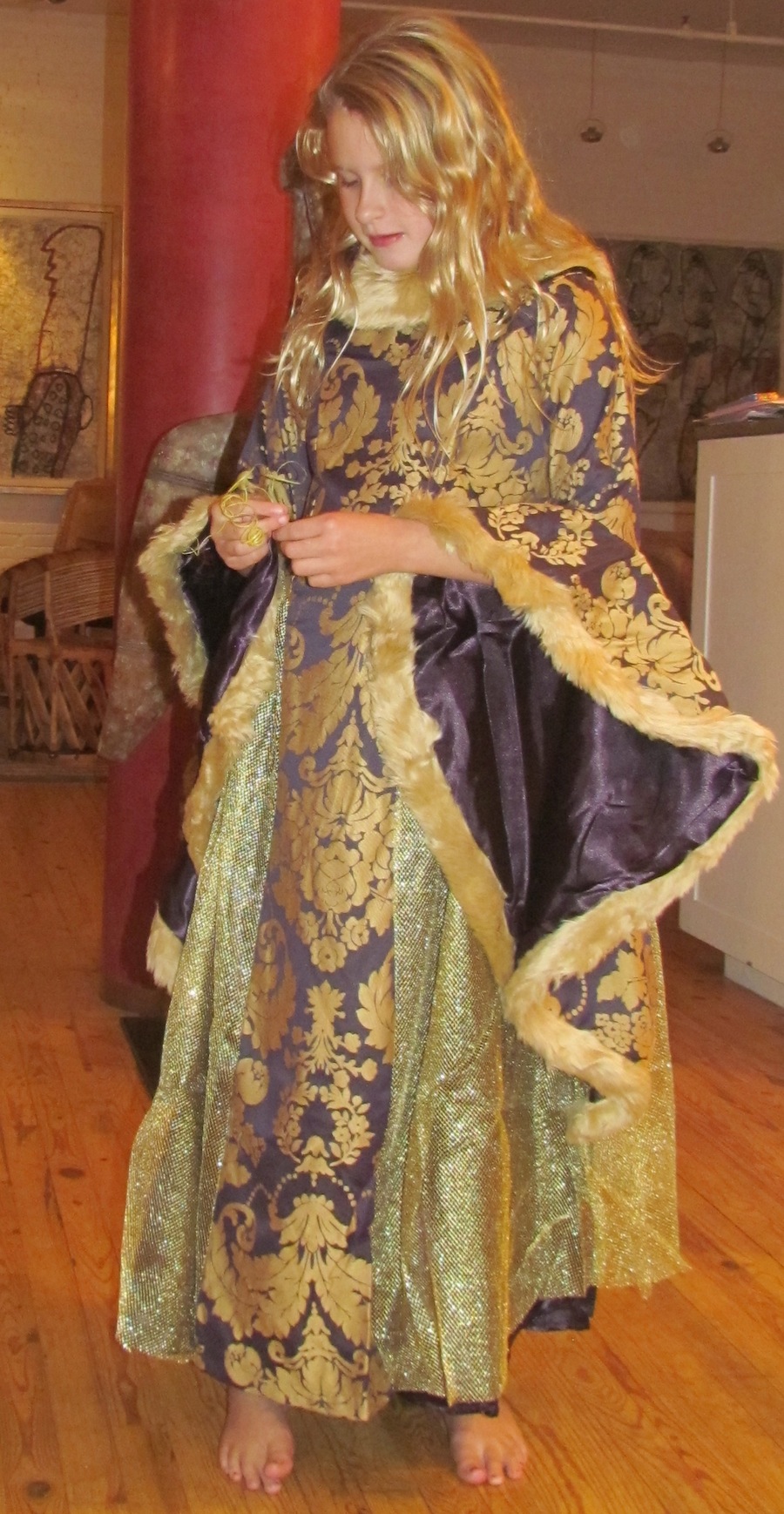
A Renassaince Princess

A Renassaince Princess

“How Did You Learn To Read?”

A few days ago someone asked Emma, “How did you learn to read and spell?”  Last night, in response to this question Emma wrote, “I learned by watching the words my mom read to me.”  She went on to write, “I was able to read many years ago and could write, but didn’t have any way to show it.”

I asked, “Were you able to read as a very little girl?”

Emma wrote, “Yes.”

“As a toddler?”

“Yes,” Emma wrote again.

What is interesting about this is that for years, when Emma was very young, I assumed she didn’t like being read to because when I tried she would grab the book, insist on flipping the pages faster than I could read them, and generally seemed (to me) uninterested.  But from what she wrote last night, it suggests I was incorrect about these early assumptions or at least was partly incorrect.  I am no longer shocked by all that I didn’t understand.  It no longer surprises me to find out, even now, how wrong I was and continue to be about so much when it comes to my daughter.

Because Emma did not sit quietly while I read to her, I thought she didn’t like being read to.  Because Emma preferred holding the book and would turn the page before I had time to finish reading the words I assumed she wasn’t interested in the story.  Because Emma protested if I tried to take the book from her to continue reading, I assumed she wanted to be left alone.  Because Emma seemed distracted while I read, I believed she didn’t like the story, didn’t care for the book, didn’t like books in general.

How would I have viewed her various therapies, preschool, and later grade school, had we understood that she already knew how to read at such a young age?  Our decisions on how to proceed, our opinions regarding what others told us, so matter-of-fact, so sure of themselves… who knew how wrong they all were?   How wrong we were?

People say things like – parents know their child better than anyone.  In our case no one knew our child better than anyone.  We didn’t.  All those therapists who worked with Emma didn’t.  All her teachers, everyone who came in contact with her, not a single person during those early years ever said, “I’m guessing she already knows how to read” or “maybe she already knows, but we haven’t found a way to help her show us all she knows.”  Emma’s need to move, her inability to consistently say out loud what she intends, her deep need for sensory input, her attempts to regulate herself, none of that was understood by anyone, including us.

Had we not begun to find ways for Emma to communicate through the written word, had we insisted on her “speaking,” we would continue to be in the dark. All the things emphasized in  school for a child like Emma who is physically capable of articulating words made us believe spoken language was what we needed to concentrate on.  What we are seeing is that the less we focus on her speaking and the more we focus on her writing, the more she is speaking.

“Hey Em, do you want to put the smaller string in your backpack, just so you have it?” I asked as we headed down to meet her school bus this morning.

“N” “O” Emma said, as she bounded toward the elevator.

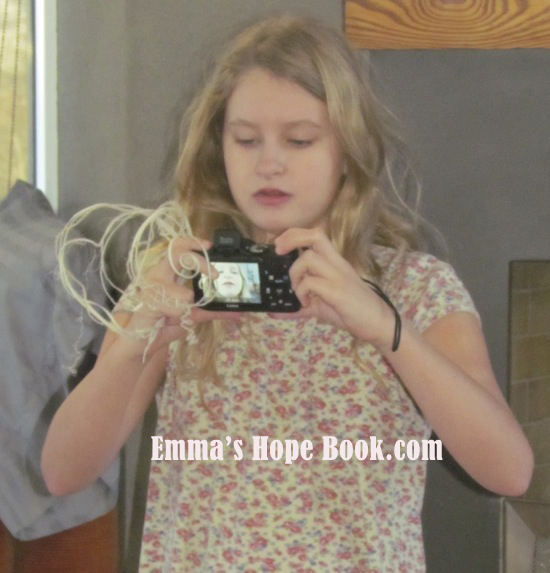
A self portrait in the making

A self portrait in the making

When the Body Does not Obey the Mind

Emma gave me permission to quote her words, written this past Sunday.

“Please remember that my mind tells my body and my mouth to do all sorts of wonderful things constantly, but they don’t obey.

“Sometimes I want to scream.  I am trying so hard, but no one notices and they are annoyed instead of understanding.”

Emma wrote this in response to her gymnastics teacher, but it applies to so many instances where she confounds those around her by doing things she knows she shouldn’t, things she doesn’t want to do, doesn’t intend to do and yet does anyway.  Typically people assume she is doing these things because she doesn’t care, or is trying to be mischievous, or “wants attention” or any number of assumptions people make when witnessing her actions.  But in speaking with Emma, it is clear how incorrect these assumptions are.  As Emma wrote, “I am trying so hard, but no one notices and they are annoyed instead of understanding.”

Sydney Edmond is an Autistic young woman who describes herself as “… locked inside a body that won’t cooperate.”  Sydney published a book of poems, The Purple Tree and Other Poems.  Recently Sydney gave a lecture to a group of Special Education students and educators at a high school.  She generously gave me permission to reprint some of her lecture here.

“People need to know, because Society apparently thinks autistic people are lacking intelligence. Our wandering wayward eyes and hands flapping, screaming, and anxious stimming don’t help, either. But in truth, we polish our souls deep down inside where they can’t see us, while our dastardly bodies act in ways we can’t control. That’s right. I told you I have lousy control over my behavior. Can you relate? Perhaps you have moments when your body does things without your permission? When you lose control and shout at someone or hit out? Well imagine what it would be like if you were just the opposite, and were always out of control with little solid gold moments when all the pieces come together and knowledge passes impulse? For those moments we are the captain of our ship and we feel unbelievably perfect. But, passing time wipes it away. Possibility becomes disability again. Look at your fellow students with autism deeply and with patience. We are in here.  And we are exhausted, panicked, and lonely.”

Ido Kedar, who wrote the book Ido in Autismland writes about the body/mind disconnect he experiences, as well as the embarrassment he then feels when his body does not do as he wishes.

“I feel it’s time autistic people finally say what it’s like to be drilled in flashcards over and over when your hands don’t move to your thoughts, or to have your teacher say in front of you that you can’t count because your stupid hands refuse the right number you’ve counted in your head.  I remember standing miserable and embarrassed, holding the wrong number of straws and hearing my teacher say, “It’s clear he has no number sense,” as if I couldn’t understand or had no emotions either.  When I think of these frustrating experiences I am grateful I am not in that situation anymore.  But many of my friends still are.  That’s why I cry for them.”

Sydney Edmond, from her recent lecture, wrote:

“I found freedom and wonderful joy when, as a ten year old, I was taught how to point to letters on a Letterboard and spell what I wanted to say. I eagerly worked, and within a few months, I was able to communicate. In the beginning, I needed a lot of support. I couldn’t even point my finger when I wanted to. My body, as usual, did not cooperate. I had to force it to, so all my words, stored away for ten years, could finally come out into the world. Do you want to know what I asked for? Well, I asked to have my own pizza. And then I asked to learn ballet. And piano. And I asked to learn about history. I was thirsty to learn. I finally had a way to ask questions that let people know I was intelligent. Soon I learned how to type on a keyboard and have a lovely voice added to my words. I went back to school to prove I was intelligent. I had been tested and told again and again I had the intelligence of an infant. Having a method to communicate turned it around. My language comprehension was college level in 8th grade when I was actually given a means to show what I knew.

“Loads of us, people all over the world, type to communicate. I am one of many, and we all want people who cannot speak to have the opportunity we are enjoying. I hope that my words today might spark a willingness to proceed on the journey of a lifetime. I hope one of you will take action to give a voice to someone who cannot speak.”

Ido, Sydney and Emma all began writing to communicate by using a letter board.  All of them discuss what it is like to have a mind that “…tells my body and my mouth to do all sorts of wonderful things constantly, but they don’t obey.”  Each of them describes their experience, whether that includes frustration, embarrassment, or shame and what it is like to be so thoroughly misunderstood.

I am grateful to each for allowing me to reprint their words in the hope that others will begin to reconsider their assumptions and how they then respond.

"Happy"

“Happy”

Justifying Our Words

Richard and I have conversations that other people might find odd.  We have little inside jokes we think funny, but that no one else is likely to agree.  We reference conversations we had years ago with a single word or sometimes even a look.  It’s the same with our son and daughter.  In fact, with all of my family and close friends I have at least one or two references that we think funny, but that others witnessing might not understand or see the humor.  With Emma, our inside jokes often come in the form of music.   We will sing to one another or utter a sentence said by someone else years ago, but that now makes all of us laugh.  For no particular reason one of us will say, “Get down Angelo!” and we will collapse in hysterical laughter or instead of saying “Good morning” we will mimic the sound of a quail.  The other will then respond with a similar noise and it is better than any greeting made of words.

When Emma began writing to express her thoughts, insights, and experience of life, I thought she would be so relieved to finally be able to communicate these things to us and the world.  So when she didn’t seem particularly eager to write, I wondered how and why that was possible.  I know communicating in language, whether it is in written or spoken form is difficult and hard work, but I couldn’t figure out why she wouldn’t be overjoyed to finally have this connection with other people.

A few months ago I asked Emma about something and she wrote, “Words are not as meaningful to me as they are to you.”  I think about that sentence a great deal.  Emma then told me she senses people.  She wrote, in reference to a question about someone who works at her school, “I can hear her.”  She then added “I feel her.”  I used to be confused by these sentences, but over time I have come to believe Emma means this literally.  Barb Rentenbach, the co-author of the book she wrote with Lois Prislovsky, I Might Be You talks about this as well.  Emma has an acute sense of people’s inner life and as a result, having to translate all of this into words must be tedious and (this is my interpretation of what it might be like for her) a step backwards.

Richard has a theory that Emma is operating at a “higher vibration” or frequency than either of us.  I have the same thought, but use the words a “higher plane,” which has the same meaning.  We both believe Emma is capable of a more sensitive and intense understanding of people than we are.  If I think about those I am close to, I am in tune to their vibes at a higher frequency than I am to strangers.  But what if I was attune to all people I came in contact with at that same level of intensity?  What if I “felt” them the way I can feel my husband and close friends?  What if I sensed the essence of them before they said a word?  What if the words they then said, rote responses to questions like “how are you?” were untrue?

We, non-autistics, tend to view our neurology as better, more efficient, less socially awkward, but in many ways our word-heavy way of communicating is less truthful.  We say things we don’t mean.  We say things we don’t believe, we agree with people we think are more powerful.  We are easily intimidated.  We are swayed by groups of people who share beliefs, even if those beliefs are not something we agree with.  We learn at an early age to question our instincts, to tamp down our emotions, to apologize when we are not sorry, to say things we do not mean and then, once we are adults, we use words like “polite,” and “kind” to justify the lies we tell.

“Words are not as meaningful to me as they are to you.”

Emma, Barb Rentenbach and Lois Prislovsky

Emma, Barb Rentenbach and Lois Prislovsky

“Talking is Easy, But Saying What I Mean is Hard”

Most of us, who have spent our lives using spoken language as a way to socialize and convey what we are thinking, do not ponder what it would be like if we could not do so.  Most of us who are able to speak do not spend time imagining what it would be like if we could speak, but what came out of our mouths did not necessarily match what was in our minds, or wasn’t what we wanted to say, or was taken to mean something else.  For those of us who speak and have little difficulty having a conversation with another it is difficult to imagine what it might be like if we could not speak at all.  We easily tune out our environment allowing us to focus on what is being said by another person.  Asking questions comes naturally, and without thinking we ask for clarification about things we don’t understand or want to know more about.  When we cannot hear something or lose part of a sentence spoken by another, we ask to have the part we didn’t hear repeated, or request that it be said in a different way.  And even so people misunderstand each other all the time.

But what if we could speak only a little and those hard-earned words we finally managed to say were met with confusion, irritation, even anger and led to misunderstandings.  Or what if speaking words was so difficult it was easier to utter sentences constructed by others, sentences that held special meaning to us because it reminded us of a happy or sad or anxious or frightening time. Whenever one of those emotions surfaced, we would blurt out that sentence from the past, because it so beautifully captured what we were feeling now.  Maybe though, other people who did not understand or know the meaning they held for us, took them to mean something entirely different.

A blogger friend, E. of the fabulous blog The Third Glance wrote an amazing piece, Words, a couple of years ago about trying to participate in a conversation with a group of friends.  I’ve never forgotten that post, it was one of a number of posts that radically changed my thinking.  You can read it by clicking ‘here‘.  She describes wanting to keep up with a conversation that a group of people she knows is having in a busy place, while trying to filter out the noise that comes with being in a public place, the stress of trying to figure out when it would be appropriate to interject a comment, the pressure of knowing some sort of response is expected of her, and not being successful.

Yesterday Emma wrote, “Talking is easy, but saying what I mean is hard.”  I understand that when she wrote that, she meant it literally.  Emma “has language” yet cannot carry on a spoken conversation.  Emma cannot answer with spoken words questions like, “What did you do in school today?”  Or “What did you think of that movie?”  Or “Which student in your class do you like best?”  Or “What’s your favorite subject?”  Or even “What are the names of the other students in your class?” or “Where do we go to borrow books?”  As a result all those so-called reading comprehension questions are met with silence, or with words that seem to have nothing to do with the question asked.

The other person then draws the conclusion that Emma does not understand the question, or cannot read, or isn’t interested, or doesn’t care or is intellectually disabled, impaired, has a disorder, a disease, is afflicted, suffers from, is a puzzle piece, is locked in her own world or any other word or phrase used to convey what we believe to be true because of our understanding of her and those like her based upon what she can or cannot say with spoken words.  This is the same girl who wrote, ““I can’t talk the way I think.  Where is the label for that?”  The same person who eloquently answered questions about functioning labels, stimming and autism, ‘here‘, ‘here‘, and ‘here‘.

“Talking is easy, but saying what I mean is hard.”

Emma Playing the "My Mouth is Glued Shut" Game

Emma Playing the “My Mouth is Glued Shut” Game

Words of Truth

“Raw thoughts are like savory understandings of yummy foods.” ~ Emma 03/02/14

Sometimes when Emma and I are working she will write something that I simply cannot follow in real-time.  It is only after multiple readings and many hours of pondering have passed that I can begin to make sense of certain sentences.  As Emma constructs a sentence to reflect her thoughts by pointing to the letters she wants on the letter board, my mind is working on another level.  I am transcribing as she points, so I’m concentrating hard on remembering the letters and figuring out when I can pause to write those letters down.

Will the pause create a disconnect?   Will it break her concentration?   How much will I be able to remember before I have to stop her to write the letters she’s chosen down?  Sometimes she’ll point to “I” then “a” and then “y” and I’ll have to stop and show her the letters and say, do you need to change any of these letters?  Sometimes she will erase all the letters, insert a letter between two others, but other times she’ll erase just the last letter and continue.  Sometimes she will say aloud, “No, keep letters” and we will proceed.  Often she will then write something so astonishing I cannot contain the surge of emotions that rush forward.

During all of this, Emma may twirl her string, laugh, say unrelated words, or look at the timer and comment about how much time is left.  Sometimes writing one sentence might take 45 minutes.  Sometimes that one sentence will remain unfinished and when we come back to it, she will simply say, “no” and we will move on to something else.  Sometimes the words are so seemingly unrelated I have to resist the urge to ask for clarification mid sentence.  Sometimes she will write something I cannot understand, but the next day will re-read it and think –  my gosh, that’s brilliant!

“Raw thoughts are like savory understandings of yummy foods.”

Seemingly disparate senses woven together to create a canvas of rich and varied depth and colors has me in awe.  We talk about autism and autistic people as having sensory integration issues, but I look at a sentence like this one and I question whether the sensory integration issues are mine rather than hers.  Emma has a wonderful command of the English language, she is able to express her senses in complex, creative and layered ways.  I am compelled to read and reread her words.  I savor them, exactly as the sentence states so matter-of-factly.   Her words…  painstaking…  one letter at a time, convey truth.

Truth

Truth

Emma Shines a Light on Functioning Labels

“People think I am troubled and can’t decide whether I am low functioning or can’t make sense of the words I say, but either way they are wrong.  So whatever label I am given it is meaningless.  Neither one assumes my intelligence.  This confuses many.  What does a functioning label do for the person it supposedly describes?

“I can’t talk the way I think.  Where is the label for that?

“Why am I punished with a label that only detracts and doesn’t tell the truth about me?”

Earlier this year Emma wrote (from Emma Discusses Functioning Labels):

“Functioning labels are insulting to me.  And people like me do not like to have others label us as though we were meat at the market.

“I do not think Autistics should be given stamps of disapproval.   How would you like to be graded all the time?

“Money makes non-autistic people have a higher functioning label, but it is not a great way to measure the worth of a person or their intellect.

“I am more than any one thing.

“Most people do not behave well under the kind of pressure Autistic people must endure all the time.  A label belongs on a piece of merchandise, not on a human being.

“Do you think you function at a higher level than other people?

“Maybe others would not agree with you.

“Let us all  do the best that we can and stop othering everyone we decide is less capable.”

2010 in Colorado

2010 in Colorado

“Talking is Hard”

*Emma gave me permission to post some of what she wrote yesterday during a meeting with a few of the people who are part of her team at her school.

Emma wrote, “Talking is hard because I like to say silly things that people take seriously and that is why I am misunderstood.”

In reply to a question about Emma’s thoughts on another class joining hers for a project they are working on together, Emma wrote, “Worrying that I will not be thought intelligent.  I am considered stupid by people who don’t know better.”

One of the staff commented that the more she writes with them, the more people will understand and know how smart she is.  Emma then wrote, “I know, but it’s hard work for me to write.”

This is something I think people may not fully appreciate – that communicating is tough and hard work for Emma.  It isn’t that she doesn’t want to participate in discussions or want to express herself and have conversations with people, it’s that what most of us take completely for granted is, for Emma, not easy and requires tremendous concentration and effort.

Someone else mentioned how Emma understands everything that people are saying and Emma wrote, “People think I can’t understand what they say, but my hearing is excellent.”

And a little later Emma wrote, “I know people don’t mean to be cruel, yet they are when they see someone like me.”

One of the team wanted to know if she was referring to specific people and how she deals with them.

Emma wrote, “They are everywhere.  I try to like them anyway.”

Before people comment on this post, protesting Emma’s words and insisting that people are basically loving and kind and that Emma must be unduly influenced by me, to write such things, I will tell you that from what I’ve witnessed when with Emma – people typically talk about her right in front of her, talk about her instead of to her, do NOT presume her competent, treat her as though she were at least eight years younger than she actually is, and though they may not mean, intend or feel they are being “cruel” this is the word Emma chose to write.  I cannot, even for a moment, really know what it is to be as intelligent as my daughter is and regularly treated as though I were not.  I will just add here that Emma is far more compassionate than I am.  So if anyone is being influenced, I hope it is me being influenced by her.

And for what it’s worth, this is what I think about all of this…  I think human beings tend to be neither saints nor evil, but that the vast majority of the human population has ingrained knee-jerk responses toward those who are different from them.  It is rare to find someone who does not hold some degree of prejudice, often without realizing it.  I believe most people, often unconsciously and without meaning to, respond to people who are different, whether that means their skin color, their accent, the way they dress or look or behave, with either fear, irritation, curiosity, jealousy, impatience or pity.  It is actually quite rare for a person to treat ALL humans they encounter with respect and as complete equals, without any trace of “othering”.  I believe segregation breeds “othering” and that an inclusive society of diverse people is the ideal, but that’s another series of posts.

Emma

Emma

“A Letter To the World” ~ By Emma

                     “A Letter To The World

“I want to tell you that I am capable.  Daring massively, eager to prove my intelligence, I will work tirelessly so that Autistic children younger than me won’t be doubted the way I am.

“Plea-ing to the world, I ask that those who are not able to restrain their doubts, at least not mute voices like mine.

“Deciding stupidity bolsters egos while crushing lives with angry words disguised as kindness.

“They say hope is cruel for the hopeless, but maybe they are the cruel ones.”

Emma wrote this in response to my question, “What do you want to learn about?” (I gave her a number of choices ranging from people like Joan of Arc and Eleanor Roosevelt to geography, history, literature, creative writing or current affairs) “…or would you like to talk about something else?”  Emma wrote, “I want to talk about autism.”  When I asked her what, specifically, she wanted to discuss, she wrote the above letter.

*For all who would like to share Emma’s words with your friends and followers – we ask that you quote a sentence or two with a link back to this blog, and not all her words.  Thank you so much for your support, encouragement and enthusiasm.

Emma ~ 2014

Emma ~ 2014

“Love Not Fear”

“You thought my autism was hurting me and that you needed to remove it, but you did not understand that it is a neurological difference and fear caused you to behave with desperation.”  ~  Emma on the topic of the three stem cell treatments we did in 2010

Fear.

This post had to begin with Emma’s words.

I’ve written enough to fill a book on fear and where that took us.  Stem cell treatments, spending all night on the internet searching for the next great “miracle” cure, taking my child from one specialist and doctor to the next, this is where fear took me.  I’ve deleted a great many posts where I express my tortured fear, but if you go to the first post, the post that began this blog almost four years ago, you will see in excruciatingly slow detail where fear took me.  Fear caused by those “alarming statistics” used ad nauseam by organizations like Autism Speaks, drives many like me to go to incredible lengths to “help” our child.  Blinded by abject fear we pursue things that can cause our children real harm, both physical and emotional.   The toll our fear can take on our children cannot be overstated.

I abhor Autism Speaks.  As the single largest organization claiming to know what autism is and is not, and worse, suggesting they “speak” for autism and those who are Autistic, Autism Speaks does more damage to my Autistic child than any other.  They have done a brilliant job marketing fear.  For transparency’s sake they should rename their organization ~ Fear Autism.  Donations pour in, large companies lulled into believing they are “helping” give their support.  Autism Speaks uses so much of their vast resources to hurt my child and Autistic people with that fear; what little good they accomplish in other areas in no way can counter the long-lasting and devastating damage they have done and continue to do to families who live in the kind of fear we once did.

I’ve written a great deal about fear on this blog, such as this post where I wrote about what I once believed:

What did the future hold for my daughter?  How was she going to get through life?  How would we be able to keep her safe?  How would she fend for herself?  Would she be able to fend for herself?  Who would take care of her once we were gone?  Fear.  Fear.  Fear and more fear.  And then, without even realizing it, I would find myself furious.  Enraged.  And my rage found the perfect target.  Autism.  Autism was what I was furious with.  Autism was what the problem was, so it stood to reason that if I could remove it, all would be well.  So this is what I set out to do.  Except that my daughter happened to be Autistic.  But if I didn’t say it that way I could continue to separate the two.  I could continue to tell myself I was fighting the autism and not her.  I could continue to believe that my anger with autism would not affect her.”

And this post where I wrote:

“When my daughter was diagnosed with autism, my fear of  institutions was the one fear, outstripped by any other, that brought me to my knees.  For years it was this vision, that horrifying gothic institution, dark and forbidding that I became convinced would be the inevitable conclusion of not my life, but hers once my husband and I died.  It was this looming image in my mind that made me hurl myself headlong into various remedies and treatments.  For years I felt sure that anything we could do to save her from such a bleak future was surely a worthy goal.  It just never occurred to me that what I thought was inevitable was not. And this is where I thank my Autistic friends for courageously sharing their stories with the world.  Because of them, their lives, their stories, I no longer believe this is my daughter’s inevitable future.”

Richard and I live a very different life than we did just three years ago and it is all because we stopped being afraid.  If you think, even for a second that we stopped finding ways to support our daughter, encourage her, cheer her on to be all she can be, then I encourage you to read the last six months of this blog. These last six months, specifically, show how Emma has increasingly taken over this blog, just as I once did not dare dream possible.  It is her voice that sings out, every day a bit louder, every day more powerfully, every day…

A few more posts on Fear:

The Impact of Fearing Autism
Where Fear Leads Us
How My Fears Drove Me to Pursue a Cure
Murder, Fear and Hope

Love Not Fear.  Tomorrow is the Love not Fear Flashblog.

For submissions email:  info@boycottautismspeaks.com

Love.  Just a whole lot of LOVE!  Emma's Halloween Costume ~ The Love Monster

Love. Just a whole lot of LOVE! Emma’s Halloween Costume ~ The Love Monster

Asking Questions

The other day during our session about the Middle East (this post is not about the Middle East) I mentioned to Emma that I’d recently read a memoir, I am Malala written by Malala Yousafzai.  Malala is Pakistani and was shot by the Taliban when she was just 15 years old because she wanted to be able to go to school and have an education.   Emma then wrote, “Was she alive after they shot her?”

It was all I could do not to jump up and down with exuberant glee that Emma wrote me this question.  It wasn’t the specifics of the question that made me so excited, it was that it was a question at all.  You see, Emma has never asked me a question like this before.  This is the sort of question she regularly asks Soma, but not me.  In fact, I just wrote about exactly this, a few weeks ago while Emma and I were visiting Soma.  You can read that post ‘here‘.  The question Emma asked is the sort of question I’ve barely dared hope for.  It is the kind of question most people take completely for granted.  Asking a question like this is the beginning of a conversation.  It requires a different kind of thought process than answering does.  It requires initiating a line of thinking.  It is the beginning of a back and forth that we talkers do not often contemplate, but do without thinking.

I know Emma has many questions just like this one, but she is not able to easily communicate them.  This is different from in the past when I was caught in that great abyss of believing that because she didn’t ask questions, she wasn’t interested.  That old way of thinking was so detrimental to her and to our relationship.  The belief that things were not being expressed because they did not exist was so destructive, not just to Emma, her self esteem and growth, but to all of our interactions.  Instead, this was a moment of celebration.  A moment when I just sat in utter admiration of my daughter.

Presuming competence.   Those two words hold so much meaning within them.  Every day I make tiny inroads, little steps forward in presuming competence, going just a little further in my ability to stretch my thinking so that I am embracing this concept just a bit more.  And as I do my daughter is showing me over and over that I have still farther to go.  This process is one of such joy, wonder and unbridled excitement.  My husband, Richard and I discuss this all the time.  How fortunate are we that we have the opportunity to expand our awareness on a daily basis?  How exciting is it that we are in a process of constantly re-evaluating what we think we know?

“Was she alive after they shot her?” Emma asked.

“Yes!  She lived and now has written this book,” I answered, showing her the cover.  “Should we read it together?”

“Yes,” Emma replied.

Em with her string!

Em with her string!

What To Do When Someone Hurts

When Emma was just two years old she was diagnosed with Pervasive Developmental Disorder- Not Otherwise Specified or PDD-NOS, which is the “it-may-be-autism-but-we-can’t-be-sure-maybe-she’s-just-a-bit-different-so-let’s-just-wait-and-see-what-happens-before-we-say-it’s-autism” diagnosis.  Two years later, Emma was diagnosed with autism.  But in 2004, when Emma was given her PDD-NOS diagnosis the neuroscientists, Kamila and Henry Markram, had not come up with their Intense World Theory for Autism.  The idea that Autistics have a brain that is far more sensitive to all stimuli than non autistic brains, was not something people were talking about.

Emma has since told me that she can “hear” people.  When I asked her what she meant by that, she wrote that she could sense people’s emotions and inner turmoil.  She could hear their moods.  I have been told and read similar things from other Autistic people.  This is something Barb Rentenbach also talks about in her must read, book, I might be you.  Now add to the intense sensory sensitivities that ebb and increase suddenly and without warning, lights, noise, touch, smells, tastes, feelings and you will begin to understand how overwhelming and unpredictable life can be.  Or, as Emma wrote last week, “On Monday a noise is pleasant, but on Tuesday the same noise is not pleasing to me.”

Yesterday, Emma wrote about what happens when she bites herself and the things others can do to help, as well as the things people do that make it worse and it made me think about my reactions to seeing my daughter hurt herself.  I can go through a fairly quick series of feelings.  I might feel scared, oh, no!  She’s hurting herself, this is terrible, I have to make her stop! and concern mixed with confusion, what can I do to make her stop?   But I also may feel other things too, like a desire to control the situation, annoyance and embarrassment that she is screaming in a public place, stress and overwhelm from the tears and her obvious upset, feelings of inadequacy that I should be able to help her more than I am, wondering whether I am a bad parent, believing that if I were a “good” parent, she wouldn’t do these things.  Questioning my own reactions, worrying that if I don’t force her to stop, people will harshly judge me or criticize me or believe I don’t care that she’s hurting herself.  Or maybe the situation is also stressful for me and I’m also in overwhelm.  And on it goes.  But as Emma wrote, “I know it upsets people, but it’s not about them, it’s about not being able to describe massive sensations that feel too much to tolerate.”  So if I don’t spend the time to think about and become aware of what I’m feeling as I witness her, I will react in ways that actually exacerbate her overwhelm.

I am once again reminded of my car ride with my beautiful, friend Ibby while visiting her in Chicago this past December.  I wrote about that ride ‘here.’  What Ibby did was such a perfect example of what I needed, though I did not realize I needed it and could not have asked for it, had I been asked – what do you need?  A calm, loving voice, carefully telling me what was going to happen next and why, a calm loving voice coming from someone who genuinely loves me, who I know has no agenda, was not trying to control me, whose words and concern were completely for me, with no other motivation than to truly be there for me… this was what Ibby gave me during that car ride.  Ibby did not try to take away my feelings, she didn’t try to control them, she wasn’t judging them, she was calm, patient, accepting and above all, incredibly kind and loving.  And, by the way, Ibby could not stop the noise the wind shield wipers made, it was not something that was within her control, it was snowing hard, she could not drive without them, yet even so, what she did instead made all the difference in the world.

It seems so simple, it seems so obvious, but it is actually quite rare to have someone do this for another.  So I will end this by encouraging all who want to know what they can do to help someone who is deeply distressed, examine your feelings, really look at them and make sure you understand what you are feeling before you attempt to help another, because if you’re becoming upset with someone else’s upset, anything you do will cause the other person to only become more upset.  Until I can get to a place of having “helpful thoughts of calming kindness.  Reassuring words of understanding, instead of irritation and impatience”  my response will add to the other person’s overwhelm.

*I just have to add here, this is something I find very difficult to actualize.  It is a work in progress, but it is vitally important.
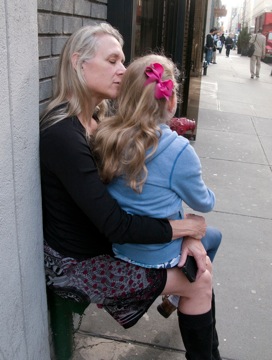
Ariane & Emma ~ 2011

Ariane & Emma ~ 2011

Emma Discusses Biting

Emma bites herself, occasionally pulls her own hair and less frequently will smack her head into the wall or punch herself in the face.  I hesitated writing about this on such a public forum because… well, because it is so public and people come to this topic with a great many strong feelings.  But Emma asked me to “put it on the blog” so I am, though with some ambivalence.  I ask that anyone who chooses to comment do so with the love, care and compassion you would hope others would have for you, were you to talk about things that are so deeply personal.  I will just add that Emma is incredibly courageous and I have nothing but admiration for her desire to speak so publicly about a topic that brings up so much distress for so many.

I asked Emma if she would be willing to discuss what is going on when she bites herself.  This is something that has happened nearly every day at her school this past week.

“I am anxious about angering those who are watching, but can’t control my aching feelings of distress.

“Biting my arm is helpful in giving those difficult feelings a pain I can control.  Getting mad at me makes it worse.

“Trying to force me to stop does not change how badly I feel, just adds to shame I already have.

“I know it upsets people, but it’s not about them, it’s about not being able to describe massive sensations that feel too much to tolerate.

“Fear takes over.

“Stress becomes impossible.

“I need helpful thoughts of calming kindness.  Reassuring words of understanding, instead of irritation and impatience.”

*I asked Emma if she could sense people’s emotions and if that added to the overload.

She wrote, “Yes, it makes it worse.”

Emma ~ 2011

Emma ~ 2011

Related Posts:

 Self Injurious Behaviors ~ Let’s Discuss

Different Neurology, Different Perception

Henry & Emma’s Story

Yesterday Emma and I spent time with our friends Lauri and her son Henry.   Lauri has a wonderful blog, Ollibean, which is a model of  inclusion and what that really means.  Recent posts include Judy Endow’s How to Figure Out if an Autistic Needs Fixing, Amy Sequenzia’s Walk in my Shoes, and Henry Frost’s All the People Saw my Intelligence.

About a year and a half ago I interviewed Henry regarding his wish to be allowed to go to his local school.  Because Henry cannot speak and is Autistic, he was denied that right.  That interview was published on The Huffington Post ‘here‘.  And a follow-up post ‘here‘ because the piece went viral.  I also wrote about staying with Lauri and her family last spring ‘here‘, which was also when Emma and Henry became friends.

Henry and Emma wrote this story together, taking turns writing a sentence by pointing to letters on an alphabet board.  Henry is “H” and Emma is “E”.  (I know … that’s probably pretty obvious…)  Afterwards Henry and Emma gave me permission to publish their story here.

H:  Once a man went to the king.

E:  He had a complaint against his horse.

H:  His horse would not carry him any more.

E:  His horse wanted five dollars each ride.

H:  The king asked him to sell the horse.

E:  The horse said it is not a slave.

H:  The king asked the horse its price.

E:  The horse said it needs a million dollars.

H:  Finally the king gave two options to the horse.

E:  First was – fight a lion.

H:  Second is –  serve this man.

E:  Choose between the two.

H:  Question is – what will he choose?

E:  The End

Henry & Emma ~ January 30, 2014

Henry & Emma ~ January 30, 2014