I’m impatient. I know this about myself. Impatience serves me to do a great many things. It propels me to take action rather than not. It makes me push harder, try harder. My impatience, which usually begins with tremendous optimism can descend rapidly into disappointment and discouragement. Fortunately I am also fiercely determined and dogged in my reluctance to give up which helps mitigate some of my impatience or maybe it just makes me confused. 😕
However, there are a great many things that are not helped by impatience, things like learning a language, learning to type or learning almost any new skill. These are things that take time, practice and patience. So I have to recognize this and continue despite my impatience. This comes up over and over as I work with my daughter. But in working with her, I’ve also come to recognize something else and that is my expectations. Huge expectations, coupled with impatience can do harm. I see that. I’ve been very aware of how it affects me, but how does it affect Em?
I am learning how to support Em in her communication. For example we will read a story together, such as a book Emma chose recently entitled, Who Pooped in the Park? The story details a family outing where the two kids are upset when they don’t see a great many wild animals on their hike, but learn to identify what animals live in the area by the markings they leave. During our session together I asked Em, “What were some of the animals the family identified? One animal starts with the letter b.” Emma then typed, “There was a bear and ciyoty and a deer.” Other than misspelling coyote, this was a terrific answer and correct. We went on to discuss another name for animal poop, which is scat and that all living things produce “waste” of some kind. After our session was over, Richard asked, “So how did it go?”
“It was fine,” I answered.
“It sounded great!” Richard said with enthusiasm.
“Yeah, I guess,” I replied. And then I had a tiny flicker of realization. I was feeling disappointed in our session. I was hoping for some brilliant, philosophical insight. I was hoping that we would have a conversation that blew my mind and when I realized that, I also realized that my desire, my expectations, my impatience had caused me to not fully take in how terrific our session had been. It also made me see how my response may have felt to Emma. Here she was working hard, doing something that does not come easily and doing it really, really well, yet I had not responded with the kind of unbridled enthusiasm I would have hoped for had our roles been reversed.
During our next session we talked about her birthday, which she is very excited about, and the party and various events we’ve planned for her. I tried hard to be aware of my response to what she was typing. I became increasingly aware of my expectations as they arose and did my best to silently acknowledge them before responding with genuine enthusiasm and appreciation for Em’s work. As a result our session was more fun for both of us. Later when I spoke to a friend about all of this he pointed out that most communication is not wildly brilliant, philosophical or even necessarily enlightening. And of course, he’s right. The majority of our communication with one another is about pretty basic stuff. Learning how to communicate basic things is relevant and important. But my impatience and expectations make me forget that.
I have learned over the years that if I want to change a behavior I need to have awareness that I’m doing whatever it is, I then need to have some degree of acceptance that I’m doing it before I can begin to make little changes to it. Those little changes repeated and added up can, over time, create bigger changes. Admitting aloud I am doing whatever it is can be very helpful as well. Without taking these steps however, I have no hope of changing the way I do something.
There’s a great deal of talk about autism and how our children and autistic adults need to work on a whole range of things, but there isn’t a great deal of conversation in the general population about our own neurological deficiencies. It seems to me that if we are going to continue to have this ongoing discussion of deficits, it’s only fair that we begin to detail our own as well. Now that’s a conversation I look forward to having. And while we’re at it, let’s include the positive aspects of Autistic neurology as well, because a little balance is a good thing!
You’ve described yourself as a “nonspeaking (at times) Autistic.
“Yes, I think the phrase “nonspeaking at times” captures my experience, and also that of others who do have speech capabilities but can’t always access them. Because one can speak at times does not mean that speech is a reliable form of communication for that person. Also, when someone can speak some of the time, others may not notice that they are having trouble speaking. I have sometimes not been able to speak and other people just thought I was “being quiet” or did not have anything to say; that dates back to childhood.”
Why did you make a video of you not speaking?
“I made the video because we need to change some of the ideas about “high functioning” and “low functioning” Autistics. Not being able to speak is equated with “low functioning”. A constellation of characteristics are said to be true of only “LF” people, such as self-injurious behavior, toileting difficulties, and not being able to speak or having limited speech, while “HF” people are said to have another set of characteristics, also fairly stereotypical, such as being “geniuses” who are good at computer programming and lack empathy. These binary divisions don’t address the wide variety and range of characteristics of Autistic people, and paint a limited picture of individual Autistics, many of whom defy (not necessarily on purpose!) the expectations surrounding their “end” of the autism spectrum. I have always known I can’t speak on a regular basis, but the conversations about “nonverbal” people assume that I have a different experience when in fact it’s not so different at all.”
Can you talk about how and why you sometimes are unable to speak?
“I can’t say I speak “most of the time,” since most of my waking hours are not spent talking. I showed on my video, even when I am alone, I frequently can’t talk. I don’t need to talk at those times, but I am very aware that if I were suddenly presented with a situation in which I needed to talk, I would not be able to. I am, however, usually able to make what some Autistics have called “speech sounds,” which means that I can say something, even if it is not exactly what wanted to say. I have a number of reasons for not being able to speak at any given time. I distinguish between not being able to talk at all and having trouble with word finding, which does not make me lose speech, but can have some interesting results when I find a word that is not the right one! I can go “in and out of speech” several times during the course of a day.
The following list has some of my reasons for not being able to talk. These are not in any particular order: Sensory overload, being tired, reading or seeing something disturbing, thinking more in visual images than in words, trying to talk when other people are talking too fast and not taking turns‒which is not limited to the autism spectrum, although a lot of literature exists about teaching us to take turns. Some of that teaching is necessary, but I think it should be introduced to non-autistics as well!”
Are there other things that stop you from being able to talk?
Another thing that will stop me from being able to talk is to have big chunks of time where I am not talking because I am mostly alone, like when my son spends the weekend with his dad. After a weekend spent primarily not talking, I am not used to it and have trouble getting started again. It does not take more than half a day of not talking before I need to urge myself to take it up again. It’s the inertia of not doing it, plus I have to remind myself, consciously, of how to move my muscles (mouth, lips, larynx) and intentionally will myself to speak, which does not always work. Sometimes my son will ask me “Mommy, are you having a hard time talking?” and if I manage to say “Yes,” I am able to start talking again, although I can have a hard time formulating sentences and finding words for a bit.”
Of all the items on the list, which ones affect you the most?
“The thing that will stop me cold, suddenly switching from being able to speak to not being able to utter a word is seeing, reading, or hearing something that is disturbing. I write indexes for nonfiction books. Some of them have very graphic descriptions of things like genocide or war. I did my “make myself talk experiment” on a day when I was using voice recognition software to do data entry for a book that had ten chapters of very disturbing material. I used VRS a lot at that time to save my wrists and fingers for playing the organ. Since I am a visual thinker, not only was I reading it, but also seeing it in my mind, like an awful movie that I did not want to watch,. I found myself typing instead of dictating, and realized I had been doing so for maybe half an hour. I said to myself, “Why did I switch to typing?! I don’t want to be typing!” and my experiment was underway. I spent the next two hours trying to make myself talk, with no success. I was online at the time, so was typing to people telling them about the experiment. Some of them were a bit concerned that I was trying to force myself to talk when I couldn’t, but I needed to find out if I would be able to talk if I tried really hard. My answer was provided after two hours, in the form of a small squeak. That’s the only sound I could make after all that trying. I had two realizations as I finally ended my experiment, still not able to talk except for that squeak. The first was that it reminded me of when I had an epidural for a procedure and tried (yet another!) experiment to see if I could wiggle my toe. The doctor got “mad” at me and told me I was actually wasting physical energy I would need to recover from the procedure. I had the same feeling of exhaustion from trying to make myself speak. The other thing I realized is that maybe I should be carrying an autism card with me in case I was at the scene of something upsetting, like an accident or crime, and could not talk to first responders. Some things that I find disturbing and thus making me not able to talk are not that dramatic. It can be someone saying something that I did not expect them to say (not limited to “bad” things) or anything unexpected or surprising.”
What are your earliest experiences of not being able to speak?
“When I was a child, there were many times when I could not speak. I think very early on, I was not very aware that I could not talk at times; I simply did not talk when I couldn’t. I definitely spent a lot of time looking at things like dust motes in the air and the thread on my blanket and other tiny little interesting things; I have no idea if anyone tried to talk to me and got a response, how fast a response they got, and whether or not I was conscious that I wanted to say something but couldn’t. In later childhood I was more aware that I was both not speaking and wishing I was. I attributed loss of speech to being “shy,” and was angry at myself for being that way. I spent quite a few decades having times of not being able to speak, including the entire day once, and being angry at myself for not being more “brave.” Reasons include some social ones, such as being afraid of another person for whatever reason, feeling “on the spot,” having a particularly anxious day, people interrupting me. I think people were not aware they were interrupting me, as my speech was so tentative. Other reasons include being tired, having more visual thinking and not the accompanying language-based thinking, since my thinking is visual with an audio soundtrack and the soundtrack sometimes drops out for whatever reason. Sometimes the lighting or the color green will render me speechless. I love green! It is very mesmerizing! It often makes me unable or disinterested in speaking, especially the green of a large field of grass. Eeeeeeee!!!!!”
When did your views regarding your inability to speak at times change?
“After I learned about autism, I started thinking more about the reasons I lost speech. I met people who either could not talk at all, could not always reliably access speech (like me!), stuttered (like me, again), had trouble finding words, or had to say other words, circling around until the right one was selected, such as one of the “big words” I used to get teased about in school.
One of my ongoing word-choice problems is “French toast.” Early in the morning, I can’t think of “French toast,” for some reason. I ask my son if he wants “Um, um, um, um, …. uh… (then I draw a square shape in the air, since I can see the French toast clearly in my mind) … um, square things!…. French toast!” Since my son now knows that “square things” means French toast, sometimes we just stop at “square things” and he says yes or he will say, “Mommy, I want square things!” and we laugh and I make the French toast.”
Does it trouble your son that you can’t talk at times, or have trouble saying what you mean?
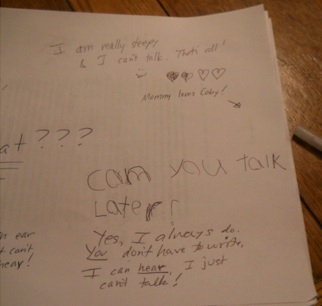
“My son is very good at talking about things he doesn’t like, but I don’t assume that he would feel entirely comfortable directly telling me things he doesn’t like about me. The things he does say indicate support rather than discomfort. A few times I have been annoyed at myself for stuttering and he says “Mommy! Don’t ever be mad at yourself for stuttering!” or, a few times, “Mommy. Stuttering. It’s a way of life.” I don’t not-communicate with him, so he does not feel ignored. I use alternative ways of communicating with him, just not talking. I write, point, use some of my extremely limited repertoire of ASL signs. I once was writing to him about what to wear to church and he wrote back “Yes, mother dearest!” He (as is true of most people I write to) matches my communication mode and writes back. I have written to him (and to others) “You don’t have to write to me; I can hear you!” He has noticed, and told me, that when he comes back from visiting his dad I “seem different.” We have talked about his coming back as a transition point- the house is suddenly noisier, and definitely “talkier.” I have often said that my child talks to think, so we are quite different in that way. I am working on what would make the transition from “kid gone” to “kid in the house” an easier one for both of us.”
For people who do not have difficulty speaking, they may have trouble understanding how someone might be able to speak in one situation and then not able to in another. Can you talk more about this?
“Some abilities are not there every single time a person wants to access them. This is true for all people, but for an Autistic person, these fluctuations in abilities and access to abilities might be more pronounced. If I don’t play the organ almost every day, it’s almost like I forget how to play it. That’s why I always practice on Saturday night and Sunday morning before church. There is no way I can go in there cold and play like I want to. Think of something like delivering a presentation. For most typical people, there will be good days and bad days, presentations you wish you could do over, and days when you were really “on your game.” Or, think of your favorite sports team and player. Some games are not so good; other games the team really does well. But playing the organ or hitting a home run is not an essential life skill (ballplayers and organists feel free to disagree!). But when it comes to anything considered really basic, like being able to talk, a sense of mystery surrounds the topic, when a person can do it one time and not another. I maintain that it’s not that different anything else, but is more noticeable and pronounced when it’s something that is expected of everyone, and when one can do that “expected thing” most of the time. Maybe for some of us talking is an extreme sport, in the sense of having to really work, practice, try hard, take risks, and think consciously about what we are doing, whereas for some people the ability to talk is very natural and not even a conscious effort.”
Talk about the idea of language and thinking.
“I have read more than one author who opines that without language there is no thought. Nothing could be farther from the truth. Language includes both written and spoken words, as well as picture-based communication systems like PECS. Not talking (and also not writing) does not equate with “not being able to think,” “being lost in an unknown world” or anything other than specifically not being able to talk. For some people it could mean a lack of focus on “the present moment” (how many people are fully present in each moment anyway?!) or not being able to think in words, which is another one of my reasons for not talking. But it is not, generally speaking, accurate to assume that because someone can’t talk, they can’t think. You wouldn’t look at someone who has a tracheostomy tube and go “Oh wow. That person can’t think!”
What is it like when you’re unable to speak while in public and are expected to?
“It’s a bit nerve-wracking, but only in situations where people do not know me well and are expecting that I can speak like a non-autistic person. I try to anticipate what I will need to be able to communicate at those times but I can’t always build in my own supports. When I am with friends, it’s no big deal if I can’t talk or can’t talk much. In work situations it’s more difficult for me to feel calm about it. Unfortunately this expectation is not limited to people who don’t know much about disabilities, so that I have had to really struggle at autism-related events where there really aren’t accommodations for Autistic ways of communicating. It’s an ongoing process for nondisabled people to learn about communication differences and to anticipate them so that Autistics and other people with communication disabilities aren’t doing most or all of the work to create our own accommodations.”
How do people react to you?
Really, I mostly don’t get reactions, because often the times that I can’t speak coincide with the other person continuing to talk, maybe because they think I don’t have anything to say, or that they are like “Well, if she’s not going to talk, I will!” I do get all kinds of reactions, from total acceptance to “you could if you wanted to- try harder” kind of thing that made me feel sad when I was making the video. Sometimes people don’t believe me when I say (in speech or writing!) that I have trouble talking. I have to be very clear that I mean not being able to talk at all. I have learned that “trouble talking” might mean not saying the right thing, or stage fright, and “I can’t talk right now” can mean “I am too busy to deal with you” rather than that I literally an unable to speak with words coming out of my mouth! I have had a few mixups when people did not know I meant “I can’t talk right now” very literally. Sometimes people just don’t quite believe me and think I am making it up. I am not sure why they would think I would go to that much trouble! There are also people who have never heard me stutter, who think that I don’t, even though I tell them I do. They are going to get treated to another video in a few weeks! I was finally able to capture myself stuttering at a time when I also had the webcam with me.”
Are there things that help you speak after a period of not speaking?
“I mostly just have to wait. I don’t particularly want to talk a lot, but I need to. It’s just one of those things that is expected, and it is expected that if I can do it some of the time, I can do it all of the time. It might seem that someone who can speak but loses speech at times would want to find ways to prevent speech loss, but I often welcome not being able to talk. It gives me a break from the exhausting task of speech production. My idea of the perfect conversation and this is ideal for a number of my Autistic friends, too, is two laptops or mobile devices or text-based equipment, but we can be in the same room together writing to one another. I don’t get a lot of this because I live in a rural area and most of the people I write to are long-distance. Some friends locally are very accepting but we don’t have any alternative setup other than me scribbling on paper. I also get way overloaded by hearing other people talk, as it challenges my auditory processing abilities and I can only take so much talking. If other people, whether or not they can speak, would type to me, I think I could get a lot more accomplished with the interaction with that person. Or, at least I think I could. If writing is not that person’s strongest form of communication, it will be a limit for that person. We should not be expected to always accommodate “talkers” and not the other way around. But it does take extra effort on my part because people can’t tell just from looking at me that I am a person who sometimes can’t access speech.
Ideally, we could take turns using each person’s communication strengths and weaknesses, assuming we are able to do that much. Of course, sometimes it just won’t work.”
Recently someone commented on the “I Believe” post. She wrote: “She is communicationg to you, she communicates to you ever day. With her body language, with her expression, with her unusual use of language.”
I loved receiving this comment (I love receiving all the comments people have sent over the past year, they are always informative, interesting and often provocative), which adds to the earlier discussion in the post “Embrace-ness-ness” regarding how we view intelligence in non-verbal people and what that means.
As I have mentioned before, my father spent the last 15 years of his life in a wheelchair and though he was cognitively unimpaired, he was treated differently, almost as though people thought his brain had somehow been damaged too. His accident and disability profoundly altered my view of the world. I came to see first hand the pain and suffering caused by people’s responses and misunderstandings of his disability.
When we are out in public with Emma, she is a free spirit. I have never seen her look in judgement at another human being, no matter how deranged they may appear. Emma will sit next to a homeless person on the subway without a second thought. If someone smiles at her, she will smile back. Emma is without malice. She is utterly void of judgement. And yet, I see the looks of fear and confusion on the faces of those who see her and do not understand what they are seeing. I see how their eyes watch her and then move to us, trying to find a clue as to why this child is behaving so oddly. Many times people assume she is behaving as she is because of our parenting or lack of parenting. We have been given well meaning advice from countless strangers over the years, people who feel they are, no doubt, helping us. Yet, if we tell them she is autistic, this explanation is rarely met with understanding.
Autism is an almost meaningless word, at this point. It covers such a vast array of behaviors and issues, it is no wonder people feel confused. Many people know someone who is autistic and assume all autistic people must share the characteristics of that person. This could not be farther from the truth however. There are people who are verbal, non-verbal, semi verbal, highly verbal, but echolaic, verbal with perseverative tendencies, etc. Some people who have received the autism diagnosis are highly functional, go on to have successful careers, excel in their chosen fields, others maintain jobs, never missing a day of work, while others cannot hold a job and will need assistance for the rest of their lives. Meeting one person with autism is like meeting one person anywhere. If that person is not able to communicate in a language we know, it doesn’t mean they can’t communicate or do not want to.
We all want to communicate. Perhaps the single most destructive belief about autism is that those who are diagnosed with it have little desire for human interaction. Just because they may not be able to communicate their desires in ways we are used to, does not mean the desire doesn’t exist. If I want to communicate with Emma I just have to spend time with her. She communicates with me in a wide variety of ways constantly.
Emma with her beloved balloon string – recovered from the laundry hamper.
For more on Emma’s balloon string and her journey through a childhood of autism go to: www.EmmasHopeBook.com
This weekend while working with Emma on her literacy program I showed her an index card with the words – Put the bus here – written on it. I then pointed to a place on the table to the right of her and waited. A frog, airplane, bus and kid were all laid out in front of her. Without hesitation she picked up the bus and placed it where I was pointing. Were Emma a neuro-typical nine year old child this would not elicit the inward gasp of excitement I found unable to stifle. But Emma is not a neuro-typical nine year old child. Emma is a moderately autistic child with massive pervasive neurological issues affecting her speech, imagination, reasoning, ability to conceptualize, communicate, initiate and interact. To witness her reading and understanding what she’s just read with an action demonstrating comprehension is nothing short of miraculous.
And it fills me with hope.
If Emma is capable of reading, then it stands to reason she will be able to write as well. What will she choose to write about? What does she think about? How does she feel? Is she aware of her differences? Does she wish she had friends the way her brother Nic does? Does she know communicating is more difficult for her than for other people? What is it like to be Emma?
Other autistic children and adults, many of them non-verbal have found ways to communicate to us about their world.
One such person is Carly Fleishmann, a non-verbal autistic teenager who has found her voice through typing and now has her own blog: Carly’s Voice
I cannot know what the future holds for Emma. What I do know is that if we continue to do everything in our power to help her, she will one day be able to answer our questions and communicate with us. One day Emma will be able to let us in. One day…
For more on Emma’s journey through a childhood of autism go to: EmmasHopeBook




 Emma's Hope Book