Tag Archives: autistic

Halloween

“Which one, Em?  The witch’s shoes or your Uggs?” I said, holding up her black Uggs.

“This one,” Emma said pointing to the black, pointy-toed shoes with large brass buckles I bought for her from the costume shop a month ago.

“She’s such a girl,” Richard whispered, smiling broadly.

Emma jammed her feet into the witchy shoes, looked down and said with a certain degree of satisfaction, “There!”

Then she hopped on her scooter and whipped around our living room.

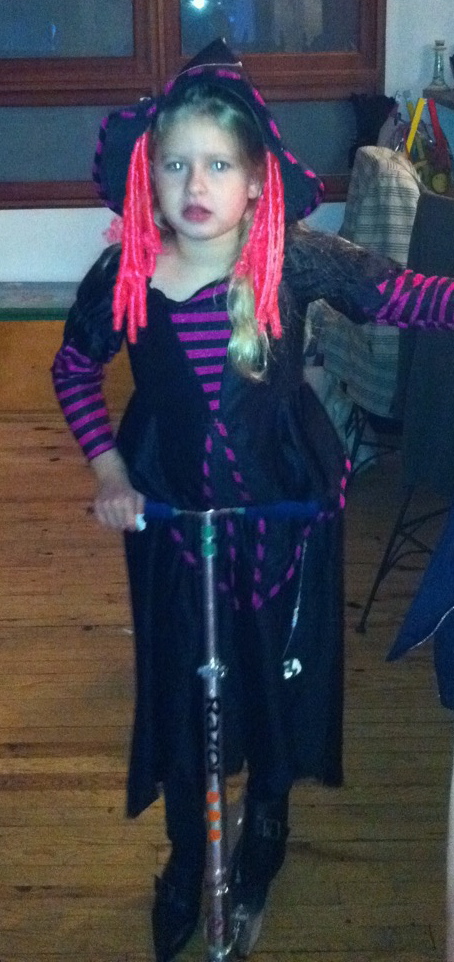
Emma on her scooter in costume

Last year for Halloween, Emma wanted to be a witch as well.  This year, however, she said matter-of-factly, “Pretty Witch.”

And a pretty witch she is.

Flash Cards

“Four, three, two, one,” Emma said, in answer to my request she brush her teeth in preparation for bedtime last night.

This was different than the “one more minute” response we have become accustomed to.

“Don’t you make me come get you,” Emma said in her cheerfully mischievous voice.

After the teeth brushing routine – a compilation of various techniques and quirks from all of us:  flossing first – Richard’s contribution, brushing front and inside gums first, then teeth – mine, ending with brushing the tongue – Joe’s, concluding with a mouthful of fluoride, swish, swish and then spit – Emma’s dentist.  Nightgown donned, Emma raced around the house on her scooter, until I interrupted her with, “Let’s do some work, Em!”

Emma ran over to the couch where I prepared her flash cards.  These were sent home to her last week and have twenty or more sight words written in black marker on pink index cards.  Words such as “huff”, “puff”, “blow”, “straw”, “stick”, “brick”, “pig”, “house”, “down”, words taken from The Three Little Pigs, which is being studied in Emma’s class.  A week ago I laid out three random cards and said, “Emma, pick out the word, “pig”.  Immediately she picked up the index card with the word “pig” on it.  I continued to go through all of the index cards, with no hesitation on Emma’s part.  Her accuracy was close to 100%.  I then increased the number of cards displayed to four, then five, then six.  By six, Emma was making more mistakes, seemed distracted and so I reduced the field back to five.  Challenging for Emma, but still extremely accurate if she could be convinced to take the time to look and not stare out the window while idly jabbing her finger in the general direction of the table.

“Take your time, Em,” I encouraged.  “Look at the word.  Which one is the word “blow”? I asked.

Emma leaned over and blew the index card with the word “blow” written on it.  Then she looked at me and laughed.

I pointed to the card with “house”.  “What does that say?” I asked.

Emma stared at the cards lying on the table and sucked her thumb.  She looked away, staring out the window.

“Hey Em.  What does that say?” I asked again.

No response.

“Can you pick up the card that says, “house”? I asked.

Immediately Emma reached over and chose the correct card.

As with so many things regarding Emma, one is left with a feeling of bewilderment, curiosity mixed with wonder.  Emma, who still cannot articulate the words in the song “Twinkle, Twinkle, Little Star”, will chose the word “brick” when asked to.  Emma who appears uninterested in any stories remotely age appropriate, who continues to struggle and squirm when asked to attend to any one thing for more than ten minutes will sit singing song after song for hours.  She will look at her pile of over one hundred photographs and knows, almost instantly when one is missing.  Emma, whose memory for events and people in her life continues to astound us and yet is not able to identify the number one when asked to.

This is Emma.

The Shower

This morning I told Emma she had to take a shower and wash her hair.

“One more minute,” came the response.  This is the standard response to almost everything asked of her.

“Okay.  One more minute,” I said.

“Don’t you make me come get you,” Emma said with a sly grin, the pronoun confusion in full swing.

“Oh I’m going to come get you!  I’m going to come get you right now!” I said, pulling her legs as she shrieked with laughter and flailed about.

Once in the bathroom, Emma turned on the shower, undressed and stepped in.  “Ewwww!  Too cold!  You have to wait,” she said as she retreated to the safety of the room.  Tentatively she put her hand in to test the water.  “Nice and warm,” she announced before stepping into the shower.

“Okay, Em.  Remember you have to take the shampoo bottle and open the top.”  As I spoke, reminding her of what the steps were, she did as I said.  She put shampoo on her head and stood still.  “You have to rub the shampoo in.  Remember?   You have to wash your hair,” I reminded her.

“You have to wash your hair,” Emma repeated.

With a little help, Emma managed to wash her hair.

“Towel!  I need a towel!” Emma said, using the correct pronoun.

“Here you are!” I said, offering her a washcloth, which she held over her eyes.  “You need to rinse your hair, Em.  You have to get all the soap out.”

“You need to rinse,” Emma repeated.

I then walked her through washing her body with soap, naming each body part, reminding her she needed to rinse the soap off.  A few weeks ago I received a phone call in the middle of our shower routine and when I returned Emma was standing in the shower covered with soap.  When she saw me she turned the water off and said, “Shower all done!”

“No Em!  You need to rinse the soap off,” to which she took the bar of soap and put it under the water spray – washing it off.  “Your body, Em.  You need to rinse the soap off of your body,” I corrected myself.

Once out of the shower, unless reminded Emma will simply get dressed or more likely, run to our bed where she will snuggle under the sheets, soaking wet.  “You have to dry off, Em.  Remember?”

Again I name all her body parts.   Upon hearing them, she dutifully dries each part and then runs to our bed, laughing.

“Emma washed your hair,” Emma announced when I joined her in our bedroom.

“Yes, Em.  You did a terrific job washing your hair,” I answered.

“Emma wash your hair again?” Emma said with a grin.  Without waiting for an answer she shouted, “No!  You cannot wash your hair again.  You already took a shower!”

This is Emma’s idea of hilarity.  And it is pretty funny watching her scream with laughter at the very idea of going back into the shower.

That’s our Emma.

A Balanced View

When writing about Emma I am often struck by how other people view what we write.   “She sounds just like my four year old,” is something I have heard more than once.   We walk a fine line of not wanting to exaggerate the tiny steps of progress she makes, with the desire to write honestly about her life as we witness and interact with it.

For example if I write of how Emma is now sleeping through the night, only very occasionally wetting her bed, hasn’t worn a diaper since June 9th, 2010, is verbally more precocious, is displaying wonderful eye contact more and more frequently, seems to understand more, has an increased interest in being read to, tolerates more situations with increasing ease, it sounds almost miraculous.  And in many ways it is.

If I then give a detailed description of a day spent with her – such as yesterday when we went not only to the Bronx zoo, but to a nearby playground afterward – describe how she never once acknowledged the hundreds of children around her, much less exchanged eye contact or words, all the while carrying a two foot long stick which she refused to release even when on the monkey bars, her utterances, her overall deficiencies appear glaring.  If I insist then on adding how she attempted to sit opposite us on the subway, made odd whooping noises and whenever the doors to the subway closed with the accompanying ding-dong sound, Emma cheerfully sang, “Gank – You!” replicating the exact tone of the warning sound indicating all passengers needed to get inside the subway before it left the station, one is left with a very different sense of who she is.  Yet both would be accurate and correct.

A balanced view is the goal of this blog.  Neither an exaggerated version of her abilities nor deficits is what we endeavor.  The trouble is, it isn’t always easy.  Given a mood, a less than ideal night with too little sleep, work stresses, marital stresses, all effect how Emma comes across on paper.  There’s no way to really portray her with all her idiosyncrasies without it seeming somehow off.  I read past posts and barely recognize her or us, for that matter.  The edges are smoothed the disagreements remain just that and not the melodramas they can feel to those intimately involved.  Perhaps it is a positive thing.  In the end we are the stories we tell, we become the edited versions we choose or in this case we choose to tell for Emma.  Who knows what she would say, were she able to.  Perhaps one day she will be able to do so and will choose to.  My guess is it will be a very different story than the one we are telling.

Books

When Emma was very young, she barely tolerated being read to.  Unlike her older neuro-typical brother, Nic, who requested certain favorites over and over again, only to be delighted when a new book was presented, Emma would take hold of a select few and flip rapidly through the pages.  It became apparent her interest was less about the book and more about the action of holding it and turning its pages.  During those early years, before we were given her diagnosis I remained baffled by her behavior.
We are a reading family.  Our home is filled with books on a wide variety of topics, fiction, non-fiction, poetry, memoirs, biography, it’s all there.  When Nic was born I looked forward to introducing him to the books, which captured my attention and imagination when I was a child.  We read to Nic every night and often still do.

When Emma was born, out came the now tattered edition of The Hungry Caterpillar, Brown Bear, Brown Bear, What do you see? Good Night Moon, its spine broken, held together with tape and hundreds of others.  But Emma would squirm in my lap, push the book away, whimper and struggle until eventually I let her go.  I was tenacious though and regularly took the children to Books of Wonder, the local bookstore where Nic promptly sat on the floor amidst a growing pile of books.

“Can I have this one?” he asked.  “And this one?”

Emma went to the bookshelves, scanned them and upon seeing a book she was familiar with would pull it down.  I don’t remember her ever pulling down a book we didn’t already own until she began going to preschool.  Then we would purchase one or maybe two books she knew from school and she would flip through the pages like some sort of speed-reader.  It was the same when she looked at photographs.  Not really seeing them, there was no studying the photo or in the case of a book, the illustration.  She methodically turned each page, seemingly without seeing.

Over the years Emma has shown a greater tolerance for the books we continue to try and entice her with.  She has learned to sit patiently with me while I read to her.  Sometimes she appears to even enjoy it.  When she likes a book after I have finished reading it to her, she will grab the book from me and say, “Emma’s turn!”

Over the past six months I’ve noticed Emma is much more curious about the books I proffer.  Now at night I typically choose one book Emma knows and has requested, at the moment her two favorites are Olivia Forms a Band and The Three Little Rigs, and several she’s never seen or expressed any desire in sitting through.  Within the past month I have read, The Cat in the Hat, McElligot’s Pool, Dr. Seuss’s Sleep Book, If I Ran The Zoo, Olivia Saves the Circus, Olivia and the Missing Toy, The Giving Tree, the list goes on.

When I was pregnant with Emma, I fantasized I would read to her and Nic at night the books I remember being read to by my mother.  Every Sunday night my father would take my brothers to the living room where he would read King Arthur and the Knights of the Round Table, The Hobbit, among others.  My fathers’ booming voice would make its way down the hallway into my parent’s room where my sister and I were lying on either side of my mother.  We would roll our eyes at each other and occasionally my sister would request that she be allowed to sit with our brothers and listen to whatever my father was reading.  Meanwhile my mother read:  Mary Poppins, Winnie the Pooh, and later books such as My Family and Other Animals.  I can still remember my heartbreak when a book came to a close. A few times I even cried when a book came to its conclusion because I could not stand it had come to an end.

That Emma is showing pleasure in being read to, fills me with joy.

Just one more small step forward…

My Emma

A mother with her little girl, about Emma’s age stand patiently in line for the bathroom on our flight to Denver.  Methodically her mother braids her daughter’s long, blonde hair, then places her arms around the child’s upper body.  Her daughter puts her own hands on top of her mother’s, tilts her head up and smiles at her mother.

I marvel at how such a simple gesture, probably gone unnoticed by either of them, is utterly foreign to me.  I long for such a simple exchange with Emma.  I get them, but they are rare.  When they do come, seemingly out of nowhere, I am usually caught off guard and brought to tears, tears of relief and joy and something else, something closer to grief.

I think of Emma, standing in a similar line, on this same airplane route flying from New York’s La Guardia to Denver several years ago.

“Potty?” Emma says, anxiety rising in her voice.

“Yes, we have to wait in line,” I say.

“Potty?!” Emma says again, her voice slightly louder, the anxiety has crept up a notch.

I count the number of people in front of us, there are four, but one’s a couple so maybe they don’t both have to go, perhaps they’re just keeping each other company I reason.  Five minutes, tops, I think.

“We have to wait,” I say again, grim determination steeling into my tone.  I take a breath when another person vacates the only bathroom, reducing our line to three.  I look behind me at the two bathrooms at the back of the plane, the line snakes up the aisle, at least half a dozen are waiting.

“Have to use the potty,” Emma says now close to tears.

The woman in front of us turns to look at the whining child, my child.  “She can go ahead of us,” she says kindly.

“No she can’t,” her husband, counters.

“Scott!  Of course she can.  Go on, go ahead of us,” she glares at her husband who is shaking his head in annoyance.

Grateful, I thank them, ignore the husband’s irritated glare and go to the head of the line, pulling Emma ahead of me.   Anxiety, stress – will she wet her pants?  Did I bring enough pairs of underwear and a full change of clothing if she does  Embarrassment, humiliation… it’s all there.

I return my thoughts to the little girl with her mother behind me, looking for any sign that she might be uncomfortable.  There are none – mother and daughter, utterly relaxed standing close to one another, as though this were the most natural thing in the world.

“Compare and despair,” a friend of mine once said to me.  And it is true, though I cannot always help myself.  Whenever we are with friends with small children, whenever we are at a playground, any time I see a child I find myself asking – did Emma do that when she was that age?  Did Emma ever to do that? And then the inevitable follow up question, which serves to slam the door shut on all further questions – will she ever do that?

Who knows?

I am away for the next four days, yet my children and husband are here with me, everywhere I go.  I find there’s great solace in that.

A Little Gratitude

Emma stealthily crept into Nic’s bed last night, without waking him and was found by Richard when he went to wake Nic at just minutes before 7:00AM this morning.

“Good job waiting!” Emma said as she bounded into our bedroom and snuggled under the sheets.

Richard, having spent well over an hour with her in the middle of the night getting her back to sleep, was in the other room.  I was getting dressed and said nothing.  I was at a loss for words.  She sounded so proud of herself.  Did she not understand that in fact, she had not slept in her own bed, had gotten up at just past midnight to come into our bedroom where she woke both of us up?  Did she no longer remember Richard went back to her bedroom with her and stayed there until after 1:00AM, making sure she was asleep before returning to our bed?  At some point after Richard left her she must have woken up once more and snuck into Nic’s bed, being sure not to wake him.  After all we told her she mustn’t wake Nic.  Technically she did not wake him, but she didn’t stay in her own bed either.

The night before she was up screaming, “Mommy!  Mommy!  Come!  Mommy come!”  Heart-rending cries, unbearable, the guilt in not responding overwhelmed me.

“I’ll get her,” Richard said, grimly.

For the past couple of nights now, Richard has gone to her before her screams woke Nic, sitting with her for more than an hour in the middle of the night.  Trying to calm her, trying to get her to understand we need to sleep, she needs to sleep, she cannot wake us.  Yet, she does anyway.  It is easy to feel discouraged, despair even, but the truth is, she is making progress.  The 2:30AM wake-up calls are now occurring just after midnight.  She is not wetting her bed.  She is (until last night) staying in her own bed, after Richard returns her to it.

“Mommy!”  Emma cried.  Five years ago, I would have given anything to have her cry out for me.  I would have given anything for her to acknowledge me at all.  Now she does and I groan.  It is Richard who bears the brunt of these middle of the night pleas.  It is Richard who suffers the next day, trying to defog his brain enough to make sense of the work before him.  It is Richard who stumbles through the day, trying to maintain a placid demeanor, not giving in to the impatience, despair and fear that lurk on the edge of his thoughts.

I must get my work done and leave the studio early today so as to be home in time to greet Nic’s bus at 3:45PM this afternoon, allowing Richard to go out with friends who are in town.  It is the least I can do.  I sit here in my studio gazing out at the Chrysler Building, feeling immense gratitude, gratitude for having a husband who places his family first, who demonstrates his love for us on a daily basis.  I am incredibly fortunate.

I have the luxury of enough sleep and a mind clear enough this morning (thanks to my husband) that I am able to remind myself, Emma is progressing.  It’s two steps forward, one step back, but she is making progress.

I don’t know how people do this without an active participating partner.

I cannot imagine.

Autism and Jaundice

I have a photo shoot this morning so this post will be brief.

My mother reminded me the other day that when Emma was born her eyes were slightly yellow.  I remember asking the mid wife about it and being told not to worry too much.  Within 48 hours Emma was fine.  A new study has come out suggesting there may be a link to babies born during October – March with jaundice and autism.  Emma was born in January.  Dr. Sandy Lowe told us several years ago he thought autism maybe due, at least in part, to a virus contracted by the mother during pregnancy.  I had a cold I could not shake for almost six months while pregnant with Emma.  I have also read articles speculating more children who are diagnosed with autism are born during the winter months.   For those who are interested, Google autism & jaundice for a more thorough review of the Denmark study.

Societal Subtleties

Emmy, I’m leaving.  Have a good day with Joe,” I said, as I was getting ready to go.  I went over to where Emma lay under the duvet in our bed with her earphones on listening to one of her favorite songs, The Beatles – Happy Birthday.  “I love you, Em.” I said as I bent down to kiss her.  She turned her head, as she almost always does, so that I kissed her forehead.

“So much,” Came Emma’s muffled answer.

“I love you so much,” I said, kissing her cheeks.  Emma said nothing in response.  I waited for a few seconds, “Em, you say – I love you Mommy.”

“I love you…” Emma looked at me as I pointed to myself.  “Emma,” she added smiling.

“Not Emma!” I said, kissing her again.  “I love…” I pointed to myself.

“Mommy!”  Emma finished.

“That’s right Em. I say – I love you Emma and you say – I love you Mommy!”

“I love you Mommy!” Emma echoed, before ducking her head down under the covers.

I went out to the living room.  “Bye Nic.  I love you.”

“I love you too, Mom,” Nic said without hesitation.

Just another morning in the Zurcher-Long household, such simple things we so easily take for granted, are stumbling blocks for Emma.  It’s not only pronouns that trip her up.  It’s the simple human niceties we do and say to one another that mystify her too.

After months of prompting, Emma now will say, “I’m fine” in answer to, “How are you?”  She understands the rote answer is what is expected and what will suffice.

“Most people really don’t want to know how you really are,” a friend of mine said to me once.  “They’re just asking because it’s expected and they don’t want to seem rude.  But can you imagine if you answered them honestly.  You know, by saying something like:  Not so well.  I’m struggling with some thorny issues I’d like your advice on.”

I interjected,  “Or – let’s sit down, this may take a few minutes.”

“Exactly, I mean that’s why everyone goes to a shrink,” my friend said matter-of-factly.

A Cry For Help

“Mommy!  I need help!” Emma said last night at 3:30AM.  Her cheeks damp with tears, her face conveyed the discomfort she felt.

“Here Em, try to yawn.  Go like this,” I said opening my mouth wide and moving my lower jaw from side to side.  We’ve been over this, countless times in the past week.  It was the same dialogue, just a different day, different hour of the night.  I became aware of the pressure in my own head, making my ears pop.  The air pressure outside must have changed during the night I thought.

Emma has become hypersensitive to any slight change in air pressure.  She tries to pop her ears by holding her nose and blowing, turning her face red until the pressure is alleviated.  Sometimes her method seems to even work.  One of us taught her to do this on an airplane once, I can no longer remember when or which one of us.  But it served its purpose and now she’s convinced it will help any time she feels any pressure.  The problem is, it also appears to cause the uncomfortable sensation and exacerbates the pressure when we are firmly on land and not flying in an airplane.  Explaining this to Emma has not proven helpful.  She cannot understand the subtleties of the situation.  When in an airplane hold your nose and blow out, when on land try to yawn.

“Mommy!  Mommy!”  Emma cried.  Her eyes searched mine, panic rising.

“I know baby, come here,” I said.  I tried to massage her ears by pulling gently on the lobes.  I pretended to yawn hoping this would produce a yawn from her.  It did not.  Emma does not yawn in response to seeing someone else yawn the way most of us neuro-typicals do.  When I yawn, Emma watches me and continues doing whatever it is she was doing before I yawned.  I found my mind going off on a tangent about what this means, mirror neurons and the like.

“Mommy!  I need help?” Emma said this last as though it were a question.  As though she were asking – Do you need help?  Instead of what she means, a demand for some assistance, a plea to have her mother make the pain go away.  Except I cannot make the pain go away, I can only try to get her to yawn.  I tried again.

“Do this Em,” I pretended to yawn, only this time I actually did yawn.

Emma watched me intently.  She opened her mouth and breathed out.  She could not make the connection.  She wasn’t able to make her ears pop, she was unable to reduce the pressure even if only momentarily.  Emma held her nose and breath, pushing her cheeks out, like a trumpet player.

“There.  That’s better,” she said.  A second later she was at it again, crying and requesting help.

I stroked her head and tried to talk in a soothing tone.  “It’ll be okay, Em,” I said, unsure what else to say or do.

Emma nodded her head.  “You have to yawn,” she said.

“That’s right Em.  Try to yawn,” I agreed.  I waited a few seconds then asked, “Is it better now?”

“Yes.  Better,” she said.  “Time to go to sleep.  It’s okay,” she said, snuggling down under the sheets.

“Yes.  Good idea.  Try to sleep,” I said.

As I write this I am aware of the continued pressure in my head.  I wonder if I have this feeling all the time, but just shut it out.  Now I too am hyper aware of the sensation.  Not painful exactly, but uncomfortable.  I imagine what it would feel like if I didn’t know it was due to the changing weather, the fluctuating air pressure.  I do not panic when I feel it because I know it will go away of its own accord and it’s not intolerable.  But what if I couldn’t understand what it was?  What if I couldn’t understand the explanations given to me?  What if it was just something that happened, seemingly arbitrarily, with no remedy?

Would I panic?  Would I cry out for help?

Yes.  I would.

Exhaustion

The vicissitudes of our daily life with Emma require a certain degree of hope in order to stave off the depression lurking in the background.  I need a plan of action, something I can refer to when I am tired, when my defenses are down, when I feel my grip on that tenuous thread of hope beginning to loosen.

At the moment I am reading about RPM – Soma Mukhopadhyay’s Rapid Prompting Method for autistic children, which gave her non-verbal son Tito a voice.  I have watched the videos, have read her book and am now rereading the book while taking notes.  I am on a waiting list to go with Emma to Texas to have a four-day session with Soma.  In addition I have just started reading Dr. Howard Shane’s book – Visual Learning.  I need to be alert while reading as the subject matter is dense and I have difficulty taking it all in.

Emma continues to wake the entire family at all hours of the night, resulting in all of us being exhausted, relying on caffeine to get us through the day with no end in sight.  Poor Nic, who is not allowed to drink caffeine, has to muddle through as best he can.  It is certainly affecting his ability to concentrate at school.

“We don’t have a plan,” I said to Richard this morning.  “We need a plan of action.”

But the truth is, I need an infusion of hope.  Like an IV – hook it up and let it drip into my veins.  Hope is the thing, more than anything else motivating me to keep pushing ahead.  Hope is the lens through which the world can seem grey and dull or bright and cheery.  I need hope.  So I think about the phone call Richard had yesterday regarding Emma’s last QEEG.  We had the brain scan done the day before we left for Panama for her second round of stem cell treatments.  Our conflicting schedules have made it impossible to meet to go over the results.  Richard is meeting with one of the doctors this Friday.  The doctor told us he thought there were some interesting things going on with that last scan.

So we wait and we hope.

Autism and the Family

“Mom! “ Nic’s cries could be heard throughout our home.

“What is it, Nicky?” I asked.  It was 1:00AM.  I could hear Emma whimpering.

Nic began to cry.  He stood in the middle of the living room, pointing toward his bedroom.  “She’s in there, she woke me again,” he said before bursting into tears.

“Oh, Nicky.  Come on.  I’ll get her out of your room,” I took his hand and led him back to his bed where Emma lay.

“Emma!  This is not okay.  You may not wake up Nic!”

“Nic’s room, bye-bye!”  Emma said cheerfully.  Then she began to whimper.

“That’s right.  You may not wake up Nic.  Go to your room,” I said.

“No.  Not going to wake up Nic,” Emma said.

The night before Emma woke everyone by screaming in the middle of the night.  It was similar to being woken by an air raid siren, jarring, disconcerting.  The shrieks were deafening.  We punished Emma by not allowing her to have her beloved pancakes the following morning.  Even so, she seemed not to fully understand the connection.

Emma’s nocturnal awakenings affect all of us, but so do her public melt downs, her inability to communicate, her inability to understand and empathize with others, her limited food choices, her inflexibility.

Perhaps of all of us, it is hardest on Nic.  He is the one who gets the brunt of our impatience.  It is Nic who feels the weight of being expected to be the “normal” one, who understands and feels our stress, who feels fury with Emma for her very public displays, which he finds increasingly intolerable and embarrassing.  He longs for a “regular” sister, one he can play “hide and seek” with, one who will play card games with him.  One he can talk to.  As exhausted as Richard and I are by our sleep- deprived nights, we do our best to plod along.  We talk with one another, lean on each other.  We rely on gallows humor when everything seems bleak.  And while we encourage Nic to talk honestly about his emotions, I wonder whether he really feels he can.  I wonder whether he doesn’t feel he is placing yet another burden on us, and censors his thoughts and feelings.

For several years after Emma’s diagnosis Nic went to see a child psychologist.  A year ago he requested that he not go any longer.  We spoke with him at length and promised him we would not force him to continue seeing her if he didn’t want to go back.  Since then, I have asked him several times whether he’s sure he wouldn’t like to return or find a new therapist, he has continued to say no.

I have learned over the years, that as bad as things are or seem:  a) they can always get worse, b) they can seem worse than they are and c) one can always shift ones perspective ever so slightly enabling one to see things differently.  I have found when I am able to achieve a more balanced perspective I am better able to cope.

Emma has changed all of our lives dramatically.  She has pushed each of us.  Sometimes it feels to our breaking point, but we have all survived thus far.  Emma forces me (I will not presume to speak for any of the other members of my family) to pay more attention.  I appreciate small gestures, small acts of kindness more than I did before Emma’s diagnosis and it inspires me to do the same for others.   For instance, I am constantly aware of how hard my husband, Richard works to help her, to help Nic, to help me.  He is a rare breed, fiercely ambitious, a visionary and yet places his family firmly first, not just in thought, but in his actions.  He believes in equality and behaves in accordance to those beliefs.  He is as strong a man as I have ever met, giving both emotionally and physically of himself.

Emma has taught me to see the world differently.

And it is beautiful.

“It’s Light Out”

Good job waiting til it’s light out.  You didn’t wake up Mommy.  High five!”  Emma said this morning as I was getting dressed.

“But Em, you did wake up Mommy.  Remember?  You were crying in the middle of the night for Mommy,” I said.

“You have to pull on Mommy’s robe.  Mommy!  Can I come get you in the other room?”  Emma said looking at me sadly.

“No Em.  You have to try to stay in your own bed at night.  You have to wait until it’s light out,” I said, peering out the window at the decidedly unlit grey sky.  Rain pummeled the sidewalk below.  How confusing this must be to Emma.  After all it was not light out this morning at 6:30AM when all of us needed to get up and begin our day.  In fact, it was extremely dark.

Last night in addition to her ears bothering her, Emma managed to lose her scrap of what was once a blanket, which she calls “Cokie”.  The 2:00AM wake up call reverberated throughout our home.  I have a vague memory of waking up, confused and saying to Richard, “Is that Emma screaming?”   When we are in Colorado Emma’s middle of the night screams sound similar to the coyote, who kill their prey out in the field below our bedroom window.

“Yup,” Richard said wearily.

“Okay.  I’ll get her,” I said, donning a bathrobe.

“You sure?”

“Yeah.  I’ll try to get her back to sleep,” I answered.

When I went into Emma’s room she was sitting on her bed with all the lights on crying, “Cokie!  Cokie!”

“Okay, Em.  It’s okay,” I said.

“You have to look,” Emma said, helpfully.

“Yes.  We have to look.  I’ll help you,” I said, digging around under her bed.  “Here it is, Em,” I said holding up a tattered strip.

Emma grabbed her Cokie from me and began sucking her thumb.  “There you are!  There’s Cokie!”

Last night Richard and I, having missed the unusually early starting time of Bloody, Bloody Andrew Jackson, managed to get tickets for Next to Normal.  Knowing nothing about the play, we took our seats with no expectations.  The play was brilliant.  The subject matter though surprising, about a mother who is bi-polar and the burden this places on the rest of the family, is beautifully depicted.   Throughout the play I thought of Emma and Nic.

During the first act the mother goes to her psychopharmacologist who tells her it’s an inexact science and later when she again complains about the drugs she has been given, he tells her there is no cure, but asks her to stay with him and not give up on the meds.

While we have not put Emma on medication, we have tried any number of other things.  Always with the assurance, whatever it is will help, always with the slight retraction when it has not.

“Sleep, wake up make pancakes?”  Emma said this morning.

“Yes, Em, tomorrow we can make pancakes together,” I said.

“It’s Nic’s Mommy,” Emma said pointing to me.

“I am Nic’s mommy.  And I’m your mommy too,” I said.

“It’s Mommy,” Emma said, kissing me on the cheek.

I held her to me and said, “That’s right, Em.  I love you.”

“It’s light out,” Emma said pointing out the window.

“Yes, Em.  It’s light out.”

Unreliable Witness

Yesterday I received a call from Emma’s school saying she was crying and her ears hurt.  She was inconsolable.  By the time I arrived to pick her up, she was cheerful and eager to, “Go see Doctor, you have to say ahhhh.”

“No I don’t think so, Em.  I think she’ll want to check your ears, make sure you don’t have an ear infection,” I told her.

When we were ushered into the doctor’s office, Dr. K. said to Emma, “Emma, can you shut my door?”  To which Emma immediately got up, ran over to the door and shut it.

“Thank you, Emma,” the doctor said.  She then proceeded to check Emma’s ears, which were fine.  After the exam I discussed some of our concerns regarding Emma’s progress.

“But she’s doing really well,” Dr. K. said.  “Her language…  She’s speaking more each time I see her,” she added.

I thought about a conversation I had with my brother, Andy a couple of weeks ago.  Andy is a physicist, whose thoughtful opinion I have come to rely on.  He called one morning, as he often does, while on his way to work.  I began crying as I told him how worried I was about Emma.  “I just don’t know that increased eye contact is enough to warrant another round of stem cell treatments,” I said.

Andy reminded me eye contact was the manifestation of a great deal more than “just eye contact”.  He went on to say that an increase in eye contact was significant as it suggested an increase in relatedness as well as cognitive awareness.  He told me he saw it as extremely positive and advised me to not be quite so easily discouraged.  By the time we ended our conversation, I felt much better.  I felt a tremor of hope.

As I sat listening to Dr. K., I realized – I am an unreliable witness.  Whether it is because I am impatient, have high expectations or am too emotionally caught up in the daily struggle to see the improvements others see, it is clear to me, I cannot entirely trust my perceptions of my daughter.

I have mentioned this before, but whenever we go to Colorado, about four times a year, my mother can be counted on to say, “You know, she’s better.”

To which I predictably respond, “Really!  Do you think so?  In what way?”  I cannot say how many times my mother and I have had the above conversation.  One that is repeated with many of our close Coloradoan friends as well.

I am reminded of my recent post regarding Emma.  How my favorite times spent with her are when I have no agenda, no expectations.

How’s Emma?

Emma is.

The Elusive Pronoun

Autistic children are known to have trouble with pronouns.  It is not simply mixing up “you” and “me”, but all pronouns; he, she, her, his, I, you, me, we, us…  There are theories regarding this confusion.  One such theory from Simon Baron-Cohen who coined the phrase “mindblindness” suggests autistic children have trouble self differentiating and therefore become confused when confronted with pronouns.  He has since amended his theory, suggesting autism is a form of “male brain” or empathizing-systemizing (E-S) theory.  He goes on to explain that autism is a series of deficits and delays in empathy.

As with all things “autistic”, it’s a theory.

Last night Emma came into our room at 2:30AM.

“C’mon Em.  You have to go back to your bed,” I told her.

“Mommy come.  You have to ask Mommy.  Mommy can I get you come into the other room?” Emma said, sadly.

“I’m going to go with you.  Come on.  Let’s go back to your bed,” I said, holding her hand.

I tucked Emma into bed and sat next to her, stroking her head.  “Now Em, you need to try to go to sleep.  You need to go to sleep and stay in your own bed until it’s light out.  Then you can come into my room.”

Emma took her hand and gently pressed it to my cheek, “You,” she said.  Then she took my hand and pressed it to her cheek, “Me,” she said.

“That’s right, Emmy!  You,” I pressed our hands to her mouth, “and me,” I said, holding our hands to my face.  This is going better than I expected, I thought. “I’m going to go back to bed, Em.  You have to stay here and try to go back to sleep, “ I explained.

“Okay,” Emma said.

I stood up.

“No!  You and me!” Emma cried.

And then I understood.  She was telling me she wanted me to stay with her.  I had assumed she was showing me she understood the correct use of the words, “You” and “Me.”  It was an interesting moment, with me taking her words literally, and Emma trying desperately to convey her upset and desire for me to stay with her.

“Okay, Em,” I said.  “But I’m really tired.  I have to get some rest,” I tried to explain.

“It’s okay,” Richard said, appearing at the door.  “You go ahead.  I’ll stay with her.”

“Mommy stay with Emma!” Emma said tearfully.

“Mommy has to go to sleep, Em,” I reminded her.

“Okay,” Emma said.  With that she got up and raced past both Richard and me to our bedroom.

“It’s okay,” Richard said with a resigned tone.  “Go with her, I’ll stay here.”

This morning as we went through the motions of getting breakfast for the children, checking backpacks, I said to Richard, “And how long did it take you to fall back asleep?”

“Oh, about an hour and a half,” he said.

“Yup!  Em and me too,” I answered with feigned cheeriness.

“Looks like a beautiful day,” Richard commented, glancing out the window.

“Another gorgeous day,” I agreed.

“Fake it til you make it,” Diane Von Furstenberg told an audience member at the WIE Symposium a few weeks ago.

It’s all in ones perspective.