Tag Archives: autistic

The Trouble with Treating “Behaviors”

A child throws a chair or their shoes at school and the parents are told of their child’s “problematic behavior”.  A child pokes another child repeatedly and when told not to, laughs and does it again.  The teacher tells the child they will not be able to go out to the playground at recess as punishment.  A child runs from the classroom, causing the teacher to stop her lesson and pursue the child.  The child is given a time out for displaying “challenging behavior”.  A child does not respond to the teacher, does the opposite of what is asked and the parent is informed that their child is “out of control” or “refuses to listen” or “is being disruptive” or any number of other comments that so many parents routinely receive from the various teachers and schools that our kids attend.

Each time it is the child’s behavior that is highlighted, documented, and charted.  Reward systems are put into place, time outs are given, the child is told there are consequences to their actions and things they love are taken away to demonstrate this point.  The thinking goes that behaviors must be treated.  But I question all of this because I’ve read too many stories that beautifully explained these so called behaviors by many people who spent a great deal of their childhood being misunderstood and told their behaviors were “out of control” or “challenging” or they needed to understand there are consequences when they were responding to other things in their environment.

Imagine you are on the school bus and another kid is seated directly behind you.  They scratch the back of your seat with their fingernails.  The sound of their scratching, coupled with the vibration caused by it, makes you feel as though your entire body was covered in crawling ants and the vibration makes you feel physically ill.  You do not have much spoke language that you can easily access and the language you do have is thought of as echolalia so it is often ignored.  Never-the-less you do the only thing you know to do, you shout, “No!  Stop doing that.  You cannot hit, you cannot punch, you cannot bite!”

The other kid thinks this hilarious and realizing you are directing this at them, continues to scratch the back of your seat, except now they are doing it with renewed vigor.  The bus matron comes over and tells you to stop yelling, that you are being disruptive and need to be quiet.  The kid behind you continues to scratch your chair, and despite your protests, despite your attempts to make him stop, he will not.  Eventually you turn around and spit at the kid.  The matron comes over, now furious and tells you that you must apologize and that she intends to tell your parents how badly you’ve been behaving.  So you spit at her too.

When the matron tells you that you will not be allowed back on the bus, something you love riding, you begin to cry and bite yourself.  Again you are yelled at, told to stop it immediately….  When you get home your parents tell you this kind of behavior is unacceptable and on it goes.  No one says a word about the boy who was making your bus ride miserable.  No one talks about his behavior or that there are consequences, in fact there appear to be no consequences to some people’s behavior, only yours.  The message you learn is that terrible things will happen to you, seemingly without reason, without any explanation and that you must be hyper vigilant and avoid sitting near any other kids.  The next time you board the bus you attempt to sit in the very last seat, but are told you cannot and are seated in front of the boy who delights in scratching your seat.

(The above story happened to someone I know well and it was only when I was able to type with this person that the whole story came out.)

A few months ago I read about a boy whose older brother would punch his friends on the shoulder upon seeing them.  They all smiled and laughed.  After much observation, the younger brother decided that this was a good thing to do, especially to someone you liked and wanted to be friends with.  So the next day when recess rolled around this boy went up to another kid and punched him in the shoulder.  Only the kid didn’t laugh or playfully punch him back.  Instead he yelled at him to stop hitting him, called a teacher over and the other boy was sent to the principal’s office.  The boy was told if he continued “picking fights” he would be expelled.

These examples are but two of dozens about so called “behaviors” that are seen as problematic and in need of various interventions to deal with them.  And yet, when one listens and asks non-scolding questions from a place of curiosity without threat of admonishment there is almost always a reason for these so-called “behaviors” and the reasons may illuminate why the various interventions to treat them will not work, or will work to make the person learn to camouflage or quell their behaviors, but will not help the person learn how to cope or deal with the things causing the “behaviors”.  Treating actions that are seen as problematic as though they occur in a vacuum is like applying a band-aid on a rash caused by allergies.  The band-aid might cover the rash from view, but it will do nothing to treat the cause.

It is interesting to note that there are people who consistently work with those who are known as having “problematic or challenging behaviors” and yet, all of those so-called behaviors disappear when they are treated with respect, presumed competent and they are not treated as though their actions are intentionally disruptive.

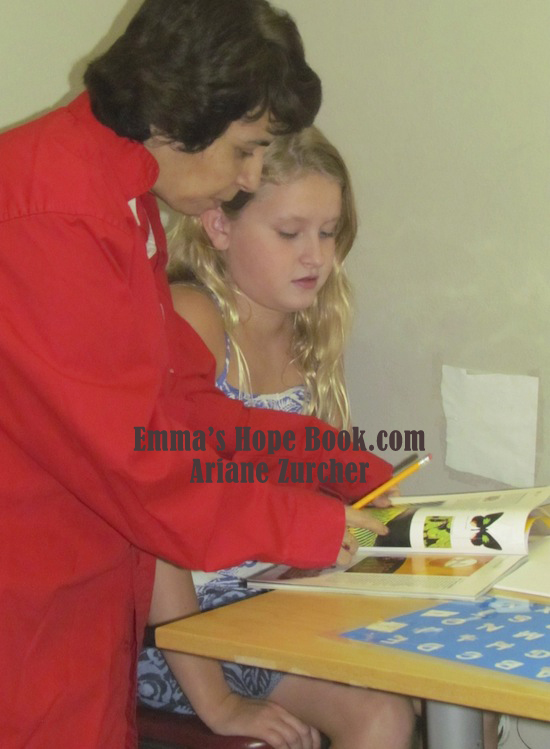
Soma Mukhopadhyay and Emma ~ September, 2013
Soma & Em copy

Related articles:

I Will Not Model Compliance For My Child

“Look! Motorcycle bubbles!”  This was a phrase Emma used to say often.  It was an all-encompassing phrase that was both a metaphor for rain and the Fourth of July and New Years Eve fireworks, as well as a descriptive phrase of what both are like sensorily for her. (Emma has verified this is true.)  “Motorcycle bubbles” meant rain and fireworks, but there was so much more to those two words than simply pointing out the window and saying, “Look!  It’s raining!”  or “Look at the fireworks!”

When I went back through this blog to find the post I’d written about motorcycle bubbles, I found these, “Sorry Bubbles” and Em & The 4-Wheeler  written more than two years ago, that I’d completely forgotten about.  “Motorcycle bubbles” and her related phrase, “Sorry bubbles” are nothing short of poetic.  Poetry is all about using words in unusual, unexpected ways, “Sorry bubbles”  Great art evokes an emotional response within us.  While, a few years ago, I was appreciative of the beauty of phrases such as “sorry bubbles”, I was even aware of the emotional tug I felt when I heard her say those words, that appreciation was tempered by worry and concern about what I believed the larger issues were for my child who said such fascinating, yet cryptic, words.

I no longer feel the strain of worry and concern, but rather delight in my daughter’s obvious brilliance and poetic gifts.   I am grateful to have gotten to this place of appreciation and joy.  So many autism specialists and so-called treatments did not and do not appreciate the beauty of those word combinations.  So many believed they were aberrant, meaningless words that must be righted through rote learning and repetition of more “appropriate” words.  Which was code for “use these conventional words, so that we can understand you more easily.   Make our lives easier.  Behave in ways that do not draw attention to you.  Be like everyone else.”  And all of this was done under the guise of “helping”.  Meanwhile “motorcycle bubbles” and the like would be bulldozed, covered with the dirt of more conventional language.

People argue that our children need to learn to “fit in” that it is our job to teach them these skills and to not do so is to be negligent or (at the very least) unrealistic about life and the world.  But for those like my daughter, asking her to spend so much of her energy and time to try to change the way she moves (were that even in the realm of possibilities), forcing her to give up her string (which marks her as different), trying to get her to substitute her string for a more “socially acceptable” object, teaching her to swallow her verbal utterances that to others seem nonsensical, forcing her, every time she said anything, to repeat a more conventional way of speaking, even if all of this were remotely possible, I ask WHY?

Why would we do this?  Why is all of that more important than giving her the freedom, support and encouragement to be her unique and beautiful self?  Why is quelling her natural tendencies so desirable?  Why is tamping down her poetic phrases, replacing them with more standard, “accepted” speech preferable?  Why is all of this considered desirable given the massive toll all of that takes on her?  Even if she could do any of these things, even if all of it were obtainable goals, how exhausting, how bone-numbingly frightening, how terrifyingly isolating it would be to grow up believing that everything about you was fundamentally wrong.

I’m not interested in grooming my child to be something she is not, demanding that she be someone, that even if it were possible for her to attempt, would make her feel awful about herself, just so society could feel better about its own mediocrity.  I’m not willing to do that.  The only thing I care about, the only thing I’m interested in, is changing society’s views and the only way that’s going to happen is by countering what is considered the “norm” and saying, NO!  I’m not going along with it.  NO!  I am not going to raise my child to be compliant or train her to say what you want to hear or try to force her to move in ways that society has deemed acceptable.  I will not model compliance for my child to imitate.  I do not condone censorship that would bury “motorcycle bubbles” and “sorry bubbles” forever.

(Chou Chou – This photo’s for you!)
Love copy

“Look At Me”

When I was young, my father would call my siblings and me into his home based “office” when we had done something wrong.  We knew when we were summoned that we were in trouble.  I can still remember, now more than four decades later, the feeling of dread when my father would call my name.  I still remember standing before him, terrified, often angry and defiant, while he spoke to me, describing whatever it was that I’d done wrong.  And I can still remember those dreaded words, “Look at me when I’m speaking to you!”  The tone was not an invitation, but a demand, a demand for compliance, a demand for respect that I did not feel, a demand to do as I was being told.  And so I did.  I would pick a point near his eyes, without actually looking at him, sometimes it was at one of his large eyebrows, or maybe a single hair that grew from his ear, or the bridge of his nose, anywhere but into those steely blue, angry eyes.  Those eyes that when I looked into them expressed pain and anger and contempt beyond anything words could convey.  It was physically painful to look into his eyes.  It was deeply, soul-wrenchingly, painful.  It tugged at the core of my being and threatened to annihilate me.  I learned, early on, to do anything BUT look him in the eye.

For years I’d forgotten about those moments of horror when I would get called into his office.  And then I gave birth to a beautiful child.  A child who would be diagnosed with autism and suddenly those awful words would be repeated by a great many and I felt that same terror all over again.  But now people who knew about autism, professionals, people who devoted their lives to working with children on the spectrum were telling me of the importance of eye contact and oddly I found a way to compartmentalize my past, after all I am not Autistic, therefore my experience must not be relevant or similar to someone who is.  And anyway, I only had trouble making eye contact in this one specific instance, it was unrelated.

I was told autistic children must be taught to look at those who are speaking to them because it was important they learn to “fit in”, and that this was what people expect and that those who do not learn to make eye contact will be thought suspicious.  So I nodded my head and proceeded to demand that my child “look at me.”  And then I read a post from an autistic person who wrote of how physically and emotionally painful it was to be told they must do this thing that hurt them.  She said it was like looking into the depths of the other person’s soul and that often the pain she saw there was too overwhelming.  And I identified.  I understood what she meant.  I had felt that way with this one person, my father, and it was exactly as she described and it made me stop and think about what I was asking of my child.

You see, I had only had this experience with one person, it was not universal, but her description reminded me of that pain I’d felt so long ago and I began to wonder, what if that experience that I had with one person was how it felt with everyone whose gaze I met?  What would that be like?  I knew then that it would be horrible to have those words said, over and over by so many, and I vowed to stop demanding this of my child.  Whatever this might cost her in the long run, whatever others might conclude about her because she did not learn to “look” at others in their eyes, I decided it was worth it.  I did not and do not want her to ever feel that terrible feeling of sadness, of pain, of overwhelm or whatever it was that made her avert her gaze to begin with.

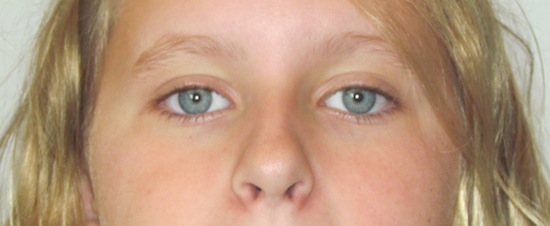
Interestingly, my daughter often makes eye contact, though I do not for a moment believe this has anything to do with me or anything I did or didn’t do one way or the other.  In fact my daughter wrote she likes looking at people’s eyes.  So much so that we have agreed to work on a project based on this together.  But for all who do not, who are overwhelmed, who feel physically ill or in pain, why would we demand this of them?

Eye Contact

The Problem with “Use Your Words”

How many of us have uttered those three words to our kids?

Use your words!

And yet, if your child is like mine, they probably do use words.  Perhaps they “script”, words we dismiss because we recognize them from a movie, or perhaps we hear the tone and recognize it as echolalia and therefore  ignore.  Maybe we think of the words as a verbal stim or maybe we hear that those words come from a teacher, the bus driver, another kid, a friend, us…  and again we dismiss them as meaningless.  But what if we are wrong?  What if all those words our kids are nobly attempting to use ARE communicating something, but it is US who cannot make the connection?  What if our kids do not learn language as we think of language being learned, but they are learning it, in their own way, on their own timeline?  What if all those words they keep using, the ones we are told to ignore or not reinforce by acknowledging, are HOW they are learning to speak?

I am currently reading Marge Blanc’s book, Natural Language Acquisition on the Autism Spectrum: The Journey from Echolalia to Self-Generated Language
and these are but a few of the questions being answered.  One thing I have not yet seen or can find in this terrific book is any mention of Tourette’s.  I am curious to know the authors opinion on how Tourette’s factors into language acquisition or if it even does.  Marge, if you’re reading this, I’m hoping you’ll comment!

In those early, blurred years after Emma’s diagnosis I remember thinking that any language was good language.  And then my daughter began to say things, things I could not and did not understand and I was told, those are meaningless words, you must ignore them, you must not reinforce them.  But maybe, just maybe those words are the foundation for others that I and others will be able to understand at some point.  My friend Ibby, of the fabulous blog, Tiny Grace Notes, told me more than a year ago about the importance of not trying to do a word for word translation of the things my daughter said, but rather to lean into the words.  I couldn’t fully understand what she was telling me at the time, but slowly I have begun to.

Marge Blanc writes, “As we valiantly try to replace our kids’ echolalia, their natural language, we feel validated when they learn to say new things.  We teach our kids a dozen functional phrases and sentences and feel satisfied that we have taught “functional speech.”  The tragedy is that while IEP goals are met, children’s linguistic potential has been ignored – and undermined.  We have forgotten how to assess a child’s developmental language level and his capacity to develop generative language.  And we have also failed to consider that the functional phrases we’ve taught might actually interfere with his potential to develop language competence.  And in the process, the echolalia doesn’t go away.”

Now add to this idea the way we are taught to ignore those scripts, that we mustn’t give them any air to breathe as we will only encourage the proliferation of similar non “language.”  So we smile patiently and nod our heads and say…

Use your words.

But not those words.  Use these words.  The words I want to hear.  The words I am now going to repeat and have you say over and over with the hope that you will say these words, my words, in place of yours.  Isn’t that really what we mean when we say “use your words”?  Use words I want to hear.  Use words I give you, but don’t, please don’t use YOUR words.

Over a year ago I wrote about how Emma advocated for herself on the school bus.  You can read that post ‘here‘.  What I didn’t spend a great deal of time talking about was how she tried, repeatedly to “use her words” but was not listened to because they did not believe she understood what she was saying.  It was only after many attempts of using the only words she knew, “you’re going the wrong way!”  “Emma goes to a different school!”  and “you have to go this way!” that she began to scream and then bite herself and eventually punch herself in the face.  Even then, when she fell to the floor of the bus, refusing to get off, crying and hurting herself, even then they continued to not listen to the words she was saying and using and insisted she get off the bus.  It was only when one of the staff at her old school heard her and recognized her and thought to tell the driver that yes, she was correct and no longer went to this school, that she was on the wrong bus, it was only then that they dialed my number and told me my daughter was refusing to go to school, and as it turns out, rightfully so.  They had taken her to the wrong school.

When they brought her home she was devastated.  I will never forget the look on her face as she descended the steps of that bus.  Before her feet hit the ground I said, “You are so awesome Emma!  You told them this wasn’t your bus.   You told them they were going the wrong way!  I am so proud of you!”  Emma still talks about that morning, that morning over a year ago when she was “using her words” and no one listened.

Use your words.

Waiting for the school bus ~ October 2, 2013
*Em copy

Changing Our Thinking

I asked Emma for her permission to talk about language retrieval issues, and specifically to describe some of what occurred during her first session with Soma last week.  She said it was okay for me to do so.  I’m incredibly grateful to my daughter for being so generous with what is personal information.  She has given me her permission, but to leave it at that, would be wrong.  To not acknowledge what this means would be negligent at best.  She is unbelievably generous to allow me to share these things.  I do not know how many of us would be willing for another to share such personal things about ourselves, and the trust she has bestowed upon me, the trust that I will not betray her…  it is something I not only take very seriously, but need to acknowledge.  To say I am grateful does not come close to describing the feelings of appreciation and awe my daughter inspires.  If all human beings could take a page from Emma, both in her cheerful generosity in giving of herself so that others might benefit and her compassion and willingness to see the best in people, even when so many have said and done cruel things to her, this world would be a far better place for all of us.

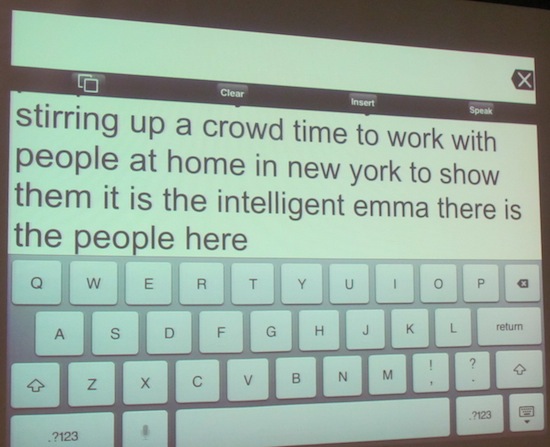
I wrote about Emma’s first session with Soma ‘here‘.  What I didn’t write about was how after Emma pointed to a letter she was encouraged to say the name of the letter, just as her Proloquo2Go program does on her iPad.  She was able to do so without hesitation.  But when Soma put the stencil board down and asked Emma to say the next letter of the word she was writing, without pointing to it first, Emma would, more often than not, say a random letter.  Soma then picked up the stencil board and again without hesitation, Emma pointed to the correct letter and was able to identify it correctly out loud.  After Emma wrote a sentence she was invited to read the sentence aloud, but could not do so.  This is a sentence she’d just written, one letter at a time.  A sentence she’d created, yet was not able to read.  It is not then surprising that Emma is unable to read a random story out loud, even though she is perfectly capable of reading it silently to herself and fully comprehending it.  See related post about reading aloud, ‘here‘.

To see this broken down, to witness this at the level of single letter retrieval and not a whole word even, made it all even clearer to me.   Which isn’t to say that Emma will never be able to do this.  Perhaps at another point, perhaps once she is proficient in writing her thoughts and identifying a letter after pointing to it, one letter at a time, she will then be able to work slowly, patiently and without the anxiety of feeling expectations are being placed on her, perhaps then she will be able to come up with the next letter before she points to it and from there the next word and on it goes until verbal language can catch up to her written.  But for now, it is imperative that every single person who comes into contact with my daughter understand how detrimental it is for her to have these expectations placed on her and then to have the inevitable conclusions drawn about her comprehension and ability.

My daughter is nothing short of brilliant.  I am not saying this as a biased mother who is basing her thoughts on nothing more than some sort of convoluted tip of the hat to genetics, or a round about way of bolstering my own ego and intellect.  I am saying this because I have seen the evidence.  Since her diagnosis, Emma has been treated as though she were intellectually impaired when, in fact, she is intellectually gifted.  This is, I’m sorry to say, something I am hearing from others.  We have a growing population of children and people who are treated as though they are incapable, when in countless cases the opposite is true.  The onus is on us to change our current teaching methods and the therapies we are employing and to open our minds to the idea that we have gone about this all wrong.  This is what must change.

Soma & Em copy

“Be Nice To Each Other”

Be nice to each other” – this was the final sentence Emma wrote to Soma on Friday before we flew back home.  She wrote it in answer to Soma’s question, “Any message to the world?  To mankind?”

Be nice to each other.

We returned home late Friday night.  I was riding on a cloud of excitement, newly found realizations, solid, unequivocal confirmation and proof that not only is Emma completely aware of her surroundings, but she has profoundly wise insights into the world, other people and herself.  She is one brilliant girl.  She has managed to learn despite having almost no formal education, she knows her multiplication tables as though she’d been studying them for years.  She knows how to solve mathematical word problems, she understands things I have only come to understand very recently and her compassion for others is astonishing.  She has been spoken harshly about.  She has heard what others have said about her in front of her as though she could not hear or understand.  She knows what others think of her, and yet, she understands these things are said in ignorance.

So excited was I, that I slept fitfully, and Saturday morning awoke to blinding, crushing, devastating sadness.  I felt the weight, the enormity of my daughter’s life and my role in all that has happened to her these past nine years since she was diagnosed.  My mind latched on to each and every misstep, the mistakes piled up so quickly, one on top of the other I felt I couldn’t breathe.  I spent Saturday in a state of crisis.  I completely broke down.  And the thought that continued to blast in my mind was, “How will I ever find my way out?  How can I forgive myself for what I’ve done?  How does one forgive another who has made the decisions I’ve made?  In essence, how can you forgive what is unforgivable? And yet, she has.  And therefore, so must I.

Be nice to each other.

And here is the thing about all of this.  Berating myself, hating myself, NOT forgiving myself allows me to continue the cycle.  It wears me down, threatens to break me when I need to be strong.  But I also know that when I am overwhelmed with feelings, telling myself that I must not feel the things I am feeling, does not make them go away.  Tamping the feelings down, pretending they do not exist, none of that actually helps me move through them.  Criticizing myself for hating myself does not make me hate any less.  And so I accepted that this was where I was.  And for one day I sat with all those awful, painful feelings and felt them.  Neither pushing them away or adding to them by criticizing myself for having them.  I sat with them one excruciating hour after the next and allowed them to be.  And all the while I repeated Emma’s words, Be nice to each other. And I allowed that to include myself.  By Sunday morning I felt my strength returning.  I felt that old determination returning.  I could feel energy flowing and I knew.  I knew.  As long as Emma gives me permission to, I will tell all who will listen, at least some of what she is writing.

When I asked Emma yesterday if I could write today’s post using her words as the title she nodded her head, yes, and smiled.  Last night before going to sleep she said, “Mommy?  No school tomorrow?  I don’t like new school.”  And so I promised her, I promised I would do everything in my power to help her school understand, but I know I have one hell of a battle before me.  And I need every ounce of strength I’ve got in me.  But maybe, just maybe some of the video clips I have of Emma writing these things will have the power to change even a few minds so that they will be swayed and will come to understand what I have.  Not only is my daughter capable, she has a great deal to teach us, but all of that will be lost if we are not willing to open our minds and listen.  This is the non autistic limitation of our neurology.  This is our neurological deficit and we will have to work mightily to change that.

Emma at Halo – September 26th, 2013

Em iPad copy

My Star: Emma

Rhyming words, poetry, fables, history, science, multiplication, math word problems…  these are the things Soma has covered with Emma over the last three days.  Emma went from pointing to one letter at a time, to writing out several words and even whole sentences describing profound thoughts, insights, doubts and concerns, and I sat there witnessing this outpouring of words, this torrent of letters that, when added up, evoked emotion and identification and concern and understanding.  The power of language.  The power of communication.  There is tremendous power in both.

This has been a profound few days; transformative, exhilarating and exhausting.  I have watched my daughter work and she has worked very, very hard.  I have watched her and I have marveled at her and been dismayed by her and astonished with her.  I have laughed and wept and listened and listened and listened some more.  She has said things that have provoked more questions than answers, but she is here, very much rooted in this world and not, as many suggest or seem to think, somewhere else, off in her own “little world”.

I cannot write about anything specific this morning, I’m too tired and Emma has said she is too.  We have two more sessions today with Soma and then we head home.  We are lucky.  We are incredibly fortunate that we’ve had the means to do this, to come here, to stay for the week so that Emma could work with Soma.  All the young children Soma has worked with over the years, so many of them are now writing books, and are at an age where they are publishing their hard-won  words; there are too many to ignore.  They are communicating on letter boards and iPads and keyboards, an unbelievable output of thoughts, ideas and opinions.  “I want to be able to talk,” Emma wrote yesterday.  And maybe, just maybe one day she will be able to talk the way she writes, but until then we will keep providing her with every available resource we can find so that she has a better chance of achieving that goal.

Em standing beneath the “Star of Texas”

Em & Star of Texas copy

“I Want to Know What God Thinks About Autism”

*Emma approved this post before I published it.

Yesterday was our second day working with Soma.  And just when I thought I could not be more blown away by anything Emma wrote, she wrote the title to this post.  It was in response to a conversation about Mesopotamia, ancient civilizations, buildings and building materials, which led to Soma discussing the types of structures built, one being temples.  Soma asked Emma why people would go into a temple, to which Emma wrote, “pray”.  Soma then asked her if she went into a temple what would she pray about.  Emma then wrote, “I want to know what god thinks about autism.”  

I have to interrupt this to say, I am not a believer.  I had a moment, a very brief moment in my teens and again in my thirties when I so wanted to believe, I needed to believe and yet still could not really believe in any way that made sense to me.  God is not something I obtain any solace or strength from believing in, and well… truthfully, I’ve stopped trying.  I don’t need to believe.  Having said that, my husband and I talk about god, religion, spirituality, the practice of acceptance and staying present, meditation, doing the right thing, and what a power greater than ourselves means on any given day.  So there is a fair amount of “god-like” talk going on.  In addition, my mother is a theologian and has taught bible study classes for many decades.  She used to attend a Torah study and I believe does again now.  She is one of the most knowledgable and interesting people I know of to talk to about religion and god.

The point is, Emma has certainly been present to a great many conversations about god, the bible and religion.  But never has she said the word “god” let alone, used the word in a sentence.  And it must be said, we never thought to ask her…   When both children were still very young I bought a number of children’s books on a variety of religions, and made some general statement about the importance of learning and deciding for yourself what you believe.  We still have those books; I’ve never seen Emma look at them, but that doesn’t mean she hasn’t.  And anyway, as I said, it’s not as though she hasn’t heard a great deal of talk about God.

Later I asked Emma if she believed in God and she wrote simply, “yes”.

If there is a god, I’d like to know what god thinks about autism, too.  I’m guessing here, but I should think god is embracing and celebrating all neurologies.  After all, most people I know who believe in the existence of god believe that god created us the same and equal and beautiful beings, given the gift of choice.  We can choose to act with love, compassion and kindness or we can choose to behave in hurtful ways that cause tremendous pain and suffering.  Either way, according to those I trust and respect on the topic, God is always there for us, all of us, all the time, and without exception.

Em Texas

The Conversation That Isn’t

The biggest problem with the conversation regarding autism and Autistic people is that it is largely had without the inclusion of those who are being discussed.  When Autistic people attempt to join the conversation they are often told – the very fact you can speak removes you from the conversation because you are not representative of those who cannot and those who cannot speak are believed to have little if nothing to say.

When someone who is Autistic and does not speak, types to communicate, they are often discounted as not really being able to type, even when they are able to do so independently.  One of the many google search terms that come up repeatedly, leading people to this blog is “Carly Fleischmann fake.”  I continue to find people’s adamant disbelief, even when shown clear evidence of ability, baffling.    For those who do not know who Carly Fleischmann is, please go to her website and Facebook page.  She is a non speaking Autistic teenager who defies all the stereotypes about what it means to be non speaking and Autistic.  People insist that she is an anomaly, but go to a conference like TASH, Autcom, the ICI Conference or go to the resources page on this blog and read the many blogs and written works by non speaking Autistic people and you will quickly see that not only is Carly not a “fake” or a “hoax”, she is not an anomaly; she is in good company and one of many.

“…. a tendency among professionals to band together when their expertise is challenged and to deny resolutely the existence of evidence which, if admitted, would force a reevaluation of established practice.” ~ Speechless by Rosemary Crossley

Rosemary Crossley on the topic of IQ tests, writes, “Tests of intelligence purport to assess how well you take information in, and what you are able to do with it, on the basis of what comes out.  If nothing quantifiable comes out you are untestable.”  She then goes on to say, “What is surprising is that the results are assumed to reflect what the child and teenager are thinking and what they are able to learn, and are used as a basis of making decisions about their futures.

So we continue to have a conversation about Autistic people, yet when those who can speak do so, they are discounted as not representative of those who cannot, and when those who cannot speak, type, they are doubted, believed to be a hoax or an anomaly and not representative of others who share their inability to speak.

Does anyone else see a problem with all of this?  Anyone?

Me and Em at the ICI Conference in July, 2013

Me & Em

Language Acquisition?

Yesterday I wrote about some of the problems inherent in asking children to read out loud.  You can read that post ‘here‘.  The comments have been uniformly terrific, extremely informative, and very helpful.  Ischemgeek wrote several comments that I’ve actually printed out and even copied and pasted into emails to a few teachers I know.  She wrote a terrific explanation and series of suggestions in answer to a question I posed asking for her thoughts regarding handwriting.  My question to her was slightly off topic from the original post, but if you read the comments you’ll see how the conversation evolved.

Another comment, from bjforshaw, reminded me of how when Emma was a baby she seemed to acquire two or even three word phrases (“chase me”, “go out”, “all done”, “play catch” “I donwannta”)  as opposed to individual words.  Bjforshaw wrote, “I dislike reading aloud because it is so different from the way I normally read and this makes it feel uncomfortable. My usual reading speed is fast, much faster than my speech, and I scan phrases, groups of words, even whole sentences. In contrast when I read aloud I have to plod along one word at a time.

When I read his comment I had one of those “light bulb” moments.  You know, where you think – wow!  This reminds me of this other, seemingly unrelated thing, I wonder if there’s a relationship?  So I went to the internet to see if I could find any articles on the topic of language acquisition, but haven’t found any dealing with babies learning whole phrases and chunks of words at a time.  Not only have I not been able to find any articles written on this topic, but I cannot find many articles written about language acquisition and autism, specifically, that aren’t more than ten years old, which I find baffling. If anyone has relevant links, please send.

I have no idea if, for some, language learning is similar to the way bjforshaw describes his ability to read, but I’m curious now.  Could it be similar?  Has anyone heard or read anything about this?  For those of you who read in chunks and not the individual word, do you know or remember whether you also learned to speak this way?  In other words instead of learning one word and then building upon that word, did you learn a phrase or several words together?  Could this also then be related to scripts? I’m thinking out loud here, but I’m wondering if scripts are meaningful because they are learned chunks of language that come to represent more than the literal interpretation given by those listening. Do the scripts carry more (hidden) meanings to the person saying them?

Thanks again to all who have commented, and to those who intend to, thank you in advance.

Em types for an audience in Tampa, April 2013Em types with Pascal

The Pitfalls of Reading Out Loud

When Rosemary Crossley was here she spent several hours working with my daughter.  One of the many discoveries we made was that Emma can and does read very quickly, but if asked to read out loud, she will stumble and get so caught up in pronunciation I question whether she is able to comprehend what she’s reading at all.  I know I have trouble following the story.  Yet most schools ask children to read out loud, both as a way to assess what they are capable of, and also to make sure they are at the correct reading level.  If a child reads a first grade reader out loud with great difficulty, the impulse is to make the reading material simpler.  Except that if this is done with my daughter she will be stuck reading kindergarten and beginning level reading books for the foreseeable future.

I know Emma is able to read much more complicated texts than beginning readers.  I know this because I have seen her read with Rosemary and me very quickly.  I have witnessed her ability to read, not only faster than I can, but her ability to accurately answer multiple choice questions related to the text with ease when  given some resistance.  In other words, if she is asked to wait a beat, instead of being allowed to immediately point to an answer, her accuracy goes way up.  Without the pause she is just as likely to randomly pick any answer.  From Rosemary Crossley’s book, Speechless, “The resistance I provided slowed her down very substantially, and the quality of her output increased as her speed fell.  I gave Jan a picture of a cow and asked her to write me a sentence about it.  Instead she typed, THIS TYPING IS HARD.  I HAVE TO THINK.  That was, of course, the aim of the exercise.

This idea of providing resistance is a tricky one to explain to people.  I have had some people say they just cannot understand why this would be necessary.  The only way I know of to better explain, is by comparing it to the way many, who are like my daughter, will perseverate on a word, or will rely on favorite scripts.  It is not that these scripts have no meaning, it is more that they are often difficult for others to understand.  If I hand Emma her iPad and ask her to type me a story, she will most likely write something like, “rollercoaster, kiteflyer, greenride, hurricane harbor, waterslide” which is also in keeping with what she might say out loud.

These words are powerful to her, they hold a great deal of meaning, but to most people, they are seen as gibberish.  If this then is used to assess her capabilities she will not be well served.  However if I ask her to type me a story and then hold one end of a rod while she holds the other end with her typing hand and types with one finger while I pull her hand back after each letter is typed, she might type, ““One day there was a boy called george. He had been in afight can’t tell you how he got into the fight but he was bruised all over.  He fought a lot and his teacher was very angry.  The next day he was all purple and his mother said you can’t go to school looking like that.  The very clever boy covered himself in flower and his teacher thought he was sick and sent him home.  The end.”  

Incidentally, that story is one Emma wrote when Rosemary was here working with her and is typical of the sorts of things she can and does type when given the kind of resistance I’ve described.  (You can read the entire post I wrote about her session with Rosie, ‘here‘.)  However, ask Emma to read out loud a story similar to the one she typed and she will have a great deal of trouble.  What she is capable of is far greater than what one might assume from what she verbalizes, whether that means reading out loud or with spontaneous speech.  Ask Emma to sing the lyrics of a song, in Greek no less, and she will get much of it right, but that’s a whole other post.

But how does one convince others that this is so?  Particularly when many are trained and told that reading out loud is a good indicator of ability.  There is surprisingly little written on the topic of the problems with reading out loud for those who have spoken language and word retrieval issues.  Again, in Rosemary Crossley’s book, Speechless, she writes, “her reading aloud was bedeviled by the same word-finding problems which affected her spontaneous speech, preventing her reading with any fluency.”

Obviously there needs to be more written about all of this.  The closest I have found, other than Rosemary’s book, Speechless, is a blog, The Right Side of Normal,  that concentrates on “right brained children”.  And on that blog, this post specifically, Silent Reading versus Reading Aloud, which deals with, at least some of what I’m discussing here. If others know of other resources discussing any of this, please do leave me links in the comments section.

Rosemarie Crossley

Rosie

When We Say Things We Do Not Mean

Erratic speech.  Unreliable language.  These are all words to describe what many, like my daughter, experience.   Speech that does not represent what is meant,  but that people hear and make assumptions about the person based on what has been said.  Rosemary Crossley in her book, Speechless talks about nominal aphasia – “One of the familiar aftereffects of stroke, for example, is not being able to say what you mean.

Many years ago I became friends with a man who’d had a stroke, leaving him aphasic (meaning he was mostly unable to speak, though he understood what was being said to him.)  Every few months my then boyfriend and I would pick him up at his apartment and take him somewhere.  I don’t remember if he could type his thoughts, this was long before the advent of the iPad, and as he could not hold a writing implement, this was not something he did when we were together.  I do not remember him ever uttering a single word.  Prior to his stroke he had made a name for himself as an avant-garde theater director.  In the theater world he was thought of as a god.  After his stroke he went on to direct a number of works with many famous actors.  People were willing to believe he could not only understand what was being said, but that he had a great deal to say, even though he could not verbalize his thoughts.   His name was Joseph Chaikin.

For those who are Autistic and also have unreliable speech, people tend to take what they say at face value and believe their speech is indicative of their thinking and thought process.  Yet this could not be farther from the truth.  Many are willing to dispense with their disbelief when someone is famous and once spoke, but most are not as willing to believe when someone has word retrieval issues, that they are capable of more than what we hear them say.  “…children who have never been able to speak fluently have not had a chance to establish themselves.  They have not had the typical infant’s experience of controlling the world with their speech.” ~ Speechless by Rosemary Crossley

And as a result they also do not have the same types of interactions with others as those who have more fluent speech.

Because our judgments of intellectual capacity, both formal and informal, are strongly tied to speech, a child who says the wrong words, who gives “silly” answers when asked questions, is likely to be seen as stupid.  A child who can never find the word he wants, or a child who cannot make his tongue do what it should, can come to associate speech with tension, embarrassment, and failure.” ~ Speechless by Rosemary Crossley.

Children with severe speech impairments often develop behavioral problems. These may simply be a result of the frustration inherent in not being able to say what you mean, but this frustration may also be exacerbated by the reactions of the people around them.” ~ Speechless by Rosemary Crossley

One young man who had unreliable language and who Rosemary worked with typed, “I dont make sense and people think Im senseless.” Speechless by Rosemary Crossley

Typically, when someone speaks to us, we believe that what they say is what they mean to say.  We respond  accordingly.  When people tell me something Emma has said and how they don’t understand why she then became so upset because they were doing what she told them she wanted, I understand.  I understand how frustrating that must be, for her, for the other person, for everyone involved.  Emma does not have phrases like, “Oh I know the answer to that, but I can’t think of it just now” or “give me a minute, it will come to me” or “it’s on the tip of my tongue” or “I just had it, the word was right there” or “what’s the word, you know it sounds like ________?”  or “wait, I know this, I know this…” or any of the other things most of us say when we know something, but the words have momentarily escaped us.

Communication is not just speech and for some, spoken language is an unreliable method of communicating.  Finding a more reliable method then becomes essential.  For my daughter, typing is proving to be a far more reliable way to communicate.  And as it turns out, there are a great many others who are just like her.

Waiting

In Answer to – Medication?

A number of people wrote in on the post, To Medicate or Not with their experiences.  The post was not about medicating autism, but about some of the co-morbid diagnoses that many people who are also Autistic  have.  Quite a few people wrote about managing depression, anxiety, stress and related issues.  Some wrote about how they began trying different medications in their late teens…  “I started medication at about 19…  I started with Prozac and it went well for a while but over time it stopped working.  It did make me feel better at first.  From there and over the years, I have tried many different antidepressants for my anxiety- Prozac, Paxil, Zoloft,Trazadone for sleeping, Zyprexa, Cymbalta, Welbutrin, Effexor, and Nortriptaline.”

Many parents wrote about how they agonized over the decision to try medication and almost all of them said it was done as a last resort.  Both Autistic parents and parents who are not autistic said similar things about their decision to medicate their child.  One person wrote, “my autistic child is on ADHD meds and has been since he was four. AdderallXR until last year, now Vyvance (same med with less appetite suppression). Clonidine at night. He wants to be on them. He has told me he feels more creative and happy with his mind not looping fifty things at once.

Another wrote, “I had been fighting the medication for a few years.  I have had anxiety since I was little.  I had the doctor refer me back to one of my psychiatrists who is willing to talk and if necessary provide a prescription.  This time we tried combining medications.  Welbutrin seemed to help a bit so we tried things like Ritalin to help increase its effectiveness.  I was able to focus much better and things seemed to go well but I got severe heart burn as a side effect of the Ritalin.  We tried Dexadrin next but it didn’t work.  I gave up for a bit and then discovered Buspar.  It is an antianxiety drug but not in a class like valium etc which are addictive.

Lots of people wrote about having to try many medications and often combinations of things before they found what worked.  And a number of people wrote about being judged harshly by others either for taking medication themselves or for deciding to give it to their child.  One person wrote, “…they do not know.  They pass judgment, but have not lived the experience.  They make comments and say things as though they have the answers, but they don’t.  They  don’t know what it’s like.  They can’t.  I’ve learned to say nothing and ignore the mean comments and loud whispers.

Another wrote, “I don’t tell people anymore, because I’m tired of their uninformed criticism.

Again, thanks to everyone who wrote about this.  Really appreciate the honesty and willingness to share your stories.

To Medicate or Not?

It has been suggested I write a post about medications, both those prescribed and given to Autistic children, as well as those taken by Autistic adults.  This is not a topic I have any first hand knowledge about.  We have not given our daughter any medication, other than melatonin at night to aid in sleep, which has been nothing short of miraculous, and during those unfortunate years when I thought or hoped massive amounts of homeopathic tinctures would “help” her (they didn’t) and later the dozen or so vitamins recommended by the naturopath, we have managed to steer clear of medications.  (By the way, magnesium is helpful with constipation.)  I also have to quickly add, we have been able to steer clear of meds because our daughter does not exhibit any clear need for the medications currently available.

Personally I don’t like taking even aspirin, forget anything more hardcore, but I also am coming from a privileged vantage point.  I don’t have debilitating depression or anxiety or other issues, which would make taking medication a good idea.  The one time in my life when I was depressed and bulimic, Prozac was prescribed.  My reaction to it was less than ideal.  Even taking something as benign as ambien has a negative effect after more than one night on it.  I seem to be extremely sensitive to drugs and often have an atypical response to them.  With ambien, if I take more than half the prescribed dose I become so depressed I can barely function.  As a result I avoid taking anything, even if prescribed.

But I know people who do and have taken medications of all kinds and to say that it is optional, is being overly simplistic.  For people who need medication, things like antidepressants, or meds for anxiety or other issues that affect their ability to function optimally, it is profound the difference the right medication can make to their quality of life, their ability to wake up in the morning, their productivity level etc.  For those people, medication makes the difference between a bare, brutal existence and being a vibrant, active being who is fully in this world and able to enjoy it.  But what about those who are Autistic?  What is their experience?  Is it similar to those who are non autistic?  Is it the difference between barely scraping by and being able be fully present, or is it something else?

So I am asking for your help.  Anyone who has any first hand knowledge, whether it is you taking the medication, giving it to your child, or if you were given medication as a child, can you tell me what you take/took/were given/ or give to another and how it affected you?  Was it a positive experience, and if it was or wasn’t, exactly why?  Do you respond to medication atypically?  Did you have to experiment?  If you are a parent, describe your decision to medicate, what was the outcome, did you feel it helped or didn’t help?  Did your child notice the difference?  Any and all answers will be quoted anonymously unless you tell me otherwise or if you leave your comments below, I will only use whatever name you used to comment with unless you tell me otherwise.  If you prefer to email me, please do:  emmashopeblog@gmail.com.

Thanks so much everyone.  Really appreciate the willingness to share your experiences with me.

Dehumanizing

A daughter lies unconscious in a hospital.

Her doctors fear she will have permanent brain damage as the result of carbon monoxide poisoning.

The mother is charged with attempted murder.

We are told the daughter was aggressive.

We are told she was Autistic.

I cannot stop thinking about Issy.  As I write this, she is lying in a hospital bed unconscious.  I cannot stop picturing a photo of her laughing, her blonde hair glimmering in the sunlight, her head thrown back, a look of joy on her face.  

And I am angry.  

We live in a society where news articles with titles like “More U.S. families in the grip of autism” are commonplace.  People equate autism to cancer, refer to autism as a burden, a crisis, and an epidemic.  The Judge Rottenberg Center is allowed to remain open despite their continued use of electric shock as a viable “treatment”.  We live in a society that has allowed schools to put young students in isolation rooms,  “Physical restraints are becoming more prevalent in public schools.”  The word “treatment” is used loosely and covers a great many behavioral plans, some which allow Autistic people to be abused and even killed.  

We have succeeded in dehumanizing a segment of our population.  A segment of our population that includes my daughter.  

Anger doesn’t begin to cover what I’m feeling.  

Related Posts:

Bodies and Behaviors – by Michael Scott Monje Jr. at Shaping Clay

It is Wrong to Murder Your Autistic Child – by Judy Endow at Ollibean

To Issy Stapleton, with love. by K. at Radical Neurodivergence Speaking

Walk in Their Shoes by Paula Durbin Westby Autistic Blog

Blaming the Victim:  An Autism Parent Story – That Autistic that Newtown Forgot

Media Throws “Autism Parents” Under the Bus Again – by Ibby Grace at Tiny Grace Notes (AKA Ask an Autistic)