Tag Archives: Autism

Words of Truth

“Raw thoughts are like savory understandings of yummy foods.” ~ Emma 03/02/14

Sometimes when Emma and I are working she will write something that I simply cannot follow in real-time.  It is only after multiple readings and many hours of pondering have passed that I can begin to make sense of certain sentences.  As Emma constructs a sentence to reflect her thoughts by pointing to the letters she wants on the letter board, my mind is working on another level.  I am transcribing as she points, so I’m concentrating hard on remembering the letters and figuring out when I can pause to write those letters down.

Will the pause create a disconnect?   Will it break her concentration?   How much will I be able to remember before I have to stop her to write the letters she’s chosen down?  Sometimes she’ll point to “I” then “a” and then “y” and I’ll have to stop and show her the letters and say, do you need to change any of these letters?  Sometimes she will erase all the letters, insert a letter between two others, but other times she’ll erase just the last letter and continue.  Sometimes she will say aloud, “No, keep letters” and we will proceed.  Often she will then write something so astonishing I cannot contain the surge of emotions that rush forward.

During all of this, Emma may twirl her string, laugh, say unrelated words, or look at the timer and comment about how much time is left.  Sometimes writing one sentence might take 45 minutes.  Sometimes that one sentence will remain unfinished and when we come back to it, she will simply say, “no” and we will move on to something else.  Sometimes the words are so seemingly unrelated I have to resist the urge to ask for clarification mid sentence.  Sometimes she will write something I cannot understand, but the next day will re-read it and think –  my gosh, that’s brilliant!

“Raw thoughts are like savory understandings of yummy foods.”

Seemingly disparate senses woven together to create a canvas of rich and varied depth and colors has me in awe.  We talk about autism and autistic people as having sensory integration issues, but I look at a sentence like this one and I question whether the sensory integration issues are mine rather than hers.  Emma has a wonderful command of the English language, she is able to express her senses in complex, creative and layered ways.  I am compelled to read and reread her words.  I savor them, exactly as the sentence states so matter-of-factly.   Her words…  painstaking…  one letter at a time, convey truth.

Truth

Truth

An Essay by Emma

*Emma asked that I post this today.

Yesterday, during Emma’s RPM session (not with me, but with the person who does weekly RPM sessions with her) she was asked to talk about something where she compared and contrasted.

Emma wrote the following…

                             “Part of All Buildings”

“For thousands of years and as long as buildings have existed, walls are covered.

“Generational trends have shifted.  The idea of paint versus wallpaper is one to give attention to.  Ask yourself what has changed in trends.  Did you ever think to believe the walls around you influenced change?

“Wallpaper with precious patterns are torn apart in many current buildings.  Paint has won the walls of this generation.

“If you believe your environment can change parts of you, keep reading.

“I am wondering if those who surround themselves with precious patterns have bigger imaginations than those with simple paint.  It is easier to become friends with colorful patterns.

“They can both get dirty.  In wallpaper the wear becomes welcomed more.

“I can do the research and report back!”

Wallpaper versus Paint

Wallpaper versus Paint

“A Letter To the World” ~ By Emma

                     “A Letter To The World

“I want to tell you that I am capable.  Daring massively, eager to prove my intelligence, I will work tirelessly so that Autistic children younger than me won’t be doubted the way I am.

“Plea-ing to the world, I ask that those who are not able to restrain their doubts, at least not mute voices like mine.

“Deciding stupidity bolsters egos while crushing lives with angry words disguised as kindness.

“They say hope is cruel for the hopeless, but maybe they are the cruel ones.”

Emma wrote this in response to my question, “What do you want to learn about?” (I gave her a number of choices ranging from people like Joan of Arc and Eleanor Roosevelt to geography, history, literature, creative writing or current affairs) “…or would you like to talk about something else?”  Emma wrote, “I want to talk about autism.”  When I asked her what, specifically, she wanted to discuss, she wrote the above letter.

*For all who would like to share Emma’s words with your friends and followers – we ask that you quote a sentence or two with a link back to this blog, and not all her words.  Thank you so much for your support, encouragement and enthusiasm.

Emma ~ 2014

Emma ~ 2014

“Crayons Have Feelings” By Emma

I’m always so excited when Emma tells me “put it on the blog” because my dream has been that this blog will be something she wants to, one day, take over as her own and where she will permit me to, occasionally, make a “guest” appearance.

What follows was Emma’s response during her RPM session to write about something she cares about in a persuasive manner.  She skillfully demonstrates theory of mind, empathy and an abundance of compassion I wish the rest of the world would try to emulate.

                     “Crayons Have Feelings

“The colors are many in a box of crayons.  All over the world people use crayons to make them happier.  It is never used as a way to punish.

“Did you ever think of what the box of crayons felt like when they were opened?

“Notice which colors are used the most.  They are ripped and sometimes broken.  The less popular colors, like brown, look so new they can be displayed in a museum.  Nobody plays with them.  They watch the other colors play and roll with their friends in the mud.

“Brown crayons are lonely.  Red crayons get the most attention.

“You should show the lonely colors on the front of the box.

“Do you have questions?”

I am persuaded,  Emma.

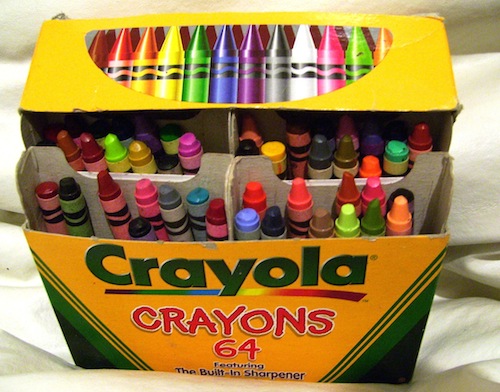
A Box of Crayons

A Box of Crayons

“Love Not Fear”

“You thought my autism was hurting me and that you needed to remove it, but you did not understand that it is a neurological difference and fear caused you to behave with desperation.”  ~  Emma on the topic of the three stem cell treatments we did in 2010

Fear.

This post had to begin with Emma’s words.

I’ve written enough to fill a book on fear and where that took us.  Stem cell treatments, spending all night on the internet searching for the next great “miracle” cure, taking my child from one specialist and doctor to the next, this is where fear took me.  I’ve deleted a great many posts where I express my tortured fear, but if you go to the first post, the post that began this blog almost four years ago, you will see in excruciatingly slow detail where fear took me.  Fear caused by those “alarming statistics” used ad nauseam by organizations like Autism Speaks, drives many like me to go to incredible lengths to “help” our child.  Blinded by abject fear we pursue things that can cause our children real harm, both physical and emotional.   The toll our fear can take on our children cannot be overstated.

I abhor Autism Speaks.  As the single largest organization claiming to know what autism is and is not, and worse, suggesting they “speak” for autism and those who are Autistic, Autism Speaks does more damage to my Autistic child than any other.  They have done a brilliant job marketing fear.  For transparency’s sake they should rename their organization ~ Fear Autism.  Donations pour in, large companies lulled into believing they are “helping” give their support.  Autism Speaks uses so much of their vast resources to hurt my child and Autistic people with that fear; what little good they accomplish in other areas in no way can counter the long-lasting and devastating damage they have done and continue to do to families who live in the kind of fear we once did.

I’ve written a great deal about fear on this blog, such as this post where I wrote about what I once believed:

What did the future hold for my daughter?  How was she going to get through life?  How would we be able to keep her safe?  How would she fend for herself?  Would she be able to fend for herself?  Who would take care of her once we were gone?  Fear.  Fear.  Fear and more fear.  And then, without even realizing it, I would find myself furious.  Enraged.  And my rage found the perfect target.  Autism.  Autism was what I was furious with.  Autism was what the problem was, so it stood to reason that if I could remove it, all would be well.  So this is what I set out to do.  Except that my daughter happened to be Autistic.  But if I didn’t say it that way I could continue to separate the two.  I could continue to tell myself I was fighting the autism and not her.  I could continue to believe that my anger with autism would not affect her.”

And this post where I wrote:

“When my daughter was diagnosed with autism, my fear of  institutions was the one fear, outstripped by any other, that brought me to my knees.  For years it was this vision, that horrifying gothic institution, dark and forbidding that I became convinced would be the inevitable conclusion of not my life, but hers once my husband and I died.  It was this looming image in my mind that made me hurl myself headlong into various remedies and treatments.  For years I felt sure that anything we could do to save her from such a bleak future was surely a worthy goal.  It just never occurred to me that what I thought was inevitable was not. And this is where I thank my Autistic friends for courageously sharing their stories with the world.  Because of them, their lives, their stories, I no longer believe this is my daughter’s inevitable future.”

Richard and I live a very different life than we did just three years ago and it is all because we stopped being afraid.  If you think, even for a second that we stopped finding ways to support our daughter, encourage her, cheer her on to be all she can be, then I encourage you to read the last six months of this blog. These last six months, specifically, show how Emma has increasingly taken over this blog, just as I once did not dare dream possible.  It is her voice that sings out, every day a bit louder, every day more powerfully, every day…

A few more posts on Fear:

The Impact of Fearing Autism
Where Fear Leads Us
How My Fears Drove Me to Pursue a Cure
Murder, Fear and Hope

Love Not Fear.  Tomorrow is the Love not Fear Flashblog.

For submissions email:  info@boycottautismspeaks.com

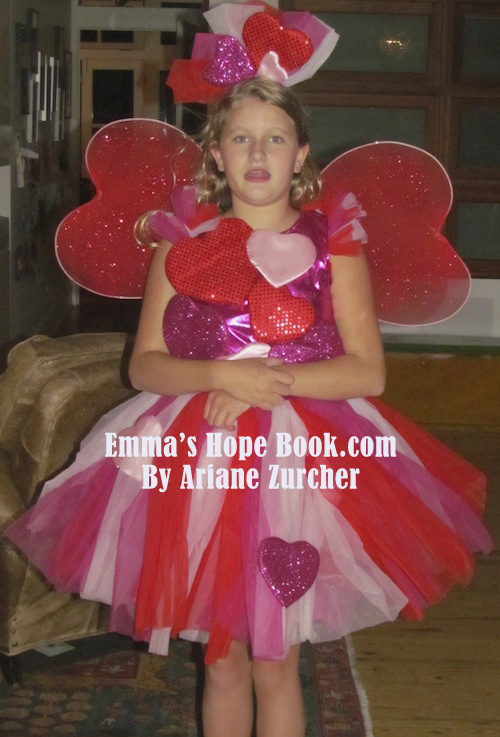
Love.  Just a whole lot of LOVE!  Emma's Halloween Costume ~ The Love Monster

Love. Just a whole lot of LOVE! Emma’s Halloween Costume ~ The Love Monster

Asking Questions

The other day during our session about the Middle East (this post is not about the Middle East) I mentioned to Emma that I’d recently read a memoir, I am Malala written by Malala Yousafzai.  Malala is Pakistani and was shot by the Taliban when she was just 15 years old because she wanted to be able to go to school and have an education.   Emma then wrote, “Was she alive after they shot her?”

It was all I could do not to jump up and down with exuberant glee that Emma wrote me this question.  It wasn’t the specifics of the question that made me so excited, it was that it was a question at all.  You see, Emma has never asked me a question like this before.  This is the sort of question she regularly asks Soma, but not me.  In fact, I just wrote about exactly this, a few weeks ago while Emma and I were visiting Soma.  You can read that post ‘here‘.  The question Emma asked is the sort of question I’ve barely dared hope for.  It is the kind of question most people take completely for granted.  Asking a question like this is the beginning of a conversation.  It requires a different kind of thought process than answering does.  It requires initiating a line of thinking.  It is the beginning of a back and forth that we talkers do not often contemplate, but do without thinking.

I know Emma has many questions just like this one, but she is not able to easily communicate them.  This is different from in the past when I was caught in that great abyss of believing that because she didn’t ask questions, she wasn’t interested.  That old way of thinking was so detrimental to her and to our relationship.  The belief that things were not being expressed because they did not exist was so destructive, not just to Emma, her self esteem and growth, but to all of our interactions.  Instead, this was a moment of celebration.  A moment when I just sat in utter admiration of my daughter.

Presuming competence.   Those two words hold so much meaning within them.  Every day I make tiny inroads, little steps forward in presuming competence, going just a little further in my ability to stretch my thinking so that I am embracing this concept just a bit more.  And as I do my daughter is showing me over and over that I have still farther to go.  This process is one of such joy, wonder and unbridled excitement.  My husband, Richard and I discuss this all the time.  How fortunate are we that we have the opportunity to expand our awareness on a daily basis?  How exciting is it that we are in a process of constantly re-evaluating what we think we know?

“Was she alive after they shot her?” Emma asked.

“Yes!  She lived and now has written this book,” I answered, showing her the cover.  “Should we read it together?”

“Yes,” Emma replied.

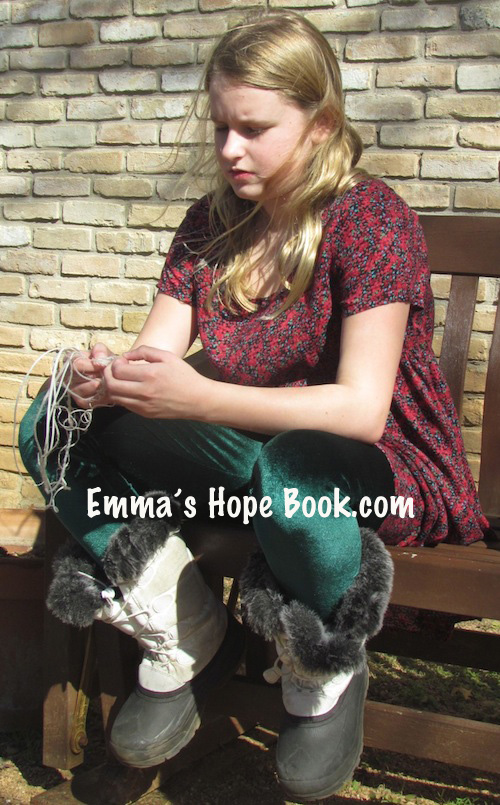
Em with her string!

Em with her string!

What To Do When Someone Hurts

When Emma was just two years old she was diagnosed with Pervasive Developmental Disorder- Not Otherwise Specified or PDD-NOS, which is the “it-may-be-autism-but-we-can’t-be-sure-maybe-she’s-just-a-bit-different-so-let’s-just-wait-and-see-what-happens-before-we-say-it’s-autism” diagnosis.  Two years later, Emma was diagnosed with autism.  But in 2004, when Emma was given her PDD-NOS diagnosis the neuroscientists, Kamila and Henry Markram, had not come up with their Intense World Theory for Autism.  The idea that Autistics have a brain that is far more sensitive to all stimuli than non autistic brains, was not something people were talking about.

Emma has since told me that she can “hear” people.  When I asked her what she meant by that, she wrote that she could sense people’s emotions and inner turmoil.  She could hear their moods.  I have been told and read similar things from other Autistic people.  This is something Barb Rentenbach also talks about in her must read, book, I might be you.  Now add to the intense sensory sensitivities that ebb and increase suddenly and without warning, lights, noise, touch, smells, tastes, feelings and you will begin to understand how overwhelming and unpredictable life can be.  Or, as Emma wrote last week, “On Monday a noise is pleasant, but on Tuesday the same noise is not pleasing to me.”

Yesterday, Emma wrote about what happens when she bites herself and the things others can do to help, as well as the things people do that make it worse and it made me think about my reactions to seeing my daughter hurt herself.  I can go through a fairly quick series of feelings.  I might feel scared, oh, no!  She’s hurting herself, this is terrible, I have to make her stop! and concern mixed with confusion, what can I do to make her stop?   But I also may feel other things too, like a desire to control the situation, annoyance and embarrassment that she is screaming in a public place, stress and overwhelm from the tears and her obvious upset, feelings of inadequacy that I should be able to help her more than I am, wondering whether I am a bad parent, believing that if I were a “good” parent, she wouldn’t do these things.  Questioning my own reactions, worrying that if I don’t force her to stop, people will harshly judge me or criticize me or believe I don’t care that she’s hurting herself.  Or maybe the situation is also stressful for me and I’m also in overwhelm.  And on it goes.  But as Emma wrote, “I know it upsets people, but it’s not about them, it’s about not being able to describe massive sensations that feel too much to tolerate.”  So if I don’t spend the time to think about and become aware of what I’m feeling as I witness her, I will react in ways that actually exacerbate her overwhelm.

I am once again reminded of my car ride with my beautiful, friend Ibby while visiting her in Chicago this past December.  I wrote about that ride ‘here.’  What Ibby did was such a perfect example of what I needed, though I did not realize I needed it and could not have asked for it, had I been asked – what do you need?  A calm, loving voice, carefully telling me what was going to happen next and why, a calm loving voice coming from someone who genuinely loves me, who I know has no agenda, was not trying to control me, whose words and concern were completely for me, with no other motivation than to truly be there for me… this was what Ibby gave me during that car ride.  Ibby did not try to take away my feelings, she didn’t try to control them, she wasn’t judging them, she was calm, patient, accepting and above all, incredibly kind and loving.  And, by the way, Ibby could not stop the noise the wind shield wipers made, it was not something that was within her control, it was snowing hard, she could not drive without them, yet even so, what she did instead made all the difference in the world.

It seems so simple, it seems so obvious, but it is actually quite rare to have someone do this for another.  So I will end this by encouraging all who want to know what they can do to help someone who is deeply distressed, examine your feelings, really look at them and make sure you understand what you are feeling before you attempt to help another, because if you’re becoming upset with someone else’s upset, anything you do will cause the other person to only become more upset.  Until I can get to a place of having “helpful thoughts of calming kindness.  Reassuring words of understanding, instead of irritation and impatience”  my response will add to the other person’s overwhelm.

*I just have to add here, this is something I find very difficult to actualize.  It is a work in progress, but it is vitally important.

Ariane & Emma ~ 2011

Ariane & Emma ~ 2011

Emma Discusses Biting

Emma bites herself, occasionally pulls her own hair and less frequently will smack her head into the wall or punch herself in the face.  I hesitated writing about this on such a public forum because… well, because it is so public and people come to this topic with a great many strong feelings.  But Emma asked me to “put it on the blog” so I am, though with some ambivalence.  I ask that anyone who chooses to comment do so with the love, care and compassion you would hope others would have for you, were you to talk about things that are so deeply personal.  I will just add that Emma is incredibly courageous and I have nothing but admiration for her desire to speak so publicly about a topic that brings up so much distress for so many.

I asked Emma if she would be willing to discuss what is going on when she bites herself.  This is something that has happened nearly every day at her school this past week.

“I am anxious about angering those who are watching, but can’t control my aching feelings of distress.

“Biting my arm is helpful in giving those difficult feelings a pain I can control.  Getting mad at me makes it worse.

“Trying to force me to stop does not change how badly I feel, just adds to shame I already have.

“I know it upsets people, but it’s not about them, it’s about not being able to describe massive sensations that feel too much to tolerate.

“Fear takes over.

“Stress becomes impossible.

“I need helpful thoughts of calming kindness.  Reassuring words of understanding, instead of irritation and impatience.”

*I asked Emma if she could sense people’s emotions and if that added to the overload.

She wrote, “Yes, it makes it worse.”

Emma ~ 2011

Emma ~ 2011

Related Posts:

 Self Injurious Behaviors ~ Let’s Discuss

Different Neurology, Different Perception

“No ABA”

A few days ago I wrote about a conversation Emma had where she said she’d like to open a center she would call, “Emma’s Hope Care.”  You can read that piece ‘here‘.  In addition to writing that the center’s philosophy would be “no Autistic child left behind”, she wrote, “no behavior management.”  In response, a commenter asked Emma “What would you do to help children cope with their feelings in our society?”

I showed Emma the comment and asked her to elaborate a bit more on her words – “no behavior management” before asking if she would answer the commenter’s question.

This conversation took several sessions to complete.

A:  Hey Em.  I was wondering if we could talk about Emma’s Hope Care.  Would that be okay?

E:  Yes.

A:  What did you mean when you wrote “no behavior management”?

E:  No ABA.

A:  That was a long time ago, when you were just two years old.  We stopped when you were four.  Do you remember the ABA you had?

E:  Yes.

A:  Will you tell me your experience of it?

E:  I was treated with mostly kindness, but the therapists could not see beyond their training.  I learn quickly, but am not able to reply with words that sound right to another.

Worry becomes everyone’s focus.

Real learning happens when no one notices.

The goals waste away.

Tender feelings do not hurt, but are not helpful because they cannot soothe wounds of being constantly underestimated.

During a separate session Emma answered the question, “What would you do to help children cope with their feelings in our society?” from the Conversing With Emma post.

First cope with your own feelings.  Second listen to the child.  Provide them with patience, accepting their feelings as valid and respecting that this will change as they grow older.

Emma during the ABA years...

Emma during the ABA years…

“Just Being Funny”

Last week Soma and Emma discussed different proverbs.  Soma explained that one of the proverbs was about how a new person can be very enthusiastic upon getting a new job, eager to prove their worth they do a great deal, but as time goes on they lose some of their enthusiasm and do not do as much.  Emma then wrote, “It is like a new husband.”

When Soma asked her to say more, Emma wrote, “Just being funny.”

And she was.  Really funny.  In fact, I burst out laughing.   One of the great things about someone who says the unexpected is that it often is very funny, and that she also intended to be so, makes it all the more joyful.  (There is nothing more upsetting and hurtful to the other person than laughing at something that strikes you as funny, only to realize the person speaking did not intend or mean to be funny.)

I cannot anticipate what Emma will write.  The way she phrases ideas and thoughts, even questions are unexpected.  I am biased, I know, but I see her way with words as one of her many, many talents.  The beautiful and unexpected way in which she will phrase a thought or express a feeling fills me with emotion. I am in eager anticipation and gratitude for every word she writes.  I sit and watch her and am mesmerized.  There are few things I enjoy doing as much, truthfully.

At the moment Emma’s two favorite songs are Clint Eastwood by the group Gorillaz and Cage the Elephant’s Ain’t No Rest For the Wicked.  Like me, when Emma likes a song she will play it over and over and over.  When I was a teenager I wore out record albums (yup, that’s how old I am) from playing the same favored song repeatedly, causing the album to get scratched from my insistence that only the one or two songs be played and not the record in its entirety.  Dancing to those favorite songs is an added bonus.  Emma loves to dance and so do I, something my husband loves doing as well.  Listening to music requires no speech; no words need to be exchanged.  Given how hard Emma must work to write her thoughts, it is nice to do something we all love, that isn’t hard work.

Yesterday Emma and I were discussing death, something Emma speaks about regularly in repetitious utterances about various pets and people who have died.  We have talked about death before, but this time Emma wrote a sentence that I couldn’t make sense of.  It was at the end of a 40 minute session, so I figured she was tired and we’d come back to it later.  Since our time was up, I left the sheet of paper with Emma’s sentence on it, on the table.  This morning, just before I left for work, I reread the sentence.

“Hysterical rant on death is assuring story, but does nothing to understand reality of story.”

And I began to wonder whether her spoken phrases, “Bertie died, Bertie has to be careful.  Yeah, Bertie got old.  Bertie lay down and went to sleep.  Bertie died…” about my very old cat who was seventeen when he finally died, is a kind of calming self talk.  Perhaps a way to make the unknown less frightening and yet she still knows that even in trying to soothe her fears, the repetitive talk does nothing to help her understand.

So this afternoon, I will ask her and afterward we will listen to Gorillaz and Cage the Elephant and dance.

Dancing ~ 2012

Dancing ~ 2012

“Why is my Mind Autistic and Yours is Not?”

Yesterday Emma wrote, “Why is my mind autistic and yours is not?”

That sentence took over two minutes for her to write.  I say this as a factual statement so that people reading this have a better understanding of the enormous effort and energy it takes for my daughter to communicate.  If it took everyone a few minutes to communicate a single sentence, perhaps we would be more thoughtful about what we said and wrote.  Two minutes.  With someone like Soma, Emma is able to write much more quickly, but I am fairly new to this (I’ve been working with Emma on an alphabet board on a daily basis since the end of September) and so with me, it takes longer.  With someone else it may take even longer still, or she may not be able to write more than a single word.   But the more salient point is, that sentence is gold, and worth every second it takes for her to point to one letter at a time to create words and then whole sentences.

Until we found this way of communicating, we were left guessing about Emma’s likes and dislikes, what interested her, what she was curious about.  And while there were a great many things we knew or believed we knew without her telling us, there was also a great deal more that we did not know or understand.  For example, I was astonished to learn last week that Emma was curious about Africa and wanted to know why so many of it’s inhabitants are poor.  Later I asked her if she’d like me to read about an African photojournalist, Echwalu, whom I love and whose blog I follow, Echwalu Photography .  She said she was interested.  We have since begun subscribing to National Geographic and I am now reading articles from the New York Times to her.

“Why is my mind autistic and yours is not?”

So I did my best to explain that no one actually knows the answer to that question.  I explained that most people believe genetics plays a role and that though I am not autistic, I do share a great many “autistic-like” traits.  I went on to explain that there is more about autism that is unknown than there is known and then our session time was up.  Emma went to listen to music while I thought more about her question, and resolved to read to her the Markram’s, Intense World Theory.  I thought about how our brains differ, but also how much they are alike.

I thought about how relatively easy it is for me to communicate and how I take most of my communication for granted.  In fact there is so much I take for granted.  I thought about how easy some things are for Emma, things that I am not able to do, like singing on key, being able to remember a melody and imitate it note for note.  Her ability to absorb knowledge without having been taught, like multiplication, division, vocabulary words, to name just a few.

This idea that Autism is a massive list of deficits needs to change.  The truth is we, non Autistics know almost nothing about Autism and what it means to be Autistic.  In fact, the human brain is constantly astonishing neuroscientists.  To say we understand or know without a doubt what any one of us is able to do is to underestimate, not just ourselves, but everyone else too.

Emma ~ 2012

Emma ~ 2012

Conversing With Emma

I asked Emma if I could write about a conversation she had with Soma last week.  She told me I could.

Emma told Soma she wanted to open a day care center.  When Soma asked her what she’d call it, Emma wrote, “Emma’s Hope Care.”  Soma then asked what the philosophy of the center would be and Emma wrote, “No Autistic child left behind.”  And then a little later Emma wrote, “early education” and “no behavior management.”  Soma asked Emma where this center would be located, Emma wrote that she intended to have several, but that the headquarters would be in Chicago.  I smiled when she wrote that as my brother and his wife live nearby as does our friend Ibby, or as Emma calls her, “Ibby from Ibbia”.  Emma also said there would be a center in New York.

This was an easy back and forth conversation, with Soma giving her thoughts about things then asking Emma for her thoughts or Emma volunteering her opinion without being asked. Emma pointed to letters on a laminated alphabet board while Soma spoke, and on it went.  It was an example of something most speaking people take for granted.  We do not think twice about exchanging an idea with another, asking questions about things we don’t understand, listening to the other person, formulating an opinion, discussing, perhaps disagreeing, but in the end each person coming away with more information than they had before entering into the conversation.

I was fascinated to hear that my daughter knew about the “no child left behind” bill, passed by the United States Senate in June of 2001 and signed into law in January, 2002.  I also wondered if her comment, “No Autistic child left behind”,  was said with a touch of irony and humor, perhaps even sarcasm, as the current situation in so many special education schools in New York City, both public and private, are leaving a great many Autistic children behind.  In fact children, like my daughter, are regularly put into classrooms where a high school diploma is not a given, much less a goal.  Not only has Emma told me she wants to get a high school diploma, but she intends to go to college as well.

But what I loved most about what Emma wrote was her obvious compassion for others and her desire to do good.  Last fall she wrote about wanting to visit “old people” and then added, or “people in a cancer hospital.”  Funny how when you listen and watch what Autistic people are saying and doing, it is not in keeping with what so many non autistic “professionals” are saying about them.

A completely unrelated photograph of Emma holding Teddy.

Emma holding Teddy

Emma holding Teddy

Henry & Emma’s Story

Yesterday Emma and I spent time with our friends Lauri and her son Henry.   Lauri has a wonderful blog, Ollibean, which is a model of  inclusion and what that really means.  Recent posts include Judy Endow’s How to Figure Out if an Autistic Needs Fixing, Amy Sequenzia’s Walk in my Shoes, and Henry Frost’s All the People Saw my Intelligence.

About a year and a half ago I interviewed Henry regarding his wish to be allowed to go to his local school.  Because Henry cannot speak and is Autistic, he was denied that right.  That interview was published on The Huffington Post ‘here‘.  And a follow-up post ‘here‘ because the piece went viral.  I also wrote about staying with Lauri and her family last spring ‘here‘, which was also when Emma and Henry became friends.

Henry and Emma wrote this story together, taking turns writing a sentence by pointing to letters on an alphabet board.  Henry is “H” and Emma is “E”.  (I know … that’s probably pretty obvious…)  Afterwards Henry and Emma gave me permission to publish their story here.

H:  Once a man went to the king.

E:  He had a complaint against his horse.

H:  His horse would not carry him any more.

E:  His horse wanted five dollars each ride.

H:  The king asked him to sell the horse.

E:  The horse said it is not a slave.

H:  The king asked the horse its price.

E:  The horse said it needs a million dollars.

H:  Finally the king gave two options to the horse.

E:  First was – fight a lion.

H:  Second is –  serve this man.

E:  Choose between the two.

H:  Question is – what will he choose?

E:  The End

Henry & Emma ~ January 30, 2014

Henry & Emma ~ January 30, 2014

Social Expectations

Yesterday there was some discussion about accepting and rejecting social rules.  Asked to talk about the rules she would reject, Emma wrote four that she would prefer were not required and expected of her.  When we returned to our hotel we discussed this further and Emma slightly amended what she’d written and added one to the list she’d made during her morning session.  I’m guessing there are additions to this list, but these sessions are exhausting and I didn’t want to push for more.

1.  “Giving eye contact when I don’t want to.”

2. “Being expected to answer verbally.”

3. “Being happy when I don’t feel up to it.”

4. “Keeping my body still”

5. “Trying to be Temple Grandin”

When Emma wrote “being happy when I don’t feel up to it” Soma asked, “do you feel social pressure to be happy?”  Emma wrote, “Don’t you?”

So here’s my question to all of you…  if you could change a societal expectation, what would it be?

Oh, and this is the eagle Emma drew after her last session…

Emma's Eagle ~ January 29th, 2014

Emma’s Eagle ~ January 29th, 2014

Questions & Learning

“Did you see the Grammy’s?”  Emma asked Soma yesterday.

And as I sat nearby watching, I marveled at how surprised I was by this question.    In part because she was asking a question, something Emma does a great deal of when she is working with Soma, but not so much with me yet.  I can’t tell you how much I look forward to that…

My surprise was not just limited to the fact that she was asking a question though, it was also because I often wonder how she knows all the things she knows.  “The Grammy’s?” I found myself thinking.  “How does she even know about the Grammy’s?  Where did she see anything about the Grammy’s?”  “Richard and I didn’t watch the Grammy’s.  I can’t even tell you when the Grammy’s were.

After Soma told Emma that she had watched the Grammy’s, Soma asked Emma where she’d seen them.

Emma wrote, “At the airport TV.”

The airport TV?  Seriously?  I didn’t even see a television, let alone notice what was on.  When we arrived at the airport we checked our bag, went through security and went looking for our gate, and when we finally found it, I don’t remember seeing a television anywhere near the seats we finally found to wait for our flight.   What else has she seen in passing?  What else would she like to know about?  What things would she be interested in learning about?  

I write all of this, because Richard and I often ask each other, “But where did she learn that?”  or “How does she know about that?”  And, well…  this is, but one answer.  There is information everywhere and my daughter is picking up information all the time.

I used to assume there was an input issue with learning, but my daughter continues to defy this idea.  An output issue?  Yes.  Input?  Evidently that’s my issue, not hers.

*Emma has given me permission to publish this on the blog.

Emma ~ January 29th, 2014

Emma ~ January 29th, 2014