Tag Archives: Autism

A Dream ~ Autism: The Documentary

Richard and I finished up our “staycation” by watching the Oscar nominated short documentaries at the IFC Center (Independent Film Channel) yesterday.  As I watched them I thought about the documentary I would most like to see.  It would be about Autism and Autistic people.  It would go back to Lovaas and Hans Aspergers, then Bettelheim, the evolution of what we thought we knew about Autism and those who are autistic and the ways in which we thought to “treat” it.  It would cover the move away from institutionalization to the current, though still negative thinking regarding the neurology we call Autism.  The documentary would have dozens and dozens of Autistic people of all ages, non-speaking, speaking, sometimes speaking, those who have careers, to those who are unable to work to those who work for themselves.   It would look at functioning labels and address why those labels work against everyone, it would cover the various myths surrounding autism and why those myths are ultimately destructive and limiting.  It would be a collaborative effort of Autistic and non-Autistic people.  It would be an example of what we can create if we work together, regardless of our neurology.  That’s the documentary I would like to see made.

Short of making such a documentary myself, I won’t hold my breath, though.  The whole idea of neurodiversity is considered radical and even threatening by many.  I understand that.  I understand that it is not a popular or particularly good way for organizations to raise money, especially those whose main goal is to fund research for treatments and cures.  I understand that change happens slowly.  I understand that any movement involving the rights of a minority moves slowly before it is embraced by more than a radical few.  But I also understand the power of good film making and that it can reach many more than any written piece could…

If you could see a documentary about Autism and Autistic people, what would it cover?

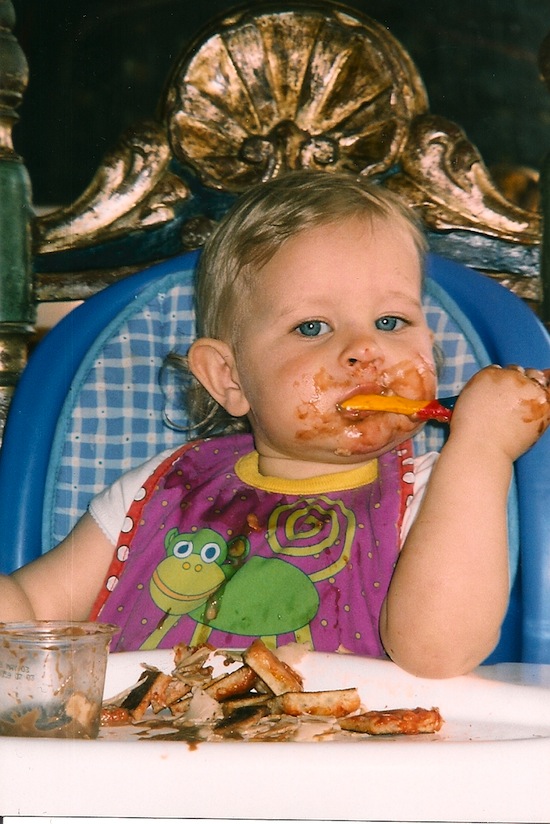
Em – 2003

sc000b447a

Emma Knows Best

This past Christmas I bought Em a snow fort.  Em loves bouncy castles and the snow fort looks a bit like a bouncy castle.  It seemed like an excellent idea at the time, except that it was missing a key component – it didn’t bounce.  It’s one of those gifts that looks good when you receive it, but once it’s been constructed it’s not so interesting.  Even I wondered, once we’d blown it up and put it out in the snow, now what?  What exactly does a kid do inside a snow fort?   Em was a trooper and sat inside it for a minute or two before extracting herself.

Em's Snow Fort

“No, it’s not a bouncy castle,” Emma said shaking her head as she wandered back into the house.

I stood there looking at it for a minute before following her.

“It doesn’t bounce,” I told Richard.

“Right.  It is without bounce,” Richard reiterated.

“And it’s not even a castle,” I added.

“It’s an inflated dome,” Richard said.

“It’s basically a piece of colored plastic,” I replied.

“What were you thinking?” Richard grinned at me.

I could interrupt this dialogue by going on at length about how Richard has the single best smile of any human being I’ve ever met, how when he grins these little dimples appear that take my breath away, how I can become so distracted I lose track of time, thought, words… I could do that, but I won’t.

Theatrical pause and winsome smile.  

Now where was I?  Oh yes, thinking… what was I thinking?  Well, the truth is I didn’t think it through.  I was thinking about her love of bouncy castles and how this looked sort of like one.  I remembered over the summer how we’d gone to our local YMCA to play on the bouncy castle they’d set up for a limited time and how the guy setting it up didn’t know how to operate it and finally Emma had to tell him.  At first he didn’t pay attention to her, probably assuming she didn’t know what she was talking about because of her non-fluency with language.

“What’s she trying to tell him?” another mom asked me as we watched from across the room.

“She’s telling him that he needs to tie the other end and that he has the air pump attached to the wrong tube, but he won’t listen to her,” I explained.

“Should we go over?” the mom asked.

“I already did.  I told him to listen to her, but he seems to believe he knows what he’s doing,” I said.  “I’m betting on my daughter.  She is rarely wrong about things like this,” I added.

“I’m betting on your daughter too,” the other mom said.  The guy fumbled some more with the defeated looking, semi-inflated bouncy castle as Emma looked on with an exasperated expression.

Finally he did as Emma instructed with a little help from me and the other mother, and the bouncy castle was, well, bouncy as it was meant to be.  Emma was ecstatic and soon joined by a dozen other kids all screaming and bouncing together.

That’s what I was “thinking”.

Moral to the story ~ A brightly colored inflatable plastic dome is not the same as a brightly colored inflatable plastic bouncy castle.

Feel free to add your own wisdom to this story or add your own story…

The Signs of Neurotypical Spectrum Disorder – A Parody

*This is a parody

The following “red flags” may indicate your child is in danger of having Neurotypical Spectrum Disorder (NSD).  If your child displays any of the following, take them immediately to an allistic or non- neurotypical pediatrician or family doctor for evaluation.  Caught early enough many children have shown dramatic improvement.  Studies show that intensive early behavioral interventions can and do help these children flourish giving them the opportunity to become honest, creative, non compliant thinkers who will not be overly concerned with amassing wealth by any means necessary or driven by self-serving desires and wants.

  • Emoting and peculiar noises when confronted with adults who make ridiculous faces and sounds at them by six months
  • Excessive self involvement by nine months
  • Excessive “babbling” seemingly to gain attention  by 12 months
  • Pronounced back and forth gestures such as pointing at random objects, reaching, and waving at anyone who smiles by 12 months
  • Difficulty occupying themselves, requires others to “entertain” them almost constantly
  • Tremendous number of words, particularly farm animals, the noises those animals make, peculiar songs about spiders crawling up drain pipes, and the various ways in which a bus and it’s parts work by 18 months
  • An abundance of ego based two-word phrases such as “I want”, “I need”, “I go” or phrases using “me” by 24 months
  • Peculiar and inappropriate play with representational objects, such as pretending to feed a plastic doll air, or make the doll “drink” from miniature tea cups by 36 month
  • Fascination with fairy tales about people falling into endless stupor, only to be woken by a complete stranger’s kiss or meeting someone on a horse and riding off with them, without getting to know them first
  • Overly concerned with what others think otherwise known as having a “herd mentality”
  • Overly compliant and especially eager to please any adult, even if the adult is a complete stranger
  • Rote and often dishonest answers to questions such as “how are you?”
  • Generalized dishonesty often used to get one’s way by 36 months
  • Inability to remove emotion from disagreements
  • Uses language to deceive by 50 months
  • Mob mentality – tendency to become influenced by those they believe to be in power by 50 months
  • “Group think” does not question, but follows what is considered to be the majority thinking
  • Making fun of, laughing at or showing fear toward any who appear different than themselves (this can include those with a different neurology, skin color or even nationality
  • Difficultly staying present.  Constantly thinking about the future or past.
  • Easily “bored”

It is imperative that you seek help for your child if you suspect they are at risk.  Though Neurotypical Spectrum Disorder can be mildly to severely disabling, NT Speaks has numerous resources for families whose children may be suffering and afflicted.  You will be relieved to know NT Speaks employs not a single neurotypical and no Neurotypicals are on their advisory boards.  In fact we do not consult, listen to, or speak with any who are on the neurotypical spectrum as we have learned they have a tendency to be dishonest, will do anything to be “liked” and are almost always self-serving.  We are a non-profit whose goal is to cure neurotypicals.  All our research dollars go toward funding pre-natal testing and cures for this terrible crisis our world is currently facing.  Do not let your child become a burden on an already beleaguered society.   Let us help you.  Call us at 999-9999-9999 (en Espanol 999-9999-9990) or email saveusfromtheapocolypse@neurotypicalspeaks.org

*This post is a parody.  However the wording is almost identical to the wording used by many organizations that claim to want to “help” those who are Autistic.   

images

“The Signs Of Autism”

When my daughter was diagnosed I heard all the autism statistics.  I read a great deal and I learned a lot.  But what I learned was not so much about autism as it was about non-Autistic perceptions of autism and what that meant to those who are not Autistic.  Non Autistic people tend to view autism with tremendous fear.  There’s so much we don’t know.   Non Autistic parents are left trying to sift through the opposing opinions about a child they may have a difficult time understanding.  Most parents deeply love their children and want what they believe is best for their child.  So when they see literature describing the “signs of autism” it looks scary.  The various “signs of Autism” do not bring them any closer to understanding their child, rather they serve as a critique.  Right away parents are shown how to view their child as less than, as not good enough, as “wrong”.

From the Mayo Clinic the first sentence under the heading “Symptoms” reads, “Children with autism generally have problems in three crucial areas of development – social interaction, language and behavior.”

If I had read this sentence upon receiving my daughter’s diagnosis I would have thought, okay, so how do we fix these problems, because  problems are to be fixed, right?   And though I did not read this exact sentence in 2004 when my daughter was diagnosed, I read a great many just like it.  I never once thought about the sentence and who was writing it.  I never once questioned it’s validity or examined the words being used.  It never occurred to me to read this sentence with skepticism and doubt.  It didn’t occur to me to wonder how my two-year old daughter might feel growing up in a society that believes the ways in which she interacts, speaks and behaves are viewed as problematic.  But I think about all of this now.  Not because my daughter is reading a sentence like this or because we are discussing things of this nature, but because I see everything regarding autism and those who are Autistic differently.  I am hyper aware of the judgmental and critical tone in almost everything to do with autism because I now know a great many people who are Autistic and they explain it to me.  I now know how offensive this language is and I understand why.

So let me ask all of you who are not Autistic this – how would you feel if you were described from the moment you were born as problematic?  How would you feel if you were taken from one doctor to the next, examined and criticized?  How would it affect you if you were told, “Stop looking at me when I speak to you!”  And then when you found that impossible, the person physically reached down and turned your head away so that you could not make eye contact.   How would you feel if you were paying attention and suddenly two hands grabbed your wrists and shook them so that  your hands flapped rapidly on either side of your face.  When you tried to pull away, you were told, “Move your hands!”  How would you feel if you were happily playing with your dolls and your parent demanded, “What are doing? Why are you making them interact that way?  Why are you trying to feed it?   You understand this is a piece of plastic and not real, don’t you?”

The point I’m trying to make, (probably poorly) is that almost all the literature about Autism is written by NON Autistic people and negatively compares Autism to a different neurology.  Is it any wonder parents feel so confused?  How is this thinking helping our kids?  How is it helping parents?

Presents

Synesthesia

I cannot stop thinking about some of the things people have written regarding pain or doing things that others perceive as painful, but that they perceive as relief or calm or being more present.  One person described it as feeling “organized.”  And then there are the people who described various types of synesthesia coupled with pain.  So I wanted to circle back to synesthesia specifically as this is something I know little about and I’m assuming many others may be unfamiliar with it as well.

*For those of you who are synesthetes, please jump in and comment or email me (emmashopeblog@gmail.com) privately.  Anything you tell me will be treated as confidential unless you give me permission to quote you, I will paraphrase and not use your name.

There are a number of interesting websites (these are just a few I found particularly interesting, but there are dozens more):  Neuroscience for Kids – Synesthesia,  American Synesthesia Association,  Brain Pickings, ScienceBlogs and Synesthete.org explains:  “Synesthesia is a perceptual condition of mixed sensations: a stimulus in one sensory modality (e.g., hearing) involuntarily elicits a sensation/experience in another modality (e.g. vision). Likewise, perception of a form (e.g., a letter) may induce an unusual perception in the same modality (e.g. a color).”  Synesthesia is thought to be inherited affecting 2-4% of the population, though there is no evidence to suggest a higher prevalence of synesthesia in Autistics and it seems women are more likely to experience it than men.  *It must be noted, everything I’ve written in this paragraph was gathered on the internet and almost all of the various articles are written by non-Autistic people.  I have added links to the original sources throughout.

Someone described how they can smell colors and another wrote about being able to smell people’s emotions.  They described being able to smell someone they saw from a distance or on television.  Another person wrote that when they meet someone they see color.  Someone else wrote about how a particular self-induced pain causes them to see the most beautiful flashes of colors, exquisite and unique and unlike anything they’ve ever experienced.  And still others talk about how numbers or letters have personalities, this is called, ordinal-linguistic personification. One person described it as a numeric “soap opera” and said, “2 and 4 are in love, but 3 hangs around and is like an annoying little brother, always wanting to be included, but nobody wants him around.”

I found a great post by Jessica Bagnall entitled, Synesthesia-Why My Numbers Have Personalities, she writes, “Five is a businessman that has a half-relationship with Eight, though he is unable to commit. He is flaky and often impossible to get hold of, though he tries to be more stable. He is the older brother of Seven.

And then I read this Autism and Synethesia (the mis-spelling is on the site):  “On a whim, I asked my son Tom, age 11, if he sees colors when he plays notes on the piano. Tom, who is diagnosed with high functioning autism, plays both piano and clarinet. Oh, yes, he said, he does! Here are the note/color correlations he gave me, right off the top of his head:

  • C=red
  • D=orange
  • E=yellow
  • F=green
  • G=blue
  • A=”pink”
  • B=violet

I drew a series of dots in the colors he gave me, and asked him to play them on the piano. He played Frere Jacques flawlessly.

I looked up synesthesia, and found that there’s a close link between synesthesia relative to music – and perfect pitch (which Tommy has).”

I have to wonder whether my daughter experiences some version of synesthesia and if most who are profoundly moved by music do as well.  Which then lead me to think about art, poetry, writing, painting, sculpture and dance.  Are all of us born with some degree of synesthesia, which we then lose as we mature?  Just as all of us are capable of learning many languages as young children, but as we grow older acquisition of other languages becomes increasingly difficult, is this true with synesthesia as well?  As with so much surrounding neurology, I find the more I learn, the more questions I have!

To all of you who have shared your stories – thank you.  Many of you have shared incredibly personal things and I’d like to acknowledge that and tell you how grateful I am.  So thank you, really, thank you for being willing to describe such personal things.  I am profoundly grateful to all who’ve reached out to me.  I hope I’m doing your experiences justice in these posts.

Em at dusk running through the sprinklers on the ranch – Summer 2011

Back Camera

Different Neurology ~ Different Perception

When I began writing about the actions many take that are labeled “self-injurious behaviors” I had some ideas from my past of self harm (bulimia, anorexia, compulsively overeating, etc) about what that might be like.  When my daughter began biting her hand and arm, punching herself in the face or chest, I knew I was seeing something different, but there seemed to be enough of an overlap that I felt I had a small degree of insight into her experience.  But there is a difference between self harm and the actions many take to mitigate external pain such as cluster headaches and the pain brought on by a variety of sensory issues.  Others have described the action of biting, pinching, head banging as a way to center themselves, they describe the calm they feel afterwards and many describe a sense of relief as well as others who say they are able to make sense of space and where their bodies are.  Many described how when the underlying source was treated the desire to bang, punch, bite went away.

Anonymous 1 (who I quoted in yesterday’s post) said, ”When I bashed my head, though, the screaming stopped. It just cut off, and then the pain spread over my entire scalp, like a blanket over my brain.

I couldn’t stop thinking about this sentence.  So I reached out to ask for more about the “screaming”.   Anonymous 1 responded:

I can hear shapes and colors, and sometimes I feel music in a very literal way. Like, slow adult contemporary stuff my mom plays makes me start itching and it makes my clothes feel too tight. The scream in my head works the same way. When I’m having a sensory day, it starts wailing away and makes it hard for me to maintain emotional equilibrium, until I lash out (either through SIB or by becoming verbally abusive to people around me). Similarly, if I’m put off emotionally by something, like someone being selfish, then the scream will start up until I’m scratching at myself and teasing the broken bones in my hand just to give myself a pain-stim that will shut it down.

“If I had to describe it, I would say that emotions are a sense, in the way that sensory issues work for me. They mix with the other senses, bleed into them synesthetically, and the integration issues for both emotions and sensory input have exactly the same process in my head. The act of both of them happening at once, where I can’t focus on just one or the other, produces the scream. Some days, I can clamp down on it and keep it in my head. Other days… meltdown. SIBs. Crying. Fighting with family.”

Anonymous 4 wrote: “I like to bite my arm. I know. It sounds weird, but I love the feeling of the shimmery yellow and blue and white sensation that flows down my arm.  There is nothing like it.

When I read this I thought about how easy it is to assume we understand until someone describes their experience and it is very different from what we assumed.    It seems to me this is an important piece.  I know Anonymous 1 and 4 are not the only ones who have this experience with synesthesia.  Judy Endow discusses how she perceives words through the sound and movement of color.  I have heard others describe variations on this as well.  If ones neurology finds meaning in spoken words through movement, sound and color, it would stand to reason, emotions and sensation would be perceived this way as well leading them to do things that might cause those witnessing it as something to be stopped.  I have to wonder how many, who are in the field of Autism are hearing these kinds of experiences.  So much regarding autism comes from those witnessing it,  people who want to understand, but whose own neurology may make it very challenging, if not impossible, for them to do so.

“Self-Injurious Behaviors” ~ Let’s Discuss

I’m continuing to research SIBs, which stands for “self-injurious behaviors”.  It’s far too complex a topic to tackle in a quick  800 – 1000 word post. There are a number of topics it seems important to discuss,  which all fall under the heading of “self-injurious behavior.” (Feel free to add more in the comments section, this is definitely a work in progress.)   I’ve broken these topics down to include:

  • The language we use to describe such actions.
  • The perception (usually of neurotypical parents, caregivers, doctors, school employees, educators and the general public) of what these actions may or may not mean, this is particularly critical when the person taking such actions is partially speaking or non-speaking.
  • The personal experiences of those who have engaged in such actions that may or may not lead to real injury.
  • The experience of those who want to help and/or are in a position where they may be held accountable for the actions or inactions taken.  (This includes parents who love their child and would do anything to lessen their child’s frustration and pain.)
  • What can be done to help those who head bang, bite, pinch, punch or engage in actions that lead to serious and/or permanent injury?
  • What can be done to help those who head bang, bite, pinch, punch or engage in actions that are difficult to witness, but do not lead to permanent or serious injury?

I will try to cover all these various sub-topics, but first I’m going to tell you a story.

Emma sits cross-legged on the floor in our living room.  Her tutu billows about her plump legs, it’s pink ribbon sash lies undone near her.  In one hand she holds one of my red suede pumps, it’s small round heel directed at her forehead.   Wordlessly she smacks her head with the shoe’s heel over and over again as if she were driving a nail into a wooden plank. 

“ NO!  Emma, don’t!” I plead, running over to her.  I take the shoe from her, kneeling down to survey the damage.   There is no blood, just a small pink mark above her left eye where the heel made contact.

Instinctively I pull her into me wanting to comfort, but she resists.  She stares over my shoulder.  No sign of pain, there are no tears, no distress.  Her face is the face of a perfectly content toddler.  Whatever emotional trauma I imagine for her is mine alone.  She turns away from me and reaches for the other shoe lying a few feet away. 

“No Emma!  You cannot hurt yourself,” I say as though this were a natural thing to remind such a young child.  Bewilderment overwhelms my shock.  Emma stands up and wanders off, leaving me with one red shoe in each hand.

This was how I responded to Emma’s seemingly bizarre actions.  This was how I continued to respond to Emma when she began to bite herself.  This was all I knew to do.  Remove the thing that was causing damage, except that when that “thing” was her own fist or fingers or teeth I was powerless and defeated.  So I begged her, pleaded with her to stop, usually in a loud, panic-stricken voice.  Why was she feeling compelled to do such a thing?  Was it a deep need for sensory input? Did her head hurt?  Was she trying to cope with internal pain caused by some outside source – the daylight streaming in through the window, the heat from the radiator, the clicking noise the steam heat made as it surged through the pipes, was there some noise only she could hear that bothered her, did the fabric from her tutu itch or dig into her skin, or was it something else that I couldn’t see or understand?

I spoke with experts, doctors and other parents, but I never learned how to help her.  I watched YouTube videos and read research articles, I spoke to school staff, psychologists and people who work in hospitals.  Nothing I read or heard about made much difference other than to make me feel even more panicked and fearful.  The language used by those in the field of Autism is almost uniformly fear based and along the lines of deficit thinking.  By saying someone is engaging in “self-injurious behavior” we are suggesting they choose to “behave” this way.  But what if this is actually incorrect?  What if you were unable to make yourself understood through spoken language and had a horrific headache?  What if you could not use words to describe the pain you were in?  What might you do?  What if you felt such a surge of frustration you lost the ability to speak?  What if you could not find something or something broke or the music you were listening to or the DVD you were watching was calming and beautiful and it suddenly, abruptly, stopped or skipped, what if you needed it and now it was gone?    What if the only way you felt better and calmer was by hitting yourself.  What if the very sensation viewed by onlookers as harmful was actually helpful to you?

To someone like my daughter, her response to upset of various kinds is not the response of a child being difficult or bratty or frustrated.  Hers is the response of someone who’s world is coming to an end.  She is in full panic mode.  If she said, “I can’t take this.  I’m feeling completely overwhelmed, I don’t know how much longer I can hold on, I just want to scream and punch something!”  We would nod our heads and say, “gosh I know exactly how you feel!  I’ve felt that way too!  Let’s talk about it!”  We would go over and hug her and she would take solace in knowing she wasn’t alone and the hug might make her feel loved and she might even feel safe enough to talk about it more.  Her situation wouldn’t change, the feelings leading up to uttering those words might not change, she may still feel overwhelmed and not know how to change those feelings, but through talking about them, we talkers have come to see there’s some comfort to be had, because our brains are programmed that way.  This is what most of us, who are more neurotypical than not, have found.  Except that my daughter’s brain doesn’t work that way.  Talking and hugs do not help her when she feels overwhelmed, in fact talking and hugs increase her upset!

In addition Emma’s experience of pain is different from mine and many people’s.  Emma can twist and yank out a tooth within an hour of it feeling even slightly loose.  Emma can have an ear infection that is so bad the pediatrician was incredulous.  Emma can show no signs of illness but is found to have strep throat, caught by her doctor only because we happened to be in his office for a routine wellness check up.  Emma craves sensory input on a level Richard and I find astonishing.  She turns the volume up as high as the TV or DVD player will go of her favorite songs or movies.  We are literally blasted out of the room she is in.  Sensory input is needed at levels we cannot tolerate.  For Emma this isn’t a “behavior” this is a need.  How this plays out when she bites or hits I cannot fully know, but that they do, is something I feel sure of.

Last summer I spoke to my friend Ibby who explained why yelling at Emma to stop hurting herself was not working.  “It’s a lie,” Ib said.  She explained that by telling her she “couldn’t” do something, something she’d just done right in front of me, as evidenced by the teeth marks on her arm, was a lie.   A lie that made no logical sense.  So I stopped saying things like that.  Soon after I stopped yelling at her, I realized that anything I said could be heard as scolding, judgmental and counterproductive, especially when done in a loud voice.  Now that I have a better understanding of language and how language can come and go, I understand it isn’t just Emma’s ability to communicate, it’s her ability to understand all verbal communication.  All spoken language, both hers and anyone else’s goes out the window.

I have to stop talking.  This is counter intuitive for me, but it’s key.  Stop talking.  I have to remind myself of this.  If Emma is in the midst of an upset where she has begun to bite herself, no amount of logic will prevent her from biting mid-bite.  When Emma is biting herself this is an indication to me that I need to be quiet.  Sometimes she will come to me and allow me to put my arms around her in a firm embrace, other times she will reject all contact.  In the midst of an upset I have learned the single best thing I can do is – nothing.  No words, no physical contact, nothing.  I remain nearby and I wait for her to come to me if she needs or wants to.  Once she is calmer, I have a chance at figuring out what led up to the upset… maybe.  Once she is calmer I can try to see if there’s a pattern so that I can interrupt it next time before she gets to the point where biting herself seems like the only solution.

The single most unproductive thing I can do in the midst of Emma’s upset is to scold, admonish, restrain and judge her.  This may seem obvious to many of you, but it wasn’t obvious to me.  Some of the things others have recommended:

Judy Endow wrote:  “DISCOVER AND ELIMINATE PHYSICAL PAIN.  I have worked with many autistics who REAL PAIN and trying to change behaviors is like telling someone you love that you don’t want to know anything at all about their pain and in fact you want them to learn to behave as if they did not have any pain at all! So many behaviors turn out to be physical – one little girl who banged her head so hard it put holes in the walls, caused concussion and wore a locked helmet was discovered to have had head lice for so long that the lice had burrowed so far under her skin she had to have some sort of specialized treatment more than lice shampoo to get rid of them. She had lice for over 3 years before it was discovered due to them burrowed under her scalp!!! Once the lice was gone so was the head banging.”

(Judy Endow has written a terrific work book Outsmarting Explosive Behavior and while she doesn’t mention “SIBs” specifically, the steps she suggests will certainly be helpful for many.)

In answer to my question “Was there anything that helped?  If so, what?”  Kassiane wrote:  “Treating my cluster headaches. Leaving the SIB alone, treating it not just as a ‘mysterious autism behavior’ but as a release valve for stress, & eliminating or reducing the input that was pushing that far. Changing the situation has a much higher success rate than “stop doing that”, because I need a way to cope with the situation that leads to chewing my hand…I dont even notice until I’m a bit…gnawed.

Anonymous 1 wrote:  “I do remember, in those early days, that I liked the head-bashing because I only needed to do it once or twice. I could pound my fists into the dirt until my knuckles scabbed up, but the pain that I felt would barely measure up to the sound of my own screaming in my head. No matter how much I tried to let it out, it just never worked. I would punch myself into exhaustion and fall asleep, still feeling completely trapped, helpless, and alone. I would wake up afterward hearing my own screaming in my head.

 “When I bashed my head, though, the screaming stopped. It just cut off, and then the pain spread over my entire scalp, like a blanket over my brain.

Anonymous 2 described a prickly sensation all over their scalp caused by a new haircut.

Many spoke of the frustration leading up to the biting, hitting, etc.  Redirection seemed to help less serious actions, but everyone, everyone agreed that scolding, punishment or anything that could be viewed as punishment made the punching, hitting, banging and pinching much, much worse.

Having said all of this, we are fortunate in that Emma has never done more than left a mark on her arm or hand.  But there are others who do.  There are children and people who break bones, break the skin, and do permanent damage to themselves.  What then?  What does one do to help them?  What can be done?

I’m afraid I have no answers for these situations.  But whatever the “remedy” or “therapy” being employed, we have to ask the person who is being subjected to these various things if it is in fact helpful and if they are unable to communicate by typing, writing or speaking, we must ask ourselves  –  Would I want to be treated this way?  This is, at least, a starting point.

An Interview With an Autistic Teacher Who Teaches Autistic Students

What follows is my interview with a teacher.  A teacher who teaches Autistic students.  A teacher who is Autistic.  

When were you diagnosed with Autism?

 I self-diagnosed as having NLD (Nonverbal Learning Disability) (which I mistakenly thought was mutually exclusive to Autism – a good reason to get a professional diagnosis, not a web diagnosis) in college, which brought me a lot of peace of mind and self-understanding. (And helped me make peace with a lot of my past.)  I was in my 30s when I finally made the decision to get the formal diagnosis. (I was both right and wrong: I do have NLD, but I’m also on the Autism Spectrum.)

I got the diagnosis because I was having a lot of trouble communicating effectively at work, and I was getting written up for it.  My supervisors were trying to work with me, but I was afraid I was going to lose my job.  It wasn’t the first job I’ve had that happen at.  The problems my coworkers were going to administration about were hauntingly familiar: my voice tone, my inability to read others voice tone, my quick answers that don’t make sense and sound frustrated.  It was a pattern I’d seen before and had never had any success stopping or changing.  I knew I needed help if I wanted to save this job.

Why do you prefer remaining anonymous?

 For now, at least, I want to maintain control over disclosure.  Also, privacy.  The web is public and it stays there forever.  I’m not comfortable with anything about me, disability related or not, being out there like that.  I don’t have anything meaningful out on the web under my real name, and I’ll keep it that way, thanks.

How did you get into teaching?

 I think it’s in my blood.  My dad is a teacher.  I remember being in first grade, when everyone wants to be police officers and firemen: I wanted to be a special education teacher.  I got a BA in Psychology and spent 5 years doing direct care before moving to work in the schools.  I worked as a paraprofessional while I got my M.Ed.  I’m certified in intensive special needs and deaf/blind education.

Would you talk about your childhood and how autism affected it?

 I did the stereotypical “little professor” thing.  My mom says my favorite word as a kid was “actually.” I had friends growing up, and if my parents thought my relationships with them were a little off, I never noticed.  I had no other standard of relations, and I was happy with what I had.  My mom tried vainly to model more appropriate social interactions (my poor mother) but it all went right over my head (I do not learn from environmental cues or social models.)

Middle and high school were rough.  I was the victim of significant bullying. Kids are mean.  I considered changing schools (I went to public school) but decided against it.  Instead, I dove into my interests: computers, foreign languages, band, technical theater. Bullying happens during the unstructured times of the school day.  I was never unstructured, participating in more classes and extracurriculars than there were hours in the day. (I seriously could have used Hermione’s time turner back then….) Not only did it give me structure and purpose, but it successfully buffered me from my would-be tormentors.

Are you concerned that if the school where you work knew you were Autistic your job would be in jeopardy?

 I’d be worried about an employer learning that I was Autistic before I had a chance to prove myself as a teacher, yes.  The concerns about my communication problems at this job came in the context of “we love your passion, but…” I had already proven myself, multiple times over, as a good teacher getting excellent results with students who are considered difficult.  Afterward, I could see I had to re-prove myself because the words of my NT (neurotypical) paraprofessionals (sometimes not just in the area of classroom communication) carried more weight than mine did.  I have reason to believe we’ve gotten past that now, but it lingers in the back of my mind.  I know I have to work harder and sometimes that makes me mad.  Luckily, I have an administration and paraprofessionals who support me in the work I do and who respect that I am approaching it from an Autistic perspective (even if they don’t always understand that perspective.)  I haven’t always been that lucky, and I am continuously grateful for it.

You say, “with the right accommodations..” can you give an example of a couple that are helpful?

 Using written communication when possible.  This frees me up to only address questions that need to be addressed, which is means I am more likely to be clearer because I can devote the needed resources to perspective taking and processing time.  Regular meetings.  I don’t pick up on things incidentally unless I’m working hard to pay attention to everything that is going on.  That’s impossible when your class is spread between multiple locations.  Regular meetings give me a chance to make sure we’re all on the same page at the end of every day and put out any fires before they get out of hand.  However, the effectiveness of these meetings is predicated on….

Direct communication from staff. This is quite possibly the hardest accommodation to get and the most important.  I ask everyone I work with to be direct with me and everyone says they will. But saying and doing are not the same thing.  Most NTs find being as direct as I need them to be as impossible as I find reading their non-verbal language.  It’s a real communication gap.  I’m incredibly fortunate that I have a para that can bridge the gap.  Some of my new paras are starting to learn as well, and I’m starting to learn to read their individual cues.  Translation is never as good as reading the original, but we get by.

Having communication support people I can turn to.  I have 2 coworkers I can trust to run things by when I’m concerned about how I’m coming across or not sure if I missed a cue from someone else.  This doesn’t help, of course, when I’m oblivious to the fact that there was something I should be concerned about in the first place, but it reduces the pool of potential landmines, at least.  Also, these are people who can listen for what I’m not hearing on the rumour mill (because I’ll never hear it) and potentially warn me of landmines I’m not aware of.  They’ve definitely saved me from several potential disasters already this year.

What are the most common misperceptions you face in trying to teach this population?

Top five misconceptions held by administrators, paraprofessionals, parents, and community members that make my job harder:

  1. That my students cannot possibly be capable of having control over (or a meaningful say in) what will happen with their lives.
  2. That the fact that most of my students may never be fully independent (living alone, working full-time) means that we should not bother teaching them community living and vocational skills.
  3. That my students are unpredictable or dangerous.
  4. That a student who may exhibit challenging behavior in the school environment shouldn’t be allowed in the community because he might exhibit the same challenging behavior.  (This one really makes me angry, because it doesn’t teach the kid anything useful. Give me appropriate staffing to handle the behavior; don’t penalize the kid.)
  5. That my students should be pitied.

Have you been surprised by any child’s ability?

 Have I have taught a student who had more skills than their assessments claimed? Absolutely.  Have I ever had a student make more progress in a year than I anticipated and had to amend the IEP part way through? I love it when that happens!  Have I ever taught a student who may not have a lot of skills that can be formally assessed, but who enriched my classroom in so many other ways?  All the time.  I don’t like the word “surprised” – it’s an autism thing, I guess.

How do you deal with self-injurious behavior?

 Behavior does not occur in a vacuum and all behavior is communication.  SIB (self-injurious behavior) usually has a sensory component, but a FBA (functional behavior assessment) will give clearer answers.  We need to look at the environment, the student’s communication strategies, and antecedents and consequences.  What is the cause of the stress?  How can we teach the student to deal with it more effectively?  Generally, positive behavior supports are most effective, but they have to be individualized in order to be effective.  What is reinforcing to one student may be aversive to another.  Behavior does not occur in a vacuum, and we cannot try to treat it in one.

Can you describe some of your own sensory issues and how they impact your life and work?

 I only recently really mastered reliable daily living skill routines.  Showering was a difficult sensory experience for me for years.  I still have trouble with toothbrushing and flossing, but I’m working on it.  I eat pretty bland foods (though, due to food allergies, my diet is both more varied and more monotonous than average) because I don’t care much for significant smells or tastes.  I’ve gotten more tolerant of different clothing textures than I was when I was younger.  I still freak out at certain textures, but my repertoire has expanded significantly from the “cotton/poly blend only” I wore when I was younger.

At work, I’m in control over the visual environment, since I’m the classroom teacher.  So I keep it pretty visually quiet, both for my own sake and that of my students.  Any conversations go out of the room, which really helps all of us focus.  My para knows to ignore when I’m self-talking, which is my primary self-calming strategy (I try to take that out of the room too, when I can.)  I stim when I need to.  So do my students. I don’t see that (the stimming) as particularly impacting our work.  I bring figits or sit on the floor during meetings (I sit in the back so it’s not disruptive.)

In previous years, when I was trying to pass and having more communication problems, I needed more sensory breaks and did a lot more self-talk (which in turn cased more communication problems.)  Now that I’m not trying to pass, I’m more comfortable and less stressed, which means I’m generally more sensory regulated – and if I’m not, dealing with it is no big deal.

Are there specific things you suggest schools can do to help their students?

 I think a lot of schools do the first half of this puzzle really well.  They have proactive sensory programs: do this activity after this interval for this amount of time.  And they have reactive programs: if you see this behavior, offer these choices for this amount of time.  The good ones have a mixture of the two.  Where the programs tend to miss the mark is in taking it to the next level: teaching the student to recognize when their sensory system is starting to become disregulated and what to do about it.  There are some good programs out there for teaching this skill: The Alert Program(TM) is probably the most popular.  I’m a fan, personally, of the Incredible 5-Point Scale, because the students can apply it to more than just their sensory system and because it has a more flexible metaphor (colors, numbers, can use pictures) and it ties into emotional regulation and understanding.

What is your opinion regarding stimming?

 I stim. My students stim. I won’t stop a student from stimming. My para (the only NT  in the room, poor guy) frequently points out that everyone stims, it’s just that society has declared NT stims socially acceptable and autistic stims unacceptable.  That said, there are also students who demonstrate self-stimulatory behaviors that are not self-calming but rather a precursor to or the beginnings of further stressed or out of control behavior. It is extremely important to know your student and to know the difference between these two types of behaviors. In one situation, the student is using their own coping strategies to de-stress, and in the other the student is indicating the beginning of losing control, and the environment or stressors needs to be addressed to prevent further escalation.

Have you ever witnessed treatment of a student that you objected?

 I’d love to say “no,” but yes, I have. Most of the time it’s things like not giving enough wait time and over-prompting. I get incredibly frustrated by the way that students who are not socially engaging, especially if they have challenging behaviors, tend to get left out in favor of the “easier” kids. But also, yes, I’ve seen what you’re really asking about. I’ve seen students physically moved or restrained when they shouldn’t have been.  I’m trained in the use of physical restraint, and yes, I’ve had to use it. Do I like it? No. Is it ever my preference to use it? No. Will I use it as a last resort to keep students safe? Absolutely. And I would 100x prefer to be called in and asked to do so then to have people who are untrained and don’t know what they are doing try to make do.  That way only leads to injury, trauma, and possibly death.  And I’m not afraid to call it like I see it.  I’ve reported coworkers to administration and when needed I’ve filed 51a reports (reports of abuse or neglect.) There are certain benefits to having an overarching sense of right and fair and not feeling bound by social conventions, at least where the students rights and safety are concerned.

Is there any methodology that you prefer and why is that?

The short answer to this question is no.  I am very wary of any program that says that a particular methodology is right for all students with diagnosis x.  I don’t believe that to be true.  The role of the teacher is to be familiar with the breadth of instructional tools that are out there and to find (or adapt) the right tool for the individual student to learn the specific skill.  For one student, that might be Discrete Trial Training to learn to attend to directions given in ASL.  For another student, that may be a phonics curriculum to learn to read.  A third student might be learning vocabulary in the natural context of a community work placement.  The one thing that all of these methods have in common is data.  I need reliable data taken daily on student achievement to know if the methodology is effective and the student is making progress, or if the instructional method needs to be changed.  There is no right or wrong method; I don’t even believe there is a best method. The question is whether the method being used is effectively teaching the student the desired skill, and there is only one way to answer that question: data.

Are there any methodologies that you believe are harmful?

Aversives, repeated use of any form of punishment (including time outs,) restraint used as a programming tool as opposed to an emergency procedure. If you’re doing it on a regular basis, something is wrong.

How do you work with a curriculum given your student’s disparate needs?

 The short answer is good staffing ratios and competent paras.  Also, using the principles of Universal Design for Learning.  By differentiating how I engage each student, and with paraprofessional support for behavior and data-taking, I can have three students engaged in a group setting.  I can have a fourth student, with additional paraprofessional support, engaging in the same material with us and connecting to the group as able. If you’re counting, that’s 3 staff and 4 students.  I’ve just described to you what my classroom looks like most days.

In an ideal world where Autism carried no stigma and you were able to be open about being Autistic, are there specific things that would allow you to do your job better?

 I would like to be able to work with my students on understanding Autistic culture and the Autism community.  My school does very well teaching our Deaf students about Deaf Culture and their Deaf identity.  I believe we could do the same for the Autistic students.  I would like to make that happen, and I know that no one else will lead it, but it would require being open about being Autistic and I’m not ready for that yet.  I trust my administration and those I’ve told, but I am not comfortable working with the rest of my co-workers as an Autistic person, which I’d need to do in order to make that happen for these students.  It’s something I want to do, but not yet.  One day, I hope.

What do you advise people who are thinking about entering the field of special education?  Is there anything you wish you’d known when you were just starting out?

 Work with kids with disabilities before you go into the schools.  Work at multiple schools (or with kids from multiple programs) before you start teaching.  One of the downsides to being in the schools, especially since most teachers work as paraprofessionals while they get their degree, is that you work with one student, or one group of students, for years.  There is frequently only one or two special education classrooms in the building, so there aren’t a lot of models to observe.  I have had too many experiences of people singing the praises of teachers I know to be mediocre at best, because they have no standard to compare them to.  See as many different students and teachers as you can before you settle on a specific subset of the population, a school, and a classroom where you want to work.  Most importantly, spend time working with typically developing children.  You’ll need that reference to fall back on so you can recognize what’s typical age-appropriate nonsense and what is actually behavior that needs to be addressed.  We tend to acquire tunnel vision in special education; make sure you don’t put the blinders on until you have to.

What do you advise parents look for of non-speaking children seeking a good school?

 Without knowing the specific student or her goals, it is impossible for me to say what program is best.  I can tell you what I look for in a school where I would consider working.  The one thing that sends up red flags and makes me stay far away is a school that believes there is one right method to teach all students.  Simply put, there isn’t.  Beyond that, I look for evidence that the people there know how to use picture supports and both high and low tech communication supports, not just for schedules but integrated into everyday activity: academics, leisure/social time, specials, lunch, etc.  For an older student, I look for evidence of functional skills and community based learning, not just using pictures to represent and role-play functional community activities, but actually getting out into the school and local community and learning the skills in the real environment.

If you could create a “dream school” what would it be like?

My dream school would have the physical environment, educational methodologies, peers, and teachers and paras with appropriate training and ratios to give each student access to both the general educational curriculum and any related services she needs to be successful as an adult: whatever that looks like for each individual student.  My dream school is not one school, but a range of options for every student so that the right option is always available.  That option would naturally change over time as the child grows and her needs change, and no one would question the need for that change.

Have you had parents or other staff question the competence of a child in your class?

 I had a former administrator tell me a student didn’t matter because his family would take care of him after graduation and to focus all my attention and resources on another student who, she said, actually had a chance of being fully independent. I basically ignored her. They are now both working in the community with support.

 Have you had a parent question their child’s competence?

 Not directly, but I certainly have known parents who have underestimated their child’s academic or independence skills.

 How have you dealt with that?

 I don’t judge, because I can’t.  I don’t walk in their shoes.  I only see their child at school.  I only know what their child does in one environment and I understand well that students will present differently in different environments. I will encourage bridging to home; I will provide support; I will provide information and data. But I will not judge, because I do not, I cannot, really know.

Self Injurious Behaviors ~ Questions

I’ve been working on a post about self-injurious behaviors for a few days now, but I realized this morning I need some feedback from all of you before I proceed.  If you aren’t comfortable commenting here, please write me at emmashopeblog@gmail.com.  Everything anyone tells me will remain confidential, unless you specifically tell me I may quote you. If you are comfortable with my quoting you, be sure to tell me!

Have you or anyone you know engaged in self-injurious behaviors?  

Can you describe the behavior?

What was done?  

Did it help?  

If not, did it make it worse?  

Was there anything that did help?  

If so, what?

If you have witnessed someone who self injured did anyone speak to you about how you felt being a witness?  If so, was it helpful?  If not, do you think it would have been?

All comments on this topic are welcome, even if they do not answer any of these questions.

Thanks so much and have a great weekend everyone!

Emma’s Self Portrait – 2013

photo


The Magic of This Moment

Early this morning:

Nic: I’m late!  Gotta go Mom.

Me:  Okay,  babe.  Have a great day!

Nic:  I love you.

Me:  Love you!  Bye babe.

Emma:  Love you, Nicky..

Nic:  I love you Em.

Emma:  Bye bye

Just another typical conversation, right?

Um no.  No.  Not at all.  Nothing typical about it.  This.  This is why I don’t envy any other family, this is what I treasure about MY family.  This is exactly why, this conversation, this seemingly common, innocent, no-big-deal conversation…. yeah.  Because this conversation has never been uttered before until this morning.  And weirdly Nic and I were talking just five minutes before, while the three of us had breakfast about the importance and magic of being present.  We were discussing how this moment, right now, this second will never be repeated.  We may have moments like it, but this one?  Nope.  Never again.

And as we were talking about all of this, Nic interrupted me and we had the above conversation, the one I’ve just transcribed.  It may seem un-noteworthy to many of you, you may be thinking, so what?  Or who cares?  But to me, this conversation that other families have, perhaps on a daily basis and don’t think twice about, they are little nuggets of pure gold because these moments with my children are gifts, each one of them, pure gifts that I am so lucky to have.

In Buddhism there is emphasis on being present and practice and it isn’t easy.  It’s  a simple concept, but definitely not easy for most of us to actually do.  And yet, when I am able to really show up for this moment the joy is beyond description.

I will leave you with one more snippet.

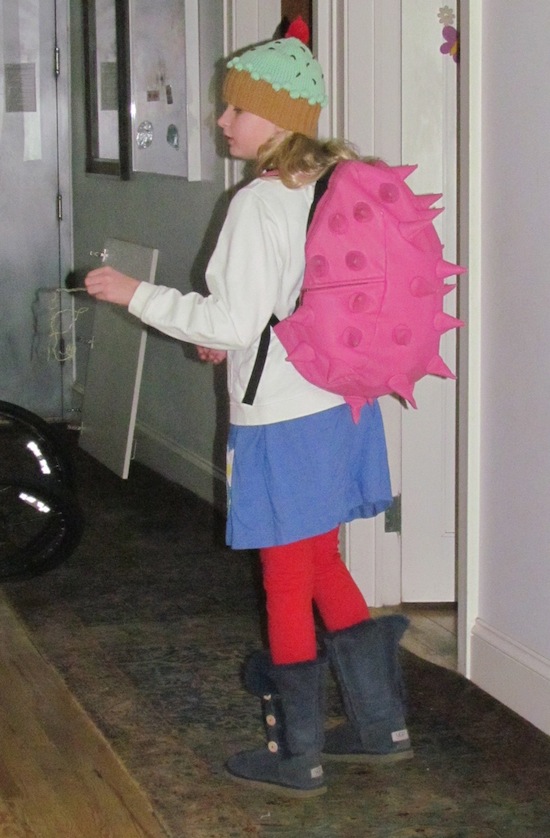
Later this morning as Em and I walked toward her school, we stopped at a red light.  As we waited she linked her arm through mine.  Not a single word was exchanged.  We waited, a mother and daughter, side by side for the light to turn green and once it did we made our way to the entrance to her school.  As Emma entered the gymnasium where the children and teachers were waiting, one of Em’s classmates called out, “It’s Emma.  Yay!  It’s Emma.  LOOK!  Look!  It’s a cupcake, I love cupcakes!”

And Em looked back at me and grinned before running to greet her friend.

The Cupcake Hat

Trouble Awaits if I Forget

I began this blog almost three years ago as a document of my daughter.  At that time I knew nothing about advocacy, I knew only one Autistic adult though I’d read the works of the most famous Autistic people ~ Donna Williams and Temple Grandin.  I assumed there were few Autistic adults because I believed what I was being told, that autism was an epidemic, and I feared it mightily.  I had a few people, made up of close friends and family members, who began to read what I wrote.  This blog was a place for me to write about how I felt and, while I tried to keep my feelings to a minimum and reported lots of dialogue and any progress I saw, I did write occasionally about how sad, angry, frustrated, scared and yes,  sorry for myself I was.  I never once considered how Emma might feel about what I was writing because Emma barely spoke, didn’t read (as far as I knew) and the idea of “presuming competence” was one I’d never heard spoken, let alone considered.  Regardless, I tried to stay upbeat.  I grew up in a WASPY enough environment to believe it was unbecoming to air one’s dirty laundry.  In addition, I believed and still do, in the power of positive thinking.  I wanted to feel hopeful, even though, it seemed to be in short supply.

As time went on and more people found this blog I continued to write about our life.  I understood that having an Autistic child made what I wrote more interesting than had I been writing about a neurotypcial child.  I never thought of it as an “opportunity” but I was certainly aware that I was being given a platform I might not have otherwise had.  I wrote a number of posts where I agonized about what it was to be the parent of such a child.  I saw nothing wrong with my thinking.  *Those posts have since been removed.  I do not post any photos or quotes without explicit permission.*  Had anyone said to me then – can you understand that your daughter’s neurology is not “good” or “bad”, that Autism in and of itself cannot and should not be judged as a deficit, with those whose neurology is in the majority held up as good and enviable, I might have been able to hear them.  But no one did say that.  No one said anything remotely like that to me.  Ever.  Not. Once.

Had someone patiently explained the concept of “presume competence” and exactly why it was so important would I have been able to hear them?  Had someone explained the relationship between depression, lack of self-esteem, how ALL children, whether they are verbal or not, whether they appear to understand or not, internalize what is said and thought of them, I probably would have understood.  I might have even felt the surge of hope I was so desperate for and that I felt so many years later when someone actually did take the time to patiently explain these concepts.  If someone went on to describe the problematic and ultimately destructive issues related to functioning labels I might have been able to comprehend, not right away, but I would certainly have found those concepts intriguing and would have wanted to know more.  Would these ideas have been enough to change the trajectory we found ourselves on?   I like to think the answer is yes.  I am just grateful, enough Autistic people took the time and energy to explain to me when they did.   These concepts are the basis for everything I do and think regarding Autism and my daughter.

Just a year ago, when I began to read the blogs of Autistics who were in their early 20’s, 30’s, 40’s and *gasp* 50’s my understanding changed radically and rapidly.  I started to see that if I wanted a personal place to vent I could do so in a support group or in a personal journal, but that what I wrote about on a public blog or submitted to the Huffington Post was reaching far more than just a few family members and close friends.  Things were easily misunderstood, my intentions were mistaken, the message I was sending was misconstrued.  Slowly, slowly over time I began to realize just how skewed public perception was and how that perception was affecting public policy, the media, where money was being spent.  I heard repeatedly how public perception played out in people’s lives.  I became aware of how pervasive the inequality and injustice was and remains and I became determined to speak out about it.  This was no longer just about my hopes and dreams for my children.  This was about human rights being blatantly ignored.

And yet, all of this is tricky.  There’s a huge danger of being seduced by one’s own ego.  When either of my children become boosters for my self worth and ego I know problems will arise.  When being a parent of an autistic child gives me a platform that I otherwise would not have available to me, I need to acknowledge that. Regardless of whether I asked for it, intended or even wanted that platform, I have to respect its presence.  When being the parent of an autistic child becomes my identity, I know I’ve drifted away from where I need to be.  My Autistic child is not “who” I am.  That’s putting way too much pressure on any child, and it sets up an unhealthy and untenable relationship.  Trouble certainly awaits me if I forget that.

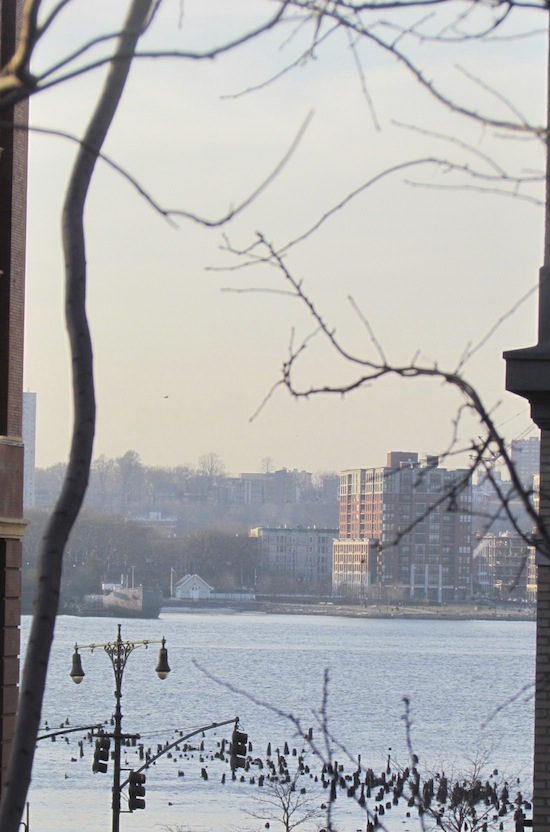
A Peek at the Hudson River taken from the Highline

The Hudson River

The Joy Of Communicating Without Words

This morning it was 17 degrees fahrenheit, but with the wind chill it felt as though it were 5 here in Manhattan, this was according to my “The Weather Channel” iPhone app.  Because of the ongoing New York City school bus strike and because my husband is SuperDad minus the voluminous cape and lycra tights, Richard has been taking Emma to school each morning for the past ten days.  But this morning it was my turn to step up to the plate.

7:30AM this morning

Me:  Okay Em.  So here’s the deal.  I’m going to take you to school today, but Daddy told me it’s tough getting a cab, so we may have to walk.

Em:  Take taxi with Mommy to school.

Me:  Well, we’ll try to get a taxi outside our building, but if we can’t get one right away, we’re going to walk.

Em:  No, I don’t want to walk.  Take taxi.  Just you and me.

Me:  Em, we’re going to try to get one, but if we can’t we’re going to walk.

Em:  Nodding her head.  Together.

8:15AM

After trying for several futile minutes to hail a taxi we began to walk to Emma’s school.  The sidewalks were crowded with parents and children.  As Emma and I made our way in the cold, Emma began to make a loud singing like sound.  It wasn’t a song, more like one line of a song, sung loudly.  People turned to look at her.  At first I just continued to walk next to her, my hands tucked into the pockets of my coat for added warmth while Emma repeated the same song-like refrain loudly.  A few people stared.  Em linked her arm through mine and sang again.  I looked over at her, ignoring the curious looks from those we passed and sang back, but in a slightly different pitch.  She smiled and did it again.  I echoed her.  She laughed.  As we continued along toward her school in this way I noticed a few people smiling as they walked by us.  Once at an intersection Emma stopped “singing” and instead winked at me.  I winked back.  When we eventually arrived at her school, Emma turned to me and said, “Bye bye Mommy.  Had so much fun walking to school with Mommy!”

Yup.  Me too.

Emma – 2003

Em2003

When the Words Don’t Match

The other night Em woke up at around 2:00AM crying.  She kept saying the same words over and over.  It was a kind of script, about an indoor playground that I used to take both children to when they were toddlers.  It is a playground that has been closed for more than six years.  “Mommy has to look.  Daddy has to find new Sydney playground.  The tickets are broken.  Mommy has to fix it.  Oh.  You want to go to new Sydney playground!”

Do not try to translate this.  Lean into the emotion, what is she telling you?  Forget the actual words, the individual words are less important, it’s the emotion, it’s the intent… 

This is what I’ve been taught.  I’ve paraphrased the exact words my friend Ibby actually used, but it captures the general idea of what she has reminded me of more than once.  It’s an important concept and one that I didn’t readily understand at first.  In fact our initial conversation went something like this –

Ibby:  Do you speak another language?

Me:  What?  No.  I barely speak English.  Do I need to learn another language?  If you tell me I need to learn Russian to help me understand, I’m on it.

Ibby:  (I imagine Ibby took a deep, calming breath before continuing)  No.  You do not need to learn Russian.  But you need to feel the words instead of trying to do a word for word translation.

Me:  Feel the words?  Mind began to race, a panicky feeling overtook my body. I don’t know what that means!  What does that mean?

And so Ibby patiently tried to explain that by getting lost in the exact meaning of the words I was missing the emotions being expressed.

With this in mind, I went back to Emma’s bedroom with her.  Very distressed, she continued to repeat the script and then suddenly veered off to an unrelated, yet another, unattainable, desire.  “I want to go to Martha’s Vineyard.  Not binyard, v, v, v, vineyard.  Mommy I want to go to Martha’s Vineyard.  No baby.  We can’t go to Martha’s Vineyard, it’s too cold.  I want to go to Martha’s Vineyard.”

As I sat with her listening, I tried to be present, neither lying to her nor adding to her anxiety, just being present and as I did this I felt a flood of recognition.  I realized I do a version of this too, only I call it “spiraling out”.  It happens at odd times, but being tired makes it harder to cope with.  When I think about how I spiral out an image of a pin ball machine comes to mind.  My thoughts are the little metal ball careening around hitting one side, ricocheting off the little bouncy things that make noise while the lights flicker, before shooting off in another direction.  Nothing anyone says helps me.  In fact, often well-intentioned people will make it much, much worse, because my mind is literally looking for things to think about that will create more anxiety.  The only thing that has ever helped me when I get this way is a calm, loving voice gently nudging me down a different path.  It has to be authentic and very, very loving and very, very calm or I become suspicious and even angry.  With this thought in mind I gently said to Em, “Is it okay if I tell you something?”  She nodded her head.

“I get upset too, Em.  Just like you are right now.  And when I do I have thoughts that I can’t stop going around around in my head.”

She sat up and looked directly into my eyes.  “Sometimes when I feel stressed and tired I can’t make the thoughts go away.  Sometimes the same thoughts just keep repeating in my head and I can’t get rid of them.  Daddy calls it spiraling out.  But you know what?  It’s going to be okay.  I’m going to stay with you.  It’s going to be okay.  I promise.  Try to breathe.  Here breathe with me.”  We inhaled together and then exhaled.  “Feel the cool air on your face and the warmth of the blanket on your body.”  I continued in this way, talking to her softly, trying to guide her, trying to make her aware of the present.  These are the things that help me when I’m agitated and feeling overwhelmed and eventually she rested her head on me, leaning her body into me as I spoke to her in a soft voice.

It was during those early morning hours with the two of us sitting together while everyone around us slept that I felt a surge of understanding.  When I get lost in the words that fill my head and when the words don’t match up with the emotions it feels confusing and I become perseverative and spiral out.  I see this now.  In the past I’ve called it anxiety.  I’ve said I’m overwhelmed and tired.  These are good words to describe what I’m feeling, but a more accurate explanation is that when I become fixated on specific thoughts, in my case they are often in the form of fears, I can become so lost in the specifics I lose sight of the emotions.  This has happened my whole life, only it took my daughter to get me to make the connection.  We are not so different, my daughter and I.

An image that calms me – The Manhattan Skyline taken while walking to my studio the other morning

Manhattan Skyline

What Does Autism and The Hubble Space Craft Have in Common?

Most of you have probably read Jim Sinclair’s famous essay Don’t Mourn For Us.  If you haven’t, do.  In the Loud Hands:  Autistic People, Speaking Anthology a version of that essay comes after Julia Bascom’s wonderful Foreword.  By the way, if you didn’t see the Huffington Post interview I did with Julia regarding the anthology and future projects, you can read that by clicking ‘here‘ and I’ve also embedded a link so those of you who haven’t read the Anthology can buy it and read, because..  well this book needs to be read by every person on this earth AND it’s now available in paperback as well as on Kindle, so who can resist?  Here’s the “link” (again) to buy it.  Full disclosure – I bought this book for a number of my family members and gave it as a Christmas gift!

I read the anthology as a PDF file first, then I read it again in paperback and now I’m rereading it with my highlighter in hand.  There is not a single essay that has not been streaked with neon green highlighter.  The anthology has contributions from a wide range of people (a few of my favorite writers are missing, but I am hoping this anthology will be followed with a second that will include writing from E. of The Third Glance (not to be confused with “E.” who is in the current anthology), Aspie Kid, Michael Scott Monje Jr and Sparrow Rose Jones to name just a few.)  It’s not the type of book you can really quote from as each piece needs to be read in its entirety to get the full weight and power of it.

Having said that, I have to quote Jim Sinclair and hope that all of you will get the book and read it from cover to cover.  Jim wrote, “The ways we relate are different.  Push for the things your expectations tell you are normal, and you’ll find frustration, disappointment, resentment, maybe even rage and hatred.  Approach respectfully, without preconceptions, and with openness to learning new things, and you’ll find a world you could never have imagined.”  “… you’ll find a world you could never have imagined.”  This has been my experience, exactly.  I think I’ve even said something close to this before.  I believe I’ve said finding Autistic voices and reading their words was like being presented with proof that another universe exists, but that I never knew about.  So for all of you who need or want proof that another universe, a more wondrous and fantastic universe than is imaginable, read the Anthology and be prepared to have your world changed in the best possible way!

One of Emma’s favorite Imax movies is about the Hubble Space Craft found to have a faulty lens and requires repair.  Once fixed, it produces absolutely hallucinogenic images of the universe that are so beautiful it is hard to believe they are real.  To me, autism is like those images, beyond anything I could have imagined.

Images taken from Hubble Space Craft 

HubbleSpaceTelescope_N90

6a01053624b365970c0120a5b6a7b5970b-800wi


A Celebration With Some Unexpected Surprises

This past weekend we spent celebrating Emma’s birthday.  For the past few months we have been planning Emma’s birthday with her.  Emma was very specific.  She asked that we spend the night in a hotel that had a swimming pool followed by a party at the same place she takes gymnastics with her brother every weekend.  We visited the hotel with Emma before booking it.  The pool was on the roof and when we visited, the saline water was at a lovely 94 degrees.  We booked the place where she wanted her party and sent out invitations.  We called the hotel ahead of time to confirm they had wi-fi and a DVD player as Em wanted to bring her favorite Charlie Brown video.  Saturday afternoon we piled into a taxi, arrived at the hotel, settled into our room, donned our bathing suits and made our way to the roof where it was windy and quite cold, but looked forward to the lovely warm water awaiting us.

Emma jumped into the water without hesitation, with Richard following.  I turned as Richard gasped in surprise.  It was the sound someone makes when the wind’s been knocked out of them.  I stared at him.  “It’s really, really cold!” Richard said in answer to my confused look.

“Seriously?”

“Uh.  Yeah.  Feel it.”

Tentatively I dipped a hand into the water.  It was not a lovely 94 degrees, it wasn’t even a tolerable 84, in fact, it seemed unlikely that it was anywhere close to being “warm”.  The outside temperature had barely climbed above 35 degrees and the wind was brisk.  Nic took one look at my face and voiced what I was thinking, “There’s no way I’m getting into that water.”  Richard, being the champ that he is, hung in there for another ten minutes before getting out, his lips having turned blue and his teeth chattering, while Emma, being impervious to cold of any kind lasted another half an hour.

It's Cold!

The beauty of Manhattan awash in the afternoon light. Taken from the hotel roof’s pool.

Manhattan

Framed Sky – Taken from the hotel’s roof while Em and Richard swam

Framed Sky

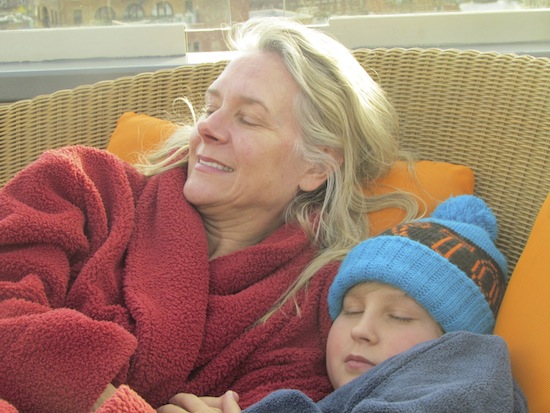
The hotel assured us the pool would be warmer by the following day, so we promised to come back the next morning for a longer swim.  Our evening was lovely, the children had a blast, and the next morning, after a wonderful breakfast we headed back up to the pool.  This time Emma did not immediately jump in, but felt the water with her toe.  It was a little warmer, though not much, but despite its cold temperature we resolved to bite the bullet and swim anyway if Emma chose to jump in.  Eventually she did and was delighted when the rest of us followed her.  It was cold, very, very cold, but it was also beautiful up on that roof, with the sun shining and the gorgeous view of Manhattan spread out before us.  We swam laps and splashed and played and Emma had a wonderful time.  When we finally got out of the water, dried off and put on our fluffy robes, we snuggled together on an enormous wicker chair, Richard called “the egg”.

Nic and I in the “egg”

In the egg

Later that afternoon we went to the gym where we celebrated Emma’s birthday with half a dozen other children whom she’d specifically asked to have invited.

Over the years we have learned to involve Emma in every aspect of planning her birthday, doing what she requests as much as possible.  Despite some unexpected surprises we have gotten better and better at giving her what she wants rather than what we think she might want.  And over the years we get it right more and more.

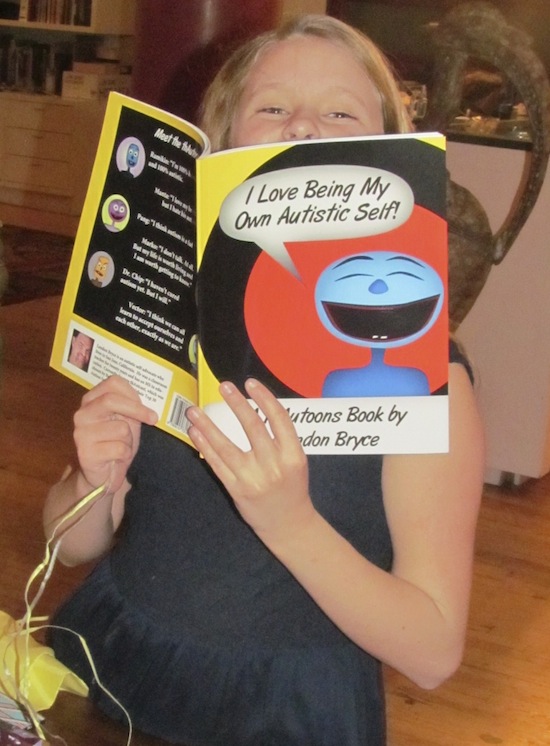
Em with her string and her new book – Landon Bryce’s “I Love Being My Own Autistic Self!”

Presents