Tag Archives: autism spectrum

Bloggers, Writers, Autism and a Huge Amount of Hope

When Emma was diagnosed with PDD-NOS (pervasive developmental disorder – not otherwise specified) in 2004, I was lulled into believing it was a temporary condition, nothing that a few years of therapy wouldn’t resolve.  I saw it as a kind of throw away diagnosis, not exactly full-blown autism, more like a mild version of something that resembled Autism, but wasn’t.  Kind of like a bad cold, not exactly a bacterial infection requiring antibiotics, but troublesome never-the-less and we’d have to ride it out.  Besides, I reasoned, just because many of Em’s behavior looked autistic-like, seemed autistic-ish, she probably wasn’t autistic because, well, no one really understood what autism was and so how could she be labeled something that no one understood or really knew what it even meant?  Or so my thinking went.  During this initial period I kept my eye out for any Autistic adults I could find, just in case, you know, she really was autistic, I wanted to know what we might expect.  I found none and concluded that since I couldn’t find any, there must not actually BE any to find.

Still, just on the off-chance I was somehow wrong, I kept looking.  Every now and again I’d find someone, read everything they wrote or said and conclude that my daughter wasn’t really like them or wasn’t like them enough to give me much hope that they were good examples of what she might be like later in life.   (In retrospect, since Em wants to be a singer, I should have been looking for performers who are autistic, but even so, would, most likely, have come to the same conclusion.) By the way, I have never met a neurotypical adult who seemed like an adult version of my neurotypical son, but this thought didn’t occur to me for a great many years.  Despite all of this, my search continued.

In 2005 Em’s PDD-NOS diagnosis officially became “autism”.  As time went on and my thinking continued to change, Emma remained Emma with all her “Autistic-like behaviors” very much in place and I continued to grapple with what this meant.  I wasn’t one of those parents who understood that regardless of her neurology, she was who she was and it was all good.  I bought into the autism is like cancer idea, and therapy was chemo.  (This idea was very popular back in 2004, though I hope it has waned.)  It took me awhile to question this thinking and it took me even longer to see how these beliefs made any “therapeutic” program somewhat reasonable, because, after all, nobody signs up to have chemo and talks about what an enjoyable experience it is.  The idea that Autism is NOT cancer, that this thinking in and of itself leads us down a very dark and dangerous path was something I didn’t come to until much later.

Now fast forward to this morning.  This morning I read a terrific post, The Princess, Her Socks and Her Late Pass on a wonderful blog I’ve begun reading regularly by Aspie Writer called, Twirling Naked in the Street and No-one Noticed, (love that title) which she describes as “A blogged book: Growing up with undiagnosed autism”.  Reading her post about how she hated wearing socks, (so does Emma) how the fabric bunched and the seam on her toes hurt and how the socks had tiny rocks in them that no one else could see or find, kept reminding me of Em.  Aspie Writer recounts how she was always late to class and keeps saying over and over, “I have to see Mr. Hiler for my late pass.”  It is a wonderfully written description about a baffling behavior.  She does such a terrific job describing her actions and words that they made total sense to me.  Not only was I able to identify with her thinking, it gave me a little glimpse into some of Em’s seemingly baffling actions or repeated sentences.

And I was reminded (again) of why reading blogs by Autistic people is of such vital importance to me.  It’s not because I think to myself, oh Emma is going to become this person when she’s an adult.  I don’t assume that because Aspie Writer is married, a mom of 3 and a wonderful writer this will be Emma’s future.  I haven’t met a single adult, autistic or otherwise who seems to be just like either of my children.  How could I?  There wasn’t an adult version of me when I was a child and I’m certainly not an adult version of anyone else’s child.  It’s kind of a ridiculous idea when you stop to think about it.  And yet, that’s what I wanted for all those years when I was searching.  I wanted to find someone who seemed just like Emma was.  I wanted this desperately because I was so fearful of her future.  Yet, all those autistic adults who are not exactly like my daughter  are the very reason I am no longer fearful and why I have so much hope.

Blogs, both the writing of this one and finding those written by Autistics have changed my life.  Blogs are a slice of life, immediate and interactive.  I can read a post and “like” it, comment on it, even though I may or may not get a response from the writer.  I can then tweet the post out, share it on Facebook and engage in a dialogue with the writer if they care to respond.  The immediacy of blogs is compelling, engaging and makes the reader feel more apart of than when reading a book.  Books are wonderful too, but they’re different.  They do not have the interactive element to them that makes blogging so wonderful.  Blogging is very much about “us”.  We, whether as a reader or writer, have the opportunity to become part of the process, a part of “them”.  Another aspect of blogging is – anyone can blog.  You don’t need an agent, you don’t need to even write “well” (though there are many wonderful writers who also blog), you just need to want to write.  So you have a great many people who may never have bothered to look for an agent or publisher, who are writing and because it’s a casual writing form, you also find some amazingly beautiful blogs written with honesty, unedited, raw and complex.

To all the Autistic people who are sharing your stories, your words, your lives, whether by commenting or by having a blog of your own or both, here’s a very loud and heartfelt thank you!  You are making a difference.  You have changed my life.  How does “thank you” even cover the enormity of that?  It doesn’t.

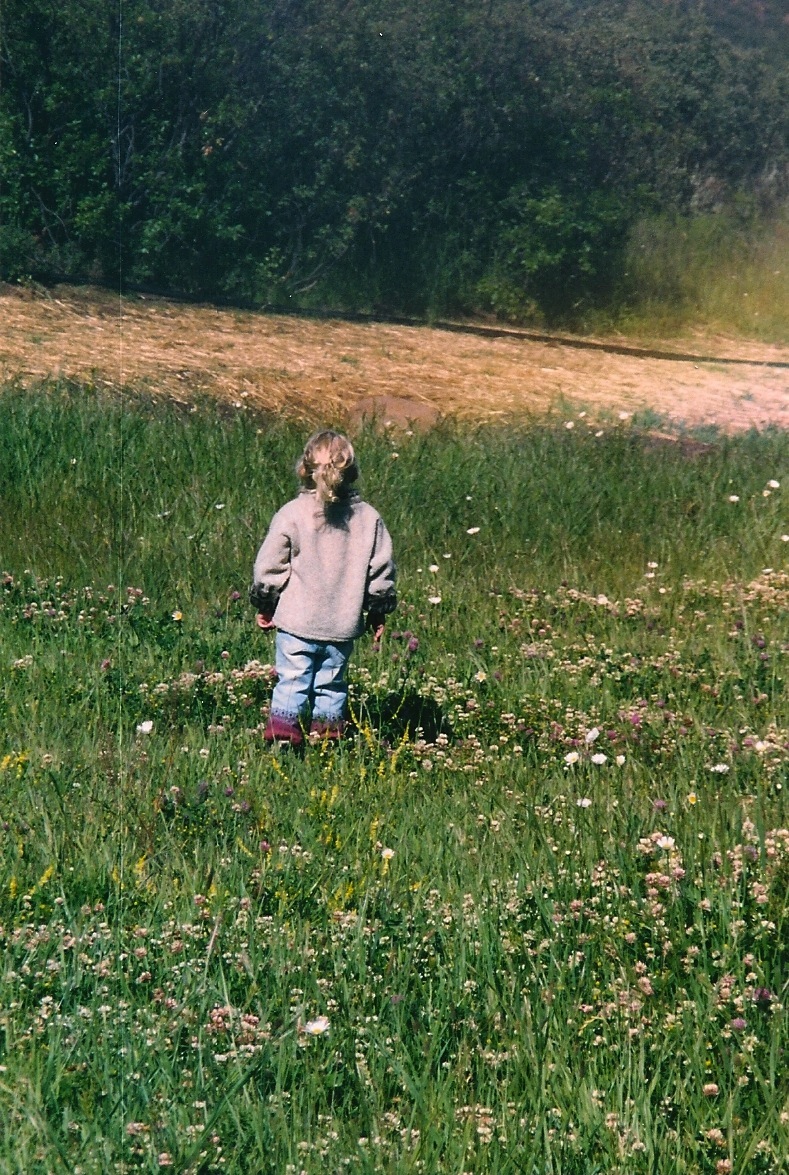
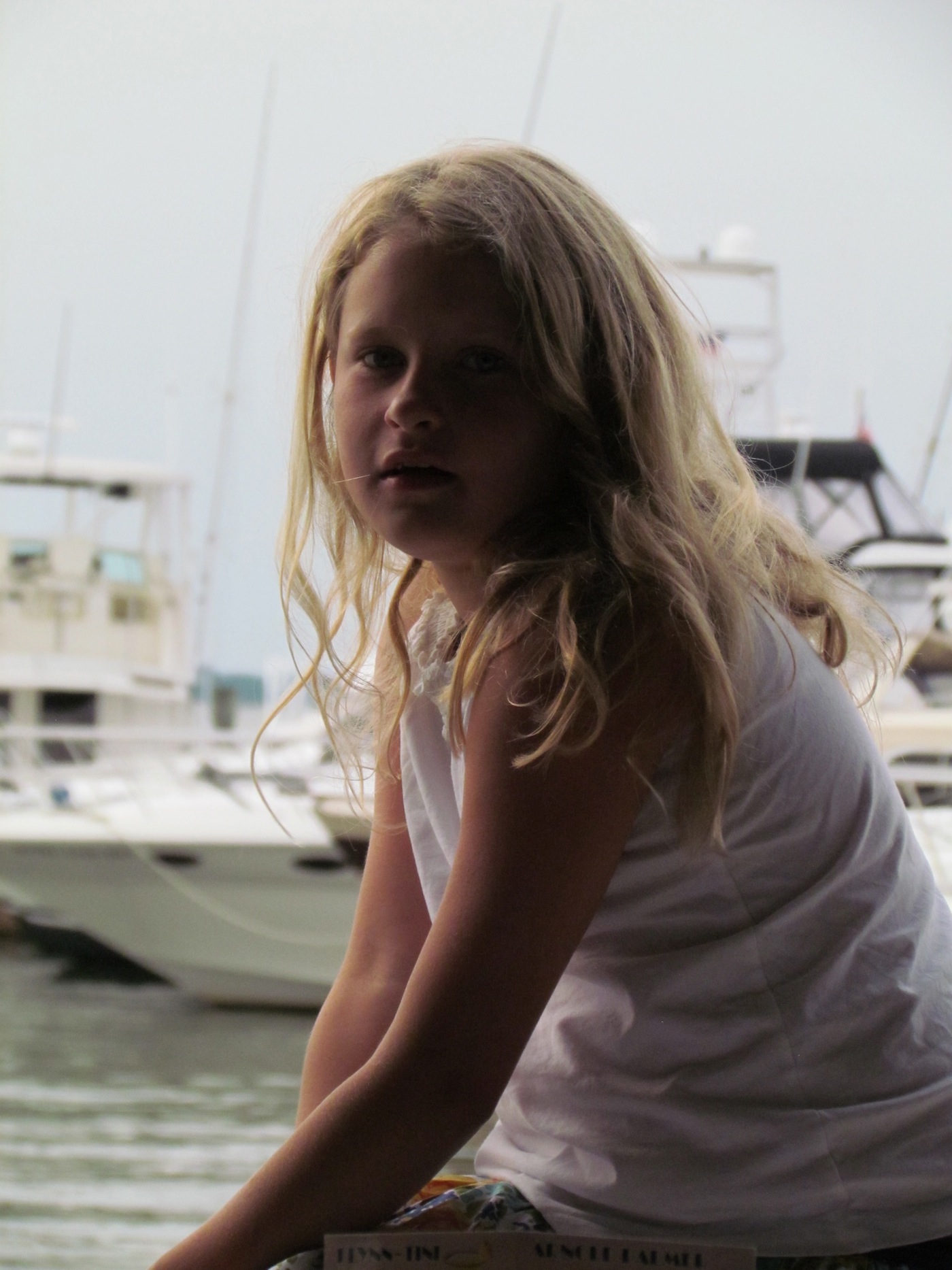
Emma – 2003

Fog

When I climbed the stairs out of the subway this morning and began heading west to my studio, fog completely obscured the Manhattan skyline.  I’m no stranger to fog, whether metaphorical or actual.  In northern California where I grew up, fog was a constant.  Each morning the fog would cover the mountains near our house, but by 11:00AM it would have lifted.  I feel a certain nostalgia for fog.  As I walked the four blocks to my studio this morning I thought about how, when we can’t see something we often assume it isn’t there or what we assume is there, actually isn’t.   Had I not known fog was covering an entire thriving metropolis called Manhattan, I would not have been able to imagine it.  That’s the beauty of fog, it usually lifts and when it does, it often reveals surprising things.

This has been my experience with my daughter and autism.  Autism was, for a great many years, like the fog, obscuring the child within.  I kept trying to lift the fog, thinking that if I could do so, I would “find” my daughter.  Then I began to realize the “fog” was my thinking.  The way I thought about autism was obscuring my daughter.   My daughter has always been there, just like Manhattan is and when the fog lifts I can see her in all her magnificent glory.

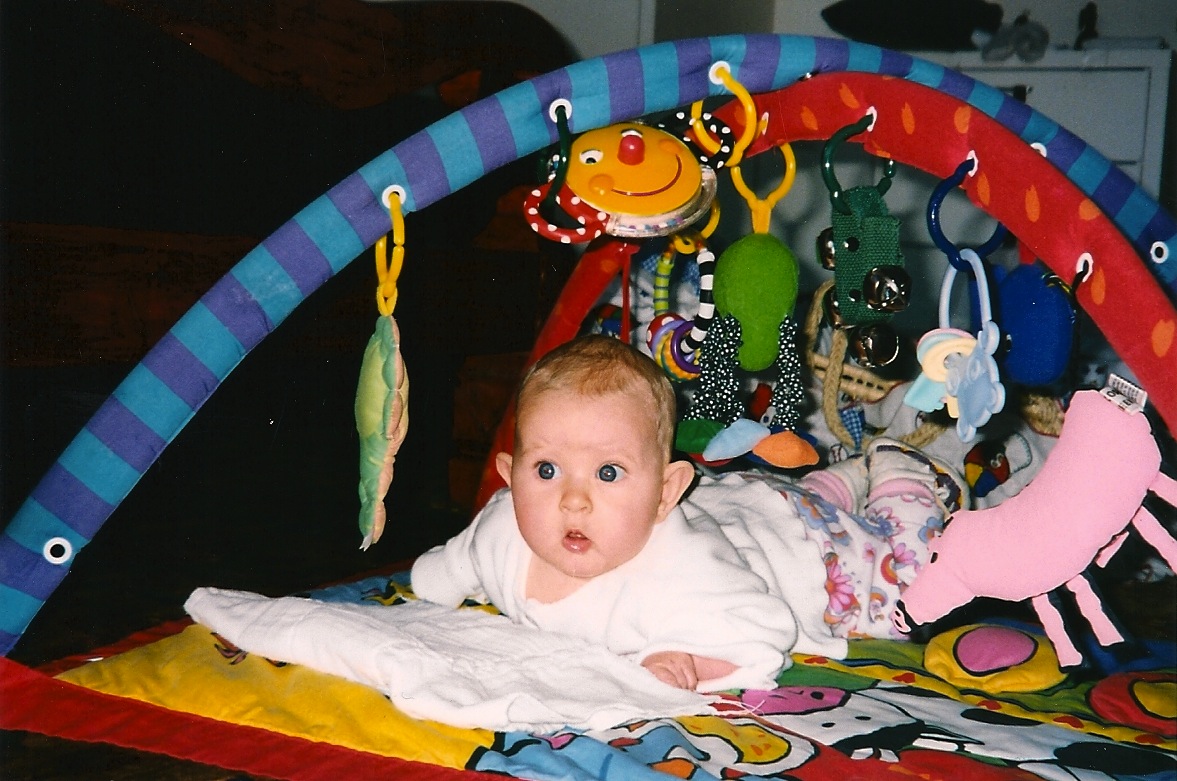
Emma – 2004

The Best Marital Advice I Was Ever Given and How It Applies to My Daughter

One of the single best pieces of marital/relationship advice I was ever given was:  Every day record all the things your partner did that was kind, helpful, thoughtful, ‘right’.  What are the things you love about this person?  What do you admire about this person?  What do you respect about them?  What are the things they do that make you happy?  What do they do that fills you with joy?  To many, these questions may seem obvious, but try doing this when you’re angry or fearful or even just annoyed.  I remember sitting with my journal that first evening and wondering what the hell was I going to write?  He breathes?  Could that really be seen as a good thing?  (It’s okay to laugh.)  I’m a master at this exercise now.   In fact, I’m so good at it, I now think of the positives FIRST!  And guess what?  My marriage is pretty fabulous, of course it helps that I’m married to such an amazing guy.

The first time anyone asked me about Emma’s assets we were a year or two into the diagnosis.  I thought it was a trick question.  Seriously.  It was my brother Chris, who asked, “What does Emma like to do?  What is she interested in?  What is she good at?”

My mind went completely blank.  No one had asked me these three important questions about my Autistic daughter.  Listing assets does not fit neatly into all those questionnaires I was constantly having to fill out.  Those little booklets with questions broken into categories of age.   Example:  From 3-5 years old:  Your child plays appropriately with toys  The choices were:  Never, Rarely, Sometimes, Usually, Always.   My pencil would hover over the choices as my mind raced.  What does “appropriate” even mean?  Why is pretending a doll is an actual baby, when it clearly is not, considered “appropriate”?   Eventually I resigned myself to the task and considered “Rarely” and “Sometimes”.   Depending on my mood, I would mark one of the two and feel the all too familiar sensation of constriction in my stomach and throat.  Fear flooded my body and mind as I tried to concentrate on the next question:  Your child eats using all utensils.  Again I would resist the urge to fudge the truth.  I had to force myself to choose the answer that came closest to reality.  I came to dread those questionnaires almost as much as reading the evaluation reports sent in once a year from the Board Of Education.  They were both exercises in, so-called, critical thinking – Look at this picture and tell me what’s wrong with it.  Look at this child.  Now let’s compare her to her neurotypical peers.  Let’s make a list of all that’s “wrong” so we can make things “right”.

But wait!  How is this helpful to anyone?  Comparing anyone to anyone else is a lesson in how to live one’s life in hell.  But compare a neuroatypical person to a neurotypical one is absurd.  Why do we even do this?  To what end?  How is this helpful?  Certainly it isn’t helpful to the neuroatypical person.  We do not say to a person who uses a wheelchair, well, you’re not walking and your same age ambulatory peer is, so let’s get you up and out of that chair and try to build those muscles. Then, when you resist or protest, we restrain you, tell you to stop complaining or tell you that you can’t fully comprehend the situation.  When you still do not manage to stand, let alone walk, we shake our heads sadly and tell you, you really need to have a better attitude and try harder, but don’t worry, it’s okay, we’ll keep working on it.

What does this thinking do to a person over the long-term?  If we are judged, compared, relentlessly criticized, taught that we fall short, told we don’t measure up, dissected publicly, privately and shunned, what does that do to us?  What would that do to any of us?  We are, after all, regardless of our neurology, human beings.  We do all share that.  Has the human piece gotten lost in all of this?

What does she like?  What’s she good at?  What is she interested in?

I’ll have to get a bigger pad of paper.

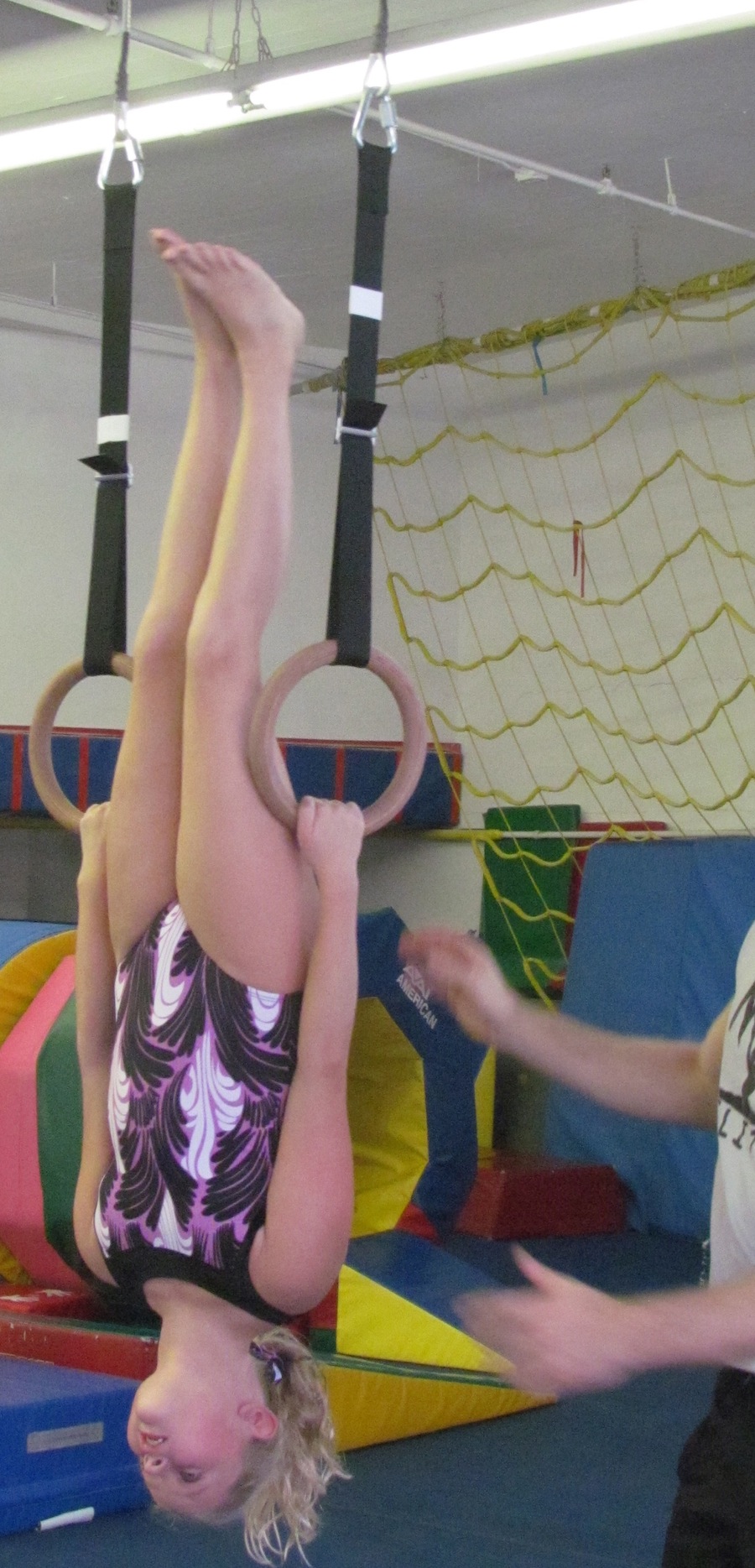
Em at Gymnastics – October, 2012

Related articles

Why? I Want to Understand…

I’m one of those people who, when told to do something that doesn’t make sense or that I can’t figure out the reasoning behind the request, questions it.  I don’t mean I think about it, while silently complying.  I mean I question the thinking out loud as in, “Why are we taking 8th Avenue, when we could take 10th?” or “Why are they asking for the last four digits of my social security number when I just gave them my passport number and anyway it’s a domestic flight?” or “Why take the ice out first when we could just put everything on top and then scoop ice around it?” or any number of other questions that so easily slide from my brain to my mouth before I can stop myself.

I can’t help myself from asking, “Why?”  By the way, I am also married to someone who does the EXACT same thing.  Some people would call this controlling or being defiant, but I see it as a need to understand the reasoning.  Sometimes when someone explains to me their reasoning, I get it, it makes sense and we can carry on, even if I don’t agree with it.  But many times the person explains their reasoning, it still makes no sense and that’s when things get problematic.  It is at this point I have a couple of choices, I can comply, do something that makes no sense to me, which is physically painful, it literally hurts to do whatever it is or I can refuse to do it while explaining why I cannot or I can ask for further clarification.  I tend toward the last two options.  I’m all about clarity.  I’m really not trying to cause problems or be difficult, I really am interested in understanding another point of view.

There are other questions I have that have nothing to do with any requests being made of me, but the answers affect me or someone I love.  Which brings me to a question that’s been very much on my mind recently.  It’s a question that has nagged me since I read Lydia Brown’s piece – Protesting Autism Speaks  on her blog Autistic Hoya – why don’t people who say they care about Autism want to hear from Autistic people directly?  I’m actually being very serious with this question.  I want to understand the thinking behind this.  Because, you see, when I finally found Autistic people who were writing blogs, I felt like I’d hit the jack pot.  When I read Julia Bascom’s blog Just Stimming it was like a beautiful universe unfolded before my eyes.  When E. of The Third Glance reached out to me that first time I read her comment and literally wept with gratitude.  I think I read her comment a dozen times.  When I met Ibby of Tiny Grace Notes at the Disability Conference in New York City, she may as well have been the President of the United States, I was so thrilled.  When she flapped because she was excited to meet me, I felt so completely flattered, it was all I could do not to jump up and down with unadulterated excitement.  I felt profound relief because:

1)  they are Autistic adults and until I found them, I personally knew none
2)  they were describing their thought processes, their experiences, their lives and it gave me insight into how my daughter may be processing the world too
3)  they introduced me to concepts I’d never considered, such as: Presuming competence and not speaking about my daughter as though she couldn’t understand, including my daughter in decisions that affect her and not speaking for her.
4) The whole idea of being talked about as inferior, as a deficit, as a tragedy and how that directly affected their self-esteem.  This last seems so obvious in retrospect, but it was something I hadn’t considered.
5) Having relied on other parents and so-called “autism professionals” up until my daughter was 10 years old, I was incredibly grateful to meet Autistic adults who were able to explain the experience of being autistic first hand. Their experience has helped me help my daughter more than anything else I’ve read or been told.
6) Many of the autistic adults I now know aren’t that much older than my daughter and I found it comforting to know there is a whole community that she may one day choose to join.

I do not read or speak with my Autistic friends and assume they are speaking for Emma.  I don’t assume Emma will grow up to be just like Julia or E. or Ibby or Chou Chou or Paula or Amy.  Each of these women has helped me help Emma far more than any “autism professional” has.  The Autistic men and women I know give me hope.  Hope, not just for Emma, but for ALL our children.  Hope for our world and our future.  I feel grateful to them.  I’m profoundly grateful that they’re blogging, speaking out, protesting, reaching out and asking to be heard.  Maybe one day my daughter will be among them.  I would hate to think that Emma, having worked so hard to communicate, in whatever way that may be when she’s an adult, having worked up the courage to ask a complete stranger, “Want to hear from me?  Want to hear what I have to say?” would be answered with silence or an abrupt “No.” I cannot imagine how painful that must be.  I cannot imagine what that does to one’s sense of self to be met with such outright hostility.  And I don’t understand why.

I am seeing that my experience is not the experience of others.  I do understand that, but why?  Why don’t people see those who are Autistic and can communicate, whether by typing or speaking , as a good thing, as a hopeful thing?  Why is it that some parents don’t want to hear from Autistics who can communicate?  What am I missing here?  Really, I want to understand this.  Help me understand.

How could you NOT want to hear what she has to say?

Autism, Acceptance And Love

My friend Shannon Des Roches Rosa posted a great piece regarding understanding acceptance on Thinking Person’s Guide to Autism the other day. I wanted to write a comment, but had to think about what she’d written and then wrote a long, epic length, rambling comment, so lengthy that when I went to submit it I was informed I’d “timed out” and lost the whole thing.  But it got me thinking…

Whenever I think of acceptance the “serenity prayer” comes to mind – “…grant me the serenity to accept the things I cannot change; courage to change the things I can; and wisdom to know the difference.”  This prayer was what I repeated to myself each and every day for years after we were given Emma’s diagnosis.  “Courage to change the things I can” was what I clung to as I doggedly pursued treatment after unproven treatment.  One of the single biggest stumbling blocks for me in accepting my daughter’s “autism” (I write it this way, because this was how I thought of it, as something separate from her) was that I believed it was within my power to change her autism.  I thought I could remove it.   As long as I continued to hold onto that belief, I couldn’t accept her autism or the idea of her as an Autistic individual, she was Emma who was diagnosed with autism and therefore, my thinking went, could also be diagnosed withOUT autism.  These two points were key in my thinking.  Anyone who suggested I not think of my daughter and autism in this way were disregarded.

I no longer think in these terms.  But I read the often heated exchanges between parents who accept autism and their Autistic children, and those who maintain they accept their child, but do not accept autism.   Interchange the word “accept” for “love” and things start getting really volatile.  None of us welcome anyone who suggests we do not love our children.  And truthfully, this is where, I think, the disconnect happens.  I think this is less about love and more about having a different understanding of what Autism is.  If autism is seen as completely negative, (something Autism Speaks has perfected to a science by using words such as, affliction, epidemic, crisis and tragedy) this horrible thing that causes my child to writhe in agony, an “affliction” with no redeeming qualities, coupled with the belief that autism is something that can be removed, in fact has been removed by many parents who have gone on to write memoirs about their triumphant courage to change the things they can, then what parent wouldn’t welcome their child relief from that?

But if Autism is seen as something complex, woven into the very fabric of a human’s being with a wide range of attributes as well as challenges, all of this becomes far more complicated.  It was this idea, so beautifully described in eloquent detail by Julia Bascom in her blog Just Stimming that made me pause.  Her description of the challenges and joys of being Autistic were what made me stop and reconsider everything I thought I knew and believed.  As long as we hold to the view that our child is locked inside a seemingly impenetrable shell called “autism” while listening to that seductive, whispering voice assuring us that we can break through that shell if we just try x, y, and z we will struggle mightily with the idea of acceptance.

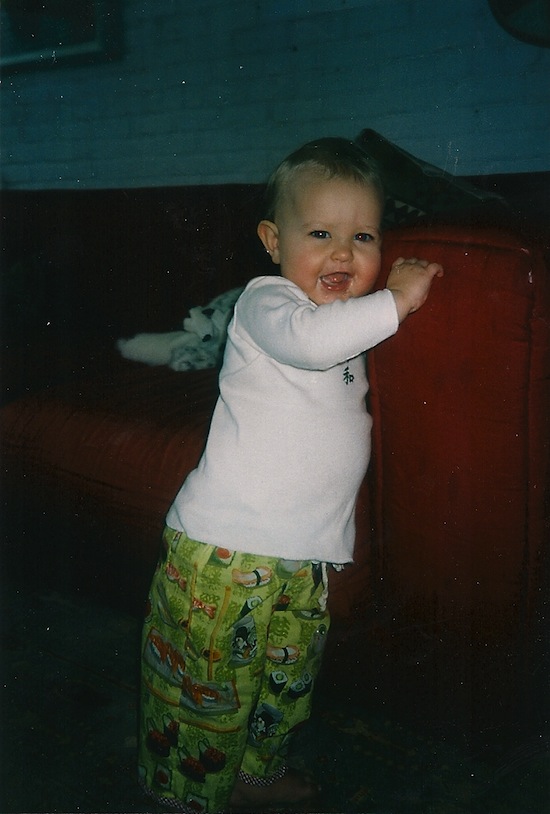
Emma – 2002

A Typed Conversation With My Daughter

This is the typed “conversation” I had with Emma last night inspired by the wonderful comments left here yesterday.  This was done with very little talking.  Emma’s replies are in italics.

“Hi Emma.  I know one of your favorite songs is “Beat it”.  What other songs do you like?

Emma likes Fireworks.  Emma likes to go swimming.

Hey!  Did you go swimming today?

Yes, it cold go swimming.

Emma, was the water cold or was the air outside cold or both?

 Both cold outside.

It is cold outside now because it is fall.  I like the fall when the air gets colder.  Do you like the fall too?

 Yes, I do like the fall too.

What do you want to do this weekend?

 I want to have a weekend with Jackie at the Vanderbilt wiyemseeay.  And go swimming.”

This was HUGE for Emma and me.  Rereading it now I’m kicking myself that I didn’t ask better questions and follow her lead more instead of directing the conversation.  For example I wish I’d spent more time talking to her about swimming instead of going off about the seasons, which were of little if any interest to her.  I could have asked her a great many questions about the pool and swimming and the water temperature, but didn’t.  I was so surprised when she wrote, “Yes, it cold go swimming.”  I literally laughed out loud when she wrote that, because this is just huge for her to introduce a new thought, to volunteer new information when typing together.  Excitement doesn’t really sum up what I felt.  I was ecstatic!

Emma kept trying to read my typed words out loud, but I reminded her to read silently.  I made a huge number of mistakes while having this conversation with her.  I corrected her spelling a couple of times, and wished I hadn’t.  I never know whether it’s best to let her spell things and go over the spelling later, separately or whether its better to correct it right away or better to leave it alone.  I wanted her to feel encouraged, supported and cheered on, not criticized.  So that’s something I am still questioning.  I also get so excited when she says anything off the grid, I get overwhelmed and can’t think what to say other than – “OMG you just introduced a new topic and I’m so excited!!”  Maybe I can learn to relax a little and go with it a bit more.  I am also aware that my excitement is an example of my NOT assuming competence or rather it is me feeling euphoric that Em shows her vast intelligence in a way that my NT brain can grasp.  I really want to learn how to move away from that limited thinking on my part.

When Emma was diagnosed with autism I remember that first day when all the therapists came to our home to work with her.  I’d done my homework, read all the materials the agency provided me with and then some.  Yet, I remember how everything was “dumbed down”.  Things that I knew she knew were treated as though she didn’t know them.  Really simple things were suddenly a huge deal if she indicated she knew them.  I remember vividly my confusion.  I began to doubt everything I thought I knew or assumed about Emma.  I completely capitulated to some set idea about my daughter given by a group of people who had never met her but made assumptions based on a single word – Autistic.

I’m old enough and have enough humility to admit I don’t know what I’m doing a great deal of the time.  This is not a popular statement in our culture of bullshit reigning supreme, even if it’s all a lie, even if it means people who know almost nothing about a given topic, but who claim “expertise” are suddenly seen as having something sensible to say.  The art of bullshit has become a well honed skill by about the age of ten these days.  It’s amazing how quickly children learn to adopt it.  Add a little chutzpah and you’ve got a kid who will go far in this world of ours without being particularly knowledgable in anything.

However, the art of bullshit requires a couple of things –  a massive dose of ego and an ability to lie.  My daughter Emma has neither of these.  Still, I am feeling confident she will do well in this crazy world of ours.

The ongoing construction of the Freedom Tower

Henry Makes Waves & Everyone’s An “Expert”

Yesterday the interview (published on Huffington Post, click ‘here‘) with Henry, the 13-year old non-speaking Autistic boy, son, brother, friend, student and all around amazing kid who has been denied enrollment to the public school across the street from his house went viral.  At the moment it has 152 comments and over 1,000 people have “liked” it, with almost 400 people sharing it on Facebook.  The comments began pouring in yesterday afternoon.  A few were particularly troubling for a couple of reasons.  The first being that a completely uninformed person(s) made broad sweeping generalizations about autism while bolstering their opinions with statements like this:  “and then there are the non verbal Autistic who need constant care.  One can’t tell if they understand language, but they can’t speak for some reason. I do know this as a fact from the Autistic that I’ve worked with in my youth.”  Another commenter suggested, “Maybe he should consider speaking …..If he wants to go to that school so badly…”  And yet another said something about how Autistic kids “drag” the rest of the students down.  All of these comments were uninformed, but the thing that was actually frightening  was when another commenter then referred to the first commenter as an “expert”.

So I lost it.  Completely.  Utterly.  Lost.  It.  Heart racing, hands shaking, head pounding, throat constricted, feeling nauseous, lost it…  Which is how many who are marginalized and live with prejudice, feel all the time.  That feeling of terror that their lives are threatened and in real danger as a result of incredible ignorance.  I should have walked away.  I should have done some breathing exercises.  I should have meditated.  But I didn’t.  Instead I reached out with words and hit back.  I used words to hurt.  I used words to wound.  I didn’t ask questions.  I didn’t wait for more information.  And here’s the thing, I don’t know that I was wrong to do so.  I feel ambivalent.  I feel I should regret my actions more than I do.

I responded with this: “…the degree to which you misunderstand Autism is actually more than frightening, it is terrifying. That you also worked with this population says more about the tragic state of the place you worked and their hiring policies, not to mention their training, which appears to be none, than your profound ignorance.”  To which he responded, “I wasn’t hired to do anything. The camp/school had normal and special kids and they had that one Autistic boy. I was nine. I wasn’t hired.”

People in the comment thread were describing a man as an “expert” who claimed knowledge of autism because he met an Autistic boy when he was nine years old.  At camp.  Nine.  And I thought of Joe Scarborough and his comment about the Aurora shooter.  I thought of Simon Baron-Cohen who actually is something of an “expert” and yet I completely disagree with his conclusions.  I thought of all the doctors, researchers, neurologists and “autism specialists” I’ve met, spoken with and consulted over the years, many of whom I do not agree with and some whom I do.  But the point is, so much of this is up for grabs.  There is a great deal of information out there that all of us have access to, but how do we know what is correct?  We’ve got doctors drawing conclusions that seem illogical and even irresponsible, while others whom we might agree with.  There are some very smart people out there working hard, publishing their work, making informed opinions, but how do we know who to believe?

I don’t.  What I do know is that anyone I read or hear I try (usually) to find out more about.  Who is this person?  What are their credentials?  What is their hands on experience?  And I get a second opinion from those who are autistic.  There are a number of people, all Autistic whom I particularly respect (this is by no means a comprehensive list and in no particular order, just thinking off the top of my head; please feel free to share anyone else I may have forgotten) Judy Endow, Lynne Soraya, Emily Willingham, Elizabeth J. Grace and Michelle Dawson.

A commenter on this blog wrote a hilarious comment about “Dr. Mom”, “Nurse Mom” and “Psych Mom”.  It was not only very funny, it was relevant to all of this. Who do we believe?  Hopefully not the guy who states they “know this for a fact” as compelling as the man might be for some.  And I’ll just add this; don’t believe me either.  I’m a mom.  I’m a writer.  I’m an artist.  I have opinions.  Sometimes I have really strong opinions, opinions that I think are right.  But I also know that over the years as I learn more, I no longer agree with many of the opinions I held a year ago, two years ago, three years ago.  My opinions change.  All I know is that I want to keep learning.  I want and try to keep my mind open.  Sometimes it’s really hard.  Sometimes I feel tremendous rage.  I don’t learn when I’m that angry.  But hopefully I calm down enough that I can go back to learning.

Let the learning continue!

A Conversation with Paula Durbin-Westby

You’ve described yourself as a “nonspeaking (at times) Autistic.

“Yes, I think the phrase “nonspeaking at times” captures my experience, and also that of others who do have speech capabilities but can’t always access them. Because one can speak at times does not mean that speech is a reliable form of communication for that person. Also, when someone can speak some of the time, others may not notice that they are having trouble speaking. I have sometimes not been able to speak and other people just thought I was “being quiet” or did not have anything to say; that dates back to childhood.”

Why did you make a video of you not speaking?

“I made the video because we need to change some of the ideas about “high functioning” and “low functioning” Autistics.  Not being able to speak is equated with “low functioning”.  A constellation of characteristics are said to be true of only “LF” people, such as self-injurious behavior, toileting difficulties, and not being able to speak or having limited speech, while “HF” people are said to have another set of characteristics, also fairly stereotypical, such as being “geniuses” who are good at computer programming and lack empathy.  These binary divisions don’t address the wide variety and range of characteristics of Autistic people, and paint a limited picture of individual Autistics, many of whom defy (not necessarily on purpose!) the expectations surrounding their “end” of the autism spectrum.  I have always known I can’t speak on a regular basis, but the conversations about “nonverbal” people assume that I have a different experience when in fact it’s not so different at all.”

Can you talk about how and why you sometimes are unable to speak?

 “I can’t say I speak “most of the time,” since most of my waking hours are not spent talking.  I showed on my video, even when I am alone, I frequently can’t talk. I don’t need to talk at those times, but I am very aware that if I were suddenly presented with a situation in which I needed to talk, I would not be able to. I am, however, usually able to make what some Autistics have called “speech sounds,” which means that I can say something, even if it is not exactly what wanted to say. I have a number of reasons for not being able to speak at any given time. I distinguish between not being able to talk at all and having trouble with word finding, which does not make me lose speech, but can have some interesting results when I find a word that is not the right one!  I can go “in and out of speech” several times during the course of a day.

The following list has some of my reasons for not being able to talk. These are not in any particular order: Sensory overload, being tired, reading or seeing something disturbing, thinking more in visual images than in words, trying to talk when other people are talking too fast and not taking turns‒which is not limited to the autism spectrum, although a lot of literature exists about teaching us to take turns. Some of that teaching is necessary, but I think it should be introduced to non-autistics as well!”

Are there other things that stop you from being able to talk?

Another thing that will stop me from being able to talk is to have big chunks of time where I am not talking because I am mostly alone, like when my son spends the weekend with his dad. After a weekend spent primarily not talking, I am not used to it and have trouble getting started again. It does not take more than half a day of not talking before I need to urge myself to take it up again. It’s the inertia of not doing it, plus I have to remind myself, consciously, of how to move my muscles (mouth, lips, larynx) and intentionally will myself to speak, which does not always work. Sometimes my son will ask me “Mommy, are you having a hard time talking?” and if I manage to say “Yes,”  I  am able to start talking again, although I can have a hard time formulating sentences and finding words for a bit.”

Of all the items on the list, which ones affect you the most?

“The thing that will stop me cold, suddenly switching from being able to speak to not being able to utter a word is seeing, reading, or hearing something that is disturbing. I write indexes for nonfiction books. Some of them have very graphic descriptions of things like genocide or war. I did my “make myself talk experiment” on a day when I was using voice recognition software to do data entry for a book that had ten chapters of very disturbing material. I used VRS a lot at that time to save my wrists and fingers for playing the organ. Since I am a visual thinker, not only was I reading it, but also seeing it in my mind, like an awful movie that I did not want to watch,. I found myself typing instead of dictating, and realized I had been doing so for maybe half an hour. I said to myself, “Why did I switch to typing?! I don’t want to be typing!” and my experiment was underway. I spent the next two hours trying to make myself talk, with no success. I was online at the time, so was typing to people telling them about the experiment. Some of them were a bit concerned that I was trying to force myself to talk when I couldn’t, but I needed to find out if I would be able to talk if I tried really hard.  My answer was provided after two hours, in the form of a small squeak. That’s the only sound I could make after all that trying. I had two realizations as I finally ended my experiment, still not able to talk except for that squeak. The first was that it reminded me of when I had an epidural for a procedure and tried (yet another!) experiment to see if I could wiggle my toe. The doctor got “mad” at me and told me I was actually wasting physical energy I would need to recover from the procedure. I had the same feeling of exhaustion from trying to make myself speak. The other thing I realized is that maybe I should be carrying an autism card with me in case I was at the scene of something upsetting, like an accident or crime, and could not talk to first responders. Some things that I find disturbing and thus making me not able to talk are not that dramatic. It can be someone saying something that I did not expect them to say (not limited to “bad” things) or anything unexpected or surprising.”

What are your earliest experiences of not being able to speak?

“When I was a child, there were many times when I could not speak. I think very early on, I was not very aware that I could not talk at times; I simply did not talk when I couldn’t. I definitely spent a lot of time looking at things like dust motes in the air and the thread on my blanket and other tiny little interesting things; I have no idea if anyone tried to talk to me and got a response, how fast a response they got, and whether or not I was conscious that I wanted to say something but couldn’t. In later childhood I was more aware that I was both not speaking and wishing I was. I attributed loss of speech to being “shy,” and was angry at myself for being that way. I spent quite a few decades having times of not being able to speak, including the entire day once, and being angry at myself for not being more “brave.” Reasons include some social ones, such as being afraid of another person for whatever reason, feeling “on the spot,” having a particularly anxious day, people interrupting me. I think people were not aware they were interrupting me, as my speech was so tentative. Other reasons include being tired, having more visual thinking and not the accompanying language-based thinking, since my thinking is visual with an audio soundtrack and the soundtrack sometimes drops out for whatever reason. Sometimes the lighting or the color green will render me speechless. I love green! It is very mesmerizing! It often makes me unable or disinterested in speaking, especially the green of a large field of grass. Eeeeeeee!!!!!”

When did your views regarding your inability to speak at times change?

“After I learned about autism, I started thinking more about the reasons I lost speech.  I met people who either could not talk at all, could not always reliably access speech (like me!), stuttered (like me, again), had trouble finding words, or had to say other words, circling around until the right one was selected, such as one of the “big words” I used to get teased about in school.

One of my ongoing word-choice problems is “French toast.” Early in the morning, I can’t think of “French toast,” for some reason. I ask my son if he wants “Um, um, um, um, …. uh… (then I draw a square shape in the air, since I can see the French toast clearly in my mind) … um, square things!…. French toast!” Since my son now knows that “square things” means French toast, sometimes we just stop at “square things” and he says yes or he will say, “Mommy, I want square things!” and we laugh and I make the French toast.”

Does it trouble your son that you can’t talk at times, or have trouble saying what you mean?

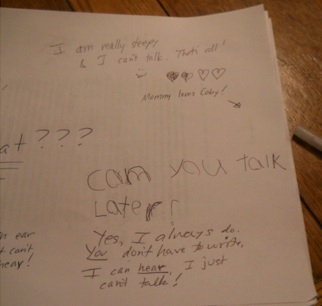
“My son is very good at talking about things he doesn’t like, but I don’t assume that he would feel entirely comfortable directly telling me things he doesn’t like about me. The things he does say indicate support rather than discomfort. A few times I have been annoyed at myself for stuttering and he says “Mommy! Don’t ever be mad at yourself for stuttering!” or, a few times, “Mommy. Stuttering. It’s a way of life.” I don’t not-communicate with him, so he does not feel ignored. I use alternative ways of communicating with him, just not talking. I write, point, use some of my extremely limited repertoire of ASL signs. I once was writing to him about what to wear to church and he wrote back “Yes, mother dearest!” He (as is true of most people I write to) matches my communication mode and writes back. I have written to him (and to others) “You don’t have to write to me; I can hear you!” He has noticed, and told me, that when he comes back from visiting his dad I “seem different.” We have talked about his coming back as a transition point- the house is suddenly noisier, and definitely “talkier.” I have often said that my child talks to think, so we are quite different in that way. I am working on what would make the transition from “kid gone” to “kid in the house” an easier one for both of us.”

 For people who do not have difficulty speaking, they may have trouble understanding how someone might be able to speak in one situation and then not able to in another.  Can you talk more about this?

“Some abilities are not there every single time a person wants to access them. This is true for all people, but for an Autistic person, these fluctuations in abilities and access to abilities might be more pronounced. If I don’t play the organ almost every day, it’s almost like I forget how to play it. That’s why I always practice on Saturday night and Sunday morning before church. There is no way I can go in there cold and play like I want to. Think of something like delivering a presentation. For most typical people, there will be good days and bad days, presentations you wish you could do over, and days when you were really “on your game.” Or, think of your favorite sports team and player. Some games are not so good; other games the team really does well. But playing the organ or hitting a home run is not an essential life skill (ballplayers  and organists feel free to disagree!). But when it comes to anything considered really basic, like being able to talk, a sense of mystery surrounds the topic, when a person can do it one time and not another. I maintain that it’s not that different anything else, but is more noticeable and pronounced when it’s something that is expected of everyone, and when one can do that “expected thing” most of the time. Maybe for some of us talking is an extreme sport, in the sense of having to really work, practice, try hard, take risks, and think consciously about what we are doing, whereas for some people the ability to talk is very natural and not even a conscious effort.”

 Talk about the idea of language and thinking.

“I have read more than one author who opines that without language there is no thought. Nothing could be farther from the truth. Language includes both written and spoken words, as well as picture-based communication systems like PECS. Not talking (and also not writing) does not equate with “not being able to think,” “being lost in an unknown world” or anything other than specifically not being able to talk.  For some people it could mean a lack of focus on “the present moment” (how many people are fully present in each moment anyway?!) or not being able to think in words, which is another one of my reasons for not talking.  But it is not, generally speaking, accurate to assume that because someone can’t talk, they can’t think.  You wouldn’t look at someone who has a tracheostomy tube and go “Oh wow.  That person can’t think!”

What is it like when you’re unable to speak while in public and are expected to? 

“It’s a bit nerve-wracking, but only in situations where people do not know me well and are expecting that I can speak like a non-autistic person. I try to anticipate what I will need to be able to communicate at those times but I can’t always build in my own supports. When I am with friends, it’s no big deal if I can’t talk or can’t talk much. In work situations it’s more difficult for me to feel calm about it. Unfortunately this expectation is not limited to people who don’t know much about disabilities, so that I have had to really struggle at autism-related events where there really aren’t accommodations for Autistic ways of communicating. It’s an ongoing process for nondisabled people to learn about communication differences and to anticipate them so that Autistics and other people with communication disabilities aren’t doing most or all of the work to create our own accommodations.”

How do people react to you?

Really, I mostly don’t get reactions, because often the times that I can’t speak coincide with the other person continuing to talk, maybe because they think I don’t have anything to say, or that they are like “Well, if she’s not going to talk, I will!” I do get all kinds of reactions, from total acceptance to “you could if you wanted to- try harder” kind of thing that made me feel sad when I was making the video. Sometimes people don’t believe me when I say (in speech or writing!) that I have trouble talking. I have to be very clear that I mean not being able to talk at all. I have learned that “trouble talking” might mean not saying the right thing, or stage fright, and “I can’t talk right now” can mean “I am too busy to deal with you” rather than that I literally an unable to speak with words coming out of my mouth! I have had a few mixups when people did not know I meant “I can’t talk right now” very literally. Sometimes people just don’t quite believe me and think I am making it up. I am not sure why they would think I would go to that much trouble! There are also people who have never heard me stutter, who think that I don’t, even though I tell them I do. They are going to get treated to another video in a few weeks! I was finally able to capture myself stuttering at a time when I also had the webcam with me.”

Are there things that help you speak after a period of not speaking?

“I mostly just have to wait. I don’t particularly want to talk a lot, but I need to. It’s just one of those things that is expected, and it is expected that if I can do it some of the time, I can do it all of the time.  It might seem that someone who can speak but loses speech at times would want to find ways to prevent speech loss, but I often welcome not being able to talk.  It gives me a break from the exhausting task of speech production.  My idea of the perfect conversation and this is ideal for a number of my Autistic friends, too, is two laptops or mobile devices or text-based equipment, but we can be in the same room together writing to one another. I don’t get a lot of this because I live in a rural area and most of the people I write to are long-distance. Some friends locally are very accepting but we don’t have any alternative setup other than me scribbling on paper. I also get way overloaded by hearing other people talk, as it challenges my auditory processing abilities and I can only take so much talking. If other people, whether or not they can speak, would type to me, I think I could get a lot more accomplished with the interaction with that person. Or, at least I think I could. If writing is not that person’s strongest form of communication, it will be a limit for that person. We should not be expected to always accommodate “talkers” and not the other way around. But it does take extra effort on my part because people can’t tell just from looking at me that I am a person who sometimes can’t access speech.

Ideally, we could take turns using each person’s communication strengths and weaknesses, assuming we are able to do that much. Of course, sometimes it just won’t work.”

Paula and her son’s writing


To read Paula’s blog, go to Paula Durbin-Westby Autistic Blog

Related articles

The Latest From Autism Speaks

This is the email I received this morning.  It’s from Autism Speaks.   Please read and let’s discuss…

“CONTACT THE CAMPAIGNS TO LET THEM KNOW WE WANT OUR 1 IN 88 IN THE DEBATES!

Dear Ariane ,

We had a significant presence at the first Presidential Debate at Denver University last week. We are going to have an even bigger presence at the next two debates to show the candidates how big the autism community is!

We need your help to make the autism community, and all of our issues, a squeaky wheel in this election season. For the next debate, we don’t want just a mention of autism.

We want the candidates to discuss a plan for leadership on increased funding for dedicated autism research and appropriate health insurance coverage for all Americans with autism.”

In the first statement Autism Speaks writes, “… we want our 1 in 88 in the debates.”  When they say “we” am I one of the “we”?  “We are going to have an even bigger presence at the next two debates…”  We are?

“Our” is a curious word to use when speaking of a group of people, many of whom can speak for themselves and those who cannot “speak” are capable of communicating, through typing or other means of communication, their thoughts and ideas.  “Our” is a pronoun implying ownership or at the very least lends a sense of unity and inclusiveness as in “our politicians,” “our neighbors,” “our friends”.   What Autism Speaks is really saying  is “our Autistics.”  I don’t think the people I know, whether Autistic or not, would take kindly to that wording, but “our 1 in 88” somehow gets a pass?

“We want our 1 in 88 in the debates!”  Really?  Is Autism Speaks suggesting Autistic people should be up on a stage or at a town hall debating the presidential candidates?  It’s an interesting and compelling idea and one I whole-heartedly embrace, except I don’t believe this is what they mean.  “Behind every person with Autism is an army of support.”  I don’t think most of the people I know who are Autistic feel they have an “army of support.”  In fact most of the people I know who are Autistic feel they have very little, if any support.  But I’d really like those who are Autistic to weigh in here and say for themselves whether they feel they have an “army of support.”  Armies are usually employed to fight or fend off an enemy.  Who is the enemy and who makes up this army?  Am I part of the ‘army’ that is supposedly supporting my daughter?   Maybe me and Richard?  An army of two?  Where is the army of support that’s standing behind each and every “person with autism”?

Autism Speaks is much, much more than an organization attempting to raise awareness or one that insists they speak for Autistic people while doing nothing of the kind.  They are running a campaign, not a campaign that raises money to help those with Autism, but a campaign that promotes fear and generates terror.  Anyone who  has spent any time in the advertising business knows, fear causes people to open their check books faster than any other single emotion.  Autism Speaks does a brilliant job using language to convey other, more subtle meanings.

Autism Speaks is interested in having autism addressed by politicians, a worthy and important suggestion that ALL of us can agree on.  Except Autism Speaks is NOT a leader in showing the world how to INCLUDE Autistic people in the building and formation of their various programs.  Autism Speaks uses the words, “Autism Speaks it’s time to listen.”  But who is it they are suggesting we listen to?  Not Autistics.  They have positioned themselves as an organization which represents Autism.  They have self-appointed themselves as the “voice” of autistic people despite the vehement protests by so many who are Autistic.

Can you imagine an organization that suggested they spoke for the American people and yet were made up of people of some other nationality.  An organization which only had one or perhaps two Americans on their board, advisory committee or occupying more than one or two seats of the upper echelons of their organization?  Imagine for a moment how you would feel if an organization called themselves: “Americans Speak it’s time to listen”, yet those who were talking weren’t American and when you tried to say something you were routinely ignored.  Imagine how you would feel if this organization continued to insist they spoke for you and yet when you heard them speak you didn’t recognize yourself or any of those you knew.  Just imagine.

To Mitt Romney and Barack Obama:  please inform yourselves about autism by listening to those who are AUTISTIC.  That’s the discussion I’m interested in listening to, the one that includes autistic people and not those organizations that say they do and yet do not.

How My Fears Drove Me To Pursue a Cure

A year ago if you’d asked me what my single greatest fear was, I would have told you it was what would happen to my daughter when my husband and I both died.  This fear was so worrisome, so looming that I often stayed up at night worrying.  Well meaning people would reassure me that “things will work out, they always do” or “group homes aren’t so bad, many are run by loving, caring people”, but none of this gave me solace.  My fear was the driving force behind my desperate pursuit of various medical interventions and treatments for my daughter.  This fear, more than any other was what drove me to search for a “cure”.  When I thought of my daughter’s future I saw one of those dark, formidable, gothic institutions, now used as set locations for horror movies.  Once my mind had latched on to that visual image my fear became so overwhelming, my throat so constricted, my body so awash in terror I would literally shut down, like an overloaded circuit.  Fade to black.

So what changed?  I began to read things like this –

Amy Sequenzia, a non-speaking, writer, poet, Autistic self-advocate from her poem Feeling Good:

“Feel the warmth of another soul                                                                                                   Ban the thoughts that block the light                                                                                           Refuse to hear what hurts, listen to the                                                                                    cry for help behind it

Well-being, feelings of unity                                                                                                             We are all the same”

Julia Bascom from her blog Just Stimming, her post Quiet Hands:

“1. When I was a little girl, they held my hands down in tacky glue while I cried.

5. When I was a little girl, I was autistic.  And when you’re autistic, it’s not abuse.  It’s therapy.”

Again from Julia, her post, The Obsessive Joy of Autism:

“If I could change three things about how the world sees autism, they would be these. That the world would see that we feel joy—sometimes a joy so intense and private and all-encompassing that it eclipses anything the world might feel. That the world would stop punishing us for our joy, stop grabbing flapping hands and eliminating interests that are not “age-appropriate”, stop shaming and gas-lighting us into believing that we are never, and can never be, happy. And that our joy would be valued in and of itself, seen as a necessary and beautiful part of our disability, pursued, and shared.”

The Third Glance, Words and Growing up Autistic: On Nature, Nurture and Abuse where she ends with this:

“But I’m not invisible anymore. I’m here, and I’m me, quirks, obsessions, passions, stims and everything else that makes me unique. Look out world, here I come.”

There were so many others, so many voices out there, somehow reading these blogs calmed my fears enough that I was able to begin dissecting them.  I was able to pause, even for a moment, allowing me to ask, what is this?  What is this fear really?  And although my immediate answer was that these were fears based in very real, logical assumptions, I was able to see that they were just that – assumptions.  They were still not reality.  Not yet.  I was also able to realize those fears were causing me to act in irrational ways.  My thought that the fear was a healthy, natural response to what I believed to be the reality of the situation, prompting me to pursue all kinds of risky, unproven and untested “treatments” for my daughter’s autism was taking all of us down a dark, dark path.  That fear caused me to behave differently toward her, but I couldn’t see that until I’d stopped and saw how my behavior toward her changed.  When I was able to stop, just for a moment and examine the fear, the fear began to fall apart.

My fears were based in things I assumed were the inevitable consequence of what I believed my daughter was or wasn’t capable of.  But this was not based in fact, I don’t have the ability to see inside my child’s mind.  In addition my fears were clouding all the things she was doing that I ignored or couldn’t see or hear.  Every single day, my daughter displays her vast intelligence.  When I read the writings of Autistic people occupying every point on the so-called spectrum, I began to see that my assumptions, what I had assumed I knew and believed were not based in anything other than that.  It was at that point that I realized I had a choice.  I could choose to believe in her incompetence and the inevitable outcome this perceived incompetence would take us or I could choose to believe her competent, making that looming horror no longer a given.

As I wrote recently in a comment to someone,  I chose the latter because to do otherwise and be wrong would be far, far worse.  This is something I cannot risk or would be able to forgive myself for.  But there’s another piece to this that is also important, and that is when we assume great things are possible, great things tend to happen.  It’s human nature to strive for independence, to communicate, to connect, ALL humans want this. Given a little encouragement we can do things we never imagined possible, but given nothing or criticism we wilt, become sad and angry.  My belief in my daughter will not change the very real challenges she faces, but it does and will help her far more than if I do not.

I’m off to the AutCom conference!

Performer, Singer, Mother, Wife, Friend & Autistic – An Interview With Chou Chou

I met Chou Chou last spring when she left a comment on this blog.  She wrote, “I love your writing, and find your darling Emma startlingly like me as a child.  I am a happy, successful, 58 year old autistic woman.  I just wanted to say you and your husband are wonderful parents, and Emma will be fine. She will be wonderful. She is wonderful.” 

 I read her comment a dozen times. I felt indescribable joy and I wept.  I was just beginning to read the writings of Autistic adults and had started, very tentatively, to reach out to a few of them.  Then out of nowhere there was Chou Chou reaching out to me!  I was so excited!  I doubt she could know how much her kind words of encouragement meant to me.  We’ve been in touch ever since.

Chou Chou performing with Doc Scantlin and His Imperial Orchestra
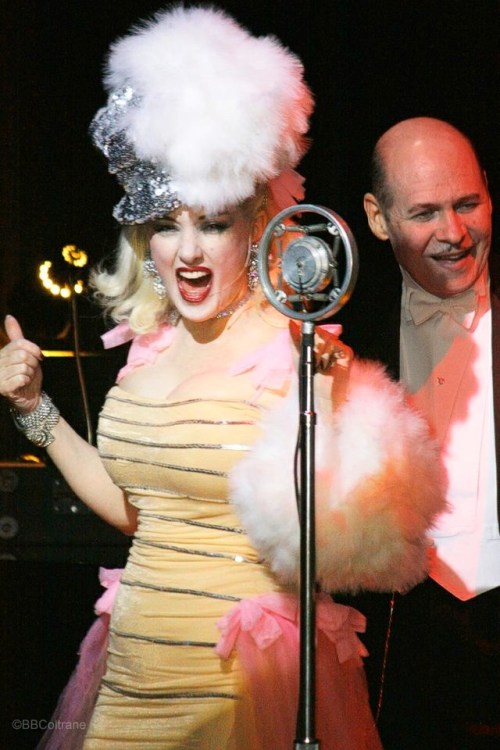
 Tell me about you as a child? 

Boy! Where does one start? I was a very passive baby, and did not react to people, or reach for toys. My mother said I appeared content and able enough, but it was as if she would lose me if she wasn’t careful, as if I would slip away into my own world, forever. Baths seemed to perk me up, so I was given five baths a day, and then played with after baths. My toys were put on strings, so I could look at them, since I wouldn’t play. I would cry for hours, but could also be in total bliss. I was very late talking, almost five, except a few words, and had trouble throughout my youth speaking. I was a toe walker, head banger, and would bite myself. I had a faulty immune system, and was sick constantly. Ear aches, flu, tonsillitis, all the respiratory stuff. My gut was a mess. All one has to do is read your posts on Emma, and that describes what I went through. I did not play with other children, although I would play beside them. I was hypersensitive, and needed much time alone to recharge. I loved nature, art, swimming, especially underwater, and performing. Performing was just like plugging me into an electric socket! I would come alive! My mother realized she could make me connect better by giving me a character to play, and a small script. It has served me well.

When were you diagnosed?

Age three. My mother was the business administrator of a small, prestigious rehabilitative home, named Idylease, in northern New Jersey and the doctor in charge became our family doctor. This was the mid fifties, and he very cutting edge, because of his position at the home. He diagnosed me, much to my mother’s horror and shame. At the time, autism was considered caused by cold mothering, and children were often institutionalized, to protect them from their bad mothers. My mother hid the diagnosis, and began a masterful strategy, that not only got me through school, but made me grow into a competent, happy (if a bit odd) woman. She was a brilliant, wonderful mother.

The word autism was never used. I was called slow, or special, or a late bloomer. It was not until the late 90’s that I was told of this early diagnosis, which was confirmed by my doctor.

Can you talk a bit more about your mothers horror and shame?  Did she believe her parenting caused your Autism?

She did until the day she died. We would have long talks about it, and I would explain, over and over, what a wonderful mother she was, and all the ways she helped me, and I sometimes thought she would “get it”, but she never did. She was a career woman, in an age when that was controversial enough, and had many symptoms of what I now recognize as Aspergers, although she was never diagnosed. She was a mathematical, logical, brilliant, woman, who was loving, but not often in an emotional way, nor was she social. Unfortunately, she interpreted that as her being the “cold mother” that was considered the cause of a child being autistic. This made sense to her, and I was never able to sway her completely, and have her forgive herself for this false accusation. I know she hid my diagnosis for her own sake, as much as mine. She feared the world would see how terrible she was. So, so sad. I adored her, and she did so much right!

How did the diagnosis affect you?

 It did not effect me as much as those around me, once I opened up about it. Yes, it was nice to pinpoint what I was dealing with and to put a stop to years of misdiagnosis, but I already knew who I was, and, like most autist adults, had created a multitude of strategy for getting by in life. The biggest thing was that I could be honest: about why I wouldn’t come to a party, why I had trouble following a conversation, why I would stop mid sentence sometimes, or covered my ears, or twisted my fingers, or had a peculiar way of speaking. It was obvious I was under much stress, and that made people uncomfortable, and made them think I didn’t like them much, I think. Now, I simple speak up when I need to, and politely explain my challenges. Everyone relaxes, and tend to be helpful and kind. Sometimes, it makes people talk to me as if I am a child, but I can quickly nip that in the bud! I often say that what I am dealing with is neurological, not psychological. Don’t get me wrong, I’m as neurotic as anyone else, but my neurological makeup is far different from the vast majority of people. I am no better or worst than any one of the unique people roaming this planet. However, I am, it appears, of a certain somewhat predictable, if varied, ilk. I am an autist, and a happy one, and am coming to realize that there may be others rather like me, younger ones, who could benefit a bit from my becoming part of the conversation. After a lifetime of hiding my differentness, this does not come easy, but I believe there is a responsibility that is mine to accept.

I am an autistic woman. Other than that, I am perfectly normal. Aren’t we all a little strange?

What do you remember of school?  Did you go to a nursery school? 

No. Since nursery and kindergarten were mostly playing, which was hard for me, my mother kept me home until first grade. This was the peak years of the baby boom, and the schools were very, very crowded. I went to parochial school, along with my older sister, brother, and, eventually, my younger sister. I think it is hard for anyone to imagine how overwhelmed the schools were by the boom. There were 72 children in my first grade classroom alone, and there were three first grade classes. It was easy to get lost in the shuffle. School was a horrible, overwhelming blur, and I mostly sat quietly and obey the rules. I am very big on rules! I was always the “slowest” child, never finishing tests, had difficulty speaking, and was pinching and biting myself. During recess, I did not play with others. I would find some detail to focus on, like an ant, or the links in the fence. I had great anxiety and fear at school. Sometimes I wasn’t able to contain it, and I would cry inconsolably. I would be sent to the nurses office, and cry it out, or be sent home. Throughout school, my mother would watch for signs that I was getting overwhelmed, and keep me home, so I could be quiet and recharge. It was easy for her to make excuses, since I was sickly anyway. Usually she would write a note saying I had a gastrointestinal virus. I missed a lot of days at school, either really ill, or with these fictitious viruses.

Were you treated differently?   

Yes. There were no special education classes, but there were groups within the class. I was in the slow group, and given special reading skill projects and tasks. This confused me, because I was a voracious reader at home, beyond my age level. I just couldn’t communicate it, so they thought I couldn’t read. I was protected. My big sister or brother knew they needed to have me tag along, so I didn’t get lost or hurt. It was not considered safe for me to be alone, unless I was in our home or yard. We all just accepted that. I was in my own world, and wouldn’t watch for signs of danger. I was never punished, like the other children, as it would totally destroy me, and I would harm myself. Sometimes my brother and sisters resented that. They would be punished, but my errors would be quietly explained to me. That was all that was necessary. I loved to know the rules.

Did people talk about you in front of you? 

Constantly. I didn’t mind, because, it was easier to listen to the conversation than converse myself. Sometimes, of course, it was frustrating to not be able to express myself. I remember hating cooked carrots. When they were on my dinner plate, I would force myself to eat them first, so they wouldn’t “contaminate” the rest of my meal. My father thought it meant I loved them, and would pile on more. I would burst into tears, wondering why he was torturing me with carrots. Poor guy.

There were, and still are, many times I have difficulty following a conversation. Particularly “small talk”. When I listened to other children, it made no sense to me, but I never felt it was because I was less intelligent. Their bickering and constant competition sounded unintelligent to me. My interests were quiet, and beautiful, to me. Their playing was constant battle.

Do you remember any particular instances when you felt people or other children didnt understand you?

It was a great conspiracy of mine, along with my mother, that I was intelligent, and even talented, but was considered so deficient. I felt that my world, the one I played in alone, was beautiful, and that the other children struggled in meanness and chaos. I did not feel less than them. Because I was quiet and never mean, and most of the neighborhood kids went to our Catholic school, it was decided I was somehow blessed, that I would grow up and be a saint. Perhaps my mother started that rumor. She was awfully clever at protecting me. It kept them from picking on me, as it would be unheard of to harm this holy creature. I was left alone, but guided and protected, and even included. They always tried to involve me in games, but I didn’t do well with them. They were illogical. Sometimes they would invent special roles, so I would be included. If they were playing “war”, they would put me on top of the swing set, like a princess needing rescue, and I would cry, ” Help, save me” over and over, while they wrestled and battled. I would also have some terrible hours of crying, but these I don’t remember well at all, and always forgot they even happened once I recovered. They were not discussed.

Did you have other sensory issues that you were aware of? 

My sensory challenges, without a doubt, were and are, the major issue for me to contend with. I now speak, write, and socialize well, but I experience the world in a much different way, sensorily, than is in the average range. I understand this now, and have devised many way of protecting myself, but I did not understand this when I was younger. I thought everyone experienced life the way I did, but that I was some kind of weak character because I “couldn’t take it”. Sights, sound, smells, emotions, all were overwhelming. My clothes scratched, and I thought digestion, and sometimes even breathing, was a painful process for everyone. I had a headache all my life that I didn’t even know I had, until I had some pain medication as an adult that made it go away. I would bang my head, and had to bounce and rock to fall asleep. I would cry on trips home from anywhere, because being out was overwhelming. I hurt, and the stimulation of the world hurt me. Why was everyone acting just fine? I would pray, and ask for forgiveness, since I somewhat bought the story that I was holy. Wasn’t I supposed to suffer as a saint? Surely, I would die young, after much torture!

Were you able to read and write at the same age as your peers? 

I loved reading, and don’t remember ever not reading, but had great trouble writing, and could not read aloud. There were a lot of monthly magazines in our house, and encyclopedias. I poured through them, and my mother got a subscription for me to a book of the month club. I liked learning a lot, and self education. In school, though, no one knew I could do this, and I lived my role of being a remedial student. The only difference was if I was given something to memorize and perform or recite. It was like a magical trick. I would come alive, so much so, that often I would be taken from class to class, to do my performance over and over, to much applause.

I come from a very intelligent family. My mother was a mathematical genius, and member of Mensa. My brother had a photographic memory, but had a head injury, and was kept back a year in school. From then on, we were in the same grade, but he was considered the smartest kid in class, and I was the slowest. In eight grade, we were given IQ tests, for placement in the high school’s track system. Test was easy, because it involved little writing, and was logical, and solving puzzles, which I was really good at. The  answers were not written, if I remember right. They were just filling in the dots, or one word. I scored the highest in the whole eight grade, even higher than my brother. It was decided I was a bored, shy genius, and I was put in track one, with the brightest students, taking advanced courses in math, Latin, and biology. That was a big mistake. I couldn’t keep up at all! I was “demoted” to track three, out of seven, where the bright, average, most popular student mostly were, and was a terrible student. My brother was made class president, and all the girls wanted to date him, so they were VERY nice to me. I got pretty, so the boys started being VERY nice to me, too, although my big brother kept vigilant guard on the advances of those New Jersey boys.

Was there anything or anyone in particular that helped you when you were young?

Without a doubt, my mother. She always believed in me, and told me I could do anything I set my mind to. When I was sick or struggled, she never for a moment treated me like I was damaged goods in any way. She would treat me with astounding respect for how I tried, and told me I was “tough as a turtle”, and a “late bloomer”. When other family members got frustrated with me, she would say, “You just wait and see. One day she’s going to show everyone what she’s made of”. She taught me to learn on my own, and gave me access to anything that I had interest in, and could do in a quiet, solitary way. She made sure I was included, but allowed me to be separate, and somehow spun it to everyone that it was a positive thing. I never had to be like anyone else. She made me feel I was wonderful as I was, and only had to be the best me, and she convinced everyone else of the same. She had a talk with the toughest bullies in the neighborhood, and made them my, and my brother, when he was injured and small, special bodyguards, to make sure no one bullied us. I don’t know if she paid them, but I wouldn’t be surprised. I remember them swaggering, “Don’t worry, Mrs. Downs, nothin’ gonna happen to them. We’ll make sure of that!”

My mother found that if she dressed me pretty, and gave me small scripts, I could become a character, and connect much better. She told me, in order to get by, to just be quiet, smile, and use my little scripts. I learned to ask questions back, by repeating questions asked to me, and, even though I couldn’t always follow the answer, just respond by saying, “that’s nice”. Usually it worked, but, sometimes they said something sad, and I wouldn’t catch it, and my response would be inappropriate. That still happens sometimes, much to my embarrassment.

My older sister changed my life, in the most astounding way. I didn’t appreciate it at all at the time, but now I do. In high school, she signed me up for drama club, because I performed so well, and was always putting on shows. I was horrified! It was a group activity. I was really scare, but more scared of my big sister, so I did it. I soared, and had the lead in many shows, and I won awards. Through playing characters, I learned to speak, and how to present myself. I went on to become a professional actress and singer, and continue to perform as my livelihood to this day.

Did you ever internalize some of the messages you received from school or others and feel shame?

The internalized negativity I feel has more to do with feeling bad that I am not able to do some things most people find easy. Feeling bad that I let others down, and can’t socialize in a more normal way. I get very frustrated that society keeps adding more sensory challenges that make things LESS accessible all the time! More noise, more flashing lights, more dependence on the value of being socially savvy, and living in a constantly socially connected way. I can no longer watch the news, because there is just so much constantly being added to help keep people’s attention, in the way of sound, visuals and speed. Many places and things are now inaccessible to me, because of the heightened stimuli.

Weve spoken of this privately, but can you talk about feelings of shame or feeling ashamed?

I go through unbearable bouts of illogical shame, although I no longer injure myself. It has nothing to do with self-esteem. I know I am capable, and that I have a great capacity for making people happy. I am a well received entertainer, with many supportive friends and fans. I’m a rather mediocre singer, I’m afraid, but a good entertainer, and can put over a song. I am loved deeply by my husband. The shame shows up most if I’m tired. I will walk onstage, and look at the audience and think, ” who are these wonderful, beautiful, people, and why am I bothering them? It makes me want to apologize for being there. I have to remind myself that they are paying good money to see me, and I need to give them my best. It is not stage fright, which I don’t have in the least. It is shame. I wake up the next morning, drained from giving my all, and am totally ashamed. It is not a feeling like I did a bad job. I can tell that the crowd was happy, and the cheering loud. It is just a horrible, illogical feeling of fright and shame, and this tough turtle pulls into her shell! I then need to hide, for surely I will die of shame, if not allowed to recover quietly. I’m fine in a few hours, and Doc is great at understanding, and can make a joke out of anything. He will squeeze me and say, ” Oh! Are you sooo ashamed? Oh no! Oh, shame on you! Oh, it is so terrible! Oh, SHAME!” We will laugh at how silly it is that I experience this, but we both know it happens, and the best choice is to roll with the punches and laugh at this crazy crossed signal I get. I think we all have our little illogical demons. This is mine. I am not sure if this is an exclusively autistic trait. I do think it should be considered when dealing with problematic self-injury. It is no small thing. There are times in my life I would do just about anything to stop the shame, or punish myself for it, without it having anything at all to do with how things are going. I have learned to make a priority of taking care of myself, and getting enough down time.

The overwhelming shame I feel has nothing to do with internalizing what others did to me. It is just one of those odd signals that come with my particular neurological makeup, like feeling punched by flashing lights, or seeing patterns and colors when I hear music.  We all tend to react to being overextended. I get bowled over by shame that has nothing to do with anything but being in a weakened state. No one causes this. I also can get in euphoric states. That can be a problem because I want to kiss and hug everyone in sight! It’s not sexual, but I just ooze with love, but you can’t go around kissing and hugging everyone who says hello to you at the grocery store!

I am pretty good at recognizing and conquering my internal baggage, and separating it from what is a more neurological manifestation, and I feel this crazy intense shame is more neurological than psychological. If there is any psychological tie-in at all, it would be that at times I am humbled, and may not feel worthy, of all the applause and special treatment I get! As I have said, I am no better or worst than anyone else, and that, above all, must be the message in conquering ableism. We are equal, and not all of us view ourselves as victims. Some of us have had wonderful people helping us, throughout our lives.

From those early days of acting in school plays, did you have a sense of what you wanted to be when you grew up?

There were certainly times when I was growing up when I wanted a life on stage, particularly because I was good at it, and people liked when I did it. I knew I would probably always perform, in some way, but never desired to be a star. It would have destroyed me! When I was a young woman, my faraway, vulnerable, nature was compared quite often to Judy Garland and Marilyn Monroe. As flattering as that was I thought they obviously did not fare too well. What I really wanted was to be an artist, a wife, and a mother, and to someday live in a little cottage by the sea. Life has certainly taken some strange twists and turns, but I have achieved all those things.

I understand I need protection in certain areas of my life, but I also have skills and desirable traits, that can enhance, and even offer a different kind of protection, in trade. I am a good, protective wife, to a good, protective husband. That said, performing is my stock and trade, and a way of making a living that is highly enjoyable, if exhausting! I’ve walked away from it many times, but always find it in my path once again. The more spiritual part of me, for what it’s worth, had to at some point say, “Okay, I’ll do it, as long as you want me to do it.”

Because social connection can be difficult, performing is a way I can connect to a group of people in a structured, rehearsed, really fun way. I adore the spotlight! It blocks so much of the sensory challenges in a room, and allows me to feel, more than see, the audience. It is a way I can party and play with everyone, without small talk, and without that nebulous ” unwritten script”, whatever-the-heck THAT is! I always wind up falling in love with those in attendance, and I adore that! It is not about showing how wonderful I am. It is a way I can remind everyone how wonderful they are and the best part is that Doc and I get to do it together. I am grateful, beyond anyone’s imagination. My mother said I would bloom, and, since I believed it, I did somehow. I am still autistic, but one in full, frenzied, exuberant, ridiculous bloom!

Chou Chou can be seen and heard performing with her husband, Doc Scantlin and his Imperial Palms Orchestra
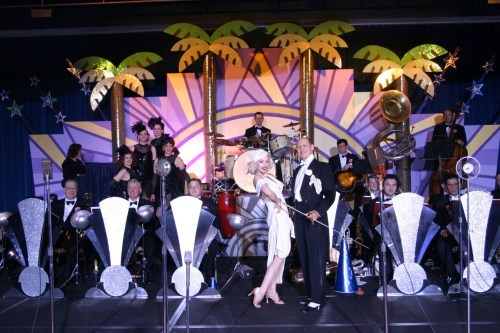
From Storm Clouds to Sunshine

Yesterday was one of those days when everything felt harder, everyone seemed grumpy, everything seemed to go wrong.  Yesterday felt like this:

By the time I got home I didn’t even try to conceal my irritability.  “You okay?” Richard asked when he saw me walk in.  “Just feeling out of sorts.”  Richard nodded his head.

I stayed away from everyone, tried to keep my interactions to a minimum lest I take my grumpiness out on my family.  After an hour or so I could feel my mood lifting.  Richard and I had the following conversation.

Me:  Standing in doorway  Hey honey?

Richard:  deeply engrossed in writing  Uh-huh?

Me:  What do you think about having some down time, you know, just you and me?

Richard:  still writing  Yeah.  That sounds good.

Me:   Still standing in doorway   Um.  Yeah.  Like, you know.  Just the two of us.

Richard:  Looking up from the computer.  Yeah.  Okay. 

Me:  Continuing to stand in the doorway

Richard:  Yeah  Big grin.  I’d like that.

Me:  Reaching for “Autism is a World” DVD   Great!  Cause I’ve got this autism video I’ve been wanting to watch with you…  Waves video in the air.

Richard:  confused look, trying to assess whether I’m being serious.  He knows me and knows this is just the sort of thing I might suggest, though the previous dialogue suggests otherwise.   So he’s trying to figure it out.  I can see him going through the mental gymnastics.  

Me:  Laughing

Richard:  Look of relief.  

Me:  Does a little dance.

Richard:  Glad you’re feeling better.

Fade to black

*As my friend Ib would say – on a lateral side note – I am off to the UN today for The Fifth Conference of State Parties to the Convention on the Rights of People With Disabilities moderated by Juan Carlos Brandt, Chief, Advocacy and Special Events, Department of Public Information, United Nations.  I intend to speak up about the need for including Autistic voices (emphasis on the plural) at any and ALL meetings such as this one.  Wish me luck.  It’s a beautiful day!

Related articles

An Interview With Amy Sequenzia

Amy Sequenzia, a  non-speaking Autistic self-advocate,  poet and writer agreed to an interview with me.  Amy is someone whose work I have been following since I met her, this past spring.  Her powerful book of poems, My Voice: Autism, Life and Dreams can be purchased by contacting Amy ‘here‘.  Amy’s writing and poems are regularly featured on Ollibean.

Amy Sequenzia

AZ:  Hi Amy. Thank you so much for agreeing to this interview. You describe yourself as a self-advocate.  Can you tell us how that came to be?

“I think it was in PA when I had my first real contact with a group of autistics who where typing to communicate (The Lonesome Doves). That was in 2003 and I realized I could be speaking up for my rights to more people. After that I began writing poems that were a little bit about my life. Then I decided to write to, and meet with, legislators; was encouraged to write to newspapers and later for blogs.”

AZ:  You’ve described how people have spoken about you when you were present, as though you couldn’t hear them or understand them. Can you talk about what that feels like?

“It feels like you don’t count as a whole person. It is rude and frustrating because I can’t respond or will not walk away. It makes me sad when people who love me do it anyway. Some people even continue to do this after being reminded that I can hear, type and think.”

AZ:  Do you have memories of that happening when you were younger, before you could communicate through typing?

“Yes and I would get angry, frustrated, sad. Sometimes I would cry, sometimes I had a meltdown.

Sadly, it still happens.”

AZ:  Were there things you did, sounds you made, actions you took when this happened?

“I answered in the question before, but I have to add this: I don’t have meltdowns anymore. But I need to have my support person with me to make sure I can express myself, if I want to. Some people still don’t get it.”

AZ:  How did you learn to communicate through typing?

“It was a long and emotionally draining session with someone from the Institute on Communication and Inclusion (I think it was called FC Institute back then). I was 8.”

AZ:  There’s been a great deal of negative notions and even so called “studies” done regarding facilitated communication. Can you address this idea that FC is not an accurate or meaningful way of communicating?

“It is how I communicate, it means it is how I can have my voice heard.

FC is a process, with clear steps and a final goal – independence. It is not easy and many factors play a part in the process.
As far as I know, from all the people who say FC is a hoax, none of them has ever interviewed a user who became independent, or has acknowledged the many studies, including double-blind studies done by different facilitators with different users. All this is documented.”

AZ:  For those people who have only read the negative views on FC, is there anything that might make them understand what you experience when you try to communicate without FC?

“I am misunderstood. My face does not always show how I feel and I have other disabilities that prevent me from being more pro-active. My body can be stubborn. Without FC I don’t really participate in the world.

But it is important to know that sometimes I choose not to type and other times I might be too overwhelmed or tired to type.”

AZ:  Have you ever had a bad facilitator?

“Yes. When I was in school, sometimes people would try to facilitate with me without any information about the method. Some would guide my hand; others would not offer resistance or the right support. I could not type like this.”

AZ:  How did you cope with that?

“Sadly, I did not do anything. There was no encouragement from some and with others it was as if I was a piece of entertainment. I felt disrespected. FC is a lot of serious work. I had to wait until I met someone who believed in me and was committed to follow the best practices.”

AZ:  How long did it take you to learn to type?

“I took only the first session for me to find out that I could type. Typing is also a matter of practice and trust. Today I am more confident and I can type fairly well with trained facilitators after a few minutes. If I know they will follow the best practices and nothing else interferes (like a seizure or spasms), I type really well, even if I don’t know the facilitator well.”

AZ:  Is there anything you’d recommend to parents of nonverbal children who are hoping their child might communicate through typing and/or FC?

“Give your child every possible chance to communicate. Don’t believe in every article or every “expert” who says FC does not work. Go to the Institute on Communication and Inclusion (ICI) and question them yourself. Being skeptical is ok. That’s why dean Biklen and the others at the Institute do such a good job documenting everything.”  (Click for the link to the ICI website)

AZ:  My daughter Emma is just learning to read, write, and type. She is extremely resistant however. I’ve been told this is often the case. Were you resistant to communicating in the beginning?

“No. I wanted to leave the school/institution where I was living, so I had to make it clear. But it can be scary to have all the power to say things that can change everything.

I don’t know Emma. Maybe she just needs some time.”

AZ:  Do you remember what it was like in the beginning for you? Were there things that could have helped you more that what was done?

“I wanted to type. I could choose food, clothes, anything. Then I began typing my thoughts. Maybe Emma is not interested yet. It has to be her choice, at her own time.”

AZ:  What is your living situation like now?

“I live with friends. It is their house, but it is our home. We call it life sharing. I have state funding which is not good, especially in Florida. But because my friends respect me, I can have a life I can be proud of, and happy with.”

AZ:  Did/do you have a mentor? If yes, can you talk about that experience and relationship?

“My mentors are people who show me the many possibilities of my life. They don’t always know that.”

AZ:  I know several people consider you extremely important in their own process of learning to communicate and in their life. They think of you as a mentor. How has mentoring others changed you/helped you?

“I hope it has helped them. I still need mentoring. It is a good exchange of ideas, experiences, encouragement and support. It feels good to be considered important in someone else’s growth. It is lovely.”

“Thanks Ariane. This was a good interview. And thank you for being supportive of autistic voices.”

Thank you so much Amy for being willing to answer all my questions.  Please help me thank Amy, everyone!

An Identity Crisis and Other Ramblings

*Warning – This post is written with humor.  If it offends, stop reading immediately and find another post.  There are lots of posts on this blog that are humorless.  Seriously.  Stop.  I mean go.  I mean…

My friend, Ib, (thank god she has returned from her various travels as I have felt decidedly “off” while she’s been away) and I were joking yesterday about the identity crisis I am currently undergoing due to the result I was given from taking the Broader Autism Phenotype test.  I was told “You scored above the cutoff on all three scales. Clearly, you are either autistic or on the broader autistic phenotype.”   It also said something about having an “aloof personality” something I’ve been accused of my whole life.  So I did what any sane human being would do – I retook the test.  This time the results said I had scored above the cutoff on two scales and therefore it was no longer “clear” that I was either autistic or on the broader autistic phenotype, but rather “likely” that I was.

And no.  I do not intend to take it a third time.  However I have resisted (so far) the desire to do a more thorough research of this test, how they are scoring it, exactly who is taking it, etc.  I so want to share my conversation with Ib, but didn’t think to ask if it was okay, so I’ll just share some of the tidbits from me, which is a pity as Ib had the best lines and is hilarious.  Ib is truly one of the funniest people I know, which, given the current view of Autistics being unable to understand irony and sarcasm, makes her so rare, she should be concerned that some autism specialist doesn’t catch wind of this lest they cart her off and stick her in a cage for more thorough examination.  But then those specialists haven’t gone on twitter and read tweets from my friends CoyoteTooth, HardAspie, TwinsMa, or AspieChap, nor have they listened in on FaceBook conversations with Brigianna, Kassiane, Julia, Rachel and countless others, all of whom have the whole sarcasm, appreciation for irony thing down to a science.

But I digress…  So in response to a hilarious, dry comment by Ib about my newly found status/nonstatus/questionable status I wrote:  “Ib… I do love you so.  And you really, really make me laugh, because you have that (oddly nonAutistic) humor, which clearly, despite being saddled with autism, you have managed to hang on to.”

To which she wrote something I cannot repeat.  And then mentioned one of the other myths regarding Autistic children, (it’s always regarding children and not adults because the common perception is that there are no Autistic adults and evidently never will be) which is that they are all so “exceptionally beautiful.”  This is something many have written about in a great many books, memoirs and on every single one of Emma’s reports and evaluations.  Each is prefaced with – “Emma, a beautiful little girl, of 5 years and 2 months, bounded around the classroom, only stopping to pick up a chair, which she hurled against the wall.  She spoke in one or two-word utterances, refused to obey any of the rules….” and the report would continue with the evaluator’s “observations” of Emma’s various activities as one might write about an animal under observation in the zoo.

So I responded to Ibby with this:  “…but that whole “oh they’re angels sent to us from God is crap.  I’ve heard the whole “unusually good looking” thing and I, personally do not see this as the case.  Sure there are lots of cute Autistic kids, there are also lots of really “cute” non Autistic kids.  I mean isn’t this the puppy syndrome?  Most puppies are pretty damn cute.  I think it’s that NTs expect an Autistic kid to look “weird” and so when they don’t they say, “oh she’s an angel, sent to teach us lessons that we’ve still not learned and never will, but while we’re NOT learning them at least we can feel better that the kid is so damn cute.

 SOS – Need Ibby home NOW..  Losing all patience with humanity’s stupidity…..  eeeeeeeeeeee”

Ib then responded with a whole diatribe that was so funny I laughed out loud and she ended said diatribe with the word – “sarcasm.”

I responded:  “I know you identified that last bit with “sarcasm” because now with my newly found identity you are assuming I’ve lost all ability to understand that that was in fact sarcastic.  Richard only this morning pointed that out to me and I tell you, it was an enormous relief to me.  Because now that it seems I am (at the very least) precariously close to being near if not ON the spectrum I will be humorless, incapable of understanding nuances and suddenly, miraculously very good at math, plus my IQ will take a massive leap upwards, for which I am extremely grateful.”

*To all whom I’ve now offended, this was not meant as offensive, but was poking fun at just a few of the ridiculous generalities, assumptions, theories and labels that continue to plague anyone who is Autistic.  And anyway if you reached this far and are still offended you clearly did not read the warning label, which suggests you are not good at following rules, coupled with your inability to see the humor, I therefore encourage you to take the Broader Autism Phenotype test.

My two exceptionally beautiful children (sarcasm, sort of)

 Related articles

Want to Know About Autism? Ask An Autistic

There’s a blog I love, written by E. called The Third Glance.   I found it last winter.  Written by a PHD student, E. describes her life, her passions, her studies, while detailing her thought process while socializing with friends during an afternoon at a café or memories of growing up with abusive parents who didn’t understand her.  E.’s compassion for humans and their neurological differences is striking as one considers the stigma she experienced growing up Autistic.  The Third Glance was one of the first blogs I found in my search for Autistic Adults.  E’s compassion and kindness shines through all her posts no matter the subject.  Her determination to give people the benefit of the doubt was something I was astonished by, particularly during those first few months of my discovering Autistic blogs and reading that so much of what I’d done was not as altruistic as I’d believed.

When Em was diagnosed, the words “Autistic adults” were not uttered.  Ever.  We heard about how imperative it was to immediately implement early intervention, we were shuttled off to get an “independent diagnosis,” we were advised to start investigating ABA therapy, we were inundated with ABA therapists, speech therapists, occupational therapists, a social worker came to our home once a week, team meetings were held regularly, we were trained to continue Emma’s ABA therapy after the last therapist had gone home.  We were advised to put Em on a gluten free/casein free diet, we were encouraged to read the thousands and thousands of pages of material thrust at us from a wide variety of well-meaning and well intended people.

In that first year of Em’s diagnosis, I was well versed in various theories regarding gut issues, lead levels, mercury levels, toxicity in our food and water, and I could reel off at least six different unpronounceable ingredients in vaccines.  I’d read at least 30 memoirs written by parents of Autistic children as well as books with titles such as A Parent’s Guide to Autism: Answers to the Most Common Questions, The World of the Autistic Child: Understanding and Treating Autistic Spectrum Disorders, Handbook of autism and Pervasive Developmental Disorders and  Biological Treatments for Autism and PDD.  I’d taken Em to cranial sacral therapists, homeopaths, lead specialists, developmental pediatricians, nutritionists, allergists and a DAN (Defeat Autism Now) doctor.  I knew about ABA, VB, RDI, PECS and DIR therapies.  I read and reread Catherine Maurice’s Let Me Hear Your Voice with the same dogged, determination and devotion evangelicals read the bible.  I knew about sorghum flour, rice flour, garbanzo bean and fava bean flour.  I honed my cooking skills on perfecting a gluten-free/casein free birthday cake for Em’s third birthday with platters of tasty GFCF finger foods, which Emma refused to touch, let alone sample.

Autism, seemingly overnight, had become my focus.  I was set on fighting it.  I was engaged in nothing less than a war.  My weapons were my determination, my tenacity, my stubbornness and my love and devotion for my daughter.  Everything else came to a screeching halt.  Everything else fell into line behind my research.  I was on a quest.  To my way of thinking, I was on a mission to save my daughter’s life.

When my husband, understandably alarmed by the fervency with which I threw myself into my research, suggested I was spending too much time searching, I was furious.  I railed at him, enumerating all the things I was doing with the sole intent of saving our daughter.   I was furious that he seemed unable to fully understand the battle I was waging.  It never occurred to me there was another way.  It never dawned on me I was battling windmills.

That Autism was the enemy, something to be vanquished, defeated and destroyed, I did not question.  I didn’t have time to question, I was too busy dealing with the Board of Education, therapists, Doctor’s appointments, tracking down every “cure,” and baking foods my daughter wanted nothing to do with.  Every time I turned around someone was sending me a link to a new “cure” a new treatment, a new therapy, a new “miracle worker.”  Countless people would begin a conversation or email with, “Have you tried…”  “Have you heard of…” and I would grab a pen and begin taking notes.  Doggedly I pursued each and every tip.  Determined not to leave a single stone left unturned, my days and nights were filled.  I was busy.  There was no time for calm contemplation, there was no time to sit and consider the path I suddenly found myself.

The Seven Year War.

And then…  what happened?  What changed?  Everything.  I began to question the “truth” about autism.  I began to question the dogma.  I began to question the “facts.”  It was inevitable, I suppose when you read as much as I do.  But the single biggest change occurred because I found Autistic Adults like E.  I’ve written about this before, ‘here‘ (the post where E. first reached out to me in the comments section) and again ‘here.’  I won’t go on about that process, except to say this – there is something about the immediacy and the interactive quality of a blog that no book can replicate.  In addition, a blog written by someone who is Autistic is far more interesting to me than anything I’ve heard from researchers, specialists, therapists, teachers, doctors because Autistics are talking about their lives, it’s not a theory, there’s no speculation.

Want to know about Autism?  Ask Autistics.

Thank you E. for reaching out to me.  Thank you for generously holding out your hand to me in kindness and friendship.  Should all parents be so fortunate as I have been.

A quick aside, E. was also one of the creators of the Autism Positivity Flash Blog (see badge on right side of this blog) where a group of bloggers reached out to hundreds of us asking that we write a post in answer to the google search words “I wish I didn’t have Aspergers.”  If you haven’t gone to that blog, do.  It’s a veritable who’s who in Autism blogging by Autistics and parents coming together to support someone on the spectrum.

Related articles

Emma Riding Beau – 2005