Tag Archives: autism children

Day 13

Today is the thirteenth day of putting Emma on the modified gluten free/casein free diet.  She has found a few things she likes to eat, is slowly expanding her choices, but there are only a couple of things she seems happy to eat and many more that she eats begrudgingly.  Most of the things I offer, she’ll taste, but will then say, “Now it’s all done.  Please Mommy I don’t like that.”

Meanwhile we continue with her studies.  I have not seen any noticeable change there.

Parenting a child with autism is like going on a trek in the Himalayas.  There are moments when you feel you’re not going to make it, your pack is too heavy, your muscles are tired and sore.  You wonder how you’ll take another step, the terrain is too steep and unforgiving.  But there are other moments of untold beauty.  Moments when you look around and see the mountains stretched out before you, the view so majestic it takes your breath away.

For more on Emma’s journey through a childhood of autism, go to:   www.EmmasHopeBook.com

Day 12

I’m feeling discouraged.  I know.  It hasn’t even been two weeks.  I know.

If a friend of mine told me they were discouraged after less than two weeks, I would say – No!  Are you kidding?  You have to be patient!  You can’t expect her to neurologically change because of her diet in two weeks!  And anyway this is about other things too.  Helping her chronic constipation, improving her focus and ability to attend to her studies, expanding her food choices, making it possible to one day go out as a family to a restaurant or travel places without bringing an extra suitcase of “Emma’s Foods” or worrying about where we’ll find Stonyfield chocolate yogurt or Wheat Bread, the one with the red label from Whole Foods because she won’t eat any other brand or flavor.  This is about not panicking when Whole Foods is out of one of the six things she’ll eat.

This diet requires a tremendous amount of work.  And I’m up for the task.  But every now and again I just want to complain and maybe cry.

A friend of mine sent me the following story:

An old donkey fell into an abandoned well.  The owner of the donkey, ambivalent about how hard he would have to work to try and get his old, and now useless donkey out of the well, decided to fill in the well, a danger to the community and now with the donkey having fallen into it, a way of doing away with the donkey too.  So he called his neighbors to help him shovel dirt into the well and as the dirt fell on top of the donkey, the donkey began to bray.  Horrible sounds, which did nothing to slow the falling dirt.   After a few minutes the donkey decided to shake off each shovelful of dirt and stomped on it with his hooves, while rising to a new level.  Soon the donkey was at the top of the well and able to walk out, much to everyone’s astonishment.

I feel much better now and if you’re having a tough morning, perhaps you are too.

The end of the story is that the donkey then trotted over to the farmer and kicked him as hard as he could.

For more on Emma’s journey through a childhood of autism, go to:   www.EmmasHopeBook.com

Day 11

Last night I offered Emma a chicken dish I’d prepared with butternut squash and golden raisins on coconut rice.  “Just taste it Em.”   I placed it in front of her and then walked away.

As I was washing dishes I heard Emma say, “It’s okay.  You have to eat it.  Take another bite.”  I continued to wash dishes and pretended to ignore her.  When I peeked over at her she was eating another forkful of the chicken and rice!  Even though I continued to say nothing, she said in her stern voice, “Okay take one more bite and then it’s all finished.”  By the time I came over to her she’d eaten all the chicken and four forkfuls of the rice.  I was ecstatic.

This morning after Emma had her breakfast of two pieces of gluten free toast with almond butter, I began packing up some things to take to my studio.  After about five minutes I looked up and didn’t see Emma anywhere.  “Hey Em!  Where are you?” I heard some rustling noises near the refrigerator and went to see what she was doing.

And there she was, scooter next to her, her beloved string in her lap, furtively eating some green grapes – her newest favorite fruit.

“Hey Em.  Why not sit at the dining room table?”

“No table.  Sitting on the floor,” she said, popping another grape into her mouth.

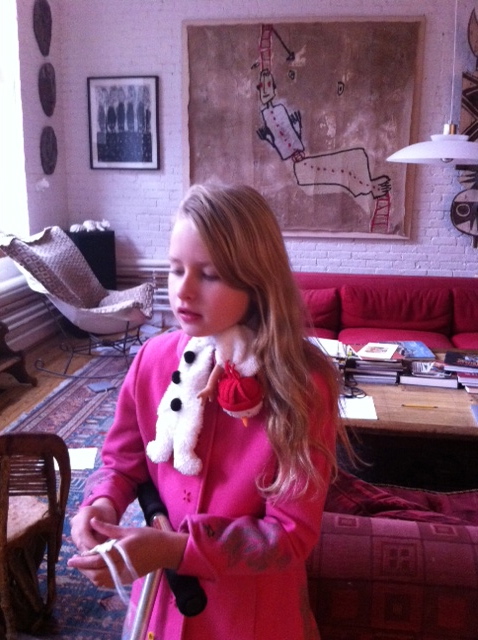
When it was time to put her coat on to go downstairs, Emma ran to the coat closet.  “Scarf!  Let’s see, how about this one?”  She pulled down one of her scarves.

“Not too tight or we have to take it away,”  she said in her stern voice.  Carefully she tied her scarf around her neck so that it hung down outside of her coat.

“I like your scarf, Em.”  I smiled at her.

“It’s cold outside.”  Emma tightened the scarf slightly and fiddled with it until the snowman’s head lay next to his body.  “There,” she said.

We’re taking this new diet one day at a time.  Emma is making steady progress!

For more on Emma’s journey through a childhood of autism, go to:   www.EmmasHopeBook.com

Day 10

Riding the wave of my previous day’s success, I fully expected to come home last night to find Emma agreeable to whatever was placed on her plate.  With visions of cheerful family dinners in my mind I set about making Hollandaise Sauce (with those duck eggs and Ghee).  Making hollandaise is a meditative endeavor, I’ve learned.  I cannot carry on a conversation with someone else while preparing it.  I must be focused, attentive with a certain amount of serenity or the whole thing curdles or separates.  I didn’t have any lemons, so I used a lime instead and all went fairly well, though it wasn’t as thick as the hollandaise I usually am able to whip up.  I steamed the asparagus, cooked the salmon steaks, drizzled everything with hollandaise and called everyone to the table where upon Emma took one look at her miniscule serving and said, “No!  I don’t want to taste it.  It’s okay.  It’s okay.  Just lick it.  You have to put your finger in it to taste.  Just one bite.  Taste it.  I don’t want to taste it!  I don’t like this.”  And then she began to whimper.

It was one of those Sybil moments, with Emma scripting using her “stern” voice, then mimicking a TA at her school to take one bite, just one bite, then Emma’s own sad voice pleading and on it went.  Finally I said, “Em you have to taste it, then you can have some grapes and apple (skinned).

“Okay, okay, okay,” she said, dipping her finger into the hollandaise.  “Taste it!”  She smelled the hollandaise, then tentatively licked her finger before looking at me with an expression of pure misery.  “I don’t like it, Mommy.  I don’t like this.”

My family dinner a la Norman Rockwell fantasy fizzled and I felt an overwhelming desire for someone to come and feed her for a month or two – get her eating a whole variety of lovely, nutritional foods before disappearing again.

Later Nic came over to me and put his arms around me.  “Hey Mom?”

“Yeah Nic?”

“I don’t mind this diet so much.  I still get to eat all my favorite things.”  He smiled at me.

“Oh, Nic.  That’s so nice of you.  You’ve been such a trooper with all of this.”  I gave him a hug.  “Thanks for being such a good sport.  It means a lot to me.”

“It’s no problem, Mom.”

This morning as I made my way to my studio I thought about when we tackled Emma’s bedwetting.  We did our homework, found an alarm to alert us to when she’d peed, whereupon we rushed her to the bathroom and eventually she was out of diapers, sleeping through the night with no accidents.  All of that seems like ages ago, but in fact it was just over a year now.  It took three solid months before she learned to use the toilet without incident during the night.  I expect it will take that much time or longer for her to become accustomed to eating new and different foods.

For more on Emma’s journey through a childhood of autism, go to:   www.EmmasHopeBook.com

Day 6

Call me crazy… BUT I think we’re seeing some changes.  Okay, I know, I said this after each of the three stem cell treatments.  Though there really did seem to be a slight shift – a change in her speech, better eye contact, longer more complex sentences, a more grounded presence in the world and I don’t think we were wrong about any of that.  I’m pretty sure Emma really did make some progress.  However, here’s my latest theory  (Richard, please refrain from rolling your eyes) – what if the stem cell treatments were helped by the fact that she also wasn’t eating all the dairy she normally ate.  What if in addition to giving her a little boost, the fact that she ate very little and therefore almost no dairy and hardly any wheat contributed to the progress we saw?   What if these food intolerances really are making it difficult for her to concentrate, focus, stay on task, carry on a conversation, maintain eye contact?

Today is the 6th day on Emma’s modified gluten free/casein free diet.  I use the word modified because, according to Dr. D she can tolerate dairy products from sheep and goats.  However she is not allowed to eat anything containing soy, corn or potato.  Which pretty much eliminates all pre-made foods, no matter how organic and gluten free they are, they all, every single one of them, contain either soy, corn or potato and often all three.  In addition she cannot eat anything with chicken eggs as she cannot have the whites, yolks are okay, but not the whites.

I’ve been doing a great deal of baking.  Which is a bit ironic considering how little Emma is actually consuming, but I keep trying to find things she might like.  I also love a challenge.  My mother told me about one of those cooking shows she likes called Chopped or a name like that. I’ve never watched it, but she described how the chefs are given bizarre items such as (I can’t remember what the actual ingredients were on the episode she told me about, so I’m making this up) – sweetbreads, licorice and coca-cola – and told to create something edible.  The chef then whips up some amazing concoction using those ingredients as their base, which looks delicious and the judges proclaim it a work of art.

The list of Emma’s “CANNOT EAT” foods sits on our kitchen counter, where I refer to it, reminding myself that if someone can prepare a fabulous dish with lifesavers and sweetbreads (or whatever it was they were given) then surely I can create something Emma will eat with all the foods she CAN have.  Still it does seem daunting.  And I’ll bet Emma wouldn’t touch any of those dishes prepared by those fabulous chefs, no matter how talented they may be.  Emma is one discerning customer.  Or as my son Nic said in answer to my question as to why he didn’t like the girl who keeps texting him at all hours of the day and night, “I’ve got very high standards, Mom.”  He then went back to playing his video game, involving lots of blood, various weapons no one has ever heard of and screams of agony.

When I first told Richard about taking Emma to Dr. D, he asked, “So what’s the science behind this?”

And the truth is I cannot answer that.  Though the following non-biased paragraph from the website, about.com is a pretty good description of the theory behind foods, intolerances, GI issues and autism:

“Why Does GFCF Seem to Work?

GFCF diets are difficult and expensive to administer. They require a lot of dedication and knowlege, and most professionals suggest that the diet be implemented over at least three months. Given all of this, it’s possible that parents who desperately want to see improvement could report improvement that may or may not actually be present. In addition, many children do gain new skills over the course of three months, with or without special diets.But there’s more to the story than just wishful thinking. Allergies to gluten and cassein are not uncommon, and those allergies often manifest themselves in diarrhea, constipation, bloating and other symptoms. About 19 to 20 percent of autistic children seem to have significant gastrointestinal issues.

If these issues are caused by gluten and/or cassein, then they would certainly be significantly improved by the diet. By removing a source of constant discomfort and anxiety, parents may well be opening the door to improved behaviors, better focus, and even lowered anxiety.”

It may be that I am trying to find improvements that have nothing to do with the change in her diet.  It may be wishful thinking on my part.  It may be that what I’m seeing may have happened had we not started her on this radical new diet. But I began this blog as an honest documentation of Emma, the progress, the lack of progress and everything in between.  Since we began the diet I have seen the following:

Greater sustained eye contact.  Less spaciness and a more solid grounded presence.  An interest in her Dad and a desire to include him beyond what she normally displays.  This morning, when I told her we didn’t have time to finish her study room and that we’d finish it tonight, she said, “Study room later.  We get to show Daddy.”  Now this may seem insignificant to most, but I can tell you, to Richard this sort of acknowledgement is a long time coming.

Emma – last night – October 20th, 2011

For more on Emma’s journey through a childhood of autism, go to:   www.EmmasHopeBook.com

Day 5

Today begins day 5 of Emma’s modified gluten free/casein free diet.  It also marks the second full day of Emma starting on her various supplements and tinctures from the natureopath/physician we saw last Friday.  I was referred to Dr. D through a friend of mine whose daughter also has autism.  When we met, Emma had just been diagnosed.  We got together, S with her daughter AF and me with Emma.  At that time AF was non-verbal, had learned some sign language and had massive sensory issues causing her to scream and cover her ears if there was a loud noise outside.  (We live across the street from a fire station, so it is often quite noisy here.)  She also screamed and cried for reasons not apparent to any of us.

We had been told Emma was on the mild end of the spectrum and at the time, both Richard and I fully expected her to be mainstreamed by Kindergarten, just as so many specialists and therapists assured us she would be.  AF, on the other hand, seemed miles behind Emma and I remember thinking we were so fortunate that Emma was as mild as she was.

Cut ahead to the present – AF is now at or near grade level, was accepted into a school Emma couldn’t get past the first interview of, she talks circles around Emma and though she still displays her autism in a variety of ways and behaviors, she has progressed in ways that are way, way beyond what I would have expected upon first meeting her.   Today AF would be considered “high functioning” or at the very least on the “mild” end of the spectrum while Emma is considered to be “moderately” autistic.

A few weeks ago I called S to speak to her about an upcoming lecture I was thinking of going to.  We began talking about different therapies and she mentioned her doctor/natureopath, Dr. D.  I told her about Emma’s limited diet and my concerns with it.  S urged me to give Dr. D a call and described how he’d helped AF.  It was in this way that I found Dr. D.  We will see what transpires.

Emma last night requested that I pull her around our loft while she lay inside my old sleeping bag that I bought several decades ago for a three week trek I took in Nepal – just me and a sherpa I hired.  But that’s another story.

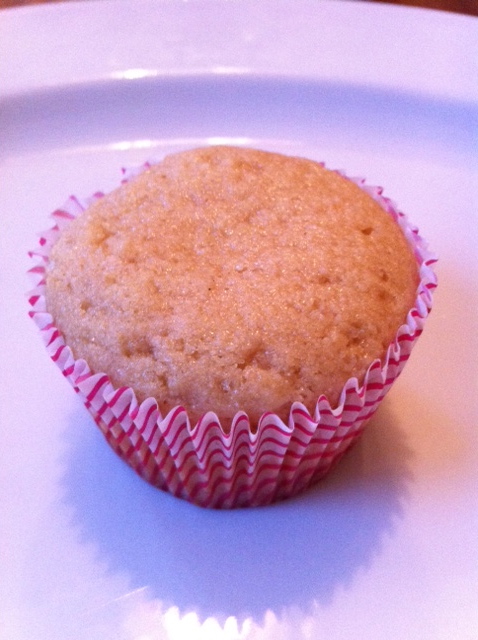
After her sleeping bag ride, she and Joe made cupcakes.

Emma’s Gluten Free Cupcakes (Emma doesn’t like icing- go figure- this is the way she likes it. Bald. She ate two of these, after putting a candle in and singing Happy Birthday to herself.)

Preheat oven to 325 degrees   –   Line muffin tin with cupcake liners

Mix together:   1 C. organic sugar, ½ C. rice flour, ¼ C. coconut flour, ⅓ C. garbanzo and fava bean flour, ¾ C. arrowroot, 1½ teaspoons baking powder, ½ teaspoon xanthan gum, ½ t. sea salt, ₁⁄₈ teaspoon baking soda.

Add, mixing well:   ⅓ C. melted Ghee, ⅓ C. Organic Applesauce, 1 Tablespoon vanilla extract, ½ C. hot almond milk

Pour well combined mix into each tin until they are ¾ full.  Bake for 8 minutes, rotate and bake for another 9 to 10 minutes.

For more on Emma’s journey through a childhood of autism, go to:   www.emmashopebook.com

Day 4

Today begins day 4.  It appears that Emma has a cold – red sore throat, cough, runny nose, slight fever in the morning.  I do not believe her cold has anything to do with going on this new diet.  We began various tinctures last night as well as omega supplements & cod liver oil.  Amazingly she took all of these things with little protest, even swallowed two capsules.  Her spirits are good and while she still isn’t eating much, she is active and cheerful.  As I write this she is singing and doing a dance in the living room.

Last night I took a break and met a friend for a few hours. Just as I was leaving Emma became extremely upset because her carousel book was missing and she couldn’t find it.  Richard pushed me out the door.  “I got this honey.  Go.”

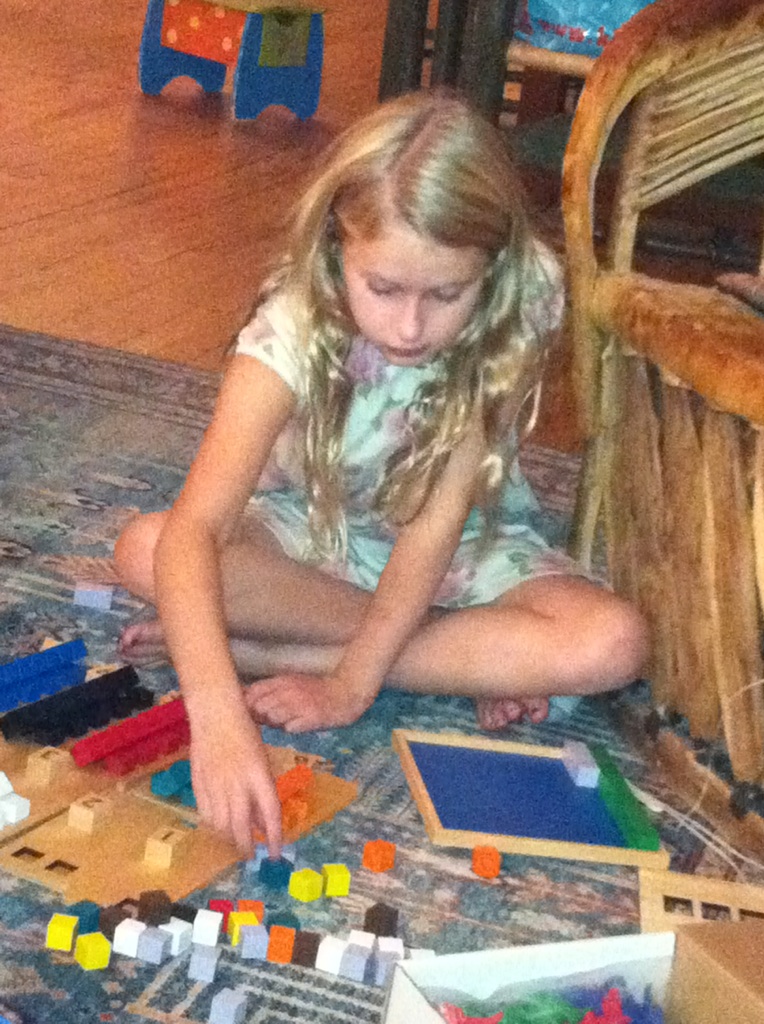
Later Richard texted me this photo.

Evidently Emma came over to Richard and asked if she could play with her math blocks.  (The following conversation is one that Richard texted to me.) “Emma, do you want to play with your pattern blocks or look for your carousel book?”

“Play with pattern box!”

As she played, making patterns, adding and subtracting and making equations, Richard found her much coveted Carousel Book.  He proudly held it up to show her and she barely glanced at it, so absorbed in her math.

“Emma, it’s the carousel book!  I found it!”  Richard was so pleased with himself he could barely stand it, but Emma continued playing with the blocks.  Not one easily deterred, he said, “Emma!  Do you want to read the book or keep playing with the blocks?”

“Keep playing with the blocks.”

“Okay, Emma.  I’ll put it in your bedroom okay?”  He headed to her bedroom.

“Okay.”

Richard turned and said, “Aren’t you going to say thank you Daddy for finding your book?”

“Thank you Daddy.”  Upon which she returned to playing with the blocks for awhile and then very neatly packed them all up in their box again.

When I arrived home Richard told me that when it was time for her to go to sleep, he asked if Emma wanted him to read to her.  But she told him she wanted him to turn off the lights.  Richard asked her if she wanted him to leave or stay with her.  She asked him to stay with her.  Then she snuggled down under the covers and said, “Lie with me.”

This was the first time Emma has asked Richard to stay with her while she fell asleep.

And stay he did.

For more on Emma’s journey through a childhood of autism, go to:   www.emmashopebook.com

Day 3

I didn’t have time yesterday to go into Emma’s response to being told she could no longer have her usual breakfast of the past six years – cheerios with milk and 2 slices of whole wheat toast with butter and raspberry jam or her weekend breakfast of pancakes (mix from William’s & Sonoma) with chocolate chips.  Did I mention she cannot eat chocolate?

I had the foresight to put everything that she can no longer eat into bags, which I then hid or, if it was perishable, threw away.  Except that I forgot about her whole wheat bread.  Sunday morning – Day 1 – there it sat on the kitchen counter like a beacon calling lost ships to shore.  She figured out pretty quickly that things were not going to be “breakfast as usual” and went for the bread before I could grab it or her.  I then had to wrestle her to the ground, as she screamed and tore at my clothing like a rabid beast.  It’s tough to maintain ones composure in such circumstances.  When she realized I intended to throw the bread away, she screamed and clawed at it, eventually crumpling into a heap on the floor, sobbing.  “Nooooooooooo!  Please Mommy.  I want toast with raspberry jam!”

I offered her the granola, then some oatmeal, all of which she refused and finally sat with her as she wept.  I tried to hold her, but she pushed me away.  I know not to take Emma’s rejection of me personally, it’s one of the many things about her autism that has always baffled.  She has never derived any comfort or pleasure from being physically soothed when she was upset.  As a baby it seemed as though she were missing that most basic human instinct, seeking contact from another human being.  It was as though self preservation was not part of her makeup.

Yesterday there was no weeping, but she had a fever and runny nose.

“Classic junkie symptoms,” a recovered addict I know informed me, after I told him what we were doing.

“What do you mean?”

“When I was a junkie, I told my dealer, heroin was great for curing the common cold.  She laughed at me and said – no you idiot.  You’re jonesing.  That was my moment of realization.  I was hooked and I hadn’t known it until then.”

“So what are you saying?  You think this fever is withdrawal?”  I sat down, incredulous.

“Maybe.  Hey I’m just thinking out loud.  What do I know?”

Still his words have stuck with me.  Maybe it’s just a coincidence.  Maybe she has a cold.  Her throat is red and I don’t see how that can be from any kind of withdrawal.  Still it’s weird.  This morning she had a fever again and her “cold” or whatever this is doesn’t seem to be better.

She continues to refuse almost everything offered.  Making whimpering noises whenever I ask her to sit at the dining room table to eat with us.  Today she finally had a slice of ham, some green grapes and some sheep’s milk cheese.  It’s the most she’s eaten in two days!

For more on Emma’s journey through a childhood of autism, go to:   www.emmashopebook.com

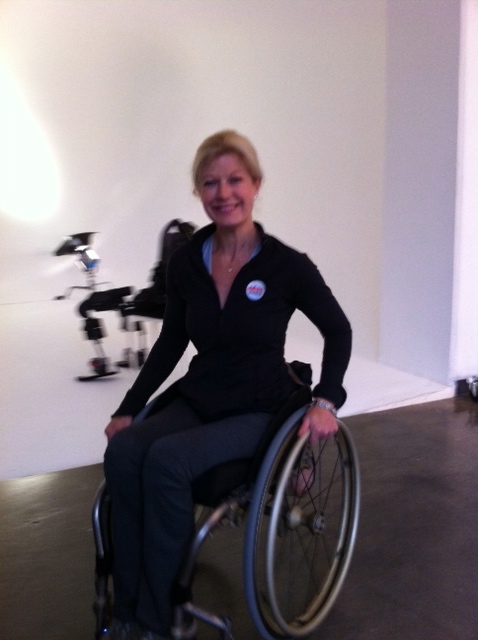
Amanda Boxtel

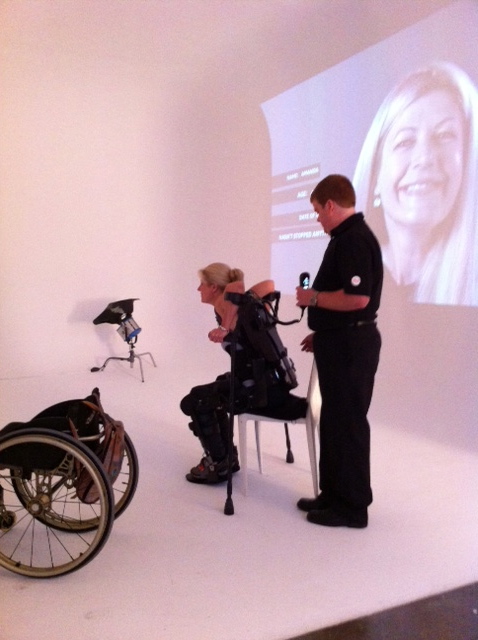
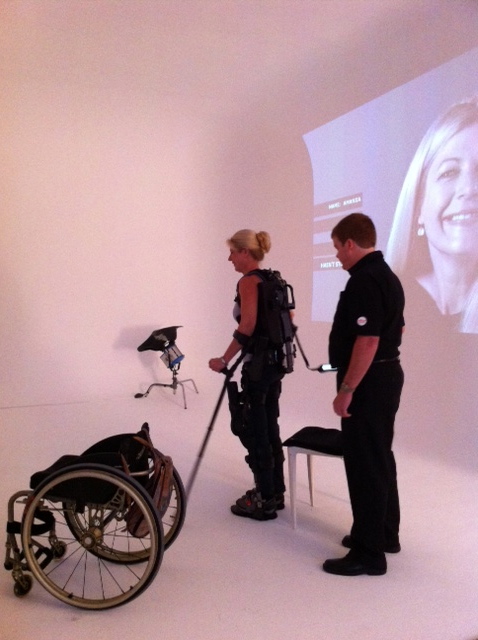
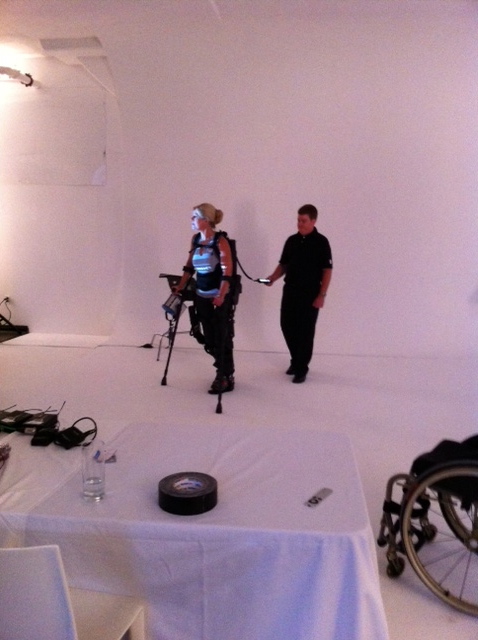
Last night Richard and I went to a launch party here in New York City of Ekso Bionics with a live demonstration by Amanda Boxtel.  Amanda was in a skiing accident over 20 years ago, which left her a paraplegic.  For more than two decades Amanda has lived her life from a wheel chair.

This photo is out of focus and does not do Amanda justice.

Amanda demonstrates the power of Ekso Bionics

This quote is from Amanda’s website.

“Imagine wanting something so badly for years and years—fluctuating between acceptance of what is and hope for something better.  Imagine if that one thing you longed for is to stand tall with your legs supporting your full body weight, and then taking your first step.”

When we took Emma to Costa Rica for her first stem cell treatment, fluid seeped from her spine into her blood stream.  Suddenly she was in excruciating pain and Richard and I were terrified.  Amanda wrote me and her letter, one of many I have kept, was a calm voice of strength and reassurance.  Amanda has been to India six times for stem cell treatments.  She is an inspiration and source of hope for all.

Watching Amanda stand and then walk last night was a visual confirmation of what is possible in this world, if we never give up.  I think of Amanda often as I work with my daughter, Emma. Writing is difficult for Emma, it does not come easily.  But then walking does not come easily to Amanda either and yet she has never allowed that to slow her down.

Emma’s writing from this morning

For more on Emma’s journey through a childhood of autism, go to:   www.EmmasHopeBook.com

A Comment

A follower of this blog wrote the following response to yesterday’s post.  I posted it here as it beautifully sums up exactly what my husband, Richard and I also feel and why we work as hard as we do with Emma.

“I think maybe this is what most parents or carers of children with autism aspire to.  Not to extinguish quirks and unique personality traits, rather to help our children function in this world, to cope, to survive, to find happiness. It is not as simple as just accepting someone as being unique when they can’t go out in public without dropping to the ground and self harming over some issue or they can’t even attend to their own most basic needs when they  become distressed, when there is an unavoidable change in routine, when they cannot even travel safely in a car or bus ( we’ve been there believe me), when they have no way to communicate their needs or to even tell a parent they are in pain or scared or hungry, when they want to reach out to a friend, but don’t know how and so are left friendless, when they struggle to eat because the food repulses them, struggle to even hold a fork or use a knife. That is not something I will accept for my children. I want more for them than that. As a mother I have had to watch my children cry in pain and be unable to hold them in my arms and give them this most basic of comfort, rather being forced to witness their anguish and left helpless. These are things that need to be changed and worked on. If that is a “cure” bring it on I say.”

I have never met the woman who wrote this comment, but we have been corresponding now for awhile.  She has two children on the spectrum, each utterly unique.  Her comments are always thoughtful and insightful.  Though we live on separate continents with several oceans between us, we have a great deal in common.  So, to you Liz – thank you for blazing a trail and sharing about it.  You have helped me more than you can know.

For more on autism and my daughter, Emma’s journey through it, go to:  www.EmmasHopeBook.com

On the Spectrum

I was asked recently why I am trying so desperately to overcome autism.  It’s a valid question and it made me think about the challenge of writing about one’s child in a way that honestly captures that child with all their complexities.  A week or so ago I wrote in my post entitled A Cure – “Emma cannot function in our world, she is not mainstreamed, she cannot take a shower, wash her hair and dry herself off without support.  We are not discussing nuances here.  We are talking about a child who is more than “quirky”.  My husband, Richard and I love quirky.  Quirky is GREAT!  We’ll take quirky.  But that’s not what Emma is.”

To me, that summed up why we continue to search, why we continue to try various things, but it does not adequately describe Emma.  Emma cannot function in our world without hands on support.  We cannot have a conversation with her or ask her questions.  I am still trying to capture Emma on video and post some clips on here, but haven’t had the time to do that yet.  The question I began this post with, made me realize that for someone reading this blog they cannot know her through my writing.  Perhaps one gets a sense of her, but there’s too much left out, too much I don’t think to mention, the cadence and inflections of her speech, the words, which I can understand, but which may not be understood by someone else.  I try to give an accurate portrait of her, but in the end, it is just that, an interpretation and not representative of the whole.

When we first received Emma’s diagnosis I was determined to find a “cure”.  I felt sure that I would find one too.  (Hubris?   Arrogance?  Ignorance?  Stupidity? Denial?  All of the above?)

After those first few years I realized I might not find a cure for what ailed Emma.  And after another few years and three trips to Central America for stem cell treatments under our belt, a “cure” seemed more and more elusive.  I have come to accept that.  Perhaps more importantly, I am less focused on the miracle of a cure and more focused on pushing Emma to expand her world.  There’s a balance we have tried to achieve with Emma.  We try to follow her lead whenever possible, but we also encourage her to stretch and do things beyond her comfort zone.  Our most recent attempts to expand her diet is a case in point, her literacy and math program are another.

Which isn’t to say that I don’t continue to research and do everything in my power to find treatments to help her.  I am convinced Emma’s digestive issues are exacerbated by her environment – the foods she ingests, the air she breathes, the water she drinks.  This Friday I am taking Emma to a doctor who has worked with hundreds of children on the spectrum.  He and I spoke on the phone yesterday for over an hour, going over her history, her GI issues (inflammations and ulcerations), chronic constipation, recurring strep throat, porous teeth, cracked heels and limited diet.  While a few years ago, I would have eagerly anticipated this appointment with the same degree of excitement the devoted view a visit from the Pope, I no longer do.  I have come to see all of these people, no matter what letters may follow their name, with tempered interest.

Last week Emma’s school bus matron told us Emma refused to buckle her seat belt and when the bus matron tried to help her, Emma kicked her hard in the chest.  We immediately went over with Emma the behavior we expected from her.  We rehearsed buckling her seat belt and made sure she had her ipod and ear buds with her so she could amuse herself once she was seated.  We went over the importance of not hurting another person.  We tried to consider what sort of support she might need to help her control herself.  We are lucky in that Emma seems to have understood and has not struck nor tried to get up from her seat while on the bus since.

As we waited for her bus this morning, I coached Emma, “Emma, it’s nice to say good morning to people.  She’s a nice lady and saying – Good Morning – will make her smile.

When Emma boarded the bus this morning she said, “Good morning, nice lady.”

The bus matron beamed.

There are many people with an autism diagnosis who are on the “mild” end of the spectrum or fall in the “gifted” category of Aspergers or are considered “high functioning”.  These children are often mainstreamed or learning at grade level or above.  And while they have tremendous hurdles, often requiring support into their adult lives, they occupy a different level of hurdles from those who, like Emma are moderately autistic.

I had a friend whose child was unable to walk or even lift his head.  He, too, was diagnosed with autism, though severely so.  That child faced developmental and physical problems far beyond anything Emma has had to deal with.  For me to compare the two would have been ludicrous.  At this point my goal is to get Emma to a higher level on the spectrum.

For more on Emma’s journey through a childhood of autism, go to:   www.EmmasHopeBook.com

Emma and Food

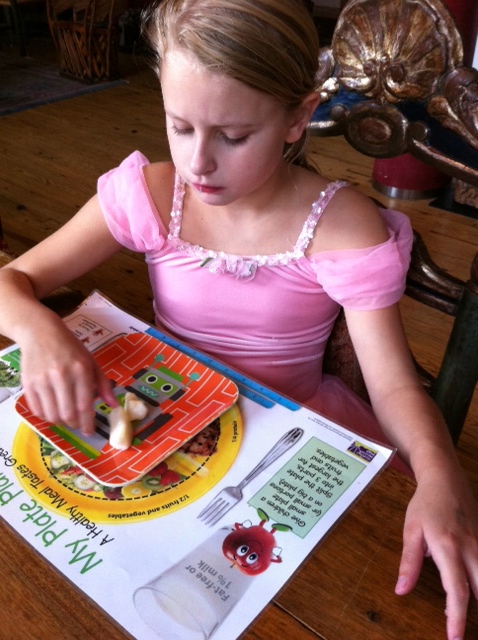
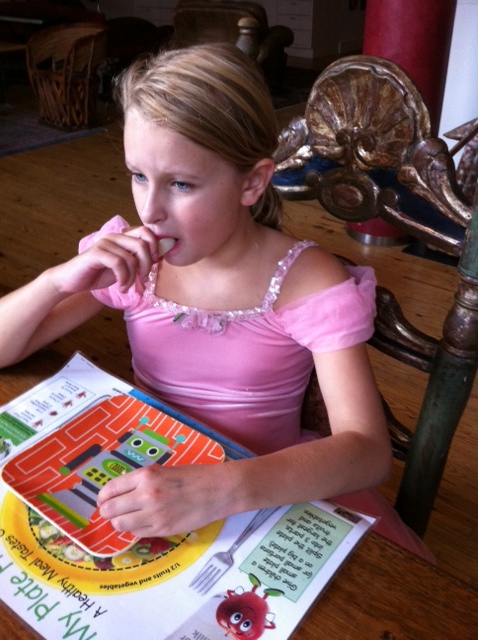
I have been keeping a chart of the new foods Emma has tried these past six days.  To date she has sampled:  pear, banana, apple, blueberry, raspberry, watermelon, honeydew melon, papaya, raisin, dried apricot, homemade granola, oatmeal with banana and raisins, chicken, (catfish, kale – totally pushing my luck last night with those two)  and the piece de resistance – vegetable frittata!  To date her favorites are watermelon, pear, banana, apple, raisin, chicken and the frittata.

I am also reading the Gut and Psychology Syndrome (GAPS) by Natasha Campbell-McBride.  It is a diet created by Dr.Campbell-McBride who “healed” her own son diagnosed with autism.  It is a daunting proposition, which requires one to forego almost all foods (saving a meat broth which one is suppose to consume every 30 minutes or so) for a few days to several weeks in order to allow the gut to heal before slowly introducing easily digested foods until eventually the child is able to eat a wide range of foods.   This diet is so draconian in the beginning, it makes going gluten and casein free look like a picnic.   Still I continue to do my research.  I guess you either have to laugh or cry.  I’m going with laughter at the moment.  Tears to follow, I’m sure.

Over the long weekend we took the children to the New York Botanical Gardens.  It was in the 80’s and gorgeous.

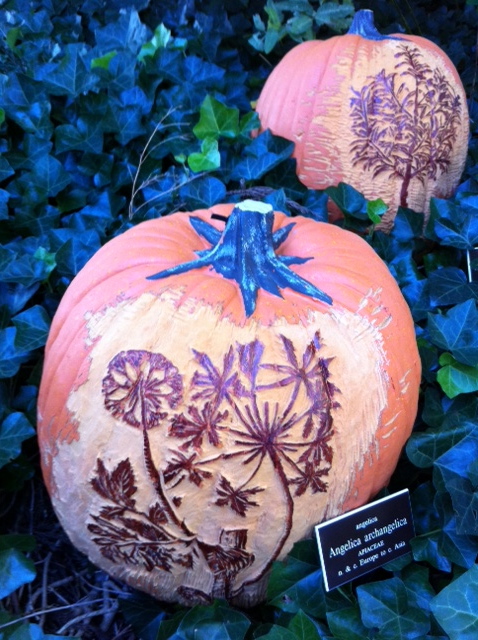
The Haunted Pumpkin Garden

The “Herb” Garden

As delightful and creative as these pumpkins were, Emma was much more concerned with getting on the tram that runs through the grounds of the Botanical Gardens.

“She loves various modes of transportation,” Richard observed when we finally secured four seats on the tram.

Yup.  That’s our Emma.

For more on Emma’s journey through a childhood of autism, go to:   www.EmmasHopeBook.com
Em

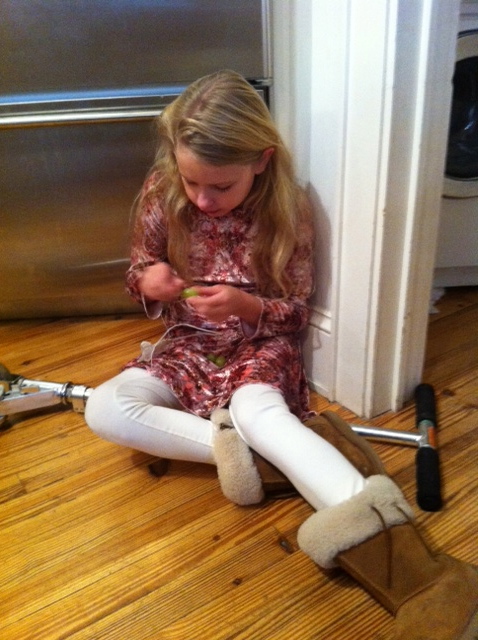
Emma holds an uncanny resemblance to a fictitious children’s book character.

Okay, so we haven’t gotten the whole handstand-on-the-handlebars thing down yet, but I’m sure that’ll be next.

Merlin watches and waits.

He just cannot help himself.

Food update:  Emma ate a blueberry last night.  This morning – one blueberry, (not her favorite) a slice of apple, a slice of pear and a piece of banana!

After eating all of that she said, “No more medicine.”

I’ve got my work cut out for me.

For more on Emma’s journey through a childhood of autism and our attempts to help her, go to: www.EmmasHopeBook.com

Emma and Food

I’ve written about this before – Emma’s limited diet.  It’s self-imposed.   As her parent and someone who struggled with an eating disorder for 22 years, I have been reluctant to get too involved in her food other than to make a few half-hearted attempts to offer her other foods I thought she might like.  By the way, Nic, her older brother eats a wide range of foods, even eating a curried rice with cauliflower and chickpeas dish I made the other night, without complaint.  (He was being a good sport, I know.)

When we first received Emma’s diagnosis I immediately put her on a gluten free/casein free diet as so many families found it helped their child.  Some even found their child lost their diagnosis after going on it.   We had her on the diet for more than three months and saw her lose 10% of her body weight with no other noticeable change.  At the time we were working with a DAN (Defeat Autism Now) doctor, who specialized in allergies and nutrition.  During that time she became even pickier about what she’d eat and by the time we took her off of the diet, she was eating soy yogurt and scrambled eggs, shunning “good” foods she once ate, such as vegetables, chicken or fish.  Years later someone told me that soy is another food to be avoided and that may have been the reason we saw no change.  All these years later, I still wonder whether we did the diet wrong, if we’d removed all soy products, perhaps we would have seen some significant change.

A friend of mine suggested the GAPS diet, created by Dr. Natasha Campbell-McBride who “fully recovered” her own child with her diet.  The problem is, there isn’t a single thing allowed on this diet that Emma currently eats.  In addition it is a labor intensive diet, requiring one to make homemade condiments – such as mayonnaise, ketchup, etc as well as yogurt.  BUT – I am still willing to look into it and have purchased the book describing the diet as well as the cookbook with various recipes.  (Richard is groaning as he reads this as he no doubt is remembering the fanaticism with which I tackled the GFCF diet.)

Before I even contemplate starting the GAPS diet, I will take her to a new pediatrician who is said to be versed in autism and am trying to encourage her to try some new foods.  I intend to document our progress and (hopefully) hers on this blog.

Last night I introduced Emma to a piece of Comice pear, peeled.

She was tentative, but eventually after smelling it, licking it and touching it, she finally ate it!

This morning I gave her a small bite of a Fuji apple, which she immediately picked up and ate without hesitation.  Tonight I will go out on a limb and try a raspberry.

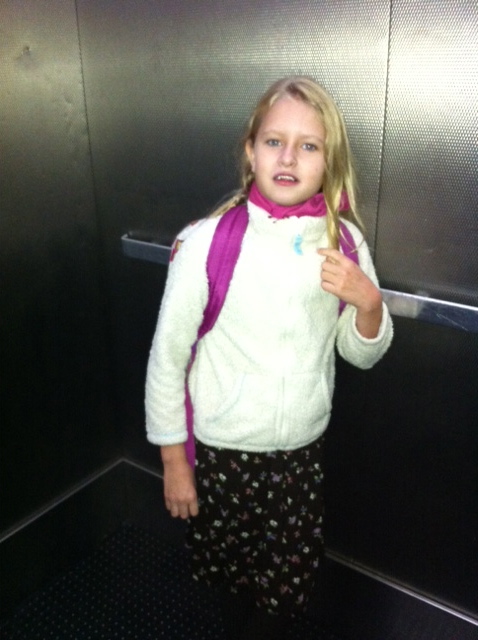
Emma on her way to the school bus this morning.

If anyone reading this has had success with any sort of diet, please contact me with what you tried and any progress you saw in your child.

For more on Emma’s journey through a childhood of autism, go to:   www.Emma’sHopeBook.com

Waking Nic – Autism

Last night Emma woke Nic up – again.

“No Mom, it was really bad.  She woke me up like five times. I swear Mom, FIVE times,” he held up one hand and wiggled all five fingers at me.

“What did you say to her?” I asked, stroking his somewhat greasy hair, while wondering if I should insist he wash it before school, then deciding he would be late for his bus and anyway it wasn’t all that bad.

“I told her she had to leave.”  He leaned against me, and said, “I told her – Emma!  You have to go back to your own room.”

“What did she do?” I asked.

“She went back to her room.  But then she came back. Like at three, then five, then six.”  He looked at me and pretended to fall asleep, collapsing in a heap on my lap.

“Hey Emma!” I called.  “You cannot wake up Nic.  It’s not okay to wake up Nic.”  But if I’m telling the truth, I was just a tiny bit relieved that she woke up Nic and not me.  I rationalized this “bad mother” thought with – He’s young and can handle sleep deprivation much better than I can.   Meanwhile Nic continued to mime sudden unconsciousness by falling on the ground, back on his bed, then into my arms, like some sort of narcoleptic preteen.

“You cannot wake up Nicky!”  Emma parroted, using her stern voice.

“Yeah, Em.  That’s just not cool,” Nic said.

I told Emma that since she woke up her brother, she couldn’t bring her  beloved “string” (a piece of packing tape) out of her bedroom.  She was very upset by this and said, “You cannot wake Nicky.  But listen, if you wake Nicky no string.”  Then she began to cry.

By the time it was time to go down to wait for her school bus, Emma was calm and said, “It’s okay.  Next time you cannot wake Nicky.  Then string can come out of the bedroom.”

I gave her a hug.  “That’s right Em.  It’ll be okay.”

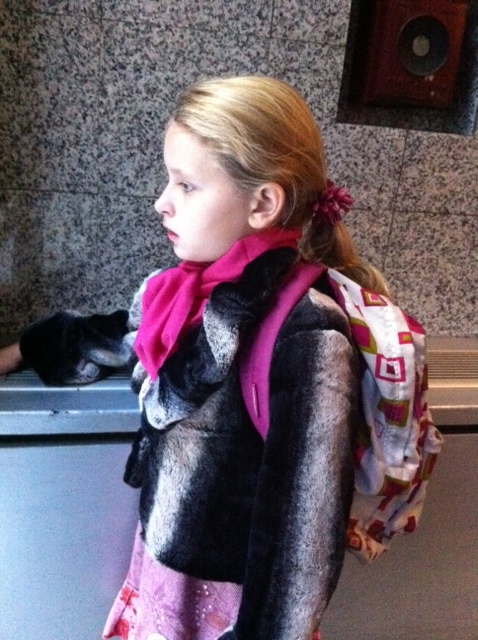
Emma waiting for her bus this morning wearing a “pretty dress”.