Category Archives: Parenting

Muddying the Water: Alleviating Pain ≠ “Recovery”

A few months ago I wrote about how, once we were given an autism diagnosis for our daughter, so many of the things we believed were uniquely and wonderfully “Emma”, were suddenly thought to be examples of her “autism”.  Things were either categorized as a deficit or a “splinter skill”.  Splinter Skills and Other Words We Use concentrated on talents, interests and abilities.  My friend, Chavisory reminded me yesterday of the physical issues often mistakenly believed to be part of autism.  Things like allergies, insomnia, GI problems, epilepsy and food and eating challenges that often people who are Autistic have, but that many in the general population also experience.

Chavisory mentioned in her comment, a NYTimes article about a drug trial thought to minimize social withdrawal in Autistic people and those with Fragile X.  She wrote, “social withdrawal is not actually a core feature of autism. It’s a consequence of deeper issues with language, sensory processing, and motor differences.” Chavisory’s point is an important one.  This distinction is critical.  Not only because researchers are often trying to treat something that is actually something else, but because it confuses caregivers into believing they can “cure their child of autism”.

When a non autistic person has food allergies or insomnia, we say they have food allergies or insomnia. When an Autistic person has a food allergy or insomnia, many believe it to be yet another aspect of their autism.  People talk about “co-morbid” diagnoses of an Autistic person as though it were all folded into the autism diagnosis.  The problem with all of this is, it muddies the waters and makes people misunderstand what autism is and isn’t.  And it opens the door for many to believe they are curing their child of autism.  Taking care of allergies, GI issues and insomnia will not make an Autistic person non Autistic, however it will make them feel a lot better.

When an Autistic person with food allergies or debilitating insomnia, who also has hyper sensitivities to texture, taste, smell and sound, is given melatonin to help them sleep or a diet that complements their specific constitution, it stands to reason they will exhibit behavior that reflects that.  When anyone, who is in extreme pain and exhausted is helped to have that pain and exhaustion alleviated, they will feel better.  They will be able to smile perhaps, focus, be more alert, even engage in conversation, with an ease they would not exhibit when overwhelmed with pain and exhaustion.  But when this person happens to be Autistic, people use language suggesting their “autism” has been reduced; words like “recovery” and “cure” creep into the conversation.

Suddenly people become convinced that every Autistic person has food allergies, GI issues and sleep disorders and therefore ALL should do x, y or z.    If that doesn’t work, instead of questioning the underlying issue (that perhaps this person does not have an allergy or insomnia)  many will up the ante by doing more radical “treatments” to treat an allergy or condition that the person actually does NOT have.   Logic falls away.  Common sense is rejected.  The pursuit of a perceived “problem” that may have never existed is discounted as not the problem.   The answer is to pour more money into finding the thing that will remove the “autism” even though autism is not what is causing the pain and discomfort.  Special doctors and “autism specialists” are brought in to advise and treat.

When we start throwing all kinds of things at an “autism” diagnosis, when a massive array of physical and emotional things get added, when temperament, interests, preferences, talents become embedded in the “autism” diagnosis we are causing far more confusion and problems to an already confusing diagnosis.  And people misunderstand and say they’ve “recovered” their child or their child has been “cured” instead of recognizing that what’s really happened is they found something that helped their Autistic child, who had allergies or insomnia feel better.  Meanwhile thousands more, who pursue similar ‘treatments’ with no benefit to their child, conclude they need to find a better doctor, or treatment, or diet instead of acknowledging their child doesn’t have an allergy.

Em listening to an opera rehearsal over the weekend 

*Emma

From Cure to Celebration

Yesterday Richard wrote a wonderful post on his blog entitled ~ Happy Father’s Day.  In it he talks about being a father and how having children has changed him and his life.  He ends the post with, “To all our children, thanks for making our lives matter!”  I love that.  That’s it, right there.  That’s the feeling I’ve had, but couldn’t find the words to so beautifully or succinctly express.

Richard also wrote, “…We got a beautiful boy, Nic. Eighteen months later, we got a beautiful girl, Emma. One of each, as they say. We got “one of each” in another way, too. One autistic, one not.”  I read that and smiled, because it’s so true.  We have been fortunate enough to have a child of each sex AND of two different neurologies!  Three years ago I would not have been able to write any of this, I was still in the – Autism is tragic – mindset.  But happily all of that has changed. Some people object to those of us who have chosen to celebrate our child’s neurology.  They say we are sugar-coating what is real and difficult and makes it seem less serious than it is.  I disagree with that thinking.  I think we can still acknowledge the massive challenges our Autistic children face in this world, while still celebrating who they are and the beauty of their specific way of thinking and being.

I do not, for a second, believe that my daughter has an easy time or that she will not face all kinds of things a non Autistic peer would not have to deal with, but I do not need to increase her challenges by not accepting her, believing in her and celebrating her, exactly as she is, now, in this moment.  Adding my expectations, despair and ongoing critique and comparison of her, to the very real issues she must cope with on a daily basis does not make her life easier.  And I really want to make her life easier, not harder.  I’d like to be the person who champions her, makes the bumps she will inevitably face a bit less bumpy and help her navigate some of the twists and turns of life, by giving her acceptance and unconditional love for every aspect of her being.

I keep thinking about all our children who have trouble speaking, how when they are able to communicate in some way, either through typing or speaking, we non autistics are far more likely to listen and assume intelligence than not.  I keep wondering what would happen if all our time, money and energy were spent on finding ways to help our children communicate through typing and other AAC devises, instead of on cures; would we see a shift in society’s perception regarding autism?  Or would all those people dismiss their words because they are written and not spoken?  Amy Sequenzia writes about this ‘here‘.

You see, we were one of those families who pursued the bio-med route.  For years I tried all kinds of things, thinking we could cure.  As long as I believed in a cure, everything else took a backseat.  What I didn’t realize was that accepting and celebrating my child, fully and without amendment was the answer I had been looking for in all those doctors and specialists who claimed cure remedies.  The remedy wasn’t a cure, the remedy was celebrating the child I have, exactly as she is – that’s the remedy.

Nic & Em


To My Father

I had a complicated relationship with my father.  One of my earliest memories of him was when I was no more than four years old.  I knocked on the door to his “in home” office and waited for permission to enter, just as I’d been taught.  Upon being told I could come in, I went over to his desk where he was seated and asked, “Why don’t you ever call me into your office?”  He smiled at me and replied, “Because you never do anything wrong… yet…”

It was the early 60’s.  Having children was not viewed with the same kind of thoughtful consideration it is given, by many, today.  Mothers were expected to stay home, while fathers were expected to go to work.  In-home offices were considered unusual.  Personal computers did not exist.  My father made notes and calculations on hundreds of pieces of paper.  It wasn’t until I was in my twenties before I could reliably decipher his illegible scrawl.  During my teens I fought with him daily.  I was more in touch with my animosity toward him than love.  During my twenties, his glaring deficits outweighed his assets.  It wasn’t until my mid-thirties that I was able to begin to forgive him.  My last memory of my father, aside from his actual death, was when I went to visit my parents after a grueling and unexpectedly, emotionally, draining trek in Nepal.

I can still remember the sound of the gravel under the wheels of the car as it drove down the slight incline of their driveway.  I can still picture my father seated in his wheelchair waiting for me, under the fig tree to the left of the front door.  I can still remember the feelings of emotion – relief, love, exhaustion and gratitude – that I felt upon seeing him there waiting.  I ran to him, crouched down so I was eye-level and threw my arms around his neck.  I remember the words I whispered into his ear as tears streamed down my face,  “I am so happy to see you.  I love you so much,” I said.  And then I kissed his wrinkled, tanned cheek and didn’t let go.  “I am so grateful you are here,” I said between sobs.

I remember the look on his face, the emotion expressed in those blue, blue eyes of his.  He smiled at me with so much adoration and love and said to my mother, with a slight grin, “I think we should send her off to Nepal every year.”  And then he placed his hand on my head and stroked my hair as I wept.

That is my favorite memory of my father.  Not six months later he was dead.  I am as grateful for that memory today, as I was seeing him that day, now so long ago.

Emma - 2008These are your grandchildren… (Taken in 2008)

Nic -0 2008

But What About Alex?

Another Autistic child has died… stabbed… multiple times, in the chest, by his mother. Alex Spourdalakis was 14 years old.

The mother of a 14-year-old with severe autism who was found stabbed to death…” ~ Daily Herald.com

But what about Alex?

The mother of a 14-year-old with severe autism…” ~ Pantagraph.com

But what about Alex?

First degree murder charges have been filed against Dorothy Spourdalakis, the mother of a teen with severe autism…” ~ abclocal.go.com

But what about Alex?

A young man. Stabbed. Not once. Multiple times.

We hold these truths to be self-evident, that all men are created equal, that they are endowed by their Creator with certain unalienable Rights, that among these are Life, Liberty and the Pursuit of happiness.” The United States Declaration of Independence – 1776

But what about Alex?

In the 237 years since those words were first written we have failed miserably at putting this idea into practice. All human life is not treated as equal; apparently it is not “self-evident”. We continue to live in a world where equality is still desperately sought by a great many.

For those who are born unable to speak and Autistic, those among us, who are given the label “severe”, their lives matter even less. We not only think of ourselves, (those of us who are able to speak and whose neurology is not Autistic) as superior, our lives deemed more worthwhile, but we are reminded of our superiority every single day of our existence, just as those who are born unlike us are told in myriad ways how they are not.

Autistic people, particularly those with multiple physical challenges, are spoken of as “burdens” to society, they are talked about as though none who are Autistic are capable of understanding the words being used to describe them. They are not consulted. They are not listened to. For the most part they are being ignored. And those who are raising their voices in protest, who dare to speak out against the crimes committed against them, they are met with resistance, anger, indignation. They are often ridiculed, dismissed, silenced or simply ignored.

When a parent murders their child, we cringe in horror. When that child is disabled we sympathize. The media brings in psychologists to help us understand. We dissect the child’s history, we look for clues, what could have provoked a parent to do such a thing? Sometimes we conclude the parent was crazy and unfit, but not before we make sure there was nothing unusual about the child. As we rally around, trying to distance or identify with the parent, Alex and those like him are all but forgotten. His life is seen as an example of what some must endure. His life becomes an illustration of that burden on society that everyone wishes would just go away.

But what about Alex?

What about what Alex had to endure? What about what it must have been like to live his life for those 14 years? Where are the news articles discussing who this young man was? What did he love? What were his passions? What made him happy? What must it be like to not be able to speak? Did he communicate through typing?  Did he read and write and if so what did he like to read?   What was his favorite subject?  Did he love music?   Did he like animals?  Was there something special he enjoyed doing?

What about Alex?

Alex


Another Way to Silence – Shame

Shame has a long and twisted history.   Over the centuries it has been used to coerce, to convert, to make people compliant, to keep people in line.  I’m not sure there is a “healthy” aspect to feeling shame, though I may be in the minority here as this article states, “Embarrassment and shame are important in the regulation of social behavior. Both emotions tend to occur when rules have been violated.”  But what if those “rules” are not actually in place for the good of ALL?  What if those societal “rules” serve the majority, but actually are a disservice to a minority?

The argument that without shame we would all resort to violent, unethical and amoral behavior is one I don’t agree with.  Plenty of people behave badly who are filled with shame, often as a direct result of the burden of shame they live with, but usually those who feel tremendous shame hurt themselves more often.  I question how often shame, actually motivates us to respond in positive and constructive ways.  In most cases, it seems to me, shame is less a controller of bad behavior and more an instigator of self-betrayal and self harm.

Shame is what people feel who have been on the receiving end of violence, violations, betrayal and abuse.  Numerous studies have linked shame with depression, suicidal ideation, post-traumatic stress, rape and incest.  The very people who could actually use a little shame appear to be without, while those they victimize carry the vast portion of it.  In these cases, shame is the emotional equivalent to metal restraints, intended to keep people in check, compliant and silent, particularly when used on children or a group of people who are already in the minority.

Many of the methods used, with supposedly great success, on Autistic children, has created a population of adults who feel tremendous shame, lack self-esteem, feel inferior, have anxiety, live with ongoing debilitating stress, all of which exacerbates the very “behaviors” these therapies attempted to remove.   The unending destructive cycle shame creates, does nothing positive for anyone, least of all our children.

I believe shame keeps us from flourishing.  It causes us to doubt, to become hyper aware, self-critical of our desires, our urges, our instincts.  Shame makes us feel incapable, unable, frozen and of little value.  From my perspective, shame is far more damaging than it is “healthy”.  Shame is exactly what I do not want my children feeling.  Ever.  In fact, shame is a warning sign that something has been taught improperly.  If either of my children exhibit shame about something, it is a signal that more needs to be discussed.

I do not want my children behaving in a certain way because they feel shame if they don’t.  I want my children behaving in a kind and loving manner towards themselves and others because they have learned it feels good to do so, because they have come to see that self-seeking, hurting others, gossip, betrayal and acts motivated by resentment and vindictiveness lead to more harm and like-minded behavior. All behavior is infectious.  All behaviors, good or bad can provoke others to do the same.  I am not naïve enough to believe it’s a given, but I do know that I like myself far more when I am kind and being of service than when I’m not.

I hope my children are learning the antithesis of shame and silent compliance, which is a strong sense of self-worth.  I want them to know now, while they are still so young, the beauty and joy of a healthy sense of self, that wonderful feeling of liking who they are as human beings, that feeling we are born with, but that over time can be taken from us.  I want my children to be in touch with those wonderful feelings of curiosity, awe and joy, so that when they make mistakes they aren’t destroyed by them, overwhelmed with shame and become silent.  I want to bolster them up, reassure them, encourage them, support them, so one day, they will be able to give hope and encouragement to someone else who may desperately need it.

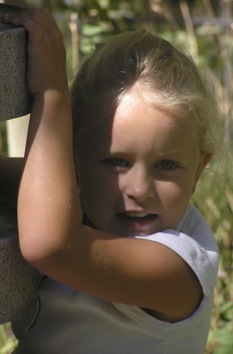
Emma – three years old – 2005 

2005

A(nother) Performer in the Family

I asked Em if it was okay to post the following photographs of her.  She said, “Yeah!  Post on blog!”

“But is it okay to first post on Facebook?” I asked.  And again without hesitation Em gave me an enthusiastic thumbs up.

I have to admit, whenever Em says yes to me, regarding posting an image of her or something she’s said or typed, I feel more than a little ambivalent.   I wonder if she fully understands what it means to post on Facebook or here on the blog, despite my lengthy (and more than one) explanations of what this means, how many people may see it, who those people are or might be.  People remind me of the importance of listening.  And part of listening is to also honor and respect what I hear.   I’m trying to do that, while also trusting my own instincts and hopefully I’m getting it “right” more often than not.

I compare Emma’s response to her older brother’s, who has made it known to us that under no circumstances is he okay having us post his photograph, except on very rare occasions when he’ll shrug and say, “Seriously, Mom?”  There’s usually a moment when he stares at me with a slight grin and then says, “Yeah, okay.”  But my daughter is not like her older brother.  My daughter has a completely different personality.  Emma, adores the spot light.  If there is a stage, she will head for it.  If there’s a microphone, she will grab it, if there’s a crowd she wants to be in front of it, preferably singing.  Emma does not have inhibitions, she does not worry about what others will think or may think.  Emma has that wonderful ability to be herself among strangers and doesn’t modify herself in accordance with what she thinks they may or may not like.  Emma is MY role model!

What follows are the photos I asked Emma if it was okay to post, to which she said cheerfully, “Yes!”

First there was this…

1Em

And then this...
2Em

And finally, this…
3Em

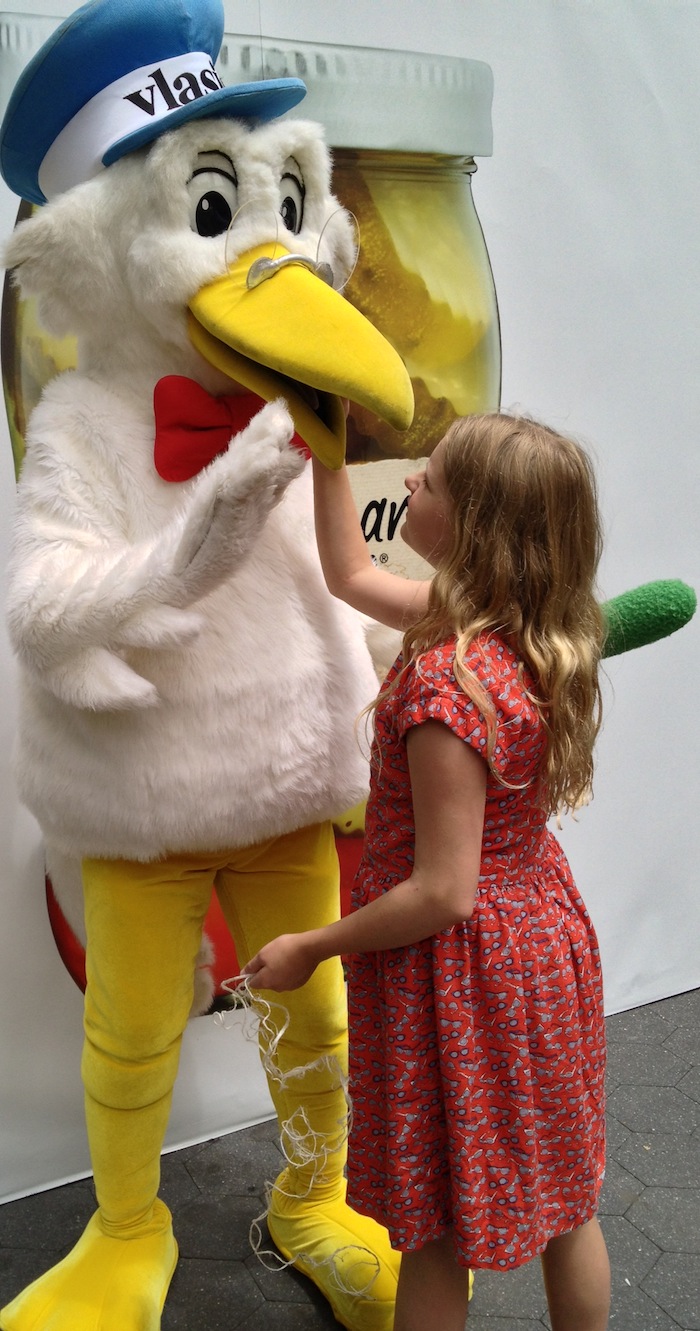
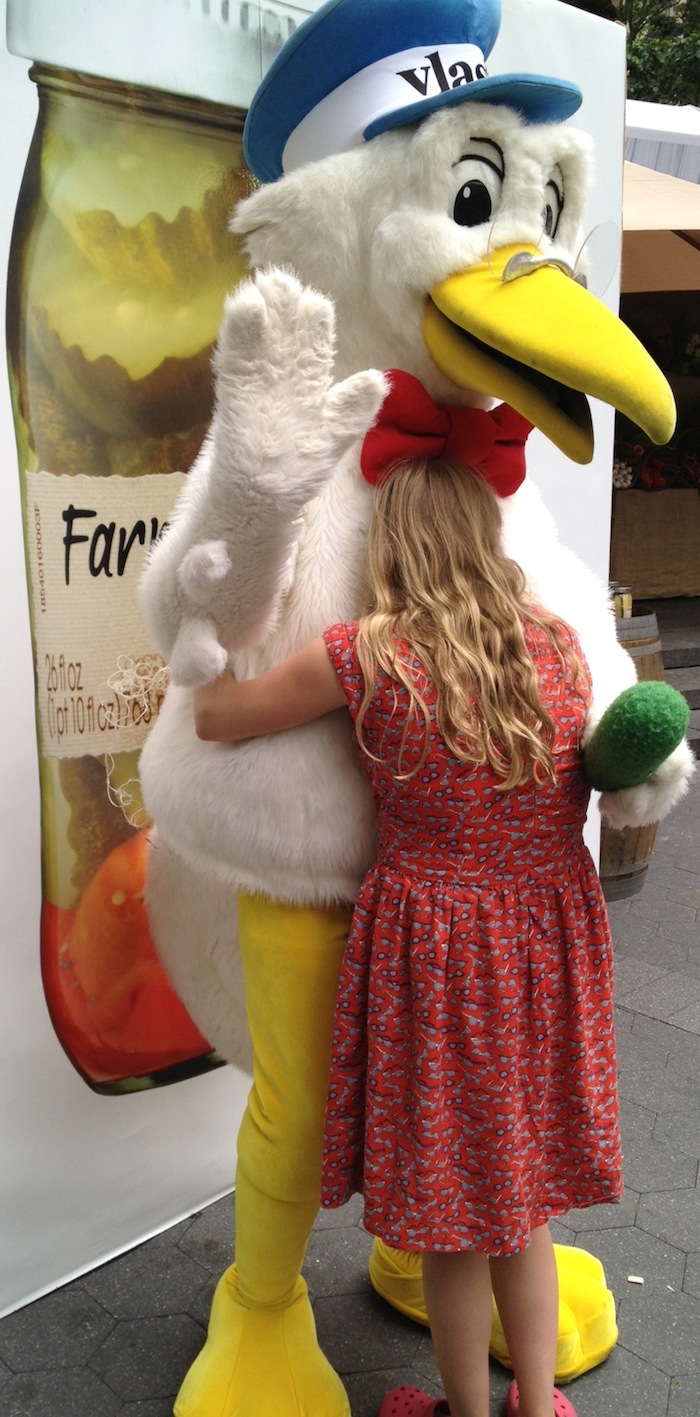
Okay, I don’t know about the rest of you, but for some reason Emma hugging the Vlasic Pickle Mascot makes me tear up… Every. Single. Time.

*A quick side note – the Vlasic Pickle mascot is a stork. Why, you might ask? Well, I googled it and found out that in the ’60’s their tag line was, “the pickle pregnant women crave…”

I have to run, because Emma’s mom is in a flash mob today outside the stock exchange…  yeah, you read that right.  YouTube video to follow…  😀

A Word Of Thanks

A friend of mine hasn’t been feeling well.  She had a cold or maybe it was the flu.  When she wrote me I could tell by the uncharacteristic abundance of typos that she wasn’t feeling great.  I thought about her, hoping she’d feel better soon.  And then yesterday there she was, so much better, her old self, witty, funny, silly, and I felt tremendous relief.  I hadn’t realized how concerned I was until she was better.

When I was nine my father went horse back riding.  It was a Wednesday.  He and my mother always went riding Wednesday afternoons.  I was home, sick with the flu that afternoon.  I remember staring out the window of my bedroom, the sunlight far too harsh forced me to turn my head from its glaring light.  My father told me he’d look in on me when he returned.  He never did.  At least not for a long time.  That afternoon he fell off his horse and, as luck would have it, he did not die as, those who administered to his broken body, predicted.  He did not die, but he was never the same.

Sometimes our lives change so suddenly it is impossible for our minds to keep up.  Sometimes it takes years to fully appreciate how one second can change so much.

When Emma was born, I could not have anticipated how completely my life would change as a result of her being.  It took years for me to process, to catch up, to fully appreciate the magnitude of one child’s existence and all that would occur as a direct result.  I could not have imagined how completely her life would change mine.   And now, today, in this moment I can say with complete and utter conviction, her life has made mine infinitely better, infinitely more enriched, infinitely more meaningful.  Her life.  Her existence.  Selfishly, and I do mean that literally, selfishly, I have benefited so completely from her being in this world, it takes my breath away.

In any given moment our lives can change.  Just like that.  And in that moment we have no way of knowing where we will be led.  Awhile ago I made a choice.  I didn’t think of it as a choice at the time, but I see now, that in fact it was.  I chose to view the things that have happened in my life as moments of possibility.  As long as I am allowed to live, each moment is a possibility to learn, to grow, to be open to new ideas.  I can say that easily now.  I understand this.  As lives go, mine has been a privileged one.  My perceived “hardship” is nothing compared to what so many have endured.  I do not say any of this flippantly.  This choice I made has been relatively easy to follow.

When my friend was sick I worried, when my father almost died I was devastated, when my child was diagnosed I despaired, but these things happened regardless of my response.  My response to them didn’t change their occurrence.

In this moment it’s raining outside.  Drops of water plop erratically on the air conditioning unit outside my studio, the clouds drift lazily along, skimming the tops of the multilevel buildings I see outside my window.  The red brake lights from the cars careening along the interlaced roadways create a moving collage as they speed off and on the exit ramps of the 59th Street bridge.  In this moment I am safe, my husband is safe, my family is safe, my friend is feeling better…  In this moment, in this brief moment, all is well and I am filled with gratitude for all I have.  I am filled with appreciation for the enormity of how one life has so profoundly changed my own in ways I could not have dared imagine.  I am humbled, knowing I will never be able to fully repay the gifts she has given me.

Beautiful Emma

Em


We Are in This Together

It is in our best interest to remember that we are all the same.” ~ Barb Rentenbach in her book, I Might Be You.

One of the most insidious and destructive messages parents are given about their Autistic child is “the list.”  I am referring to that list of deficits we are given.  The list that enumerates all the reasons why our child has earned the “autism” diagnosis.   It is a list that divides.  It sets us a part from our child.  It makes us question our maternal instincts.  It makes us wonder what we did wrong.  It is the list that becomes our to-do list.  A list of things we now set out to “fix”.  Or so this was my experience when my daughter, Emma was first diagnosed.

That list, filled with judgment, a critique of my not-yet-three-year-old child, the same child that just moments before, I knew was different from what I expected, different than my son, yet still was a part of, was now branded with “other”.  If we are going to make such lists, I think it only fair the “evaluator” and all members of the human race be given similar critiques.  I would be curious to see how each of us stands up under such scrutiny.  Let us be evaluated by someone who does not share our particular neurology.  Let us each be judged by another – another who deems themselves superior.  Let’s see how well that plays out.

Loneliness is the most predominant side effect of our unique design. Many times, autistics revert to isolation by default rather than preference. It is infinitely easier to back away and not try to be included instead of oafishly stepping in and attempting to convey you intend to be a part.” ~ Barb Rentenbach in I Might Be You.

Have you ever felt like a fraud?  Have you ever said something to someone only to realize you said the wrong thing?  Have you ever been in a social situation and left, wondering why you feel uneasy, upset or just sad?  Have you ever spent time in the presence of a group, yet felt lonelier than had you been alone?  Have you ever had the thought that if people really knew you, they wouldn’t like what they found?  Have you ever felt separate from, less than, not good enough?  Have you ever felt critical of the way you look, the shape of your body, the size of a particular body part and wished it were different?  Have you ever thought if only that part was smaller, larger, different, if only the number on the scale was less, if only your hair was lighter, darker, straight, curly, your skin was a different shade, your height…  Have you ever thought if only X was different, I wouldn’t feel this way?

Remember a time, no matter how brief, when you felt that magical euphoria of connecting with another human being?  That moment when you felt the wonder and bliss that only comes with friendship and love, the beauty of connecting with another?  Remember what that felt like?  Wasn’t it beautiful?  Wasn’t it unlike anything you’ve ever felt?  A kind of anything-is-possible feeling?  A feeling of all being right with the world, that joy of knowing we belong.  Who among us has not experienced both?  Who among us has not felt the horror of feeling separate from, the worry that we are somehow damaged, not right?  Who among us has not felt the inextricable sadness that comes from feeling we are all alone?  Now add an entire society, a whole group of people, all of whom have decided we are “less than”.  Feel what that feels like.

Go back to the memory of bliss, of joy, of connection.  Feel the vibrancy, the exuberance that comes with that.  Which do you choose?  Would any choose differently?  We are all served by remembering we are more alike than not.

Reach out and connect with those who may be struggling with separation. It takes just one person to care to change a life for the positive. Be that for someone.” ~ Barb Rentenbach in I Might Be You.

Emma, Barb & Lois the week we recorded the audiobook of I Might Be You

Em, Barb & Lois

Autism And Stress

Lest you think this post is about stress felt by parents, let me quickly say, it’s not.  This post is about the stress I have observed my daughter experiences.  The stress she feels and that I (often unwittingly and unknowingly) exacerbate.  This is not about  beating myself up, but is an honest look at how my reactions can make matters worse.  As I’ve said before, it is my hope that as Emma’s mother I continue to make progress in my parenting, but also as a human being.  Just as I hope and expect my daughter to learn and progress, I hope the same for myself.

“We have to minimize her stress.”  This was something Soma Mukhopadhyay said during Emma’s most recent session with her.  It was in answer to my question about when to graduate from using a letter board to a computer keyboard during her RPM (rapid prompting method) sessions.  During the session Emma pointed to a letter, then Soma wrote the letter down, Emma pointed to another letter, and on it went until Emma had written an entire sentence.  This technique, of one letter pointed to, one letter written down, helps with Emma’s impulsivity, which is amplified when she’s feeling stress.  It was during this same session that Emma answered Soma’s question about whether she could feel colors, with, “Of course.  That answer, those two words spelled out so easily by my daughter, made me laugh and cry at the same time.

My daughter types and does things that astound me.  It doesn’t matter how much I believe in her competence, I am continually astonished, ecstatic and heartbroken all at the same time.  Astonished because of the ease and confidence with which she will say something like, “Of course” in answer to a highly complex question, heartbroken because for so long these were words I never imagined I’d hear, let alone learn what I am now learning about her.  I no longer believe these feelings are mutually exclusive to each other.  Now, instead of wondering whether it was all a dream, I celebrate the exquisite beauty of my child and all she does that constantly reminds me of just how vast and incredible the human mind is.  I am humbled, on a daily basis, in the best possible way.  I would not trade the awe I get to feel when in the presence of my child for anything.  Seeing my daughter defy every limited idea about her that has ever been uttered, including my own thinking, gives me tremendous hope for this world, for my own growth and for humanity.

I witness greatness when I watch her work and it is a beautiful thing.  So when she expresses upset, which I now am able to identify as stress, it breaks my heart in a way that it didn’t, before I understood.  What I used to think of as stubbornness or a temper tantrum or a form of manipulation, I now see as a product of the enormous stress she feels.  And I have to wonder, exactly how much stress must she cope with?  I have talked about what I perceived to be her “resistance” in typing, but am now beginning to think of it as less “resistance” and more stress.  Stress from how very difficult it is.  Stress from expectations, stress from making a mistake, stress from doing something different, and those are just the stresses I can easily come up with and relate to.  I’m guessing there are many more I am completely unaware of.

Stress is something that, when she is gripped by it, all systems seem to simultaneously crash.  To make matters worse, my stress level rises in direct proportion to hers and I am confronted with how unhelpful I am when I allow my stress to overwhelm me as was the case the other day.  My response to Emma’s panic was to panic too.  So much so that I could barely breathe.  “You have to calm down!” I instructed her, while my own sense of calm, shattered so completely, was a perfect example of what NOT to do.  It was the antithesis of modeling behavior sought and it reminded me of something my father used to say to my siblings and me – “Do as I say and not as I do!”  I think he thought it amusing, however I remember it as anything but.

There are times I cannot predict, when something happens, things I don’t know or understand, and suddenly my seemingly placid, happy child is in a turmoil of upset.  There is often a sensory component I’m unaware of.  During these times sentences are repeated that are obviously meaningful to her, but that I find confusing.  As her stress escalates, her ability to verbalize what’s going on plummets and my frenzied request that she “type it out” does nothing to alleviate the situation.  The longer all of this goes on, the more I feel completely ill-equipped to keep my stress level from going into the red, let alone help her with hers.  That Emma seems convinced I am, not only capable of pulling it together, but will be able to help her, is an example of my daughter presuming in my competence, which makes me all the more determined to work through my own issues and do better.  I owe it to her.

September, 2009

September '09

Respect

I don’t know about you, but there are definitely days when I lose sight of long-term goals.  I become impatient.  I forget to respect the process… whether it’s my own, my husband’s, a friend’s or either of my children’s.  I just don’t.  I want things to happen on MY time frame.  I like when things happen in exactly the way I imagined they would, with the speed in which I hoped for.  I LOVE when things happen even faster or in a way I couldn’t have imagined and end up even better than I thought.  But when things meander along, taking their time, going at a pace far too slow for my liking I have trouble…  My father used to say to me, “You want what you want, when you want it.”  This was NOT meant as a compliment.   He was right.  I am impatient.  I prefer when things I want to happen, happened yesterday.

I used to think I would become more patient with age, but if anything, growing older makes me even less patient as I’m more aware of my mortality and that there really is an “end” to all of this, or I should say an end to me(gasp!) and therefore I have to hurry if I’m going to get everything I want done, finished.  You know, things like changing the way people perceive autism, changing the way society treats people with disabilities, changing how our education system works… little stuff like that…  *Big grin.

So when I’m hit with a wave of impatience, when I am most definitely NOT respecting the process, whatever and whomever that may apply to, I must remind myself of my tendency toward impatience and that I do not control much of what happens in this world.  Everyone can let out their breath now; I know that was something most of you were concerned about.  *Said with a big smile and a generous dollop of sarcasm.

Respect… this is something I think about a great deal.  My daughter’s life is no less worthy of respect than my own.  Respecting her means, listening to her, finding out how best to communicate with her, I have to respect the way she learns, the best ways for her to express herself in any given situation, the way she takes in information, the time she needs to move from one thing to the next, the clear instructions she needs so she can do what is being asked and honoring her as a human being who deserves to be treated with dignity.

Respect.

Musings of an Aspie wrote a post the other day entitled, (Not) a Little Slow.  It’s a terrific post, one I wish was part of a “Welcome To The Tribe – Things You Should Know Handout”.  I wish this handout existed for all of us when we receive an autism diagnosis, whether for ourselves or our children.  Actually this imaginary handout should be made available to every human being on this planet.  If we treated all humans with the kind of generosity, respect and civility practiced at Autism conferences where Autistic people are not only in attendance, but are largely responsible for the creation of the programming and planning, this world would be a better place.

Respect.

Em & Laura on the subway

Em & Laura

Acknowledging Other’s Achievements

When I asked Emma if I could post this video of her doing her latest “catch”, she said, “Yes!  Post on blog!”

I’ve written about Emma perfecting her “catch” ‘here‘ and ‘here‘ and I’ve mentioned too, the hours of practice it took, for her to get to this point.  It’s important you understand how hard she’s worked.   She didn’t suddenly climb up a ladder, grab onto the trapeze, swing a few times and then catch someone else’s arms one day.  She has been practicing this for years.  Just as she didn’t suddenly begin typing sentences or one day open up a book and start reading it, Emma has worked hard, incredibly hard and for anyone to suggest otherwise is doing her and others who are accomplishing wonderful things a tremendous disservice.

Far too often we hear stories of children and people who, seemingly miraculously, began reading grade level material or began typing their thoughts or began playing an instrument and to us, the reader, the person who has just now discovered this story, this video, this whatever it is, it seems it all happened “suddenly”, “miraculously”,  “overnight”, yet this is rarely the case.   Years and years of practice, of hard, hard work have taken place before that moment when we become aware of the person.  How many times have we heard about someone being an “overnight sensation” with lots of exclamation marks following those two words.  How often do we hear of someone who has accomplished incredible things, we marvel at them, but we also dismiss their tremendous accomplishments with our belief that it all happened “miraculously”.

The years leading up to those success stories are not so interesting to most of us.  We don’t really want to know about the daily grind, day after day of showing up to perfect or master a skill.  When we apply these same beliefs to people with disabilities we are doing them a tremendous disservice.  Not only are we ignoring the difficult work, the hours and hours they put, in practicing and honing their skills, we are dismissing all that hard work with words like “magical” and “miraculous” and we are ignoring just how hard that work is.   There is nothing miraculous about someone accomplishing something after putting in hundreds and thousands of hours of practice and hard work for years.  Their accomplishment is not an indication of our failure.  We do not need to dismiss someone else’s achievements to make ourselves feel better.

All those people who have gone on to prove themselves as more capable than most people gave them credit for are NOT examples of miracles.  They got to where they are through HARD WORK.  To all of you,  Emma Z-L, Carly Fleischmann, Tito Mukhopadhyay, Jennifer Seybert, Jamie Burke, DJ Savarese, Barb Rentenbach, Amy Sequenzia,  Emma Studer, Paige Goddard, Amanda Baggs, Henry Frost, Larry Bissonnette, Tracy Thresher, Sue Rubin, Alberto Frugone, Richard Attfield, Nick Pentzell, Rob Cutler (there are too many people to list) to all of you who have worked so hard, who continue to work every single day to communicate and do all that you do, your hard work is acknowledged and appreciated.  I need you to know how much I appreciate the days, months, years, and for some of you, decades that each of you has spent showing up, day after day to do what does not come easily.

You are leading the way for my daughter.  You are showing me how it’s done; I cannot thank you enough.

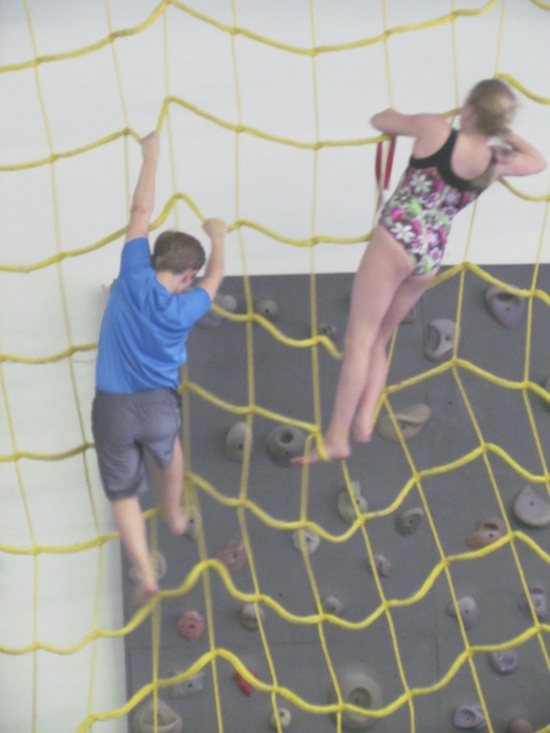
Emma practices climbing the rope wall

Nic & Em

Letting Go and Trust

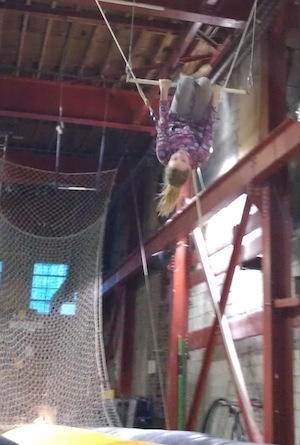
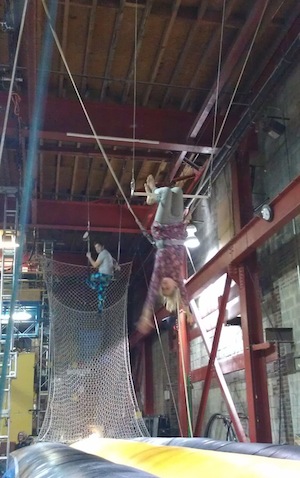
Yesterday Emma did another “catch” at her trapeze school.  Yesterday’s catch was more complicated than the one she perfected a month ago and I cannot wait to see it.  I asked Em last night whether I could post it here and she said, “Yes!  Post on blog!” Since Em’s therapist, Joe, hasn’t had time to upload and send me the link from yesterday , I’m sorry, I can’t help myself, I am posting her first catch from a month ago AGAIN.  Watch all the way through to hear what Em says at the end, it makes me teary just thinking about it.

2Watching her flying through the air makes me happy.  Seeing her joy and sense of accomplishment, makes me happy.  The first time I watched her swooshing through the air I felt a mixture of joy and trepidation, the second time a soaring hopefulness of all that is possible, the third time pride, knowing how hard she has worked, trained and practiced to get to this point.  Years.  Years of practicing.  Just now, as I watched it again, I was reminded of how, it is the connections with other people who make our lives full and joyous.  Connections rooted in trust, compassion, love, and a sense of belonging.

3When Emma releases the bar and reaches out to grab the forearms of the other person, I cannot help but hold my breath.  Even though I know the ending to this particular story, I still hold my breath.  Will they catch her?  Will she fall?  Will she get hurt?  Can she trust them, rely on them to be there for her?   As I write this I know these are universal questions.  Questions I have asked with both my children in mind, questions I have asked about everyone I’ve ever loved.  But in this one instance Emma trusts the other person will be there to catch her and the tears fill my eyes because they are, yet I know this won’t always be the case.   As much as I want to convince myself that I have that power to always be there, to have every situation in my control, there will be times when I won’t be able to protect her from the disappointment and heartache that will come from trusting someone who cannot be relied upon.

But before I drift off into a melancholy laced reverie, I have to remind myself that this is my interpretation of how my daughter may or may not feel when faced with disappointment and the deep sadness that comes with trusting someone, only to feel let down by them or worse, betrayed.  My daughter has a very different outlook on life than me.  She has proven to me repeatedly that my life experiences are not accurate lenses with which to view or predict her life.  The beauty of being a mom is realizing my ideas about how my children will or won’t cope with the things thrown at them are not necessarily correct.  I believe this is what older parents of children who are now adults refer to as “letting go”!

In the twelve-step rooms there’s a great deal of talk about the g-o-d word.  It’s not a word that brings me any degree of solace, so I’ve learned to do what my friend Ibby calls a “work around”.  I don’t do the g-word, but I have faith.  Faith that if I am kind, generous and try my best to be of service, I will be better off than if I’m not.  This thinking doesn’t ensure those I love will always be safe, but it helps me stay centered and present one day at a time.  I can hear Richard’s voice in my head saying, “What?  That’s it?”  And my answer is to laugh and say, “Yup.  That’s pretty much the extent of my wisdom.”

4

Encouraging a Sense of Self Worth

When I was in eighth grade I had a “Wellness” class given by a classmate’s mother who had been a child actor and model.  The boys were separated out and taken to (presumably) a similar class given by a male equivalent. (I have to wonder now, where exactly did they go?  Who was the male equivalent?  At the time, I never thought to ask.)  All the eighth grade girls sat in a circle on the ground in front of this woman who stood before us in all her coiffed, fine featured, perfumed glory, wearing an oh-so-chic, red pants suit (this was the early ’70’s) and looking like she had just walked off a shoot for the cover of a fashion magazine.  (Which, in fact, she had.)

I felt completely inadequate in comparison and all the more so as I sat listening to her glowing accounts of what she did for exercise, the wholesome meals she ate and her disciplined daily use of various emollients.  I remember falling into despair as I listened to her, not only because I didn’t know what emollients were, or couldn’t imagine a life that did not include glazed jelly doughnuts, but because everything about her was foreign to me, forget that hers was not a life I had ever thought about having, let alone wanting.  But as I sat there I was aware that I should want to be just like her.  She represented all that was beautiful and unobtainable and I, in direct contrast, represented all that was wanting.  I’ve never forgotten her.

When I gave birth to each of my children, the one thing I wanted more than anything else was to make sure they never felt ashamed of themselves.  I wanted to make sure they felt supported, loved and valued for who they were, exactly as they were.  I wanted to be sure I cheered them on, to model for them kindness, generosity, compassion and good work ethics.  I swore to myself I would do my best to respect them and to listen to them.  And then we were given Emma’s diagnosis and suddenly those goals took a back seat to the goal of her being “mainstreamed” and “indistinguishable from her peers.”  Those two goals rammed up against my desire for her to feel self-love, self-acceptance, self-worth.  For a couple of years I lost my way.  In my desperation I allowed others to dictate what I should do and what I should want for my daughter.  I forgot that my early goals for her were more important than anything else.

I began to look for an Autistic adult who I could imagine my daughter might be like.  I wanted to find someone who might represent a possibility of what I might expect.  I read what books I could find, written by Autistic adults, but concluded these adults were much “higher” functioning than my child.   It wasn’t until later that someone pointed out these adults who had written and had published books, were at least twenty years older than my daughter and therefore had more than twenty years of learning, experience and growth that my daughter had not had the advantage of.  Undeterred, I kept looking anyway.  Even when I found someone who seemed to have similar language challenges, their upbringing differed greatly, their interests led them in other directions, I could never quite imagine my daughter growing up to be just like them.

Searching for Autistic adults who might be a version of my daughter was grounded in a desire to calm my fears.  It was a misguided attempt to comfort myself.  By saying – well this person is speaking so clearly, able to have their needs known and heard, therefore perhaps my daughter will be able to one day do the same, I was hoping to quell my worries.  A shared neurology with random people does not mean anything more than it does to compare my shared non Autistic neurology with the same. Without meaning to I was replicating that “wellness” class over and over only now it was my daughter I imagined sitting cross-legged on the ground looking up at someone she would never grow up to be like.  This or that person is not an adult replica of my daughter any more than that woman teaching the Wellness class was an adult version of me.

I want and hope my daughter will feel empowered to be who she is without amendment.  The best way I can ensure she feel empowered is by listening to her, honoring her, celebrating and embracing her, exactly as she is in this moment.  I must give her the support she needs to communicate,  show her the different methods she can use to communicate so she knows she has choices and believe in her.  And there’s another piece to this, which is this – my issue of self-worth, with not being that fine featured, delicate nosed, thin hipped, flat chested version of ideal woman I grew up believing meant happiness, is mine to work through and not my daughter’s.  This may seem obvious to many of you, but it is something I must remind myself of.  I have to ask myself often, is this my issue or hers?  Comparing Emma to adults, to any adult is most definitely my issue and it is one I am trying hard not to pass along to her.

2012

Giving Hope…

During those first few years of Emma’s life, when we were so exhausted and everything was confusing, well-meaning people made pronouncements about Emma’s future.  If I had to choose one emotion to describe my feelings during those early years, it would be terror…  I was terrified.  The kind of terror that keeps you up at night and then, once you’ve managed to lose yourself in the welcome relief of sleep, you dream about elevators swinging in midair, doors that open up to emptiness, running to places only to find you keep ending up where you began…  and then… and then you wake up with a jolt of optimism, for a brief, few seconds you have forgotten your terror, only to have it come surging back, dispersing any wisps of residual optimism from days now gone…  You’re left bereft, empty, alone and yes, grieving… Grieving for that time when terror wasn’t something you were intimate with…

What I wanted during those early years, what I wanted later when Emma grew beyond toddlerhood, when she entered adolescence, all I wanted was for someone, anyone to say –  Don’t believe any of these people.  They have no idea what they’re talking about.  Don’t spend your time on the internet researching autism.  Don’t listen to organizations with Autism in their title, but that have few or no Autistic people occupying prominent positions in their organization.  Don’t believe any of those people who talk about “recovery” and liken your daughter’s neurology to disease or buy into therapies whose main goal is to make your daughter indistinguishable from her non Autistic peers.  Reject ALL of that.  Being able to speak isn’t the only way to communicate.  An Autism diagnosis isn’t a metaphoric nail in a coffin.  

I imagine those years of terror and how different our lives would have been had I met some of the people I now know.  People I have met on the internet, through their blogs, at conferences such as AutCom and the ICI Conference in Syracuse.  Conferences where I left feeling elated and euphoric because I witnessed all that was possible and not all that wasn’t.  How can we move beyond the current conveyor belt of fear that only serves to pad the pockets of Autism businesses run and created by non Autistic people, who do not seek out the active involvement of those very people they insist they are dedicated to help?  How do we dispense hope and what is possible amidst the maelström of deficit thinking?  How do we care for families new to all of this, those families whose children will be greatly affected by their parent’s terror?

We have to give eye-witness accounts of what is possible.  We must have resources available to families that will counter the predominantly negative views of autism.  Resources that do not condemn the parent or the child.  Resources that do not encourage terror, but offer hope and possibility.  Ideally I would have been given the list of books  I have on my “Resources” page and actual copies of these four books:  Autism and Representation Edited by Mark Osteen, Autism and The Myth of the Person Alone Edited by Douglas Biklen, Inventing the Feeble Mind: A History of Mental Retardation in the United States by James W. Trent Jr.  and Representing Autism by Stuart Murray.

Parents need support so they have the energy, patience and optimism to give their child the support and encouragement they need.  Therapists, professionals, educators, experts who are making a living working in the field of Autism must understand the importance of offering hope.  Hope based in possibility and reality.  No one is served by being terrified.  The only people who will be adversely affected if we stop the terror surrounding autism are those whose businesses thrive on such beliefs.  And to all those businesses – I say – Good riddance.

LifeThe possibilities are endless… 

Why Wretches And Jabberers Is Essential Viewing

Wretches and Jabberers.  I have written before about this documentary, but I’ve never fully explained why this movie had such a profound impact on me, on my thinking and subsequently on my family.  I will attempt to do that now.

I watched Wretches and Jabberers at the urging of my friend, Ibby last summer.  If a person’s life can be seen as a series of lights, indicating special influencers, Wretches and Jabberers was a beacon.   I knew nothing about supported typing, in fact, I’d never heard of it, so I watched in fascination as both Larry Bissonnette and Tracy Thresher (who are mostly non-speakers and Autistic) typed with their support persons, Pascal Cheng and Harvey Lavoy.  And I wondered whether my daughter might find communicating easier if she typed, instead of being expected to speak.

Larry is a painter, lives with his sister and was institutionalized as a teenager.  He shouts out things like “Bad boy!”  Tracy hits himself in the head when frustrated and has nowhere he can call “home”.  The documentary follows Larry and Tracy as they travel the world meeting other non speaking Autistics.  Again and again the viewer is shown a mostly non speaking Autistic person who has been deemed intellectually incapable by society, only to witness their intelligence and humor break through the silence by typing on a voice activated keyboard or iPad.  And again I thought about my daughter.

It is impossible to watch the film and believe these two men are isolated cases.  One cannot view this documentary and not question one’s preconceived beliefs about intelligence. The film defies the accepted and common non Autistic assumptions about Autism and what it means to be Autistic.  And for me, anyway, it made me question everything I thought I “knew” about my daughter.  All the things I had begun to question, whispering doubts about my thinking that I was no longer able to ignore because of the blogs I was reading written by Autistic people, were now amplified.

I have been interviewing Tracy Thresher for a piece I’m working on that I intend to submit to Huffingtion Post.  In answer to my question about what it meant to him making the film he wrote, “Our film catapulted me to realize my dream of traveling the world to educate, learn and change old attitudes of discrimination toward people of varying abilities. The Larry and Tracy duo illustrates how intelligence is often worked out in a much different way.”

Later in my interview he wrote, “…my mission to show kids and their supports that putting communication to the top of their list of priorities is vitally cleansing to the mind. Releasing deep thoughts is the key to alleviating anxiety. Frustration leads the body to unproductive anger. Being able to show intelligent thought is the path to happier futures and true quality of life, leading to purpose. That is what I sought and found with typing.”

Once again I thought about my daughter and her difficulty with oral language and the frustration that causes her.

Wretches and Jabberers was like an enormous, day glo green, neon sign saying “follow me” on it.  Powerful, funny, poignant, Wretches and Jabberers is essential viewing for all human beings, not just those interested in Autism and parents of Autistic children.  It rattles our unexamined biases, our beliefs, our perceptions and everything we are being “told” about autism, our children and what is and isn’t possible.  And if you are like me, you will think about your child and the world differently as a result of watching it.

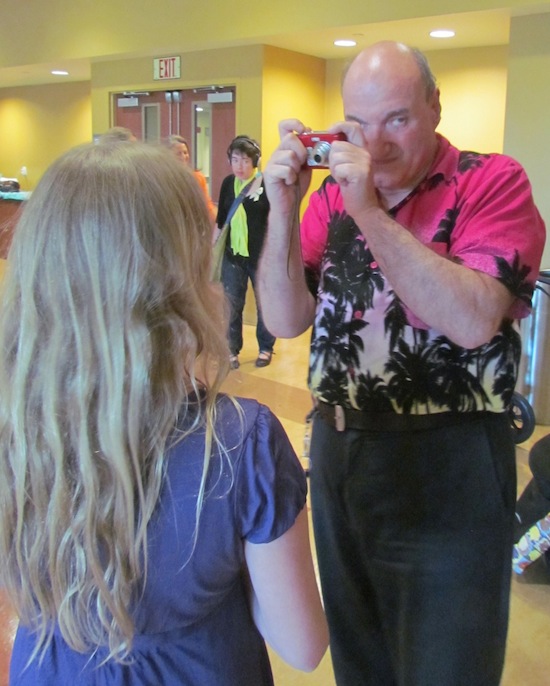
One of my all time favorite photographs of Larry Bissonnette taking Emma’s photograph in Tampa, Florida ~ April 2013  (Amy Sequenzia is in the background)

Larry takes Em's photograph