Category Archives: Autism

Running with Mermaids

When Emma was a toddler she had a mermaid finger puppet.  It had long black hair, sported a blue bikini top and had a blue sequined tail.  At the time, I thought it was the first of what would be many dolls.  I loved dolls when I was little.  My favorite doll was named Maribelle.    Her left hand, the victim of my rage when I was four and hacked off three of her fingers with a pair of pruning shears was a reminder of anger gone awry.  I immediately regretted my actions and attempted to glue her fingers back on.  Crazy glue was not the common item found in every tool box as it is today.  My options were Elmer’s and rubber cement, neither of which could repair the damage.  I then tried tape with no better results.  At some point the fingers were lost or I threw them away, I can no longer remember.  Mirabelle’s fingers, while physically gone, are forever etched in my conscience, an impulsive act I could not undo.  Still, I loved Mirabelle and though I eventually moved on to a series of other baby dolls, little girl dolls and finally Barbie dolls, my first love was Mirabelle.  All these years later Maribelle resides in the blue and silver striped trunk she originally came in, now in an upstairs closet  in my mother’s house.  I have never been able to part with her, my thinking was that if I had a daughter, perhaps she would one day want to have her.

When Emma showed interest in the mermaid, I had high hopes for Mirabelle’s return.  Only, it turns out, Emma’s mermaid did not hold the same sort of feelings as Mirabelle had for me.  The mermaid was the beginning of a series of objects that Emma was fascinated by.  The item that eventually replaced Emma’s mermaid was The Corpse Bride from the Tim Burton movie with the same name.  Then it was Jessie from Toy Story and after that a long stick picked up from the playground.  From there she gravitated to a series of sticks, balloon strings and her current favorite: packing string.  The packing string is a work in progress, held together in the middle with masking tape, then scotch tape, which was then covered in reinforced packing tape and finally covered in turquoise duct tape.  When we were at Granma’s house, Emma covered the turquoise duct tape in masking tape she found in a drawer in my mother’s kitchen.  When we returned home, Emma covered the masking tape with yet another layer of the turquoise duct tape.  It has a certain heft to it and looks like this.

I know a little more than I did when Emma first ran back and forth from our front door through the house and back to the front door with the finger puppet held between her thumb and index finger, the mermaid’s black hair swinging to and fro as she ran.  Today Emma holds her “string” as we call it, in her hand while dancing.  Her string serves as part security object, part stim object, part something else that I am still trying to figure out.  “An attachment to peculiar objects…” is one of many characteristics of autism, but when Emma was little, it was just a mermaid.  Who knew?

To read my most recent Huffington Post piece, click ‘here.’

An Easter Party and An Excuse to Wear a Pretty Dress

Emma and I did some work yesterday morning, on her reading, writing and typing.  This is the “story” she wrote:

“I can’t wait for our Easter party!

I am going to wear a pretty dress.

I love to wear pretty dresses.

I am excited to see Max. I am excited to see cousin Alexandra and Jackie too.”

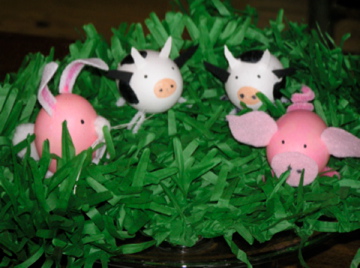
Sadly, I do not have a photograph of Emma wearing her pretty party dress because I got a late start on cooking, what with decorating Easter eggs to resemble farm animals…

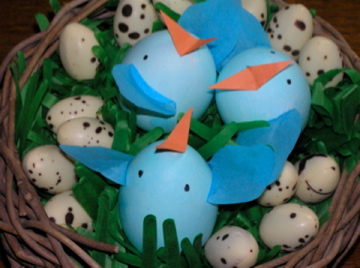
and birds…

bird's nest

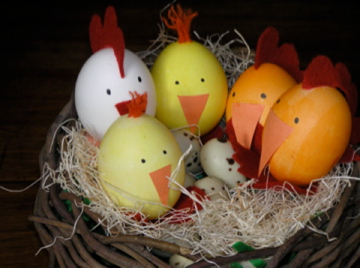
of all types…

There were chocolate eggs that needed to be hidden for the Easter “Egg” hunt, thankfully Richard did a superb job with that and came up with some very creative places to hide them, including inside one of our speakers, where they will remain lodged forever.  We invited 13 people over due to arrive at 5:00PM  and I was way behind schedule, hadn’t prepared the roasted vegetables, fixed the leg of lamb, prepared the biscuits, the appetizers or the berries and whipped cream and it was already 3:00PM. (Gulp!)

Emma donned her pretty party dress and whirled about while listening to a medley of her current favorites, MIchael Jackson, Dionne Warwick, The BeeGees and Led Zeppelin.  You have to hand it to her, the kid has a wide and varied taste in music!

Emma had been looking forward to our “Easter Party” for weeks.  We had gone over the list of people countless times.  She fixated on a few of those people, talking about them over and over again.  We did a countdown of how many hours until they would arrive.  And then when the first person arrived Emma squealed in delight and raced to the door.  When cousin Alexandra arrived, Emma could barely look at her, she was so overwhelmed.  The same happened when Jackie appeared.  It was as though it were all too much.  The very sight of these much anticipated arrivals was more than she could take.  “Max is coming!” she said over and over again.  Max had called ahead to inform us that he would be late.
“Yes.  Max will be here in another 20 minutes or so,” we answered.

“Max is late,”  Emma stated, nodding her head and looking sad.

“But he’ll be here soon,” we reassured her.

When Max finally arrived, Emma put her hand in front of her eyes, as though he were as bright as the sun and the glare was too much for her.  Meanwhile I was busy getting the leg of lamb out of the oven and serving everyone a cheddar-chive biscuit.  “Where’s Em?” I asked Richard at one point.

“She’s hiding,” he said.

I found Emma crouched behind the couch, her head down, almost touching the floor.  “Emmy, what are you doing?”  I asked.  When she didn’t respond I said, “Come sit with us at the table.”  Reluctantly she sat down, next to Jackie and across from Max.  She kept her head and eyes lowered and wouldn’t look at either of them.

After an hour or so, Emma was able to raise her head and began playing various games with Max.  By the end of the evening she was beside herself with excitement, fully engaged and talkative.  She said good bye to each guest as they departed, and when Max left she walked him to the door and said, “Bye Max!”  and then she blew him kisses.

For more on Emma’s journey, go to:   Emma’s Hope Book


Autism Acceptance

Paula Durbin-Westby is an adult autist, an advocate, a writer, blogger, and mother. She writes extensively about autism on her blog – Autism Acceptance Day.  I had planned to do a series throughout the month of April of Autistic writers discussing autism, “awareness” and acceptance, which I planned to submit to the Huffington Post.  However, HuffPo does not take “guest bloggers” and as I hadn’t gotten permission beforehand, this piece from Paula was never printed.   I am printing it here, instead:

This article introduces a new celebration for the month of April: Autism Acceptance Day.  First, the background.  Autism Awareness month has been around for quite awhile.  Unfortunately, much of the deluge of “awareness” has been demeaning and even discriminatory.  Many Autistics have written pieces on the theme “April is the cruelest month.”  Parents talk about wanting to turn off the TV during April so their Autistic children will not have to see the alarmist statistics and “medical mystery” reporting.  Autistic friends, weaving their way through a barrage of autism “warning” signs placed prominently on campus, talk about how they can’t wait for April to be over.

In 2008, the UN declared April 2 World Autism Awareness Day.  A year later, in September 2009, during an autism conference the UN showed a video called “I Am Autism,” which portrays autism as a demonic persona that threatens harm to parents and families. In one section, voices chime “We are the United Nations,” showing people from many nations who will stand up to “autism.”  It was outrageous.  The United Nations, by showing this film, violated its own principles in the UN Convention on the Rights of Persons with Disabilities.   The UN wrote in Article 8, and I quote, “As a change of perceptions is essential to improve the situation of persons with disabilities, ratifying countries are to combat stereotypes and prejudices and promote awareness of the capabilities of persons with disabilities.

Against this backdrop, I organized the first Autism Acceptance Day in 2011.  Autism Acceptance Day was to be everything that Autism Awareness Month was not. Rather than “awareness” that insults and even damages the life chances of Autistic people, I promoted complete acceptance, not just mere tolerance. As Autistic activist Nick Walker puts it, “If it doesn’t involve acceptance of autism, and acceptance of autistic people as autistic people, you don’t get to call it “autism acceptance.” I was tired of my friends being hurt, and dismayed at the media and parent- and researcher-led autism organizations portraying autism and Autistic people in what my nine-year old calls a “despicatizing” light.

Autism acceptance means an active acceptance of neurodiversity. Neurodiversity sometimes gets a bad rap, but it’s really fairly simple: neurodiversity encompasses all neurologies, from “typical” people to those who have a variety of neurologically-based differences and disabilities. We support all people with disabilities, even though our emphasis is on neurology. We assert the worth and dignity of every person, no matter what their disability or level of disability, including people with significant disabilities. Our aim is not to gloss over the very real difficulties that people with neurologically-based disabilities face. Our focus is on access to services, supports, education and employment opportunities. We support the development of communication systems, a high priority for Autistics, some of whom do not speak, and many of whom do not have reliable access to language-based communication at times.

The first year, Autism Acceptance Day was primarily an online, Facebook event. I started a blog so that people who were not on Facebook could read about Autism Acceptance Day and participate. Over 1000 people signed up for the Facebook event. This year, as more people made plans and expanded on the idea, I wrote – “It’s time to take back April!” ASAN did a series on its blog and there were other events and activities.

Like any other community, the Autistic community and our supporters have developed expressions of community involvement.  Some events are celebratory; some are not.  On March 30, people attended candlelight vigils to mourn and remember people with disabilities who have been murdered by family members or caregivers. The vigil effort was organized by Zoe Gross. An online vigil was implemented as well.  As with other minority communities, a sense of identity, pride, and accomplishment, as well as a time to pause and reflect, is a way to build upon our strengths, learn to work together to promote our own interests and concerns, and ultimately to foster a greater societal acceptance of people with disabilities including autism.  Sadly, the day after the vigil, Daniel Corby, age 4, was murdered.  We still have much to do toward acceptance of Autistic people.

Sleepovers, Siblings and Autism

I have to begin by pointing out our redesigned, upgraded and improved site!  (If you could see me I look like Carol Merrill in front of door #1 on Let’s Make a Deal.  I’m waving my arm up and down, pausing at all the new, awesome features, while smiling invitingly.  Okay, totally dating myself on that one.)

A few months ago my cousin, Peter and his wife invited Emma’s older brother, Nic to come to their home for a “sleepover.”  On the designated and much anticipated afternoon, Nic and I took the subway uptown to their home.  I got Nic settled and discussed when we should come to retrieve him.   It was decided that we would all come the following morning for a breakfast of pancakes and then be on our way.  (My cousin is actually close to my mother’s age, yet I feel particularly close to him and his wife.)

When I returned home Emma had just returned from a full day of activities.  We had told Emma that Nic would be spending the night with “cousin Peter and Susan” several days before and she seemed to take it all in stride.  The next morning as planned we went to pick up Nic, ate a lovely breakfast that Susan had prepared for us, and left, thanking them profusely.

Yesterday, now at least a month later if not more, Emma announced, “Go sleep over at Susan and Peter’s house.”

Thinking she meant that she wanted Nic to go there again and that she had so enjoyed our night with Richard and me all to herself, I said, “Oh!  You want Nicky to go back to Peter and Susan’s house?”

“Yeah!”  she said, nodding her head vigorously.  Then she came closer to me and said, “Go with Nicky?”

“You want to go with Nicky to Peter and Susan’s house?”

“No.  Just Emma.”

Confused, I said, “You want to go to Peter and Susan’s by yourself?”

“Yes.”  She looked at me expectantly.  “Spend the night at Susan and Peter’s!  Nicky stay home.”

It was one of those moments when you feel overjoyed, but also filled with sadness.  How could I tell her this was unlikely to happen?  How could I explain that Peter and Susan might not invite her?  How could I explain that this was not something I could ask them to do?  As my mind whirled around trying to figure out how to respond, Emma began to cry.

“Go to Peter and Susan’s house.  Sleep at Susan and Peter’s house.  Tonight.”

The longer I remained silent the more she upped the ante.  I glanced over at Richard with a look of desperation.  A look that said – how are we going to deal with this?

Richard explained that tonight we were going to have dinner and then go up on the roof.  We brought out a calendar and ticked off the upcoming activities we had planned.  We tried to explain to her that we couldn’t invite ourselves over to people’s homes.  (This was way to complicated and too much information.)  And the whole time I kept thinking how do we explain?  How do we say this simply?  As she became more fixated on the idea, she began repeating it over and over again in between tears.  Everything we said, “Not tonight, Em.”  or “Maybe over the summer,”  did little to satisfy her.

Eventually I brushed her and did joint compressions.  She seemed calmed by this and we talked about pressure and how she prefers firm long strokes, not light strokes.  We both did some breathing exercises together and the fixation on going to her cousin’s house seemed to dissipate.  Later Richard put on music for her and we danced.

After I had put Emma to bed and read stories to her, I said to Richard, “You know there’s a really positive side to this.  She’s showing her desire for independence.  It’s pretty amazing.”  We discussed how this represented so many terrific leaps forward for Emma.  She is eager for more independence, is cognizant of Nic having sleepovers, and wants to have that experience too.

It’s all good.  (Where did that expression originate, by the way?!)  But it is.  It’s all good.

For more on Emma’s journey through a childhood of autism, go to:   Emma’s Hope Book

For my latest Huffington Post:  HuffPo

Murder, Fear and Hope

An autistic child has been murdered.

Again.

His name was Daniel Corby.  He was 4 years old.

(The following is by no means a cohesive or complete list.)

March 2012 – mother kills George, her 22 year old autistic son.

August, 2011 – mother shot and killed her 13 year old autistic son, Ben.

July, 2011- mother strangled her two autistic children, a 2 year old daughter and 5 year old son.

May 2011 – mother kills her autistic son, Glen by strangling him with the belt from her coat.

February, 2010 – mother killed her 8 year old autistic son, Jude.

2010 – Mother kills 6-month old son, Rylan because she suspected he might have autism.

2009 – Father kills 11 year old autistic son, Jeremy.

2009 – mother withholds medication from her autistic son, Jeremy who has leukemia.  Jeremy dies as a result.

Our outrage, our pleas that these murders stop, our desire to blame, rationalize or even understand will not bring any of these children back or prevent another parent from murdering their child.  What can make a difference is a change in the way we as a society view autism and autistic people.

The word “autism” causes fear.  So little is actually understood about autism and so much of what people hear are theories, it is natural that people would find autism frightening.  We fear what we do not know or understand.  This has been true throughout history.  The ever changing “statistics,” the words used to describe autism, the vastness and mutable nature of the spectrum, how indefinable it is, all add fuel to the fear.  It doesn’t have to be this way though.  And that is where there is tremendous hope.

A year ago I regularly lay awake at night worrying about my daughter, Emma’s future.  I knew of very few adults with autism, I had read everything written by both Donna Williams and Temple Grandin, but their experiences seemed far removed from my daughter’s.  All of that changed when I began following blogs written by autistic adults.  I had an “aha” moment.  The moment of realization and understanding when what was once abstract becomes real.  A friend of mine told me of her “aha” moment during an autism conference she attended where she saw a nonverbal young man who reminded her of her son.  He had the same gestures, the same stims as her child.  She imagined this was her son in 15 years and she was filled with despair.  The following day she returned to the conference and attended a workshop on facilitated communication, led by…. none other than the young man she’d seen the day before.  Only now he was communicating his thoughts.  His words were intelligent, articulate and heartwarmingly beautiful.  She left the conference in tears realizing how she had underestimated this young man, as well as her own child.   She vowed never to do so again.

Assume competence.  Even if there is no “proof” that our neuro-typical minds can hold onto, we must assume competence.  Because to do otherwise is to fail our children.

I have written about much of this at length in other posts, so I am not going to continue now, but I strongly urge anyone who is frightened to read the blogs written by autists.  The veil of mystery may be lifted.  It was for me.  Reading the words of autists alleviated my worries.  Here were adults who were leading the way, so that those, like my daughter, Emma, might not have to. My life, so long dominated by fear is now dominated by hope.

There is a large and thriving community out there of both autists and parents of autists who are writing, blogging, commenting and reaching out to one another.  The only requirement to join this community is a desire for connection.  Because of the internet, we all have a support system if we want it.  No parent or autist need feel alone.  The autists are the ones who can and will change the current perception of what it means to be autistic.  They are writing and speaking forcefully, beautifully, with eloquence and power.  I have said this before, I will say it again:  We must listen to them.  They need to be included in any discussion, organization or conference regarding autism.  More importantly, they need to be included, period.  Some parents have said to me – but they have blogs.  They can talk.  They are articulate, while my child is non-verbal, self-injurious, cannot attend to his basic daily needs.  And my response is – Yes, that is exactly why we must listen.   Just because some of our children cannot speak or those who do may not be as articulate, doesn’t take away from the fact that these autists can and do.  If our children could speak as eloquently – how do we know what they would say?  If they could speak, wouldn’t we listen?

The following is a list of wonderful blogs that have literally changed my life:

Aspie Rhetor

Autism and Empathy

Autistic Hoya

Dude, I’m an Aspie

I’m Somewhere Else

Journeys with Autism

Juniper Hills Farms

Just Stimming

Life With Aspergers

Moonlit Lily

Quirky and Laughing

ThAutcast

The Autistic Me

The Third Glance

For parents with non-verbal autistic children:

Read any book written by the autist Tito Mukhopadhyay

Carly Fleishmann

Another youtube video of Carly

Interview with non-verbal autistic adult

In addition, for anyone who has an autistic child no matter where they fall on the spectrum, please read this interview with Henry Markram on his Intense World Theory for Autism.  It is the first time I’ve read a “theory” that validated everything I felt I saw in my daughter, Emma.

We may not be able to stop parents from murdering their children, but we can change how people view autism.

We must not succumb to fear.  Hope is all around us, we need to stop and listen.

For more on Emma’s journey through a childhood of autism, go to:  Emma’s Hope Book

For my most recent Huffington Post piece, go to:  HuffPost

New York City Subways and Musings on Autism

Yesterday afternoon I received the following text from Emma’s therapist Joe – “Heading your way.  Em had a rough day after museum trip.  Wants to see you.”

First of all, I’d like to point out that the fact that Emma was able to communicate to Joe that she’d had a rough day is a massive leap forward.  Secondly that she was able to then make it known that what she now wanted to do was see me was nothing short of amazing.  It required her to identify her feelings.  It required her to map out what might make her feel better.  It required her to verbally put together the words in such a way that they would be understood.  It required her to then make her request.

Yesterday morning on the subway headed to my studio I was reading the memoir by the autist, Rachel Cohen-Rottenberg, Blazing My Trail on my ipad.  It’s a wonderful book, for those who don’t know of it, and had fully captured my attention when I felt a light tap on my arm.  I looked to my left and there sat a woman, about my age or maybe a bit younger dressed in a suit, clasping a briefcase.  “Excuse me,” she said.  “I get claustrophobic in subways, especially when they stop and it helps if I have someone to talk to.  Do you mind?”

“Oh,” I said, surprised by her directness, but also relieved that she seemed genuine (this is New York City after all) and was clearly frightened that our train had come to a halt in the middle of the tracks, something I hadn’t even noticed until she tapped my arm.  I closed my ipad and turned toward her.  “Sure,” I said. Not at all sure what to say next, but because I had just been reading Blazing My Trail in which Rachel Cohen-Rottenberg talks about wishing people would just ask how they might help, I asked, “What can I do?”

“Just talk,” she said, then to help me along she motioned to my ipad, “What were you reading?”

So I told her about the book I was reading and how wonderful it was.  We then talked briefly about autism, something she knew almost nothing about. I asked her where she was headed.  She told me about a business meeting she was on her way to at Rockefeller Center and how she was nervous about it.  And then the train began to move again.  She took a deep inward breath and exhaled, shutting her eyes momentarily before opening them again and smiling at me.  “Thank you for being so kind and talking to me.  You have no idea how much it helped.”  At the next stop she got up.  I wished her luck and she disappeared.  As I sat watching her leave I thought about how great it was that she had figured out what she needed to do to help herself through what was clearly a stressful situation.  And then I thought about Emma.  I thought about how I hoped Emma would one day be able to express herself in a similar way.  I thought about Rachel Cohen-Rottenberg’s memoir and how she has learned through a great deal of trial and error to get her needs met and I thought about how hard it is for so many of us to know what we want let alone muster up the courage to ask for help.

Not eight hours later I received Joe’s text – “Em had a rough day after museum trip.  Wants to see you.”

Wow!

For more on Emma’s journey through a childhood of autism, go to:   Emma’s Hope Book

Pain, Air Pressure and Autism

Emma woke up in the middle of the night crying.  Her screams of pain, the result of intense pressure in her ears, were like the sounds of an animal under attack.  Last night, having read about the intense sensory issues many people on the spectrum must continually cope with, an intensity we neuro-typicals have difficulty understanding, I felt that I finally understood.  I “got it” in a way that I hadn’t until now.

For years Emma has, periodically, complained about her ears.  When she does we rush her off to various doctors and specialists, only to be told that there is “nothing wrong.”  But those words are being said by neuro-typical doctors and specialists and to a neuro-typical there is, indeed, nothing “wrong.”  But Emma is not neuro-typical, what appears fine to us, does not feel fine to Emma.  She is particularly sensitive to the changing air pressure.  She feels unbearable pain in her ears.  We cannot predict when this will happen, though I suspect the pain she experiences is exacerbated when she spends a great deal of time in the pool swimming, as she did these last few weeks while in Colorado.  Emma loves swimming.  She particularly loves jumping off the diving board and swimming under water.  I could be wrong, of course, but my guess is, the pressure is worsened with those activities.

Last night by the time I’d woken up and gone to her, Richard had already calmed her down.  When she saw me she came to me and wrapped her arms around me, her cheeks still damp from her tears.  She preempted me by saying,  “Ah, baby.  I know, I know.  Your ears are hurting.”  Her voice sounded almost exactly like my own.  She was using the words I use.  She was saying those words with the same tone I say them.

I held her for a few seconds before following her into the bedroom.  I urged Richard, bleary and exhausted to go back to bed, while I sat with Emma.  “Have to go see nurse Mommy,” Emma said, stroking my arm.  “Go aaaaahhhhhh!” Emma made a pretend cry.  “Mommy come!  Mommy come.  I need help!  AAAAAHHHHH!”  Emma continued in a soft voice, reenacting what had happened just moments before.  “Daddy says – you have to blow your nose. Oh, I know, I know it hurts.”  Emma nodded her head up and down.  “Mommy’s here!  It’s nurse Mommy!”  Then she lay her head on my lap, pulled her blanket up around her shoulders and began sucking her thumb.  As I sat with her in the dim light of her bedroom, her head in my lap, stroking her hair I wondered what must it be like to feel a sudden shock of pain caused by something you cannot see or stop.  No matter how much you cry out for help, it isn’t lessened.  I tried to imagine, what that must be like.  How frightening that must be.  How upsetting to be the only one feeling it.  How disorienting.  As I sat there I became aware of the air pressure.  I could feel the pressure in my own ears, not painful, but uncomfortable, building the more I concentrated.  And I found myself wondering what would it be like if I felt this all the time?  How distracting it must be.  What if I felt this, but much more intensely?  What if I felt this pressure, but the pain was excruciating?  How terrifying, while hoping that someone could remove what was causing the pain.

Only we can’t.

For more on Emma’s journey through a childhood of autism, go to:  Emma’s Hope Book

Autism “Awareness” and a State of Bliss

I’m having “a morning.”  You know, the kind where, despite how organized you are, despite how well you laid everything out the night before, everything seems to work against you.  So rather than go on a rant, enumerating all the things that have managed to go “wrong” in the last three hours, I’m going to reflect on Emma.  Because Emma is a very, very happy little girl.  In fact, unless Emma has gotten into a perseverative loop about going to the zoo or someplace that she has become fixated on and feels she cannot do without, she is in a state of bliss.  It is the sort of blissful state achieved by gurus, yogis or LSD, or so I’m told.  Yet Emma comes to this place naturally.  She does not have a “practice,” she does not sit cross-legged staring at a fixed point for an hour each day, she does not meditate, feeling euphoric if she managed to pause the endless chatter in her head for even a few seconds, no, Emma is full of joy almost constantly.

Today is Autism “Awareness” day.  It is a day that was intended, and no doubt with the best of intentions, to bring much needed awareness to the larger community.  Yet, instead it has become a day that many of us dread.  Instead of bringing awareness about what it means to be autistic, we are bombarded with frightening statistics.  Statistics that many will read and then, feeling helpless, will turn the page.  I’m all for awareness, but let’s then be aware.  Let’s be aware that our society does not embrace those with disabilities.  Let’s acknowledge that our school systems are failing our autistic children.  Let’s look at our government and exactly what is being done to help those who are autistic.  Let’s take a good hard look at autism. Let’s look at the prejudices, the bullying, the marginalization of people on the spectrum.  Let’s take a good hard look at ourselves.  Are we assuming incompetence when confronted with someone who makes grunting noises, whose speech is garbled, who flaps their hands, or doesn’t look us in the eye?  When someone cannot speak do you assume they have nothing to say?  When you see someone, on the airplane, in the playground, sitting next to you on the bus or subway, who is acting differently, do you move away?  Do you feel irritation?  Do you feel annoyed?  Do you feel impatient and wish you’d gotten onto a different car or bus?  Awareness begins with each of us.  Awareness is more than lighting something up a given color.  Awareness begins with being open.  Awareness means stopping and examining our beliefs.  Awareness means asking questions.  Awareness begins with each of us.

Awareness.

It’s a great word.

Let’s not allow it to become meaningless.

For more on Emma’s journey and ours through a childhood of autism, go to:   Emma’s Hope Book

Creating a Community

Oddly enough I was planning to write a post about commenting on blogs and comments in general.  Just as I was sitting down to begin the post, I received an email telling me one of the blogs I follow had a new post.  The post was entitled – For Ariane and Those Who Lie Awake At Night.

A little backtracking is in order – about a week ago during another late night blog surfing session (finding blogs related to autism has become nothing short of obsessive – who says the apple doesn’t fall far from the tree?) I found a blog, Life and Ink.  The writer is a mom whose autistic son is now a young man.  Since she began the blog last fall it was easy to read all her posts, which I did.  As I did, I wrote a comment on one particularly moving post and then she answered and I kept reading and read this:

“And with that said dear reader, if YOU need help, if YOU are overwhelmed, contact me. Talk to me. Let me or another parent who has been there listen and help you. If we pooled our resources and decades of experience just think of the difference we can make for each other and for our children.

Now that makes me happy.”

When I read that, I was in the middle of trying to put the series of autistic writers together for the Huffington Post and I was writing the introduction to the series.  I thought about what Charlotte had written and it inspired me to write a hypothetical conversation:

“What if, instead of receiving that memorable phone call when Emma was first diagnosed, I received a call that went something like this:

“Your daughter has been diagnosed with autism.”

“Excuse me?”

“Let me give you a list of blogs and people you can call who have been where you are now. I think you’ll find them invaluable. These are parents whose children are autistic and autistic adults who are happy to speak with you. They will help you help your child.”

When the HuffPo piece was published I commented on Life and Ink telling her that she had inspired me to write that.  We then wrote back and forth and now she’s written the post that I’ve added the link to.  In that post she writes (in response to something I’d written earlier about lying awake in the middle of the night and listening to “the voice” – “The voice knows once you share what it has said it will lose its potency, its grip on you. And that is why talking to people about what you are feeling, what it is saying, is so important. That is why these blogs are so important.”

I don’t know if any of this makes sense to everyone reading this, but each comment I receive on Emma’s Hope Book is like a little gift.  Each time I comment on someone else’s blog and they reply, it’s the same.  A little gift wrapped up in words to savor.

On this most recent Huffington Post piece an autist wrote – “I have this feeling we’ll both soldier on.”  I loved that he wrote “we” because the truth is “we” will.  We will soldier on… together.  (As Emma would say.)

So to all of you who have commented – thank you.  And to all who haven’t, but think about doing so, DO!  It’s wonderful and I promise you, I’ll respond.  I promise.

For more on Emma’s journey through a childhood of autism and ours, go to:  Emma’s Hope Book

Pizza and the Art of a Low Key Response

Emma ate a slice of pizza last night.

That sentence required some space.  It needed to be written by itself with nothing else.  For most of you, this may seem like an excuse-me-while-I-yawn moment.  But for us, it was a DID-YOU-SEE-THAT-STOP-THE-CONVERSATION-EMMA-IS-EATING-PIZZA-FOR-THE-FIRST-TIME-SINCE-SHE-WAS-FOUR-YEARS-OLD moment.  Please excuse me while I dance a little jig,  do a little arm twirling while yelling woo-hoo, spin around, do a few jumps up and down and shout as loud as I can, “Oh yeah!  Oh yeah!”  And, I don’t know, this might be totally overdoing it, but what the hell, a fist bump, just for good measure.

Emma ate a slice of pizza last night.

While other parents are counting the years when they will no longer be required to sit down to one more meal in a pizza parlor, or wonder how they’re going to fit four large, now empty, cardboard boxes into their trash bin, we are rejoicing.  This is HUGE.  We had dinner with friends who have two boys about the same age as Nic and Emma.  And there was pizza.  And then suddenly there was Emma happily digging in as though this was a food she eats all the time.  As though nothing extraordinary was going on at all.  As though sitting at the dinner table with a group of other kids eating what they were eating happens all the time.  I will end this now, because really there’s nothing more I can say.

I was planning to write a whole post about comments and commenting, but I’ll have to save that for tomorrow.  This was just too good to pass up.  Joe said, “Did you take a photo?”  But I was so excited, I forgot, so you’ll just have to trust me.

Emma ate a slice of pizza.

For more on Emma’s journey through a childhood of autism, go to:   Emma’s Hope Book

A Call to Listen

I’m reposting Ariane’s recent Huffington post below. I think it’s one of her most eloquent, powerful and important posts. Whoever is in charge of Huff Post Posting apparently didn’t agree with that assessment since he/she buried it in the Huffington morgue and  now it’s been wheeled away for cremation. Ariane wanted the piece to generate some excitement about her intention to post the writings of autistics on Huff (and here) in an effort to make people more AWARE of what life is like on the inside of ASD. Reading the blogs of autistics has completely changed our perception of ASD, our children, our goals, our life together. Hopefully Ariane’s “call to listen” will spread (hint, hint) and more people will hear the joy, laughter, hopes, fears and frustrations of autistics who have been discriminated against, marginalized, disenfranchised, bullied, or simply ignored by ‘normals’ who can’t bear to look, listen or care. So without further ado:

A Call to Listen

The beginning of my “awareness” regarding autism came in the form of an apologetic voice over the phone.  “I’m sorry to be the one to tell you,” she began.  I don’t remember the exact wording of the rest of the sentence as I was too distracted by her apologetic tone and sadness.  I remember fighting the urge to make her feel better.  Responses like – “It’s okay”, or “it’s not your fault” or “don’t feel sad,” went through my head as she continued telling me that my daughter Emma had been diagnosed at the age of two with PDD-NOS.   Then she asked, “Do you understand what that means?” I wanted to say, “No, actually.  I have no idea what that means.”  Not wanting to appear rude, I said nothing.

I knew very little about PDD-NOS (Pervasive, Developmental Disorder – Not Otherwise Specified.)  Did it mean she’d become an independent adult?  Would she be able to live a happy life, filled with things and people she loved?  These were some of the questions ricocheting around in my mind.  When I didn’t answer, the voice said, “Do you agree with the diagnosis?”  Was this a rhetorical question?  How could I answer that?  If I disagreed, would it somehow change the diagnosis?  I remained silent.  “Are you there?” she finally asked.  And suddenly all I wanted was to be home with my husband, Richard, my son, Nic and my daughter, Emma.

Two years ago I began a blog out of pure laziness because I hated writing emails updating those members of my family and friends who were asking about Emma.  I figured I’d write a blog, relieving myself of the more cumbersome mass emails I felt obliged to send.  I have documented everything from Emma’s initial diagnosis of PDD-NOS to her diagnosis two years later of “autism” to our (successful) attempts at getting her out of diapers, to the evolution of my perceptions, regarding Emma and autism.  The blog began as a way to document Emma’s journey, but it became a document of our journey too.

I have never stopped researching and trying to find ways to help Emma with her GI issues, her articulation and language processing, her discomfort with transitions and her need for routine and rules.  But it wasn’t until recently and because of a comment left on my blog that everything changed.  I discovered a world I didn’t know about – blogs written by autistic adults who were more than capable of speaking for themselves.  My views and “awareness” have dramatically changed as a direct result of reading and listening to those voices.

What if, instead of receiving the phone call I did when Emma was first diagnosed, I received a call that went something like this:

“Your daughter has been diagnosed with autism.”

“Excuse me?”

“Let me give you a list of blogs and people you can call who have been where you are now.  I think you’ll find them invaluable.  These are parents whose children are autistic and autistic adults who are happy to speak with you.  They will help you help your child.”

“Really?”

“Yes!  Your child is not broken or damaged.  In fact, your child is simply different. There are ways to help her.  Don’t worry.   Even if she is non-verbal, there are methods that will help her communicate.  There are countless things you can do that will mitigate some of the stress neuro-typical parents sometimes have in trying to understand their autistic child.”

“Oh thank you.  That’s wonderful.  I so appreciate your help.”

“It’s my pleasure.  I’m sending you some links and contact information to get you started.”

“Thank you so much.”

“Remember, this diagnosis is not a death sentence.  It is a starting point.  Don’t be frightened by it.  Don’t ever underestimate her potential.  You are not alone and neither is your child.”

What if autism awareness began with listening to adult autists describing what their lives were like?  What if those same autists were on the boards of every autism group?  What if all of us, whether we had an autistic child or not were aware of autistic adults living happy, fulfilled lives?  How would that change our “awareness?” I am profoundly grateful to each and every one of the autists who are speaking out and expressing their opinions on their blogs and through other forms of media.  If we want autism awareness, these are the voices that need to be heard.  It is up to us to listen.

Throughout the month of April in commemoration of “Autism Awareness” I will be posting the writings of several autistic adults in a series of posts entitled:

Autism Awareness = Listening to Autists

Autism, Huffington Post and Getting Away to The Cabin

As I wrote yesterday – please be sure to read my most recent post on Huffington Post.  It is the introduction to a series of posts written by autists throughout the month of April.  Share the link, tweet, “like” and comment!

Last Friday Emma said, “Mommy, I want to go to the cabin please.” And since going to the cabin isn’t nearly as arduous as it sounds, we decided to go for a sleepover Saturday night.

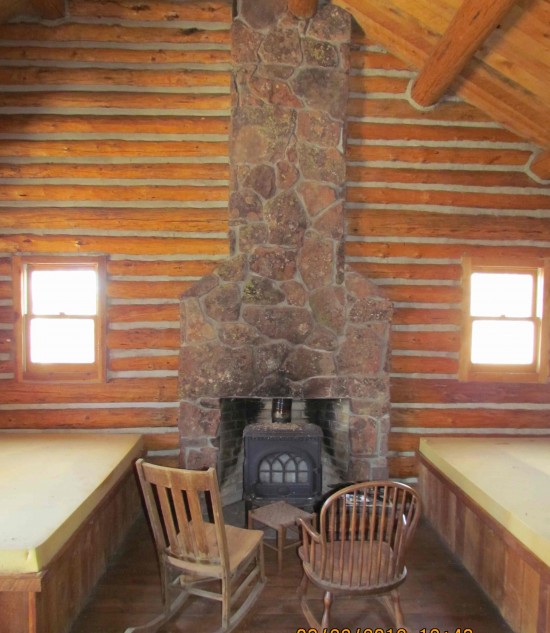
It’s “rustic” but sleeps four comfortably and the kids love going there, particularly Emma.

Emma grabbed the heaviest pack and began tromping through the snow.

Once we arrived, she wasted no time getting comfortable.

Despite the fact it was broad daylight and there were lots of weird insects flying around, many of them inside the cabin.  Nic took enormous pleasure in shooshing all the bugs and moths outside, while Emma, Richard and I sat together in the rocking chairs.  Point a camera toward Emma and she makes her “say cheese” face.

We tried to get Emma to look at the clouds. They were like nothing I’d seen before.  As though each had it’s own rainbow.

But Emma was much more interested in sitting on the porch railing with her brother.

And looking out at the mountains.

When we woke up the next morning, Emma said, “Go back to Granma’s house, eat breakfast, go swimming in the indoor pool, make cake, pack and go back to the cabin!”

“But we haven’t even left yet!”

“Go now,” Emma said.  Then as she was packing up, she said, “Come back later.”

Makes sense to me.

Autism “Awareness” on Huffington Post

The following post has just been published on Huffington Post.  This piece is important to me as it is the introduction to four or five subsequent posts I am planning for the entire month of April, written by autists.   April, for those who may not be aware, is “autism awareness” month.  These autists who will be writing posts for me to submit are the voices that have changed my life.  These are the voices that, because they’ve changed my life are changing my daughter’s life.  These are the voices that are NOT being included in all the fund raisers for “Autism Awareness.”  How can we possibly hope for awareness if autists are not being included?  Please help me by sharing the Huffington Post link (here it is again, in case you missed the first one) through email, facebook, tweets, share it, comment, please, please comment, even if it’s just to say, “I read this” and send the link to as many people as you can.  We need these posts to go viral.  And I need each and every one of you reading this to help me.  Please.

Let’s change what “awareness” means.  With your help we can.

For those interested, this is Paula Durbin-Westby’s blog, one of the autists who has agreed to write the first piece to kick things off for the Huffington Post.

Epidemic of Genius

Below is another epic length post from Richard. You have been warned!

I’m a science nut. Ariane, not so much. I constantly pester her with the latest science news I’ve gleaned from books, articles, documentaries, the Internet. I just can’t get enough of that crazy science stuff. One of my greatest frustrations is that I have some kind of math glitch in my brain which prevents me from learning much of what interests me, especially the nuts and bolts of physics and of course, higher mathematics — which I would really love to understand. Despite my brain-freeze, or math dyslexia, or whatever it is — I love numbers. I’ve even been known to do numerology readings. In short, I’m a seeker. Like many other non-scientist science lovers, I want answers to the BIG questions. Why are we here? What it’s all about?

For people like me, “What if…?” is a favorite lead-in phrase. When I heard Henry Markram’s TED talk and then read his Intense World Theory for autism and an interview where he theorizes that all autists could be genius savants and (here comes the real mind-blower) autism may be the next phase of human brain evolution – well, my mind grabbed that football and ran for the goalposts.

What if the Intense World Theory is correct? What if Markram is also correct in his theory of autistic genius? What if Emma is a genius savant too? What if all her friends at school are? What if every single one of the autists born every year are geniuses, or savants or genius savants? What if the staggering ONE PERCENT of infants now born every year with autism are ALL genius savants? What if new learning therapies like Marion Blank’s system catch on, and a whole lot more of all those savants born every year are able to communicate all the knowledge and insights they possess.

What if…(add your own far-fetched speculations here).

Well…if Markram is correctit’s a massive game changer…for all of us.

Here are some staggering stats: it is currently estimated that 2.2% of the human population possess IQs of 140 or more (the extremely arbitrary genius IQ cut off). Since the world population recently topped 7 billion (and since I suck at math I’ll gladly use that nice round figure), then 2.2 percent of 7 billion equals 154,000,000 million geniuses walking around. And since IQ tests for autists are notoriously inaccurate (particularly for those who are non-verbal) – then many adult autistics and those born every year will not be crowned with the genius laurel wreath, yet nonetheless they may possess staggeringly high intelligence coupled with the uncanny insights that their unique perception of the world provides them.

The annual birth rate is now between 19 and 20 million people. One percent of those babies will (eventually) be diagnosed as autistic. What if every single one of these 190,000-200,000 autistics turn out to be genius savants? What could be accomplished with that kind of creative horsepower, if acceptance and encouragement furthered their interests and yes, obsessions? Or at the very least, what fruits might be harvested if they weren’t bullied, teased, ridiculed, marginalized and segregated? If their abilities weren’t so consistently and grossly underestimated?

It’s something to think about. I’ve been thinking about it all the time now.

When Emma first received her diagnosis, I knew next to nothing about autism. I just knew it was bad. A terrible tragedy. The loss of our hopes and dreams for a ‘normal’ life and a ‘normal’ family. Something to grieve over. As the years went by, my perspective gradually shifted. Emma’s nearly continuous blissed-out happiness and her mischievous sense of humor made it a lot easier for me to deal with all the difficulties she had with sensory issues, changes in her routines, communication problems, etc., etc. — and all the difficulties I had coping with them.

Since we found a learning therapy that actually works, my fear-based perspective has altered dramatically. Emma can read, write, add, subtract and speak in complete sentences. She loves to learn. She carries her favorite books around everywhere. With the recent oxytocin boost, we now walk down the street hand-in-hand – a behavioral shift as radical and unexpected as it would be for me to teleport to Mars.

Now Ariane and I are blissed-out with happiness much of the time. Our exposure to the writings of adult autistics has been as consciousness expanding as anything we’ve ever experienced. Beautiful voices telling sad, poignant, frustrated and hysterically funny stories of what autistic life is like from the inside. WrongPlanet introduced us to Henry Markram’s Intense World Theory for Autism, which have radically altered our perspective – permanently, I hope.

The epidemic of autism has been a rallying cry for myself and most parents of autistics who were and/or are desperate for a cure. If we hadn’t discovered Dr. Marion Blank’s  program I might still be feeling the same way. If I hadn’t read Henry Markram’s theories I would never have entertained the possibility that the epidemic of autism could also be the epidemic of genius – a phrase I keep repeating over and over like a mantra.

What if? What if?

In the not very distant past, nothing short of a complete cure for autism was an acceptable goal. My goals are different now. I know Ariane’s are too. We want more effective treatments, therapies and learning programs that help autistics cope with the difficulties they face and make it easier to navigate in a world that doesn’t necessarily correspond to their perspectives. We want more research into the causes and the neurological differences, not so autism can be prevented or eliminated, but so the difficulties can be mitigated. We want ‘normals’ like ourselves to be more kind, compassionate, helpful, encouraging, inclusive and aware that the kid or adult they are looking at as a weirdo, gimp, or even a retard, might well possess intelligence far in advance of their own. They may be more sensitive, insightful, kind, creative and inventive than those whispering, pointing their fingers, snickering or simply turning away because all they can see is the ‘handicap’ – and they cannot bear to look at it.

When Ariane was pregnant with Emma and Nic, we opted out of having an amniocentesis. The doctor told us that there was a real possibility of miscarriage. “Don’t do this unless you’re prepared to terminate the pregnancy if you find out your baby has Down’s Syndrome. There’s no point in taking the risk unless that’s your intention.”

That was not our intention. We both agreed that, “We’ll take what we get.” We got Emma. And we are incredibly fortunate.

When the human genome was first sequenced it cost over a billion dollars. Now anyone can have their own genome sequenced for under $1,000 dollars. Soon it will cost less than a hundred dollars. Couples wishing to have children will be able to identify every gene marker that may indicate a susceptibility to autism.

With that knowledge will come new decisions. What choices will be made?

Ariane and I still have many decisions to make regarding how we can best advocate for Emma and help her learn and communicate and understand the world she lives in. We want many things for her, but we don’t want Emma to be cured anymore. We want her to be supported and encouraged to learn at her own pace. To express herself in her own unique and wondrous voice. When/if she is able to communicate in the manner of many of the autists whose blogs we’ve been so incredibly moved and inspired by, we want to discover what she has to say about her life, her loves, her passions and fears and hopes.

Then Emma’s Hope Book will be fully her story, instead of our story about her.

For more on Emma’s journey through a childhood of autism, go to:   Emma’s Hope Book

“Minus One Equals Zero”

Emma reached for the last bag of Pirate’s Booty yesterday and said, “Minus one equals zero.”  Then she grabbed the bag and ate it’s contents.

I am constantly impressed with Emma’s mind and creative use of words.  I often think when I listen to her that there’s a kind of poetry in the way she phrases things, the way she will use seemingly unrelated words to describe something, such as “motorcycle bubbles” for the fireworks we see over the fourth of July.  It conjures up the noise, which she finds frightening, but also the visual image of bubbles, which I think she likes.  I don’t know if this is what she thinks of when she uses those words, but to me, it’s beautifully descriptive in a nuanced and personal way.  It’s very “Emma.”

When Emma and I did some literacy work yesterday, she was having a terrible time with a story we read and that she had to summarize.  I mentioned to Joe that we had a tough session, so when he worked with her later he used no verbal language and she was able to fly through the work.  During my session with her I was reminded of a post I read recently, written by an autistic adult who described how one day conversing and finding the correct words came relatively easily, but the following day, or even that afternoon, she found it almost impossible to express herself verbally.

I have become much more aware of Emma’s sensory issues in the past few weeks from reading other blogs written by autistic adults.  I have certainly been aware that Emma had to deal with a sensory overload, but how that manifested itself, what that actually meant to her was something I had trouble understanding.  But reading what it’s like for some other autistic people has been enlightening.  This is one of my favorite posts on the subject of language and words.  It is written by E. who has a blog – The Third Glance.  The post is entitled – Words.

Another post – Squawk? by Square 8 is another wonderful description of how talking can be akin to walking through a minefield for many on the spectrum.  Sadly this blog’s last entry was in November 2010.

Minus one equals…

For more on Emma’s journey through a childhood of autism, go to:  Emma’s Hope Book