Category Archives: Autism

People: Interpreting and Responding

Two days ago Emma told me I could write about people’s reactions to her, though it is more accurate to say this post is about my reactions to what I perceive to be people’s reactions.   I asked Em if I could write about that too and she gave me her permission.  My feelings are not necessarily the same as my daughter’s.  I may perceive someone’s curiosity and even confusion as annoyance or impatience or even outright anger, while Emma remains in the moment, without judgment or adding layers of interpretation to people’s responses to her.  Someone who makes a comment or tries to engage her in conversation, a person she then walks away from or answers with, “Emmaemmaemma!” I may decide is judging her harshly or is drawing conclusions about her that they may not be.  Sometimes I decide my daughter is saddened by the reactions she gets from others, yet when asked, she tells me she liked that person and felt happy meeting them.

So it was, a  few nights ago when a dozen or so people came over for dinner.  I knew only one of them, the rest being complete strangers.  Typically at any gathering, either here or at our home in New York City, we know almost everyone who enters our home.   And they, in turn, have met, or at least know we have two children.  Whatever happens is usually met with smiles and kindness.  People might ask questions, some will actively seek to engage, others do not attempt to, but all are friendly and take whatever happens in stride.  We have wonderful friends, and those who are not kind, are not our friends…  but this group was made up of people I’d never met and so when Emma said she wanted to sit at the dinner table with them, I felt a certain degree of trepidation.

I imagined they were confused by her and it felt awful.  I stood nearby, ready to interpret, ready to intervene, ready to take over, ready to control the situation.  But my daughter does not need me to take over, she’s perfectly capable of interacting with people without my intervention.  At one point she thrust her hand out blocking one woman’s view of her, so that the woman could not see Emma, or more accurately, Emma could not see her and the woman immediately made it into a game of peering over and under Emma’s hand.  Emma smiled and began to laugh.  “Don’t look at me!” she said in delight.  The woman stopped and made a big point of looking away.  Emma giggled.

I went into the kitchen briefly and when I returned, one woman I imagined, looked worried.  Another guest I thought seemed annoyed or maybe nervous.  I am sensitive.  I know this about myself.  I think I can “feel” people’s energy, and often I can, but sometimes I decide I know what others are thinking and feeling and I’m wrong.  I have always been hyper aware of people’s vibes, sensing their emotional state, which has caused me problems when I’ve been wrong, as well as kept me safe, when I’ve been correct.

After everyone left, Emma said to me, “Have another dinner party tomorrow?”

“Did you have a good time, Em?”  I asked.

“Yeah!”

“How did you feel when that woman was looking at you and you held your hand out blocking her view of you?”  I asked.

“Playing don’t look at me game!”  Emma answered, laughing.

“Was that fun?” I said, wanting to make sure she was okay with the interaction that had taken place.

“Yeah!  Another dinner party tomorrow!!”

After Emma went to sleep, I lay awake, feeling troubled.  Emma’s experience of people is not the same as mine.  I am fearful of people, or I tend to be.  My daughter does not share my fears.  I sense people’s intent and often believe what I’m sensing, as though it were fact.  I hear and sense people’s words, often read between the lines, take their words, add my interpretation of them from the way they hold themselves, the tone they use, the way they look and draw conclusions from all these factors.  My daughter does not do what I do.  I’m not sure how she interprets others, but I do know it is different from the way I do.  Both my children interpret the world differently from me.  This is a good thing.

Neither of them are as fearful as I am.  Neither of them shrink in fear when someone is angry as I do.  Neither of them physically pull away when someone raises their voice as I do.  I have a physical response to what I perceive people are thinking and feeling.  I feel slightly nauseous when I think someone is angry, even if they are not, or if they’re angry, but not about anything to do with me, I still feel uneasy.  If someone seems particularly upset, my hands will shake, it’s hard for me to speak.  If I become angry, my face will turn red, my whole body feels hot and I will begin to shake.  If very upset I cannot form coherent sentences.  Sometimes, whether angry or hurt, I feel pain in my chest and it becomes hard to swallow, my breathing becomes shallow and it feels as though there is less oxygen in the room.  All of these things are ways of adapting, I understand this, but I also am relieved when I see both my children not interpreting people and therefore not responding to a perception of people’s emotions as I do.

Performing for guestsPerforming

Routines Disrupted

We have been traveling.  Our cell phone and internet coverage has been spotty and in some places we’ve had none at all.  As a result my routine, which usually means I wake up when Emma comes into our room, (anywhere from 5:15AM – 6:00AM) get dressed and go to my studio where I begin the day by writing, has been disrupted.  The beautiful thing about traveling is that there is no room for routines.  We’ve spent a few days with my sister, gone on a rafting trip down the Colorado River, gone horseback riding, gotten lost, spent time with one of my brothers, hung out with one of my cousins, (I have a large and sprawling family that live all over the United States and even world, and my mother’s house is often the only place we get to see one another.)  So it’s been really wonderful and lots of fun.

When I have gotten up early enough to write AND the internet is cooperating, I have begun a post only to have Em say she doesn’t want me to write about the topic I began writing about.  In fact, I have started three different posts, and Em has shot down every single one of them.  This could be seen as a bad thing, but I don’t view it that way.  I see this as an incredibly good, no, a great thing.  The first time I told her what I was starting to write about and asked her permission, she said no, I was surprised.  The second time I began writing about something else and asked her permission, I was surprised and amused when she typed “no, I do not want you to write that.”  The third time I thought – this is great!  Great because this blog began with no thought of her opinion and has evolved to represent only what she agrees to and may well end because of her thoughts and opinions.

What all of this means is that I haven’t been writing every morning.

So I will end with something Em typed to me the other day and told me I could post.  She typed, “Language is an awkward way to communicate.”  She would not elaborate further and why would she, as that sentence says it all.

The Rocky Mountains

View From Cabin

The Quest

The quest for various potions and remedies kept the mother  separate from her child, though she did not know this at the time.  The mother believed it a valiant quest, and prided herself in her vigilance and determination.  She would single-handedly conquer what had thus far proven unconquerable to vast numbers of scientists, neurologists, neuropharmacologists, researchers and all those who had devoted their lives to finding a cure for autism.  She would save her daughter and she would prevail.  Call it arrogance, a lack of humility or simply being unable to understand; she would reflect on her own near miss with death as justification for her belief in her ability to do what no one else to date had.  (And yes, she began to forget that her sobriety and abstinence were not due to will power or because she tried harder, but was because of the help she received from a larger group/ a power greater than herself.)  All thoughts of something being more powerful than herself were temporarily forgotten, or put on hold, or, depending on the day, justified as being part of what she was trying to do.  As I said before, she was veering from the path laid out for her by thousands of addicts who had years of sobriety and abstinence and practiced humility, honesty, openness, willingness and acceptance as the basic tenets of their ability to stay clean one day at a time.

“Courage to change the things I can…”  she would often repeat this to herself during particularly tough times, neither saying the first part, “Grant me the serenity to accept the things I cannot change,” nor the last, “and wisdom to know the difference.”  She believed herself to be courageous.  She knew herself to be courageous.  And she had learned over the years how to tap into her innate kindness, to foster it, encourage it and nurture it, though in her quest for a cure she felt increasingly out of touch with all that and began to struggle mightily with what it meant to take “the next right action”  or know what it meant to know any will other than her own.

Whether there is a G-O-D piece to all this is not something I can speak of, nor can she, as this is a word that never brought solace, so in the midst of all of this she abandoned even saying the word and stopped trying to make sense of what it may or may not mean.  She did, however, believe in something larger than herself, a power whose meaning shifted over the years and eventually evolved to mean – kindness, love, appreciation, gratitude – these were the things she knew to do and act upon when feelings began to feel factual, when feelings served to confuse her and make her believe them, despite what was happening and what she was witnessing.  Acts of kindness were the mainstay of her “practice” for no other reason than she knew her life was better when practicing kindness than when she did not.

So it was not a leap for her to believe that finding a cure for all that ailed her daughter was an act of kindness.   It’s important that I interject here that to this girl who had grown into a woman, had spent more than two decades of her life being an addict, found abstinence and sobriety through another way of being in this world, became a mother to two beautiful children, a “cure” meant removing all those things that caused her daughter pain.  A cure meant that her daughter would be able to carry on a conversation, the way non-autistic children do, that she would not have GI issues, she would not have sensitivities to texture and noise and pain, but that she would be relieved of all of that.  She told herself these were all things her daughter would want to have removed and be “cured” of if only she could tell her.  The mother believed this wholeheartedly and comforted herself that she was doing the right thing.  The only thing.  The best thing.  Not for a moment did she think of a “cure” as an eradication of her child, but more a version of her child.  A kind of fantasy, similar to believing in Santa Claus, of who her child would be if she were relieved of all or most of her physical pain and had the ability to get along in society and this world with ease.

Once Upon A Time (Part 3)

Part one and two are ‘here‘ and ‘here‘.

So this woman who was once a troubled girl, now the mother to two small children, one of whom was a beautiful little girl with curly white/blonde locks and chubby cheeks and dimpled knees, wondered how she ever gave birth to such perfection.  She was filled with gratitude and felt each of her children were gifts, tiny gifts that she was being given the opportunity to influence and even direct, but who were their own people, with their own temperaments and personalities, unique and wonderful in their own right.  She believed this fiercely.  But do not forget, this woman lived for many years of her adult life, prior to giving birth to her two wonderful children, believing she was bad.  She imagined that inside of her there was darkness, as though there was a bad seed deep within her soul and for many, many years she had tried to purge that badness from her being.  She believed she needed to be “fixed” and that left to her own devices she was fundamentally flawed and that if people got to know her, they too would learn this truth about her and it was only a matter of time before she was found out until others who had once felt similarly about themselves, convinced her that this was untrue.  These people showed her over time that in fact there was tremendous goodness within her and they taught her how to nurture that goodness and how to behave in ways that fostered it and encouraged it to grow and even flourish.

But then, now years later, she saw aspects of herself in her daughter.  Behaviors she used to do, but no longer did.  Her daughter loved to look at photographs and there were a great many to view.  Her daughter liked to sit on the floor with more than a hundred photographs piled in front of her and quickly scan them.  If one was missing, her daughter knew instantly and began to howl in great distress.  The mother watched in confusion as this scene unfurled.  The daughter, perfectly happy one minute, and then in terrible agony the next could not be consoled and would hurt herself by punching herself in the face or biting her hand or arm.  And something inside the mother clicked.  She recognized this desire to control her pain.  It took her back to a time when she needed things to be a certain way and when they were not she felt her entire life was unraveling and that her very existence was put into jeopardy and the only release from the horror was to hurt herself.  There was a kind of twisted logic to all of this, her self-induced pain, a pain that at least she could control, though awful, was not as terrible as her rampant and erratic feelings and somewhere along the way that self-induced pain made her feel she could endure, at least for a little while.

Now here was her daughter behaving, it seemed to her, in similar ways, expressing the agony she once knew so intimately.  She had no words to describe what she was witnessing, but she thought she could feel what her daughter was feeling, the despair, the pain, the fear that if the photograph was not immediately found she might die.  The mother believed this was what her daughter was going through and because she had lived through similar feelings she thought she would be able to help her.  She would provide her with the same sort of safety net she had been given.  A place to land, as it were, a safe space where her daughter could feel comforted, except that the things she said and did, did not provide her daughter with the comfort the mother expected and hoped she would feel.

You see, the mother forgot that her daughter was not a mirror of herself.  The mother forgot the thing that she knew when she gave birth to each of her children – that they were their own unique beings, quite separate and individual from anyone else.  She forgot all of this in her fear and worry over what she was witnessing and imagined her child was feeling and doing.  So she began to look outside herself for answers.  People, many, many people told her that they knew what would help and she listened to them.  These people spoke of her daughter using language all too familiar to the mother.  They used words like “broken,” “disorders,” “pervasive” and likened her neurology to cancer, which to the mother sounded a great deal like what she once thought of herself.  They said her daughter was part of an epidemic and that various methodologies would “treat” her disorder and might even reverse and cure her if done quickly and everyday for many, many hours.  The mother listened to all of these people and nodded her head as these people put into words what she had once believed to be true about herself.

Had she done this to her child?  Had she somehow passed along the worst aspects of herself to this beautiful, innocent child.  Was this some sort of karmic payback for all those years the mother had spent living a selfish, self-involved life?  Was her daughter the direct result of every mistake she’d made?  Was this really how life worked?  She could not believe this, at least not logically.  She refused to believe her daughter was being sacrificed for the sins of her mother.  She refused to believe there was some greater omnipotent power that would cause her daughter so much physical, emotional and psychic pain and yet she was terribly, terribly confused and somewhere she could not fully let herself off the hook.  Somewhere, unconsciously, she believed she was to blame for all that was causing her child pain and turmoil.  And if she was to blame, then she knew she, and she alone must make it right.

(To be continued) contemplation

There Once Was A Girl (Cont’d)

The first part is ‘here‘.

This woman, who was once a girl, learned a great many things once she stopped trying not to feel.  This was a huge surprise to her as she believed she already knew a great deal.  She learned that people terrified her for they were capable of doing tremendous harm and she came to realize she had spent many years avoiding all people as a result.  Most of her pain in her adult life came from the expectations she held and not from the actual people or things they did or didn’t do.  She learned that no one person could ever be all she wanted and hoped for, but that a group of people could.  She learned that a community with a shared goal was more important than individual grievances and that her ego often pushed her from the path she’d chosen.

She met a wonderfully, flawed human and together they had two beautiful children.  With each child her world expanded and grew.  She often reflected on all she’d learned during those terrible years of her earlier life and tried her best to apply what she was learning to her new life as a parent.  But her youngest child, a strong, independent, baby girl who held an uncanny resemblance to her mother had a dreadful time tolerating certain feelings, sensations and the world.  She could not communicate through words and her mother watched her in helpless despair as she saw herself, her early self, her former self reflected in her child’s upset and frustration.  The mother would do anything to take that pain away so her daughter would not have to go through what her mother once had.  The mother would walk to the ends of this earth if it meant she could alleviate even some of her daughter’s massive physical and emotional discomfort.

And so, without even realizing it, the mother veered off the path laid out for her by so many others.  She did not begin using substances again, but slowly over time, she found herself moving away from one of the key tenets of her new life –  she began to believe she had power over another human being’s neurology and that she knew what was best for another.  Instead of helping her child, she began to fight against her child.  She did not think of it in this way at the time.  She thought she was fighting FOR her child and for many years this is what she told herself and others who asked.  She was fighting for her child and it was a noble fight, she would go to her grave fighting, and, by the way, in fighting she avoided a great many feelings.  She did not know this at the time, but in fact this is what happened.  And while she was busy fighting and desperately trying to keep all those messy feelings at bay, her child was hurting and feeling increasingly separate from her mother, (we cannot know this for a fact, but in retrospect the mother sensed this to be true).

More to follow…

A Few Thoughts…

I haven’t written anything on this blog for an entire week, the longest I have gone without posting something since I began blogging over three years ago.  A combination of things kept me from my routine, the first being – Emma and I were away, traveling to a new place with food we do not usually eat, people, most of whom we did not know, sleeping on beds we weren’t use to.  Everything about our environment was different, but there was something else too.  Something I can’t completely explain because I haven’t figured it all out yet.  Something that was more than just a disruption to routine, something about identity and society and how the two intersect and influence each other, what that means and how that changes the way we live our lives.  These are all thoughts that are more like wisps of random words than fully formed structures I am able to describe.  I am in the midst of these words, loosely pieced together ideas; I am twirling among them, investigating, looking, feeling and trying to be still in my discomfort of not knowing or being able to define.

Em and I traveled to a place that was created, organized and for Autistic people.  I took Emma because I wanted her to experience being in a place where her neurology was in the majority.  I wanted her to meet others who are more like her than not.  Em has not commented on our time away other than to say she had fun.  I, however, have a great many thoughts and feelings about being in such a place.  And I suppose the thing I felt more than anything else was how much more alike we humans are no matter our specific neurology.  But there is always a danger in making such a statement.  I have been accused of “sugar-coating” autism.  I have been told my daughter must be “high functioning” because surely if she were like their child it would not be possible for me to have come to a place of not just acceptance, but celebration of all that makes her who she is.  Some people have written that by accepting I am giving up.  They equate acceptance with resignation and doing nothing.  Others have said that acceptance will not get my daughter and others like her the services needed, that the negative rhetoric is necessary.

People have written me that they want to hear about the hardship, the difficult times, the pain…  they wonder at my decision NOT to talk about that.  To all those who come to this blog hoping to hear about the gory details of parenting an Autistic child – better to move along, you aren’t going to find that here.  There are countless blogs that do that far better than I ever could, even if I wanted to.  I lived too many years of my life neck-deep in pain and all that was wrong with this planet and my life.  And by the way, I did that well before I had an Autistic child.  I am more than capable of seeing the world as a dark and miserable place.  I don’t need a great deal of encouragement to go there.  Perhaps one of the greatest gifts I have been given is that I was once in such tremendous pain and know how easy it is to live in a place that feeds off that misery.  I have no desire to return to that mindset.

I am interested in hope.  I am interested in both being the recipient of and the giver of hope.   Hope gives me energy.  I feel invigorated by it.  When my daughter types something I have never heard her communicate to me before I am filled with joy. When she says something I have never heard her say, I am filled with happiness.  When she performs a new song, in Greek, no less, I feel proud, I feel excitement, I feel the beauty of her voice fill my soul, I feel bliss.  When my daughter reads something and makes a comment about what she’s just read I am euphoric.  When she tries something new, I am cheering her on.  None of this erases the moments of pain.  None of this means everything is simple or easy or that there are never moments of sadness or difficulty.

I will and do write about my own challenges, not because of my children, but because of who I am.  Placing blame on others for my issues and challenges is not something that helps me change and it definitely does not make me feel any degree of happiness.  My best moments with my daughter are spent when I have no expectations and greet each moment with wonder and curiosity.

“Type three colors,” I said this morning.

“…Violet, slate blue and red,”  Emma typed.

I’m in awe.

Emma’s ever-changing “string”

Em's String

Being an Anchor

Yesterday I wrote a post, Seeing But Unable to Believe about people who see people like my daughter and assume they are incapable of a great many things.  These are the people for whom presuming competence is not only the exact opposite of what they do, but is something they have trouble wrapping their minds around.  In the comments section of yesterday’s post, someone I adore, Chou Chou, who has been commenting on this blog for almost two years now, wrote, “…if I am walking in a confusing environment, I can hold Doc’s arm and find my way, and even lead the way. He doesn’t guide. He anchors.”  She was relating this to my thoughts about supporting my daughter while she types.   Even though my daughter can type independently, she is able to converse if supported.

He anchors.”  I thought about this idea ever since Chou Chou left it here.  The idea of anchoring is one I love.  It is exactly what I hope to provide for both my children; to be an anchor.  Solid, stable, grounded, rooted…   Being an anchor, someone who provides both physical and emotional support for another human being.  I think we all need that, I know I do.  I have a number of anchors in my life and I rely on all of them.  In the context of supporting my daughter as she types, I am reminded of something Amy Sequenzia told me once when I asked her about being supported.  She told me it was more than physical support that was needed; she needed to be able to trust the person supporting her.

Trust.  When I am with someone who I do not trust it is impossible for me to relax.  If I feel I am doubted or am on the defensive I have a much harder time getting my needs met.  If the person who says they are trying to help me, keeps ignoring my requests, continues to tell me I should need something else, I become confused.  I do not, for a second believe I am alone in my response to those who say they want to help, but who seem unable to hear me when I tell them what I actually need.

If you’ve ever spent time in a hospital or have been in a situation where you were accused of something you did not do, or have been told that what you’ve stated is not believed, you will have an idea of what I am talking about.  In a world where people are living longer, more and more of us will one day have to consider living without the independence we might prefer.  Many of us will need assistance, many of us will be forced to rely on others.  Being an anchor for those who need support is something each of us can give to another, but it is also something most of us will need at some point in our life, or if you are like me, throughout your life.

One of my anchors…

*Richard

Seeing But Unable to Believe

When some people hear that my daughter is Autistic they see a beautiful blonde haired girl with no noticeable physical impairments.  They see a pre-teen who has terrific eye contact.  They see someone who is happy and playful and who laughs often and with abandon.  They see someone who loves loud music, a good party and will grab hold of a microphone if given the opportunity.  They see someone who obviously loves to perform in front of an audience.  She doesn’t fit their concept of autism so they assume the diagnosis must be wrong.  They say things like,  “But I never would have known if you hadn’t said something.”

When it becomes clear that she cannot carry on a conversation with them, but demonstrates her intelligence by typing something with lots of insights and wisdom, they see a doting mother who is supporting her daughter’s arm or holding on to the other end of a pole and they assume it is all a manipulation.  They decide it is me who is writing these things, “putting words into her mouth”.  After all my daughter cannot carry on a conversation, how could she possibly be writing such beautiful words?  Later, when I am no longer present they might say, “Poor thing, she’s deluding herself about her daughter, of course she would, how could she not?  It would be giving up all hope to do otherwise.”

In our field, assumptions about labeled people are so deeply rooted that we tend to think they are facts.  They are not – they are only shared beliefs.” ~ Autism: Sensory-Movement Differences and Diversity by Martha R. Leary and Anne M. Donnellan

I explain that my daughter is typing these things, but needs support to do so, without that support, which is in the form of resistance, she will impulsively revert to her favorite scripts, and they think to themselves – that doesn’t make sense.  How is that possible?  She can type independently now, why don’t they just leave her alone and let her type what she wants?  If she can’t type these things independently, it must not be coming from her.  Her mom must be writing those things for her daughter.

I then talk about how my daughter is doing math, multiplication and division (in her head) without any formal training and they think – well, that simply isn’t  possible.  That can’t be.  They look to see if my daughter is somehow being manipulated, prompted, even though she is not being touched.  When I state that my daughter is reading faster than I can, they wonder – but how can she really know that for sure?  When Emma then obviously passes reading comprehension multiple choice tests, they think – well, but it’s just a coincidence, after all it IS multiple choice, that’s much easier than if she had to write an essay.  Those who do believe, assume she must be the exception.  They say things like, “But my child/the child I work with can’t possibly do that. You’re so lucky.  Your daughter is very, very special.”  They place my child into a little file in their mind.  A file entitled –  anomaly.

When you have enough exceptions you have to start questioning the legitimacy of the rule, the assumptions, and the paradigm.” ~ Speechless by Rosemary Crossley.

I have interviewed  a great many non-speaking Autistic people and published our conversations here and on the Huffington Post.  I have an entire page on this blog devoted to Resources, the first list is of all the blogs and writings of non-speaking Autistics that I know of, but there are a great many more that I do not know about.  Even so, people will write about how those non-speakers didn’t really write their own words or, conversely, they say –  isn’t it wonderful that these individuals are so amazing and an inspiration, but they are exceptional, they are not like my non-speaking child, or the children I teach, or the children I work with or…  Perhaps they are right, but what if they are wrong?

I would rather have my daughter surrounded by people who believe her capable than around those who do not.

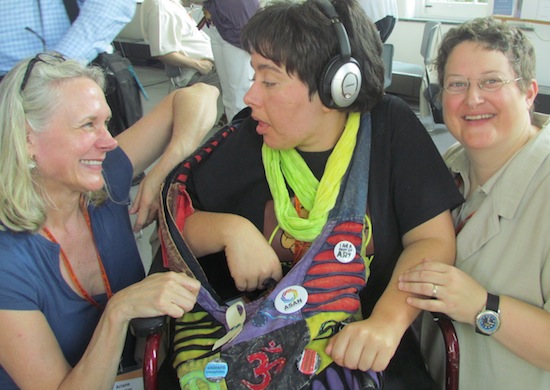
Ariane Zurcher, Amy Sequenzia and Ibby Grace at the ICI Conference ~ A conference dedicated to accommodating those who do not speak

Me, Amy & Ib

Variations in Neurology and Other Ramblings

I say I’m an addict and you envision a bum passed out in a gutter on the lower East side.  I don’t look like that bum.  I don’t fit that image.  So you smile at me and say things like, “well, you can’t really be addicted to food, can you?” or “oh you’re not really an addict, why label yourself that way?” or “you just need to use a little more self-control,” or “why can’t you just stop?”

I call myself an addict, not because I am active, but because I cannot allow myself to forget that my brain is hard-wired that way.  Once active, I can’t “just stop.”  I call myself an addict because that is the best descriptor of how my brain works.  I accept this.  I know this about myself.  There’s no judgment, it is what it is.  I call myself an addict because I don’t have the wiggle room to say I’m not.  Whenever I delude myself into thinking maybe, just maybe I can do x, y or z just this once, I’ve opened the door to addiction and I can’t afford to do that.  Once I become active, I may be able to stop, but I may not and that’s not a risk I am willing to take.  For twenty-two years I lived as an active addict and by the time I finally found the support and help I needed, I was ready to end my life.  It is not a way of life I want to revisit.  (I’ve written about some of this, ‘here‘, ‘here‘ and ‘here‘.)  But people have a tough time with this concept.  People who aren’t addicts, find this difficult to grasp.  That’s okay.  They don’t need to understand it.  I just need to keep doing what I’m doing.

There are things I need to do that help me stay “clean”.  I need support from other addicts.  Those friendships and relationships are not only important, they are essential.  All of us have a similar vision for each other and ourselves.  We place our shared vision above individual personalities.  If a disagreement arises, we try to remind ourselves and each other that our common goal is far more important than whether we like or dislike someone.  We try hard to keep away from gossip, judgment and personal attacks as best we can.  We talk about progress not perfection.  We mentor each other and reach out to those who are struggling.

Within these principles there are a great many tools that help us.  For me, the single most important thing has been realizing that when I behave with integrity, and by that I mean, do not lie, cheat, take advantage of another, treat others as I would like to be treated, do my best to keep my energy directed at my behavior and actions, reach out to those who may be struggling, listen, learn, remain curious and tapped into the wonder of life and all that I do not know, then I will live a far better life than if I do not do these things.  This also is the only method I know of to stay free from my addictions.  It’s pretty simple, right?  Simple, but not easy to practice.  I often don’t get it right.  But I keep trying.

I bring all of this up because there are many of us who have neurologies that differ from the majority.  As I said, judging my own or anyone else’s as good or bad, better or worse is unhelpful.  It is what it is.  We can get caught up in semantics, we can argue about addiction or any other neurological variation from what is considered the “norm”.  But more importantly (to me anyway) is the vision.  Many do not agree with that either.  My vision includes a society of inclusion.  I am reminded over and over that compassion and love are actions.  Who I am and the way I behave have nothing to do with what others think of me.  There are people who need support to do things I can do without thinking.  Things I take completely for granted, like communicating.  There are people whose lives could be transformed from one of misery to one of purpose if their neurology was accommodated.

In yesterday’s interview, Tracy said, “The man I am today is because my autism is the gift I was given to be a leader to anyone who has ever felt less than human based on their appearance. Martin Luther King knew that hurt and he took it to the mountain of peace. My mind is more like a Mensa candidate than I can type. My life is a testimony to the lesson of humanity. Like Larry typed “More like you than not” is the guiding principle to inclusion.”

We are all more alike than we aren’t.

A Conversation with Tracy Thresher

One of the things I love about having a blog are the conversations I get to have with people I would not feel courageous enough to approach and/or get to know.  Tracy Thresher is one of those people.  Tracy Thresher and Larry Bissonnette are the stars of Wretches and Jabberers, the documentary by Oscar Award winning and two-time Academy award-nominated filmmaker Gerardine Wurtzburg.  Wretches and Jabberers follows two non-speaking Autistic men, (Tracy and Larry) as they travel the world, reaching out to other non-speaking Autistic people in an attempt to change public perceptions surrounding intelligence and autism.

“Leading man, Tracy” as he often jokingly refers to himself, is a terrific public speaker.  I have seen him speak through typing many times now and each and every time I am riveted.  It isn’t just the poetic way Tracy puts words together, it is his humanity, his humor, generosity, and ultimately, his tremendous compassion for this world and the people who inhabit it, that makes people sit up and listen to every word he taps out one painstaking letter at a time.

The following is a dialogue Tracy and I have been having for about seven months now.  It has taken so long because of our schedules, but also because I could not stop asking more questions.  Every time Tracy answered one question, I would have about ten more.  Tracy was not only patient with me, but his kindness infiltrates his every response.  As this conversation could go on and on, as far as I’m concerned, I thought I better post what we’ve been discussing thus far.

AZ:  Tracy, how would you describe the documentary, Wretches and Jabberers that stars you and Larry Bissonnette?

TT:  Our film catapulted me to realize my dream of traveling the world to educate, learn and change old attitudes of discrimination toward people of varying abilities. The Larry and Tracy duo illustrates how intelligence is often worked out in a much different way. Our journey takes us to places of enlightenment and our humanity, humor and intelligence comes shining through our typing. Our mission to spread the reality of our amazing intelligence through our typing is our way of promoting the Presumption of Competence dispelling myths. Our story is one that is a road trip for two friends who are in Larry’s words “more like you than not”.

AZ:  “More like you than not” is such a wonderful description.  So much of the literature surrounding autism is about the “deficits” of Autistic neurology compared to non Autistic neurology. Can you talk about the assets and the similarities?

TT:  In my way of thinking, my experience initially was uncontrollable anger for the life I had trying to break through the misunderstanding in school. Kids can be brutally honest, reflecting the language that was the accepted norm in my childhood. Labeling kids is crippling. MR (mental retardation) on a diagnostic chart equates to NOT a candidate for the honor roll. Now I am able to communicate the reality of autism. I met Monk Hogen during the filming of “Wretches and Jabberers”, shining his wisdom on my autism. My true desire and purpose in life is breaking the walls of injustice down and my autism is the gift God gave me. I now focus on how I am connecting with all kinds of people through my work on the road. The high I feel in my own community is so wonderful, knowing that people want to know me. The man I am today is because my autism is the gift I was given to be a leader to anyone who has ever felt less than human based on their appearance. Martin Luther King knew that hurt and he took it to the mountain of peace. My mind is more like a Mensa candidate than I can type. My life is a testimony to the lesson of humanity. Like Larry typed “More like you than not” is the guiding principle to inclusion.

The anger on stage during my presentation in Japan was related to the lost opportunities in my education. I kept shouting out my automatics like “Look at me now! The kid you told one another to keep in isolation now is mentoring students which is healing salve to old wounds of injustice.” The other anger in Sri Lanka is more about the heat in the way it took my overly heated mix of perspiration soaking my clothing to extreme discomfort. Also, the popular foods in their culture are not in my comfort zone. Finland washed my anger, turning my heart to love of the climate. The cuisine helped too. Primarily, beautiful lands of countryside put my spirit at ease. Henna melted years of lost hope by crumbling away the feelings of isolating my heart to love.

People in the world often fear the paradox that autism usually presents. Larry and I mostly felt gracious vibes in our travels but the camera crew likely alters reality. To reflect on the cultural attitudes, the typing of my international friends is the true compass pointing to injustice.

AZ:  For children who may be trying to cope with similar frustrations and anger, what do you suggest to them and their parents, teachers and therapists?

TT:  This is my mission to show kids and their supports that putting communication to the top of their list of priorities is vitally cleansing to the mind. Releasing deep thoughts is the key to alleviating anxiety. Frustration leads the body to unproductive anger. Being able to show intelligent thought is the path to happier futures and true quality of life, leading to purpose. That is what I sought and found with typing.

AZ:  Was there anything others might have done to help when you were overwhelmed with anger?

TT:  Harvey and I have trust in our partnership. I need his firm yet kind support to stay on course with managing my autism. Harvey and I work well together. Typing is my outlet and open communication is the key.  Long term shared goals helps to keep me on track. Harvey’s commitment to my communication is the big time dosing of calm energy that I need. The commitment to presuming competence is the major breeze of refreshing air to cooling anger.

AZ:  You communicate by typing, but need someone to support your typing.  Why is it necessary to have someone physically supporting you? 

TT:  Impulse to type out my most irritating automatics like going to radio stations or wcax news gets looping in my mind. Having good facilitators is helping me to slow my typing to think and connect to my inner thoughts. I also need high goal of working on fading physical support to be more independent and type with lessening support. Building trust is critical to fading.

AZ: What issues and resources do you feel are most important for a parent to be aware of when encouraging their child to self-advocate?

TT:  I look up to pioneers in the FC world like Annie McDonald for her courage in the looking with the harshest disbelief on her typing. Rosie Crossley I also find gave me hope with her tell-it-like-she- sees-it firm approach. On a daily basis, the man of firm guidance is Harvey Lavoy. Harvey is my guru of staying focused. I would say he is my mentor of communication.

AZ:  When and how did you begin typing?

TT:  I was one lucky man to meet Alan Kurtz in 1990. Alan was motivated to unlock my wisdom. He treated me to intelligent conversation. Alan picked up on my eyes grazing on morsels of typing in magazines and the local paper.  I was one of the first people in my Green Mountains of Vermont to be treated to this life changing mode of communication. I was 23. Alan unlocked years of pent up chaotic thoughts. My intelligence was masked by autistic looping of hurtful labeling.

Early Supports:

I had my job coach Donna. Donna was kind and gentle. I liked her. Her support for typing limited me to Kinney’s work. It takes time to build foundations of trust and to build connections. Alan presumed my competence. The feeling of being spoken to in an intelligent manner was exhilarating. My inner thoughts hid in my mind looking for light like trees needing to flourish. My true communication jumping out on thin strips of paper was like first steps, shaky building of freeing my mind.

AZ:  Did you know you could write, but had nothing you could write on or with?

TT:  I could put letters together in my mind to make them join to form words. It was my life to play with vocabulary in lonely times. I did not think too much about how I could put my thoughts out on paper. The labeling I heard made for pesky lapping up of my hope for sharing my thoughts.

AZ:  How hard was it to start typing?

TT:  The torch of my fiery need to have a communication partner passed from Alan to Harvey Lavoy. Looking into my dark deep chaos was like unlocking madness. I held many hard grudges toward a label of retardation. The looping replay was non-stop with no way to talk or vent to Mom or a friend. Using miserable behavior is release of the locking in of intelligence. I had lots of my pre-scripted looping thoughts coming through my typing; things like radio and my local news station WCAX. My inner thoughts got masked in too much of holding on to my autism. I did not know the term proprioception then. Lack of knowledge of my own body ticked me off. My movement looked like no control in the beginning. Harvey had many arm wrestling contests with me. Ha-ha.

AZ:  Was it frustrating?

TT:  Oh big time ticked off was my typing in my starting out with Harvey. I had my liking of typing with my days with Alan. Mighty communication got put to the derailed track when Alan moved to Maine. Harvey took my brutal frustration in stride. I was brewing with lots of anger. I worried I would lose my life line of typing.

AZ:  Did you immediately feel motivated and liberated?

TT:  I did feel the tangled web of thoughts trying to be set free. My body was like a tight coil pulling so anxiously; did not easily break free to allow for liberation. Harvey motivated me by talking to me about self-advocacy. I began to hope life would be mine to choose. Emerging from despair is hard work. The power of typing took my mind to freeing the grip of autism but it took lots of grueling typing sessions.

AZ:  Were you resistant to typing at first?

TT:  My body took over my logical mind many times. I often ran from the typing space out to the parking space trying to regulate. It did not help to be gulping Mountain Dew. My impulsive habits with food led me to not think with clarity. I needed much support from Harvey to stay in my typing space.

AZ:  If yes, did anything help with the resistance?

TT:  Placing high expectations on me truly is my need. Harvey looked me in the eye to insist that I decide my purpose in life. To be in control I needed to make big changes in my life. I had terrible grating on Mom’s nerves yelling to be rid of. Holistic life of Buddhism is my goal but I easily revert to junk food at times. Harvey leads me to mindfulness by pointing out hard truths to help me make thoughtful choices.

AZ:  What did it feel like to be able to communicate in a way that people seemed to finally understand?  Was it at all scary?

TT:  Typing lifted my label of retard. Scary, it was not. More like “Take that!”  I had begun my journey to change perceptions. It was like the locking in of my voice was over. I was giddy with hope.

AZ:  Lots of people who watched Wretches and Jabberers have asked about your living situation.  Do you mind answering the question so many continue to ask – What is your living situation right now?

TT:  My Mom and Dad live near my week day home provider. I have my Wednesday family dinners. My mom is very involved in my life. I made the choice to leave my parents’ home to embark on my journey toward having a life of my own. It has been arduous at times but I have learned hard lessons toward life of my own making. Right now I live in one place Monday through Friday. I spend weekends with my family or with my weekend provider. I am working with my team on finding a place of my own.

In addition Tracy sent me a word document which he said I could share with all of you:

Many people have tried to help with my residential situation. I would like to clarify my search is plagued with difficulties of lack of knowledge in the way I would like to be supported. My family is my greatest place of stability but my idea of independence is having my own home to hang my hat, to set up in the way I choose. Mom has been there my entire life to help me on my path to being the independent thinker I want to be.

It is my time to search for the place I want to live that is both independent oriented but gives me the right thinking type of support I need. By that I mean it is necessary for me to have physical cues to get my body moving not bossy final answers made by others. My dream is to be in my own place where I make choices of the groceries I wish to buy; the decorative theme is of my choosing; the communication is open; the weekends’ activities fill my desire for exercise.

The most important thing is the commitment to learning how to support my typing. I have to let it be known that my family would never turn me from their home; this is my desire in my search for being in control of my life that I want to make for myself. I know my fans mean well to help in my residential search. For me it is more than a hook to hang my hat on; it is being in peace in my way of living where I make the house rules in cooperation with my like minded roommate.

For more on this blog about Tracy and Larry click ‘here‘, ‘here‘, ‘here‘ and ‘here‘.

Tracy – 1991
Early shot Tracy

Tracy at the ICI Conference – July 2013
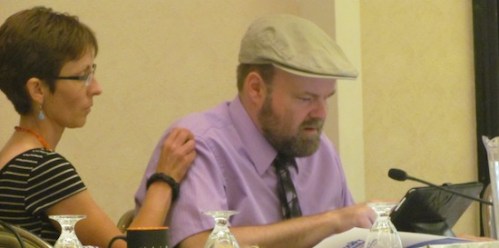
Tracy @ICIConference

The Snowball Effect

The snowball effect began with, what I now think of as, a leap of faith.  Richard and I leapt into that great abyss better known as the unknown.  It turns out this was actually not true, it would be more accurate to say we chose to neither believe nor disbelieve, but instead began to examine all we were being told.  Perhaps it’s better to say that instead of leaping into we jumped out of.  From there it was more of a hop to begin presuming competence.  However, as a commenter on this blog said, “presuming competence isn’t enough.” And knowing what we now know, I have to agree.  It’s the starting point.  It’s like that initial leaping off point, it’s just the beginning.

At the moment we are experiencing something akin to being in free fall.  It’s the feeling of discovery, limitlessness, surprise, and pure ecstasy that comes with being present without expectation or preconceived ideas about what should or will happen.  Our perspective continues to change as we move along.  Like any great adventure, the path is at times rocky, but the triumphs are exquisite.  As we move deeper into this process it becomes easier and more familiar to be solidly in the discomfort of the unknown.  There is bliss in that.  True bliss.

Last fall I wrote a post about how I was worried Emma was not comprehending a story that had been sent home in her back pack from school.  It was a simple story, perhaps 1st grade level reading with some questions that she seemed unable to answer.  In the post I write how I am trying to find ways to help her reading comprehension.  I talk about presuming competence.  What I am struck by now is not Emma’s level of supposed incomprehension, but by my own.  I reread all the comments just now and am amazed, amazed that though I thought I was presuming competence, I was only able to go so far with my presumptions and, as it turns out, wasn’t going far enough.  I could only presume as much as my limited thinking would allow me.  The idea that she was not only comprehending this story, but was so far beyond it, was not something I was capable of fully understanding, let alone considering.  I was much more stuck, as it turns out, than my daughter was.

Now jump forward to yesterday afternoon, almost nine months after I wrote the post I refer to in the above paragraph.  Emma chose to talk about adjectives.  We watched the BrainPop movie about adjectives and then she took the quiz.  I copied what Rosie had done, asked her to read the questions silently to herself while using a laminated card to direct her visually and then quickly guided her to read each of the four multiple choice answers.  She only hesitated once, on a question about a possessive adjective, but otherwise breezed through the quiz with 90% accuracy.  Not only was Emma reading faster than I was able to, but she was accurately answering the questions faster than I could read them, let alone answer them.

The snowball effect:  “The basic workings of a literal snowball effect can be illustrated by taking one’s average baseball-sized snowball and dropping it down the side of a snowy hill. As it descends it gathers more snow and whatever leaves, sticks, etc. are in its way. The snowball accumulates not only size, but speed.” ~ From the Urban Dictionary

Self Portrait

photo

Audio Book “I might be you” Giveaway!

Barb Rentenbach, author of the wonderful book I might be youwhich if you haven’t read it yet, you must, is giving away the audio version to the first 5 people who click on this link and enter your name.  Ready… set… GO!

For those of you new to this blog or who may have missed the posts or who read them the first time, but can’t remember them any more or those of you who want a refresher course on all things involving Barb (and why wouldn’t you?) I wrote about recording Barb’s book last spring, you can read all about it ‘here,’ ‘here,’ ‘here‘ and ‘here‘.  If you want to hear directly from Barb about the giveaway and why she is doing this, read her post “Introducing: ‘Ask Barb’

Now I’m going back to bed because I seem to have caught some nasty bronchial cough, runny nose, sneezing, achy, maybe even feverish horror that I mistakenly thought was allergies but that I am now convinced is a distant cousin to whooping-cough.  In other words I’m miserable and unless you want to read an entire post about just how awful I feel, you should go now and pick up that FREE audio book quickly while they last.

No, no, never mind me… *coughing while feebly gesturing you to get on with your day.

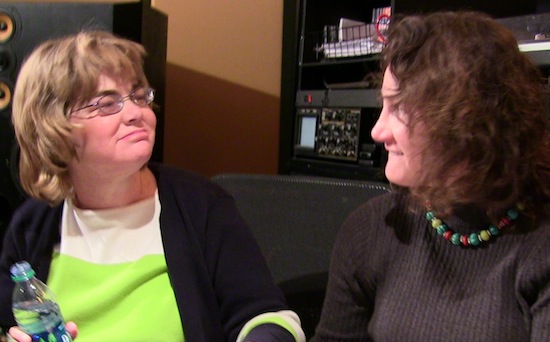
Barb Rentenbach & Lois Prislovsky in the recording studio (I was in the ‘cave’ aka recording booth with headphones on)

Barb & Lois

Emma’s Story

Emma told me I could post her story on here this morning.  This is a story she wrote yesterday with Rosie (Rosemary Crossley).  Rosie developed a technique more than thirty years ago to help people with a variety of issues, specifically those that make speaking difficult or impossible .  Em held onto a tube with one hand while Rosie held the other end as Emma typed.  Rosie began yesterday’s session by asking Emma to write a story that began with either, “once upon a time” or “one day.”  I was standing near Emma, with Richard, Joe and Em’s teacher, Katie, all watching as she typed the following.

“One day there was a boy called george. He had been in afight can’t tell you how he got into the fight but he was bruised all over.  He fought a lot and his teacher was very angry.  The next day he was all purple and his mother said you can’t go to school looking like that.  The very clever boy covered himself in flower and his teacher thought he was sick and sent him home.  The end.” 

Not sure I can actually continue writing here…  but I’m going to try… *Breathe*

I have read this story more than a dozen times already.  I know I’m totally biased, but I’m just going to say it – what an incredible story!  There are so many layers to it.  This story that Emma wrote with great concentration, with little pause is the first story she’s ever written.  She was focused and when asked about the word “flower” she verbally said “powder” in explanation.  Rosie explained that flower/flour are words that sound alike but are different in meaning.  Rosie explained that the powder kind is spelled “flour.”

But there’s more…  A little later Rosie brought out a math app called Math Magic where Emma proceeded to zip through addition, subtraction, multiplication and division.  None of this is particularly noteworthy, except that Emma has never been formerly taught division.  She was choosing the correct answers from a field of four.  A sample equation is:  “56 ÷ 8” and the multiple choices available were: 2, 9, 7, 6.  Emma chose the correct answers independently.    Allow me to say that again.  Division.  Emma chose the answers independently.

It was at this point that I felt so many things all at once it was almost impossible to speak.  But more than anything I kept thinking about how we continue to underestimate our daughter.  I had no idea she could do division.  Not only can she do division, she can do it quickly.  There’s another app Rosie recommended – Brain Pop and Brain Pop Jr. which Emma also did as we watched.  Not only did she listen to the short lesson, but then read all the questions silently, read the multiple choice answers and chose the correct answers.  It seems verbal speech is tricky, particularly when she is expected to answer questions verbally.  When asked to read silently and then identify the correct written statement by pointing to it, Emma did beautifully… about Ellis Island, no less!  The only interaction Rosie provided with both the math and Brain Bop was to use a laminated card that she silently moved across the words as Emma read and she did not allow Emma to point to any answer until she’d finished reading all the choices.

I cannot imagine how awful it must be to be so capable and yet treated as though you were not.  I imagine it must feel like being “bruised all over.” I imagine it must feel like you “fought a lot”.  My wish for my daughter is that she may continue to do all that she is doing, while we provide her with every opportunity to flourish and continue to show the world how very “clever” she is.  The only limitations are the ones we provide.

I am incredibly grateful to all who believe in her, all who have helped and who continue to help us so that we can be better parents to our daughter.  The list continues to grow…

Rosemary Crossley

Rosemary Crossley

The Teen Behind the Blog

There’s a blog called, TeenTyper, written by someone who describes himself as, “an autistic teenage awesome boy.”  He started his blog two years ago when he was 14 years old.  On a recent post he wrote, “the feeling is bold saturated thimbles of strength.”  Em and I had the honor to meet the young man behind the blog while in Syracuse.  As he also lives in the same city as we do, we got together with him and his mom yesterday.   He is non-speaking, but types and so he and Em typed to each other for a little while and then I asked if it would be okay to talk to him about his blog.  He said it would.  I asked him, “Why did you start writing your blog?”

He typed, “i startd because my aggravation abt my spaz speaking.”

This is from his Subway Poem

“Subway subculture asserting the stroll
I watch and try to look like another old soul…”

Later I asked him, “Is the blog a place where you want to tell people something specific or is it more a general way to communicate your thoughts, or something else?”

He typed, “neurotypical need to be more conscious abt mean stares and hearing my voice will help them understand who I am.”

From Let me say:

“Before you judge let me say
You need to try being me
Before you judge let me say
I feel awful when you overly stare at me
Before you judge let me say…”

We need to be aware of the harm we do to each other with our judgments and implied criticism.  We need to pause and take our time.  We need to give each other the benefit of our kindness, we need to slow down…  we need to talk less and feel more, we need to give one another the gift of acceptance, we need to stop with our projected fears, our desire for sameness, our impatience, our disregard for another’s humanity…  we need to embrace one another.

From Wasted Words:

“Words wasted on nonsense
Still
Define…”

I urge everyone to go over to TeenTyper and give it, and the “badass awesome” teen who writes it, some love and support!

On Being Fallible

At the conference Em and I just returned from I was confronted by someone who told me I was being disrespectful of my daughter.  She actually went further and said I had spoken “inappropriately” to her.  Furthermore she said these things to me in front of a room filled with people, all of whom could hear her, because she was leading the presentation.  Yup.  It was one of those moments when you really wish the floor would arbitrarily open up and allow you to slide into its blissful dark, abyss.  It was also the final day of the conference and I was feeling pretty fragile and emotional.  My ability to filter was at an all time low, my ability to think logically was pretty much non-existent, and finally, my ability to hear her and reflect on her words without defensiveness was hovering in the red-high-alert-grab-your-oxygen-mask-we’re-going-down-save-yourself range.  It was one of those moments you wish had never happened, but more to the point you wish you’d never said the thing that was being criticized so publicly.  It was a moment of intense shame.  And my first thought was – defend, defend, defend!

But remember, I was in overwhelm before her words had found their target and I didn’t feel strong or able to fight back, nor did I feel I was in a position to fight back, after all not only was she leading the workshop, she was someone I have a massive amount of respect and admiration for.  This is someone I had looked forward to seeing ever since I was told we would be in her workshop.  This was the person I’d read about and anticipated meeting with eager excitement.  Meanwhile there my daughter was, typing out “I’m happy.”  To which she said, “I’m guessing you’re happy when your mom gets called out on her behavior.” Ouch. Ouch.  Ouch.  Let’s just get a knife while we’re at it and see some real blood.

But here’s the thing…  she had a point.  The details aren’t relevant, what is, though, is that if I am speaking to my Autistic child in a way that I wouldn’t speak to my non autistic child, then that’s clearly a problem.  If I am speaking to my Autistic child in a way that I would speak to my non autistic child, (as was the case in this instance) and someone who has spent their life working with children and advocating for them calls me out on what I’ve just said, I need to, at the very least, consider their words and reflect on my own.  I have never claimed to be an ideal parent.  Years of parenting has taught me that sometimes I get it right, often I get it wrong, but hopefully I will always be willing to look honestly at my actions and behavior without defensiveness, but with a desire to learn and be the best parent I can be one day at a time.

So if someone says something that really hurts, when their words pierce, I’m old enough and smart enough to spend some time thinking about my reaction and at least try to see where the other person is coming from.  Sometimes people say things without the necessary information, sometimes people say things that hurt because they are operating from a set of false assumptions, and sometimes hurtful things are hurtful because there is truth to their words.  I’ve spent the last 36 hours trying to figure out which of these was true or if it was a combination of things, but more importantly, I have reflected on whether the sentence I said to my child was the best way I could have spoken to her and if it wasn’t, what would have been.

Even in my state of overwhelm, I was able to whisper to Em right away, “I’m so sorry, Emmy.”  And I was.  But I was also angry with this other person.  I still felt the need to defend.  I still wanted to “save face” in front of this room filled with people.  But instead I went silent and tried not to cry.  Shame.  Shame is brutal and though all of us have probably felt first hand what it feels like, we also probably, inadvertently have shamed others without realizing it or even meaning to.  I know I have.  The above example is a case in point.  Without meaning to – I had shamed my daughter by questioning out loud what she’d just typed.  I get that.  I have enough humility to know that I make tons of mistakes… every day…  but I also know the beat up job that is my default reaction to making a mistake is not a healthy one.  I’m working toward more measured and thoughtful responses.

One of the things I love about Pascal Cheng, the first person to help me begin supporting Emma with her typing was that when I did something that he saw was unhelpful, he would/will say, “May I give you some feedback?”  He then says things like, “Instead of saying, ‘No!’ ask her if that’s the word she meant to type.”  He has taught me to try and give her just the right amount of resistance (to make sure that she doesn’t go to favorite scripts) combined with the emotional support and encouragement she needs to continue typing with me. Pascal models the same respectful interaction with everyone he comes into contact with.  When I grow up I want to be like Pascal.

But in the meantime, I am looking at my words and seeing how important it is for me to be aware and conscious and respectful of my daughter.  Perhaps the better question I must remember to ask myself is not – would I speak to my son this way, but, would I want someone else to speak to me this way?  The beauty of life is that  we can always improve if we want to.  And I desperately want to.  My goal isn’t to be “right” or never to do anything “wrong” or to make someone else “wrong” when they confront me, my goal is to have the willingness to look honestly at my behavior and the things I say and do, face my mistakes and learn from them.  That’s my goal for this short life I have been given.

Me and Em at the ICI Conference
Me & Em