Category Archives: Autism

Language Acquisition?

Yesterday I wrote about some of the problems inherent in asking children to read out loud.  You can read that post ‘here‘.  The comments have been uniformly terrific, extremely informative, and very helpful.  Ischemgeek wrote several comments that I’ve actually printed out and even copied and pasted into emails to a few teachers I know.  She wrote a terrific explanation and series of suggestions in answer to a question I posed asking for her thoughts regarding handwriting.  My question to her was slightly off topic from the original post, but if you read the comments you’ll see how the conversation evolved.

Another comment, from bjforshaw, reminded me of how when Emma was a baby she seemed to acquire two or even three word phrases (“chase me”, “go out”, “all done”, “play catch” “I donwannta”)  as opposed to individual words.  Bjforshaw wrote, “I dislike reading aloud because it is so different from the way I normally read and this makes it feel uncomfortable. My usual reading speed is fast, much faster than my speech, and I scan phrases, groups of words, even whole sentences. In contrast when I read aloud I have to plod along one word at a time.

When I read his comment I had one of those “light bulb” moments.  You know, where you think – wow!  This reminds me of this other, seemingly unrelated thing, I wonder if there’s a relationship?  So I went to the internet to see if I could find any articles on the topic of language acquisition, but haven’t found any dealing with babies learning whole phrases and chunks of words at a time.  Not only have I not been able to find any articles written on this topic, but I cannot find many articles written about language acquisition and autism, specifically, that aren’t more than ten years old, which I find baffling. If anyone has relevant links, please send.

I have no idea if, for some, language learning is similar to the way bjforshaw describes his ability to read, but I’m curious now.  Could it be similar?  Has anyone heard or read anything about this?  For those of you who read in chunks and not the individual word, do you know or remember whether you also learned to speak this way?  In other words instead of learning one word and then building upon that word, did you learn a phrase or several words together?  Could this also then be related to scripts? I’m thinking out loud here, but I’m wondering if scripts are meaningful because they are learned chunks of language that come to represent more than the literal interpretation given by those listening. Do the scripts carry more (hidden) meanings to the person saying them?

Thanks again to all who have commented, and to those who intend to, thank you in advance.

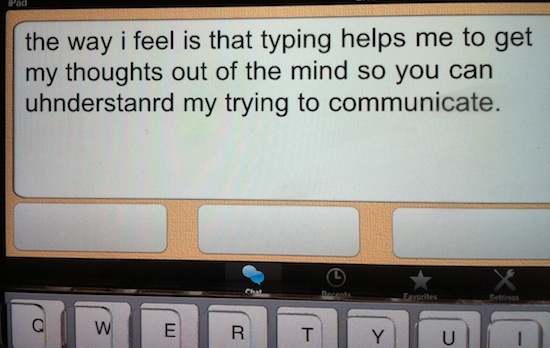
Em types for an audience in Tampa, April 2013Em types with Pascal

The Pitfalls of Reading Out Loud

When Rosemary Crossley was here she spent several hours working with my daughter.  One of the many discoveries we made was that Emma can and does read very quickly, but if asked to read out loud, she will stumble and get so caught up in pronunciation I question whether she is able to comprehend what she’s reading at all.  I know I have trouble following the story.  Yet most schools ask children to read out loud, both as a way to assess what they are capable of, and also to make sure they are at the correct reading level.  If a child reads a first grade reader out loud with great difficulty, the impulse is to make the reading material simpler.  Except that if this is done with my daughter she will be stuck reading kindergarten and beginning level reading books for the foreseeable future.

I know Emma is able to read much more complicated texts than beginning readers.  I know this because I have seen her read with Rosemary and me very quickly.  I have witnessed her ability to read, not only faster than I can, but her ability to accurately answer multiple choice questions related to the text with ease when  given some resistance.  In other words, if she is asked to wait a beat, instead of being allowed to immediately point to an answer, her accuracy goes way up.  Without the pause she is just as likely to randomly pick any answer.  From Rosemary Crossley’s book, Speechless, “The resistance I provided slowed her down very substantially, and the quality of her output increased as her speed fell.  I gave Jan a picture of a cow and asked her to write me a sentence about it.  Instead she typed, THIS TYPING IS HARD.  I HAVE TO THINK.  That was, of course, the aim of the exercise.

This idea of providing resistance is a tricky one to explain to people.  I have had some people say they just cannot understand why this would be necessary.  The only way I know of to better explain, is by comparing it to the way many, who are like my daughter, will perseverate on a word, or will rely on favorite scripts.  It is not that these scripts have no meaning, it is more that they are often difficult for others to understand.  If I hand Emma her iPad and ask her to type me a story, she will most likely write something like, “rollercoaster, kiteflyer, greenride, hurricane harbor, waterslide” which is also in keeping with what she might say out loud.

These words are powerful to her, they hold a great deal of meaning, but to most people, they are seen as gibberish.  If this then is used to assess her capabilities she will not be well served.  However if I ask her to type me a story and then hold one end of a rod while she holds the other end with her typing hand and types with one finger while I pull her hand back after each letter is typed, she might type, ““One day there was a boy called george. He had been in afight can’t tell you how he got into the fight but he was bruised all over.  He fought a lot and his teacher was very angry.  The next day he was all purple and his mother said you can’t go to school looking like that.  The very clever boy covered himself in flower and his teacher thought he was sick and sent him home.  The end.”  

Incidentally, that story is one Emma wrote when Rosemary was here working with her and is typical of the sorts of things she can and does type when given the kind of resistance I’ve described.  (You can read the entire post I wrote about her session with Rosie, ‘here‘.)  However, ask Emma to read out loud a story similar to the one she typed and she will have a great deal of trouble.  What she is capable of is far greater than what one might assume from what she verbalizes, whether that means reading out loud or with spontaneous speech.  Ask Emma to sing the lyrics of a song, in Greek no less, and she will get much of it right, but that’s a whole other post.

But how does one convince others that this is so?  Particularly when many are trained and told that reading out loud is a good indicator of ability.  There is surprisingly little written on the topic of the problems with reading out loud for those who have spoken language and word retrieval issues.  Again, in Rosemary Crossley’s book, Speechless, she writes, “her reading aloud was bedeviled by the same word-finding problems which affected her spontaneous speech, preventing her reading with any fluency.”

Obviously there needs to be more written about all of this.  The closest I have found, other than Rosemary’s book, Speechless, is a blog, The Right Side of Normal,  that concentrates on “right brained children”.  And on that blog, this post specifically, Silent Reading versus Reading Aloud, which deals with, at least some of what I’m discussing here. If others know of other resources discussing any of this, please do leave me links in the comments section.

Rosemarie Crossley

Rosie

When We Say Things We Do Not Mean

Erratic speech.  Unreliable language.  These are all words to describe what many, like my daughter, experience.   Speech that does not represent what is meant,  but that people hear and make assumptions about the person based on what has been said.  Rosemary Crossley in her book, Speechless talks about nominal aphasia – “One of the familiar aftereffects of stroke, for example, is not being able to say what you mean.

Many years ago I became friends with a man who’d had a stroke, leaving him aphasic (meaning he was mostly unable to speak, though he understood what was being said to him.)  Every few months my then boyfriend and I would pick him up at his apartment and take him somewhere.  I don’t remember if he could type his thoughts, this was long before the advent of the iPad, and as he could not hold a writing implement, this was not something he did when we were together.  I do not remember him ever uttering a single word.  Prior to his stroke he had made a name for himself as an avant-garde theater director.  In the theater world he was thought of as a god.  After his stroke he went on to direct a number of works with many famous actors.  People were willing to believe he could not only understand what was being said, but that he had a great deal to say, even though he could not verbalize his thoughts.   His name was Joseph Chaikin.

For those who are Autistic and also have unreliable speech, people tend to take what they say at face value and believe their speech is indicative of their thinking and thought process.  Yet this could not be farther from the truth.  Many are willing to dispense with their disbelief when someone is famous and once spoke, but most are not as willing to believe when someone has word retrieval issues, that they are capable of more than what we hear them say.  “…children who have never been able to speak fluently have not had a chance to establish themselves.  They have not had the typical infant’s experience of controlling the world with their speech.” ~ Speechless by Rosemary Crossley

And as a result they also do not have the same types of interactions with others as those who have more fluent speech.

Because our judgments of intellectual capacity, both formal and informal, are strongly tied to speech, a child who says the wrong words, who gives “silly” answers when asked questions, is likely to be seen as stupid.  A child who can never find the word he wants, or a child who cannot make his tongue do what it should, can come to associate speech with tension, embarrassment, and failure.” ~ Speechless by Rosemary Crossley.

Children with severe speech impairments often develop behavioral problems. These may simply be a result of the frustration inherent in not being able to say what you mean, but this frustration may also be exacerbated by the reactions of the people around them.” ~ Speechless by Rosemary Crossley

One young man who had unreliable language and who Rosemary worked with typed, “I dont make sense and people think Im senseless.” Speechless by Rosemary Crossley

Typically, when someone speaks to us, we believe that what they say is what they mean to say.  We respond  accordingly.  When people tell me something Emma has said and how they don’t understand why she then became so upset because they were doing what she told them she wanted, I understand.  I understand how frustrating that must be, for her, for the other person, for everyone involved.  Emma does not have phrases like, “Oh I know the answer to that, but I can’t think of it just now” or “give me a minute, it will come to me” or “it’s on the tip of my tongue” or “I just had it, the word was right there” or “what’s the word, you know it sounds like ________?”  or “wait, I know this, I know this…” or any of the other things most of us say when we know something, but the words have momentarily escaped us.

Communication is not just speech and for some, spoken language is an unreliable method of communicating.  Finding a more reliable method then becomes essential.  For my daughter, typing is proving to be a far more reliable way to communicate.  And as it turns out, there are a great many others who are just like her.

Waiting

In Answer to – Medication?

A number of people wrote in on the post, To Medicate or Not with their experiences.  The post was not about medicating autism, but about some of the co-morbid diagnoses that many people who are also Autistic  have.  Quite a few people wrote about managing depression, anxiety, stress and related issues.  Some wrote about how they began trying different medications in their late teens…  “I started medication at about 19…  I started with Prozac and it went well for a while but over time it stopped working.  It did make me feel better at first.  From there and over the years, I have tried many different antidepressants for my anxiety- Prozac, Paxil, Zoloft,Trazadone for sleeping, Zyprexa, Cymbalta, Welbutrin, Effexor, and Nortriptaline.”

Many parents wrote about how they agonized over the decision to try medication and almost all of them said it was done as a last resort.  Both Autistic parents and parents who are not autistic said similar things about their decision to medicate their child.  One person wrote, “my autistic child is on ADHD meds and has been since he was four. AdderallXR until last year, now Vyvance (same med with less appetite suppression). Clonidine at night. He wants to be on them. He has told me he feels more creative and happy with his mind not looping fifty things at once.

Another wrote, “I had been fighting the medication for a few years.  I have had anxiety since I was little.  I had the doctor refer me back to one of my psychiatrists who is willing to talk and if necessary provide a prescription.  This time we tried combining medications.  Welbutrin seemed to help a bit so we tried things like Ritalin to help increase its effectiveness.  I was able to focus much better and things seemed to go well but I got severe heart burn as a side effect of the Ritalin.  We tried Dexadrin next but it didn’t work.  I gave up for a bit and then discovered Buspar.  It is an antianxiety drug but not in a class like valium etc which are addictive.

Lots of people wrote about having to try many medications and often combinations of things before they found what worked.  And a number of people wrote about being judged harshly by others either for taking medication themselves or for deciding to give it to their child.  One person wrote, “…they do not know.  They pass judgment, but have not lived the experience.  They make comments and say things as though they have the answers, but they don’t.  They  don’t know what it’s like.  They can’t.  I’ve learned to say nothing and ignore the mean comments and loud whispers.

Another wrote, “I don’t tell people anymore, because I’m tired of their uninformed criticism.

Again, thanks to everyone who wrote about this.  Really appreciate the honesty and willingness to share your stories.

To Medicate or Not?

It has been suggested I write a post about medications, both those prescribed and given to Autistic children, as well as those taken by Autistic adults.  This is not a topic I have any first hand knowledge about.  We have not given our daughter any medication, other than melatonin at night to aid in sleep, which has been nothing short of miraculous, and during those unfortunate years when I thought or hoped massive amounts of homeopathic tinctures would “help” her (they didn’t) and later the dozen or so vitamins recommended by the naturopath, we have managed to steer clear of medications.  (By the way, magnesium is helpful with constipation.)  I also have to quickly add, we have been able to steer clear of meds because our daughter does not exhibit any clear need for the medications currently available.

Personally I don’t like taking even aspirin, forget anything more hardcore, but I also am coming from a privileged vantage point.  I don’t have debilitating depression or anxiety or other issues, which would make taking medication a good idea.  The one time in my life when I was depressed and bulimic, Prozac was prescribed.  My reaction to it was less than ideal.  Even taking something as benign as ambien has a negative effect after more than one night on it.  I seem to be extremely sensitive to drugs and often have an atypical response to them.  With ambien, if I take more than half the prescribed dose I become so depressed I can barely function.  As a result I avoid taking anything, even if prescribed.

But I know people who do and have taken medications of all kinds and to say that it is optional, is being overly simplistic.  For people who need medication, things like antidepressants, or meds for anxiety or other issues that affect their ability to function optimally, it is profound the difference the right medication can make to their quality of life, their ability to wake up in the morning, their productivity level etc.  For those people, medication makes the difference between a bare, brutal existence and being a vibrant, active being who is fully in this world and able to enjoy it.  But what about those who are Autistic?  What is their experience?  Is it similar to those who are non autistic?  Is it the difference between barely scraping by and being able be fully present, or is it something else?

So I am asking for your help.  Anyone who has any first hand knowledge, whether it is you taking the medication, giving it to your child, or if you were given medication as a child, can you tell me what you take/took/were given/ or give to another and how it affected you?  Was it a positive experience, and if it was or wasn’t, exactly why?  Do you respond to medication atypically?  Did you have to experiment?  If you are a parent, describe your decision to medicate, what was the outcome, did you feel it helped or didn’t help?  Did your child notice the difference?  Any and all answers will be quoted anonymously unless you tell me otherwise or if you leave your comments below, I will only use whatever name you used to comment with unless you tell me otherwise.  If you prefer to email me, please do:  emmashopeblog@gmail.com.

Thanks so much everyone.  Really appreciate the willingness to share your experiences with me.

On the Topic of Violence…

On the topic of violence or actions, that by those witnessing, appear violent, actions that harm another or oneself, there is one thing that stands out, one thing every single person who has physically harmed themselves or another person have all agreed upon, and that is the need for a self-appointed safe place.  Not a place chosen by another, which can too often be seen as punishment, but a place that the person who is overwhelmed can go to, a place that feels safe.  A place that is sacred, that will not be violated; a place that is a safe haven.

From reading the numerous comments, emails and DMs people have sent over the last few days, it is the one thing every single person has agreed upon.  (If you’d like to read the other posts on this topic click ‘here‘, ‘here‘ and ‘here‘.)  And interestingly, not only a safe place for the person who is feeling overwhelmed and whose actions are harming others and/or themselves is needed, but a safe place for all present, those who either by chance or because they are trying to defuse the situation, is necessary.  A number of people have asked, but what if my child follows me or is breaking things and is a danger to themselves?  Again a number of people answered this question with the same answer.  They all said that in such cases it will take some time, repeatedly moving to a safe space, being followed, and leading them back to their safe space.  Every single person said that talking, reasoning, arguing, placing demands, insisting that the person “use your words”, telling them to take deep breaths, demanding they count to ten are uniformly unhelpful, and in most cases, cause the person more distress and further upset.

Another aspect to all of this is escalation.  Lots of people have described how they escalate or their child does.  One wrote about a child who had 8 escalation levels and that “if he gets to 4, they’ve lost him.”  They wrote that “most kids have at least 2 before they get to the attacking stage.”  They described one child whose first level was so subtle, many did not even notice or pick up on it – a heavy sigh.  Another parent wrote about a certain look the child gets, a stare off into space that they now know means they must get them to safety.  All agree that catching it before things escalate is key.  This is something Judy Endow talks about in her book, Outsmarting Explosive Behavior.  She describes “the four stages of explosive behavior: Starting Out, Picking up Steam, Point of No Return, and Explosion.”

Ari, who is non speaking and has a blog, Perceptions, described in detail what things help and what does not.  He wrote, “Am autistic and nonverbal. Never speak. Use devices with pictures mostly, but can type (sometimes). Have been violent. Usually only when people around me have problems below.

Problem #1. No one thinks to get one of my communication devices, switch to meltdown page, and put it in my hands to see if I could use it. Communication is hard. Some times I need be helped to use picture buttons. I have a page specifically for pre-meltdowns. It never gets used.

Problem #2. Blocking me, restraining me, pushing me into a corner, or otherwise making me feel trapped is not okay without my advance consent. Can follow me, stay close enough to see what I do or where I go, but let me go. Walking is calming. Non-autistics get to walk when stressed, why not me too? Trusted friends get my permission to touch my arm to guide me in safe walking direction. So much easier when there is trust and respect.

Problem #3. I hit myself, pull my hair, scratch/cut my skin, do other harmful things. Very rarely is done hard enough to cause serious damage. I understand it is uncomfortable to watch, but interfering will make me hurt myself far more. If you cannot bear to see this, leave and call someone else who can instead of interfering with my efforts to calm myself.

Problem #4. This one applies to everyone, I think. #1-3 may not be true for anyone other than me. Problem #4 is BELIEVE ME. Believe what I say about me because I am only one who knows what it is like to be me. If I tell you that you are wrong about me, accept that you are wrong and pay attention to what I say is right.

Problem #5. I admit there are times when I cannot calm myself, they are rare now but still can happen. There are acceptable ways to protect me (and others) from harm.  It usually involves medication, thick soft blanket, silence, darkness, patience, and ice. If person can resolve #4 with me, I am happy to discuss #5. Otherwise… Energy is not infinite, left alone I will eventually stop screaming and fall asleep. There may be blood. I will not die. Ice for my head when I am done is much appreciated. This is when I am most likely to get violent towards others. I know it is scary. I know. For me too. If unsure of what to do, just stay away from me, be quiet, wait for calmness. I will look for help when I am ready.

#5 usually happens because of problems #1-4. It is best avoided.

Last time was about 1 months ago in a hospital waiting room. I am 31 years old legally independent adult (whether I should be is another matter entirely). I just needed to walk. Instead I was pushed into corner and trapped until doctor called us into private room. If had been restrained longer probably would have hit person hard. Probably would have been charged with assault. Probably sent to psych hospital again. This is not my fault. I can not fix this. But at least it has taught me self control. I can endure incredible amounts of pain/fear/chaos without reacting, now. I did not hit her.

I asked Ari what he meant by “medication”.  He responded, “Only medication now is ativan. Had haldol many years ago and it worked better for #5 situations. But not good for anything less intense, unlike ativan. Need better. But no doctor good with this. So get no help finding better. Need body sedation, sensory pain away, fuzziness from situation, to for logical thought processes work again so can calm self.”  

He then added:  “Broken logical reasoning ability. In those moments, no logic. Only chaos.

A parent wrote:  “People have seen it and have threatened to call the police (when he was five!) or worse.  I really didn’t know what to do because he would get so upset and frustrated.  People said to put him in therapy, but the thing I did that saved us was I put our whole family in therapy.  We learned to communicate with him in ways he understood.  We learned that we weren’t always right in how we handled it, and we often made things worse.  We learned to find effective problem solving solutions (mostly following The Explosive Child by Ross Greene) It really made a huge difference and he rarely has violent meltdowns now.  When he does, I have to step back and ask myself what was going on, was I not listening to him?  Was I placing too many demands on him?  Was I not allowing him to effectively self advocate?  He always says to me that he doesn’t want to do it, he just is so frustrated and has a hard time communicating and identifying his feelings. We are still a work in progress, learning together how to understand each other.   I KNOW he doesn’t like it when he is violent, but he is doing the best that he can with the tools we give him.  I know this because he tells me, and because I was also a violent child.  My target was my younger sister sometimes, but mostly myself.   I was beyond frustrated and felt completely powerless due to the environment in which we were brought up.  I know I am doing better with my son than what I grew up with, but there are times I screw up.  I had to relearn everything I was taught about children, about communication and about respect.  I had to learn that “noncompliance” is really just self advocacy and that it’s actually a positive character trait!   That has made all the difference.  I really believe that kids do the best that they can with what they have to work with.  Kids who are violent are frustrated and need our help to find their voice.

If any of you know of other blogs, articles that have been helpful or are writing something on this topic, please send the links in the comments section so I can include in future posts.  I may need to make a separate page for all of this…

The Conversation Continues…

The comments continue to pour in, both through email and on yesterday’s post and the post from the day before on the topic of violence and coping when overwhelmed and overloaded.  A number of parents have emailed that a behavioral program helped tremendously and a few wrote about various medications they’ve (almost always) reluctantly given their child as a “last resort”.  One parent wrote:  “I had to go to the ER because he broke my nose and when the doc saw the bruises on my arms and my broken finger they called social services.  I was told my child would be taken from me.  Another doc prescribed _____  (anti-psychotic drug) and told me it was the only shot I had at keeping my son with me.  Sometimes the choices we parents are given suck.  I never went back to the ER even after he broke two ribs and my toe.  Years later he was able to type that three kids were bullying him on the school bus and had been for years.

Has anyone had experience with being given a behavioral plan?  Did it help?  If it did, what was it exactly?   And if it didn’t, and you don’t mind sharing about it, what was your experience of it like?  Did anyone have drugs given to you as a child and what was your experience with that?   As always, I will not use whatever name you give unless you leave it in the comments section of this blog or give me explicit permission.

Feministaspie wrote:  “The adults around me would tell me to take deep breaths, count to ten etc, and while I knew they meant well (and frankly, that was a much better way for them to deal with me than some of the other things I’ve read online, so I’m lucky really), that sort of thing didn’t really work for me. This was because at the time, I’d basically go into fight-or-flight mode so I absolutely was not thinking about that at all. I think it might also be to do with taking things literally, because apparently I’d just scream the numbers 1 through 10 at whoever told me to count, which obviously didn’t help matters. In hindsight, perhaps a more detailed plan was needed as far as that was concerned!! This made me feel really frustrated because that sort of thing was supposed to help and it didn’t and I felt like it was completely hopeless.

Ashmire wrote:  “I’d also add that sometimes there is kind of a feeling of powerlessness, of knowing that no matter how bad I hurt someone I don’t/didn’t have the capacity to hurt them as much as they are hurting me, because they are hurting me with emotions and I can only use physical damage which just doesn’t, can’t, ever, inflict as much pain as emotions can.

bjforshaw wrote:  “As for what helps, I would say that being given space is paramount. Confronting the violence feels like being cornered and makes it worse. What helps me is whatever makes me feel safe and unthreatened. I’m not able to speak or even type (I hate to think what effect my pounding would have on my keyboard) but as long as I’m not pressured I will be able to talk about it after I calm down. It has to be in my own time, on my own terms. That’s when I can start to explore the causes, the triggers.

In his blog post, Violence as a Means of Expression, bjforshaw writes: “Why do I do it? That’s a very important question. I am usually able to communicate effectively but emotion is a minefield: I have alexithymia which means I have great difficulty identifying and describing my emotional states. Strong emotions, especially negative ones, are very stressful. Add to that the fact that I become practically non-verbal when under stress — words are in my mind but I can’t get them to come out of my mouth — and you have a recipe for disaster. I’m not able to communicate my state of mind or my immediate needs which adds to the sense of frustration.

What Others Had to Say: Love, Overwhelm, Violence

Yesterday I wrote a post entitled, When Upset Turns Violent.  I wrote it hoping for feedback from those who may have at one time, or currently have felt so overwhelmed they strike out and from parents who are on the receiving end of children who become violent.   I wanted to get a better idea of the kinds of support that might be beneficial to all involved.

As the comments came in, both here and through email, I realized a few things.  One was the shared feeling of shame so many felt. Tremendous shame was described by almost all the parents of kids who express themselves violently, as well as some who become so overwhelmed they become violent.  Exacerbating, or perhaps a part of the shame, was the feeling that this should not be spoken of for fear of ridicule, blame and judgment.   Many people remain silent, which serves to further feelings of isolation and disconnect from community.

Another thing I realized as I read, was how both parents and those who are in overwhelm are actually feeling similar feelings of powerlessness and wanting a safe place to go.   I identified mightily with all the feelings described and thought it might be most helpful to reprint a number of the things people have written, both from the comments section on this blog, but also from some of the emails I received.  (For those who asked that I not reveal what you wrote, don’t worry, I haven’t.)   There are too many wonderful thoughts, comments, advice and experiences to publish here in a single post, but you can read, at least some of the comments in the comments section of yesterday’s post and a few that came in on Emma’s Hope Book Facebook page.

What follows is a sampling from some of the terrific comments received.  There are many more and they are all insightful and wonderful.  So please do read the related articles at the end of this as well as all the comments from those who so generously wrote in on this blog.  Obviously, there is a huge need for more conversations like this…

A few quotes from parents –

“I just want a safe place where I can talk about this stuff.  Not publicly.  I don’t ever want to be “one of those moms”  but I want to be able to talk about what’s going on with other parents who know what it’s like.”

” I know what it is to sit in an IEP meeting begging for help for my child with my eye swollen shut and bite marks and scratchs covering my arms.”

“I am scared of ____ and that makes me feel terrible.  What kind of parent is scared of their own kid?  A kid I love with all my heart.  A kid I want to help…”

“It changes you when you live in a state of perpetual fear and not having any place to talk about that makes it  harder.”

“I would love a support group, but not where everyone sits around blaming all their problems on autism and their kid.”

Comments from others:

Emily K. wrote:  “Remove yourself from “their” space but do not leave. Defend yourself but do not leave. Let your child Leave/ escape and do not block his/her path. Follow but do not intrude. Allow space and time do not react but respond in the opposite, we need peaceful and loving parents.”

Autisticook wrote a number of really powerful and wonderful comments, this is but one of them:  “I have given some thought to what I would have needed as a child to cope with my violence. I would like to start with a caveat: first of all, anyone who knows me in real life would be shocked at my description. The only people who believe I can be violent are the people I’ve actually hit. That’s about 4 or 5 people. The rest of the world calls me sweet natured and a good person and empathic and supportive of others. I’m also just over 5 feet tall and present as extremely non-threatening.

Second of all, my parents are still the most important two people in my life. A lot of people in the autism community weren’t so lucky with their parents and have a lot more to deal with as a result. I’ve been incredibly lucky to have such generous, loving people prepare me for the outside world. I have a lot of emotional stuff that’s coming out now that I know about autism, but I don’t blame them for any of it. So here goes: the things I needed as a child and didn’t get.

1. Don’t blame yourself. Don’t punish yourself for not being a perfect parent. I can tell when you feel bad and what I’m learning is that I need to be perfect as well. When I’m not, I feel as if I’m disappointing you and making you feel bad. I want you to be happy with me. But when I make you feel bad, I feel bad as well and that is making me even more stressed out because I’m still learning to deal with my emotions.

2. It will get better. I’m trying to learn how to walk. You can show me how it’s done but you can’t force me to walk. It might take me a bit longer to learn this, or I might do it a bit later than others. But it doesn’t mean I will never learn. I just need someone to show me and teach me and support me. This is as true for feeling upset as it is for walking. Teach me how to be upset. Show me there are other ways of being upset, instead of only telling me the way I have chosen is wrong and leaving it at that.

3. Help me recognise my triggers. I might come home from school cranky and tired and overwhelmed. My brother sticking his tongue out at me might simply be the last drop. If I am not saying much, if I’m curled up in the big chair kicking my legs out, or if I seem to be absorbed in an activity like playing with my toys and not paying attention, it might be because I’m trying to self-regulate and deal with all the stuff that’s coming at me. Help me recognise that this is what I am doing. Maybe you need to learn how to read my behaviour first, like hanging upside down in the chair (vestibular stims) and kicking my feet (propioceptive stims) and the attention on my toys (visual or tactile stims). You’re the adult, so I’m depending on you to explain to me what I’m doing and why. I won’t be able to correct you on your assumptions until I’m an adult myself. So please be careful in learning my behaviour and don’t label it until you’re absolutely sure. It’s also OK to ask my input on this when I’m calm and happy.

4. Allow me a way out. If my self-regulating isn’t allowed, I can guarantee you I will get a meltdown. And once I am in that space, all I can think of is making the thing stop that made me go into meltdown. I only have short term memory and very limited reasoning power when I go into meltdown, so I will latch onto whatever trigger I see in front of me. First it will be my brother who stuck his tongue out at me. And then it will be you for restraining me from hitting my brother. Or myself for being in the way. Triggers triggers triggers. I will keep triggering until the world is empty of triggers or until I am utterly exhausted. So if you hold me down, you’re actually keeping me in the world of triggers. I need a different world that is practically triggerless. But I’m too young to know this, which is why I will sometimes keep following you and hitting you even though you try to remove yourself. Because I want the upset feeling to stop and the only way I know how to stop something is to hit it until it stops moving.

5. Don’t ask me questions. If you want to know how I’m feeling, please ask me afterwards, when I have calmed down and can find my words again. Ask me too soon and it will just be another trigger. I am dealing with my overload, with my own feelings of anger and guilt and frustration and sadness and pain, and there’s so much going on that there’s no room for words. It’s hard enough for me to even understand, LITERALLY understand, what you are saying. Formulating an answer is simply not going to happen. However, if you talk about it with me afterwards, that might be a really big help for me in learning how to understand emotions and how my mind works. I may sound resistant to questioning, but that’s also because I’m afraid of going into another emotional meltdown.

6. Don’t try to distract me. I’m not having a temper tantrum, I’m having a meltdown. Trying to get me to focus my attention on something else means I get even more input that’s getting on top of the input overload and I just can’t deal with that. Fewer triggers, not more. You can try getting me to hit a pillow instead of you, but the pillow isn’t triggering me so I might not listen to that. What’s better once I get that violent is bringing me to a GUARANTEED safe space (I emphasise guaranteed because it needs to be not just a space of your choosing, but a space where I can feel safe no matter what and where I won’t be forced out again). My safe space was the back of my mother’s wardrobe, between her clothes, because even if I had the door to my room closed, people still barged in. Once I’m in my safe space and I know people will no longer ask me questions and I can block out the noises and lights and stim to my heart’s content without someone telling me it’s wrong, I usually calm down within an hour or two.

7. Yeah, it takes that long. Please give me time to process. I will come to you once I’m ready. Because I love and trust you, even if I don’t always show it in a way that you can recognise. Please don’t punish me for not understanding why things went wrong or for losing control. I’m punishing myself already. Trust me on that.

Anon wrote:  “I used to hum to myself for comfort when I was sick (about 7yrs) and my father used to threaten me into silence – it was his ignorance and fear, not malice… but I stopped humming.”

Autisticook wrote:  “It was NOT HAVING WORDS and SO MUCH FEELS and STOP TALKING I CAN’T MAKE SENSE OF THINGS and HELP ME NOTICE MY DESPAIR NOTICE MY NO WORDS HELP ME. And above all just stop stop stop stop stop.”

Ischemgeek wrote:  “Especially big for me was stop yelling at me so I can think and figure out what you want because I don’t even know what you want and why you’re screaming at me I just know you’re screaming and I can’t take it just stop.”

And in another comment wrote:  “For me, violence of the meltdown variety (as opposed to sibling bickering violence, which stopped around age 8) was never so much about getting my way and more about gettingaway, if that makes sense.”

MonkeyPliers wrote:  “I’d be concerned about any child developing the kind of anger towards her- or himself that I learned to have towards myself from not being understood and being accused of “putting on a display” when I couldn’t regulate myself.”

Related articles

When Upset Turns Violent

A number of people have reached out to me privately with questions about how to help their child who is violent.  They fear for their other children’s safety as well as their own, but are frightened to reach out for help because they worry their child will be taken from them.  This is not an easy topic.  If you do not have a child who is prone to violence, it is difficult to imagine what that child is going through.  If you are not and have never been the recipient of violence it is difficult to imagine what that is like.  Similar to self injury/harm this is a hot button topic for many people, not just parents who feel powerless to help their child and feel they have nowhere to turn, but for the person who does not have any other way to express themselves.

So I am asking for all of your help.  If you once were or currently are someone who knows anything about responding to the environment and people in your life with violence, and are comfortable telling me what that experience is/was like for you, please email me at:  emmashopeblog@gmail.com.  Also if you are in a position to tell me what might have helped, what, if anything, might have given you the support you needed/wanted.  Was there anyone you could talk to?  If you cannot speak or cannot rely on verbal speech when upset, were you able to type?  Would that have helped?  Is there anything that might help/would have helped?  Do you have advice for parents?  Do you have advice for those who are under the care of another person?  If you are the parent of a child you are frightened of and want to reach out, please do.  Please describe your situation as best you can, as well as what might be helpful to you.  In other words would a help/hotline (if one were available) be something you would use?  Would you prefer an anonymous support group where you could discuss what you are going through with others?  Would something else be helpful?  Anyone who contacts me will remain anonymous.  Anything you tell me, I will quote as anonymous.  If you prefer that what you write NOT be quoted, please be sure to tell me that.  All names and/or places you tell me about will remain confidential.

I don’t know what can be done, but it seems to me, from some of the stories I’m being told, that something needs to be done/created to help all involved.  Maybe you know of resources that have helped, maybe something you’ve tried helped, maybe there was something/one helped you.  If any of you know of anything, please let me know.  Any and all information is appreciated.  Maybe just talking about what’s going on in a safe place is a start.  You can also write in the comments section anonymously, if you prefer doing that.

Justifying Actions

I just wrote an angry rant.  As I was getting set to publish it, someone tweeted me about something unrelated.  They wrote that in order for people, who may be feeling desperate, to hear what you (the universal/general you) have to say, there is a need for kindness, and it stopped me in my tracks.  Kindness…  In my fury I had forgotten all about kindness and I felt like a balloon that had just been popped. Pfssssst…  All that lovely anger that was protecting me from all those other feelings I have, oozed out.  Pffffffssssst.  And you know what I was left with?  Sadness.  Overwhelming sadness and something else.  Fear.  Tremendous fear.

Sadness and fear do not make me feel powerful.  Instead they make me feel vulnerable.  I don’t like feeling sad and vulnerable.  I want to feel powerful, but all of these things are illusions at best.  Just because I feel powerful does not make it so.  Just because I feel vulnerable does not mean I am.

Someone wrote on a public forum that they were heart-broken over a mother who tried to kill herself and her child.  They followed that thought with this, “she was given a burden she could not bear” and I felt like someone had kicked me in the solar plexus.  You see, I take those words personally.  They may as well have said that they believed that about one of my children.  Please, please, do not say a child, any child is a burden.  Even if you believe this to be true, do not say those words in public.  Do not.  This is what private support groups are for. This is why people see psychiatrists, psychologists, counselors, this is why we call close friends whom we love and trust and who we know will honor what we say in confidence and keep what we say confidential.  In moments of terrible pain all of us can and do say things that upon further reflection we wish we hadn’t.  We think things we do not really believe in moments of upset.  We may even act on these things that we think and say, these are the times we wish we’d said and done nothing.

Not every feeling must be acted upon.  Not every thought needs to be said out loud.  Please, when you say someone’s child is a burden and that it was too great to bear and that this was why they tried to kill that child, it places a stigma on all our children.  This kind of language terrifies me.  I am terrified someone who believes Autistic children are a burden will come into contact with my child and treat her accordingly.  Please if you believe Autistic children are a burden, if you feel their neurology makes them inferior, do not go into the field of autism.  Do not convince yourself that you will be able to help that person, you won’t.  Feeling sorry and pity will not help or make that person’s life better.  In addition, when we believe another person is a “burden” it is being suggested that there are situations when it is acceptable to not be held responsible for what we say and do.  It is being suggested that, to hurt someone we believe is a burden, or worse, take that person’s life, is a reasonable thing to do.  It’s not.  It’s not okay.  We cannot, in our desire for compassion, allow this to ever be okay.   It is not okay.

Finally, if you truly believe someone, whether it is your child, someone else’s child or just in general, is a burden, please talk about these feelings and thoughts with a professional or someone you trust who can help you work through these beliefs with compassion and care.  If you do not know where to turn or do not understand why this kind of thinking is problematic, email me privately so that I can try to better explain or can find someone who will be able to explain this in a way you can hear.  My email is:  emmashopeblog@gmail.com

Dehumanizing

A daughter lies unconscious in a hospital.

Her doctors fear she will have permanent brain damage as the result of carbon monoxide poisoning.

The mother is charged with attempted murder.

We are told the daughter was aggressive.

We are told she was Autistic.

I cannot stop thinking about Issy.  As I write this, she is lying in a hospital bed unconscious.  I cannot stop picturing a photo of her laughing, her blonde hair glimmering in the sunlight, her head thrown back, a look of joy on her face.  

And I am angry.  

We live in a society where news articles with titles like “More U.S. families in the grip of autism” are commonplace.  People equate autism to cancer, refer to autism as a burden, a crisis, and an epidemic.  The Judge Rottenberg Center is allowed to remain open despite their continued use of electric shock as a viable “treatment”.  We live in a society that has allowed schools to put young students in isolation rooms,  “Physical restraints are becoming more prevalent in public schools.”  The word “treatment” is used loosely and covers a great many behavioral plans, some which allow Autistic people to be abused and even killed.  

We have succeeded in dehumanizing a segment of our population.  A segment of our population that includes my daughter.  

Anger doesn’t begin to cover what I’m feeling.  

Related Posts:

Bodies and Behaviors – by Michael Scott Monje Jr. at Shaping Clay

It is Wrong to Murder Your Autistic Child – by Judy Endow at Ollibean

To Issy Stapleton, with love. by K. at Radical Neurodivergence Speaking

Walk in Their Shoes by Paula Durbin Westby Autistic Blog

Blaming the Victim:  An Autism Parent Story – That Autistic that Newtown Forgot

Media Throws “Autism Parents” Under the Bus Again – by Ibby Grace at Tiny Grace Notes (AKA Ask an Autistic)

An Analogy – Communication via Violin

*This is a guest post by a friend of mine who is brilliant and thoughtful and compassionate and patient and, well, all-around fabulous.

*Guest Post by DYMPHNA

This blog post is a brainstorm I had after reading several posts (‘here‘ and ‘here‘) on this blog regarding the idea of communication, particular why spoken language, which seems so natural for some, is more difficult for others.  First, I must own the fact that I have a pretty strong relative privilege in this vein.  Spoken language comes naturally to me, so I am writing all of this with the caveat that I might be totally wrong.  If Autistics who are less inclined to spoken language correct me on anything I write in this blog post, listen to them, not me.  Secondly, this is an analogy and all analogies are imperfect; my hope is that this might provide an accurate framework through which people who grasp spoken language easily might be able to understand the difficulties of those for whom it does not come so easily.  (This process for learning music is way out of order from how people actually learn music.  Please don’t kill me, music educators.)

Okay, so, in this analogy, you are going to take this page of information and realize it into meaningful sound:
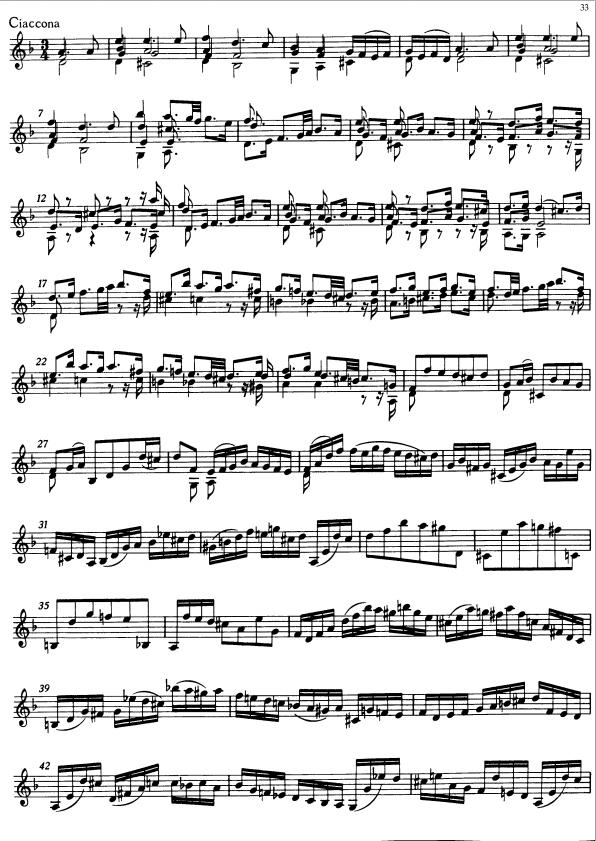

[Image description: Picture is the first page of the Chaconne
from Bach’s Violin Partita No. 2 in D Minor, BWV 1004.]

Now, for many of you who haven’t learned anything about musical notation, you are already at a loss.  The picture above is literally meaningless to you.  There are some horizontal lines and there are dot’s connected to vertical lines and there are these weird symbols that look like a lowercase b and a #.  If you haven’t learned to read musical notation, the only things on this page that you even recognize are some arabic numerals that you have no idea how to interpret and this Italian word at the top “Ciaconna”, which the dictionary defines as, “a slow, stately dance of the 18th century or the music for it,” a definition which is not particularly helpful.  With the resources available to you, you have established that this is an Italian dance from the 1700s.  So in order to realize the page I put above you, you need to become fluent in musical notation and have the ear training necessary to understand what the pitches are and how to keep time properly, a process which many people find quite difficult.

So, having learned all you need to know about musical notation, you’re ready to perform the Chaconne, right?  Well, probably not, as you have no idea how to play the violin.  (Violinists, you are playing the piece on the piano.  If you are also a pianist, you’re playing it on the flute.  If you’re also a flautist, you are playing it on the musical saw.  If you also play the musical saw, you need to just accept the premise of this analogy and move on.)  If you are not a violinist, and I imagine that most of you are not, you don’t even know how to set up, hold, or tune the instrument, let alone produce a decent sound and then connect those sounds into a meaningful piece of music.  So now that you understand what the notation means, you need to tackle the actual physical reality of learning how to play the instrument, a skill that takes years to do competently, decades to do proficiently, and half a lifetime to do masterfully.  You need to learn how to hold the instrument and the bow and all sorts of skills about how to make the correct sounds come out of the instrument.  Likewise, before you can do any of that, you have to learn to set up and tune the instrument, skills which are quite challenging to the beginning player.  (As someone who has attempted to play the violin on several occasions, I can attest to this.)  The process usually involves tedious work on many minute elements of technique that are by themselves very difficult, such as using different bow strokes, crossing strings, and pressing the fingerboard in the correct location.  Moreover, you have to keep track of all of these elements of technique while attempting to accurately realize a score of music, so in addition to the difficulty of playing the music, you are simultaneously applying the skills you’ve learned in step one.

Congratulations!  Having done that, you have the skills needed to accurately realize the first page of Bach’s Chaconne, a skill that will land you zero audiences and communicate very little.  What most people don’t realize is that very little information is actually given to the musician by the composer.  Many elements, such as the subtle ebb and flow of time, the varying loudness of any given instant of music, vibrato, etc., the elements that make music expressive and, if you’ll pardon the expression, musical, are not given to the performer by the composer.  If the performer performs the work exactly as written on the page, it will sound mechanical and banal.  This is why proficient musicians spend a great deal of their time focusing on interpretation.  They are trying not only to reproduce the pitches and rhythms indicated on the page, but also subtlety that music needs to be truly compelling and persuasive.

All right, having done all of that, you can now convincingly convey great musical ideas.  Musical ideas written by Johann Sebastian Bach.  While you certainly bring something of yourself to the table, none of these are ideas that you originally had.  The basis for all of these ideas was written almost three centuries ago.  In speaking, this is analogous to someone being able to convincing recite a work by Shakespeare.  A great skill in its own right, but all the while we’ve still fallen short of our actual goal, which is to communicate our own ideas effectively to others.  Right now we are only equipped to communicate other people’s ideas, albeit with our own twist.

I would like to pause here and draw some of the analogies between playing the violin and speaking.  First of all, there is the process of developing a rudimentary understanding of what music is, which corresponds to having a crude and basic understanding of the English language.  I will discuss the full understanding in just a moment.  Next, we have to negotiate the physical reality of playing the instrument.  We might have a fantastic conception of what the Bach Chaconne should sound like, but that means nothing if we lack the ability to realize it on the instrument, which is an inherently physical process.  This, not surprisingly, corresponds to the actual motor process of forming words.  For many of us, those processes seem pretty simple, but imagine what it would be like if they didn’t come naturally to you.  Imagine if everyone seemed to have this innate aptitude for holding the violin and producing pleasant sounds on it while you are struggling to get notes out.  Most people, having able or neurotypical privilege, take this ability for granted, so I want you to imagine a world where, instead of speaking, we communicated by playing the violin, a skill for which many people do not have the natural aptitude.  This is where the Social Model of Disability comes into play.  For those who find speech easy but playing the violin difficult, this world is fine for them while they would be disabled in the violin world.  Likewise, those who find playing the violin easy and speech difficult are disabled in this world but fine in the violin world.

Resuming our violin analogy, there is a lot more to speech than playing the Chaconne by J.S. Bach.  As I stated before, most people seek not to reproduce the ideas of others, but rather to convey their own ideas, which they do in real-time.  In music, this equates to improvising, a skill that isn’t necessarily that difficult provided you don’t seek to convey anything that complex.  However, there are still things to consider.  First, you want to have the semantics of what you are improvising accurately reflect what you are trying to convey.  I cannot think of an accurate analogy for this, so please leave an idea in comments if you have one.  On top of that, you have the elements of music theory, which is essentially the grammar of music.  Certain notes in certain contexts convey specific meanings that might not be conveyed in another context.  Without using this correct syntax, what you are trying to convey will start to sound random and disorganized or possibly just “wrong”.  This process comes very easily to most people, but understanding grammar is no simple task, a fact which anyone who has tried to learn a foreign language can testify.  In our native language, we can just say what “sounds right” without having to put too much thought into it.  In the same way, a native tonal musician might be able to tell you that a C-Sharp and a G need to resolve to D and F intuitively without explaining the theoretical reason behind this in the same way that you know whether to use “me” or “I” in a sentence.  However, just because this process comes to us intuitively doesn’t mean it isn’t going on and it’s something we oughtn’t take for granted when thinking about communication.

So what is the point in all of this?  I’ve drawn all of these parallels about how spoken language is like playing the violin.  The point in all of this is the following:

First, the process that we think of as intuitive and easy is not necessarily that easy or intuitive for others.  I don’t find playing the piano very difficult, but most people would struggle to play something rudimentary on the piano because they are dealing with all of the things I mentioned above.  Moreover, at the piano, you at least have the reassurance that if you press a key, a musically sounding sound will come out, something that isn’t guaranteed on a violin or when speaking (which is why I chose the violin for this analogy).

Second, I want people who find things to be easy and intuitive to think about what it might be like for those who don’t find the process so intuitive.  As many people are not instrumental musicians, I challenge you to think about what challenges you would face in the world if, instead of communicating via mouth sounds in natural language, we communicated by instrumental music.  Hopefully this exercise will expand your empathic process so that you can understand what it means to be disabled without medicalizing us or assuming we have a deficit.

Third, I want everyone to think about some of the strategies you might employ in this alternative violin world where you are struggling with many of the rudimentary elements of communication.  Maybe, since you don’t want to have to deal with the challenge of writing a syntactically correct and semantically accurate statement while dealing with the difficulty of playing the instrument, you might instead use an existing melody that approximates what you want to say instead of attempting to improvise something of your own.  Maybe in this violin world, you’ll get special education for doing this, seeing that you have musical echolalia and your ability to use spoken natural language, a skill that frustrates you as you want to use it to express yourself while no one uses that skill, is seen as a “splinter skill”, not inherently useful, but rather a means to develop your violin skills, which are the “correct” way to communicate.

I think this exercise in empathy is much more effective than the wholly appropriative and mocking “Be Disabled for an Hour” idea that many people try out.  Of course, you need to recognize that this will not give you a perfect view into our world.  Being that you don’t live in this culture in which you are disabled, there are things that might not occur to you that are realities that disabled folks have to deal with every day.  Thus is the nature of privilege.  But I hope this has expanded your notion about how disabilities impact your life and how society defines what is and is not a disability.

Sensing Another

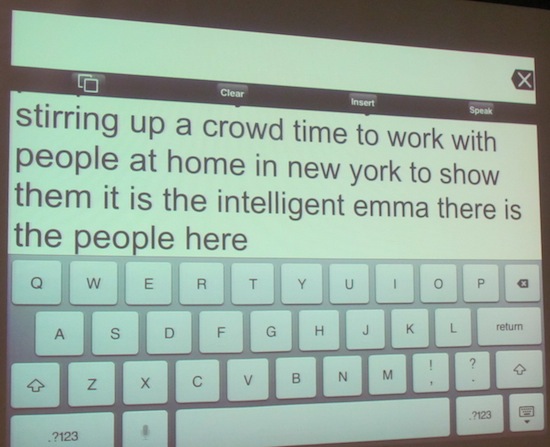
Last week I wrote a post, Speaking vs Typing, which sparked a terrific discussion about language, communication and how we interpret what others say and do.  My friend Barb, who wrote (with Lois Prislovsky) the not-to-be-missed book, I might be you commented:

“my dear neurotypical friends, first, let me say i love that you all are putting your heads together to break down this truth into practical ideas to help me and my autistic peers who struggle mightily with spoken language communications. em is right, “language is an awkward way to communicate” and i argue that is true for everyone but highly challenging for those of us who are autistically wired in the “vanilla cake” or “mail truck” way that em and i are. it took me years to think in language. but prior to that my thinking was not faulty it was just not language based. thinking in language is not efficient for me. i wish i could give you a pretty little fact package about what works so folk like me could get such treatment and soar socially and academically. of course, the problem is…it is hard to say in language. typing makes it way easier, because i can control the speed of each thought and break it down to smaller parts to be better described by letters one peck at a time. speaking requires a rather unnatural process for me perhaps like you singing a song you heard in another language. u may be able to imitate the sounds but the meaning in each mimic is not precise. since most folk are not yet well practiced in telepathy the best way for me now is to communicate through typing. but still my thinking is not easily translated in to words. feelings, sensations, visions and perceptions that are cleanly processed in my mind dont fit well into letter symbols. there i said it – or something close. thanks for caring. trying b”

Barb’s comment made me wonder whether my daughter is able to “hear” my thoughts, even if just a little.  And that if she were able to, it would make sense that either typing or speaking would feel like an inferior, less efficient form of communication, perhaps it would be viewed as somewhat barbaric, and certainly a less sophisticated way of communicating.  So I asked her, “Can you hear my thoughts?”  To which she answered, “No.”  Not undone, I asked, “Do you feel them?”  To which she did not reply.  This post is not about mental telepathy, but is more about how we sense each other.  Some of our senses we are taught to fine-tune and others society either doesn’t recognize or doesn’t place as much importance on.

But what if we lived in a culture that did encourage sensing another’s presence and feelings?  What if, from the time we were born, our sense of other people’s state of mind, their feelings, was nurtured.  Would that change how we communicated with each other?  What if spoken language took a back seat to our intuition?  What if we lived in a society that placed more importance on our presence, than on our words?

All of this reminded me of a conversation I had with a couple of friends, both of whom are Autistic, about disability and society’s role.  I wrote a post about that, ‘here‘.  One friend said that if we lived in a world where everyone used a variety of alternate forms of communication, where a longer time period was allowed and expected between words, and supports were anticipated and provided, then people who do not speak would not be considered disabled, just as I am not considered disabled because I cannot juggle or jump as high as an Olympic high jumper.

If children were taught at an early age to sense each other without relying on language, would we evolve into a species where language was viewed as unreliable and untrustworthy?  Does my daughter view language as a lesser form of communication?  Is she not as motivated to communicate, either through typing or verbally because her other senses are more finely tuned?  Does motivation even enter into all of this?  My brain is constantly looking for intent, motivation, but what if this isn’t what’s going on at all?  What if this has nothing to do with any of that?  What if she is trying so hard to communicate by typing and speaking because she understands I want her to, but not because she has the same need that I have?  Does music call to her because it is less about the lyrics and more about the beauty of the music, the feelings the music evokes?

Is all of this way too esoteric and ethereal?  EmTypes ICI


Presuming Competence & Expectations

Presuming competence is not code for – my kid is a genius and capable of super human abilities.  (Though some may be, it’s not a given.)  One of the things I continue to struggle with is the idea of presuming competence.  Often I don’t go far enough and other times I go too far without meaning to.  I have made assumptions about my daughter’s ability or inability that are incorrect, or at least have been incorrect in that moment.  Whether I expect her to be able to do something that she cannot, or at least cannot do today, but may well be able to do at some point in the future or whether I do not expect her to do something that, it turns out, she is more than capable of, I am treating her as though I know one way or the other.  But the truth is, I don’t know and neither do a great many of the people who come into contact with her.

The best thing I know to do is to remain in the moment with an open mind.  Easy, right?  Yet I don’t think it’s easy at all.  I find staying present very, very difficult, which is why in Buddhism they call it a “practice”.   It takes practice to stay in the present.  It takes practice to remain solidly rooted in this moment without drifting off into some future scenario of what might happen, what should happen, what I want to have happen, what I fear will happen and then all the things I do to control all of that so everything I want will occur the way I want it to, in the time frame I want.  I’m exhausted just writing about this!

My daughter continues to astonish and amaze, just as my son does.  As both my children mature and come into their own, they do and say things on a daily basis that I find utterly delightful and incredible.  But that delight is tempered by expectations.  I know this, yet find it extremely difficult to keep my expectations in check.  My expectations often cause disappointment. I don’t like feeling disappointed, so I try to turn the volume down on my expectations, but if I keep my expectations in check then am I still presuming competence?  I can go around and around with all of this endlessly.  The only conclusion I have come to is that I’m not going to always get it right, but I’m going to do my best to stay aware, stay present and open to whatever happens without preconceived ideas of what should or shouldn’t happen and while I’m doing all of that, I’m going to remember to breathe.

Breathing is good.


A wild mushroom growing out of the side of a makeshift bridge – Colorado August, 2013Mushroom


Speaking vs Typing

At an Autism Conference last month someone asked my daughter “Have you ever been to Australia?”  Em immediately answered “Yes!”  Yet when this person held up a laminated card with two boxes, one red with the word NO and the other box green with the word YES and asked the same question, Em promptly pointed to the red box with the word “NO”.  When asked what she had for breakfast that morning, she answered, “Vanilla cake!” but when asked the same question and asked to respond by typing she wrote, “I ate cereal, toast and yogurt.”

Many people ask me why we are spending so much time and energy learning to support Emma’s typing.  The most common two questions I’m asked regarding this are – why do you need to support her at all when she can use her two index fingers to type independently  (I will write a separate post on that question) and why do you encourage her to type when she does and can speak?

Ironically I have yet to find accurate words to describe my daughter’s speech.  I’ve said things like, “Her speech is unreliable” or “She can use language, but it often does not reflect what she really means to say” or “When she types we get a more accurate idea of what she intends to say, wants, or is thinking.”  But I’m never sure people understand what I mean or if they do understand, whether it helps them when they try to talk to someone like Emma.  (I have since met a great many people who have some language, but it is “unreliable” in that they will say things that are not necessarily the answer they mean or the words they meant to say.)  Inaccurate speech is not because the person means to evade or is willfully not telling the truth, but is indicative of specific brain function.  Lots of speech therapy, concentrating on spoken language, did not help Emma.

By the way verbal scripts serve as a default and come into play often in context to what is going on, but sometimes they are triggered by a detail.  The script can appear to have nothing to do with the topic being discussed.  For example we had an electrical storm the other night which reminds Emma of the fireworks on both New Year’s Eve and the Fourth of July.  Emma calls both firework displays and electrical storms, “thunder fireworks.”  She also calls rain storms and electrical storms, “firework bubbles” or “motorcycle bubbles”.  But if you didn’t know any of this and were with her when it began to rain, you probably would not understand the association when she said, “Ohhh, look!  It’s motorcycle bubbles!” and then pointed cheerfully out the window.

If I ask, “Em do you want to make vanilla cake?” Em will ecstatically respond, “Yes!”  She happens to love nothing more than vanilla cake with vanilla frosting.  I know this, no further questions are needed.  However, if I ask her, “Em what did you eat for dinner last night?” She might respond with, “Vanilla cake!” or she might respond with what she actually ate.  If I ask her why she was crying on the school bus, she might say, “You cannot scream!  You cannot scream and bite on the bus.  If you bite, no hitting!”  or some other equally cryptic answer that does not answer the question of why, though it does give me a good idea of what was said to her and that she became so upset she began to bite herself.

However if I ask her to type her answer, she might type, “A boy was scratching my seat.  I asked him to stop, but he kept scratching.  He made me mad.  The matron said, no kicking.  Emma’s sad, Emma bit her arm. I don’t like that boy.”  If pressed further, she will type his name and I will be able to tell the bus matron that Emma should not be seated near the boy whose name is X.  Problem solved.  The point is, when typing, Emma will write things she does not say. But to people who are unfamiliar with someone like this, they find it confusing.

When I showed Emma this photograph just now and asked, “what do you see?”  She answered, “Good!”  We went horseback riding while visiting my sister last week.  And it was.  It was “good!”

Horseback riding