Category Archives: Autism

How We Got Here

I was asked recently to talk about the process that led to my daughter being able to write the insightful posts she’s been writing of late.  And while I initially thought I HAD written about all of this and so much more throughout this blog, upon further reflection I realized I have not written about the process in a condensed form, so will attempt to do so now.  (Wish me luck.)  For those of you who are interested in a more detailed, chronological version of what we’ve been doing that has led to Emma writing posts like ‘this‘, ‘this‘, ‘this‘, ‘this‘, ‘this‘, ‘this‘, ‘this‘, ‘this‘, ‘this’ and ‘this‘ for this blog (and to see the daily progress) you can enter terms such as, RPM, Halo, Soma, communication and non-speaking in the “search” box or just begin reading the posts starting in mid-September until now.   For those of you who are REALLY curious, you can go back to October, 2012 when I went to the Autcom Conference.

There’s no way to say that on such and such date everything changed.  Like so much in life it was the incremental, seemingly, not-so-important things that occurred one after the other that then allowed for the next thing and the next until there was that moment we remembered and now look back upon and say, “oh yes, that was when everything shifted.”  Our version of having a – Helen Keller moment –  the day when W-A-T-E-R suddenly made sense, didn’t happen.  At least not like that.  There wasn’t any ONE moment when it all changed, but more a series of moments one after the other that led to a number of “OH!” moments.

One of those “OH!” moments was when Emma went to see Soma Mukhopadhyay (I wrote about that session ‘here‘) and we sat with tears streaming down our cheeks because Emma knew how to spell October and that it was a month in Autumn.  Another moment, previous to that, was when Emma was working with Pascal (documented ‘here‘) over a year ago.  Pascal “asked Em what she would do if she went into her own bedroom and found baby bear in her bed, Em typed, “I would be scared and I would watch his mother.”

I read that sentence several times.  How can I describe the feelings that came with reading it?  How can I express the surge of hope I felt?  How can I possibly describe the feeling of euphoria?  This sentence, this idea was beyond what I have come to expect.  It suggested a whole other level of thinking, a thought process far beyond anything she has been able to express before.”

In retrospect it seems incredible that all of this came as such a shock to us, but it did.  As I’ve said before, we knew nothing.  Literally.  Nothing.  But we thought we knew a great deal.  We knew what we’d been told up until that point and then it seemed as though over night, we realized everything we thought we knew was wrong.  So it was little moments just like these, over and over and over again, that continued to happen leading up to the first time I took Emma to see Soma in Texas (described in more detail ‘here‘, ‘here‘, ‘here‘ and ‘here‘) last September and then returning home and not being able to replicate what Soma was doing. But I was so determined and had to fight how depressed I felt because Emma seemed unable to write words that I’d just seen her write with Soma and yet with me, nothing.  Nothing at all.  There was self-doubt and fear, just tremendous fear that I wouldn’t be able to learn how to do this.  Fear that I would never be able to communicate with my daughter in the way I witnessed her communicating with others like Soma and Rosie and Pascal and Harvey and Leah.

So I had to begin at the beginning with simple choices and felt so impatient and so worried that this was how it was going to be for the rest of our lives.  But I kept showing up each day and making us do our “study room” together setting a timer for ten minutes and then 15 and then 20 and eventually up to 45 minutes and making lesson plans and wondering, wondering, always wondering whether she would be able to get to the point where she could trust me and write with me as I saw her writing with Soma.

I found a woman in NYC whom Soma had trained and we began taking Emma to see her too and I studied the videos of Soma working with Emma and I made notes and spent hours and hours pouring over them and making lesson plans and practicing.  I wrote out scripts of exactly what I would say during our “study room” session, leaving nothing to chance and I kept at it. Finally, after what seemed like an eternity, but actually it was more like six weeks, I arranged to have a Skype call with Soma, having sent her a video of me working with Emma.  Soma advised me to ask her one open ended question at the end of each lesson, which I hadn’t dared do as the one session I had, it was a disaster and she wouldn’t answer me.  I said as much to Soma.  I told her I didn’t think we were ready for that and Soma said, oh yes, but she’s ready.  You must ask something simple at the end of each lesson. So I did.  I did because Soma was so matter-of-fact and sure that this was what needed to happen next.

Emma began answering these open ended questions, at first with a few words and then with longer, more complex sentences.  I began to ask clarifying questions and now…  now look at her go!  It makes me cry thinking about this actually.  I couldn’t have known it would all happen as quickly as it did.  At the time, the process seemed to take forever, but looking back one’s perspective is different and I see it as very fast and I’m just so grateful for all that work, for all those days I struggled and cried to my husband and didn’t believe it would ever be any other way…

By the way, I DO think those Helen Keller moments that Hollywood then immortalizes, has all of us very impatient and thinking life is like that. Of course you and I know, life isn’t so simple or easy, nothing ever is. There’s work, hard, hard work and hours upon hours of showing up over and over again, and then slowly change occurs and it seems incredible, even miraculous!  But no one sees all that work, all those days when things didn’t go well, all those days when tempers flared, when there were tears and frustration and doubt and even disbelief that it would ever be different… until it is.

To all of you reading this – this has been my experience, as a parent, as someone who has always been terribly impatient, but determined.  Emma’s experience has been different (I’m hoping she’ll want to write about that at some point.) Everyone’s experience will differ, but perhaps, just perhaps, my experience will be useful to those of you just beginning, or will bring a smile of recognition to those of you ahead of me, either way, none of us need do this alone.  I didn’t and I am so grateful to all of you who have helped me help my daughter get to where she is now.

Em & Ariane on New Year's Eve ~ 2013

Em & Ariane on New Year’s Eve ~ 2013
Emma Recommends…

Someone asked Emma what she’d recommend they say in answer to the question, “how high functioning is your child?”

Emma wrote, “I recommend being patient with them and saying that functioning labels will almost always give the wrong idea to those who are trying to understand.”

I have thought about Emma’s response a great deal since she wrote it and asked her if it would be okay to write a bit more about this, specifically in relation to some of the issues Emma confronts on a daily basis.   Emma gave me permission.

“Red car, red truck, red car, red car, red car, red truck, red backpack, red car, red car, red car, red car, red truck, red van, red car…”  Emma said as we drove to the airport yesterday.

It is inaccurate to say Emma does not speak.  She does speak and her words are accurate in that we did pass all of those things in exactly the order she listed.  In fact, a few times when I protested because I did not see a red car pass us, after Emma said, “red car,” Emma will correct me and point to a parking lot father away that I had not noticed, where there was a red car.   If there is one thing I have come to understand, it is that my daughter is never wrong about such things.  If she says, “red sweater” it is not a fantasy, it is because she just saw someone wearing a red sweater, even if I didn’t see them or notice.

Emma has never lined up toys, but she lines up words.  To those of us new to all of this, it can seem strange, even bizarre, but it is her way of taking care of herself and is calming to her, please read more about Emma’s thoughts on self-care ‘here‘.  However to people who do not know Emma, they listen to her, try to engage her in conversation and then make assumptions about her intelligence based upon the list of words she utters.  If they try to engage in a conversation about the red car we just passed, Emma will typically ignore them and continue with her list.

When it comes to “functioning” labels, people who try to have a conversation with Emma will, typically, come to the conclusion she is “moderately” or “severely” autistic.  People take this to mean she is “low” functioning.  But if someone reads a post, like this ‘one’ that Emma wrote, pointing to one letter at a time on her stencil board, they may assume she is “high functioning” or they may come to some other conclusion, but they will not assume she is “severe”.

Until we were able to help Emma tell us what she was thinking, we had no idea what she was capable of.  A little over a year ago her school sent home “reading comprehension” work.  Emma was unable to do any of it.  At the time we tried a number of different things, but still Emma was unable to answer the questions as they were written and it was assumed she did not understand the simple story given to her.  We had no idea how completely wrong we were in our assumptions.  It was the same with the ongoing insistence that she read out loud and that when she could not, this also then meant that she was unable to read silently or at all.

The same thing happened with simple addition and subtraction.  It was assumed Emma could not do the math sheets being given, meanwhile she not only knew addition and subtraction, but knew multiplication and division, despite having never been formally taught either one.  These assumptions were repeated when it came to telling time and the concept of money or what a penny, nickel, dime or quarter were worth.  At her IEP meetings it was assumed these “concepts” were too abstract and difficult for her to comprehend.  None of us had any idea just how wrong we were.

I wrote about some of this ‘here‘ and ‘here‘.  Now, just over a year later I re-read those older posts and am so grateful we know better.  Knowing better has changed everything, but had someone told me just over a year ago that Emma would be writing the insightful, wise and incredibly philosophical posts for this blog that she has been recently, I would have been incredulous.  As I’ve said before, this is much more an example of my neurological limitations than it is of anything else.

“I recommend being patient with them and saying that functioning labels will almost always give the wrong idea to those who are trying to understand.”

Thank you Emma for being patient with us!

"Red Dress"

“Red Dress”

Emma Discusses Functioning Labels

I asked Emma what she thought of the functioning labels applied to Autistic people: mild, moderate, severe, or high functioning and low functioning.  What follows is her response.

“Functioning labels are insulting to me.  And people like me do not like to have others label us as though we were meat at the market.

“I do not think Autistics should be given stamps of disapproval.   How would you like to be graded all the time?

“Money makes people (*not autistic) have a higher functioning label, but it is not a great way to measure the worth of a person or their intellect.

“I am more than any one thing.

“Most people do not behave well under the kind of pressure Autistic people must endure all the time.  A label belongs on a piece of merchandise, not on a human being.

“Do you think you function at a higher level than other people?

“Maybe others would not agree with you.

“Let us all  do the best that we can and stop othering everyone we decide is less capable.”

*I asked Emma whether she meant all people or a particular group of people, she wrote “not autistic”.

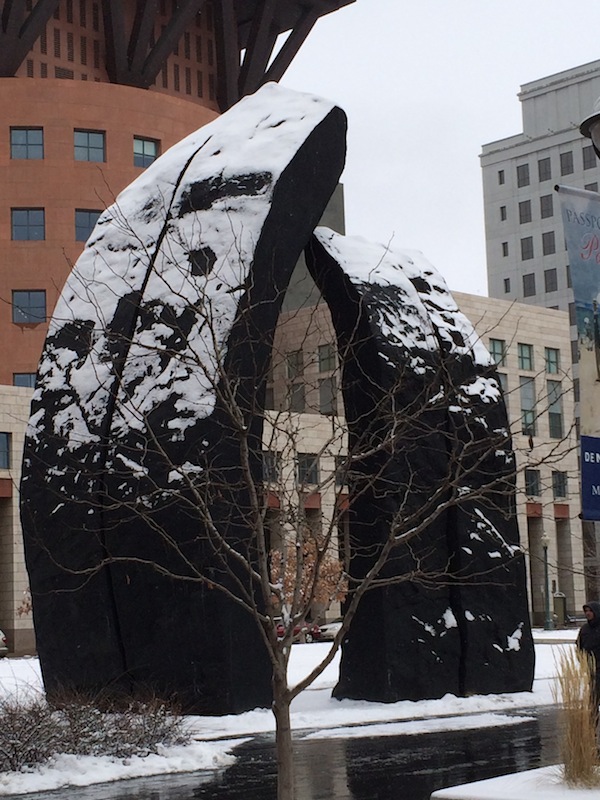
Snowy Denver where we are currently snowed in and cannot leave...

Snowy Denver where we are currently snowed in and cannot leave…

An Interview With Emma About Stimming

What follows is an interview I conducted this morning with Emma about stimming.  Emma patiently tried to explain to me what stimming is like for her.  

A:  Is it okay to ask you some questions about stimming?  (For those of you unfamiliar with the term, stimming is a repetitive action or verbal output.)

E:  Stimming is fun.  And I am in calming and obedient service to those who are in charge.

A:   Are you being facetious when you write “obedient service to those who are in charge?”

E:  (Smiles)  Yes.  (Laughs)  The stim is a great way to roam around feelings that are too intense.  You treat me like a baby.”

A: Are you speaking specifically to me or are you using a more universal “you”?

E:  All people out there.  Bloated feelings despair and anger me.  Almost all feel too much to manage and I cannot be present all the time.

A:  Can you tell me more about stimming?

E:  I am not able to write about stimming because words cannot describe it.

A:  Can I ask some specific questions about it though?

E: Yes.  (Leans over and gives me kisses on my cheek.)

A: Is stimming ever not fun?

E:  Yes.  When feelings are too extreme, even a good stim won’t help.

A:  Is there anything that will help?

E:  A lot of patience and love.  Acknowledge my attempts to self-care and do not cause me more pain by trying to change or control me.

A:  What happens if someone stops or tries to stop you from stimming?

E:  It makes thick feelings worse.

A:  Do you ever feel stuck in repetitive loops?

E:  Yes, but so do others who are not autistic, but they are called passionate and are looked up to instead of looked down on.

A:  Yesterday you wrote: “Raging beasts of pain masquerading as stims cause many to misunderstand.”  Can you elaborate on that?

E:  Stims alter the persistent anxiety of life so that I am able to function as well as I am.

A:  So you weren’t saying stims are painful as much as that they help you cope with the pain and anxiety you often feel?

E:  It is impossible to describe to all who have not experienced a lot of distress.  Day after day I am scared of people’s opinions about me because they can harm me with their beliefs about my lack of intelligence.  People treat those they believe stupid, very badly.  I am not stupid.

A:  I know you aren’t!  You are the smartest person I have ever met!!

E:  (Smiles and squeezes my arm.)  I am intelligent and cannot speak with the same brilliant words that are in my mind.

The timer goes off.

E:  Now we are all done!

A: Yes we are!  Thank you Emma for your patience with me and helping me understand.

Addendum:  I asked Emma just now if I could ask her one more question.  She told me that I could.

A:  Do you like the word “stimming” ?

E:  No.

A:  Is there another word you’d prefer?

E:  Yes, but words are not as meaningful to me as they are to those who talk all the time.

A:  If you could choose any word other than stimming, what would it be?

E:  Self-care

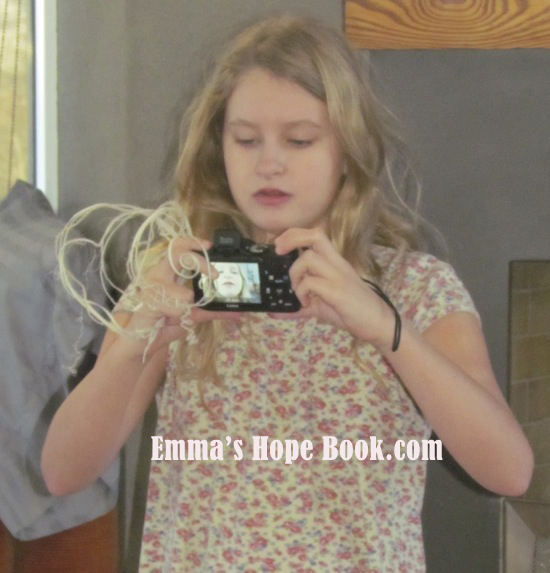
Em with her string!

Em with her string!

A Letter To You ~ By Emma

I asked Emma whether she wanted to finish the story she began about an otter or talk about something else.  She wrote:

“I want to talk about the New Year.

“This is a meaningful year because I am beginning to write about my ideas about autism and how people need an education in applying what Autistic people feel.

“Fear is non-living.  It cripples the mind and deadens the soul.  Raging beasts of pain masquerading as stims cause many to misunderstand.

“I am not without thought.  My forever beautiful mind needs nourishment all the time.  Autistic people are left to linger in a secluded world by those who could be helping instead of harming them.

“Please care enough to alter how you interact with those who may seem different than you, but who are actually the same.  We are all beings with similar feelings and hopes.

“Do not believe your fears.  They will lead you the wrong way.”

Emma told me she wanted me to publish this on the blog today.  Emma turns twelve this month.  I have spent more than fifty years learning what she already knows.  Em & Ariane on New Year's Eve ~ 2013    Em & Ariane on New Year’s Eve ~ 2013
 

A Look Back and Then Forward…

Em wrote just now (and said I could publish what she wrote here):

“I want to talk about the New Year.

“I know it was an important year to talk to the world.  I need people to understand what it is like to be Autistic.  I could be daring by saying that, but I think it is the only way others will become more tolerant of those of us who think differently than most, and it is opportunity that both separates and connects.”

I have so many thoughts about this…  “it is opportunity that both separates and connects.”  That sentence could be the topic for an entire semester in graduate school.

After Emma wrote this, I asked her if I could share it with Richard and on here, to which she nodded and wrote “yes.”  Richard and I had different responses to the word “opportunity” but when asked to clarify, Emma was already listening to her music and as I told her our study session would last 25 minutes and no longer, I did not press her to elaborate.

I will end this brief post by saying this past year has been a monumental one for me and my family.  As I look back on previous years, there have been none that can compete.  Here’s to embarking on another incredible year filled with curiosity and wonder.  Thanks to all of you who have read, commented and/or reached out.

As Emma has advised many times over the last few months, “Be kind to each other” and “everyone should be treated kindly and with love.”

Happy New Year!

Self portrait

The Gift of Emma

In the days leading up to Christmas, Ariane excitedly told me that Emma had written, “I want to write a story about Daddy.” Ariane said it was going to be my Christmas present. Obviously, I was incredibly excited as well. But on the following day Ariane came to me after her writing session with Emma and said:

“This story is going to make you cry.”

On Christmas morning, when I untied the bow around the paper Ariane had rolled up, I braced myself. The story was indeed sad, yet hopeful, wonderful and important, like all of Emma’s stories. It was also very private, and so, days later, I still hadn’t asked Emma if I could/should publish it. Ariane asked her today and Emma said she didn’t want the entire story published, but it was okay to post this section:

“One day there was a man and woman who fell in love.  They eventually had two children, one son and one daughter.  They were very happy.  The daughter was distinctly different, but meant well.  She did not understand many of the ways of her family.

“Her father told her that she was kind and smart.  She ran away because no one believed her to be clever, even though her parents did.  Her father wanted many to realize how smart she really was.  So he told others “do not treat my daughter like a baby.”  People did not listen.

“His daughter was sad, but her parents believed in her, and that mattered more.  She was the luckiest girl in the world.”

I’m so glad Emma feels this way. I wish she were even “luckier” and we had known all these things about her many years ago. I do truly believe that I am the luckiest dad in the world. Like Emma, I feel incredibly sad that I underestimated Emma for so long, that I was so utterly clueless to this entirely different aspect of her, that I could not see and appreciate. But I feel so blessed today to hear and see all these amazing parts of Emma I had never understood.

“Better late than never” is an apt phrase to convey both the joy and sorrow I feel, now that I’m aware of what is certainly only a small fraction of Emma’s talents, feelings, insights, intelligence and her poetic soul. It is also an apt phrase to convey the necessity of getting this message out to the world, something that Emma and Ariane, and so many other autistic people and their families and friends have been struggling so hard to do for so long, in the face of an Everest-sized mountain of misinformation from so-called “autism experts.” The most heinous sub(human) class of these is the “debunking” posse, who seem to spend every waking moment of their lives trying to discredit any assisted communication methods for autistic people. Yet no matter how hard they try, and they do try really hard–they will never succeed in keeping these blindingly brilliant autistic minds imprisoned by their willful and malicious ignorance.

The three best gifts I’ve ever been blessed with are my wife Ariane (who I met at a party on Christmas day 15 years ago!), and my wonderful children, Nicholas (age 13), and Emma (who turns 12 in January).

Emma is such a wonderful gift in so many ways. I could write another (even longer) post just listing all the amazing blessings she has brought to me and our family. But I’ll simply conclude by repeating one of the sections of her story that Emma agreed to publish, because it’s the kind of “better late than never” message so many more people need to hear:

“Her father wanted many to realize how smart she really was.  So he told others ‘do not treat my daughter like a baby.’  People did not listen.”

Maybe they are listening now, Emma. Maybe more and more people will hear your voice and the voices of your autistic brothers and sisters. Maybe all these people will someday be lucky enough to experience the gift of Emma.

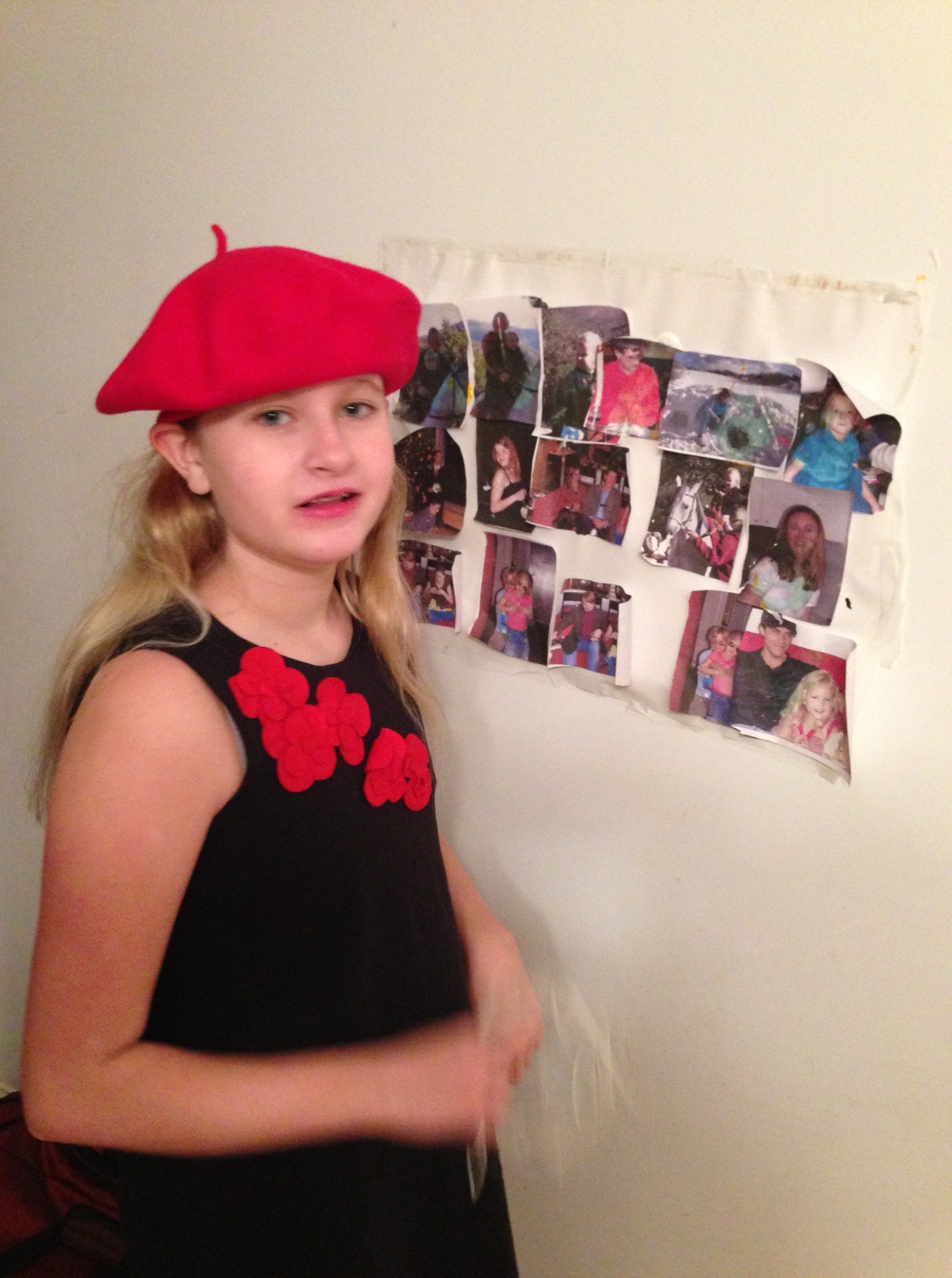
Emma showing off her new red beret and her new art work (a collage of relatives).

Emma showing off her new red beret and her new art work (a collage of relatives).


More Insights From Emma

My entire routine has been so thoroughly disrupted these past three weeks that this blog has suffered the consequences.  There’s simply too much going on, not in a bad way necessarily, but more than I have been able to keep up with.  But today…   Today both kids are out skiing and I have a few hours to write.

Emma has been writing a great deal.  In fact Emma wrote three stories as Christmas presents to her granma, her Uncle and Aunt and her dad.  Each one is beautiful and poignant and kind of over the top amazing in its complexity and layered meaning.  I transcribed the one for her granma ‘here‘.  In the story to her Uncle and Aunt, the final sentence was, “No words need to be used to hear love.”  Think about that for a second…  This kind of insight shows a level of sophistication and poetic understanding of the world few adults have managed to appreciate, let alone, express.   Emma is eleven years old.

In the story for her dad she wrote about a  daughter who, “Daily she tried to communicate her love for her family, but her words came out of her mouth wrong.  In day after day conversation she was misunderstood.  Finally she began to write on a stencil board and the words came out right.”  I am quoting this here because this is exactly the sort of thing so many of us get hung up on.  How many times have we seen or heard parents talk about their distress because their child is not able to say those three words, “I love you”?  How many times did I once, not so long ago, lament that my child had not ever said those words without being prompted to?  How often did I wonder and question her love?  And now…  now I wonder why and how could I have ever questioned those feelings?  How was it possible that I ever doubted her?  I say this lovingly and with tremendous compassion for all who have ever wondered this about their child.  We are being given incorrect information about autism and our children.  But I wonder if I would be so certain if my daughter were not writing and telling me the things that she is.

As I’ve stated before, writing is hard work for Emma and even though all of us, who receive her words, feel incredibly grateful to read anything she writes, it is difficult for Emma to express herself even in writing.  I say this as much as a reminder to myself as to inform those who may not fully appreciate how hard it is for her.  Often, when people hear that Emma is writing, and writing some pretty profound insights about the world, herself and autism, they will say, “but why not just give her an iPad or let her write on a computer?”  And then I must try to find the best words to explain.  It isn’t that easy or that simple, if it were, she would have begun writing a long time ago.

I’ve described before the process ‘here‘ and ‘here‘ that Emma uses to write, one letter pointed to at a time, on a stencil board, while a trusted person transcribes each letter or word one by one.  I have worked with Emma since the end of September almost daily and am now one of the people she can and does write with, to express herself.  She is incredibly generous in her willingness to allow me to quote her and almost always gives me permission to quote her on this blog, something I am doing more and more frequently!

This morning I talked to her about skiing with a ski pro, asking whether she’d like me to ski too.  She told me she preferred that I did not come too, and when I asked what, if anything, she wanted me to tell the ski instructor, she wrote about how she wanted to eat lunch early and then wrote, “Have to understand my mind talks heavy thoughts, but my mouth talks silliness.”   I asked her what she advised and she wrote, “Try to be patient and do not over rate talking to each other.”

A message we talkers would do well to appreciate and try our best to implement.

Emma’s Eyes ~ A Self Portrait

Em

Emma’s Gift to her Granma

I asked Emma what she wanted to give to her grandma for Christmas this year.  Emma wrote, “I will give to Granma a story about dogs who go to work instead of playing.”

Here is her story, reprinted here with both Emma’s and her granma’s permission.

A Folk Story For Granma ~ By Emma

“Once there were many dogs who went to work.  They worked part of the year in the fields, yet their masters wished they would work all the time.  So one day they organized a strike and their owners got very angry.  They told their owners they would not involve them in their decisions about how they spend their time.  Their owners said they had to work or they would not be fed.

“One day everyone went to work.  Sounds were too loud.  Every dog began to whimper.  The noise was so dreadful, the owners told their dogs to take the day off.  Noise is everyone’s enemy, but it is everyone’s  friend too.

“Today, dogs do not have to work in fields.  They are free to play.

“The End”

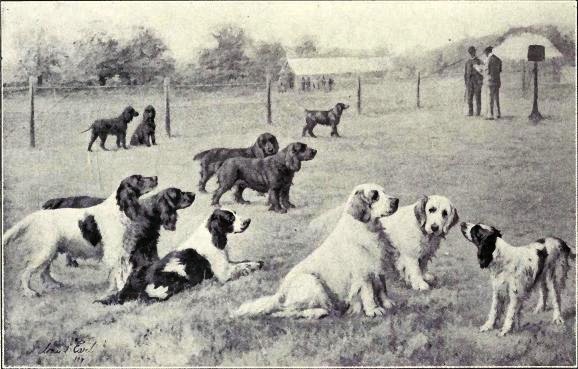
Emma chose this image to accompany her story.

Group_of_Gun_Dogs_from_1915

Silence and the Words That Fill it

Emma has been writing stories to give as Christmas presents to a couple of special people in her life.  It is an exhausting process for her and one that takes a great deal of time.  As the person who is witnessing and encouraging her to keep going, it is always revelatory.  Her gift to me is her ongoing commitment to keep showing up for the hard work that is required of her to communicate in ways most people consider most important, with words.   However as I sit with her I am increasingly aware of how much, those of us who are talkers, often miss.   Because of my daughter, I have a heightened appreciation for the beauty of silence words seek to fill.

I cannot quote anything from the amazing stories Emma has written for family members, as they are gifts to be given tonight and tomorrow.  But I can quote this, which Em wrote in response to my question – “Tell me one thing about Christmas?”

Emma wrote, “Christmas means love and family.”  (This, from an eleven year old.)

There is nothing more to say.

Merry Christmas to those of you who celebrate and for everyone else, may you experience love and family, in whatever way those words may mean for you this holiday season.

“Music is Stars for your Ears”

Profound. Poetic. Always unexpected. When Emma writes (in this case she was typing), she is able to express herself in a way that she isn’t able to with speech yet. But what she has to say is always (to me at least) profound, poetic and unexpected.

Take that above line for example. As she slowly typed, letter by letter and got to this point: “Music is star…” I wondered, where is she going with this? And no matter how many times I witness her write, I never cease to marvel at what she ends up saying.

It’s Richard here. Ariane has been traveling for the last two weeks doing her Holiday Trunk Show in Chicago and for the last day today in Aspen. She hates it. She is an incredibly talented, award-winning jewelry designer. Just take a look here and see for yourself. She began designing jewelry after some prodding from me because she had become so obsessed with autism and (many years ago) with finding a cure, that she was stressed out to the snapping point.

Ariane went to school for fashion design with a bunch of today’s top name luxury designers–an exclusive class at an exclusive school. But she hated the fashion world. I suggested that she channel all that talent and creativity in a different direction, so she wasn’t spending every waking moment of her life reading books about autism and searching the Internet for the latest studies and therapies and anything else under the sun she could discover about autism. That inexhaustible search led her to discover the blogs of autistic adults, films like Wretches and Jabberers, Supported Typing, Soma’s RPM, the Intense World Theory, and a hundred other things that have completely transformed our family in the most wonderful way possible. And by sharing her/our journey on this blog, I believe she is making the world a better place, day by day.

Ariane would never make such claims about herself. I’m happy to. She invited me to write a guest blog today while she is doing her trunk show. I’m certain she thought it would be all about Emma, but “heh heh” as Ibby would say.

If Ariane had a partner that handled the business side and left her free to simply design jewelry, she’d probably still be having fun with it. But these trunk shows are definitely a drag. I know for certain that she would much rather spend the day writing a blog post, replying to comments, working on one of the books she’s writing about her/our journey, reading more books and articles, chatting with her friends, getting a manicure–basically anything other than sitting around in a hotel room, waiting/hoping for people to stop in and buy some of her amazing designs so she doesn’t hate being there even more. So if you’re in Aspen, stop in and say “hi!” Oh, and bring your wallet. If you’re not in Aspen and love jewelry, or just love Ariane, send her a note, or a message or call, or Skype–or buy some jewelry after browsing on her website. She would never say such things here, or anywhere but once again “heh heh.”  I, for better or worse, am and shall always be: The King of Bluntness.

Now, after that shameless plug, let me talk about the session I had with Emma and “B”, who helps with Emma’s written communication, using Soma’s RPM method. Yesterday was a milestone because Emma used a keyboard throughout the entire 45 minute session, instead of the stencil board or letter board she usually uses. This was clearly a stressful adjustment for Emma, but she soldiered on bravely, and as usual, wrote some amazing things. Profound. Poetic. Always unexpected.

Rather than editorialize, I’m going to relate the entire session, using B: and E: for Emma. Some of B’s statements are paraphrased. All of Emma’s responses are exactly what she wrote, because the keyboard was connected to an iPad and it was all recorded.

B: What history topics are you interested in?

E: music, history, country, the world, the playground

B: Tell me something about music.

E: Music is stars for your ears.

B: (B gives a lesson about the origin of blues music with slavery) What kind of music are we talking about?

E: blues

B: Tell me something about our country in the 19th century as opposed to the 20th century.

E: there were slaves

B: What can you say about freedom?

E: less freedom when you are someones slave.

B: What do you think singing (the blues) did for them (slaves)?

E: how about it helped the crops grow.

(There was an interesting blurt Emma did here: “You left him there to die!” from her favorite movie Two-Headed Shark Attack. It speaks to me of injustice, self-interest and the horrifying results)

B and Emma then did some “Call and Response” blues-style singing together.

B:  What would you say about that?

E: when you call your friend they should not ignore you.

B: Can you come up with a call and response song?

E: I like to eat cake

the sweet is so nice

They sang these verses together a few times (ultra-sweet!).

B: Where in the country does the blues come from?

E: south

B: Do you have something to say about this?

E: there is fun music in the north also.

B: (B plays a video of BB King singing “Stormy Monday”) What do you think about that?

E: stormy tuesday it was. (the previous day was Tuesday and it was stormy).

B: (B tells a story about a teenage boy who was lost and later found by a homeless man who called the police and contacted his mother. The mom was very grateful and rewarded him.)

B: What did I say about the man?

E: homeless.

B: The mom was grateful. Why?

E: he found the son.

B: Years later there was a news article about the man whose name was Leo. Another man named Patrick used to pass Leo every day on the way to work. They began chatting. One day Patrick gave Leo an offer and he had two choices:

1. $100

2. A laptop, lessons everyday for an hour in computer coding.

(Leo took door #2, and in the article Leo coded an app later.)

B: What was one of the options?

E:  money

B: What do you think about the story of Leo getting lessons and coding the app?

E: he needed to get rewarded.

B: Any message for the world about anything?

E: hearing my response to your call is like being at a fun amusement park.

Image

And being present for all of this was like being in a fun amusement park too.

“Music is Stars for the Ears.”

Yes, it certainly is Emma. It certainly is.

Happy holidays to all! See you Saturday Ariane. Emma and Nic are counting the days and so am I!

Travel, Friendship and Sensory Overload

A couple of days ago my friend Ib, of the blog Tiny Grace Notes, whom I was staying with, drove me to the airport.  Ib knows me pretty well and could tell I was nervous, as I have become increasingly as I get older, about getting to the airport, going through security and making my flight, even though we were leaving ample time to do all of that.  Still the combination of nerves due to traveling, my busy work schedule, being away from my family for so long, being tired and going to an unfamiliar airport had me on high alert.

It was snowing a little so we needed to have the window wipers on or Ib wouldn’t be able to see well enough to drive safely.  But the wipers made a scraping noise that I found almost intolerable.  Every time the wipers ran across the window they vibrated and made a noise that was akin to finger nails being raked along a chalk board.  It was jarring and I could feel my body tense, so I gritted my teeth and began an internal dialogue with myself to try to calm and as I did all of this, I thought of my daughter.  I thought about what it must be like to be bombarded with sounds and sensations that she cannot speak of, or if she does speak of them, the words that she speaks are not what she intends to say, so people are left confused, asking questions or simply ignoring.

As we drove and Ib, being Ib, had already sensed my tension and anxiety and was doing everything in her power to take care of me, I thought about how it is only recently that I’ve become hyper aware of certain sounds, sights, tastes, smells, and how things feel to the touch.  It is because of my daughter and other Autistic people I’ve met and/or read and heard speak about such things, that I have begun to see how, things I once learned to ignore are now things I cannot ignore, like those window wipers scraping against the window and making me so upset it was all I could do to sit quietly and not begin to cry.  I am grateful for this as it makes me far more understanding of what my daughter and others might be going through at times.

Ib began to very quietly and gently tell me what she was about to do, before she did it.  So, for example, she would say things like, (I’m making this up as I can’t remember her exact words now) “just up ahead I’m going to slow a little and get into the right lane” or “the exit we want is in another 2 miles to the left” or whatever it was, she would say these things in that lovely, mellifluous voice of hers and I began to calm down.  Ibby was modeling, actively demonstrating what I need to do for my daughter.  She was also being a kind, sensitive and deeply compassionate friend to me and I sat there, my eyes fixed on the traffic around us, feeling so thankful that I know her and am friends with her.

As we drove along and I began to relax a little, I imagined a place where non autistic people would go where they would be given the very real experience of what it might be like for an Autistic person.  I fantasized that there would be all manner of sensations, highly elevated and constantly changing as examples of what might be another person’s experience of daily life.  Just as I found those window wipers so harsh and grating that I could not engage in conversation, I imagined that this place would both bombard the person as well as under stimulate so the person could experience what it is like to alternate between not being able to hear, taste, see, feel, smell and during all of this, demands would be placed on the person.  Not just demands, but the person would be required to answer questions within a specific time frame and if they didn’t answer or got the answer wrong they would be required to go back and start all over again.  However regardless of whether they got the answer right the sensations would remain, the things they would try to do to calm themselves would not be allowed or taken away and they would be forced to stay in this place indefinitely.

As Ibby helped me retrieve my bags from the car I felt tremendous relief knowing that I would be able to manage the curbside check-in, knew I would not lose the ability to speak, knew I would be able to find the correct line to go through for security, find the correct gate and wait for my flight.  All the things I do without thinking, without questioning, things I take for granted.  But I also was aware that this relief is not what others, others like my daughter, necessarily experience.

Why People Walk With Two Legs Instead of Four

Emma wrote this folk tale yesterday.  She gave us permission to post it here on the blog.  It took her 45 minutes, pointing to one letter after another.  She is so, so talented!

Why People Walk With Two Legs Instead of Four

“Many years ago, people were walking on all fours like many animals.  Reaching for food meant they could use front arms or back legs.  They were very strong.  Other animals were not afraid of them.  They looked at other animals as family.

“There was much to see from being so low to the ground.  There was much to touch from living in the dirt and the grass.  They tasted whatever they could. People now are more fussy with food.  The smells were all they knew.

“What is missing?

“You are right if you said:  sound.  People heard sounds from high above and they did not know where they were coming from.  The sounds were soft and silky.   Days went by without knowledge of sound.  One people leader wanted badly to hear it louder.  The only way she thought possible was to be taller.  She practiced standing on her back legs and it was successful.  Everyone else followed.  The soft and silky sounds were birds chirping.”

Emma began writing this series of folk tales while we were in Texas last month.  She has written five now and the third one was entitled, Why People Walk on Two Legs.  You can read it by clicking on the link, but in it she wrote, “They had to work in the fields wearing knee-shoes and regular shoes.  They could not run fast that way.”  I love that!  She goes on to talk about a king who had outlawed walking, until he was injured from all that crawling around and the only remedy was for him to walk, whereupon he made it legal for people to walk on their two feet and so they did, never looking back.  To me, that story was about how until we experience what another goes through, we often remain divided, though I have no idea if that was her intent.   This one is completely different, even though the titles are similar.

I am in Chicago at the TASH conference, where IbbyLeah Kelly and I are presenting first thing this morning on Relationships and Multi-media (so excited to be with my two wonderful friends!)

Em giving the Queen’s wave astride her favorite statue – Balto

Em on Balto

Autism Speaks and Signal Boosting

Signal boosting.  I love that phrase, it reminds me of a train yard.  That’s the image that comes to mind when I write those two words.  Signal boosting is when someone else shares a link or another’s writing either on a blog or on some other form of social media.  It’s the single most appreciated and important tool, those of us who are not Autistic, can use to help amplify the words of those we support.

The other day I signal boosted a letter to the sponsors of Autism Speaks from ASAN, Autistic Self Advocacy Network, – you can read that letter ‘here‘, which outlines why they are asking sponsors to reconsider lending their support to Autism Speaks.  I thought it was an excellent letter and as such, I decided to post it on my timeline on Facebook, with the heading, “For all who may be confused as to why so many are asking to boycott organizations that sponsor Autism Speaks, this is a wonderful explanation.”  And that’s when the proverbial shit hit the fan.  I’m not going to derail this post by going into the specifics of the comments I then received because I want to use this time to discuss Autism Speaks and why I object to what they are doing.  Again ASAN’s letter is an excellent point by point summation of exactly this, but I will attempt to give my personal views and why I have come to believe as I do.

Many defenders of Autism Speaks point out all the “good” they have done and continue to do.  They highlight insurance reform, their 100 day tool kit, autism awareness, spending millions of dollars on research, etc and yet, even if every single thing people who support Autism Speaks believe they are doing that is positive and helpful to Autistic people were true, (which I, for one, do not believe) it still does not take away from the fact that Autism Speaks does a great deal that hurts Autistic people and my child.  Autism Speaks uses its power and massive reach to shape how the public views autism and autistic people.  Suzanne Wright’s A Call for Action is a good example of this.  She begins with –

“This week is the week America will fully wake up to the autism crisis.

If three million children in America one day went missing – what would we as a country do?”

“Went missing” furthers the misconception that our autistic children were once here, and now are gone.  This idea is not helpful to anyone, least of all the parents who are new to a diagnosis and their young children.  Nothing positive, absolutely nothing positive comes from this kind of language, in fact this is exactly the sort of thinking that had my husband and I pursuing all kinds of “cures” not so long ago.  It was this thinking, that my daughter was buried beneath “autism” and that if I could just find a way to release her from its tortured grip, I would have done the noble thing, the right thing for my daughter.  As painful as it all was, as terrified as we were, she would thank us later… this was my thinking.

And yet, none of this helped me find ways to help her communicate.  Once we found a way to help her write and find her “voice” that was when the real miracles began to happen.  Helping my daughter communicate is what she is thanking us for now, not all those so-called “cures” we traumatized her with.  And please know, I mean that word, “traumatized” literally.  You can read more about some of that trauma ‘here‘, ‘here‘ and ‘here‘.

Suzanne Wright continues with increasingly alarmist, even threatening language.

“And, what about their parents? How much can we ask them to handle? How long will it be before the exhaustion makes them ill?  How long before they break?

“How long before they break?”  Given that several parents have recently attempted and some have succeeded in killing their Autistic children, this language is particularly repugnant.  This is not a call for action, it is a call for fear.  It sets autism up as something to go to war against.  It dismisses the horror of these crimes against their own children as something that is practically inevitable.    It suggests that autism is the reason people would go to such extremes, but nowhere does Autism Speaks suggest it is the public perception, a perception they have had a massive hand in creating, that makes the lives of families and our Autistic children more difficult and yet I can tell you, it  does.  What they are doing, what they are saying is making my daughter’s life harder, not easier.

Those horrible ads (ransom notes) they posted all over New York City in 2007 and then took down because of the public outcry, the videos of parents who speak about their children, while their child is right there, but because their child does not speak it is assumed they cannot understand what others are saying… these are the things people believe, but that I have learned from my non-speaking Autistic friends and my daughter are simply not true.  My daughter understands everything that is said around her and she is not alone.  So many who do not speak have written about this, Ido, Naoki, Amy, Nick, Joey, Barb, Carly, Tito…  too many to ignore or to dismiss as an anomaly.

In one video Autism Speaks produced a few years ago, the mother describes how she thinks about driving off the George Washington Bridge with her Autistic daughter in the back seat, the same daughter who goes over, numerous times, as her mother talks to the camera, to hug her. This video continues to haunt me.  I no longer believe that child did not understand what her mother was saying.  My daughter understood everything we said in front of her, even though at the time she gave no indication she did.  I now know differently.  What must it have been like to be that child, to hear your mother saying to a camera crew that she thinks about killing herself and you and that the only reason she does not is because of her other non autistic child?  What would that be like to be that child?

These ad campaigns, these videos, these words, these “calls” for action DO have a huge impact on what people then think about autism, about Autistic people, about my daughter.   People make assumptions about my daughter’s intellectual capabilities all the time.  If you are curious to read some of what my daughter is writing these days, please click ‘here‘, ‘here‘ and ‘here‘.  None of what she is writing is thanks to anything Autism Speaks has done.  Autism Speaks absolutely impacts my daughter’s life, and they aren’t doing her any favors.  

In the end, it doesn’t matter what good Autism Speaks has accomplished, until they really understand why so many are so angry, as long as they continue to not include Autistic people in any position of power, they will continue to be attacked by the very people they claim to represent.  How long will it take?  What will need to happen before Autism Speaks stops talking and LISTENS to those it keeps insisting it represents.  So many Autistic people are furious. And so am I.  All their power, resources, money could be used to do so much good for Autistic people, they could make such a difference in the lives of so many…

I stand beside my Autistic brothers and sisters and I will signal boost their words at every opportunity I get until they are able to take the microphone away from Autism Speaks and people begin to hear their voices. Their voices are what the public needs to hear, NOT Autism Speaks.

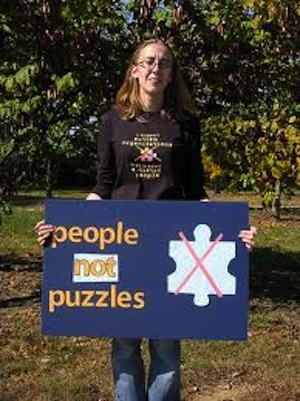
Image of Melanie Yergeau with a sign of a red X over a puzzle piece.  To the left of the image are the words “people not puzzles”

images-1


Man and Woman – A Tale

This story was written by Emma and was inspired by a photograph she was shown of a small house built in the middle of a lake atop a large rock with steps carved into the rock leading into the water.  Against one side of the house was a kayak and paddle.  (To read more about how Emma is writing, please click, ‘here‘ and ‘here‘.)

“Man and woman landed into marriage.  Both worked hard to make thousands of pennies.  There was trouble when they decided on what to do with the thousands.  Woman wanted to buy a boat; man did not agree.  Man and woman gave fighting a try, but it was not for them.

Welcome to their new home.”

Earlier when first shown the photograph (I’ve posted it below) and asked to make a comment about it, Emma wrote, “There is many reasons to believe it is fall.”

When asked to write one question she thought people would ask the person(s) who live in this house, she wrote, “Do you know how to swim?”

house-river-serbia_57361_600x450