Tag Archives: writing

When Time Stands Still

After publishing yesterday’s post, “So Many Kids Are Just Like Me” I added a video of Emma writing those words and more.  I hadn’t added it when I first wrote the post because Emma hadn’t given me permission yet and we were still trying to get the video uploaded, ran into problems with the picture being condensed and other issues.  In any case, for those who want to view it now, you can.  On a personal note, I’ll just add that this video makes me feel very squirmy because it does not capture the playfulness we usually have together, and I’m hyper aware of the anxiety I was feeling while we were taping…  Also the video does seem to be taking longer than it should to load, at least it is on my computer, but Emma has said she’d like to tape more, so I’m hoping we will get better at uploading as we continue.

My friend Alex commented on yesterday’s post about the impact of watching Emma write, as opposed to reading about it.  It was exactly for this reason that we decided it was important to post the video.  There is nothing like seeing in real-time another person writing this way.   No amount of words, no matter how well phrased can describe this process the way watching it in real-time does.

I will never forget that moment at the Autcom Conference in 2012 when I watched a boy, younger than Emma is now, write such insightful and profoundly wise comments  that his mother then read out loud during a presentation.  It was that moment when I thought to myself – maybe, just maybe my daughter has thoughts like this, and we just have to find a way for her to express them.  It makes me cry with gratitude thinking about that moment not so very long ago.  No one could have convinced me then that just a year and a half later we would be where we now find ourselves.

It is inevitable that there will be people who say things like, “well it takes too long” and  “how can this work in a class room?”  But as a parent who has wanted nothing more than to know what my daughter was thinking, who believed despite what the majority of people believed and were telling us that maybe, just maybe they were wrong, watching Emma write is when time stands still.  The excitement I feel when she begins to point to a letter is like nothing I’ve ever experienced.  Each letter she points to is a tiny gift wrapped in beautiful paper, as the paper peels back to uncover the word inside the world and everything in it stops.  It is a sensation like none other.

To my daughter, who works so very hard to accommodate my need to hear her experience of the world put into words, I thank you.  Every single time you do, even though you feel it’s tedious, I thank you.  Gratitude does not come anywhere near my feelings.  There are no words for this.  And I know this is a tiny glimpse into what you, Emma, feel every time you are asked to put into words your thoughts.  Words can’t come close…  finally I understand…

Em & Ariane on New Year's Eve ~ 2013

Em & Ariane on New Year’s Eve ~ 2013

“So Many Kids are Just Like Me”

“I am smarter than most people think.  So many kids are just like me.”

Emma wrote this yesterday in response to my question, “What would you like teachers, who want to teach Autistic kids, to know?”

http://youtu.be/rtfJr46S7NQ

There are a number of young people who write to communicate things that they cannot with spoken words, just as Emma does.  Many of them are starting blogs of their own, some have parents who have blogs and like Emma they are beginning to take ownership of those blogs.  On the “Resources” page here on Emma’s Hope Book I’ve listed a great many blogs beginning with those written by non-speakers, or people who write to communicate.

When Emma wrote “so many kids are just like me” I thought about how when Emma was diagnosed I knew of none (of any age) who wrote to communicate.  The entire concept was completely foreign to me.  In fact, and I hate admitting this, I hadn’t spent any time considering neurology, literacy, language, or which parts of the brain process language.  I remember being confused by the idea that someone who didn’t speak, could still read.  I’ve come a long way!

I would like to take the opportunity to list here just a few blogs that I personally know of where people around or near Emma’s age are writing to communicate.  This is by no means a comprehensive list and I welcome any additions, which I will add here and on the resources page as they come in.

Oliver – Day Sixty-Seven
Philip – Faith, Hope and Love… With Autism 
Aidan
Cindi’s Blog
Henry Frost – Ollibean
Matteo – Matteo’s Loving Blog
Ido – Ido in Autismland
Joey Lowenstein
Nick – Teen Typer

“So many kids are just like me…”

Emma with her friend Henry ~ January 30, 2014

Emma with her friend Henry ~ January 30, 2014

Justifying Our Words

Richard and I have conversations that other people might find odd.  We have little inside jokes we think funny, but that no one else is likely to agree.  We reference conversations we had years ago with a single word or sometimes even a look.  It’s the same with our son and daughter.  In fact, with all of my family and close friends I have at least one or two references that we think funny, but that others witnessing might not understand or see the humor.  With Emma, our inside jokes often come in the form of music.   We will sing to one another or utter a sentence said by someone else years ago, but that now makes all of us laugh.  For no particular reason one of us will say, “Get down Angelo!” and we will collapse in hysterical laughter or instead of saying “Good morning” we will mimic the sound of a quail.  The other will then respond with a similar noise and it is better than any greeting made of words.

When Emma began writing to express her thoughts, insights, and experience of life, I thought she would be so relieved to finally be able to communicate these things to us and the world.  So when she didn’t seem particularly eager to write, I wondered how and why that was possible.  I know communicating in language, whether it is in written or spoken form is difficult and hard work, but I couldn’t figure out why she wouldn’t be overjoyed to finally have this connection with other people.

A few months ago I asked Emma about something and she wrote, “Words are not as meaningful to me as they are to you.”  I think about that sentence a great deal.  Emma then told me she senses people.  She wrote, in reference to a question about someone who works at her school, “I can hear her.”  She then added “I feel her.”  I used to be confused by these sentences, but over time I have come to believe Emma means this literally.  Barb Rentenbach, the co-author of the book she wrote with Lois Prislovsky, I Might Be You talks about this as well.  Emma has an acute sense of people’s inner life and as a result, having to translate all of this into words must be tedious and (this is my interpretation of what it might be like for her) a step backwards.

Richard has a theory that Emma is operating at a “higher vibration” or frequency than either of us.  I have the same thought, but use the words a “higher plane,” which has the same meaning.  We both believe Emma is capable of a more sensitive and intense understanding of people than we are.  If I think about those I am close to, I am in tune to their vibes at a higher frequency than I am to strangers.  But what if I was attune to all people I came in contact with at that same level of intensity?  What if I “felt” them the way I can feel my husband and close friends?  What if I sensed the essence of them before they said a word?  What if the words they then said, rote responses to questions like “how are you?” were untrue?

We, non-autistics, tend to view our neurology as better, more efficient, less socially awkward, but in many ways our word-heavy way of communicating is less truthful.  We say things we don’t mean.  We say things we don’t believe, we agree with people we think are more powerful.  We are easily intimidated.  We are swayed by groups of people who share beliefs, even if those beliefs are not something we agree with.  We learn at an early age to question our instincts, to tamp down our emotions, to apologize when we are not sorry, to say things we do not mean and then, once we are adults, we use words like “polite,” and “kind” to justify the lies we tell.

“Words are not as meaningful to me as they are to you.”

Emma, Barb Rentenbach and Lois Prislovsky

Emma, Barb Rentenbach and Lois Prislovsky

“Talking is Easy, But Saying What I Mean is Hard”

Most of us, who have spent our lives using spoken language as a way to socialize and convey what we are thinking, do not ponder what it would be like if we could not do so.  Most of us who are able to speak do not spend time imagining what it would be like if we could speak, but what came out of our mouths did not necessarily match what was in our minds, or wasn’t what we wanted to say, or was taken to mean something else.  For those of us who speak and have little difficulty having a conversation with another it is difficult to imagine what it might be like if we could not speak at all.  We easily tune out our environment allowing us to focus on what is being said by another person.  Asking questions comes naturally, and without thinking we ask for clarification about things we don’t understand or want to know more about.  When we cannot hear something or lose part of a sentence spoken by another, we ask to have the part we didn’t hear repeated, or request that it be said in a different way.  And even so people misunderstand each other all the time.

But what if we could speak only a little and those hard-earned words we finally managed to say were met with confusion, irritation, even anger and led to misunderstandings.  Or what if speaking words was so difficult it was easier to utter sentences constructed by others, sentences that held special meaning to us because it reminded us of a happy or sad or anxious or frightening time. Whenever one of those emotions surfaced, we would blurt out that sentence from the past, because it so beautifully captured what we were feeling now.  Maybe though, other people who did not understand or know the meaning they held for us, took them to mean something entirely different.

A blogger friend, E. of the fabulous blog The Third Glance wrote an amazing piece, Words, a couple of years ago about trying to participate in a conversation with a group of friends.  I’ve never forgotten that post, it was one of a number of posts that radically changed my thinking.  You can read it by clicking ‘here‘.  She describes wanting to keep up with a conversation that a group of people she knows is having in a busy place, while trying to filter out the noise that comes with being in a public place, the stress of trying to figure out when it would be appropriate to interject a comment, the pressure of knowing some sort of response is expected of her, and not being successful.

Yesterday Emma wrote, “Talking is easy, but saying what I mean is hard.”  I understand that when she wrote that, she meant it literally.  Emma “has language” yet cannot carry on a spoken conversation.  Emma cannot answer with spoken words questions like, “What did you do in school today?”  Or “What did you think of that movie?”  Or “Which student in your class do you like best?”  Or “What’s your favorite subject?”  Or even “What are the names of the other students in your class?” or “Where do we go to borrow books?”  As a result all those so-called reading comprehension questions are met with silence, or with words that seem to have nothing to do with the question asked.

The other person then draws the conclusion that Emma does not understand the question, or cannot read, or isn’t interested, or doesn’t care or is intellectually disabled, impaired, has a disorder, a disease, is afflicted, suffers from, is a puzzle piece, is locked in her own world or any other word or phrase used to convey what we believe to be true because of our understanding of her and those like her based upon what she can or cannot say with spoken words.  This is the same girl who wrote, ““I can’t talk the way I think.  Where is the label for that?”  The same person who eloquently answered questions about functioning labels, stimming and autism, ‘here‘, ‘here‘, and ‘here‘.

“Talking is easy, but saying what I mean is hard.”

Emma Playing the "My Mouth is Glued Shut" Game

Emma Playing the “My Mouth is Glued Shut” Game

Emma’s Story Written Entirely On A Qwerty Keyboard!

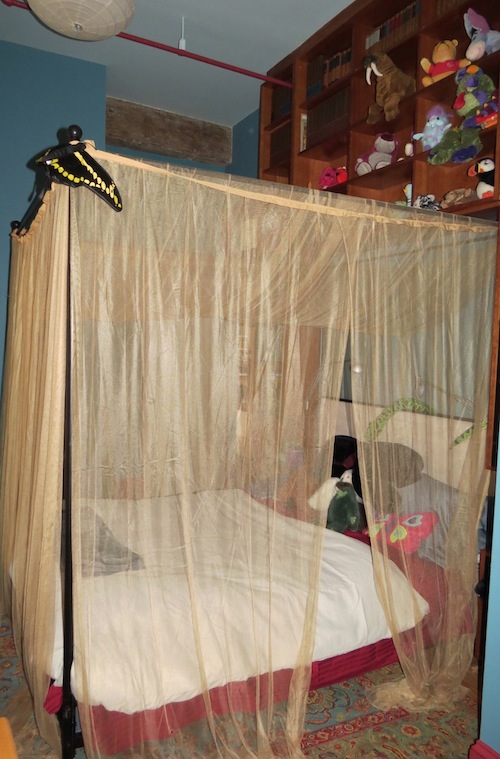
Recently we painted both the kid’s bedrooms.  They each found the colors they wanted.  Emma chose a beautiful sea greenish blue and a luxurious red for the baseboard, exposed pipes and doors.  She picked out a gold-colored mesh to cover her new four-poster bed.  Her new room is beautiful and I have found myself wandering into it, just so I can soak up the beauty of her newly painted walls, her princess bed with golden, cascading canopy and all her stuffed animals filling the floor to ceiling bookshelves.

Yesterday during Emma’s RPM (Rapid Prompting Method) session Emma wrote that she intended to write a story.  I’m including a link here to the post I wrote not long ago entitled “How We Got Here” for those of you new to this blog.  This is the story Emma wrote by typing on a qwerty keyboard attached to an iPad.  This is Emma’s first full story written entirely on a qwerty keyboard!  And as always, Emma approved this post and the accompanying photograph of her room.

                               The Girl Magician

From the bedroom of a house in Southern Georgia, there lived a girl named Judy.  Her room was dazzling.  Her time was spent by herself, and she liked it that way.

She had visiting hours for family to check out the best room in the house.  When visiting hours were over, Judy got to work on secret projects.  She noticed that when she changed the color of her scarf, many other things changed also.  When the blue scarf attached to her, she became very talkative.  The orange one made her laugh and the brown one made her cry.

Judy wore a yellow scarf during visiting hours one day.  Family was calling her name, but they did not see her.  She was invisible.  Judy was someone with magic powers.

The End

The Princess Bed with bookshelf filled with animal friends.  Notice the newly painted blue walls with red trim!

The Princess Bed with bookshelf filled with animal friends. Notice the newly painted blue walls with red trim!

Emma’s Question To You

Last week during Emma’s RPM session with B. they discussed interviews, the act of interviewing another person and the reasons one might interview another: for jobs, schools, etc.  They discussed where an interview might take place, one on one and in person, a group interview, by telephone, over email, etc.  I don’t have Emma’s permission to write about the interview she then conducted with an imaginary person, but as a result of all of this, I decided to continue with this idea of an interview in our session at home.  So I asked Emma whether she wanted to be the interviewer or the one being interviewed.

Emma wrote, “I want to know what you think about autism and am curious to understand why wasted time is spent being against a way of thinking.”  Later she added to that last part, “and being.”  So the sentence read, “I want to know what you think about autism and am curious to understand why wasted time is spent being against a way of thinking and being.”

Whew.  Talk about a great question!  I told her that I believed there was so much more we do not know than we know about all neurology.  I mentioned that with  Autistic neurology in particular, there is a tendency to state as fact a great deal that is not fact, but is really an opinion.   I told her that her writing has so completely changed my thinking about not just her, but autism in general.  I talked about how people fear what they do not understand, how they make up stories and confuse ideas and opinions as facts.  I discussed how assumptions are made because people like to believe they know things, even when they don’t and how people would rather believe something that isn’t true than sit with the discomfort that can come with not knowing.

And then I asked her if she wanted to know what other people thought about her question, or was this a question specifically for me?

Emma wrote that she would like to know what others think.

So I’m throwing it out to all of you… think of this as Emma’s first interview question to you.

“I want to know what you think about autism and am curious to understand why wasted time is spent being against a way of thinking and being.”

Emma's "Eyes and I" project

Emma’s “Eyes and I” project

Words of Truth

“Raw thoughts are like savory understandings of yummy foods.” ~ Emma 03/02/14

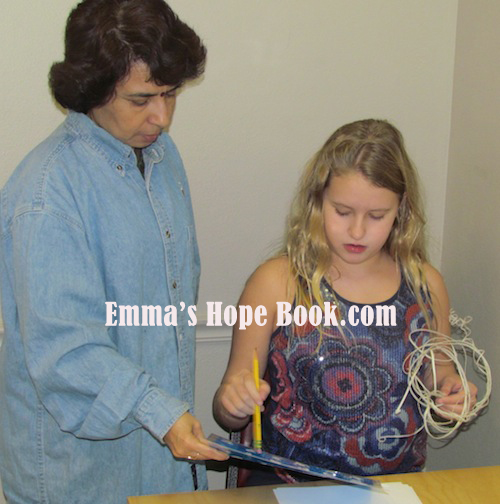
Sometimes when Emma and I are working she will write something that I simply cannot follow in real-time.  It is only after multiple readings and many hours of pondering have passed that I can begin to make sense of certain sentences.  As Emma constructs a sentence to reflect her thoughts by pointing to the letters she wants on the letter board, my mind is working on another level.  I am transcribing as she points, so I’m concentrating hard on remembering the letters and figuring out when I can pause to write those letters down.

Will the pause create a disconnect?   Will it break her concentration?   How much will I be able to remember before I have to stop her to write the letters she’s chosen down?  Sometimes she’ll point to “I” then “a” and then “y” and I’ll have to stop and show her the letters and say, do you need to change any of these letters?  Sometimes she will erase all the letters, insert a letter between two others, but other times she’ll erase just the last letter and continue.  Sometimes she will say aloud, “No, keep letters” and we will proceed.  Often she will then write something so astonishing I cannot contain the surge of emotions that rush forward.

During all of this, Emma may twirl her string, laugh, say unrelated words, or look at the timer and comment about how much time is left.  Sometimes writing one sentence might take 45 minutes.  Sometimes that one sentence will remain unfinished and when we come back to it, she will simply say, “no” and we will move on to something else.  Sometimes the words are so seemingly unrelated I have to resist the urge to ask for clarification mid sentence.  Sometimes she will write something I cannot understand, but the next day will re-read it and think –  my gosh, that’s brilliant!

“Raw thoughts are like savory understandings of yummy foods.”

Seemingly disparate senses woven together to create a canvas of rich and varied depth and colors has me in awe.  We talk about autism and autistic people as having sensory integration issues, but I look at a sentence like this one and I question whether the sensory integration issues are mine rather than hers.  Emma has a wonderful command of the English language, she is able to express her senses in complex, creative and layered ways.  I am compelled to read and reread her words.  I savor them, exactly as the sentence states so matter-of-factly.   Her words…  painstaking…  one letter at a time, convey truth.

Truth

Truth

The Opposite of False Hope

Two days ago, Emma wrote her “Letter To the World” and yesterday while doing a throw-the-entire-house-into-disarray spring cleaning, I came upon a scrap of paper where I’d scrawled an enthusiastic note about something Emma had said.  I was so excited by her comment I had thought to write it down immediately lest I forget.  I even dated it.   The note read, 11/20/11 – Emma saw the next word we were about to work on and she said – “today we do “see”!  You see I did not realize then that Emma already knew how to read.  At the time, we had no idea of Emma’s capabilities.

Along with this note were books on counting, a whole book devoted to telling time, another that dealt with coins and the value of a penny, nickel, dime and quarter.  There were kindergarten level readers and books featuring simple addition and subtraction, along with multiplication and division flash cards that remained wrapped in their original cellophane wrapping, having never been opened because it was not believed Emma had mastered addition and subtraction yet, so how could we possibly expect her to move on to multiplication and division?

There have been other notes over the years, just like this one; little bits of paper where I jotted something down because I didn’t want to forget.  Usually noting things Emma said or did that proved to me that what people were saying about her were wrong, but often they were just moments, moments I wanted to record so that when I was feeling sad or discouraged I could see that there was progress, little glimmers of progress no matter how infinitesimal, they were undeniably there.

For those who have read what Emma is currently writing, all of this will seem a little strange.  You see, Emma has told us that she already could read more than two years ago when we were breaking everything down to its most basic, going over one word at a time, over and over, making sure she knew it before building on to the next and then the next.  All those years spent going over the concept of addition or subtraction, only to have her flounder when asked what 6+5 equaled.  Or when asked, “how do we spell “cat” she would remain silent or if asked to write the answer by hand or to type it, she could not and so we assumed she hadn’t learned the word yet.

We believed that because she could not read aloud a level one reader, or answer a question about the contents of that story, it meant she was unable to read or understand.  When she was unable to answer us, little things like, “where do we go to buy milk?” and she would giggle and say something completely unrelated like,  “it’s Mommy’s turn” I would then despair, look at my husband with fear and believe this proved, yet again, just how far we had to go.  There were other fears too.  Fears about what all of this meant to my child for her future, but increasingly I would try to head those off with a kind of stoic resolve to not give into them and to review once more the concept of quantity, or time, or value, or the spelling of a single-syllable word.

Of course looking back I see how wrong we were.  I understand now that the problem was she had no way of communicating to us what she knew.  She could not “tell” us, she could not “show” us in any way that we were able to see.  All those reading comprehension questions, all those work sheets, all that fear, all those days, months, years spent in terror…   I see this now.  I “get” it.  Now.  Now I get it, but for so long I did not.  For so many years I didn’t understand.  I kept thinking she couldn’t learn.  I kept thinking what was being said to her wasn’t understood.  I kept thinking that I had to use more basic language, that I was complicating things, that the answer was to dumb it down, to do more review, more repetition, more of the same, over and over until she could answer me in the way I believed showed she’d learned.

Meanwhile Emma patiently waited for me to understand.  Years went by and Emma continued to do her best, hoping, hoping we would finally catch on.  With Soma, Emma wrote how  grateful she was to us, her mom and dad, for “not giving up on me, I was so scared.”  And as I sat watching her type those words I wept.  Tears of gratitude for her, for not giving up on us, but also tears of sadness for all those years… years of misunderstanding, years when we just didn’t know.  Every time I would read about a child who did not speak, or did not have conversations using spoken language, but who typed incredible insights, thoughts and opinions, I believed they were an anomaly.  I didn’t dare believe my child could be like those few who were speaking out.  I didn’t dare hope.  I couldn’t.  It was too painful.

“They say hope is cruel for the hopeless, but maybe they are the cruel ones.”  Emma wrote this the other day and as she wrote those words I reflected on the irony of it all.  One day I hope this idea – that we mustn’t raise false hopes – will no longer be what parents like me are told.  One day I hope those people, the therapists, the educators, all those people, many of whom are in the field of autism, who mean well, but who do not know what our children are capable of, will realize how wrong they are and will stop trying to protect parents like me from what they believe is “false hope”, but it turns out is simply what they do not know and have not yet come to understand.

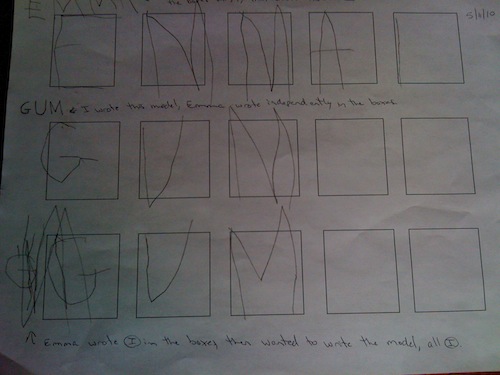
The hundreds of worksheets...

The hundreds of worksheets…

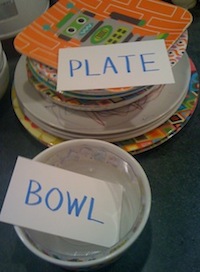
During the years when we labeled things

During the years when we labeled things

in large print before we knew she could read...

in large print before we knew she could read…

A Short Interview With Emma

This is a short interview I did with Emma this morning about speaking, writing, and words.  

Ariane:  Do you have an inner dialogue?  You know, where you have a running conversation in your head?

Emma:  I do not think in words.

Ariane:  So that must make it hard to articulate what you are thinking and feeling.

Emma:  Yes, it is frustrating.  I am often unable to express myself even in writing.

Ariane:  Any suggestions for those of us who think in words?

Emma:  Do not think so much.  Empathy and love are not conveyed with words.

Texas ~ September, 2013

Texas ~ September, 2013

“Voices”

The Halo Center has published a little pamphlet of Autistic people’s writing. It’s called “Voices” and this year’s issue – “Voices” 2013 edition –  is available for purchase ‘here‘.  One of Emma’s fabulous folk tales is in it, along with dozens of others.  For anyone who is even remotely interested in Soma Mukhopadhyay’s Rapid Prompting Method or RPM, it is a great sample of the writings of a wide range of people of all ages who do not rely on spoken language to communicate, but who write to communicate.

“Butterflies used to be sticky as butter.  But they had curiosity.” ~ Emma

I am not going to reprint Emma’s entire story here as I hope some of you will go over and purchase a copy.

Soma and RPM have completely transformed our lives.  It is my dream that every school, every educator, every therapist, and all people who are in the field of autism have the opportunity to witness someone like my daughter writing her thoughts on the letter board.  Eventually Emma will write on her iPad and computer, but for now she is using a laminated letter board with me, her iPad with the person she sees here and the laminated board, which she even holds herself at times, with Soma.

A Session With Soma

A Session With Soma

The Gift of Emma

In the days leading up to Christmas, Ariane excitedly told me that Emma had written, “I want to write a story about Daddy.” Ariane said it was going to be my Christmas present. Obviously, I was incredibly excited as well. But on the following day Ariane came to me after her writing session with Emma and said:

“This story is going to make you cry.”

On Christmas morning, when I untied the bow around the paper Ariane had rolled up, I braced myself. The story was indeed sad, yet hopeful, wonderful and important, like all of Emma’s stories. It was also very private, and so, days later, I still hadn’t asked Emma if I could/should publish it. Ariane asked her today and Emma said she didn’t want the entire story published, but it was okay to post this section:

“One day there was a man and woman who fell in love.  They eventually had two children, one son and one daughter.  They were very happy.  The daughter was distinctly different, but meant well.  She did not understand many of the ways of her family.

“Her father told her that she was kind and smart.  She ran away because no one believed her to be clever, even though her parents did.  Her father wanted many to realize how smart she really was.  So he told others “do not treat my daughter like a baby.”  People did not listen.

“His daughter was sad, but her parents believed in her, and that mattered more.  She was the luckiest girl in the world.”

I’m so glad Emma feels this way. I wish she were even “luckier” and we had known all these things about her many years ago. I do truly believe that I am the luckiest dad in the world. Like Emma, I feel incredibly sad that I underestimated Emma for so long, that I was so utterly clueless to this entirely different aspect of her, that I could not see and appreciate. But I feel so blessed today to hear and see all these amazing parts of Emma I had never understood.

“Better late than never” is an apt phrase to convey both the joy and sorrow I feel, now that I’m aware of what is certainly only a small fraction of Emma’s talents, feelings, insights, intelligence and her poetic soul. It is also an apt phrase to convey the necessity of getting this message out to the world, something that Emma and Ariane, and so many other autistic people and their families and friends have been struggling so hard to do for so long, in the face of an Everest-sized mountain of misinformation from so-called “autism experts.” The most heinous sub(human) class of these is the “debunking” posse, who seem to spend every waking moment of their lives trying to discredit any assisted communication methods for autistic people. Yet no matter how hard they try, and they do try really hard–they will never succeed in keeping these blindingly brilliant autistic minds imprisoned by their willful and malicious ignorance.

The three best gifts I’ve ever been blessed with are my wife Ariane (who I met at a party on Christmas day 15 years ago!), and my wonderful children, Nicholas (age 13), and Emma (who turns 12 in January).

Emma is such a wonderful gift in so many ways. I could write another (even longer) post just listing all the amazing blessings she has brought to me and our family. But I’ll simply conclude by repeating one of the sections of her story that Emma agreed to publish, because it’s the kind of “better late than never” message so many more people need to hear:

“Her father wanted many to realize how smart she really was.  So he told others ‘do not treat my daughter like a baby.’  People did not listen.”

Maybe they are listening now, Emma. Maybe more and more people will hear your voice and the voices of your autistic brothers and sisters. Maybe all these people will someday be lucky enough to experience the gift of Emma.

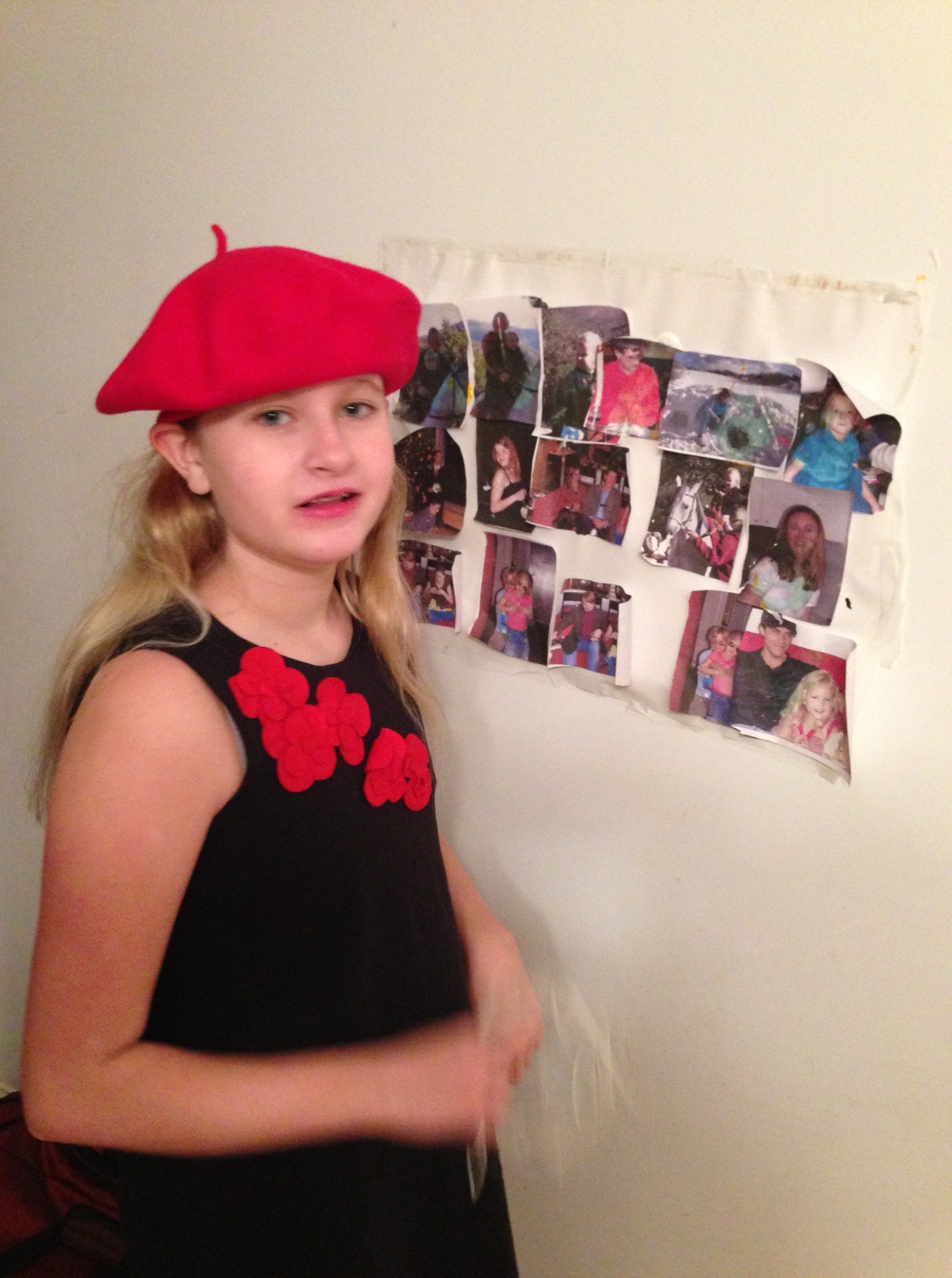
Emma showing off her new red beret and her new art work (a collage of relatives).

Emma showing off her new red beret and her new art work (a collage of relatives).


More Insights From Emma

My entire routine has been so thoroughly disrupted these past three weeks that this blog has suffered the consequences.  There’s simply too much going on, not in a bad way necessarily, but more than I have been able to keep up with.  But today…   Today both kids are out skiing and I have a few hours to write.

Emma has been writing a great deal.  In fact Emma wrote three stories as Christmas presents to her granma, her Uncle and Aunt and her dad.  Each one is beautiful and poignant and kind of over the top amazing in its complexity and layered meaning.  I transcribed the one for her granma ‘here‘.  In the story to her Uncle and Aunt, the final sentence was, “No words need to be used to hear love.”  Think about that for a second…  This kind of insight shows a level of sophistication and poetic understanding of the world few adults have managed to appreciate, let alone, express.   Emma is eleven years old.

In the story for her dad she wrote about a  daughter who, “Daily she tried to communicate her love for her family, but her words came out of her mouth wrong.  In day after day conversation she was misunderstood.  Finally she began to write on a stencil board and the words came out right.”  I am quoting this here because this is exactly the sort of thing so many of us get hung up on.  How many times have we seen or heard parents talk about their distress because their child is not able to say those three words, “I love you”?  How many times did I once, not so long ago, lament that my child had not ever said those words without being prompted to?  How often did I wonder and question her love?  And now…  now I wonder why and how could I have ever questioned those feelings?  How was it possible that I ever doubted her?  I say this lovingly and with tremendous compassion for all who have ever wondered this about their child.  We are being given incorrect information about autism and our children.  But I wonder if I would be so certain if my daughter were not writing and telling me the things that she is.

As I’ve stated before, writing is hard work for Emma and even though all of us, who receive her words, feel incredibly grateful to read anything she writes, it is difficult for Emma to express herself even in writing.  I say this as much as a reminder to myself as to inform those who may not fully appreciate how hard it is for her.  Often, when people hear that Emma is writing, and writing some pretty profound insights about the world, herself and autism, they will say, “but why not just give her an iPad or let her write on a computer?”  And then I must try to find the best words to explain.  It isn’t that easy or that simple, if it were, she would have begun writing a long time ago.

I’ve described before the process ‘here‘ and ‘here‘ that Emma uses to write, one letter pointed to at a time, on a stencil board, while a trusted person transcribes each letter or word one by one.  I have worked with Emma since the end of September almost daily and am now one of the people she can and does write with, to express herself.  She is incredibly generous in her willingness to allow me to quote her and almost always gives me permission to quote her on this blog, something I am doing more and more frequently!

This morning I talked to her about skiing with a ski pro, asking whether she’d like me to ski too.  She told me she preferred that I did not come too, and when I asked what, if anything, she wanted me to tell the ski instructor, she wrote about how she wanted to eat lunch early and then wrote, “Have to understand my mind talks heavy thoughts, but my mouth talks silliness.”   I asked her what she advised and she wrote, “Try to be patient and do not over rate talking to each other.”

A message we talkers would do well to appreciate and try our best to implement.

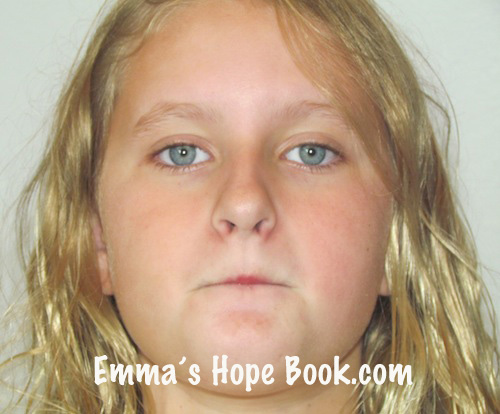
Emma’s Eyes ~ A Self Portrait

Em

Why People Walk With Two Legs Instead of Four

Emma wrote this folk tale yesterday.  She gave us permission to post it here on the blog.  It took her 45 minutes, pointing to one letter after another.  She is so, so talented!

Why People Walk With Two Legs Instead of Four

“Many years ago, people were walking on all fours like many animals.  Reaching for food meant they could use front arms or back legs.  They were very strong.  Other animals were not afraid of them.  They looked at other animals as family.

“There was much to see from being so low to the ground.  There was much to touch from living in the dirt and the grass.  They tasted whatever they could. People now are more fussy with food.  The smells were all they knew.

“What is missing?

“You are right if you said:  sound.  People heard sounds from high above and they did not know where they were coming from.  The sounds were soft and silky.   Days went by without knowledge of sound.  One people leader wanted badly to hear it louder.  The only way she thought possible was to be taller.  She practiced standing on her back legs and it was successful.  Everyone else followed.  The soft and silky sounds were birds chirping.”

Emma began writing this series of folk tales while we were in Texas last month.  She has written five now and the third one was entitled, Why People Walk on Two Legs.  You can read it by clicking on the link, but in it she wrote, “They had to work in the fields wearing knee-shoes and regular shoes.  They could not run fast that way.”  I love that!  She goes on to talk about a king who had outlawed walking, until he was injured from all that crawling around and the only remedy was for him to walk, whereupon he made it legal for people to walk on their two feet and so they did, never looking back.  To me, that story was about how until we experience what another goes through, we often remain divided, though I have no idea if that was her intent.   This one is completely different, even though the titles are similar.

I am in Chicago at the TASH conference, where IbbyLeah Kelly and I are presenting first thing this morning on Relationships and Multi-media (so excited to be with my two wonderful friends!)

Em giving the Queen’s wave astride her favorite statue – Balto

Em on Balto

“Let Me Tell You…”

Emma gave me permission to tell all of you what she would invent were she an inventor.  *A little background – the quotes from Emma are what she spelled out by pointing to a letter, one letter at a time on a stenciled alphabet board.  No one touches Emma as she does this.  In fact there is no physical contact of any kind during the session, also known as an RPM (Rapid Prompting Method) session.

Emma has been doing RPM daily with me since the end of September.  Within the past two weeks she has begun to answer open-ended questions with me.  However the session I am going to write about was with someone who was trained by Soma Mukhopadhyay (the creator of RPM) and whom she is now seeing a couple of times a week.  This person, who I have not asked permission to print her name and so will refer to as B, has been doing RPM for a while now and as a result is able to move far more quickly into open-ended questions than I am.

In their previous session they had discussed train engines.  At the end of their session B asked Emma to think about what she might invent were she an inventor.  When Emma returned for her next session they began with the question, “What would you think was a really great thing to invent?”

Emma then replied, “Let me tell you that it is not a train engine.”

I have to interject here…   I love how ballsy my daughter is.  I love that she didn’t just answer with one word.  I love how audacious, cocky even her answer was… “Let me tell you…”  Emma spells words out, and I sit watching, literally on the edge of my chair, waiting, wondering what wonderful words will she write?  “Let me tell you…”  YES!  I cannot wait to hear what you have to say!!!!!

Emma continued, “It is more from the future…”

B urged her to tell us more.

“It is a spaceship.”

For all who know my husband this answer has brought a smile to your face.  For those of you who do not, let’s just say he has a particular fascination with spaceships, UFO sightings, etc.  He has logged in many an hour watching YouTube clips of various sightings.   As I sat watching my daughter spelling out these words I kept thinking how much Richard was going to LOVE hearing about this session.  But there’s more…

B encouraged Emma to continue, asking her to tell us more about the spaceship she would invent.

Emma spelled out, “Have you ever seen spaceships in New York?”

Sorry, I have to interject again.  This question… this question is wonderful and defies all that is commonly thought about so many of our kids who cannot verbalize questions like this.  For all those parents who have never had their child ask a question, for all who have bought into this idea of Autistic self involvement, of a lack of interest in others, this thought that our children who are non-speaking or unreliable speakers are “caught” or “lost” in some other world… to all of you, I suggest we rethink these ideas.  My daughter is not the only one writing things like this, she is one of many, many children, teenagers and adults who cannot voice their thoughts, but are writing them.  I have watched her, time and time again, asking questions; this kind of engaged conversing goes against everything we are taught and being told about non-speaking/unreliably speaking autistic people.  

B answered Emma’s question saying that she had not seen a spaceship in New York City.  She said she’d seen a great many different types of transportation in New York City, but never a spaceship, to which Emma then wrote, “You never have to wait to go anywhere.”

B then asked her how you could get a spaceship and Emma wrote, “You buy it on your own or you get a monthly pass.”  (In New York City most of us take advantage of the terrific subway system.  To use the subway you need a “Metrocard” which you can purchase for a single ride, multiple rides or for those who commute daily a monthly card of unlimited rides.)

B observed that as parking in New York City is already limited she wondered where a spaceship would go.  Emma wrote, “No parking needed.  Once they have landed they become invisible.”

B then asked her,  “How do you call for one?”

Emma wrote, “You have a button to press and it arrives right away.”

Let me tell you…

images

The Purple Tree

The Purple Tree and Other Poems is a collection of poems by Sydney Edmond who is non-speaking and autistic.  She learned how to write using a letter board when she was ten-years old, two years later she gave her first public presentation  and has presented at a number of other conferences since then.  Now ten years later, Sydney continues to write, present and is the subject of a documentary called, “My name is Sydney

“Lazy, achy lady
lived by the sea.
Lazy, achy lady,
move away, please.

You are always blabbing,
talking long and loud.
You are closing in on
my lovely little cloud.” ~ From the poem, Some Early Poems

One of the most exciting things happening now is the emergence of a growing number of non-speaking Autistic people who are writing.  Thankfully self-publishing and blogs are making their work accessible to the public.  As more non-speaking Autistic people write and publish their work, it will become increasingly difficult for the public to deny that the assumptions we have long-held about Autistic people are incorrect.  Eventually we will have to re-evaluate how we are viewing those who are Autistic and what that actually means.  Our notions of “intellectual disability”, our ideas about what someone is or is not capable of are being challenged and will continue to be until what we think we know now, what is considered common knowledge will be seen as antiquated and our limited assumptions an example of just how ignorant we once were.

“I lack the lovely peace of mind,
lack my always smile.
Who listens to a lonely girl,
Listens to a child?”  ~ From Dear Friend

The first presentation Sydney gave was in 2005, just two years after she began communicating on a letter board.  This poem, Love, Love, Love! was part of her presentation at the West Coast Symposium on Facilitated Communication.

“But Soma came along
and changed my life.
She actually lifted poor little me
out of darkness
and into light,
love,
and lovable, lovable, lovely happiness.

Soma taught Mom
how to communicate with me,
and Mom and I have been talking
ever since.
Now I can choose my own clothes,
make my own decisions,
and make lovely friends out of people.”

For those of us with children who do not speak or whose language is unreliable, or does not necessarily reflect what is meant or intended, we are entering a time of tremendous hope.  There is a great deal of work still to be done, but in publicizing the work of those who are like our children, who are communicating by typing and pointing to letters on letter boards, we will shift how people view not only our children, but all our children and people.  By questioning commonly held beliefs about any one group of people we affect change for all mankind.

Unknown