Tag Archives: non-speaking

Alone? Frightened? Worried?

“No one knows how to help us.”  This was what I once said to my husband.  It was many years ago.  So many, I no longer remember the year.  Along with that realization was this one – “We are in this alone.”  And while, at the time, that thought terrified me, it was the beginning of finding another way.  It was the moment when I realized all these people we were looking to for guidance, didn’t know what was best for our daughter, even when they believed they did.

In the beginning we were told how fortunate we were, our daughter was “mild” we were told and if we followed their advice – an aggressive implementation of ABA, Speech Therapy and Occupational Therapy – she would be in a regular classroom by the time she entered kindergarten.  She was still two years old when she was diagnosed and we knew nothing about autism.  We did as we were told.  We were assured she would “skyrocket.”  We fought to increase the hours of therapy, we went to the team meetings, we took notes, we learned how to “play” with her using ABA’s techniques, we monitored her and kept charts.  We filled notebooks with our observations and we waited for her to “skyrocket.”

When she turned three we enrolled her in an ABA based pre-school.  By the end of that school year I no longer believed all that I was being told.  The therapists were no longer assuring us she would “skyrocket.”  Now words like “red flag” were being used to describe her behavior.  She had “behaviors” and these were being pinpointed and noted with alarming frequency.  We were getting reports of non-compliance, an inability to “use her words” as though she was being defiant  and then she began to self-injure. No one understood why.  Everyone was baffled.

And now, so many years later, I look back on those years and it all seems so understandable.  They say hind sight is 20/20, that looking back we can easily understand that which was once incomprehensible.  I understand now.  We didn’t appreciate what was going on.  We didn’t think we understood our child, and for the most part we didn’t and we kept looking to others to explain her to us.  The explanations they gave us, we believed.  We thought, since we didn’t understand and they seemed sure that they did, they must be right.  It took several more years for me to realize they didn’t and they didn’t know how to help us or her either.  When the methods they believed in didn’t do what they believed should and would happen, they blamed us and they blamed her.

Emma continues to remind me that “regret is not needed” and she’s right.  I am working hard on that one.  I cannot describe someone else’s experience, I can only write about mine.  This was mine.  As the mother of a daughter who was once believed “mild” and later “moderate” and finally “moderate to severe” on autism’s vast spectrum, we have learned a great deal.  And while many may not derive any solace in what I’m about to say, I would have.  No one can predict what life holds for your two, three, four, five, six or seven-year old child.  No one can predict another’s future, there are too many variables.

That my daughter has some spoken language is, and was, the single biggest red herring for those who meet her.  It never occurred to us that all that speech therapy, focusing on spoken language, would ultimately be unhelpful.  I knew nothing of AAC  (Augmentative and Alternative Communication) devices or methods and as spoken language seemed to me to be the ideal, the idea of her using something else honestly never crossed my mind.  Why would I encourage her to use something else to communicate if she could speak?  When, after years of speech therapy focusing on spoken language, she still couldn’t have a conversation with us, our answer was to try more, push harder and it would come.

So many people ask what we would have done, knowing all we know now.  This is a question that is specific to my daughter, but I know there are other children who are similar as I’ve met so many of them.  I would not have waited so long to begin using other forms of communication.  In fact, this would have been the thing I would have concentrated on right away.  There is no evidence that using an AAC device will have a negative effect on spoken language acquisition, in fact there are studies showing the opposite is likely to be true.  Had my daughter been able to communicate at an earlier age, many things would have changed.  The most important one being that we would have understood much earlier all that she knew and understood.  This may strike some as a little thing, but I can assure you, had we realized this early on, had we believed this right away, it would have changed every single decision we then made.  Not to mention the massive reduction in our stress, anxiety and fear.

There is so much we are learning and still have to learn, but we are no longer alone.  We are surrounded by other parents, professionals, educators and, most importantly, people who share our daughter’s neurology, those who are Autistic and who continue to share their experiences with us so that we might better parent our Autistic daughter.  And of course, our daughter, Emma whose patience, love, wisdom and endless compassion is teaching us more than any.


One year after the diagnosis

One year after the diagnosis

A Researcher Asks…

I speak with a researcher who says, “we need to hear the pain and needs of the parents of individuals affected by the disorder.”  She goes on to say, “Nobody else can know better what the needs of the affected person are.”  “Oh,” I say, “how about speaking with Autistic people?”  Surely they know better than any what it’s like to have once been a child.  The researcher tells me this is not their focus.  I try to understand what I’m missing, what is the focus then?  I ask more questions.  I listen.  As I listen I am aware of my heart.  It feels louder, is that possible I find myself wondering.  Can one’s heart actually beat harder?  I decide this cannot be true.  I’m upset.  I know I become more aware of my heart when I’m upset.  I try to listen to her words, but I’m not able to hear all of them.  I know I’m missing some of what she’s saying.  I concentrate harder.  My throat constricts.  My stomach tightens, my face feels warm.

I try to make a few helpful suggestions based on what I hear her saying.  But she is not interested in suggestions.  I try again.  It is as though we are speaking two different languages.  I cannot understand hers and she seems unable to understand mine.  We are becoming exasperated with one another. I try to provide answers from my perspective, but this is not the focus of her research she tells me.  The needs of Autistic people are not the focus.  I feel some confusion.  How is this research?  How can one do research if the questions are already skewed?  Isn’t research supposed to be unbiased?  Isn’t the point of research to learn more, to understand?  But we are trying to understand, she tells me.

We are circling each other with growing wariness.  The conversation began one way and somewhere it took a turn.  I’m trying to both back track to see where it changed from cordial, curious and open, to distrust, while also still listening and trying to understand what this research is meant for.  My daughter is behind me.  She drifts past where I’m sitting and stops.   She is looking up toward the ceiling, her head slightly cocked to one side.  I know she hears this conversation.  I know she can feel my growing tension.  “I’m just going to take this call into the other room,” I whisper to her.  I go into the other room and shut the door.  I don’t want my daughter exposed to more of this.

The constant barrage of words – Disorder.  Pain.  Afflicted.  These are the words the researcher uses.  These are the words, like a never-ending eddy threatening to pull my daughter down.  I once used these words too.  I once said things to others in front of her.  “You walk forward and not backward,” Emma wrote the other day.  Just before that she’d written, “…regrets are not needed.”  I owe this to her.  I must move forward and not backward.  Regret, like those words, pull me down.  I have made a commitment to become more aware of my regrets and to not allow them to keep me stuck.

I become aware of the researchers voice again.  She really wants to know, she says, about the pain.  And I lose my patience.  I tell her no one would dream of asking me this question regarding my non autistic child.  I tell her that if she is interested in understanding Autistic children, she should ask Autistic adults to describe what it was like.  She says, “Well, if you’d like us to speak to your daughter we can certainly do that too.”  But that isn’t what I suggested.

My exasperation with her has now crossed over into anger.  She compares autism to Parkinsons and I’m furious.  “Let’s not do this,” I say.  We are practically competing with each other as to who can hang up faster.  I am madly hitting the red button on my phone to hang up, but it won’t disconnect.  This would be comical if I weren’t so upset.  I have a moment when I see the humor, but it’s fleeting.  I remind myself to come back to this feeling.  Finally I stand there looking at my phone and I feel utterly defeated.  This was an opportunity to offer another point of view and I failed.  Miserably.  I go out into the other room, where Emma is listening to music and dancing.  I watch her, marveling at her beauty, her grace, her joy.  In contrast, I’m a churning mess of anger, indignation, sadness and upset.

“We are interested in the needs of the parents,” the researcher said.  More accurate information, unbiased research, questions that are not skewed to get a particular response, training that would have helped us support my daughter to communicate through typing at an early age, removing the emphasis on spoken language, abandoning functioning labels, showing me that my neurology has deficits too, that we have devised a society skewed to accommodate non autistics who use spoken language to communicate and how that benefits those of us who speak and aren’t Autistic, but hurts those who are, helping me understand that we have set up our schools to segregate a population that should be included and not excluded.  My needs?  Change the way autism is viewed and spoken of and my needs will dramatically decrease.  Help me navigate parenting an Autistic child by giving me access to Autistic people and culture.  Show me others who are parenting with love, compassion and complete and utter respect for their child.  Most of these are things I’ve found for myself, but what a wonderful difference this would have made earlier.

Research


Presuming Competence – Revised

Over the past few years I’ve written about presuming competence as I have come to understand it, ‘here,’ ‘here,’ ‘here,’ and ‘here‘.  Over the years my definition continues to shift or, perhaps more accurately I should say, my ability to practice presuming competence continues to shift.  I still grapple with whether I am going far enough when I  presume competence, though the simplest definition, is also the best one, which is that we presume all human beings are capable of learning if given the right supports and accommodations.  But many want to know what that means for a specific person they know or are working with.  What are those supports and accommodations?

There are a couple of universal things I have found extremely helpful.  (I’m hoping others will add what they’ve found universally helpful as well as specifics that may be particular to just one or two.)  The first is being respectful of the person and speaking to them as one would speak to any human being regardless of whether they use spoken language or not.  It may take some getting used to, because unlike someone who uses spoken language easily, you may not get a spoken reply, or you may get a spoken response that you cannot make sense of.  Either way, I have found, speaking to my daughter (and I’m now talking about before we knew all that she knows and before she was typing with us) as I would any person her age, was critical.  Explaining to her what was going on, what was going to happen next, what we would do if something we expected to happen didn’t, and including her in any and all conversations that were taking place in her presence, has been key.

In situations where a meeting is occurring, as might happen during an IEP meeting at school or with a team of therapists or with a doctor and nurse, I have found the single best thing I can do is include her in the conversation.  (I have made many mistakes over the years, so please do not interpret this as my suggesting I do all of this perfectly without ever stumbling along the way.)  So, for example, when we arrive at the place we are having the meeting, I will speak to her as I would anyone her age.  I will ask if she’s comfortable in a particular chair or if she’d prefer sitting in a different one, perhaps away from direct light, or one that might have a cushion.  Today I always sit to her right so that I can hold her keyboard for her as she types.  I make sure she knows why we are all gathered.

If others begin to speak about her (as they almost always do and will) I will then politely remind them that she is right here and has no issues with her hearing.  Emma wrote during one such meeting, “My hearing is excellent.”  These days I hold the keyboard for her to write questions she may have or to add whatever she might like.  As Emma now types with us daily and is more used to this, she will often initiate a question or comment without me asking her if she wants to add something.   But in the past, if the people at the meeting continued to speak about her as though she weren’t present or seemed completely confused by my insistence on including her, (which many undoubtedly will)  I might then say something about how hurtful and disrespectful it is to be spoken of in this way and that I’d appreciate it if they would rephrase their language.

If the talk becomes an endless list of deficits I would ask them to identify her many talents and assets and point out that constant criticism is unhelpful and destroys self-confidence and self-esteem.  If they are silent (as has happened to us in the past) and seem incapable of naming any assets, I would give them a few opportunities to learn and do better, but at a certain point, professionals should be held accountable for what they are doing and how they are behaving.  If after several opportunities, they continue to disregard my daughter and seem incapable of treating her with respect and seem convinced that she cannot understand, they do not deserve to be paid for their “services”.

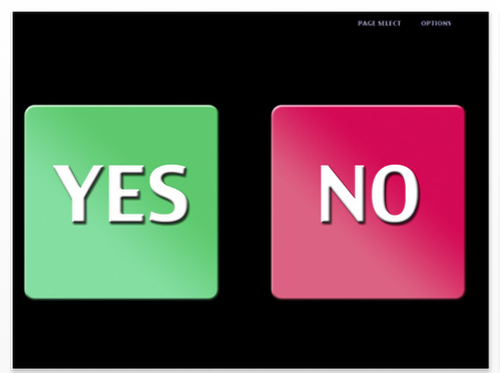
Another helpful tool is a yes/no laminated card.  I used to carry one or several around with me and would ask Emma to verify any yes or no question, because she often says “yes,” but means “no”.  I found that what she pointed to with the laminated card, was almost always correct, while the spoken answer wasn’t as much.  I have since seen iPhone and iPad apps that people use, which are almost exactly the same as the laminated card I once used.  A friend of mine holds up her index fingers from each hand and says, “yes” and gestures with the one index finger, or “no” and then gestures with the other index finger.  I remember being shocked that this simple method could produce accurate answers and yet it did.  Obviously if there are profound physical issues, this may not be possible, so the laminated card might work better as one can position it so that a large range of physical movement will not be required.

Yes/No

Yes/No


Parenting an Autistic Child

One of the most difficult things about being a parent to an Autistic child is the realization that almost everyone we parents come into contact with, when getting the diagnosis, have ideas about autism and what that means for our child, regardless if their ideas are based in fact.  So many people have theories and opinions about what autism is or isn’t.  There are endless charts and check lists meant to be helpful, yet they are all skewed and written from the point of view of a non autistic person or someone who uses spoken language to communicate.

Once you begin the evaluation process you are asked hundreds of questions.  Questions such as, “How many words does your child know?”  We answer these questions to the best of our ability and from the perspective that “knowing” means “speaking”.  Zero, or maybe five, ten, oh perhaps twenty, we say with wavering confidence and this answer is then noted.  “Does your child show interest in others?”  “Does your child engage in imaginative play?” We are asked.  And again, we do our best to answer honestly from what we’ve witnessed or believe we know.

But if we use spoken language, we answer these questions from the perspective of one who speaks, not from the perspective of one who does not.   The idea that someone might be unable to speak, but knows a massive amount and can learn to write to communicate or someone might have a difficult time translating words, whether written or spoken to match their non word thinking, is never brought up. As parents, we do not hear this idea voiced and yet it is crucial to our understanding of our child.  How different we might feel and understand our child if we were told that this may be our child’s experience of the world.  We could be told about the body/mind disconnect and how that might manifest itself.  We could be given the words of non-speaking children, teenagers and adults to help us understand.  Why are parents not being informed of this?

Instead your child is observed, notes are made and a diagnosis is given.  We parents are left with a word, laden with opinions, ideas, but few facts.  People talk about the “science” behind various “treatments” and we are told that the only scientifically proven method is x.  We are told that we must hurry as the window to help our child is quickly closing.  We rush ahead, madly, blindly, we do as we are told.  There’s no time to wait, to find other opinions, we must hurry, hurry.  We feel the guilt and the horror of not doing enough.  We must engage our child in a specific way.  We must urge them to complete puzzles and force them to play with dolls or farm animals, we give them treats so that they’ll comply, we buy play kitchens and a variety of toys and when they finally show an interest in one, we watch to be sure they don’t show too much interest.  Too much interest is a red flag, we are told.

When things do not feel right to us, we begin to do more research, looking for answers and we begin to form our own opinions about what’s really going on.  But for many of us we just feel terror and confusion.  Well meaning people give us advice.  We are sent links and the names of specialists.  Suddenly, many of us are deeply immersed in that surreal world of “alternative” medicine.  Each person we see speaks with the authoritative voice of someone who knows, who understands, who is convinced this will make our child “better”.  Yet few question what that word means.  What is “better” and what does “better” look like for my child?

The sinking feeling that something is terribly “wrong” embeds itself into every fiber of your being. Almost everything you read about autism confirms that sinking feeling.  This is a terrible thing that has happened.  It makes sense that  to you and your family, the focus is on “righting” what is wrong with your child.  A child whose life would be so much easier were they neurologically like the majority of the world.  But they are not neurologically like the rest of the world.   This one fact is overlooked as we continue to pursue all that we are told and advised to do.

How do we conceive of something we do not understand?  How do we see something we’ve not heard of or ever believed possible?  How can we understand a neurology that is so different from our own?  Autism.  What does that mean?  What does it mean for my child?  How do we support our children so that they flourish?  How do we best raise an intensely sensitive being who does not necessarily use words to think?  These are the questions I would like to hear educators, doctors and all those who feel they are experts answer.

The things that are being said, all those recommended check lists and the questions asked by all those autism organizations and experts are encouraging us to teach our children that they are the problem.   We are raising a population of children who are internalizing the awful message given to them…  Our children, who will grow up to be Autistic adults, are getting this message from almost everyone they come into contact with from the moment they are given the diagnosis.  It is a message that is hurting our children and hurts all Autistic people.  Our children, whatever their neurology hear it,and those who have internalized it may go on to deliver it too.  It is up to us to change the message.

Ask a parent what they want most for their children and most will say, “Happiness.”  Yet so much of what we are told about autism and our Autistic children is ensuring the opposite outcome.

"I don't want to talk about it!"  ~ One of Emma's favorite spoken comments

“Music is Language of the Soul”

A friend of ours sent us a link to a short piece about stuttering and singing as something that has proven helpful for some.  After Emma and I read the piece I asked Emma what she thought.  Emma wrote, “Singing is the only time words come easily.”

When Emma was very young many of her therapists would sing various songs to her, but usually repeated the same ones, “Head, shoulders, knees and toes” and “The wheels on the bus” being the two that feature most prominently in my memory of that period.  I was curious about Emma’s memory about those songs and so asked her.

“The mistake people made was in not using music more.  Music was more beneficial than anything else,” Emma wrote.

“Even though you couldn’t articulate the few words you spoke back then, I’m talking about when you were just two and three years old, you loved singing and sang a lot.  Did you understand the meaning of the words of the songs you would sing?” I asked.

Emma wrote, “Yes.”

Did you purposefully choose songs that communicated what you were feeling?

“Music conveyed my feelings more than anything else.  I might feel something that no words can describe.  Music is the language of the soul,” Emma wrote.

Yesterday Richard, Emma and I were discussing consciousness, thinking and different ways of communicating our thoughts.  Emma wrote, “Can you think about how I sense the world and then try not to use words?  My pacifist’s stance is the only way.  Fighting requires words, pacifism does not.”

Richard then asked, “Are you saying that from your perspective you see all intelligence as being linked and one, and we, who use words, fight because we cannot see and understand this?”

Emma wrote, “You are trying to define knowledge and intelligence with inadequate words.  Intelligence is not word based.  Music and words used in song come closest.”

Summer - 2009

Summer – 2009


A Father’s Powerful & Extremely Personal Thoughts on Parenting

*This was what my wonderful husband, Richard, wrote as a comment on my post the other day.  I asked him if I could make it a post all on its own.  He gave me permission…

“Pain is inevitable, suffering is optional.”

There are plenty of difficulties in life. Parenting is hard, but “childering” is harder. Parents usually have some experience in navigating the complex social expectations of the world. Children must gain that experience with each passing day, hopefully with the guidance, support and unconditional love of parents who put their children’s needs ahead of their own.

But there are a lot of parents who aren’t like that. Mine for example. I was taught from birth that my obedience and subservience were more important than my own needs and desires, or personal considerations. When I didn’t do what I was told to do, or didn’t do it fast enough with a “good attitude” I was yelled at. Punished. Spanked. Slapped in the face. Called awful names. Verbally abused. Degraded. Humiliated. And that happened nearly every day of my life until I left home at the age of eighteen.

My parents constantly reminded me how difficult I was to cope with. How hard I made life for them. If I would only try harder, work harder, move faster, then their lives would be so much better. Their lives.

Me? I didn’t really matter.

I waited a long time before becoming a parent. For years I swore I would never have children, perhaps because I was afraid I might behave like my own parents. And no child deserved that. When I met Ariane, something shifted monumentally in me, and I was suddenly eager to be a dad. I was 40 years old. Maybe I was finally emotionally mature enough to handle the enormous responsibility of parenting. I was ready to put someone else’s needs ahead of my own. Because for me, that’s what parenting is about. Service. My children don’t exist to fulfill my expectations, or make me happy. They exist in order to experience life and fulfill their destinies.

It is indeed hard to be a parent. I empathize and sympathize with all the parents who feel overwhelmed, who don’t have the resources or support to cope well with these tremendous responsibilities. I know life is hard for you. But trust me, no matter how hard you think you have it, your children have it harder. They sense your frustration, your discontent, your fear and panic, your anger and rage, your sadness and depression and hopelessness.

And quite likely, they feel themselves to be responsible. Maybe they are even told they are responsible. They feel guilt and shame. They try harder to make you happy. To not be so upset with them. Because they have learned–deep, deep inside–that they are “the problem.”

I’m talking about all children here, not just autistic children. For autistic children, multiply that angst level by a thousand. If you are autistic, you live in a world where so many people are telling you that you are broken, that you need to be fixed, that you need to be trained, conditioned to “act normal.” If you like to spin around over and over, or bounce, or rock back and forth, you are given the message, sometimes spoken, sometimes not, that this is “wrong.” And therefore, by extension, there is “something wrong with you.”

If you are non-speaking, or have difficulty with speaking, or with other physical issues, life is even harder, because you are being told that there is something REALLY “wrong” with you. Meanwhile, you’re trying to live in a world of “talkers” that constantly underestimate your intelligence and capabilities, who treat you like babies, who give you dirty looks, or tease you, or bully you.

You are put to “work” when you’re only two or three years old, or as soon as it has been decided that something is “wrong” with you. Early Intervention is required, in order that you be “fixed” and/or “rescued.” This is not optional for you. It is mandatory. You have no choice in the matter. And if you can’t speak, you can’t even complain. So it begins. The endless conditioning. The continuous demand to stop being who you are and “fit in.”

And nearly the entire world of medicine and science and education is conspiring to maintain the status quo of the deficit model. Autism isn’t defined by all its wondrous capabilities, but by what is seen as lacking. Autism Speaks continuously fuels the bonfire of “wrongness” with every dollar they spend.

And it has to stop. It is wrong. It is life-killing and soul-killing. And if you, as a parent, can’t see that this is the reality your children are living with every second of every day, you need to open your eyes and ears and heart.

I so wish it hadn’t taken me so long to wake up. I so wish that I could erase all the damage I did to Emma, like subjecting her to the torture of ABA when she was only two years old. But I can’t change the past. I can’t take it back. What I can do, is speak the truth of what I’ve learned to whomever is willing to listen.

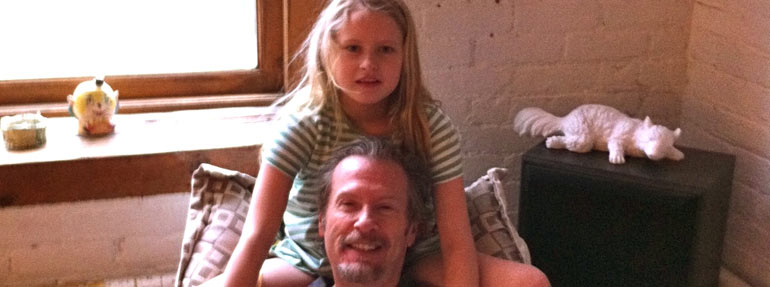
My Beautiful Husband and Daughter

Richard and Emma – 2011

Insights From a Non-Talker: Emma’s Conversation With A Friend

The following is a conversation Emma, Richard and I had with a friend of ours who works at a school.  (DF = dear friend)  I have paraphrased DF’s part of the conversation because a) I cannot type as quickly as she speaks and b) she was thinking out loud at certain points, so I just wrote the gist of what she was saying. All of Emma’s words are what she typed.  Both DF and Emma gave permission to have their words posted here.  As Emma wrote – “People need to understand.”

DF:  I’ve been thinking about your presentation (click ‘here‘ to watch Emma’s presentation) and the body/mind disconnect that you talked about during your presentation last week.  I was thinking about being respectful and making faces back at you and I know you’re smart, but I was afraid that if you can’t control your body and don’t mean to make faces, is it disrespectful to make faces back?

Emma:  Making faces is fun communication in my chosen language.

DF:  Is it also the same for the words you sometimes use?  So, if you’re saying a word like “peacock”, is it respectful to repeat it back and play with words that way?

Emma:  Playing in all ways is my favored way of interacting with people even when they don’t speak silly.

DF:  Sometimes I feel bad because I want to ask you questions because I want to know you better, but I don’t want to ask because I know how hard work it is for you to answer.

Emma:  Talkers always want words, as though everyone stated exactly what they meant.

Richard & Ariane:  (we both asked similar questions, but in different ways, this is a combined version of what we asked) Emma, I’m curious…  when you say “peacock” sometimes you are singing in an operatic voice, but other times you are saying the word over and over while also saying “peek-a-boo” so I’m wondering are you mimicking the bird or are you playing around with the words, “peek-a-boo”?

Instead of pointing to the “y” or “n” for yes or no, Emma pointed to the letter, “w”.  This led to a quick back and forth between us, talkers, about how Emma rarely just answers yes or no when given the opportunity to, but instead writes much more.  I even then joked to Emma, “Em, that was a yes or no question.  You can just hit “y” for yes or “n” for no!”

Emma:  Word play is joyful and I think obvious joy is had with both associations.  Decision to sing while thinking about birds with peek-a-boo tail  feathers brings happy feelings.

Ariane:  Oh my gosh, Emma!  That’s so amazing.  The tail feathers look like hundreds of eyes and they are only fanned out at particular times!  So this wasn’t a yes or no question after all!

We then discussed peacocks, their beautiful plumage and how we often thought we were asking a yes or no question, only to realize how wrong this assumption is.

DF:  Okay, so here’s a problem that many teachers have at school.  A lot of times kids your age or older have fascinations with things that talkers think are inappropriate.  Things like a teenager who likes Teletubbies or wants to carry around a stuffed animal or wants to talk about Thomas the Tank Engine.  We want to be respectful and treat that kid like a mature teenager, but we don’t feel comfortable talking about Teletubbies or Thomas the Tank Engine.

Emma:  This is their fear of indulging a mind that they suspect is simple, but someone who is known to be brilliant would be thought eccentric.

DF:  Should I defend their right to explore their interest in school?

Emma:  Yes, expressions are not threatening and harm none.

*Quick aside – using interests as the gateway to other academics is how many homeschool/unschool .

Richard:  In the past, while watching you type, you’ve made faces at me and I’ve made faces back and was told not to do that.  But I’ve seen you making faces and you still are able to type, should we feel free to make faces with you while you’re typing?

Emma:  This is a difficult answer because I prefer to make faces, but I know how much you want to talk.

R:  What I meant was, do you enjoy having someone make faces back while you’re typing or would you prefer they did not?

E:  I would love to just make faces and not type.

*Another quick aside – so this is the ongoing struggle of all parents it seems to me.  It’s those grey areas when we ask our children to do something, even when they may not always want to.  For us, we put boundaries around typing sessions, so there is a clear beginning, middle and end.  As with most parents, we hope our decision is the right one.

Ariane:  Talk to me about when you say to guests, “good-bye”.  Often you say it shortly after they’ve arrived, sometimes immediately after they’ve finished dinner.  You can clear the room in seconds because they think you want them to leave.  But do you want them to leave?

Emma:  Saying good-bye to some is because I think they need to go, but other times I am sad and say it because I don’t want them to leave.

*Emma then made a sad face and pretended to cry.

Richard:  That’s a good face to make when you’re sad that they must go!

DF, Richard and I circled back to DF’s question about students who have interests in things that the non-autistic educators deem not age appropriate.

Emma:  It’s hypocritical though, because I was often given very young books, more suited for a toddler.


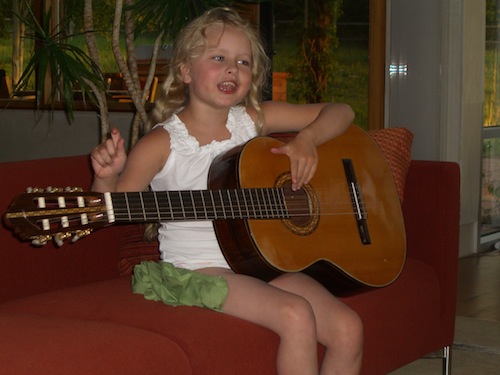
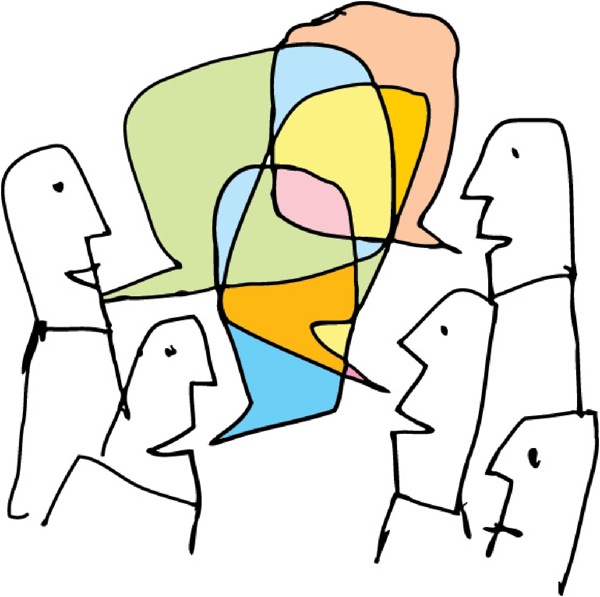
I asked Emma what image she wanted with this post, she typed, "google - "talking" and then chose this.

I asked Emma what image she wanted with this post, she typed, “google – “talking” and then chose this.

The Three Boxes ~ A Story

Emma’s story, which she edited slightly from the original:

There were three boxes that were left on three different doorsteps.  They appeared to be identical in physicality.  The size, shape, and color made them far from unique.  The way they each arrived is still unknown.  Assuming they are identical on the inside would be ignorant.

When the people opened their doors and saw the boxes left, their reactions varied.  One questioned why there were no markings on the box.  The other tripped over the box when leaving, but did not pay it more attention right then.  The third opened it immediately since she loved getting mail.

Inside the boxes were lives – a kitten, a puppy, and a baby.  We will never know who abandoned these precious lives.  The focus is on how these lives adapt to new environments.  The easy answer is not that easy.  The longer version is that once the boxes were opened – the kitten quickly scampered out, easily scaling the box’s cardboard sides, the puppy tried to get out, but the box was too deep and he was too little, so he looked around for help, and the baby lay there, too young to even roll over and simply cried.

Luckily the enthusiastic mail-lover became the baby’s new mother.

That is food for thought.

The End

The box with the kitten

The box with the kitten

Saying One Thing, Meaning Another

First – here is the video of Emma’s and my presentation at the ICare4Autism Conference on July 2nd in New York City – “My Body Does Not Obey My Mind”.

Emma ended our presentation by singing one of her favorite songs, You’ll never see me again.  We uploaded this separately and changed it from “public” to  “unlisted” as someone has already given her singing performance a “thumbs down”.  As with anything that is “public” on the internet, one can expect to get those who are so troubled and filled with self-loathing they cannot control their wish to hurt others.

We may make a new video that includes both the presentation and her singing. At which point we will remove this video of just her singing performance so that only those who watch the full presentation will be able to watch her singing at the end, but have not done so yet.  In the meantime here it is, though this link may only work until we’ve made the new video.

As Richard edited the video of our presentation I became uncomfortably aware of how, in my desire to amplify Emma’s voice, I tried to keep her from applauding and kept trying to read her words over the applause.  This presentation was the first full length presentation we’ve done together, so there were a couple of things I will be sure not to repeat next time.  In addition to my issues, the font size needed to be about 30 times larger for such a big room and the activated voice needed to be miked and next time you can be sure I will be applauding Emma right along with the audience, waiting until the applause died down before attempting to read her words.

This morning I was reminded of how Emma, when asked, “How old are you?”  will, without hesitation and in a matter-of-fact voice, say, “Nine.”  If I give her the keyboard she will then type, “I am 12.”  When I asked her to talk about what it was like to say something, knowing it wasn’t “correct.”  She wrote, “Hearing myself say words that cause confused reactions, solidifying doubt, makes people befuddled and causes me anxiety.”

I asked Emma if she was willing to say more.  She wrote, “The words are not friendly when they march purposefully from my mouth, ignoring my brain’s direct orders, like obstinate and unruly toddlers defying all.  Words pouring forth like water after a dam break, do not pay attention to me.  I am so used to it I no longer fight.  I dread the smiling talkers who insist on spoken language as proof of being and serious thought.  Humor and a reminder to not take themselves so seriously is my loving suggestion for all.”

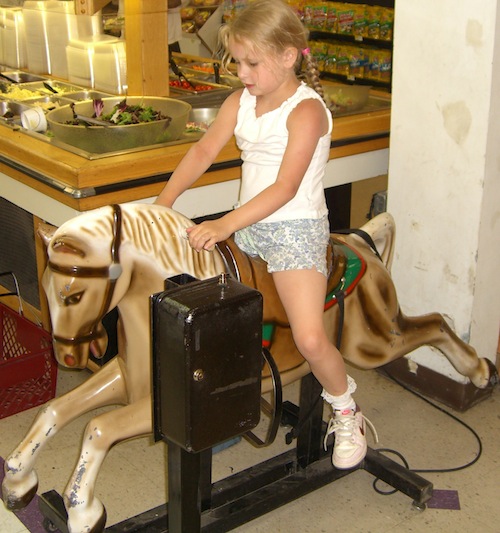
I asked Emma why she chose this image for today's blog post.  She wrote, "I was so happy riding the horse and this post makes me happy too!"

I asked Emma why she chose this image for today’s blog post. She wrote, “I was so happy riding the horse and this post makes me happy too!”


Tomorrow’s Presentation

Emma and I are giving an hour-long presentation tomorrow at the ICare4Autism Conference.  We have been discussing our presentation and while I would be most comfortable writing everything out and basically reading from index cards, Emma has proposed that we do a much looser, more fluid type of presentation, one where I introduce us and then she will type some thoughts about the topic she chose, My Body Does not Obey My Mind, I will respond, she will type something else and on it goes, ending with questions from the audience.

Emma wrote, “How about making this presentation more meaningful by having me talk and then writing an answer to a question and showing them what we mean when we use the words “body/mind disconnect”?

I asked her if she was okay if I brought up the topic of stimming too.  Emma wrote, “Maybe we start with something less controversial like nice questions about the weather.”

I said, “You mean I ask you a question about the weather and then wait for you to give a spoken answer? And then after you’ve said something, you will type an answer to show the difference in real-time?”

Emma replied, “You ask me a simple question like – How do you like the weather today? – because talkers like that sort of thing.”

So to practice, I said to her, “What do you think of the weather today?”  Emma said, “Pool!”

“So that’s a good example, right?” I asked.

Emma then typed, “Beautiful blue skies with whispering air that rustling leaves answer.”

I said, “That is such a perfect example of what you’ve been talking about.  What else?”

“Vanity will be put aside so that others may learn,” Emma wrote.

When I suggested I write what I would say in response, Emma wrote, “How about you talk about how my talking voice confused you and made you think what I said was my intention?”

I told Emma this way of presenting is nerve-wracking for me, but that I think it will make for a far more compelling and powerful presentation.  She then typed, “You can lean on me.”  I told her I will be practicing mindfulness and breathing to relax.  Emma wrote, “Good work, Mommy.  I will be right next to you lending support.”

I’m counting on it, Emma.  I’m counting on it.

Emma and Me

Emma and Me

A Few Thoughts From Emma

“Today I will talk about the weather,”  Emma wrote.  Then she smiled and wrote, “That’s a joke.”

*Quick aside from Ariane.  Emma has referred to those who are well versed in cocktail party conversation as “weather talkers”.

“You’re funny,” Ariane said.

“Lean trains of thought provide rich moments of quiet peace.  Purposeful silence holds meaningful interconnection between like-minded souls.  Caring beings care in the silence as much or more as with words.   Now for a moment of silence.”

The view from the deck where we are staying

The view from the deck where we are staying

Today’s Post Brought to You By Emma

Written by Emma Zurcher-Long

“Today I will tell a short story about a girl who wanted to speak to the wind.  She listened with ears attuned to wind’s song, and desired to speak with its power and beauty.  But the wind was not used to listening, and the sounds she made were ignored.  People heard her and told her to be less noisy.  The wind was loud, yet no one attempted to quiet it.  The girl understood the wind’s voice and eventually it heard her.  Neither one spoke with words.

“The End”

Emma Chose this image from a google search "Girl in the wind"

Emma chose this image from a google search “Girl in the wind”

Homeschooling, Unschooling…

We are homeschooling, or unschooling or…  I actually don’t know how these terms are defined and haven’t had time to do the research necessary to speak about any of this with any authority, let alone knowledge.  In fact “time” and what that means has kind of blown up in our faces as there never seems to be enough of it.  Richard and I are scrambling to make this work, while making jokes about how many clones we would need to do so, if cloning were an actual thing.  All of this is very new and we have not fallen into a routine yet.  I guess the best description of what we are doing at the moment is – winging it.  We are winging it, though this will change as time goes on, we think.  We hope.  We expect.  What I can say is that Richard asked Emma what part of history she was interested in learning and she chose ancient Egypt and ancient Rome.  This then led to several lessons on the Druids.  Who knows where all of this will lead next!

Meanwhile, Emma and I have embarked on the exciting adventure known as the German language, as per Emma’s request.  We had a particularly hilarious conversation a few weeks ago when Emma first brought up her interest in learning German.  I was somewhat incredulous and kept saying things like “Really?”  and “Are you sure you want to learn German?”  and “What about Spanish or French?”  But no, Emma was not to be swayed, so German it is.  And guess what?  It is SO much FUN!!  We are using a couple of different programs, one is Duolingo, which was recommended by a couple of people.  It’s a free online language program.  Did you know all nouns in German are capitalized?  Why?  Who knows, lots of theories, but there is no one answer as to why, that everyone agrees with.

In addition Emma is working on several writing projects.  One is a chapter idea, in which we will write alternating chapters.  Emma wrote, “How about starting on what you presumed parenting would be before I was born.”  I said, “Can you ask me questions, things you want to know?”  Emma wrote, “Very happy to ask.”  I said, “And what will your chapter be about?”  Emma wrote, “What I presumed the world would be like when I was a baby.”  I cannot wait to hear what she has to say about that!

We continue to make our way through Malala’s autobiography, I am Malala about the Pakistani girl who fought for her right to have the same education as boys and was shot by the Taliban.  This has led to some terrific discussions about advocating for one’s rights, oppression, prejudice, violence, silencing, education, and the lack of.  Recently Emma wrote, “Her life is unlike mine.”  (Referring to Malala.)  “But the oppression is similar to what I have experienced.”

While I continue to go through periods of abject terror at the thought of what we have undertaken, these moments are tempered with the excitement and joy I feel knowing that pulling Emma from school was by far the best thing for her.  She is ecstatic and the marked change in her anxiety and stress levels makes all of us very, very happy.

Emma chose this image for today's post.

Emma chose this image for today’s post.

A Traffic Jam and an Analogy

Yesterday we had to rent a car (we New Yorkers often do not own cars, one of the many wonderful benefits of living in such a vibrant city!) to go see Soma, who was about an hour outside of the city.  (For more about Soma, you can click on her name above, which will take you to her website for the Halo Center.  You can also read more that I’ve written by typing either Soma and/or RPM into the search box on this blog.)  We thought we’d given ourselves plenty of time by renting the car almost two hours prior to our appointment, but as luck would have it a lane was closed due to an earlier collision and coupled with the ongoing and seemingly never ending road work on all and any highways in and out of Manhattan, we realized we would be lucky if we made our appointment at all.

When we pulled up, Soma was waiting, we were exactly two minutes late(!) so we jumped out of the car and raced in to begin Emma’s session.  Emma wrote, “What happens if traffic never gets moving?”

Pause.

“You are stuck in a rut.  It’s like autism.  When you have the diagnosis you are stuck in stims and cannot proceed where your actions want to be.  It is always clogged like a caged mind driving through traffic.”

This morning I asked Emma if we could talk more about this as I’ve not heard her talk about autism and stims in this way before.  In fact, Emma has referred to stimming as self-care ‘here‘ and ‘here‘ and I wondered if she’d be willing to talk a bit more about this with me.  She wrote that she would.  She wrote, “Circular stimming begins in self-care and can aid focussed mind, but samples hasty stress when consumed by the stim.”

“So what I hear you saying is that the stim begins as a way to self-care, but can also become the cause of stress.  Is that accurate?”  I asked.

“Understand that I cannot always filter all that is going on easily.  My string grounds me.  Not having it can cause horrible stress, but it can also distract me.”

I asked Emma if there was anything that another person can do that would feel supportive and encouraging, but that might also make that struggle easier.

Emma wrote, “Don’t force me to put it away, but instead gently remind me to stay in the task asked.”

“Is it okay to suggest you hold the string in your left hand or wrap it around one hand so that you’re still free to type?”  I asked.

“It is nice to be helped with kind suggestions, not nice to be stripped of any say in what is being done.”

“Okay, I totally get that,” I said.  “With Soma you wrote, “What is wrong with the world?”  Then you answered your own question by writing, “In fact nothing is wrong with the world.  We are the problems.  We are not right.  We see things and create a problem.  I don’t have autism label on my forehead like Soma’s dot.”

(Emma was referring to Soma’s “bindi” the red dot Hindi Indian women often wear.  Soma, being Soma, made a joke and did not take offense.)  Emma then wrote, “But I have to walk around all my life with this label.”

I asked Emma if she’d talk a bit more about this and asked, “Do you feel if you didn’t have a diagnosis, people would treat you differently?”

“People see me, think she is different, forgetting that I have feelings like they do. If people understood what autism really is, it would not matter, but people don’t, and so it makes life much harder.”

“So it isn’t the label or the word “autism” that bothers you as much as what that seems to mean to so many people?”

Emma wrote, “This is the biggest problem and causes mistreatment and misunderstandings.”

“Thank you so much for clarifying all of this Emma.  Do you have anything to say to parents and educators who are trying to understand?”

“Keep your open mind and listen to the people who are Autistic for information about autism,” Emma wrote.

Soma and Emma ~ June 12, 2014

Soma and Emma ~ June 12, 2014

Ido Kedar’s Blog and Emma’s Response

I’ve written about Ido and his book and blog, both entitled Ido in Autismland, before, ‘here‘, ‘here‘, and ‘here,’ but want to devote today’s post to Ido’s latest blog post because Emma and I read his post this morning and Emma added some of her own thoughts to what Ido wrote.

Ido begins by talking about having just finished up his junior year at a non special education high school.  (I originally wrote “regular,” but then amended that because I no longer know what any of these words even mean, much less how derogatory they sound.)  Ido then addresses parents and then professionals and finally ends the post with a few encouraging words to other Autistic non-speakers.

After Emma and I read his post, I asked Emma what she thought.  She wrote, “I thought it was decidedly helpful to read Ido’s writing.  He tells strong truths lived.  Teaching wasted talkers about life not run on word fuel.”

“Word fuel.”  Can we just take a moment to fully appreciate that?  “Teaching wasted talkers about life not run on word fuel.”  There’s more, so I will disregard my urge to just end this post with that.

I asked Emma if she had anything she wanted to add to the paragraph he addresses to parents.  Emma wrote, “Parents – you must address your fears and doubts first, and then have caring words of encouragement for all word thinkers.”

I then asked for her thoughts on the paragraph addressed to “professionals”.  Emma wrote, “Teaching tedium does nothing, but water down ideas.  Lethargy is the lesson learned.”

Lethargy is the lesson learned.

Ido ends his post with a few words directed to Autistics like him.  Emma then wrote, “Work today, knowing each day pleases the necessary work of tomorrow.  Having hope, and loving, believing parents will make work easier.”

"Talkers"

“Talkers”