Tag Archives: non-speaking Autistic

An Interview With Tracy Thresher of Wretches and Jabberers

Wretches and Jabberers, the not-to-be-missed documentary by Oscar Award winning and two-time Academy award-nominated filmmaker Gerardine Wurtzburg, follows two non-speaking Autistic men, Tracy Thresher and Larry Bissonnette as they travel the world, reaching out to other non-speaking Autistic people in an attempt to change public perceptions surrounding intelligence and autism.

I’ve written about the film ‘here‘, ‘here‘ and ‘here‘ and about meeting Tracy and Larry, ‘here‘, ‘here‘ and ‘here‘.  I cannot emphasize enough how mind altering this documentary is. It is imperative people begin to examine their own ideas about what intelligence is and what that means, particularly as parents of children who may be similar to Larry and Tracy, who appear profoundly disabled or have difficulties with verbal communication.  Tracy and Larry exemplify all that is thought to be “other” and yet, when they type, they are eloquent, often hilarious, articulate and philosophical, as well as insightful about society’s view of them.  After watching Wretches and Jabberers, one cannot help but conclude we are all more alike than not.  The divisions we perceive are shown as constructs of our own making.  The biases we have towards those with disabilities is something we all must actively change.

A few months ago Tracy Thresher generously agreed to answer a few of my questions.  What follows is our conversation, but as you read this, please think about questions you may have and leave them for me in the comments section or email me privately with them at:  emmashopeblog@gmail.com.  (Do tell me whether you prefer to remain anonymous as I will credit you with any questions I end up using, unless you prefer I do not.)  I intend to submit this interview, once it’s finished, to Huffington Post and hope it might inspire people to reconsider their assumptions.

AZ:  Tracy, how would you describe the documentary, Wretches and Jabberers?

TT:  Our film catapulted me to realize my dream of traveling the world to educate, learn and change old attitudes of discrimination toward people of varying abilities. The Larry and Tracy duo illustrates how intelligence is often worked out in a much different way. Our journey takes us to places of enlightenment and our humanity, humor and intelligence comes shining through our typing. Our mission to spread the reality of our amazing intelligence through our typing is our way of promoting the Presumption of Competence dispelling myths. Our story is one that is a road trip for two friends who are in Larry’s words “more like you than not”.

AZ:  “More like you than not” is such a wonderful description.  So much of the literature surrounding autism is about the “deficits” of Autistic neurology compared to non Autistic neurology. Can you talk about the assets and the similarities?

TT:  In my way of thinking, my experience initially was uncontrollable anger for the life I had trying to break through the misunderstanding in school. Kids can be brutally honest, reflecting the language that was the accepted norm in my childhood. Labeling kids is crippling. MR (mental retardation) on a diagnostic chart equates to NOT a candidate for the honor roll. Now I am able to communicate the reality of autism. I met Monk Hogen during the filming of “Wretches and Jabberers”, shining his wisdom on my autism. My true desire and purpose in life is breaking the walls of injustice down and my autism is the gift God gave me. I now focus on how I am connecting with all kinds of people through my work on the road. The high I feel in my own community is so wonderful, knowing that people want to know me. The man I am today is because my autism is the gift I was given to be a leader to anyone who has ever felt less than human based on their appearance. Martin Luther King knew that hurt and he took it to the mountain of peace. My mind is more like a Mensa candidate than I can type. My life is a testimony to the lesson of humanity. Like Larry typed “More like you than not” is the guiding principle to inclusion.

The anger on stage during my presentation in Japan was related to the lost opportunities in my education. I kept shouting out my automatics like “Look at me now! The kid you told one another to keep in isolation now is mentoring students which is healing salve to old wounds of injustice.” The other anger in Sri Lanka is more about the heat in the way it took my overly heated mix of perspiration soaking my clothing to extreme discomfort. Also, the popular foods in their culture are not in my comfort zone. Finland washed my anger, turning my heart to love of the climate. The cuisine helped too. Primarily, beautiful lands of countryside put my spirit at ease. Henna melted years of lost hope by crumbling away the feelings of isolating my heart to love.

People in the world often fear the paradox that autism usually presents. Larry and I mostly felt gracious vibes in our travels but the camera crew likely alters reality. To reflect on the cultural attitudes, the typing of my international friends is the true compass pointing to injustice.

AZ:  For children who may be trying to cope with similar frustrations and anger, what do you suggest to them and their parents, teachers and therapists?

TT:  This is my mission to show kids and their supports that putting communication to the top of their list of priorities is vitally cleansing to the mind. Releasing deep thoughts is the key to alleviating anxiety. Frustration leads the body to unproductive anger. Being able to show intelligent thought is the path to happier futures and true quality of life, leading to purpose. That is what I sought and found with typing.

AZ:  Was there anything others might have done to help you when you were overwhelmed with anger?

Harvey and I have trust in our partnership. I need his firm yet kind support to stay on course with managing my autism. Harvey and I work well together. Typing is my outlet and open communication is the key.  Long term shared goals helps to keep me on track. Harvey’s commitment to my communication is the big time dosing of calm energy that I need. The commitment to presuming competence is the major breeze of refreshing air to cooling anger.

AZ:  You communicate by typing, but need someone to support your typing.  Why is it necessary for you to have someone supporting you?

TT:  Impulse to type out my most irritating automatics like going to radio stations or wcax news gets looping in my mind. Having good facilitators is helping me to slow my typing to think and connect to my inner thoughts. I also need high goal of working on fading physical support to be more independent and type with lessening support. Building trust is critical to fading.

Tracy Thresher

The Audio Book for “I Might Be You” is Here!!

Barb Rentenbach’s fantastic, funny, poignant and beautiful, must read book, I might be you. An Exploration of Autism and Connection is now available as an audio book!  Full disclosure:  Barb, who is non-speaking or “mute” as she describes herself, and Autistic, asked me to be her voice for the audio book, an honor I cannot begin to fully express.   I do not receive any proceeds from the sale of the audio book.  The payment I receive is the joy I feel knowing that Barb was pleased with the end result.  It is a joy that is literally priceless… That all of you, who purchase the audio book, may benefit from Barb’s hard work is the metaphoric icing on an already sumptuous and exquisitely rich cake.

Barb is non-speaking and writes with a sharp-witted, R-rated, take no prisoners eloquence.  She is brutally honest in her description of her life as someone who is often mistaken as someone she is not.  For anyone who has ever felt they are on the fringes of society, felt they didn’t “fit in”, judged, seen as an “outsider”, as “other”, as less than, this book will resonate.  For anyone who has ever felt insecure, shunned, rejected, judged, criticized or misunderstood, this book is for you.  I Might Be You is about how we are more alike than not.

In preparation for this post, (and a version of this that I will be submitting to the Huffington Post) I asked both Barb and Lois Prislovsky, Barb’s therapist and co-author of I Might Be You to give me their thoughts on the making of the book and subsequent audiobook.  Lois wrote: “Barb typed, “being heard may be as close to helping to cure all that ails ya as one prescription gets.”  I agree.  As a psychologist, I get a daily front row seat to this truth.  What I find most remarkable about Barb is not her spectacular growing wisdom, wit, or even her gifted powers of perception.   It’s her patience that I think is unparalleled.   This book literally took her over 10 years to write one disappointment, milestone, and letter at a time.  My chapters were faster because as Barb says, I am, “less interesting”.  No one book or person has taught me more.  Barb is my favorite author and teacher.”

It took Barb ten years to write I Might Be You because she knew there would be those who would doubt the words in the book were her own and some who would even accuse her of not typing this book herself as she first learned to type with a facilitator.  Determined, she spent ten years learning to type independently, each word spelled out, one index finger jabbing at a letter at a time as she pushed beyond her physical and neurological challenges that made typing completely on her own so very difficult.  Ten years.

I asked Barb to weigh in on what it was like for her to hear her words being spoken out loud by someone who not only was not autistic, but who needed a great deal of direction during the recording!  By the way, Barb was a terrific director: kind, patient, encouraging, yet exacting and uncompromising in her insistence that her words be given the voice she needed them to be.  I wrote about my experience of recording her words ‘here‘, ‘here‘ and ‘here‘ on this blog.  But this post today… this post has to be Barb’s words, Barb’s experience written in Barb’s voice and not mine.  This is what Barb wrote to me:

“health: the state of being free from illness or injury.

“in preparation for this piece, az asked me to “let me not speak for you but rather hand the huffpo mic over to you”.

“i think she just cured my autism.  and what a great slogan ‘mics to mutes’ makes.

“before some poor clerk from the dmv (department of miracle validation) at the vatican calls my number, please know I am still an autistic mute so it will just go to voice mail.  but, i have finally been freed from 4 decades of ills.  it turns out being heard may be as close curing all that ails ya as one prescription gets.

“for 40 years, autism has been seen by all to hold me back.  today, autism propelled me forward as my whole self towards my life’s goal of being a successful writer.

“am i dreaming? yes. and this dream i hand pecked.

“az asked specifically what is my experience of hearing my words being read by another.

“well, it is healing.  for several years now, people have read the words i typed and that has allowed me to accomplish a more independent and quality life.   but those words were read.  meaning people ran them through their personality filters and voice boxes and simply got my gist.  the gift az is referring to is completely different.

“my lourdes miracle cure happened at the hangar studios in nyc.  there, my great difficulties in communicating and forming relationships were lifted – permanently.  this spectacular healing happened when a beautifully open woman with a strong, feminine, and southern twang free voice gifted me what i lacked with no cords attached.   my not so virgin az appeared and did not read my gist.  she got out and selflessly let me drive her luxury voice for a full week to transport my 10 years of pecked letters to let my 40 years of not talking be heard.

“i still don’t look normal.  i appear quite messed up and a prime candidate for nothing but pity and patronization with a sprinkling of repulsion and fear. i am disguised as a poor thinker with a filthy squeegee whom most veer to avoid.  so why did az give me the key? because I asked.

“like me, like you, like “THEM”, poetry is best heard.  two of my favorite lines from derrick brown’s poetry are, “dumb as a bomb on a boomerang” and  “kiss like u couldn’t beat cancer”.   being heard is key.

“we are all each other’s cure.  god cares about us all through us all.

“please say this out loud as i am borrowing your voice to be heard again (only a lunatic would give up voice jacking at this point.  plus think of the icky karma involved if one denies an autistic mute such a simple request.) : “i will not be as dumb as a bomb on a boomerang.  i will be here and hear like i couldn’t beat cancer so today i free myself and others from illness and injury.”

hear and ask to be heard.

“thanks for listening.  healthy b”

Barb and Lois at Hangar Studios in New York City ~ April, 2013

Barb & Lois


Parenting & Presuming Competence

I am reading Anne of Green Gables to Emma.  Three years ago it would not have occurred to me to read her a book that I might have enjoyed at her age.  Three years ago I was “reading” picture books to her before bed.  Three years ago I did not assume she understood the stories in those picture books.  Three years ago I not only did not assume my then eight year old child understood what I read, but I also did not assume she understood 90% of what was being said to her.   Because I did not assume she understood I treated her as though she couldn’t understand.  I treated her as though what I thought was a fact.  Then I learned I was wrong.   Not only did I learn my assumptions were incorrect, I began to see how those assumptions caused me to act and treat her as less capable than she actually was.  I treated her as though she couldn’t and I didn’t see how this attitude was hurting her.  Instead of teaching her to do things for herself, I did them for her.  It was quicker, easier…

I wrote a post not long ago ~ Presume Competence, What does that mean exactly?   People have a tough time with the idea of presuming competence,  let alone putting that idea into action.  I get that.  I did too.  Here was a child, my child, a child we had been told was capable of this, but not of that, a child who was treated by society as much younger than she actually was, a child who, because of her unreliable language did not have conversations with us, did not answer most of our questions, never asked us questions, and so we assumed had little if any interest in such things.  We made the mistake of assuming language retrieval issues were indicative of lack of intent and desire.  We made the mistake of limiting our thinking and therefore limited our child.  We thought we knew, until we didn’t.  We behaved as though what we thought was true and our behavior and actions or inactions fed into that erroneous thinking.

I’ve spoken a great deal about the brilliant documentary by Gerardine Wurzburg, Wretches and Jabberers.  I continue to urge everyone I know to watch it because it is the best illustration I know of, that explains the concept of presuming competence and what can happen as a direct result of doing so.  It is a highly entertaining, moving documentary following two (mostly) non-speaking Autistic men as they travel the world meeting other non-speaking Autistic people who are all far more capable than society believes.  Many are in “life skills” programs or work initiatives doing menial tasks like paper shredding and folding towels.  They type about their mind numbing boredom and brutal frustration they feel as a result of being treated as far less intelligent than they are.

Presuming competence is an act, it isn’t just an idea.  Presuming competence is the single most powerful action we have taken that has directly helped our daughter flourish and grow.  Nothing, absolutely nothing else we’ve done has helped Emma as much as presuming competence.  When we stopped limiting her with our limited beliefs of what she is or isn’t capable of and began giving her the information and materials she needed, she has taken off.  In school she is being taught grade level science, at home she is being taught grade level geography, I am reading age level fiction and nonfiction, she clears her own dishes, cleans them and puts them away.  She sorts her own laundry, helps fold it and knows how to make pancakes without assistance.  She takes a shower on her own, has learned to shampoo her hair and brush it afterwards.  She brushes and flosses her own teeth with minimal support, she dresses herself.  When it is clear she needs help learning to do something, we help her, without admonishment, without distress, but instead with the knowledge that she will eventually learn to do it on her own.

Presuming competence does not mean we expect her to know how to do something without support and instruction, it means we assume she can and will learn with appropriate accommodation.  This is is a very different way of thinking than either assuming she can’t do something and never teaching her, or teaching her, but requiring her to prove her knowledge over and over before moving on.  With reading comprehension we realized we were asking the wrong questions.  Often we were asking her to answer questions that were not obvious to the story.  When she couldn’t answer, we’d dumb down the reading material and then wonder why she wouldn’t pay attention.

In the beginning, presuming competence felt like a leap of faith.  It scared me.  I didn’t want to get my hopes up.  I didn’t want to feel the disappointment that I knew I’d feel if I was wrong.  It felt like a massive disconnect.  But presuming competence is not about my ego, my expectations or anything else involving me.  Presuming competence is about respecting my daughter and respecting her process.  It is about honoring her.  It is about giving her what she needs to flourish.  It is about dispensing with what I think, believe and have been told.  Presuming competence has nothing to do with my fears of success or failure.  Presuming competence is not about me at all.  It is all about my daughter.

Harvey, Tracy, Pascal & Em @ USFEmma takes the stages with Pascal, Tracy Thresher and Harvey

The Wisdom of Peyton Goddard

Peyton Goddard, wrote a memoir with her mother Dianne Goddard and Carol Cujec entitled, i am intelligent.  It is an unforgettable book.  Recently, Peyton gave a presentation in San Diego, where she typed, “After decades of torture, still each dawn I struggle to feel my worth.”  You can read her entire presentation ‘here‘.

“After decades of torture, still each dawn I struggle to feel my worth.”

Peyton was not tortured by her autism.  Peyton was tortured by non autistic people who cruelly and viciously hurt her over and over.  People who used the fact that she could not use her voice to speak to protect themselves.  I would like to believe we are moving away from a world and society where abusing people we have deemed “inferior” is done.  I would like to believe that, but I cannot.  The abuse of Autistic people at the hands of those who care for them, whose job it is to help them, continues.  The abuse of Autistic people by society, continues.  The abuse of Autistic people by those who are either ignorant or misinformed continues.  The abuse of Autistic people by those who pretend it isn’t abuse because they choose to believe Autistic people are incapable of feeling or really understanding what’s happening to them and therefore it’s okay, continues.

“Estimate I that anger in this pesty world is because pierced persons think hurting others will strip their own hurts away.” ~ Peyton Goddard

In her book Peyton writes about forgiveness.  Forgiveness of those who have hurt her the most.  Peyton Goddard is leading the way, with wisdom, kindness, forgiveness and compassion.

Peyton Goddard – a non-speaking Autistic woman, assumed incapable, presumed incompetent – has a great deal to teach us.

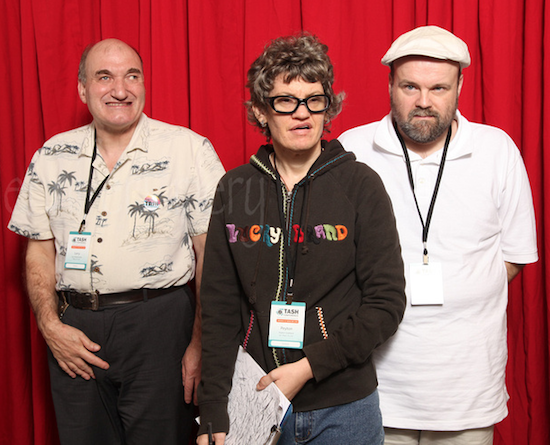
Three Non-Speaking “Teachers”:  Larry Bissonnette, Peyton Goddard & Tracy Thresher

TASH 6

The Barb Show…

I’ve written before ‘here‘ and ‘here‘ about how I don’t always get jokes.  It’s not that I don’t have a sense of humor, it’s just that a great many jokes are hard for me to understand why other people find them funny.  Jokes or anything that starts with the words “Two” (of anything) “walk into a bar…”, or The Onion, (I can’t tell you how many times Richard will thrust some headline from the Onion at me, only for me to say, “wait, what?  I don’t get it.  Why is that funny?”) fall flat.  At this point, Richard now tells me jokes or shows me things that he knows I won’t laugh at because he finds my response as funny if not funnier than the actual thing.  Apparently humor is all the more so when someone is completely clueless. I’m good at that – playing it straight.  

For those who follow this blog, you know by now that I am in the recording studio all week recording Barb Rentenbach’s terrific book, I might be you.  Barb has a wonderfully nuanced and, at times, sarcastic wit.  I can do sarcasm, and wit for that matter, except, as it turns out, when I’m reading aloud someone else’s words.  In addition to this challenge of mine, when I’m nervous, my blue-blooded-upper-crust-WASPy heritage becomes even more pronounced.  So when I’m reading some of Barb’s naughtier bits, not only do my cheeks turn quite pink, I also pretty much stomp all over the delivery of a number of her otherwise humorous sentences.  Because if you read a sentence that is funny as though it weren’t and said it straight, carefully articulating each word as though doing an exercise in drama class, the humor is completely and utterly lost.  The only analogy I can think of that captures this is, imagine reciting the Commodore’s 1977 hit song, Brick House.  “She’s a brick —– ‘ouse, mighty, mighty, just lettin’ it all hang out…” but instead of saying the words as they were meant to be read, carefully articulate each word as though reciting a psalm in church.  I think that gives you an idea of what happened a couple of times in the recording studio.

Fortunately I do have a sense of humor and can laugh at my fumbling.  Barb and Lois were kind and patient.  Even when I had to repeat the sentence until I got the inflection right, they did not fall on the floor in hysterical laughter or poke fun.  I’m grateful to them.  Really.  Because truthfully, that had to have been pretty funny to witness.  The good news is, I was able to get it right… eventually, which is important because this book, this incredible book by Barb and Lois deserves to be heard as it was written, with elegance, eloquence, poignant power, laced with self-deprecating humor.  Every few moments I’d look up to see Barb beaming at me and Lois giving me an enthusiastic thumbs up and I would continue reading feeling exuberant and grateful to be involved in such an incredible project.

Barb showing Em encouragement later that afternoon.

Barb Rentenbach

The Adventures With Barb Rentenbach in The Recording Studio Begin!

I’m speed blogging this morning because I need to be in the recording studio in a little while where I will be at Barb’s mercy.  For those of you new to this blog, read Friday’s post ‘here‘.  For those of you who cannot cope with clicking on a link  – I’m recording the audio book version of Barb’s fabulous book  I might be you which she wrote with Lois Prislovsky.  Barb is non-speaking and writes with a sharp-witted, take no prisoners eloquence.  She is brutally honest in her description of her life as someone who is often mistaken as someone she is not.  For anyone who has ever felt they are on the fringes of society, felt they didn’t “fit in”, judged, seen as an “outsider”, as “other”, as less than, this book will resonate.  For anyone who has ever felt insecure, shunned, rejected, judged, criticized, and/or misunderstood, this book is for you.  I might be you is about how we are more alike than not.

I don’t know that I’ve ever been so excited to go into work!

More to follow…

“I Might Be You” – The Audio Version – Voice by Ariane Zurcher :)

Next week I will be in a recording studio taping the audio version of the wonderful book, I might be you by Barb Rentenbach and Lois Prislovsky.  *Doing a happy dance.  Barb asked me to be her voice a few months ago and without hesitation I agreed!  EEEEE!  Not only will I spend time with both Barb and Lois, but Barb will direct me to make sure I don’t mangle her beautiful words or trample on her often bawdy sense of humor.  It’s all in the delivery; I will do my best to make her proud.  Did I mention, Barb is funny?  She has a wonderful, edgy, R-rated sense of humor.  She avoids nothing and no topic is off-limits.  And while I’m not exactly a prude, I may get a little rosy-cheeked as I attempt to do her words justice, especially that chapter discussing masturbation, sex, or the lack of, and those hunky personal trainers who motivate her…  Taking a deep breath.  For those of you unfamiliar with the book, I wrote about it ‘here‘.  For those of you interested in purchasing a hard cover copy, and why wouldn’t you be (?) you can do so ‘here‘.  (I gain nothing from your purchase, other than the pleasure in knowing you will enjoy reading her book.)

I first met Barb and Lois at the AutCom Conference in the fall of 2012.  Their presentation was crowded, but I managed to secure myself a seat at one of the round tables.  I remember watching Barb type on a key board and being wonderfully surprised by both her self-deprecating sense of humor and how quickly she was able to type.  I admit, I couldn’t keep up as the letters whipped by while Lois read what she was typing.  Barb told of how it took her ten years to write the book because there were so many who simply did not believe she was actually writing the things that were being typed.  The assumption was that Lois or whoever was facilitating her was doing the writing.  But Barb being Barb, did not allow their doubts to stop her.  Now Barb is typing independently, her book has been published and the audio version is about to be recorded!  Woot!  Woot!

Do I need to say how excited I am?

Have I mentioned how honored I am to be Barb’s voice?

Stay tuned next week for ~ Adventures in the Recording Studio with Barb!

Why Teach Age Appropriate Topics?

Someone asked me why would I teach my child age appropriate topics such as the American Indians, the arrival of Europeans to America, the Roman Empire and the difference between amphibians and reptiles, when tying her shoes, answering (whether verbally or by typing) a why question and riding a two-wheel bike has yet to be accomplished.

The short answer is – they are not mutually exclusive.  It is not that one thing gets taught and the other is left to languish.  I believe all these things are important for any child to learn; why shouldn’t my child have the opportunity to learn these things too?  But just to play devils advocate, let’s say that the questioner still asks, but why?  To them I say, because knowledge is freedom.   Knowledge gives us context, history provides us with choices, knowing how our government works gives us important information about leadership, honesty and conversely dishonesty.  Learning about geography gives us information about the physical world we inhabit.  Reading Wordsworth or Shakespeare or Susan Sontag, studying a painting by Rubens or Renoir or Basquiat, listening to music by Rachmaninov or  Ray Charles or, my daughter’s personal favorite, Gwen Stefani transports us, encourages us to think both analytically and creatively and enhances our lives.

Ralph Saverese, author of  Reasonable People: A Memoir of Autism and Adoption wrote a wonderful piece about a year ago, The Silver Trumpet of Freedom about his non-speaking, Autistic, son DJ who had just been accepted into Oberlin.  It’s a terrific piece and I encourage all of you to take a few minutes to read it.  I’ll wait.

Right here.

Seriously.

Go.

Read it.  

What many believe to be true about Autism is proving again and again to be incorrect.  What many believe to be true about those who are Autistic AND non-speaking is proving to be incorrect.  Our ideas about someone who has physical challenges AND is Autistic AND does not speak are proving to be incorrect.  Our incorrect beliefs are limiting how that segment of the population is taught and what information they are given access to.

This must change.

AutCom 2012 Conference – The Best Kept Secret

The Autcom conference was a fleeting glimpse into paradise.  A tiny taste of how the world could be were we accepting of each other, treated all people as equals and with respect, without prejudice, without assumptions, without bias.  Autcom was a window into how the world could be, but isn’t.  Not yet.  Words do not do this conference justice.  How could they?  How do you describe a room full of people who are connected not through race, nationality, religion, political views or neurology, but instead are connected by an idea.  A vision.  How do you describe that?

Accommodation – it’s a word we hear, but what does it really mean?  At the Autcom conference it meant waving hands at the end of a presentation instead of clapping, lowered lights, snacks that included gluten-free and casein free items and non dairy alternatives.  Accommodation meant no one stared disapprovingly at anyone who stimmed or made noise or got up to leave in the middle of a talk.  Accommodation meant people were polite and moved chairs that might be blocking someone’s ability to come or go.  It meant using a microphone or repeating a question for those who weren’t able to hear the first time.  It meant being respectful and considerate when someone came up to peer at your name tag and it meant understanding that when that person gently touched your hand after a presentation it was their way of thanking you and I defy anyone to not see the beauty and love in that.  Accommodation meant slowing down while someone typed their answer or question or thought.  It turns out accommodation means being a thoughtful, considerate human being who is respectful of others.  How is it this isn’t done automatically, as a matter of course.  How is it that we as a society have drifted so far from this very basic and easy way of being in the world?

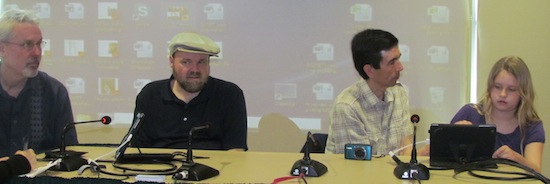
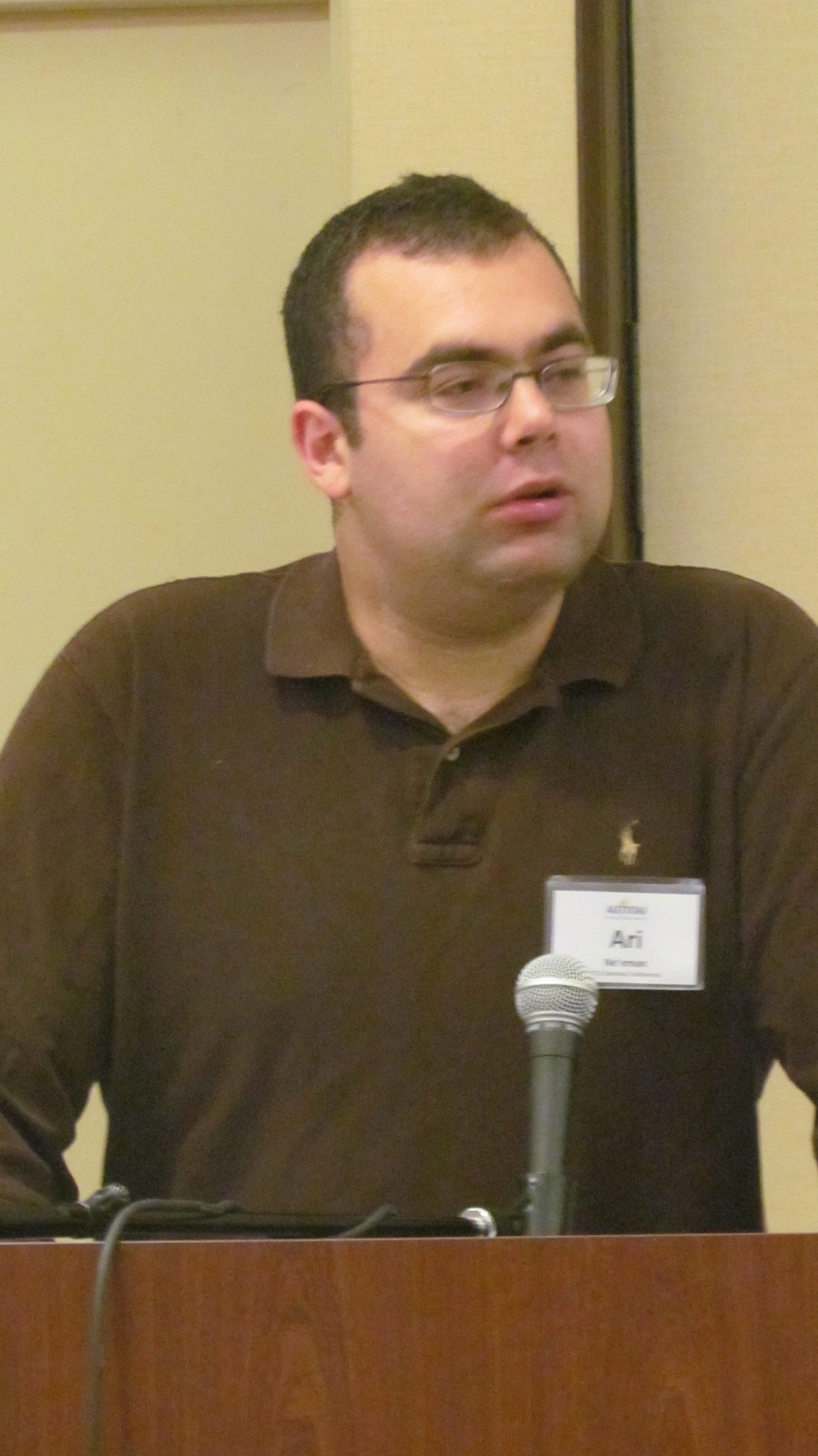
The single biggest issue I had with this wonderful conference was that there were too many terrific things going on at once and it was impossible to see and hear everyone and everything.  To give you an example of this – on the first day of the conference after Ari Ne’eman’s welcome and an opening keynote address by Jennifer Paige Seybert, was Savannah Nicole Logsdon-Breakstone’s presentation – Loud Hands Project’s Neurodiversity 101.  At the same time, Larry Bissonnette, Pascal Cheng, Harvey Lavoy and Tracy Thresher were doing a presentation on Supported Typing, which I really needed to go to in order to assess whether this might be something we could use to help Em communicate more effectively, but next door to them was Nick Pentzell, Hope Block, Jacob Pratt and Autumn Dae Miller presenting “Rated “R”: That Oh-So-Difficult Topic”.  I cannot tell you how much I wanted to hear them too and later heard from others that it was a not to be missed presentation, sadly though, I missed it.  Human Development Journey was presented by Cecilia Breinbauer about using DIR, which was the method Richard and I were trained in by the late Stanley Greenspan, after abandoning ABA.

Ari Ne’eman

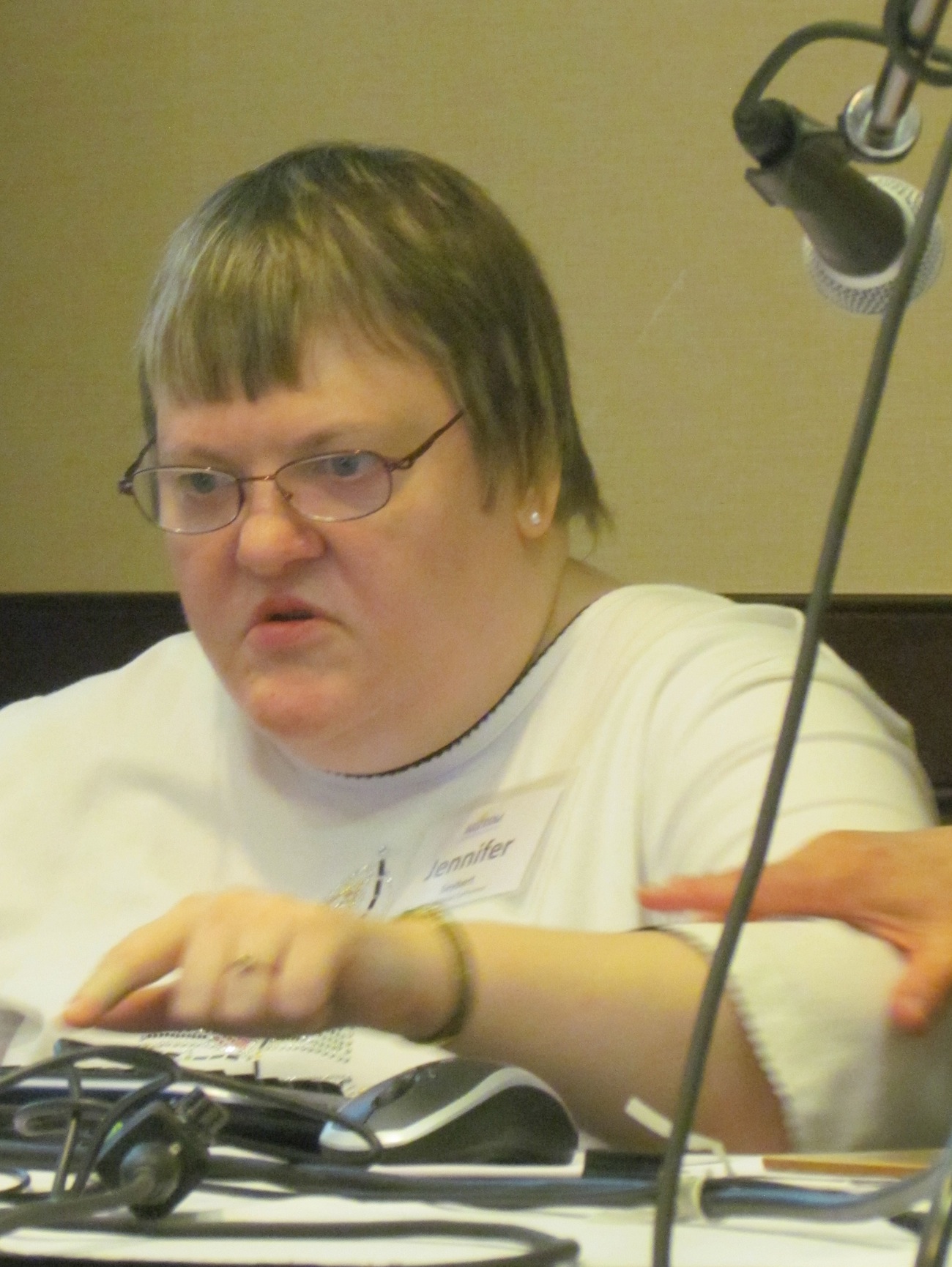
Jennifer Paige Seybert

That evening after dinner and a wonderful performance by Jordon Ackerson who reminded me of Emma because of his beautiful voice, we watched Wretches and Jabberers, with a Q&A with Larry and Tracy.  This was my third time watching this documentary, which I posted about last month ‘here‘.   I asked them about self-injurious behaviors, something both engage in during the film.  I asked for  their opinion about the commonly held belief by many that SIBs should be thwarted and how parents and caregivers are often unsure how to deal with this.  Tracy typed, “That was years of frustration with no way to reliably express myself working its way out through my behavior the problem was lack of communication which pissed me off.”  Larry typed, “I lived in an institution so I was locked in arms of restraint its legal but immoral and only represses anger nothing looks more kind than softly spoken words and lit up smiles.”

Jordan Ackerson

Tracy Thresher

Larry Bissonnette

Read that again.  “… nothing looks more kind than softly spoken words and lit up smiles.”  The presentations were terrific, but it was what is possible that this conference represented, which affected me most profoundly. The AutCom conference was an example all organizations, who say they are interested in Autism and helping those who are Autistic, should follow.  Autistic people make up a large portion of their board, Autistic people led more than 50% of the presentations, the audience was at least half Autistic, if not more.  At my presentation there were more Autistic people than not, for which I was truly honored by.  The conference showed what the world could be like if we work together, reach out to each other, include everyone despite our perceived differences with love, compassion and kindness.  Accommodation is less about accommodating and more about getting in touch with our humanity and what it means to be alive and sharing this planet together.  Accommodation and inclusion means we ALL benefit.