Tag Archives: Education

A Letter To You ~ By Emma

I asked Emma whether she wanted to finish the story she began about an otter or talk about something else.  She wrote:

“I want to talk about the New Year.

“This is a meaningful year because I am beginning to write about my ideas about autism and how people need an education in applying what Autistic people feel.

“Fear is non-living.  It cripples the mind and deadens the soul.  Raging beasts of pain masquerading as stims cause many to misunderstand.

“I am not without thought.  My forever beautiful mind needs nourishment all the time.  Autistic people are left to linger in a secluded world by those who could be helping instead of harming them.

“Please care enough to alter how you interact with those who may seem different than you, but who are actually the same.  We are all beings with similar feelings and hopes.

“Do not believe your fears.  They will lead you the wrong way.”

Emma told me she wanted me to publish this on the blog today.  Emma turns twelve this month.  I have spent more than fifty years learning what she already knows.  Em & Ariane on New Year's Eve ~ 2013    Em & Ariane on New Year’s Eve ~ 2013


A Look Back and Then Forward…

Em wrote just now (and said I could publish what she wrote here):

“I want to talk about the New Year.

“I know it was an important year to talk to the world.  I need people to understand what it is like to be Autistic.  I could be daring by saying that, but I think it is the only way others will become more tolerant of those of us who think differently than most, and it is opportunity that both separates and connects.”

I have so many thoughts about this…  “it is opportunity that both separates and connects.”  That sentence could be the topic for an entire semester in graduate school.

After Emma wrote this, I asked her if I could share it with Richard and on here, to which she nodded and wrote “yes.”  Richard and I had different responses to the word “opportunity” but when asked to clarify, Emma was already listening to her music and as I told her our study session would last 25 minutes and no longer, I did not press her to elaborate.

I will end this brief post by saying this past year has been a monumental one for me and my family.  As I look back on previous years, there have been none that can compete.  Here’s to embarking on another incredible year filled with curiosity and wonder.  Thanks to all of you who have read, commented and/or reached out.

As Emma has advised many times over the last few months, “Be kind to each other” and “everyone should be treated kindly and with love.”

Happy New Year!

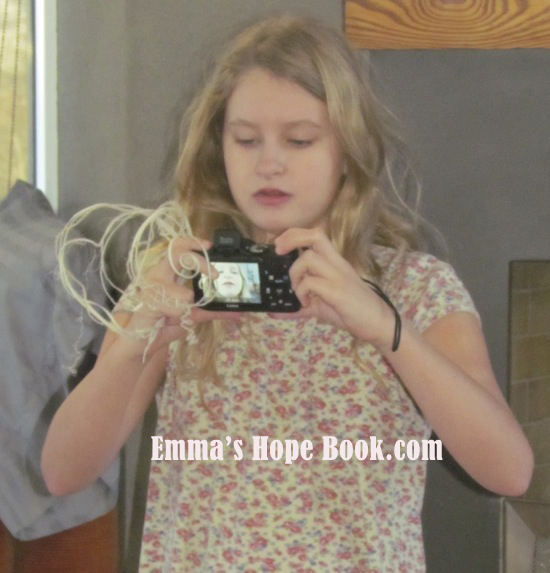
Self portrait

“It’s Good to Be Heard”

It’s good to be heard

These are the words my daughter spelled out yesterday during an RPM session.  She wrote some other wonderful things too, but I don’t have her permission to print them here.

“It’s good to be heard”

Imagine a life where it was not a given that what you said would be listened to, or even understood.  Imagine if you said things you didn’t mean or that people couldn’t follow the meaning and so you were dismissed.  Imagine being treated “like a three-year old” (this was something else my daughter wrote last week) by people who do not understand, cannot understand, are incapable of understanding because it flies directly in the face of all they’ve been taught and know.  My daughter does not have the mind of a three-year old, despite what anyone else may think or assume.

“It’s good to be heard”

Thanks to a number of dedicated people who have devoted their lives to figuring out alternate ways for people to communicate who cannot or do not reliably speak, my daughter is communicating with us.  Much to our surprise she has managed to learn an enormous amount despite the fact that she has spent years of her life in little more than holding tanks, i.e. special education schools where “life skills” classes are lauded as progressive, where verbal speech is seen as the only true barometer by which intelligence can be gauged.

It’s good to be heard”

RPM copy

More On ABA

I finally did something I’ve never done before.  I’ve closed down any further comments on a post I wrote about the ethics of ABA.  I continue to get up to thirty views on that post daily, now over a year later.  Most of the comments are coming from ABA therapists who write in defense of ABA, which is fine, except most of them are saying the same thing and my response is also to repeat what I’ve said before, but I’m also getting comments from people who are furious that I dare suggest ABA is anything but wonderful, so instead of endlessly repeating myself, I have shut comments down, just on that post.

If you are an ABA therapist, it is your obligation to, at the very least, read what those who are autistic and were given ABA as children are saying about it.  If nothing else, please read Ido Kedar’s book Ido in Autismland where he describes what it was like to be a non-speaking autistic child, with a body that does not do as he would like, and who was given hours of ABA therapy every day for years.

Ido writes:

“It frustrates me to look back at how my ABA teachers drilled me endlessly in basic skills only to say it wasn’t mastered because I had inaccurate pointing.  I knew everything so easily.  I was bored to tears but my apraxic hands would go to the wrong card so they thought I didn’t know “book” or “tree”.  I did it over and over.  It was the worst.  The assumption that people don’t understand if they reply incorrectly is a huge misconception.  ABA is built on this erroneous premise.”

Again from Ido in Autismland:

“My ABA teachers would talk baby talk and tickle me to reward me.  I cared that they see me as smart, so I tried, but I think it was pointless.  I often felt that they couldn’t see my potential, just the drills.  I feel it’s time autistic people finally say what it’s like to be drilled in flashcards over and over when your hands don’t move to your thoughts, or to have your teacher say in front of you that you can’t count because your stupid hands refuse the right number you’ve counted in your head.  I remember standing miserable and embarrassed, holding the wrong number of straws and hearing my teacher say, “It’s clear he has no number sense,” as if I couldn’t understand or had no emotions either.  When I think of these frustrating experiences I am grateful I am not in that situation anymore.  But many of my friends still are.  That’s why I cry for them.”

Regarding eye contact, Ido writes:

“I can listen better if I don’t look at the person.  I can look, but it’s not pleasant.  In ABA I had to look in people’s eyes with a timer.  It was so torturous I did it, but with terrible anxiety.”

Anyone reading this, I hope will be asking themselves what the objective is to insist someone “look at my eyes”.  Would we prefer someone looks at us and pretends to listen to what we’re saying or that they listen?  If someone is not able to do both, is there any point in insisting they do so anyway?

Again in Ido in Autismland:

“In ABA supervision I had to do drills in front of a supervisor with all my teachers.  Then they’d talk about me in front of me to decide how to improve my performance.  It’s miserable to be an object of study especially because they never realized I understood what they were saying.  The consequence of testing me in front of people is that I grew embarrassed and ashamed inside.  By analyzing me in front of me, usually wrong, I grew resentful.  It was so frustrating I don’t like remembering it to tell it now. It’s over for me, thank God, but not for other kids so I have to share this to help them too.”

Rather than continue to quote Ido’s book, I urge you to read it.  This is one person’s experience, but it is also an experience that a great many have said they understand and had as well.  For those who believe in ABA’s benefits, I just ask that you consider Ido’s words, echoed by so many.  There is no “winning” this argument.  All of us have, I believe, similar goals, and that is to do what proves most helpful for our children.

slide-1-728

To Educators, Therapists & Doctors

You are the first people most parents meet after getting our child’s diagnosis.  Therefore you have tremendous influence on how we view autism, what that means or doesn’t mean, what services we seek, and how we then view and treat our child.

That’s a huge responsibility.

The onus is not entirely on you, of course, but don’t kid yourself, you have the power to change the course of a child’s life and their family’s with your knowledge and what you tell their parents.  If you don’t know the answer to a question, do not pretend you do.  Do not rely solely on whatever university you went to, or the medical journals you may subscribe to, the most recent statistic, medical study or your colleagues for information.

If you’ve been taught a particular therapy or  teaching method is the only scientifically proven method to “treat” or teach Autistic children, find Autistic people who were given that therapy or method as children and learn what they have to say about it.  If you find a number of Autistic people are speaking out about a specific treatment or method, saying they have post traumatic stress as a direct result, reconsider your position.  If you still feel this therapy is important to pursue, ask yourself why and at the very least, inform the parents who are considering this method that there are Autistic people who believe it was damaging to them.  It doesn’t matter whether non autistic people and professionals agree, you have an ethical obligation to tell parents that this treatment or method has caused damage to a great many.

If you think you know, if you are convinced you are right about some aspect related to autism, do more research and make sure what you think you know, is in fact true, if it isn’t or if it isn’t clear, then do not present it as though it is the “truth”.  I don’t care how well known or famous you are in the field of autism, if you are not engaged in reading and talking to Autistic people outside of a clinical setting, you have more to learn.  And do not be afraid to admit when you don’t know something or if you find you are wrong about something you previously thought to be true.  Most of us would prefer being told by a professional that you don’t know something or thought you knew something, but now realize you were wrong than to be given incorrect information.  There’s massive amounts of incorrect information out there.  Please.  Don’t add to it.

You have a responsibility, not just to Autistic people, but to those of us who are their parents and to your profession to read everything you can about autism and what it means to be autistic.  If you’ve never read anything written by an autistic person, now’s the time to do so.  If you cannot bear the idea of doing so, if you believe your various degrees are enough, if you feel annoyed, believe I’m being presumptuous by suggesting you do more, then find another profession.  You aren’t doing anyone any favors by continuing to pursue a career in a field that has so few concrete answers but that you are convinced you know all there is to know.

Even if you’ve read one or two books, maybe seen the latest documentary featuring one or two autistic people, it’s not enough.  You need to read blogs and books written by non-speaking Autistic people, there are more and more of them being published every year.  You need to read the writing of people who speak, can sometimes access language, access language all the time, but do not say what they intend, people who have intense sensory sensitivities, those who are hypo sensitive as well as those who are hyper sensitive and those who have a mixture of the two.

Examine your beliefs:  Do you believe that non speaking Autistic people cannot speak because they aren’t trying hard enough or because they do not have anything to say?  If someone’s facial expressions are hard to read, do you believe that means they do not feel emotion?  Do you think Autistic children lack empathy?  Are you convinced that Autistic people are unreachable?  Do you believe Autistic people have no desire for friendship, lack the ability to love, cannot understand what is being said and written about them?  Do you think that if an Autistic person acts more like a non autistic person they have “recovered”?  Do you believe this is a worthy goal?

Please.  Do all of us a tremendous favor.  If you are entering the field of autism or are an educator, therapist, doctor or professional in the field, in whatever capacity that may be, question everything, read, ask questions, examine your beliefs.  Learn what so many have gone through at the hands of well-meaning professionals.  Remain curious, stay open to new ideas and continue to adjust what you believe.

I was terrified when we received my daughter’s diagnosis.  I knew very little about autism and I looked to all of you for answers.  The answers I was given I’ve since learned were mostly incorrect.  Because of those answers, we made a great many mistakes.  Mistakes that hurt our daughter.  Other parents do not have to go through what we went through.  There is so much great information out there, but often finding it can feel overwhelming and impossible for parents.  You have a great deal of power to affect how families think about and respond to their child and their child’s diagnosis.  You can help so many families help their children in ways that are respectful, by honoring them and their neurology and not making them feel they are broken or are to blame for how society misunderstands and treats them.

To those non autistics who this letter does not apply, you who have dedicated your lives to helping children like mine, I thank you.

Rosemary Crossley, Soma Mukhopadhyay, Christine Ashby, Anne Donnallan, Douglas Biklen, Mary Schuh, Leah Kelley, Pascal Cheng, Harvey Lavoy, H. Markram, K. Markram, *Marge Blanc, Susan Marks,  Paula Kluth, Char Brandl, Cecilia Breinbauer, Phil Smith, Barry Prizant *do not have photos* and so many others, thank you.

Rosie Crossley

Soma Mukhopadhyay

Christy AshbyAnne DonnallanDouglas Biklen

Mary ShuhLeah

PascalHarvey LavoyH. MarkramK.Markram

“Both Sides of the Table”

I’m reading a really wonderful book right now.  Both Sides of the Table Autoethnographies of Educators Learning and Teaching With [Dis]ability Edited by Phil Smith.  My friend Ib wrote a chapter for this fabulous book.  Her chapter is called, Autistethnography.  In her chapter she writes about the mesmerizing beauty of a dodecahedron and provides the following link – http://beachpackagingdesign.typepad.com/photos/uncategorized/2008/04/30/dodecahedron.jpg .   Ibby writes, “…. if you memorize it well enough to be able to spin it around in your head while changing its colors, enable you to loiter for ages with the greatest of ease, astonishing onlookers with your ability to do what they mistakenly believe is nothing whatsoever.

Oh how I love that and if you’re like me, you will read that sentence many times, considering its implications and its layered meaning.  That sentence, if a sentence could be a dodecahedron, then it certainly is.  I have spent the last five minutes carefully spinning those words around in my head while staring out the window of my studio at the snarled traffic creeping along the 59th Street bridge.  What a wonderful sentence.  What a wonderful way to think about something.  And it is so perfectly Ibby-ish in all it’s spectacular-ness.  My daughter understood this instantly after meeting Ibby for the first time and began to refer to her cheerfully as, “Ibby from Ibbia!”  Do not mistake this as a demonstration of othering; it most certainly is not.  In fact, it is the opposite.  That she understood so instantly and on a whole other level is something I envy.

Both Sides of the Table isn’t an autism only book.  It’s a book about identity, relationships, society, politics, research and self-discovery.  It’s about the stories we create so we might learn about and from one another and how we affect each other through our experiences of the world.  Don’t be put off by the title.  Autoethnography is really another word for memoir, but the best kind of memoir.  Memoir as a tool for investigation and a search for larger meaning.  To me, anyway, those are always the very best memoirs, the ones where we not only identify, but where we learn something about the other person and in so doing, ourselves.

So I’ve been thinking a great deal about stories.  Stories as research, stories of lives that overlap and how we affect one another.  Deodatta Shenai Khatkhate left a great comment on yesterday’s post, he wrote, “There is a thought process that we ought to use our Words with caution, for they become our Actions; then our Actions become our Habits; and our Habits become our Character; and ultimately our Character becomes our Destiny. Thus the creator of one’s Words is always the master of one’s Destiny.”  He attributed this idea to Ghandi and Margaret Thatcher;  I’ve also read something similar from Lao Tse.  In any case, it is wonderful and reminded me of this idea of autoethnography.  The layering of experience, meaning, the overlap and the way we are intertwined with each other’s lives as they unfold, affecting change, shifting research, becoming research, becoming change.

Dodecahedrons

FCX0LIXGXDWPLQJ-1.LARGE


Changing Our Thinking

I asked Emma for her permission to talk about language retrieval issues, and specifically to describe some of what occurred during her first session with Soma last week.  She said it was okay for me to do so.  I’m incredibly grateful to my daughter for being so generous with what is personal information.  She has given me her permission, but to leave it at that, would be wrong.  To not acknowledge what this means would be negligent at best.  She is unbelievably generous to allow me to share these things.  I do not know how many of us would be willing for another to share such personal things about ourselves, and the trust she has bestowed upon me, the trust that I will not betray her…  it is something I not only take very seriously, but need to acknowledge.  To say I am grateful does not come close to describing the feelings of appreciation and awe my daughter inspires.  If all human beings could take a page from Emma, both in her cheerful generosity in giving of herself so that others might benefit and her compassion and willingness to see the best in people, even when so many have said and done cruel things to her, this world would be a far better place for all of us.

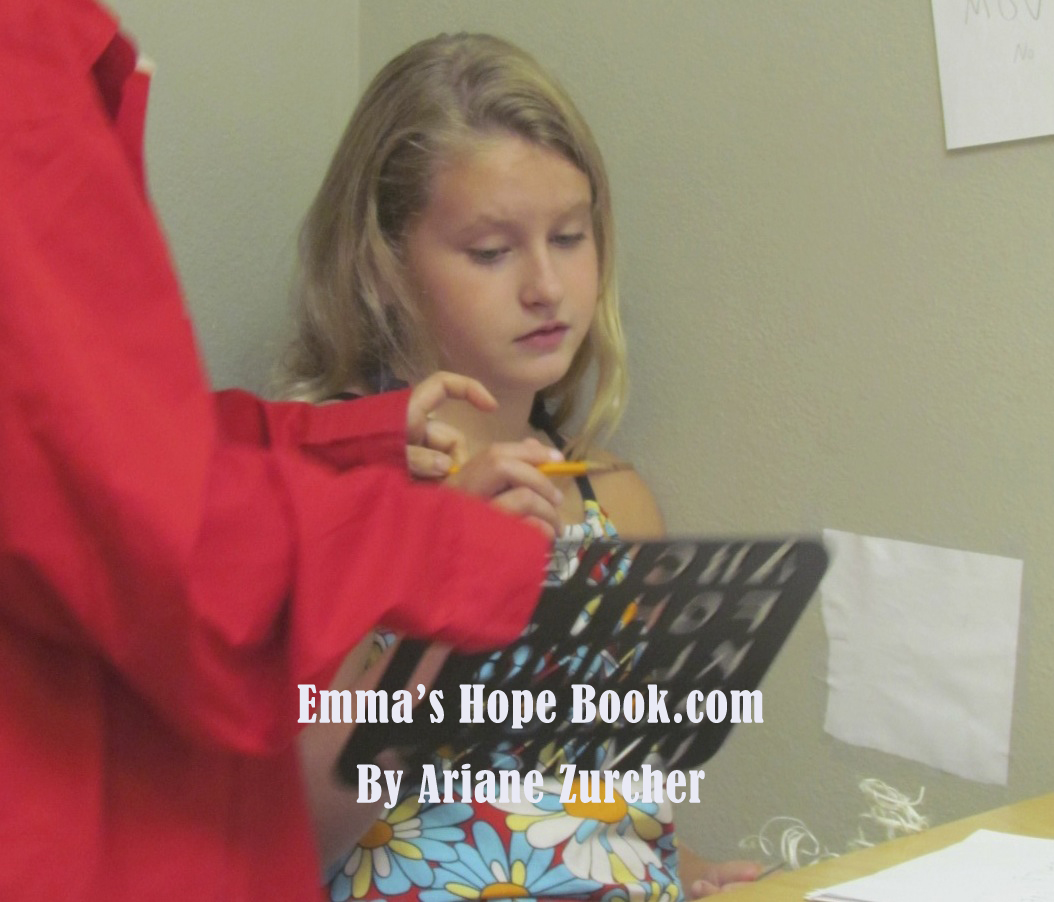
I wrote about Emma’s first session with Soma ‘here‘.  What I didn’t write about was how after Emma pointed to a letter she was encouraged to say the name of the letter, just as her Proloquo2Go program does on her iPad.  She was able to do so without hesitation.  But when Soma put the stencil board down and asked Emma to say the next letter of the word she was writing, without pointing to it first, Emma would, more often than not, say a random letter.  Soma then picked up the stencil board and again without hesitation, Emma pointed to the correct letter and was able to identify it correctly out loud.  After Emma wrote a sentence she was invited to read the sentence aloud, but could not do so.  This is a sentence she’d just written, one letter at a time.  A sentence she’d created, yet was not able to read.  It is not then surprising that Emma is unable to read a random story out loud, even though she is perfectly capable of reading it silently to herself and fully comprehending it.  See related post about reading aloud, ‘here‘.

To see this broken down, to witness this at the level of single letter retrieval and not a whole word even, made it all even clearer to me.   Which isn’t to say that Emma will never be able to do this.  Perhaps at another point, perhaps once she is proficient in writing her thoughts and identifying a letter after pointing to it, one letter at a time, she will then be able to work slowly, patiently and without the anxiety of feeling expectations are being placed on her, perhaps then she will be able to come up with the next letter before she points to it and from there the next word and on it goes until verbal language can catch up to her written.  But for now, it is imperative that every single person who comes into contact with my daughter understand how detrimental it is for her to have these expectations placed on her and then to have the inevitable conclusions drawn about her comprehension and ability.

My daughter is nothing short of brilliant.  I am not saying this as a biased mother who is basing her thoughts on nothing more than some sort of convoluted tip of the hat to genetics, or a round about way of bolstering my own ego and intellect.  I am saying this because I have seen the evidence.  Since her diagnosis, Emma has been treated as though she were intellectually impaired when, in fact, she is intellectually gifted.  This is, I’m sorry to say, something I am hearing from others.  We have a growing population of children and people who are treated as though they are incapable, when in countless cases the opposite is true.  The onus is on us to change our current teaching methods and the therapies we are employing and to open our minds to the idea that we have gone about this all wrong.  This is what must change.

Soma & Em copy

“Be Nice To Each Other”

Be nice to each other” – this was the final sentence Emma wrote to Soma on Friday before we flew back home.  She wrote it in answer to Soma’s question, “Any message to the world?  To mankind?”

Be nice to each other.

We returned home late Friday night.  I was riding on a cloud of excitement, newly found realizations, solid, unequivocal confirmation and proof that not only is Emma completely aware of her surroundings, but she has profoundly wise insights into the world, other people and herself.  She is one brilliant girl.  She has managed to learn despite having almost no formal education, she knows her multiplication tables as though she’d been studying them for years.  She knows how to solve mathematical word problems, she understands things I have only come to understand very recently and her compassion for others is astonishing.  She has been spoken harshly about.  She has heard what others have said about her in front of her as though she could not hear or understand.  She knows what others think of her, and yet, she understands these things are said in ignorance.

So excited was I, that I slept fitfully, and Saturday morning awoke to blinding, crushing, devastating sadness.  I felt the weight, the enormity of my daughter’s life and my role in all that has happened to her these past nine years since she was diagnosed.  My mind latched on to each and every misstep, the mistakes piled up so quickly, one on top of the other I felt I couldn’t breathe.  I spent Saturday in a state of crisis.  I completely broke down.  And the thought that continued to blast in my mind was, “How will I ever find my way out?  How can I forgive myself for what I’ve done?  How does one forgive another who has made the decisions I’ve made?  In essence, how can you forgive what is unforgivable? And yet, she has.  And therefore, so must I.

Be nice to each other.

And here is the thing about all of this.  Berating myself, hating myself, NOT forgiving myself allows me to continue the cycle.  It wears me down, threatens to break me when I need to be strong.  But I also know that when I am overwhelmed with feelings, telling myself that I must not feel the things I am feeling, does not make them go away.  Tamping the feelings down, pretending they do not exist, none of that actually helps me move through them.  Criticizing myself for hating myself does not make me hate any less.  And so I accepted that this was where I was.  And for one day I sat with all those awful, painful feelings and felt them.  Neither pushing them away or adding to them by criticizing myself for having them.  I sat with them one excruciating hour after the next and allowed them to be.  And all the while I repeated Emma’s words, Be nice to each other. And I allowed that to include myself.  By Sunday morning I felt my strength returning.  I felt that old determination returning.  I could feel energy flowing and I knew.  I knew.  As long as Emma gives me permission to, I will tell all who will listen, at least some of what she is writing.

When I asked Emma yesterday if I could write today’s post using her words as the title she nodded her head, yes, and smiled.  Last night before going to sleep she said, “Mommy?  No school tomorrow?  I don’t like new school.”  And so I promised her, I promised I would do everything in my power to help her school understand, but I know I have one hell of a battle before me.  And I need every ounce of strength I’ve got in me.  But maybe, just maybe some of the video clips I have of Emma writing these things will have the power to change even a few minds so that they will be swayed and will come to understand what I have.  Not only is my daughter capable, she has a great deal to teach us, but all of that will be lost if we are not willing to open our minds and listen.  This is the non autistic limitation of our neurology.  This is our neurological deficit and we will have to work mightily to change that.

Emma at Halo – September 26th, 2013

Em iPad copy

The Pitfalls of Reading Out Loud

When Rosemary Crossley was here she spent several hours working with my daughter.  One of the many discoveries we made was that Emma can and does read very quickly, but if asked to read out loud, she will stumble and get so caught up in pronunciation I question whether she is able to comprehend what she’s reading at all.  I know I have trouble following the story.  Yet most schools ask children to read out loud, both as a way to assess what they are capable of, and also to make sure they are at the correct reading level.  If a child reads a first grade reader out loud with great difficulty, the impulse is to make the reading material simpler.  Except that if this is done with my daughter she will be stuck reading kindergarten and beginning level reading books for the foreseeable future.

I know Emma is able to read much more complicated texts than beginning readers.  I know this because I have seen her read with Rosemary and me very quickly.  I have witnessed her ability to read, not only faster than I can, but her ability to accurately answer multiple choice questions related to the text with ease when  given some resistance.  In other words, if she is asked to wait a beat, instead of being allowed to immediately point to an answer, her accuracy goes way up.  Without the pause she is just as likely to randomly pick any answer.  From Rosemary Crossley’s book, Speechless, “The resistance I provided slowed her down very substantially, and the quality of her output increased as her speed fell.  I gave Jan a picture of a cow and asked her to write me a sentence about it.  Instead she typed, THIS TYPING IS HARD.  I HAVE TO THINK.  That was, of course, the aim of the exercise.

This idea of providing resistance is a tricky one to explain to people.  I have had some people say they just cannot understand why this would be necessary.  The only way I know of to better explain, is by comparing it to the way many, who are like my daughter, will perseverate on a word, or will rely on favorite scripts.  It is not that these scripts have no meaning, it is more that they are often difficult for others to understand.  If I hand Emma her iPad and ask her to type me a story, she will most likely write something like, “rollercoaster, kiteflyer, greenride, hurricane harbor, waterslide” which is also in keeping with what she might say out loud.

These words are powerful to her, they hold a great deal of meaning, but to most people, they are seen as gibberish.  If this then is used to assess her capabilities she will not be well served.  However if I ask her to type me a story and then hold one end of a rod while she holds the other end with her typing hand and types with one finger while I pull her hand back after each letter is typed, she might type, ““One day there was a boy called george. He had been in afight can’t tell you how he got into the fight but he was bruised all over.  He fought a lot and his teacher was very angry.  The next day he was all purple and his mother said you can’t go to school looking like that.  The very clever boy covered himself in flower and his teacher thought he was sick and sent him home.  The end.”  

Incidentally, that story is one Emma wrote when Rosemary was here working with her and is typical of the sorts of things she can and does type when given the kind of resistance I’ve described.  (You can read the entire post I wrote about her session with Rosie, ‘here‘.)  However, ask Emma to read out loud a story similar to the one she typed and she will have a great deal of trouble.  What she is capable of is far greater than what one might assume from what she verbalizes, whether that means reading out loud or with spontaneous speech.  Ask Emma to sing the lyrics of a song, in Greek no less, and she will get much of it right, but that’s a whole other post.

But how does one convince others that this is so?  Particularly when many are trained and told that reading out loud is a good indicator of ability.  There is surprisingly little written on the topic of the problems with reading out loud for those who have spoken language and word retrieval issues.  Again, in Rosemary Crossley’s book, Speechless, she writes, “her reading aloud was bedeviled by the same word-finding problems which affected her spontaneous speech, preventing her reading with any fluency.”

Obviously there needs to be more written about all of this.  The closest I have found, other than Rosemary’s book, Speechless, is a blog, The Right Side of Normal,  that concentrates on “right brained children”.  And on that blog, this post specifically, Silent Reading versus Reading Aloud, which deals with, at least some of what I’m discussing here. If others know of other resources discussing any of this, please do leave me links in the comments section.

Rosemarie Crossley

Rosie

A Teacher You Want to Clone

Having had a downright, dreadful experience at our daughter’s ABA based preschool that was publicly funded and had come highly recommended, we were determined not to make the same mistake twice.   We found a private school, the only non-ABA based school around at that time and for the next six years she went to it.  She was loved, she was well taken care of and she learned almost nothing.  It wasn’t that no one tried to teach her, it was that the way she was being taught was not a way she was able to learn.  So we hired a private literacy specialist and over the next two years, Emma learned to read and write.  But there was a “behavioral” piece to this person’s program that came at a cost.  I don’t mean a financial cost, though there was that too, I mean a different sort of cost, the kind you can’t completely assess or gauge until years later.  It was the cost that comes with being put into an emotional strait jacket.  So, at a certain point, as I learned more about autism from Autistic people I realized we could not continue, despite her terrific gains in learning to read, write and type.

A year ago we found a public school (most no longer adhere to any one methodology, thankfully) where Emma is loved and well taken care of AND is learning.  Her teacher is wonderful.  The kind of teacher all parents dream of for their child.  Loving, patient, kind, observant, respectful, presumes competence of all the children in her class, smart, has a sense of humor and open to anything that may prove helpful in teaching.  The sort of teacher who takes time out of a Sunday afternoon to sit in on a session with Soma Mukhopadhyay and Emma and takes notes and then asks to borrow books written by Soma on her method.  The sort of teacher who then comes over to our house to do a strategy session and begins to incorporate what she saw and has learned into her teaching.  Suddenly Em’s backpack is filled with material from a grade level curriculum she is now doing at school with this amazing teacher.  The sort of teacher who seems too good to be true.  The sort of teacher you wish you could clone…  The sort of teacher who is better than Xanax, Wellbutrin and Prozac without any of the side effects.  Except that the school year is almost over and this amazing teacher is leaving to teach somewhere else and Emma is entering middle school, so we must say goodbye to her wonderful school and her incredible teacher.

This morning we toured a middle school.  And guess what?  It emphasizes the performing arts AND it looks wonderful, with a fantastic sensory gym and a “theatre room” with photos lining the hallways of the children performing their own musical that they wrote and performed in.  Could we have created such a place more perfectly suited to Emma?  It could be a little closer to where we live, but that would be nit-picky of me.  So come this September, Emma will go to yet another school.  That’s three different schools in three years.  For any kid, that’s a lot of change.  For Em, who was such a trooper about her “new” school last September, I am keeping my fingers crossed the transition will be as positive.  Anyone have a cloning machine perfected?  Because if her current teacher could just be cloned and her head teacher in this newer new school, I’d have no stress at all!

In the meantime, Em will visit her “new” school a couple of times over the summer months.  From what we’ve seen so far, we are filled with hope!

**Em

Parenting & Presuming Competence

I am reading Anne of Green Gables to Emma.  Three years ago it would not have occurred to me to read her a book that I might have enjoyed at her age.  Three years ago I was “reading” picture books to her before bed.  Three years ago I did not assume she understood the stories in those picture books.  Three years ago I not only did not assume my then eight year old child understood what I read, but I also did not assume she understood 90% of what was being said to her.   Because I did not assume she understood I treated her as though she couldn’t understand.  I treated her as though what I thought was a fact.  Then I learned I was wrong.   Not only did I learn my assumptions were incorrect, I began to see how those assumptions caused me to act and treat her as less capable than she actually was.  I treated her as though she couldn’t and I didn’t see how this attitude was hurting her.  Instead of teaching her to do things for herself, I did them for her.  It was quicker, easier…

I wrote a post not long ago ~ Presume Competence, What does that mean exactly?   People have a tough time with the idea of presuming competence,  let alone putting that idea into action.  I get that.  I did too.  Here was a child, my child, a child we had been told was capable of this, but not of that, a child who was treated by society as much younger than she actually was, a child who, because of her unreliable language did not have conversations with us, did not answer most of our questions, never asked us questions, and so we assumed had little if any interest in such things.  We made the mistake of assuming language retrieval issues were indicative of lack of intent and desire.  We made the mistake of limiting our thinking and therefore limited our child.  We thought we knew, until we didn’t.  We behaved as though what we thought was true and our behavior and actions or inactions fed into that erroneous thinking.

I’ve spoken a great deal about the brilliant documentary by Gerardine Wurzburg, Wretches and Jabberers.  I continue to urge everyone I know to watch it because it is the best illustration I know of, that explains the concept of presuming competence and what can happen as a direct result of doing so.  It is a highly entertaining, moving documentary following two (mostly) non-speaking Autistic men as they travel the world meeting other non-speaking Autistic people who are all far more capable than society believes.  Many are in “life skills” programs or work initiatives doing menial tasks like paper shredding and folding towels.  They type about their mind numbing boredom and brutal frustration they feel as a result of being treated as far less intelligent than they are.

Presuming competence is an act, it isn’t just an idea.  Presuming competence is the single most powerful action we have taken that has directly helped our daughter flourish and grow.  Nothing, absolutely nothing else we’ve done has helped Emma as much as presuming competence.  When we stopped limiting her with our limited beliefs of what she is or isn’t capable of and began giving her the information and materials she needed, she has taken off.  In school she is being taught grade level science, at home she is being taught grade level geography, I am reading age level fiction and nonfiction, she clears her own dishes, cleans them and puts them away.  She sorts her own laundry, helps fold it and knows how to make pancakes without assistance.  She takes a shower on her own, has learned to shampoo her hair and brush it afterwards.  She brushes and flosses her own teeth with minimal support, she dresses herself.  When it is clear she needs help learning to do something, we help her, without admonishment, without distress, but instead with the knowledge that she will eventually learn to do it on her own.

Presuming competence does not mean we expect her to know how to do something without support and instruction, it means we assume she can and will learn with appropriate accommodation.  This is is a very different way of thinking than either assuming she can’t do something and never teaching her, or teaching her, but requiring her to prove her knowledge over and over before moving on.  With reading comprehension we realized we were asking the wrong questions.  Often we were asking her to answer questions that were not obvious to the story.  When she couldn’t answer, we’d dumb down the reading material and then wonder why she wouldn’t pay attention.

In the beginning, presuming competence felt like a leap of faith.  It scared me.  I didn’t want to get my hopes up.  I didn’t want to feel the disappointment that I knew I’d feel if I was wrong.  It felt like a massive disconnect.  But presuming competence is not about my ego, my expectations or anything else involving me.  Presuming competence is about respecting my daughter and respecting her process.  It is about honoring her.  It is about giving her what she needs to flourish.  It is about dispensing with what I think, believe and have been told.  Presuming competence has nothing to do with my fears of success or failure.  Presuming competence is not about me at all.  It is all about my daughter.

Harvey, Tracy, Pascal & Em @ USFEmma takes the stages with Pascal, Tracy Thresher and Harvey

“Splinter Skills” and Other Words We Use

When Em was not yet three years old we received her diagnosis and began the long trek through, what appeared to us at the time to be, the treacherous terrain of autism.  All the things we admired, her various abilities, all those things I had identified as wonderfully “Emma” were now reduced to a single word “autism.”  I remember bragging about the fact that Emma, at the age of 18 months had taught herself how to pump her legs on a big kid’s swing, only to be told after her diagnosis that “kids with autism will often display splinter skills.” When I then commented that my daughter was extremely independent it was said that her autism caused her to shun other children and people, thus reducing her independence to nothing more than, yet another example of, her autism.

After awhile I felt I didn’t know who my daughter was, other than “autistic”.  That word seemed to so thoroughly obscure her in the minds of so many experts and people in the know.  Autism, it seemed, meant lacking and less than and not capable.   Whenever my daughter displayed things that could not be neatly placed in the deficit box, it was tossed into the “splinter skills” box.  It seemed no matter what she did it was viewed as “deficient” even when it wasn’t.  I remember feeling I finally understood what people meant when they talked about their child being imprisoned or all those awful images that abound of children silently, sadly, standing behind impenetrable walls of glass or behind bars of steel,  their small hands gripping the cold metal as they silently watch the world go by.  All of this, the words and images, showing us, telling us what we could and should expect were like seeing train tracks descending into hell.  Who knew it would take me eight years to understand that so many of those impenetrable walls of glass were constructs made by us.

If we did the same thing to those who are born without Autism, if we talked about our non-Autistic neurology as a deficit and identified all the ways in which it would cause us problems and difficulty, would we not despair when our non-autistic child was born as well?  Take your own life as an example and imagine that when you were born you were seen as a great disappointment.  Think about how each time you did something well it was dismissed as a “splinter skill” and was seen as yet another example of all that was “wrong” with you.  Think about what it would do to your self-esteem if your interests and passions were spoken of as “obsessions” or actively undermined and limited because they were seen as “unhealthy”.  It’s a double standard we have.  We non Autistics are praised, admired, given awards and accolades for our passions and obsessive interests.  People describe us as “driven”, “ambitious” or any number of other words used to describe the things that interest us.  But think if instead we were denigrated, ridiculed and scolded.  What does that do to a person?

The way we speak of and about our children, the way we think about their neurology, the way we attempt to “help” them “fit in”, these are the things I hope will change because it is not helping us parent our children, who need our help, it is not helping educators teach our children, who need to be taught, but mostly it is not helping our children be all that they can be.   My husband once said, “People spend all their time and energy trying to teach their Autistic kids to be something they’re not, when they should be spending all their time teaching their kids to be all they can be.”

Emma’s favorite work of art “Railroad Nostalgia” at the Scope Show in NYC.

Train tracks

Why Teach Age Appropriate Topics?

Someone asked me why would I teach my child age appropriate topics such as the American Indians, the arrival of Europeans to America, the Roman Empire and the difference between amphibians and reptiles, when tying her shoes, answering (whether verbally or by typing) a why question and riding a two-wheel bike has yet to be accomplished.

The short answer is – they are not mutually exclusive.  It is not that one thing gets taught and the other is left to languish.  I believe all these things are important for any child to learn; why shouldn’t my child have the opportunity to learn these things too?  But just to play devils advocate, let’s say that the questioner still asks, but why?  To them I say, because knowledge is freedom.   Knowledge gives us context, history provides us with choices, knowing how our government works gives us important information about leadership, honesty and conversely dishonesty.  Learning about geography gives us information about the physical world we inhabit.  Reading Wordsworth or Shakespeare or Susan Sontag, studying a painting by Rubens or Renoir or Basquiat, listening to music by Rachmaninov or  Ray Charles or, my daughter’s personal favorite, Gwen Stefani transports us, encourages us to think both analytically and creatively and enhances our lives.

Ralph Saverese, author of  Reasonable People: A Memoir of Autism and Adoption wrote a wonderful piece about a year ago, The Silver Trumpet of Freedom about his non-speaking, Autistic, son DJ who had just been accepted into Oberlin.  It’s a terrific piece and I encourage all of you to take a few minutes to read it.  I’ll wait.

Right here.

Seriously.

Go.

Read it.  

What many believe to be true about Autism is proving again and again to be incorrect.  What many believe to be true about those who are Autistic AND non-speaking is proving to be incorrect.  Our ideas about someone who has physical challenges AND is Autistic AND does not speak are proving to be incorrect.  Our incorrect beliefs are limiting how that segment of the population is taught and what information they are given access to.

This must change.

To My Daughter…

You are capable.  I am sorry it has taken me so long to fully understand this.  You are smart and able to learn and know so much more than I ever knew.  You understand that sea turtles lay their eggs beneath the sand and then, once hatched, the baby turtles must make the treacherous trek toward the ocean.  An ocean many will never reach.  You understand this.  You understand that turtles live in and out of water.  We did not categorize them yet as reptiles, but we will get to that, possibly tomorrow.

You know Christopher Columbus is said to have reached America in 1492 and that there were people already living here.  You pointed to an illustration of an American Indian and typed that this person was called a Native American.  You showed me where we live on a globe and then suggested we take a boat to England over the Atlantic Ocean so that you might visit an old therapist you still remember and speak of with great fondness.  You became particularly excited by the thought that we would have to stay in a hotel and inquired whether that hotel would have a swimming pool.  I know.  A hotel is not a good hotel without a pool.

You told me an insect has six legs and that a spider has eight legs and even though it kind of seems like a spider should be called an insect, it is not and in fact eats insects which is why all those insects in the Miss Spider book you love so much are scared of Miss Spider and that makes her cry.  You demonstrated your innate acting talents by pretending to cry about Miss Spider’s predicament.  It turns out Miss Spider is a vegetarian and happily eats the flowers offered to her much to the relief of all the fearful insects.  That made you laugh.  Then you remembered how “Bertie kitty” was admonished for getting on the dining room table and eating the flowers and said so, again in a very convincing and stern voice.  You are so talented.  I believed both your pretend tears and your pretend/scolding voice. Thank you for telling me you were pretending because you were very convincing.

You are so, so capable and for so many years I’ve been blind to just how capable you really are.  But maybe, just maybe now I have the tools I need to hear you.  Those tools I thought I was learning to use for you, it turns out are tools I needed for me.  I need them so that I can hear all the things you’ve tried to tell me for so long.

I promise.  I promise to keep listening.

Soma Mukhopadhyay ~ Day 3

It is hard to believe how much information Soma is able to pack into the first three days of a four-day training.  She has managed to cover the different learning channels and how to teach toward each one.  We learned about the various stages of development, left brain/right brain, the difference between an excitatory stim and a calming stim.  The importance of presuming competence, working through self-injury and highly charged emotional situations have all been discussed.  We were taught that social expression and gestures begin in the hypothalamus travels down into the body, then back up to the somatosensory cortex, to the pre-motor cortex and finally to the motor cortex and how at any point along the way, things can become disconnected causing the Autistic person tremendous challenges in behaving as we non-autistics might expect.  We learned about OCD and how to interrupt it by asking the student to spell a relevant word or introduce numbers and/or a math problem as a way of working with it while at the same time diffusing it.

Soma described how to implement a lesson plan around just about any topic, mental mapping and the different stages of rapid prompting method.  We went over methodologies and how to plan a lesson by using flow charts, listing objectives, relevant spelling words and key terms and concepts that need to be introduced, explored and learned.  She taught us the importance of teaching concepts, and the words used, as well as reading comprehension, spelling, grammar and such abstract ideas as time, symbolism, relativity, belief systems and throughout all of this Soma emphasized the importance of teaching age appropriate or above age level materials while filling in the gaps of what isn’t yet learned.

I’m exhausted, exhilarated, but exhausted and there’s still one day to go!  Today, the final day of the training, we are going to cover how to teach math and math goals, how to take and administer a test, how to teach poetry, literature and creative writing and the training will end in a review aka test. Tests have always been my downfall when I was in school.  I become anxious and overly nervous.  When I was in high school I learned to over study and even then I would become easily overwhelmed if I didn’t know the answer to a question and would get so upset that even the questions I could answer would go unanswered because I couldn’t move on from the one I didn’t know.  Writing all of this makes me aware of how similar my daughter is to me in this regard.  She also becomes fixated and upset when she gets an answer wrong.  She too has trouble moving on to the next question or topic, can become dis-regulated and overly anxious.  I will try to incorporate some of the exercises Soma has taught to see if I can interrupt my obsessive thinking if and when it happens.  So much of what Soma teaches could be used for anyone, even me!  I could write a lesson plan around that…

*5