Tag Archives: autistic

Tackling That Troublesome Issue of ABA and Ethics

One of the best arguments against ABA is Michelle Dawson’s article, The Misbehaviour of Behaviourists: Ethical Challenges to the Autism-ABA industry.  If you google Applied Behavioral Analysis you will see glowing reports of its efficacy for more than 30 pages.  I actually stopped at the 30th page only because I didn’t have time to continue.  The first book I read on the subject of Autism was Catherine Maurice’s Let Me Hear Your Voice which details how ABA saved two of her children’s lives from Autism.  (I use this language as it is the language employed by the author.)  Catherine Maurice also likens Autism to cancer and ABA as the necessary chemotherapy.  The whole acceptance model obviously is not employed when thinking in these terms, how could it be?  And perhaps this is the single greatest problem when discussing ABA.   Ethics is not a word one associates with chemotherapy.  Why would it be?  The person considering chemotherapy is doing so because to not do so is to face the very real possibility of death.  When the language around autism becomes synonymous with cancer, one is saying to be Autistic is to have a death sentence.  And while that may seem like hyperbole to many parents and Autistics, it is not so far from the truth when we were informed of our daughter’s autism.

When Emma, then two years old, was given her diagnosis we were told, if we employed 40 hours of ABA a week she would undoubtedly be mainstreamed by Kindergarten.  This was what we were told.  This is what we hoped for.  This is what we chose to believe.  We were also told that a bio-medical approach when coupled with ABA was ideal and so we did that too.  We fought and received 40 hours of ABA a week, took Emma to a homeopath, who through more than a dozen tinctures, did a homeopathic version of chelation (i.e. removed heavy metals from her system).  I also took Emma to a cranial sacral doctor as well as had her on a gluten-free casein free diet.  Despite all of this, when she did not show the sort of monumental leaps promised, the ABA therapists said it was because we were at fault.  Never once did any of the therapists, supervisor or agency waver in their firm belief that ABA was a solid, “scientifically” backed methodology.  It was spoken of as fact.  We were the only variable.  We then did what they advised, we put Emma in an ABA based preschool, continued our own ABA training so we could continue doing it at home, hired an ABA trained therapist to help us implement ABA in the evenings and weekends and again were reassured that she would be mainstreamed by the time she was in Kindergarten.   We didn’t have any alternatives as far as preschools went, so I ignored my gut, my maternal instincts, warning me that this was NOT a method I would ever allow used on my neurotypical son and yet, was allowing to have implemented for my autistic daughter.

After a year, not only had Emma not progressed as the school had hoped, but she was actually regressing and was, what the principal informed us, a “red flag”.  The teacher, obviously aggravated with Emma’s lack of progress even suggested that this was Emma’s fault, that she was “refusing” to comply and expressed her irritation with us.  Emma, at the time was just FOUR years old.  Looking back on those first few years is surreal.  A four year old was being blamed and words like “manipulative” and “misbehaving” were used.  I’m going to interrupt this story to acknowledge, this is one story.  One family’s experience and is an anecdotal tale.  In no way do I believe for a moment that because ABA did not produce the results so many believed it would that our story is somehow scientific fact.  What I will say though is that ABA is, in my opinion, a flawed, at best, methodology and one that we do not, would not ever consider using with our NT son.  Therefore an important question must be asked – Why is that?

Why do we not use ABA for the neurotypical population?  This is where the ethical question must be considered.  This is where the “science” behind the use of ABA begins to fray.  If we really believe Autistic people (and children) deserve the same respect, are truly considered equal as those in the neurotypical population, ABA presents some real problems.   ABA can only really work if we view autism as a deficit and something that must be removed.  Autism is a complex neurological difference that cannot be removed.  I do not believe for a moment that there will ever be a “cure” for Autism.  It was explained to me by a neurologist that Autism is a web of neural pathways branching off and fusing producing new neural pathways, so random, so complex making it impossible to single out any one pathway allowing for a simple removal to produce a non autistic person.

I don’t believe anyone would argue against helping an Autistic person cope with the challenges they face, but the larger question is how do we do that?  Restraining someone who needs to concentrate by flapping is not the answer.  Insisting children sit quietly so they can “attend” and be “table ready” when flapping or twirling a piece of string actually helps them listen and concentrate does not make any logical sense.  Insisting that the non autistic way of communicating is the ONLY way to communicate is limiting and unhelpful to those who cannot express themselves by speaking.  Viewing Autism as a list of deficits that can be corrected through a series of discrete trials will not make an autistic person any less autistic.  Teaching Autistic people how to ‘pass’ so they can blend in better with non autistics is similar to the belief that a closeted gay person will live a happier and more fulfilled life by being closeted than someone who is “out”.

I don’t agree with the basic tenets of ABA because it is a methodology based in looking at those it treats as deficient and inferior.  This is not a model I believe will help Autistics or any of us in the long run.  We, who are not autistic are in a position of power, we are the majority, we are the ones making the rules.  That does not mean the rules we make are correct or even right.  We must be willing to examine what our objective is in using ABA.  Is the objective to make someone blend in better and if so we must ask ourselves why?  Before ABA is considered, ask yourself, is this a treatment you would employ for your neurotypical child?  What message are we sending our Autistic children?  What will this message do to their self-image?  What message will be internalized, a message they will carry with them well into adulthood?  Will this message serve them, make them feel good about themselves, help them lead happy, fulfilled lives.  After all isn’t that what ALL parents want for our children?

*I urge any who are reading this to read what autistic people are saying about ABA.  Ido Kedar, a non speaking Autistic teenager has written a book, Ido in Autismland where he criticizes ABA and describes why.  Any of you who are ABA therapists, it is incumbent upon you to read his book.  He is one of a number of Autistic people who are speaking out about ABA.

Other posts dealing with ABA:

Non-Speaking With A Lot to Say
Trauma & Autism
ABA

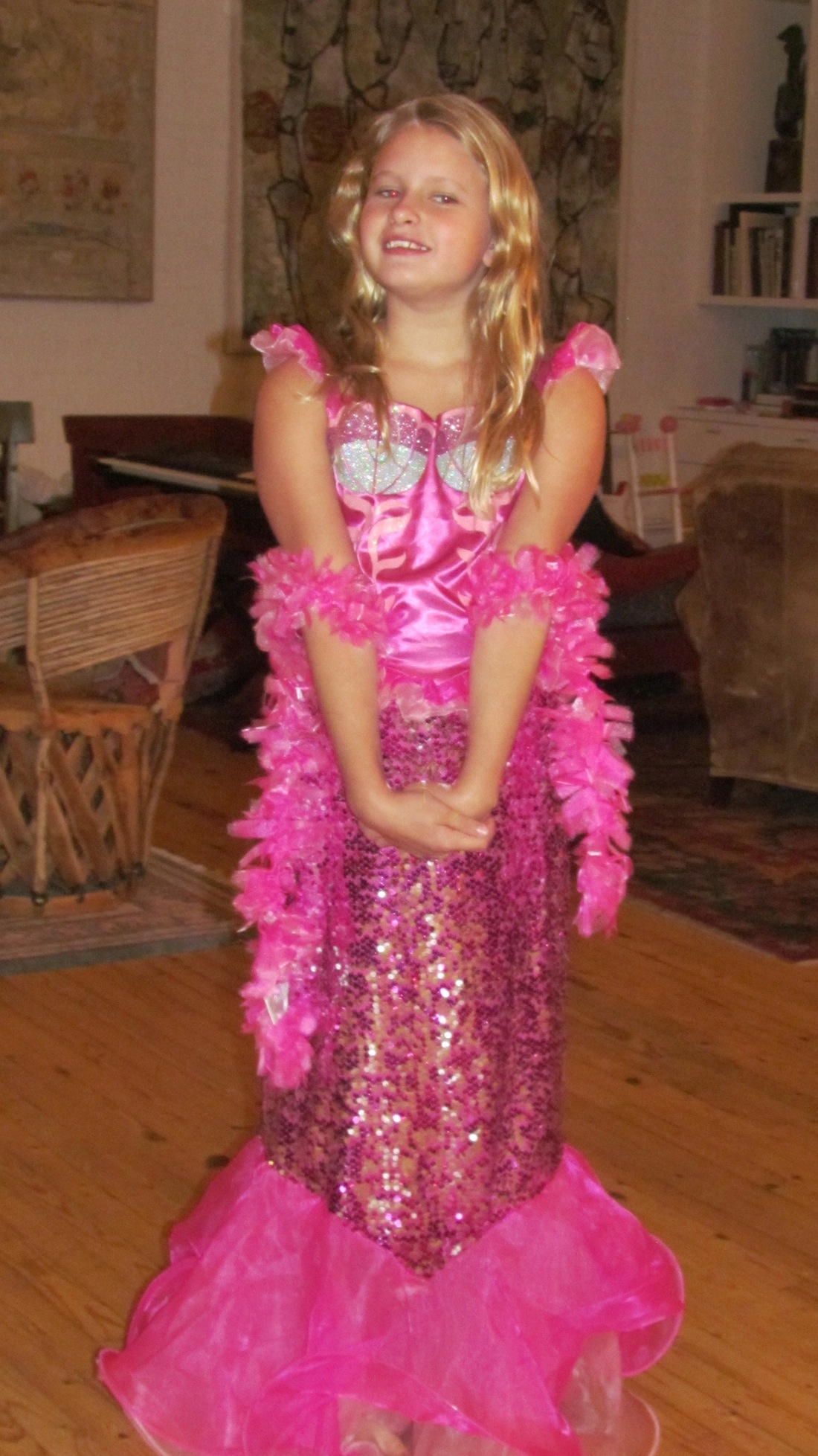
Emma as mermaid!

AutCom 2012 Conference – The Best Kept Secret

The Autcom conference was a fleeting glimpse into paradise.  A tiny taste of how the world could be were we accepting of each other, treated all people as equals and with respect, without prejudice, without assumptions, without bias.  Autcom was a window into how the world could be, but isn’t.  Not yet.  Words do not do this conference justice.  How could they?  How do you describe a room full of people who are connected not through race, nationality, religion, political views or neurology, but instead are connected by an idea.  A vision.  How do you describe that?

Accommodation – it’s a word we hear, but what does it really mean?  At the Autcom conference it meant waving hands at the end of a presentation instead of clapping, lowered lights, snacks that included gluten-free and casein free items and non dairy alternatives.  Accommodation meant no one stared disapprovingly at anyone who stimmed or made noise or got up to leave in the middle of a talk.  Accommodation meant people were polite and moved chairs that might be blocking someone’s ability to come or go.  It meant using a microphone or repeating a question for those who weren’t able to hear the first time.  It meant being respectful and considerate when someone came up to peer at your name tag and it meant understanding that when that person gently touched your hand after a presentation it was their way of thanking you and I defy anyone to not see the beauty and love in that.  Accommodation meant slowing down while someone typed their answer or question or thought.  It turns out accommodation means being a thoughtful, considerate human being who is respectful of others.  How is it this isn’t done automatically, as a matter of course.  How is it that we as a society have drifted so far from this very basic and easy way of being in the world?

The single biggest issue I had with this wonderful conference was that there were too many terrific things going on at once and it was impossible to see and hear everyone and everything.  To give you an example of this – on the first day of the conference after Ari Ne’eman’s welcome and an opening keynote address by Jennifer Paige Seybert, was Savannah Nicole Logsdon-Breakstone’s presentation – Loud Hands Project’s Neurodiversity 101.  At the same time, Larry Bissonnette, Pascal Cheng, Harvey Lavoy and Tracy Thresher were doing a presentation on Supported Typing, which I really needed to go to in order to assess whether this might be something we could use to help Em communicate more effectively, but next door to them was Nick Pentzell, Hope Block, Jacob Pratt and Autumn Dae Miller presenting “Rated “R”: That Oh-So-Difficult Topic”.  I cannot tell you how much I wanted to hear them too and later heard from others that it was a not to be missed presentation, sadly though, I missed it.  Human Development Journey was presented by Cecilia Breinbauer about using DIR, which was the method Richard and I were trained in by the late Stanley Greenspan, after abandoning ABA.

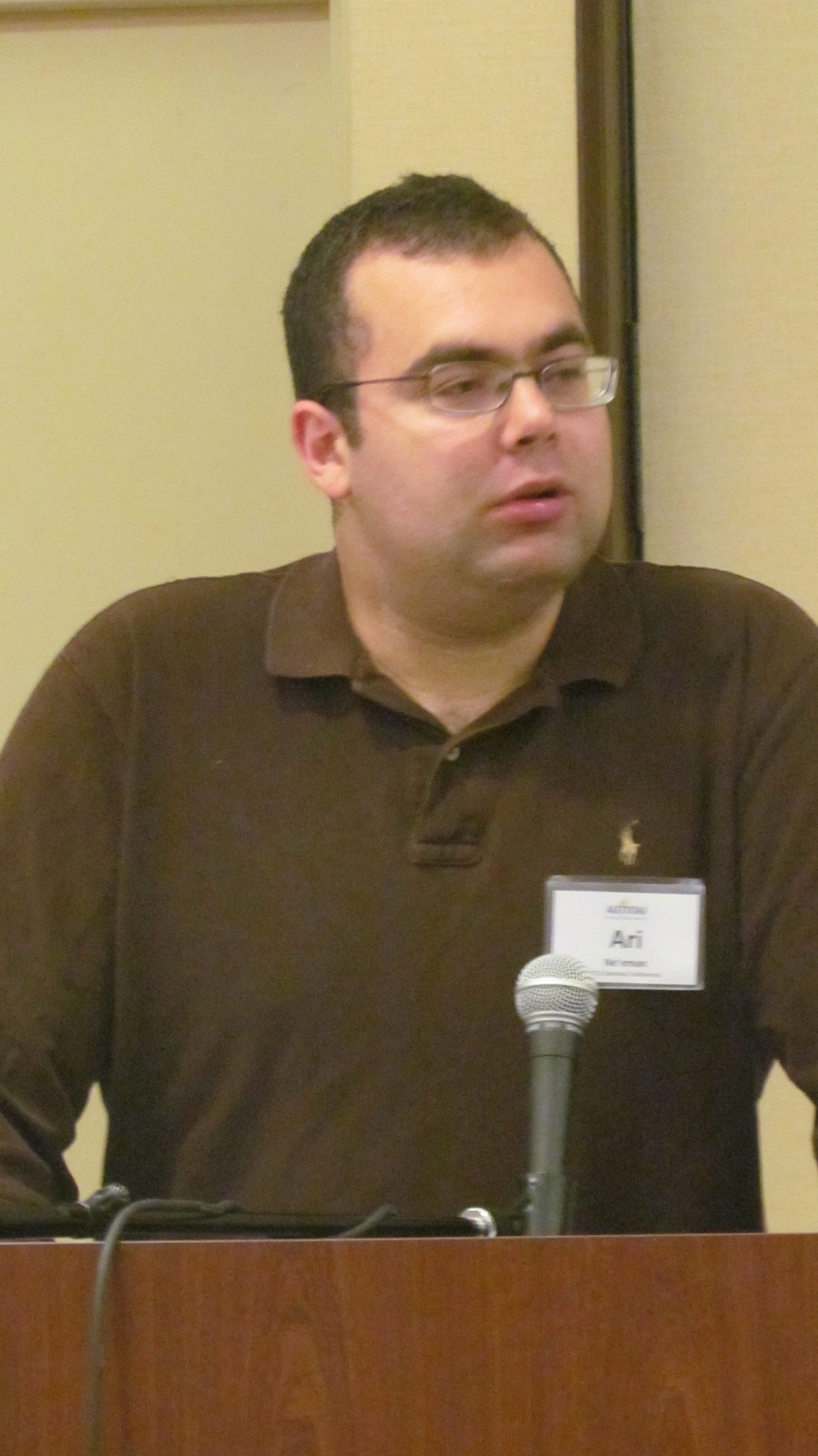
Ari Ne’eman

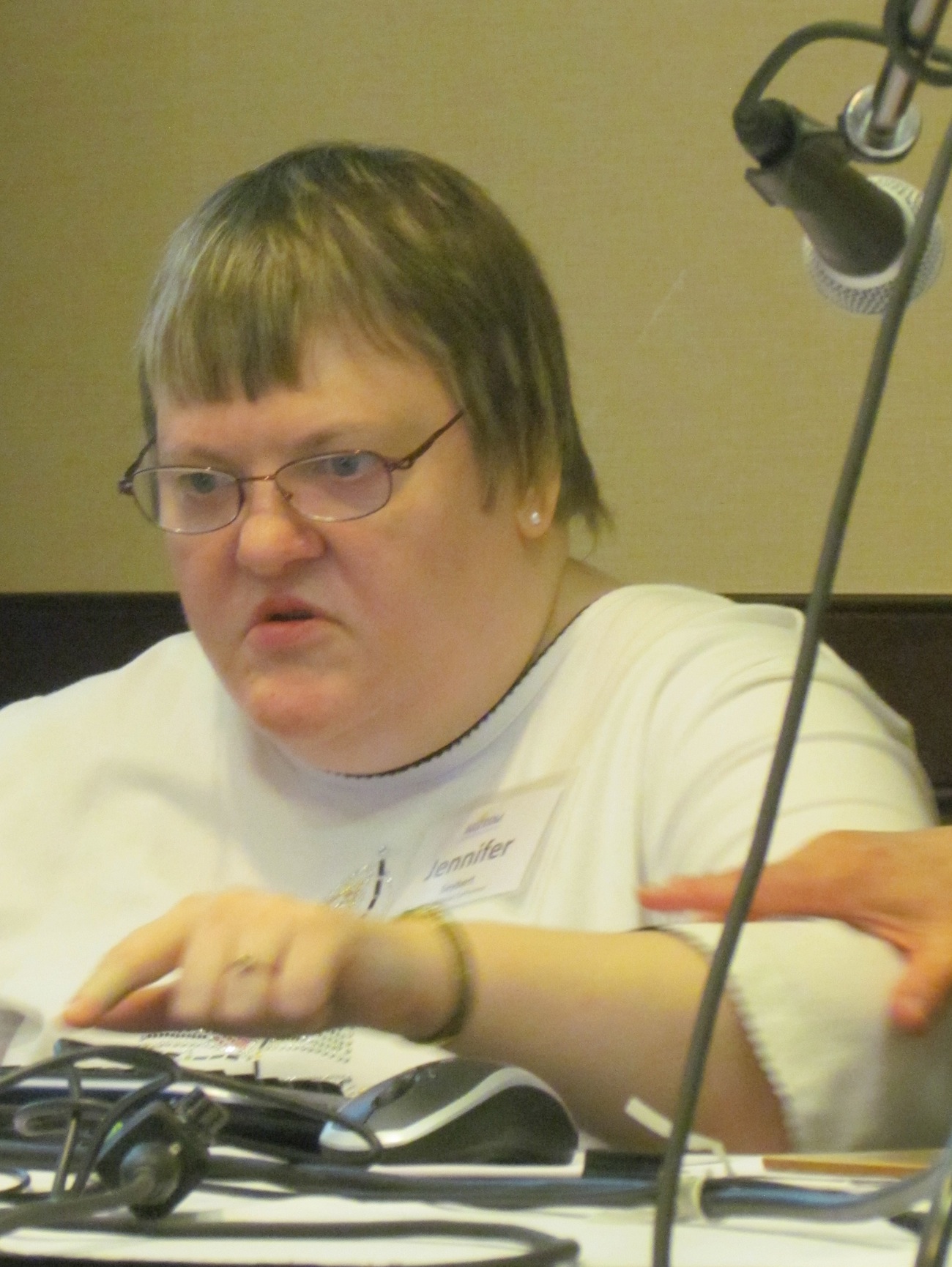
Jennifer Paige Seybert

That evening after dinner and a wonderful performance by Jordon Ackerson who reminded me of Emma because of his beautiful voice, we watched Wretches and Jabberers, with a Q&A with Larry and Tracy.  This was my third time watching this documentary, which I posted about last month ‘here‘.   I asked them about self-injurious behaviors, something both engage in during the film.  I asked for  their opinion about the commonly held belief by many that SIBs should be thwarted and how parents and caregivers are often unsure how to deal with this.  Tracy typed, “That was years of frustration with no way to reliably express myself working its way out through my behavior the problem was lack of communication which pissed me off.”  Larry typed, “I lived in an institution so I was locked in arms of restraint its legal but immoral and only represses anger nothing looks more kind than softly spoken words and lit up smiles.”

Jordan Ackerson

Tracy Thresher

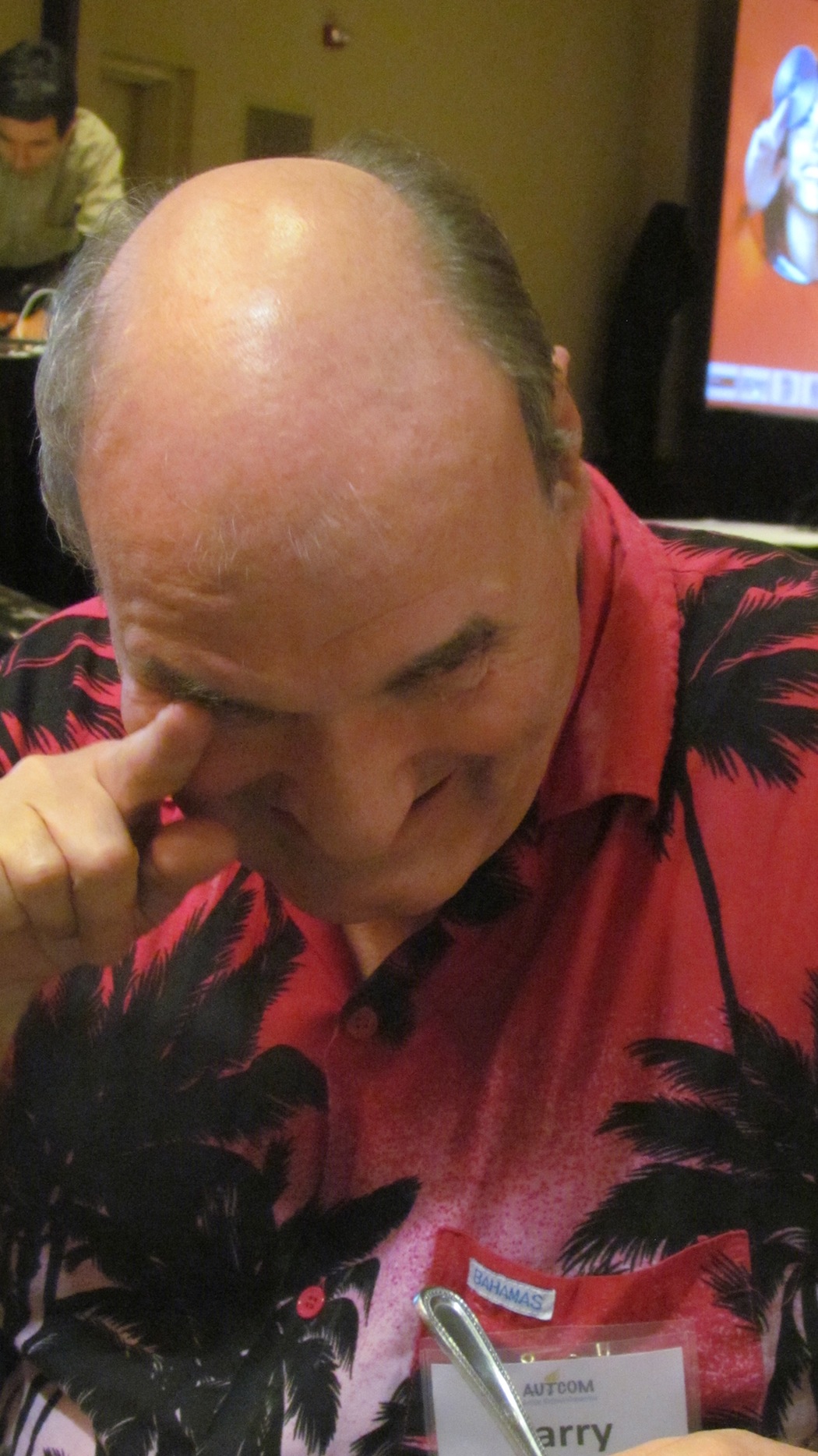
Larry Bissonnette

Read that again.  “… nothing looks more kind than softly spoken words and lit up smiles.”  The presentations were terrific, but it was what is possible that this conference represented, which affected me most profoundly. The AutCom conference was an example all organizations, who say they are interested in Autism and helping those who are Autistic, should follow.  Autistic people make up a large portion of their board, Autistic people led more than 50% of the presentations, the audience was at least half Autistic, if not more.  At my presentation there were more Autistic people than not, for which I was truly honored by.  The conference showed what the world could be like if we work together, reach out to each other, include everyone despite our perceived differences with love, compassion and kindness.  Accommodation is less about accommodating and more about getting in touch with our humanity and what it means to be alive and sharing this planet together.  Accommodation and inclusion means we ALL benefit.

How My Fears Drove Me To Pursue a Cure

A year ago if you’d asked me what my single greatest fear was, I would have told you it was what would happen to my daughter when my husband and I both died.  This fear was so worrisome, so looming that I often stayed up at night worrying.  Well meaning people would reassure me that “things will work out, they always do” or “group homes aren’t so bad, many are run by loving, caring people”, but none of this gave me solace.  My fear was the driving force behind my desperate pursuit of various medical interventions and treatments for my daughter.  This fear, more than any other was what drove me to search for a “cure”.  When I thought of my daughter’s future I saw one of those dark, formidable, gothic institutions, now used as set locations for horror movies.  Once my mind had latched on to that visual image my fear became so overwhelming, my throat so constricted, my body so awash in terror I would literally shut down, like an overloaded circuit.  Fade to black.

So what changed?  I began to read things like this –

Amy Sequenzia, a non-speaking, writer, poet, Autistic self-advocate from her poem Feeling Good:

“Feel the warmth of another soul                                                                                                   Ban the thoughts that block the light                                                                                           Refuse to hear what hurts, listen to the                                                                                    cry for help behind it

Well-being, feelings of unity                                                                                                             We are all the same”

Julia Bascom from her blog Just Stimming, her post Quiet Hands:

“1. When I was a little girl, they held my hands down in tacky glue while I cried.

5. When I was a little girl, I was autistic.  And when you’re autistic, it’s not abuse.  It’s therapy.”

Again from Julia, her post, The Obsessive Joy of Autism:

“If I could change three things about how the world sees autism, they would be these. That the world would see that we feel joy—sometimes a joy so intense and private and all-encompassing that it eclipses anything the world might feel. That the world would stop punishing us for our joy, stop grabbing flapping hands and eliminating interests that are not “age-appropriate”, stop shaming and gas-lighting us into believing that we are never, and can never be, happy. And that our joy would be valued in and of itself, seen as a necessary and beautiful part of our disability, pursued, and shared.”

The Third Glance, Words and Growing up Autistic: On Nature, Nurture and Abuse where she ends with this:

“But I’m not invisible anymore. I’m here, and I’m me, quirks, obsessions, passions, stims and everything else that makes me unique. Look out world, here I come.”

There were so many others, so many voices out there, somehow reading these blogs calmed my fears enough that I was able to begin dissecting them.  I was able to pause, even for a moment, allowing me to ask, what is this?  What is this fear really?  And although my immediate answer was that these were fears based in very real, logical assumptions, I was able to see that they were just that – assumptions.  They were still not reality.  Not yet.  I was also able to realize those fears were causing me to act in irrational ways.  My thought that the fear was a healthy, natural response to what I believed to be the reality of the situation, prompting me to pursue all kinds of risky, unproven and untested “treatments” for my daughter’s autism was taking all of us down a dark, dark path.  That fear caused me to behave differently toward her, but I couldn’t see that until I’d stopped and saw how my behavior toward her changed.  When I was able to stop, just for a moment and examine the fear, the fear began to fall apart.

My fears were based in things I assumed were the inevitable consequence of what I believed my daughter was or wasn’t capable of.  But this was not based in fact, I don’t have the ability to see inside my child’s mind.  In addition my fears were clouding all the things she was doing that I ignored or couldn’t see or hear.  Every single day, my daughter displays her vast intelligence.  When I read the writings of Autistic people occupying every point on the so-called spectrum, I began to see that my assumptions, what I had assumed I knew and believed were not based in anything other than that.  It was at that point that I realized I had a choice.  I could choose to believe in her incompetence and the inevitable outcome this perceived incompetence would take us or I could choose to believe her competent, making that looming horror no longer a given.

As I wrote recently in a comment to someone,  I chose the latter because to do otherwise and be wrong would be far, far worse.  This is something I cannot risk or would be able to forgive myself for.  But there’s another piece to this that is also important, and that is when we assume great things are possible, great things tend to happen.  It’s human nature to strive for independence, to communicate, to connect, ALL humans want this. Given a little encouragement we can do things we never imagined possible, but given nothing or criticism we wilt, become sad and angry.  My belief in my daughter will not change the very real challenges she faces, but it does and will help her far more than if I do not.

I’m off to the AutCom conference!

Parental Bullying and Autism

I have kept the specific blog, post and commenter who I refer to in this piece anonymous because my point is not about any particular person, but about a larger issue.  But first, a little background…   I was alerted to some negative comments left on a friend’s blog.  She had written a post about learning to accept her Autistic child.  It was a beautifully written, honest and loving post detailing what things had helped her find her way to acceptance and how that journey had changed her and her relationship to her child.  The path she describes was similar to my own, except mine took much longer and was more circuitous, but I could completely relate to her process.  It was my journey, only on speed.

I went to the blog to read the comments and read this:  “”You accepted autism, I fought it.”  I stopped breathing.  I felt as though someone had taken a 2 X 4 and rammed me in the solar plexus.  I became aware of the fluttering in my stomach with the simultaneous sensation of dizziness in my head, starting just behind my eyes and then a prickly feeling at the back of my skull.  I could feel my heart pounding.  I swallowed.  I read on.  The words are no longer important.  She  related how she had “recovered” her child as though it were scientific fact and then said that her thinking would one day be common knowledge and any other view would be considered “archaic.”

I had to stop reading.  I stood up.  I left the room, walked around, drank some water and came back.  I could feel tears welling up.  I swallowed again.  I was aware that my hands trembled as I read “Seems to me a thinking person would keep an open mind and once you accept autism…there is no more thinking that occurs…just the acceptance.”  I couldn’t work out what that meant as there was no logic that I could get a firm handle on, but the feeling those words evoked was one of failure and shame.  I had to make a conscious effort to take a deep breath.  I felt the sting of her words, like a knife cutting me open.  I sat there and read the other comments and another from her, reiterating her stance, her position.  Her story, no longer a personal tale, but one given forth as though evidence in a court of law.  And her love shining through it all, triumphant, jeering, condemning.  Her actions and the outcome of her actions worn like a medal of honor, the purple heart of parenting, pinned to her chest, evidence of her supremacy.

I could no longer hold back my tears.  My tears, physical expressions of my inadequacies.  As I cried, as the tears ran down my cheeks, dripping off my chin on to my shirt, I closed my eyes and felt all those feelings of pain, of sadness, of shame that had nothing to do with autism, but are feelings I carry around, despite how hard I try to get beyond them, feelings I have had my entire adult life, long before I became a mother.  Those feelings of not being good enough, not being worthy, not being pulled together, not having all the answers.  Those feelings of being “less than” all of them came bubbling to the surface.  Those biting words from that commenter cut through the fragile dam I so carefully constructed for myself.

“You accepted… I fought…”

I am better than you.  My love is stronger, better… I love my child more than you do.

This is bullying.  Words used to personally attack or intimidate another person.  It makes us think we are not as good as someone else.  For me, her words took me back to all those years when I believed all those parents who spoke with assurance, with superiority, without doubt about something that could not be proven or even replicated, stories that are not based in any science, but are “one offs”.  All those false hopes I had and mistook for the real thing.  False promises that lead me down a path of tremendous pain, ultimately harming my daughter far more than helping her.  The biggest strides I’ve made that have positively impacted my daughter are when I was able to completely accept every aspect of Emma and put down the whip beating me to change her neurology.   This is not to say we do not do everything in our power to help her learn, teach her to care for herself and try to give her tools she can use to flourish.

Richard said to me the other day, “Parents are spending all this time and energy trying to teach their kids to be normal, when they should be teaching their kids how to be themselves.”

My husband is brilliant.

Emma – September, 2012

An Ode To Ibby And Her Tiny Grace Notes

My friend Ibby has started her own shiny, new, fabulous blog, called Tiny Grace Notes (AKA Ask An Autistic!  *Doing a little snoopy dance*

This is how Ibby describes her blog:  “The purpose of this blog is specifically so people can ask me things that may not come up on other blogs, which I completely recommend reading.  But let’s say you have a burning desire for the answer to a question that nobody blogs about that week?  Come here and ask it in the comments.  You can do that right now.  I might answer myself, and I might also remember that my friend told me about it a couple months ago, so I could answer from multiple viewpoints in conversation.  Also, I may be able to give you a study about it that isn’t insulting and eugenic and horrible.”

This is how Ibby describes herself:  “I’m an Autistic member of the Community and an education professor…”

Ib is an educator.  She teaches educators.  Not only that, but Ibby is patient, incredibly kind, nonjudgmental and one of the funniest people I’ve ever met.  Seriously.  (I love saying that after saying someone’s funny…)  I know Ibby’s blog will soon have more questions than she’ll have time to give, so I’ve already elbowed my way in there and asked her a question in the comments section!  If you want to ask her something go over there NOW and get in line, because I have a feeling that line is going to get pretty long, pretty quickly!

Just to backtrack a little…  Most of you have heard me talk about Ibby.  We met at a Disability Conference here in New York City where she was presenting last spring.  I wrote about meeting her ‘here‘.  It was one of those magical moments when you meet someone and you just know instantly, you just know there’s an immediate bond, an indescribable feeling of closeness that defies explanation.  That’s what it was like for me when I met Ib.  She flapped, I allowed myself to do a tiny little, tentative bounce on my toes, nothing that would call attention, (I was new to the sensation, had not allowed myself to engage in such behavior since I was a kid, but it felt GREAT!) and we hugged.

After that first meeting we kept in touch.  In fact, we began “talking” aka IMing each other once or twice a week and then we began talking several times a week.  We talked about autism, I asked her if I could ask for advice about Emma and she graciously not only agreed, but patiently explained and re-explained things I found difficult to understand.  Over time we began talking about ourselves more.  I began to talk candidly with Ibby about my guilt over the things  I’d done, the various therapies, the remedies and Ib told me more about her life.  This was a post I wrote after one of our epic conversations.  (I hadn’t asked Ib if it was okay to use her name at that point, so I didn’t.)  We found we had similar senses of humor, we went off on whole riffs together, and I laughed.  I laughed with Ib as I hadn’t laughed in a very long time.  As our friendship grew, so did my hope.  Now, if too many days go by and I haven’t been in touch with Ib I feel a little off, a little melancholy.

All of this is to say, Ibby is rare.  She’s brilliant and really, really smart, which aren’t the same thing.  You can be brilliant, but not very wise.  Ib is both.  So go over to her blog and ask her some questions, because honestly, I can’t think of a better person to go to.

Totally unrelated photo taken by Richard of Em at MOMA

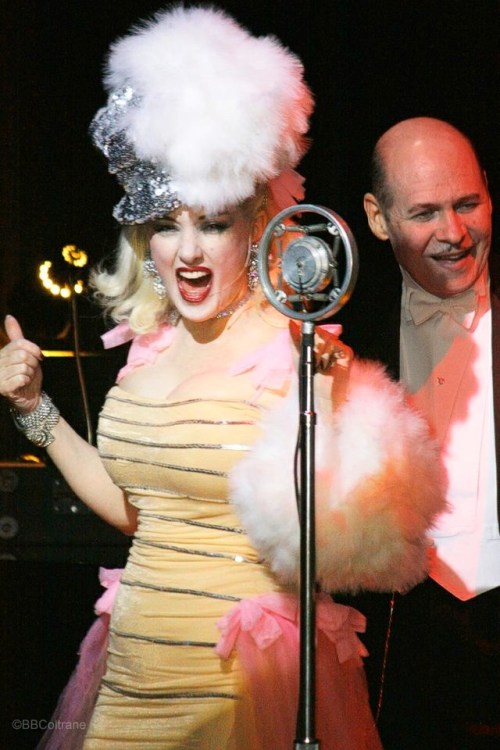
Performer, Singer, Mother, Wife, Friend & Autistic – An Interview With Chou Chou

I met Chou Chou last spring when she left a comment on this blog.  She wrote, “I love your writing, and find your darling Emma startlingly like me as a child.  I am a happy, successful, 58 year old autistic woman.  I just wanted to say you and your husband are wonderful parents, and Emma will be fine. She will be wonderful. She is wonderful.” 

 I read her comment a dozen times. I felt indescribable joy and I wept.  I was just beginning to read the writings of Autistic adults and had started, very tentatively, to reach out to a few of them.  Then out of nowhere there was Chou Chou reaching out to me!  I was so excited!  I doubt she could know how much her kind words of encouragement meant to me.  We’ve been in touch ever since.

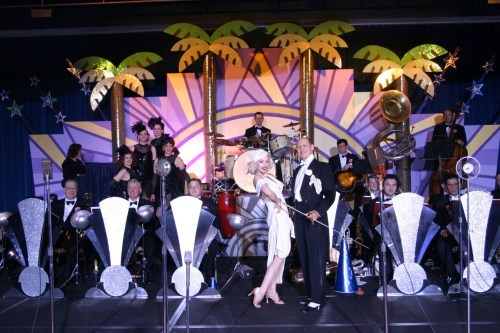
Chou Chou performing with Doc Scantlin and His Imperial Orchestra
 Tell me about you as a child? 

Boy! Where does one start? I was a very passive baby, and did not react to people, or reach for toys. My mother said I appeared content and able enough, but it was as if she would lose me if she wasn’t careful, as if I would slip away into my own world, forever. Baths seemed to perk me up, so I was given five baths a day, and then played with after baths. My toys were put on strings, so I could look at them, since I wouldn’t play. I would cry for hours, but could also be in total bliss. I was very late talking, almost five, except a few words, and had trouble throughout my youth speaking. I was a toe walker, head banger, and would bite myself. I had a faulty immune system, and was sick constantly. Ear aches, flu, tonsillitis, all the respiratory stuff. My gut was a mess. All one has to do is read your posts on Emma, and that describes what I went through. I did not play with other children, although I would play beside them. I was hypersensitive, and needed much time alone to recharge. I loved nature, art, swimming, especially underwater, and performing. Performing was just like plugging me into an electric socket! I would come alive! My mother realized she could make me connect better by giving me a character to play, and a small script. It has served me well.

When were you diagnosed?

Age three. My mother was the business administrator of a small, prestigious rehabilitative home, named Idylease, in northern New Jersey and the doctor in charge became our family doctor. This was the mid fifties, and he very cutting edge, because of his position at the home. He diagnosed me, much to my mother’s horror and shame. At the time, autism was considered caused by cold mothering, and children were often institutionalized, to protect them from their bad mothers. My mother hid the diagnosis, and began a masterful strategy, that not only got me through school, but made me grow into a competent, happy (if a bit odd) woman. She was a brilliant, wonderful mother.

The word autism was never used. I was called slow, or special, or a late bloomer. It was not until the late 90’s that I was told of this early diagnosis, which was confirmed by my doctor.

Can you talk a bit more about your mothers horror and shame?  Did she believe her parenting caused your Autism?

She did until the day she died. We would have long talks about it, and I would explain, over and over, what a wonderful mother she was, and all the ways she helped me, and I sometimes thought she would “get it”, but she never did. She was a career woman, in an age when that was controversial enough, and had many symptoms of what I now recognize as Aspergers, although she was never diagnosed. She was a mathematical, logical, brilliant, woman, who was loving, but not often in an emotional way, nor was she social. Unfortunately, she interpreted that as her being the “cold mother” that was considered the cause of a child being autistic. This made sense to her, and I was never able to sway her completely, and have her forgive herself for this false accusation. I know she hid my diagnosis for her own sake, as much as mine. She feared the world would see how terrible she was. So, so sad. I adored her, and she did so much right!

How did the diagnosis affect you?

 It did not effect me as much as those around me, once I opened up about it. Yes, it was nice to pinpoint what I was dealing with and to put a stop to years of misdiagnosis, but I already knew who I was, and, like most autist adults, had created a multitude of strategy for getting by in life. The biggest thing was that I could be honest: about why I wouldn’t come to a party, why I had trouble following a conversation, why I would stop mid sentence sometimes, or covered my ears, or twisted my fingers, or had a peculiar way of speaking. It was obvious I was under much stress, and that made people uncomfortable, and made them think I didn’t like them much, I think. Now, I simple speak up when I need to, and politely explain my challenges. Everyone relaxes, and tend to be helpful and kind. Sometimes, it makes people talk to me as if I am a child, but I can quickly nip that in the bud! I often say that what I am dealing with is neurological, not psychological. Don’t get me wrong, I’m as neurotic as anyone else, but my neurological makeup is far different from the vast majority of people. I am no better or worst than any one of the unique people roaming this planet. However, I am, it appears, of a certain somewhat predictable, if varied, ilk. I am an autist, and a happy one, and am coming to realize that there may be others rather like me, younger ones, who could benefit a bit from my becoming part of the conversation. After a lifetime of hiding my differentness, this does not come easy, but I believe there is a responsibility that is mine to accept.

I am an autistic woman. Other than that, I am perfectly normal. Aren’t we all a little strange?

What do you remember of school?  Did you go to a nursery school? 

No. Since nursery and kindergarten were mostly playing, which was hard for me, my mother kept me home until first grade. This was the peak years of the baby boom, and the schools were very, very crowded. I went to parochial school, along with my older sister, brother, and, eventually, my younger sister. I think it is hard for anyone to imagine how overwhelmed the schools were by the boom. There were 72 children in my first grade classroom alone, and there were three first grade classes. It was easy to get lost in the shuffle. School was a horrible, overwhelming blur, and I mostly sat quietly and obey the rules. I am very big on rules! I was always the “slowest” child, never finishing tests, had difficulty speaking, and was pinching and biting myself. During recess, I did not play with others. I would find some detail to focus on, like an ant, or the links in the fence. I had great anxiety and fear at school. Sometimes I wasn’t able to contain it, and I would cry inconsolably. I would be sent to the nurses office, and cry it out, or be sent home. Throughout school, my mother would watch for signs that I was getting overwhelmed, and keep me home, so I could be quiet and recharge. It was easy for her to make excuses, since I was sickly anyway. Usually she would write a note saying I had a gastrointestinal virus. I missed a lot of days at school, either really ill, or with these fictitious viruses.

Were you treated differently?   

Yes. There were no special education classes, but there were groups within the class. I was in the slow group, and given special reading skill projects and tasks. This confused me, because I was a voracious reader at home, beyond my age level. I just couldn’t communicate it, so they thought I couldn’t read. I was protected. My big sister or brother knew they needed to have me tag along, so I didn’t get lost or hurt. It was not considered safe for me to be alone, unless I was in our home or yard. We all just accepted that. I was in my own world, and wouldn’t watch for signs of danger. I was never punished, like the other children, as it would totally destroy me, and I would harm myself. Sometimes my brother and sisters resented that. They would be punished, but my errors would be quietly explained to me. That was all that was necessary. I loved to know the rules.

Did people talk about you in front of you? 

Constantly. I didn’t mind, because, it was easier to listen to the conversation than converse myself. Sometimes, of course, it was frustrating to not be able to express myself. I remember hating cooked carrots. When they were on my dinner plate, I would force myself to eat them first, so they wouldn’t “contaminate” the rest of my meal. My father thought it meant I loved them, and would pile on more. I would burst into tears, wondering why he was torturing me with carrots. Poor guy.

There were, and still are, many times I have difficulty following a conversation. Particularly “small talk”. When I listened to other children, it made no sense to me, but I never felt it was because I was less intelligent. Their bickering and constant competition sounded unintelligent to me. My interests were quiet, and beautiful, to me. Their playing was constant battle.

Do you remember any particular instances when you felt people or other children didnt understand you?

It was a great conspiracy of mine, along with my mother, that I was intelligent, and even talented, but was considered so deficient. I felt that my world, the one I played in alone, was beautiful, and that the other children struggled in meanness and chaos. I did not feel less than them. Because I was quiet and never mean, and most of the neighborhood kids went to our Catholic school, it was decided I was somehow blessed, that I would grow up and be a saint. Perhaps my mother started that rumor. She was awfully clever at protecting me. It kept them from picking on me, as it would be unheard of to harm this holy creature. I was left alone, but guided and protected, and even included. They always tried to involve me in games, but I didn’t do well with them. They were illogical. Sometimes they would invent special roles, so I would be included. If they were playing “war”, they would put me on top of the swing set, like a princess needing rescue, and I would cry, ” Help, save me” over and over, while they wrestled and battled. I would also have some terrible hours of crying, but these I don’t remember well at all, and always forgot they even happened once I recovered. They were not discussed.

Did you have other sensory issues that you were aware of? 

My sensory challenges, without a doubt, were and are, the major issue for me to contend with. I now speak, write, and socialize well, but I experience the world in a much different way, sensorily, than is in the average range. I understand this now, and have devised many way of protecting myself, but I did not understand this when I was younger. I thought everyone experienced life the way I did, but that I was some kind of weak character because I “couldn’t take it”. Sights, sound, smells, emotions, all were overwhelming. My clothes scratched, and I thought digestion, and sometimes even breathing, was a painful process for everyone. I had a headache all my life that I didn’t even know I had, until I had some pain medication as an adult that made it go away. I would bang my head, and had to bounce and rock to fall asleep. I would cry on trips home from anywhere, because being out was overwhelming. I hurt, and the stimulation of the world hurt me. Why was everyone acting just fine? I would pray, and ask for forgiveness, since I somewhat bought the story that I was holy. Wasn’t I supposed to suffer as a saint? Surely, I would die young, after much torture!

Were you able to read and write at the same age as your peers? 

I loved reading, and don’t remember ever not reading, but had great trouble writing, and could not read aloud. There were a lot of monthly magazines in our house, and encyclopedias. I poured through them, and my mother got a subscription for me to a book of the month club. I liked learning a lot, and self education. In school, though, no one knew I could do this, and I lived my role of being a remedial student. The only difference was if I was given something to memorize and perform or recite. It was like a magical trick. I would come alive, so much so, that often I would be taken from class to class, to do my performance over and over, to much applause.

I come from a very intelligent family. My mother was a mathematical genius, and member of Mensa. My brother had a photographic memory, but had a head injury, and was kept back a year in school. From then on, we were in the same grade, but he was considered the smartest kid in class, and I was the slowest. In eight grade, we were given IQ tests, for placement in the high school’s track system. Test was easy, because it involved little writing, and was logical, and solving puzzles, which I was really good at. The  answers were not written, if I remember right. They were just filling in the dots, or one word. I scored the highest in the whole eight grade, even higher than my brother. It was decided I was a bored, shy genius, and I was put in track one, with the brightest students, taking advanced courses in math, Latin, and biology. That was a big mistake. I couldn’t keep up at all! I was “demoted” to track three, out of seven, where the bright, average, most popular student mostly were, and was a terrible student. My brother was made class president, and all the girls wanted to date him, so they were VERY nice to me. I got pretty, so the boys started being VERY nice to me, too, although my big brother kept vigilant guard on the advances of those New Jersey boys.

Was there anything or anyone in particular that helped you when you were young?

Without a doubt, my mother. She always believed in me, and told me I could do anything I set my mind to. When I was sick or struggled, she never for a moment treated me like I was damaged goods in any way. She would treat me with astounding respect for how I tried, and told me I was “tough as a turtle”, and a “late bloomer”. When other family members got frustrated with me, she would say, “You just wait and see. One day she’s going to show everyone what she’s made of”. She taught me to learn on my own, and gave me access to anything that I had interest in, and could do in a quiet, solitary way. She made sure I was included, but allowed me to be separate, and somehow spun it to everyone that it was a positive thing. I never had to be like anyone else. She made me feel I was wonderful as I was, and only had to be the best me, and she convinced everyone else of the same. She had a talk with the toughest bullies in the neighborhood, and made them my, and my brother, when he was injured and small, special bodyguards, to make sure no one bullied us. I don’t know if she paid them, but I wouldn’t be surprised. I remember them swaggering, “Don’t worry, Mrs. Downs, nothin’ gonna happen to them. We’ll make sure of that!”

My mother found that if she dressed me pretty, and gave me small scripts, I could become a character, and connect much better. She told me, in order to get by, to just be quiet, smile, and use my little scripts. I learned to ask questions back, by repeating questions asked to me, and, even though I couldn’t always follow the answer, just respond by saying, “that’s nice”. Usually it worked, but, sometimes they said something sad, and I wouldn’t catch it, and my response would be inappropriate. That still happens sometimes, much to my embarrassment.

My older sister changed my life, in the most astounding way. I didn’t appreciate it at all at the time, but now I do. In high school, she signed me up for drama club, because I performed so well, and was always putting on shows. I was horrified! It was a group activity. I was really scare, but more scared of my big sister, so I did it. I soared, and had the lead in many shows, and I won awards. Through playing characters, I learned to speak, and how to present myself. I went on to become a professional actress and singer, and continue to perform as my livelihood to this day.

Did you ever internalize some of the messages you received from school or others and feel shame?

The internalized negativity I feel has more to do with feeling bad that I am not able to do some things most people find easy. Feeling bad that I let others down, and can’t socialize in a more normal way. I get very frustrated that society keeps adding more sensory challenges that make things LESS accessible all the time! More noise, more flashing lights, more dependence on the value of being socially savvy, and living in a constantly socially connected way. I can no longer watch the news, because there is just so much constantly being added to help keep people’s attention, in the way of sound, visuals and speed. Many places and things are now inaccessible to me, because of the heightened stimuli.

Weve spoken of this privately, but can you talk about feelings of shame or feeling ashamed?

I go through unbearable bouts of illogical shame, although I no longer injure myself. It has nothing to do with self-esteem. I know I am capable, and that I have a great capacity for making people happy. I am a well received entertainer, with many supportive friends and fans. I’m a rather mediocre singer, I’m afraid, but a good entertainer, and can put over a song. I am loved deeply by my husband. The shame shows up most if I’m tired. I will walk onstage, and look at the audience and think, ” who are these wonderful, beautiful, people, and why am I bothering them? It makes me want to apologize for being there. I have to remind myself that they are paying good money to see me, and I need to give them my best. It is not stage fright, which I don’t have in the least. It is shame. I wake up the next morning, drained from giving my all, and am totally ashamed. It is not a feeling like I did a bad job. I can tell that the crowd was happy, and the cheering loud. It is just a horrible, illogical feeling of fright and shame, and this tough turtle pulls into her shell! I then need to hide, for surely I will die of shame, if not allowed to recover quietly. I’m fine in a few hours, and Doc is great at understanding, and can make a joke out of anything. He will squeeze me and say, ” Oh! Are you sooo ashamed? Oh no! Oh, shame on you! Oh, it is so terrible! Oh, SHAME!” We will laugh at how silly it is that I experience this, but we both know it happens, and the best choice is to roll with the punches and laugh at this crazy crossed signal I get. I think we all have our little illogical demons. This is mine. I am not sure if this is an exclusively autistic trait. I do think it should be considered when dealing with problematic self-injury. It is no small thing. There are times in my life I would do just about anything to stop the shame, or punish myself for it, without it having anything at all to do with how things are going. I have learned to make a priority of taking care of myself, and getting enough down time.

The overwhelming shame I feel has nothing to do with internalizing what others did to me. It is just one of those odd signals that come with my particular neurological makeup, like feeling punched by flashing lights, or seeing patterns and colors when I hear music.  We all tend to react to being overextended. I get bowled over by shame that has nothing to do with anything but being in a weakened state. No one causes this. I also can get in euphoric states. That can be a problem because I want to kiss and hug everyone in sight! It’s not sexual, but I just ooze with love, but you can’t go around kissing and hugging everyone who says hello to you at the grocery store!

I am pretty good at recognizing and conquering my internal baggage, and separating it from what is a more neurological manifestation, and I feel this crazy intense shame is more neurological than psychological. If there is any psychological tie-in at all, it would be that at times I am humbled, and may not feel worthy, of all the applause and special treatment I get! As I have said, I am no better or worst than anyone else, and that, above all, must be the message in conquering ableism. We are equal, and not all of us view ourselves as victims. Some of us have had wonderful people helping us, throughout our lives.

From those early days of acting in school plays, did you have a sense of what you wanted to be when you grew up?

There were certainly times when I was growing up when I wanted a life on stage, particularly because I was good at it, and people liked when I did it. I knew I would probably always perform, in some way, but never desired to be a star. It would have destroyed me! When I was a young woman, my faraway, vulnerable, nature was compared quite often to Judy Garland and Marilyn Monroe. As flattering as that was I thought they obviously did not fare too well. What I really wanted was to be an artist, a wife, and a mother, and to someday live in a little cottage by the sea. Life has certainly taken some strange twists and turns, but I have achieved all those things.

I understand I need protection in certain areas of my life, but I also have skills and desirable traits, that can enhance, and even offer a different kind of protection, in trade. I am a good, protective wife, to a good, protective husband. That said, performing is my stock and trade, and a way of making a living that is highly enjoyable, if exhausting! I’ve walked away from it many times, but always find it in my path once again. The more spiritual part of me, for what it’s worth, had to at some point say, “Okay, I’ll do it, as long as you want me to do it.”

Because social connection can be difficult, performing is a way I can connect to a group of people in a structured, rehearsed, really fun way. I adore the spotlight! It blocks so much of the sensory challenges in a room, and allows me to feel, more than see, the audience. It is a way I can party and play with everyone, without small talk, and without that nebulous ” unwritten script”, whatever-the-heck THAT is! I always wind up falling in love with those in attendance, and I adore that! It is not about showing how wonderful I am. It is a way I can remind everyone how wonderful they are and the best part is that Doc and I get to do it together. I am grateful, beyond anyone’s imagination. My mother said I would bloom, and, since I believed it, I did somehow. I am still autistic, but one in full, frenzied, exuberant, ridiculous bloom!

Chou Chou can be seen and heard performing with her husband, Doc Scantlin and his Imperial Palms Orchestra
From Storm Clouds to Sunshine

Yesterday was one of those days when everything felt harder, everyone seemed grumpy, everything seemed to go wrong.  Yesterday felt like this:

By the time I got home I didn’t even try to conceal my irritability.  “You okay?” Richard asked when he saw me walk in.  “Just feeling out of sorts.”  Richard nodded his head.

I stayed away from everyone, tried to keep my interactions to a minimum lest I take my grumpiness out on my family.  After an hour or so I could feel my mood lifting.  Richard and I had the following conversation.

Me:  Standing in doorway  Hey honey?

Richard:  deeply engrossed in writing  Uh-huh?

Me:  What do you think about having some down time, you know, just you and me?

Richard:  still writing  Yeah.  That sounds good.

Me:   Still standing in doorway   Um.  Yeah.  Like, you know.  Just the two of us.

Richard:  Looking up from the computer.  Yeah.  Okay. 

Me:  Continuing to stand in the doorway

Richard:  Yeah  Big grin.  I’d like that.

Me:  Reaching for “Autism is a World” DVD   Great!  Cause I’ve got this autism video I’ve been wanting to watch with you…  Waves video in the air.

Richard:  confused look, trying to assess whether I’m being serious.  He knows me and knows this is just the sort of thing I might suggest, though the previous dialogue suggests otherwise.   So he’s trying to figure it out.  I can see him going through the mental gymnastics.  

Me:  Laughing

Richard:  Look of relief.  

Me:  Does a little dance.

Richard:  Glad you’re feeling better.

Fade to black

*As my friend Ib would say – on a lateral side note – I am off to the UN today for The Fifth Conference of State Parties to the Convention on the Rights of People With Disabilities moderated by Juan Carlos Brandt, Chief, Advocacy and Special Events, Department of Public Information, United Nations.  I intend to speak up about the need for including Autistic voices (emphasis on the plural) at any and ALL meetings such as this one.  Wish me luck.  It’s a beautiful day!

Related articles

At What Point Do Our Actions Constitute Torture?

The New York Times published an OpEd piece yesterday by Bill Lichtenstein about the use of restraints and seclusion rooms for children with special needs in schools.  Please read by clicking ‘here‘.   Bill Lichtenstein writes, “According to national Department of Education data, most of the nearly 40,000 students who were restrained or isolated in seclusion rooms during the 2009-10 school year had learning, behavioral, physical or developmental needs, even though students with those issues represented just 12 percent of the student population.”

When we speak of a group of people as less than, when we view them through the lens of deficiency, we begin paving the way for the kind of abuse shown in this footage at the Judge Rotenberg Center.

The Judge Rotenberg Center is still operating despite lawsuits, protests and outrage.  The Judge Rotenberg Center, the systematic use of restraints and seclusion rooms in our schools as described in the NYTimes OpEd piece are but a few examples of what happens when we allow ourselves to think of people as “low functioning,” “severely Autistic” or any of the other words so readily used when speaking of Autism .  Those words make incorrect assumptions about a person’s intellect, capabilities and cognition.

When organizations like Autism Speaks and others like them fan the flames of fear by using words like epidemic, devastating, and use war terminology regarding Autism and Autistic people we are creating a toxic environment for those who are Autistic, an environment our children, who will one day grow up to become adults, will inherit.  There is a connection to the current words being used when talking about Autism and the abuse of Autistics.

All of us, each one of us must ask ourselves – if you were unable to speak in a language that those who had power over you understood, if you were spoken of as “broken,” “deficient,” “low functioning” and people treated you as though you were incapable of understanding because you could not make yourself understood, even though you continuously tried, if you were then punished, scolded, yelled at, drugged, restrained, shocked, put into a dark room because you expressed your frustration in the only way you knew how – by acting out, by becoming violent, by self harming –  what would you do?  How would YOU feel?  At what point do our actions constitute torture?

Countless articles have been written about the abuse of disabled children and yet the abuse continues.  Mother Jones published an article  about the Judge Rotenberg Center in 2007, recently updated entitled School of Shock.  

“The Rotenberg Center is the only facility in the country that disciplines students by shocking them, a form of punishment not inflicted on serial killers or child molesters or any of the 2.2 million inmates now incarcerated in U.S. jails and prisons.”

The words we use, the organizations we support, the way we speak to and about our Autistic children, as well as Autistic people, matters.  I have done so many things wrong in raising my daughter, I cannot fit it all into a single post.  I have so many regrets, I could fill several pages with the things I tried all in the name of “helping her.”  Emma could not tell me how she felt about the various treatments and remedies I tried and I never thought to ask.  I’ve written about all of this before, the DAN doctors, the specialists, the pediatricians, the stem cell treatments.  If I sit and contemplate what I’ve done to my daughter with the best of intentions, I can barely move.  I feel devastated.  I know I didn’t mean to hurt her.  I know I didn’t mean to harm her.  I know.  I did it because I thought that as her mother it was the right thing to do.  Now I know differently.  Now I know what I did was wrong.  And the only thing I can do moving forward is write about it honestly.  Talk about it.  I can make sure I do things differently now.  I can make sure I talk about these things openly, honestly, not because I am intent on beating myself up, nothing good comes of that, but because maybe, just maybe others may learn from my mistakes.

What we do, how we behave, what we say and how we say it matters.  This is the ripple effect.

Related articles

An Identity Crisis and Other Ramblings

*Warning – This post is written with humor.  If it offends, stop reading immediately and find another post.  There are lots of posts on this blog that are humorless.  Seriously.  Stop.  I mean go.  I mean…

My friend, Ib, (thank god she has returned from her various travels as I have felt decidedly “off” while she’s been away) and I were joking yesterday about the identity crisis I am currently undergoing due to the result I was given from taking the Broader Autism Phenotype test.  I was told “You scored above the cutoff on all three scales. Clearly, you are either autistic or on the broader autistic phenotype.”   It also said something about having an “aloof personality” something I’ve been accused of my whole life.  So I did what any sane human being would do – I retook the test.  This time the results said I had scored above the cutoff on two scales and therefore it was no longer “clear” that I was either autistic or on the broader autistic phenotype, but rather “likely” that I was.

And no.  I do not intend to take it a third time.  However I have resisted (so far) the desire to do a more thorough research of this test, how they are scoring it, exactly who is taking it, etc.  I so want to share my conversation with Ib, but didn’t think to ask if it was okay, so I’ll just share some of the tidbits from me, which is a pity as Ib had the best lines and is hilarious.  Ib is truly one of the funniest people I know, which, given the current view of Autistics being unable to understand irony and sarcasm, makes her so rare, she should be concerned that some autism specialist doesn’t catch wind of this lest they cart her off and stick her in a cage for more thorough examination.  But then those specialists haven’t gone on twitter and read tweets from my friends CoyoteTooth, HardAspie, TwinsMa, or AspieChap, nor have they listened in on FaceBook conversations with Brigianna, Kassiane, Julia, Rachel and countless others, all of whom have the whole sarcasm, appreciation for irony thing down to a science.

But I digress…  So in response to a hilarious, dry comment by Ib about my newly found status/nonstatus/questionable status I wrote:  “Ib… I do love you so.  And you really, really make me laugh, because you have that (oddly nonAutistic) humor, which clearly, despite being saddled with autism, you have managed to hang on to.”

To which she wrote something I cannot repeat.  And then mentioned one of the other myths regarding Autistic children, (it’s always regarding children and not adults because the common perception is that there are no Autistic adults and evidently never will be) which is that they are all so “exceptionally beautiful.”  This is something many have written about in a great many books, memoirs and on every single one of Emma’s reports and evaluations.  Each is prefaced with – “Emma, a beautiful little girl, of 5 years and 2 months, bounded around the classroom, only stopping to pick up a chair, which she hurled against the wall.  She spoke in one or two-word utterances, refused to obey any of the rules….” and the report would continue with the evaluator’s “observations” of Emma’s various activities as one might write about an animal under observation in the zoo.

So I responded to Ibby with this:  “…but that whole “oh they’re angels sent to us from God is crap.  I’ve heard the whole “unusually good looking” thing and I, personally do not see this as the case.  Sure there are lots of cute Autistic kids, there are also lots of really “cute” non Autistic kids.  I mean isn’t this the puppy syndrome?  Most puppies are pretty damn cute.  I think it’s that NTs expect an Autistic kid to look “weird” and so when they don’t they say, “oh she’s an angel, sent to teach us lessons that we’ve still not learned and never will, but while we’re NOT learning them at least we can feel better that the kid is so damn cute.

 SOS – Need Ibby home NOW..  Losing all patience with humanity’s stupidity…..  eeeeeeeeeeee”

Ib then responded with a whole diatribe that was so funny I laughed out loud and she ended said diatribe with the word – “sarcasm.”

I responded:  “I know you identified that last bit with “sarcasm” because now with my newly found identity you are assuming I’ve lost all ability to understand that that was in fact sarcastic.  Richard only this morning pointed that out to me and I tell you, it was an enormous relief to me.  Because now that it seems I am (at the very least) precariously close to being near if not ON the spectrum I will be humorless, incapable of understanding nuances and suddenly, miraculously very good at math, plus my IQ will take a massive leap upwards, for which I am extremely grateful.”

*To all whom I’ve now offended, this was not meant as offensive, but was poking fun at just a few of the ridiculous generalities, assumptions, theories and labels that continue to plague anyone who is Autistic.  And anyway if you reached this far and are still offended you clearly did not read the warning label, which suggests you are not good at following rules, coupled with your inability to see the humor, I therefore encourage you to take the Broader Autism Phenotype test.

My two exceptionally beautiful children (sarcasm, sort of)

 Related articles

Wretches and Jabberers – Defying Labels

A few months ago, my friend Ib, gently encouraged me to watch the documentary Wretches and Jabberers.  It’s available on Netflix and iTunes.  I was traveling at the time, Richard was in Colorado, I was in NYC.  In addition I can’t be bothered with the four different remote controls required to watch anything on our TV, let alone find a specific movie, put it in the queue, figure out which remote(s) to use, download the movie and watch it.  Yeah.  I know.  When I see a TV, anywhere (unless it’s already turned on) I automatically walk away.  It’s like a Pavlovian response at this point.  If I’m home alone or just with Em, the TV screen stays dark.  And I’m totally f*cked if Em wants to watch something and presses the wrong button by mistake.  My 12-year-old son, Nic, has been known to pat me on the head and say in condescending tones, “Aw… Mommy.  It’s okay.  Let me help you with that.”  Really.  This has actually happened.  Several times.   So, yes, it took me awhile before I finally was able to watch Wretches and Jabberers with Richard on Netflix.  I cried.  I laughed.  Wow, what a documentary!  I’ll wait here while you go to the above link and put it in your queue.

Larry Bissonnette and Tracy Thresher are predominantly nonverbal Autistics.  Larry is a painter, lives with his sister and was institutionalized as a child.  He hits himself in the head when frustrated.  He is echolaic.  Tracy is homeless. *Please read Tracy’s mom’s comment on this comment thread as my statement is incorrect.*   In the documentary he has places he is able to go for a few nights here and there, but nowhere he calls “home”.  Both Larry and Tracy communicate through facilitators by typing.  The documentary follows them as they travel all over the world meeting other nonverbal Autistics.  The film defies the accepted and common neurotypical views and assumptions about Autism and what it means to be Autistic.  Powerful, funny, poignant, it is essential viewing for all human beings, not just those interested in Autism, because it rattles our unexamined biases, our beliefs, our perceptions and everything we are being “told” about autism.

A terrific discussion took place in the comments on yesterday’s post.  The whole issue of mentorship and hf/lf (high functioning / low functioning) was brought up.  One person mentioned how “our functioning level should be based on how we treat our fellow humans not whether someone judges another’s way of communicating or perceiving the world as correct, or less or greater than another’s.”  Her remarks made me think about the neurotypical world.  What if each of us were given a functioning label?  What if our lives, our abilities were reduced to a set list of priorities.  Let’s say each of us was given a “critique” of our ability to meet that criteria?

If I was put under a similar magnifying glass as Autistics, it could be argued (of course all of this is subjective and that’s the point) I would fall into the moderately functioning category for neurotypicals depending on the set of agreed upon priorities.  I do not hold any position of power.  I write a blog for which I earn not a single cent.  I publish occasionally on the Huffington Post, again, I am not “employed” by them, I submit pieces, they publish them, no money is paid for those pieces.  I am mother to my two children, I do my best to care for them, but I do not “make money” for the privilege of having two children.  I have my own business, I make a decent living (for a great many years I did not and barely was able to pay my rent.)

I flounder in the face of tests.  I score poorly on most of them unless I have taken the time to study the material to ensure I am able to breeze through and even then I tend to make mistakes.  I freeze up when I feel nervous or stressed.  My vocabulary can be spotty, particularly when in stressful situations, I go off on tangents, I have difficulty writing a standard 5 paragraph essay.  I shut down completely in the face of mathematical word problems.  I use lots of adverbs, sometimes I change tenses in the middle of a sentence.  Sometimes it’s hard for me to stay on track.  I’m terrible at most cocktail parties.  My interest in cocktail conversation wanes after the first 5 minutes.  I have a passing interest in the weather, a favorite topic at such events.  I have special interests that I can go on and on and on about.  I cannot remember people’s names.  I’m marginally versed in social networking.  I dislike most TV.  I cannot stand any show with the word “housewives” in it.  I am extremely sensitive.  I make social faux pas (what is the plural of faux pas?) often.  I am not patient.  I am a terrible liar.  The list goes on and on.

We neurotypicals are not held to the same scrutiny our Autistic brothers and sisters are held to though.  We don’t have to worry that we will be slapped with a functioning label, which will be prominently placed on our resumes.  But what if we were?  I doubt we’d sit passively, without resistance and “accept” this kind of limited categorization.  I think many of us would protest vehemently.  I think many of us would rise up, organize protests, argue for our rights as human beings, we would advocate for ourselves, we would fight,  just as gays, African-Americans, Women and now…  Autistics are.

Emma – 2008

Want to Know About Autism? Ask An Autistic

There’s a blog I love, written by E. called The Third Glance.   I found it last winter.  Written by a PHD student, E. describes her life, her passions, her studies, while detailing her thought process while socializing with friends during an afternoon at a café or memories of growing up with abusive parents who didn’t understand her.  E.’s compassion for humans and their neurological differences is striking as one considers the stigma she experienced growing up Autistic.  The Third Glance was one of the first blogs I found in my search for Autistic Adults.  E’s compassion and kindness shines through all her posts no matter the subject.  Her determination to give people the benefit of the doubt was something I was astonished by, particularly during those first few months of my discovering Autistic blogs and reading that so much of what I’d done was not as altruistic as I’d believed.

When Em was diagnosed, the words “Autistic adults” were not uttered.  Ever.  We heard about how imperative it was to immediately implement early intervention, we were shuttled off to get an “independent diagnosis,” we were advised to start investigating ABA therapy, we were inundated with ABA therapists, speech therapists, occupational therapists, a social worker came to our home once a week, team meetings were held regularly, we were trained to continue Emma’s ABA therapy after the last therapist had gone home.  We were advised to put Em on a gluten free/casein free diet, we were encouraged to read the thousands and thousands of pages of material thrust at us from a wide variety of well-meaning and well intended people.

In that first year of Em’s diagnosis, I was well versed in various theories regarding gut issues, lead levels, mercury levels, toxicity in our food and water, and I could reel off at least six different unpronounceable ingredients in vaccines.  I’d read at least 30 memoirs written by parents of Autistic children as well as books with titles such as A Parent’s Guide to Autism: Answers to the Most Common Questions, The World of the Autistic Child: Understanding and Treating Autistic Spectrum Disorders, Handbook of autism and Pervasive Developmental Disorders and  Biological Treatments for Autism and PDD.  I’d taken Em to cranial sacral therapists, homeopaths, lead specialists, developmental pediatricians, nutritionists, allergists and a DAN (Defeat Autism Now) doctor.  I knew about ABA, VB, RDI, PECS and DIR therapies.  I read and reread Catherine Maurice’s Let Me Hear Your Voice with the same dogged, determination and devotion evangelicals read the bible.  I knew about sorghum flour, rice flour, garbanzo bean and fava bean flour.  I honed my cooking skills on perfecting a gluten-free/casein free birthday cake for Em’s third birthday with platters of tasty GFCF finger foods, which Emma refused to touch, let alone sample.

Autism, seemingly overnight, had become my focus.  I was set on fighting it.  I was engaged in nothing less than a war.  My weapons were my determination, my tenacity, my stubbornness and my love and devotion for my daughter.  Everything else came to a screeching halt.  Everything else fell into line behind my research.  I was on a quest.  To my way of thinking, I was on a mission to save my daughter’s life.

When my husband, understandably alarmed by the fervency with which I threw myself into my research, suggested I was spending too much time searching, I was furious.  I railed at him, enumerating all the things I was doing with the sole intent of saving our daughter.   I was furious that he seemed unable to fully understand the battle I was waging.  It never occurred to me there was another way.  It never dawned on me I was battling windmills.

That Autism was the enemy, something to be vanquished, defeated and destroyed, I did not question.  I didn’t have time to question, I was too busy dealing with the Board of Education, therapists, Doctor’s appointments, tracking down every “cure,” and baking foods my daughter wanted nothing to do with.  Every time I turned around someone was sending me a link to a new “cure” a new treatment, a new therapy, a new “miracle worker.”  Countless people would begin a conversation or email with, “Have you tried…”  “Have you heard of…” and I would grab a pen and begin taking notes.  Doggedly I pursued each and every tip.  Determined not to leave a single stone left unturned, my days and nights were filled.  I was busy.  There was no time for calm contemplation, there was no time to sit and consider the path I suddenly found myself.

The Seven Year War.

And then…  what happened?  What changed?  Everything.  I began to question the “truth” about autism.  I began to question the dogma.  I began to question the “facts.”  It was inevitable, I suppose when you read as much as I do.  But the single biggest change occurred because I found Autistic Adults like E.  I’ve written about this before, ‘here‘ (the post where E. first reached out to me in the comments section) and again ‘here.’  I won’t go on about that process, except to say this – there is something about the immediacy and the interactive quality of a blog that no book can replicate.  In addition, a blog written by someone who is Autistic is far more interesting to me than anything I’ve heard from researchers, specialists, therapists, teachers, doctors because Autistics are talking about their lives, it’s not a theory, there’s no speculation.

Want to know about Autism?  Ask Autistics.

Thank you E. for reaching out to me.  Thank you for generously holding out your hand to me in kindness and friendship.  Should all parents be so fortunate as I have been.

A quick aside, E. was also one of the creators of the Autism Positivity Flash Blog (see badge on right side of this blog) where a group of bloggers reached out to hundreds of us asking that we write a post in answer to the google search words “I wish I didn’t have Aspergers.”  If you haven’t gone to that blog, do.  It’s a veritable who’s who in Autism blogging by Autistics and parents coming together to support someone on the spectrum.

Related articles

Emma Riding Beau – 2005

Autism = A Human Rights Issue

Sometimes I read something and I am completely overwhelmed by the weight and content of the words.  Yesterday I read this – written by Kate.  It’s entitled Scarred.   It was posted on The Thinking Person’s Guide to Autism.  I am including just the first few sentences.  Please click on the link to read it in it’s entirety.  This piece needs to be read – by every parent, every school, every “specialist,” every researcher, everyone and anyone who every comes into contact with anyone, ever, on the spectrum.

“Scarred

Kate

We are scarred, we adults on the spectrum.

We are scarred, both inside and out.

Our lives are twisted paths littered with diagnoses. We have fought for years to get to where we are now, and still it isn’t good enough. 

We are scarred.” 

Autism is a human rights issue.  We must begin thinking of it this way.  We are condemning a group of people, treating them worse than we treat convicted felons, murderers, rapists, psychopaths.  We must stop.  We must stop the way we think about Autism.  We must stop the way we think of Autistics.  We must stop oversimplifying, we must stop applying our Neurotypical thought processes to Autistic people.  We must stop with our assumptions.  And the only way we are going to stop is by LISTENING!  We must, every single one of us, listen to those on the spectrum who are communicating and we must put aside our “but my child can’t talk, therefore this person isn’t like my child” or “this person must be high functioning and therefore doesn’t know what it’s like for me and my child” or “my child is in diapers and is nonverbal and therefore this other Autistic person has nothing of any importance to say to me”  or “I can’t hear this person, they’re too angry.”

We must stop speaking for Autistics.  We must stop arguing about semantics.  We must stop and hear the pain our misinformation and misperceptions are causing.  We must stop and listen.  Listen to what we, as a society, are doing.  Listen to what Kate and so many others are saying.  A group of people are being abused, shamed, yelled at, blamed, talked about, treated with contempt by schools, specialists, doctors, teachers, organizations carrying the word “autism” in it’s name, parents, siblings, cousins, society, the world.  We are arguing over wording.  We are bristling at the word Neurodiversity, we are shouting at one another, but shouldn’t we start listening to those who we are all supposedly wanting to help?  Isn’t it condescending of us to pretend to care about autism and yet make excuses as to why what so many of them are saying shouldn’t be listened to?  I hear people say, well that person is too angry, therefore, what?  Therefore their voice is invalid?  Really? Do we really believe that when  someone is saying something we agree with and want to hear?  Isn’t it that we don’t like it when someone is saying something that goes against what we think or believe?

Can we all try harder to look at what we’re doing when we try to silence those who are speaking out.  Do you think so many would be so angry if they felt they were being heard, that what they had to say was having an impact?  Hasn’t every movement had voices of anger as well as those who tried to be civil?   Don’t we need both?  Do you think they would be shouting if they didn’t feel ignored, condemned, brutalized?  Many Autistics are angry?  Yes.  Why wouldn’t they be?

Autism is a human rights issue that has been sadly overlooked.  That has to change.

It must.

I know, I know.  I just went on a rant.  I’m taking a deep breath…  

Autism can look like this… (2002)

and like this… (2003)

and this… (2004)

and this, too… (2012)

Related articles

It’s My Birthday and I’ll Laugh if I Want To

Saturday was my birthday.  I’m 52.  Or as my twelve-year-old son said to his younger cousin last night, “Do you understand how old she is?”  A look of confusion lingered on his cousin’s face.  Then, apparently tiring of her lack of response, Nic said in a grave tone, “She’s fifty-two.” There was a moment of silence and then to be sure he’d left no room for error he added, “Fifty two years old.”   His cousin looked at me with raised eyebrows and what I imagined to be a new-found appreciation or maybe it was horror, it’s impossible to know what an eight year old, having been given this sort of news, might think.

I figure I’m at the halfway point, though my husband would say I’m being unrealistic as he fully intends to live… forever.  Yeah, you read that right.  As in eternity.  I’m not as optimistic.  However, I like the idea of having reached the halfway mark, forget that I felt I was at the halfway point last year and the year before and the year before that too…  But let’s just say I’m right, that would mean I’ve got another 52 years ahead of me.  And I don’t know about you, but I fully intend to make good use of them!  Because the first 35 or so I kind of made a mess of.  There’s good reason I have a 12-year-old and 10-year-old when many of my same age friends have children graduating from high school and college.  Don’t get me wrong, I’m grateful for my past, I’ve learned a great deal.  I just wouldn’t want to do any of it over again.  I really like being 52.  I like being where I now find myself.  But mostly I really like my life.  

Birthdays are a time of celebration, but more than anything they’re a milestone of how far we’ve come.  At least that’s how I like to think of them.  I’ve come far in 52 years, but this last year has been more significant than any other year to date.  It has been within the last year that I have completely changed how I see my daughter.  And that change has unexpectedly altered my view of the world and my life.  I don’t know that any other single thing has changed my thinking and views of life and the world as quickly, dramatically or completely.  There have certainly been milestones – getting help for my eating disorder, stopping my bulimia and anorexia and getting sober are two examples of significant change.  And while the actual stopping of an action happens in a single moment, real change occurs over many such moments, repeated over and over.  The larger changes that take place as a result of those repeated actions or inactions can take years to recognize.  It is, as they say, a slow recovery.

My introduction into the world Autistics inhabit and talk about, was swift, abrupt and in many ways, more life altering than anything I’ve ever experienced.   I am still reeling from the force with which this knowledge has transformed my life and the lives of my immediate family.  As a result, I have never been so happy.  I have never felt so hopeful.  I have never been so sure we are on the right path.  I have never enjoyed my family as much as I do now.  Most surprisingly, my happiness is not because Emma has become a “normal” child.  On the contrary, my happiness is, in large part, because she is not.  I view her with wonder, without judgement and an open mind.  I have learned to see her as neurologically different, not wrong or broken or in need of fixing.

I no longer speak of Emma as though she cannot hear me or understand me.  When she doesn’t answer or walks away when I’m talking to her I no longer assume she’s not interested in what I have to say.  I have learned to examine all of my assumptions.  I have learned to question everything, and I mean literally everything I think or think I know.  At my friend Ib’s urging I’ve begun reading Autism and the Myth of the Person Alone by Douglas Biklen.  This book, like so many that I’ve read in recent months, throws everything we neurotypicals think and say about autism and Autistics out the window.  Judy Endow, just posted a terrific piece entitled, Seeing Beyond My Autism Diagnosis.  She talks about the lens through which NTs view Autistics and writes:  “Stereotypical views of autism are based on the neurotypical (NT) assignment of “truth” as they look at us.”

One of the greatest gifts I’ve received this past year is the joy that has come with  questioning my “truth” when it comes to Emma.  In questioning it I have found my sense of humor.  It never entirely left me, more like it had been tamped down by stress and worry.  To laugh, to really feel the absurdity of situations that used to cause me tremendous upset and concern, to feel the carefree pleasure of being with my family and enjoying them…  this is the life I had always hoped for, but felt would never be mine.

Yeah.  I turned fifty-two on Saturday and I’ve never been happier.

The vanilla cake with raspberry icing Em and I made.  Nic and Emma decorated it by writing everyone’s name on it.  And yes, it was delicious!

Beautiful Em wearing one of her pretty dresses

The Intense World Theory Of Autism And An Interview With The Markrams

At the ICare4Autism Conference, held in Jerusalem August 1st & 2nd, I had the opportunity to interview the neuroscientist team Henry and Kamila Markram who created The Intense World Theory for Autism.  Henry Markram is also director of Blue Brain, and is a coordinator on The Human Brain Project.  Both were at the conference presenting.  The Intense World Theory for Autism states autism is the result of a “super charged brain.”  Feelings, visual, auditory and tactile sensations are felt so intensely they are painful.  These intense feelings, coupled with extreme pain memory causes the child to become overwhelmed and shut down, withdrawing from stimulus.

I first read The Intense World Theory in March of this past year.  I was also just beginning to find blogs written by Autistics.   My world completely changed.  It was the first time I heard anyone working in the field of autism who did not speak of it as a deficit.  I remember reading every paper they’d written, making Richard read everything I was finding as well.  We stayed up every night for weeks discussing what this might mean, how it changed our view of our daughter, how it completely upended how we worked and communicated with her.  It was as close to a spiritual awakening as I’ve ever had.  I felt as though everything I thought I knew about Emma opened up and I was introduced to a vibrant, new and hopeful world.

So it was with great excitement that I sat down with Kamila and Henry Markram after their presentation on August 1st.  I have not delineated who was speaking, other than to write my questions in bold, as the conversation was a casual one and the dialogue often overlapped.  What follows is an edited version of my interview as we spoke for close to an hour and I didn’t want to repeat much of what was covered in their terrific interview with John Scott Holman of Wrong Planet.  For a more thorough reading of The Intense World Theory of Autism read his interview ‘here‘.

In your presentation you spoke about neuroscience and how the biggest impediment to Autism is that it continues to be listed in the same category as mental retardation in the DSM.  (Diagnostic and Statistical Manual of Mental Disorders)  Can you talk about that a bit more?

“Autism is not a form of mental retardation. If parents approach their child as mentally retarded, then naturally they will apply a whole program of hammering the brain. If the Intense World Theory is correct, and the brain is already hyper-reactive, then this could just accelerate autism.  We have a grant now to study this for the Swiss National Science Foundation.  We hypothesize that you need an environment that is filtered from surprise.  Surprise can be painful.  You can’t easily undo the pain.  Memories shape your life.  normally, it is difficult to undo them, but for an autistic it is much more difficult to forget.  The other problem with Autism being listed as a form of mental retardation in the DSM is that it directs the way scientists research the problem. For decades, they have just been looking for deficits. So, the biggest impediment to Autism is the way it is classified in the DSM.  This should change.”

So what do you think of ABA as a recommended therapy during early intervention?

“It can be very dangerous and irresponsible.  ABA is for mental retardation.  Evidence points to the fact that ABA could be very dangerous for autistic children.  We don’t have proof yet, we don’t have an animal model, but the risk is very high. From our analysis of it, ABA, especially in the early phases, the critical developmental stage of from birth until about 5, is very dangerous.  You cannot know the intensity in which these children see the world and they are seeing things you can’t see.  There is a hyper emotionality.   ABA at an early age is definitely a no–no.”

How do parents facilitate the transition from this early phase of a filtered environment to the real world?

“The main critical periods for the brain during which time circuits form irreversibly are in the first few years (till about the age of 5 or so). We think this is an important age period when autism can either fully express to become a severe handicap or turned to become a major advantage. We think a calm filtered environment will not send the circuits into hyper-active modes, but the brain will keep most of its potential for plasticity. At later ages, filtered environments should help calm the autistic child and give them a starting point from where they can venture out. Each autistic child probably will first needs its own bubble environment before on can start mixing bubbles. It should happen mostly on its own, but with very gentle guidance and encouragement.  Do all you would want for your child ….but in slow motion…let the child set the pace…they need that control to feel secure enough to begin to venture off into any other other bubbles.”

Given that Autism is not a psychiatric illness, that it should not be in the DSM to begin with, but rather is a difference in neurology, what do you say to psychiatrists who are coming up with theories that people then believe as though these theories were fact?

“It is very difficult.  There are lots of theories , not so many facts.  Theory of Mind is a deficit model.  I think it’s been a very distorted interpretation.  When we first came out with the Intense World Theory people were quite opposed to it.  But now people are starting to move away from the deficit model.”

Your son is Autistic?

“Yes, he is now eighteen years old, living in Israel.  The opposite of what people tell you about autism, he is so emotional, he feels so intensely.  The smallest thing happens, he is mortally wounded.  He doesn’t know how to organize himself.  He has hyper memory.”   Henry:  “I’m pretty much also autistic.  I learned all kinds of tricks,  all kinds of strategies and I was able to develop tricks.”  

It seems a great many Autistic children also have GI issues.  What do you say to that?  

“When you alter something in the brain it alters the communication in the body.  It is very difficult to separate them.  All of these things could be secondary to a neural insult.”

What about diet?

“Some respond better to diet than others.  Some may be very sensitive to diet, not necessarily because of their autism.  Allergies can affect all people.  A diet can help the symptoms of autism if that is a stressor.  You need to lower the stressors, diet, sleep, all those things are stressors, combined with their sensory overload it’s going to exacerbate everything.  These aren’t treatments for autism, they are things that can place stress on an autistic child.”

What do you say to the parent who is considering drug treatments?

“Drugs are being given by doctors who have no idea how the neurons are affected. We are living in an illusion that we can easily treat brain disorders.  The human  brain project will change everything in the way we think and treat autism.”

Care to weigh in on the ongoing vaccination controversy?

“There is no evidence to support the connection.  The idea of toxic effects after the first trimester and the idea of toxic effects after birth seem very unlikely.  Parents should not avoid vaccinations.  I think the insult has to be in utero.  The first trimester is the danger.  Avoid anything extreme, no extreme stress.  That should be taken as a black out period for women from the moment they know they are pregnant.  Stay calm, sleep well, eat well.  All we can do is guess.”

Given the intensity of an Autistic child, how can we help manage their environment?

“In the early phase of the child’s life..  Repetition is a response to extreme fear.  The Autist perceives, feels and fears too much.  Let them have their routines, no computers, television, no sharp colors, no surprises.  It’s the opposite of what parents are told to do.  We actually think if you could develop a filtered environment in the early phase of life you could end up with an incredible genius child without many of the sensory challenges.”

Kamila Markram

Henry Markram


A Little Gratitude And Love

I have to begin this post with some gratitude.  Angela, whose blog – Half Past Normal – a wonderful blog I hope all of you will visit, reached out to me yesterday with a lovely comment.  As with all the comments people leave, I was left feeling so fortunate to be among such a wonderfully vibrant and diverse community.  Thank you Angela for thinking of me and reaching out to me.  It made me very, very happy.

I wrote yesterday about feeling off kilter, feeling what my father would have termed – je ne c’est quoi – I couldn’t put my finger on it, thought it was from all the travel and jet lag, maybe some overwhelm too, I didn’t know really.  But I’m closer now to what it is.  My friend Ib, whom I adore and carry with me in my heart at all moments, helped clarify it for me yesterday.  She calls it “weltschmerz” and she said, “it is located in your language of erosion of trust… disappointment… the need to help underscored with a note of (in my ears) not being sure it will work or anyone will listen… I think it is weltschmerz and I think it got in your body like it does for us and made your bones tired.”  The “us” she is referring to are all the Autistics who are advocating for change.  They are constantly working to change our thinking, our perceptions and the way Autism and Autistics are viewed and treated.

As I read Ib’s explanation I thought of @Coyotetooth who tweets poems in 140 characters or less and photos of his walks.  He is one of the many brilliant, kind souls who is quietly making a difference.  His post, Unshattered is just one example of his poetry on his blog CoyoteTooth13.  His tweets are the ones I try to find first thing in the morning. Sometimes if I’m very lucky I will come upon his and @AspieChap’s conversations, often conducted in rhyme, the best way to begin any morning, it seems to me.  Then there’s @Aspie_Warrior who is tweeting and blogging (blog – Aspiewarrior) about  what it’s like for him as Dad to AS son and NT family.  He writes, “This has led to me working as kind of translator in my household. Kind of a bridge between my NT family and my son.”

@SpectrumScribe with his wonderful blog, Postcards From the Edge of the Spectrum writes about his journey of discovery, revelation, acceptance and self-reconciliation.  He has wonderful suggestions for books and film in addition to his terrific posts.  There’s @AspieKid whose comments on Emma’s Hope Book have inspired whole posts  and who writes on his blog, AspieKid about his life and what it was like for him as a child.  There’s Laura Nagle, featured in the wonderful documentary, Vectors of Autism: Laura Nagle and gives one of the best monologues I’ve ever heard about what it is to be Autistic.

There is Amy Sequenzia and Peyton Goddard and Emma Studer, all of whom are nonverbal Autistics communicating through typing and whose words are having an impact.  One by one they are changing people’s perceptions of their children and what it means to be a nonverbal Autistic adult in the world.  There are countless others and I will try to include them in future posts, but these are all Autistic people who help me understand, who through their kindness help me forgive myself for the mistakes I’ve made, who have helped me do things differently.  Maybe they already know they are making a difference or maybe this will come as a surprise, but they are and they have.  They have made a difference in my life and by extension in my daughter’s life.

If there is one thing I can do with my writing and with this blog, I hope it is to inspire other parents and organizations to read what Autistics are writing and to interact with Autistic people.  If I can have any impact on the organization – icare4autism – it is to persuade them to seek out the advice of Autistics, to hand the microphone over to them and to work closely with them in moving their organization forward.   We parents can give each other support and cheer each other on, but it is Autistics who can best advocate for themselves, who can explain to the rest of us what it’s like, who can encourage us to not concentrate on deficits, but on assets and who can show us we are not so different.  We are, after all, human, regardless of our neurology.  Perhaps it is in sharing our commonalities, rather than our differences that will encourage people, all people to come together to help one another.

I have to end this post with my friend Ib.  Ib doesn’t have a blog, but she is a powerful presenter and advocate.  She also is my friend, someone who reminds me when I feel discouraged, frustrated, tired or angry that kindness was what changed things for me.  Kindness from Autistics who reached out to me and extended their hand not so long ago.  E. from the blog The Third Glance was one of the first, and I’ll never forget how much her comment on this blog meant to me.  Ib has not only extended her hand to me, but opened her arms in embrace, no matter my mood, no matter my lack of understanding, patiently, lovingly, she has given herself in friendship and I can only hope she feels my love for her in return.

Yesterday evening