Tag Archives: autistic kids

Preventative Measures

The New York Times published a piece in August of this year about the role the environment plays in the rise of autism.  It begins with the question asked by many people who are hoping to become parents  – What can we do to decrease the risk?

I have often thought about what I would have done differently, knowing what I now know.  There are a number of things, things I didn’t know to do or not do when I was pregnant with Emma.  There are a few things that appear to have some scientific basis to them, such as taking prenatal vitamins at least three months before getting pregnant and continuing to take them for the duration of the pregnancy.  I began taking them when I learned I was pregnant with Nic, though interestingly, with Emma I was taking them before I became pregnant with her and continued throughout the duration of my pregnancy.  I would not have eaten any fish of any kind during any part of my pregnancy.  I ate grilled swordfish a couple of times in my second trimester with Emma.  I also used fingernail polish remover a couple of times and had my hair highlighted once during my third trimester.   I would have stopped using all artificial sweeteners and I would have been more careful after the 9/11 attacks by not going downtown to Richard’s office in Soho to work.  Beyond those incidences, I did not take any drugs of any kind, not even aspirin, I didn’t consume caffeine or alcohol, I did not have an amniocentesis, avoided all and any invasive procedures, had two sonograms and gave birth naturally in a birthing center.  It seems unlikely that anything I did while pregnant contributed to her autism, but who knows?

After giving birth I would have done a number of things differently.  From the moment she took her first breath I would have eliminated all onion, garlic, dairy and wheat from my diet while I was breast feeding.  During those first few months when she was so uncomfortable and “colicky” I would have kept a food journal to see if there were other foods I was consuming that upset her and then eliminated those.  Since Emma seemed so uncomfortable when I breast fed and much preferred drinking breast milk from the bottle, I would have tried different techniques in swaddling her or having some sort of soft cloth between us so our skin to skin contact wasn’t so uncomfortable for her.  I would have started brushing therapy (click link for more detailed information on brushing) with joint compressions (see link for a detailed description of joint compression exercises) during this period as well.

Then there are the things I wish I had done much sooner such as  Dr. Marion Blank‘s literacy program instead of all those hours spent doing ABA.  I wish I had discouraged Emma from sucking her thumb.  I would not have introduced corn, soy, wheat, dairy or any foods that are thought to be problematic for some children.  I would have obtained an evaluation much sooner as well as taken her to a neurologist and had an MRI done before she was 18 months old.

Had I done all of those things, would any of it made a difference?  Except for introducing Dr. Blank’s program right away, which I am convinced would have made an enormous difference, who knows?  How much of a role does the environment play?  How much is due to genetics?  I have questions, lots of questions.  None of which will likely be answered any time soon.

For more on Emma’s journey through a childhood of autism, go to:   www.Emma’s Hope Book.com

Emma’s Story

This is the story Emma made up and wrote this morning before she went to school.

I had to give her support a couple of times when she would say a word, such as “the” or “to” but then would forget to actually write it and wrote the next word (always a noun or verb) instead.  According to Dr. Marion Blank, the woman who created the literacy program we have been using with Emma for the past nine months, children on the spectrum dislike non-content words.

Emma then took her story over to her dad and read it to him!

We first met Dr. Blank almost a year ago now.  Before that first meeting we both read her book “The Reading Remedy” and were impressed by it.  In January of 2011 we began implementing her program with Emma.  During those first few months we worked on the beginning of letter formations and sequencing.  In April Emma was able to form all the letters of the alphabet and we began the first level of the literacy program.  Over the last seven months Dr. Blank has added other elements to the program, specifically designed for Emma so that we now are working on a spoken language program in conjunction with the literacy piece as well as the Phonics Plus Five and Reading Kingdom programs.

For more on Emma’s journey through a childhood of autism, go to:   www.Emma’s Hope Book.com

Three Weeks and Two Days

Today marks exactly three weeks and two days since Emma began the modified gluten free/casein free/soy free/potato free/corn free/peanut free/banana free/chocolate free/cocoa free/red, blue, purple skinned fruit & vegetable free diet.  (Breathe.  I think I may have left some things out, but I can’t remember now.)

Last night she ate a tiny piece of catfish and coconut rice.  I soaked the catfish fillets in beaten quail eggs and almond milk, then drenched them in a mixture of coconut flour, quinoa flour & oat flour with some salt, before sauteing in ghee.  The coconut rice has become my new favorite dish.  Instead of cooking the rice in water I use coconut milk, making it creamy with a slightly nutty flavor.  However Emma is not quite as enthusiastic by my culinary inventiveness as the rest of the family.  Still, she did eat some and then was allowed to eat her new mainstay – green grapes and honeydew melon.  Except that when I offered her a few pieces of honeydew melon this morning she began to scream as though I’d amputated a limb.  As I’ve said before, she’s one tough customer.

In addition to all of this, ideally she should be on a rotation diet, meaning no food is to be repeated for at least four days.  (Laugh hysterically.  Then try to calm down and remember to breathe.)  Um.  Right.

“So how’s the rotation diet part going?”

“Not so much.”

That short dialogue sums it up.

As far as any changes we’ve witnessed – we think we may see an uptick in her desire for physical affection.  It’s hard to say this definitively, but we have all been getting more spontaneous hugs and kisses it seems.  I think her eye contact is better, again, it’s a subtle shift, if at all.  She has become more perseverative, so on the advice of her doctor we’ve reduced the Malvin, Piperine and one other, whose name eludes me at the moment, drops back to two daily instead of three.  I cannot tell if her chronic constipation is better as I have no way of knowing what she does, if anything, at school.  She does not seem particularly uncomfortable, but then she rarely does.  Emma also takes a magnesium supplement, Taurine, one drop of dopamine, several multi-vitamins as well as cod liver oil, which bizarrely, she actually seems to like.

And, because of this diet I now have become versed in such unlikely ingredients as – Guar Gum, (used as a thickener in place of cornstarch, it comes from the Guar or cluster plant grown in northern India and Pakistan.  The seeds are hulled and ground into flour)  Xanthum Gum, (also used in many gluten free recipes as a thickener and to add volume to baked goods.  It is derived from corn.  However, because it is derived from corn sugars and during the process, all corn sugars are removed, it should be okay for Emma.  This is according to her doctor.  I did find a corn free xanthum gum from Namastefoods.com, just to be safe.)  Arrowroot, (used as a thickener, found in South America, got it’s name from being used to treat wounds from a poisoned arrow.)  How’s that for a bit of trivia?

For more on Emma’s journey through a childhood of autism, go to:   www.Emma’s Hope Book.com

What They Don’t Tell You

Here are some things you will not find in your research on autism:

You will not learn how this diagnosis will affect your marriage or other members of your family.  You will not be told how it may fundamentally alter your perceptions of what is “normal”, how it may change your view of human beings, how it can force you to question small talk and why we behave the way we do, how it will transform your outlook on life, how it will change you, how your life and everything you assumed to be true, is no longer what you thought.

Having a child with autism may cause you to feel things you never dreamed possible.  You may know moments of joy and moments of despair you could not have imagined.  You may find yourself going to untold lengths in the hope of helping your child.  You may feel distracted, unable to concentrate.  Your work and career may suffer.  You may learn what it is to be sleep deprived.  You will come to know what it means to feel desperation.  You will know sorrow in a way no one can prepare you for.  You will know happiness in a way no one can prepare you for.  Sometimes you may feel both sorrow and happiness within the same day, within the same hour, within the same minute.

You may spend money you do not have on yet another treatment, yet another doctor, yet another specialist, yet another therapy, yet another intervention, all the while rationalizing that if it helps, it will all be worth it.  You may contemplate doing things you would have scoffed at before your child was diagnosed.  You may find yourself doing things that defy logic and have no medical basis.  You may listen to implausible, anecdotal stories and think – we will try that next.  You may dream your child is speaking to you in complex, beautifully self aware and revealing sentences.  You may wake from those dreams believing for a few seconds they were real and not a dream.  You will pray that you might dream again.  You will welcome sleep, as you never believed possible.  You may ache with sadness because your child is crying and in pain and your presence brings them no solace.  You may question every maternal instinct you have.

You may feel ecstasy from being hugged, unprompted.  You may feel the exquisite joy from having your child reach for you, ask for you, call for you.  You may know the joy that comes with seeing your child work so hard at something that does not come easily to them.  You may celebrate when they use the correct pronoun, even though they are no longer a toddler, when they learn to get dressed on their own, drink from a cup, say hello to you without being asked or simply acknowledge your presence.  You may feel a gratitude you would not have believed possible.  You may cry from happiness when they say a word, any word, even if you are the only person who can understand what the word is.  You will know what it is to appreciate commonplace things – eye contact, the correct use of the words “me”, “you” and “I”, physical contact initiated by your child, a word, any word spoken.

You will feel a fierce love for your child that seems to come from a place that is not of this world.  You will know what it is to love unconditionally and you will understand what that really means.

For more on Emma’s journey through a childhood of autism, go to:   www.Emma’sHopeBook.com

An Overview

On autism.com‘s web site, they write:

“What is the Outlook? Age at intervention has a direct impact on outcome–typically, the earlier a child is treated, the better the prognosis will be. In recent years there has been a marked increase in the percentage of children who can attend school in a typical classroom and live semi-independently in community settings. However, the majority of autistic persons remain impaired in their ability to communicate and socialize.”

After receiving an autism diagnosis for one’s child, most people go to the internet to learn more.  Quotes like this one abound.  What these sites do not say, cannot say, is what will specifically help your child –  What interventions, if any, will make a difference, what biomedical, dietary & behavioral approaches will work?

This quote is also from autism.com’s website:

Conclusion Autism is a very complex disorder; and the needs of these individuals vary greatly. After 50 years of research, traditional and contemporary approaches are enabling us to understand and treat these individuals. It is also important to mention that parents and professionals are beginning to realize that the symptoms of autism are treatable–there are many interventions that can make a significant difference.

The logo for the national parent support group, the Autism Society of America, is a picture of a child embedded in a puzzle. Most of the pieces of the puzzle are on the table, but we are still trying to figure out how they fit together. We must also keep in mind that these pieces may fit several different puzzles.”

A parent of a child with autism quickly finds they will need to read enormous amounts, speak with a great many “specialists”, sift through the endless opinions (often stated as fact), and try to make sense of all the various articles, papers, news items and books currently in print on autism.  In addition they may watch the numerous documentaries, interviews, YouTube clips and all the other visual forms that exist relating to autism.  Having done all of that a parent must make decisions as to what they can and cannot do, what they can and cannot afford to do in their attempts to help their child.  While they are making these decisions, they must cope with their own emotions, trying hard to keep depression, worry, panic, fear, sadness and guilt at bay.  They must learn to manage these feelings while continuing to research and do what they are able to with the hope something they try might just help their child.

But most important perhaps, we must never give up.  We must try in our darkest hour to see the light.  We must treasure our child’s differences, celebrate our child’s uniqueness, rejoice in our child’s strengths.

Years ago Richard and I went to a couple’s therapist.  He listened to us both individually and then asked us to meet with him together.  As we sat side by side on his couch he told us he didn’t want to hear about our latest disagreement, he was much more interested in hearing from each of us what the other had done right in the last 24 hours.  We were told to go home and keep a journal, recording all the things the other had done that was kind, thoughtful and helpful.  He encouraged us to examine each act, to consider things we perhaps took for granted.  It was the single most helpful advice anyone ever gave us.

This blog is a version of that exercise.  While I do my best to accurately document Emma’s progress or lack of, while continuing to try different interventions, I also try my best to celebrate her.  Let me concentrate on her strengths while I continue to do everything in my power to help her build on those same strengths and perhaps she’ll discover new ones.

For more on Emma’s journey through a childhood of autism, go to:   www.Emma’sHopeBook.com

Emma – The Performer

I have a tripod with a hotlight set up for the trunk show I’ve been doing these past two days.  I turn the hot light off whenever possible as it’s so bright and, well, hot.  Even though the weather has turned fall-like, the sun pouring in through the windows facing south, serve to warm the place so much that I am often opening windows to let the cool air in.  But every time Emma is here she turns the light back on.  At first I thought she liked the warmth it generates.  Then I noticed she liked to sit directly in front of it, but far enough away that the heat from the light couldn’t be felt.  She was sitting in a spot light.  The kind of bright theatrical lighting one sees shining on a diva singing an aria.  You can tell where I’m going with this.  This morning, just so there would be no mistake, Emma grabbed a toy microphone and began singing and dancing under the glare of the light.

Richard came out from the back.  “Do you see what she’s doing?”

“She’s a diva.”

We watched Emma crooning away and shook our heads.  That’s our little girl – drawn to the lights as only a natural born performer could and would be!

On a food side note – Emma ate three forkfuls of the meatloaf I made last night, dipped in applesauce.  (My mother used to serve applesauce with meatloaf, which is how I came up with the idea.) Not only is this incredible and unprecedented, but all the more so because I steamed a head of broccoli, 7 spears of asparagus and two large carrots, then pureed them and mixed them in with the meat before putting it in the oven to bake.  Last night marked the most vegetables Emma has consumed in seven years!  Even though the amount she actually ate was miniscule, it was better than nothing.  She also ate two pieces of rice quesadilla.  Just to be perfectly clear, not two bites, two PIECES, whole wedges.  I bought the rice tortillas from Trader Joe’s, spread it with grated Sheep’s milk cheese and baked it in the oven.  A huge success.  Then I pushed my luck by making another rice milk smoothie, which she refused, even though I thought it delicious.

For more on Emma’s journey through a childhood of autism, go to:   www.Emma’sHopeBook.com

The Search for GF/CF Cupcakes

Yesterday we received a call from Emma’s school because she was hysterical and couldn’t calm down.  Evidently a child in her class had a birthday and the parent sent in cupcakes, which Emma couldn’t eat.  There are few things Emma loves more than a birthday celebration and cupcakes are an integral part of that.  So when Emma wasn’t allowed to eat the cupcakes, she was beside herself.  Eventually she was able to calm down, but it took awhile.

I was with a client when the call came in and couldn’t speak with her, but told the school I would make cupcakes with her when she returned home.  (I have made at least four batches of cupcakes to date, none which she will actually eat.  She and Joe made a batch – she ate two right away and a third the following day, then refused to touch them again.)  But yesterday I found my old tried and true recipe for cupcakes.  Emma has always loved the cupcakes from this recipe, so I substituted gluten free flours and hoped for the best.  Emma enthusiastically poured sugar into the ghee, helped whip everything together, occasionally dipping her finger into the batter and eating it – all a good sign.  I had her help me spoon the batter into the muffin tins and put the whole thing in the oven.  When they were done, beautifully fluffy and perfect looking, Emma eyed them critically before speeding away, saying nothing.

“Hey Em, look!  They look perfect.”  I held one up for inspection.

“No?”  Emma said in that questioning way of hers.

“Oh, Em.  Just taste it.”  I could see she wasn’t going to like them.

Nic came over and picked one up.  “These look great, Mom.  Can I have one?”

I have always taken pride in my culinary skills, but Emma is one tough customer.  She did finally taste one before putting it down again and expressing her displeasure.

“I can’t believe she doesn’t like these.  They’re so good!” Nic managed to say between mouthfuls.

Ah well.  The search for a cupcake recipe Emma will enjoy continues.

For more on Emma’s journey through a childhood of autism, go to:   www.Emma’sHopeBook.com

Halloween in New York

(Something odd happened in almost every photograph taken – either Emma’s or my eyes look creepy.  I figured since I was dressed as a “Fallen Angel” I should post the one with my weird eyes.)

In New York City, a great many people, adults and children alike get dressed up for Halloween.  And not just those who walk in the epic Halloween Parade that begins in the village and winds its way north until it ends just a block from where we live.   (This is in explanation to those of you who might think we’re peculiar – though we probably are.)  We live in Chelsea where at least eight blocks of brownstones go all out for Halloween.  New Yorkers take their Halloween very seriously.  The brownstones don’t just have a couple of fabulous pumpkins on their stoops, the building’s facades are covered in cobwebs, enormous black hairy spiders hang from windows and doors, strobe lights blink, Halloween themed music blares from speakers rigged outside (Michael Jackson’s Thriller is a big hit), a coffin with a corpse that suddenly comes alive decorates a front garden, dismembered limbs hang from trees, a couple of the brownstones even used dry ice to create a fog that meandered down the block. People travel from all five boroughs to trick or treat on these eight blocks, they have become so renowned.

We usually try to get an early start as the streets become so crowded it’s almost impossible to squeeze through the crowds by 8:00PM. What with Richard’s broad shoulders from his executioner’s costume and my tattered wings, we were like a double-wide, the Hummer of costumes, taking up most of the sidewalk, requiring us to walk single file.  I clocked half a dozen people inadvertently with my wings, though everyone was forgiving – one man even said in a reverential whisper – “I’ve been touched by an angel.”

Richard upstaged all of us though.  Every now and again I would turn to find him nowhere in sight.  Ten minutes later he would catch up, having been grabbed by someone who insisted on having their photo taken with him.

One of many Chelsea brownstones transformed for Halloween

Emma laughs with her scary dad

One of the dozens of shops open late for Halloween – This unicorn was one of my favorite costumes – look at the pose!

Luckily, Emma has never eaten the Halloween candy given to her, much to her brother Nic’s delight.  She did say at one point, while holding a lollipop, “Just taste it!”

“No, that’s okay, Em.  You don’t need to taste it.”  I smiled at her.

“Just lick it!”  She began unwrapping the lollipop.

“Oh that’s okay, Em.  You don’t have to lick it.”

“It’ll make you sick,” she said, putting it back in her halloween basket.

For more on Emma’s journey through a childhood of autism, go to:   www.Emma’sHopeBook.com

Week Three

I spoke to a woman this morning who put her child with autism on a gluten free/ casein free/ phenol free rotation diet over a year ago.  About two minutes into the conversation she asked, “Have you seen any changes?”

“Maybe an increase in eye contact, but I’m not sure.”  I paused.  “She seems a bit more affectionate.  Not sure if that’s wishful thinking, but it seems like it’s true.”

“You have to give it at least three months,”  she said.

“Three months?  Please tell me you’re joking!”

She laughed.  “I know.  It’s so hard.”

Then she gave me a couple of tips, like making meatballs, then steaming vegetables and pureeing them to hide in the meatballs and serving them with hummus.  I’ll give it a try, though the idea that Emma would even taste such a concoction seems far-fetched.  Then she told me about some rice tortillas from Trader Joe’s that I can make a quesadilla with, again, I’ll try it.  Who knows?  Maybe Emma will like them.

At a certain point in our conversation, she was asking whether Emma liked any number of things to which I was answering no, no, no, she started to laugh.  “You have to laugh, it’s so awful.”  And we did.  We both just began laughing, because what else can you do?  When I told her Emma won’t drink anything other than apple juice, which she can no longer have because they don’t skin the apples before they juice them and she cannot have any red skinned fruits or vegetables, she asked about water.

“Emma will only drink water that comes from a water fountain,” I told her.  “I guess I’ll have to install a water fountain in our home.”

“Maybe you could hook up a hose or something,” she suggested.  And then we both began laughing again.  For some reason the image of me attaching a hose to our sink faucet and having Emma drink from it, struck both of us as hilarious. All the more so because we aren’t talking about a house in the suburbs, but an apartment in New York City.  Hoses and apartments are not things that go together.  I was grateful for the laughter.

Then my sister called to discuss menopause and how and when that might occur – she’s older and I look to her to advise me on such things, but that’s a whole other conversation.

Last night I had Emma help me make a rice milk/almond butter smoothie.  She loved making it, helped me pour the rice milk in, added ice cubes and then when it was all blended and frothy I said, “Here Em!  Look how yummy it looks!”

Em took one look at it and said, “No thank you!”   She sped away on her scooter, before I could get her to try it.

“Wait Em!  Come back!  Just taste it.”

“No thank you, Mommy.  I don’t like that.”

I put the smoothie down on the dining room table.  “Em just take a sip.”

She came over, peered into the glass, smelled it, then delicately dipped an index finger into it and licked her finger.  “That’s it, now it’s all done.  Mommy have it.”

“You don’t like it?”

“No thank you.  I don’t like that,” she said handing me the glass.

At least she’s polite.

For more on Emma’s journey through a childhood of autism, go to:   www.EmmasHopeBook.com

Day 13

Today is the thirteenth day of putting Emma on the modified gluten free/casein free diet.  She has found a few things she likes to eat, is slowly expanding her choices, but there are only a couple of things she seems happy to eat and many more that she eats begrudgingly.  Most of the things I offer, she’ll taste, but will then say, “Now it’s all done.  Please Mommy I don’t like that.”

Meanwhile we continue with her studies.  I have not seen any noticeable change there.

Parenting a child with autism is like going on a trek in the Himalayas.  There are moments when you feel you’re not going to make it, your pack is too heavy, your muscles are tired and sore.  You wonder how you’ll take another step, the terrain is too steep and unforgiving.  But there are other moments of untold beauty.  Moments when you look around and see the mountains stretched out before you, the view so majestic it takes your breath away.

For more on Emma’s journey through a childhood of autism, go to:   www.EmmasHopeBook.com

Day 12

I’m feeling discouraged.  I know.  It hasn’t even been two weeks.  I know.

If a friend of mine told me they were discouraged after less than two weeks, I would say – No!  Are you kidding?  You have to be patient!  You can’t expect her to neurologically change because of her diet in two weeks!  And anyway this is about other things too.  Helping her chronic constipation, improving her focus and ability to attend to her studies, expanding her food choices, making it possible to one day go out as a family to a restaurant or travel places without bringing an extra suitcase of “Emma’s Foods” or worrying about where we’ll find Stonyfield chocolate yogurt or Wheat Bread, the one with the red label from Whole Foods because she won’t eat any other brand or flavor.  This is about not panicking when Whole Foods is out of one of the six things she’ll eat.

This diet requires a tremendous amount of work.  And I’m up for the task.  But every now and again I just want to complain and maybe cry.

A friend of mine sent me the following story:

An old donkey fell into an abandoned well.  The owner of the donkey, ambivalent about how hard he would have to work to try and get his old, and now useless donkey out of the well, decided to fill in the well, a danger to the community and now with the donkey having fallen into it, a way of doing away with the donkey too.  So he called his neighbors to help him shovel dirt into the well and as the dirt fell on top of the donkey, the donkey began to bray.  Horrible sounds, which did nothing to slow the falling dirt.   After a few minutes the donkey decided to shake off each shovelful of dirt and stomped on it with his hooves, while rising to a new level.  Soon the donkey was at the top of the well and able to walk out, much to everyone’s astonishment.

I feel much better now and if you’re having a tough morning, perhaps you are too.

The end of the story is that the donkey then trotted over to the farmer and kicked him as hard as he could.

For more on Emma’s journey through a childhood of autism, go to:   www.EmmasHopeBook.com

Day 11

Last night I offered Emma a chicken dish I’d prepared with butternut squash and golden raisins on coconut rice.  “Just taste it Em.”   I placed it in front of her and then walked away.

As I was washing dishes I heard Emma say, “It’s okay.  You have to eat it.  Take another bite.”  I continued to wash dishes and pretended to ignore her.  When I peeked over at her she was eating another forkful of the chicken and rice!  Even though I continued to say nothing, she said in her stern voice, “Okay take one more bite and then it’s all finished.”  By the time I came over to her she’d eaten all the chicken and four forkfuls of the rice.  I was ecstatic.

This morning after Emma had her breakfast of two pieces of gluten free toast with almond butter, I began packing up some things to take to my studio.  After about five minutes I looked up and didn’t see Emma anywhere.  “Hey Em!  Where are you?” I heard some rustling noises near the refrigerator and went to see what she was doing.

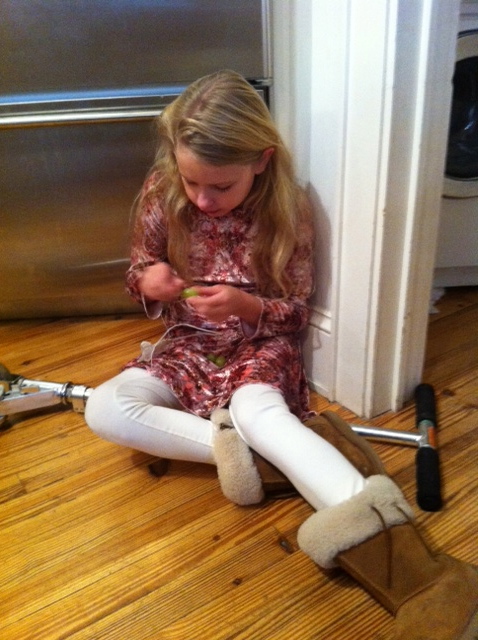
And there she was, scooter next to her, her beloved string in her lap, furtively eating some green grapes – her newest favorite fruit.

“Hey Em.  Why not sit at the dining room table?”

“No table.  Sitting on the floor,” she said, popping another grape into her mouth.

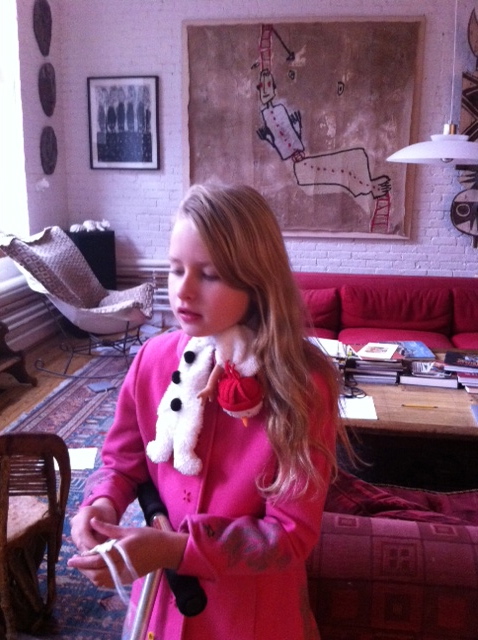
When it was time to put her coat on to go downstairs, Emma ran to the coat closet.  “Scarf!  Let’s see, how about this one?”  She pulled down one of her scarves.

“Not too tight or we have to take it away,”  she said in her stern voice.  Carefully she tied her scarf around her neck so that it hung down outside of her coat.

“I like your scarf, Em.”  I smiled at her.

“It’s cold outside.”  Emma tightened the scarf slightly and fiddled with it until the snowman’s head lay next to his body.  “There,” she said.

We’re taking this new diet one day at a time.  Emma is making steady progress!

For more on Emma’s journey through a childhood of autism, go to:   www.EmmasHopeBook.com

Day 10

Riding the wave of my previous day’s success, I fully expected to come home last night to find Emma agreeable to whatever was placed on her plate.  With visions of cheerful family dinners in my mind I set about making Hollandaise Sauce (with those duck eggs and Ghee).  Making hollandaise is a meditative endeavor, I’ve learned.  I cannot carry on a conversation with someone else while preparing it.  I must be focused, attentive with a certain amount of serenity or the whole thing curdles or separates.  I didn’t have any lemons, so I used a lime instead and all went fairly well, though it wasn’t as thick as the hollandaise I usually am able to whip up.  I steamed the asparagus, cooked the salmon steaks, drizzled everything with hollandaise and called everyone to the table where upon Emma took one look at her miniscule serving and said, “No!  I don’t want to taste it.  It’s okay.  It’s okay.  Just lick it.  You have to put your finger in it to taste.  Just one bite.  Taste it.  I don’t want to taste it!  I don’t like this.”  And then she began to whimper.

It was one of those Sybil moments, with Emma scripting using her “stern” voice, then mimicking a TA at her school to take one bite, just one bite, then Emma’s own sad voice pleading and on it went.  Finally I said, “Em you have to taste it, then you can have some grapes and apple (skinned).

“Okay, okay, okay,” she said, dipping her finger into the hollandaise.  “Taste it!”  She smelled the hollandaise, then tentatively licked her finger before looking at me with an expression of pure misery.  “I don’t like it, Mommy.  I don’t like this.”

My family dinner a la Norman Rockwell fantasy fizzled and I felt an overwhelming desire for someone to come and feed her for a month or two – get her eating a whole variety of lovely, nutritional foods before disappearing again.

Later Nic came over to me and put his arms around me.  “Hey Mom?”

“Yeah Nic?”

“I don’t mind this diet so much.  I still get to eat all my favorite things.”  He smiled at me.

“Oh, Nic.  That’s so nice of you.  You’ve been such a trooper with all of this.”  I gave him a hug.  “Thanks for being such a good sport.  It means a lot to me.”

“It’s no problem, Mom.”

This morning as I made my way to my studio I thought about when we tackled Emma’s bedwetting.  We did our homework, found an alarm to alert us to when she’d peed, whereupon we rushed her to the bathroom and eventually she was out of diapers, sleeping through the night with no accidents.  All of that seems like ages ago, but in fact it was just over a year now.  It took three solid months before she learned to use the toilet without incident during the night.  I expect it will take that much time or longer for her to become accustomed to eating new and different foods.

For more on Emma’s journey through a childhood of autism, go to:   www.EmmasHopeBook.com

Day 6

Call me crazy… BUT I think we’re seeing some changes.  Okay, I know, I said this after each of the three stem cell treatments.  Though there really did seem to be a slight shift – a change in her speech, better eye contact, longer more complex sentences, a more grounded presence in the world and I don’t think we were wrong about any of that.  I’m pretty sure Emma really did make some progress.  However, here’s my latest theory  (Richard, please refrain from rolling your eyes) – what if the stem cell treatments were helped by the fact that she also wasn’t eating all the dairy she normally ate.  What if in addition to giving her a little boost, the fact that she ate very little and therefore almost no dairy and hardly any wheat contributed to the progress we saw?   What if these food intolerances really are making it difficult for her to concentrate, focus, stay on task, carry on a conversation, maintain eye contact?

Today is the 6th day on Emma’s modified gluten free/casein free diet.  I use the word modified because, according to Dr. D she can tolerate dairy products from sheep and goats.  However she is not allowed to eat anything containing soy, corn or potato.  Which pretty much eliminates all pre-made foods, no matter how organic and gluten free they are, they all, every single one of them, contain either soy, corn or potato and often all three.  In addition she cannot eat anything with chicken eggs as she cannot have the whites, yolks are okay, but not the whites.

I’ve been doing a great deal of baking.  Which is a bit ironic considering how little Emma is actually consuming, but I keep trying to find things she might like.  I also love a challenge.  My mother told me about one of those cooking shows she likes called Chopped or a name like that. I’ve never watched it, but she described how the chefs are given bizarre items such as (I can’t remember what the actual ingredients were on the episode she told me about, so I’m making this up) – sweetbreads, licorice and coca-cola – and told to create something edible.  The chef then whips up some amazing concoction using those ingredients as their base, which looks delicious and the judges proclaim it a work of art.

The list of Emma’s “CANNOT EAT” foods sits on our kitchen counter, where I refer to it, reminding myself that if someone can prepare a fabulous dish with lifesavers and sweetbreads (or whatever it was they were given) then surely I can create something Emma will eat with all the foods she CAN have.  Still it does seem daunting.  And I’ll bet Emma wouldn’t touch any of those dishes prepared by those fabulous chefs, no matter how talented they may be.  Emma is one discerning customer.  Or as my son Nic said in answer to my question as to why he didn’t like the girl who keeps texting him at all hours of the day and night, “I’ve got very high standards, Mom.”  He then went back to playing his video game, involving lots of blood, various weapons no one has ever heard of and screams of agony.

When I first told Richard about taking Emma to Dr. D, he asked, “So what’s the science behind this?”

And the truth is I cannot answer that.  Though the following non-biased paragraph from the website, about.com is a pretty good description of the theory behind foods, intolerances, GI issues and autism:

“Why Does GFCF Seem to Work?

GFCF diets are difficult and expensive to administer. They require a lot of dedication and knowlege, and most professionals suggest that the diet be implemented over at least three months. Given all of this, it’s possible that parents who desperately want to see improvement could report improvement that may or may not actually be present. In addition, many children do gain new skills over the course of three months, with or without special diets.But there’s more to the story than just wishful thinking. Allergies to gluten and cassein are not uncommon, and those allergies often manifest themselves in diarrhea, constipation, bloating and other symptoms. About 19 to 20 percent of autistic children seem to have significant gastrointestinal issues.

If these issues are caused by gluten and/or cassein, then they would certainly be significantly improved by the diet. By removing a source of constant discomfort and anxiety, parents may well be opening the door to improved behaviors, better focus, and even lowered anxiety.”

It may be that I am trying to find improvements that have nothing to do with the change in her diet.  It may be wishful thinking on my part.  It may be that what I’m seeing may have happened had we not started her on this radical new diet. But I began this blog as an honest documentation of Emma, the progress, the lack of progress and everything in between.  Since we began the diet I have seen the following:

Greater sustained eye contact.  Less spaciness and a more solid grounded presence.  An interest in her Dad and a desire to include him beyond what she normally displays.  This morning, when I told her we didn’t have time to finish her study room and that we’d finish it tonight, she said, “Study room later.  We get to show Daddy.”  Now this may seem insignificant to most, but I can tell you, to Richard this sort of acknowledgement is a long time coming.

Emma – last night – October 20th, 2011

For more on Emma’s journey through a childhood of autism, go to:   www.EmmasHopeBook.com

Day 5

Today begins day 5 of Emma’s modified gluten free/casein free diet.  It also marks the second full day of Emma starting on her various supplements and tinctures from the natureopath/physician we saw last Friday.  I was referred to Dr. D through a friend of mine whose daughter also has autism.  When we met, Emma had just been diagnosed.  We got together, S with her daughter AF and me with Emma.  At that time AF was non-verbal, had learned some sign language and had massive sensory issues causing her to scream and cover her ears if there was a loud noise outside.  (We live across the street from a fire station, so it is often quite noisy here.)  She also screamed and cried for reasons not apparent to any of us.

We had been told Emma was on the mild end of the spectrum and at the time, both Richard and I fully expected her to be mainstreamed by Kindergarten, just as so many specialists and therapists assured us she would be.  AF, on the other hand, seemed miles behind Emma and I remember thinking we were so fortunate that Emma was as mild as she was.

Cut ahead to the present – AF is now at or near grade level, was accepted into a school Emma couldn’t get past the first interview of, she talks circles around Emma and though she still displays her autism in a variety of ways and behaviors, she has progressed in ways that are way, way beyond what I would have expected upon first meeting her.   Today AF would be considered “high functioning” or at the very least on the “mild” end of the spectrum while Emma is considered to be “moderately” autistic.

A few weeks ago I called S to speak to her about an upcoming lecture I was thinking of going to.  We began talking about different therapies and she mentioned her doctor/natureopath, Dr. D.  I told her about Emma’s limited diet and my concerns with it.  S urged me to give Dr. D a call and described how he’d helped AF.  It was in this way that I found Dr. D.  We will see what transpires.

Emma last night requested that I pull her around our loft while she lay inside my old sleeping bag that I bought several decades ago for a three week trek I took in Nepal – just me and a sherpa I hired.  But that’s another story.

After her sleeping bag ride, she and Joe made cupcakes.

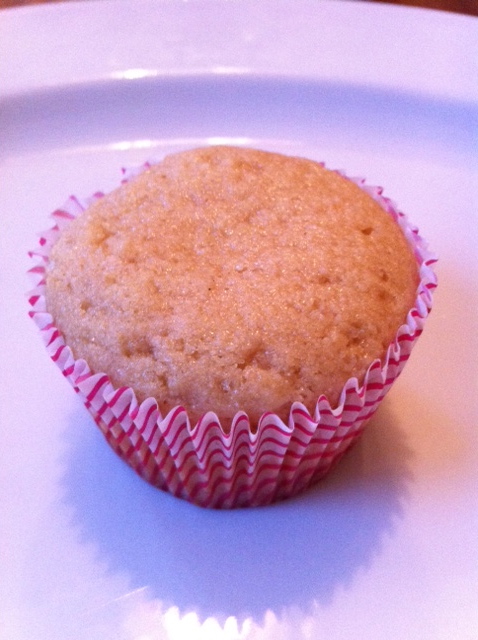
Emma’s Gluten Free Cupcakes (Emma doesn’t like icing- go figure- this is the way she likes it. Bald. She ate two of these, after putting a candle in and singing Happy Birthday to herself.)

Preheat oven to 325 degrees   –   Line muffin tin with cupcake liners

Mix together:   1 C. organic sugar, ½ C. rice flour, ¼ C. coconut flour, ⅓ C. garbanzo and fava bean flour, ¾ C. arrowroot, 1½ teaspoons baking powder, ½ teaspoon xanthan gum, ½ t. sea salt, ₁⁄₈ teaspoon baking soda.

Add, mixing well:   ⅓ C. melted Ghee, ⅓ C. Organic Applesauce, 1 Tablespoon vanilla extract, ½ C. hot almond milk

Pour well combined mix into each tin until they are ¾ full.  Bake for 8 minutes, rotate and bake for another 9 to 10 minutes.

For more on Emma’s journey through a childhood of autism, go to:   www.emmashopebook.com