Tag Archives: autism spectrum

A Conversation with Tracy Thresher

One of the things I love about having a blog are the conversations I get to have with people I would not feel courageous enough to approach and/or get to know.  Tracy Thresher is one of those people.  Tracy Thresher and Larry Bissonnette are the stars of Wretches and Jabberers, the documentary by Oscar Award winning and two-time Academy award-nominated filmmaker Gerardine Wurtzburg.  Wretches and Jabberers follows two non-speaking Autistic men, (Tracy and Larry) as they travel the world, reaching out to other non-speaking Autistic people in an attempt to change public perceptions surrounding intelligence and autism.

“Leading man, Tracy” as he often jokingly refers to himself, is a terrific public speaker.  I have seen him speak through typing many times now and each and every time I am riveted.  It isn’t just the poetic way Tracy puts words together, it is his humanity, his humor, generosity, and ultimately, his tremendous compassion for this world and the people who inhabit it, that makes people sit up and listen to every word he taps out one painstaking letter at a time.

The following is a dialogue Tracy and I have been having for about seven months now.  It has taken so long because of our schedules, but also because I could not stop asking more questions.  Every time Tracy answered one question, I would have about ten more.  Tracy was not only patient with me, but his kindness infiltrates his every response.  As this conversation could go on and on, as far as I’m concerned, I thought I better post what we’ve been discussing thus far.

AZ:  Tracy, how would you describe the documentary, Wretches and Jabberers that stars you and Larry Bissonnette?

TT:  Our film catapulted me to realize my dream of traveling the world to educate, learn and change old attitudes of discrimination toward people of varying abilities. The Larry and Tracy duo illustrates how intelligence is often worked out in a much different way. Our journey takes us to places of enlightenment and our humanity, humor and intelligence comes shining through our typing. Our mission to spread the reality of our amazing intelligence through our typing is our way of promoting the Presumption of Competence dispelling myths. Our story is one that is a road trip for two friends who are in Larry’s words “more like you than not”.

AZ:  “More like you than not” is such a wonderful description.  So much of the literature surrounding autism is about the “deficits” of Autistic neurology compared to non Autistic neurology. Can you talk about the assets and the similarities?

TT:  In my way of thinking, my experience initially was uncontrollable anger for the life I had trying to break through the misunderstanding in school. Kids can be brutally honest, reflecting the language that was the accepted norm in my childhood. Labeling kids is crippling. MR (mental retardation) on a diagnostic chart equates to NOT a candidate for the honor roll. Now I am able to communicate the reality of autism. I met Monk Hogen during the filming of “Wretches and Jabberers”, shining his wisdom on my autism. My true desire and purpose in life is breaking the walls of injustice down and my autism is the gift God gave me. I now focus on how I am connecting with all kinds of people through my work on the road. The high I feel in my own community is so wonderful, knowing that people want to know me. The man I am today is because my autism is the gift I was given to be a leader to anyone who has ever felt less than human based on their appearance. Martin Luther King knew that hurt and he took it to the mountain of peace. My mind is more like a Mensa candidate than I can type. My life is a testimony to the lesson of humanity. Like Larry typed “More like you than not” is the guiding principle to inclusion.

The anger on stage during my presentation in Japan was related to the lost opportunities in my education. I kept shouting out my automatics like “Look at me now! The kid you told one another to keep in isolation now is mentoring students which is healing salve to old wounds of injustice.” The other anger in Sri Lanka is more about the heat in the way it took my overly heated mix of perspiration soaking my clothing to extreme discomfort. Also, the popular foods in their culture are not in my comfort zone. Finland washed my anger, turning my heart to love of the climate. The cuisine helped too. Primarily, beautiful lands of countryside put my spirit at ease. Henna melted years of lost hope by crumbling away the feelings of isolating my heart to love.

People in the world often fear the paradox that autism usually presents. Larry and I mostly felt gracious vibes in our travels but the camera crew likely alters reality. To reflect on the cultural attitudes, the typing of my international friends is the true compass pointing to injustice.

AZ:  For children who may be trying to cope with similar frustrations and anger, what do you suggest to them and their parents, teachers and therapists?

TT:  This is my mission to show kids and their supports that putting communication to the top of their list of priorities is vitally cleansing to the mind. Releasing deep thoughts is the key to alleviating anxiety. Frustration leads the body to unproductive anger. Being able to show intelligent thought is the path to happier futures and true quality of life, leading to purpose. That is what I sought and found with typing.

AZ:  Was there anything others might have done to help when you were overwhelmed with anger?

TT:  Harvey and I have trust in our partnership. I need his firm yet kind support to stay on course with managing my autism. Harvey and I work well together. Typing is my outlet and open communication is the key.  Long term shared goals helps to keep me on track. Harvey’s commitment to my communication is the big time dosing of calm energy that I need. The commitment to presuming competence is the major breeze of refreshing air to cooling anger.

AZ:  You communicate by typing, but need someone to support your typing.  Why is it necessary to have someone physically supporting you? 

TT:  Impulse to type out my most irritating automatics like going to radio stations or wcax news gets looping in my mind. Having good facilitators is helping me to slow my typing to think and connect to my inner thoughts. I also need high goal of working on fading physical support to be more independent and type with lessening support. Building trust is critical to fading.

AZ: What issues and resources do you feel are most important for a parent to be aware of when encouraging their child to self-advocate?

TT:  I look up to pioneers in the FC world like Annie McDonald for her courage in the looking with the harshest disbelief on her typing. Rosie Crossley I also find gave me hope with her tell-it-like-she- sees-it firm approach. On a daily basis, the man of firm guidance is Harvey Lavoy. Harvey is my guru of staying focused. I would say he is my mentor of communication.

AZ:  When and how did you begin typing?

TT:  I was one lucky man to meet Alan Kurtz in 1990. Alan was motivated to unlock my wisdom. He treated me to intelligent conversation. Alan picked up on my eyes grazing on morsels of typing in magazines and the local paper.  I was one of the first people in my Green Mountains of Vermont to be treated to this life changing mode of communication. I was 23. Alan unlocked years of pent up chaotic thoughts. My intelligence was masked by autistic looping of hurtful labeling.

Early Supports:

I had my job coach Donna. Donna was kind and gentle. I liked her. Her support for typing limited me to Kinney’s work. It takes time to build foundations of trust and to build connections. Alan presumed my competence. The feeling of being spoken to in an intelligent manner was exhilarating. My inner thoughts hid in my mind looking for light like trees needing to flourish. My true communication jumping out on thin strips of paper was like first steps, shaky building of freeing my mind.

AZ:  Did you know you could write, but had nothing you could write on or with?

TT:  I could put letters together in my mind to make them join to form words. It was my life to play with vocabulary in lonely times. I did not think too much about how I could put my thoughts out on paper. The labeling I heard made for pesky lapping up of my hope for sharing my thoughts.

AZ:  How hard was it to start typing?

TT:  The torch of my fiery need to have a communication partner passed from Alan to Harvey Lavoy. Looking into my dark deep chaos was like unlocking madness. I held many hard grudges toward a label of retardation. The looping replay was non-stop with no way to talk or vent to Mom or a friend. Using miserable behavior is release of the locking in of intelligence. I had lots of my pre-scripted looping thoughts coming through my typing; things like radio and my local news station WCAX. My inner thoughts got masked in too much of holding on to my autism. I did not know the term proprioception then. Lack of knowledge of my own body ticked me off. My movement looked like no control in the beginning. Harvey had many arm wrestling contests with me. Ha-ha.

AZ:  Was it frustrating?

TT:  Oh big time ticked off was my typing in my starting out with Harvey. I had my liking of typing with my days with Alan. Mighty communication got put to the derailed track when Alan moved to Maine. Harvey took my brutal frustration in stride. I was brewing with lots of anger. I worried I would lose my life line of typing.

AZ:  Did you immediately feel motivated and liberated?

TT:  I did feel the tangled web of thoughts trying to be set free. My body was like a tight coil pulling so anxiously; did not easily break free to allow for liberation. Harvey motivated me by talking to me about self-advocacy. I began to hope life would be mine to choose. Emerging from despair is hard work. The power of typing took my mind to freeing the grip of autism but it took lots of grueling typing sessions.

AZ:  Were you resistant to typing at first?

TT:  My body took over my logical mind many times. I often ran from the typing space out to the parking space trying to regulate. It did not help to be gulping Mountain Dew. My impulsive habits with food led me to not think with clarity. I needed much support from Harvey to stay in my typing space.

AZ:  If yes, did anything help with the resistance?

TT:  Placing high expectations on me truly is my need. Harvey looked me in the eye to insist that I decide my purpose in life. To be in control I needed to make big changes in my life. I had terrible grating on Mom’s nerves yelling to be rid of. Holistic life of Buddhism is my goal but I easily revert to junk food at times. Harvey leads me to mindfulness by pointing out hard truths to help me make thoughtful choices.

AZ:  What did it feel like to be able to communicate in a way that people seemed to finally understand?  Was it at all scary?

TT:  Typing lifted my label of retard. Scary, it was not. More like “Take that!”  I had begun my journey to change perceptions. It was like the locking in of my voice was over. I was giddy with hope.

AZ:  Lots of people who watched Wretches and Jabberers have asked about your living situation.  Do you mind answering the question so many continue to ask – What is your living situation right now?

TT:  My Mom and Dad live near my week day home provider. I have my Wednesday family dinners. My mom is very involved in my life. I made the choice to leave my parents’ home to embark on my journey toward having a life of my own. It has been arduous at times but I have learned hard lessons toward life of my own making. Right now I live in one place Monday through Friday. I spend weekends with my family or with my weekend provider. I am working with my team on finding a place of my own.

In addition Tracy sent me a word document which he said I could share with all of you:

Many people have tried to help with my residential situation. I would like to clarify my search is plagued with difficulties of lack of knowledge in the way I would like to be supported. My family is my greatest place of stability but my idea of independence is having my own home to hang my hat, to set up in the way I choose. Mom has been there my entire life to help me on my path to being the independent thinker I want to be.

It is my time to search for the place I want to live that is both independent oriented but gives me the right thinking type of support I need. By that I mean it is necessary for me to have physical cues to get my body moving not bossy final answers made by others. My dream is to be in my own place where I make choices of the groceries I wish to buy; the decorative theme is of my choosing; the communication is open; the weekends’ activities fill my desire for exercise.

The most important thing is the commitment to learning how to support my typing. I have to let it be known that my family would never turn me from their home; this is my desire in my search for being in control of my life that I want to make for myself. I know my fans mean well to help in my residential search. For me it is more than a hook to hang my hat on; it is being in peace in my way of living where I make the house rules in cooperation with my like minded roommate.

For more on this blog about Tracy and Larry click ‘here‘, ‘here‘, ‘here‘ and ‘here‘.

Tracy – 1991
Early shot Tracy

Tracy at the ICI Conference – July 2013
Tracy @ICIConference

Autism “Experts”

Yesterday Emma asked Richard a question.  It was a question she’d never asked before.  It was a question that made us both inwardly gasp and later discuss at length.  It was one of those things that was noteworthy and made us both rejoice.  It was an example of progress, not just Emma’s, but as I’ll explain, our’s too.  Emma’s reaction to Richard crying out when our impish kitty, Merlin leapt onto his back, was what one might expect, except it wasn’t.  As all four paws, claws extended made contact with Richard’s flesh, Richard howled out in considerable pain.  Emma ran into our bedroom and asked, “What happened Daddy?”

Had we been in the midst of some “therapy” or “treatment” protocol, as we almost always were a few years back, we would have attributed this new, never-before-heard question to that therapy or treatment.  We would have felt a wave of euphoria, believing, even if only briefly, that this new treatment or therapy could be credited for her voicing such a question.  We would have remarked to each other that this was proof and only later, perhaps the following day or day after that, we might have questioned our conclusions.  We might have discussed any other significant thing that might have occurred or we might have waited with guarded excitement for the “next” wonderful thing that would prove to us, once and for all, without a doubt that this thing we were doing was making a difference.  As though our daughter would otherwise stagnate without our constant tinkering.  As though she would not make any “progress” without our various interventions.  As though autism meant complete stagnation and no movement of any kind.

Since we no longer adhere to this line of thinking, we simply spoke of what we’d just witnessed with joy, while shaking our heads at how fabulous it was that we are making progress along side our wonderful daughter.  And as we mutually applauded ourselves for the headway we’ve made, we attributed all of it, her question and our reaction, to what it was – life, maturity, learning, growth and the fact that we humans have a tendency to change and progress and how wonderful is that?!

No one told us this seemingly obvious fact when Em was first diagnosed.  No one told us this, probably because no one thought it necessary to.  Except that in my case anyway, it was necessary.  It was more than necessary.  It was required.  Because with all the misinformation we received upon Emma’s diagnosis, one of the implications was that massive amounts of intervention, forced interaction and jumping through a million hoops was more than necessary, it was required if we wanted to see any “progress.”  It was suggested that if we didn’t do all these things, we might as well resign ourselves to the idea that our child would never move beyond where she currently was.

“I can’t stress strongly enough the importance of diving into action immediately. Every expert in the field agrees that early intervention is essential and critical. The “wait and see” approach is detrimental to your child.” ~  Lynn Koegel and Claire LaZebnik

It should be noted, “Every expert” who is NOT Autistic, may believe this, though I’d argue with the word “every.”  It wasn’t until I began reading blogs written by Autistic people and talking with my Autistic friends, that I started to seriously question this idea.  I also began questioning the whole idea of what “progress” really meant, but that will have to be tackled in another post.  It wasn’t until I began questioning the idea, that I then began also questioning who exactly were these people calling themselves “experts” and how none of them were Autistic, nor did they seem particularly interested in hearing what Autistic people were saying.  Do any of you find it curious that so many of these so-called “experts” do not seem to personally know any Autistic people outside of a clinical setting?  The very people they say they are experts on?  Don’t you find that odd?

Can you imagine if a number of men claimed to be “experts” of women and what it is to be female, but none actually knew any women outside of their professional setting?  Can you imagine that when women spoke up or suggested these views were in direct contrast to what they, as women, lived on a daily basis, these male “experts” ignored them or suggested they couldn’t possibly know what they were talking about because women couldn’t be relied upon to make sense of such things?  Perhaps even suggesting that women tended toward hysteria and being overly emotional? Can you imagine laws being enacted that directly affected women’s lives and their bodies, with a complete disregard for how women felt about such laws?  Any of this sound vaguely familiar?

“What happened, Daddy?”

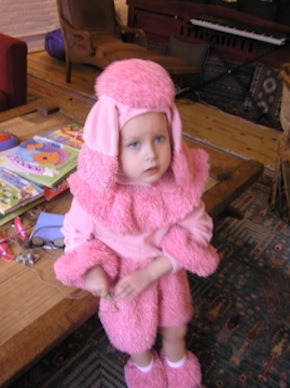
Em dressed as a pink poodle ~ 2007

Em- poodle

Living Independently on the Autism Spectrum: by Lynne Soraya

Unknown-1Living Independently on the Autism Spectrum by Lynne Soraya is described as “What you need to know to move into a place of your own, succeed at work, start a relationship, stay safe.”  In fact, it’s a great deal more.  Lynne, who writes for Asperger’s Diary in Psychology Today and works for a Fortune 500 company, covers everything from proper conduct and attire at a job interview, what to do when stopped by the police, setting boundaries, career goals, work related issues and self advocacy.  My copy is filled with highlighted sections and notations, such as this quote regarding boundaries:

“The unfortunate reality for many on the spectrum is that the training that we receive to help us to “blend in” to the wider world can have the difficult side effect of teaching us to ignore our own boundaries.

“We learn to tolerate pain and discomfort of situations beyond what many others experience in order to appear more “normal” or to “fit in.”

In the margin I scribbled – “encourage a sense of self, listen, honor and respect.  Attempts to teach how to “fit in” ensures the opposite within one’s own self. Feelings of being a fraud.”

And this, in her chapter on safety:

“There are times when you will not want to make eye contact.  For example, for men, making eye contact while in the bathroom or at the urinal may be completely misunderstood.”

I wrote in the margin, “Privilege = never having to think about things like this.”  And, I would add, not only never thinking about something like this, but never having the thought occur to me to think about something like this.  Many of the things Lynne writes about are not only things I’ve never had to think about, they are things that have never even occurred to me to think about.

Another sentence I highlighted regarding encounters with law enforcement:

“If you are concerned as to how your body language or speech patterns may be perceived by the officer or first responder, let her know that you have autism and/or provide an autism information card.  Before you reach for the card, however, indicate to the officer either verbally or with gestures that you will be reaching into your pocket or wherever the card is located so that the officer will not think you are reaching for a weapon.”

And this about job interviews:

“However, the way many charities represent autism, mixed with our culture’s very simplistic understanding of what disability is all about, can be devastating to many of us who are seeking deeper inclusion in the world.  The reality is that I, you, and everyone else on the spectrum need to help the world understand that having challenges – even extreme ones – does not mean a person does not have abilities and contributions to make to the world.  Ability isn’t a binary thing.  Unfortunately, many people who have limited experience with disabilities tend to act like it is, so when challenges are emphasized, lack of ability is assumed.”

Throughout this book I thought about my daughter.  I thought about how, as she grows older, she may encounter, at least, some of these issues.  I thought about how she put music to a slide show of photographs on her computer last night and was so excited because I came in to watch it with her and told her how impressed I was.  I thought about how creative she is with language and how she comes up with ideas and ways of saying things that would never occur to me, I thought of her joy in music and how when she dances, she is without inhibitions or self-conscious thought.  I thought about society and how so many would suggest we “train” her to conform, fit in, and how, many believe, it is all for her own good.  And I thought about how I hope my daughter never feels she must betray herself to appease or please others.

Lynne’s thought-provoking and insightful book is available in paperback and on kindle at Amazon.

A Radical Notion

As I fantasize about a world in which autism is not consider a “bad” thing, but instead is seen as yet another type of neurology with its pluses and minuses, I continue to rewrite the “ideal introduction to autism” with the hope that one day this may actually be a parent’s experience.  I can’t imagine what that would be like, but I know for a fact, it would be a hell of a lot better than the very real, very upsetting, confusing and painful introduction to autism that I was given almost ten years ago.

First off, the literature regarding autism…  more and more there are books and blogs (!) written by Autistic people introducing the idea of autism as another kind of neurology with both innate challenges and wonders.  I’ve listed many of them on the Resources page on this blog.  As there were no blogs (written by Autistic people) that I knew of in the fall of 2004 I went to Barnes & Noble and bought pretty much every single book written on Autism.  Some would say that was my first mistake, as I was greeted with nothing but gloom and doom.  Other than Donna Williams and Temple Grandin, all the books were written by non autistic people about the dire, horrors of autism and what that meant for your child. (And none of it was good.)  Autism was most definitely not something to celebrate.

The idea that autism could be seen as anything but terrible was not even a radical notion, it was a thought that hadn’t made it into the public sphere.  When Emma was diagnosed the big names associated with autism were Andrew Wakefield, Jenny McCarthy and Bernard Rimland.  It was impossible to read anything about autism without those three names coming up.  Parents new to all of this, fumbled around trying to make sense of the various thoughts about cause, was it really an epidemic and how to best serve our children who were said to have been snatched from our protective arms.  I’ve written about the depth of my fear during those first few months that turned quickly into years in numerous posts on this blog.

My fantasy is nothing short of radical, but perhaps one day it will not be seen as such, but instead, will be commonplace.  My fantasy introduction to autism begins with the evaluation.  At least one of the therapists who came to our home in September of 2004 would have been Autistic.  Once it was thought my daughter might occupy a place on the Autism spectrum, more Autistic therapists, social workers and psychologists would have come to conduct the evaluation and talk to us.  This, then, would have been our introduction to autism…  meeting actual Autistic people, who are able to articulate what the challenges are and what the joys are!  People who could offer a balanced view of a neurology that I would be able to identify with and see there was overlap with my own.  People who would gently encourage me to review my own neurology and see that my daughter’s experience and processing of the world, while different from mine, has many similarities.  People who could help me so that I was in a better position to be the mother my daughter needed me to be.

After the evaluation and diagnosis had been made, we would then be given support in finding at least a few Autistic people who were in the profession of working with families with Autistic children.  In my fantasy, Autistic people would be among those creating schools, designing curriculums, teaching academics, conducting seminars for us, the parents of Autistic children, to attend so that we might better help our kids.  It seems to me a radical shift in all aspects of autism, what is said about what it is to be Autistic and what is being told to those who are non autistic, needs to occur.  My dream team would include Autistic and non autistic alike, but it would be a blend of those who presume my child competent, who treat my child with respect, who are interested in my child’s well being and want to work towards her strengths, encouraging her to be all she can be and cheering her on.  photo

Trauma & Autism

Studies confirm that people who are Autistic often respond to stimuli more intensely than those who are not.  Hypo and hyper sensitivities are often discussed when it comes to vision, taste, hearing, smell and touch in Autistic people.  Often there is a mixture of both hyper and hypo sensitivities in any one person.  (I use these terms because we have a lack of good words to describe these things.  Both hyper and hypo sensitivities are subjective and are used in comparison to non autistic people, which is problematic in and of itself, but for the sake of this post, it is the best language I have.)  What happens to a person who experiences the world more intensely than the majority of people, particularly when confronted with frightening situations, anger, loud noises, etc?

Recent studies have confirmed that children with autism have very active Amygdalas; the center of the brain that stores traumatic events.” Traumatizing Events and Autism

When Emma was just two, we went to visit my mother, the proud owner of an adorable German Shepherd puppy.  Emma had no fear of dogs, but during that visit, the puppy playfully chased Emma, nipping at her ankles and Emma began to scream in terror.  By the time I was able to rescue her, hoisting her up in the air and away from the puppy’s sharp little teeth, the damage had been done.  To this day, Emma is frightened of dogs and upon seeing one that gets too close, she will cry, “Mommy pick me up!”  Despite the fact that Emma is now much older, the trauma is real and intensely felt.  For years I couldn’t understand how something so (seemingly) benign could cause her such incredible, and to me anyway, over-the-top terror.  I continued to believe this was a fear she would “outgrow” and that it was only a matter of time before she did so.  But so far, her fear, while not as extreme as it once was, is very much intact.

I am on a family picnic.  My parents pull out a french baguette, an imported pâté, a coveted gift from my father’s sister who lives in Paris, and some Swiss chocolate.  I am hungry and excited as pâté and chocolate are two of my favorite things to eat.  On the way home I begin to feel sick.  By the time we return home, I am vomiting and have the flu, but associate the feeling of nausea with the pâté.   It is almost two decades before I can stand the smell of pâté, let alone taste it without gagging.

These are both relatively benign examples of sensory issues intersecting with memory and causing longer term associations, but what about intense trauma such as physical and emotional traumas?  What about the time when the ABA therapist locked Emma, who was only three years old, in her room for 30 minutes, instructing me to stay out or he would pull all our services, while she screamed and begged to be let out?  I know how traumatized I was and continue to be because of those 30 minutes, what about Emma’s experience?  Did this cause untold damage?  Did Emma experience the degree of trauma that I did?  Is her experience even more profound?  What about how she experienced her own mother not saving her from such a person?  How has she integrated these events into her life experience?  Is it felt as the ultimate betrayal?  How will it manifest in the future?

These are the things I think about.  Not because I am intent on beating myself up, but because these are things that happened and I don’t think any of us are served by NOT talking about them.  These are the kinds of dilemmas many parents have experienced.  These are the questions so many of us have. Questions that are, as yet, unanswered.  We have to ask ourselves when we are considering a methodology and those who will come into contact with our children, are they going to be respectful and kind?  Does this methodology presume competence, is it respectful of my child?  Will the person be patient? Will they treat our children as inferior because they see autism as an inferior neurology and one that needs to be “trained” away?

What does trauma do to the brain?

“Severe or repeated trauma can re-route emergency systems that are meant to be used only occasionally, and leaves them active, like a switch stuck in the “on” position. This can shrink or damage the part of the brain that thinks and plans, and potentially damages the brain’s ability to feel love and safety in the presence of others.

“To deal with this pain and stress, the individual may become more rigid and inflexible in his or her thinking and develop tunnel vision and selective listening. Over time to compensate for the damage done to the short term memory and ability to sequence by continued exposure to our fight or flight response, or allostasis, the individual may develop rituals, become rigid and controlling or “oppositional”, shut down, withdraw, rage, retreat into a special place, or become over-involved in things that help the individual to escape.” ~ Autism and Trauma:  Calming Anxious Brains 

It is tragic that the very methods a traumatized Autistic person may use to calm themselves from the trauma they’ve experienced, are often the very things those who are not Autistic pinpoint as “behaviors” or actions that must be stopped.   Not only is the person trying as best they can to deal with the initial traumatic event(s), but they are often being punished and told to stop using the only ways they know of that actually help them cope, thus creating further trauma.

Traumatic events often occur during developmentally vulnerable stages in the individual’s life, and in this process become intertwined with the child’s bio- psychosocial development. How easy it would be to dismiss this in a child with an ASD, who by definition is struggling with development of a sense of self, and is uncomfortable in an alien world, even prior to repeated exposure to trauma.” ~  Commentary: Complex Post-Traumatic Stress Disorder. Implications for Individuals with Autism Spectrum Disorders—Part II 

Trauma, in relation to autism, is something I wish I’d heard about during those first few years so that I might have made better and different choices for my daughter.  Those I know who are Autistic talk about their trauma often, yet there is very little written about trauma in relation to autism in the general conversations currently going on.  This must change.

Em with the dogs

What Is Autism?

Google that term and one is faced with a lengthy list of deficits.  The definitions of autism are cloaked in subjective language.  All the words used are in relation to non Autistic neurology: “severe impairment”, “life long developmental disorder”,  “social impairment” and one site went so far as to say, “A mental condition in which fantasy dominates over reality, as a symptom of schizophrenia and other disorders.”  None of these “definitions” have been helpful to me, personally, nor have I found them to be factually correct.  The most common definitions of autism out there have increased my fear and encouraged me to pursue therapies and treatments that have done far more harm than good.

People often ask, “so what is autism exactly?”  Over the years I’ve had a variety of responses, but like the definitions above, they always seemed inadequate, unhelpful and inaccurate.  So now, when I answer that question all I can come up with is this:  Autism is a type of neurology.   Short and sweet.  No judgment, no comparison, just six words.  It is a neurology.  It’s the best way I know of to describe what is often mired in negativity and judgment.

Comparing Autism to non autistic neurology has gotten me into a great deal of trouble over the years.  I have found it is important that I avoid doing that.  (I’m keeping this personal.  I speak only for myself and do not presume this is how others feel.)  For years I worried about my daughter’s ability to have friends.  If I believe the common definitions of autism, her ability to make friends is “impaired”.  Yet the impairment is less about her desire and attempts to have friends as it is about non Autistic neurology being out of sync with hers.  When Em was in Florida with her friend Henry, they had no problem hanging out together, laughing and enjoying each other’s company.  Just because they typed to each other and didn’t engage in endless verbal conversation, didn’t mean they didn’t have a blast together.

If I listened to and believed the definitions of autism, I might think my child couldn’t learn to read or write.  I would be wrong.   Not only has my daughter learned to read and write, she also has learned to type.  Because I no longer believe the common definitions regarding autism I do not limit what she should or shouldn’t do.  I do not limit her future with set ideas about her future capabilities.  I have found it helpful to disregard those organizations and people who insist that Autism is a dreadful “affliction” and compare rates of autism diagnosis with cancer.

So what is a longer definition of autism?

It’s a terrific question.  Finding an answer that is factual as well as helpful to me, has been difficult to find.  However there are a few who have done a terrific job defining autism and in doing so have also helped me, personally.  Autistic Self Advocacy Network (ASAN) defines Autism ‘here‘ and this post by Brenda, over at Mama Be Good, gives a great, comprehensive answer to the question and at the end includes her personal observations of her child and what it’s been like to parent an Autistic child.

So I ask you, how do you answer the question – What is Autism?

Em on her way back to Henry’s house – April 2013

Em pets the kitty

Accepting Ourselves So We Can Accept Others

Accepting myself has been an ongoing process and it began well before I became a parent and got married.  It began more than seventeen years ago when I was flailing about, bulimic, unable to stop using my substance of choice (food) the way a drug addict uses crack.  I have written about this period of my life before ‘here‘, ‘here‘, ‘here‘ and ‘here‘ so I won’t go into great detail again now.  Suffice it to say, I was out of control, scared, suicidal and I couldn’t stop binging and purging.  And then someone who had once been an active alcoholic and obese, with more than a hundred pound maintained weight loss, said to me, “What if you accept that this is where you are?”

I remember I looked at her in shock.  Even now, thinking back to her words I find I am holding my breath.  It was such a stunning statement.  Never had anyone suggested such a thing.  To me it suggested complete defeat.  It was blasphemous.  It was the single most heinous suggestion I’d ever heard.  I think I said something like, “Are you kidding?  What do you mean?”  I can no longer remember her exact words, but she said something like, “You just told me you can’t stop binging and throwing up.  You just said you are out of control.  You just gave me a detailed description of what you do, how completely depressed you are, how you’ve tried for twenty-two years to control yourself and yet here you are, still unable to.  What if you told yourself – okay.  This is where I am.  I am out of control.  I hate it.  I hate feeling this way.  I can’t stop.  I can’t stop hurting myself.  I can’t stop binging.  I can’t stop throwing up.  I can’t stop thinking about food.  I can’t stop abusing myself.  This is where I am.  I accept that I am here.  What if you did that?

I didn’t have an answer.  I couldn’t think.  I felt like I was being given a pop quiz I hadn’t studied for.  I stared at her and then she did the next thing that I could not understand or wrap my mind around.  She opened her arms in embrace and hugged me.  I remember my confusion, the feeling that this couldn’t be right, that she was unhinged, that the only thing that could save me from self-destruction was more self-criticism, more self-loathing and more self-recrimination.  But I also knew what she’d said made some sort of bizarre sense; for twenty-two years I’d been upping the self hate talk to no avail.  All that criticism I kept dumping on myself had gotten me exactly where I was – at a dead end.  So I took a deep breath, held onto her hand and took a metaphoric leap into the unknown.  The unknown of acceptance.

Just in case you’re wondering, it didn’t happen as quickly or as easily as this may sound.  That leap took years of practice, of gently reminding myself that whatever I was feeling, whatever I was doing, I could accept that in that moment I was where I was.  It took years and years of cultivating awareness, of being able to see when I took up the whip that I could also put it down again.  Kindness, compassion, gentle reminders and acceptance, this is the road I have tried to stay on.  As I said, this is very much a work in progress.  Some call it a ‘practice’ because ‘work’ sounds difficult.  My experience with acceptance has been that it is “work”.  It is not easy for me.  It does not come naturally.  I have stumbled along the way.  I continue to wander off at times, only to be brought back, gently, kindly and with compassion by others who are on the same path.  It takes gentle reminders, many nonjudgmental nudges to move back onto the path of acceptance.  But I have seen the light and know to follow it even when it grows dim.

My experience with acceptance regarding autism has followed a similar trajectory.  You might think – why didn’t she ‘get it’ right away?  Why did it take so long for her to remember that what had worked for herself would work with this too?   And the only answer I have is this – I forgot and I couldn’t see that they were connected.  I didn’t see the value in accepting autism because I didn’t see my child as Autistic.  I saw her as having been diagnosed with a word I feared and didn’t understand, and therefore was not going to accept.  Again it felt like defeat to accept.  It has only been a little over a year that I was able to make the connection.  And the thing that helped me make the connection came in the form of yet another person who accepted me and all my fear, guilt and shame with compassion.  Once I was able to make the connection, became aware of my lack of acceptance and allowed that to be, without adding criticism and judgement to it, was I finally able to begin the process of true acceptance.

Acceptance of ourselves and where we are in this moment opens us up to the wonder of all.

Pascal, Emma, Harvey & Henry typing to each other – April, 2013

H &E type


Friendship – Another Myth Regarding Autism

My friend Ibby is here staying with us for a few days.  It’s a working visit, but that doesn’t take away from the joy we are all experiencing because she is here.  Who says work cannot also be a blast?

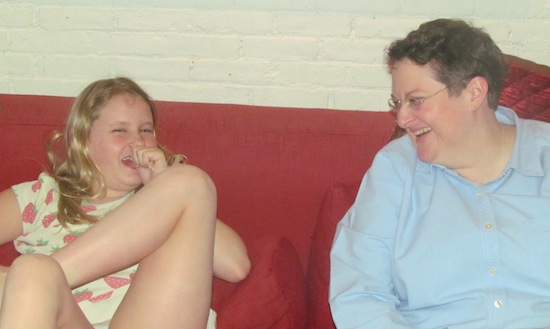
Emma and Ibby 

Em and Ib

I’ve spoken of Ibby many times on this blog (here, here, here and here to link a few) because Ib has, more than any single human being, done more to change my views regarding autism and my daughter than any other person.  I know that may sound hyperbolic, but it’s actually not.  It’s true.  Or as Ib would say, “Fact.”  And it is.  Fact.  Another fact is the gratitude I feel toward her.  Just tremendous gratitude for opening my eyes, not just to one thing, but to multiple things.  As an example, here is just one little thing that happened as a direct result of Ib.

Ib gently urged me to watch the documentary Wretches and Jabberers.  When I did not immediately watch it, she reminded me and again encouraged me to rent it.  I think she had to remind me three times, before I actually sat down and watched it.  And because I watched W& J, when I presented at the Autcom Conference last fall I went to hear Harvey, Tracy, Pascal and Larry’s presentation on supported typing and because I went to that presentation I had the idea that maybe, just maybe it might be the thing that could help my daughter communicate more reliably and because I had that idea I approached Pascal and asked if he was ever in New York City and because I asked him that, Pascal began helping us learn to support Em and because we started helping support Em I began to understand what presuming competence really meant and on it goes like the “If You Give a Mouse a Cookie” books, one thing leads to another and another and suddenly you look back and see that this person, this one person has influenced another (me) and the ripple effect is so far-reaching and beyond anything anyone could have imagined.

The Wretches and Jabberers example was just one example of one tiny thing Ib had a hand in.  I could name at least a dozen or more much larger examples, like the conversation (documented ‘here‘) we had about language and my daughter’s specifically and how sometimes she says things that seem completely unrelated to anything that’s going on, but how it is related, even if it’s not related in any way I can identify.  Sometimes it’s a leap-frog kind of association, often there’s an emotional component too, so when she suddenly blurts out, “No not going to see motorcycle bubbles” I now know Em is thinking about visiting her Granma in Colorado or is anticipating an electrical storm or watching the 4th of July fireworks display from the ranch. There’s excitement and maybe some anxiety and even fear and eager anticipation.   I know this now because Ib has helped me understand and has taught me how to “lean into” her words and not try to do a word for word translation.

Ib and I have been working on a book together about Autism, Inclusion and Friendship.  As a result I am thinking a great deal about friendships and relationships in general what they mean and how they develop and how the very definition of friendship is about inclusion and support and accommodation and giving each other slack and cheering each other on and appreciation and gratitude and being there for the other person.  It’s a mutual give and take and it’s reciprocal.  Relationships are basically what make this world and life worth living.  Ironically friendship was the thing I wrote about on this blog’s first entry.  It was what I wanted my daughter to experience, but feared she might not ever have, because I believed what I was being told about autism and that myth surrounding autism and being alone.

Over three years ago, when I started this blog, I wrote, “…hope that we may help our daughter Emma, now 8 years old, lead a life that includes deep friendships and the powerful bonds that result from being able to communicate with one another.  A life that is enriched by our interactions..  this is what I dream of for her..”   Who knew that not only would my definition of what constitutes “communication” completely change, but so would my mistaken ideas about my daughter’s ability to have friendships.  As an added plus Ibby is not only in my life, but in my entire family’s!

So yeah, Ib is really important to me.  I love her dearly; we do all the things friends do when they get together: confide in each other, laugh, hang out without having to talk, hang out and talk and talk and talk, cry, and when we aren’t physically together we stay in touch.  But as with all really close friends, Ib is in my mind and heart regardless of where she is.  I think about her and when we haven’t spoken for a few days we reach out to each other and connect, sometimes briefly if we’re both busy, but she’s always “here” in my heart.

As Ib has said, “Friendship is Fact.”

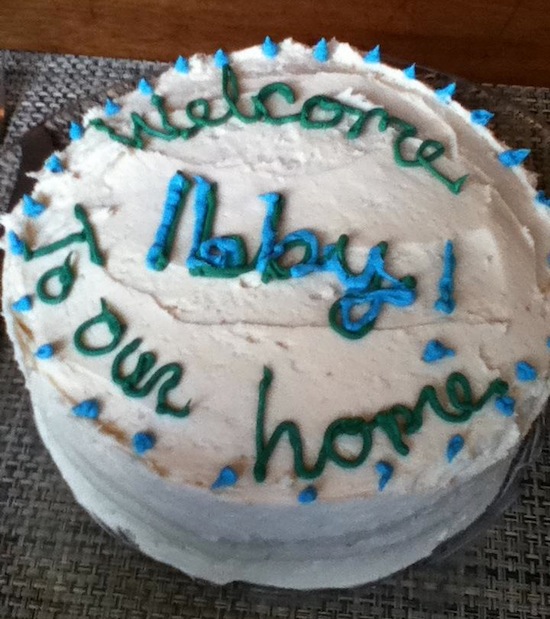
Vanilla cake with vanilla icing – made by Emma, Nic and me 

Ib's Cake


“Will She Be Okay?”

“Will she be okay?”  This was the question that went unanswered for the first nine years of my daughter’s life.  

“Will she be okay?” I asked every autism specialist, neurologist, pediatrician and anyone else who seemed vaguely knowledgable.  This question actually had almost nothing to do with the child I saw before me and everything to do with how I felt.  I so wanted reassurance.  I so wanted and needed someone to tell me she was going to be okay, whatever okay meant.  Whatever world “okay” occupied, I wanted to know, really know that my child was going to be embraced and fully in the “okay” of it all.  

“Will she be okay?”

Like the children’s story about the baby bird who’s fallen from its nest and asks all manner of creatures it meets “Are you my mother?” I desperately wanted someone to put their arm around me and say those seemingly magical and reassuring words – “Yes.  I promise.  She’s going to be just fine.”  But none did. So on I went, searching, trying every therapy, remedy, every crazy combination of vitamins, diets, homeopathy, naturopathy, healer, energy worker, cranial-sacral therapist, shaman, neurologist, developmental pediatrician, speech therapist, occupational therapist who held out the promise that all would be okay if only I did whatever it was they believed would make her “okay”. 

“Will she be okay?”  

When we finally ended our campaign to cure our daughter, our campaign to help her accelerated.  But this didn’t happen in a vacuum.  We had support.  And the support we were given came from other Autistic people. In retrospect, had I known my friend Ibby, I would not have asked “will she be okay?”  Had I met Tracy Thresher, Larry Bissonnette, Jamie Burke, Jennifer Seybert or any of the other people I’ve had the good fortune to physically meet, I would not have felt the need to ask repeatedly whether my daughter would be okay, because I would have known she already was.  That question would not have occurred to me to ask, because these people, many of whom do not speak or more often than not do not speak, or as in Ibby’s case speak, but when stressed, is unable to, are living their lives fully and they certainly know joy.  Each of them has grown up in a society that underestimated them.  All of them have been doubted and had to prove their intelligence over and over to those who are unwilling to see the evidence before them.   

“Will she be okay?”

We, as a society, must stop forcing people we deem different or less than to prove their worth.  We, as a society, must look inward and start asking ourselves, not “will my autistic child be okay?” but “what can we do to accommodate Autistic people so that all can flourish and be included?”

In the end, that’s all I really want for both my children.  I want them to feel a part of a society that supports them. 

“Will my child be okay?”

She IS okay.  Right now at this moment.  It’s up to the rest of us to recognize this.

Em singing “Clumsy” for Ibby and Emily last night

Em's performance 

The Influence of Others

On March 1st, 2012 my life changed.  I had no idea it was about to change.  I had no idea a single blog post would impact my life the way it did.  I didn’t know when I clicked on the link a commenter sent me on this blog, taking me to someone else’s blog, that I was in for the ride of a lifetime.

I had no idea.

On March 1st, 2012 I read Julia Bascom‘s post ~ The Obsessive Joy of Autism.  A post she’d written almost a year before, but I was only now reading.  Her post begins with this, “I am autistic. I can talk; I talked to myself for a long time before I would talk to anyone else. My sensory system is a painful mess, my grasp on language isn’t always the best, and it takes me quite some time to process social situations. I cannot yet live on my own or manage college or relationships successfully.”

I had no idea.

I have read that post half a dozen times since I discovered it.  And then I read her post just preceding entitled Grabbers.  “The grabbers don’t believe that we can be happy or find meaning unless we are exactly like them…”

Read that again – “The grabbers don’t believe that we can be happy or find meaning unless we are exactly like them…”

As a parent I want nothing more than for both my children to find their way toward meaningful lives, lived with purpose.  That they will then also find happiness I thought was a given.  Or so I always believed.  Does that mean they must be like me?  Do I believe that their ability to feel happiness is reduced, lessened, not relevant, inadequate, inferior, if it looks different from my idea of what constitutes meaning and happiness?  Can I let go of my preconceived ideas pertaining to happiness and what that means for anyone but myself?  Do I even know what happiness is for me, let alone another?

I had no idea.

These were the questions that began to gnaw at me as I read Julia’s blog, Just Stimming.  I urge anyone who is not familiar with her blog to read it.  Just Stimming is beautifully written as well as powerful, poignant, evocative and for me anyway, gut wrenching.

Again, from her post Grabbers –  (**Words highlighted in bold are mine, as in Julia’s post those words are italicized.)

The hands are everywhere.

They’re at our chins. “Look at me,” with a face pressed in so close to yours that you count the pores until they force your gazes to meet.

…protesting just means you need to be grabbed more often, with harder and more insistent hands, until you realize that the way you move is fundamentally wrong, as wrong and deficient and disturbing and dangerous as you are, and if you want to be counted as a “you” at all you must let them grab you until you can stop your self.”

I had no idea and now I realize that claim begins to ring false, even to my ears.  How was it possible to not have considered this?  But no.

I had no idea.

“…Until you realize that the way you move is fundamentally wrong…”

The post ends with, “In the end it just comes down to you are wrong, and for that you must be punished. It simplifies to your body is not your own, but it is mine.

I am about four years old, we are living in the first house I ever lived in.  Our baby sitter, Mrs. Williams stands guard outside the bathroom where I have been told I will stay until I have had a “bowel movement.”  I am sure she will not let me leave, but I cannot go to the bathroom on command.  I feel anxiety course through my body, it is as though my entire being is encased in a net, I can breathe, but I am trapped.  I sit staring straight ahead, wondering how long before she begins to yell at me.  I am terrified of Mrs. Williams.  She smells of antiseptic soap and wears a nurses uniform that crackles when she moves and those awful white shoes you see in hospitals that sound like she’s stepped in chewing gum when she walks.  Her skin is pasty white and hangs from her body as though it were half a size too big.   But mostly it is her eyes, partially hidden by glasses lens that  do not conceal her anger and resentment.  Those eyes hurt to look at because I see so much that isn’t said.

Finally I stand, tip toe to the sink, grab my drinking cup and fill it with toilet water then pour the water back into the toilet and flush.  I place the cup carefully back on the edge of the sink and wait for Mrs. Williams to open the door, allowing me to escape.

Your body is not your own, but it is mine...”

Julia’s blog was the beginning.  It showed me a different path and urged me to follow it.  I did.  Along the way I have found countless other blogs and have even been fortunate enough to meet many of the authors of those blogs.  Because of Julia’s blog I met my mentor and friend Ibby.  Because of Julia’s blog I read E.’s blog The Third Glance, which I intend to write about in the near future.  Because of Julia I have become a  (I hope) better parent.  Because of Julia I see the world differently.  Julia’s writing opened my eyes.  I wonder if any of us can ever really know how deeply our words can impact another.  I don’t know that anything I write here can convey what this woman has done for me or how enormously she has influenced me and because of her influence the difference she has made to my thinking and life and by extension, my daughter’s life.

Julia lit the way.

Julia created The Loud Hands Project.

Julia, with ASAN (Autistic Self Advocacy Network) put together the must read anthology, Loud Hands:  Autistic People Speaking.  

Julia is also the editor of the just released And Straight on Till Morning Essays on Autism Acceptance.  I just downloaded this book from Amazon for $2.99 and encourage everyone to do the same!

Julia’s writing gave me insight.  She confronted me with her truth.  She makes me think and rethink what I believe, what I think I know and she has made me question everything.  This post doesn’t do her justice.  How could it?

To Julia ~ Thank you  

Trashing Common Misperceptions About Autism

“Trashing Common Misperceptions About Autism and Autistic People and Creating a New World” – that’s what I first wrote as the title for this post, but it’s a mouthful and given the limit on characters on twitter, I revised it.

We just returned from Tampa where Richard, Em and I went to a screening of Wretches and Jabberers and to stay with my friend Lauri and her family, or as Em referred to it, “Have sleepover with Henry three.”  Which is an apt description because we spent three nights there.  Four days and three nights of paradise.  Four days and three nights of being with another family and a whole group of friends, new and old who didn’t judge, but rather embraced, a truly inclusive group, coming together, eating, laughing, connecting, talking and typing.  It reminded me a little of my experience at the Autcom Conference this past fall, except it was far more intimate and this time my husband and daughter shared the experience with me.  For four days we were given a glimpse of paradise.   A little peek into what our world could be like, but isn’t…  not yet.

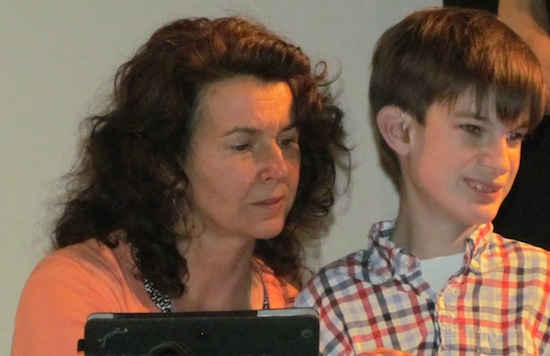
Many people believe, erroneously, that Autistic people aren’t as interested in having friends, developing relationships or crave having mentors as we, non-Autistics.  Those people have never seen Henry’s smile when he is around his mentor and friend, Tracy.

Henry & Tracy@USF

Those people who doubt, didn’t witness Emma’s tears last night when we returned home and she made me promise we would see Henry again and have another “sleepover” with him and his family.  They did not witness Henry and Emma’s laughter and joy from being around each other.

Em and Henry hanging out together by the pool

E&H -Friends

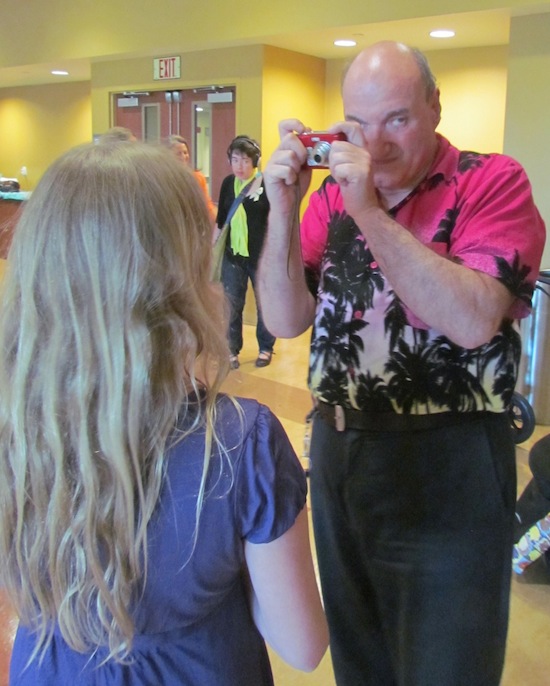
Larry takes Emma’s photograph – perhaps the single greatest compliment a person could receive.  (Amy Sequenzia is in the background.)

Larry takes Em's photograph

They weren’t there to hear Emma tearfully say last night, “Please Mommy.  Go back to Florida tomorrow?  Play with Henry again soon?”

Just because someone cannot or does not express with words their love for another in the way we might expect, does not mean they do not feel it.

Many believe that if a person doesn’t speak, or speaks with a great deal of scripting and echolalia they are not interested in communicating or have little to say.  Those people have never witnessed a typed conversation between those so-called, “non-speaking” or atypical speakers.

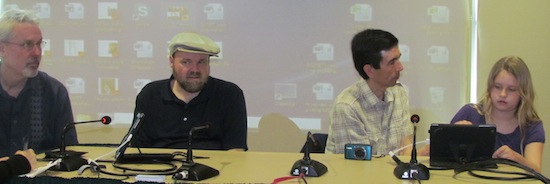
Harvey, Tracy, Pascal and Larry, the stars of Gerardine Wurzburg’s documentary, Wretches and Jabberers

H,T, P & L.

Emma, being the consummate performer that she is, could not resist occupying the seat Larry vacated during a break at the University of Southern Florida, the day before the screening, where she wrote for all to read – “My mom and dad hope to meet more people like Larry and Tracy.  Wow(*!)  I am stirring up a crowd(*.)  time to work with people at home in new york to show them it is the intelligent emma there…”  *punctuation was added by me for the purpose of this post and indicates the smile Em gave and the pause she took between typing “crowd” and “time”.

Harvey, Tracy, Pascal & Em @ USF

Em Types@USF

Many people are surprised to learn that even those who do not speak can have wonderfully nuanced senses of humor, can enjoy deep, meaningful friendships, have a great deal to say and are often far more profound than most speaking people are in any given 24 hour period.

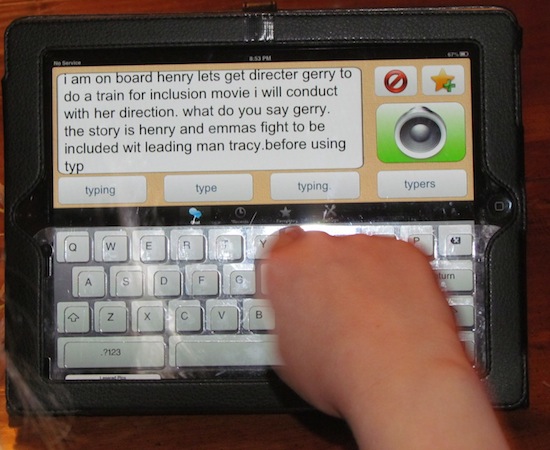
A conversation between Tracy, Henry and Emma about getting on board the “inclusion typing train” the night before the Wretches and Jabberers screening.  Tracy is to Henry’s right and out of the picture frame.

H &E type

Tracy, Henry and Emma make a “pitch” to Academy Award winning director, Gerardine Wurzburg who was standing nearby!

Em types

Em takes Gerry Wurzburg’s photo 

Gerry Wurtzburg

Many people assume Autistics have intellectual limitations commensurate with their “severe” and “moderate” labels, yet given appropriate accommodations this idea has been proven wrong again and again.  Yet another reason those labels are not only meaningless, but actually damaging.

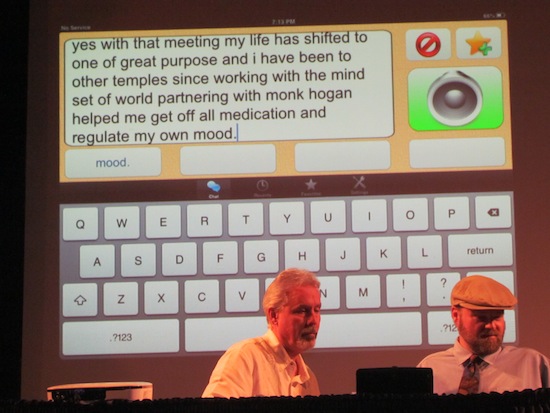
Tracy types in answer to a question from the audience about the impact the documentary and meeting monk Hogan has had on his life.

Tracy @ W&J screeening

Many people believe inclusion of Autistics in schools will “bring the other children down” and that inclusion in society will be harmful, when the truth is the opposite with many studies proving this.   (Why this even needs to be proven, is something I am still trying to wrap my mind around!)

Mary Schuh (director of development and consumer affairs at the National Center of Inclusive Education Institute on Disability) and Henry at the Wretches and Jabberers screening at the Tampa Theatre, April 6th, 2013.  Henry is now attending the public school near his home.

Mary & Henry

These are only a few of the beliefs people have when it comes to autism and Autistic people.  Yet, if people were able to witness a weekend such as the one we just experienced, I guarantee their minds would be changed and we would be one step closer to creating a new world.

*Emma approved this post.

Those Who Influence..

There have been a number of Autistic people who through their writing or by meeting them have greatly influenced my thinking and radically changed how I view autism.  Through their writing and/or our direct interactions I began to question everything I thought I knew.  I began to see that so much of the information I’d been given was false.  It was because of these people that I have a level of understanding about the problems with *functioning labels, the problematic issues surrounding *segregating Autistic children from other non Autistic children not only in the classroom, but in life.  I have a better understanding about how *important the words used to describe autism and Autistic people can do tremendous damage or, conversely shift the conversation to one of better understanding and progress.

*I have put related posts below for each of these topics.

All of this brings me to Ibby.

Ibby was/is someone who radically changed my thinking, and continues to change how I think about autism and my daughter.  I have written about Ibby before ‘here‘ and ‘here‘.  We met at a disabilities conference not quite a year ago, where she was presenting.  Ib has changed my life.  I don’t know how else to describe someone who is not only a close friend, but who has patiently advised me, explained things that I didn’t understand, didn’t judge me, never shamed me, but instead was kind, loving, compassionate and very, very patient with me.  For those of you not familiar with Ibby, I hope you’ll go to her blog and read her writing.  If there is one thing I would like to see change regarding autism”awareness”, it is that the public become familiar with Autistic people like Ibby, who are tirelessly speaking out and patiently trying to bridge the massive gap between public perception surrounding autism and Autistic people, and reality.

There are a number of people who have been crucial in influencing me, Ibby is one of them.

Related topics


What I Wish I’d Been Made Aware of When My Daughter Was Diagnosed With Autism

What follows are some of the things I wish I’d been told (and given) when we learned Emma was Autistic.  These are the things, in retrospect, I wish all those doctors, specialists, pediatricians, therapists and people who dedicate their lives and careers to autism had told me, but did not.  I believe our lives would have changed dramatically had we been told even a few of these things.  It is my hope that for those of you who may be at the beginning of your journey with an Autistic child, this list might help you avoid some of the many, many mistakes we made and a great deal of unnecessary pain.

1.  Seek out the work of Autistic people ~ most of the work I’ve listed was not available when my daughter was diagnosed, but it is now.  Take advantage of all that is out there, these people are leading the way.  If I had to choose just one thing that has had the single greatest impact on my life and the life of my daughter, it is these people.  My gratitude to all of them doesn’t come close to covering how I feel.  I have compiled an extensive list of blogs and books written by Autistic people as well as a couple of documentaries that are a MUST WATCH!   on the “Resources” page on this blog.  Please go take a look.

2. Autism is not a disease.  Read Don’t mourn for us by Jim Sinclair.  This may take some time for you to understand.  It’s okay.  Get the help and support you need so you can better help your child.  Try to think of autism in the same way you think about any groupings, a Mac and a PC, fiction, non-fiction, memoir and young adult, a shirt, a pair of pants, shoes and socks, a microwave and a gas heated oven.  Autistic, Neurotypical, Allistic, (or my personal favorite, coined by a friend) NT-NOS, we are all human beings.   Try not to judge one over another.  Judgment will not help you help your child.

3.  Presume Competence.  (This ‘post‘ helps explain what presuming competence means.)  If a therapy and/or professional does not approach your child with a presumption of competence, please consider finding one who does.  Tremendous long-term damage can come from not presuming competence.  Rethink how you view communication.  Listen to your child, not just to words, but to body language, facial expressions.  You may be surprised by the ways your child is communicating despite not being able to do so verbally.  Teach her to point with her index finger, first with support if needed and as time goes on, fade the support. Give her the appropriate tools and support so that she can learn to type or communicate by pointing to a letter board.    There are many wonderful iPad apps that can help with this.  Begin with sequencing games and colored tiles, or if she’s musical, notes.  Join them together to make patterns.  Show her first, have her mimic.

4.  Do not speak of or about your child as though they cannot and do not understand or hear you  (read Barb Rentenbach’s book for more on this).  This is something we did without thinking for years.  Sadly it is not the only regret I have, but one of many.  Still it is worth repeating.  Chances are your child can and does understand what you’re saying even if they do not show any signs that you recognize.

5.  Throw out everything you think you know and question everything.  There is a massive amount of misinformation/myths disguised as truth and fact regarding autism.  You may hear people say things like “They are in their own little world,” or “they are imprisoned behind their autism” these phrases are perhaps an accurate reflection of what non-Autistic people feel about the Autistic person in their life, but they serve to divide rather than unite and ultimately serve none of us. Be suspicious of anyone who says they know what causes autism or how to “treat” it.  Disregard any organization that describes autism and your child as tragic, an epidemic, a burden or any other word generally reserved for warfare.  If you read or hear something that causes you to feel fear, walk away, it is most likely inaccurate and intended to make you afraid.  None of us are able to help our children when we are terrified.  Fear can cause us to make decisions we will later regret.

6.  Set your child up to succeed.  My daughter is extremely sensitive to criticism.  Saying “No!” or criticizing her does not help her learn, but instead makes her feel badly about herself.  Encourage her with smiles and by asking her to try again.

7. Do not try to make your Autistic child behave like a non Autistic child, instead encourage your Autistic child to be the very best ______ (fill in your child’s name) they can be.  For more, read ‘this‘.

8.  Avoid comparing your child to any other child, Autistic or otherwise.  I have struggled with this one and continue to.  All I can say is, this is a work in progress. I hope one day to “know” this and refrain from doing it as it gets me into “compare and despair” thinking faster than anything else.  Emma is Emma.  She is best served when I remember this fact.

9. We parents are fallible.  We will make mistakes.  I’ve made dozens.  I wish I hadn’t made quite so many.  But I have.  If there is one thing I know without a doubt it is this – I will make mistakes, I am human.  I can admit my mistakes, tell my daughter how sorry I am, make a living amends to her by doing everything in my power not to repeat the mistake and continue to move forward without beating myself or anyone else up.  As my wise mother once said, “Show and tell your children over and over how much you love them, and one day they will forgive you.”

10. Get to know Autistic adults.  One of the single biggest misperceptions surrounding autism is that autism is only seen in children.  Autistic adults are often our best teachers and  many of them are leading the way so that our children’s lives might be better than their own.  These people are courageously and tirelessly pushing back against the deeply ingrained prejudices, biases and misperceptions that are rampant within our society.  (See #1)  It is my goal to honor these people who have beaten a path ahead of my daughter so that she may more easily live in this world that so often will not and does not accommodate her or give her what she needs to flourish.  They are speaking out, let’s all get behind them and give them the microphone so that more can hear what they are saying.  One day, the person holding that microphone might just be your child!

The year after Emma was diagnosed ~ 2005

Em - 2005

Acceptance And A Webinar

When my daughter was diagnosed first with PDD-NOS and later with autism, I easily fell into the ~ I-completely-love-and-accept-my-daughter-but-I-do-not-accept-her-autism ~ mindset.  At the time, this seemed perfectly logical and I didn’t think a great deal more about it.  Autism was the “problem” after all, not her, and once we got rid of the autism, everything else would fall into place.  When people said the word “acceptance” and “autism” in the same sentence I nodded my head yes, while my mind carefully separated autism from my daughter, plucked the word from the sentence and placed it into a box before closing the lid.

It took a very long time for me to understand that my daughter and autism were not to be separated.  And it wasn’t until I began developing real friendships with Autistic adults that I stopped trying or wanting to separate the two.  Acceptance is much more than tolerating something or saying – okay I won’t actively fight this any longer.  Acceptance is an embrace, it’s understanding and actively celebrating difference, it’s about looking inward and asking questions.  It’s about self-reflection and digging deep into the darkness of preconceived beliefs and being willing to be wrong.  It’s about saying – I don’t know and I don’t understand, will you help me?  It’s about being vulnerable and not “right” and it’s about the excitement of discovery and being curious and open to different ways of being and seeing the world.  To me, it is the most exciting way to live life.

To say I’m grateful to all those people in my life whose neurology falls under the Autistic label, would be a vast understatement.

Today at 4PM eastern time, Brenda Rothman of Mama Be Good, Melody Latimer of AS Parenting and I will be speaking about Parenting Toward Acceptance.  The webinar can be found at the following link – http://www.icdl.com.

In other news, I was more than a little surprised to see this – Top 10 Social HealthMakers

“Splinter Skills” and Other Words We Use

When Em was not yet three years old we received her diagnosis and began the long trek through, what appeared to us at the time to be, the treacherous terrain of autism.  All the things we admired, her various abilities, all those things I had identified as wonderfully “Emma” were now reduced to a single word “autism.”  I remember bragging about the fact that Emma, at the age of 18 months had taught herself how to pump her legs on a big kid’s swing, only to be told after her diagnosis that “kids with autism will often display splinter skills.” When I then commented that my daughter was extremely independent it was said that her autism caused her to shun other children and people, thus reducing her independence to nothing more than, yet another example of, her autism.

After awhile I felt I didn’t know who my daughter was, other than “autistic”.  That word seemed to so thoroughly obscure her in the minds of so many experts and people in the know.  Autism, it seemed, meant lacking and less than and not capable.   Whenever my daughter displayed things that could not be neatly placed in the deficit box, it was tossed into the “splinter skills” box.  It seemed no matter what she did it was viewed as “deficient” even when it wasn’t.  I remember feeling I finally understood what people meant when they talked about their child being imprisoned or all those awful images that abound of children silently, sadly, standing behind impenetrable walls of glass or behind bars of steel,  their small hands gripping the cold metal as they silently watch the world go by.  All of this, the words and images, showing us, telling us what we could and should expect were like seeing train tracks descending into hell.  Who knew it would take me eight years to understand that so many of those impenetrable walls of glass were constructs made by us.

If we did the same thing to those who are born without Autism, if we talked about our non-Autistic neurology as a deficit and identified all the ways in which it would cause us problems and difficulty, would we not despair when our non-autistic child was born as well?  Take your own life as an example and imagine that when you were born you were seen as a great disappointment.  Think about how each time you did something well it was dismissed as a “splinter skill” and was seen as yet another example of all that was “wrong” with you.  Think about what it would do to your self-esteem if your interests and passions were spoken of as “obsessions” or actively undermined and limited because they were seen as “unhealthy”.  It’s a double standard we have.  We non Autistics are praised, admired, given awards and accolades for our passions and obsessive interests.  People describe us as “driven”, “ambitious” or any number of other words used to describe the things that interest us.  But think if instead we were denigrated, ridiculed and scolded.  What does that do to a person?

The way we speak of and about our children, the way we think about their neurology, the way we attempt to “help” them “fit in”, these are the things I hope will change because it is not helping us parent our children, who need our help, it is not helping educators teach our children, who need to be taught, but mostly it is not helping our children be all that they can be.   My husband once said, “People spend all their time and energy trying to teach their Autistic kids to be something they’re not, when they should be spending all their time teaching their kids to be all they can be.”

Emma’s favorite work of art “Railroad Nostalgia” at the Scope Show in NYC.

Train tracks