Category Archives: Parenting

Demanding Speech

Over the weekend I witnessed a young man who did not easily speak and when he did say a word, it was clear how hard he was having to work for that one syllable.  Yet the people around him bombarded him with questions.   Questions he could not answer with spoken language, but that did not stop them from asking.  When he managed to make a sound resembling the answer they wanted, they would pause for a moment before asking him another question.  After about ten minutes of this he retreated into what looked like a sensory friendly room, where he rocked gently back and forth, holding his hands over his ears.  Even so, the questions continued.  

Another boy who was having his lunch was told during a ten minute time period to “look at me” more than a dozen times.  He too could not easily speak and was asked a great many questions.  Things like, “Is that good?” When he said, what sounded like, “Yes,” the other person said, “Look at me.  Stop.  Put down your fork.  Look at me.  Is it very good?”  When he again said, “Yes,” he was allowed to eat his lunch for a few seconds in peace before the next question came.

People often ask me why I object to ABA therapy.  It is not only ABA therapy that I object to.  It is ANY therapy that treats another human being as these very well-intentioned people were treating these young people, all of whom were teenagers.  I object to the way so many, who are in the field of autism are trained and how that training  affects how they speak to and interact with people who are autistic.   I do not, for a moment, doubt that they believed that what they were doing was good and ultimately helpful to the kids they were working with.  Yet each one of them was unconsciously or not, treating those kids as though they could not and did not understand what was being said to and about them.  The kids were not being treated as one would treat their same age non autistic peers.

On the Presume Competence – What Does That Mean Exactly – post I wrote, “What I have come to understand, is that a presumption of competence is much more than a set of beliefs, it is a way of interacting with another human being who is seen as a true equal and as having the same basic human rights as I have.”

What I saw was fairly typical of what I see often – well-meaning people who are working with autistic people, but who do NOT presume them competent, not really.  Had I said something to any of these people, I’m sure they would have expressed surprise with my observations of what they were doing and how they were interacting.  I would even guess that they would have told me that they were presuming them competent.  These were not mean people, they were not sadistic people, these were people who believed in the training they’ve been given and believed this was the best way to interact with these teenagers.

At one point the young man who was trying to eat his lunch, looked over at me and my son.  My son, smiled at him and I did a little wave and said, “hi.” He nodded his head ever so slightly at us and then the person who was paid to sit with him, asked him another question.  I do not doubt for a second that all the kids there were competent.  In fact I am convinced of it.  I know it to the core of my being as I have been around so many people who cannot speak, or who can speak, but not easily or naturally and who are all competent.  But this was not how they were being treated.  This idea, which is popular with a number of therapies, not just ABA, that we withhold desirable things until the person speaks as demanded, is not something I agree with because it is based in a presumption that wanting something is equated with ability and this is incorrect, even if it obtains the desired result – a verbal utterance.

Until Emma began to write, using her letter board, I had a great many thoughts about her that have proven incorrect.  Until she began to express herself through those words she painstakingly spells out, I was not treating her as the exceedingly  competent human being that she is, even though I often thought I was.  Even now, on any given day, I do not do this as well as I’d like to.  All those years of ingrained thinking are extremely difficult to change.  But change I must…
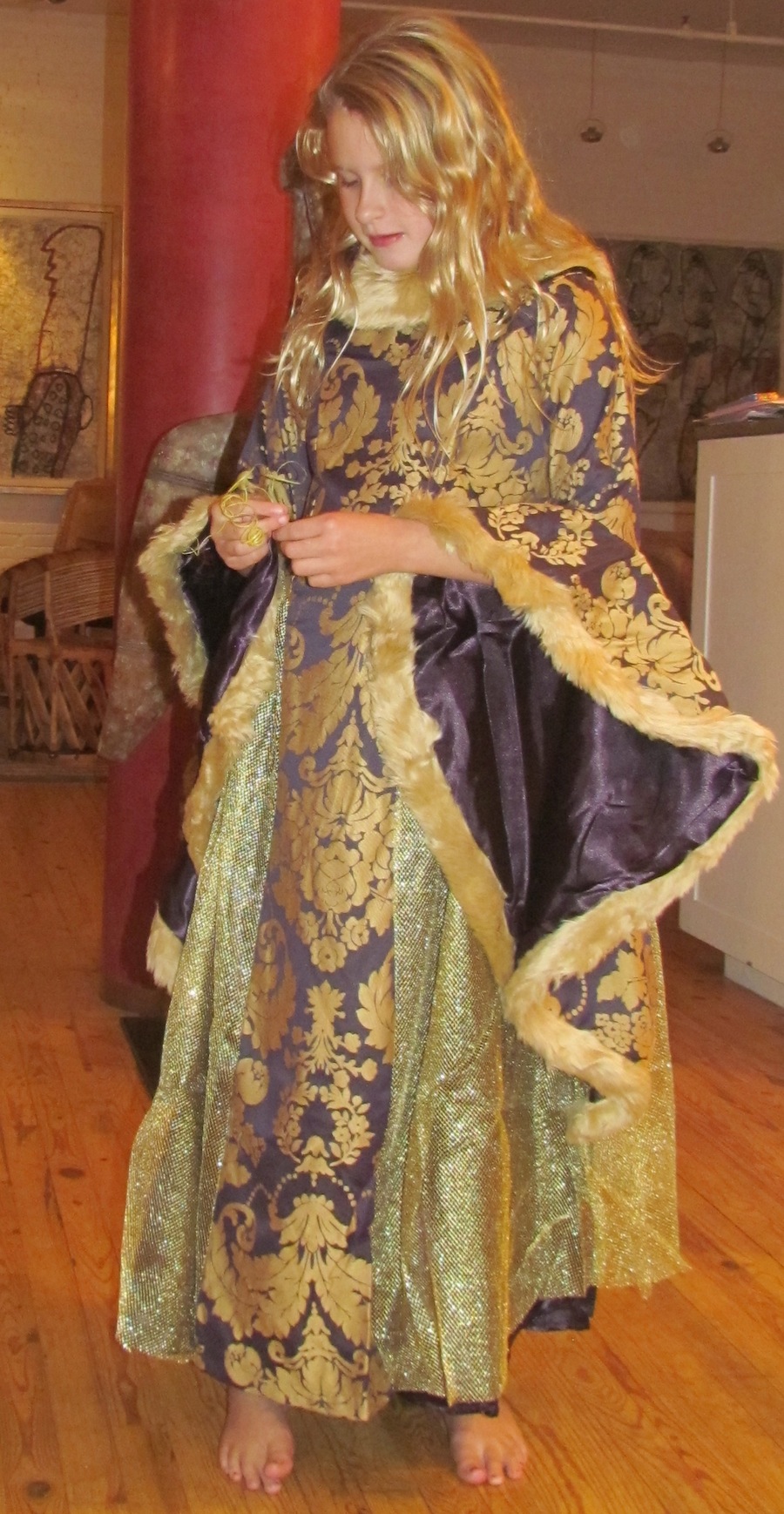
A Renassaince Princess
A Renassaince Princess

Separation Anxiety

In our ongoing “spring cleaning” (which never seems to end) I came upon a large spiral notebook filled with notes from the dozen or so ABA therapists who came to our home beginning in November, 2004 through August, 2005.  Emma was just two years old when all of this began.  It’s a fascinating document of that time period and it depresses me to no end.  Over and over the notations remark upon Emma’s “clingy-ness to Mom”, her “whimpering” and “despondency” when I would leave the room and her internal discomfort.

It is impossible for me to read the notes and not see an obvious pattern.  For a therapy that prides itself in collecting data, it is curious that this larger and, what seemed to me anyway, obvious pattern was largely ignored or, perhaps it is what naturally happens when we pathologize a neurology.  Emma’s desire to seek comfort and assurance from me, her mom, was seen as a negative, something to be trained away, something that was getting in the way of more important things.  It is ironic that this was being said about a young child who was diagnosed with autism, which has, according to all those experts, as one of its most defining characteristics, “social impairment” and an inability to form close bonds.

A two-year old not wanting to go off with a stranger is considered a “good” thing by most people.  That this same child would prefer being with their mother, even after getting to know someone else, would still, in most instances, be thought of as an excellent example of bonding and having a close relationship with one of the most important people in that person’s life – their mother.  After all, if you cannot trust your mother to protect you, to be there for you when you are two, how will you learn to trust anyone later in life?

Richard and I talk about “what we would have done” all the time.  Not as in – what would we have done if we could do it all over again – as much as, what would we do now if we had a two-year old today who was just like Emma.  And the first thing, the absolute first thing would have been PRESUME COMPETENCE.  That is the key, the foundation by which everything else would have been gauged.  This does not mean expecting a two-year old to understand, know and behave as a twenty year old.  It means we would have presumed she understood and felt what a two-year old is capable of understanding and feeling not less.

When Emma began her ABA based preschool in the fall of 2005, I was told to drop her off and immediately leave.  Yet when my non autistic son went to preschool they had a three-week “transition period’ in place where parents routinely stayed with their child, slowly reducing the time they stayed until eventually the child separated from their parent when they felt comfortable to do so.  Each child was different.  Some children ran off within the first few days, others needed more time, some needed several weeks, but no one said, “Leave now, even though your child is hysterically crying and clinging to your leg, it will be good for them.”  I remember asking about this at Emma’s preschool and being told they didn’t allow parents to stay with their child as this only prolonged the child’s suffering.  How is it that one method is good for one child, but not another?

Knowing how sensitive my daughter is and was, knowing how intensely painful this must have been for her, I can only sit here, filled with sadness that we just didn’t know better.  It was as though, when we got her diagnosis, all common sense left us.

So I am asking all my Autistic friends – What would have helped you when you were a small child?  Would it have been helpful to have your parent stay with you until you were comfortable and felt safe enough to go off on your own?  Would you have liked knowing your parent was there, even if you didn’t need to be right next to them?  What do you advise parents new to all of this?

OT session ~ 2005

OT session ~ 2005

“Social Impairment”

“Autism spectrum disorder (ASD) is a range of complex neurodevelopment disorders, characterized by social impairments” ~ NIH (National Institute of Neurological Disorders)

When I first learned about autism, as defined by many organizations, I understood it to be a “disorder,” with “social impairments” being one of its defining characteristics.  As autism was also spoken of as meaning someone who did not and could not understand others, and that the very word “autism” stemming from the Greek word “autos” or “self”, suggested a person who had little interest in other people, I assumed this meant my child didn’t care about or want to make friends.

Add to this the unfortunate wording of what so many of our kids engage in – “self stimulation” – which to my ears anyway sounded vaguely  masturbatory, and as we live in a society tending toward the puritanical, self stimulation, even to my liberal notions, carried with it a decidedly negative connotation.  The word “stimming” is a bit better, but even so, I cannot get away from the sense that this feeds into those negative assumptions about intent and a lack of interest in connecting with others, which is still believed by a great many.

When my daughter described stimming as “self-care” (you can read that post ‘here‘) I  was filled with admiration.  Self care is such a wonderful way to describe what I see her doing.  Self care is not about rejecting others, but instead describes a way of regulating oneself so that one can engage with others.  This idea that autism means disinterest in other people, an idea so many have embraced, does not describe my daughter at all.  To the contrary, my daughter and so many of my friends who share her neurology care deeply and take tremendous pleasure in their various relationships, just as those who are not autistic do.  (That this last sentence is even necessary to write, demonstrates how far we have to go.)

This idea that autism characterized by “social impairments” is something that drives me crazy.  It isn’t a social impairment.  It’s a complete misrepresentation and misunderstanding of what autism means to those whose neurology is called autistic.  My daughter does not lack a desire for friendship or have a disinterest in other people.   Unable to often communicate what she intends, constantly distracted by things others cannot and do not necessarily see, hear or feel and a need to move her body in ways others misinterpret, it is no wonder “friendships” present a whole series of issues for her.

So many of the assumptions about autism, based on what non autistic people witness and believe they are seeing and the theories they then develop supporting these assumptions continues.  Assumptions, spoken of as though fact, with therapies devised to “help” what is assumed to be true and yet, is not, is based on a false premise.   But when we were given Emma’s diagnosis, I did not question these various theories.  I, as did so many others, took them at face value, believing that though there was much we still did not know about autism, these beliefs at least, were some of the things we DID know about autism and by extension autistic people.

Oh how wrong I was…

Emma holding Teddy

Emma holding Teddy With her String

When the Body Does not Obey the Mind

Emma gave me permission to quote her words, written this past Sunday.

“Please remember that my mind tells my body and my mouth to do all sorts of wonderful things constantly, but they don’t obey.

“Sometimes I want to scream.  I am trying so hard, but no one notices and they are annoyed instead of understanding.”

Emma wrote this in response to her gymnastics teacher, but it applies to so many instances where she confounds those around her by doing things she knows she shouldn’t, things she doesn’t want to do, doesn’t intend to do and yet does anyway.  Typically people assume she is doing these things because she doesn’t care, or is trying to be mischievous, or “wants attention” or any number of assumptions people make when witnessing her actions.  But in speaking with Emma, it is clear how incorrect these assumptions are.  As Emma wrote, “I am trying so hard, but no one notices and they are annoyed instead of understanding.”

Sydney Edmond is an Autistic young woman who describes herself as “… locked inside a body that won’t cooperate.”  Sydney published a book of poems, The Purple Tree and Other Poems.  Recently Sydney gave a lecture to a group of Special Education students and educators at a high school.  She generously gave me permission to reprint some of her lecture here.

“People need to know, because Society apparently thinks autistic people are lacking intelligence. Our wandering wayward eyes and hands flapping, screaming, and anxious stimming don’t help, either. But in truth, we polish our souls deep down inside where they can’t see us, while our dastardly bodies act in ways we can’t control. That’s right. I told you I have lousy control over my behavior. Can you relate? Perhaps you have moments when your body does things without your permission? When you lose control and shout at someone or hit out? Well imagine what it would be like if you were just the opposite, and were always out of control with little solid gold moments when all the pieces come together and knowledge passes impulse? For those moments we are the captain of our ship and we feel unbelievably perfect. But, passing time wipes it away. Possibility becomes disability again. Look at your fellow students with autism deeply and with patience. We are in here.  And we are exhausted, panicked, and lonely.”

Ido Kedar, who wrote the book Ido in Autismland writes about the body/mind disconnect he experiences, as well as the embarrassment he then feels when his body does not do as he wishes.

“I feel it’s time autistic people finally say what it’s like to be drilled in flashcards over and over when your hands don’t move to your thoughts, or to have your teacher say in front of you that you can’t count because your stupid hands refuse the right number you’ve counted in your head.  I remember standing miserable and embarrassed, holding the wrong number of straws and hearing my teacher say, “It’s clear he has no number sense,” as if I couldn’t understand or had no emotions either.  When I think of these frustrating experiences I am grateful I am not in that situation anymore.  But many of my friends still are.  That’s why I cry for them.”

Sydney Edmond, from her recent lecture, wrote:

“I found freedom and wonderful joy when, as a ten year old, I was taught how to point to letters on a Letterboard and spell what I wanted to say. I eagerly worked, and within a few months, I was able to communicate. In the beginning, I needed a lot of support. I couldn’t even point my finger when I wanted to. My body, as usual, did not cooperate. I had to force it to, so all my words, stored away for ten years, could finally come out into the world. Do you want to know what I asked for? Well, I asked to have my own pizza. And then I asked to learn ballet. And piano. And I asked to learn about history. I was thirsty to learn. I finally had a way to ask questions that let people know I was intelligent. Soon I learned how to type on a keyboard and have a lovely voice added to my words. I went back to school to prove I was intelligent. I had been tested and told again and again I had the intelligence of an infant. Having a method to communicate turned it around. My language comprehension was college level in 8th grade when I was actually given a means to show what I knew.

“Loads of us, people all over the world, type to communicate. I am one of many, and we all want people who cannot speak to have the opportunity we are enjoying. I hope that my words today might spark a willingness to proceed on the journey of a lifetime. I hope one of you will take action to give a voice to someone who cannot speak.”

Ido, Sydney and Emma all began writing to communicate by using a letter board.  All of them discuss what it is like to have a mind that “…tells my body and my mouth to do all sorts of wonderful things constantly, but they don’t obey.”  Each of them describes their experience, whether that includes frustration, embarrassment, or shame and what it is like to be so thoroughly misunderstood.

I am grateful to each for allowing me to reprint their words in the hope that others will begin to reconsider their assumptions and how they then respond.

"Happy"

“Happy”

“Put it on the Blog!”

“Put it on the blog!” Emma said with glee as she bounded into the house. A master at multi-tasking, she twirled her string, unzipped her coat and raced off to put on some music all within seconds of opening the front door.  I knew what she wanted to put on the blog.  She’d successfully completed a catch in Trapeze School that morning.  I knew it had been recorded.  So… here it is, for all of you to see.


Yesterday afternoon Emma wrote some pretty wonderful stuff about how her body and mind are often not in sync and what that’s like for her.  We taped some of it and once I have her permission and we’ve uploaded it, I will attempt to post it here.

Earlier I showed Emma a NYTimes article about the missing Malaysian Airlines jet leaving Kuala Lumpur heading to Beijing.  I asked Emma what she thought and she wrote, “It is terrible and worrisome for all of us.”  I then asked if she had any questions and she wrote, “Has anyone asked for anything yet?”  I asked her if she meant a ransom note of some kind, to which she answered, “yes.”

I write this as an example of the sorts of things we discuss these days and because there are some who continue to doubt Emma is capable of understanding such things…

When Time Stands Still

After publishing yesterday’s post, “So Many Kids Are Just Like Me” I added a video of Emma writing those words and more.  I hadn’t added it when I first wrote the post because Emma hadn’t given me permission yet and we were still trying to get the video uploaded, ran into problems with the picture being condensed and other issues.  In any case, for those who want to view it now, you can.  On a personal note, I’ll just add that this video makes me feel very squirmy because it does not capture the playfulness we usually have together, and I’m hyper aware of the anxiety I was feeling while we were taping…  Also the video does seem to be taking longer than it should to load, at least it is on my computer, but Emma has said she’d like to tape more, so I’m hoping we will get better at uploading as we continue.

My friend Alex commented on yesterday’s post about the impact of watching Emma write, as opposed to reading about it.  It was exactly for this reason that we decided it was important to post the video.  There is nothing like seeing in real-time another person writing this way.   No amount of words, no matter how well phrased can describe this process the way watching it in real-time does.

I will never forget that moment at the Autcom Conference in 2012 when I watched a boy, younger than Emma is now, write such insightful and profoundly wise comments  that his mother then read out loud during a presentation.  It was that moment when I thought to myself – maybe, just maybe my daughter has thoughts like this, and we just have to find a way for her to express them.  It makes me cry with gratitude thinking about that moment not so very long ago.  No one could have convinced me then that just a year and a half later we would be where we now find ourselves.

It is inevitable that there will be people who say things like, “well it takes too long” and  “how can this work in a class room?”  But as a parent who has wanted nothing more than to know what my daughter was thinking, who believed despite what the majority of people believed and were telling us that maybe, just maybe they were wrong, watching Emma write is when time stands still.  The excitement I feel when she begins to point to a letter is like nothing I’ve ever experienced.  Each letter she points to is a tiny gift wrapped in beautiful paper, as the paper peels back to uncover the word inside the world and everything in it stops.  It is a sensation like none other.

To my daughter, who works so very hard to accommodate my need to hear her experience of the world put into words, I thank you.  Every single time you do, even though you feel it’s tedious, I thank you.  Gratitude does not come anywhere near my feelings.  There are no words for this.  And I know this is a tiny glimpse into what you, Emma, feel every time you are asked to put into words your thoughts.  Words can’t come close…  finally I understand…

Em & Ariane on New Year's Eve ~ 2013

Em & Ariane on New Year’s Eve ~ 2013

“So Many Kids are Just Like Me”

“I am smarter than most people think.  So many kids are just like me.”

Emma wrote this yesterday in response to my question, “What would you like teachers, who want to teach Autistic kids, to know?”

There are a number of young people who write to communicate things that they cannot with spoken words, just as Emma does.  Many of them are starting blogs of their own, some have parents who have blogs and like Emma they are beginning to take ownership of those blogs.  On the “Resources” page here on Emma’s Hope Book I’ve listed a great many blogs beginning with those written by non-speakers, or people who write to communicate.

When Emma wrote “so many kids are just like me” I thought about how when Emma was diagnosed I knew of none (of any age) who wrote to communicate.  The entire concept was completely foreign to me.  In fact, and I hate admitting this, I hadn’t spent any time considering neurology, literacy, language, or which parts of the brain process language.  I remember being confused by the idea that someone who didn’t speak, could still read.  I’ve come a long way!

I would like to take the opportunity to list here just a few blogs that I personally know of where people around or near Emma’s age are writing to communicate.  This is by no means a comprehensive list and I welcome any additions, which I will add here and on the resources page as they come in.

Oliver – Day Sixty-Seven
Philip – Faith, Hope and Love… With Autism 
Aidan
Cindi’s Blog
Henry Frost – Ollibean
Matteo – Matteo’s Loving Blog
Ido – Ido in Autismland
Joey Lowenstein
Nick – Teen Typer

“So many kids are just like me…”

Emma with her friend Henry ~ January 30, 2014

Emma with her friend Henry ~ January 30, 2014

I Used to Believe…

The degree of arrogance displayed by more than a few who claim to be “experts” with decades of hands on experience in the field of autism is absolutely staggering.  Their arrogance is only rivaled by their mindset of assuredness. They are unwavering in their absolute knowing about a neurology that continues to baffle the best neuroscientists in the world.  These practitioners not only speak from a place of “authority” they are imperious, contemptuous and profoundly scornful of any who suggest they might want to consult with a few people who are actually living their lives with the neurology these so-called experts claim to understand and know all about.

We have run into more than a few of these professionals over the years.  These are the people who fill me with fear.  They come into contact with hundreds and thousands of children over their decades of “expertise” and it terrifies me.  They win grants and are paid to speak at conferences.  Their opinions are sought by a great many.  They swagger about with their self importance, wearing their years of working with the Autistic population as though it were a badge of honor.  They think nothing of grouping an entire neurology into a small, convenient box labeled “autism”.

They smirk and posture and plaster their walls with their many credentials and degrees.  They make sure everyone understands exactly how many years they’ve been working in the “field.”  They say things like, “autistic children are…” accuse those they disagree with of “falsehoods” and go on at length about how they know what “autistic children” want, need and care about.  They are profoundly dismissive of those who actually ARE Autistic and who dare question or disagree with them.  Instead of listening to the very people they claim to know so much about, they silence with words of contempt.  They attack.  They strike out, bring in reinforcements of like-minded colleagues.  Sometimes they even target someone, almost always someone who is autistic, and try to do damage to them by contacting their employers, or those they have professional contact with.

I used to be shocked that such people would choose to be in a profession where the people they are supposedly wanting to help, end up being the very people they silence and hurt.  It used to surprise me when I would read comments by people who have no trouble using language either written or spoken to get their point across, dismiss and question someone who does not enjoy the same ease with which they do, to communicate.  I used to be naive enough to believe those calling themselves an “expert,” and had degrees suggesting study and dedication in their given field was further evidence of their title.

I used to believe in a great many things.

*This post is not about any one person, but about the dozens of people I’ve met over the years who fit the above description.  There are many people, both autistic and non autistic, who have dedicated their lives to autism, who (thankfully) do not fit this description.  They are open to new ways of thinking, they are actively listening to those who have different experiences than their own.  All of them are engaged in learning, discovering, uncovering more information and examining what they think.  They are operating from a place of humility, and to those people I am profoundly grateful.

facts
Related posts from others:

Cart Before the Horse Research ~ By Michael Forbes Wilcox

“Picture Day Moments”

Yesterday was picture day at Emma’s school.  Over the weekend I went to the photographer’s website, paid for the photographs online, chose which packet we wanted and then filled out the little envelope that had been sent home and placed it in Emma’s back pack.  Emma and I discussed picture day and she carefully chose what she wanted to wear, a red velvet dress worn with black velvet leggings.  She’d washed and rinsed her hair the night before with particular care, and as she waited for the bus, she smiled at me and said, “Smile!”  I laughed and told her I couldn’t wait to see her photograph. The bus arrived and off she went, sprinting up the steps, with me waving good-bye.

That afternoon I had a meeting at her school with a few people from her team.  I was informed that there’d been some issues in the morning with Emma distressed.  Something about wanting to leave the room.  There was mention of her wanting to leave the room because of it being picture day, but that she had to stay in the room and was not allowed to leave.  I assumed that was because the other children were waiting their turns too and didn’t think to ask for more information.  The conversation veered off to other, seemingly more important, topics.

When I returned home with Emma I opened her back pack to find the envelope for picture day just where I’d left it.  No one had taken it.  Still, I didn’t put two and two together, didn’t think to ask Emma about it and besides, she’d already been asked to write with me that afternoon at school.  I emailed her teacher telling her the envelope was still in her back pack and received a reply that they hadn’t seen it and therefore assumed that I did not want Emma to have her photograph taken, but that she had been included in the class photo.  And I felt that awful feeling when your throat feels swollen and you can feel your heart beating and your chest constricts and your breathing becomes shallow and your vision blurs.

This morning I spoke with Emma about picture day, telling her there’d been a misunderstanding and how sorry I was.  I asked her to talk about it.  She told me how upset she was that she didn’t get to have her individual photograph taken as the other children had.  “I’m so sorry” I kept saying, but I can’t make what happened any different.  I know it’s just one incident, something relatively small and in the grand scheme of things not particularly important, but you see, this is just one example of what occurs regularly for our kids who do not speak, or, as is the case with my daughter, cannot say what she necessarily intends.

There are dozens and dozens of “picture day” moments.  Little things where she is misunderstood, cannot initiate a complaint, is not asked the right questions, cannot “speak up”, cannot protest with a reason why, instead she is thought to have “behaviors” when she tries to leave the room.  Assumptions are made, well meaning staff decide they understand her and know what is going on, and maybe they do, but maybe they don’t.  How many “picture day moments” happen from one day to the next.  Expectations and questions gone unanswered, thoughts and feelings unable to be formulated into words, or words at the ready if others were only capable and able to support enough that those things could be expressed.  How often?

Teachers are trained in a definition of autism, that is incorrect.  A definition that assumes intellectual disability which is connected to an inability to make oneself understood, low IQ, problematic behaviors, unable to read aloud and therefore cannot read, a whole series of assumptions are being made daily about Emma and kids just like Emma, but those assumptions are based on a false premise.  Teachers must give our children state required assessments and those scores are believed to represent capability when, in fact, they do nothing of the kind.  Our children must prove that they are not the sum of what others believe to be true.

There is so much that is wrong with the way we think about autism and Autistic people and it begins with our children and continues from there.  Our children who are then put into schools, most of them ill-equipped to help them flourish, spend their days in classrooms where they protest in little ways all the time.  The Board of Education is a massive machine and it is one that must change from the bottom up.  The premise they are working from – that what our children who have the ability to speak words are saying exactly what they mean, that their spoken language represents what they are capable of, that those who cannot speak, who protest by biting themselves, hit their heads against walls of brick and concrete are demonstrating “behaviors” as opposed to actively protesting a system that is not helping them, curriculum is dumbed down, life skills are taught, a high school diploma is not a given, college is not viewed as a realistic goal, all of this is wrong, so very, very wrong.

How many “picture day moments” does a child have in any given day?  How many?

Picture Day ~ 2008

Picture Day ~ 2008

Words of Truth

“Raw thoughts are like savory understandings of yummy foods.” ~ Emma 03/02/14

Sometimes when Emma and I are working she will write something that I simply cannot follow in real-time.  It is only after multiple readings and many hours of pondering have passed that I can begin to make sense of certain sentences.  As Emma constructs a sentence to reflect her thoughts by pointing to the letters she wants on the letter board, my mind is working on another level.  I am transcribing as she points, so I’m concentrating hard on remembering the letters and figuring out when I can pause to write those letters down.

Will the pause create a disconnect?   Will it break her concentration?   How much will I be able to remember before I have to stop her to write the letters she’s chosen down?  Sometimes she’ll point to “I” then “a” and then “y” and I’ll have to stop and show her the letters and say, do you need to change any of these letters?  Sometimes she will erase all the letters, insert a letter between two others, but other times she’ll erase just the last letter and continue.  Sometimes she will say aloud, “No, keep letters” and we will proceed.  Often she will then write something so astonishing I cannot contain the surge of emotions that rush forward.

During all of this, Emma may twirl her string, laugh, say unrelated words, or look at the timer and comment about how much time is left.  Sometimes writing one sentence might take 45 minutes.  Sometimes that one sentence will remain unfinished and when we come back to it, she will simply say, “no” and we will move on to something else.  Sometimes the words are so seemingly unrelated I have to resist the urge to ask for clarification mid sentence.  Sometimes she will write something I cannot understand, but the next day will re-read it and think –  my gosh, that’s brilliant!

“Raw thoughts are like savory understandings of yummy foods.”

Seemingly disparate senses woven together to create a canvas of rich and varied depth and colors has me in awe.  We talk about autism and autistic people as having sensory integration issues, but I look at a sentence like this one and I question whether the sensory integration issues are mine rather than hers.  Emma has a wonderful command of the English language, she is able to express her senses in complex, creative and layered ways.  I am compelled to read and reread her words.  I savor them, exactly as the sentence states so matter-of-factly.   Her words…  painstaking…  one letter at a time, convey truth.

Truth

Truth

What We Would Have Done Differently

What We Would Have Done Differently Had We Known What We Know Now is the longer version of the above title for this post.

Someone left a comment on a post I wrote about a year and a half ago – Want to Know About Autism?  Ask An Autistic.  In the comment they asked a number of questions and because they are questions others have also asked, I’m writing a post devoted solely to answering them.

“What would you have done with Emma if you had not fought your seven year war? How would you have spent that time with her knowing what you know now? What do you think would have been of most benefit to Emma when she was still too young to type? How would you have gone about learning assuming competence?”

“What would you have done with Emma if you had not fought your seven year war?”

The “seven-year war” they are referring to is one I describe in that post detailing all the things I did upon receiving my daughter’s diagnosis.  To contemplate what we would have done differently had we known what we know now is both exhilarating and painful, but I’m going to give it my best shot…

The short answer is – we would have done everything differently.  The longer answer is vast, so vast I don’t know that I can do it justice in just a few paragraphs, but I will try…

Once we were given her diagnosis I would not have done any of the therapies suggested other than occupational therapy.  I know this will strike many as radical, even negligent, but I am speaking very specifically about my daughter.  Right from the beginning, knowing what I know now, would have changed all of my thinking, reactions and response to my daughter.  All those years spent trying to “help” her were years marked by fear, distress and worry.

I know now how sensitive Emma is to other people’s emotions, how she picks up on all of that easily and how distressing it can be for her.  So there are things I would have done that actually have nothing to do with Emma, but that would have helped me be a better parent to her.  Reducing my fear and constant worry would have been helpful to all of us.  In order to do that I would have had to ignore pretty much everything I was being told about autism and what that meant for my child.  The information we were given in 2004, the year Emma was diagnosed, was presented as fact.  And, as it turns out, it was incorrect.  I cannot think of a single thing we were told that did not prove later to be wrong.  Think about that for a second…  Every single thing we were told was incorrect.  Everything.  (Richard, correct me if I’m mistaken about this.)

A quick aside –  this is where, the way our society is structured has done none of us any favors.  If we lived in a truly inclusive society where autism was not denigrated, but was considered just another neurology, no better or worse than non-autistic neurology, where there was no judgement placed on either neurology, but more was treated as fact, where everyone came into contact with both neurologies on any given day in a variety of settings, “autism” would not be viewed with the fear and worry and even terror that it currently is.  When I say “inclusive” I am using that word literally and not code for “tolerating” or “understanding” or even “accepting.”  I mean a society where all neurologies are treated equal, without comparison of one, which is thought to be superior, to another considered inferior.  An inclusive society would mean “accommodations” would be embedded into our daily lives seamlessly and without fanfare, just as the many accommodations non-autistic people enjoy without even noticing them, do.

I would not have sought out the advice of the slew of doctors and specialists we carted her off to.  I would have surrounded her with music, singing, dancing, lots and lots of movement, gymnastics, swimming, trampolines, trapeze, art, literature, poetry (much of this we actually did do.)  Had Soma begun her center at the time of Emma’s diagnosis, I would have begun learning RPM and implemented Soma‘s suggestions for very young children right away.   Beginning with isolating the index finger to point independently and moving on to presenting written choices, for everything and anything – “do you want some M-I-L-K or do you prefer J-U-I-C-E?”  Writing each letter, while saying the letters out loud as I did so.  Encouraging her to point to the two choices I wrote.

There were many things, looking back, that we did right, things we did for both our children, such as getting her on skis when she was just three years old, horseback riding, lots of hiking, carrying her in a back pack, Emma loved being carried in a Kelty pack so she was able to view the world at the same height as me.  We took the children to the theatre, puppet shows, kids concerts, and traveled on airplanes when they were both babies.  I began brushing their teeth the minute that first tooth came in, I cannot tell you how grateful I am that I did that.  I began flossing their teeth the instant a neighboring tooth appeared.  I read to the children and provided both of them with lots and lots of books.  We exposed our children to art and literature; these are all things I would not have changed.

“How would you have gone about learning assuming competence?”

Presuming competence is ongoing.  It’s a practice, a mind set and it requires a leap of faith.  Or at least this is how I have come to view it.  Presuming competence is less about an idea and more about doing.  It’s an action, one I must be constantly mindful of and vigilant about doing moment to moment.  My past thinking is so ingrained, changing that thinking is something I must work hard at all the time.  First I must become aware that I have ingrained thinking that is not presuming in my child’s competence, second, I must accept that my ingrained thinking is unhelpful and hurts my child, and third slowly, slowly work to do, and  think about, things differently.

I’ve written about presuming competence ‘here‘, ‘here‘, ‘here‘ and ‘here,’ but I will just add that this is very much something I continually struggle to do better.  To peel back the layers and layers of misinformation and assumptions that get in the way of being completely present in a way that is nonjudgmental and most helpful to my daughter so that she can flourish is not easy, but it is the single best thing I have strived to do.  It requires actively ignoring the more common thinking about autism and what that neurology means.  It means actively questioning everything I am told by people who present themselves as experts.  It means listening, really listening to my daughter.  It means sitting with the discomfort that I have done so much of this wrong.  It means forgiving myself for my mistakes.  This is the path I find myself on at present.

And truthfully it is Emma who is leading the way, my job is to follow, listen, learn and cheer her on.

Emma ~ January 29th, 2014

Emma ~ January 29th, 2014

Asking Questions

The other day during our session about the Middle East (this post is not about the Middle East) I mentioned to Emma that I’d recently read a memoir, I am Malala written by Malala Yousafzai.  Malala is Pakistani and was shot by the Taliban when she was just 15 years old because she wanted to be able to go to school and have an education.   Emma then wrote, “Was she alive after they shot her?”

It was all I could do not to jump up and down with exuberant glee that Emma wrote me this question.  It wasn’t the specifics of the question that made me so excited, it was that it was a question at all.  You see, Emma has never asked me a question like this before.  This is the sort of question she regularly asks Soma, but not me.  In fact, I just wrote about exactly this, a few weeks ago while Emma and I were visiting Soma.  You can read that post ‘here‘.  The question Emma asked is the sort of question I’ve barely dared hope for.  It is the kind of question most people take completely for granted.  Asking a question like this is the beginning of a conversation.  It requires a different kind of thought process than answering does.  It requires initiating a line of thinking.  It is the beginning of a back and forth that we talkers do not often contemplate, but do without thinking.

I know Emma has many questions just like this one, but she is not able to easily communicate them.  This is different from in the past when I was caught in that great abyss of believing that because she didn’t ask questions, she wasn’t interested.  That old way of thinking was so detrimental to her and to our relationship.  The belief that things were not being expressed because they did not exist was so destructive, not just to Emma, her self esteem and growth, but to all of our interactions.  Instead, this was a moment of celebration.  A moment when I just sat in utter admiration of my daughter.

Presuming competence.   Those two words hold so much meaning within them.  Every day I make tiny inroads, little steps forward in presuming competence, going just a little further in my ability to stretch my thinking so that I am embracing this concept just a bit more.  And as I do my daughter is showing me over and over that I have still farther to go.  This process is one of such joy, wonder and unbridled excitement.  My husband, Richard and I discuss this all the time.  How fortunate are we that we have the opportunity to expand our awareness on a daily basis?  How exciting is it that we are in a process of constantly re-evaluating what we think we know?

“Was she alive after they shot her?” Emma asked.

“Yes!  She lived and now has written this book,” I answered, showing her the cover.  “Should we read it together?”

“Yes,” Emma replied.

Em with her string!

Em with her string!

What To Do When Someone Hurts

When Emma was just two years old she was diagnosed with Pervasive Developmental Disorder- Not Otherwise Specified or PDD-NOS, which is the “it-may-be-autism-but-we-can’t-be-sure-maybe-she’s-just-a-bit-different-so-let’s-just-wait-and-see-what-happens-before-we-say-it’s-autism” diagnosis.  Two years later, Emma was diagnosed with autism.  But in 2004, when Emma was given her PDD-NOS diagnosis the neuroscientists, Kamila and Henry Markram, had not come up with their Intense World Theory for Autism.  The idea that Autistics have a brain that is far more sensitive to all stimuli than non autistic brains, was not something people were talking about.

Emma has since told me that she can “hear” people.  When I asked her what she meant by that, she wrote that she could sense people’s emotions and inner turmoil.  She could hear their moods.  I have been told and read similar things from other Autistic people.  This is something Barb Rentenbach also talks about in her must read, book, I might be you.  Now add to the intense sensory sensitivities that ebb and increase suddenly and without warning, lights, noise, touch, smells, tastes, feelings and you will begin to understand how overwhelming and unpredictable life can be.  Or, as Emma wrote last week, “On Monday a noise is pleasant, but on Tuesday the same noise is not pleasing to me.”

Yesterday, Emma wrote about what happens when she bites herself and the things others can do to help, as well as the things people do that make it worse and it made me think about my reactions to seeing my daughter hurt herself.  I can go through a fairly quick series of feelings.  I might feel scared, oh, no!  She’s hurting herself, this is terrible, I have to make her stop! and concern mixed with confusion, what can I do to make her stop?   But I also may feel other things too, like a desire to control the situation, annoyance and embarrassment that she is screaming in a public place, stress and overwhelm from the tears and her obvious upset, feelings of inadequacy that I should be able to help her more than I am, wondering whether I am a bad parent, believing that if I were a “good” parent, she wouldn’t do these things.  Questioning my own reactions, worrying that if I don’t force her to stop, people will harshly judge me or criticize me or believe I don’t care that she’s hurting herself.  Or maybe the situation is also stressful for me and I’m also in overwhelm.  And on it goes.  But as Emma wrote, “I know it upsets people, but it’s not about them, it’s about not being able to describe massive sensations that feel too much to tolerate.”  So if I don’t spend the time to think about and become aware of what I’m feeling as I witness her, I will react in ways that actually exacerbate her overwhelm.

I am once again reminded of my car ride with my beautiful, friend Ibby while visiting her in Chicago this past December.  I wrote about that ride ‘here.’  What Ibby did was such a perfect example of what I needed, though I did not realize I needed it and could not have asked for it, had I been asked – what do you need?  A calm, loving voice, carefully telling me what was going to happen next and why, a calm loving voice coming from someone who genuinely loves me, who I know has no agenda, was not trying to control me, whose words and concern were completely for me, with no other motivation than to truly be there for me… this was what Ibby gave me during that car ride.  Ibby did not try to take away my feelings, she didn’t try to control them, she wasn’t judging them, she was calm, patient, accepting and above all, incredibly kind and loving.  And, by the way, Ibby could not stop the noise the wind shield wipers made, it was not something that was within her control, it was snowing hard, she could not drive without them, yet even so, what she did instead made all the difference in the world.

It seems so simple, it seems so obvious, but it is actually quite rare to have someone do this for another.  So I will end this by encouraging all who want to know what they can do to help someone who is deeply distressed, examine your feelings, really look at them and make sure you understand what you are feeling before you attempt to help another, because if you’re becoming upset with someone else’s upset, anything you do will cause the other person to only become more upset.  Until I can get to a place of having “helpful thoughts of calming kindness.  Reassuring words of understanding, instead of irritation and impatience”  my response will add to the other person’s overwhelm.

*I just have to add here, this is something I find very difficult to actualize.  It is a work in progress, but it is vitally important.

Ariane & Emma ~ 2011

Ariane & Emma ~ 2011

Emma Discusses Biting

Emma bites herself, occasionally pulls her own hair and less frequently will smack her head into the wall or punch herself in the face.  I hesitated writing about this on such a public forum because… well, because it is so public and people come to this topic with a great many strong feelings.  But Emma asked me to “put it on the blog” so I am, though with some ambivalence.  I ask that anyone who chooses to comment do so with the love, care and compassion you would hope others would have for you, were you to talk about things that are so deeply personal.  I will just add that Emma is incredibly courageous and I have nothing but admiration for her desire to speak so publicly about a topic that brings up so much distress for so many.

I asked Emma if she would be willing to discuss what is going on when she bites herself.  This is something that has happened nearly every day at her school this past week.

“I am anxious about angering those who are watching, but can’t control my aching feelings of distress.

“Biting my arm is helpful in giving those difficult feelings a pain I can control.  Getting mad at me makes it worse.

“Trying to force me to stop does not change how badly I feel, just adds to shame I already have.

“I know it upsets people, but it’s not about them, it’s about not being able to describe massive sensations that feel too much to tolerate.

“Fear takes over.

“Stress becomes impossible.

“I need helpful thoughts of calming kindness.  Reassuring words of understanding, instead of irritation and impatience.”

*I asked Emma if she could sense people’s emotions and if that added to the overload.

She wrote, “Yes, it makes it worse.”

Emma ~ 2011

Emma ~ 2011

Related Posts:

 Self Injurious Behaviors ~ Let’s Discuss

Different Neurology, Different Perception

“Just Being Funny”

Last week Soma and Emma discussed different proverbs.  Soma explained that one of the proverbs was about how a new person can be very enthusiastic upon getting a new job, eager to prove their worth they do a great deal, but as time goes on they lose some of their enthusiasm and do not do as much.  Emma then wrote, “It is like a new husband.”

When Soma asked her to say more, Emma wrote, “Just being funny.”

And she was.  Really funny.  In fact, I burst out laughing.   One of the great things about someone who says the unexpected is that it often is very funny, and that she also intended to be so, makes it all the more joyful.  (There is nothing more upsetting and hurtful to the other person than laughing at something that strikes you as funny, only to realize the person speaking did not intend or mean to be funny.)

I cannot anticipate what Emma will write.  The way she phrases ideas and thoughts, even questions are unexpected.  I am biased, I know, but I see her way with words as one of her many, many talents.  The beautiful and unexpected way in which she will phrase a thought or express a feeling fills me with emotion. I am in eager anticipation and gratitude for every word she writes.  I sit and watch her and am mesmerized.  There are few things I enjoy doing as much, truthfully.

At the moment Emma’s two favorite songs are Clint Eastwood by the group Gorillaz and Cage the Elephant’s Ain’t No Rest For the Wicked.  Like me, when Emma likes a song she will play it over and over and over.  When I was a teenager I wore out record albums (yup, that’s how old I am) from playing the same favored song repeatedly, causing the album to get scratched from my insistence that only the one or two songs be played and not the record in its entirety.  Dancing to those favorite songs is an added bonus.  Emma loves to dance and so do I, something my husband loves doing as well.  Listening to music requires no speech; no words need to be exchanged.  Given how hard Emma must work to write her thoughts, it is nice to do something we all love, that isn’t hard work.

Yesterday Emma and I were discussing death, something Emma speaks about regularly in repetitious utterances about various pets and people who have died.  We have talked about death before, but this time Emma wrote a sentence that I couldn’t make sense of.  It was at the end of a 40 minute session, so I figured she was tired and we’d come back to it later.  Since our time was up, I left the sheet of paper with Emma’s sentence on it, on the table.  This morning, just before I left for work, I reread the sentence.

“Hysterical rant on death is assuring story, but does nothing to understand reality of story.”

And I began to wonder whether her spoken phrases, “Bertie died, Bertie has to be careful.  Yeah, Bertie got old.  Bertie lay down and went to sleep.  Bertie died…” about my very old cat who was seventeen when he finally died, is a kind of calming self talk.  Perhaps a way to make the unknown less frightening and yet she still knows that even in trying to soothe her fears, the repetitive talk does nothing to help her understand.

So this afternoon, I will ask her and afterward we will listen to Gorillaz and Cage the Elephant and dance.

Dancing ~ 2012

Dancing ~ 2012