Category Archives: Parenting

Entries about what it means to be the parents of an autistic child.

Grappling With The Right Thing To Do

When Emma was first diagnosed she was still two years old.  The supervising ABA (applied behavior analysis) therapist from the agency who provided us with Emma’s early intervention program was a huge imposing man with a beard.  During one of her more difficult sessions, he took Emma into her bedroom where he told me he needed to have me not intervene as it would only make matters worse.  I was told that she needed to learn she must comply or she would never be able to progress.  I was told that no matter what, I was not to enter her bedroom.

As her screams grew louder and more desperate I huddled in the hallway against the wall to her bedroom, confused, horrified and angry and wept.  It was a form of torture, listening to her screams.  As the minutes wore on I wavered between the instinctive need to protect my daughter and the desire to do what would prove best for her.  The problem was, it was not clear what the right thing to do was.  If I went in and rescued her, according to the therapist, I would jeopardize all the hard work they had up to that point accomplished, reinforcing the idea that screaming would get her out of doing any “work” and if I didn’t intervene I had to sit with the knowledge that I had allowed a complete stranger to traumatize my daughter.  These are the kinds of episodes we parents replay in our minds, with new ones constantly being added to the queue.  Did I do the right thing?  Should I have stopped him?  What sort of long term trauma did I subject my daughter to?  If I didn’t stop him, if I allowed these sorts of sessions to continue was I not an accomplice in harming my daughter?  Was the therapist correct?  Would the rigorous ABA program we fought so hard to implement have worked had I not doubted it so much?

As it was, I did not intervene that day.  However, months later during yet another session when Emma cried and screamed with the therapist, while sequestered in her bedroom, I finally did.  I was told by the therapist that it was my behavior that was causing Emma to not progress with her ABA program.  I was told in no uncertain terms that the therapist (whom I liked) could no longer work with Emma because I wasn’t sufficiently supportive.  Later that day I received a call from the head of the agency telling me they would no longer provide services for Emma because I was too difficult to work with.  The year was 2005 and in New York City there were few other options.  ABA therapy was considered the gold standard, the only scientifically “proven” methodology that worked with children on the spectrum.  We had fought hard to obtain 35 hours a week of it for Emma.

The point is, whatever the methodology you employ with your child, there is no way to know whether it will help.  Uncertainty is part of parenting.  With a child on the spectrum that feeling of uncertainty is heightened and more loaded, the stakes feel so much higher.  Are we doing the right thing?  Will this help her in the long run?  What will do the least amount of “damage” and help her the most?  We neuro-typicals cannot know what it is to be autistic.  We cannot speak for people on the spectrum.  All we can do is hope that the decisions we make are going to help our children so that they can one day speak for themselves.

For more on Emma’s journey through a childhood of autism, go to:   Emma’s Hope Book

Dionne Warwick, Somersaults and Feelings

Every morning after her breakfast, Emma listens to music, which she dances and sings to.  This morning she played Dionne Warwick.  Emma has choreographed specific dances for specific songs and in one she has even incorporated a series of somersaults; it’s a kind of Cirque Du Soleil goes disco moment.  When one of us dances with her she will sometimes dance with us while laughing, but just as often will turn her back or, as she did last night yell, “No Mommy.  Sit down!”  So horrified was she by my undulations.  At other times she will hold an arm out in front of her with her hand held like a shield blocking her eyes from us, although I think from her perspective we are the ones being blocked from her.  We’ve made a game out of this and will dart around her so that we are within sight while Emma shrieks with laughter.

“She wants to engage with others,” one of the many specialists noted during an evaluation when Emma was just three years old.  “No one can teach a child that.  You’re way ahead of the game.”

When Emma was first diagnosed I read about how autists are unable to understand emotions and have little if any desire for interaction.  I then reached the conclusion that were this true Emma didn’t feel the full range of emotions we neuro-typicals do.  But I quickly found this to be false.  In fact, I would say the opposite is true.  Emma feels the full range of emotions available to any of us in high-def.  I have seen the look on her face when she thinks she will get to see one of her cousins, but is told they are not coming after all.  Emma’s feelings get hurt, she feels tremendous disappointment, she prefers being with her family more than anything in the world, she finds comfort in specific people just as any other child does.  She has favorite friends at school whom she seeks out.   If anything Emma is an extremely sensitive child, just as her brother is, the difference is she isn’t able to talk to us about her feelings, at least not yet, and the way she conceptualizes situations may be different, I don’t know.  What I do know is that Emma feels a great deal.  Her feelings are easily hurt, she feels tremendous frustration, disappointment, sadness as well as happiness, joy, excitement, anticipation and love.

Before Joe took the kids to a giant indoor water park two weeks ago, Emma said, “I’m so excited!  Mommy and Daddy come too?”  Her full range of emotions were obvious in those two utterances.

Regarding our IEP meeting yesterday – thank you to all who reached out.  These meetings are never fun and this one proved to be no different from the rest.  We did insist that Emma’s sensory issues be noted, though we were told the words “sensory diet” could not be used as they were a specific methodology and therefore could not be included in the report.  We found this somewhat baffling as a sensory diet is not a “methodology.”  It’s a bit like saying someone’s wheelchair is a “methodology,” but rather than quibble with them, we made sure specific references were made throughout her IEP, which should help, if anyone actually bothers to read it.  At least they didn’t say – “Oh yes, I see here that she eats a limited number of foods,” which was what was said to us several years ago during another IEP meeting when we spoke of the need for a “sensory diet.”

I will end with a series of Prepper acronyms WTSHTF (When The S**t Hits The Fan) at least we’ll have our BOB (Bug Out Bag – enough supplies to last a week or so) or at the very least our GOOD kit (Get Out Of Dodge) so that we’ll be prepared for TEOTWAWKI (The End Of The World As We Know It).  I am not making these up.  They exist.  I swear.  Gotta love that.  And for all of you as amused by The Donald’s (TD’s) “hair” as I am, he claims it is NOT a weave, though some have speculated that it’s a “double comb over” (DCO) which is one of the funniest things I’ve ever heard, so I’m going with that theory.  I promise I’m done.  OAO.  (Over And Out.)

For more on Emma’s journey through a childhood of autism, go to:   Emma’s Hope Book
Chest Hair, Zombies and Laughter

A friend of mine in describing a man we both knew who had a surprising amount of chest hair, so much that it resembled ivy growing up a trellis and a love of wearing white tank tops, exclaimed, “He looks like a chia pet in a wife beater!”  It was one of those moments when I laughed, the kind of laughter where you are actually doubled over, gasping for breath, that kind of laughter.  Those words were said to me over 15 years ago now, yet I still remember it as though it were yesterday.  I know, it’s not nice to make fun of people, but these are tough times, calling for tough measures.  I’m on the front lines here, so this morning I decided to pull out the big guns.

Can we all agree?  This is nothing short of hilarious.  I don’t know which is more troubling, the fact that Donald Trump has insisted on wearing his hair this way for decades or the fact that I felt the need to actually go on the internet and download this photograph.  Like I said, these are desperate times, requiring desperate measures.  And might I just add?  This man has done me a tremendous service.  I cannot look at this photograph and feel sad at the same time.  It simply is not possible.

Yesterday, while talking to Richard, I disagreed with him.  (It doesn’t matter about what, and anyway I can’t remember.)  He began to argue with me about why I was incorrect.  I then raised my voice and accused him of going “global” and that this was a specific comment, not a broader condemnation of everything he’d just said.  Richard looked at me with a look of annoyance mixed with amusement and then gave me the finger.  He held it there, about four inches from my nose.  “Get that thing out of my face or I’m going to bite it,” I said.  But he didn’t move his finger for a few seconds, just to get his point across.  I looked over at him and then we began laughing.  Because really, what else can one do?

I don’t pretend to know how Emma experiences the world.  I cannot speak for her.  I can barely speak for myself.  But I am grateful that she, too, finds arbitrary and seemingly random things funny – like zombies and Winnie the Pooh and her friends Charlie and Gabriel and Justus from her school.  I am thankful for those things and the people who make her laugh.

“Who’s the best girl in the whole world?” I asked her this morning when she came into our bed and snuggled up against me.

“I am!” she shouted.

Yes, she is.

For more on Emma’s journey through a childhood of autism, go to:   Emma’s Hope Book

The Fallout

I was thinking about how we had to take Emma to the hospital last week because she was complaining about a pain on the right side of her abdomen.  Once there they took an x-ray, told us she was constipated and that we should give her an enema.  Everyone became focused on the “constipation” issue, us included and while I wouldn’t agree to the hospital restraining her and giving her an enema no one said much about the fact that she had a fever and that the pain she was complaining about may have been due to the stomach flu.  That night when her fever spiked, her body burning up and the following morning when she threw up, it was pretty evident that in fact she did have a case of stomach flu, just as her brother had three days before.  But the doctors at the hospital didn’t mention the flu, even though we told them her brother had had it.

What happened in the hospital is an example of how quickly things can derail with an autistic child.  The idea that an enema was considered an appropriate next step for a child with a fever, complaining of a stomach ache who’s brother just had a bout of stomach flu, seems somewhat incredible now looking back.  I don’t know how many people have experienced an enema, but it is not pleasant.  When I was in labor with Nic, I was given one to speed up my contractions.  I was in labor for 38 hours.  I was determined to give birth naturally and it was thought that the enema would help.  I have no idea if it did, but it was both horrific and memorable.  I no longer have any memory of being in any real pain during labor, though Richard assures me I was, but I can still vividly remember the enema.

Emma hates enemas.  She has had many of them.  The minute the word enema was said, she began to cry.  The idea that we were going to allow a group of strangers to restrain her as she tried to fight them off (all the while with a fever and the stomach flu) seemed, if not abusive, damn near.  I just couldn’t give the okay.  I couldn’t.  But then once home I began monitoring her bowel movements and that didn’t seem like a good idea either.  There is so much talk, articles and books have been written about the relationship between autism and GI tract issues.  The whole leaky gut theory adds to the concern that if allowed to continue constipation may even cause neurological damage.  With this in mind the word “constipation” when applied to an autistic child feels loaded and it is difficult to step away from the feelings of panic long enough to gain any perspective on what is happening.

Last night, having, until then, somewhat successfully tamped down my feelings of uncertainty, worry, concern, rage and guilt (there is always the guilt lurking) I came in touch with all those feelings and more.  But instead of feeling each of these things, initially I just felt guilt.  Tremendous guilt that I had begun monitoring her trips to the bathroom, that I hadn’t seen right away that she had the stomach flu, that I had allowed the doctors suggestion that her pain was due to constipation (a hot button for us, as it was such a daily concern for so many of her early years) to override all the other evidence, this was my crime.  And last night, I became judge, jury and prosecutor, the only thing missing was my own attorney.  I forgot to bring along someone to defend me.  Years of blame, years of condemnation came bubbling up as though they had always been there.  As though I hadn’t done any work on any of this, as though blaming myself for Emma’s pain would somehow lessen it for her.  Let me take her pain.  Let me bear the brunt of it.  If only I could, I would.  If only this was how it worked.  Give it to me, just please, please remove hers.  She’s just a little girl.  I can take it.  But it doesn’t work that way, does it?  I can’t take her pain from her.  I have held on to guilt, the feeling that somehow I am at fault for Emma being born autistic, for the pain that causes her, it is somehow my fault.  A kind of mental contortionist, I have found ways to always blame myself.  I thought I had gotten better at this.  I thought I had let go of most of it.  But last night showed me, I have not.  It’s all there, waiting.  Waiting for the first sign of weakness.  This is the fallout.

For more on our journey through Emma’s childhood marked by autism, go to:  Emma’s Hope Book

Bliss

My friend Kelly sent me this link to a post entitled The Obsessive Joy of Autism.  The piece is written by Julia who is on the spectrum and one of three contributors on a blog, Love-NOS.  I have only begun to read some of the posts, but it’s a terrific blog regarding autism and being autistic, but also about being human, our differences, our intolerances, our society and culture and how we hurt others with our judgements and by insisting our ideas of what is “right” should be adhered to by all.

“One of the things about autism is that a lot of things can make you terribly unhappy while barely affecting others. A lot of things are harder.

But some things? Some things are so much easier. Sometimes being autistic means that you get to be incredibly happy.”

Julia goes on to write – “Without this part autism is not worth having.”

I have written before about Emma’s joy.  We call it her bliss.  Left on her own she is in a state of almost constant bliss.  The kind of bliss we neuro-typicals work so hard to attain.  We take classes, read books, go to retreats and meditate all with the hope that we will be able to feel that bliss, no matter how fleeting.  Emma’s bliss is a part of who she is.  It is one aspect of her Emmaness. It is infectious and beautiful.

Julia writes – “If I could change three things about how the world sees autism, they would be these. That the world would see that we feel joy—sometimes a joy so intense and private and all-encompassing that it eclipses anything the world might feel. That the world would stop punishing us for our joy, stop grabbing flapping hands and eliminating interests that are not “age-appropriate”, stop shaming and gas-lighting us into believing that we are never, and can never be, happy. And that our joy would be valued in and of itself, seen as a necessary and beautiful part of our disability, pursued, and shared.”

My wish for Emma is that one day she could articulate her thoughts and opinions as beautifully as Julia has here.  Everything I am doing, every “study room” session we do is with that hope in mind.

For more on Emma’s journey through a childhood of autism, go to:   Emma’s Hope Book

Laughter

I used to believe I could cure Emma.  I used to believe if I just looked hard enough I would find the thing that would take her autism away.  I read the memoirs by parents who, through various bio-medical or behavioral interventions had “recovered” kids, I avoided reading the memoirs by parents who did not.  I used to believe that by force of will, hard work, focus, dedication and diligence I too would one day have a daughter who had gained membership to that exclusive club of “recovered children.”

I no longer believe that.  However that does not mean she cannot be helped.  Emma can grow, learn and progress as we all can.  It just takes her much, much longer and requires a great deal more support.

Emma has a stomach bug in addition to her other ailments.  She was up on and off all night.  Her ears are bothering her, her stomach hurts, her bowels are sluggish and blocked and despite all of this, despite having just thrown up what little food she ate for breakfast, she is cheerful.  “Belly go bang bang,” she said, before turning on Michael Jackson’s Beat It.

Belly go bang-bang is what Emma calls the sensation she feels before she throws up.  It’s an apt description.  Right now she is singing to MJ’s incomprehensible lyrics and dancing.  It’s a muted version of her usual singing and dancing, but given how uncomfortable she must feel, it’s admirable.

As we lurched through traffic yesterday morning, headed for the emergency room with Emma, Richard said, “Well, you couldn’t accuse us of having boring lives.”

No, you really couldn’t.  And then for some reason I thought of Donald Trump’s hair.  Why this arbitrary and completely ridiculous image came to mind, I have no idea.  But it made me smile.  His wacky, and timeless, I might add, hairstyle is one of a number of constants in life that make me laugh.  I’m grateful for that.

For more on Emma’s journey through a childhood of autism, go to:   Emma’s Hope Book.

Impatience

How you do anything, is how you do everything.  I don’t know if that’s a direct quote, but the idea is from a Buddhist teacher who wrote a book with a similar title, which I also cannot remember exactly.  What I do remember is reading that idea and how it resonated.

So I had surgery on Wednesday, was home that night, was in a lot of pain Thursday, barely remember Friday, but know I felt much, much better and by Saturday was over it.  I don’t mean physically, I mean I was over it, as in – we did the whole surgery thing, now let’s get on with life, this has becoming tiresome.  When I woke up on Saturday and still felt like I’d been hit broadside by a semi, I thought –  I should feel well enough to get up and do things.  Then I had to remind myself, it had only been two full days since I woke from the anesthesia and that this was the third day and I would feel better, eventually.  With that thought in mind I wandered around and went back to bed.  Sunday I was more active and yesterday I was a whirlwind of activity, comparatively speaking.  But I did have to take a nap at one point and had a brutal headache.  Today, determined to just “act as if” all was well, I woke with everyone else, tried to do my part in getting the children ready for school, did a load of laundry, and now, sitting here, feel exhausted again, and, it must be said, tired of feeling tired.

How you do anything is how you do everything.

So the bad news is I’m impatient, but that’s also the good news because my impatience pushes me to be active, which is a good thing after surgery as the worst thing one can do is give in to the feeling of just wanting to stay in bed… forever.

Like so many things, emotions tend to seep into everything.  When I feel upbeat and full of energy everything takes on a brighter hue, people seem friendlier, minor delays and the vicissitudes of  life don’t have a lasting impact.  But the opposite is also true.  So this morning while getting Emma ready for her school bus she said she wanted to play a game.

“Okay.  What game do you want to play?” I asked.

“Imagine that game,” she answered.

“How do you play it?”  I asked.

She then began to sing an Elmo song entitled – “Imagine That” and began to script the dialogue between Zooey and another Sesame Street character.

“Now we know what the – imagine that – game is,” Richard remarked.

Yep.  And here’s the thing, this isn’t terrible.  There’s nothing inherently wrong with her choosing to do this during the ten minutes she had left before her school bus arrived.  But I felt disappointed.  I had hoped she wanted to play a game.  You know, a game where we actually interacted.  But that’s not what Emma had in mind.  And it’s okay.  She wanted to sing her song and so she did.

Impatience.  Acceptance.   Impatience.  Acceptance.

How you do anything is how you do everything.

For more on Emma’s journey through a childhood of autism, go to:   Emma’s Hope Book

Zombies

The night before Joe took the kids on their holiday, Richard and Nic watched Shaun of the Dead, a British zombie movie that is more comedy than scary.  Emma insisted she be allowed to watch too, and while Richard was worried it was too gruesome and that even though it’s a comedy she might be frightened by the walking dead and gore, I thought it would be alright if she watched for a little while.  I draw the line at any movie with sexual content, explicit or even suggested, but zombies, no problem.

“Watch a movie together!”  Emma said.  She snuggled under the covers next to me and then when all the zombies are breaking into the Winchester Pub where the few remaining survivors have holed up, she popped her head up, bugged her eyes out and made biting motions with her mouth.

“Oh Emma!  Are you a zombie?” I laughed.  “Richard!  Look at Emma.”

To say that it was hilarious, would be an understatement.  Her depiction was nothing short of brilliant and by the way, extremely convincing.

“Emma let me see!” Nic shouted above the groaning zombie noises.  For the remaining minutes of the movie we took turns making zombie faces and pretending to bite each other, before collapsing into giggles.

Emma and Nic are spending the day at a water park before heading home this evening.  When we spoke to the kids yesterday, Emma said, “Mommy had to stay home.   Mommy couldn’t go to the new hotel.  Just Nic and Joe.”   She said she was having fun, but then went back to talking about how I had to stay home.

“She misses you,” Richard observed when we got off the phone.

I miss my little zombie too.

I have to have surgery tomorrow morning, so I may not be able to post anything for a few days.  It’s nothing life threatening, but I will be out of commission for a while, maybe, probably, unless I turn into a zombie instead.  Either way, I’m sure I’ll be as good as new in no time at all.

For more on Emma’s journey through a childhood of autism, go to:    Emma’s Hope Book

A Staycation

For Richard’s birthday, Joe offered to take both children snow-tubing and to an indoor water park for three days and two nights over President’s Day weekend.  Both Richard and I leapt at his offer.  Don’t misunderstand, we love, love, love our children.  But it’s really nice to have a couple of days and nights off.  Richard and I haven’t spent time, just the two of us together, for several years.  That was not a typo.  YEARS.  And never before have we stayed home without one or both children here with us.  When I told my cousin about Joe taking the children and how excited we were, she said, “Oh you’re having a staycation!”

The kids and Joe left yesterday.

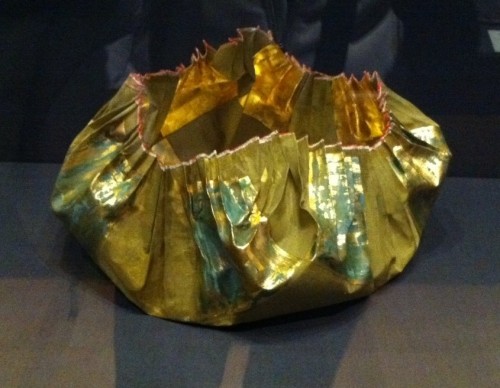
I cannot describe how incredible it is to have the comfort of our home with only Richard and me (and our cat, Merlin) here in it.  For one thing it is very, very quiet.    And for another we can come and go as we please without booking caregivers, worrying about being home at specific hours; it’s hard to believe a large portion of the population lives this way on a daily basis.  I can’t imagine!  So yesterday Richard and I went up to MAD (Museum of Art and Design) leisurely strolled through the exhibits, even wandered up to the sixth floor to the Open Studios, where we met the artist, Fergus Walsh, a puppeteer at work on one of his wonderfully expressive clay looking creatures with funny eye balls.  Then we made our way downstairs to the Beauty in All Things:  Japanese in Art and Design show, where I saw this Bronze Vessel by Iwata Kiyomi, made of metal cloth, composite, gold leaf, silk organza and acrylic paint.

Never once did one of us say with an edge of panic, even though she was right next to us, “Where’s Emma?”  or “I think the kids have had enough, we better get going.”  We took our time, pausing at things we found particularly compelling, like the moving Japanese screens depicting the changing seasons.

Later we went to see a silly movie about two hired assassins who fall in love with the same girl, unbeknownst to her.  By the time we left the movie it was dark. We walked over to a little restaurant in the Flat Iron District we like, Basta Pasta, a Japanese take on Italian food packed with an eclectic crowd of people from all over the world.  We didn’t worry about rushing home to relieve the baby sitter.  We didn’t bother looking at the time.  Though at one point I did say to Richard, “after dinner I think I’ll text Joe and just check in.”  But just as I said that, Joe sent me an email saying both kids were exhausted and asleep having had a great day snow-tubing and swimming.

By the time we returned home we marveled at how quiet the house was.  We discussed what we would do the next day before turning off our reading lights.

“I’m glad to have this time together, just the two of us,” I said in the dark.

“Me too,” Richard said.

“I’m glad the kids will be back Tuesday night.”

“Me too.”

For more on Emma’s journey through a childhood of autism, go to:   Emma’s Hope Book

A Blessing or A Curse

I rewrote and submitted my Waging War post for the Huffington Post.  They changed some of the tenses (I hate when they do that) and published it last night – click here.  Someone commented, “It is great that you come to the realizatio­n that you can accept your child for who she is. However, I know very few parents of autistic children who confuse their children with their children’s disorder — whether or not they wage a war against autism. Children are blessings, autism is a curse.”

That comment made me think about how difficult it has been, for me anyway, to separate Emma from her autism.   I have always loved my daughter.  I have not loved her autism.  Even now, that concept continues to evolve.  I accept that this is how things are, I accept that she has autism, I accept that because she has autism there are many, many things we must do to support and help her.  I accept that there are things that will take much, much longer for her to  learn and other things that she comes to with no trouble at all.  I accept that who she is has as much to do with the autism piece as it does the Emma piece, that in fact the two are not separate.

Any parent with a child on the spectrum has wondered what their child would have been like had they not had autism.  Would she still have near perfect pitch?  Would she still have an amazing memory, the sort of memory that remembers specific people, places and events when she was two years old?  What sorts of things would she like doing?  Presumably her favored activities: the carousel, the zoo, The American Natural History Museum and FAO Schwartz would have worn out their welcome by now.  Would she still fear dogs?  Would she be the sort of child who had many friends or just a few very close friends?  What classes would she excel in?  What subjects would captivate her?  Where does the autism end and Emma start?  Can we really do that?  Can we really separate the two?  Emma’s autism informs every aspect of her life.  And yes, she is a blessing.  Exactly as she is, with autism or without it.

Nic & Em at the Metropolitan Museum of Art

For more on Emma’s journey through a childhood of autism, go to:   Emma’s Hope Book

The Shower

Emma washed her hair this morning.  By herself.  With almost no input from me.  Emma is ten years old.  Emma has autism.   I used to think those few sentences would suffice.  Keep it short and sweet, age, diagnosis, what more needs to be said?  But I was wrong.  Most people who do not live with a child with autism have little or no idea how monumental something like washing her hair unaided is.  Okay, so I stood outside the shower and had to do a little coaching – “Lather the shampoo on the top of your head too, Em.  Good, now behind your ears, don’t miss the hair on the sides, just above your ears.  No, not like that, Em.  Like this.”  Then I demonstrated by pretending to shampoo my own hair, as she watched me and did her best to mimic my movements.

For the past four years, since Emma began preferring showers over baths, Richard or I have aided her in washing herself and her hair.  Richard’s swimsuit hangs in our bathroom, damp evidence of his continued support.  The few times I tried to let Emma wash her hair on her own, I regretted it. Once her hair dried, revealing large patches of unwashed and now even greasier hair, it was all too apparent that help was still required.  As with everything, it is not that Emma cannot eventually wash her own hair, it’s that it takes a great deal longer for her to learn.  Years, actually.  Many, many years.  “Maybe we should move to France,” I suggested one day after a particularly lengthy and difficult session trying to get Emma to rinse the shampoo out of her hair.  Richard looked at me quizzically.

“They don’t take bathing as seriously as we Americans do.”  (To all French people whom I have now possibly offended, forgive me for my blatant stereotyping.)

“Uh-huh.”

A bit later Nic announced that he too, would like to move to Paris.  When I inquired as to why he thought this was a good idea, he mentioned the museums, the great food, I’m pretty sure he even said something about their coffee being superior, a beverage he isn’t allowed to have.  But I knew his desire had more to do with the fact he doesn’t love showering either.

When Emma got out of the shower, she pulled a towel around her body.  Carefully she began to dry her feet, legs, stomach, arms, just as she has been coached to do for all these years.  “Em, you’re doing such a great job,” I said.

“Drying by myself,”  she said, sternly.  Then she corrected herself, “I’m doing it by myself.”

I nodded and smiled at her.

“Mommy, go away,” she said.

So I did.

For more on Emma’s journey through a childhood of autism, go to:   Emma’s Hope Book

A Birthday Party

Emma does not get invited to many birthday parties.  In fact I can count on one hand the number of times she’s been invited to a birthday party in the last year.  Okay, make that one finger.  Don’t misunderstand me, there is no resentment here.  The children with whom Emma goes to school all have autism in varying degrees, food allergies are rampant, each kid has their own specific sensory issues, some have physical challenges as well, so for a parent to take on the idea, let alone put into action, the planning of a birthday party, is a major undertaking.  The other children Emma knows or has any contact with are either her cousins or friends from before her diagnosis and most of them are Nic’s age, not Emma’s.

So when my cousin invited her to her daughter’s birthday party, Emma was so excited, she talked about it for at least a week prior to the actual party, which was this past Saturday afternoon.  Richard was sick with some nasty bronchial sounding cold, lending him a – come hither – husky quality, opted to stay home and not risk infecting all the children and their families with his germ riddled body.  (TMI – too much information – as Nic would say.)  Emma insisted on wearing a black shirt, embellished with little beads at the neckline, leggings and a plaid skirt, all but the leggings were a size too small, despite my suggesting she wear something a size larger.  “No!  Please!  I want to wear this one!” She pleaded.

When we arrived, Emma said hello to all her cousins and though I kept my eye on her the entire time, she did very well.  There were some 30 children aged 5 – 12, mostly girls and mostly Emma’s age – 10.  The family had hired a couple of clowns who did an hour long routine, with gags, pratfalls and “magic” such as the man pretending to eat a piece of kleenex while the woman demands that he spit it out, only to have her pull the kleenex from his mouth, but instead of kleenex coming out, yards of multi-colored tissue pour forth, leaving one to wonder how he managed to get all of that in his mouth in the first place.  An hour is a long time for a child who may or may not understand all of what is being said and done, to sit.  But sit she did.  Right in the front with all the other girls, watching and though I don’t think she laughed at any of their antics, she did seem intrigued.

After the show ended, the other children ran around playing chase while Emma played with the string of a balloon.  When it was time for us to leave, Emma put on her shoes and coat and said, “We went to Gaby’s birthday party at Gaby’s house.”  And by the time the elevator let us out onto the street, Emma looked up at me and said, “We went to Gaby’s house a long time ago.”

For more on Emma’s journey through a childhood of autism, go to:   Emma’s Hope Book

Waging War – Not So Much

I think of myself as pretty determined.  Someone who doesn’t take “no” for an answer.  A person who doesn’t give up easily.  When Emma was diagnosed I thought of “autism” as something to battle, wage a war on.  I saw it as something we needed to get rid of, a detrimental condition, which needed to be excised.   Emma is not “high-functioning” and while there are many people who reject these delineations of high and low functioning in describing autism, I do not know many parents of children with autism who fall in the moderate to severe category who object.  A child who needs support with daily living skills, while also being non-verbal or almost non-verbal has a very different set of issues than a high-functioning child who is mainstreamed and will most likely need support in holding down a job.  Both will need support, but one will need a great deal more and may never have the opportunity to live independently.  There is a difference.

In the over seven years since I learned of autism and first heard the word applied to my daughter, I find I am slowly letting go of the desire to wage an all out war on Emma’s autism and have been coming around to a slightly different view.  A view I hope will prove to be more productive and less stressful, for all of us.  Allow me to state the obvious – Emma is a little girl, first and foremost.  She is funny, has a great sense of humor, loves music and dancing, loves to perform.  Emma feels tremendous anxiety when she doesn’t know how to do something or is asked a question she doesn’t have the words for or is unable to fully grasp the concept of.  She tries hard.  She makes Herculean attempts to do what is asked of her.  She has sensory issues, which I still do not fully know how to help her with.  She has internal issues I no longer expect anyone to be able to diagnose.  And she is my daughter.

A few years ago she went through a period when she raided my lingerie drawer on a regular basis.  Richard and I (and sometimes guests) would be sitting in the living room when all of a sudden Emma would burst forth, donning a bra and pair of my underwear, but otherwise naked.  The bra haphazardly flung around her shoulders, the cups puckered, the underwear sagged and falling off, she gripped a corner in one hand to ensure they didn’t completely abandon her.  The first time she did this, Richard began laughing, while our guest, I think it may have been an electrician who was fixing a blown lighting fixture stared in stunned silence from his perch on a ladder, while I  hustled her back into our bedroom, out of view.  The second time she appeared, wearing the same combination – never any of the more colorful and attractive lacy lingerie I happen to own, always the same set of sensible, no-nonsense skin-toned bra and underwear – I was able to laugh with Richard, before telling her to go put everything back.  Her raid-mommy’s-lingerie-drawer episodes were interspersed with raiding my shoes, thankfully never at the same time, it was one or the other, for which I am grateful.   Her favored pair of shoes was a pair of red suede pumps, which she would clomp around in.  During these forays into my things, Richard would say things like – “She’s mommy’s little girl!”  or “She’s such a girl!”

That I love her, goes without saying.  She is my daughter, Emma.  Who happens to have autism.  The autism piece is complicated, the beautiful little girl/daughter piece is not.  I used to view Emma’s autism as something separate from her.  I used to think of it as something, like a tumor that needed to be removed.  I am coming around to having a less draconian point of view.  I am beginning to have some acceptance around it.  I find myself thinking less about ridding her of it and more about helping her be all that she can be.  Waging war has been exhausting.  Maybe, in the end, it all comes down to nothing more than semantics, but I am tired of battling something that does not need to completely define my daughter.  I am lucky, Emma is verbal, Emma has shown that she can and will learn to read, write, communicate more appropriately, focus, and is able to understand abstract concepts such as time, names, part vs whole, same vs different, etc.  It just takes a great deal more practice and time.

For more on Emma’s journey through a childhood of autism, go to:   Emma’s Hope Book

Teaching a Name

When Emma was a year old, in a moment of impatience we bought her a baby doll for Christmas.  Despite the fact she showed no interest in dolls of any kind, despite the fact she showed little interest in any of the toys we tried to entice her with.  Emma was much more of a doer than a child who sat happily playing with a toy.  This was a kid who liked to move.  Take her to the playground and she made the other kids look lethargic.  I admit, I took a certain degree of pride in her rejection of all toys and her desire to move and run and slide instead.  Emma’s disinterest reminded me of my father who shunned all holidays, grousing that they no longer celebrated what they were intended to, but instead fed the insatiable Hallmark Greeting Card’s appetite for cheap sentimentality and  had become a financial boon for ad agencies.  His grumpiness about it all, increased with his age.   Emma’s resolute rejection of all toys, her disinterest in videos, movies, and anything else that required her to sit still, would have made my father proud.

The baby doll we purchased was pudgy, with blonde pigtails, and came with a little toilet, hairbrush, mirror, bathrobe and towel.  All that was missing was a mani/pedi kit and perhaps some massage oil.  I bought a couple of little playsuits for the doll and wrapped everything up in pretty paper with a big satin ribbon.  We had to help Emma as she showed no enthusiasm in her gifts piled under the Christmas tree.  She begrudgingly humored us by tearing open the present, but showed no excitement, it was as though it were a chore,  something that was expected of her.  When she saw the baby doll, securely fastened in it’s box with a clear window so that she could see it, but not actually reach it, she lost all interest and wandered off.  “Emma, look!  It’s your very own baby doll!”  I exclaimed.  “What are you going to call her?”  Being ignored during those early years was something we had grown used to.  Still, I persisted, carrying the baby doll over to her, I said, “What’s her name?”  Emma refused to look at me or the baby doll.

Years later, during out DIR (Developmental, Individual Difference, Relationship-based Model, also known as floortime) phase, the baby doll, now joined by a number of other baby dolls, groovy girls, Jessy and Woody from the Toy Story, Tim Burton’s Corpse Bride, each one evidence of our ignorance and dogged determination to engage her in the world of make believe, lay untouched in a pink plastic bin near her bed.  In a moment of inspiration I yanked the baby doll from its bin and thrusting it in Emma’s face, asked, “Oh look Em!  What’s her name?”  Emma said nothing, but I persisted.  “What do you call her, Em?”  And then Emma spoke.  “Doll,” she said.  “Yes, but what will you call her?”  I was nothing, if not determined.  “Is her name, Tabitha or Katherine, Anastasia, Cynthia?  What’s her name, Em?”  The idea that naming something was not a concept Emma fully grasped, never occurred to me.  When Emma then repeated the names I was throwing out, I eventually gave up and as I was leaving, Emma said, simply, “Doll.”

And of course, she was right.  It was a doll.  To Emma that was all she was.  A doll.  For a child with little or no ability to understand the world of make believe, the idea of naming a doll, must have seemed bizarre.  Why would one do that?

Last weekend, at Barnes & Noble, I showed Emma a book called Biscuit, a beginning reader book.  Emma took the book from me, sat down on the carpet and pointed to the first word.  “Biscuit, that word says Biscuit.  That’s the dog’s name,” I said.  Emma nodded and continued to read the book, stumbling over a couple of unknown words, but for the most part being able to get through it with little help from me.  As I sat with her I remembered her baby doll and it occurred to me, she does not fully understand the concept of naming.  It is something I will attempt to teach her this weekend.

For more on Emma’s journey through a childhood of autism, go to:  Emma’s Hope Book.com

A Case of Mistaken Identity

The latest issue of the magazine AARP arrived last week.  It’s the hot potato in our house as Richard will place it on the keyboard of my computer or by my things to take to work.  When he’s not looking I will then surreptitiously put it on his desk in our office, both of us denying that we’ve had anything to do with it.  “Did you put this on my computer?” I’ll ask, waving the magazine in front of him as I head out to work.  “Nope.  Didn’t see it,” he’ll reply.  “You know, it’s your magazine.  It’s addressed to you,”  I’ll inform him, as though he hadn’t noticed or that this will change the fact that we are both over 50 and therefore deserving of its presence in our home.  Truthfully, I am careening toward 52 at a frightening pace.  How did I get here – I find myself wondering.

Last Friday, there it was on my desk, a reminder of the passing of time.  Sharon Stone graced the cover, beaming, in all her youthful beauty.  The only indicator of her advancing age were the reading glasses dangling from her right hand.  I admit, I took some solace in seeing that she too requires reading glasses.  Emma bounded into the office and plopped down on my lap.  She looked at the photo of the dazzlingly gorgeous Sharon Stone and said the most beautiful words perhaps she has ever uttered, “It’s Mommy!”  she exclaimed, before demanding to watch a YouTube video.  (It must be said, I did NOT correct her, I should have, I know.)  She could have asked for anything at that point.  The world was hers for the taking.

In a moment of pure vanity, a moment I admit to being ashamed of,  I showed her the magazine last night, just to see if she hadn’t somehow changed her mind.  Sure enough, she glanced at it and said, “There’s Mommy!”

Love that kid.

For more on Emma’s journey through a childhood of autism, go to:  Emma’s Hope Book