Category Archives: Parenting

An Ode To Richard ~ On His Birthday

Richard’s birthday falls on Valentine’s day.  We met on Christmas day at a Christmas party.  I didn’t know many of the people at the party, but parlor games were being played (always a good ice breaker) and Richard, no matter who he was teamed up with, was winning.  I remember seeing him seated on a couch near the window that looked out on to the snow drifts on 8th Avenue.  I remember how intense he was and focused.  He was funny, in a dry, smart kind of way.  He was  one of those people who doesn’t seem to really care about what others think, a bit of a rebel, certainly someone who doesn’t take orders from others.  (Have I mentioned that people say I can be a little “bossy”?  Not that there’s any truth to that mind you.  I just have really good ideas about how things should be done.)  I remember the way he looked at me.  I remember saying to him in front of everyone there, “Are you flirting with me?  I thought you were flirting…”  He grinned at me, with those dimples of his and answered, “Well I was flirting, but I was also asking you a question.”

I can’t remember the question any more.

Right from the beginning ours was not a traditional nor particularly conventional courtship, if you can even call it that.  We went out with groups of friends a few times, always making sure we sat together, always pretty much ignoring everyone else.  We had planned on going to a New Year’s Eve party together, but Richard got the flu, so I went alone.   The next day I received a call from my mother that my father wasn’t well.  I grabbed my wallet, a toothbrush and a pair of underwear, (I’m serious and yes it was a bizarre choice, particularly as I brought nothing else) hailed a cab and caught the first airplane I could get, out west.  Those were the days when you could show up at the airport, without a driver’s license and take a plane where ever you felt like going.  By that night I was at my parent’s house.  Two days later my father died.  Richard and I spent at least an hour every night on the phone.  He held my virtual hand.  He said all the right things, he listened, he talked, I listened.  We talked about death and life and our childhoods and everything in between.  There were lots of tears and emotions.

A week later I returned to New York in love with a man I had spent almost no time with alone.  But I knew the essentials.  I knew he was kind.  I knew he was smart and funny and wise and ambitious and curious and utterly unconventional.  I knew he was a tad quirky.  I knew he had strong opinions, was a bit esoteric, had some weird ideas about aliens and wanted more than anything to see a UFO in his lifetime.  I knew he had a tough childhood and a past that was complicated and I knew we were both in for the ride of a lifetime.  I knew it wasn’t going to necessarily be an easy relationship,  we are both far too feisty, opinionated and sensitive for that, but I knew this was a man who would challenge me and I wanted and needed to be challenged.  That hasn’t changed.

Over the years we have learned to give each other slack, to not pick apart every perceived slight, we have learned to weather our differences, we’ve learned to respect our marriage even when we’re angry with each other and don’t agree.  We’ve learned the art of letting go, not needing to control so much, it’s definitely a work in progress.  We’ve learned a great many things from each other and we keep learning.  We have two beautiful, quirky kids whom we love and adore.  We do not own them.  We do not mistaken our children as extensions of ourselves.  We do not mistaken each other as extensions or expressions of ourselves.  We are a family, a beautifully diverse, vibrant family who respect one another and give each other the space each needs to (hopefully) grow and flourish.  Richard reminds me to “take it down a notch” when I become too fixated on something that is not within my power to change, he encourages me to fight and change the things I can, he is always there for me, supporting me and cheering me on.  He believes in me even when I don’t believe in myself.  He believes in our children with the same dedication and passion.

I can honestly say I love him even more today than when I first fell in love with him on that snowy, wintry Christmas day so long ago now.

Happy Birthday dear Richard!

Richard – then

A young Richard Long

Richard – Now

*Richard

Emma Knows Best

This past Christmas I bought Em a snow fort.  Em loves bouncy castles and the snow fort looks a bit like a bouncy castle.  It seemed like an excellent idea at the time, except that it was missing a key component – it didn’t bounce.  It’s one of those gifts that looks good when you receive it, but once it’s been constructed it’s not so interesting.  Even I wondered, once we’d blown it up and put it out in the snow, now what?  What exactly does a kid do inside a snow fort?   Em was a trooper and sat inside it for a minute or two before extracting herself.

Em's Snow Fort

“No, it’s not a bouncy castle,” Emma said shaking her head as she wandered back into the house.

I stood there looking at it for a minute before following her.

“It doesn’t bounce,” I told Richard.

“Right.  It is without bounce,” Richard reiterated.

“And it’s not even a castle,” I added.

“It’s an inflated dome,” Richard said.

“It’s basically a piece of colored plastic,” I replied.

“What were you thinking?” Richard grinned at me.

I could interrupt this dialogue by going on at length about how Richard has the single best smile of any human being I’ve ever met, how when he grins these little dimples appear that take my breath away, how I can become so distracted I lose track of time, thought, words… I could do that, but I won’t.

Theatrical pause and winsome smile.  

Now where was I?  Oh yes, thinking… what was I thinking?  Well, the truth is I didn’t think it through.  I was thinking about her love of bouncy castles and how this looked sort of like one.  I remembered over the summer how we’d gone to our local YMCA to play on the bouncy castle they’d set up for a limited time and how the guy setting it up didn’t know how to operate it and finally Emma had to tell him.  At first he didn’t pay attention to her, probably assuming she didn’t know what she was talking about because of her non-fluency with language.

“What’s she trying to tell him?” another mom asked me as we watched from across the room.

“She’s telling him that he needs to tie the other end and that he has the air pump attached to the wrong tube, but he won’t listen to her,” I explained.

“Should we go over?” the mom asked.

“I already did.  I told him to listen to her, but he seems to believe he knows what he’s doing,” I said.  “I’m betting on my daughter.  She is rarely wrong about things like this,” I added.

“I’m betting on your daughter too,” the other mom said.  The guy fumbled some more with the defeated looking, semi-inflated bouncy castle as Emma looked on with an exasperated expression.

Finally he did as Emma instructed with a little help from me and the other mother, and the bouncy castle was, well, bouncy as it was meant to be.  Emma was ecstatic and soon joined by a dozen other kids all screaming and bouncing together.

That’s what I was “thinking”.

Moral to the story ~ A brightly colored inflatable plastic dome is not the same as a brightly colored inflatable plastic bouncy castle.

Feel free to add your own wisdom to this story or add your own story…

Mistakes Will Be Made

Over the weekend something happened.  I did something I regretted.  It was one of those “jokes” that isn’t funny.  One of those things that afterwards you wonder why you ever thought that was even remotely funny, because it wasn’t.  Instead it was hurtful and nobody thought it humorous.  I immediately apologized, but my apology wasn’t enough to make the hurt disappear.  Apologies are like that.  They’re certainly better than nothing, but they don’t erase the regrettable action.  So there I was holding this child who was understandably upset because I did something without thinking or stopping to ask myself “is this a good idea?” “If someone did this to you, would you think it funny?” I felt terrible.  The child felt terrible, but allowed me to tell them how sorry I was.  They allowed me to hold them.  They allowed me to witness their upset and it took everything in me to stop talking, to give them the space to feel their feelings without tramping all over them with words.

“Aw….”  Emma said as she embraced the child.  “_____’s upset,” Emma said, looking at me with concern.  “_____’s sad.  He wants to go to Sydney’s playground.”  Emma was doing her best to make sense of the situation, citing a playground long ago closed.

“No, that’s not it, Em.  I hurt ____’s feelings and….”  I looked over at Richard.  “Well I shouldn’t have done that,” I finished.

“Aw….”  Emma said again, wrapping her arms more tightly around the other child’s torso.  “It’s okay.  Take a deep breath.”

“I’m okay.  Thanks Emma,” the child said.

“Aw…” Em continued.  “Here.  Take a deep breath… It’s okay.”  Em looked over at me and said, “Then time to do yoga!”

It was one of those moments.  A moment where there are lots of feelings, lots of different emotions.  Sorrow and remorse for doing something hurtful to another person.  Proud of my daughter for being so kind.  Concern for the hurt person’s feelings.  It was one of those moments when you know you’re never going to do it all beautifully or elegantly or even well, but that you, like everyone else on this earth does things you wish you hadn’t and you can sit with that and hopefully learn from it so you don’t repeat it.

I watched Em hugging this child.  I watched this child feeling their feelings and I knew the biggest apology I could give was not one of words, but of honoring and respecting their feelings, without trying to undo or change or make light of it.  I know, once I make a mistake, I must not make more mistakes in an attempt to cover up the original one.  Once I make a mistake I have to own it.  I have to acknowledge the other’s feelings and respect them enough to give them space and the time they need to process, while being there if they want or need me to be.

As a friend of mine said –  if you don’t want someone to have bad memories of you, don’t do things to give them any.

Nic reading to Em – January, 2013

Nic & Em

The Signs of Neurotypical Spectrum Disorder – A Parody

*This is a parody

The following “red flags” may indicate your child is in danger of having Neurotypical Spectrum Disorder (NSD).  If your child displays any of the following, take them immediately to an allistic or non- neurotypical pediatrician or family doctor for evaluation.  Caught early enough many children have shown dramatic improvement.  Studies show that intensive early behavioral interventions can and do help these children flourish giving them the opportunity to become honest, creative, non compliant thinkers who will not be overly concerned with amassing wealth by any means necessary or driven by self-serving desires and wants.

  • Emoting and peculiar noises when confronted with adults who make ridiculous faces and sounds at them by six months
  • Excessive self involvement by nine months
  • Excessive “babbling” seemingly to gain attention  by 12 months
  • Pronounced back and forth gestures such as pointing at random objects, reaching, and waving at anyone who smiles by 12 months
  • Difficulty occupying themselves, requires others to “entertain” them almost constantly
  • Tremendous number of words, particularly farm animals, the noises those animals make, peculiar songs about spiders crawling up drain pipes, and the various ways in which a bus and it’s parts work by 18 months
  • An abundance of ego based two-word phrases such as “I want”, “I need”, “I go” or phrases using “me” by 24 months
  • Peculiar and inappropriate play with representational objects, such as pretending to feed a plastic doll air, or make the doll “drink” from miniature tea cups by 36 month
  • Fascination with fairy tales about people falling into endless stupor, only to be woken by a complete stranger’s kiss or meeting someone on a horse and riding off with them, without getting to know them first
  • Overly concerned with what others think otherwise known as having a “herd mentality”
  • Overly compliant and especially eager to please any adult, even if the adult is a complete stranger
  • Rote and often dishonest answers to questions such as “how are you?”
  • Generalized dishonesty often used to get one’s way by 36 months
  • Inability to remove emotion from disagreements
  • Uses language to deceive by 50 months
  • Mob mentality – tendency to become influenced by those they believe to be in power by 50 months
  • “Group think” does not question, but follows what is considered to be the majority thinking
  • Making fun of, laughing at or showing fear toward any who appear different than themselves (this can include those with a different neurology, skin color or even nationality
  • Difficultly staying present.  Constantly thinking about the future or past.
  • Easily “bored”

It is imperative that you seek help for your child if you suspect they are at risk.  Though Neurotypical Spectrum Disorder can be mildly to severely disabling, NT Speaks has numerous resources for families whose children may be suffering and afflicted.  You will be relieved to know NT Speaks employs not a single neurotypical and no Neurotypicals are on their advisory boards.  In fact we do not consult, listen to, or speak with any who are on the neurotypical spectrum as we have learned they have a tendency to be dishonest, will do anything to be “liked” and are almost always self-serving.  We are a non-profit whose goal is to cure neurotypicals.  All our research dollars go toward funding pre-natal testing and cures for this terrible crisis our world is currently facing.  Do not let your child become a burden on an already beleaguered society.   Let us help you.  Call us at 999-9999-9999 (en Espanol 999-9999-9990) or email saveusfromtheapocolypse@neurotypicalspeaks.org

*This post is a parody.  However the wording is almost identical to the wording used by many organizations that claim to want to “help” those who are Autistic.   

images

“The Signs Of Autism”

When my daughter was diagnosed I heard all the autism statistics.  I read a great deal and I learned a lot.  But what I learned was not so much about autism as it was about non-Autistic perceptions of autism and what that meant to those who are not Autistic.  Non Autistic people tend to view autism with tremendous fear.  There’s so much we don’t know.   Non Autistic parents are left trying to sift through the opposing opinions about a child they may have a difficult time understanding.  Most parents deeply love their children and want what they believe is best for their child.  So when they see literature describing the “signs of autism” it looks scary.  The various “signs of Autism” do not bring them any closer to understanding their child, rather they serve as a critique.  Right away parents are shown how to view their child as less than, as not good enough, as “wrong”.

From the Mayo Clinic the first sentence under the heading “Symptoms” reads, “Children with autism generally have problems in three crucial areas of development – social interaction, language and behavior.”

If I had read this sentence upon receiving my daughter’s diagnosis I would have thought, okay, so how do we fix these problems, because  problems are to be fixed, right?   And though I did not read this exact sentence in 2004 when my daughter was diagnosed, I read a great many just like it.  I never once thought about the sentence and who was writing it.  I never once questioned it’s validity or examined the words being used.  It never occurred to me to read this sentence with skepticism and doubt.  It didn’t occur to me to wonder how my two-year old daughter might feel growing up in a society that believes the ways in which she interacts, speaks and behaves are viewed as problematic.  But I think about all of this now.  Not because my daughter is reading a sentence like this or because we are discussing things of this nature, but because I see everything regarding autism and those who are Autistic differently.  I am hyper aware of the judgmental and critical tone in almost everything to do with autism because I now know a great many people who are Autistic and they explain it to me.  I now know how offensive this language is and I understand why.

So let me ask all of you who are not Autistic this – how would you feel if you were described from the moment you were born as problematic?  How would you feel if you were taken from one doctor to the next, examined and criticized?  How would it affect you if you were told, “Stop looking at me when I speak to you!”  And then when you found that impossible, the person physically reached down and turned your head away so that you could not make eye contact.   How would you feel if you were paying attention and suddenly two hands grabbed your wrists and shook them so that  your hands flapped rapidly on either side of your face.  When you tried to pull away, you were told, “Move your hands!”  How would you feel if you were happily playing with your dolls and your parent demanded, “What are doing? Why are you making them interact that way?  Why are you trying to feed it?   You understand this is a piece of plastic and not real, don’t you?”

The point I’m trying to make, (probably poorly) is that almost all the literature about Autism is written by NON Autistic people and negatively compares Autism to a different neurology.  Is it any wonder parents feel so confused?  How is this thinking helping our kids?  How is it helping parents?

Presents

Different Neurology ~ Different Perception

When I began writing about the actions many take that are labeled “self-injurious behaviors” I had some ideas from my past of self harm (bulimia, anorexia, compulsively overeating, etc) about what that might be like.  When my daughter began biting her hand and arm, punching herself in the face or chest, I knew I was seeing something different, but there seemed to be enough of an overlap that I felt I had a small degree of insight into her experience.  But there is a difference between self harm and the actions many take to mitigate external pain such as cluster headaches and the pain brought on by a variety of sensory issues.  Others have described the action of biting, pinching, head banging as a way to center themselves, they describe the calm they feel afterwards and many describe a sense of relief as well as others who say they are able to make sense of space and where their bodies are.  Many described how when the underlying source was treated the desire to bang, punch, bite went away.

Anonymous 1 (who I quoted in yesterday’s post) said, ”When I bashed my head, though, the screaming stopped. It just cut off, and then the pain spread over my entire scalp, like a blanket over my brain.

I couldn’t stop thinking about this sentence.  So I reached out to ask for more about the “screaming”.   Anonymous 1 responded:

I can hear shapes and colors, and sometimes I feel music in a very literal way. Like, slow adult contemporary stuff my mom plays makes me start itching and it makes my clothes feel too tight. The scream in my head works the same way. When I’m having a sensory day, it starts wailing away and makes it hard for me to maintain emotional equilibrium, until I lash out (either through SIB or by becoming verbally abusive to people around me). Similarly, if I’m put off emotionally by something, like someone being selfish, then the scream will start up until I’m scratching at myself and teasing the broken bones in my hand just to give myself a pain-stim that will shut it down.

“If I had to describe it, I would say that emotions are a sense, in the way that sensory issues work for me. They mix with the other senses, bleed into them synesthetically, and the integration issues for both emotions and sensory input have exactly the same process in my head. The act of both of them happening at once, where I can’t focus on just one or the other, produces the scream. Some days, I can clamp down on it and keep it in my head. Other days… meltdown. SIBs. Crying. Fighting with family.”

Anonymous 4 wrote: “I like to bite my arm. I know. It sounds weird, but I love the feeling of the shimmery yellow and blue and white sensation that flows down my arm.  There is nothing like it.

When I read this I thought about how easy it is to assume we understand until someone describes their experience and it is very different from what we assumed.    It seems to me this is an important piece.  I know Anonymous 1 and 4 are not the only ones who have this experience with synesthesia.  Judy Endow discusses how she perceives words through the sound and movement of color.  I have heard others describe variations on this as well.  If ones neurology finds meaning in spoken words through movement, sound and color, it would stand to reason, emotions and sensation would be perceived this way as well leading them to do things that might cause those witnessing it as something to be stopped.  I have to wonder how many, who are in the field of Autism are hearing these kinds of experiences.  So much regarding autism comes from those witnessing it,  people who want to understand, but whose own neurology may make it very challenging, if not impossible, for them to do so.

“Self-Injurious Behaviors” ~ Let’s Discuss

I’m continuing to research SIBs, which stands for “self-injurious behaviors”.  It’s far too complex a topic to tackle in a quick  800 – 1000 word post. There are a number of topics it seems important to discuss,  which all fall under the heading of “self-injurious behavior.” (Feel free to add more in the comments section, this is definitely a work in progress.)   I’ve broken these topics down to include:

  • The language we use to describe such actions.
  • The perception (usually of neurotypical parents, caregivers, doctors, school employees, educators and the general public) of what these actions may or may not mean, this is particularly critical when the person taking such actions is partially speaking or non-speaking.
  • The personal experiences of those who have engaged in such actions that may or may not lead to real injury.
  • The experience of those who want to help and/or are in a position where they may be held accountable for the actions or inactions taken.  (This includes parents who love their child and would do anything to lessen their child’s frustration and pain.)
  • What can be done to help those who head bang, bite, pinch, punch or engage in actions that lead to serious and/or permanent injury?
  • What can be done to help those who head bang, bite, pinch, punch or engage in actions that are difficult to witness, but do not lead to permanent or serious injury?

I will try to cover all these various sub-topics, but first I’m going to tell you a story.

Emma sits cross-legged on the floor in our living room.  Her tutu billows about her plump legs, it’s pink ribbon sash lies undone near her.  In one hand she holds one of my red suede pumps, it’s small round heel directed at her forehead.   Wordlessly she smacks her head with the shoe’s heel over and over again as if she were driving a nail into a wooden plank. 

“ NO!  Emma, don’t!” I plead, running over to her.  I take the shoe from her, kneeling down to survey the damage.   There is no blood, just a small pink mark above her left eye where the heel made contact.

Instinctively I pull her into me wanting to comfort, but she resists.  She stares over my shoulder.  No sign of pain, there are no tears, no distress.  Her face is the face of a perfectly content toddler.  Whatever emotional trauma I imagine for her is mine alone.  She turns away from me and reaches for the other shoe lying a few feet away. 

“No Emma!  You cannot hurt yourself,” I say as though this were a natural thing to remind such a young child.  Bewilderment overwhelms my shock.  Emma stands up and wanders off, leaving me with one red shoe in each hand.

This was how I responded to Emma’s seemingly bizarre actions.  This was how I continued to respond to Emma when she began to bite herself.  This was all I knew to do.  Remove the thing that was causing damage, except that when that “thing” was her own fist or fingers or teeth I was powerless and defeated.  So I begged her, pleaded with her to stop, usually in a loud, panic-stricken voice.  Why was she feeling compelled to do such a thing?  Was it a deep need for sensory input? Did her head hurt?  Was she trying to cope with internal pain caused by some outside source – the daylight streaming in through the window, the heat from the radiator, the clicking noise the steam heat made as it surged through the pipes, was there some noise only she could hear that bothered her, did the fabric from her tutu itch or dig into her skin, or was it something else that I couldn’t see or understand?

I spoke with experts, doctors and other parents, but I never learned how to help her.  I watched YouTube videos and read research articles, I spoke to school staff, psychologists and people who work in hospitals.  Nothing I read or heard about made much difference other than to make me feel even more panicked and fearful.  The language used by those in the field of Autism is almost uniformly fear based and along the lines of deficit thinking.  By saying someone is engaging in “self-injurious behavior” we are suggesting they choose to “behave” this way.  But what if this is actually incorrect?  What if you were unable to make yourself understood through spoken language and had a horrific headache?  What if you could not use words to describe the pain you were in?  What might you do?  What if you felt such a surge of frustration you lost the ability to speak?  What if you could not find something or something broke or the music you were listening to or the DVD you were watching was calming and beautiful and it suddenly, abruptly, stopped or skipped, what if you needed it and now it was gone?    What if the only way you felt better and calmer was by hitting yourself.  What if the very sensation viewed by onlookers as harmful was actually helpful to you?

To someone like my daughter, her response to upset of various kinds is not the response of a child being difficult or bratty or frustrated.  Hers is the response of someone who’s world is coming to an end.  She is in full panic mode.  If she said, “I can’t take this.  I’m feeling completely overwhelmed, I don’t know how much longer I can hold on, I just want to scream and punch something!”  We would nod our heads and say, “gosh I know exactly how you feel!  I’ve felt that way too!  Let’s talk about it!”  We would go over and hug her and she would take solace in knowing she wasn’t alone and the hug might make her feel loved and she might even feel safe enough to talk about it more.  Her situation wouldn’t change, the feelings leading up to uttering those words might not change, she may still feel overwhelmed and not know how to change those feelings, but through talking about them, we talkers have come to see there’s some comfort to be had, because our brains are programmed that way.  This is what most of us, who are more neurotypical than not, have found.  Except that my daughter’s brain doesn’t work that way.  Talking and hugs do not help her when she feels overwhelmed, in fact talking and hugs increase her upset!

In addition Emma’s experience of pain is different from mine and many people’s.  Emma can twist and yank out a tooth within an hour of it feeling even slightly loose.  Emma can have an ear infection that is so bad the pediatrician was incredulous.  Emma can show no signs of illness but is found to have strep throat, caught by her doctor only because we happened to be in his office for a routine wellness check up.  Emma craves sensory input on a level Richard and I find astonishing.  She turns the volume up as high as the TV or DVD player will go of her favorite songs or movies.  We are literally blasted out of the room she is in.  Sensory input is needed at levels we cannot tolerate.  For Emma this isn’t a “behavior” this is a need.  How this plays out when she bites or hits I cannot fully know, but that they do, is something I feel sure of.

Last summer I spoke to my friend Ibby who explained why yelling at Emma to stop hurting herself was not working.  “It’s a lie,” Ib said.  She explained that by telling her she “couldn’t” do something, something she’d just done right in front of me, as evidenced by the teeth marks on her arm, was a lie.   A lie that made no logical sense.  So I stopped saying things like that.  Soon after I stopped yelling at her, I realized that anything I said could be heard as scolding, judgmental and counterproductive, especially when done in a loud voice.  Now that I have a better understanding of language and how language can come and go, I understand it isn’t just Emma’s ability to communicate, it’s her ability to understand all verbal communication.  All spoken language, both hers and anyone else’s goes out the window.

I have to stop talking.  This is counter intuitive for me, but it’s key.  Stop talking.  I have to remind myself of this.  If Emma is in the midst of an upset where she has begun to bite herself, no amount of logic will prevent her from biting mid-bite.  When Emma is biting herself this is an indication to me that I need to be quiet.  Sometimes she will come to me and allow me to put my arms around her in a firm embrace, other times she will reject all contact.  In the midst of an upset I have learned the single best thing I can do is – nothing.  No words, no physical contact, nothing.  I remain nearby and I wait for her to come to me if she needs or wants to.  Once she is calmer, I have a chance at figuring out what led up to the upset… maybe.  Once she is calmer I can try to see if there’s a pattern so that I can interrupt it next time before she gets to the point where biting herself seems like the only solution.

The single most unproductive thing I can do in the midst of Emma’s upset is to scold, admonish, restrain and judge her.  This may seem obvious to many of you, but it wasn’t obvious to me.  Some of the things others have recommended:

Judy Endow wrote:  “DISCOVER AND ELIMINATE PHYSICAL PAIN.  I have worked with many autistics who REAL PAIN and trying to change behaviors is like telling someone you love that you don’t want to know anything at all about their pain and in fact you want them to learn to behave as if they did not have any pain at all! So many behaviors turn out to be physical – one little girl who banged her head so hard it put holes in the walls, caused concussion and wore a locked helmet was discovered to have had head lice for so long that the lice had burrowed so far under her skin she had to have some sort of specialized treatment more than lice shampoo to get rid of them. She had lice for over 3 years before it was discovered due to them burrowed under her scalp!!! Once the lice was gone so was the head banging.”

(Judy Endow has written a terrific work book Outsmarting Explosive Behavior and while she doesn’t mention “SIBs” specifically, the steps she suggests will certainly be helpful for many.)

In answer to my question “Was there anything that helped?  If so, what?”  Kassiane wrote:  “Treating my cluster headaches. Leaving the SIB alone, treating it not just as a ‘mysterious autism behavior’ but as a release valve for stress, & eliminating or reducing the input that was pushing that far. Changing the situation has a much higher success rate than “stop doing that”, because I need a way to cope with the situation that leads to chewing my hand…I dont even notice until I’m a bit…gnawed.

Anonymous 1 wrote:  “I do remember, in those early days, that I liked the head-bashing because I only needed to do it once or twice. I could pound my fists into the dirt until my knuckles scabbed up, but the pain that I felt would barely measure up to the sound of my own screaming in my head. No matter how much I tried to let it out, it just never worked. I would punch myself into exhaustion and fall asleep, still feeling completely trapped, helpless, and alone. I would wake up afterward hearing my own screaming in my head.

 “When I bashed my head, though, the screaming stopped. It just cut off, and then the pain spread over my entire scalp, like a blanket over my brain.

Anonymous 2 described a prickly sensation all over their scalp caused by a new haircut.

Many spoke of the frustration leading up to the biting, hitting, etc.  Redirection seemed to help less serious actions, but everyone, everyone agreed that scolding, punishment or anything that could be viewed as punishment made the punching, hitting, banging and pinching much, much worse.

Having said all of this, we are fortunate in that Emma has never done more than left a mark on her arm or hand.  But there are others who do.  There are children and people who break bones, break the skin, and do permanent damage to themselves.  What then?  What does one do to help them?  What can be done?

I’m afraid I have no answers for these situations.  But whatever the “remedy” or “therapy” being employed, we have to ask the person who is being subjected to these various things if it is in fact helpful and if they are unable to communicate by typing, writing or speaking, we must ask ourselves  –  Would I want to be treated this way?  This is, at least, a starting point.

Self Injurious Behaviors ~ Questions

I’ve been working on a post about self-injurious behaviors for a few days now, but I realized this morning I need some feedback from all of you before I proceed.  If you aren’t comfortable commenting here, please write me at emmashopeblog@gmail.com.  Everything anyone tells me will remain confidential, unless you specifically tell me I may quote you. If you are comfortable with my quoting you, be sure to tell me!

Have you or anyone you know engaged in self-injurious behaviors?  

Can you describe the behavior?

What was done?  

Did it help?  

If not, did it make it worse?  

Was there anything that did help?  

If so, what?

If you have witnessed someone who self injured did anyone speak to you about how you felt being a witness?  If so, was it helpful?  If not, do you think it would have been?

All comments on this topic are welcome, even if they do not answer any of these questions.

Thanks so much and have a great weekend everyone!

Emma’s Self Portrait – 2013

photo


Do You Prefer Writing to Speaking?

I think a great deal about writing and how I write less because it feels like a choice and more because it is a need.  I am far more comfortable writing than I am speaking, though people who know me well may find this surprising as I certainly can go on and on about things I feel passionate about.  Writing is the most honest way I can communicate.  When I am speaking to another person(s) I am easily caught up in the emotional exchange, whether it is verbal or not is of little consequence.  I am all too aware of the other person’s tone, their facial expression, the volume they are using, the emphasis they place, the way they move as they are speaking and together with the words that come out of their mouths I make interpretations about what they really mean.  I’m sometimes wrong, sometimes I’m right, but most of the time I have no idea whether I’m right or wrong because I cannot ask to verify my conclusions.

If someone raises their voice in anger, I cannot “hear” them.  Literally, they could be saying anything to me, but I cannot hear their words above the “anger tape” that is embedded in my brain and clicks on when they begin to shout.  The anger tape is ugly and cruel, words are brandished as weapons and used to make deep, painful cuts that take my breath away.  Once the tape begins to play it is almost impossible for me to turn it off.  Still I’ve gotten better and can even say, “I can’t hear you, when you’re yelling.”  Sometimes that works, sometimes it doesn’t, even so it’s better than remaining silent.  I think about these things a great deal because of my daughter, who cannot access language easily.   I think about communication and how much of it has nothing to do with actual words.  I think about how I am 52 years old and am just now beginning to really make strides in how I communicate with spoken words in the face of anger and upset.

Writing though, writing is different.  I can think about the words, I can use metaphor, simile and punctuation to enhance.  I can take my time.  I can savor and wallow, I can perseverate.  Words are little sparks, placed together they can sputter and die or surge forth creating something unexpected and beautiful.  Some days it’s easier, the words flow readily and easily.  Whatever I’m writing about takes on a life of its own, the words spill out, paragraphs come together.  On days like that it all feels magical.  But there are other days when I write and delete, I agonize, the words do not obediently fall into place, they are stubborn, they scatter or elude.  I must remind myself to breath and refocus.  But I am dogged and know from years of practice the written words will come if I’m patient.

However with the internet and social media written communication is presenting some of the same problems I have with speech.  If I’m having a written conversation with someone it can go too quickly for me.  I can’t take the time and care I want or need to say things in a way I’ve intended.  I can get swept up in the emotional content of the words being written, either my own or the other person’s and I become easily confused.  Sometimes I perceive the written words in the same way I do when someone begins yelling and I can no longer process what they are saying.  The anger tape has clicked on, the volume is so loud, the content so cruel I’m transported to that miserable place of feeling all my worst fears are being confirmed.  I have thought of this as an “anger tape” but another apt word for what happens to me is what is called “scripting”.  This is a word used often regarding autism; my anger tape is most definitely a script.  And once it’s been activated it is almost impossible for me to turn it off.

I welcome these insights.  So much about autism is covered in thick layers of seemingly impenetrable “otherness”.  That puzzle piece used to symbolize Autism isn’t doing any of us any favors by the way, but that’s worthy of a whole post all on its own.  Whenever I discover things I have experienced, things I know about myself that give me clues into what my daughter or my friends who share her neurology may be experiencing, I am grateful.  I need these insights to help me understand, but also to help me progress and grow as a writer and human being.

Em

The Magic of This Moment

Early this morning:

Nic: I’m late!  Gotta go Mom.

Me:  Okay,  babe.  Have a great day!

Nic:  I love you.

Me:  Love you!  Bye babe.

Emma:  Love you, Nicky..

Nic:  I love you Em.

Emma:  Bye bye

Just another typical conversation, right?

Um no.  No.  Not at all.  Nothing typical about it.  This.  This is why I don’t envy any other family, this is what I treasure about MY family.  This is exactly why, this conversation, this seemingly common, innocent, no-big-deal conversation…. yeah.  Because this conversation has never been uttered before until this morning.  And weirdly Nic and I were talking just five minutes before, while the three of us had breakfast about the importance and magic of being present.  We were discussing how this moment, right now, this second will never be repeated.  We may have moments like it, but this one?  Nope.  Never again.

And as we were talking about all of this, Nic interrupted me and we had the above conversation, the one I’ve just transcribed.  It may seem un-noteworthy to many of you, you may be thinking, so what?  Or who cares?  But to me, this conversation that other families have, perhaps on a daily basis and don’t think twice about, they are little nuggets of pure gold because these moments with my children are gifts, each one of them, pure gifts that I am so lucky to have.

In Buddhism there is emphasis on being present and practice and it isn’t easy.  It’s  a simple concept, but definitely not easy for most of us to actually do.  And yet, when I am able to really show up for this moment the joy is beyond description.

I will leave you with one more snippet.

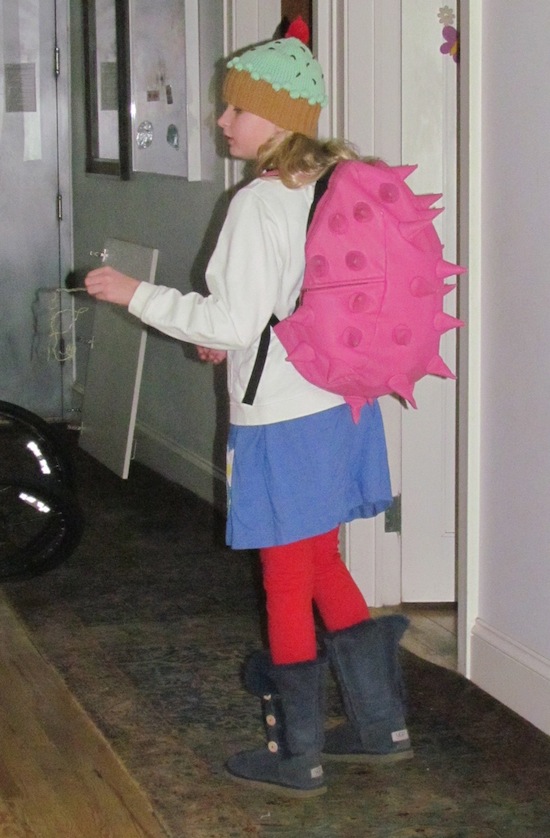
Later this morning as Em and I walked toward her school, we stopped at a red light.  As we waited she linked her arm through mine.  Not a single word was exchanged.  We waited, a mother and daughter, side by side for the light to turn green and once it did we made our way to the entrance to her school.  As Emma entered the gymnasium where the children and teachers were waiting, one of Em’s classmates called out, “It’s Emma.  Yay!  It’s Emma.  LOOK!  Look!  It’s a cupcake, I love cupcakes!”

And Em looked back at me and grinned before running to greet her friend.

The Cupcake Hat

Trouble Awaits if I Forget

I began this blog almost three years ago as a document of my daughter.  At that time I knew nothing about advocacy, I knew only one Autistic adult though I’d read the works of the most famous Autistic people ~ Donna Williams and Temple Grandin.  I assumed there were few Autistic adults because I believed what I was being told, that autism was an epidemic, and I feared it mightily.  I had a few people, made up of close friends and family members, who began to read what I wrote.  This blog was a place for me to write about how I felt and, while I tried to keep my feelings to a minimum and reported lots of dialogue and any progress I saw, I did write occasionally about how sad, angry, frustrated, scared and yes,  sorry for myself I was.  I never once considered how Emma might feel about what I was writing because Emma barely spoke, didn’t read (as far as I knew) and the idea of “presuming competence” was one I’d never heard spoken, let alone considered.  Regardless, I tried to stay upbeat.  I grew up in a WASPY enough environment to believe it was unbecoming to air one’s dirty laundry.  In addition, I believed and still do, in the power of positive thinking.  I wanted to feel hopeful, even though, it seemed to be in short supply.

As time went on and more people found this blog I continued to write about our life.  I understood that having an Autistic child made what I wrote more interesting than had I been writing about a neurotypcial child.  I never thought of it as an “opportunity” but I was certainly aware that I was being given a platform I might not have otherwise had.  I wrote a number of posts where I agonized about what it was to be the parent of such a child.  I saw nothing wrong with my thinking.  *Those posts have since been removed.  I do not post any photos or quotes without explicit permission.*  Had anyone said to me then – can you understand that your daughter’s neurology is not “good” or “bad”, that Autism in and of itself cannot and should not be judged as a deficit, with those whose neurology is in the majority held up as good and enviable, I might have been able to hear them.  But no one did say that.  No one said anything remotely like that to me.  Ever.  Not. Once.

Had someone patiently explained the concept of “presume competence” and exactly why it was so important would I have been able to hear them?  Had someone explained the relationship between depression, lack of self-esteem, how ALL children, whether they are verbal or not, whether they appear to understand or not, internalize what is said and thought of them, I probably would have understood.  I might have even felt the surge of hope I was so desperate for and that I felt so many years later when someone actually did take the time to patiently explain these concepts.  If someone went on to describe the problematic and ultimately destructive issues related to functioning labels I might have been able to comprehend, not right away, but I would certainly have found those concepts intriguing and would have wanted to know more.  Would these ideas have been enough to change the trajectory we found ourselves on?   I like to think the answer is yes.  I am just grateful, enough Autistic people took the time and energy to explain to me when they did.   These concepts are the basis for everything I do and think regarding Autism and my daughter.

Just a year ago, when I began to read the blogs of Autistics who were in their early 20’s, 30’s, 40’s and *gasp* 50’s my understanding changed radically and rapidly.  I started to see that if I wanted a personal place to vent I could do so in a support group or in a personal journal, but that what I wrote about on a public blog or submitted to the Huffington Post was reaching far more than just a few family members and close friends.  Things were easily misunderstood, my intentions were mistaken, the message I was sending was misconstrued.  Slowly, slowly over time I began to realize just how skewed public perception was and how that perception was affecting public policy, the media, where money was being spent.  I heard repeatedly how public perception played out in people’s lives.  I became aware of how pervasive the inequality and injustice was and remains and I became determined to speak out about it.  This was no longer just about my hopes and dreams for my children.  This was about human rights being blatantly ignored.

And yet, all of this is tricky.  There’s a huge danger of being seduced by one’s own ego.  When either of my children become boosters for my self worth and ego I know problems will arise.  When being a parent of an autistic child gives me a platform that I otherwise would not have available to me, I need to acknowledge that. Regardless of whether I asked for it, intended or even wanted that platform, I have to respect its presence.  When being the parent of an autistic child becomes my identity, I know I’ve drifted away from where I need to be.  My Autistic child is not “who” I am.  That’s putting way too much pressure on any child, and it sets up an unhealthy and untenable relationship.  Trouble certainly awaits me if I forget that.

A Peek at the Hudson River taken from the Highline

The Hudson River

Anger, Confusion, Doing the Right Thing

My father was born and raised in Paris.  He was actually Swiss, hence my last name, but he grew up in France and only came to the States in his twenties.  As a child I remember feeling ever so slightly embarrassed by my obvious “American-ness” something my father was often critical of in not so subtle ways.  One of his complaints was regarding what he felt was an American preoccupation with “happiness”.  One of his favorite phrases, repeated to my annoyance when I was a teenager, was “no one ever promised you a rose garden.”  (It was an interesting statement coming from someone who lovingly tended to his rose bushes that accented an enormous cactus/rock garden in front of our ranch-style house.)  I hated when he said that.  I can remember driving in the car staring out the window, talking about the injustices of the world and our society and feeling it was all too much to bear and he would come out with the thing about the rose garden or another of his favorites, “it’s a wicked world”  and I would silently scream in my head, while saying nothing.

It’s snowing right now.  My studio windows look north onto a bridge where hundreds of commuters barrel along to and from Manhattan.  On sunny days to my left the Manhattan skyline beckons in all its grandeur, to my right massive factory buildings rise up, grey concrete and windows where I can see heavy machinery, artist’s studios and manufacturing.  Often, on the street my studio building occupies, film crews shoot TV shows I’ve never watched, parking is suspended, barricades are set up and large tables laden with food, none of the actors will eat, take up space on the sidewalk.  But this morning it’s snowing.  Manhattan is completely obscured by heavy, grey clouds.  Different sized flakes whirl about as though unaware that gravity will eventually win out.

I spent most of my teens in a state of confused, directionless, rage.   Eventually all that anger found its target…  me.  For the next few decades I took my upset and sense of injustice and dumped it on my self over and over until I had all but forgotten there was anything else to be outraged about.  Slowly over time that changed.  I learned to have some acceptance, I learned that my anger was not the single worst thing about me, to be buried and beaten down and hidden.  I learned that other people’s anger, while uncomfortable, would not kill me.  I learned about myself and I began to see that my resentments led me to behave in ways that would eventually crush me.  My addictions (click for more on that) were all about rage, debilitating resentments turned inward.   I learned the only way I could crawl out from under my addictions was through honesty, acceptance, compassion and love.  I learned I could feel rage, but that I had to learn how to respect and care for it.  I am still learning.  I haven’t gotten it all figured out yet.  I still falter and make missteps, but I know the key points so that I don’t completely fall off into self-destruction.

Anger.  What is it telling me?  I have to keep my actions honest.  I have to keep conflicts centered on separating feelings from facts.  I have to try to recognize when I am responding with judgment, prejudice, privilege, superiority or defensiveness (this is no small feat!)  I have to step away and ask myself – am I being honest?  Am I being willfully hurtful?  Am I intentionally or unintentionally being manipulative?  Am I afraid?  If so, what of?  Am I speaking from truth or because I want others to think well of me?  Am I placing principles above personalities?  Am I practicing these principles in all my affairs?  Am I gossiping?  Am I feeling superior or conversely inferior?  Am I demonstrating any of these things in my behavior?  What can I do to support those I care about and love?  What can I do to be of service?  What is the next “right” action in the face of conflict?  Sometimes the answer to this last question is to be present and enjoy the snow falling outside my window and to see the beauty in its gathering on the rooftops and farther below on the ground.  Sometimes, not always, but sometimes, taking care of myself so that I can take action at a later point means doing absolutely nothing in this moment.

January 2013 – The Chrysler Building at night

Chryslar Building

The Joy Of Communicating Without Words

This morning it was 17 degrees fahrenheit, but with the wind chill it felt as though it were 5 here in Manhattan, this was according to my “The Weather Channel” iPhone app.  Because of the ongoing New York City school bus strike and because my husband is SuperDad minus the voluminous cape and lycra tights, Richard has been taking Emma to school each morning for the past ten days.  But this morning it was my turn to step up to the plate.

7:30AM this morning

Me:  Okay Em.  So here’s the deal.  I’m going to take you to school today, but Daddy told me it’s tough getting a cab, so we may have to walk.

Em:  Take taxi with Mommy to school.

Me:  Well, we’ll try to get a taxi outside our building, but if we can’t get one right away, we’re going to walk.

Em:  No, I don’t want to walk.  Take taxi.  Just you and me.

Me:  Em, we’re going to try to get one, but if we can’t we’re going to walk.

Em:  Nodding her head.  Together.

8:15AM

After trying for several futile minutes to hail a taxi we began to walk to Emma’s school.  The sidewalks were crowded with parents and children.  As Emma and I made our way in the cold, Emma began to make a loud singing like sound.  It wasn’t a song, more like one line of a song, sung loudly.  People turned to look at her.  At first I just continued to walk next to her, my hands tucked into the pockets of my coat for added warmth while Emma repeated the same song-like refrain loudly.  A few people stared.  Em linked her arm through mine and sang again.  I looked over at her, ignoring the curious looks from those we passed and sang back, but in a slightly different pitch.  She smiled and did it again.  I echoed her.  She laughed.  As we continued along toward her school in this way I noticed a few people smiling as they walked by us.  Once at an intersection Emma stopped “singing” and instead winked at me.  I winked back.  When we eventually arrived at her school, Emma turned to me and said, “Bye bye Mommy.  Had so much fun walking to school with Mommy!”

Yup.  Me too.

Emma – 2003

Em2003

When the Words Don’t Match

The other night Em woke up at around 2:00AM crying.  She kept saying the same words over and over.  It was a kind of script, about an indoor playground that I used to take both children to when they were toddlers.  It is a playground that has been closed for more than six years.  “Mommy has to look.  Daddy has to find new Sydney playground.  The tickets are broken.  Mommy has to fix it.  Oh.  You want to go to new Sydney playground!”

Do not try to translate this.  Lean into the emotion, what is she telling you?  Forget the actual words, the individual words are less important, it’s the emotion, it’s the intent… 

This is what I’ve been taught.  I’ve paraphrased the exact words my friend Ibby actually used, but it captures the general idea of what she has reminded me of more than once.  It’s an important concept and one that I didn’t readily understand at first.  In fact our initial conversation went something like this –

Ibby:  Do you speak another language?

Me:  What?  No.  I barely speak English.  Do I need to learn another language?  If you tell me I need to learn Russian to help me understand, I’m on it.

Ibby:  (I imagine Ibby took a deep, calming breath before continuing)  No.  You do not need to learn Russian.  But you need to feel the words instead of trying to do a word for word translation.

Me:  Feel the words?  Mind began to race, a panicky feeling overtook my body. I don’t know what that means!  What does that mean?

And so Ibby patiently tried to explain that by getting lost in the exact meaning of the words I was missing the emotions being expressed.

With this in mind, I went back to Emma’s bedroom with her.  Very distressed, she continued to repeat the script and then suddenly veered off to an unrelated, yet another, unattainable, desire.  “I want to go to Martha’s Vineyard.  Not binyard, v, v, v, vineyard.  Mommy I want to go to Martha’s Vineyard.  No baby.  We can’t go to Martha’s Vineyard, it’s too cold.  I want to go to Martha’s Vineyard.”

As I sat with her listening, I tried to be present, neither lying to her nor adding to her anxiety, just being present and as I did this I felt a flood of recognition.  I realized I do a version of this too, only I call it “spiraling out”.  It happens at odd times, but being tired makes it harder to cope with.  When I think about how I spiral out an image of a pin ball machine comes to mind.  My thoughts are the little metal ball careening around hitting one side, ricocheting off the little bouncy things that make noise while the lights flicker, before shooting off in another direction.  Nothing anyone says helps me.  In fact, often well-intentioned people will make it much, much worse, because my mind is literally looking for things to think about that will create more anxiety.  The only thing that has ever helped me when I get this way is a calm, loving voice gently nudging me down a different path.  It has to be authentic and very, very loving and very, very calm or I become suspicious and even angry.  With this thought in mind I gently said to Em, “Is it okay if I tell you something?”  She nodded her head.

“I get upset too, Em.  Just like you are right now.  And when I do I have thoughts that I can’t stop going around around in my head.”

She sat up and looked directly into my eyes.  “Sometimes when I feel stressed and tired I can’t make the thoughts go away.  Sometimes the same thoughts just keep repeating in my head and I can’t get rid of them.  Daddy calls it spiraling out.  But you know what?  It’s going to be okay.  I’m going to stay with you.  It’s going to be okay.  I promise.  Try to breathe.  Here breathe with me.”  We inhaled together and then exhaled.  “Feel the cool air on your face and the warmth of the blanket on your body.”  I continued in this way, talking to her softly, trying to guide her, trying to make her aware of the present.  These are the things that help me when I’m agitated and feeling overwhelmed and eventually she rested her head on me, leaning her body into me as I spoke to her in a soft voice.

It was during those early morning hours with the two of us sitting together while everyone around us slept that I felt a surge of understanding.  When I get lost in the words that fill my head and when the words don’t match up with the emotions it feels confusing and I become perseverative and spiral out.  I see this now.  In the past I’ve called it anxiety.  I’ve said I’m overwhelmed and tired.  These are good words to describe what I’m feeling, but a more accurate explanation is that when I become fixated on specific thoughts, in my case they are often in the form of fears, I can become so lost in the specifics I lose sight of the emotions.  This has happened my whole life, only it took my daughter to get me to make the connection.  We are not so different, my daughter and I.

An image that calms me – The Manhattan Skyline taken while walking to my studio the other morning

Manhattan Skyline

A Celebration With Some Unexpected Surprises

This past weekend we spent celebrating Emma’s birthday.  For the past few months we have been planning Emma’s birthday with her.  Emma was very specific.  She asked that we spend the night in a hotel that had a swimming pool followed by a party at the same place she takes gymnastics with her brother every weekend.  We visited the hotel with Emma before booking it.  The pool was on the roof and when we visited, the saline water was at a lovely 94 degrees.  We booked the place where she wanted her party and sent out invitations.  We called the hotel ahead of time to confirm they had wi-fi and a DVD player as Em wanted to bring her favorite Charlie Brown video.  Saturday afternoon we piled into a taxi, arrived at the hotel, settled into our room, donned our bathing suits and made our way to the roof where it was windy and quite cold, but looked forward to the lovely warm water awaiting us.

Emma jumped into the water without hesitation, with Richard following.  I turned as Richard gasped in surprise.  It was the sound someone makes when the wind’s been knocked out of them.  I stared at him.  “It’s really, really cold!” Richard said in answer to my confused look.

“Seriously?”

“Uh.  Yeah.  Feel it.”

Tentatively I dipped a hand into the water.  It was not a lovely 94 degrees, it wasn’t even a tolerable 84, in fact, it seemed unlikely that it was anywhere close to being “warm”.  The outside temperature had barely climbed above 35 degrees and the wind was brisk.  Nic took one look at my face and voiced what I was thinking, “There’s no way I’m getting into that water.”  Richard, being the champ that he is, hung in there for another ten minutes before getting out, his lips having turned blue and his teeth chattering, while Emma, being impervious to cold of any kind lasted another half an hour.

It's Cold!

The beauty of Manhattan awash in the afternoon light. Taken from the hotel roof’s pool.

Manhattan

Framed Sky – Taken from the hotel’s roof while Em and Richard swam

Framed Sky

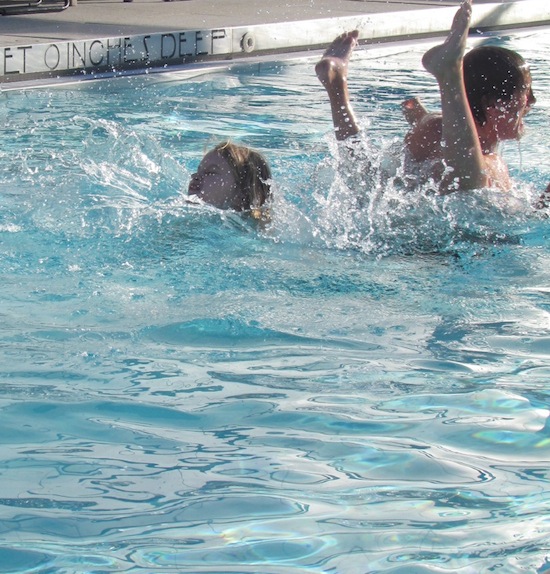
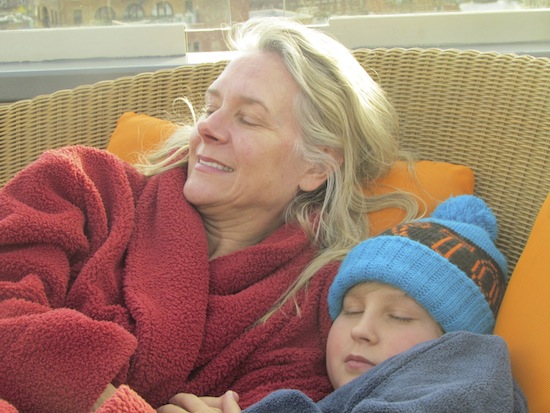
The hotel assured us the pool would be warmer by the following day, so we promised to come back the next morning for a longer swim.  Our evening was lovely, the children had a blast, and the next morning, after a wonderful breakfast we headed back up to the pool.  This time Emma did not immediately jump in, but felt the water with her toe.  It was a little warmer, though not much, but despite its cold temperature we resolved to bite the bullet and swim anyway if Emma chose to jump in.  Eventually she did and was delighted when the rest of us followed her.  It was cold, very, very cold, but it was also beautiful up on that roof, with the sun shining and the gorgeous view of Manhattan spread out before us.  We swam laps and splashed and played and Emma had a wonderful time.  When we finally got out of the water, dried off and put on our fluffy robes, we snuggled together on an enormous wicker chair, Richard called “the egg”.

Nic and I in the “egg”

In the egg

Later that afternoon we went to the gym where we celebrated Emma’s birthday with half a dozen other children whom she’d specifically asked to have invited.

Over the years we have learned to involve Emma in every aspect of planning her birthday, doing what she requests as much as possible.  Despite some unexpected surprises we have gotten better and better at giving her what she wants rather than what we think she might want.  And over the years we get it right more and more.

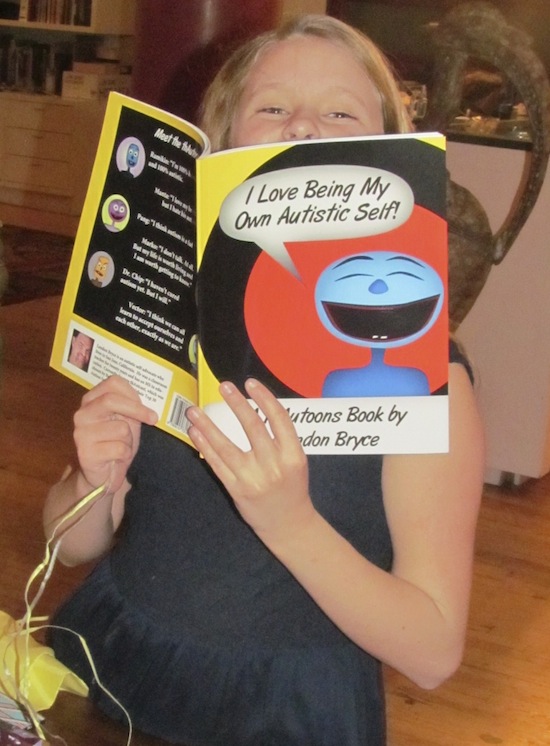
Em with her string and her new book – Landon Bryce’s “I Love Being My Own Autistic Self!”

Presents