Category Archives: Parenting

“Will She Be Okay?”

“Will she be okay?”  This was the question that went unanswered for the first nine years of my daughter’s life.  

“Will she be okay?” I asked every autism specialist, neurologist, pediatrician and anyone else who seemed vaguely knowledgable.  This question actually had almost nothing to do with the child I saw before me and everything to do with how I felt.  I so wanted reassurance.  I so wanted and needed someone to tell me she was going to be okay, whatever okay meant.  Whatever world “okay” occupied, I wanted to know, really know that my child was going to be embraced and fully in the “okay” of it all.  

“Will she be okay?”

Like the children’s story about the baby bird who’s fallen from its nest and asks all manner of creatures it meets “Are you my mother?” I desperately wanted someone to put their arm around me and say those seemingly magical and reassuring words – “Yes.  I promise.  She’s going to be just fine.”  But none did. So on I went, searching, trying every therapy, remedy, every crazy combination of vitamins, diets, homeopathy, naturopathy, healer, energy worker, cranial-sacral therapist, shaman, neurologist, developmental pediatrician, speech therapist, occupational therapist who held out the promise that all would be okay if only I did whatever it was they believed would make her “okay”. 

“Will she be okay?”  

When we finally ended our campaign to cure our daughter, our campaign to help her accelerated.  But this didn’t happen in a vacuum.  We had support.  And the support we were given came from other Autistic people. In retrospect, had I known my friend Ibby, I would not have asked “will she be okay?”  Had I met Tracy Thresher, Larry Bissonnette, Jamie Burke, Jennifer Seybert or any of the other people I’ve had the good fortune to physically meet, I would not have felt the need to ask repeatedly whether my daughter would be okay, because I would have known she already was.  That question would not have occurred to me to ask, because these people, many of whom do not speak or more often than not do not speak, or as in Ibby’s case speak, but when stressed, is unable to, are living their lives fully and they certainly know joy.  Each of them has grown up in a society that underestimated them.  All of them have been doubted and had to prove their intelligence over and over to those who are unwilling to see the evidence before them.   

“Will she be okay?”

We, as a society, must stop forcing people we deem different or less than to prove their worth.  We, as a society, must look inward and start asking ourselves, not “will my autistic child be okay?” but “what can we do to accommodate Autistic people so that all can flourish and be included?”

In the end, that’s all I really want for both my children.  I want them to feel a part of a society that supports them. 

“Will my child be okay?”

She IS okay.  Right now at this moment.  It’s up to the rest of us to recognize this.

Em singing “Clumsy” for Ibby and Emily last night

Em's performance 

Autism Awareness ~ Not Fear

In the spirit of “Autism Awareness” month, I’ve decided to write at least a few posts this month devoted to the kind of “awareness” I would like to see more of.  Awareness can be subjective and the awareness being pushed, this month in particular but, most of the time is usually not the awareness I wish I had been given when my daughter was diagnosed almost nine years ago.  I believe awareness should help us, not make things more difficult.  In the best case scenario, awareness gives us options and makes us feel empowered to make better decisions.  Awareness is the opposite of ignorance, yet more often than not, when it comes to autism, so-called “awareness” becomes an abettor to ignorance.  This is not as it should be.  Awareness, in its true form, is a good thing, even if not easy, even if becoming aware is painful, even if awareness makes us uncomfortable, it (hopefully) leads us to act in a more thoughtful manner.

E., whose blog The Third Glance, is someone I urge everyone to follow.  I first became aware of E.’s blog shortly after I found Julia Bascom’s blog Just Stimming.  So within a 48 hour period I read Julia’s blog and then found E.’s blog and read My Cat is My HeroExecutive Function and Words, which describes in beautiful detail the pitfalls and distractions of having a conversation with a group of people.  Growing Up Autistic where she writes,  “Anything related to my Autism was punishable, regardless of the actual magnitude or relevance of the offense.”  A little farther along she writes, “I am Autistic. I was abused for it. My whole person was trained to be invisible and I was taught that I didn’t matter.

I read E.’s blog and I learned and my awareness increased and I started to see how things I’d been told, things I’d been made “aware” of were actually incorrect. E.’s blog was the kind of awareness I needed.  It was the kind of awareness that helped me make different decisions.  This was the sort of awareness that helped me understand, helped me take more informed actions, helped me seek out more information.   Isn’t that what “awareness is really all about?  Isn’t awareness suppose to be about gaining knowledge?  I want knowledge.  I don’t want knowledge disguised as fear.

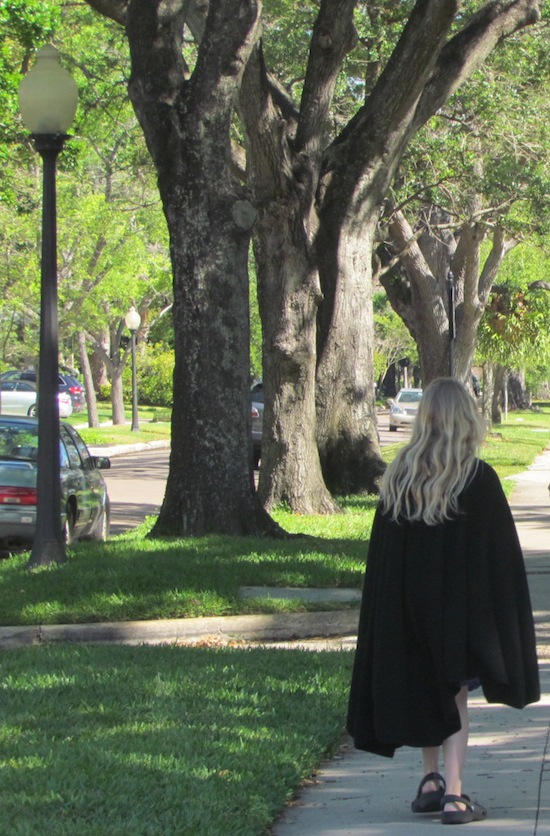
Em, having appropriated my black shawl, takes a morning stroll in Tampa

**Em

When Insights are Speculation

One of the things I’ve felt particularly confused by is why my daughter sometimes resists communicating.  My thinking has been – why would she resist doing the one thing that will help her get along in this world more than perhaps anything else?  The other day, I had a moment of clarity.  I came a step closer to “getting it”.  And now, I think I understand.  Not only do I think I understand, but I am able to identify and relate to that resistance, because, I realized, I do it too!  There are a number of things I resist doing, even while knowing that if I just did them I’d feel better and would be able to weather the vicissitudes of daily life a bit better.  I’d be happier, calmer, less anxious, and yet knowing this, intellectually understanding that this is true, does not make my resistance any less.

know being mindful and in the present gives me clarity and a sense of calm, I do not otherwise have.  I know this, and yet find it extremely difficult to be completely present for more than moments at a time.  My daughter has little problem with this.  In fact, Emma is far more comfortable in the moment than anywhere else.  I remember when we were inundated with therapists coming and going during those early years of fear and panic.  Richard and I used to comment on the irony that Emma was completely present and in the here and now far more easily than we were and yet we were constantly encouraging her to talk about tomorrow or yesterday or any number of other topics that had little to do with NOW.    We were pushing her to move away from the bliss of this moment to join us in the fear and anxiety of the non-present moment, all for the sake of the larger picture, which in our minds was to have her join us in our world.  Even though our world was fraught with expectations, hopes, dreams, wishes and the inevitable disappointment those things often bring.

We used to joke that if we could bottle what Emma came to naturally we would have no cause for worry.  And that really is the crux of most conversations.  They are usually not about the here and now.  They are almost always about some other time, some other idea, some other person, some other concern that is not now.  And yet…  

I resist being in the present and Emma resists being pulled out of it.   And yet, we non-Autistics continue to insist our world is better, or superior even as many spend thousands of dollars going on spiritual retreats, reading books about meditation and going to workshops to teach us how to “sit”.  So the question I am now asking myself is this:  Can I find the grey area of encouraging Emma to communicate with me, something that is difficult for her and pulls her from the bliss of now, while giving her plenty of time to be present and just be?  And what about my own resistance?  Can I learn to meet Emma in her blissful place of now and resist the urge to go off in my mind to somewhere else?

Of course there’s always a danger in interpreting my daughter’s behavior as any one thing.  Her resistance, like mine, is probably made up of many things, and this could be just one reason.  Or I may have this entirely wrong and her resistance is about something that hasn’t even occurred to me.  Or perhaps it isn’t resistance at all and is something else or I may find, next time we type together and when I ask her why, she will tell me something I hadn’t considered.  And that’s the beauty of all of this, I can’t and don’t know until she tells me.  Until then it’s just speculation and me projecting my stuff onto her.   So that’s more for me to be aware of – seeing when and if I do that and understanding that I am.

Henry and I sharing a moment of laughter at Emma’s antics

H & A

What I Wish I’d Been Made Aware of When My Daughter Was Diagnosed With Autism

What follows are some of the things I wish I’d been told (and given) when we learned Emma was Autistic.  These are the things, in retrospect, I wish all those doctors, specialists, pediatricians, therapists and people who dedicate their lives and careers to autism had told me, but did not.  I believe our lives would have changed dramatically had we been told even a few of these things.  It is my hope that for those of you who may be at the beginning of your journey with an Autistic child, this list might help you avoid some of the many, many mistakes we made and a great deal of unnecessary pain.

1.  Seek out the work of Autistic people ~ most of the work I’ve listed was not available when my daughter was diagnosed, but it is now.  Take advantage of all that is out there, these people are leading the way.  If I had to choose just one thing that has had the single greatest impact on my life and the life of my daughter, it is these people.  My gratitude to all of them doesn’t come close to covering how I feel.  I have compiled an extensive list of blogs and books written by Autistic people as well as a couple of documentaries that are a MUST WATCH!   on the “Resources” page on this blog.  Please go take a look.

2. Autism is not a disease.  Read Don’t mourn for us by Jim Sinclair.  This may take some time for you to understand.  It’s okay.  Get the help and support you need so you can better help your child.  Try to think of autism in the same way you think about any groupings, a Mac and a PC, fiction, non-fiction, memoir and young adult, a shirt, a pair of pants, shoes and socks, a microwave and a gas heated oven.  Autistic, Neurotypical, Allistic, (or my personal favorite, coined by a friend) NT-NOS, we are all human beings.   Try not to judge one over another.  Judgment will not help you help your child.

3.  Presume Competence.  (This ‘post‘ helps explain what presuming competence means.)  If a therapy and/or professional does not approach your child with a presumption of competence, please consider finding one who does.  Tremendous long-term damage can come from not presuming competence.  Rethink how you view communication.  Listen to your child, not just to words, but to body language, facial expressions.  You may be surprised by the ways your child is communicating despite not being able to do so verbally.  Teach her to point with her index finger, first with support if needed and as time goes on, fade the support. Give her the appropriate tools and support so that she can learn to type or communicate by pointing to a letter board.    There are many wonderful iPad apps that can help with this.  Begin with sequencing games and colored tiles, or if she’s musical, notes.  Join them together to make patterns.  Show her first, have her mimic.

4.  Do not speak of or about your child as though they cannot and do not understand or hear you  (read Barb Rentenbach’s book for more on this).  This is something we did without thinking for years.  Sadly it is not the only regret I have, but one of many.  Still it is worth repeating.  Chances are your child can and does understand what you’re saying even if they do not show any signs that you recognize.

5.  Throw out everything you think you know and question everything.  There is a massive amount of misinformation/myths disguised as truth and fact regarding autism.  You may hear people say things like “They are in their own little world,” or “they are imprisoned behind their autism” these phrases are perhaps an accurate reflection of what non-Autistic people feel about the Autistic person in their life, but they serve to divide rather than unite and ultimately serve none of us. Be suspicious of anyone who says they know what causes autism or how to “treat” it.  Disregard any organization that describes autism and your child as tragic, an epidemic, a burden or any other word generally reserved for warfare.  If you read or hear something that causes you to feel fear, walk away, it is most likely inaccurate and intended to make you afraid.  None of us are able to help our children when we are terrified.  Fear can cause us to make decisions we will later regret.

6.  Set your child up to succeed.  My daughter is extremely sensitive to criticism.  Saying “No!” or criticizing her does not help her learn, but instead makes her feel badly about herself.  Encourage her with smiles and by asking her to try again.

7. Do not try to make your Autistic child behave like a non Autistic child, instead encourage your Autistic child to be the very best ______ (fill in your child’s name) they can be.  For more, read ‘this‘.

8.  Avoid comparing your child to any other child, Autistic or otherwise.  I have struggled with this one and continue to.  All I can say is, this is a work in progress. I hope one day to “know” this and refrain from doing it as it gets me into “compare and despair” thinking faster than anything else.  Emma is Emma.  She is best served when I remember this fact.

9. We parents are fallible.  We will make mistakes.  I’ve made dozens.  I wish I hadn’t made quite so many.  But I have.  If there is one thing I know without a doubt it is this – I will make mistakes, I am human.  I can admit my mistakes, tell my daughter how sorry I am, make a living amends to her by doing everything in my power not to repeat the mistake and continue to move forward without beating myself or anyone else up.  As my wise mother once said, “Show and tell your children over and over how much you love them, and one day they will forgive you.”

10. Get to know Autistic adults.  One of the single biggest misperceptions surrounding autism is that autism is only seen in children.  Autistic adults are often our best teachers and  many of them are leading the way so that our children’s lives might be better than their own.  These people are courageously and tirelessly pushing back against the deeply ingrained prejudices, biases and misperceptions that are rampant within our society.  (See #1)  It is my goal to honor these people who have beaten a path ahead of my daughter so that she may more easily live in this world that so often will not and does not accommodate her or give her what she needs to flourish.  They are speaking out, let’s all get behind them and give them the microphone so that more can hear what they are saying.  One day, the person holding that microphone might just be your child!

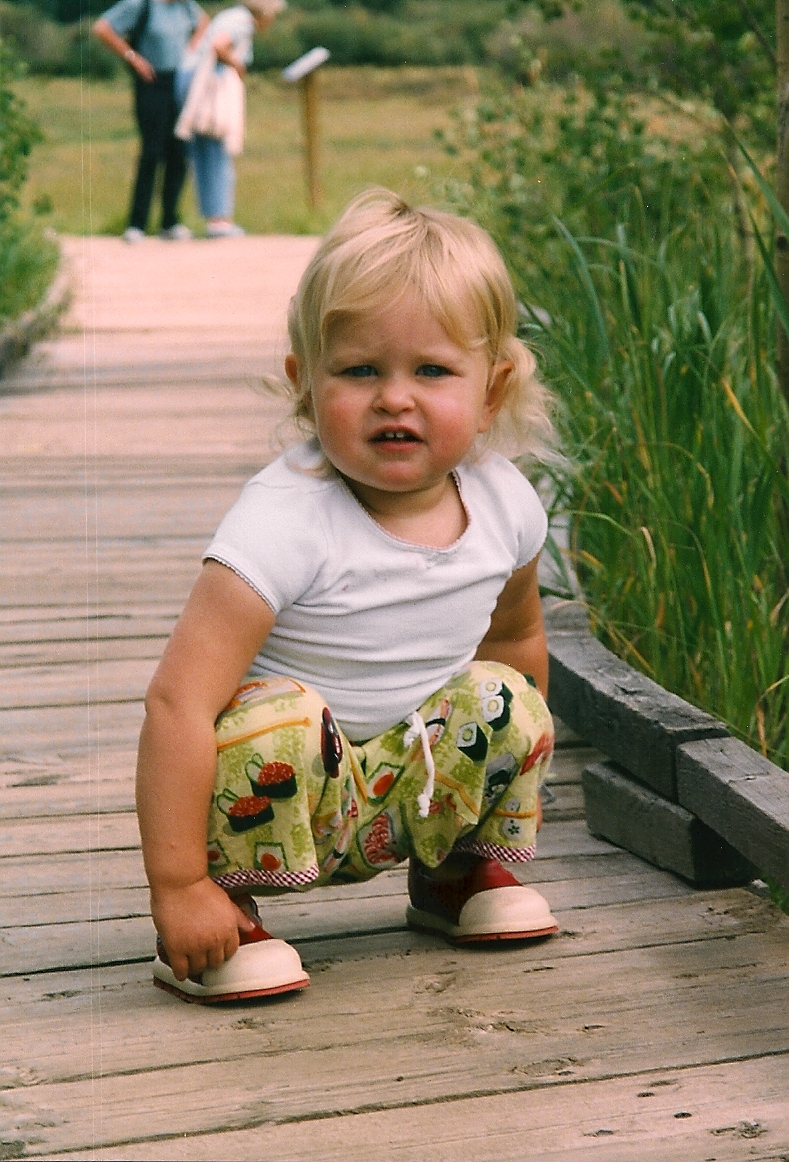
The year after Emma was diagnosed ~ 2005
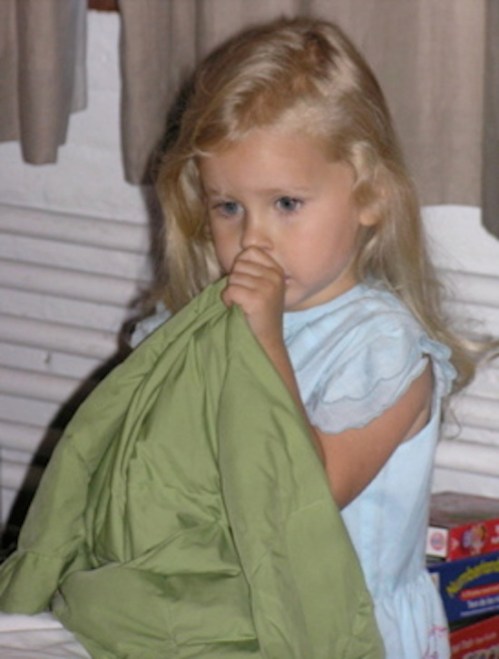
Em - 2005

Autism Awareness?

It’s interesting to note that the word awareness, when paired with the verb “to be” as in – be aware, is easily visualized and thought of as, “beware” which dramatically changes the meaning.  It no longer is a word of benign information, but instead is a word of caution and fear.  I do not think this is a mistake.  I know it’s cynical of me, but I think Autism Speaks, the single largest organization involved in Autism and the creator of the “Autism Awareness” campaign, chose their wording carefully.  I’d like to think I’m giving them more credit than they deserve, but for a company that spends more on PR than they do on actually helping families and those who are Autistic, I don’t believe I am.

My awareness of autism has dramatically changed over the years.  It has changed because of the information I’ve found and been given.  In the beginning, my information came from books, autism organizations, various professionals, a couple of neurologists, our pediatrician; surprisingly the more “credentialed” the person was, the more likely they were to admit how little they actually knew about autism.  In retrospect this was my first real lesson in awareness – beware of organizations and those who believe they “know” all about autism, whether that is the cause or which specific methodologies, treatments or therapies your child will be best served by, because they do not know, despite how vehemently and persuasively they may speak.

As time went on, I became increasingly aware of my own misery.  The common misery supposedly shared by us parents, dominated the conversations surrounding autism.  I became fixated on the “fact” that autism was the cause of my misery and set about removing it from all our lives.  This is where awareness took me.  This was what I knew and understood.  But this is not the sort of awareness I want to be a part of.  This is not the kind of information I wish I’d gotten, nor is it the information I hope other parents and families will receive.  Those first few months after receiving the diagnosis are critical.  How we talk about autism and by extension our Autistic child changes all that we then do and where we focus our energies.

Autism did not cause me to be miserable.  I was concerned and I was scared, but my daughter’s neurology was factually not what frightened me, it was what I was being told about her neurology that terrified me.  Had someone said to me when we were still trying to get her out of diapers when she was seven years old – “it’s going to be okay, here are a couple of different things you can try, but remember most people do get out of diapers, eventually” I would have felt a little calmer.  Had someone said to us when our daughter was six years old, “read to her age appropriate material, teach her age appropriate lessons” I might have felt confused, I might have had a great many questions, but I wouldn’t have felt the fear I felt when we were informed she could not possibly be placed in a school with her same age peers.  Had someone said to us when we first received her diagnosis, “presume competence, she can and will learn, but she will learn at a different pace, she will learn differently than you might expect” I might have felt concern, but I would not have felt the kind of despair I felt when I questioned whether she was capable of learning at all.

If we want to have more awareness about Autism then let’s have it come from those who are actually Autistic.  Because if you are like me, these are the people who will change your views and shift your mind away from the “tragic” to the far more helpful information that might actually help you help your child.  The kind of information that opened our minds to different forms of communicating, different ways of learning, all those things that have actually aided us in helping our daughter.  Our judgments about her neurology and all it meant to us and her, did not help us do anything but feel more fearful and miserable.

Below is a small list of people I know and am in touch with.  I’ve provided a link to their blog, book(s) or film to each of their names.  I will feature more people who have helped me in my growing awareness during this month of April.  I’ve separated those who can speak, but depending on the circumstances lose speech, with those who mostly do not speak, but ALL communicate.  Want to become aware?  Read their words.

Non-Speaking Autistic:

Amy SequenziaBarb Rentenbach, Peyton Goddard, EmmaTracy Thresher, Henry Frost, Tito Mukhopadhyay

Autistic:

Ibby Grace, GareethKassiane, Paula Durbin-Westby, Landon Bryce, Julia Bascom, E., Renee, Judy Endow, Michael Scott Monje Jr.

Practice

Everything takes practice.  Learning to sit with my fears, takes practice.  Learning to not say something that might be hurtful takes practice.  Learning how to best help my child takes practice.  Learning to disagree with my husband and not do harm takes practice.  Learning to feel compassion for those who harm me takes practice.

Everything I have learned in life, I’ve had to learn over and over.  I seldom get it the first time.  I’m a slow learner.  I know this.  I can admit this without shame.  It all takes practice.

Practice.

I am never going to do any of this perfectly.  But I will always continue to practice.

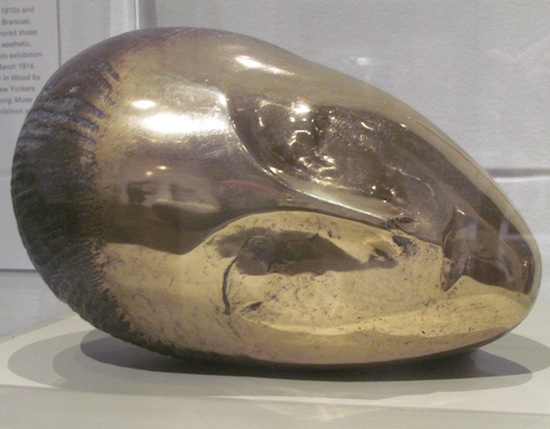
Sleeping Muse – Constantin Brancusi 1910

*Sleeping Muse

“Splinter Skills” and Other Words We Use

When Em was not yet three years old we received her diagnosis and began the long trek through, what appeared to us at the time to be, the treacherous terrain of autism.  All the things we admired, her various abilities, all those things I had identified as wonderfully “Emma” were now reduced to a single word “autism.”  I remember bragging about the fact that Emma, at the age of 18 months had taught herself how to pump her legs on a big kid’s swing, only to be told after her diagnosis that “kids with autism will often display splinter skills.” When I then commented that my daughter was extremely independent it was said that her autism caused her to shun other children and people, thus reducing her independence to nothing more than, yet another example of, her autism.

After awhile I felt I didn’t know who my daughter was, other than “autistic”.  That word seemed to so thoroughly obscure her in the minds of so many experts and people in the know.  Autism, it seemed, meant lacking and less than and not capable.   Whenever my daughter displayed things that could not be neatly placed in the deficit box, it was tossed into the “splinter skills” box.  It seemed no matter what she did it was viewed as “deficient” even when it wasn’t.  I remember feeling I finally understood what people meant when they talked about their child being imprisoned or all those awful images that abound of children silently, sadly, standing behind impenetrable walls of glass or behind bars of steel,  their small hands gripping the cold metal as they silently watch the world go by.  All of this, the words and images, showing us, telling us what we could and should expect were like seeing train tracks descending into hell.  Who knew it would take me eight years to understand that so many of those impenetrable walls of glass were constructs made by us.

If we did the same thing to those who are born without Autism, if we talked about our non-Autistic neurology as a deficit and identified all the ways in which it would cause us problems and difficulty, would we not despair when our non-autistic child was born as well?  Take your own life as an example and imagine that when you were born you were seen as a great disappointment.  Think about how each time you did something well it was dismissed as a “splinter skill” and was seen as yet another example of all that was “wrong” with you.  Think about what it would do to your self-esteem if your interests and passions were spoken of as “obsessions” or actively undermined and limited because they were seen as “unhealthy”.  It’s a double standard we have.  We non Autistics are praised, admired, given awards and accolades for our passions and obsessive interests.  People describe us as “driven”, “ambitious” or any number of other words used to describe the things that interest us.  But think if instead we were denigrated, ridiculed and scolded.  What does that do to a person?

The way we speak of and about our children, the way we think about their neurology, the way we attempt to “help” them “fit in”, these are the things I hope will change because it is not helping us parent our children, who need our help, it is not helping educators teach our children, who need to be taught, but mostly it is not helping our children be all that they can be.   My husband once said, “People spend all their time and energy trying to teach their Autistic kids to be something they’re not, when they should be spending all their time teaching their kids to be all they can be.”

Emma’s favorite work of art “Railroad Nostalgia” at the Scope Show in NYC.

Train tracks

Why Teach Age Appropriate Topics?

Someone asked me why would I teach my child age appropriate topics such as the American Indians, the arrival of Europeans to America, the Roman Empire and the difference between amphibians and reptiles, when tying her shoes, answering (whether verbally or by typing) a why question and riding a two-wheel bike has yet to be accomplished.

The short answer is – they are not mutually exclusive.  It is not that one thing gets taught and the other is left to languish.  I believe all these things are important for any child to learn; why shouldn’t my child have the opportunity to learn these things too?  But just to play devils advocate, let’s say that the questioner still asks, but why?  To them I say, because knowledge is freedom.   Knowledge gives us context, history provides us with choices, knowing how our government works gives us important information about leadership, honesty and conversely dishonesty.  Learning about geography gives us information about the physical world we inhabit.  Reading Wordsworth or Shakespeare or Susan Sontag, studying a painting by Rubens or Renoir or Basquiat, listening to music by Rachmaninov or  Ray Charles or, my daughter’s personal favorite, Gwen Stefani transports us, encourages us to think both analytically and creatively and enhances our lives.

Ralph Saverese, author of  Reasonable People: A Memoir of Autism and Adoption wrote a wonderful piece about a year ago, The Silver Trumpet of Freedom about his non-speaking, Autistic, son DJ who had just been accepted into Oberlin.  It’s a terrific piece and I encourage all of you to take a few minutes to read it.  I’ll wait.

Right here.

Seriously.

Go.

Read it.  

What many believe to be true about Autism is proving again and again to be incorrect.  What many believe to be true about those who are Autistic AND non-speaking is proving to be incorrect.  Our ideas about someone who has physical challenges AND is Autistic AND does not speak are proving to be incorrect.  Our incorrect beliefs are limiting how that segment of the population is taught and what information they are given access to.

This must change.

To My Daughter…

You are capable.  I am sorry it has taken me so long to fully understand this.  You are smart and able to learn and know so much more than I ever knew.  You understand that sea turtles lay their eggs beneath the sand and then, once hatched, the baby turtles must make the treacherous trek toward the ocean.  An ocean many will never reach.  You understand this.  You understand that turtles live in and out of water.  We did not categorize them yet as reptiles, but we will get to that, possibly tomorrow.

You know Christopher Columbus is said to have reached America in 1492 and that there were people already living here.  You pointed to an illustration of an American Indian and typed that this person was called a Native American.  You showed me where we live on a globe and then suggested we take a boat to England over the Atlantic Ocean so that you might visit an old therapist you still remember and speak of with great fondness.  You became particularly excited by the thought that we would have to stay in a hotel and inquired whether that hotel would have a swimming pool.  I know.  A hotel is not a good hotel without a pool.

You told me an insect has six legs and that a spider has eight legs and even though it kind of seems like a spider should be called an insect, it is not and in fact eats insects which is why all those insects in the Miss Spider book you love so much are scared of Miss Spider and that makes her cry.  You demonstrated your innate acting talents by pretending to cry about Miss Spider’s predicament.  It turns out Miss Spider is a vegetarian and happily eats the flowers offered to her much to the relief of all the fearful insects.  That made you laugh.  Then you remembered how “Bertie kitty” was admonished for getting on the dining room table and eating the flowers and said so, again in a very convincing and stern voice.  You are so talented.  I believed both your pretend tears and your pretend/scolding voice. Thank you for telling me you were pretending because you were very convincing.

You are so, so capable and for so many years I’ve been blind to just how capable you really are.  But maybe, just maybe now I have the tools I need to hear you.  Those tools I thought I was learning to use for you, it turns out are tools I needed for me.  I need them so that I can hear all the things you’ve tried to tell me for so long.

I promise.  I promise to keep listening.

“Presume Competence” – What Does That Mean Exactly?

When my daughter was first diagnosed at the age of two and a half, presuming competence was not a concept I was ever told about or had heard of.  And even if someone had suggested we do so, I’m not sure I would have fully understood what that meant exactly.  So what does “presume competence” really mean?  And how and why should we carry out a presumption of competence?

In an interview, Douglas Biklen explained:  “Assume that a child has intellectual ability, provide opportunities to be exposed to learning, assume the child wants to learn and assert him or herself in the world.”

A key component to presuming competence is to become aware of the prejudice that currently exists regarding autism and how these ingrained beliefs harm not just our children, but ALL Autistic people.   Like any prejudice, based on layers and layers of misinformation, misperceptions, and misunderstandings, we must be willing to acknowledge our own “beliefs” before we can begin to deconstruct them.

When my daughter was little with almost no language I could not understand how it was possible for her to learn to read and write if she did not speak first.  I was surprised and confused when I learned how completely wrong I was.  When I read about all the non-speaking Autistic people who had learned to read and write despite being given no formal instruction, it seemed magical to me.  This mind that seemed, from my limited perspective, to not understand so much, actually was taking in far more than I could imagine, let alone believe.  It wasn’t until I was able to see my own limitations caused by the things I had been told about autism and hence, my daughter, that I was able to move beyond that thinking and embrace another way of thinking.  I had to acknowledge my misperceptions and the misinformation I was given, then I had to question everything I thought I knew and was being told.  I had to seek out Autistic people who were kind enough to share their own experiences before I was finally able to dispense with my erroneous ideas and move beyond them.  In case anyone’s missing it, there is a certain irony in my early assumptions regarding Autistic competence.

At the Institute on Communication and Inclusion conference, which we’ve just returned from, and I began writing about in yesterday’s post, Tracy Thresher typed, “… couldn’t let anyone know I could read and I understood what was said to me the training gave me the way to communicate with others.”  On the Wretches and Jabberers website, Tracy wrote, “My communication is paramount to my well-being and is key to my being an active citizen.”  He goes on to say, “I may appear to be a man shrouded by a cloak of incompetence but if you will take the time to listen to my typing you will understand I am intelligent.”

What I have come to understand, is that a presumption of competence is much more than a set of beliefs, it is a way of interacting with another human being who is seen as a true equal and as having the same basic human rights as I have.

A presumption of competence may seem like a leap for many non Autistic people,  it may even feel like a disconnect.  Some may argue that their non-speaking child cannot possibly understand, that they know this beyond any doubt and I must ask, but how can you know this for sure?  We may tell ourselves that our child is too “severe” and we are setting them up for certain failure by presuming competence.  To these people I would suggest the opposite is true.  The only true failure is when we walk away and assume incompetence.

Presume competence means – assume your child is aware and able to understand even though they may not show this to you in a way that you are able to recognize or understand.

To presume competence means to assume your child or the other person does and can understand when they are being spoken of and to.

Presume competence means talk to your child or the other person as you would a same age non-Autistic child or person.

Read and have available age appropriate stories and give access and instruction to age appropriate learning material.

Presumptions of competence means treating the other person with respect and as an equal without pity or infantilization.

It does not mean that we will carry expectations that if not met will cause us to admonish, scold or assume the person is being manipulative or just needs to “try harder”.

To presume competence does not mean we assume there is a “neurotypical” person “trapped” or “imprisoned” under an Autistic “shell”.

Presuming competence is not an act of kindness.

Presuming competence is not something we do because we are a “good” person.

We do not get to pat ourselves on the back because we have presumed competence.  If we believe we deserve a pat on the back and/or acknowledgement, then we are not presuming competence, we are more likely being condescending.

One last thought regarding presuming competence…   to presume incompetence is to actively do damage.  Let’s all agree not to do harm to our fellow human beings.

Embracing Change

When Em turned two, I said, “I’d give a limb to have her ask for something.”

When Em was three, I said, “If only she could tell me what was wrong.”

When Em was four, I said,  “If only she was able to understand.”

When Em was five, I said, “If only she would sleep through the night.”

When Em was six, I said, “If only she would learn to use the bathroom during the night too.”

When Em was seven, I said, “If only I understood what she was thinking.”

When Em was eight, I said, “I just want her to be safe.”

When Em was nine, I said, “I want her to have choices in her life.”

When Em was ten, I said, “I think I’m beginning to understand.”

When Em turned eleven, I said, “Thank you.  Just thank you.”

Things continue to change.  We adjust.  I continue to change and my life gets bigger and fuller.  Em continues to change and her life gets bigger and fuller.  I didn’t fully appreciate or understand this when Em was first diagnosed, but I do now.

Everything changes.  I’m learning to embrace it.

sc000a5075

The Dentist and Tiny Steps

“Take it out!” Emma said.  “Take it out!”

We were at the dentist’s office where she had just had a baby tooth pulled because it was obstructing the adult tooth from descending.

Five years ago when Emma had two cavities that needed to be filled on two baby teeth, we had to take her to the hospital and have her anesthetized as she could not tolerate having an x-ray let alone having a cavity filled.  The two baby teeth were capped and while she was unconscious the dentist applied a sealant to all her teeth as they are unusually porous and susceptible to cavities and plaque.  When she regained consciousness she cried, “Take it out! Take it out!  She then tried to pull the metal caps off her teeth.  I still remember sitting with her at the hospital, horrified as she screamed and cried and pulled at the caps on her two teeth, wondering what we were going to do.  After a few days, when she realized the capped teeth were not going anywhere anytime soon, she grew accustomed to them and stopped trying to pull them off.

Over the years Em has grown used to the dentist and dental visits and allowed him to clean her teeth without protest.  A year ago she sat still long enough to have multiple x-rays taken of her mouth and teeth.  This was a first!  Em was ten years old.  Now Em has four braces on her four front teeth and has a palate expander in place that she tolerates, though doesn’t much like.  (Who would?)  Two days ago she tolerated the dentist giving her a novocaine like numbing agent allowing him to pull her baby tooth.  This was a first and a huge milestone.

“Take it out!” she kept saying.  At first the dentist thought she was eager to have him pull her tooth, but I had a feeling she meant the numbing sensation.  “Do you mean take out the tooth or take away the strange sensation?” I asked.  “Take it out, Mommy.  This,” and she pulled at her upper lip, twisting it with her fingers.  “I know it’s an awful feeling, but it will wear off, Em,” I told her and then asked the dentist how long he thought the numb feeling would last.  The dentist told me it should wear off in about an hour, so I set a timer on my phone and handed it to her.  She held the phone and watched the minutes tick by.  Meanwhile I hoped beyond hope the dentist had given me a correct estimate and wasn’t being optimistic.

After the tooth had been pulled and the bleeding had stopped, he came by to check on her and saw Em with my phone and the timer counting down the seconds and minutes.   He laughed, “Uh oh, you’re going to hold me to it!”  Then he said, “You better give her something hot to drink, that will speed up the process.”

“Good to know,” I said.  “Hey Em, when we get home, I’m going to fix you some hot chai.  It will help that weird feeling go away.”  “Take it out!” Em said.  “Yeah, it’s going to make the numb feeling go away faster.” Em nodded her head and off we went with Em clutching my phone watching the seconds tick by.

By the time we arrived home there were about ten minutes left and Em kept repeating, “Take it out!  It’s okay, it’s okay.  Timer goes off and it’ll be gone!”

I fixed her some hot tea, told her to drink it and when the timer went off the numbness must have abated enough to make her less panicked.  About an hour and a half after the first shot she said she felt fine.

Tiny steps, taken one after the other over time, can and do take us far…

Related articles

Goals and IEP Meetings

My goals for my daughter have completely changed since she was first diagnosed with Autism more than nine years ago.  I have been thinking about goals a great deal because her IEP (Individualized Education Plan) meeting is coming up and for those of you familiar with IEP meetings, it’s all about goals, both long-term and short-term.  The parent’s goals, the teacher’s and therapist’s goals, everyone’s goals are discussed and written down.  Except for Emma’s.  What are Emma’s goals for herself?  For those who have children with either spoken or typed language this is an easy enough question to ask.  For those of us whose children do not it gets a bit more complicated.  Still, I plan to ask, even if I do not get an answer, whether verbally or typed, I will ask and I plan to talk to her about her IEP and what that means as well.  I may even type out some of the goals we are thinking about and ask her if she agrees with them.

I have to admit that sometimes when I speak to Emma about things, whether it’s about privacy, our bodies and bodily functions, the power of saying no, the importance of self and self-determination, or something like explaining what is going to happen over the weekend or asking her what her goals are at an IEP meeting, I catch myself wondering if she really understands.  What I have learned, what I continually remind myself is that it’s okay to wonder, it’s okay to feel all those feelings, but it’s not okay to act or behave as though she does not understand.  I have to speak to her as though she does understand, even when I don’t know that she does.  In the end I have to do this, because to believe that she can’t/ won’t/ doesn’t understand and to be wrong is a risk I cannot take.


The Tug of The Unknown

Ever since Em was first diagnosed I have looked to others to tell me what was best for her.  I have read countless opinions.  I have read hundreds of articles written by self-appointed Autism experts, educators and therapists.  I have listened to organizations, I have consulted doctors, neurologists and developmental pediatricians.  Emma has had quantitative EEGs, hearing tests, vision tests, colonoscopies, endoscopies, x-rays, and more hospital visits than any child her age should have to endure.  She has been prodded, poked, examined, questioned and discussed.  She has had more “professionals” come and go in her short life than I have in my entire 52 years.

A year ago I began meeting Autistic adults and what they were saying and describing first hand wasn’t what all those experts, doctors, educators and therapists had been telling me.  In fact what Autistics were telling me was often in direct opposition to what all those other people said.  The more I listened to what Autistics said and how they experienced their childhoods and life now as adults, the more I saw how wrong most of the professionals were.  It’s not that any of the Autistic people tried to predict what my daughter would be like as an adult, or that I came away believing I’d just met an older version of my daughter, but I’ve gained a clearer picture of autism and I am not as afraid as I once was.  As a side note, I have yet to meet a single Autistic adult who has assured me my daughter would be just like them, quite the opposite in fact.  Each and every person I’ve personally been in contact with has made a point of saying they are not representative of any Autistic child.

When I went to the Autcom Conference in Maryland last fall I met a great many older Autistic adults.  People who are in their 40’s and 50’s, some had been institutionalized, others lived in group homes, some lived with their aging parents, others lived independently, but all were Autistic and while it was surprising to meet so many (the hidden Autistic adults that our society knows almost nothing about)  it was a relief too because the fear I had and to a lesser degree still have about autism falls away the more time I spend with those who are Autistic.

My fear is about the unknown.  My greatest fears are those I create in my mind.  I have to remind myself of this on an almost daily basis.  I have tremendous fear.  I have always been fearful.  Long before I had children or got married I have lived with fear.  Fear of failure, fear of success, fear of relationships, fear of rejection, fear of abandonment, fear of being hurt, fear of hurting others, fear of saying the wrong thing, fear of life, fear of being.  You name it and I can figure out a way to fear it.  I have mornings when I wake up and feel fear like a second skin shrouding my body and mind.  There are days I cannot shake it.  There are days when the best I can do is get up and just put one foot in front of the other.  There are days when I cannot even acknowledge how scared I am.  A good day is when I keep doing the next thing that needs to get done and not say or do anything hurtful to anyone who crosses my path.  Those are the days when the image of myself is that of being covered in a thick cloak.  I keep my head down, keep to myself and do my best to not cause others pain.

Then there are the days when even that is too challenging a task.  Anger is almost always the result of tremendous, debilitating fear.  This is just one reason why I so vehemently object to the way in which autism is depicted in the general population.  Just about everything that is currently written by non-Autistic people regarding autism is fear based and increases fear.  And where there is fear, anger is not far behind.  Fear and anger cause many to behave in ways they wouldn’t, were they not feeling terrified and/or enraged.  Fight or flight.  I do both, sometimes within minutes of each other.  Neither is particularly helpful.

I know I still have a tendency to look to the “next thing” that will help my daughter.  I know this is what I have a tendency to do.  I am trying to trust myself and her more.  I am trying to remember that I don’t always know what will help and, as it turns out, neither does anyone else, but I can make sensible, informed decisions.  I am trying to accept that no one can predict with absolute knowledge what will occur in the future.  I am trying to parent my children with respect for who they are, what their interests are and not what they may or may not become.  I am doing my best to be present, to enjoy the moments of joy.    When I go off into future, fearful thinking, I try to gently pull myself back to the present without admonishment and judgment, but rather lovingly and with kindness for my own faltering, uneven progress.

Em – 2002

sc0008a4f3

A Dream ~ Autism: The Documentary

Richard and I finished up our “staycation” by watching the Oscar nominated short documentaries at the IFC Center (Independent Film Channel) yesterday.  As I watched them I thought about the documentary I would most like to see.  It would be about Autism and Autistic people.  It would go back to Lovaas and Hans Aspergers, then Bettelheim, the evolution of what we thought we knew about Autism and those who are autistic and the ways in which we thought to “treat” it.  It would cover the move away from institutionalization to the current, though still negative thinking regarding the neurology we call Autism.  The documentary would have dozens and dozens of Autistic people of all ages, non-speaking, speaking, sometimes speaking, those who have careers, to those who are unable to work to those who work for themselves.   It would look at functioning labels and address why those labels work against everyone, it would cover the various myths surrounding autism and why those myths are ultimately destructive and limiting.  It would be a collaborative effort of Autistic and non-Autistic people.  It would be an example of what we can create if we work together, regardless of our neurology.  That’s the documentary I would like to see made.

Short of making such a documentary myself, I won’t hold my breath, though.  The whole idea of neurodiversity is considered radical and even threatening by many.  I understand that.  I understand that it is not a popular or particularly good way for organizations to raise money, especially those whose main goal is to fund research for treatments and cures.  I understand that change happens slowly.  I understand that any movement involving the rights of a minority moves slowly before it is embraced by more than a radical few.  But I also understand the power of good film making and that it can reach many more than any written piece could…

If you could see a documentary about Autism and Autistic people, what would it cover?

Em – 2003

sc000b447a