Category Archives: Parenting

When Upset Turns Violent

A number of people have reached out to me privately with questions about how to help their child who is violent.  They fear for their other children’s safety as well as their own, but are frightened to reach out for help because they worry their child will be taken from them.  This is not an easy topic.  If you do not have a child who is prone to violence, it is difficult to imagine what that child is going through.  If you are not and have never been the recipient of violence it is difficult to imagine what that is like.  Similar to self injury/harm this is a hot button topic for many people, not just parents who feel powerless to help their child and feel they have nowhere to turn, but for the person who does not have any other way to express themselves.

So I am asking for all of your help.  If you once were or currently are someone who knows anything about responding to the environment and people in your life with violence, and are comfortable telling me what that experience is/was like for you, please email me at:  emmashopeblog@gmail.com.  Also if you are in a position to tell me what might have helped, what, if anything, might have given you the support you needed/wanted.  Was there anyone you could talk to?  If you cannot speak or cannot rely on verbal speech when upset, were you able to type?  Would that have helped?  Is there anything that might help/would have helped?  Do you have advice for parents?  Do you have advice for those who are under the care of another person?  If you are the parent of a child you are frightened of and want to reach out, please do.  Please describe your situation as best you can, as well as what might be helpful to you.  In other words would a help/hotline (if one were available) be something you would use?  Would you prefer an anonymous support group where you could discuss what you are going through with others?  Would something else be helpful?  Anyone who contacts me will remain anonymous.  Anything you tell me, I will quote as anonymous.  If you prefer that what you write NOT be quoted, please be sure to tell me that.  All names and/or places you tell me about will remain confidential.

I don’t know what can be done, but it seems to me, from some of the stories I’m being told, that something needs to be done/created to help all involved.  Maybe you know of resources that have helped, maybe something you’ve tried helped, maybe there was something/one helped you.  If any of you know of anything, please let me know.  Any and all information is appreciated.  Maybe just talking about what’s going on in a safe place is a start.  You can also write in the comments section anonymously, if you prefer doing that.

Justifying Actions

I just wrote an angry rant.  As I was getting set to publish it, someone tweeted me about something unrelated.  They wrote that in order for people, who may be feeling desperate, to hear what you (the universal/general you) have to say, there is a need for kindness, and it stopped me in my tracks.  Kindness…  In my fury I had forgotten all about kindness and I felt like a balloon that had just been popped. Pfssssst…  All that lovely anger that was protecting me from all those other feelings I have, oozed out.  Pffffffssssst.  And you know what I was left with?  Sadness.  Overwhelming sadness and something else.  Fear.  Tremendous fear.

Sadness and fear do not make me feel powerful.  Instead they make me feel vulnerable.  I don’t like feeling sad and vulnerable.  I want to feel powerful, but all of these things are illusions at best.  Just because I feel powerful does not make it so.  Just because I feel vulnerable does not mean I am.

Someone wrote on a public forum that they were heart-broken over a mother who tried to kill herself and her child.  They followed that thought with this, “she was given a burden she could not bear” and I felt like someone had kicked me in the solar plexus.  You see, I take those words personally.  They may as well have said that they believed that about one of my children.  Please, please, do not say a child, any child is a burden.  Even if you believe this to be true, do not say those words in public.  Do not.  This is what private support groups are for. This is why people see psychiatrists, psychologists, counselors, this is why we call close friends whom we love and trust and who we know will honor what we say in confidence and keep what we say confidential.  In moments of terrible pain all of us can and do say things that upon further reflection we wish we hadn’t.  We think things we do not really believe in moments of upset.  We may even act on these things that we think and say, these are the times we wish we’d said and done nothing.

Not every feeling must be acted upon.  Not every thought needs to be said out loud.  Please, when you say someone’s child is a burden and that it was too great to bear and that this was why they tried to kill that child, it places a stigma on all our children.  This kind of language terrifies me.  I am terrified someone who believes Autistic children are a burden will come into contact with my child and treat her accordingly.  Please if you believe Autistic children are a burden, if you feel their neurology makes them inferior, do not go into the field of autism.  Do not convince yourself that you will be able to help that person, you won’t.  Feeling sorry and pity will not help or make that person’s life better.  In addition, when we believe another person is a “burden” it is being suggested that there are situations when it is acceptable to not be held responsible for what we say and do.  It is being suggested that, to hurt someone we believe is a burden, or worse, take that person’s life, is a reasonable thing to do.  It’s not.  It’s not okay.  We cannot, in our desire for compassion, allow this to ever be okay.   It is not okay.

Finally, if you truly believe someone, whether it is your child, someone else’s child or just in general, is a burden, please talk about these feelings and thoughts with a professional or someone you trust who can help you work through these beliefs with compassion and care.  If you do not know where to turn or do not understand why this kind of thinking is problematic, email me privately so that I can try to better explain or can find someone who will be able to explain this in a way you can hear.  My email is:  emmashopeblog@gmail.com

Memories Evoked

I enter the subway car.  To my delight there is an empty seat near the door.  I sit, rummage through my bag for my book and begin reading from where I left off, but the words are blurry and I cannot concentrate.  I am aware of a powerful odor emanating from the person seated next to me.  I close my eyes and try to concentrate on breathing through my mouth.  My stomach clenches and my eyes begin to water.

I’m five years old.  Mrs. Williams is rustling about in the other room.  The pain in my chest is as much from the ache I feel because my parents have left on their yearly trip as it is from my fear of the woman who has been hired to take care of us for the next few weeks.  Mrs. Williams with her coiffed hair and antiseptic smell, everything about her is no nonsense, business like, a kind of grim resignation that oozes from her every pore.  When angry she uses her hand, like a paddle, it comes down swift and seemingly without emotion, as though the pain I feel upon contact has nothing to do with anything: arbitrary, remote, senseless.

I hate Mrs. Williams and my anxiety and sadness that my parents have left us, even for only a few weeks adds to my hatred of her.  She crinkles and rustles when she moves, her skin hangs from her body like an ill-fitted suit, she smells of soap and perfume that make me nauseous.  She is stocky and seems well rooted to the ground, her movements are steady and purposeful.  She rides out the time my parents are gone like a convict doing time.  I can find nothing pleasant about her.  Just thinking about her fills me with fear.   Her dislike for me and my sister is all the more apparent when my brothers are around as she obviously dotes on them and shuns us.  If ever there is a dispute, it is my fault, no matter that I am the youngest with siblings a full eight and six years older than me.   

We are told she had a son sent to Vietnam who never returned.  We are told it is because of this son that she adores my brothers.  I take this information in stride.  It is fact.  I am representative of something unwanted, something I do not and cannot understand.  She is particularly concerned about my bowel movements.  She takes note of them, even going so far as to stand guard outside the bathroom listening for sounds of success.  As I sit on the toilet I imagine her ear pressed to the door.  Why this is important is something I can’t figure out, but that it is, is evident by the reports she feels compelled to give my older siblings.  Now my brothers and sister are on high alert.  My bodily functions are examined, discussed, they have become a topic.  The more I am closely observed the more  anxious and fearful I become.   

I grip my book tightly and try hard to breathe out of my mouth. I glance over at the woman next to me.  Her eyes are closed and I realize she is asleep.  As the train careens through the darkness, her body sways with its motion.  The train turns.  She leans into me, the smell of soap, antiseptic, and some other odor I cannot identify, but that reminds me of those weeks once a year when my parents left us in the hands of someone who should not have been caring for small children, is over powering.  She is unaware of me or the memories her presence has evoked.

I think of my children.  I see the look of anxiety on my daughter’s face when she says, “No, not going to Katie’s class.  That is the old school.  Emma goes to new school.  Emma goes to new school with Mommy.”  And all I can hope for is that her new school will not be staffed by anyone whose presence gives her cause to remember them decades later with anxiety and a feeling of plummeting through an endless darkness.

Visiting the new school

New School

Presuming Competence & Expectations

Presuming competence is not code for – my kid is a genius and capable of super human abilities.  (Though some may be, it’s not a given.)  One of the things I continue to struggle with is the idea of presuming competence.  Often I don’t go far enough and other times I go too far without meaning to.  I have made assumptions about my daughter’s ability or inability that are incorrect, or at least have been incorrect in that moment.  Whether I expect her to be able to do something that she cannot, or at least cannot do today, but may well be able to do at some point in the future or whether I do not expect her to do something that, it turns out, she is more than capable of, I am treating her as though I know one way or the other.  But the truth is, I don’t know and neither do a great many of the people who come into contact with her.

The best thing I know to do is to remain in the moment with an open mind.  Easy, right?  Yet I don’t think it’s easy at all.  I find staying present very, very difficult, which is why in Buddhism they call it a “practice”.   It takes practice to stay in the present.  It takes practice to remain solidly rooted in this moment without drifting off into some future scenario of what might happen, what should happen, what I want to have happen, what I fear will happen and then all the things I do to control all of that so everything I want will occur the way I want it to, in the time frame I want.  I’m exhausted just writing about this!

My daughter continues to astonish and amaze, just as my son does.  As both my children mature and come into their own, they do and say things on a daily basis that I find utterly delightful and incredible.  But that delight is tempered by expectations.  I know this, yet find it extremely difficult to keep my expectations in check.  My expectations often cause disappointment. I don’t like feeling disappointed, so I try to turn the volume down on my expectations, but if I keep my expectations in check then am I still presuming competence?  I can go around and around with all of this endlessly.  The only conclusion I have come to is that I’m not going to always get it right, but I’m going to do my best to stay aware, stay present and open to whatever happens without preconceived ideas of what should or shouldn’t happen and while I’m doing all of that, I’m going to remember to breathe.

Breathing is good.


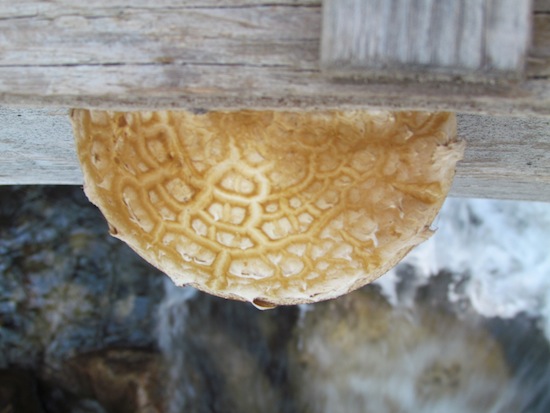
A wild mushroom growing out of the side of a makeshift bridge – Colorado August, 2013Mushroom


People: Interpreting and Responding

Two days ago Emma told me I could write about people’s reactions to her, though it is more accurate to say this post is about my reactions to what I perceive to be people’s reactions.   I asked Em if I could write about that too and she gave me her permission.  My feelings are not necessarily the same as my daughter’s.  I may perceive someone’s curiosity and even confusion as annoyance or impatience or even outright anger, while Emma remains in the moment, without judgment or adding layers of interpretation to people’s responses to her.  Someone who makes a comment or tries to engage her in conversation, a person she then walks away from or answers with, “Emmaemmaemma!” I may decide is judging her harshly or is drawing conclusions about her that they may not be.  Sometimes I decide my daughter is saddened by the reactions she gets from others, yet when asked, she tells me she liked that person and felt happy meeting them.

So it was, a  few nights ago when a dozen or so people came over for dinner.  I knew only one of them, the rest being complete strangers.  Typically at any gathering, either here or at our home in New York City, we know almost everyone who enters our home.   And they, in turn, have met, or at least know we have two children.  Whatever happens is usually met with smiles and kindness.  People might ask questions, some will actively seek to engage, others do not attempt to, but all are friendly and take whatever happens in stride.  We have wonderful friends, and those who are not kind, are not our friends…  but this group was made up of people I’d never met and so when Emma said she wanted to sit at the dinner table with them, I felt a certain degree of trepidation.

I imagined they were confused by her and it felt awful.  I stood nearby, ready to interpret, ready to intervene, ready to take over, ready to control the situation.  But my daughter does not need me to take over, she’s perfectly capable of interacting with people without my intervention.  At one point she thrust her hand out blocking one woman’s view of her, so that the woman could not see Emma, or more accurately, Emma could not see her and the woman immediately made it into a game of peering over and under Emma’s hand.  Emma smiled and began to laugh.  “Don’t look at me!” she said in delight.  The woman stopped and made a big point of looking away.  Emma giggled.

I went into the kitchen briefly and when I returned, one woman I imagined, looked worried.  Another guest I thought seemed annoyed or maybe nervous.  I am sensitive.  I know this about myself.  I think I can “feel” people’s energy, and often I can, but sometimes I decide I know what others are thinking and feeling and I’m wrong.  I have always been hyper aware of people’s vibes, sensing their emotional state, which has caused me problems when I’ve been wrong, as well as kept me safe, when I’ve been correct.

After everyone left, Emma said to me, “Have another dinner party tomorrow?”

“Did you have a good time, Em?”  I asked.

“Yeah!”

“How did you feel when that woman was looking at you and you held your hand out blocking her view of you?”  I asked.

“Playing don’t look at me game!”  Emma answered, laughing.

“Was that fun?” I said, wanting to make sure she was okay with the interaction that had taken place.

“Yeah!  Another dinner party tomorrow!!”

After Emma went to sleep, I lay awake, feeling troubled.  Emma’s experience of people is not the same as mine.  I am fearful of people, or I tend to be.  My daughter does not share my fears.  I sense people’s intent and often believe what I’m sensing, as though it were fact.  I hear and sense people’s words, often read between the lines, take their words, add my interpretation of them from the way they hold themselves, the tone they use, the way they look and draw conclusions from all these factors.  My daughter does not do what I do.  I’m not sure how she interprets others, but I do know it is different from the way I do.  Both my children interpret the world differently from me.  This is a good thing.

Neither of them are as fearful as I am.  Neither of them shrink in fear when someone is angry as I do.  Neither of them physically pull away when someone raises their voice as I do.  I have a physical response to what I perceive people are thinking and feeling.  I feel slightly nauseous when I think someone is angry, even if they are not, or if they’re angry, but not about anything to do with me, I still feel uneasy.  If someone seems particularly upset, my hands will shake, it’s hard for me to speak.  If I become angry, my face will turn red, my whole body feels hot and I will begin to shake.  If very upset I cannot form coherent sentences.  Sometimes, whether angry or hurt, I feel pain in my chest and it becomes hard to swallow, my breathing becomes shallow and it feels as though there is less oxygen in the room.  All of these things are ways of adapting, I understand this, but I also am relieved when I see both my children not interpreting people and therefore not responding to a perception of people’s emotions as I do.

Performing for guestsPerforming

Routines Disrupted

We have been traveling.  Our cell phone and internet coverage has been spotty and in some places we’ve had none at all.  As a result my routine, which usually means I wake up when Emma comes into our room, (anywhere from 5:15AM – 6:00AM) get dressed and go to my studio where I begin the day by writing, has been disrupted.  The beautiful thing about traveling is that there is no room for routines.  We’ve spent a few days with my sister, gone on a rafting trip down the Colorado River, gone horseback riding, gotten lost, spent time with one of my brothers, hung out with one of my cousins, (I have a large and sprawling family that live all over the United States and even world, and my mother’s house is often the only place we get to see one another.)  So it’s been really wonderful and lots of fun.

When I have gotten up early enough to write AND the internet is cooperating, I have begun a post only to have Em say she doesn’t want me to write about the topic I began writing about.  In fact, I have started three different posts, and Em has shot down every single one of them.  This could be seen as a bad thing, but I don’t view it that way.  I see this as an incredibly good, no, a great thing.  The first time I told her what I was starting to write about and asked her permission, she said no, I was surprised.  The second time I began writing about something else and asked her permission, I was surprised and amused when she typed “no, I do not want you to write that.”  The third time I thought – this is great!  Great because this blog began with no thought of her opinion and has evolved to represent only what she agrees to and may well end because of her thoughts and opinions.

What all of this means is that I haven’t been writing every morning.

So I will end with something Em typed to me the other day and told me I could post.  She typed, “Language is an awkward way to communicate.”  She would not elaborate further and why would she, as that sentence says it all.

The Rocky Mountains

View From Cabin

The Quest

The quest for various potions and remedies kept the mother  separate from her child, though she did not know this at the time.  The mother believed it a valiant quest, and prided herself in her vigilance and determination.  She would single-handedly conquer what had thus far proven unconquerable to vast numbers of scientists, neurologists, neuropharmacologists, researchers and all those who had devoted their lives to finding a cure for autism.  She would save her daughter and she would prevail.  Call it arrogance, a lack of humility or simply being unable to understand; she would reflect on her own near miss with death as justification for her belief in her ability to do what no one else to date had.  (And yes, she began to forget that her sobriety and abstinence were not due to will power or because she tried harder, but was because of the help she received from a larger group/ a power greater than herself.)  All thoughts of something being more powerful than herself were temporarily forgotten, or put on hold, or, depending on the day, justified as being part of what she was trying to do.  As I said before, she was veering from the path laid out for her by thousands of addicts who had years of sobriety and abstinence and practiced humility, honesty, openness, willingness and acceptance as the basic tenets of their ability to stay clean one day at a time.

“Courage to change the things I can…”  she would often repeat this to herself during particularly tough times, neither saying the first part, “Grant me the serenity to accept the things I cannot change,” nor the last, “and wisdom to know the difference.”  She believed herself to be courageous.  She knew herself to be courageous.  And she had learned over the years how to tap into her innate kindness, to foster it, encourage it and nurture it, though in her quest for a cure she felt increasingly out of touch with all that and began to struggle mightily with what it meant to take “the next right action”  or know what it meant to know any will other than her own.

Whether there is a G-O-D piece to all this is not something I can speak of, nor can she, as this is a word that never brought solace, so in the midst of all of this she abandoned even saying the word and stopped trying to make sense of what it may or may not mean.  She did, however, believe in something larger than herself, a power whose meaning shifted over the years and eventually evolved to mean – kindness, love, appreciation, gratitude – these were the things she knew to do and act upon when feelings began to feel factual, when feelings served to confuse her and make her believe them, despite what was happening and what she was witnessing.  Acts of kindness were the mainstay of her “practice” for no other reason than she knew her life was better when practicing kindness than when she did not.

So it was not a leap for her to believe that finding a cure for all that ailed her daughter was an act of kindness.   It’s important that I interject here that to this girl who had grown into a woman, had spent more than two decades of her life being an addict, found abstinence and sobriety through another way of being in this world, became a mother to two beautiful children, a “cure” meant removing all those things that caused her daughter pain.  A cure meant that her daughter would be able to carry on a conversation, the way non-autistic children do, that she would not have GI issues, she would not have sensitivities to texture and noise and pain, but that she would be relieved of all of that.  She told herself these were all things her daughter would want to have removed and be “cured” of if only she could tell her.  The mother believed this wholeheartedly and comforted herself that she was doing the right thing.  The only thing.  The best thing.  Not for a moment did she think of a “cure” as an eradication of her child, but more a version of her child.  A kind of fantasy, similar to believing in Santa Claus, of who her child would be if she were relieved of all or most of her physical pain and had the ability to get along in society and this world with ease.

Once Upon A Time (Part 3)

Part one and two are ‘here‘ and ‘here‘.

So this woman who was once a troubled girl, now the mother to two small children, one of whom was a beautiful little girl with curly white/blonde locks and chubby cheeks and dimpled knees, wondered how she ever gave birth to such perfection.  She was filled with gratitude and felt each of her children were gifts, tiny gifts that she was being given the opportunity to influence and even direct, but who were their own people, with their own temperaments and personalities, unique and wonderful in their own right.  She believed this fiercely.  But do not forget, this woman lived for many years of her adult life, prior to giving birth to her two wonderful children, believing she was bad.  She imagined that inside of her there was darkness, as though there was a bad seed deep within her soul and for many, many years she had tried to purge that badness from her being.  She believed she needed to be “fixed” and that left to her own devices she was fundamentally flawed and that if people got to know her, they too would learn this truth about her and it was only a matter of time before she was found out until others who had once felt similarly about themselves, convinced her that this was untrue.  These people showed her over time that in fact there was tremendous goodness within her and they taught her how to nurture that goodness and how to behave in ways that fostered it and encouraged it to grow and even flourish.

But then, now years later, she saw aspects of herself in her daughter.  Behaviors she used to do, but no longer did.  Her daughter loved to look at photographs and there were a great many to view.  Her daughter liked to sit on the floor with more than a hundred photographs piled in front of her and quickly scan them.  If one was missing, her daughter knew instantly and began to howl in great distress.  The mother watched in confusion as this scene unfurled.  The daughter, perfectly happy one minute, and then in terrible agony the next could not be consoled and would hurt herself by punching herself in the face or biting her hand or arm.  And something inside the mother clicked.  She recognized this desire to control her pain.  It took her back to a time when she needed things to be a certain way and when they were not she felt her entire life was unraveling and that her very existence was put into jeopardy and the only release from the horror was to hurt herself.  There was a kind of twisted logic to all of this, her self-induced pain, a pain that at least she could control, though awful, was not as terrible as her rampant and erratic feelings and somewhere along the way that self-induced pain made her feel she could endure, at least for a little while.

Now here was her daughter behaving, it seemed to her, in similar ways, expressing the agony she once knew so intimately.  She had no words to describe what she was witnessing, but she thought she could feel what her daughter was feeling, the despair, the pain, the fear that if the photograph was not immediately found she might die.  The mother believed this was what her daughter was going through and because she had lived through similar feelings she thought she would be able to help her.  She would provide her with the same sort of safety net she had been given.  A place to land, as it were, a safe space where her daughter could feel comforted, except that the things she said and did, did not provide her daughter with the comfort the mother expected and hoped she would feel.

You see, the mother forgot that her daughter was not a mirror of herself.  The mother forgot the thing that she knew when she gave birth to each of her children – that they were their own unique beings, quite separate and individual from anyone else.  She forgot all of this in her fear and worry over what she was witnessing and imagined her child was feeling and doing.  So she began to look outside herself for answers.  People, many, many people told her that they knew what would help and she listened to them.  These people spoke of her daughter using language all too familiar to the mother.  They used words like “broken,” “disorders,” “pervasive” and likened her neurology to cancer, which to the mother sounded a great deal like what she once thought of herself.  They said her daughter was part of an epidemic and that various methodologies would “treat” her disorder and might even reverse and cure her if done quickly and everyday for many, many hours.  The mother listened to all of these people and nodded her head as these people put into words what she had once believed to be true about herself.

Had she done this to her child?  Had she somehow passed along the worst aspects of herself to this beautiful, innocent child.  Was this some sort of karmic payback for all those years the mother had spent living a selfish, self-involved life?  Was her daughter the direct result of every mistake she’d made?  Was this really how life worked?  She could not believe this, at least not logically.  She refused to believe her daughter was being sacrificed for the sins of her mother.  She refused to believe there was some greater omnipotent power that would cause her daughter so much physical, emotional and psychic pain and yet she was terribly, terribly confused and somewhere she could not fully let herself off the hook.  Somewhere, unconsciously, she believed she was to blame for all that was causing her child pain and turmoil.  And if she was to blame, then she knew she, and she alone must make it right.

(To be continued) contemplation

There Once Was A Girl (Cont’d)

The first part is ‘here‘.

This woman, who was once a girl, learned a great many things once she stopped trying not to feel.  This was a huge surprise to her as she believed she already knew a great deal.  She learned that people terrified her for they were capable of doing tremendous harm and she came to realize she had spent many years avoiding all people as a result.  Most of her pain in her adult life came from the expectations she held and not from the actual people or things they did or didn’t do.  She learned that no one person could ever be all she wanted and hoped for, but that a group of people could.  She learned that a community with a shared goal was more important than individual grievances and that her ego often pushed her from the path she’d chosen.

She met a wonderfully, flawed human and together they had two beautiful children.  With each child her world expanded and grew.  She often reflected on all she’d learned during those terrible years of her earlier life and tried her best to apply what she was learning to her new life as a parent.  But her youngest child, a strong, independent, baby girl who held an uncanny resemblance to her mother had a dreadful time tolerating certain feelings, sensations and the world.  She could not communicate through words and her mother watched her in helpless despair as she saw herself, her early self, her former self reflected in her child’s upset and frustration.  The mother would do anything to take that pain away so her daughter would not have to go through what her mother once had.  The mother would walk to the ends of this earth if it meant she could alleviate even some of her daughter’s massive physical and emotional discomfort.

And so, without even realizing it, the mother veered off the path laid out for her by so many others.  She did not begin using substances again, but slowly over time, she found herself moving away from one of the key tenets of her new life –  she began to believe she had power over another human being’s neurology and that she knew what was best for another.  Instead of helping her child, she began to fight against her child.  She did not think of it in this way at the time.  She thought she was fighting FOR her child and for many years this is what she told herself and others who asked.  She was fighting for her child and it was a noble fight, she would go to her grave fighting, and, by the way, in fighting she avoided a great many feelings.  She did not know this at the time, but in fact this is what happened.  And while she was busy fighting and desperately trying to keep all those messy feelings at bay, her child was hurting and feeling increasingly separate from her mother, (we cannot know this for a fact, but in retrospect the mother sensed this to be true).

More to follow…

Being an Anchor

Yesterday I wrote a post, Seeing But Unable to Believe about people who see people like my daughter and assume they are incapable of a great many things.  These are the people for whom presuming competence is not only the exact opposite of what they do, but is something they have trouble wrapping their minds around.  In the comments section of yesterday’s post, someone I adore, Chou Chou, who has been commenting on this blog for almost two years now, wrote, “…if I am walking in a confusing environment, I can hold Doc’s arm and find my way, and even lead the way. He doesn’t guide. He anchors.”  She was relating this to my thoughts about supporting my daughter while she types.   Even though my daughter can type independently, she is able to converse if supported.

He anchors.”  I thought about this idea ever since Chou Chou left it here.  The idea of anchoring is one I love.  It is exactly what I hope to provide for both my children; to be an anchor.  Solid, stable, grounded, rooted…   Being an anchor, someone who provides both physical and emotional support for another human being.  I think we all need that, I know I do.  I have a number of anchors in my life and I rely on all of them.  In the context of supporting my daughter as she types, I am reminded of something Amy Sequenzia told me once when I asked her about being supported.  She told me it was more than physical support that was needed; she needed to be able to trust the person supporting her.

Trust.  When I am with someone who I do not trust it is impossible for me to relax.  If I feel I am doubted or am on the defensive I have a much harder time getting my needs met.  If the person who says they are trying to help me, keeps ignoring my requests, continues to tell me I should need something else, I become confused.  I do not, for a second believe I am alone in my response to those who say they want to help, but who seem unable to hear me when I tell them what I actually need.

If you’ve ever spent time in a hospital or have been in a situation where you were accused of something you did not do, or have been told that what you’ve stated is not believed, you will have an idea of what I am talking about.  In a world where people are living longer, more and more of us will one day have to consider living without the independence we might prefer.  Many of us will need assistance, many of us will be forced to rely on others.  Being an anchor for those who need support is something each of us can give to another, but it is also something most of us will need at some point in our life, or if you are like me, throughout your life.

One of my anchors…

*Richard

Seeing But Unable to Believe

When some people hear that my daughter is Autistic they see a beautiful blonde haired girl with no noticeable physical impairments.  They see a pre-teen who has terrific eye contact.  They see someone who is happy and playful and who laughs often and with abandon.  They see someone who loves loud music, a good party and will grab hold of a microphone if given the opportunity.  They see someone who obviously loves to perform in front of an audience.  She doesn’t fit their concept of autism so they assume the diagnosis must be wrong.  They say things like,  “But I never would have known if you hadn’t said something.”

When it becomes clear that she cannot carry on a conversation with them, but demonstrates her intelligence by typing something with lots of insights and wisdom, they see a doting mother who is supporting her daughter’s arm or holding on to the other end of a pole and they assume it is all a manipulation.  They decide it is me who is writing these things, “putting words into her mouth”.  After all my daughter cannot carry on a conversation, how could she possibly be writing such beautiful words?  Later, when I am no longer present they might say, “Poor thing, she’s deluding herself about her daughter, of course she would, how could she not?  It would be giving up all hope to do otherwise.”

In our field, assumptions about labeled people are so deeply rooted that we tend to think they are facts.  They are not – they are only shared beliefs.” ~ Autism: Sensory-Movement Differences and Diversity by Martha R. Leary and Anne M. Donnellan

I explain that my daughter is typing these things, but needs support to do so, without that support, which is in the form of resistance, she will impulsively revert to her favorite scripts, and they think to themselves – that doesn’t make sense.  How is that possible?  She can type independently now, why don’t they just leave her alone and let her type what she wants?  If she can’t type these things independently, it must not be coming from her.  Her mom must be writing those things for her daughter.

I then talk about how my daughter is doing math, multiplication and division (in her head) without any formal training and they think – well, that simply isn’t  possible.  That can’t be.  They look to see if my daughter is somehow being manipulated, prompted, even though she is not being touched.  When I state that my daughter is reading faster than I can, they wonder – but how can she really know that for sure?  When Emma then obviously passes reading comprehension multiple choice tests, they think – well, but it’s just a coincidence, after all it IS multiple choice, that’s much easier than if she had to write an essay.  Those who do believe, assume she must be the exception.  They say things like, “But my child/the child I work with can’t possibly do that. You’re so lucky.  Your daughter is very, very special.”  They place my child into a little file in their mind.  A file entitled –  anomaly.

When you have enough exceptions you have to start questioning the legitimacy of the rule, the assumptions, and the paradigm.” ~ Speechless by Rosemary Crossley.

I have interviewed  a great many non-speaking Autistic people and published our conversations here and on the Huffington Post.  I have an entire page on this blog devoted to Resources, the first list is of all the blogs and writings of non-speaking Autistics that I know of, but there are a great many more that I do not know about.  Even so, people will write about how those non-speakers didn’t really write their own words or, conversely, they say –  isn’t it wonderful that these individuals are so amazing and an inspiration, but they are exceptional, they are not like my non-speaking child, or the children I teach, or the children I work with or…  Perhaps they are right, but what if they are wrong?

I would rather have my daughter surrounded by people who believe her capable than around those who do not.

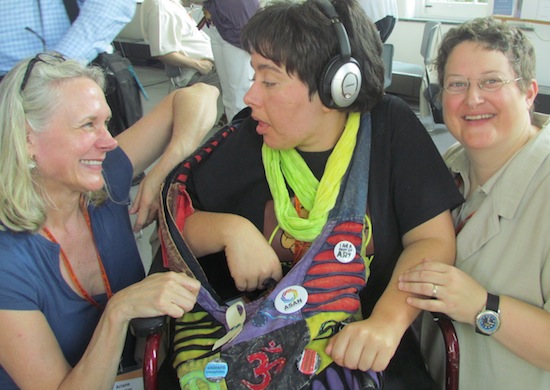
Ariane Zurcher, Amy Sequenzia and Ibby Grace at the ICI Conference ~ A conference dedicated to accommodating those who do not speak

Me, Amy & Ib

Blogging

It’s always interesting to get attacked by someone you’ve never met.  All the more so when they write about how “narcissistic” I am, while talking about themselves and bolstering themselves up in comparison.  They use this blog, link to it, as a spring-board to talk about themselves.  They talk about how they are such a “bad autism mom” because they do not do whatever it is they perceive me to be doing, while at the same time congratulating themselves.  All of this they say with a liberal dose of sarcasm and “eye rolling”.  How easy it is to criticize everyone else.  How easy it is to sit on one’s little self-made throne of superiority, picking apart other people’s lives, while avoiding looking at one’s own.  It’s so much more fun to sit in judgment of everyone else.

There are so many blogs out there, written by all kinds of people about all kinds of things.  Why choose to talk about the blogs you don’t like?  Why not talk about the ones you do.  This blog isn’t for everyone.  If you don’t like what I write about, you don’t like what I say, you don’t agree, then comment, start a conversation, have the guts to say something here, directly to me, or don’t, and go find another of the tens of thousands of blogs out there.  But devote an entire post to all that I’ve written that pisses you off while calling me names, meanwhile using the cloak of anonymity?  Seriously?  Why do that?

I always find it interesting that the meanest comments (and by “mean” I do not mean those who disagree, I mean, nasty, sarcastic and those who resort to name calling) almost always come from people who do not use their real names.  I understand many people choose to use other names to protect themselves and those they write about, I understand that many do so for good and well thought out reasons, but there are others who do so because they say awful things about other people, things they would not have the courage to say to the person’s face while hiding behind their safety net of anonymity.

I have a lot of ambivalence about this blog.  I always have.  I love that my daughter says she’d like to write things to post on here.  I look forward to the day when this blog becomes hers, or we decide to shut it down and she begins her own, if that’s what she would prefer.  I do not post photos of her without her permission.  I do not quote her without her permission.  I try to write honestly.  I write about what I know.  I write about what I think about.  I write about the mistakes I’ve made and continue to make.  I try to write with a certain degree of self-reflection.  I write about what I’m learning.  I’ve written about my past, my childhood, addiction, career, passions.  I try to keep the focus on “my side of the street.”  Often that’s not easy.  It would be far easier to write about everyone else, a running critique of everyone else’s poor behavior, but doing that is not the person I want to be.  I have worked hard these last two decades of my life to be and behave differently.  My default mode of being in this world does not serve me or others.  Being self-involved, a victim, blaming my bad behavior on others, doesn’t help me.  What do I learn from that? How is any of that going to improve anything?  I can’t control other people.  The only thing I have any control over is my response and my actions.  I try hard to not get into judging and condemning others.  I try.  I’m not perfect.

I do what I can to live a life with purpose.  Some people are going to disagree, some people won’t like the way I write.  Some people will decide they “know” me and don’t like what they think they know.  They will find fault.  That’s okay.  But don’t come here and use this blog as a spring-board to talk about how superior you are because you “don’t do” what I am doing.  Don’t twist my words around, take them out of context to bolster yourself up.  Go get some help.  There are lots of people who specialize in helping people with issues of self-esteem.  You want to have more self-confidence?  You want to deal with your insecurities?  Trust me bashing, judging, criticizing others isn’t going to give you what you’re looking for.  You want to complain about me and what I seem to represent to you, go for it.  But have the guts to do it to my face or at least do it here, while using your real name.  Don’t link to this blog from yours.  I don’t need nor do I want the traffic that is generated from your words.

The Snowball Effect

The snowball effect began with, what I now think of as, a leap of faith.  Richard and I leapt into that great abyss better known as the unknown.  It turns out this was actually not true, it would be more accurate to say we chose to neither believe nor disbelieve, but instead began to examine all we were being told.  Perhaps it’s better to say that instead of leaping into we jumped out of.  From there it was more of a hop to begin presuming competence.  However, as a commenter on this blog said, “presuming competence isn’t enough.” And knowing what we now know, I have to agree.  It’s the starting point.  It’s like that initial leaping off point, it’s just the beginning.

At the moment we are experiencing something akin to being in free fall.  It’s the feeling of discovery, limitlessness, surprise, and pure ecstasy that comes with being present without expectation or preconceived ideas about what should or will happen.  Our perspective continues to change as we move along.  Like any great adventure, the path is at times rocky, but the triumphs are exquisite.  As we move deeper into this process it becomes easier and more familiar to be solidly in the discomfort of the unknown.  There is bliss in that.  True bliss.

Last fall I wrote a post about how I was worried Emma was not comprehending a story that had been sent home in her back pack from school.  It was a simple story, perhaps 1st grade level reading with some questions that she seemed unable to answer.  In the post I write how I am trying to find ways to help her reading comprehension.  I talk about presuming competence.  What I am struck by now is not Emma’s level of supposed incomprehension, but by my own.  I reread all the comments just now and am amazed, amazed that though I thought I was presuming competence, I was only able to go so far with my presumptions and, as it turns out, wasn’t going far enough.  I could only presume as much as my limited thinking would allow me.  The idea that she was not only comprehending this story, but was so far beyond it, was not something I was capable of fully understanding, let alone considering.  I was much more stuck, as it turns out, than my daughter was.

Now jump forward to yesterday afternoon, almost nine months after I wrote the post I refer to in the above paragraph.  Emma chose to talk about adjectives.  We watched the BrainPop movie about adjectives and then she took the quiz.  I copied what Rosie had done, asked her to read the questions silently to herself while using a laminated card to direct her visually and then quickly guided her to read each of the four multiple choice answers.  She only hesitated once, on a question about a possessive adjective, but otherwise breezed through the quiz with 90% accuracy.  Not only was Emma reading faster than I was able to, but she was accurately answering the questions faster than I could read them, let alone answer them.

The snowball effect:  “The basic workings of a literal snowball effect can be illustrated by taking one’s average baseball-sized snowball and dropping it down the side of a snowy hill. As it descends it gathers more snow and whatever leaves, sticks, etc. are in its way. The snowball accumulates not only size, but speed.” ~ From the Urban Dictionary

Self Portrait

photo

On Being Fallible

At the conference Em and I just returned from I was confronted by someone who told me I was being disrespectful of my daughter.  She actually went further and said I had spoken “inappropriately” to her.  Furthermore she said these things to me in front of a room filled with people, all of whom could hear her, because she was leading the presentation.  Yup.  It was one of those moments when you really wish the floor would arbitrarily open up and allow you to slide into its blissful dark, abyss.  It was also the final day of the conference and I was feeling pretty fragile and emotional.  My ability to filter was at an all time low, my ability to think logically was pretty much non-existent, and finally, my ability to hear her and reflect on her words without defensiveness was hovering in the red-high-alert-grab-your-oxygen-mask-we’re-going-down-save-yourself range.  It was one of those moments you wish had never happened, but more to the point you wish you’d never said the thing that was being criticized so publicly.  It was a moment of intense shame.  And my first thought was – defend, defend, defend!

But remember, I was in overwhelm before her words had found their target and I didn’t feel strong or able to fight back, nor did I feel I was in a position to fight back, after all not only was she leading the workshop, she was someone I have a massive amount of respect and admiration for.  This is someone I had looked forward to seeing ever since I was told we would be in her workshop.  This was the person I’d read about and anticipated meeting with eager excitement.  Meanwhile there my daughter was, typing out “I’m happy.”  To which she said, “I’m guessing you’re happy when your mom gets called out on her behavior.” Ouch. Ouch.  Ouch.  Let’s just get a knife while we’re at it and see some real blood.

But here’s the thing…  she had a point.  The details aren’t relevant, what is, though, is that if I am speaking to my Autistic child in a way that I wouldn’t speak to my non autistic child, then that’s clearly a problem.  If I am speaking to my Autistic child in a way that I would speak to my non autistic child, (as was the case in this instance) and someone who has spent their life working with children and advocating for them calls me out on what I’ve just said, I need to, at the very least, consider their words and reflect on my own.  I have never claimed to be an ideal parent.  Years of parenting has taught me that sometimes I get it right, often I get it wrong, but hopefully I will always be willing to look honestly at my actions and behavior without defensiveness, but with a desire to learn and be the best parent I can be one day at a time.

So if someone says something that really hurts, when their words pierce, I’m old enough and smart enough to spend some time thinking about my reaction and at least try to see where the other person is coming from.  Sometimes people say things without the necessary information, sometimes people say things that hurt because they are operating from a set of false assumptions, and sometimes hurtful things are hurtful because there is truth to their words.  I’ve spent the last 36 hours trying to figure out which of these was true or if it was a combination of things, but more importantly, I have reflected on whether the sentence I said to my child was the best way I could have spoken to her and if it wasn’t, what would have been.

Even in my state of overwhelm, I was able to whisper to Em right away, “I’m so sorry, Emmy.”  And I was.  But I was also angry with this other person.  I still felt the need to defend.  I still wanted to “save face” in front of this room filled with people.  But instead I went silent and tried not to cry.  Shame.  Shame is brutal and though all of us have probably felt first hand what it feels like, we also probably, inadvertently have shamed others without realizing it or even meaning to.  I know I have.  The above example is a case in point.  Without meaning to – I had shamed my daughter by questioning out loud what she’d just typed.  I get that.  I have enough humility to know that I make tons of mistakes… every day…  but I also know the beat up job that is my default reaction to making a mistake is not a healthy one.  I’m working toward more measured and thoughtful responses.

One of the things I love about Pascal Cheng, the first person to help me begin supporting Emma with her typing was that when I did something that he saw was unhelpful, he would/will say, “May I give you some feedback?”  He then says things like, “Instead of saying, ‘No!’ ask her if that’s the word she meant to type.”  He has taught me to try and give her just the right amount of resistance (to make sure that she doesn’t go to favorite scripts) combined with the emotional support and encouragement she needs to continue typing with me. Pascal models the same respectful interaction with everyone he comes into contact with.  When I grow up I want to be like Pascal.

But in the meantime, I am looking at my words and seeing how important it is for me to be aware and conscious and respectful of my daughter.  Perhaps the better question I must remember to ask myself is not – would I speak to my son this way, but, would I want someone else to speak to me this way?  The beauty of life is that  we can always improve if we want to.  And I desperately want to.  My goal isn’t to be “right” or never to do anything “wrong” or to make someone else “wrong” when they confront me, my goal is to have the willingness to look honestly at my behavior and the things I say and do, face my mistakes and learn from them.  That’s my goal for this short life I have been given.

Me and Em at the ICI Conference
Me & Em

The ICI Conference – Day 2

Anne DonnallanDr. Anne Donnellan, Professor in the School of Leadership and Education Sciences at the University of San Diego gave the keynote address yesterday morning.  She said,  “I’m very happy to say, when it’s true – I don’t know.”  This sentence should be framed and placed inside of every doctor’s, educator’s and professional’s office.  In fact, this should be in every human being’s home, office, place of work, car… well, you get the idea.  Anne went on to say, “If you don’t know the answer, if you’re not sure, what are you going to say?”  She waited for those in the audience who speak to shout, “I don’t know!”  I have pages of notes from Anne’s speech which centered on how autism is mischaracterized as a communication, behavioral and social deficit, yet the massive sensory-movement issues that most Autistics experience is completely ignored.  Early in her presentation she said, “We didn’t notice people with autism have bodies.”  And a little later she said, “We tend to invent knowledge.”  I will be reading Anne’s book, Autism: Sensory-Movement Differences and Diversity by Martha R. Leary and Anne M. Donnellan.

The bulk of the day was spent supporting Em in her typing.   (I dreamt last night Em had taken over Emma’s Hope Book Face Book page!) Our session with Rosemary Crossley was terrific, with a young woman who is aiding Rosie, and all of twenty years old, came over and expertly supported Em in her typing.  Em proceeded to inform us that “math is not my favorite subject in school” and “The subject I like is english.”  Which… yeah…  because excuse, me young lady, but there’s this blog with YOUR name on it, all set to go!  Trying hard to contain my excitement.  Em then typed, “I am very creative.”  And in answer to my question about whether she’d like to maybe write something for the blog at some point, she typed, “I would like that.”  Yet as I write this, I paused just now and asked her if she’d like to write  something now, to which she gave me a resounding “NO!”  But she did say that she didn’t mind if I quoted her in the sentences above.  This is a work in progress for both of us!

Emily and Mark UtterAfter lunch Em and I watched a wonderful documentary by Mark Utter called, “I am in here.”  Before the movie began Mark typed, “i am totally happy you all are moving with me down this fine river.”  Mark is wonderful, and I have to say, he is one of my new favorite friends, even though we have exchanged few words.  I intend to devote a post to his creative and moving movie about what daily life is like for him and how he would respond to people were he able to talk.  Mark is one of a number of people we have met that I hope to stay in touch with.

PascalLater Em and I met with another family who also live in New York City hoping to have a conversation between Em and a non-speaking teen.  Pascal agreed to help facilitate, but as it turned out, I was able to work with Em pretty well with only a few pointers from Pascal.  It was a great day, though it’s really hard work for Em.  Later she typed with Pascal, “Much of my work with people is patterns and things like spelling is like that…”  And then she added, “And I love to work with Pascal.”
This photograph of Pascal was taken by Emma.

I must end this post now, but not before saying, these conferences are profound.  They are profound because of how they are completely unlike the world we live in.  They include, embrace and celebrate difference.  Every person is treated with respect.  People are allowed to be, without judgment.  It is bittersweet to be here, because this afternoon we will have to leave and return to the world that is not even remotely like this tiny piece, of what can only be described as, paradise.