Category Archives: Autism

Why Teach Age Appropriate Topics?

Someone asked me why would I teach my child age appropriate topics such as the American Indians, the arrival of Europeans to America, the Roman Empire and the difference between amphibians and reptiles, when tying her shoes, answering (whether verbally or by typing) a why question and riding a two-wheel bike has yet to be accomplished.

The short answer is – they are not mutually exclusive.  It is not that one thing gets taught and the other is left to languish.  I believe all these things are important for any child to learn; why shouldn’t my child have the opportunity to learn these things too?  But just to play devils advocate, let’s say that the questioner still asks, but why?  To them I say, because knowledge is freedom.   Knowledge gives us context, history provides us with choices, knowing how our government works gives us important information about leadership, honesty and conversely dishonesty.  Learning about geography gives us information about the physical world we inhabit.  Reading Wordsworth or Shakespeare or Susan Sontag, studying a painting by Rubens or Renoir or Basquiat, listening to music by Rachmaninov or  Ray Charles or, my daughter’s personal favorite, Gwen Stefani transports us, encourages us to think both analytically and creatively and enhances our lives.

Ralph Saverese, author of  Reasonable People: A Memoir of Autism and Adoption wrote a wonderful piece about a year ago, The Silver Trumpet of Freedom about his non-speaking, Autistic, son DJ who had just been accepted into Oberlin.  It’s a terrific piece and I encourage all of you to take a few minutes to read it.  I’ll wait.

Right here.

Seriously.

Go.

Read it.  

What many believe to be true about Autism is proving again and again to be incorrect.  What many believe to be true about those who are Autistic AND non-speaking is proving to be incorrect.  Our ideas about someone who has physical challenges AND is Autistic AND does not speak are proving to be incorrect.  Our incorrect beliefs are limiting how that segment of the population is taught and what information they are given access to.

This must change.

To My Daughter…

You are capable.  I am sorry it has taken me so long to fully understand this.  You are smart and able to learn and know so much more than I ever knew.  You understand that sea turtles lay their eggs beneath the sand and then, once hatched, the baby turtles must make the treacherous trek toward the ocean.  An ocean many will never reach.  You understand this.  You understand that turtles live in and out of water.  We did not categorize them yet as reptiles, but we will get to that, possibly tomorrow.

You know Christopher Columbus is said to have reached America in 1492 and that there were people already living here.  You pointed to an illustration of an American Indian and typed that this person was called a Native American.  You showed me where we live on a globe and then suggested we take a boat to England over the Atlantic Ocean so that you might visit an old therapist you still remember and speak of with great fondness.  You became particularly excited by the thought that we would have to stay in a hotel and inquired whether that hotel would have a swimming pool.  I know.  A hotel is not a good hotel without a pool.

You told me an insect has six legs and that a spider has eight legs and even though it kind of seems like a spider should be called an insect, it is not and in fact eats insects which is why all those insects in the Miss Spider book you love so much are scared of Miss Spider and that makes her cry.  You demonstrated your innate acting talents by pretending to cry about Miss Spider’s predicament.  It turns out Miss Spider is a vegetarian and happily eats the flowers offered to her much to the relief of all the fearful insects.  That made you laugh.  Then you remembered how “Bertie kitty” was admonished for getting on the dining room table and eating the flowers and said so, again in a very convincing and stern voice.  You are so talented.  I believed both your pretend tears and your pretend/scolding voice. Thank you for telling me you were pretending because you were very convincing.

You are so, so capable and for so many years I’ve been blind to just how capable you really are.  But maybe, just maybe now I have the tools I need to hear you.  Those tools I thought I was learning to use for you, it turns out are tools I needed for me.  I need them so that I can hear all the things you’ve tried to tell me for so long.

I promise.  I promise to keep listening.

The Final Day With Soma and A Word About Methodologies

Yesterday was the last day of Soma Mukhopadhyay‘s 4-day training.  I wrote about it ‘here‘, ‘here‘, and ‘here‘.  Soma packs an enormous amount of information into four days.  She discussed everything from neural pathways of the brain to which parts of the brain are used during specific activities, to how to devise lesson plans and ways to physically position oneself in relation to the student.  There were so many surprising moments, but one that I never could have anticipated, was how helpful it was to learn about the actual brain function during moments that are emotionally charged or OCD.  Learning some of the basics in brain function demystified a great many things in a way I hadn’t before considered.

Given what we now know, and granted it isn’t much comparatively speaking, but is so much more than we knew even twenty years ago, it is astonishing that certain older therapies continue to be popular and used for autism.  Two of the most destructive phrases used with an Autistic person are the dreaded, “Look at me!” and “Use your words!” I cannot list how many times Emma has been instructed to “use your words” only to do so and be ignored.  It seems those who say “use your words” really mean, “use the words I want to hear”.   Add to that the insistence that an Autistic student have “quiet hands” and not stim because it is believed learning cannot take place while stimming even though by removing the stim no learning can or will take place because we’ve just taken away the one thing that was allowing the student to stay focused and attend, even if it did not “look” that way to us.  We non Autistics have a tough time understanding anything or anyone who is vaguely different from ourselves.  Before we start calling ourselves “experts” in Autism, we might want to become “experts” in our own neurology first, at least we’d have a better handle on our own limitations and see how those can so easily dovetail into how we are interpreting what we’ve decided is “the truth” about someone else.

I have written about methodologies before on this blog.  There are some that I find more troubling than others, but in the end, the thing I care about more than anything else is: is it helping my child?  Is she learning?  Is she safe?  Will the short-term gains be at the cost of long-term pain and even trauma?  What is this doing to her self-esteem?  Is respectful interaction being modeled?  Is she being humiliated, shamed, made to feel badly for the way her brain processes information?  Is she being taught by people who believe in her ability to learn?  Are her teachers believing her capable and giving her the tools she needs to flourish and be all that she can be?  Is she assumed to be competent or is she being forced to prove her competence?  Is she being taught the same equation, story, concept and terms over and over?  Is she seen as a human being with the same rights as any other person?  Would YOU want to be treated the way you are treating and teaching this person?

I don’t care what the methodology is, who created it or how many people believe in its efficacy, if it isn’t taking these questions into account, I am not interested in it.  I do not care what others believe, I don’t care what the “experts” say, I don’t care how many letters a person has after their name or who created the methodology or the various papers and/or books the person has written, if the methodology is not attempting to consider these other ideas, I am not interested in it.  I, as a parent,  am not invested in any particular methodology unlike so many schools.  And for that reason I have far more leeway than most schools do, to keep trying different things until we (I’m including my wonderful husband) find the thing or a combination of things that will best help our daughter learn, grow and become all that she can be.  In the end that is what we care about more than anything.

This weekend I will create a lesson plan for my daughter with age appropriate materials for next week’s  RPM session.  I am hoping I will be able to demonstrate, at least some of what I’ve learned, to Emma’s therapist and her teacher.    But I also know I will make mistakes, I do not expect that after four days of an intensive training I will do Soma’s method well, but I think I have a fairly good understanding of the basics so that I can start, at least, trying.

Wish me luck!

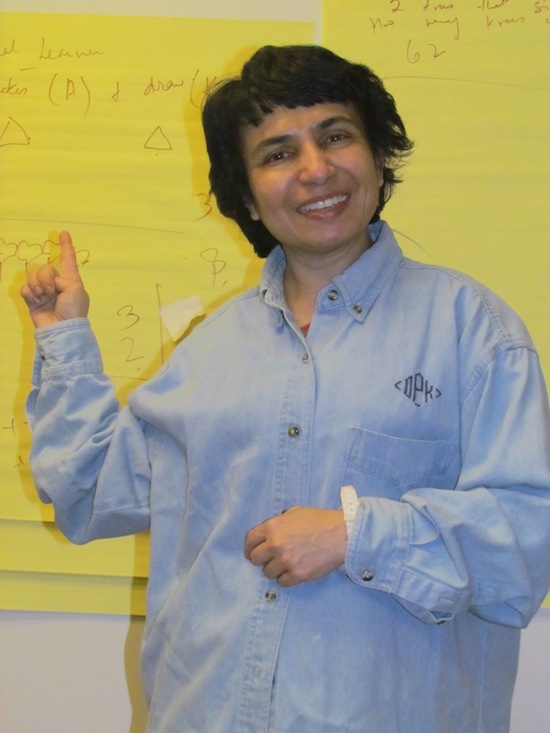
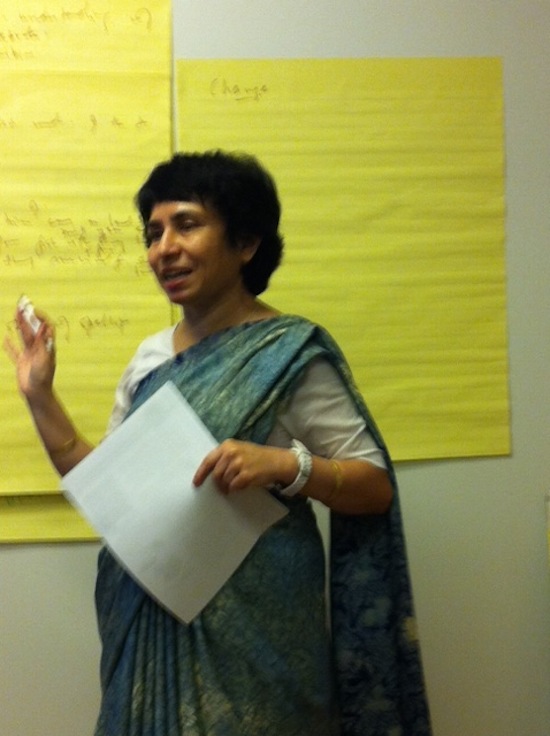
Soma Mukhopadhyay – March, 2013

3Soma

Soma Mukhopadhyay ~ Day 3

It is hard to believe how much information Soma is able to pack into the first three days of a four-day training.  She has managed to cover the different learning channels and how to teach toward each one.  We learned about the various stages of development, left brain/right brain, the difference between an excitatory stim and a calming stim.  The importance of presuming competence, working through self-injury and highly charged emotional situations have all been discussed.  We were taught that social expression and gestures begin in the hypothalamus travels down into the body, then back up to the somatosensory cortex, to the pre-motor cortex and finally to the motor cortex and how at any point along the way, things can become disconnected causing the Autistic person tremendous challenges in behaving as we non-autistics might expect.  We learned about OCD and how to interrupt it by asking the student to spell a relevant word or introduce numbers and/or a math problem as a way of working with it while at the same time diffusing it.

Soma described how to implement a lesson plan around just about any topic, mental mapping and the different stages of rapid prompting method.  We went over methodologies and how to plan a lesson by using flow charts, listing objectives, relevant spelling words and key terms and concepts that need to be introduced, explored and learned.  She taught us the importance of teaching concepts, and the words used, as well as reading comprehension, spelling, grammar and such abstract ideas as time, symbolism, relativity, belief systems and throughout all of this Soma emphasized the importance of teaching age appropriate or above age level materials while filling in the gaps of what isn’t yet learned.

I’m exhausted, exhilarated, but exhausted and there’s still one day to go!  Today, the final day of the training, we are going to cover how to teach math and math goals, how to take and administer a test, how to teach poetry, literature and creative writing and the training will end in a review aka test. Tests have always been my downfall when I was in school.  I become anxious and overly nervous.  When I was in high school I learned to over study and even then I would become easily overwhelmed if I didn’t know the answer to a question and would get so upset that even the questions I could answer would go unanswered because I couldn’t move on from the one I didn’t know.  Writing all of this makes me aware of how similar my daughter is to me in this regard.  She also becomes fixated and upset when she gets an answer wrong.  She too has trouble moving on to the next question or topic, can become dis-regulated and overly anxious.  I will try to incorporate some of the exercises Soma has taught to see if I can interrupt my obsessive thinking if and when it happens.  So much of what Soma teaches could be used for anyone, even me!  I could write a lesson plan around that…

*5

Soma Mukhopadhyay ~ Training Day 2

I’m halfway through a four-day training with Soma and I have filled more than half a legal sized notepad with notes.  Yesterday we covered Mental Mapping/ the different stages of RPM and Implementation.  I told Soma about my encounter with the child who didn’t want to work and immediately hit themselves.  I described how I’d had them spell “hitting” on the letter board and how this had immediately diffused the situation.  Soma then gave me more terrific suggestions on how to devise a lesson plan around an action such as hitting.  An example of this is (I”m making this up) “I would like to know more about hitting.  What else can you hit?  Do you hit the sky or a ball?”  Soma spoke of how when emotions are running high, switching to numbers and math, which have no emotion can be helpful during emotional outbursts.  “How many times can you hit the ball? Here let’s count.  1, 2, 3, 4, 5.  You hit 5 times and if you hit once more, that would be 87 times or 6 times?”

We spent a great deal of time discussing the ways in which one can learn about a student through their preferences, stims, what they’ve been exposed to, skill levels and abilities, tolerance levels, acquired knowledge and defenses.  Soma then covered how one goes about implementing all of this through lesson plans.  Each step of the way one presumes competence in the student’s ability to learn and be taught without presuming that they already know how to read, write, add and subtract.  Through the various activities it quickly becomes clear whether the student needs to be shown how to spell a word such as “hitting” or whether they already know the word.  On the first day one of the students, whom Soma had never met before, sat down and after working with her for fifteen minutes or so, was asked what his favorite color was.  She had him choose from one of two stencil boards for the first letter.  From that board he chose the letter “r”.  He then proceeded to type ‘r’, ‘e’, ‘d’.  The following day a number of the people  taking the training expressed skepticism that the student actually could read or write.  One suggested that red may not have been his favorite color.

When asked how they knew that he couldn’t read or write, they weren’t able to give specific reasons, it seems many just assumed he could not.  It reminded me of the years and years I spent believing a whole variety of things about my own child, which turned out to be untrue.  I had no proof that the things I thought were actually true, I had just assumed and then behaved toward her as though it were fact.  Perhaps one of the single most destructive things we can do to our children, students, the people we meet is to make assumptions about their intelligence and abilities.  Beliefs based in nothing other than unfounded assumptions and our own biases of those who look or seem to us as not being capable.  These assumptions are dangerous and can do real harm.  As I’ve said before ~ to presume competence and be wrong will do no harm, to presume incompetence and be wrong can and will do tremendous damage.

Soma – 2013

Soma

A Training with Soma Mukhopadhyay

I am taking a four-day training that Soma Mukhopadhyay is giving this week.  Yesterday was the first day and Soma covered the stages of development and different learning styles.  Throughout the entire day Soma demonstrated how one teaches while presuming competence, though she never said those two words or even mentioned this, it is, in fact, what she was doing.  She does not assume a person she’s never met will know how to read or write, but she does presume that the person can and will learn regardless of whether they speak or not.  Rapid Prompt Method teaches skills that create a strong foundation for all learning to take place.

Soma walked us through stims that are excitatory and calming and how to tell the difference.  She demonstrated how one can work with them and how they give us clues about whether the person is auditory, visual, tactile and kinesthetic.  I asked a great many questions about things such as, what do you do when the person you’re working with hits, bites, slaps or pinches themselves or you.  Later after the training had ended I had the opportunity to work with someone who almost immediately hit themselves in the chest and they shouted, “No hitting!”  Fresh from the day’s training, I grabbed a letter board and said, “Oh here.  Spell hitting.”  I held the letter board out and shoved a pencil in their hand.  Immediately they stopped hitting themselves and pointing to first the ‘h’ then the ‘i’ and so on until they’d spelled “hitting” at which point they were able and willing to move on to do some other things.

Afterwards I reflected on what had just happened and remembered something else Soma did when one of the children she was working with tried to bite her.  I am paraphrasing as I didn’t write down exactly what she said. In a very calm, matter of fact voice, she said something like ~ Oh you’re trying to bite my arm.  My arm is not lunch. What else can you bite?  No judgment, no scolding, shaming or anger, there was nothing in her voice to suggest she was speaking of anything out of the ordinary or that this was something to get upset about.

For years I have been baffled by how to respond or even if one should respond to such actions.  I have written about “self-injurious” actions ‘here‘, ‘here‘ and ‘here‘.  I’ve never completely known how to respond and have responded in a variety of different ways, but today… today was the first day I saw someone model a response in an academic setting that made sense to me.  It isn’t that this response will eradicate the need or desire to hit or bite, but it was the first time I’ve seen someone respond in a way that didn’t make it worse, either by scolding, shaming or reinforcing.  As was the case this afternoon, the child I was with, immediately stopped hitting themselves and we were able to get back to work without further comment.

Today is day 2 of the training and it’s very exciting!

“Presume Competence” – What Does That Mean Exactly?

When my daughter was first diagnosed at the age of two and a half, presuming competence was not a concept I was ever told about or had heard of.  And even if someone had suggested we do so, I’m not sure I would have fully understood what that meant exactly.  So what does “presume competence” really mean?  And how and why should we carry out a presumption of competence?

In an interview, Douglas Biklen explained:  “Assume that a child has intellectual ability, provide opportunities to be exposed to learning, assume the child wants to learn and assert him or herself in the world.”

A key component to presuming competence is to become aware of the prejudice that currently exists regarding autism and how these ingrained beliefs harm not just our children, but ALL Autistic people.   Like any prejudice, based on layers and layers of misinformation, misperceptions, and misunderstandings, we must be willing to acknowledge our own “beliefs” before we can begin to deconstruct them.

When my daughter was little with almost no language I could not understand how it was possible for her to learn to read and write if she did not speak first.  I was surprised and confused when I learned how completely wrong I was.  When I read about all the non-speaking Autistic people who had learned to read and write despite being given no formal instruction, it seemed magical to me.  This mind that seemed, from my limited perspective, to not understand so much, actually was taking in far more than I could imagine, let alone believe.  It wasn’t until I was able to see my own limitations caused by the things I had been told about autism and hence, my daughter, that I was able to move beyond that thinking and embrace another way of thinking.  I had to acknowledge my misperceptions and the misinformation I was given, then I had to question everything I thought I knew and was being told.  I had to seek out Autistic people who were kind enough to share their own experiences before I was finally able to dispense with my erroneous ideas and move beyond them.  In case anyone’s missing it, there is a certain irony in my early assumptions regarding Autistic competence.

At the Institute on Communication and Inclusion conference, which we’ve just returned from, and I began writing about in yesterday’s post, Tracy Thresher typed, “… couldn’t let anyone know I could read and I understood what was said to me the training gave me the way to communicate with others.”  On the Wretches and Jabberers website, Tracy wrote, “My communication is paramount to my well-being and is key to my being an active citizen.”  He goes on to say, “I may appear to be a man shrouded by a cloak of incompetence but if you will take the time to listen to my typing you will understand I am intelligent.”

What I have come to understand, is that a presumption of competence is much more than a set of beliefs, it is a way of interacting with another human being who is seen as a true equal and as having the same basic human rights as I have.

A presumption of competence may seem like a leap for many non Autistic people,  it may even feel like a disconnect.  Some may argue that their non-speaking child cannot possibly understand, that they know this beyond any doubt and I must ask, but how can you know this for sure?  We may tell ourselves that our child is too “severe” and we are setting them up for certain failure by presuming competence.  To these people I would suggest the opposite is true.  The only true failure is when we walk away and assume incompetence.

Presume competence means – assume your child is aware and able to understand even though they may not show this to you in a way that you are able to recognize or understand.

To presume competence means to assume your child or the other person does and can understand when they are being spoken of and to.

Presume competence means talk to your child or the other person as you would a same age non-Autistic child or person.

Read and have available age appropriate stories and give access and instruction to age appropriate learning material.

Presumptions of competence means treating the other person with respect and as an equal without pity or infantilization.

It does not mean that we will carry expectations that if not met will cause us to admonish, scold or assume the person is being manipulative or just needs to “try harder”.

To presume competence does not mean we assume there is a “neurotypical” person “trapped” or “imprisoned” under an Autistic “shell”.

Presuming competence is not an act of kindness.

Presuming competence is not something we do because we are a “good” person.

We do not get to pat ourselves on the back because we have presumed competence.  If we believe we deserve a pat on the back and/or acknowledgement, then we are not presuming competence, we are more likely being condescending.

One last thought regarding presuming competence…   to presume incompetence is to actively do damage.  Let’s all agree not to do harm to our fellow human beings.

“Autistic People Are…”

*Following on the heels of the tremendously successful “Autistic people should…” flash blog last Saturday, today’s flash blog has bloggers adding their thoughts to “Autistic people are…”

Autistic people are…   

human beings.  

with the same rights as anyone else.  

equal.  

as diverse as those who are not Autistic.  

Autistic people are.  

Welcome to the human race.  

Now let’s start treating them as such.

For some history and the flash blog link, click ‘here‘.

As a direct result of last Saturday’s flash blog and thanks to the hard work by Yes, That Too, Unstrangemind and many other Autistic bloggers, this happened – Google Changes Policy for Autism 

While those policies have not yet gone into effect, it is hopeful news and a wonderful first step.

Embracing Change

When Em turned two, I said, “I’d give a limb to have her ask for something.”

When Em was three, I said, “If only she could tell me what was wrong.”

When Em was four, I said,  “If only she was able to understand.”

When Em was five, I said, “If only she would sleep through the night.”

When Em was six, I said, “If only she would learn to use the bathroom during the night too.”

When Em was seven, I said, “If only I understood what she was thinking.”

When Em was eight, I said, “I just want her to be safe.”

When Em was nine, I said, “I want her to have choices in her life.”

When Em was ten, I said, “I think I’m beginning to understand.”

When Em turned eleven, I said, “Thank you.  Just thank you.”

Things continue to change.  We adjust.  I continue to change and my life gets bigger and fuller.  Em continues to change and her life gets bigger and fuller.  I didn’t fully appreciate or understand this when Em was first diagnosed, but I do now.

Everything changes.  I’m learning to embrace it.

sc000a5075

The Dentist and Tiny Steps

“Take it out!” Emma said.  “Take it out!”

We were at the dentist’s office where she had just had a baby tooth pulled because it was obstructing the adult tooth from descending.

Five years ago when Emma had two cavities that needed to be filled on two baby teeth, we had to take her to the hospital and have her anesthetized as she could not tolerate having an x-ray let alone having a cavity filled.  The two baby teeth were capped and while she was unconscious the dentist applied a sealant to all her teeth as they are unusually porous and susceptible to cavities and plaque.  When she regained consciousness she cried, “Take it out! Take it out!  She then tried to pull the metal caps off her teeth.  I still remember sitting with her at the hospital, horrified as she screamed and cried and pulled at the caps on her two teeth, wondering what we were going to do.  After a few days, when she realized the capped teeth were not going anywhere anytime soon, she grew accustomed to them and stopped trying to pull them off.

Over the years Em has grown used to the dentist and dental visits and allowed him to clean her teeth without protest.  A year ago she sat still long enough to have multiple x-rays taken of her mouth and teeth.  This was a first!  Em was ten years old.  Now Em has four braces on her four front teeth and has a palate expander in place that she tolerates, though doesn’t much like.  (Who would?)  Two days ago she tolerated the dentist giving her a novocaine like numbing agent allowing him to pull her baby tooth.  This was a first and a huge milestone.

“Take it out!” she kept saying.  At first the dentist thought she was eager to have him pull her tooth, but I had a feeling she meant the numbing sensation.  “Do you mean take out the tooth or take away the strange sensation?” I asked.  “Take it out, Mommy.  This,” and she pulled at her upper lip, twisting it with her fingers.  “I know it’s an awful feeling, but it will wear off, Em,” I told her and then asked the dentist how long he thought the numb feeling would last.  The dentist told me it should wear off in about an hour, so I set a timer on my phone and handed it to her.  She held the phone and watched the minutes tick by.  Meanwhile I hoped beyond hope the dentist had given me a correct estimate and wasn’t being optimistic.

After the tooth had been pulled and the bleeding had stopped, he came by to check on her and saw Em with my phone and the timer counting down the seconds and minutes.   He laughed, “Uh oh, you’re going to hold me to it!”  Then he said, “You better give her something hot to drink, that will speed up the process.”

“Good to know,” I said.  “Hey Em, when we get home, I’m going to fix you some hot chai.  It will help that weird feeling go away.”  “Take it out!” Em said.  “Yeah, it’s going to make the numb feeling go away faster.” Em nodded her head and off we went with Em clutching my phone watching the seconds tick by.

By the time we arrived home there were about ten minutes left and Em kept repeating, “Take it out!  It’s okay, it’s okay.  Timer goes off and it’ll be gone!”

I fixed her some hot tea, told her to drink it and when the timer went off the numbness must have abated enough to make her less panicked.  About an hour and a half after the first shot she said she felt fine.

Tiny steps, taken one after the other over time, can and do take us far…

Related articles

Dreams, Love, Loss and Gratitude

I had a dream last night that unsettled me.  I dreamt that I was standing with some other people and saw a woman with her young son.  He was small, maybe five years old at most.  I was fascinated because he was holding what looked to be a “string” like Emma has, but much smaller.  It was proportionately the same size as Em’s given how little he was.  I turned away because Em was saying something to me and when I turned back around the mother and her son had walked away.  On the ground was the little boy’s string.  So I picked it up and ran after them.  As I approached the mother I held out the tiny furl of string and said, “I think this is your son’s.  I wouldn’t want him to lose it.”  The mother stared at me and said, “What is that thing?”

I said, “Oh!  I think it’s maybe his string.  My daughter…”  but before I could finish she interrupted me and said, “That isn’t ours.  It’s garbage.”  I felt as though I had been punched in the stomach.  And then she turned away, carrying her son who gazed at me wordlessly over her shoulder.  I stood there watching them walk away from me and felt stunned and confused.  I wondered if maybe I’d somehow misunderstood and that perhaps it wasn’t important to her child.  And then I felt ashamed for having approached them and said anything.  Ashamed that I’d assumed it was important because my daughter’s string is so important to her.  Ashamed too, that what is considered beloved and of value to my daughter is seen as garbage by another.  I stood there feeling these things and then I turned to find my daughter was no where in sight.  I felt that horrible surge of panic and adrenaline as I began going through the various scenarios of where she could be or what might have happened to her.

When I woke up I wanted to cry I felt such unspeakable sadness.  All morning that dream stayed with me like a shadow.  All morning I have felt fragile and on edge.  And then I read my friend Gareeth’s latest blog post.  You can read it ‘here‘.  It is a daughter’s moving and powerful tribute to her mother.  I cried as I read because it is so beautifully written, but also because it is about profound loss as well as gratitude for what wasn’t lost.  Loss of time, loss of relationships, loss of missed opportunities…  and as I read I realized that dream was also about loss and judgement and denial and how we harm those we love.  And now as I sit here in my studio looking out at the bumper to bumper traffic on the 59th Street bridge, the rain pours down.  I can hear drops splattering the top of the air conditioner that juts out of one of my studio windows in irregular plops and pings.  Rain drops stream down the windows obscuring my view and I am surprised that I hear no angry honking given how treacherous the traffic is, just the occasional siren can be heard in the far distance.

I feel so grateful to all those people driving their cars who aren’t honking at each other.  I feel so grateful that though the traffic is at a crawl, people are being patient and it gives me hope.  Let me be patient today with every person I come into contact with.  Let me give myself the same respect and patience.  Let me be aware and kind and respectful to others today.  Let me feel gratitude for all that I have.  Let me feel my feelings and not behave as though my feelings are facts.  But most of all, let me know the difference.

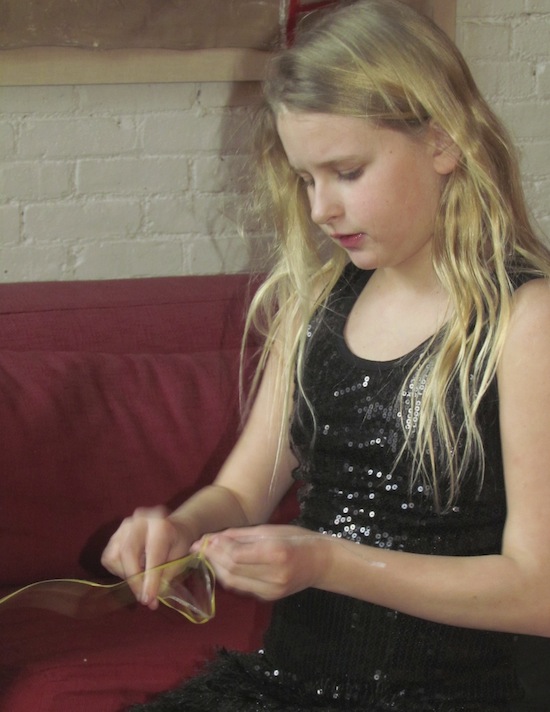
Em’s string – February, 2013

Em's string


A Witness to Her Own IEP Meeting

This morning we went to Em’s IEP meeting…  with Emma.  I wrote about this ‘here‘ last week.  It was the first time we’ve done this and while Em chose not to add any goals when asked at several points during the meeting, she did express interest in speaking with me during our typing session together, later.  So I intend to talk with her about what was covered and see what she might like to add or discuss.  Most importantly, she was there to witness and hear the thoughts others have regarding her academic goals for the coming year.

At one point she began parroting every word I said.  It was like being in an echo chamber.  I looked over at her and it reminded me of when I was a kid and my siblings and I would do this to make each other laugh.  I do not believe this was the reason Em was doing this however.   Both Richard and I felt she was trying hard to show that she was listening and an active participant.   A few times when one of us directly asked her  whether she agreed or had anything to add she scripted, “Bertie kitty!  You have to get off the table.”  Or some other equally, (seemingly) unrelated script about my old cat who died five years ago.  I kept reminding myself that Em’s language default is a set of scripts.  The scripts may or may not be related to the conversation, but are most definitely an indication of intent and interest in being part of the conversation.

For almost an hour Em sat in her favorite chair during the meeting.  Not once did she try to get up and go somewhere else.  Not once did she indicate she wanted to leave.  Not once did she say anything to show upset or stress.  I was proud of her.  And I was glad she was there, not because she added any specific goals to the IEP, she did not, but because she was present and witness to a conversation regarding the coming year’s goals for her.   And her presence matters and changes the conversation, even if just slightly, it makes a difference.  As Richard and I continue to move forward in our journey to give our daughter the tools she needs to help us help her, this is an important first step.  I had no expectations going into this meeting regarding her input.  I had no idea what would happen or if she would want to leave.  All I knew was that I gave her the choice to come or to stay with her class and she asked to be present.  So she was and for that I am very grateful.

More will be revealed…

Tears and Love

This past Saturday we took Em to meet and have a session with Soma Mukhopadhyay, who developed RPM ~ Rapid Prompting Method for Autism.   I’ve written about Soma before, ‘here‘ and briefly on a number of other posts.  If you want to read those old posts you can put “Soma” into the search box and everything I’ve written mentioning her will come up.  A word of warning, however, those early posts show a very different mind-set regarding autism and my daughter than the one I now hold.  I find it difficult to read them because I had so completely bought into the Autism = tragedy mode of thinking.  As anyone who follows this blog knows, this is not the view I hold now.  It is good to see that my daughter is not the only one who is making progress!

One of the first things Soma did, (who has never met nor worked with Emma before) was comment to us that Em needs help to slow down.  This is identical to Pascal’s observations.  Em’s default is to script or point to the first thing she sees, whether that is a piece of paper or a key on a computer.  So despite the name of Soma’s program, for Emma this is less a literal “rapid” method and more a sustained level of interaction.  During the entire session Em remained focused and answered each of Soma’s questions appropriately.  There was no physical contact of any kind.  Rather Emma was asked to point to letters on a stencil board or to scraps of paper with different options on them.

Soma began with “I am thinking of a month when the leaves start to fall.”

Em then dutifully spelled “October” on the stencil board and my tears began to flow.  “I’m thinking of the season when the leaves grow,” Soma said.  To which Em pointed to the letters to spell “spring.”  For forty-five minutes Soma covered math, the seasons, an Aesop’s fable, reasoning, science and for forty-five minutes I watched with tears in my eyes as my daughter attended with focus while holding on to her string.  Every now and again Em would verbally respond to Soma’s question and then glanced up at her with a little smile.  By the end of the forty-five minutes Soma asked, “do you have any questions?”

“Will you come live with us?”  Was the only question I could think to ask.  I was kidding of course, but it was the only way I knew to sum up how I felt.  For years now we have been trying to find a curriculum that will help Em learn in an academic setting.  For years we’ve tried, her various schools have tried many different methods, none of which have worked.  Yet here we were watching a program that not only worked, but that I could see the potential and the potential is limitless.

Yesterday I decided to try to combine some of what I saw Soma doing with what Pascal has been helping us learn with supporting her typing by creating resistance to her.  I sat on Em’s right side and brought out our iPad.  I also had Nic’s old globe and we talked about how we live on a planet called Earth. I showed Emma where we live and then where one of her favorite people lives in London, England and how to get to London we would need to fly over the Atlantic Ocean.  Em typed, with me providing resistance, “We live on a planet called Earth.  To visit England we have to fly over the Atlantic Ocean.”

This was the first time I have supported Em’s typing and given her the proper resistance.  I could feel it.  I could feel her reaching for the keys.  I could tell when I needed to provide more resistance, I could feel when her body was tensing and when she was trying to perseverate or trying to script.  This was the first time I have worked with Em that I knew without any doubt that I was not directing her at all.  She went on to type that if she could visit any other planet she would like to visit Mars.  We then ended with her typing her full name, her age and where she lived.  She knows all of this and so much more.

And finally, just finally I know she knows.  I know, she knows, without any doubt.

Tears and love.

header_4

“Autistic People Should…”

Today is “Autistic People Should…” flash blog day!  Please take the time to read these terrific posts by Autistic people who are blogging in to change the current views by non-autistic people of what Autistic people should or should not do or be.  Autistic people are taking these three words today and making them their own.

The Autistic People Should… Flash Blog

To give all of you an idea of what comes up if one types “Autistic people should” into a google search box at the moment ~

Yeah.

This has to change.  WE can change this, all of us, together, by spreading the word, sharing the flash blog link, tweeting the posts.  Let’s help change the way we think about autism and Autistic people.  We ALL benefit when we work toward ending oppression and respecting every person’s right to exist.

Goals and IEP Meetings

My goals for my daughter have completely changed since she was first diagnosed with Autism more than nine years ago.  I have been thinking about goals a great deal because her IEP (Individualized Education Plan) meeting is coming up and for those of you familiar with IEP meetings, it’s all about goals, both long-term and short-term.  The parent’s goals, the teacher’s and therapist’s goals, everyone’s goals are discussed and written down.  Except for Emma’s.  What are Emma’s goals for herself?  For those who have children with either spoken or typed language this is an easy enough question to ask.  For those of us whose children do not it gets a bit more complicated.  Still, I plan to ask, even if I do not get an answer, whether verbally or typed, I will ask and I plan to talk to her about her IEP and what that means as well.  I may even type out some of the goals we are thinking about and ask her if she agrees with them.

I have to admit that sometimes when I speak to Emma about things, whether it’s about privacy, our bodies and bodily functions, the power of saying no, the importance of self and self-determination, or something like explaining what is going to happen over the weekend or asking her what her goals are at an IEP meeting, I catch myself wondering if she really understands.  What I have learned, what I continually remind myself is that it’s okay to wonder, it’s okay to feel all those feelings, but it’s not okay to act or behave as though she does not understand.  I have to speak to her as though she does understand, even when I don’t know that she does.  In the end I have to do this, because to believe that she can’t/ won’t/ doesn’t understand and to be wrong is a risk I cannot take.