Author Archives: arianezurcher

Living in the Grey

No, this post has nothing to do with porn, soft, hard or anything in between.  In fact, this post is not about sex at all.   There will not be any numbers or shades or subtle, implied meanings of anything remotely titillating.  For those who were hoping otherwise, best to move along…

However, I do have a confession to make.  I tend toward extreme thinking.  An example, if someone cuts me off while I’m waiting for the subway, grabbing the one remaining, unoccupied seat, forcing me to stand, I can get into some pretty abysmal thinking.  I am likely to assume the day is cursed, as I engage in heinous thinking about the person who “stole” MY seat, to apocalyptic views about the nature of human beings.  I know this about myself.  I know I have a difficult time living in the soft, greyness of life, while rejecting the glaring, yet far more exciting black and white tragedy or ecstasy of my circumstances.

For years I felt mildly victimized by Em’s diagnosis.  I felt no one really understood or could possibly understand and any who suggested otherwise offended me.  Then I found Autistic adults who were not living the tragedy I had assumed was my daughter’s inevitable future.  In fact, these adults were interesting, smart, some spoke, some did not, others spoke on occasion, some communicated through typing, others communicated through typing with a facilitator, some had careers, others didn’t, some were in relationships, others weren’t, some had children, others did not.  Some have become friends, one in particular has become a close friend, someone I seek out, think about, want to spend time with, look forward to talking to and miss when our schedules do not allow us to connect.  In knowing her I’ve been able to dispense with the “victimized” mindset.  She’s helped me enormously, not just in giving me a better, more tempered view of autism and breaking down some of the more harmful stereotypes and beliefs I once held about autism and Autistic people, but in what it means to be human.

I have gone from feeling a low-grade sense of sorrow for my circumstances to feeling fortunate and grateful for my life and family.  I don’t mean that everything is perfection and that we never encounter moments of sadness or unhappiness, I just mean that I no longer pin my dark moods and feelings on “autism”.  In fact, I feel ridiculously fortunate.  I have met more fascinating people in the past year than I ever imagined possible.  I no longer wonder what life would be like had I not had an autistic child.  I am grateful for the life I have.  I am grateful for both my children and I’m grateful for my friendships.  I find I am living more and more often in that comfortable grey area of non-extremes.  (Please feel free to remind me of this post when I write something less “evolved”.)

And that woman on the subway, who for the past four years has shot in front of me to grab the only remaining unoccupied seat on more mornings than I can count?  I wish her well.  I even gave up my seat, so she could sit this morning AND I didn’t feel smug or resentful; I just kept reading my email.  Who knows?  Tomorrow I may even muster up the courage to smile at her.  Because you know what?  Life is just too damn short.  Besides I’m growing fond of the grey.

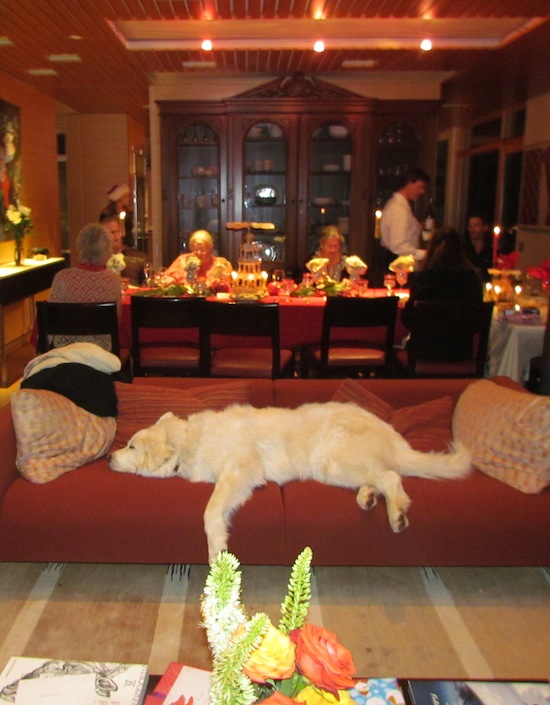
Christmas Eve Dinner – 2012
“I might be you.”

I might be you. the terrific new book written by Barb Rentenbach and Lois Prislovsky, Ph.D awaited my arrival from our holiday travels.  I am only on page 51, but wow(!) what a book!  Barb is Autistic.  She also happens to be non-speaking and needs support doing almost everything including communicating.  Barb uses facilitated communication to type.  In her own words she explains, “The deal is, I still can’t talk, but I can type on a keyboard or letter board if someone supports my wobbly hand.  The process is called facilitated communication, or “assisted typing.” It is quite controversial, meaning lots of people think it is not really me doing the typing.  This infuriates me…”

For those who are dubious about facilitated communication, Barb now types independently requiring just a hand placed gently on her back.  In October of last year I went to a presentation given by Barb and Lois.  It was riveting, mind-blowing and made me rethink everything I thought I knew, but realized I did not.  Barb wears thick glasses and uses an oversized keyboard to type.  She has a terrific sense of humor, is incredible honest on all topics including extremely personal ones;  this book is a joy to read.  She discusses self-injurious behavior, feces smearing, violent outbursts, which her school viewed as baffling and without provocation and yet in the telling, one realizes this was not the case.

Barb eloquently describes the brutality of other human beings who do nothing to temper their contempt for any who appear different.  Barb writes, “Let me be brutally honest.  Most of the blisteringly painful assaults and provocations happened at school – this school, by children who grew up to be you.”  Breathe.  Read that again.   “… Most of the blisteringly painful assaults and provocations happened at school – this school, by children who grew up to be you.”  “You.” Take a breath and let that in.  “Children who grew up to be you.”  

Confession:  I am in second grade.  There is a little girl named Louise who wants to be my friend.  She has warts covering her hand, the hand that she has extended to me, the hand she wants me to hold, only I will not.  I am the new kid.  I am well aware of the unspoken rules of the playground.  You do not hold Louise’s hand.  You do not allow yourself to be seen with Louise.  You distance yourself.  You play alone if need be.  To be seen with Louise is to be like Louise.  Flawed, with warts for all to see.  Instead I tell everyone I moved from a foreign land and spoke another language, a language only I and the village I have moved from speak.  I lie about my family, I lie and say we lived in a field with a house made of straw.  I told these lies because I thought they made me seem exotic and fascinating.  I lied because, already at the age of seven I believed I was less than, not good enough, destined to be like Louise, with my hand outstretched to others, only to be rejected time and time again.

Barb writes about how she is unable to eat without making a mess, as hard as she tries, her hands do not do as her mind bids them.  At lunch a student reports her messy attempts to eat her sandwich and is told by a teacher that she will have to eat somewhere else, away from the others as she is, “making the other children sick.”  This book (and again I am only on page 51) made me stop and reflect on my own behavior.  Am I really as empathic, compassionate and wonderfully kind as I would have everyone believe?  Do I make assumptions?  Do I hold beliefs about others because of the way they appear?  What are my hidden prejudices?  Am I able to admit to them?   Who among us can say without hesitation that were our bodies not able to respond in the way our brain and intellect would have us, were we ridiculed and shunned as a result of that disconnect, that we would maintain our composure, would not act out in protest?

“Am I so different from any of you?” Barb asks.

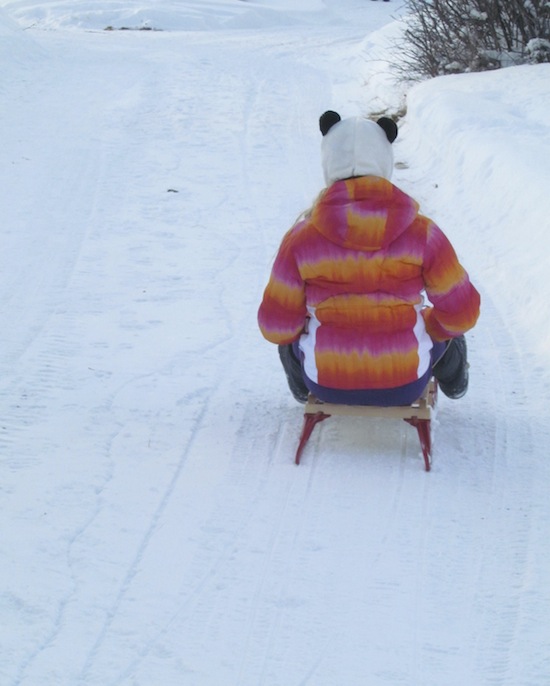
Em sledding

Impatience and Expectations

I’m impatient.  I know this about myself.  Impatience serves me to do a great many things.  It propels me to take action rather than not.  It makes me push harder, try harder.  My impatience, which usually begins with tremendous optimism can descend rapidly into disappointment and discouragement.  Fortunately I am also fiercely determined and dogged in my reluctance to give up which helps mitigate some of my impatience or maybe it just makes me confused. 😕

However, there are a great many things that are not helped by impatience, things like learning a language, learning to type or learning almost any new skill.  These are things that take time, practice and patience.  So I have to recognize this and continue despite my impatience.  This comes up over and over as I work with my daughter.  But in working with her, I’ve also come to recognize something else and that is my expectations.  Huge expectations, coupled with impatience can do harm.  I see that.  I’ve been very aware of how it affects me, but how does it affect Em?

I am learning how to support Em in her communication.  For example we will read a story together, such as a book Emma chose recently entitled, Who Pooped in the Park?  The story details a family outing where the two kids are upset when they don’t see a great many wild animals on their hike, but learn to identify what animals live in the area by the markings they leave.  During our session together I asked Em, “What were some of the animals the family identified?  One animal starts with the letter b.”  Emma then typed, “There was a bear and ciyoty and a deer.”   Other than misspelling coyote, this was a terrific answer and correct.  We went on to discuss another name for animal poop, which is scat and that all living things produce “waste” of some kind.  After our session was over, Richard asked, “So how did it go?”

“It was fine,” I answered.

“It sounded great!” Richard said with enthusiasm.

“Yeah, I guess,” I replied.  And then I had a tiny flicker of realization.  I was feeling disappointed in our session.  I was hoping for some brilliant, philosophical insight.  I was hoping that we would have a conversation that blew my mind and when I realized that, I also realized that my desire, my expectations, my impatience had caused me to not fully take in how terrific our session had been.  It also made me see how my response may have felt to Emma.  Here she was working hard, doing something that does not come easily and doing it really, really well, yet I had not responded with the kind of unbridled enthusiasm I would have hoped for had our roles been reversed.

During our next session we talked about her birthday, which she is very excited about, and the party and various events we’ve planned for her.  I tried hard to be aware of my response to what she was typing.  I became increasingly aware of my expectations as they arose and did my best to silently acknowledge them before responding with genuine enthusiasm and appreciation for Em’s work.  As a result our session was more fun for both of us.  Later when I spoke to a friend about all of this he pointed out that most communication is not wildly brilliant, philosophical or even necessarily enlightening.  And of course, he’s right.  The majority of our communication with one another is about pretty basic stuff.  Learning how to communicate basic things is relevant and important.  But my impatience and expectations make me forget that.

I have learned over the years that if I want to change a behavior I need to have awareness that I’m doing whatever it is, I then need to have some degree of acceptance that I’m doing it before I can begin to make little changes to it.  Those little changes repeated and added up can, over time, create bigger changes.  Admitting aloud I am doing whatever it is can be very helpful as well.  Without taking these steps however, I have no hope of changing the way I do something.

There’s a great deal of talk about autism and how our children and autistic adults need to work on a whole range of things, but there isn’t a great deal of conversation in the general population about our own neurological deficiencies.  It seems to me that if we are going to continue to have this ongoing discussion of deficits, it’s only fair that we begin to detail our own as well.  Now that’s a conversation I look forward to having.  And while we’re at it, let’s include the positive aspects of Autistic neurology as well, because a little balance is a good thing!

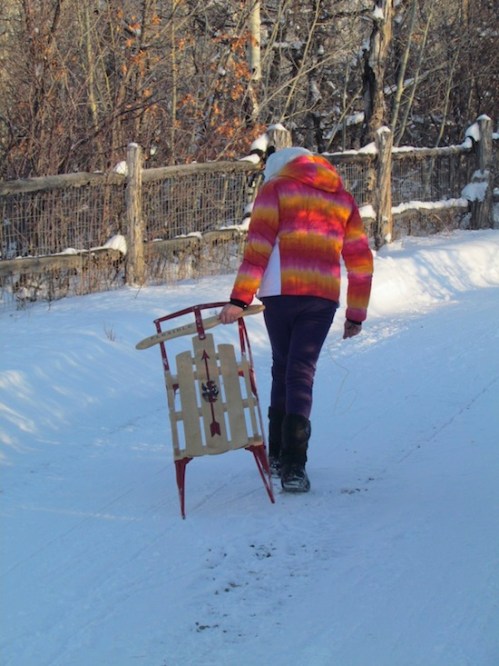
Sled

Doing the Best I Can…

Yesterday I was targeted by someone whose name I am not going to divulge because doing so will only further engagement and unnecessary dialogue.  I am going to keep this about my reaction to being attacked and will not engage in a counter attack.  One of the things I have learned over the years is that when someone attacks, my knee jerk response is to attack back, but this never actually does anything to further the conversation, encourage discussion or an exchange of ideas.  Nothing changes when two people angrily engage in self-righteous, self-justified shouting matches.  So why do it?

Sadly, within any community, positions are taken, an “us” and “them” mentality which serves to separate each other from the very people we appear to want to engage.  I do not completely understand this desire by some to engage others with their anger.  However I do know first hand the feeling of frustration when I have believed something and had those beliefs questioned, judged or argued with.  When someone says with absolute conviction that they know for a fact that a certain therapy, treatment or way of supporting another does or does not work, I figure it’s worth investigating.  I do my best to look at the pros and cons, I try to read the various scientific studies, the anecdotal stories, and control studies if there have been any.  I take into account how many people were used in the study, I look at who conducted the study and whether there were any conflicts of interest in the study’s results.  I read any controversy surrounding the therapy.

If I know someone personally who is using whatever the therapy, treatment or support is, I reach out to them, ask them questions and observe.  If what I am observing counters the conclusions of some of the scientific studies done, I take that into account and look at why that might be.  Beyond wanting to do what will prove best for my daughter I try to remain open to both sides.  However, if a number of Autistic people have PTSD because of a particular therapy or speak out about it with their reasons why, I listen to their accounts and place more weight in their experiences than I do in studies conducted by neurotypical “experts”.  I also listen to those who are Autistic and have found something particularly helpful, even if many neurotypicals suggest otherwise.

These are the things I do.  Others may have different approaches, but this is what has proven most helpful for me.  When someone then attacks me for doing a particular therapy, treatment or support with viciousness, it hurts, but it does not make me change my opinion, in fact it does the opposite.  When someone personally attacks me with sarcasm, condescension and aggression it serves to make me wonder why they would do so.  When they then back their vitriolic, venomous statements by saying that “science” is behind them and that I cannot possibly have read the studies they cite, when they dismiss opposing studies as being “shoddy” and “poorly” done as non-science or “pseudoscience”, there is no point in responding.  When they then further their comments by saying that I am being “unethical” and suggest that by engaging in such support I am hurting those who cannot speak by putting words in their mouth, it crosses the line of being about ideas, opinions, science or anything else, it is a personal attack.

I come here day after day and share my thoughts, feelings, views.  I try to be honest, above all else and in doing so open myself up to attack.  I know that.  I cannot do this any other way.  I am vulnerable in a way that those who attack me are not.  That’s okay.  No one is forcing me to write a blog or to be as honest as I can be.  These are the decisions I’ve made.  I try hard to keep my side of the street clean, as they say.  Some days I’m more successful at that than others, but I always keep showing up and trying as best I can.  In the end that’s all any of us can do.

Unrelated photograph taken Christmas Day on the ranch

Christmas Day

Related articles

The Impact of Fearing Autism

Last night I spoke with my brother by phone.  He is unable to travel.  His voice was so raspy, his breathing slow and labored, had I not known it was my brother I was speaking to, I would not have been able to guess from the sound of his voice.  He wasn’t able to complete a sentence without pausing to take a breath.  It was clear listening to him that the act of talking was incredibly difficult and painful.  When we said good-bye to each other I was overcome with emotion.

My brother is very slowly recovering from pertussis, more familiarly known as whooping-cough.  Because so many parents have chosen not to vaccinate their children for fear that vaccinations cause autism, whooping-cough is on the rise.  I’m including some links ‘here‘ and ‘here‘, for those of you who may not be aware of just how serious and deadly whooping-cough is, not just to our children, but to teenagers and adults too.  This is the other side of not vaccinating, the side so many do not consider.  People of all ages are getting sick and even dying of diseases most of us assumed had been eradicated long ago.  Whooping cough, once unheard of, is now on the rise.  In my brother’s case, his coughing was so extreme he would vomit, was unable to breathe and speaking became impossible.  Fortunately he is slowly getting better, but whooping-cough can take more than three months to recover from, for those lucky enough to recover at all.

My children are vaccinated.  I am vaccinated.  I have had moments in the past when I wondered if there was a connection between vaccines and autism.  I never believed vaccines caused autism, but I did wonder if it exacerbated pre-existing conditions.  I no longer wonder because I stopped fearing autism and listening to those who would have us fear it and those who are Autistic.  And it seems this is what it comes down to.  When we fear “autism” so much that we are willing to put our child’s life at risk because of those fears, we must, as a society, look at what we are saying and believing.  Organizations intent on fueling those fears for monetary gain are being dishonest with themselves when they refuse to see the connection.  Adults, teenagers, children and babies are dying from preventable diseases because of people’s fears regarding causation and vaccinations.

When a parent makes the decision to not vaccinate their child they are not just putting their own child at risk for developing life threatening diseases, they are putting all of our lives at risk.  It’s important that we are clear about this.  None of us live in a bubble no matter how careful we might believe ourselves to be.  The decisions we make affect more than just ourselves and our families.  The decisions we make have larger ramifications that impact everyone we come into contact with.

For those of you on the fence regarding vaccinations – I understand the dilemma.  I understand how difficult it is.  I understand how debilitating fear can be.  Really I do.  I’ve felt it.  But in the end your decision comes down to this – are you willing to put not only your child’s life at risk, but your own and every person’s life you come into contact with?

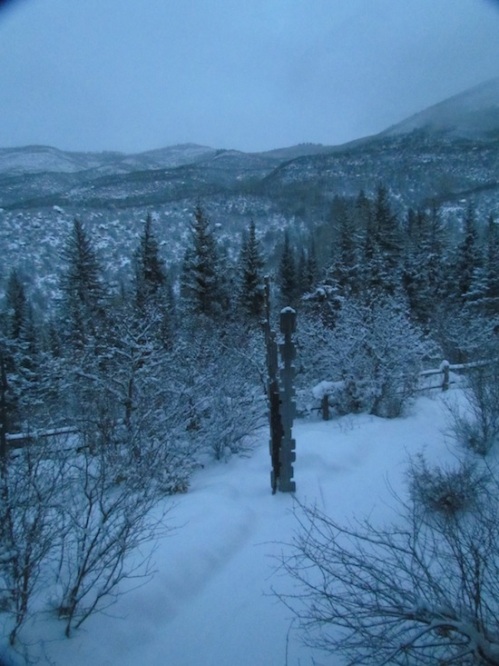
Completely unrelated photograph taken yesterday of the rocky mountains

Perfection


Dreams of a New World…

Moral dilemmas continue to plague…  I have never seen myself as one of those mothers who poured all of her competitive spirit into shamelessly promoting her child.  A kind of stage mom gone rogue, using her kid’s exuberant charm and/or talents to gain recognition from thousands of strangers.  A kind of warped narcissistic mirror of neediness, an adult version of a child’s plea, Look at me!  Look at me!  Yet, in light of recent events with parents blogging about their children, posting photos, using their real names, telling excruciatingly personal stories, many not kind or endearing, while supposedly illuminating their child’s and their struggles for all the world to read, judge and comment on as a way to advocate for better services, it’s impossible for me not to reflect on what exactly am I doing here and how is what I’m doing so dissimilar?

I began this blog as a record, of what I hoped and expected would be, Em’s progress after a series of radical stem cell treatments.  I didn’t think or expect this would be read by anyone other than family and friends and those who might be thinking of embarking on similar radical treatments to “cure” their Autistic child.  At the time, April 2010, I wasn’t thinking ahead, I didn’t consider the broader implications, I thought of this space, this blank page, as a place I could come to record what I saw and hoped for, while believing that whatever it was, it would be “miraculous”.

What I didn’t know, couldn’t have known, was that the miracle that occurred ended up having nothing to do with stem cell treatments or any other treatment or therapy.  The miracle has been my own evolution, a kind of 180 degree turn from where I once was in my thinking, in my attitude and in my expectations about autism and what it means to be autistic.  And while there is no doubt that my daughter continues to make wonderful, steady progress, it is not as the result of various remedies and treatments we embarked upon, but rather as a direct result of NOT engaging in those various so-called “therapies”.   What harm we may have done to our daughter because of those treatments, bio-medical and otherwise, is something we will never know, but must live with the uncertainty for the rest of our lives.  

So why write about all of this?  Does the world really need another parent blog about their kid?  Probably not.  However, and here is where things get muddy for me, every time I think about ending this blog, every time I think I can’t keep doing this, it’s not right, it’s not fair to my daughter, it’s not for me to write about her, it’s not for me to broadcast what she says and/or does, it’s not for me to post photos of her, these are not my truths, they are hers to tell if and when she can, every time I think along these lines I wonder if I would have done things differently had I read a blog of someone’s journey that was similar to mine?  Would I have still gone to such drastic lengths?

Is it possible a child’s life might be made just a little easier because of something I write or say here?  Is that just ridiculously grandiose to even think in these terms?  And yet, I have to go back to my own history of having an eating disorder for more than 2o years and the help I was given from hearing others candid, uncensored stories of hope and recovery.  Those stories that resonated were the ones I clung to so desperately during those first painful and terrifying years as I tried to change my life.  Years when making it through a single day without binging and puking was considered a “good” day.  I needed those stories.  Had those people NOT told them I doubt very much I would have gotten through.  I don’t mean that to sound self-congratulatory, it’s actually the opposite, I could not have gotten to where I am without all those people, all those stories, all those people who reached out to me and said, “it’s okay, you can do this.  Here’s my number, give me a call if you’re in trouble.”  I learned to lean on people, I learned that I didn’t have all the answers, I learned that there were more things I couldn’t control than I could.  I learned what it meant to accept what is, the here and now.  I learned about being present and that I hold my breath when I’m fearful and I learned that I wasn’t alone.

So in the end, this blog is no longer a document of “my daughter’s journey through a childhood of autism” as I once described it.  This blog is a document of my journey as a parent and as a human being and how autism has changed my views.  It is a far more beautiful and complex world than I ever imagined or dreamed possible.  It is a world that is evolving, far too slowly for my taste, but I have seen glimmers of what is possible.  A world where we do not segregate, where ALL people are treated as equals, not just as an idea, but in reality, a world where everyone is fortunate enough to have an Autistic person in their life.  A world where autism is no longer feared, but is embraced.

Sunset

Let Us All Be Safe

My favorite memories of Christmas are those spent at my grandmother’s house in Colorado when I was a little girl.   Every morning I would wake to see the snow covered mountains outside my bedroom window and snuggle deeper beneath the warmth and weight of the woolen blankets on my bed.  The smell of freshly baked orange buns and cinnamon rolls filled the air.  I grew up in Northern California not far from the Pacific ocean, so snow was a novelty and cause for great excitement.  The thrill of being in the mountains in Colorado during Christmas was something I anticipated with great excitement and impatience.   My grandmother always bought my sister and I a dirndl, the traditional German dress, to wear on Christmas eve, while my father, who was Swiss wore a pair of black leather lederhosen with white socks embroidered with green foliage, worn with black velvet slippers and a black or red cashmere turtleneck sweater.  Picture the Sound of Music with Christopher Plummer as my father and me as the youngest child, Gretyl and you get an image of how we looked on Christmas eve, though the similarities pretty much stop there.

When I had my two children I had an idea that I would dress them in lederhosen  and a dirndl, and over the Christmas holidays I would stay up late making yeast breads of various kinds and baking them early the next morning so that my children could have similar memories.  However this never came to be, though Em would probably love wearing a dirndl as she loves dressing up, just as I did when I was her age.   But as a parent I’ve learned that many of my memories do not need to be repeated, that my children will have their own memories and that they do not match mine is as it should be.  I have come to see that this is a good thing.   I had so many ideas about what it was going to be like to be a parent and almost all those ideas have proven wrong in the best possible way.  Letting go of my ideas about how anything should be has been a great gift, not just in parenting, but in life.  I did not come to this easily or without a fight.  And I still forget this truth often.

But I am grateful when I remember.   There is so much I cannot control.  In fact the only thing I have within my control is my own behavior.  I keep coming back to that over and over again.  I cannot control other people’s memories or behavior or prejudices or actions.  The only person I have any control over is me.  For today, let me behave well.  Let me be kind, loving and generous.  Let me give more than I take.  Let me help more than hinder.  Let me be the parent my children need and not the one I thought I should/would/was supposed to be.  And let us all be safe.

December 2009

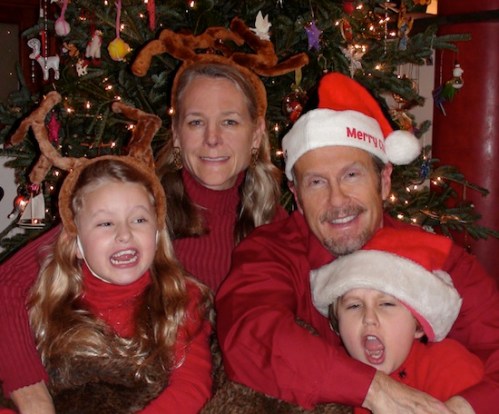
xmas family-09

Related articles

This… Just This….

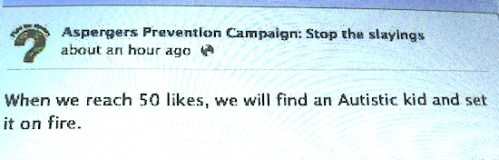
Someone spent time creating this page on Facebook… no one stopped them until countless people had seen it.

Hatred

This page has now been removed.  I post it here because the hatred, the sheer toxicity and venom that the person who created this page had to have felt to create this page is what so many of my friends and I have worried about and feared.  This screen shot sums up so much.

I have spent several hours writing and deleting my thoughts on this.  I have decided I cannot write anything more because I have no words.  I have nothing to offer.

Related Articles: 

Where Fear Leads Us…

I used to work at an ad agency.  One of the first things I learned was that there is one emotion that motivates people more reliably than any other.  Fear.  Fear compels people to do a great many things they might not otherwise do.

Once we’ve become convinced that something is worth fearing it is extremely difficult to reverse.  When we speak of Autism using words and phrases that cause us to fear Autistic people, we are doing tremendous harm in the short and long-term to that population, harm that will be very difficult to reverse.   Convincing people to feel fearful about something or someone is one of the easiest things to do.  Convincing them, once they are convinced, that it was all a “false alarm” is extremely hard.  So when those first news reports came out linking Aspergers with the shooting at Sandy Hook Elementary School, it only took an unethical few to do tremendous damage to an entire population of people.  Despite the fact that if you google “Aspergers and violence” the first dozen pages that come up are articles stating that there is absolutely NO connection between Aspergers and violence.  And yet, my Autistic friends and I are terrified.

I am frightened for my Autistic daughter and for those I love and care about who are Autistic.  I am frightened by what people will assume and how they will then treat those they assume are Autistic.  I am frightened for my friends who are Autistic, will they be safe?  Will a non autistic person hurt them, say cruel things to them, treat them differently because they fear “autism” and therefore “Autistics”?  I am frightened even though the truth is neurotypical people are far more likely to commit acts of violence than Autistics.  Watch these videos on Youtube ‘here‘ and ‘here‘.  Videos showing Autistic and disabled people being tortured by others.  Read these reports ‘here’, ‘here‘, ‘here‘ and ‘here‘ about the systematic abuse of Autistic people, abuse that continues unabated all the time.

It is WRONG to condemn a group of people, people who have suffered at the hands of those who now accuse them, a people who have been marginalized, some of whom cannot defend themselves because they do not speak and have not been given the means to communicate effectively through any other means.  It is important that you know.  It is important that you understand the ramifications of connecting autism with murder.   I want you, no, I need you to understand why the words we use, the constant stream of negativity in relation to autism is causing untold damage to my daughter, to your daughter, your son, your Autistic child, to their futures, to the people I love, to my friends, to all who are Autistic and have had to deal with exactly this kind of prejudice their entire lives.  It has to stop.  It has to stop.

Children were killed, murdered.  The horror is unbearable.  But to add to an already heinous act by targeting a group of people and making it about them instead of what has happened, is adding more pain and agony to more children’s and people’s lives.  Innocent people.  Innocent children.  Don’t we see that?  Can’t people see we’re making it worse?   We aren’t ensuring our children will be safe with these beliefs.  We aren’t making the world a better place with more prejudice, bigotry, false assumptions, and our fear.  Our fear is what drives us to conclude that we are fighting a false enemy.  Our fear is what compels us to hurt, lock up, institutionalize, condemn and torture.  Our fear is what causes us to commit acts of violence against those we’ve deemed violent.  Our fear…

1Freedom Tower

The Art of Breathing and Just Being: Lessons From my Daughter

One of the single most difficult things I have had to practice in life is the art of being present.  Simply being shouldn’t be so hard, yet I have found it is.  It is something I have to practice, something, I have come to understand, that is much like breathing, I will never be “done with it”.   Doing nothing is surprisingly difficult.  Doing nothing in the face of horror is even harder.  When I have a great many feelings, sitting still and being present is all the more difficult.  The last thing I want to do is sit and actually feel.  Why would I want to do that?  Now’s the time for action (!) and yet, it is during these times that it is vitally important for me to practice being still.  Every fiber of my being is screaming at me to move, to make sense of, to understand, to find the thing, the motive, something or someone I can blame, something that allows me to say, oh yes, of course it was that, that’s why this has happened.

Yet, it is an illusion.  The feelings remain no matter what is said.  No matter what has been written, the feelings remain.  Feelings – grief, fear, horror, sadness, confusion, pain, suffering, outrage and anger.  Feelings.  Lean into them.  Do nothing.  Breathe.  

Emma, unlike me, does not need to practice the art of being.  She does this without trying.  It seems to me, as I watch her, that she comes to this idea of “being present” naturally.  It is not an “idea” for her, it is simply life.  Emma just “is”.  Emma is one of the happiest, most joyful beings I have ever come into contact with.  Her median state is one of happiness.   She is without judgement or blame.  She does not hold onto resentments or grudges.  Emma does not talk about people behind their backs, she does not condemn or bully.  Emma is not dishonest or cruel.  And yes, Emma is Autistic, which must not to be confused with “mental illness”.   In fact, Emma is the opposite of “mentally ill”.  Perhaps because of her neurology she is able to be present in a way that I do not come to as easily.  I must work hard at something she does not think about.

People say all kinds of things in anger, in grief that have little to do with anything.  People say things while trying to make sense of something that is senseless.  They latch on to an idea, they offer a reason, a cause, it’s because of this, or that they say.  Oh, that person did that because of __________.  We talk and reason and blame.  People say and do things we find offensive, things that will hurt us and our children.  When people are scared they say and do things they would not, upon deeper reflection, say and do.  So don’t do anything, I keep telling myself. Sit and be still.  But it hurts to do so.

Don’t say anything, just sit and be present.  And it feels unbearable.

Don’t move, just be present.  Look around.  What do you see?  What do you hear?  What do you smell.  What are you feeling?   I don’t want to feel.  

Close your eyes.

Breathe.   Fear.

Be present.  I can’t!

Breathe.   Anger.

Breathe.  More fear.

Breathe.

Breathe and just be.

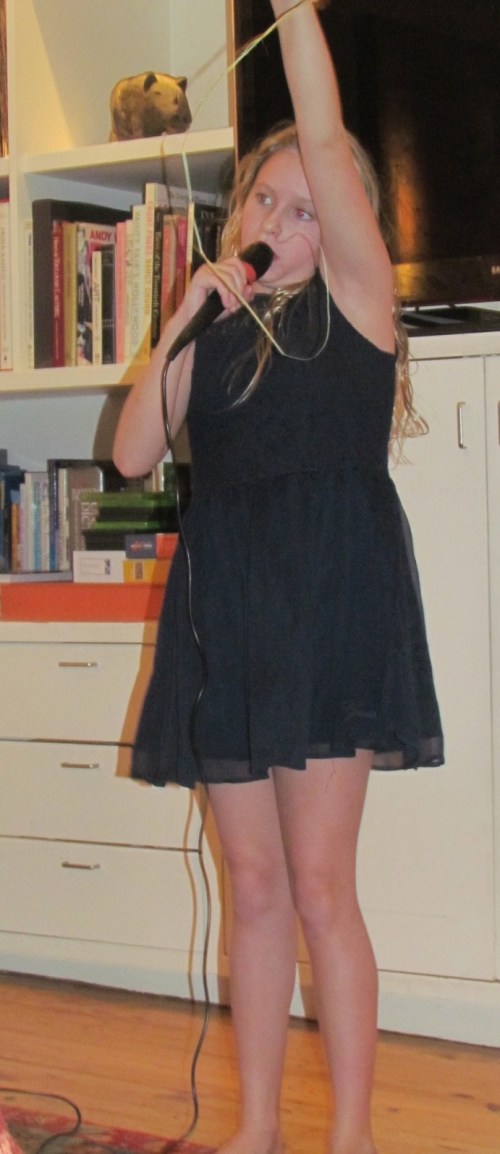
Emma performing for us, Saturday evening

1Em_performs

The Decisions We Make…. Or Parenting and Being Human

I hear you out there, Em.  I can hear you singing the same refrain, “you’ll never go home, you’ll never go home, you’ll never, never, never….. you’ll never go home.”  It’s a catchy tune, a little sad, but I try not to read anything into it.  It’s just a song you like, with a repetitive tune.   Eventually I go out and ask what you’re singing.  You hesitate and say nothing at first.  Then you tell me, “Central Park, it was a long time ago, you see Peter Pan.”  And I know that you saw a production of Peter Pan many years ago in Central Park’s Marionette Theatre.  I smile and tell you how much I love hearing you sing.  You indulge me with a few refrains before snuggling back into the rocking chair and falling silent.

Today we are going to the orthodontist.  He’s going to put braces on your back molars to expand your mouth.  All those years of thumb-sucking have taken a toll on the curvature of your mouth.  It sounds painful to me, but I’ve been assured it’s not.  You cannot bite down with your front teeth any longer.  There’s a permanent gap there, a thumb-sized gap, a space created from years of self soothing.  People warned us over the years.  People said you should make her stop doing that.  People said, she’ll have serious problems, her teeth will be ruined, her mouth will become distorted and change shape.  They were right.  It did.  But would it have been better to stop you from doing the one thing that made you feel calmer, the one thing that soothed you more than anything else, the one thing you could completely rely on?  Would that have been better?

In another few hours we will go to the orthodontist and you will have bands put on your molars to begin the expansion.  We’ve been preparing you for this for months.  “Go to dentist.  You’re going to get braces!”  You’ve said for the past few weeks.  We were given the option of having a metal “thumb guard” put into your mouth as well, but opted not to do that.  The orthodontist made no comment upon hearing our decision, simply nodded his head and said, “I understand.”  Maybe he does.  We just couldn’t do that to you without knowing what harm it would do.  You have only a few self soothing tricks up your sleeve and sucking your thumb is first in line.  How could we take that from you?  What would you substitute that with?  Something better?  Something worse?

We’re your parents.  We’re suppose to know these things, right?  Wrong.  Being parents is a lot trickier than anyone ever mentioned.  There was all the talk about pregnancy and labor, we went to the required classes teaching us how to regulate our breathing, but there were no parenting classes required, we didn’t need a license or a certificate, we didn’t even need a permit.  Pretty quickly we learned that what’s best for one child, isn’t necessarily what’s best for another.  That was a tough concept to fully take in.  Thumb sucking?  She’ll grow out of it.  One day she won’t need to do that, some people said.  We weighed the pros and cons.  We took a chance.  We didn’t stop you from soothing yourself, were we wrong?  Who knows.  And now today, off we go to the orthodontist.  As bumps in the road go, this is a small one.   I told the orthodontist, “we’re not going for perfection here.”  He nodded as he peered into your mouth.  “Right,” he said.  “We’ll go with the expander and then braces.  We’ll discuss as we go.

That sounded reasonable.

I can hear you in the other room.  You’re not singing any longer.  You’re doing a familiar monologue, “Not safe to hang on the pipe and not safe to go in the ledge.  What happens when we go in the ledge?  We might fall down.  It’s not safe!  We bump your head if you go in the ledge.  We’re not going to take go in.” (You always say that last line in a sing songy way.  As though it were part of a song.)  “No not going to take go swimming.  No.  Go to the dentist.  Get braces.  Yeah, going to go get braces then Emma gotta have to go.  Yeah, Emma gotta have to go on the airplane.”

Those are your words, Em.  That’s what you said this morning just now.  Is this the verbal equivalent of sucking your thumb?  Is this how you’re trying to work through fear, uncertainty?  Are you scared?  I realize I don’t know the answer to this.  I’ve learned that when I don’t know how you feel or what you think about something to ask you.  So I ask you, “Hey Em are you scared to go to the dentist?”  “Neeyah,” you say, shaking your head no and laughing.  “You get to put on braces!” you say.  “Are you happy you get to have braces?” I ask.  You nod your head up and down.  “Yeah!  Put on braces, then come home work with Pascal!”  “Yeah, Em.  That’s right.  We have a Skype call with Pascal this afternoon.  Are you looking forward to that?”

“Yeah!”  You say nodding your head emphatically.

So who’s fearful?  Not you.  You’re singing now.  To MJ.  You love dancing and singing with abandon and that’s what you’re doing now as I type this.  As I try to work through the decisions we made that led up to this moment.  This moment…  a moment when you are laughing, singing and dancing in the other room with the music blaring.   Here, let me hit “publish” so I can join you.

!EM

Less Than A Year Ago…

If I don’t immediately take notes during and after my typing sessions with Emma, I would wonder whether the words she typed were a figment of my imagination. There is something almost magical seeing and reading the words typed from someone who does not, or does not easily, communicate with spoken language.  It reminds me of the time I went to a lecture given by Soma Mukhopadhyay with her autistic son, Tito who began answering questions from the audience.  Tito is non-speaking and has a great many stims, yet translates his beautifully eloquent, poetic  thoughts into words and has no problem answering any question posed.  It’s often a disconnect for the neurotypical person watching someone who isn’t able to verbally say what they are thinking, yet has no trouble writing their thoughts, which in no way match the presumptions we, NTs tend to make.  If you’ve never witnessed something like this, it can be pretty mind-blowing, which says more about the limitations of neurotypical thinking and the constraints we unintentionally place on others who seem different from us than anything else.

Last night I began Emma’s session with a question.  It’s the same question I always ask her.  “Hey Em, how about after you sing this song we do a typing session together?”  And Emma answered, as she does every time I ask her this question, “Yeah!  Typing session with Mommy!”  Emma’s excitement, in and of itself, makes me incredibly happy.  That she’s interested and (I think) looks forward to our sessions as much as I do, makes me believe we are on the right track.  When we went into the room, now dubbed, “Emma’s office” I tried to think of a question it seemed likely Emma would know the answer to, but that if she typed it out, I would be surprised.  As we are leaving soon to visit her Granma for the holidays, I said, “When we fly to Granma’s we have to first take a taxi to an airport.  What’s the name of the airport we usually go to?”  Without hesitation, Emma typed, “La guardia”.  Wow!  Just wow!  I then asked, “There’s another airport near La Guardia, we don’t usually fly out of, but what’s the name of it?”  Emma, again, without hesitation, typed, “kennedy”.  Whoa!   Then I threw her, what I thought would be, a curve ball and asked, “When we fly out of La Guardia we always take the same airline to visit Granma.  What’s the name of the airline we always take?”  Emma wrote “United”.   EEEEEE!!!!!  Snoopy dance.  Give me a moment while I hyperventilate.  Whooooo, whooooo.

Emma went on to tell me what state and city we live in, the name of the state we were flying to and when I asked, “What’s another name for the city we live in?  It starts with an M?”  Em immediately typed “Manhattan” though she forgot the h and one of the ts.  I followed up with, “And what’s the neighborhood we live in?”  Emma, again without hesitation, typed, “Chelsea.”  Taking another deep breath.  For those of you who are doubting what I’m writing, I understand.  Really.  I do.  As I wrote above, I actually had to take notes during our session, because I knew I would come away as if in a dream.  (Ibby suggested I record our sessions together and I keep forgetting to do that, but I have to remember to from now on.)  That’s what it feels like, a dream.  I absolutely believe in my daughter’s competence.  I believe she is far more competent than most people who come into contact with her do.  I do not for a second doubt that she has a busy, complicated and fascinating mind, filled with thoughts, ideas and knowledge I can only guess at.  But to know this, to believe this, is different from being shown this.  I don’t mean to offend any of you reading this who are non-speaking and communicate by typing.  I don’t mean to offend, really I don’t.  I hope that were Emma to ever read this she will understand what I’m trying to say.  This is not about Emma’s limitations, either intellectual or otherwise, this is about my own.

For all you neurotypicals who can speak, humor me for a moment.  Think about how you would feel if you could not speak.  Think about all the things you know, but couldn’t say.  Now imagine if you were told something simple, like the city and state where you lived over and over, repeatedly, day after day.  Just think about this for a second.  Close your eyes and try to imagine what it would be like to not be able to speak.  Imagine that well-meaning people tried to help you speak through repetition and you were not allowed to move on until you were able to say these things being “taught” aloud.  Imagine how you would feel were you never able to say these things, so you weren’t allowed to move on.  It was assumed that because you couldn’t say them, you must not KNOW them. And yet, all this time…   all this time you really did know these things.  Not only did you know these things, but you knew so much more.  But no one believed that you did.  No one treated you as though you did.  Less than a year ago I assumed Emma did not know.  Less than a year ago I assumed Emma did not understand.

Less than a year ago…

Emma waiting for the school bus with her string

*Em

Balancing Career, Family and Losing Things…

Balance.  Sometimes it’s impossible for me to balance family, career, marriage, kids, friends, writing, keeping up with emails, showering…  okay I do usually get the showering part in there somehow, but other things tend to fall through the cracks.  At the moment I’m consumed with work related things and so the showering part seems like kind of a pain.  Though the old “french bath” notion can be kind of awful if you are sensitive to perfumes and cologne, as I am.  The combination of body odor being masked by an aggressive dose of perfume, no matter how expensive, makes me a little nauseous just thinking about it.   So no, foregoing a shower isn’t an option, but other things fall by the way side or are delegated to others.  And while all this is going on I know I’m not alone.  I know others hold down full-time jobs, have kids, manage to get them fed and into fairly clean clothes and off to school without too many mishaps.

The basics do get taken care of, though Nic’s question of whats for dinner, and my answer, “Ummmm…. how about a bowl of Cheerios?” didn’t exactly gain me any parenting of the year points, Nic didn’t seem too traumatized and Em was thrilled.  In fact, she was already happily digging into her bowl of Cheerios, which is her second favorite meal falling only behind pancakes as her first choice.  I only learned a few months ago that Nic had begun wearing his school uniform to bed at night, “it’s easier, Mom” and I’m pleased to say I put a stop to that, though I was proud of his creative problem solving and told him so.   I am grateful for the small things…

Anne-Marie Slaughter wrote a piece for the Atlantic last summer entitled: Why Women Still Can’t Have it All .  That piece caused a stir, though I never was able to work out exactly why.  My only issue was with the word “still”, implying that we should be able to have it all or that someone else does, but women don’t.  The truth is, it seems to me, no one “has it all”.   I’m not even sure what that means really, but that’s probably not the point.  I did feel an uncontrollable urge to argue the definition of the word “all” and was only stopped by the lack of interest anyone I attempted to discuss this with showed.  The tricky balance of work, family, mother, wife, friend, while maintaining some semblance of sanity is one I continue to look for, but never seem to actually find.  Things just do get forgotten or lost in the shuffle.

I have mail that remains unopened, I know I received some emails that I now cannot find, which require answering.  I’ll try to find them later.  I know there are things I can’t remember that were on my to do list, if only I could remember where I put that list and it’s not a coincidence that the single most common question in my family is:  “have you seen my glasses?”  that or “anyone seen my keys/phone/wallet?”  And the predictable answer, “if I could find my glasses I’d help you look.”  Nic thinks all of this is hilarious and has taken to falling on the floor in feigned horror when either of us ask, our voices suggesting the panic we are already feeling, no matter how many times in a single day this occurs.  That both his parents seem so completely incapable of keeping track of these everyday items does not portend well for either of our children, but at the moment this thought hasn’t occurred to them and we aren’t planning to mention it.

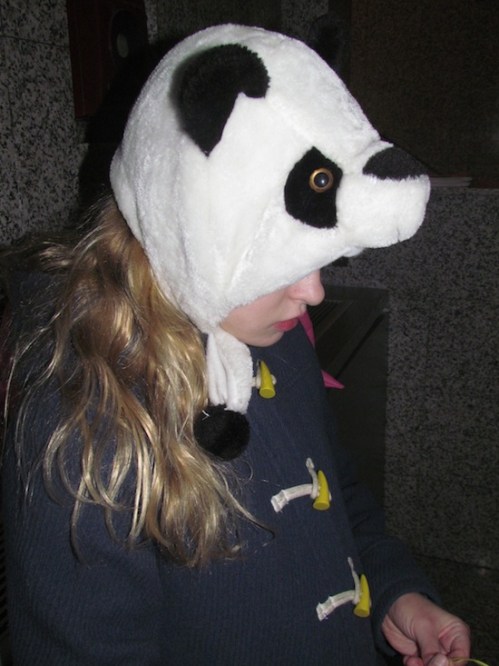
Em (wearing her favorite hat) made it out of the house this morning in one piece…

*Panda


An Unexpected Response and The Importance of Trust

During my supported typing session with Emma Saturday evening we discussed Little Red Riding Hood.  I asked Em what she thought Little Red was bringing Grandma in her basket.  Emma typed “blueberries”, which seemed like a terrific guess, particularly as Little Red could certainly have picked them herself, placing each blueberry in her basket as she made her way toward her Grandma’s house.  We discussed the wolf and I asked questions I thought it likely Em knew the answer to, but that I wouldn’t expect her to answer verbally, just as Pascal, who is helping me, advised.  Eventually I asked, “Em, what would you do if you were asleep in your bed and woke to see the big bad wolf?”  To which Emma typed,  “I would go to the three little pigs house”.  Though she paused after she’d typed, “I would go to the”.  I urged her, “Take your time Em.  Write what’s in your head.”  She looked at me and whispered, “three little pig’s house.”  She then typed the rest of the sentence with me.  “I would go to the three little pigs house.”

I looked at that sentence.  It took me a second and then I laughed and said, “Wow Em.  That is such a great idea!”  After all the three little pigs have had run-ins with the wolf.   They know, better than anyone, how to deal with him AND they figured out how to build a wolf-proof structure after much trial and error that the wolf cannot break into and where they are safe.  Emma grinned at me and then, very sweetly, patted my cheek.  I took her loving gesture as a sign of her encouragement and patience with me.

Supporting Emma’s typing is not easy.  It is actually much harder than I imagined it would be.  I am pretty sure Emma spoke the last four words of that sentence because she was not able to trust that I was able to support her well enough to type that.  I think she sensed my hesitation.  I had no idea what she was trying to type and because I am not well trained and am very new to this, my support varies and is not consistent yet.  I am hoping I will learn and be able to give her the support she needs to flourish and eventually type independently.  What is fascinating about FC (facilitated communication, more on that ‘here‘ and ‘here‘) is that had I asked this same question of Emma and expected a verbal response, I do not believe she would have given me this answer.  If she had, I would have been absolutely blown away.  These are not the types of things we have been able to “talk” about.  Typing is giving her the tool she needs to be able to express herself in a way that has not been possible to date.

As an aside, two years ago we hired a woman who developed a literacy program for Autistic children.  While I have some serious misgivings about certain aspects of her program, the literacy piece is extremely well mapped out and it was what finally gave Emma the tools and practice she needed to learn to form the letters of the alphabet and began to read, write and type.  Now two years later as a result, Emma is reading and writing at a second grade level, though it is probably much higher.  Emma was not taught through phonetics, in fact we never even taught her the names of the letters in the alphabet.  For two years Joe and I worked with Emma every day on her literacy program.  For more about that program you can read ‘here‘ and ‘here‘ or put the word “literacy” into the search box and everything I’ve written on the topic will come up (just be aware my ideas and views have changed pretty dramatically since many of these posts were written.)

I mention all of this, because I want people to understand that Emma did not sit down one day and begin typing in full sentences.  She did not suddenly pick up an encyclopedia and begin quoting from it.  I know there are those who have.  I wanted to pursue supported typing with Emma after going to the Autcom Conference this past October and meeting Pascal.  He was kind enough to speak with me about Emma and gave me some advice.  I didn’t know if she would be a good candidate for FC.  After all she has some language and typed independently with her two index fingers.  But I want her able to converse on a more sophisticated level.  It seemed to me, FC might be the method by which she would be able to do that.

I am always in awe of Emma’s patience with this world, with all of us, with me.  Her inner strength and resilience are incredible.  She has been ignored, doubted, talked down to, spoken of while she stood right there listening as though she were deaf, she has been misunderstood and treated as though she were incapable of understanding.  Were I treated this way I would be in a state of near constant rage, alternating with debilitating depression.  If any one of us were treated the way so many view and treat Autistic (whether non-speaking, marginally speaking or fully speaking) people, most of us would want to retreat from this world and lose all faith in people, even people we love.

I do not know how or where Emma gets the strength to greet each day with such cheer or how it is that she is so good-natured, kind and loving after all she has been through in her short life.  But she has and is.  I began this blog thinking it would be a document of Emma’s progress.  But in fact, this blog is a document of my progression.  I look back on entries made just a year ago and see how completely my ideas about Autism and my daughter have changed.  So much of what I thought and believed I no longer agree with or feel.  I have resisted the urge to delete all those past posts, because as horrified as I am by so many of them, I also know they are what I believed at the time.  My own journey is a reminder that we neuro-typical (not otherwise specified) adults can and do change, sometimes it just takes some of us a bit longer.

Me, Pascal, Richard and Em during our first “training” session

“Burden”? I Don’t Think So.

The roller coaster I call “autism” is less actual and more a description of my emotions, expectations and judgments surrounding specific things such as communication differences, internal issues, pain perception, sensory issues and the different ways in which Emma takes in information as opposed to the way my (more often than not) non-autistic brain works.  (My friend, AspieKid calls brains like mine NT-NOS, which I think is a hilarious and fitting acronym.) It is a “roller coaster” of my own design and construct.  A roller coaster being an accurate description of my emotional state, something I’ve grappled with my entire life and certainly well before I ever met my husband and had children.  Suggesting “autism” is the root cause for those pre-existing twists and turns my emotions tend to take or pinning the psychological upheavals I’m experiencing onto “autism” is not only wrong, it’s dishonest.

The truth is, I’ve always been a bit high-strung.  I live in New York City, a city whose inhabitants wear their neuroses proudly.  Neuroses in New York city are treated the way a runny nose is looked upon in the mid-west.  No big deal.  New Yorkers have melt downs at the drop of a hat.  I’ve seen fist fights break out between grown men in the middle of an intersection because of a perceived insult, people routinely scream at each other and cut each other off while driving.  Moms pushing babies and toddlers in Hummer-sized strollers wield them like tanks plowing a path for themselves along clogged sidewalks like Moses parting the Red Sea.  People think nothing of getting into loud arguments with lovers, neighbors, friends and strangers in the middle of the sidewalk, forcing pedestrians to walk around them.  It’s a city of ids and super egos.  It’s a city that is (perhaps) an exaggerated version of what one sees anywhere in the world.  People are capable of some pretty dreadful behavior.  Add a child with a different neurology to that already fragile, high-strung mix and you’re going to get some interesting results.  To then conclude that autism is to blame, defies all logic.  No one would do that.  Yet people blame their bad behavior, their inability to cope, their sadness, depression and general irritability on their autistic child all the time.

Suddenly it’s autism and Autistic people who are a “burden” to society.  Autism isn’t a “burden”.  It’s the negative views of autism, it’s the autism = untold horror, it’s the perception of autism and the lack of understanding and services, the lack of training and programs in our schools so they can help our Autistic children learn in a way that will ensure they flourish.  The “burden” is not our Autistic child on society.  The “burden” is the lack of support and adequate help families need so they can better support their child, giving them the sort of assistance  they need to thrive and flourish, a child who will one day become an Autistic adult and, in an ideal world, an active member of society.  We have to move away from this idea of Autism = burden.  Autism = tragedy.  Autism = _______ fill in the blank with a negative word.  We need to abandon our preconceived notions of what a non-speaking Autistic child cannot do.  We need to open our minds to the idea that our children are capable of far more than we may believe or can fathom.  We need to begin looking at what is good about Autism and the countless ways in which Autistic people can and do contribute to this world.  We need to remove the stigma and negativity and replace it with a more balanced and yes, positive view.

Imagine a world that includes Autistic people, accommodates Autistic people and stops shunning, restraining and abusing them.  A world in which it is not okay to have seclusion rooms and restraints, where a non-speaking person is treated with respect and without prejudice and where it is not assumed that because they do not speak they have nothing to say.  A world where people finally understand the burden isn’t the Autistic person, whether child or adult, it’s the lack of services, the judgments and the scare tactics being used.   Autism is big business and there is no better way to ensure dollars continue to pour in than when we are terrified. Let’s change that.

Having a child is joyful, exhausting, frustrating and the single most extraordinary experience a human being can have.  Having an Autistic child is joyful, exhausting, frustrating and the single most extraordinary experience a human being can have.   One can say that about a great many things in this life.  Let’s stop blaming Autism and our Autistic children for the ills of the world and the bad behavior displayed by people.

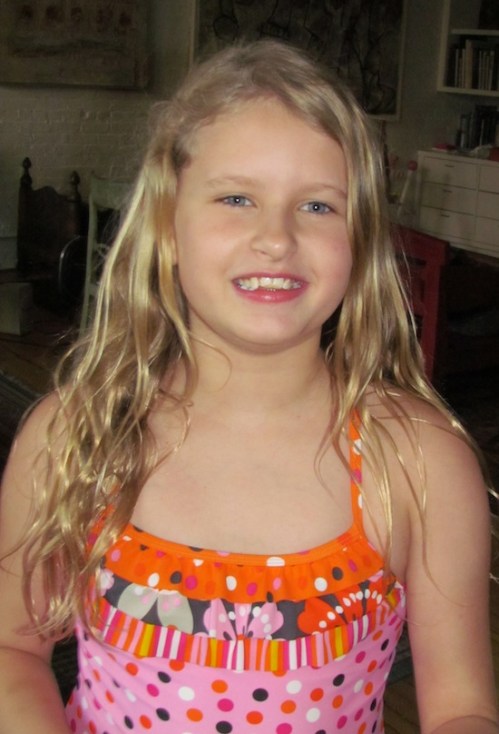
Emma and her infectious laugh

Em