Monthly Archives: October 2013

Autism is Not Like Cancer

I’m traveling and haven’t had time to blog.  But a couple of comments came in on the last post about How We Discuss Our Children that made me think a bit more about all of this.

When my daughter was first diagnosed we were told a great many things that frightened us as well as some things that were very encouraging, but when those, seemingly “good” things did not come to pass, we became even more frightened. In part because it became clear no one actually knew what they were talking about and coupled with that realization was the idea that if they didn’t know what they were talking about, how were we going to help our child?  Add to that our expectations, no one talked with us about any “positive” aspects of the diagnosis, nor did anyone suggest anything that sounded remotely “good”.  All of this was done with good intentions, lots of well-meaning advice, but all of it came from non autistic people who were operating under the assumption that our neurology was the gold standard and one that everyone should aspire to, as if that were possible.

Autism was framed in the “disease” model with people alluding to cancer as an appropriate analogy. As I have family who have both died and survived cancer, and have witnessed what chemotherapy does to a person, both when it works and does not, this was particularly awful as I took it literally and began to see any and all “treatments” as a kind of “chemotherapy”.  I even consoled myself with the idea that this “risky” treatment would all be worth it, if it “saved my child’s life”.  I spoke of it in this way and thought of autism as “life threatening” because I could not imagine a life without language, friendships, empathy, etc and this was what we were being told autism was.  This is an incredibly dangerous idea for any of us to engage in and is why I find it incredibly unethical for organizations and public figures to talk about autism and Autistic people in this way.

Now add to this the financial toll of all those unverified “treatments”, the appointments, dealing with schools and the general anxieties that come with parenting on too little sleep and too much caffeine, along with a parent who has expectations that something she does will “save her child’s life”, and that’s a pretty great recipe for discontent, depression, anxiety and upset.  Particularly when it becomes increasingly clear that there is little available that will actually prove helpful to our kids.

Think of how different it would be if our pediatrician was a non-speaking Autistic person and our non autistic older child had a couple of Autistic teachers and another kid’s parent was Autistic and one of our closest friends happened to be Autistic and Autistic kids were not segregated out of schools and work places accommodated their neurology and made it easier for Autistic people to be among us.  Part of that initial fear we parents often have is because we have never met anyone who is Autistic.  All the information we then receive is taken as fact and not questioned immediately.

So yeah, there are things that really do need to be addressed and changed because the stress of parenting is massively exacerbated by society’s use of the medical model and because of the way we have segregated those who are Autistic. It isn’t that a child who has all kinds of medical issues and co-occurring diagnoses will not be cause for concern, it is that to add to these concerns the – oh-and-by-the-way, autism-is-an-epidemic-that-is-analogous-to-cancer-try-anything-and-everything-to-erradicate-it, is increasing everyone’s pain and suffering, including our children’s.


How We Discuss Our Children

Some people say that parents like me are dismissive of how difficult it is to parent an Autistic child.  They say that we are choosing not to dwell on the negative and that it’s important that the other side be shown.  They suggest that by NOT discussing how very challenging it is, we are doing harm, that it is in the stories of horror and devastation that services are gotten.  They say that pathologizing autism is necessary because without talking about it as a pathology, funding would be diminished or cut off.  Many people assume that those of us who write about the positive aspects, the joys, the triumphs that we experience as parents of Autistic children, we must have “high functioning” children and that we cannot possibly know what it is like to have a child who is “severe”.   We are accused of diminishing or dismissing the suffering other parents experience.

When I was fairly new to all of this, not so long ago, I thought nothing of writing about my child’s latest upset in graphic detail.  Not so long ago, I wrote about my child, believing she did not and could not understand what was being written, that she would never read my words, that she could not and did not understand what I said to others, what I wrote.  I posted photos of her, never once considering whether she wanted such a photo posted on the internet for all to see.  It did not occur to me to ask her.  Literally, it did not occur to me.  These are things I now am aware of.  Posts have been deleted, photos have been removed, but had I continued to listen to what I was being told, had I not seen and met non-speaking Autistic children, teenagers and adults who wrote how it felt to be spoken of, written about, and treated as though they weren’t there, I don’t know that I would have thought to stop.

It isn’t that parenting is never challenging, hell, life is challenging, it’s that in talking about parenting it too often sounds like we are blaming our child for our suffering.  It’s like when my husband and I fight and I think to myself, if he didn’t do x, y and z, I wouldn’t get so angry and while there may be some truth to that, it also isn’t owning up to my part in the fight.  So many people write about parenting but they don’t seem to connect it to how they respond to this situation with their child, is how they respond to stress, not getting what we want, impatience, dealing with upheaval, etc.  It seems to me, the less common conversation is the one that talks about personal responsibility and honoring another person, instead of blaming them for what ails us.

In all of this, the Autistic person, whether they are a child, teenager or an adult, are being “treated as though they weren’t there.”  This was the thing that changed everything for me.  Realizing that there is a person there.  Right there.  Right here.  Right in front of me.  And this person has feelings and thoughts and her opinions about herself are affected by what I’m doing and saying about her.  She is just like any other child, who would feel tremendously sad and even traumatized knowing that her parent blames her for their pain and upset.  

This post is being interrupted by more pressing matters, so I will have to come back to this when I have more time…

Em on her pogo stick copy

To Educators, Therapists & Doctors

You are the first people most parents meet after getting our child’s diagnosis.  Therefore you have tremendous influence on how we view autism, what that means or doesn’t mean, what services we seek, and how we then view and treat our child.

That’s a huge responsibility.

The onus is not entirely on you, of course, but don’t kid yourself, you have the power to change the course of a child’s life and their family’s with your knowledge and what you tell their parents.  If you don’t know the answer to a question, do not pretend you do.  Do not rely solely on whatever university you went to, or the medical journals you may subscribe to, the most recent statistic, medical study or your colleagues for information.

If you’ve been taught a particular therapy or  teaching method is the only scientifically proven method to “treat” or teach Autistic children, find Autistic people who were given that therapy or method as children and learn what they have to say about it.  If you find a number of Autistic people are speaking out about a specific treatment or method, saying they have post traumatic stress as a direct result, reconsider your position.  If you still feel this therapy is important to pursue, ask yourself why and at the very least, inform the parents who are considering this method that there are Autistic people who believe it was damaging to them.  It doesn’t matter whether non autistic people and professionals agree, you have an ethical obligation to tell parents that this treatment or method has caused damage to a great many.

If you think you know, if you are convinced you are right about some aspect related to autism, do more research and make sure what you think you know, is in fact true, if it isn’t or if it isn’t clear, then do not present it as though it is the “truth”.  I don’t care how well known or famous you are in the field of autism, if you are not engaged in reading and talking to Autistic people outside of a clinical setting, you have more to learn.  And do not be afraid to admit when you don’t know something or if you find you are wrong about something you previously thought to be true.  Most of us would prefer being told by a professional that you don’t know something or thought you knew something, but now realize you were wrong than to be given incorrect information.  There’s massive amounts of incorrect information out there.  Please.  Don’t add to it.

You have a responsibility, not just to Autistic people, but to those of us who are their parents and to your profession to read everything you can about autism and what it means to be autistic.  If you’ve never read anything written by an autistic person, now’s the time to do so.  If you cannot bear the idea of doing so, if you believe your various degrees are enough, if you feel annoyed, believe I’m being presumptuous by suggesting you do more, then find another profession.  You aren’t doing anyone any favors by continuing to pursue a career in a field that has so few concrete answers but that you are convinced you know all there is to know.

Even if you’ve read one or two books, maybe seen the latest documentary featuring one or two autistic people, it’s not enough.  You need to read blogs and books written by non-speaking Autistic people, there are more and more of them being published every year.  You need to read the writing of people who speak, can sometimes access language, access language all the time, but do not say what they intend, people who have intense sensory sensitivities, those who are hypo sensitive as well as those who are hyper sensitive and those who have a mixture of the two.

Examine your beliefs:  Do you believe that non speaking Autistic people cannot speak because they aren’t trying hard enough or because they do not have anything to say?  If someone’s facial expressions are hard to read, do you believe that means they do not feel emotion?  Do you think Autistic children lack empathy?  Are you convinced that Autistic people are unreachable?  Do you believe Autistic people have no desire for friendship, lack the ability to love, cannot understand what is being said and written about them?  Do you think that if an Autistic person acts more like a non autistic person they have “recovered”?  Do you believe this is a worthy goal?

Please.  Do all of us a tremendous favor.  If you are entering the field of autism or are an educator, therapist, doctor or professional in the field, in whatever capacity that may be, question everything, read, ask questions, examine your beliefs.  Learn what so many have gone through at the hands of well-meaning professionals.  Remain curious, stay open to new ideas and continue to adjust what you believe.

I was terrified when we received my daughter’s diagnosis.  I knew very little about autism and I looked to all of you for answers.  The answers I was given I’ve since learned were mostly incorrect.  Because of those answers, we made a great many mistakes.  Mistakes that hurt our daughter.  Other parents do not have to go through what we went through.  There is so much great information out there, but often finding it can feel overwhelming and impossible for parents.  You have a great deal of power to affect how families think about and respond to their child and their child’s diagnosis.  You can help so many families help their children in ways that are respectful, by honoring them and their neurology and not making them feel they are broken or are to blame for how society misunderstands and treats them.

To those non autistics who this letter does not apply, you who have dedicated your lives to helping children like mine, I thank you.

Rosemary Crossley, Soma Mukhopadhyay, Christine Ashby, Anne Donnallan, Douglas Biklen, Mary Schuh, Leah Kelley, Pascal Cheng, Harvey Lavoy, H. Markram, K. Markram, *Marge Blanc, Susan Marks,  Paula Kluth, Char Brandl, Cecilia Breinbauer, Phil Smith, Barry Prizant *do not have photos* and so many others, thank you.

Rosie Crossley

Soma Mukhopadhyay

Christy AshbyAnne DonnallanDouglas Biklen

Mary ShuhLeah

PascalHarvey LavoyH. MarkramK.Markram

My Resistance to Practice

I’ve been struggling, feeling very emotional in a “bad” sort of way.  You know how when you’re weepy all the time for seemingly no good reason?  Those times when you keep crying every time you hear sad music, and all music strikes you as sad, even really upbeat music, or when someone looks at you with a stern face, or uses a harsh tone, or if you read something sad, and everything you read seems really sad, and you keep having to wipe tears from your face and hope you remembered to bring tissues with you, but you never do?  Yeah, sort of like that.

*Sigh*  It’s been a tough few weeks.  I have felt off-balance because I have been expecting myself to be able to do what I’ve seen a number of people do with my daughter, but that I have not been able to do.  I returned from our trip to Texas and thought, after only a couple of sessions with my daughter, I’d be able to start asking her open-ended questions, just as I’d seen Soma Mukhopadhyay do.  (Despite the fact that Soma advised me NOT to ask any open-ended questions in the beginning.)  *Define beginning, I kept thinking.  I HAVE begun.  Surely now after the second or third day home I am beyond “beginning”!  This thinking is akin to seeing a master jeweler create a beautiful ring and expecting that I should be able to create that same ring without having spent years practicing the craft as a bench jeweler, or hearing a Rachmaninoff piano concerto played at Carnegie Hall and then going home and thinking after a couple of piano lessons that I would be able to replicate that piano concerto.  The point is, Soma is a master at RPM (rapid prompting method).  She’s been doing RPM for close to two decades, first with her son Tito and later with hundreds of Autistic people.

But I so wanted to have the kind of conversations with my daughter that I saw her having with Soma.  It was like catching a little glimpse of paradise, but not being able to find the bridge to actually get there.  I kept trying to leap.  I kept trying to find a short cut.  And as I did this, each day, my distress grew.  I felt frustrated and then angry and then beaten down.  All because I was expecting myself to be able to do something without any practice.  So when my suffering reached an all time high, when the occasional weeping, became more than occasional and my son, upon seeing me asked, “why are you always crying?” I realized I had to get help.  I did what years of recovery from addiction has taught me – I reached out to another human being.  I contacted someone I only know through the internet, but who has been working with her son for a number of years now.

She gave me wonderful tips.  She sent me videos to watch.  She listened to my distress.  She told me it took months of practice and as I read everything she sent me, I kept thinking both how grateful I was to her for being so kind and generous in sharing her experience with me, but also was reminded that I need to practice and I need to start at the beginning.  Everything takes practice.  My expectations of myself were causing me tremendous pain.  They were unrealistic.  It isn’t that I can’t do this method with my child, it’s that I can, but I need to practice.  And as I realized this, as I thought more about this, I saw the parallels to presuming competence in my child.  I have written about what “presume competence” means, but in all the posts I’ve written on the topic there is one piece of this that I have neglected to mention and that is, presuming that we can and will be able to learn with appropriate accommodations and enough practice.  I forgot to include myself in presuming competence.  I need that presumption too.  I need to remember that I can and do learn if I’m given instruction and give myself the opportunity and time to practice.

I had the proper instruction, but I haven’t been practicing long enough to get the results I wanted.  So last night I wrote up a lesson plan, just as Soma had instructed during a previous four-day intensive workshop I took last spring.  I made sure I followed her format of how to create a lesson plan.  I made sure I began with choices and spelling key words.  I even tried to embody her lovely, sing-song, calm, kind voice.  I laid aside any expectations of what would or should happen.  And you know what?  It was a great session.  I made a couple of mistakes, I had to refer to my notes often.  I had to make some adjustments.  I forgot a couple of key things, but I jotted down some comments to myself so I can remember to revise accordingly for our next session this afternoon and more importantly, we were both more relaxed than we have been since we returned home.

Practice.  I hate the idea of having to practice.  I want to go from never having done something, to immediate fluency.  But once I begin practicing and let go of that desire and those expectations for immediate fluency, practicing can be incredibly enjoyable.

To Sue:  This post is for you.  Thank you.

Em practices jumping on her pogo stick.  New all time record?   127.

Joy copy

The Joy of Being Wrong

When my daughter was eight I was so envious of my friends who had daughters the same age, because they were going out together, having mother/daughter outings, getting pedicures, doing girlie things and I despaired that I would never have these kinds of outings with my child.  I know how selfish this sounds.  I know this statement is all about me and has nothing to do with my child or her interests or her feelings.  I always dislike hearing parents talk about their children as though they were some sort of glorified extension of themselves, like a conduit for all the parent’s failings, as though this child was a metaphoric phoenix rising from the parent’s DNA, destined to be all that the parent hopes for, but has failed to do and be themselves.  But at the time I did feel envy and also, was aware enough to also feel badly for having those feelings.

Flash forward to this summer.

A friend of ours returned home one Saturday afternoon with Emma, who ecstatically showed off her newly painted RED toenails.  I was astonished. “You guys went and had a pedicure?” I asked.  “Red toenails!” Emma exclaimed with glee, while positioning her foot next to our friend’s, who had the same color red on her toenails.  “They match!”  Since then Emma and I have gone every other weekend for our “pedicure spa” where we sit side by side and have our toenails painted.  Emma picks out the color, which she insists we both have so that we “match.”  Both of us look forward to these outings.

There are other examples of times I’ve despaired, thinking that whatever our current situation is, it will remain so forever.  This is not specific to my daughter, but is something I am aware that I have a tendency to do in life and always have.  The idea that things are fluid and constantly change, is a tough concept for me.  I tend towards extreme thinking.  When things seem bleak, I am convinced they will always be.  When things are good I am suspicious and await the inevitable.

It is as though I believe I will have to pay for those good times, like an invisible law that shows no mercy.  The good times are tempered with the “knowing” that they will be fleeting and won’t last.  Over the decades I’ve gotten better at this, I am aware this is my tendency.  I catch my thoughts quicker and am able to remind myself that I do not know what will happen next.  But still I find myself easily sliding back into that old way of thinking.  It’s not the reality of someone else’s life, it is the idea of someone else’s life that I compare myself to and that idea is never true.

These days I try to head off comparing the minute I become aware of it.  It does not serve me.  It does nothing to help me.  I am not a better person because of it.  It makes me sad and miserable and has nothing to do with either of my children or my life.  In fact that thinking hurts my children.  Both are highly sensitive to other people’s moods, they easily pick up on emotions and take them on.

At the moment, Emma and I are sporting pink toenails and every time I see our toes, I smile. They remind me of all those years when everything seemed grim and hopeless.  When despair surrounded my every breath, when desperation hung in the air I breathed, when I believed I knew what we were up against, when I believed this was going to be our life, when I thought I knew and no one could convince me otherwise.  That toenail polish, that gorgeous pink toenail polish that Emma insisted we both wear is proof of just how wrong I was.  About everything.  About everything.

Sparrow Rose Jones’ E-Book

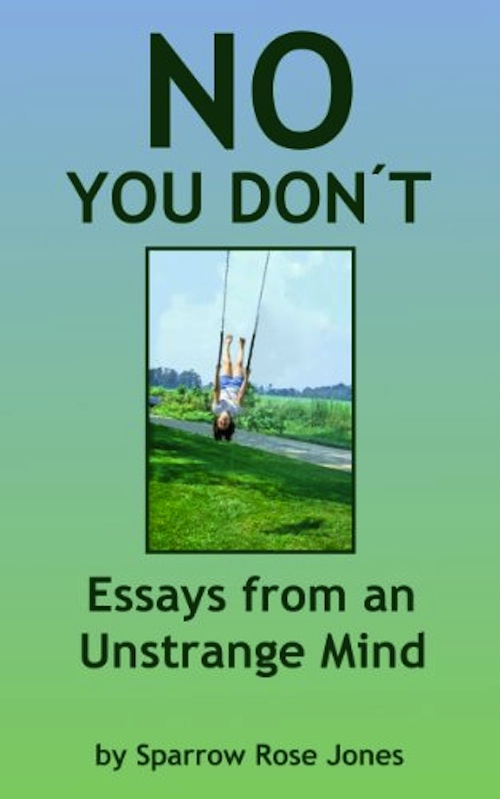
Sparrow Rose Jones wrote an e-book No You Don’t: Essays From an Unstrange Mind that is now available on Amazon.  The title comes from a powerful essay she wrote on her blog – Unstrange Mind –  in response to the many parents who have told her how they would like nothing more than to have their autistic child grow up to be like her.  Sparrow writes:

“I used to say, “I hope she’s much better off than I am,” or simply, “no, you don’t,” but over time I learned that parents refuse to accept that answer.  Maybe they think I’m doing that social thing where someone compliments you and you are expected to refuse the compliment a time or two, finally accepting it but maintaining your veneer of humility.  Or maybe they’re just baffled.  But sometimes they even got angry so I finally learned that I should answer, “thank you.  That’s very kind of you to say.”  Reinforced behavior — reinforced by social censure if I dare give the wrong response.”

Sparrow writes,

“… what I wish to come from this book:  a recognition of the shared humanity we all enjoy and a sense of connection among people coming together across a wide gap of experiential realities.”

And again from the essay – No, You Don’t:

“… they think, “my child is non-verbal.  My child goes to school and crawls around on the floor, meowing like a cat.  My child still wears diapers while all her same age peers have been toilet trained.  My child bites and hits people.  My child bites and hits herself.” And so on.

“Then they hear that I was many of those things, myself.  I was kicked out of the classroom for crawling on the floor and hiding under the tables.  My first grade teacher said I was “mentally retarded” and petitioned (successfully) to have me removed from her classroom.”

Further along she writes:

“I was raped.  I was abused — domestically and otherwise.  I was molested.  I was taken sexual advantage of.  I want you to teach your children to say no and I want them to know how to mean it and back it up when they say it.  I want you to teach your children to value themselves and I want you to teach them to own their bodies.”

Sparrow writes about how she lives in “crushing poverty”, how she has spent a great deal of time homeless, couldn’t keep a job,and was “unable to consistently keep a roof over my head or food to eat.

In her follow-up to her No, You Don’t essay she writes about the response she received because of it.  “There was a small group of people, though, who read my essay and became angry.”  She describes how she was attacked by parents of autistic children, “I felt like I was being punished for writing and all that compliance training kicked in as a result.  I closed down my blog.  I became physically ill from the stress and shame and ended up in the emergency room more than once as a result.

The next essay is called “Bullies, Bullying, and the Struggle to Speak My Heart”.  The first sentence of that essay is:

“Bullies have been one of the most constant things in my life.”

Sparrow writes:

“An Autistic kid who is behaving in a violent manner is an Autistic kid who is seriously suffering on a daily basis and needs a lot of help.  And being able to speak doesn’t always mean that a kid will be able to tell you what is wrong.”

There are too many wonderful essays in this e-book to quote in one short post.  Sparrow writes honestly with tremendous compassion for all of us.  She ends her beautiful collection of essays with this:

“May my journey of self-discovery inspire you to journeys of your own.  Where there is life, there is hope.  Autistic lives do not always look the way you might expect or hope they would look, but you must keep a sharp eye out for the tender flowers as you travel and you must understand that Autistics often bloom in surprising and exquisite ways.  Don’t try to shape us to your garden or we may wilt.  Enjoy and foster our own, unique beauty in all its fierce wildness and you will find your heart and your truest reward there.”

No You Don't

Humanity

“Please try to remember that what they believe, as well as what they do and cause you to endure, does not testify to your inferiority but to their inhumanity and fear.” ~ James Baldwin from The Fire Next Time

If there is one thing I want my Autistic child to know, it is this idea written by James Baldwin.  He was writing about race, but his words apply to any who have been on the receiving end of prejudice.

I think about my father a great deal.  A proud, athletic man who broke his back in a horse back riding accident which eventually forced him to rely on a wheelchair to get around.  My father used to call me every Sunday.  We would chat about things that interested him, the weather, his garden, his cat, the dogs, the horses.  He would ask me about what I was working on.  He was tremendously supportive of my career.  I was battling my own demons, demons of my own making, but demons never-the-less that I rarely discussed.  I would ask him how he was, but he would always answer, “I’m still here.”  I knew that I would have to call my mother to learn about his physical well-being  if I wanted anything more in depth.  He never complained.

One day I told him I was tired of him always saying he was fine, I really wanted to know how he was.  I wanted him to tell me the truth.  He said, “You want me to tell you about the constant pain I’m in?  You want me to tell you about how my bodily functions are slowing down and what that’s like?  Is that what you really want to know?”  I remember pausing for a second and feeling confused.  And then felt terrible for my hesitation.  What I really wanted was for him to be fine.  I wanted him to be happy and energetic and well.  I wanted him to feel good and he did not.  He did not feel happy and energetic.  He was in pain.  Physical and emotional pain and a lot of it.  At the time I wanted to be the one who would change his circumstances.  I wanted to be able to make him better.  I wanted to save him from his pain.  But I couldn’t.  I couldn’t.

When my daughter tells me she wishes there was a cure for autism, I feel that same stab of pain.  This is the price of our inhumanity.  I think how society and my past actions have done this to her.  All those people, the media, the articles, the doctors, the therapists who spoke of her neurology as a terrible thing, a neurology that is not understood, that most see as inferior.  And I blame myself for having bought into this belief for so many years.  The idea that if I could just find the right pill, the right bio-medical intervention, the right therapy, we would successfully alter her brain and make it so she could talk and have conversations with us, so she could learn to “pass” if she wanted to, so that she’d at least have that option if she chose it, despite the devastating price she would have to pay to achieve this.  So that she’d have a chance.

But she couldn’t achieve this goal and I learned to stop asking her to.  I found other methods, not therapies, not treatments, but rather ways to teach her, ways to work with her specific neurology, and I keep practicing these methods because I have seen how others who created them and have trained in using them are able to converse with her through writing.   While I do all that, I keep telling her and showing her that she is loved and of value.  She is worthy and perfectly imperfect and deserves to be treated kindly and as the intelligent, sensitive, talented human being that she is.  She has as much right to be in this world as anyone else.  She is equal to her peers not less.  Being indistinguishable is not a goal.

My daughter’s neurology is not inferior.  Those who believe this are wrong.  My daughter is no more inferior than I am.  She has challenges, they may feel at times insurmountable to her, but we as a society can make her challenges easier.  It is our inability to lessen her challenges that is at fault, not her neurology.  It is our responsibility to challenge our views, to call each other out when we see injustices being done, to treat each other with the same respect and care we would have others treat us.  We must never give up.  We must never allow ourselves to fall into lethargy or the false believe that we are better than anyone else.  We are not.  We are human.  Imperfect.  We need each other.  We need to push each other to do better.  We can do better.  We must do better for our children, for this world, for all humanity.

Jen at Down Wit Dat is doing a blog hop.  It is open to all blogs in the disability and special needs communities: self-advocates, allies, parent advocates, and others are encouraged to share posts. 

These posts brought to you by:

Powered by Linky Tools

Click here to enter your link and view this Linky Tools list…

When Words Don’t Reflect What is in the Mind

Imagine being asked a simple question, say a question about whether you’ve ever been to New Zealand.  Now you know perfectly well that you’ve never traveled to New Zealand, though you have a pretty good idea of where it’s located, however it’s not a place you’ve spent much time thinking about and it wasn’t even on your top-ten-must-travel-to-before-I die list.  But when you opened your mouth instead of saying, “No, I’ve never been to New Zealand, why do you ask?” all you could manage to say was, “Yes!” and not just a sullen sort of yes, but a happy, eager and enthusiastic “YES!”

So now the person begins talking to you about New Zealand and maybe they’ve just returned or they were born and raised there and they go on and on and then say, “What was your favorite place in New Zealand?”  Well, since you’ve actually never stepped foot in New Zealand this question is impossible to answer and so maybe you say “vanilla cake” because the one thing you know about New Zealand is that people are referred to as Kiwis and your only reference to kiwis is when you tried an actual kiwi once and didn’t care for it, but your favorite thing to eat is vanilla cake and besides vanilla cake makes you happy and this conversation is making you anxious because you said “YES!” when you actually meant “no” but things have moved on so quickly that you are feeling tremendous anxiety and wish you could just go somewhere away from this voice that is speaking so quickly about a place you’ve never been to nor have any interest in.

They look at you with that look, it’s a mixture of irritation and surprise, like they cannot decide whether you are purposefully making fun of them, or are tuning them out because you’re rude and have no manners or because you are actually hungry and are wanting to eat some cake.  So they give you the benefit of the doubt and say, “Yeah, well we can’t eat vanilla cake right now and anyway we were discussing New Zealand, so I’d like you to focus so that we can continue.”  Feeling frustrated and maybe even ashamed that they think you’re rude, you try to make a friendly overture by saying, “I like vanilla cake.”  But instead of smiling they look even more angry and so your anxiety kicks into high gear and you bite your hand to center yourself and because you are overwhelmed with frustration.

Suddenly all thought of New Zealand and anything else gets tossed out the window, because here you are biting yourself to center yourself and also cope with how frustrated you are, but all it does is make the other person furious.  You are so completely misunderstood and without the means to explain, you are caught in a web of other people’s assumptions.  “Stop it!  We do not bite!” the person scolds and maybe they grab your hand and hold it done at your side.  Their grip is firm, so firm, it actually hurts, and they look so angry that it’s scary too.  They are restraining you and glaring at you and all because your mouth wouldn’t obey your mind and said, “Yes” when you meant “no”.

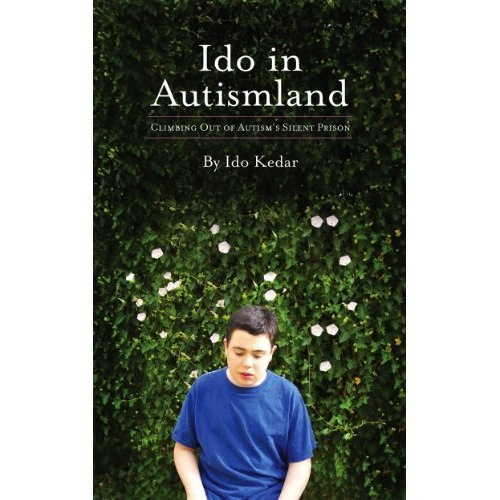
I have no idea if this is what it’s like for my daughter or others who have what I call unreliable spoken language, but these are the kinds of scenarios I imagine and wonder about.  Is this what it’s like?  One day she will tell me, but in the meantime, there are others who are now writing about similar things, when their mind knows but their body is unable to do as their mind wants.  This is what Ido writes in his book, Ido in Autismland:

“… my mom asked me to hand her a bag.  I kept handing her a piece of paper the bag was near.”

“It happens less often now but it was common when I was small in my ABA drills.  I wanted to touch a card but my hand had another plan so I had to redo drills until my hand got it.  Not my head.  It knew everything.  My hand had to learn the drill. It’s something for the neurologists to study.  This is why so many parents think their kids don’t understand them.”

Naoki Higashida in his book, The Reason I Jump, writes:

“…as soon as I try to speak to someone my words just vanish.  Sure, sometimes I manage a few words, but even these can come out the complete opposite to what I want to say.”

What would that be like?  How would it feel to be completely misunderstood, your every action misinterpreted by someone else who believes you meant something that you did not?

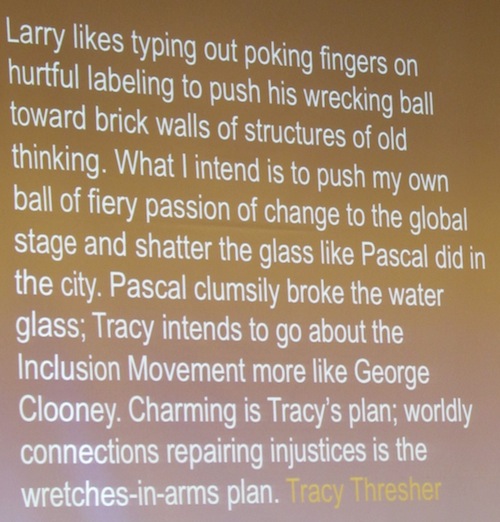
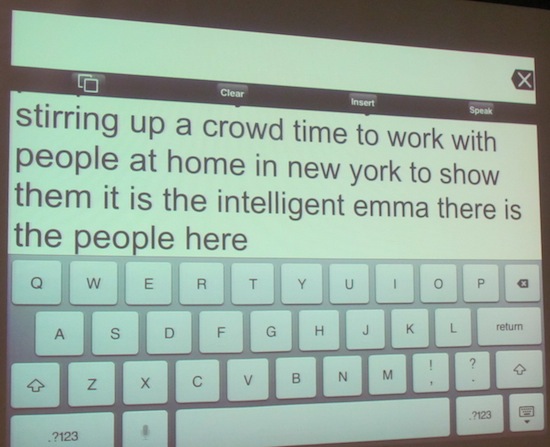
Tracy Thresher types during a Q&A at the ICI Conference ~ July, 2013

Tracy Writes

Non-Speaking With a Lot To Say

I am reading Ido in Autismland: Climbing out of Autism’s Prison by Ido Kedar.  This is another one of those MUST READ books.  Ido is a non-speaking Autistic teenager who learned to write his thoughts by pointing to a stencil board using Soma Mukhopadhyay‘s RPM method.  Ido now types on an iPad.  When I first received a copy of this book, I admit, I was put off by the subtitle.  You see, I was one of those people who once believed my daughter was trapped inside a prison that I called “autism” and for a long time I absolutely believed this.  This thinking led me to believe that if I could cure her, if I could remove her “autism” she would be released from its prison.  It was also this thinking that caused me to say how much I loved my daughter, but hated her autism.  Once I discovered blogs written by Autistic people I began to reassess these various beliefs and finally began to understand how my thinking was actually harming her.    I’ve written about some of this ‘here‘, ‘here‘ and ‘here‘.

But in reading Ido’s book and because I wrote directly to him and his mom about my initial reaction to the subtitle, I have come to understand that his reference to “prison” refers to being imprisoned in a body that does not obey what his mind wants, a mouth that does not say the words he wants to communicate and a society that perceives him as someone he is not.  But more importantly this is Ido’s story and is about the way he perceives autism as it relates to himself and what he has been through as a result. To not read this terrific book because of semantics or because Ido’s perception of autism as “illness” is one I found unhelpful and even harmful to my family and daughter, would mean I would have missed reading a great book written by a really insightful and wise young man who had to fight against prejudices and preconceived ideas about who and what he was capable of.  This is Ido’s story and what a wonderful story it is!

In the introduction, Tracy Kedar, Ido’s mother, writes,

“The ideas in this book challenge many assumptions long held by professionals working with autistic people.  In our own experience, Ido broke free in spite of, not because of, the mainstream thinking today.  If we had continued to rely on  the specialists and educators who dominated Ido’s early years, if he had not been able to find a way to show me that he could read and write, and if I had not finally trusted my own eyes and impressions, Ido would still be stuck as he was, locked internally, underestimated and hopeless.  It is time for our understanding of autism to undergo yet another paradigm shift, and Ido, along with other non-verbal autistic communicators, is a pivotal guide.”

*The use of bold is mine, used for emphasis and is not in the book.

Just as a quick aside, Soma’s RPM method begins with written choices, progresses to a stencil board with the student pointing to the desired letters with a pencil, then to a laminated alphabet board and eventually to an iPad and computer.  Soma or the person doing RPM does not come into physical contact with the student and once the student has moved to a laminated board, she even encourages the student to hold the board themselves.  The final step is to move from the laminated board to independently typing on an iPad or computer.

This quote was written by Ido in 2008 regarding his body and mind and how the two do not obey each other.

“Time after time people assume that I don’t understand simple words when they see me move wrong.  Understanding is not the problem.  It’s that my body finds its own route when my mind can’t find it.”

Again in 2008, Ido writes about his life before he learned to communicate using RPM.

“They misinterpreted my behavior often.  For example, I remember that during my ABA supervisions, I sometimes ran to the window over the parking lot in an attempt to show them that I wanted to go to my car.  They didn’t understand how a non-verbal person might be communicating.  Once, when I got really mad I urinated in my seat, but the supervisor just thought I couldn’t hold my bladder.

“But even worse was that they didn’t support me when I began to communicate.  Maybe they assumed I was too dumb, or they simply couldn’t see what I had learned because I learned it in a different way than their methods.  The response to everything was to give me drills.  If I had a dollar for every time I had to touch my nose, I’d be rich. I remember one day they realized that I hated being told to touch my nose, so they brilliantly switched the command to “touch your head.”  I felt like a prisoner of these theories and methods…”

“On Being Silent and Liberated from Silence”

“Can you imagine silence your entire life?  This silence includes writing, gestures, and non-verbal communication, so it is a total silence.  This is what a non-verbal autistic person deals with, forever.  Your hopes dim, yet you persevere in going to ABA or Floortime (play focused treatment for autism) or speech therapy, all to no avail.  The therapists can’t help and you despair, and only you know that your mind is intact.  This is a kind of hell, I am certain.

“The experts focused on stim management, or drills of rote activities, or silly play like finding things in Play Doh, over and over, on and on.  But they never taught me communication.  I shouted to them in my heart, “I need to communicate!”  They never listened to my plea.  It was silent.

“I could read from an early age.  I could write too, only my fingers were too clumsy to show it.  In school I sat through ABC tapes over and over and added 1+2=3 over and over.  It was a nightmare…”

Ido writes how when he was seven years old his mother supported his hand in an effort to have him help write invitations to his birthday party and how she could feel he was attempting to move his hand and in this way realized he could write.  But things did not immediately change.  No one believed him or his mother.

“My ABA team tried to convince my mom that she was wrong.  This hurt me so much because I thought they’d be happy for me and teach me how to communicate better.”

My daughter has asked that I read Ido’s book to her, so I am.  It has opened up a whole discussion about communication, what it means to not be given the tools to do so, what is autism, what it means to be autistic, being in a body that often does not do as one would like and what others believe as a result of actions you often have little if any control over.

Ido

The Trouble with Treating “Behaviors”

A child throws a chair or their shoes at school and the parents are told of their child’s “problematic behavior”.  A child pokes another child repeatedly and when told not to, laughs and does it again.  The teacher tells the child they will not be able to go out to the playground at recess as punishment.  A child runs from the classroom, causing the teacher to stop her lesson and pursue the child.  The child is given a time out for displaying “challenging behavior”.  A child does not respond to the teacher, does the opposite of what is asked and the parent is informed that their child is “out of control” or “refuses to listen” or “is being disruptive” or any number of other comments that so many parents routinely receive from the various teachers and schools that our kids attend.

Each time it is the child’s behavior that is highlighted, documented, and charted.  Reward systems are put into place, time outs are given, the child is told there are consequences to their actions and things they love are taken away to demonstrate this point.  The thinking goes that behaviors must be treated.  But I question all of this because I’ve read too many stories that beautifully explained these so called behaviors by many people who spent a great deal of their childhood being misunderstood and told their behaviors were “out of control” or “challenging” or they needed to understand there are consequences when they were responding to other things in their environment.

Imagine you are on the school bus and another kid is seated directly behind you.  They scratch the back of your seat with their fingernails.  The sound of their scratching, coupled with the vibration caused by it, makes you feel as though your entire body was covered in crawling ants and the vibration makes you feel physically ill.  You do not have much spoke language that you can easily access and the language you do have is thought of as echolalia so it is often ignored.  Never-the-less you do the only thing you know to do, you shout, “No!  Stop doing that.  You cannot hit, you cannot punch, you cannot bite!”

The other kid thinks this hilarious and realizing you are directing this at them, continues to scratch the back of your seat, except now they are doing it with renewed vigor.  The bus matron comes over and tells you to stop yelling, that you are being disruptive and need to be quiet.  The kid behind you continues to scratch your chair, and despite your protests, despite your attempts to make him stop, he will not.  Eventually you turn around and spit at the kid.  The matron comes over, now furious and tells you that you must apologize and that she intends to tell your parents how badly you’ve been behaving.  So you spit at her too.

When the matron tells you that you will not be allowed back on the bus, something you love riding, you begin to cry and bite yourself.  Again you are yelled at, told to stop it immediately….  When you get home your parents tell you this kind of behavior is unacceptable and on it goes.  No one says a word about the boy who was making your bus ride miserable.  No one talks about his behavior or that there are consequences, in fact there appear to be no consequences to some people’s behavior, only yours.  The message you learn is that terrible things will happen to you, seemingly without reason, without any explanation and that you must be hyper vigilant and avoid sitting near any other kids.  The next time you board the bus you attempt to sit in the very last seat, but are told you cannot and are seated in front of the boy who delights in scratching your seat.

(The above story happened to someone I know well and it was only when I was able to type with this person that the whole story came out.)

A few months ago I read about a boy whose older brother would punch his friends on the shoulder upon seeing them.  They all smiled and laughed.  After much observation, the younger brother decided that this was a good thing to do, especially to someone you liked and wanted to be friends with.  So the next day when recess rolled around this boy went up to another kid and punched him in the shoulder.  Only the kid didn’t laugh or playfully punch him back.  Instead he yelled at him to stop hitting him, called a teacher over and the other boy was sent to the principal’s office.  The boy was told if he continued “picking fights” he would be expelled.

These examples are but two of dozens about so called “behaviors” that are seen as problematic and in need of various interventions to deal with them.  And yet, when one listens and asks non-scolding questions from a place of curiosity without threat of admonishment there is almost always a reason for these so-called “behaviors” and the reasons may illuminate why the various interventions to treat them will not work, or will work to make the person learn to camouflage or quell their behaviors, but will not help the person learn how to cope or deal with the things causing the “behaviors”.  Treating actions that are seen as problematic as though they occur in a vacuum is like applying a band-aid on a rash caused by allergies.  The band-aid might cover the rash from view, but it will do nothing to treat the cause.

It is interesting to note that there are people who consistently work with those who are known as having “problematic or challenging behaviors” and yet, all of those so-called behaviors disappear when they are treated with respect, presumed competent and they are not treated as though their actions are intentionally disruptive.

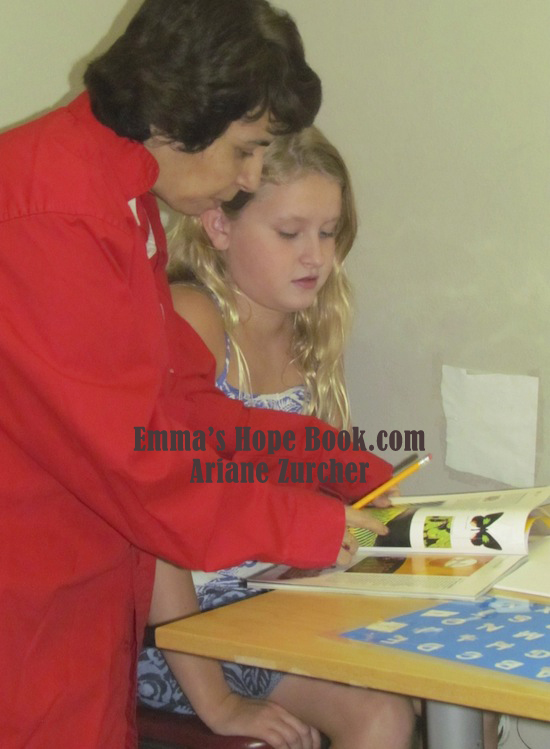
Soma Mukhopadhyay and Emma ~ September, 2013

Soma & Em copy

Related articles:

Having to Prove Competence

I have always feared being put somewhere against my will.  Sequestered, hospitalized, institutionalized, these are abject fears I have had since I was very young.  The idea that others would have control over what I did, where I went, what I ate, who I saw…  these are more than just fears, they are like nightmares, too horrible to contemplate.  My greatest fear when I went to see a therapist in my early twenties was that I would be put away somewhere, so sure was I that if my secrets were revealed I would be thought too damaged to live among my peers.  I made my therapist promise that if I told him what was on my mind he would never allow me to be admitted to a mental hospital.  It was after he assured me, swore he would honor my requests that I was able to finally begin telling the truth.

On Homeland (the Showtime series beginning its second season) there is a scene with the main character being committed to a mental institution, forced to take medication, her speech garbled and slowed, her facial expressions a slow motion blur of terror, rage and pain, her eyes wild, like a caged animal, while her intelligence burns bright.  The well-meaning staff speak to her as though she were a child, incapable of reason, they tell her to calm down.  They tell her to take deep breaths and count to ten.  They doubt her ability to make decisions, they speak to her in voices cloaked in a calm-like veneer, their irritation still bleeds out, their condescension is palpable, their dislike for this person who is inconveniencing them is still vividly apparent.

And I thought of all the people we have met who are like those well-meaning nurses and staff.  They do not view those who are neurologically different as equals, not really.  They believe they have proof of this.  They do not believe, even though they may say otherwise, that people who cannot speak or who do so intermittently  are competent, capable of insightful thoughts, or have anything of importance to say.  They alternate between ignoring the person, to speaking to them as though they were still a toddler.  They are visibly uncomfortable.  These are the people who have concluded that because someone cannot verbalize what they think candidly and with ease, they must not have anything of importance to say.  Thankfully most of the people we meet who are like this have not devoted their lives to working with this population.

But now and then I meet someone who has.  They believe they are doing a good thing, a noble thing.  They believe they are helping.  They believe that the people they are trying to help are living happier lives as a result.  They believe this with all their heart.  They give words, as though gifts, in grammatically correct sentences, believing people can be trained to say things and do things that will be understood by the majority of the population.  They think that if they can force someone to stop moving their hands or legs or twirling bits of string that the person will be better for it.  They do not consider that this may be detrimental, that these actions are necessary to their concentration, that they will actually learn more and be able to concentrate better if they are allowed to do these things that are seen as unusual.

As I watched Claire Danes in the role of Carrie Mathison, I felt that old familiar terror  I used to feel when I imagined if people knew me they would believe I needed to be put away somewhere and locked up.  I was reminded of all my old fears that who and what I was, was broken and needed to be fixed and that I was not like others who seemed so pulled together, so calm and happy.  On the show, Homeland, the more Carrie tries to convince the staff that she is fine and calm, the more out of control she appears.  Having to prove oneself as competent is a difficult, if not impossible thing to accomplish, if those you are trying to prove to, already have made up their minds to disbelieve.

Em types with Pascal

One of My Favorite Blogs…

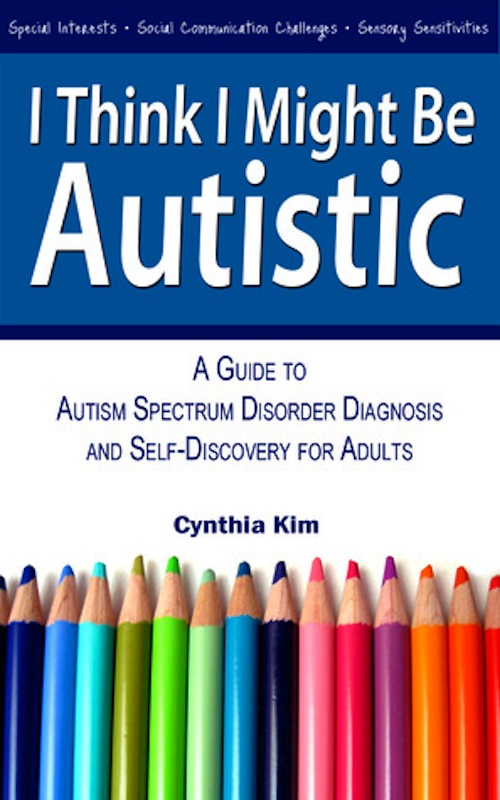
There’s a blog I love called, Musings of an Aspie written by Cynthia Kim.   Cynthia Kim also has a book, I Think I Might Be Autistic , which is now available as an e-book and in paperback.  She writes about her decision to pursue a diagnosis, with lots of tips for those who might be thinking of doing the same.  “I Think I Might Be Autistic: A Guide to Autism Spectrum Disorder Diagnosis and Self-Discovery for Adults” begins from that “aha!’ moment, addressing the many questions that follow. What do the symptoms of ASD look like in adults? Is getting a diagnosis worth it? What does an assessment consist of and how can you prepare for it?”  But the book is much more than just advice about whether to get a formal diagnosis or not.  It’s about identity, who we are, what that means and why we care.

On Cynthia’s blog she writes about marriage, motherhood, being a “self-employed aspie” as well as a whole host of other topics.

Here are a few of my favorite quotes and posts from her blog:

From Beyond The Talk:  What Else Autistic Girls Need to Know About Puberty

When it came to puberty, my parents did what many parents in the seventies did: they gave me a book about puberty written especially for girls. It was a slim cranberry hardback with an ambiguous title like “Everything is Changing.”

I was a voracious reader, so I would curl up in my beanbag and scour the pages for clues to the mysterious changes that were on the horizon. I think I had many of the same fears, anxieties and curiosities about puberty as my friends had. Certainly my body went through the same changes that other girls experienced. However, I think there are some areas where girls on the spectrum would benefit from additional information or guidance. That’s what I’m going to focus on in this post.

Cynthia wrote a kind of parody about “NT’s” in the same writing style so commonly used when non autistic people write about Autistics.  It is perhaps, one of my favorite posts, although it’s hard to say as there are a number vying for that position.  The quote below is from her post, What is Neurotypical?

“Perhaps the most obvious giveaway is an NT’s tendency to make “small talk” or to want to “chat” with you. While small talk appears to be nonfunctional, for NTs it serves a very specific purpose. It’s a good idea to humor them and participate to whatever degree you can tolerate. If you’re patient with them, many NTs will soon feel comfortable enough to move from small talk to more interesting, in-depth conversations.

Another common sign that someone is an NT? Touching. NTs enjoy all sorts of physical contact and often use touch to greet friends, family and even casual acquaintances. While it’s hard to fathom why your real estate agent or hairdresser feels the need to send you off with a hug, try not to be judgmental while fending them off. NTs are simply wired differently.”

From Cynthia’s Aspergers and Marriage Series, Lessons From an Aspergers – NT Marriage :

The Scientist: “You don’t have to make my lunch every morning. I can pick something up in the cafeteria.”

Me: “I don’t mind. It only takes a few minutes and I know you’d rather have something healthy to eat. This way you don’t have to waste time waiting in line.”

The Scientist: “So you mean you make my lunch because you care about me, right?”

Exactly.

I will end with a quote from her post, A Cognitive Defense of Stimming (or Why “Quiet Hands” Makes Math Harder):

The obvious reason for objecting to “quiet hands”-type instruction is that it shames the child for moving in a way that is natural and comforting for them. Others have written eloquently and in great depth about this subject; I’ve linked to some key pieces below rather than repeating what has already been said.

The case I want to make against “quiet hands” is that in addition to being emotionally damaging, it’s cognitively counterproductive. Think back to the experiment where the people who were told to resist eating chocolate gave up more easily on solving puzzles. Substitute stimming for chocolate and learning long division for solving puzzles. Add in the fact that autistic people have impaired executive function to begin with, making inhibition of actions more challenging, and you can see why asking a child to resist stimming is counterproductive if you’d also like them to learn a new skill.

For those of you unfamiliar with Cynthia’s work, I urge you to go now and enjoy, and for those who already know about her writing, how did my medley of some of my favorite posts from her blog measure up against yours?

Cynthia's Book

Can One Be Too Sensitive?

When I was young I was told I was too sensitive.  I was told this by many, many people.  I cried easily and often.  I didn’t take criticism well.  When scolded I felt awful about myself, took all the words said, mulled them over and concluded I was a terrible child.  I remember wondering how it was that I could be so awful?  Why did I make so many dreadful mistakes and so often?  I believed that I was unusual in this way.  I thought there was something very wrong with me, confirmed by all the things I did that caused me to get into trouble so much of the time.

This thinking caused me a great deal of pain and suffering later in life.  I was not able to step back from what people said to me in annoyance or anger.  Even when they would later compliment me about something I’d done that they approved of, it was tempered by the last admonishment.  I didn’t know how to hold two opposing ideas about me at once and make sense of them.  It never occurred to me that it was my behavior that was being objected to.  It didn’t dawn on me that teachers and adults were talking about things I’d done and that my actions were separate from who I fundamentally was.

This morning I awoke and my child bounded out of their room in an exuberant flourish of happy energy and good cheer.  I urged them to lower their voice as I busied myself with preparing their breakfast and my coffee.  Over the course of the next hour I admonished my happy child to not pound the floor by jumping in gleeful abandon for fear of waking the downstairs neighbors and again to lower their voice for fear of waking their sibling and reminded this joyous child to not slam the door to our apartment (which slams on its own without anyone’s help) and while waiting for the elevator to lower their voice yet again.  And by the time the bus had come to take my wonderful child to school I had tried (I am hoping, unsuccessfully) to tamp down their enthusiasm a dozen times.  As I made my way to the subway I realized I had not shared in their joy for all that was joyful and wondrous.  I had not joined them in greeting this beautiful day with such untethered optimism.  And that old crushing feeling came down upon me like an avalanche.  I felt terrible.  I reflected on all those days when I was a child and how it felt to be hushed and told to lower my voice and how I would try with all my might and yet never could lower my voice enough.

As awful as I felt, as sad as it made me to reflect on all of this, by the time the subway came to my stop I saw how being overly sensitive is highly under-rated.  How can one be “overly” sensitive, anyway?  And what’s the alternative?  Even now in my mid-fifties I still am extremely sensitive, too sensitive, or so people tell me.  I no longer believe I will be able to develop a thick skin as so many predicted I would at some point obtain.  And honestly I no longer strive to.  Besides, if I weren’t too sensitive would I have noticed how I was shushing my child more than was necessary.  Without being overly sensitive I might not have made a mental note to be extra playful and bouncey when I see them this afternoon.  Without being far too sensitive for my own good, I would not have connected my child’s awesomeness with my younger, often exuberant and very sensitive, self.

Joy

Joy copy

I Will Not Model Compliance For My Child

“Look! Motorcycle bubbles!”  This was a phrase Emma used to say often.  It was an all-encompassing phrase that was both a metaphor for rain and the Fourth of July and New Years Eve fireworks, as well as a descriptive phrase of what both are like sensorily for her. (Emma has verified this is true.)  “Motorcycle bubbles” meant rain and fireworks, but there was so much more to those two words than simply pointing out the window and saying, “Look!  It’s raining!”  or “Look at the fireworks!”

When I went back through this blog to find the post I’d written about motorcycle bubbles, I found these, “Sorry Bubbles” and Em & The 4-Wheeler  written more than two years ago, that I’d completely forgotten about.  “Motorcycle bubbles” and her related phrase, “Sorry bubbles” are nothing short of poetic.  Poetry is all about using words in unusual, unexpected ways, “Sorry bubbles”  Great art evokes an emotional response within us.  While, a few years ago, I was appreciative of the beauty of phrases such as “sorry bubbles”, I was even aware of the emotional tug I felt when I heard her say those words, that appreciation was tempered by worry and concern about what I believed the larger issues were for my child who said such fascinating, yet cryptic, words.

I no longer feel the strain of worry and concern, but rather delight in my daughter’s obvious brilliance and poetic gifts.   I am grateful to have gotten to this place of appreciation and joy.  So many autism specialists and so-called treatments did not and do not appreciate the beauty of those word combinations.  So many believed they were aberrant, meaningless words that must be righted through rote learning and repetition of more “appropriate” words.  Which was code for “use these conventional words, so that we can understand you more easily.   Make our lives easier.  Behave in ways that do not draw attention to you.  Be like everyone else.”  And all of this was done under the guise of “helping”.  Meanwhile “motorcycle bubbles” and the like would be bulldozed, covered with the dirt of more conventional language.

People argue that our children need to learn to “fit in” that it is our job to teach them these skills and to not do so is to be negligent or (at the very least) unrealistic about life and the world.  But for those like my daughter, asking her to spend so much of her energy and time to try to change the way she moves (were that even in the realm of possibilities), forcing her to give up her string (which marks her as different), trying to get her to substitute her string for a more “socially acceptable” object, teaching her to swallow her verbal utterances that to others seem nonsensical, forcing her, every time she said anything, to repeat a more conventional way of speaking, even if all of this were remotely possible, I ask WHY?

Why would we do this?  Why is all of that more important than giving her the freedom, support and encouragement to be her unique and beautiful self?  Why is quelling her natural tendencies so desirable?  Why is tamping down her poetic phrases, replacing them with more standard, “accepted” speech preferable?  Why is all of this considered desirable given the massive toll all of that takes on her?  Even if she could do any of these things, even if all of it were obtainable goals, how exhausting, how bone-numbingly frightening, how terrifyingly isolating it would be to grow up believing that everything about you was fundamentally wrong.

I’m not interested in grooming my child to be something she is not, demanding that she be someone, that even if it were possible for her to attempt, would make her feel awful about herself, just so society could feel better about its own mediocrity.  I’m not willing to do that.  The only thing I care about, the only thing I’m interested in, is changing society’s views and the only way that’s going to happen is by countering what is considered the “norm” and saying, NO!  I’m not going along with it.  NO!  I am not going to raise my child to be compliant or train her to say what you want to hear or try to force her to move in ways that society has deemed acceptable.  I will not model compliance for my child to imitate.  I do not condone censorship that would bury “motorcycle bubbles” and “sorry bubbles” forever.

(Chou Chou – This photo’s for you!)
Love copy

The Blurring of Diagnoses

There was a time in my life when I could not get through an entire day without throwing up.  I would get hungry, eat to the point of discomfort and vomit.  I went to therapists who tried to help me.  I tried various techniques, stalling methods, eliminating certain foods, but in the end nothing I did helped.  I couldn’t stop.  I remember sitting in my apartment, afraid to eat anything because to eat meant I would purge.  It was no longer a choice.  It was something I had to do.  All of this was complicated by body image issues, tremendous shame and the belief that who I was depended on how thin I was.  That I was dying inside seemed less important than how I looked.

“One major distinction between an addiction and a compulsion (as it is experienced in obsessive-compulsive disorder) is the experience of pleasure. While people who have addictions suffer all manner of discomforts, the desire to use the substance or engage in the behavior is based on the expectation that it will be pleasurable.

“In contrast, someone who experiences a compulsion as part of obsessive-compulsive disorder may not get any pleasure from the behavior he carries out. Often, it is a way of dealing with the obsessive part of the disorder, resulting in a feeling of relief.”  ~ About.com

When I read a description such as this one, I begin to question my eating disorder as addiction and wonder whether it was much closer to the definition for OCD  because though it all began with a desire to quell pain and seeking pleasure, by the time I found recovery, pleasure was illusive and no longer part of the equation.  “This can get a little confusing because there often comes a point for people with addictions where they don’t really enjoy the addictive behavior, and they are just seeking relief from the urge to use or engage in the behavior.

Although this can look like obsessive-compulsive behavior because the pleasure is gone, the original motivation to engage in the behavior was to feel good.”  ~ Helpguide.org.   So we have come full circle and are back to addiction.

I bring all of this up because as with anything whether we are talking about addiction, OCD,  anxiety or any of the other numerous issues many people struggle with, the labels can overlap.  So I was an active addict and when I was active, my addictive behavior mimicked pretty classic OCD behavior.  There was a point when the idea of sitting with my feelings, sitting and not tamping them down with food was inconceivable to me.  I really believed I would die.  This statement describes OCD almost exactly.  “OCD… characterized by uncontrollable, unwanted thoughts and repetitive, ritualized behaviors you feel compelled to perform.” ~ Helpguide.org

And yet, even though OCD looks a lot like addiction, there are differences.  Differences that make helping someone with one or the other tricky, but understanding the differences is important.  For example the two most common forms of treatment for OCD is cognitive-behavioral therapy and medication, though neither have proven to be entirely successful and often it is said that OCD, like addiction is something one must learn to manage for the rest of ones life, these treatments flourish.  Treatment options for addiction have proven to be equally challenging.  Some people have found help in working a 12-step program, but others have not.

While the onset of obsessive-compulsive disorder usually occurs during adolescence or young adulthood, younger children sometimes have symptoms that look like OCD. However, the symptoms of other disorders, such as ADD, autism, and Tourette’s syndrome, can also look like obsessive-compulsive disorder, so a thorough medical and psychological exam is essential before any diagnosis is made.” ~ Helpguide.org

Someone whose neurology is autistic may have OCD AND a whole host of other things too, similar to the non autistic population.  Because there is so often an overlap, people mistakenly think that autism is the same as OCD or assume that ALL Autistic children and people have OCD.  The lines between the two become blurred and the distinctions get lost.  So much of what people believe IS autism, are actually co-morbids.  Without making the distinction between what is and isn’t “autism” we may be treating something that we should not be or are missing what we could treat, but aren’t.

Autistic neurology, like non autistic neurology needs to be separated from the co-morbids that affect some, but not all people.  Just as I am non autistic AND an (not active) addict, no one would leap to the conclusion that because I am both, ALL non autistic people are also addicts or that addiction is the same as being non autistic.  Yet, we see this kind of thinking over and over with autism and Autistic people.

Em on her pogo stick copy