Tag Archives: Rapid Prompting Method

A Tale: “Horses Will Never Fly”

This tale was written by Emma and she has generously agreed to allow me to share it here with all of you.  She will finish it at a later date since she was too tired to do so now.

“Horses Will Never Fly ~ By Emma

Long ago horses were mean animals.  If anyone tried to go near, they charged at them.  They had big wings and flew higher than eagles.

One day they flew around and caused so much wind that the dust began to fly.  Dust and sand covered big areas of earth, making deserts.  People and trees were buried below the dust.

Finally when they rested they saw their wings had begun to shed…”

Originally Emma ended this with “They stopped flying.  Horses will never fly.  The end.”  But once we returned to our hotel and discussed it more, Em said it wasn’t quite finished and promised to finish it later when she wasn’t so tired.  In addition, I added the punctuation with Emma’s approval.  As there is no way to punctuate from a stencil board it must be done afterwards.

These sessions are exhausting and she works so hard.   Her story reminded me of Rudyard Kipling’s Just So Stories that I loved as a child.  I cannot wait to read what Emma writes next!

Emma chose this image to accompany her tale from a search for “winged horses.”  It was attributed to redorbit.com

images

This is Autism (Written by Emma)

*A quick note on today’s flashblog ~ This is Autism.  In response to Suzanne Wright’s upsetting and fear-inducing letter entitled A Call for Action  a Flashblog has been organized to take back the phrase “this is autism”, which Suzanne Wright used several times in her letter that was posted on Autism Speaks’ website, the organization she and her husband Bob Wright created eight years ago.   Suzanne and Bob Wright and their organization’s beliefs are exactly what I hope my daughter never sees, hears or is confronted with, but that she feels the repercussions from on a daily basis.

I asked Emma if she wanted to write something for today’s post with the title, “This is Autism”.  She wrote that, yes, she did.  The following is what my daughter wrote, pointing to one letter at a time on a stencil board with a pencil.

This is Autism

Autism is anything.  

It is not bad,  

it is a mindset.

Autism is a method of energy,

it is how I think.

Autism is derided and except in some accepting eyes,

it is seen as not a nice thing,

but

it is me.

*Em

“Let Me Tell You…”

Emma gave me permission to tell all of you what she would invent were she an inventor.  *A little background – the quotes from Emma are what she spelled out by pointing to a letter, one letter at a time on a stenciled alphabet board.  No one touches Emma as she does this.  In fact there is no physical contact of any kind during the session, also known as an RPM (Rapid Prompting Method) session.

Emma has been doing RPM daily with me since the end of September.  Within the past two weeks she has begun to answer open-ended questions with me.  However the session I am going to write about was with someone who was trained by Soma Mukhopadhyay (the creator of RPM) and whom she is now seeing a couple of times a week.  This person, who I have not asked permission to print her name and so will refer to as B, has been doing RPM for a while now and as a result is able to move far more quickly into open-ended questions than I am.

In their previous session they had discussed train engines.  At the end of their session B asked Emma to think about what she might invent were she an inventor.  When Emma returned for her next session they began with the question, “What would you think was a really great thing to invent?”

Emma then replied, “Let me tell you that it is not a train engine.”

I have to interject here…   I love how ballsy my daughter is.  I love that she didn’t just answer with one word.  I love how audacious, cocky even her answer was… “Let me tell you…”  Emma spells words out, and I sit watching, literally on the edge of my chair, waiting, wondering what wonderful words will she write?  “Let me tell you…”  YES!  I cannot wait to hear what you have to say!!!!!

Emma continued, “It is more from the future…”

B urged her to tell us more.

“It is a spaceship.”

For all who know my husband this answer has brought a smile to your face.  For those of you who do not, let’s just say he has a particular fascination with spaceships, UFO sightings, etc.  He has logged in many an hour watching YouTube clips of various sightings.   As I sat watching my daughter spelling out these words I kept thinking how much Richard was going to LOVE hearing about this session.  But there’s more…

B encouraged Emma to continue, asking her to tell us more about the spaceship she would invent.

Emma spelled out, “Have you ever seen spaceships in New York?”

Sorry, I have to interject again.  This question… this question is wonderful and defies all that is commonly thought about so many of our kids who cannot verbalize questions like this.  For all those parents who have never had their child ask a question, for all who have bought into this idea of Autistic self involvement, of a lack of interest in others, this thought that our children who are non-speaking or unreliable speakers are “caught” or “lost” in some other world… to all of you, I suggest we rethink these ideas.  My daughter is not the only one writing things like this, she is one of many, many children, teenagers and adults who cannot voice their thoughts, but are writing them.  I have watched her, time and time again, asking questions; this kind of engaged conversing goes against everything we are taught and being told about non-speaking/unreliably speaking autistic people.  

B answered Emma’s question saying that she had not seen a spaceship in New York City.  She said she’d seen a great many different types of transportation in New York City, but never a spaceship, to which Emma then wrote, “You never have to wait to go anywhere.”

B then asked her how you could get a spaceship and Emma wrote, “You buy it on your own or you get a monthly pass.”  (In New York City most of us take advantage of the terrific subway system.  To use the subway you need a “Metrocard” which you can purchase for a single ride, multiple rides or for those who commute daily a monthly card of unlimited rides.)

B observed that as parking in New York City is already limited she wondered where a spaceship would go.  Emma wrote, “No parking needed.  Once they have landed they become invisible.”

B then asked her,  “How do you call for one?”

Emma wrote, “You have a button to press and it arrives right away.”

Let me tell you…

images

A Guest Post From Richard Long…

What follows is a guest post from my husband, Richard Long

After Ariane’s post What’s Wrong With Autism Speaks yesterday, I thought I’d throw my three cents in here. I didn’t know ANYTHING about autism when our daughter Emma was first diagnosed–except that it was BAD, very BAD and that I should be terrified. My wife went out and read most of the books written about autism at the time, mostly written by parents of autistic children documenting their torturous journey, many about the miracle cure they found that “cured” their child.

Like most guys, I Googled my ass off to try and bottom line the situation. And the news was BAD. My child was probably incapable of feeling empathy, of understanding sarcasm, of connecting with other people. Wow. Since Emma was making very little eye contact at the time and was not interested in cuddling or hugging, I thought this all had to be true. Poor Emma. Poor Ariane. Poor me.

I was told life would be difficult. Meltdowns, speech and language processing issues, OCD symptoms, toilet training. I watched horrifying videos like the ones made my Autism Speaks, (I won’t post links here, but they are on the other posts I linked to earlier if you want to get the crap scared out of yourself as well). I was told that a cure may be possible if we ponied up enough $ to Autism Speaks or TACA, so I opened my wallet. I was told about other miracle cures from casein-free, gluten-free diets, hyperbaric chambers, even stem cell therapy! We actually tried them all. We were so very desperate to “save” our daughter.

Then a true miracle happened. Ariane discovered the blogs of adult autistics who were telling a very different story. They DIDN’T want to be “cured.” Autism was part of who they were, as integral as any other component of their personalities. We were told that there were many advantages of autism: heightened senses, high intelligence, great analytic capabilities. I discovered all the famous inventors who were probably autistic.

Most importantly, we learned that what you see isn’t necessarily what you get.

We thought our daughter couldn’t understand what we were saying. Why? Because A) she didn’t react like she was listening B)  she didn’t comment on what we were saying C) she never spoke about things like that herself and D) she didn’t seem capable of very much speech at all. But now that we have found new communication systems, it turns out Emma understands EVERYTHING we are saying and has AMAZING things to say about her world. She is HIGHLY intelligent (I suspect she is more intelligent than me). Her sense of humor is incredibly sophisticated. She thinks about some things we never considered at all and sees things in such a creative, unique way.

Live and learn. It took us SEVEN YEARS to realize these things. During that time, we really did think of our lives as tragic. And now I can see how much better all our lives would have been if we had received the right information about autism from the very start. Information that came directly from autistic people, rather than people who claimed to “Speak for Autism”. Information from the parents of autistic children who had also discovered the truth about autism from adult autistics. Parents who weren’t looking for a cure, but instead trying to help their children communicate more effectively and deal with the other issues that make life difficult.

It’s a brave new world for us. Thank god. “Better late than never” I keep repeating to myself. But better yet, my hope is that all children who are born autistic are lucky enough to have people around them who actually understand what this means, that don’t look at this as tragedy, who are ready to help in the best ways possible because they have truly useful information available to them.

And I have never seen any useful information come from Autism Speaks. Then again, if they had said something useful recently, I wouldn’t know because I stopped listening to a group that never speaks with the voice of actual autistic people.

Speaking of which, yesterday Emma had another writing session, which Ariane will post in full on her blog tomorrow. It is mind-blowing so don’t miss it. Here’s a preview: In the session before last, Emma was taught about an inventor of oil pumps for train steam engines. At the end of that session the teacher asked Emma to think about what she would want to invent. So yesterday the teacher asks her what would be a really great thing to invent. Emma’s response:

“Let me tell you that it is not a train engine.”

What is it then?

“It is more from the future. It is a spaceship.”

I can’t wait to show her my UFO videos tonight.

Summer 2008 ~ Richard, Em and Ariane

Richard, Em & A

Facing the Skeptics

It’s snowing.  In New York City.  Right now.

“Look Daddy!  It’s snowing!”  Em said this morning.

There’s nothing particularly spectacular about that comment, except to us, it’s not only spectacular, it is exciting and yet another example of how my husband and I continue to underestimate our child.  (This is less a criticism of us and more a statement of fact to illustrate a larger point.)

“Em, do you know who the president of the United States is?”

“Yes,” she spelled out.

“What is our president’s name?”  I asked.

“Barak Obama,” she spelled.

“Do you know our vice president’s name?” I asked, thinking this might be taking things too far.

“Yes,” she spelled again.

“What is the name of our vice president?” I asked.

“Biden,” she wrote matter-of-factly.

“Communication is the most essential use to which spelling should be devoted.  It should not be used as a test or an exhibition piece.  Try being confined to a sentence a week and see h ow you feel about using that sentence to answer some stupid question about whether you live in St. Nicholas.  If Rosie had spent all her time giving tests we would not have had time to use spelling for our own communication.  Crushing the personalities of speechless individuals is very easy: just make it impossible for them to communicate freely.” ~ Anne McDonald from the book Annie’s Coming Out

This is what we are striving toward.  Annie’s comment here is one I have read and reread and yet find so difficult to apply because I am in a near constant state of disbelief when it comes to all that my child is capable of.  I write often about presuming competence, I write about how we dehumanize Autistic people with the language that is commonly used to describe them.  I write about how important it is to treat all people as equal.  I talk about human rights and how the rights of those who are Autistic, particularly those who do not speak reliably or at all, are dismissed, ignored or simply not acknowledged.  And yet I underestimate my child’s ability constantly and without meaning to.

On a daily basis she writes something that blows my mind.  EVERY DAY.  Read that again.  Every.  Single. Day.  It’s like living in an alternate universe.  Every day I feel excited to know what the day will bring.  Every day when I sit down with her I am prepared to feel that mixture of excitement, surprise and overwhelming gratitude.  Every day I think, will I ever stop being surprised?  How long will it take?  I don’t know.  But here’s what I do know – everyday I am overcome with emotion, respect and profound joy in  all that is my daughter.  I am sincerely grateful to read what she tells us, and grateful to all the people who have made it possible for her to do so.  Grateful doesn’t cover the emotions, but it’s the best I can do at the moment.

Yesterday in her *RPM session (follow this link to read more about RPM, which is not the same as FC or facilitated communication, though there is some overlap in that they both presume competence and treat the person with the respect most of us take for granted) she was asked, “What else has an engine?”

Emma spelled out, “Lets say leaf blower.”

My smile was like the Cheshire Cat’s, from ear to ear.  Leaf blower?  I LOVE that!  And later she asked for a clarifying question and then wrote a wonderful answer to a question about what changed once we began using automatic train engines.

“Until I could prove that they were intelligent nobody would come and assess them.  Guilty until proved innocent.  The children were profoundly and hopelessly retarded until they could prove they were intelligent.”  ~ Rosemary Crossley from  Annie’s Coming Out

“It was simply too threatening; my discovery questioned the basic assumptions on which care was offered…”  ~ Rosemary Crossley from Annie’s Coming Out

My daughter is one of hundreds of Autistic people who are writing and typing to communicate and in doing so she is proving every day how extremely gifted she is.  We are at the very beginning with all of this.   There are others who are far ahead of us, those who have published their thoughts, with more being published all the time.  Incredibly, what Rosie experienced, those deeply held prejudices back in the 1970s, continue to flourish today, now more than thirty years later.

“This was one of our standard problems:  people who doubted the children were always so sure of themselves that they openly expressed their skepticism in front of them.  It did not occur to them that if they were wrong they were terribly rude, and that they were making it very difficult for the children to respond to them.  How do you talk to someone who tells  you that they are convinced that you cannot talk?  What are they going to ‘hear’ when you try to talk?” ~ Rosemary Crossley from Annie’s Coming Out

We are living in a time when more and more parents, educators, people who work with Autistic people and Autistic people are facing the skeptics.  We are offering continued proof of our children’s and Autistic people’s intellectual gifts, indisputable evidence of all they are capable of.   My daughter is but one of a great many.  As long as she gives me her permission, I will continue to report some of what she is saying here while hoping that one day soon she, and others like her, will no longer be placed in  the insulting position of having to prove their vast intelligence, and themselves, to anyone.

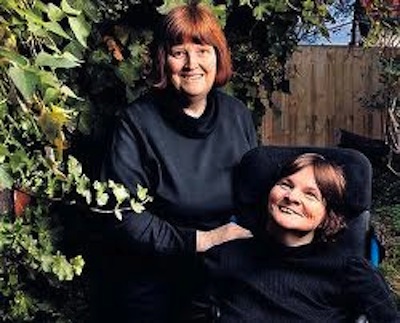
Rosemary Crossley and Anne McDonald
Unknown

The Purple Tree

The Purple Tree and Other Poems is a collection of poems by Sydney Edmond who is non-speaking and autistic.  She learned how to write using a letter board when she was ten-years old, two years later she gave her first public presentation  and has presented at a number of other conferences since then.  Now ten years later, Sydney continues to write, present and is the subject of a documentary called, “My name is Sydney

“Lazy, achy lady
lived by the sea.
Lazy, achy lady,
move away, please.

You are always blabbing,
talking long and loud.
You are closing in on
my lovely little cloud.” ~ From the poem, Some Early Poems

One of the most exciting things happening now is the emergence of a growing number of non-speaking Autistic people who are writing.  Thankfully self-publishing and blogs are making their work accessible to the public.  As more non-speaking Autistic people write and publish their work, it will become increasingly difficult for the public to deny that the assumptions we have long-held about Autistic people are incorrect.  Eventually we will have to re-evaluate how we are viewing those who are Autistic and what that actually means.  Our notions of “intellectual disability”, our ideas about what someone is or is not capable of are being challenged and will continue to be until what we think we know now, what is considered common knowledge will be seen as antiquated and our limited assumptions an example of just how ignorant we once were.

“I lack the lovely peace of mind,
lack my always smile.
Who listens to a lonely girl,
Listens to a child?”  ~ From Dear Friend

The first presentation Sydney gave was in 2005, just two years after she began communicating on a letter board.  This poem, Love, Love, Love! was part of her presentation at the West Coast Symposium on Facilitated Communication.

“But Soma came along
and changed my life.
She actually lifted poor little me
out of darkness
and into light,
love,
and lovable, lovable, lovely happiness.

Soma taught Mom
how to communicate with me,
and Mom and I have been talking
ever since.
Now I can choose my own clothes,
make my own decisions,
and make lovely friends out of people.”

For those of us with children who do not speak or whose language is unreliable, or does not necessarily reflect what is meant or intended, we are entering a time of tremendous hope.  There is a great deal of work still to be done, but in publicizing the work of those who are like our children, who are communicating by typing and pointing to letters on letter boards, we will shift how people view not only our children, but all our children and people.  By questioning commonly held beliefs about any one group of people we affect change for all mankind.

Unknown

The Final Day With Soma and A Word About Methodologies

Yesterday was the last day of Soma Mukhopadhyay‘s 4-day training.  I wrote about it ‘here‘, ‘here‘, and ‘here‘.  Soma packs an enormous amount of information into four days.  She discussed everything from neural pathways of the brain to which parts of the brain are used during specific activities, to how to devise lesson plans and ways to physically position oneself in relation to the student.  There were so many surprising moments, but one that I never could have anticipated, was how helpful it was to learn about the actual brain function during moments that are emotionally charged or OCD.  Learning some of the basics in brain function demystified a great many things in a way I hadn’t before considered.

Given what we now know, and granted it isn’t much comparatively speaking, but is so much more than we knew even twenty years ago, it is astonishing that certain older therapies continue to be popular and used for autism.  Two of the most destructive phrases used with an Autistic person are the dreaded, “Look at me!” and “Use your words!” I cannot list how many times Emma has been instructed to “use your words” only to do so and be ignored.  It seems those who say “use your words” really mean, “use the words I want to hear”.   Add to that the insistence that an Autistic student have “quiet hands” and not stim because it is believed learning cannot take place while stimming even though by removing the stim no learning can or will take place because we’ve just taken away the one thing that was allowing the student to stay focused and attend, even if it did not “look” that way to us.  We non Autistics have a tough time understanding anything or anyone who is vaguely different from ourselves.  Before we start calling ourselves “experts” in Autism, we might want to become “experts” in our own neurology first, at least we’d have a better handle on our own limitations and see how those can so easily dovetail into how we are interpreting what we’ve decided is “the truth” about someone else.

I have written about methodologies before on this blog.  There are some that I find more troubling than others, but in the end, the thing I care about more than anything else is: is it helping my child?  Is she learning?  Is she safe?  Will the short-term gains be at the cost of long-term pain and even trauma?  What is this doing to her self-esteem?  Is respectful interaction being modeled?  Is she being humiliated, shamed, made to feel badly for the way her brain processes information?  Is she being taught by people who believe in her ability to learn?  Are her teachers believing her capable and giving her the tools she needs to flourish and be all that she can be?  Is she assumed to be competent or is she being forced to prove her competence?  Is she being taught the same equation, story, concept and terms over and over?  Is she seen as a human being with the same rights as any other person?  Would YOU want to be treated the way you are treating and teaching this person?

I don’t care what the methodology is, who created it or how many people believe in its efficacy, if it isn’t taking these questions into account, I am not interested in it.  I do not care what others believe, I don’t care what the “experts” say, I don’t care how many letters a person has after their name or who created the methodology or the various papers and/or books the person has written, if the methodology is not attempting to consider these other ideas, I am not interested in it.  I, as a parent,  am not invested in any particular methodology unlike so many schools.  And for that reason I have far more leeway than most schools do, to keep trying different things until we (I’m including my wonderful husband) find the thing or a combination of things that will best help our daughter learn, grow and become all that she can be.  In the end that is what we care about more than anything.

This weekend I will create a lesson plan for my daughter with age appropriate materials for next week’s  RPM session.  I am hoping I will be able to demonstrate, at least some of what I’ve learned, to Emma’s therapist and her teacher.    But I also know I will make mistakes, I do not expect that after four days of an intensive training I will do Soma’s method well, but I think I have a fairly good understanding of the basics so that I can start, at least, trying.

Wish me luck!

Soma Mukhopadhyay – March, 2013

3Soma

Soma Mukhopadhyay ~ Day 3

It is hard to believe how much information Soma is able to pack into the first three days of a four-day training.  She has managed to cover the different learning channels and how to teach toward each one.  We learned about the various stages of development, left brain/right brain, the difference between an excitatory stim and a calming stim.  The importance of presuming competence, working through self-injury and highly charged emotional situations have all been discussed.  We were taught that social expression and gestures begin in the hypothalamus travels down into the body, then back up to the somatosensory cortex, to the pre-motor cortex and finally to the motor cortex and how at any point along the way, things can become disconnected causing the Autistic person tremendous challenges in behaving as we non-autistics might expect.  We learned about OCD and how to interrupt it by asking the student to spell a relevant word or introduce numbers and/or a math problem as a way of working with it while at the same time diffusing it.

Soma described how to implement a lesson plan around just about any topic, mental mapping and the different stages of rapid prompting method.  We went over methodologies and how to plan a lesson by using flow charts, listing objectives, relevant spelling words and key terms and concepts that need to be introduced, explored and learned.  She taught us the importance of teaching concepts, and the words used, as well as reading comprehension, spelling, grammar and such abstract ideas as time, symbolism, relativity, belief systems and throughout all of this Soma emphasized the importance of teaching age appropriate or above age level materials while filling in the gaps of what isn’t yet learned.

I’m exhausted, exhilarated, but exhausted and there’s still one day to go!  Today, the final day of the training, we are going to cover how to teach math and math goals, how to take and administer a test, how to teach poetry, literature and creative writing and the training will end in a review aka test. Tests have always been my downfall when I was in school.  I become anxious and overly nervous.  When I was in high school I learned to over study and even then I would become easily overwhelmed if I didn’t know the answer to a question and would get so upset that even the questions I could answer would go unanswered because I couldn’t move on from the one I didn’t know.  Writing all of this makes me aware of how similar my daughter is to me in this regard.  She also becomes fixated and upset when she gets an answer wrong.  She too has trouble moving on to the next question or topic, can become dis-regulated and overly anxious.  I will try to incorporate some of the exercises Soma has taught to see if I can interrupt my obsessive thinking if and when it happens.  So much of what Soma teaches could be used for anyone, even me!  I could write a lesson plan around that…

*5

Soma Mukhopadhyay ~ Training Day 2

I’m halfway through a four-day training with Soma and I have filled more than half a legal sized notepad with notes.  Yesterday we covered Mental Mapping/ the different stages of RPM and Implementation.  I told Soma about my encounter with the child who didn’t want to work and immediately hit themselves.  I described how I’d had them spell “hitting” on the letter board and how this had immediately diffused the situation.  Soma then gave me more terrific suggestions on how to devise a lesson plan around an action such as hitting.  An example of this is (I”m making this up) “I would like to know more about hitting.  What else can you hit?  Do you hit the sky or a ball?”  Soma spoke of how when emotions are running high, switching to numbers and math, which have no emotion can be helpful during emotional outbursts.  “How many times can you hit the ball? Here let’s count.  1, 2, 3, 4, 5.  You hit 5 times and if you hit once more, that would be 87 times or 6 times?”

We spent a great deal of time discussing the ways in which one can learn about a student through their preferences, stims, what they’ve been exposed to, skill levels and abilities, tolerance levels, acquired knowledge and defenses.  Soma then covered how one goes about implementing all of this through lesson plans.  Each step of the way one presumes competence in the student’s ability to learn and be taught without presuming that they already know how to read, write, add and subtract.  Through the various activities it quickly becomes clear whether the student needs to be shown how to spell a word such as “hitting” or whether they already know the word.  On the first day one of the students, whom Soma had never met before, sat down and after working with her for fifteen minutes or so, was asked what his favorite color was.  She had him choose from one of two stencil boards for the first letter.  From that board he chose the letter “r”.  He then proceeded to type ‘r’, ‘e’, ‘d’.  The following day a number of the people  taking the training expressed skepticism that the student actually could read or write.  One suggested that red may not have been his favorite color.

When asked how they knew that he couldn’t read or write, they weren’t able to give specific reasons, it seems many just assumed he could not.  It reminded me of the years and years I spent believing a whole variety of things about my own child, which turned out to be untrue.  I had no proof that the things I thought were actually true, I had just assumed and then behaved toward her as though it were fact.  Perhaps one of the single most destructive things we can do to our children, students, the people we meet is to make assumptions about their intelligence and abilities.  Beliefs based in nothing other than unfounded assumptions and our own biases of those who look or seem to us as not being capable.  These assumptions are dangerous and can do real harm.  As I’ve said before ~ to presume competence and be wrong will do no harm, to presume incompetence and be wrong can and will do tremendous damage.

Soma – 2013

Soma

A Training with Soma Mukhopadhyay

I am taking a four-day training that Soma Mukhopadhyay is giving this week.  Yesterday was the first day and Soma covered the stages of development and different learning styles.  Throughout the entire day Soma demonstrated how one teaches while presuming competence, though she never said those two words or even mentioned this, it is, in fact, what she was doing.  She does not assume a person she’s never met will know how to read or write, but she does presume that the person can and will learn regardless of whether they speak or not.  Rapid Prompt Method teaches skills that create a strong foundation for all learning to take place.

Soma walked us through stims that are excitatory and calming and how to tell the difference.  She demonstrated how one can work with them and how they give us clues about whether the person is auditory, visual, tactile and kinesthetic.  I asked a great many questions about things such as, what do you do when the person you’re working with hits, bites, slaps or pinches themselves or you.  Later after the training had ended I had the opportunity to work with someone who almost immediately hit themselves in the chest and they shouted, “No hitting!”  Fresh from the day’s training, I grabbed a letter board and said, “Oh here.  Spell hitting.”  I held the letter board out and shoved a pencil in their hand.  Immediately they stopped hitting themselves and pointing to first the ‘h’ then the ‘i’ and so on until they’d spelled “hitting” at which point they were able and willing to move on to do some other things.

Afterwards I reflected on what had just happened and remembered something else Soma did when one of the children she was working with tried to bite her.  I am paraphrasing as I didn’t write down exactly what she said. In a very calm, matter of fact voice, she said something like ~ Oh you’re trying to bite my arm.  My arm is not lunch. What else can you bite?  No judgment, no scolding, shaming or anger, there was nothing in her voice to suggest she was speaking of anything out of the ordinary or that this was something to get upset about.

For years I have been baffled by how to respond or even if one should respond to such actions.  I have written about “self-injurious” actions ‘here‘, ‘here‘ and ‘here‘.  I’ve never completely known how to respond and have responded in a variety of different ways, but today… today was the first day I saw someone model a response in an academic setting that made sense to me.  It isn’t that this response will eradicate the need or desire to hit or bite, but it was the first time I’ve seen someone respond in a way that didn’t make it worse, either by scolding, shaming or reinforcing.  As was the case this afternoon, the child I was with, immediately stopped hitting themselves and we were able to get back to work without further comment.

Today is day 2 of the training and it’s very exciting!

Tears and Love

This past Saturday we took Em to meet and have a session with Soma Mukhopadhyay, who developed RPM ~ Rapid Prompting Method for Autism.   I’ve written about Soma before, ‘here‘ and briefly on a number of other posts.  If you want to read those old posts you can put “Soma” into the search box and everything I’ve written mentioning her will come up.  A word of warning, however, those early posts show a very different mind-set regarding autism and my daughter than the one I now hold.  I find it difficult to read them because I had so completely bought into the Autism = tragedy mode of thinking.  As anyone who follows this blog knows, this is not the view I hold now.  It is good to see that my daughter is not the only one who is making progress!

One of the first things Soma did, (who has never met nor worked with Emma before) was comment to us that Em needs help to slow down.  This is identical to Pascal’s observations.  Em’s default is to script or point to the first thing she sees, whether that is a piece of paper or a key on a computer.  So despite the name of Soma’s program, for Emma this is less a literal “rapid” method and more a sustained level of interaction.  During the entire session Em remained focused and answered each of Soma’s questions appropriately.  There was no physical contact of any kind.  Rather Emma was asked to point to letters on a stencil board or to scraps of paper with different options on them.

Soma began with “I am thinking of a month when the leaves start to fall.”

Em then dutifully spelled “October” on the stencil board and my tears began to flow.  “I’m thinking of the season when the leaves grow,” Soma said.  To which Em pointed to the letters to spell “spring.”  For forty-five minutes Soma covered math, the seasons, an Aesop’s fable, reasoning, science and for forty-five minutes I watched with tears in my eyes as my daughter attended with focus while holding on to her string.  Every now and again Em would verbally respond to Soma’s question and then glanced up at her with a little smile.  By the end of the forty-five minutes Soma asked, “do you have any questions?”

“Will you come live with us?”  Was the only question I could think to ask.  I was kidding of course, but it was the only way I knew to sum up how I felt.  For years now we have been trying to find a curriculum that will help Em learn in an academic setting.  For years we’ve tried, her various schools have tried many different methods, none of which have worked.  Yet here we were watching a program that not only worked, but that I could see the potential and the potential is limitless.

Yesterday I decided to try to combine some of what I saw Soma doing with what Pascal has been helping us learn with supporting her typing by creating resistance to her.  I sat on Em’s right side and brought out our iPad.  I also had Nic’s old globe and we talked about how we live on a planet called Earth. I showed Emma where we live and then where one of her favorite people lives in London, England and how to get to London we would need to fly over the Atlantic Ocean.  Em typed, with me providing resistance, “We live on a planet called Earth.  To visit England we have to fly over the Atlantic Ocean.”

This was the first time I have supported Em’s typing and given her the proper resistance.  I could feel it.  I could feel her reaching for the keys.  I could tell when I needed to provide more resistance, I could feel when her body was tensing and when she was trying to perseverate or trying to script.  This was the first time I have worked with Em that I knew without any doubt that I was not directing her at all.  She went on to type that if she could visit any other planet she would like to visit Mars.  We then ended with her typing her full name, her age and where she lived.  She knows all of this and so much more.

And finally, just finally I know she knows.  I know, she knows, without any doubt.

Tears and love.

header_4