Tag Archives: prejudice

The Insidiousness of Prejudice

A year ago, I would have gone to a parent/teacher conference and not thought twice about my daughter being in the same room while we spoke about her.  Six months ago, I knew enough to know that she understood what was being said even if she didn’t indicate that she did and would move to another room or arrange for child care during a conference so she would not be present.

This morning I received a passionate comment from someone who was responding to another comment about parent/teacher conferences.   You can see the whole comment by going to yesterday’s post, but she ended with this:

“These things can ONLY happen in context of a culture of acceptance of the exclusion of Autistic people from discussions about our own lives, and of acceptance of the ‘need’ to speak of us in negative inaccurate terms because that supposedly fulfills some ‘need’ that will bring us help and support. It doesn’t EVER bring us the support we actually need because negative inaccurate information ‘about’ us means any support is founded in untruth and therefore is not help and support of US as the ACTUAL human beings we are.

PLEASE, if you truly want to help Autistic people, stand up for our right to be part of the conversation about our own lives from a VERY young age. Advocating FOR us is GREAT, but ONLY if the purpose of that is to support us in our SELF-advocacy… and to put pressure on professionals to accept OUR voices and OUR choices as the determining forces in OUR lives.”

My initial reaction was a defensive one.  My first thought was – but children are never present at parent/teacher conferences.  And then I realized that isn’t true.  My son Nic is asked to attend our parent/teacher conferences and has been required to attend them since he entered middle school (the fifth grade, the age Emma is now).  My second thought was, but what if one of her teachers or an aide said something awful about Emma in front of her, what if they spoke of her in language that would be hurtful?  I can’t control how others speak.  But then I realized that were this to happen in my son’s presence I would not hesitate in saying something in front of him to that person.  I would correct them and tell them why it was unacceptable and he would hear this and understand that this person was wrong in speaking this way about him.  Then I thought, but wait, we might need to discuss topics that might make her sad, things about self-injurious behaviors or how she ran out into the hallway and it wouldn’t be appropriate for her to hear these kinds of conversations, but again I thought of my son and realized how we would include him in the conversation.  As I went through the various reasons why I couldn’t do what the commenter suggested, I saw quickly just how insidious the ingrained prejudices regarding autism are.  I saw how I still have so much more to learn.  And so I continue to and I tweak my thinking and my behavior and then someone else tells me something and I have to think about their words and then I have to tweak my behavior some more.

Directly after reading this thought-provoking comment (I am so grateful to the writer for having sent it) I received an email from someone I care deeply about.  I do not have explicit permission to write about the specifics so I will not, but it was about where these kinds of ingrained beliefs can lead.  It was about abuse.  It was a story I am becoming more and more familiar with.  It was about someone I know.  It was about a defenseless, nonverbal child.  It was about more than one event.  It was about many, many abuses occurring over and over by many, many different people.  My horror is never lessened no matter how many times I hear of this.  In fact my horror increases.  What I used to believe, what I used to console myself with, that these were unusual, isolated instances of horrible people behaving in heinous way, is not something I can cling to any more.  These stories are everywhere and I am hearing them all the time now.  I cannot console myself that they are unusual.  I can no longer wrap myself in a cocoon of optimistic assurances that this hasn’t happened and will never happen to my daughter, because even if we are lucky enough that they do not happen to our specific child, they are occurring constantly to other people’s children.  How is that any better?  How is that any different?

The abuse of people who are considered “less than” and “incompetent”.  The physical, sexual and emotional abuse that Autistic people and children are having to endure at the hands of people ALL THE TIME that they come into contact with, at school, their care givers, the people they are suppose to be able to trust, their relatives, neighbors, the list goes on and on.  This is going on around us and to those we love and care about.  This is about people who are hurting, not just our children, but people all over the world who are deemed “less than”.  This is so much bigger than “our children”.

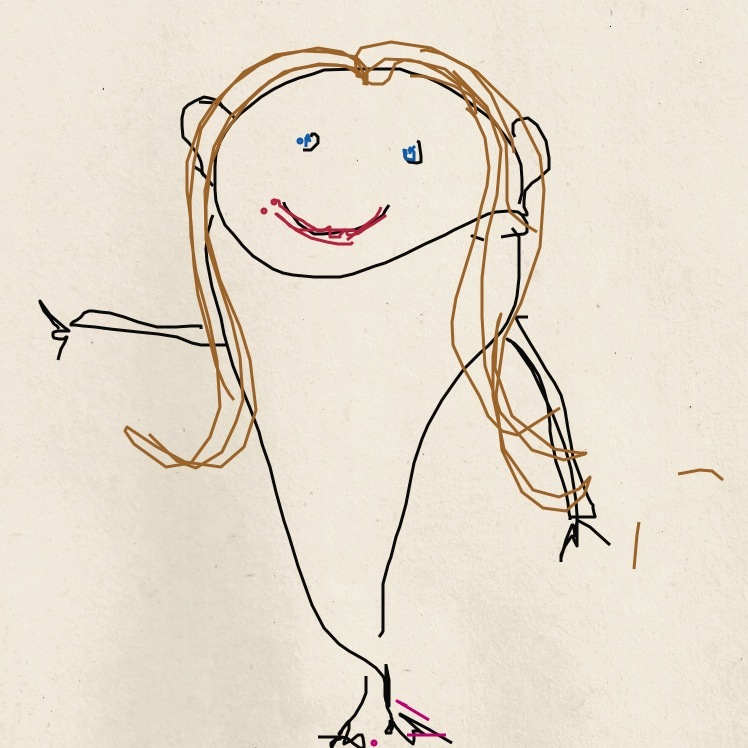
Em’s “self-portrait” – 2011
It Begins With My Father

Emma – This morning


Yesterday’s post inspired more thought.  I have often asked myself why?

Why did I believe all those specialists, doctors and “Autism experts,” particularly as I have always been so wary of authority figures?  Why didn’t I question the specialists, why did I engage in a war for so long?  Why wasn’t I one of the parents who saw through the autism = tragedy model?  I have always been somewhat of a rebel, what happened to that rebellious streak?

The answer begins with my father.

My father had a horse back riding accident when I was nine years old.  He was just shy of his 50th birthday.   It was a Wednesday.  I was home sick with the flu.  For years afterward I blamed myself for his accident.  If I had put up a bigger fuss, maybe he wouldn’t have left.  If only I’d been sicker he would have stayed home with me.  If only I had begged him to read another chapter from the incomprehensible book he’d been reading to me, if only, if only…  But that wasn’t what happened.  He left.  He did not come back as promised.

The next few weeks are a blur of images and sensations.  Sounds of my mother crying behind her bedroom door.   My grandmother arriving in a dramatic swirl of lavender and rose perfume and silk, her hair perfectly brushed, the grey curls delicately framing her beautiful features, her gnarled, arthritic, fingers turning the pages to one of my school books as she helped me with my homework.  The afternoon I yelled, “I hate you” to my mother who dropped the rolls of toilet paper she was carrying to the floor.  Her receding figure disappearing behind the door to her bedroom, their bedroom, now half empty.  The rolls of toilet paper, partially unfurled, lay in disarray at my feet.  My fury, shame, and horror, tangled and confused, waiting for an acknowledgment I was incapable of giving, instead I stormed into my bedroom and kicked the drawers of my bureau, leaving the mess on the floor in the hallway for someone else to pick up.  My feelings, I learned much later, were not as easily left behind.

Visits to the hospital.  Doctors in white coats, clipboards, a red light next to my father’s bed, the beeping emanating from a monitor overhead, his life reduced to one thin jagged line on a screen.  The needles inserted into his veins, pumping clear liquid contained in bags held by poles and hooks into his damaged, broken body.   The nurse who crackled as she moved, her shoes squeaked as she approached.  The smell.  That horrible, unmistakable, antiseptic smell that burned my nostrils and pulled at my stomach, making me worry I might vomit.  The emotionless, grave, tones used by the doctors, carefully offering opinions as though they were a given, as though fact.  The statements, each a warning, a flag being hoisted up the mast of hopelessness –  “He may not make it.”  “He may be paralyzed for the rest of his life.”  “He will never walk again.”  Each pronouncement proven wrong.  Each learned statement shown up for what it really was, nothing more than a thought.

My father confounded them all.  He, alone, it seemed to me at the time, had risen up from the dead, shown them their stupidity.  He was underestimated time and time again.  For decades, through sheer force of will, determination and hard work, he showed the medical profession, and me, what was possible.   And yet, even my father eventually succumbed to a wheelchair the final decade of his life.  I saw first hand the prejudices, the attitudes of people who came into contact with him. And while his was also a disability, it was of a very different kind from autism.  He and by extension, I, never “accepted” it.  His neurology was unaffected as his legs gave out.  He needed support, yet proudly refused help.  When he died, “his” doctor refused to come to the house, saying my father was no longer under his care because he hadn’t been to see him in so many years.  We were forced to call 911.  My father had no respect for the medical profession.  He had proven them wrong.  His life was a testament to that.  He believed in self reliance.  He believed in himself.

When we were given Emma’s diagnosis, without thinking, I knew what I had to do.  I, too, would confound all the naysayers, those who said, nothing could be done.  Those who grimly wrote evaluations, itemizing my daughters deficits with matter of fact, clinical words.  Her vibrant personality reduced to a critique, her intelligence, not applicable, not even a number as she was deemed impossible to test.  I would show them, just as my father had.  It was the beginning.  I didn’t know it at the time.  I didn’t realize I had chosen the wrong road to go down.  I didn’t see that my initial, knee jerk reaction to her diagnosis was correct after all.  The word “autism” wasn’t what was wrong.  It was the information and interpretation of what that word meant that was wrong.   If you’d told me this at the time, I would have responded in rage.  I would have told you, you were wrong.  I would have told you I could save her from the diagnosis, when what I needed to do was save her from the misperceptions surrounding the diagnosis.

Related articles

Joe Scarborough’s Ignorance And What It Means To The American Public

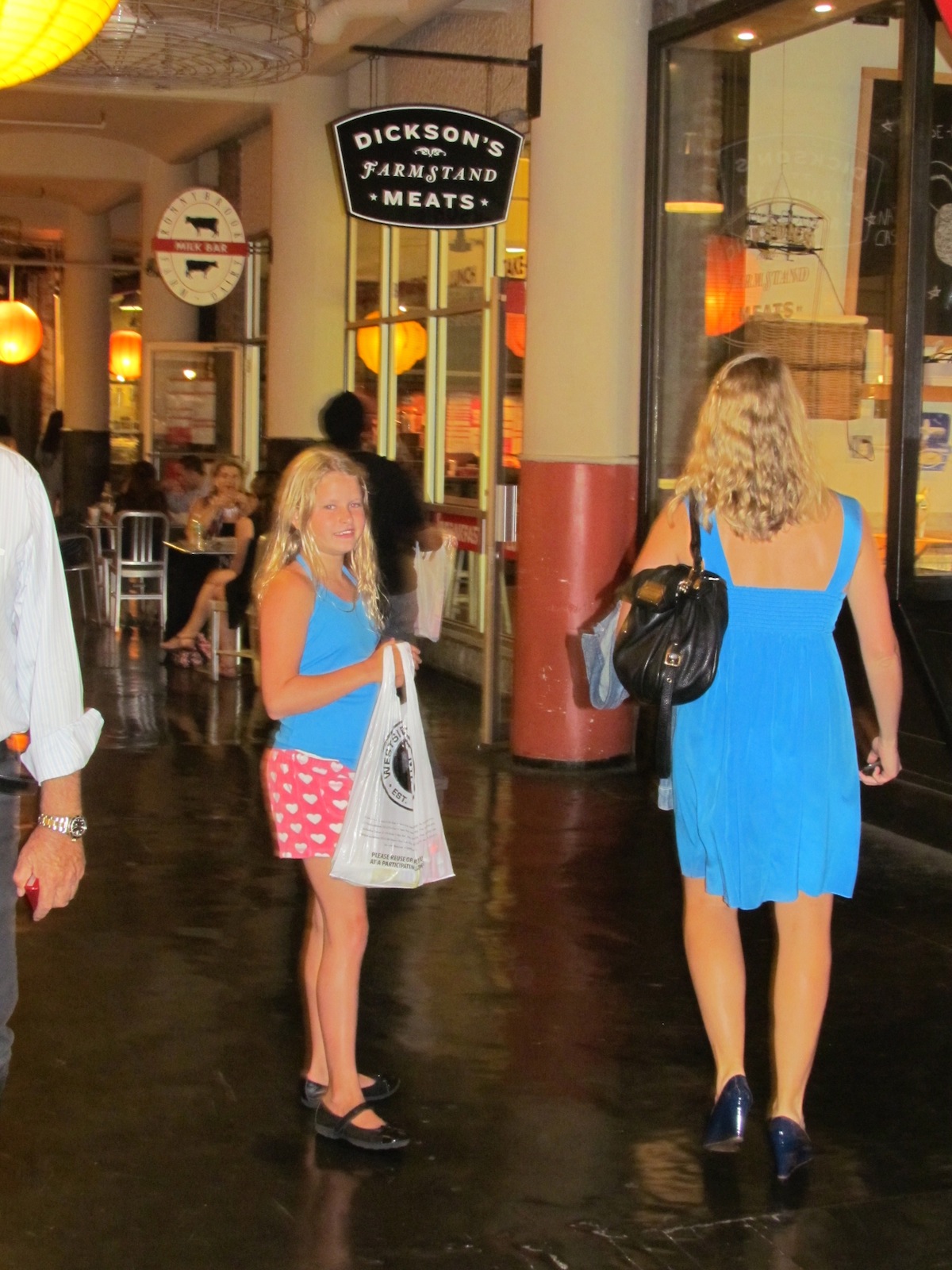
I wanted to write about how Richard came home yesterday (Yay!) and how we took Emma to the Chelsea Market and how she insisted on wearing a pair of black patent leather shoes, turquoise tank top and pink terry cloth shorts with white hearts.  I wanted to post a couple of photos of her so you could see for yourself how great she looks, but when I sat down to write I knew I had to write about something else.

I don’t want to talk about Joe Scarborough any more.  Yet his unfortunate, ridiculous, careless and ignorant remarks, make it impossible not to mention him, because he has a huge following, because people imagine he knows something about Autism.  Joe Scarborough’s remarks are indicative of a larger issue – ignorance and misinformation, which leads to opinions and a general consensus about Autism that is incorrect.  One such commenter on an article about Joe Scarborough’s remarks, said he believed Joe Scarborough knew more about autism than he did because he has a son who is Autistic.  And that is exactly why this is about more than just some asshole with a radio show.  There are countless people spewing all kinds of venom on the radio and everywhere else.  Much of it is dismissed.  But when someone, whether it’s a pseudo celebrity or a talk show host with a large following says they have a child on the spectrum ears perk up.  Forget that AUTISTICS are talking about what it’s like to be autistic ALL THE TIME and their words are almost never in accordance with what that parent with an Autistic child is saying.

So just to reiterate:

Autism is NOT a “mental health” issue.  It is neurological, neither good nor bad, just DIFFERENT.

Joe Scarborough, (I know, there’s his name again) said in a statement he made yesterday, which was neither apologetic nor a retraction from his original inflammatory comments, “I look forward to continuing my work with wonderful organizations like Autism Speaks to provide badly needed support to millions of Americans who struggle with Autism every day.”

Autism Speaks does NOT provide badly needed support to Autistics.  In fact Autism Speaks is uniformly HATED by a massive number of Autistics who speak to that fact on a daily basis.  If you google “Autistics who hate Autism Speaks” you will see more than a dozen pages of links addressing why this is so.  (Really, I just googled it.)

While I’m at it, let’s dispel a couple more myths, something Autistics are doing ALL the time on their blogs.

Autistic people are not inherently violent.

Autistic people do not LACK empathy.

Autistic people are not all loners sitting in a corner banging their heads against the wall  (That would better describe me right about now)  until they can no longer take it and go on a murderous rampage.

Autistic people are not all depressed and friendless.

I’m depressed right now.  But this isn’t about me, or how I feel, or anything else that contains the word, me or I.  This is about prejudices and prejudices are always negative, reinforced by ignorance, ingested by those who believe they are being told the truth by someone who is more knowledgable than they are about something they know nothing about.  This is how it works.  This is how it has always worked throughout history, the demonization of a group of people whose voices are drowned out by the larger roar of ignorance and stupidity.

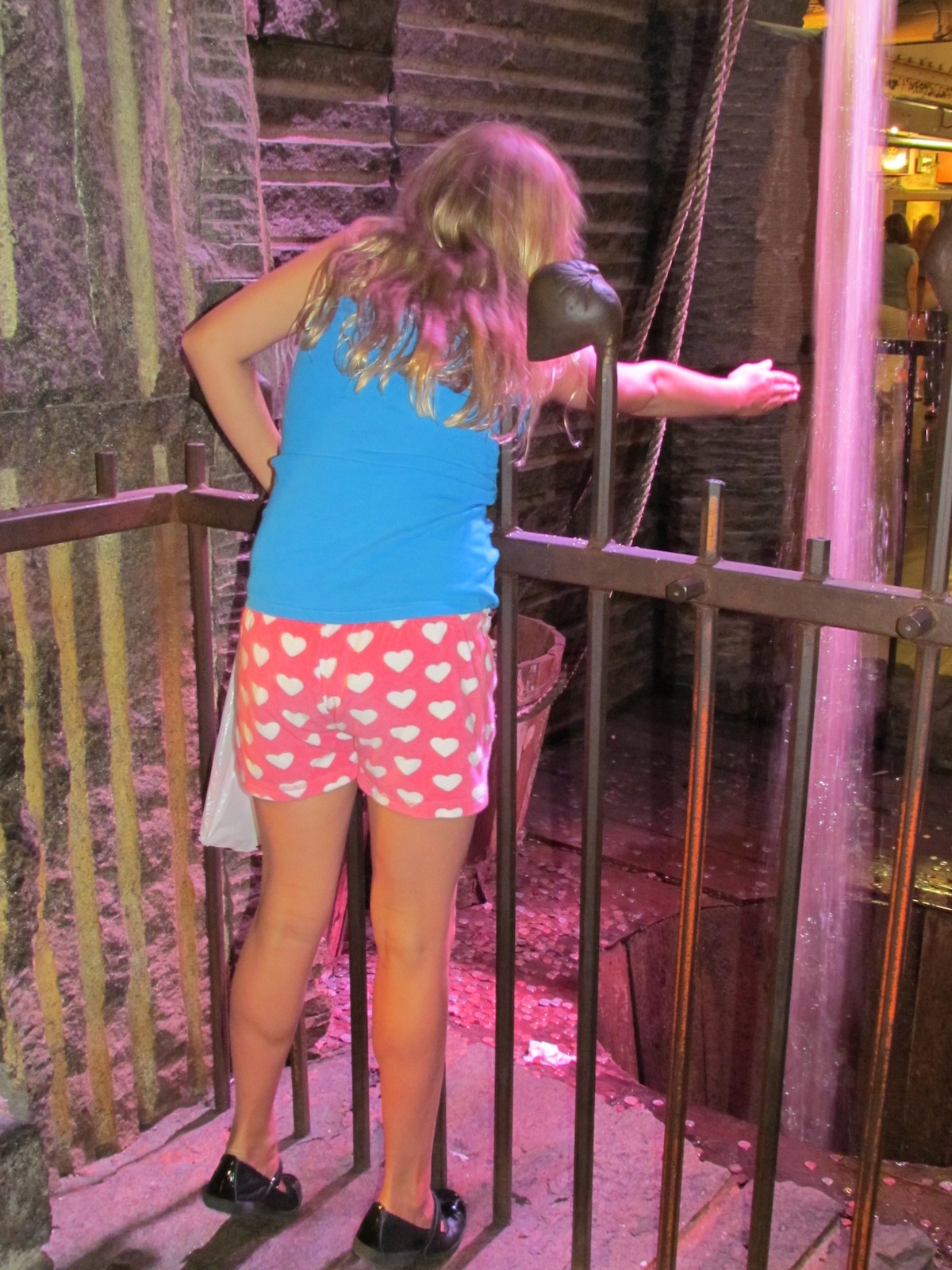
I refuse to end on this note, however.  So here.  Here are a couple of photos of Emma in the outfit she threw on to go to Chelsea Market yesterday evening.  Because Em is one more example of what Autism looks like.  Emma is inherently HAPPY.  Emma is inherently SOCIAL.  Emma is inherently KIND.  Emma is inherently EMPATHIC.  I’m trying really hard to follow her lead.

This is Autism.  This is Emma.

Loved that as I took this photo a woman wearing black patent leather pumps and turquoise dress walked toward her!

“I can’t reach!”

Related articles

Another Mom’s Comment

This comment from the “On Engagement” post was so beautiful I wanted to share it.  Her daughter is also named Emma.

“I love your Utopian world. I wish it existed. I avoid going to events sometimes because I just don’t want to have to have Emma deal with the looks, or me at times. Her tantrums are nothing like that of a two year old either. She is eight, and carrying an eight year old out of a store spitting and biting and screaming in a piercing , gut wrenching manner gets many looks. One time Emma lost it in a fabric store. I should have known better because it is overstimulating. She loves textures, but does horrible in overstimulating environments. Anyway, it ended abruptly when I had to take her screaming and kicking out of the store. I held onto her for dear life, wishing I had parked closer, hoping no one would see me. I almost accomplished this endeavor when a woman started approaching me as I was desperately getting Emma to buckle her seat belt. I was sure she was coming over to tell me what a horrible mom I was, how social services should be called on me because it felt so violent as I held onto Emma and I imagined it looked violent as well. But instead, she came over and asked if she could hug me. She told me her son was autistic and has been a participant in much worse tantrums and just wanted me to know I was loved. I felt an angel had been sent to me. What a world of difference it would make if people were less worried about judging others and more concerned about helping others. A smile to a parent that is in need can make such a difference. We are all mothers, or daughters, or fathers, or sons. That is something that binds us all. Why not honor that in our daily encounters and help a struggling parent, not shun her, and refrain from assuming.”

Happy Thanksgiving!

For more on autism and Emma’s journey through a childhood of it, go to:   www.Emma’s Hope Book.com

Tolerance, Despair and Hope – Autism

A follower of this blog emailed me this morning about a new app for the ipad called, Pop It.  It’s a “book” that when one shakes the ipad, the perspective of the story changes.  The creator, an artist named Raghava, gave a talk on Ted.com, which is terrific – about perspective and tolerance of others and the role of art and creativity.  Listening to Raghava made me think of a book I am currently reading by the extremely talented and insightful theologian, James H. Cone.  His book – The Cross and the Lynching Tree is a deeply touching and powerful investigation of suffering and hope.  James Cone writes at length about the nature of faith, how God “could make a way out of no way”, how “hope could remain alive in the world of Jim Crow segregation.”

I do not claim to know of the existence, nor can I claim to know of the non-existence of a god.  I cannot even define that word.  It is not a word that holds any meaning for me.  But I do know what it is to struggle with hope.  Hope for Emma, hope for all our children who will grow up to become adults, who many will fear, ignore or just wish would go away.  Our children with autism are often misunderstood, in their inability to fall into line with societal norms they are in turn rejected by society.  The continued negligence and worse, abuse, of people with disabilities is rampant.  Their abuse is done by people who have deemed them incompetent, imbeciles and without value.  This is the common thread that exists in the abuse of all groups of people throughout history.  It is our intolerance of those we believe to be “less than” that makes us believe we have the “right” to punish, shun, ignore, hurt, torture and kill.

James Cone writes:  “The cross is a paradoxical religious symbol because it inverts the world’s value system with the news that hope comes by way of defeat, that suffering and death do not have the last word, that the last shall be first and the first last.”

When I was in my late teens I began using food as a way to quell anxiety and emotions I felt incapable of dealing with.  My overeating turned to full blown bulimia and the bulimia became a way of life – for 22 years.  I remember when I finally stopped, the idea of “surrender” seemed antithetical to all I had, up to that point, believed.  I thought that if I just had more will power I would be able to stop the destructive behavior.  I believed that the bulimia was something I could control.  I believed that my lack of control simply proved how despicable I was, which only served to fuel more of the same behavior.  It wasn’t until I took a leap of faith – really took in that I was, in fact, out of control, that I received a respite from the behavior.  Early in my “recovery” from bulimia someone said to me, “don’t you think that if you could have controlled the bulimia, you would have by now?  Isn’t it true that in fact you have tried to control it all these years and this is where that control has gotten you?”  With a great deal of support from others who had eating disorders and had come out the other side, was I finally able to find a way out from under it.  In surrendering to the fact that I was unable to control it, was I finally able to find freedom from it.

I’m all over the map with this post, but perhaps some of these thoughts will prove helpful to someone else or if not at least encourage thought and conversation.

For more on Emma and our journey through her childhood of autism, go to:   www.EmmasHopeBook.com

Labels – Autism

Labels are easy, they’re shorthand for what we want to communicate and yet they often obscure what is really being said.  (These are the things I think about when I’m away from my family for an extended period of time, as I have been, since coming out to Aspen because of work. All of this reflection will end in another four days, because the children and Richard will be joining me out here this Sunday – Hurray!)

We say things like – “oh he’s schizophrenic,” “she’s bi-polar,” “she’s anorexic,” “he’s an alcoholic” and the meaning gets conveyed and yet, is it?  After all that’s not ALL the person is.  It’s something they have been diagnosed with, perhaps are struggling with,  it’s a medical term, but it does not encompass who and what that person is in their entirety.  When I hear someone describe another person as “autistic” I understand that person has been given a diagnosis of autism, but I don’t presume to know much more about that person.  For example, I won’t know if this particular person diagnosed with autism can speak, read or write, they may have other issues, physical issues, other diagnoses added on to further illuminate, but the labels begin to overwhelm the actual person.  I can’t know from the various labels whether the person has a sense of humor, if they have terrific eye contact or no eye contact, whether they cringe at physical contact or whether they seek it.  The word “autistic” does not give me any clues as to whether the person is gregarious or shy, enjoys reading about painting or knows everything there is to know about quantum physics.  The label does not tell me about the person’s passions, dreams, desires or talents.  If I knew nothing about autism, having someone described to me as such might cause me to presume a great many things.  Things I would be completely wrong in assuming.

In my daughter, Emma’s case, the labels are almost always unhelpful.  I use them, it is shorthand after all, but they reduce her to something that doesn’t help people know her or understand her.  For example, Emma has a terrific sense of humor, she loves playing jokes, being silly, making faces, repeating things in a way that will guarantee a laugh.  When I use the word autism, or say to someone – she has autism – it’s the best I can do in a short period of time.  It’s a little like when we say to one another – “How are you today?”  The answer we all know to give is:  “I’m fine, how are you.”  Even if we aren’t fine.  Can you imagine if you asked that seemingly innocuous question and the response was:  “You better take a seat, this may take some time.”

I avoid using the word “autistic” because it implies more to me, than saying “she has autism.”   It’s a subtle distinction, but to me, anyway, it’s there.  Emma is so much more than a diagnosis.  She is pure Emma. And Emma is complex, just like the rest of us.  She is funny, a talented singer with a beautiful voice, she has a personality and temperament that are unique to her.  She loves to run and swim and swing her arms and zip around on her scooter.  She enjoys being read to, sung to, and any game that involves running.  I dislike that her diagnosis takes up so much room in people’s minds.  I do not like that when people hear she’s “autistic” they make assumptions about her, almost always incorrect.

Can you imagine what the world would be like, if all of us took all these labels, our shorthand for communicating and tossed them out the window?  We would live in a world, which would make prejudice and judgements much more difficult to come by.  We would have to live in the discomfort of not knowing.  But what a great way to live!

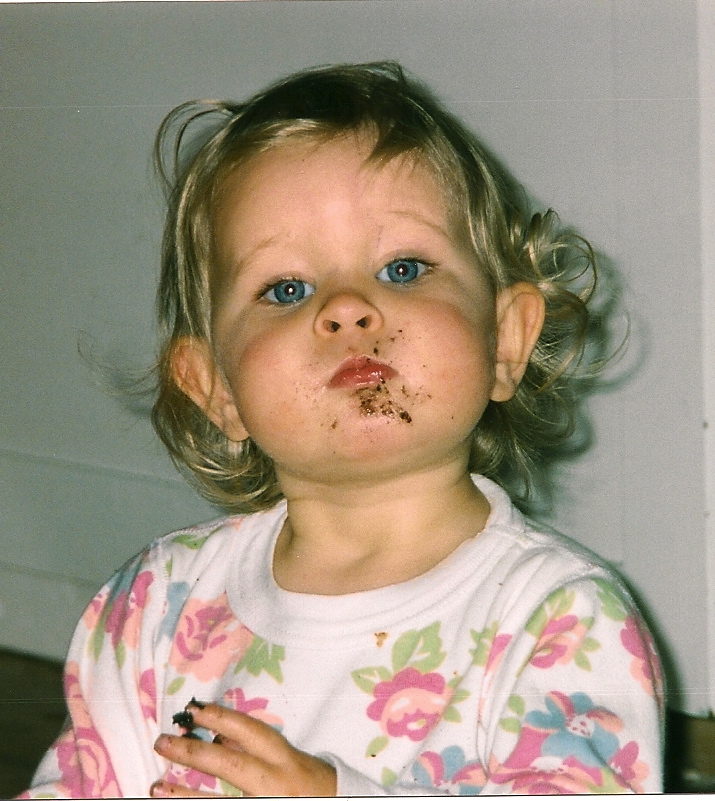
Emma – 13 months – eating a brownie.

For more on Emma’s journey through a childhood of autism, go to:  www.EmmasHopeBook.com