Tag Archives: Parenting

Sliver Abilities in Autism

The other day while waiting for Emma’s bus we sat together.  Emma recounted, as she often does, what she planned to do that day and what she looked forward to in the days ahead.  “Get on school bus, Becky’s class, Joe, see Mommy, sleep, wake up, sleep, wake up, sleep wake up, sleep, wake up, Throwback Sports, sleep, wake up, make pancakes!”

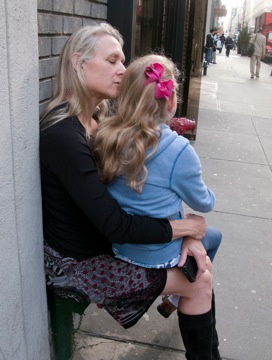
Our neighbor took this photograph of me and Em waiting for her school bus.
I’m always astonished that Emma almost always gets the right number of “sleep, wake ups” before she can have pancakes on the weekend.  I have even seen her count on her fingers, making me wonder whether we shouldn’t start implementing a math program – if I can find one – as it’s clear she is counting and figuring out how many times she’ll sleep and then wake up before Saturday morning.

Much has been said about autism and “sliver” abilities, the sorts of things autistic children seem to be able to do at age level or above while most other things lag far behind.  I am not referring to the much publicized, but rare, savants.  I’m talking about the abilities many autistic children have that surprise us, their parents.  In Emma’s case it is her unbelievably accurate memory for people, places and things.  She will talk about a preschool teacher she had when she was three and she has an uncanny ability to know when a favored object or photograph is missing.  She seems to know immediately that not only a photograph is missing, but she knows which one with a glance at the pile of over 200 photographs.  I have no idea how this is even possible.

“Carousel photo?”  Emma will cry.

“But Em, here’s the photo.  Look!  There’s you and…”

“No!  Other one!” She’ll cry in frustration.

We no longer doubt her.  I cannot remember Emma ever being wrong about a missing photograph from her box of photos.  She keeps them in a box the size of a shoe box and there are over two hundred photographs.

I am constantly amazed with Emma’s mind.  It can retain massive amounts of information and yet I still must remind her that she needs to dry her body off when she gets out of the shower.
“Okay, Em.  Now get a towel.  You have to dry your arms and legs.  Now dry your stomach and back,” I will say.

What has become clear to me is that Emma’s mind is not something I can predict.  I cannot assume she will know how to do something – rinse her hair after she puts shampoo in it – while at the same time I cannot not assume anything either.

“Mona Lisa!”  Emma said, pointing to a book with the portrait of the Mona Lisa on the cover.

“Yeah, Em.  That’s right.  Who painted it?”

“Leonardo,” Emma answered happily.

“What’s his last name?” I asked.

“Vincy” She said.

“That’s right Em.  His name was Leonardo Da Vinci.”

When we were at MOMA a few years ago, Emma astonished all of us when she pointed to a painting and said, “Picasso!  Man with Guitar.”

Just around the time Emma was diagnosed I showed Emma a book on famous painters and their paintings.  Over six years later she still could remember them.

For more on Emma’s “splinter abilities” and her journey through a childhood of autism go to:  www.EmmasHopeBook.com

How We Communicate

Recently someone commented on the “I Believe” post.  She wrote:  “She is communicationg to you, she communicates to you ever day. With her body language, with her expression, with her unusual use of language.”

I loved receiving this comment (I love receiving all the comments people have sent over the past year, they are always informative, interesting and often provocative), which adds to the earlier discussion in the post “Embrace-ness-ness” regarding how we view intelligence in non-verbal people and what that means.

As I have mentioned before, my father spent the last 15 years of his life in a wheelchair and though he was cognitively unimpaired, he was treated differently, almost as though people thought his brain had somehow been damaged too.  His accident and disability profoundly altered my view of the world.  I came to see first hand the pain and suffering caused by people’s responses and misunderstandings of his disability.

When we are out in public with Emma, she is a free spirit.  I have never seen her look in judgement at another human being, no matter how deranged they may appear.  Emma will sit next to a homeless person on the subway without a second thought.  If someone smiles at her, she will smile back.  Emma is without malice.  She is utterly void of judgement.  And yet, I see the looks of fear and confusion on the faces of those who see her and do not understand what they are seeing.  I see how their eyes watch her and then move to us, trying to find a clue as to why this child is behaving so oddly.  Many times people assume she is behaving as she is because of our parenting or lack of parenting.  We have been given well meaning advice from countless strangers over the years, people who feel they are, no doubt, helping us.  Yet, if we tell them she is autistic, this explanation is rarely met with understanding.

Autism is an almost meaningless word, at this point.  It covers such a vast array of behaviors and issues, it is no wonder people feel confused.  Many people know someone who is autistic and assume all autistic people must share the characteristics of that person.  This could not be farther from the truth however.  There are people who are verbal, non-verbal, semi verbal, highly verbal, but echolaic, verbal with perseverative tendencies, etc.  Some people who have received the autism diagnosis are highly functional, go on to have successful careers, excel in their chosen fields, others maintain jobs, never missing a day of work, while others cannot hold a job and will need assistance for the rest of their lives.  Meeting one person with autism is like meeting one person anywhere.  If that person is not able to communicate in a language we know, it doesn’t mean they can’t communicate or do not want to.

We all want to communicate.  Perhaps the single most destructive belief about autism is that those who are diagnosed with it have little desire for human interaction.  Just because they may not be able to communicate their desires in ways we are used to, does not mean the desire doesn’t exist.  If I want to communicate with Emma I just have to spend time with her.  She communicates with me in a wide variety of ways constantly.

Emma with her beloved balloon string – recovered from the laundry hamper.

For more on Emma’s balloon string and her journey through a childhood of autism go to:  www.EmmasHopeBook.com

Emma’s Handwriting

As those of you who follow this blog know, Joe (click on “Joe” to read an entire post devoted to him regarding his tireless efforts and hard work with our daughter, Emma) and I have been working diligently with Emma on her reading and writing skills and comprehension.  So when she requested Sunday morning to “go to the study room”, I wasn’t particularly surprised.  Just as she inquired however, Nic and his friend Max, who had spent the night, wandered into the kitchen asking for french toast.

“Hang on, Em.  Let me make the boys breakfast and then we’ll do study room,” I said.

“Study room now?”  Emma replied.

“Would you like to write something?” I asked pulling a pad of writing paper out.

“Yes.” Emma said, much to my surprise as handwriting is by far the most challenging aspect of the literacy program we’ve implemented for Emma.

“Okay.  Here.  Go ahead while I make breakfast.”  As I began the preparations for french toast I could see Emma at the dining room table writing.  I quelled the urge to go over and look.

After a few minutes Emma said, “Good job drawing hand!”

I went over to see and saw that above the drawing of her left hand she had written, “This a kid”.

What was remarkable about this was that she came up with this sentence on her own, did not copy it from anywhere, initiated the whole thing, used an upper case “T” to begin the sentence and other than the absence of the “is” and a period at the end, wrote a complete, grammatically correct sentence.  This is not a child who is learning their alphabet, this is a child who is reading and writing.  It was breathtakingly exciting.

“Good drawing hand!” Emma said when she saw me staring down at her work.

“Em!  You wrote – This a kid – that’s fantastic!” I answered.  “Look, you just forgot the is,” I said pointing to the space between this and a.  It’s fantastic!  And this has is in it, so it’s easy to forget.”

“Yeah!” Emma said, smiling broadly.

“I love how you wrote that, Em.  It’s so great!” I said staring at her handwriting and feeling tremendous pride.

“You writing,” Emma said.

“You have to say – I’m writing,” I told her.

“I’m writing,” she said.

“Hey, let’s write – This is a hand,” I said while writing the words to the right of her hand drawing.  “Now you write – hand,” I instructed.

Emma carefully took the marker and wrote – hand – underneath mine.

“That’s great.  And look, let’s write – Emma’s hand – here,” I said.

“Yeah.  That’s Emma’s hand!” she said, pointing.

“Wow, Em.  This is terrific,” I told her.

“Study room now?” Emma asked.

“Yes!  Let’s do your study room now,” I said.  “But first let’s write – This is a kid – again.”

Very methodically Emma took a separate piece of paper and wrote – This is a kid.  Then she reached over and made the toy kid sit on the edge of the page.

“Em, I’m so proud of you,” I told her.

“Emma’s writing!” Emma said, happily.

“I’m writing.  You say – I’m writing,” I said.

“I’m writing!”  Emma repeated.

Yes, she is.

For more on Emma’s journey through a childhood of autism go to:  EmmasHopeBook.com

Clothing Autism

This morning I asked Emma, “Do you want to wear pants or a dress to school today?”

“Pretty dress,” Emma said without hesitation.

“Okay.  Which one?” I pulled two dresses out for her to choose from.

“Other one?”  Emma said-asked.  “This one?”   She pulled at her red and white print skirt she’d worn just the day before.

“No.  How about picking a different one.  You just wore that one,” I said, wondering if I should let her wear it again.  After all I wear a uniform of sorts to my studio most days – a pair of jeans and t-shirt of some kind.  Her skirt had been washed and ironed, there was no reason why she couldn’t wear it twice in one week.  Nic wears a school uniform to school everyday and I must admit it makes life easy.

When Emma was first diagnosed I became aware of how I was dressing her with painstaking care each morning.  It was as though I were trying to cloak her autism in pretty dresses, making sure her hair was neatly braided with different colored ribbons.  As she grew older I became less fastidious about her clothing, but I am still aware of my complicated feelings when I see her wearing some bizarre outfit of her own choosing.  Often when a caregiver has let her choose what she wants with no editing.  Socks worn with crocs, leggings that are too small, now resembling capris, the two inch gap of skin between pant and sock, the t-shirt in some color, ill-matched with the rest of the outfit.  I inwardly cringe and I admonish myself for being so shallow.  I just want her to fit in and when she’s dressed in such a way that only seems to advertise loudly how different she is, it breaks my heart.  Still I do my best to temper those feelings.

“You rarely get the chance to be frivolous,” a friend of mine said the other day.

“But it’s ridiculous.  I know,” I answered.

Once when I brought the subject up to my husband, Richard, he replied, “But people do respond differently to her when she’s wearing a pretty dress.”

And he’s right they do.  They tell her how pretty she looks and she smiles and twirls around.  I know it really is absurd, but I want people to be kind to her.  I want people to smile at her and they do when she’s dressed nicely.  I know how silly all of this sounds.  I know this isn’t going to help her autism.  I know I’m talking about something as idiotic as how she appears and has nothing to do with substance, but I also know that people react to her in a more complimentary way.

“Please don’t ever let her wear a velour track suit,” I begged Richard before leaving on a trip a few months ago.

“I love velour!”  Richard said.

“Well of course you do, just don’t let her wear one, okay?”

“She doesn’t own a velour track suit,” he answered, seriously.

“Yeah, but you might feel compelled to buy one while I’m gone,” I said.

“It’s going to be okay, honey.  I think I can handle this,” he said.

And of course he did handle it all beautifully while I was away, just as he always does.

“Okay.  This one,” Emma said, patting at a pretty white, turquoise and orange skirt.

“Oh that’s perfect!” I said, pulling it out of the closet.

“It’s perfect!” Emma repeated, bouncing up and down on the bed.

For more on Emma’s journey through a childhood of autism go to:  www.EmmasHopeBook.com
An Easter Birthday Party

To Emma a party is a birthday party, no matter what we say to explain that this is not the case in every circumstance.  Yesterday was no different.  When Emma saw me pulling out the linen table cloth and setting the table for our Easter (or as we like to refer to it – Welcome to Spring) party she said, “It’s a birthday party!”

“No Em, it’s an easter party,” Richard said.

“Birthday party,” Emma insisted.

“Today is Easter.  We’re having a dinner party for Easter,” Richard explained.

“Easter birthday party!” Emma said, jumping up and down.

“Not a birthday party, just Easter,” Richard patiently corrected her.

Not easily swayed, Emma cheerfully said again, “Easter birthday party!”

“Whatever Dad,” Nic said, accompanied by the one-two punch that apparently afflicts all tweens – shrugging his shoulders and rolling his eyes.

“Hey Em, sometimes we have a party and it’s not for anyone’s birthday…” I began.

“Christmas,” Richard interjected.

“Thanksgiving,” I added.

“Valentines Day, no wait that’s Daddy’s birthday,” I said, catching myself and realizing this was only going to confuse the situation.

“Birthday party,” Emma chimed in.

“Except no one is having a birthday tonight.  We’re having people over just because it’s fun.”

At this point Emma wandered off, probably feeling we’d exhausted the subject.  A little later she returned to survey the cooking and, since I’d made cupcakes for her and Nic and his friend, knowing they probably wouldn’t eat the meringue & apricot extravaganza I’d made for the rest of us, to lick the icing.

As though to prove her point she said, pointing to the purple, blue and green frosting, “Yum!  Birthday cake,” Emma said.

“Easter cupcakes,” I said.

“For Easter,” Emma said, nodding her head.

“Yes!  That’s right.  For Easter.”

“Easter!” Emma said.  And then as she was walking away she said very quickly and under her breath, “Easter birthday party!”

For more on Emma’s journey through a childhood of autism and an actual birthday party go to:  EmmasHopeBook

Unlocking Emma’s Mind

This morning Emma said, “Play musical chairs!”  Then proceeded to position several dining room chairs in the middle of the room so they had their backs to one another, fanning out in a kind of lopsided circle.  She turned on some music from her iPod and danced for a minute or two, then hit the pause button and yelled, “Freeze!”  She ran to the nearest chair and sat down, staying very still for a few seconds before leaping up and turning the music back on.

When I joined in she said, “Mommy dancing!”  Then she began to laugh uncontrollably.

After about twenty minutes I sat down and watched her continue to play by herself.  She looked up at me and smiled, then covered her eyes with one hand.  “Hi Mommy!”  she said, peeking out between two fingers.

“Hi Em.”

“Playing Freeze with Mommy.”

“Yeah do you want me to keep playing?”

“No.  Nicky hurt his toe in Aspen.”

This is typical of Emma to make a sudden leap in thinking or maybe we all do this, but she just verbalizes her train of thought.  Maybe he hurt his toe while they were listening to music, I can’t remember any more.  Maybe it was simply an errant thought.

A specialist said, while being interviewed about autism, that they thought autism was the disregulation of neural pathways.  They went on to speak of the idea that people with autism have trouble communicating and putting into words their thinking.  But that it was the communicating that is troublesome, not the thinking.  I have no way of knowing what Emma is thinking, obviously, unless she tells me and even then it can be difficult figuring out exactly what she is trying to tell me, but I know her mind is very busy.  I can see her processing information, I can watch her and see that she is thinking, I just don’t know about what.

When I work with her on her reading and writing I can see how she is very clearly understanding the words she sees.  She is learning to read.  Yet if I ask her to read the sentence – Here is a truck – it causes her tremendous difficulty.  I know she can read it because she knows each word when shown by itself.  Yet put it into a sentence and it confuses her.  It’s similar to when she works at the computer.  She seems to have an easier time typing words and identifying words when she’s on the computer than if she’s asked to write those same words by hand.

When I read about autistic children who suddenly begin to type out full comprehensive sentences, it seems like magic.  Usually these same children have displayed nothing to indicate to their caregivers that they can read, let alone spell.  Yet there are numerous cases of children communicating through typing who have never been able to communicate before.

The other night I dreamt about Emma.  In my dream she was talking to me, just as any neuro-typical nine-year old child would.  She was telling me “secrets” and in the dream I thought how profound this information was.  She was telling me about what it was like for her and answering all my questions.  When I woke up the next morning I tried to remember what she’d told me, but I couldn’t.  I kept thinking if I just relaxed I would remember, as though she really had told me, as though it hadn’t been a dream, as though for a brief moment I had the answers, the key to unlocking her mind.

Every time I work with her on the computer I have a tiny hope that she’ll suddenly write something on her own, something that we aren’t working on.  Like magic, she’ll write a sentence that let’s me in on her thinking and her mind.  And each session when she doesn’t do that, I think – it’s okay, maybe next time.

For now, I have a game of musical chairs waiting for me.

For more on Emma’s journey through a childhood of autism and to hear her sing go to:  EmmasHopeBook

Piggyback Rides and Bats

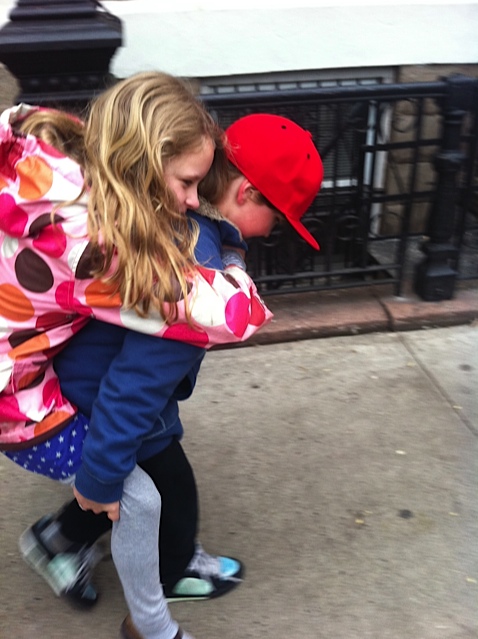
The other day Emma said to me, “Give piggy back ride?”  Then she leapt from the couch where she was balancing herself into my arms.

“Em!  You’re heavy!”  I said.

“I feel your pain, Mom,” Nic said to me.

“You do?”

“Yeah, she did that to me the other day,” he said.

“You’re kidding?  How did you carry her?” I asked.

Nic laughed.  “It was tough, Mom.  It was tough,” he said, shaking his head as he left the room.

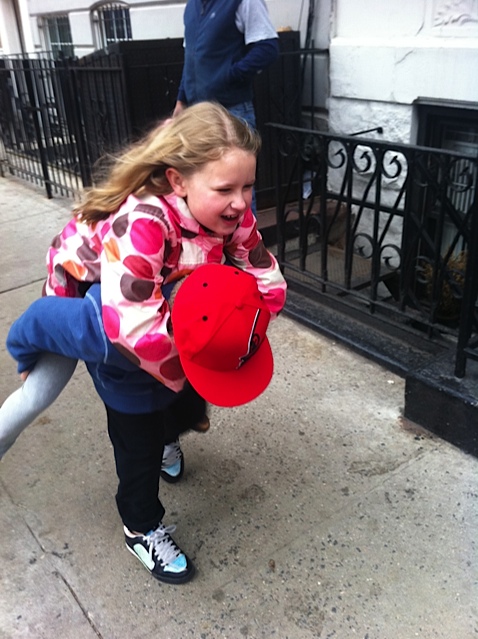
Later Geneva, one of our wonderful caregivers, confirmed that Nic had given Emma a piggy back ride.  Here are the photos she took documenting it.


Last night Emma said to me, “I’m going to fly and bite you!”  Then she ran over to me and bit my cheek.

“Ouch!  Em you just bit me!”  I said.

“A bat, fly and bite you!”  Emma said, laughing.

“Are you a bat?”

“Yes!  Don’t bite me!  Fly and bite you!” she said coming close again.

“No!  Don’t bite me!” I said.

“I’m going to bite you!”

“Ahhhh!!” I yelled running away from her.

It’s always difficult to know whether encouraging her to play a game that she might “play” with another child at school, who doesn’t understand that this is a game is a good idea.  And yet, to not encourage her to be playful seems wrong.  Is this an opportunity to discuss biting and how it’s not okay to hurt, how it’s important to be gentle, how this is a game only to be played with me?

With these thoughts in mind I approached Emma, “Hey Em, when you’re pretending to be a bat…” I began.

“You have to be gentle,” she interrupted me.

“Yes!  You have to be gentle.  And you can only play this game with me, okay?”

“Yes.  Just with Mommy,” she said, nodding her head.  Then she pointed to my cheek and said, “I don’t mean to hurt you.”

“And you didn’t…” I started to say.

“You have to be gentle,” she added.

“That’s right Em.  You have to be so gentle and you can only play this game with me.  You know that, right?”

“Yes.  Just with Mommy,” she said pointing to me.   “Now play – Don’t say Mommy!”

“Okay.  One game of Don’t-say-Mommy,” I agreed.

With which she put her face up into mine and said, “Don’t…  say… Mommy!” and then ran out of the room with me following close behind.

For more on Emma’s journey through a childhood of autism go to:  EmmasHopeBook.

Nic’s Birthday

Emma has very specific ideas about birthdays.  The best birthday, in Emma’s opinion, is one that takes place at one of the many kid’s gyms here in New York City and is followed by a birthday cake or cupcakes with candles and Happy Birthday sung loudly.

However, today is Nic’s birthday and it’s hard for Emma to understand that he did not choose to celebrate it at one of the gyms Emma so adores.

“Hey Em, it’s Nic’s birthday today,” I said early this morning.

“Birthday at Elite gymnastics!”  Emma replied.

“No, Nic isn’t going to celebrate his birthday there,” I told her.

“Birthday at other gymnastics!”  Emma said bouncing up and down.

“No.  Nic didn’t want to celebrate his birthday at a gym,” I said.

“Different gymnastics,” Emma said, trying to process this information.

“Well no.  Not any gymnastics.”

Emma was silent.

“Is there anything you want to know or say about Nic’s birthday today?” I asked.

“Yes,” Emma said.

“Okay.  What?”

“Happy Birthday Nicky!”

“Ah, that’s so nice of you, Em.  Let’s go tell him,” I held out my hand.  Emma took it and went over to Nic who was charging his new video game controller.

Emma leaned into his face and said, “Happy Birthday Nicky-Nic!”

“Hey, thanks Emma.  That’s really nice of you,” he said, putting his arm around her.

Then she gave him a kiss on the cheek.

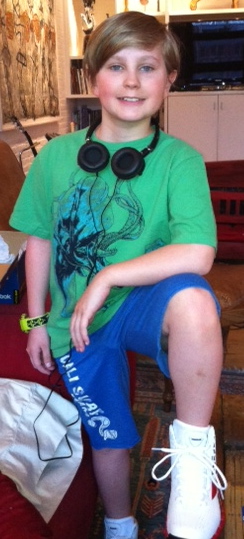
Happy Birthday Nic!

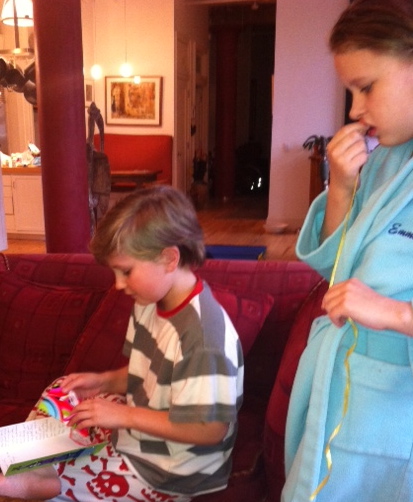
Emma looks on as Nic reads a birthday card and opens presents.

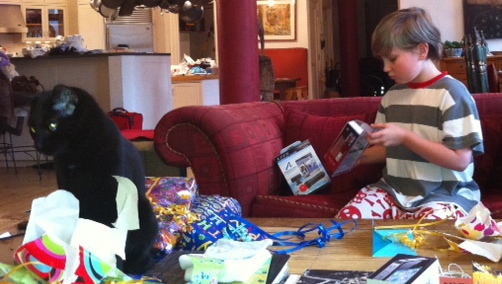
Merlin amidst wrapping paper

Nic shows off his birthday haul.

Happy Birthday Nic!

For more on Emma and her journey through a childhood of autism go to:  EmmasHopeBook

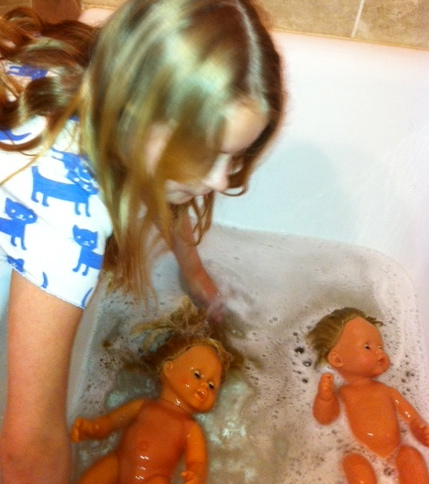
Emma’s Dolls Get A Bath

Two nights ago as Nic was helping me clean the dishes, I heard the sound of water running in Emma’s bathroom.  “Hey Nic, hang on a second.  I want to see what Emmy’s doing.”

Nic held out his hand for the scrub brush so that he could take over.

As I rounded the corner I could hear Emma singing.

“Hi Em.  What are you doing?”  I asked surveying the scene.

“Mommy go away!”  Emma said.

This is what Emma says when she thinks she may be doing something we might object to.

“Em!  You’re giving your dolls a bath!”  I said.

“Mommy go away, go away!”  Emma said while trying to close the bathroom door with her foot.

“Okay, don’t worry Em.  I’m gong to go finish the dishes with Nic.  But can I come back a little later?”

“Yes,” Emma said and closed the door on me.

“What’s she doing, Mom?” Nic asked me when I reappeared.

“She’s giving her dolls a bath,” I said.  “It’s so great!”  When I returned to the bathroom I said, “Em, that is so thoughtful of you to put the rubber ducks in the tub with your dolls!”

“And bubbles,” Nic added.

“Doing great job washing doll’s hair,”  Emma said, nodding her head and reaching for the bottle of shampoo.

“Yeah, you’re doing a great job!”  Nic said.

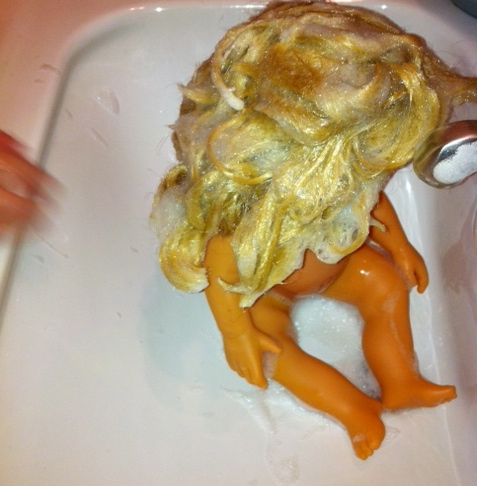
As Nic said this, Emma squirted an enormous amount of shampoo onto each of her doll’s heads.

“Okay, maybe that’s too much,” Nic commented, looking at me with concern.

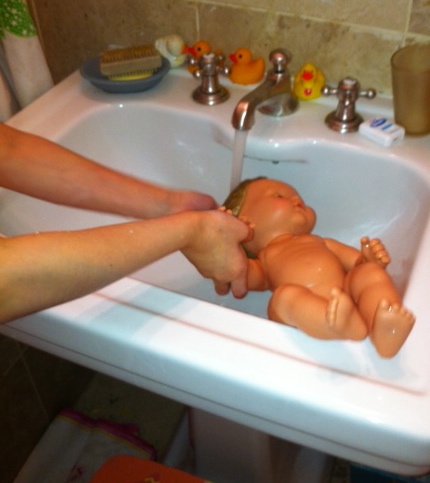
Oblivious, Emma happily massaged the shampoo into each of her doll’s hair and then pulled one of them from the tub and sat her in the sink.  “Have to rinse hair,” she announced as water sprayed from the sink faucet out into the bathroom onto her and her brother.  “Uh-oh!”  Emma said, cheerfully as she struggled out of her now soaked nightgown.

“Oh boy,” Nic said, retreating from the spray.

Emma carefully gathered all the rubber ducks from the bathtub and sat them on the edge of the sink, then rinsed each of her dolls before putting them on a towel on the floor.

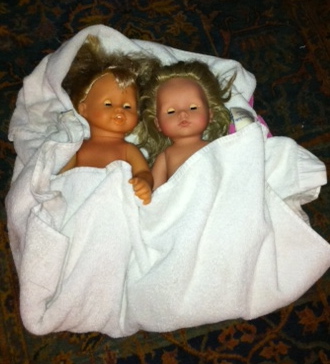
“Dolls all done!”  Emma said, as she wrapped her dolls in several towels.

“Awesome job drying off dolls!”  Emma said.  “Now time for bed,” she added.

I often find myself looking for little clues, the small details in what Emma does as reasons for hope. The washing of her dolls is such a great example, I think, of Emma’s continued development.  That she thought to include the rubber ducks was such a wonderful display of thoughtfulness and pretend play.  Emma still doesn’t cuddle her dolls the way I used to when I was a little girl, but in her own way she is caring for them, giving them a bath, washing their hair, rinsing them off and then drying them, wrapping them in towels before leaving them on the floor.  She has, in the past, put them in bed as well, though she seemed to lose interest before that thought occurred to her.

Emma even remembered to drain the water from the tub before shutting off the light and leaving the bathroom.  Sometimes I think I am clutching at straws, I mean, really what’s the big deal?  So she gave her dolls a bath.  But to me, it is a big deal.  Or I choose to make it one, because really what’s the alternative?  I can find the positive in the things she does, see them as hopeful examples of progress or I can shrug my shoulders and say – So what?

I’ve never been the “so what?” type, so I can’t imagine I’ll start now.

For more on Emma’s journey through a childhood of autism go to:  EmmasHopeBook.

“Mommy Cut Hair”

The other day as I was helping Emma brush her teeth, she said, “Mommy cut hair?”

Which could mean she wanted me to cut her hair or she felt my hair was in need of a trim or she was remembering when I cut her hair a few months ago, it’s hard to say what she actually meant without more information.  “Do you want me to cut your hair Em?” I asked for clarification.

“No?” she said as though it were a question.  “Mommy cut hair?” she said again with the same upward, questioning  tone.

“You want me to get my hair cut?”

“Yes?” she said it as though she wasn’t sure or maybe she was asking me if I agreed with her assessment of my hair needing a trim.

“Really?   Do you think I’m due for a trim?” I asked, looking at our reflections in the bathroom mirror.

“Yes!”

“Really?”  I asked again, not at all sure I was interested in getting my hair cut.

“Yes!  Mommy cut hair like this,” Emma said, reaching over and pulling my hair up so that it barely grazed my shoulders.

“Wow Em!  That’s really short!”  I laughed.  “Are you sure?”

“Yes!”  Emma said and then she ran out of the bathroom.

“Wait Em!  We aren’t finished with your teeth!”  I called.  When there was no reply I left the bathroom and found Emma in the kitchen wielding a pair of scissors.  “Cut Mommy’s hair!” Emma laughed when she saw me.

“Whoa!  Em, no way!  We are NOT cutting my hair right now.  You have to put those away!”

Emma laughed and said, “Mommy cut hair now.”

“No.  Not now,” I said.  “Maybe I’ll get my hair cut later.”

Richard and Nic, who were now both in the kitchen witnessing all of this were laughing.

“Not funny,” I said to all of them.

“Very funny,” Nic said still laughing.

“But that was great,” Richard said to me later.

And it was, because for Emma to express awareness and interest in another person is a huge step.  In fact the entire dialogue was incredible as it did not center around her personal needs.  She was engaged in a playful interaction with another person, about something that had nothing to do with her.  This was a big leap forward.

This morning as Emma was getting dressed, I knelt down to straighten her dress.  She put her hands around my hair and said, “Mommy cut hair like this.”  Then she pushed her face up into mine and began giggling.

“That’s really short, Em.  How about I just get it trimmed. Maybe this much,” I showed her with my hands, cutting off about four inches.

“Okay,”  Emma said.

This afternoon I will go in to get my hair trimmed.  We shall see if Emma approves.

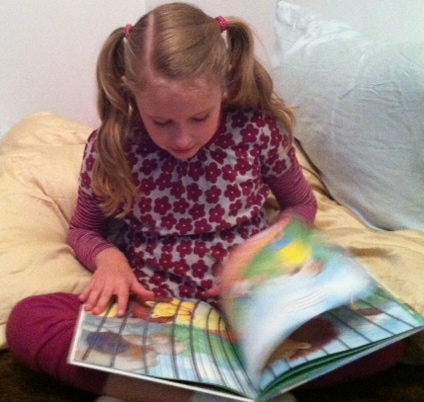
Emma looking at a book before going off to school this morning

“Embrace-ness-ness”

For those of you who have not viewed the interview of Carly Fleishman, you should:  Autistic Teen Finds Inner Voice. (There is a 15 second ad that you must cope with, but the interview is well worth the annoyance of the ad.)

The clip is an amazing example of a severely autistic non-verbal teenager who finds a way to “speak” by typing on her computer.  What occurs as a result is profound with far-reaching implications for all of us.

A follower of  EmmasHopeBook, an English teacher of 7th graders, and I have been engaged in a “cyber conversation” regarding disabilities, “tolerance”, how we view intelligence etc.  She wrote me this morning regarding her english class:  “We’ve also been discussing the semantics of disability (and earlier in the year, racism and homophobia). The word “tolerance” has come up in class, and the kids actually hypothesized and agreed that it’s just not strong enough for the world they want to live in. There were some strong voices saying that they feel it is actually negative! One girl said that, to her, to “tolerate” someone or something means “OK, I’ll put up with this if I have to, not because I want to,” and then they universally decided that the ultimate goal they should be pursuing and activating for is something like equality, or, as the same girl put it “It’s something like ’embrace-ness-ness.’ ”

I love this.  We live in a world, populated by people whom we often judge.  We tend to come up with ideas about other people and the lives they live.  The unknown can be uncomfortable and so we draw conclusions and then behave as though these conclusions were facts.  Someone cannot speak and we conclude they’re intelligence is lower than those who can.  A person is disabled and we conclude their intelligence is disabled as well.  How can we embrace what we do not know or understand?  It can be a frightening prospect and yet it is the key to a better understanding.

When my father finally succumbed to a wheel chair, having had a debilitating accident in his 40’s he was treated differently.  People condescended to him, they felt sorry for him.  He was a proud man, who at one time was extremely athletic.  Being in a wheel chair changed him.  He became despondent, he hated how he perceived people were viewing him – with pity.

When we are out with Emma, people at first believe her to be a “normal” little girl.  But once they speak to her or are with her for an extended period of time, they begin to realize she is different.  Usually they have no idea what is “wrong”, but the way they behave changes ever so slightly.  Sometimes they’ll raise their voice or their tone will change.  They clip their sentences, they speak as one might to an animal.  (I have been guilty of many of these things, by the way.)  It is confusing to be confronted with a child who looks neuro-typical, but who clearly is not.

I wish I could inhabit Emma for a day so I could feel and know what it is to be her.  Would I treat her differently if I knew what it was like to be her?   I hold onto the idea that if I continue working with her on her reading and writing, one day she’ll be able to tell me.

Last night as I lay beside Emma reading to her, she began laughing.  I put the book I was reading down and said, “What’s so funny, Em?”

“Crash into foof!” she said, breaking into hysterical giggles.

“Did you do that at school?”

“Yes!”

“That sounds like fun,” I said.  Emma was silent.  “Do you want me to keep reading?”

“Yes!”

After I finished reading about our moon landing in 1969, I said, “One day Em, you’re going to be able to read and write.  I can’t wait to read and hear what you’ll say.”

“Go to the computer with Mommy and Daddy,” Emma said.

“Is it easier to communicate on the computer?” I asked.

“Yes. Computer with Mommy and Daddy,” she said.

“Okay.  We’re going to work on that,” I said.

“Mommy sing song?”

“Right.  I’ll sing you a lullabye.”  After I sang her a few songs I hugged her.  “I love you Em.”

“So much,” she said.

Emma

For more on Emma’s journey through a childhood of autism go to:  EmmasHopeBook

One Day…

This weekend while working with Emma on her literacy program I showed her an index card with the words – Put the bus here – written on it.  I then pointed to a place on the table to the right of her and waited.  A frog, airplane, bus and kid were all laid out in front of her.  Without hesitation she picked up the bus and placed it where I was pointing.  Were Emma a neuro-typical nine year old child this would not elicit the inward gasp of excitement I found unable to stifle.  But Emma is not a neuro-typical nine year old child.  Emma is a moderately autistic child with massive pervasive neurological issues affecting her speech, imagination, reasoning, ability to conceptualize, communicate, initiate and interact.  To witness her reading and understanding what she’s just read with an action demonstrating comprehension is nothing short of miraculous.

And it fills me with hope.

If Emma is capable of reading, then it stands to reason she will be able to write as well.  What will she choose to write about?  What does she think about?  How does she feel?  Is she aware of her differences?  Does she wish she had friends the way her brother Nic does?  Does she know communicating is more difficult for her than for other people?  What is it like to be Emma?

Other autistic children and adults, many of them non-verbal have found ways to communicate to us about their world.

One such person is Carly Fleishmann, a non-verbal autistic teenager who has found her voice through typing and now has her own blog:  Carly’s Voice

I cannot know what the future holds for Emma.  What I do know is that if we continue to do everything in our power to help her, she will one day be able to answer our questions and communicate with us.  One day Emma will be able to let us in.  One day…

For more on Emma’s journey through a childhood of autism go to:  EmmasHopeBook

Pretty in Red

Emma dislikes wearing clothing that has scratchy tags, is tight fitting, such as skinny jeans and form fitting jackets, anything that binds or doesn’t have some sort of elasticized waist.  I believe it’s her sensory issues that make most clothing so uncomfortable and so I try to find her things to wear that I know won’t bother her.  If it were up to Emma (and it usually is) she would wear nothing but track suits.  Thankfully there are plenty of children’s clothing companies who produce attractive clothing which relies heavily on elastic waistbands and whatever it is they put into clothing to make it stretchy.  But every now and then in a moment of insanity I see something so cute it’s irresistible and out comes the credit card before I’ve taken the time to consider the above prerequisites.  Inevitably the package arrives and Emma takes one quick look at it and says, “No, that’s too small!”

Which is code for – I have absolutely no intention of wearing this, ever.

If I insist, “But Em, just try it on, then you can take it off.”

She will usually comply while saying, “Just try it, then take it off.”

Every once in a while I have been able to get her to wear something other than her leggings with cute t-shirts and a hoodie, but it’s not the norm.   And once the weather gets anywhere near 50 degrees, Emma begins negotiating to wear her crocs.

“Em, it’s still winter out.  You can’t wear your crocs,” I will tell her.

“It’s too cold!” Emma will say, showing me she understands the concept.  “Wear crocs tomorrow,” she’ll say wistfully.

Emma reminds me of the firemen at the fire station across the street from us.  We always know when the weather is above 40 degrees because the firemen begin wearing shorts.  I figure it must be because they’re around all that fire and heat and they crave feeling the bracing cold air on their skin, but perhaps it’s just they are a heartier breed than the rest of us.  Impossible to say, but I keep meaning to take a photograph of the children bundled in their winter coats standing next to the firemen wearing shorts and short sleeved shirts.

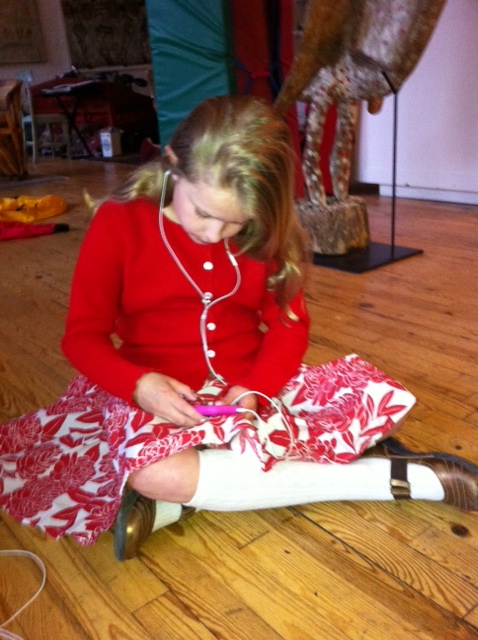
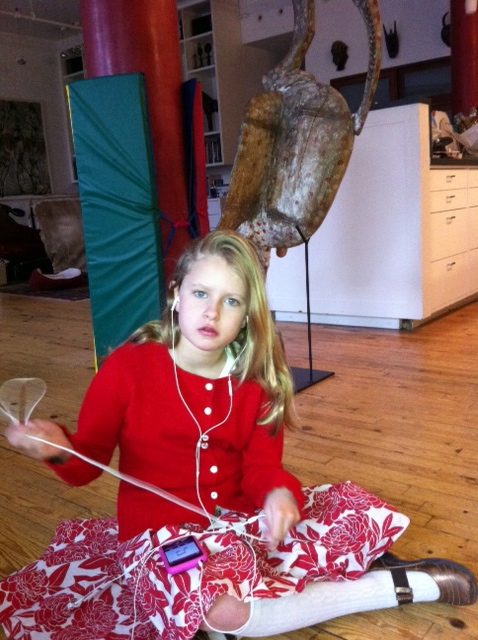
Yesterday the forecast was for a high of 72 degrees, (even though it went up into the 80’s!) so I tentatively pulled out some spring like clothing for Em and held my breath when I presented her with:  a skirt made of cotton, no elastic waist band, soft cotton t-shirt and soft red (wool) sweater, no annoying tags as I had cut them all out.  Then I stood back and watched.  Miraculously Emma put everything on, then chose her shoes, “wear these shoes!” she said cheerfully as she pulled on her socks and pushed each foot into a bronze pump.

“Emma!  You look so pretty!” I told her.

Emma smiled at me and twirled around.  “So pretty!” she repeated.

I took pictures because she was so cute in her red and white outfit and who knows when she’ll ever wear it again, so I figured we needed documentation.  Years from now, I’ll say to Richard, “Remember that day in April when she wore that adorable outfit to school?”  Then I’ll pull out these photographs.

Emma getting ready to listen to some music on her ipod

Choosing the music she wants to listen to

Looking up when I said, “Emma you’re so pretty!”

For more on Emma’s journey through a childhood of autism go to:  EmmasHopeBook

“Strawberry Cake”

Saturday morning Emma said, “Make cake?”

“What kind of cake, Em?” I asked.

“Make strawberry cake?”  Emma said in her usual questioning way.

It’s always interesting to me that Emma will make a statement, but will say it in a way that turns it into a question.  For instance when I ask her – do you want  to wear this?  She will answer, “No?”  which means she doesn’t want to wear it, but is asking if it’s okay not to.  Usually my answer is – okay – or – how about this?  To which she’ll then say – Okay or sometimes she’ll offer an alternative of her own, such as, “Wear this one?”  It’s a clever shorthand using much fewer words, but still gets the meaning across.  When we were in Panama having her third stem cell treatment done, another autistic girl a few years older than Emma did the same thing.  I remember after the procedure she kept saying, “Have chicken sandwich?”  She used the same upward lilt to the ending of the sentence that Emma incorporates.

“You want to make strawberry cake?” I asked Emma, somewhat incredulous as this was something she’s never requested before.

“Yeah!” Emma said jumping up and down.

“Okay.  How about we make a cake tonight?”

“Strawberry cake later,” Emma said.

“Yes, this afternoon.  Okay?”

“Okay,” Emma said.

Later that afternoon, Emma came over to me, “Mommy!  I want to make strawberry cake, please!”

“Okay, Em.  What should we do first?”  I asked as Nic ran over to join us.

“Get a bowl and get out strawberries,” Emma said, taking the container of strawberries from the refrigerator.

“Now what should we do?”  I asked.

“Mush them,” Emma said.

“Okay, here,” I handed her a potato masher.

Emma waited as I removed the stems from the strawberries and put them in the bowl.  Then she began mashing them.  After a little while, (about a minute) she took the milk out and said, “Pour in to mush.”

“Yeah, okay,” I said watching her.

“Mom, are you sure this is a good idea?” Nic asked.

I shrugged.  “I don’t know.  Let’s see what happens.”

“But what about the cake?” Nic asked.

“We can make a batter and add the strawberries to it,” I said, wondering exactly how this was going to work out.  “Hey Nic, why don’t you turn the oven on.”

As Nic turned on the oven, Emma continued to mash the strawberries in with the milk.

“Em, I have an idea, let’s use this,” I offered her a hand blender.  “This will mash the strawberries better,” I added, plugging it in.

“Okay.  Have to mush, mush, mush,”  Emma sang as she worked.  “Mush the strawberries, mush, mush, mush, mush the strawberries.”

Meanwhile I had Nic add a little bit of sugar, mix the flour and baking powder, then cream the butter, sugar and eggs in the electric mixer.

“Hey Em, are you ready to add the strawberries to our cake batter?”

“Yes!”  Emma said, pouring the now blended strawberries into the batter.  “Smell!”  she said, lowering her head so that it was close to the batter.

“Does it smell good?” I asked.

“Yum!”  Emma said.

While the cake was in the oven, Nic and Emma helped me make buttercream frosting.  “Em, should we put strawberries into the frosting?”

“No!”  Emma laughed as though this was the most ridiculous question she’d ever heard.  I looked at Nic.

He shrugged and said, “No strawberries in the frosting, Mom.”

“Okay it’s unanimous.”

When the cake was finished we pulled it out of the oven, let it cool and then Nic and Emma “helped” me frost it, which meant licking the spatula, licking the beater, licking the bowl.   When it was finished I said, “Who wants to have some strawberry cake?”

“I do!” Nic yelled.

“Hey Em, want to taste it?”

“Naaah!” Emma said running to the other side of the room.

“Hey Em.  Come on!  It’s your strawberry cake.  Don’t you want to try it?”

“Okay, just a taste,” Emma said coming over to sniff the cake.

“Mom!”  Nic yelled.  “This is the best cake ever!”

Meanwhile Emma poked at the cake with her fork then tasted the frosting and walked away.  Nic looked over, then rolled his eyes at me.  “Whatever Mom.  It’s a great cake,” he said, taking another mouthful.

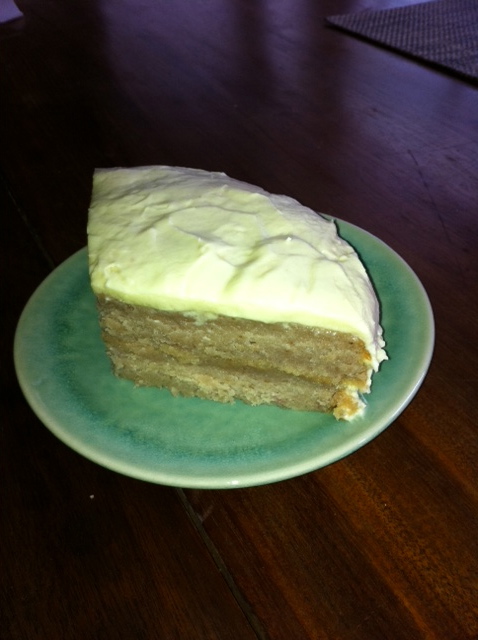
What remains of Emma’s Strawberry Cake

For more on Emma and autism go to:  EmmasHopeBook

Emma’s photographs

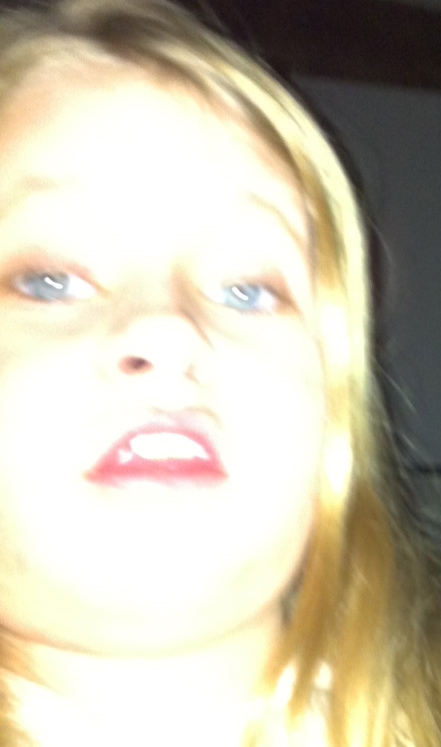
About six months ago Emma discovered the camera feature on my iphone.  Since then she’s taken hundreds of photographs, many are of the floor and curtains, which I’ve deleted, as well as self-portraits with weird lighting.  But my favorites – the pictures of her surroundings as she is running, dancing, jumping give the photographs a surreal, slightly hallucinogenic, ethereal quality to them.

Self Portrait

Our living room as viewed by Emma

Emma – Self Portrait

I could go on about her “artistic vision,” what they seem to represent, how they appear to reflect her interior life etc.  But I don’t know how accurate any of my ideas really are and for Emma any thoughts I have on her photographic endeavors are meaningless.  She just likes to take photographs.  Interestingly, she has begun to take fewer photos of herself and her surroundings and more photos of the people who are around her at home – us.  Our much-coddled cat, Merlin remains sadly out of the loop however, as she has yet to photograph him.  Even so, I cannot help but feel this is positive as it indicates a growing awareness and interest in others.

When Emma was a toddler she had piles of photographs she would carry around with her.  If one went missing she knew within seconds and would become increasingly agitated until she was utterly inconsolable.  The only remedy was to recover the missing photograph.  If we couldn’t find it, her upset often went on for several hours.  The missing photograph seemed to represent so much more to her than we could understand.  Although I have come to view her disconsolation as more of an obsessive-compulsion than the shattering of her world, but to her it is probably the same thing.

As Emma’s interest in being behind the camera increases, her desire to look at piles of photographs has lessened. Which is something else I see as a positive change.

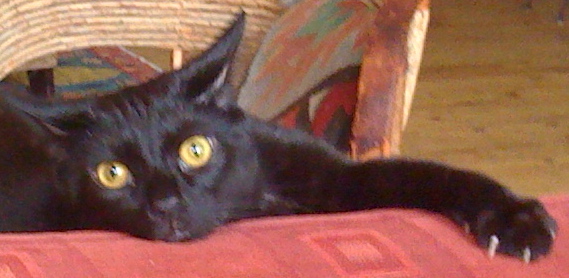
Even though Em didn’t take this photograph of Merlin – one day she might – and it’s important for him to feel included.  Notice the distended claw piercing the fabric on our couch.  Richard is inwardly cringing as he views this photograph.

For more on Emma’s journey through a childhood of autism go to:  EmmasHopeBook.com